• About

Brandon Ray Kirk

~ This site is dedicated to the collection, preservation, and promotion of history and culture in my section of Appalachia.

Brandon Ray Kirk

Tag Archives: Charleston

Armed Marcher Marries in Logan (1922)

06 Saturday Jun 2020

Posted by Brandon Ray Kirk in Battle of Blair Mountain, Coal, Logan, Williamson

≈ Leave a comment

Tags

Appalachia, Blair Mountain, Charleston, history, Jack Brinkham, Jack Brinkman, Lacie Kirk, Logan Banner, Logan County, Peach Creek, West Virginia, William Chafin

On February 17, 1922, the Logan Banner of Logan, WV, offered this little tale relating to the Armed March, or the Battle of Blair Mountain as it is mostly known now:

JAIL PARLOR IS SCENE OF HAPPY WEDDING FEB. 15

Miss Lacie Kirk, of Peach Creek, Becomes Bride of Jack Brinkham, of Charleston

That little goddess of love called Cupid simply will not be downed. Blows below the belt, solar-plexus blows and all others fail to knock the little fellow out and he remains constantly on the job. Obstacles are nothing in his life and no obstruction is so great as to be insurmountable by him. Cupid had shot his darts into the heart of Jack Brinkman, pianist for the Hippodrome Theatre of Charleston and also into the heart of Miss Lacie Kirk of Peach Creek some months ago and the wounds were to be healed on January 22, when they expected to appear before a minister and have the injury cured via the matrimonial route but Fate struck Cupid a blow that all but put the little fellow out for the count.

On the evening preceding the intended wedding, Capt. Lilly of the state police arrived in Charleston, and in his pocket he carried a warrant for the arrest of Brinkman, charging him with being a member of the armed band who marched on Logan county last August. Capt. Lilly executed the warrant and brought Brinkman to Logan and lodged him in the county jail, where he lingered until Wednesday of this week when he obtained bail.

In the meantime the wound in the heart of Miss Kirk had refused to heal and cupid kept alive the spark of love kindled in her breast in days gone by. She bided the time and with womanly patience and fidelity she counted the days until her intended husband should gain his freedom.

Brinkman was busy Wednesday making preparations for the ceremony and the parlor of the Jailor’s residence was obtained and the nuptial knot tied there. Mr. Wm. Chafin of Williamson was present and played for the wedding ceremony and many relatives and friends of the couple were present to witness the happy event, which was a very elaborate affair. The happy couple left the residence amid the congratulations and best wishes of those present and the day proved doubly happy to them in that the husband had again obtained liberty and likewise a lovely bride.

Ethel, Logan County, WV (2020)

11 Saturday Apr 2020

Posted by Brandon Ray Kirk in Battle of Blair Mountain, Coal, Huntington, Italian American History

≈ 1 Comment

Tags

Appalachia, Battle of Blair Mountain, Bearwallow Branch, C&O Railroad, C.W. Campbell, Camp Branch, Charleston, coal, Dingess Run, Dingess-Rum Coal Company, Don Chafin, Ethel, Ethel Hollow, Freeze Fork, history, Huntington, James L. Caldwell, John Q. Dickinson, Logan County, Mash Branch, photos, Red Campbell, Rockcamp Branch, Rockhouse Branch, Wanda, West Virginia

In the 1890s, land speculators James L. Caldwell, a banker from Huntington, C.W. Campbell, an attorney from Huntington, and John Q. Dickinson, a banker from Charleston, acquired many acres of land on Dingess Run and Rum Creek. The trio procured some of Logan County’s finest coal lands with six accessible seams of coal. They formed the Dingess-Rum Coal Company in June of 1903 to administer their lands, which totaled over 26,000 acres. They surveyed a railroad bed up Dingess Run and laid the cross-ties, leaving only the rails to be laid by the C&O Railroad, which occurred by late 1906. From there, the railroad extended up Right Fork and Left Fork (Ethel Hollow). At the juncture of the two forks, the company town of Ethel, named for the daughter or wife of an early coal operator, was established around 1907. In 1923, the town was populated by 2000 residents.

Ethel was originally located at the mouth of Left Fork (now Ethel Hollow) of Dingess Run. Today, Ethel includes Camp Branch, Freeze Fork (town and stream), Rockcamp Branch, Rockhouse Branch (now Georges Creek), Mash Branch (formerly Wanda), and Bearwallow Branch (formerly Red Campbell). It is situated at the base of Blair Mountain.

IMG_8779

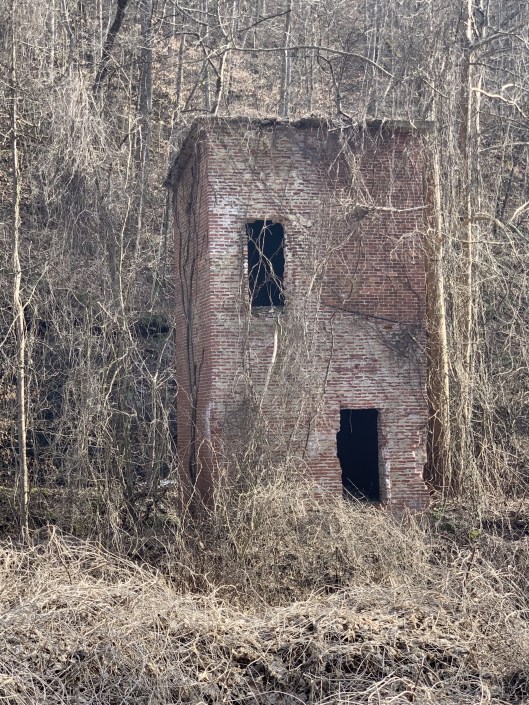
Ethel Coal Company Supply Building, constructed about 1914 by Italian stonemasons. The building served as a staging area for Don Chafin’s defensive forces in the Battle of Blair Mountain. 1 March 2020

IMG_8786

Remnants of Ethel No. 1 Company Store, built between 1907 and 1916. 1 March 2020

African-American Items from Logan, WV (1920s)

29 Sunday Mar 2020

Posted by Brandon Ray Kirk in African American History, Holden, Man, World War I

≈ Leave a comment

Tags

Accoville, African-Americans, Andrew Carnegie, Appalachia, Charleston, Cora, crime, Dearborn Independent, E.W. Ross, Eugene Carter, Guy W. Pennington, Harvey Bias, history, Logan, Logan Banner, Logan County, Lord Bryce, Lucas Wade, M.C. Gentry, Man, Omar, Peach Creek, Prohibition, R.R. Batty, slavery, West Virginia, White Child, World War I

From the Logan Banner of Logan, WV, comes these items relating to African-American life in Logan County during the 1920s:

“Jes’ Twelve O’Clock”

A hungry looking negro was observed sitting on a railroad track at Peach Creek yards when the noon whistle blew. He scratched his head and remarked, “Dar she blows. Dinner time for most folks, but jes’ twelve o’clock fo’ me.”

Logan (WV) Banner, 14 April 1922

***

War Story Uncovered

It was four shot years ago and the American doughboys were in the front line trenches facing Heinie. A company of colored troops were in the front trenches and among them were two colored boys from Logan whom we will call Sam and Rastus. They were backed up by 6,000 white troops and the order had been given to “go over the top” at a certain moment and the zero hour was fast approaching.

]Sam aquietly crept over to Rastus and said, “What do you ‘spose our folks would say about us if ‘de knowed where we was now?”

“Go away,” said Rastus. “If ‘de knowed where we wuz ‘de Logan Banner would be setting up headlines right now, saying, ‘Six thousan’ white boys done been trampled to death'”

Logan (WV) Banner, 27 October 1922

***

Negro Advancement

Though most northerners, including Negro leaders, often express disappointment with the progress the race is making, especially in the southern states, an impartial survey would doubtless inspire hope and pride rather than despair and humiliation.

In spite of deplorable lynchings and persistent unkindness toward him that must make the angel weep, the Negro is advancing. Future generations will be amazed at the rapidity with which he has overcome his handicaps. This view is set forth clearly, along with the facts that justify it, in the Dearborn Independent, which quotes a “Southern Planter” as follows:

Nearly nine million Negroes live south of Mason and Dixon’s line. With but few exceptions they are the progeny of grandparents who were born in slavery. The Negro emerged from the darkness of servitude without land, capital or credit. Within the sixty years that have followed emancipation he has come into possession of twenty-two million acres of land, an area greater than that of South Carolina. Negroes of the South are proprietors of business of every description. Approximately forty thousand enterprises, some of which are national in scope, are owned and operated by them. There are nearly seventy Negro banks, three Negro life insurance companies, real estate firms, hotels, factories, drug and department stores. Colored lawyers, doctors, dentists, undertakers and artisans of every degree of skill practice their profession and ply their trade in every part of the Negro’s native section. In sixty years the Southern Negro has acquired these for himself.

Negroes of the nation own one billion dollars’ worth of property and their holdings are increasing at the rate of fifty million dollars a year. Their most important investments and greatest enterprises are in the South, for that is the section they have known for generations, and the one in which, best authorities say, they will find their greatest success.

Were the Southerner not the friend of the Negro it would have been impossible for the Negro to have attained the degree of success with which he has been blessed. The late Andrew Carnegie and the late Lord Bryce agreed that the progress of the American Negro, after emancipation, was the most remarkable racial accomplishment in the history of the world. The Southerner claims his part of the glory for this achievement for he is the Negro’s teacher.

Logan (WV) Banner, 6 January 1928

***

Holden Wins Debate

Resolved “That the Negro has received more cruel treatment than the Indian in America,” was the interesting subject debated by Holden and Logan at Cora last Friday night, with a judges’ score of 5 to 6 points in favor of Holden. The Logan speakers were Rev. E.W. Ross, Rev. M.C. Gentry and Prof. Lucas Wade, while R.R. Batty, Eugene Carter and Guy W. Pennington represented Holden. A spicy program, arranged by the local P.T. Association at Cora, who sponsored the debate, was also a pleasing feature.

Logan (WV) Banner, 8 March 1929

***

Negro Prisoner Bears Odd Name

A colored man of very dark skin languishes in the county jail in default of bond for his appearance in federal court. Commissioner Hager bound him over to Charleston court April 16, after hearing evidence concerning a sale of whiskey. The arrest was made by Troopers Reed and Creasy of Man.

Now the interesting feature of this case is the prisoner’s name, which is none other than White Child. The surname as well as the first name must be the gift of the satirist, for this fellow, a resident of Accoville, has been under pretty close surveillance for a child.

The same troopers brought in Harvey Bias on a charge of possessing booze. He, too, was bound over to federal court and in default of bond went to jail.

Logan (WV) Banner, 12 April 1929

Ku Klux Klan in Logan, WV (1922)

13 Friday Mar 2020

Posted by Brandon Ray Kirk in Logan

≈ 2 Comments

Tags

Appalachia, Billy Sunday, Charleston, history, Island Creek, Ku Klux Klan, Logan, Logan Banner, Logan County, Mud Fork, West Virginia

From the Logan Banner of Logan, WV, comes this bit of history about the Ku Klux Klan in Logan County in 1922:

Has Logan An Organization of the Ku Klux Klan in her Midst?

Mysterious Fire Surrounded by Many Figures in Long Flowing Robes Observed

JUNCTION OF MUD FORK AND ISLAND CREEK ASSEMBLY SPOT

Ceremony Lasted Until Midnight, When Fiery Red Cross Was Raised and the Crowd Left

Has Logan a Ku Klux Klan?

Wednesday night a bright fire was observed on the mountain at the junction of Mud Fork and Island Creek, around which the figures of many beings were assembled. Many people that observed the fire made a closer inspection and they witnessed a secret meeting around a large, brightly burning fire, in which 60 or more figures dressed in long, flowing white robes participated. In the circle formed by these people could be observed the figure of the Chief, and the ceremony, while it could not be heard, was beautifully executed as each member arose and in a majestic manner saluted the Chief, and hastened to do his bidding.

The ceremony lasted until the hour of twelve when the fiery red cross was raised and the blazing emblem cast a ghostly shadow throughout the valley beneath. When the names from the flaming symbol had died away the clan evidently dispersed for the fire around which they had been assembled was ____ out and no further signs of the figures could be observed.

The Ku Klux Klan does not signify what the clansmen stood for during the reconstruction period. The Ku Klux Klan in this day assists in maintaining law and order, yet they still stand for supremacy of the white race. Unlawful acts and violence have no place within their councils, yet in their silent way they have a means whereby they are enabled to right wrongs and assist the authorities in maintaining the peace and dignity of the commonwealth. This invisible society is not to be feared by any that are law abiding citizens but to those who are inclined to do those things which are morally wrong yet probably within the law may sometime play host or hostess to a visit from these weird strangers.

Inquiry was made in the city as to whether or not there was a local branch of the Ku Klux Klan here. They are known to exist in many parts of the state and nation for the revival conducted at Charleston by Billy Sunday, which has just closed, was visited by members of the Klan there, who appeared in their weird attire. Of course no one here would speak authoritatively, but one prominent party of the town vouched for the information that they were here and in larger numbers than the public would suspect.

Strange and mysterious lights have been observed high on the peaks of the mountains about our city for some weeks. These lights have a habit of mysteriously appearing and suddenly disappearing. They occur at all hours of the night and in various places. Whether or not these strange lights have any connection with the meeting of Wednesday night is, of course, a matter of conjecture. However, those who observed the meeting of the Ku Klux Klan are inclined to believe all the lights signify individual members of the council which held forth Wednesday night.

Their future meetings will be observed with interest–if they can be discovered.

Logan (WV) Banner, 14 April 1922

***

Ku Klux Klan Has Been Organized Here

Organization Which Has Sprung Up So Quietly Within Our Midst Gives Promise of Being Strongest of Any Other Body in the County if Information Gained is True

Perhaps the readers of the Banner were a little doubtful of the authenticity of the statement made in these columns a few weeks ago relative to the presence in Logan county of the Ku Klux Klan. If any doubt existed then it is well to rid your mind of further doubt, for the Ku Klux Klan is here and the organization is not holding “marshmallow roasts” as was thought by a contemporary newspaper.

According to information which we feel is authentic, the second meeting of the Klan was held in this city Wednesday evening at which time the organization was perfected but only those on the inside are aware of the place of the meeting and just what occurred that evening. It is understood leaders were elected and members were made acquainted with the purposes and objects of the organization.

The movement for the organization in this country, while made secretly, spread like wildfire and applications for membership swamped those behind the movement and the Klan now numbers about 500 members, of which it is thought approximately 200 are to be found in the city while the remainder is scattered throughout the county and is composed of the most prominent business and professional men of the Guyan Valley.

The first meeting of the Klan was held a few weeks ago. Since that time the movement has grown with rapidity and it is understood several hundred applications for membership are now on file. New members are being carefully and systematically chosen and the Logan Klan will evidently take first rank with the numerous other Klans found throughout the state.

The Ku Klux Klan movement has met with the endorsement and approval of the most prominent men of the nation. The Rev. Billy Sunday, during his recent revival in Charleston, proudly announced he was a member and many of the Klans throughout the state number among their members, officials, professional men, and others whose moral character and community standing is above reproach.

The greatest secrecy attends all movements of the order and the identity of the members and the place of meeting of the Klan are secrets carefully guarded. secrecy is necessary in view of the old false prejudice against the order in the north, yet since the objects have become nationally known the order is experiencing its greatest growth in northern states. Membership is limited to native born Americans and initiation is open only to those who receive special invitation to join.

The Ku Klux Klan is described as an institution of picked men standing for “Chivalry, Humanity, Justice and Patriotism”; embodying in its genius and principles all that is chivalric in conduct, noble in sentiment, generous in manhood and patriotic in purpose; its peculiar objects being:

First: To protect the weak, the innocent, and the defenseless from the indignities, wrongs and outrages of the lawless, the violent and the brutal; to relieve the injured and oppressed; to succor the suffering and unfortunate, especially worthy widows and orphans.

Second: To protect and defend the Constitution of the United States of America, and all laws passed in conformity thereto, and to protect the people thereof from all invasion of their rights thereunder from any source whatsoever.

Third: To aid and assist in the execution of all constitutional laws and to preserve the honor and dignity of the state by opposing tyranny, in any and every degree attempted from any and every source whatsoever, by a fearless and faithful administration of justice to promptly meet every behest of duty without fear and without reproach.

Logan (WV) Banner, 12 May 1922

Mrs. Evva L. Hatch (1929)

04 Wednesday Mar 2020

Posted by Brandon Ray Kirk in African American History, Women's History

≈ Leave a comment

Tags

African-Americans, Appalachia, Charleston, Evva L. Hatch, Garnet High School, Logan Banner, Logan County, McBeth School, Ohio University, teacher, University of Chicago, West Virginia, West Virginia State College, West Virginia State Teachers' Association

In April of 1929, the Logan Banner profiled numerous prominent African-American residents of Logan County, West Virginia.

Notable Blacks of Logan County LB 04.16.1929 18

Mrs. Evva L. Hatch

Teacher, McBeth School

Mrs. Hatch is a graduate of Garnet High School, Charleston, and West Virginia State College. She has done summer work at Ohio University and University of Chicago. Mrs. Hatch has taught for fourteen years in the state, twelve years of which have been spent in Logan county. She is a member of West Virginia State Teachers’ Association.

In her community and district and also through the county, Mrs. Hatch is regarded as one of the active and influential leaders in all of her activities that are promoted in interest of good citizenship. Her preparation and long service as a teacher makes her ability unquestioned. She is a leader in her field and all groups of citizens recognize her qualifications and hold her in high regard.

Armed March Trial (1923): Convicted Man Flees to Mexico

08 Saturday Feb 2020

Posted by Brandon Ray Kirk in Battle of Blair Mountain, Coal

≈ Leave a comment

Tags

Appalachia, Battle of Blair Mountain, Blair Mountain, C.W. Conrad, Charles Town, Charleston, circuit clerk, crime, deputy sheriff, Don Chafin, H.E. Keadle, history, Jefferson County, Logan Banner, Logan County, Mexico City, Oklahoma, Oklahoma City, sheriff, U.G. Young, United Mine Workers of America, Walter Allen, West Virginia

From the Logan Banner of Logan, WV, comes this bit of history about the “Armed March” at Blair Mountain, dated February 2, 1923:

Allen Is Traced By Deputy E. Keadle To Mexico City

Walter Allen, convicted of treason at Charlestown on September 15, and sentenced to ten years in the state penitentiary and who was released on bond of $15,000 with U.G. Young of Charleston as surety and who jumped his bond and fled from the state recently has been traced by Logan officers to Mexico City.

A capias was received here on December 20 for Allen, the capias being issued to C.W. Conrad, clerk of the circuit court of Jefferson County, when Allen failed to appear there on the date set. Deputy H.E. Keadle took the capias to Charleston and called at headquarters of the United Mine Workers, and attorneys for that organization professed their ignorance of his whereabouts and stated they would do all within their power to apprehend the fugitive.

However it was ascertained that Allen had been in Oklahoma City, Okla., and the officers there were requested by wire to arrest the fugitive but he had fled the city when they searched for him. Deputy Keadle then continued the search and the latest information received at the sheriff’s office here states that Allen is now known to be in Mexico City, Mexico.

Allen was convicted for his participation in the armed march of Logan in August and September, 1921. According to the evidence in the trial which lasted five weeks, he handled the finances and otherwise assumed direction of the armed march which was stopped at the border of Logan County where a battle between the invaders and the state forces raged over a battle line extending for 25 miles.

After his conviction his attorneys noted an appeal and stated the case would be carried to the supreme court. The time granted Allen for his appeal expired December 13, but the time expired without any record of an appeal being noted. When Allen failed to appear at Charlestown to begin his sentence a capias was issued for him and sent to Sheriff Chafin for execution and the hunt for the fugitive then began.

Due to the red tape connected with extradition proceedings, it is not yet known what steps will be taken by Logan authorities toward extraditing the fugitive.

***

For more information about Mr. Allen, go here: https://www.wvencyclopedia.org/articles/205

Jewish History for Logan, WV (1923)

31 Friday Jan 2020

Posted by Brandon Ray Kirk in Huntington, Jewish History, Logan

≈ Leave a comment

Tags

Abraham Feinstein, Appalachia, Charleston, Coalfield Jews: An Appalachian History, Dave Fried, Deborah R. Weiner, history, Huntington, Jews, Ku Klux Klan, Logan, Logan Banner, Logan County, New York, Philadelphia, West Virginia

From a Logan Banner story dated May 11, 1923 comes this bit of history about Jewish activity in Logan, WV.

Dr. Feinstein Gives Talk to Society

Dr. Abraham Feinstein, of Huntington, addressing the Hebrew Sisterhood of Logan county Wednesday evening, spoke zealously for the establishment of a Jewish synagogue in Logan.

Dr. Feinstein told the gathering that there was one idea uppermost in his mind, which he wanted to submit. And that idea was the establishment of a place of worship and meeting for the Jews of Logan.

This suggestion had a far more deeper significance than was apparent on the surface, the audience was told, because it was the small part of the greatest problem that the Jews of America face today.

And this problem, as Dr. Feinstein pointed out, is “the reclamation of Jews to Judaism. And this can be done only through the mediums of education. Study the history of your people and your race. Jews are Jews merely by accident; understanding Jews study their religion, so that they might know why they are Jews. Familiarize yourself with the prophets, be square-shouldered Jews, proud and happy in being a Jew.

“It isn’t anti-semitism, the K.K.K., Henry Ford with his smug ideas of patriotism, nor Lowell asking for the expulsion of the Jews from American universities, nor the Zionist movement that is your problem. Your problem is education. See to it that this problem is solved and you will have contributed richly to the Jewish life in your city.”

Dr. Feinstein pointed out that in New York, where the largest number of Jewish citizens in the world reside, that seventy-five percent of the children have never received any kind of Jewish education whatsoever. “The more we are attacked and denounced the more schools and synagogues we should build,” he said.

“The greatest enemy of the Jews is the Jew who goes out, ignorant of things Jewish,” Dr. Feinstein said.

These words were quoted from an address of a Philadelphia Rabbi by the speaker: “I am not particularly pleased when I hear of a Jew becoming a great scientist, for Judaism is not a school of science. I am not pleased when a Jew becomes a great actor, a great inventor, a great lawyer, pugilist, statesman, but I exalt and rejoice when a true altruistic man becomes a Jew.”

The order of the meeting follows:

Opening prayer–Dr. Feinstein.

Piano and violin–Mrs. Dave Fried and Mrs. Brown.

Piano Solo–Mrs. S. Michaelson.

Voice–Miss Mellman of Charleston.

NOTE: One excellent source for regional Jewish history is Deborah R. Weiner’s Coalfield Jews: An Appalachian History (2006).

Chapmanville News 11.23.1923

28 Tuesday Jan 2020

Posted by Brandon Ray Kirk in Chapmanville, Huntington, Logan

≈ Leave a comment

Tags

A.K. Bowling, Appalachia, B.B. Ward, Basil Robertson, Bennie Robertson, Cecil Ward, Chapmanville, Charleston, Code Tabor, Donald Stone, Dr. Turner, Eva Barker, Floyd Barker, genealogy, Harriet Hill, Hinton, history, Huntington, Kentucky, Lexington, Logan, Logan Banner, Logan County, New York, Opie Robertson, Roscoe Turner, Subinia Ward, Victor Toney, Wallace Ferrell, Washington, Wayne Brown, West Virginia, William Turner, Young People's Epworth League

A correspondent named “Old Man Grump” from Chapmanville in Logan County, West Virginia, offered the following news, which the Logan Banner printed on November 23, 1923:

Last week was a sad week on account of the death of Dr. Turner and we failed to write. We all are much grieved over his death.

Rev. Chambers conducted a two weeks service and had quite a few joiners and several were baptized Sunday. Rev. Chambers left Sunday afternoon for Lexington, Ky.

Mr. Cecil Ward left Monday for Charleston where he will spend his vacation. Wish you a happy time, Cecil.

The Young People’s Epworth League are doing great work and the young and old people seem to be interested in it. We hope they still hold out for I am sure it will be a great help to all the young people.

Mr. Opie Robertson spent Sunday in Chapmansville with his mother, Mrs. A.K. Bowling.

We have seen in the papers so much about Hazel Maud, Hazel E. McCloud, but we haven’t never been able to find out which is Hazel M. and Hazel E. but we see them quite often.

Ima Nutt, we sure are glad you come to our little town, but we would be pleased if you would let yourself be known and not be so bashful. Now don’t get mad as we are just joking.

Mr. Donald Stone left Monday for Charleston for an extended visit. We haven’t been able to find out how long.

Mr. Basil Robertson spent Sunday with his mother of this place.

Seems like some of the girls like to quarrel on their way home from church, don’t they Hazel?

Mr. Victor Toney and Miss Bennie Robertson were seen out walking Sunday afternoon.

Mr. Floyd Barker spent Saturday in Chapmansville with friends. Mr. Barker is here from the army on a three [day?] vacation, then he will return and stay another year.

Mr. Code Tabor of Logan was visiting in Chapmansville Saturday.

Roscoe Turner, a brother of Dr. Turner, from New York, attended the funeral of his brother last week.

Mr. and Mrs. Wallace Ferrell of Huntington spent last week here with Mrs. Ferrell’s sister, Mrs. Turner.

Mr. and Mrs. King of Hinton attended the burial of Dr. Turner. Mrs. King is a sister of Dr. Turner.

Mrs. William Turner, mother of the late Dr. Turner, and his sister, Mrs. Mankins of Washington, D.C., attended the burial services.

Mrs. Subinia Ward was calling on Mr. and Mrs. B.B. Ward Sunday.

Mr. Wayne Brown and Miss Harriet Hill were seen out walking Sunday evening.

Miss Eva Barker and Mr. Wilkie were seen out car riding Sunday.

Civil War in the Kanawha Valley: Littlepage Mansion (2019)

20 Monday Jan 2020

Posted by Brandon Ray Kirk in Civil War, Women's History

≈ Leave a comment

Tags

Adam Littlepage, Appalachia, architecture, Camp Two Mile, Charleston, civil war, Confederate Army, Gallipolis, George B. McClellan, Henry Wise, history, Kanawha County, Kanawha Valley, Littlepage Mansion, National Register of Historic Places, Ohio, Rebecca Littlepage, Ripley, Terry Lowry, The Battle of Charleston, Two Mile Creek, Union Army, West Virginia

IMG_0669

Terry Lowry is THE authority on the Civil War in the Kanawha Valley. Stop 7 on his tour: Littlepage Mansion in Charleston, WV. 29 September 2019. Here is a link to Terry’s latest book, The Battle of Charleston (2016): https://wvcivilwar.com/now-available-the-battle-of-charleston/

IMG_0670

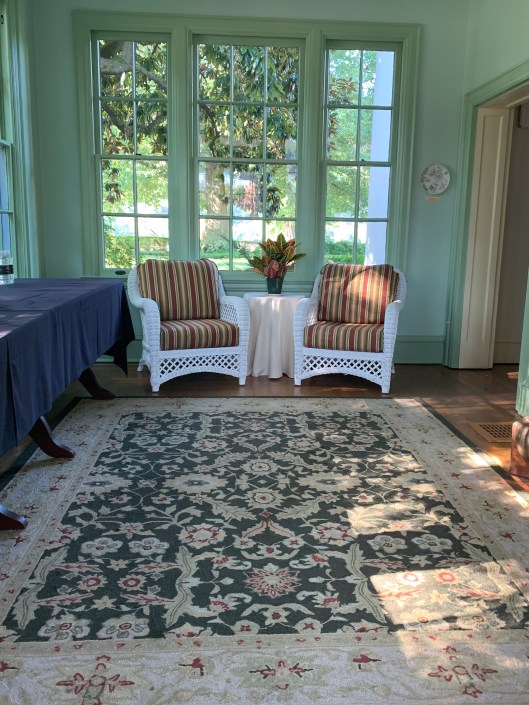
Built in 1845, the Littlepage mansion is one of only six antebellum houses remaining in Charleston, WV. It is listed on the National Register of Historic Places. 29 September 2019

IMG_0667

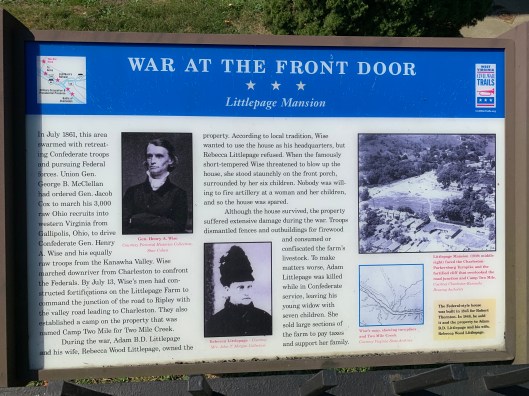
Rebecca Littlepage reportedly refused to allow Confederate General Henry A. Wise to occupy her home as a headquarters. According to the historical marker: “When the famously short-tempered Wise threatened to blow up the house, she stood staunchly on the front porch, surrounded by her six children. Nobody was willing to fire artillery at a woman and her children, and the house was spared.” For more history about the Littlepage mansion, go here: https://www.wvencyclopedia.org/exhibits/23?section=7

Chapmanville News 11.30.1923

20 Monday Jan 2020

Posted by Brandon Ray Kirk in Big Creek, Chapmanville, Coal, Holden, Logan

≈ Leave a comment

Tags

A.K. Bowling, Appalachia, Bernie Ward, Big Creek, Bill Carper, Bill Cooper, Chapmanville, Charleston, Chester Barker, coal, Dr. J.D. Turner, Fannie Brown, genealogy, Guyan Hospital, Henlawson, history, Holden, Logan, Logan Banner, Logan County, Man, merchant, Molly Conley, O.C. Winters, Oliver Shuff, Oscar Langton, T.A. Rogers, West Virginia

A correspondent named “Pug Nose” and “Let All-Alone Blues” from Chapmanville in Logan County, West Virginia, offered the following news, which the Logan Banner printed on November 30, 1923:

We are having some rainy weather here now.

Fannie Brown, Miss Daniels and Mrs. Bernie Ward have some attraction in Big Creek, as they go down every evening on 51 and back on 52.

Mr. A.K. Bowling was home Sunday from Man, W.Va.

Mrs. Collins of Holden was calling on homefolks SUnday.

Borned to Mr. and Mrs. Oscar Langton, a fine boy last Friday. Mrs. Langton before marriage was Miss Fannie Brown.

Some one said wedding bells will ring at Henlawson soon.

Mr. Bill Cooper is able to be home from the Guyan Hospital at Logan.

Mr. T.A. Rogers was in Logan last Thursday on business.

We are having lots of new houses built now.

Oliver Shuff is building him a house here.

***

As there hasn’t been any one here writing I will try and see what I can do.

Last week was sad on account of the death of Dr. J.D. Turner. We are much grieved over the loss of him.

Mr. Bill Carper was seriously hurt in the mines while driving. He was caught between two cars. Mr. Carper was taken to the Guyan Valley hospital.

Miss Molly Conley and Mr. Chester Barker were seen coming from church one night last week.

Ferrells and Winters store seems to be doing great business under the general manager, Mr. O.C. Winters.

Combinations: Everett and his sweater; Inez and her dancing; Anna and her apron; Bena and beans; Mrs. A.K. Bowling and her cap; Mrs. Ward and her hotel; Eva and her parcel; Cecil going to Charleston.

Civil War in the Kanawha Valley: Glenwood Estate (2019)

12 Sunday Jan 2020

Posted by Brandon Ray Kirk in Civil War

≈ Leave a comment

Tags

Appalachia, Charleston, civil war, Glenwood Estate, history, Kanawha County, Kanawha Valley, Terry Lowry, The Battle of Charleston, West Virginia

IMG_0665

Terry Lowry is THE authority on the Civil War in the Kanawha Valley. Stop 6 on his tour: Glenwood Estate in Charleston, WV. 29 September 2019. Here is a link to Terry’s latest book, The Battle of Charleston (2016): https://wvcivilwar.com/now-available-the-battle-of-charleston/

IMG_0666

For more information about Glenwood, go here: https://www.marshall.edu/graduatehumanities/the-glenwood-project/

Big Creek News 09.05.1924

12 Sunday Jan 2020

Posted by Brandon Ray Kirk in Big Creek, Guyandotte River, Huntington, Logan

≈ Leave a comment

Tags

Appalachia, basket meetings, Big Creek, Burke McComas, Cecil Hager, Charleston, Florence Wheeler, genealogy, Gladys Saunders, Guyandotte Valley, history, Huntington, Jess Harmon, John Mitchell, John Mobley, Laura Hager, Lillie Estep, Lloyd Ellis, Logan, Logan Banner, Logan County, Lonna Hager, Lulu Harmon, merchant, Myrtle Mobley, Nannie Lilly, Nannie Mobley, Norma Saunders, P.D. Bradbury, Pearl Mobley, Peter M. Toney, Tom Vance, Ward Shively, West Virginia

An unnamed correspondent from Big Creek in Logan County, West Virginia, offered the following news, which the Logan Banner printed on September 5, 1924:

Dear old Banner, here I am with a bit of news from our little city Big Creek, one of the most leading little cities on the Guyan Valley.

Miss Lulu Harmon is very ill at this writing.

Mrs. John Mitchell was calling on Mrs. John Mobley Sunday.

It was sad to see Mr. Burke McComas baptized Sunday. He is very ill and not expected to live.

Mr. Lloyd Ellis seems to be enjoying himself of late.

Misses Florence Wheeler and Gladys Saunders has returned home after a short stay in Huntington.

A fine new boy arrived at the home of Mr. and Mrs. John Mobley.

Don’t forget the basket meeting Sunday on Big Creek. Everybody invited.

Misses Nannie Lilly, Myrtle Mobley, and Cecil Hager were out car riding Sunday.

Mr. Jess Harmon and Miss Norma Saunders were out picnicking Sunday.

Mr. Tom Vance and Miss Pearl Mobley motored to Logan Sunday.

John Mobley has accommodated all loafers. He has made a loafers bench under his shade tree near his store.

Ward Shively has returned to his home after a short stay in Charleston.

Peter M. Toney made a flying trip to Huntington to see his home folks.

We all were sorry when Mr. P.D. Bradbury found his span of mules drowned Sunday. They were tied with a rope and fell over the high bank.

Mrs. Nannie Mobley was kodaking Sunday evening.

Miss Lillie Estepp returned home after a short stay with her parents.

Miss Gladys Saunders and Miss Myrtle Mobley had a happy meeting when first they met after Gladys’ return home.

There are plenty of cars and good drivers nowadays.

Mrs. Lonna Hager of Huntington is the guest of her sisters, Laura Hager.

Hungarian News from the WV Coalfields (1923, 1927-1929)

13 Friday Dec 2019

Posted by Brandon Ray Kirk in Coal, Hungarian-American History, Huntington, Inez, Logan, Music, Williamson

≈ 1 Comment

Tags

Appalachia, Beauty, Charleston, Cinder Bottom, coal, crime, dancing, Elizabeth Nagy, Ellis Park, Emmett Scaggs, Himlerville, history, Hungarian Benevolent Association, Hungarian Miners' Journal, Hungarian-Americans, Hungarians, Huntington, Joe Hatfield, Kentucky, Keystone, Logan, Logan Banner, Logan County, Martin County, McDowell County, Mingo County, Mud Fork, Rose Mustapha, Warfield, Welch, West Virginia, Williamson, Williamson Daily News

Between 1900 and 1920, a large number of Hungarians settled in West Virginia. Most were employed as coal miners. As of 1920, 6,260 Hungarians lived in West Virginia, primarily in Logan and McDowell counties. The Logan Banner, seated in Logan, WV, offered coverage of Hungarian news. It also commented on items published by Martin Himler in the Hungarian Miners’ Journal.

New Marathon Dance Record Is Made Here

Rose Mustapha, Pretty Hungarian Starts the Step Believed to Be the record.

At nigh noon Sunday, Rose Mustapha, a beautiful Hungarian girl, tripped the starting step in a terpsichorean debauch, that is believed to have established a record for sustained dancing in groups. Rose led a cotillion of thirty of her countrymen over a stretch of nineteen hours of continual dancing.

The dance started at twelve o’clock Sunday noon and continued without intermission till seven o’clock Monday morning. The jolly spirit of old Budapest struck color with jazz hilarity as the dancers spun in a vortez over the polished floor.

Hundreds of the dancers’ admirers rimmed the floor, hailing the participants in a half dozen different languages and dialects. Three wheezy but quite animated violins provided the music, which ran in wild Magyar strains and jazzy syncopation.

For the most part the dancers adhered to their native folk dances, but occasionally a couple would break into a fox trot, or a one step. At six o’clock Sunday evening, the dancers were given liquid nourishment as they whirled, and at midnight the same was repeated.

Most of the dancers finished strong, but several of the weaker sex had to be helped from the floor by their friends. Long distance dancing is quite common in their native land, and had the participants been in trim the task would have been comparatively easy, they say. As it was all of the men, who are miners, reported for work Monday morning and so far no ill results have been reported of the affair.

Logan (WV) Banner, 3 August 1923

***

Hungarian Dance

Several hundred persons enjoyed the dance given by the Hungarian Benevolent Association at Ellis Park skating rink last Saturday night. The program included many attractive features and novelties. Miss Elizabeth Nagy of Mud Fork was the winner of the beauty prize. She received a fine watch and $5 in gold.

Logan (WV) Banner, 29 November 1927

***

Hungarian Paper Tells of Resorts Hereabouts

Sensational Charges Prompt Williamson News to Demand Investigation and “Clean-Up”–Logan and Neighboring Cities Are Mentioned In This Alleged Expose

A Hungarian paper published at Himlerville, Ky., not far from Williamson, is running a series of sensational articles on vice conditions in Logan, Williamson, Huntington and Charleston. These articles are printed both in English and Hungarian and are attracting much attention, many copies of the paper having been sent to the cities named.

Two articles about Logan have mentioned various resorts in which it is charged that vice is rampant, that protection is obtained by bribery of officials, and that conditions are getting worse. Local officers brand these so-called disclosures as either baseless or greatly exaggerated.

In Williamson the expose has attracted much attention, particularly since the Williamson Daily News carried the following editorial, under the heading, “A Clean City.”

It’s a sad commentary on our city, county, and state police officials when the leaders of the foreign element in our midst are forced to take the lead in cleaning up moral conditions.

Through the Hungarian paper published at Himlerville, Ky., a campaign is being waged to clean up Williamson, Logan, Huntington and Charleston.

We are primarily concerned in Williamson and this paper charges that Williamson is harboring not less than eleven Hungarian brothels and some fifteen speak-easies. The editor of the paper has furnished the Williamson Daily News with the names of eight hotels and rooming houses where he says “light o’ love ladies” may be found.

It is common knowledge in Williamson that what he charges is true. Furthermore it is also common knowledge that there is hardly a hotel from the best to the worst in the city that does not harbor women of prostitution.

These women are debauching our manhood and spreading disease and there are attendant demoralizing evils which add to the indictment against them.

Not only are there Hungarian brothels in Williamson, but there are brothels that cater to every race and condition. The fact that they exist is known to practically every person in Williamson.

In this same Himlerville paper in an article published in this week’s issue it is stated that “Protection fees vary between twenty-five and seventy-five dollars weekly” suggesting a reason why no action is taken to remedy conditions.

We have had every reason to believe that Williamson was infested with brothels of every degree of degradation, but until the bold statement is made in the Hungarian paper, we had no reason to suspect that some persons were receiving protection fees.

However, such a state of things is a natural noncomitant, in view of the laws of the land. It would be very easy for city, state or county officers to take action, and if they do not the question immediately arises: Why?

It cannot be argued that it is impossible to clean up the city in this respect. We all know better. The chief of police and four good policemen, with proper backing of the mayor and the citizens of Williamson could do the job, and do it thoroughly in ten days. In doing it they could be so impressively earnest that there would be no recurrence of the evil for months to come. If instances of violations of the law of this character did occur in the future they could enforce the law with such vigor as to deter others. Williamson would soon be classed as a “clean city.”

Even the notorious “Cinder Bottom” at Keystone has been cleaned up. Welch, the county seat of McDowell county, is known far and wide as a “clean city.” Chippies and their like give it a wide berth. Why? Because the mayor and the chief of police of Welch, with a determined citizenship back of them, will not tolerate the evil. Merchants and business men of Welch generally are unreservedly in favor of an absolute ban against women of evil character being allowed to remain in hotels and rooming houses, because they know it hurts business and is a thoroughly demoralizing factor.

Primarily the question is one for the mayor and the chief of police at Williamson to handle, but there are other law enforcement agencies that could function.

For instance, the prosecuting attorney has an effective weapon at hand if he wants to use it. We refer to the state padlock law, upheld by the supreme court. With this weapon he could close every hotel and rooming house in the city that harbored women of ill fame. And there would be no question of securing sufficient evidence to act. It is ready at hand.

There is another agency, the state police. This efficient body of men could take action and bring the matter to a hand.

The state health department is aware of the fact that Williamson is one of the vilest cities in the way of brothels in the state. It has investigated conditions here and has data that could be used by officials who wanted to take action. Furthermore the state health department, on request of the city or county officials, would send investigators here to ascertain true conditions. But, if we understand the situation rightly there is no need for further investigation. The brothels are conducted more or less openly, are well advertised and unfortunately are well patronized.

There would be no lack of information to proceed upon if city, county or state officials wanted to take action. And first of all, it is up to our city officials to act.

Logan (WV) Banner, 27 January 1928

***

NOTICE TO LOGAN

With newly sharpened sticks the Hungarian Miners Journal, published at Himlerville, Ky., continues to prod into vice conditions hereabouts. Its latest issue is devoted largely to a further exposure at Williamson’s intrenched vice, but Logan has not been forgotten. In fact, in a large type box on the first page notice is given that the spotlight will be turned again soon on the garden spot. It says:

“The brother-situation of Williamson is taking up all our space and our energies for a few days.

“This does not mean that we have nothing more to say about Logan brothels.

“A score of Hungarian criminals, keepers of brothels and white-slavers are harbored in and by Logan, to the great detriment of the decent Hungarians in the Logan field.

“We demand the expulsion of these criminals and we will turn to Logan in a very short time.

“Surely the decent citizens of Logan are not going to build a roof over their town to designate THE red-light district.”

Logan (WV) Banner, 3 February 1928

***

Hungarian Paper Reverts to Logan’s Need of Reformation

Editor Fisher Takes Crack at The Banner, Sheriff Hatfield and Chief Scaggs–Long Silence Broken By Familiar, Rasping Outcry

Remember the Magyar Banyaszlap, a newspaper formerly published at Warfield, Ky., not far from Williamson, W.Va. A year or more ago it probed conditions in Logan and carried some sensational strictures about county and city officials. Finally, an officious and offensively inquisitive soul, the editor hisself, came in person and before he left was given quite a thumping by Chief of Police Scaggs.

Some time later the coal company located at Warfield and Hungarian-owned, went into the hands of a receiver and whether the Banyaszlap then suspended publication or not it ceased to come to this office. The other day a copy came. It is published in Columbus now but its editor is evidently still interested in conditions here. After scanning its eight pages, the writer of these lines found but one article printed in English. That embraced a clipping from The Banner and the Banyaszlap’s comments thereupon. The article clipped appeared to the Banner on April 9 and had to do with reports that the sheriff’s forces were determined to suppress the liquor traffic in boarding and lodging houses that cater to foreign-born miners. Most Banner readers will recall that news item and for that reason it will not be reproduced here, but what the Columbus paper says may be of some interest.

“We are glad to note the sudden interest of Sheriff Hatfield, and the rather mild interest of the Logan Banner, in the speak-easyes.

“The officers do not have to ‘trail’ these boarding houses, for we have published a list of them.

“And we have also published a long-long list of speak-easyes and brothels in Logan, W.Va., with addresses, and names, with locations and any other needed informations.

“Why not start a housecleaning right here in Logan, W.Va., and spread it then to the coal field?

“We can promise Logan and its vicinity that others than the sheriff will also be interested in these affairs.

“When the gunman (called chief of police) of Logan so heroically objected to our articles, we have promised that we will have the matter attended to in good time.

“It will happen soon.

“Perhaps hence the sudden interest in the Logan vice.”

Logan (WV) Banner, 23 April 1929

***

For more information about Hungarians in West Virginia, go here: https://www.appalachianhistory.net/2017/03/magyars-in-morgantown.html

For more information about Martin Himler, Himlerville (Beauty), and the Magyar Banyaszlap: Hungarian Miners’ Journal, go here: https://www.appalachianhistory.net/2014/11/saving-himler-house.html

Armed March: Logan County Officers Thwarted in Pomeroy, OH (1921)

16 Saturday Nov 2019

Posted by Brandon Ray Kirk in Battle of Blair Mountain, Coal, Logan, Matewan

≈ Leave a comment

Tags

A.M. Belcher, Appalachia, Charleston, coal, deputy sheriff, Ed Reynolds, Edgar Combs, George Munsey, Harold W. Houston, Harry R. Barnes, history, Jackson Arnold, James Miller, James Swanner, John Chafin, John Gore, justice of the peace, Lee Belcher, Logan, Logan Banner, Mason City, Matewan, Meigs County, Mine Wars, Ohio, Point Pleasant, Pomeroy, Savoy Holt, U.S. Cantley, United Mine Workers of America, W.M. Swanner, Wallace Chafin, Welch, West Virginia, William Chafin

From the Logan Banner of Logan, WV, comes this bit of history about the armed march of 1921:

OFFICERS SAY OHIO MOB THREATENED LIVES

“Let’s Make It a Matewan-Welch Affair,” Yells Citizens of Pomeroy

Officers Say Lives Were Threatened

Another tragic sequel to the miners “armed march” on Logan was narrowly averted at Pomeroy, Ohio, Monday, when a mob of about three hundred persons are said to have threatened the lives of Deputy Sheriffs Wallace Chafin and Lee Belcher, and Mr. Chafin’s son William, who went to Pomeroy to visit his grandfather. The officers were sent to Pomeroy with requisition papers for the removal of Savoy Holt, and U.S. Cantley, who are wanted in Logan on the charge of being accessory before the fact of the killing of George  Munsey and John Gore, during the “armed march.”

A statement was given out by Officer Chafin Wednesday, which he described in detail the affair at Pomeroy. Bearing requisition papers for the removal of Holt drawn by the Governor of Ohio and later held up by the agreement of attorneys of both the defense and prosecution till after the trial of James Miller. Officers Chafin and Belcher reported to the sheriffs of Meigs county. They were sent to the Prosecuting Attorney’s office of the county where they were advised that they would have to get other papers for their purpose. They then went before Justice of Peace Harry R. Barnes and swore out a fugitive warrant for the two men wanted. “A crowd of seventy-five or a hundred gathered around the jail. All of the men wore coats and did not  seem friendly,” Mr. Chafin said. “We returned to the Prosecuting Attorney’s office, and as I came out there was considerable commotion among the large crowd of men. Persons were  being waved back and told to stand aside. These directions were being made by members of the crowd,” Officer Chafin said. Chafin returnerd to the Sheriff’s office and was told that he had been called away, and that he could not see Holt.

“Officer Belcher, myself and my son were directed to the Mayor’s office. We were told that the Mayor had a telegram for us from Governor Donahey, which said that Holt should not be delivered and that if we were ___ to run us out of town and tell us not to return. We did not go to the Mayor’s office, and thought if we were really causing trouble it would be best for us to leave immediately. From the time I arrived in town I noticed that the atmosphere had changed since I was last there. Not an officer could be found anywhere. People gazed out on the streets from their houses in great numbers. And several people were noticed to follow us from the time we arrived in town.”

“When we decided to leave, we hired a taxi cab with the intention of going to Point Pleasant. Again, the crowd which seemed to be growing surrounded the cab, and the driver fled, leaving us standing amidst the crowd in the middle of the street. We heard some one in the crowd say, ‘Let’s make it another Welch or Matewan affair.’ A man who said he was a newspaper reporter began to ask questions as the crowd pushed in against the cab. We were asked if we weren’t Logan county thugs, and if we were not in the gang that opposed the ‘armed march.’ We told them that we were regular Logan county officers and had been serving as Deputy Sheriffs for some time, also that we had been sent there with the proper papers to return Savoy Holt to Logan. They were told that I had been a Deputy for two years and that Belcher had been in office for six years. The crowd dropped back and we got our bags and endeavored to hire another taxi, but evidently the drivers had been given instructions not to drive us. They all refused and we were forced to go to the ferry. The crowd continued to swell and they followed us to the ferry. The ferry boat was on the West Virginia side and we were forced to endure the jeers and threats of the crowd until the boat returned to the Ohio side.

While on the ferry ten or twelve men came in a group and demanded me to get off, saying that I had given a false name. I told them if they wanted me they would have to come and get me. They approached and requested me to show further identifications and I compiled by showing them my Masonic cards.”

“Upon arriving on the West Virginia side I saw several of the same men I had seen in Pomeroy. Another taxi was hired to take us to Point Pleasant. As we started we were hailed. The taxi was stopped and we were told that the driver could not take us. We concluded that we would walk to the next station to avoid trouble. A short distance below the town we were surrounded by about twelve men in automobiles. Heading for the river, and afraid that they would kill my son, we returned to the station at Mason City to wait for a train. While sitting in the station group after group of men came to the doors and men swarmed around. I believe they would have fired on us in the station if there had not been several women sitting near us. The first train to arrive was an east bound train which we took to Parkersburg. The last words we heard from the crowd was from a large man who seemed to act in capacity of spokesman. He yelled, ‘I’m damn sorry boys we did not make this another Welch or Matewan affair.'”

Mr. Chafin reported the affair to Governor Morgan at Charleston Tuesday. He was instructed by the governor that the removal of Holt and Cantley would be affected by the state authorities. It is understood that Colonel Jackson Arnold has been sent to Columbus, Ohio, to get the proper extradition papers for the men’s removal. Cantley is still at large and Holt is being held in the county jail at Pomeroy, where he has been held as a witness in the case of James Miller who was sentenced from two to twenty years for the killing of E. Reynolds and W.M. Swanner. Holt was in the Miller home in Pomeroy at the time of the shooting which took place in Miller’s front yard.

Logan (WV) Banner, 3 August 1923

***

POMEROY, OHIO, IS A REFUGE AFTER CRIMES ARE COMMITTED, SAID

A.M. Belcher, Attorney, Says the Failure of Meigs County to Relinquish Prisoners Is Proof.

MAKES STATEMENT WHILE CALLING ON PROSECUTOR

“The attack on Deputy Sheriffs Wallace Chafin and Lee Belcher, at Pomeroy, Ohio, where they were threatened by a mob when they attempted to return Savoy Holt to West Virginia for trial in connection with the armed march on Logan, in 1921, is only added proof to the claim that the Pomeroy Band is serving as a refuge for various crimes in West Virginia,” said A.M. Belcher, state counsel in the prosecution of the so-called armed march cases.

Mr. Belcher was here Thursday to assist Prosecuting Attorney John Chafin resist an application for a change of venue for Harold W. Houston, chief counsel for District 17, United Mine Workers and Edgar Combs, a member of the mine workers union, for their alleged connection with the murders which grew out of the armed march.

“The refusal of the Meigs county authorities to turn over Holt to the custody of the Logan county sheriffs was in a direct violation of an agreement we had made with attorneys representing the defense,” said Mr. Belcher.

“At the time J.E. Miller was indicted for the murder of James Swanner and Ed Reynolds, Holt was indicted as an accessory to that crime. He was also wanted by the Logan county authorities for his participation in the march, but an agreement was made with Miller’s attorneys that if he were allowed to remain in Meigs county until after the Miller trial that he would immediately be returned to Logan.”

Requisition papers for Holt’s return were honored at the time by Governor Donahey but at the request of Miller’s attorneys West Virginia decided not to insist upon Holt’s immediate return, relying on the defense’s promise that he would be surrendered as soon as the trial was over.

“When Deputies Chafin and Belcher went to Pomeroy Tuesday they had in their possession the requisition papers issued at the time we instituted the original proceedings. They were signed by Governor Donahey on May 15. Neither of the two deputies expected any resistance but to their surprise they were met by a mob of 300 men who not only drove them out of town but pursued them across the river into West Virginia territory.

It would appear that there is something radically wrong with the state’s government that would permit a mob’s action to override its official decisions. The Pomeroy Band has become the refuge of scores of miners who took part in the uprising against Logan county. The entire section apparently is in sympathy with the band of radicals who fostered the march against the citizens of a peaceful county.

The temper of the mob which threatened the two Logan county deputies is seen in the fact that it was only by a miracle that the two officers escaped with their lives. “Let’s make it another Matewan affair” was their battle cry; and the reason that two more West Virginians did not meet death in Pomeroy as did Jim Swanner and Ed Reynolds is due to the courage and coolness of the two officers.

Holt was once in custody of the Logan county officers but was released on bail. Soon after his release he is said to have gone to the headquarters of the United Mine Workers at Charleston and then on the following day left for Pomeroy. It was on the next day that Swanner and Reynolds went to Pomeroy to offer Miller immunity if he would return to Logan county and testify for the state in the armed march cases.

Miller met the two men at the door of his home near Pomeroy and shot both of them to death, though neither of the Logan deputies were armed. Holt, it is said, was in the house at the time of the shooting.

Logan (WV) Banner, 10 August 1923

Civil War in the Kanawha Valley: Spring Hill Cemetery (2019)

09 Saturday Nov 2019

Posted by Brandon Ray Kirk in Cemeteries, Civil War

≈ Leave a comment

Tags

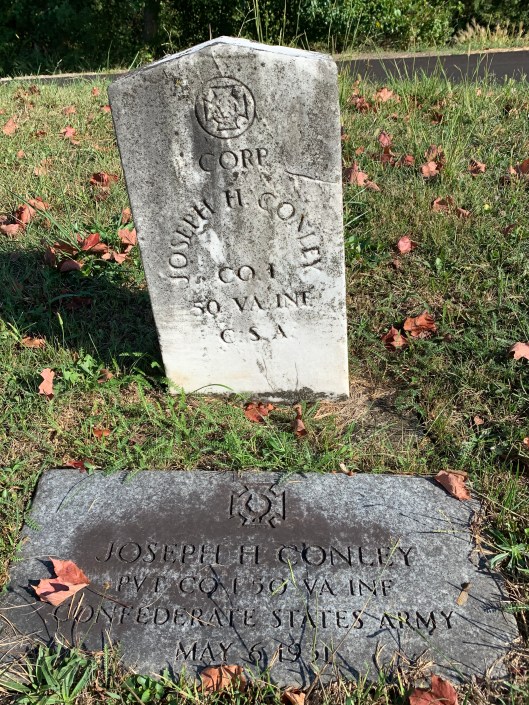
50th Virginia Infantry, Appalachia, Battle of Charleston, Camp Garnett, Charleston, civil war, Confederate Army, Confederate Cemetery, genealogy, history, Joseph H. Conley, Kanawha County, Sons of Confederate Veterans, Spring Hill Cemetery, Stonewall Jackson Camp, Terry Lowry, United Confederate Veterans, West Virginia

IMG_0660

Terry Lowry is THE authority on the Civil War in the Kanawha Valley. Stop 4 on his tour: Spring Hill Cemetery in Charleston, WV. 29 September 2019. Here is a link to Terry’s latest book, The Battle of Charleston (2016): https://wvcivilwar.com/now-available-the-battle-of-charleston/

IMG_0657

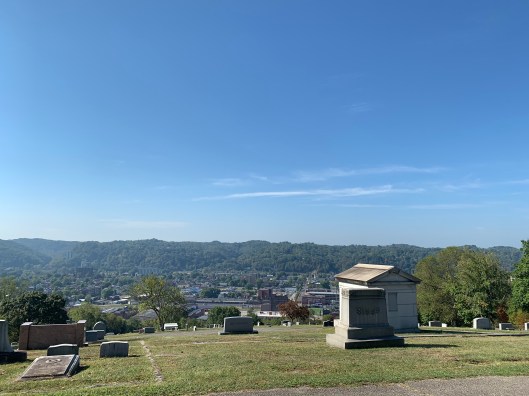
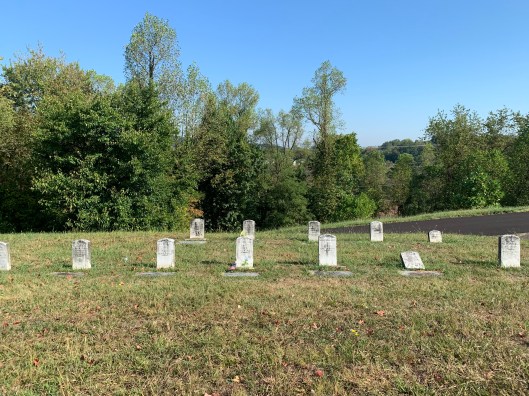
Confederate Cemetery at Spring Hill Cemetery in Charleston, WV. 29 September 2019. For more information about the cemetery, go here: https://www.wvencyclopedia.org/articles/539

IMG_0656

Confederate Cemetery at Spring Hill Cemetery in Charleston, WV. 29 September 2019. For more information about the cemetery, go here: https://wvtourism.com/company/spring-hill-cemetery/

IMG_0661

Confederate Cemetery at Spring Hill Cemetery in Charleston, WV. 29 September 2019

Civil War in the Kanawha Valley: MacFarland-Hubbard House (2019)

31 Thursday Oct 2019

Posted by Brandon Ray Kirk in Civil War

≈ Leave a comment

Tags

Appalachia, Battle of Charleston, Charleston, civil war, history, Kanawha County, Kanawha Valley, MacFarland-Hubbard House, photos, Terry Lowry, West Virginia

IMG_0652

Terry Lowry is THE authority on the Civil War in the Kanawha Valley. Stop 3 on his tour: MacFarland-Hubbard House in Charleston, WV. 29 September 2019. Here is a link to Terry’s latest book, The Battle of Charleston (2016): https://wvcivilwar.com/now-available-the-battle-of-charleston/

IMG_0653

MacFarland-Hubbard House in Charleston, WV. 29 September 2019. For house history, go here: https://www.wvencyclopedia.org/exhibits/23?section=6

IMG_0654

MacFarland-Hubbard House in Charleston, WV. 29 September 2019. During the Battle of Charleston (1862), a cannonball struck in the house. It also served as a hospital. For history about house restoration, go here: http://wvhumanities.org/about/our-historic-house/macfarland-hubbard-house-restoration/

IMG_0655

MacFarland-Hubbard House in Charleston, WV. 29 September 2019. 

Civil War in the Kanawha Valley: Ruffner Memorial Park (2019)

29 Tuesday Oct 2019

Posted by Brandon Ray Kirk in African American History, American Revolutionary War, Cemeteries, Civil War

≈ Leave a comment

Tags

22nd Virginia Infantry, Appalachia, Charleston, Confederate Army, Daniel Ruffner, French and Indian War, gas, George S. Patton, George Washington, Henry D. Ruffner, history, Holly Mansion, John McCausland, Joseph Ruffner, Kanawha County, Kanawha Riflemen, Kanawha River, Kanawha Street, oil, Revolutionary War, Richard Laidley, salt, Thomas Bullitt, United Daughters of the Confederacy, West Virginia

IMG_0648

Terry Lowry is THE authority on the Civil War in the Kanawha Valley. Stop 2 on his tour: Ruffner Memorial Park in Charleston, WV. 29 September 2019. Here is a link to Terry’s latest book, The Battle of Charleston (2016): https://wvcivilwar.com/now-available-the-battle-of-charleston/

IMG_0649

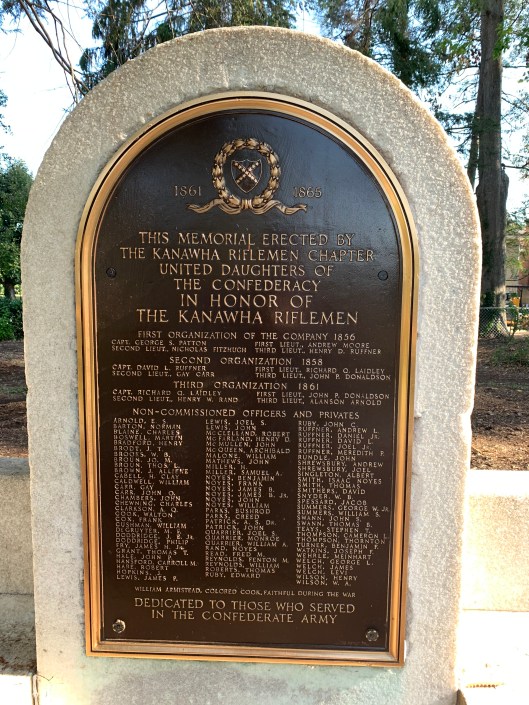
Kanawha Riflemen: “Hometown Boys in Gray.” 29 September 2019

IMG_0646

Kanawha Riflemen Memorial at Ruffner Memorial Park. In 1831, Joseph Ruffner deeded this cemetery to the city. In 1920, the site became a city park. Some graves were relocated but many are still here with their headstones buried beneath the surface. The UDC memorial was placed in 1922. 29 September 2019

IMG_0647

Thomas Bullitt grave. Ruffner Memorial Park. In 1776, George Washington wrote of him: “Bullet (sic) is no favourite of mine, & therefore I shall say nothing more of him, than that his own opinion of himself always kept pace with what others pleas’d to think of him—if any thing, rather run a head of it.” 29 September 2019

Civil War in the Kanawha Valley: Ruffner Log Cabin and Craik-Patton House (2019)

29 Tuesday Oct 2019

Posted by Brandon Ray Kirk in Civil War

≈ Leave a comment

Tags

22nd Virginia Infantry, A.J. Lightburn, Appalachia, Battle of Charleston, Charleston, civil war, Confederate Army, Craik-Patton House, George S. Patton, history, James Craik, Kanawha Boulevard, Kanawha County, Kanawha Rifleman, Kanawha Valley, lawyer, Ruffner Log Cabin, Terry Lowry, The Battle of Charleston, Union Army, West Virginia

IMG_0641

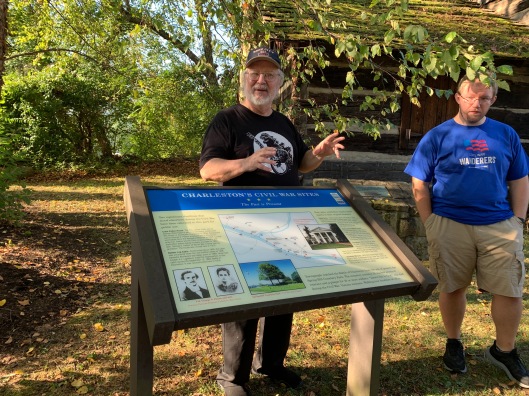
Terry Lowry is THE authority on the Civil War in the Kanawha Valley. He began his tour at the Ruffner Log Cabin and the Craik-Patton House. 29 September 2019. Here is a link to his latest book, The Battle of Charleston (2016): https://wvcivilwar.com/now-available-the-battle-of-charleston/

IMG_0643

Ruffner Log Cabin. Constructed about 1800 at 1536 Kanawha Boulevard; discovered in 1969; reconstructed here in 1976. Union General Joseph A.J. Lightburn made his headquarters in the cabin during the Battle of Charleston (09.13.1862). 29 September 2019

IMG_0644

Craik-Patton House. Rev. James Craik constructed this home in downtown Charleston in 1834. George S. Patton, a lawyer and leader of the Kanawha Riflemen, later lived in the home. Patton led the 22nd Virginia Infantry before his mortal wounding in 1864. The house was moved to this location in 1973. 29 September 2019

Armed March on Logan County, WV (1921)

21 Saturday Sep 2019

Posted by Brandon Ray Kirk in Battle of Blair Mountain, Boone County, Logan

≈ Leave a comment

Tags

A.C. Rouse, A.R. Browning, Appalachia, Battle of Blair Mountain, Bill Blizzard, Blair Mountain, Charleston, crime, deputy sheriff, District No. 17, Don Chafin, Ferndale, Frank Keeney, George Munsy, H.M. Miller, history, Hubert Ferrell, J.E. Wilburn, J.L. Workman, John Gore, Lens Creek, Logan, Logan Banner, Madison, Marmet, merchant, Mine Wars, Mother Jones, Savoy Holt, sheriff, T.C. Townsend, United Mine Workers of America, Warren G. Harding, West Virginia

Here is one article from the Logan Banner relating to Bill Blizzard and the Armed March on Logan County, WV, popularly remembered today as the Battle of Blair Mountain:

Blizzard Gloated at Gore’s Death, Said

“That’s fine! What’s the matter you haven’t killed any others?” William Blizzard, mine workers’ officer, was quoted as saying after he heard of the death of Deputy Sheriff John Gore and two companions at the hands of a party of union miners, according to testimony Monday at Blizzard’s trial upon an accessory to murder indictment growing out of the armed march against Logan county in 1921. Blizzard is charged with having participated in the plans that caused the death of George Munsy, one of the Logan defenders killed with Gore.

Hubert Ferrell, of Ferndale, the witness who quoted Blizzard’s words, declared the mine workers’ office made the statement in a speech to the armed miners gathered at Blair on the afternoon of the day after they had returned from Blair mountain where the Logan “defenders” were killed.

“It don’t seem like it would take any  more nerve to kill Don Chafin (Logan county sheriff) and his thugs than it would a sheep-killing dog,” Ferrell testified Blizzard continued in his speech. “Right tomorrow I want you to fix up to go over the top. It don’t matter about losing a few men. I want you to go over to Logan and let the men out of jail and tear the thing down to the ground.”

Under cross-examination Ferrell added that Blizzard had told the men he wanted them to eat dinner the next day “on the jail house step.”

Ferrell, according to his testimony, failed in his first effort to visit the men who participated in the armed march when he was stopped by guards at the mouth of Lens Creek where the marchers first assembled. He denied that he had ever desired to join the march and said he went there only to see if there were any men there whom he knew. T.C. Townsend, one of the defense attorneys, cross-examined Ferrell vigorously upon that point. The witness said he was on his way to Charleston to buy clothing at the time. Later he said he went to Blair intending to go on to Logan and visit his half-brother, but was prevented by the armed men in Blair from either going on or returning and eventually returned home on a special train after federal troops took charge of the situation.

While he was at Marmet at the mouth of Lens Creek and unable to go farther up the creek because he could not give the guards the password and did not belong to a union, Ferrell said Fred Mooney, secretary treasurer of District No. 17, United Mine Workers, and a man who was said to be C. Frank Keeney, the district president, were there in an automobile. Mooney, the young man told the jury, asked the guards if any guns and ammunition had arrived and on being told he had none informed them that two truck loads had left Charleston. The man pointed out as Keeney told the men he did not believe they were sufficiently prepared and that they would do better to go home, “get prepared and then go over and get Don Chafin and his thugs.”

On the day before Gore and Munsy were killed, Ferrell said Blizzard also made a speech from the porch of the school house that served as base for the armed forces on the union side at the mountain and asked what was the matter that they were not having more success and told them they ought to go over and “get Chafin and the thugs and get it over with.”

Mrs. J.E. Wilburn, wife of the miner-preacher who was one of the principal witnesses for the state now serving a sentence of 12 years for his part in the killings on Blair mountain, testified that guns and ammunition were stored in the parlor of their home. She did not know Blizzard, she said, but men who took the arms into the house said Blizzard had brought them, she testified.

A.R. Browning, a merchant at Blair, told the court that members of the armed forces there got merchandise at his store and told him to charge it to the United Mine Workers of America. The things they got, he said, included shoes, overalls, and other clothing and also some women’s clothing, which he thought, they got for their wives and daughters.

H.M. Miller, a constable at Madison, said that just before Keeney made a speech at the ball park near there which he counselled the marchers to return to their homes, he had a conversation with the union president in which Keeney said that “if the federal troops would keep out he would take these men and go through Logan with them.”

Earlier in the day, J.L. Workman and A.C. Rouse of Marmet had testified as to the occurrence during the assembling of the men on Lens Creek. Workman told of “Mother” Jones’ efforts to get the men to go back to their homes and her declaration that she had a telegram from the President of the United States, which he said Keeney called a “fake.” Later that day both Workman and Rouse said Savoy Holt in a speech from the running board of an automobile said the union officials were their but could not address the men and that he had been instructed to tell them that the telegram was not genuine and that they were to “go on.” Rouse said Keeney and Mooney were in this automobile and that Blizzard was in another nearby. A man he did not know spoke from the running board of the automobile in which Blizzard was riding, telling the men to go on, and Blizzard’s car drove up Lens Creek followed by the armed hordes.

Source: Logan (WV) Banner, 6 July 1923

Leet News 07.13.1923

12 Wednesday Jun 2019

Posted by Brandon Ray Kirk in Big Ugly Creek, Leet

≈ 2 Comments

Tags

Appalachia, Big Ugly Creek, Charleston, Edna Brumfield, Fourth of July, genealogy, history, Leet, Lillie Curry, Lincoln County, Logan Banner, Thelma Huffman, Tom Lambert, Wayne Brumfield, West Virginia

A correspondent named “Black Eye” from Leet on Big Ugly Creek in Lincoln County, West Virginia, offered the following items, which the Logan Banner printed on July 13, 1923:

Mrs. L. Huffman entertained a bunch of friends and guests for dinner on the Fourth. A delightful dinner was served.

Miss Thelma Huffman is on a vacation in Charleston visiting friends.

The Death Angel visited the home of Mr. and Mrs. Tom Lambert last Sunday and took their new born babe away.

Mr. Wayne Brumfield was the guest of Thelma Huffman Sunday.

Miss Edna Brumfield and Lonnie Lambert are engaged to be married July 15th.

The Death Angel visited the home of Mrs. Lillie Curry and took her husband away last Saturday morning.

NOTE: Lon and Edna married on December 26, 1923 in Lincoln County, WV.

← Older posts
Newer posts →

Feud Poll 1

If you had lived in the Harts Creek community during the 1880s, to which faction of feudists might you have given your loyalty?

Categories

  • Adkins Mill
  • African American History
  • American Revolutionary War
  • Ashland
  • Atenville
  • Banco
  • Barboursville
  • Battle of Blair Mountain
  • Beech Creek
  • Big Creek
  • Big Harts Creek
  • Big Sandy Valley
  • Big Ugly Creek
  • Boone County
  • Breeden
  • Calhoun County
  • Cemeteries
  • Chapmanville
  • Civil War
  • Clay County
  • Clothier
  • Coal
  • Cove Gap
  • Crawley Creek
  • Culture of Honor
  • Dingess
  • Dollie
  • Dunlow
  • East Lynn
  • Ed Haley
  • Eden Park
  • Enslow
  • Estep
  • Ethel
  • Ferrellsburg
  • Fourteen
  • French-Eversole Feud
  • Gilbert
  • Giles County
  • Gill
  • Green Shoal
  • Guyandotte River
  • Halcyon
  • Hamlin
  • Harts
  • Hatfield-McCoy Feud
  • Holden
  • Hungarian-American History
  • Huntington
  • Inez
  • Irish-Americans
  • Italian American History
  • Jamboree
  • Jewish History
  • John Hartford
  • Kermit
  • Kiahsville
  • Kitchen
  • Leet
  • Lincoln County Feud
  • Little Harts Creek
  • Logan
  • Man
  • Matewan
  • Meador
  • Midkiff
  • Monroe County
  • Montgomery County
  • Music
  • Native American History
  • Peach Creek
  • Pearl Adkins Diary
  • Pecks Mill
  • Peter Creek
  • Pikeville
  • Pilgrim
  • Poetry
  • Queens Ridge
  • Ranger
  • Rector
  • Roane County
  • Rowan County Feud
  • Salt Rock
  • Sand Creek
  • Shively
  • Spears
  • Sports
  • Spottswood
  • Spurlockville
  • Stiltner
  • Stone Branch
  • Tazewell County
  • Timber
  • Tom Dula
  • Toney
  • Turner-Howard Feud
  • Twelve Pole Creek
  • Uncategorized
  • Warren
  • Wayne
  • West Hamlin
  • Wewanta
  • Wharncliffe
  • Whirlwind
  • Williamson
  • Women's History
  • World War I
  • Wyoming County
  • Yantus

Feud Poll 2

Do you think Milt Haley and Green McCoy committed the ambush on Al and Hollene Brumfield in 1889?

Blogroll

  • Ancestry.com
  • Ashland (KY) Daily Independent News Article
  • Author FB page
  • Beckley (WV) Register-Herald News Article
  • Big Sandy News (KY) News Article
  • Blood in West Virginia FB
  • Blood in West Virginia order
  • Chapters TV Program
  • Facebook
  • Ghosts of Guyan
  • Herald-Dispatch News Article 1
  • Herald-Dispatch News Article 2
  • In Search of Ed Haley
  • Instagram
  • Lincoln (WV) Journal News Article
  • Lincoln (WV) Journal Thumbs Up
  • Lincoln County
  • Lincoln County Feud
  • Lincoln County Feud Lecture
  • LinkedIn
  • Logan (WV) Banner News Article
  • Lunch With Books
  • Our Overmountain Men: The Revolutionary War in Western Virginia (1775-1783)
  • Pinterest
  • Scarborough Society's Art and Lecture Series
  • Smithsonian Article
  • Spirit of Jefferson News Article
  • The Friendly Neighbor Radio Show 1
  • The Friendly Neighbor Radio Show 2
  • The Friendly Neighbor Radio Show 3
  • The Friendly Neighbor Radio Show 4
  • The New Yorker
  • The State Journal's 55 Good Things About WV
  • tumblr.
  • Twitter
  • Website
  • Weirton (WV) Daily Times Article
  • Wheeling (WV) Intelligencer News Article 1
  • Wheeling (WV) Intelligencer News Article 2
  • WOWK TV
  • Writers Can Read Open Mic Night

Feud Poll 3

Who do you think organized the ambush of Al and Hollene Brumfield in 1889?

Recent Posts

  • Logan County Jail in Logan, WV
  • Absentee Landowners of Magnolia District (1890, 1892, 1894)
  • Charles Spurlock Survey at Fourteen Mile Creek, Lincoln County, WV (1815)

Ed Haley Poll 1

What do you think caused Ed Haley to lose his sight when he was three years old?

Top Posts & Pages

  • Early Schools of Logan County, WV (1916)
  • Jack Dempsey’s Broadway Restaurant Location in New York City (2019)
  • Cotton Production in Antebellum Pike County, KY
  • Blood in West Virginia: Brumfield v. McCoy (2014)
  • Blood in West Virginia

Copyright

© Brandon Ray Kirk and brandonraykirk.wordpress.com, 1987-2023. Unauthorized use and/or duplication of this material without express and written permission from this blog’s author and/or owner is strictly prohibited. Excerpts and links may be used, provided that full and clear credit is given to Brandon Ray Kirk and brandonraykirk.wordpress.com with appropriate and specific direction to the original content.

Archives

  • February 2025
  • January 2025
  • October 2023
  • September 2023
  • December 2022
  • November 2022
  • May 2022
  • April 2022
  • February 2022
  • November 2021
  • October 2021
  • September 2021
  • June 2021
  • May 2021
  • April 2021
  • March 2021
  • February 2021
  • January 2021
  • December 2020
  • November 2020
  • October 2020
  • July 2020
  • June 2020
  • May 2020
  • April 2020
  • March 2020
  • February 2020
  • January 2020
  • December 2019
  • November 2019
  • October 2019
  • September 2019
  • August 2019
  • July 2019
  • June 2019
  • May 2019
  • April 2019
  • March 2019
  • February 2019
  • January 2019
  • December 2018
  • November 2018
  • October 2018
  • September 2018
  • August 2018
  • July 2018
  • June 2018
  • May 2018
  • April 2018
  • March 2018
  • February 2018
  • January 2018
  • December 2017
  • November 2017
  • October 2017
  • September 2017
  • August 2017
  • July 2017
  • June 2017
  • May 2017
  • April 2017
  • March 2017
  • February 2017
  • January 2017
  • December 2016
  • November 2016
  • October 2016
  • September 2016
  • August 2016
  • July 2016
  • June 2016
  • May 2016
  • April 2016
  • March 2016
  • February 2016
  • January 2016
  • December 2015
  • November 2015
  • October 2015
  • September 2015
  • August 2015
  • July 2015
  • June 2015
  • May 2015
  • April 2015
  • March 2015
  • February 2015
  • January 2015
  • December 2014
  • October 2014
  • September 2014
  • August 2014
  • July 2014
  • June 2014
  • May 2014
  • April 2014
  • March 2014
  • February 2014
  • January 2014
  • December 2013
  • November 2013
  • October 2013
  • September 2013
  • August 2013
  • July 2013
  • June 2013
  • May 2013
  • April 2013
  • March 2013
  • February 2013
  • January 2013
  • December 2012
  • November 2012

Enter your email address to follow this blog and receive notifications of new posts by email.

Join 2,927 other subscribers

Tags

Appalachia Ashland Big Creek Big Ugly Creek Blood in West Virginia Brandon Kirk Cabell County cemeteries Chapmanville Charleston civil war coal Confederate Army crime culture Ed Haley Ella Haley Ferrellsburg feud fiddler fiddling genealogy Green McCoy Guyandotte River Harts Harts Creek Hatfield-McCoy Feud history Huntington John Hartford Kentucky Lawrence Haley life Lincoln County Lincoln County Feud Logan Logan Banner Logan County Milt Haley Mingo County music Ohio photos timbering U.S. South Virginia Wayne County West Virginia Whirlwind writing

Blogs I Follow

  • OtterTales
  • Our Appalachia: A Blog Created by Students of Brandon Kirk
  • Piedmont Trails
  • Truman Capote
  • Appalachian Diaspora

BLOOD IN WEST VIRGINIA is now available for order at Amazon!

Blog at WordPress.com.

OtterTales

Writings from my travels and experiences. High and fine literature is wine, and mine is only water; but everybody likes water. Mark Twain

Our Appalachia: A Blog Created by Students of Brandon Kirk

This site is dedicated to the collection, preservation, and promotion of history and culture in Appalachia.

Piedmont Trails

Genealogy and History in North Carolina and Beyond

Truman Capote

A site about one of the most beautiful, interesting, tallented, outrageous and colorful personalities of the 20th Century

Appalachian Diaspora

  • Subscribe Subscribed
    • Brandon Ray Kirk
    • Join 789 other subscribers
    • Already have a WordPress.com account? Log in now.
    • Brandon Ray Kirk
    • Subscribe Subscribed
    • Sign up
    • Log in
    • Report this content
    • View site in Reader
    • Manage subscriptions
    • Collapse this bar
 

Loading Comments...