• About

Brandon Ray Kirk

~ This site is dedicated to the collection, preservation, and promotion of history and culture in my section of Appalachia.

Brandon Ray Kirk

Tag Archives: Guyandotte River

Enos “Jake” Adkins Deed to Henry Adkins (1854)

25 Monday Dec 2017

Posted by Brandon Ray Kirk in Atenville, Little Harts Creek

≈ Leave a comment

Tags

Appalachia, Elizabeth Adkins, Enos "Jake" Adkins, genealogy, Guyandotte River, Henry Adkins, history, Isaac Adkins, Isaiah Adkins, James Toney, justice of the peace, Letty Adkins, Lincoln County, Little Harts Creek, Logan County, Nancy Toney, Price Lucas, Spencer A. Mullins, Virginia, W.I. Campbell, West Virginia, William Straton

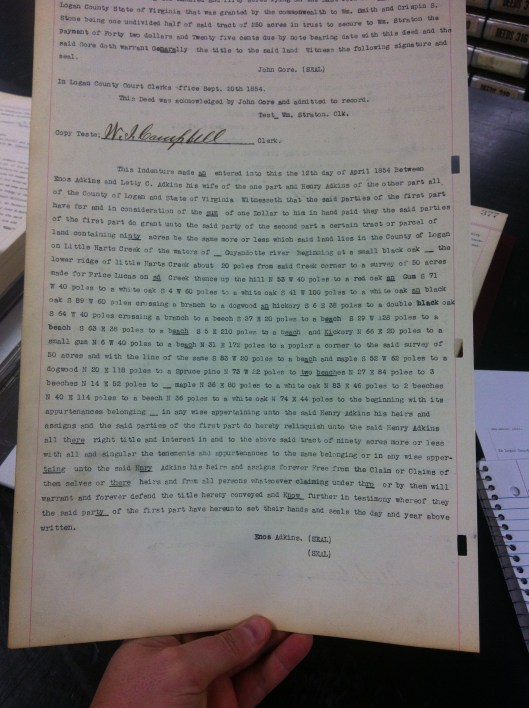
Enos Adkins to Henry Adkins 1

Deed Book C, page 376, Logan County Clerk’s Office, Logan, WV. Elias “Jake” Adkins was the son of Elias and Susannah (Fry) Adkins. Letty Adkins was the daughter of James and Nancy (Gillispie) Toney. Henry Adkins was the son of Isaac and Elizabeth (Adkins) Adkins. Jake and Henry were first cousins. I descend from Henry’s brother, Isaiah.

Enos Adkins to Henry Adkins 2

Deed Book C, page 377, Logan County Clerk’s Office, Logan, WV. This property is located in present-day Lincoln County, WV.

Republicans Driven from Logan County by Gunmen (1914)

01 Friday Dec 2017

Posted by Brandon Ray Kirk in African American History, Logan

≈ Leave a comment

Tags

African-Americans, Appalachia, coal, Con Chafin, crime, Democratic Party, deputy sheriff, Don Chafin, E.T. England, guitar, Guyandotte River, Herald-Dispatch, history, Huntington, Ira P. Hager, John B. Wilkinson, Ku Klux Klan, lawyers, Logan, Logan Banner, Logan County, mine guards, O.J. Deegan, politics, prosecuting attorney, Republican Party, sheriff, timbering, W.C. Lawrence Jr., West Virginia

From the Herald-Dispatch of Huntington, WV, comes this story printed by the Logan Banner of Logan, WV, dated October 30, 1914:

Republican Voters Driven from Co. by Gunmen

Deputy Sheriffs, Acting as Mine Guards, Are the Law and Enforcement Thereof.

Many Believe Martial Law Will be Sequel to Rule of Thugs.

Democratic schemes for the intimidation of Republican voters, for the prevention of a Republican victory in the state next Tuesday, whether by fair means or foul, have reached their climax in Logan county. If there is a place in West Virginia where lawlessness has succeeded law and order, where the persons chosen to enforce the law have initiated a system of rule by force and intimidation, a rule by force of clubs and pistols, a rule by thugs and gunmen, that place is Logan county.

A thorough investigation of conditions in Logan county today proves that the Ku Klux Klan in the south were mere pikers. There are men in Logan county who could beat them blindfolded.

The man, woman or child who would enjoy life–aye, who are willing to accept life or pass through Logan county, must be careful not to cross the paths of Sheriff Don Chafin and his force of about two hundred armed deputies.

And it can be truthfully said that the paths of these men extend to every nook and corner of the county. And several newly-made graves along the banks of the Guyandotte river and its tributaries shows who is the law and the enforcement thereof.

Several men have been shot, two negroes fatally, others have been clubbed and driven out of the county, women and children have been forced to flee clad only in their night-clothes, upon order of the Chafin deputies.

And all this because some Republicans desired to be registered in order that they might cast their votes for the Republican candidates next Tuesday.

Logan county is about to throw off the yoke of Democracy. The coal and lumber industries are rapidly being developed, and, as is always the case in progressive communities, the Republicans are making large gains.

If the voters of Logan county are allowed to cast their ballots as they desire, and those ballots are counted as cast, the Republican candidates will be elected.

If the conspiracy which has been formed by and in the interest of the Democrats is allowed to be carried out, the Democrats will continue in control of the county, the enforcement of law will be a mere joke and there will be probably a score added to the newly made graves along Old Guyan after next Tuesday.

Opinions vary as to what the outcome will be. Some believe that only martial law will prove a solution. Others are of the opinion that conditions will grow gradually worse and that the enforcement of law and order in Logan county will be a subject for investigation by the next legislature which convenes in January. Most certainly, if the threats of the Democrats are carried out, the Republicans are driven from the polls next Tuesday, the legislature will be asked to make a sweeping investigation and their findings will reveal conditions incredible in a civilized state.

Don Chafin is high sheriff of Logan county. His cousin, Con Chafin is prosecuting attorney. All the county officials are Democrats. Circuit Judge Wilkinson is a Democrat, though a man who wants the law enforced.

Sheriff Chafin, it is estimated, has about two hundred deputies. When he was elected, a part of his platform was that he would drive out the Baldwin mine guards from Logan county. No Baldwin men are known to be in this county now but these deputy sheriffs are known as mine guards. All of them are supposed to be armed with pistols, black-jacks and the usual weapons of gunmen. But few of them are licensed to carry such weapons and there is no trouble to find evidence that they have these weapons in violation of the law. Some of them are known to be ex-convicts and as such would not be licensed to carry revolvers, etc.

They shoot, club, slug and thug at will. But they are not arrested and imprisoned. For they are the law and the enforcement thereof.

Events of the past few weeks show the effectiveness of this organization of deputies and the way in which they operate. When the registrars were on their rounds registering the voters some of the deputies were on hand and even the Democratic registrars were afraid not to obey their orders. To go back further, they were on hand at the Democratic primaries and the Democratic nominees were the men of their choice and of that of their chief.

The Democratic registrars refused to register many Republicans, especially among the colored voters. When the county commissioners met to canvass the registration, four Republican lawyers State Senator E.T. England, Ira P. Hager, W.C. Lawrence, Jr., and O.J. Deegan, the latter being Republican county chairman, took the lead to see that Republicans entitled to vote were registered. One hundred colored voters were brought into Logan for examination and registration.

Threats have been made by deputies against the journeying of negroes to the court house, there to demand their rights, and the republican leaders realized there was danger.

The work before the county court was slow, as the democratic leaders challenged every step of the republicans. But eleven men were passed upon the first day, five of whom were registered, six turned down. That night the apparent cause for delay came. A colored family lived at Monitor, a mile from the court house. It was supposed that some of the negroes awaiting registration were there. This gave the conspirators a chance and the gunmen got busy.

Soon after dark a band of armed men raided the house, shot out the windows, fired bullets into bodies of two colored men, beat up others and drove a woman and child into the hills without giving them time to dress. The raiders said they were looking for “strange niggers.” As the result of that raid one colored man lies in an unmarked grave on the hillside and another is likely to join him soon. No “strange niggers” were in that house.

A colored man owned a cleaning and pressing establishment within a couple of squares of the court house. His windows were demolished and his place of business next morning looked as though a German siege gun had been turned on it.

A score of colored men awaiting registration were quartered for the night in the office of Senator England, and adjoining offices. About 11:30 o’clock at night some of the negroes were awakened by noises in the hallways and a sensation of not being able to breathe. They rushed to the windows and threw them open, but met with a shower of stones from the outside.

Piled on Senator England’s desk can be seen the stones hurled with force as is shown by the scars on the walls. Some of the stones were thrown from the court house steps.

No arrests were made. A grand jury was in session and Judge Wilkinson instructed the jurors to ferret out the dastardly assault and bring the miscreants to justice. But not an indictment resulted. It is no mystery in Logan as to who committed the deed. Any citizen not afraid to talk, and they are few, will name half a dozen deputy sheriffs as being in the party.

A telephone exchange girl next door to where some of the negroes were attacked made an outcry and was told that she would not be hurt if she kept still. She knows who told her to keep quiet, but would hardly give his name, probably not if she faced a jail sentence for contempt of court. It is not safe to talk in Logan county. “Don’t mention my name,” is what they all say when discussing the outrages.

A short distance from Logan is a construction camp. A large crowd of deputies raided the camp. One negro was playing the guitar and singing. No “strange niggers” were found there, but the one negro sang his last song. He, too, lies in an unmarked grave along the banks of Old Guyan. “Resisting arrest” was the excuse given.

Such depredations naturally drove many colored voters away and they will not vote.

Though threats have been made against the life of Senator England and his followers, they are putting up a game fight. By agreement the county court was to hold a night session to get through with the registration. England was later notified that nothing further would be done that night but the work would be taken up the next day he was amazed to find the court was no longer sitting. He went before Judge Wilkinson, mandamused the county court to sit again, and got ninety-eight colored voters registered.

The democrats were beaten in that game. “What’s the difference,” said a deputy when the court reconvened. “We will get them election day.” It has been openly boasted by the democrats that in many precincts the republicans, especially the colored voters, will not be allowed at the polls next Tuesday.

The sheriff and his deputies form an organization with unlimited power. Every little town or village, every public works, has the deputies. By intimidation and force in most instances and by favors in others, these deputies can run things to suit themselves. Infractions of the law by supporters of the organization can easily be overlooked, while on the other hand, the slightest technical violation can be punished to the full extent of the law.

The high-handed way in which the Democratic county organization is running things has caused a ruction in the Democratic ranks and many of them will quietly vote the Republican ticket. Many members of the old-time militant Democracy, some of them ex-Confederate soldiers, have assured the Republican leaders that they can no longer approve the Democratic methods employed in Logan County and will record their votes against it.

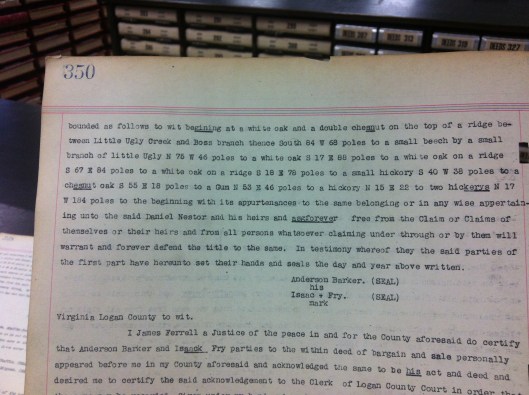
Anderson Barker and Isaac Fry Deed to Daniel Nester (1854)

01 Friday Dec 2017

Posted by Brandon Ray Kirk in Big Ugly Creek, Guyandotte River

≈ 1 Comment

Tags

Anderson Barker, Appalachia, Big Ugly Creek, Boone County, Boss Branch, Daniel Nester, genealogy, Guyandotte River, history, Isaac Fry, James Ferrell, justice of the peace, Letisha Barker, Little Ugly Creek, Sarah Fry, Virginia, W.I. Campbell, West Virginia, William Straton

Barker and Fry to Daniel Nester 1

Deed Book C, page 349, Logan County Clerk’s Office, Logan, WV.

Barker and Fry to Daniel Nester 2

Deed Book C, page 350, Logan County Clerk’s Office, Logan, WV.

Barker and Fry to Daniel Nester 3

Deed Book C, page 350, Logan County Clerk’s Office, Logan, WV.

Dusenberry’s Dam (1887)

30 Thursday Nov 2017

Posted by Brandon Ray Kirk in Barboursville, Guyandotte River, Huntington, Logan

≈ Leave a comment

Tags

Barboursville, Cabell County, Charleston, Dusenberry's Dam, Guyandotte River, history, Hugh Toney, Huntington, Huntington Advertiser, Logan, steamboats, West Virginia

From the Huntington (WV) Advertiser of February 5, 1887 comes this bit of history about Dusenberry’s Dam:

The dwellers along the banks of the Guyandotte River from its mouth to the headwaters, together with many others who are interested in the navigation of that stream, will be pleased to know that it is soon to be cleared of all obstructions. Major Post, the Chief Engineer, and Capt. Hugh Toney, his assistant, in charge of the Government improvement on Guyandotte River, have made a contract with the Messrs. Rodgers to clear the river of all obstructions from Barboursville up for a considerable distance. By this contract the Dusenberry mill dam, which has been the chief obstacle to the free navigation of the river and the cause of immense loss to timber dealers and others, will be removed.

After its removal, with such a stage of water as we now have, steamboats will be enabled to ascend to within a few miles of Logan C.H. This will be of immense importance to the city of Huntington, as it opens a fertile region, which has in a great measure been cut off by this dam and forced to go to Charleston. A line of steamboats will, no doubt, enter the trade between this city and Logan C.H. as soon as the river is clear.

At the point where the Dusenberry dam is located was established as one of the first grist mills in all this region of country. About the year 1818 or 1820, the Legislature of Virginia passed an act allowing a mill dam four feet high to be built across the river at that point, and since that time the obstruction has remained.

Capt. Toney has been untiring in his efforts to secure the removal of this bar to the free navigation of Guyan, but not until a few days ago was he able to effect the arrangement which will result in opening the stream.

The merchants and business men of Huntington should now be on the look out for the trade up this river and use all proper means to bring it here.

Henry Conley and William Thompson Deed to John Godby (1849)

21 Tuesday Nov 2017

Posted by Brandon Ray Kirk in Big Creek, Guyandotte River

≈ Leave a comment

Tags

Appalachia, Big Creek, Crispin S. Stone, Elizabeth Conley, Elizabeth Lilly, Elizabeth Thompson, Garland Conley, Guyandotte River, Hannan Survey, Henry Conley, John Godby, Joshua Butcher, Judith Thompson, justice of the peace, Logan County, Peter Dingess, Polly Conley, Thomas P. Thompson, Virginia, West Virginia, William Straton, William Thompson

Henry Conley and William Thompson to John Godby 1849 1

Deed Book C, page 279, Logan County Clerk’s Office, Logan, WV. Henry Conley, son of Garland and Elizabeth (Farley) Conley, was the husband of Mary “Polly” Thompson. William Thompson, son of Thomas P. and Judith (Farley) Thompson, was the husband of Elizabeth Lilly. Grantors Conley and Thompson were first cousins…and brothers-in-law.

Henry Conley and William Thompson to John Godby 1849 2

Deed Book C, page 280, Logan County Clerk’s Office, Logan, WV. William Thompson, who died in 1850, is my paternal great-great-great-great-grandfather.

Squire Toney Deed to Richard Leander Ferrell (1851)

02 Thursday Nov 2017

Posted by Brandon Ray Kirk in Chapmanville, Guyandotte River

≈ Leave a comment

Tags

Appalachia, Crispin S. Stone, Edward Chapman, Elias Adkins, genealogy, Guy Dingess, Guyandotte River, history, Jacob Stollings, justice of the peace, Kanawha Branch, Logan, Logan County, Nancy Toney, Richard Leander Ferrell, Samuel Ferrell, Sarah Ferrell, Squire Toney, Virginia, West Virginia

Squire Toney to Richard Leander Ferrell 1851 1

Deed Book C, page 287, Logan County Clerk’s Office, Logan, WV. Squire Toney was born about 1783, reportedly in Bedford County, VA. His wife, the former Nancy Brown, was born about 1788, reportedly in Ireland.

Squire Toney to Richard Leander Ferrell 1851 2

Deed Book C, page 288, Logan County Clerk’s Office, Logan, WV. Samuel R. Ferrell was born about 1826. He married a daughter of Squire Toney. His oldest son, Richard Leander Ferrell, was born about 1850.

Hamilton Fry Deed to Thomas Dunn English (1852)

01 Wednesday Nov 2017

Posted by Brandon Ray Kirk in Big Ugly Creek, Guyandotte River

≈ Leave a comment

Tags

Big Ugly Creek, Christian Fry, Crispin S. Stone, Druzilla Fry, Elias Adkins, Emily Fry, Guyandotte River, Hamilton Fry, history, justice of the peace, Lincoln County, Logan County, Nancy Fry, Pigeon Roost Branch, Thomas Dunn English, Virginia, West Virginia

Hamilton Fry to Thomas Dunn English 1852 1

Deed Book C, page 270, Logan County Clerk’s Office, Logan, WV. I descend from three of Hamilton Fry’s siblings: Christian Fry, Emily Fry, and Druzilla Fry. Thomas Dunn English was a well-known poet. This land is located in present-day Lincoln County, WV.

Hamilton Fry to Thomas Dunn English 1852 2

Deed Book C, page 271, Logan County Clerk’s Office, Logan, WV. I live on part of the old Elias Adkins farm.

Logan, WV (1913)

31 Tuesday Oct 2017

Posted by Brandon Ray Kirk in Cemeteries, Guyandotte River, Logan

≈ Leave a comment

Tags

Decoration Day, Dingess Run, Foley Cemetery, Guyandotte River, history, Logan, Logan Banner, Logan County, mayor, Order of Owls, Robert Bland, Stollings, Stratton Street, West Virginia

Decoration Day LB 05.09.1913.JPG

Logan (WV) Banner, 9 May 1913.

From the Logan Banner of Logan, WV, comes this story dated May 23, 1913:

The Call to Arms

Ladies of Logan, we need you, and ask your unfailing support against filth and flies. With your full assistance we expect to make the men “help the women do the work.” We want you to help us develop the pride and civic duty which promotes cleanliness. Enlist the whole household in this crusade against filth and flies–breeders of disease.

With the homes, the yards and the streets clean, screened receptacles for kitchen waste, which we will remove without expense, the free use of lime daily, our city will be respectable and commendable.

Lend us your aid and imbibe the slogan, “Cleaner, Healthier and Better Logan.”

Respectfully,

ROBERT BLAND, Mayor

By order of the Common Council

***

From the Logan Banner of Logan, WV, comes this story dated August 22, 1913:

Spreading Their Tracks

What has become of the city cow-bell ordinance? If it can’t be enforced, why not repeal it and substitute one demanding that each animal provide itself with a portable bathroom with regulation sewer connection–or, to use plain every-day English, a slop-bucket securely tied to its tail. One “special privilege” lady cow has been roaming the streets at night with a bell that makes you think the ice man is coming, but that ain’t him at all. It’s the milk maid patting along up the walk! Yes, right up the front steps and rings the bell! This particular lady cow is not satisfied with brick pavements and macadam roads, she prefers cement sidewalks. A blind man could tell you which way she went and where she stopped–in fact she don’t stop at all. If she did, there would be no occasion to write this article. She plods along all night, leaving her trail behind her. We don’t know who owns this madam bovine and we don’t care Adam. We have told her “past and present” just as we might have told of “John Brown’s Raid”–up the Guyan–the “raid that made the Chafins famous!” But we leave that also for the “city papers” to dope out. Good night!

Barboursville, WV

27 Friday Oct 2017

Posted by Brandon Ray Kirk in Barboursville, Lincoln County Feud

≈ Leave a comment

Tags

Appalachia, Barboursville, Barboursville College, Blood in West Virginia, Brandon Kirk, Cabell County, Daughters of the American Revolution, Davis Creek, Eastman Community College, George A. Proffitt, ghosts, Guyandotte River, history, Hollena Brumfield, Huntington Advertiser, James I. Kuhn Presbyterian Church, James River-Kanawha Turnkpike, Lincoln County Feud, Logan County Banner, Logan Democrat, Mary G. Moss, Morris Harvey College, Old Toll House, photos, Phyllis Kirk, R.A. Alderman, Robert W. Douthat, S.V. Matthews, Virginus R. Moss, West Virginia

IMG_9184

Old Toll House, built 1837, Barboursville, Cabell County, WV. 15 February 2015. For more, follow this link: http://www.wvdar.org/Barboursville/

IMG_9185

Old Toll House Historical Marker. 15 February 2015. For more, follow this link: https://www.theclio.com/web/entry?id=6682

IMG_4145

Barboursville College, 1889. Photo by S.V. Matthews. For more, visit here: https://www.theclio.com/web/entry?id=11606

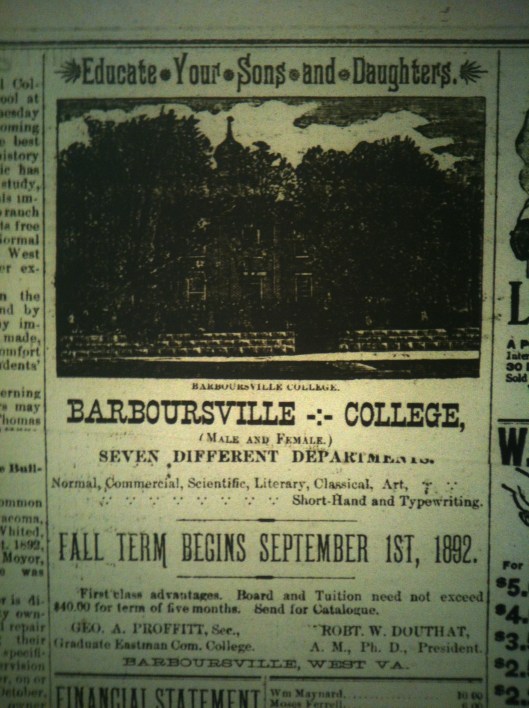
Barboursville College LCB 09.08.1892

Logan County Banner (Logan, WV), 8 September 1892.

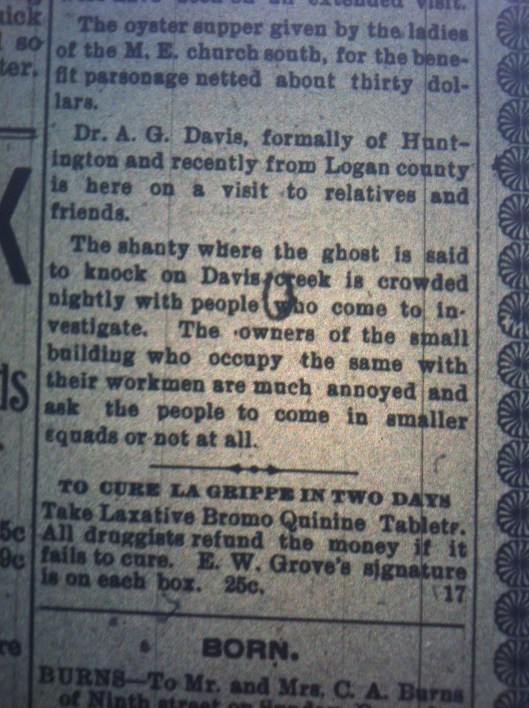
Barboursville Ghost HuA 12.04.1899

Davis Creek Ghost, Huntington (WV) Advertiser, 4 December 1899.

Morris Harvey College LD 08.10.1911

Logan (WV) Democrat, 10 August 1911. For more, visit here: https://www.wvencyclopedia.org/articles/276

IMG_3286

Dr. Virginus R. Moss treated Hollena Brumfield after she had been shot in the face during the Lincoln County Feud. 5 May 2017. Photo by Mom. For more, follow this link: https://www.amazon.com/Blood-West-Virginia-Brumfield-McCoy/dp/1455619183

BK at Kuhn Memorial

James I. Kuhn Memorial Presbyterian Church. 5 May 2017. Photo by Mom. For more, follow this link: http://www.herald-dispatch.com/features_entertainment/kuhn-memorial-presbyterian-church-to-celebrate-its-centennial/article_15f4d296-b5fb-505a-830d-1d6935babe87.html

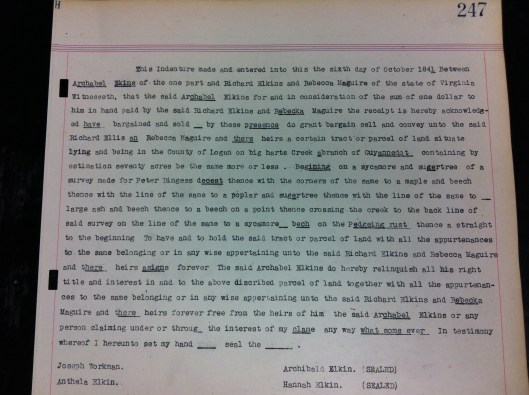
Archibald Elkins to Richard Elkins Deed (1841)

19 Thursday Oct 2017

Posted by Brandon Ray Kirk in Big Harts Creek

≈ Leave a comment

Tags

Anthelia Elkins, Appalachia, Archibald Elkins, genealogy, Guyandotte River, Hannah Elkins, Harts Creek, history, Josephus Workman, Lincoln County, Logan County, Peter Dingess, Pigeon Roost, Rebecca Maguire, Richard Elkins, Virginia, West Virginia

Archibald Elkins to Richard Elkins Deed 1841 1

Deed Book C, page 247, Logan County Clerk’s Office, Logan, WV.

Corpse Found in River at Chapmanville, WV (1927)

13 Wednesday Sep 2017

Posted by Brandon Ray Kirk in Chapmanville, Guyandotte River, Huntington, Logan

≈ Leave a comment

Tags

Appalachia, B.C. Harris, Branchland, Carlos Hatfield, Chapmanville, Chauncey, E.M. Jeffrey, genealogy, Guyandotte, Guyandotte River, Henlawson, history, Huntington, Island Creek, J.D. Parsley, J.F. May, Lincoln County, Logan, Logan Banner, Logan County, Mud Fork, Omar, West Virginia, Williamson

From the Logan Banner of Logan, WV, we find the following story dated 29 March 1927:

All doubt as to the body of the woman found a mile above Chapmanville last Friday being that of Mrs. J.D. Parsley of Omar was removed that evening. Identification was positive on account of her wedding ring and her shoes.

So badly decomposed was the body, the flesh of the face having wasted away, that identification would have been impossible except for the ring or bits of clothing. In fact, its condition was such that it was recovered with sand at the place where found, after the identification was completed and after Undertaker B.C. Harris reached the scene, it being decided to await instructions from Mr. Parsley. The body had been in water more than three months, for it was on December 21 that she was drowned in the flooded waters of Main Island Creek near her home between Omar and Chauncey. From that point to the point where the  body was found is 22 miles, according to estimates of some deputy sheriffs who are familiar with Logan county distances.

Friday evening Mr. Parsley was located in Huntington, whither he had moved a few weeks ago to engage in the real estate business.

Mr. Parsley came to Chapmanville on the Saturday morning train, bringing a casket with him. Sunday the body was brought on a railway motor to Henlawson and then was taken by way of Charleston to Wayne county for burial. This was done because of the certainty the railway company would not transport the body from Chapmanville to  Huntington or to any other point on a passenger train.

Mr. Parsley, it is said, recognized a scar on his wife’s body–a scar left by a surgical operation.

The finder of the body was a Scarberry boy who lives near the place where it was found. It was lying near the shore, partly covered by silt, with the head wedged under a log or between two logs, according to reports heard here.

From the day of Mrs. Parsley’s tragic death till the body was found scandal-mongers busied themselves circulating reports that she had not drowned but had gone away of her own accord. As late as last Wednesday a Banner reporter was told that she was living in Guyandotte.

Concerning the drowning of Mrs. Parsley The Banner on Friday December 24 published the following account:

In the swollen waters of Main Island Creek Mrs. J.D. Parsley was drowned near her home between Omar and Chauncey at about 5:30 Tuesday evening.

Stepping into a necessary outbuilding that stood on the creek bank behind her home, the building suddenly toppled over and crashed into the swirling tide. Her screams were heard by several persons, among them Carlos Hatfield, a neighbor, who rushed to the rescue. When he reached the bank he saw Mrs. Parsley struggling in the water close to the shore and at the same time being carried swiftly forward by the stream. Just behind her was the building from which she had extricated herself. He waded into the waters and was almost within reach when the building turned over on her and shoved her beneath it out of sight. Before she reappeared on the surface she was too far down stream and too far out in the swift current for Hatfield to reach her.

Reports received here indicate that a son of E.M. Jeffrey of Omar was attracted to the scene and got a glimpse of either Mrs. Parsley or the building, or probably both, and followed along the bank until he saw the building crash into the bridge at Chauncey. The impact shattered the frail structure into pieces that were soon carried from view.

During the night and Wednesday forenoon searchers scanned the banks of the creek in what proved to be a futile effort to find the body.

Mrs. Parsley was nearing her 40th birthday. Her maiden name was Clay, according to her neighbors, and it is said her parents live at Branchland. She leaves no children, though Parsley is the father of several children by a previous marriage.

The Parsleys moved to the present home last August, when he leased a garage from Oscar Napier. This is located near the home of Dr. J.F. May and also close to the garage of Carlos Hatfield, previously mentioned as having tried to rescue the drowning woman. Before moving to the Omar-Chauncey neighborhood, Parsley had a grocery store at Mud Fork. At one time he was in the merchandise business at Williamson.

When the drowning occurred Parsley was at work in his garage. Word came to him that a woman had drowned, but it was half an hour or more before he realized that the victim was his own wife.

Source: “Body Found at Chapmanville is Identified as that of Mrs. Parsley Drowned at Omar on December 21,” Logan Banner, 29 March 1927.

***

Mrs. Parsley’s death record is found here: http://www.wvculture.org/vrr/va_view2.aspx?FilmNumber=1953328&ImageNumber=3233


Let’s Boost Old Logan (1911)

15 Tuesday Aug 2017

Posted by Brandon Ray Kirk in Coal, Guyandotte River, Logan

≈ Leave a comment

Tags

Appalachia, C&O Railroad, Christmas, coal, Guyandotte River, history, Logan, Logan Banner, Logan County, West Virginia

From the Logan Banner of Logan, West Virginia, dated January 5, 1911, we find this editorial:

“The bounteous harvest of holiday business is past, and the so-called dull season is upon our business man. But why a dull season? Some of our business men are going around with a face as long as a shingle, and to see them and hear them talk about dull business reminds one of a man in the last stages of consumption who is resigned to his fate. They appear as though they see bankruptcy staring them in the face. What they need is a little stiffening of the backbone. They need not expect business to be as good as it was through the holiday season, but they should remember that the people of this generation must be fed and clothed and furnished with whatever comforts they can afford, and as long as this is the case, there will be a continued demand for goods and merchandise of all kinds, and business will go on in the same old way. The trouble with the  business men of this city is that they talk down instead of talking up. If the merchant talks dull times, the farmer, the miner, the teamster, the carpenter, the professional man and all others will catch the contagion, and then business will be dull, but if they take an optimistic view of the matter and talk up, the opposite will be the result.

“There is no county in the state, and probably not in the union, that has a more brilliant future than Logan. Logan is today the best town of the state of its size, and it has much to be proud of. The coming year will witness greater development throughout the county than any two previous years, and instead of our business men going around with their lips hung down, they should be right now planning a vigorous campaign to capture their fair share of the prosperity that is sure to abound. Let them rouse themselves from the lethargy which now enshrouds them and be up and doing. Logan is all right. The fault is your own if you do not prosper. It is here for you. If you don’t get it, it will be your own fault. With the railroad going on up the river, and new coal operations opening up within sight of one another, and with our fine quality of coal and timber, nothing but Divine intervention can keep the Guyan Valley from blossoming as the rose. Stop your whining or get off the earth. Take hold and boost or the wheels of progress will mash you into smithereens.

“Logan is all right.

“It may be that you are too slow to keep up.”


“Ben Bolt” Not Written in Logan (1926)

15 Saturday Jul 2017

Posted by Brandon Ray Kirk in Logan

≈ Leave a comment

Tags

Alice Lawson, Aracoma, assistant postmaster, Ben Bolt, Charleston Gazette, Edgar Allan Poe, George T. Swain, George Washington, Guyandotte River, history, Karl Myers, Logan, Logan Banner, Logan County, logging, mayor, New York Mirror, Pennsylvania, poems, poetry, postmaster, rafting, Rafting on the Guyandotte, Savage Grant, St. Albans, Thomas Dunn English, timbering, Vicie Nighbert, Walt Whitman, West Virginia, writers

Thomas Dunn English (1819-1902) was a Pennsylvania-born writer who lived briefly in present-day Logan, WV, before the Civil War. At one time, many Loganites believed he wrote his famous work titled “Ben Bolt” while a resident of Logan, then called Aracoma. For more information about his biography, follow this link: https://www.wvencyclopedia.org/articles/2205

The following story appeared in the Logan Banner on November 23, 1926:

“Logan gains quite a bit of notoriety from the fact that the song ‘Ben Bolt’ was written here,” said G.T. Swain in his short history of Logan county, published in 1916. Dr. English wrote “Ben Bolt” for the New York Mirror about 10 years before he ever came to Logan. So here explodeth another nice literary myth–if a myth concerning “Ben Bolt” may be called a literary one. They even tell how Dr. English laid aside his law and medicine practice, his novel writing, and his duties as assistant postmaster and politician and dreamily to go to the shades of certain elm trees overlooking the Guyandotte and there wrote the poem to a sweetheart of other days. The truth is that English wrote the poem while in the east at the request of “The Mirror” and while trying to compose a sea song he suddenly hit upon the sentimental mood and dashed it off, tacking the first four lines of the sea song-in-the-making onto the one in question. He sent it to the editor and told him the story and remarked that if it was not worth using to burn it. It was always a matter of chagrin to Dr. English that it was the best received piece he ever wrote and his prestige in congress was largely due to his fame from the song.

“For information relating to Dr. English we are indebted to Mrs. Vicie Nighbert, who gave us the information as told to her by her mother, and to Mr. Bryan [who] was personally acquainted [with English, now in his] 80th year and living at present in Straton street,” said Mr. Swain. “Mr. Bryan was personally acquainted with Dr. English, having at one time been postmaster of the town and employed Dr. English as assistant postmaster.”

English was mayor of Logan, according to Swain, in 1852. Mr. Swain said that Dr. English suddenly disappeared while living in Logan and showed up again with a woman and two children. Dr. English announced at the time that he had married a widow but rumors around the Logan chimney corners had it that the versatile gentleman had added that of wife stealing to his accomplishments. He did not permit the woman to visit or receive but a few friends “and she always carried a look of apprehension.” It is known that English, by act of the general assembly, had the names of the children changed to his own.

Although the whole thing is not worth refuting or proving, English did not write his “Ben Bolt” as told in Logan county. Mrs. Nighbert told the author of this historical sketch that “Dr. English used to often visit the large elm trees that stood by the bank of the Guyandotte near the woman’s residence. It was beneath the shade of the elm that stands today by the railroad bridge that he composed the song ‘Ben Bolt.'” Dr. English was a frequent visitor to the home of the Lawson’s, but the story to the effect that this song was dedicated to Alice Lawson is only imaginary for there was at that time none of the Lawson children bearing the name of Alice, nor were any of the girls at that time large enough to attract the attention of Dr. English.

The “Ben Bolt” myth is comparable to the story around Charleston that Poe wrote some of his works at St. Albans. Poe was never at St. Albans. It is like that pet tradition of the Huntington D.A.R. that George Washington surveyed lands in the Savage grant, the first grants involving the present site of Huntington.

Dr. English wrote a thousand rimes and jingles and couplets but no poems. “Ben Bolt” is a spurt of sentimentality of which the author was ashamed. Its popularity began when the German air was adapted to it, and has lived only on the strength of the music which is a sort the folk will not forget.

BEN BOLT

Don’t you remember sweet Alice, Ben Bolt…

Sweet Alice whose hair was so brown.

Who wept with delight when you gave her a smile.

And trembled with fear at your frown?

In the old churchyard in the valley, Ben Bolt.

In a corner obscure and alone,

They have fitted a slab of the granite so grey,

And Alice lies under the stone.

And so forth. English was at a loss how to open the verses when he hit upon the idea of tacking the first four lines of a sea song he was trying to compose for Willis, editor of “The Mirror,” and his last lines reflect the influence of the idea:

Your presence a blessing, your friendship a truth.

Ben Bolt, of the salt sea gale.

English wrote “Rafting on the Guyandotte” and two other “poems” while waiting on the return of a friend he was visiting, taking about an hour to [write] the poem. The opening to his poem is:

Who at danger never laughed,

Let him ride upon a raft

Down Guyan, when from the drains

Pours the flood from many rains,

And a stream no plummet gauges

In a furious freshet rages

With a strange and rapturous fear

Rushing water he will hear;

Woods and cliffsides darting by,

These shall terribly glad his eye.

He shall find his life blood leaping

Feel his brain with frenzy swell;

Faster with the current’s sweeping;

Hear his voice in sudden yell…

And so on for a 100 lines or more he describes the thrills of rafting. It would be interesting to have the collectors of West Virginia verse to rise up [illegible] now and tell exactly their reaction to this “beautiful verse” and why they like it, or why they attach importance to the scribbling pastimes of Dr. English, politician, physician, and lawyer.

Although he went to congress on “Ben Bolt,” there is no legitimate claims to list him as a West Virginia poet. Karl Myers writes much better verse than English ever achieved. A sixth grade pupil of native brightness a notch or two above his classmates can write pages of rhymes as good as the rafting poem. It is the sort of rhyme that is easier to do than not to do, once you establish the swing of it. Youngsters have been known to turn in history examination papers done in rhyme as good as this. But West Virginia is so anxious to claim some poets. Why this should worry the state is a mystery, for European critics say that the whole of America has produced but a poet and a half… Edgar Allan Poe the poet and Walt Whitman the half poet. So why should we feel sensitive about it?

Source: Charleston Gazette via the Logan Banner, 23 November 1926.

Chapmanville District Schools (1927) 1

14 Wednesday Jun 2017

Posted by Brandon Ray Kirk in African American History, Banco, Big Creek, Big Harts Creek, Chapmanville, Civil War, Guyandotte River, Holden, Native American History, Stone Branch, Timber

≈ Leave a comment

Tags

36th Virginia Volunteer Infantry Regiment, African-Americans, Appalachia, Battle of Kanawha Gap, Big Creek, Big Creek School, Burley Stollings, Buzzard Hill, Chapmanville District, Chapmanville School, Charles I. Stone, civil war, Confederate Army, Crispin Stone, Daisy Pettit, Daisy School, Dare Devils, Ed Stone School, Edith Richardson, education, Fort Sumter, French Dingess, Garrett Fork, genealogy, George Hill, Godby Branch, Guyandotte River, history, Holden, Hugh Thompson School, Hugh Toney, J.A. Vickers, J.G. Beymer, John Conley, John Garrett, John Godby, John stone, Kitchen School, Lane School, Local History and Topography of Logan County, Logan County, Lot W. Adams, Mabel Lowe, Native American History, Native Americans, Pigeon Mountain, Poplar Camp Creek, Prudential Coal Mine, Rosa Barker, Sid Ferrell, Simon Girty, Spanish-American War, Stone Branch, Stone Branch School, Thomas Huff, Thomas School, Union Army, Vette, Violet H. Agee, West Virginia, World War I

Teachers identified the following schools in Chapmanville District of Logan County, WV, and offered a bit of local history in 1927:

Big Creek School, est. 1852

Edith Richardson, teacher

Big Creek School was built of logs in 1870. Crispin S. Stone taught the first free school in his kitchen in 1870. A log building was erected the next year by the people. A Baptist Church exists here as of 1906. Many soldiers of the Civil War served from here. Two are still living. George Hill of Holden served in the Spanish-American War. Sid Ferrell of Big Creek was wounded in World War I when he left the trenches ahead of his command. The first merchant started here in 1904. Prudential was the first coal mine, just below here, in 1905. The first gas well was drilled here in 1909. Big Creek was formerly named “vette.” On the left of Big Creek (stream) looking downstream is Buzzard Hill and on the right is Pigeon Mountain. Pigeon Hill was named due to the great number of pigeons resting there. Big Creek was formerly called Poplar Camp Creek from a surveyor’s camp made of logs. The town was pretty well built up since 1902.

Lane School, est. 1887

Mable Lowe, teacher

Two room frame building

Four Confederate soldiers and one Union soldier lived here during the war. Garrett Fork was named for John Garrett, an old soldier.

Under the entry for Godby Branch: Godby Branch was named for John Godby. Old settlers claim that Simon Girty who married an Indian squaw lived on Godby Branch for several years. He cut his name on a large beech tree that fell in 1890. John Godby told the story.

Chapmanville School, est. 1892

Lot W. Adams, teacher

Four rooms and two outside rooms

There is a large Indian mound in Chapmanville. French Dingess reportedly fired the first gun at Fort Sumter. The Guyandotte River was reportedly named from the Indian word meaning “narrow bottoms.” Company D, 36th Virginia Infantry, known as the Dare Devils, organized here in May 1861 with Charles I. Stone as captain. Later it combined with Co. C, 36th Virginia Volunteer Infantry and was known as the Logan Wildcats with Hugh Toney as captain. The Battle of Chapmanville Mountain was fought in the fall of 1861 here. Major Davis was wounded and captured and his original is still kept by his relatives. He charged fifty cents a month per pupil and the textbooks were free. A large beech and a large white oak plainly marked a corner trees on the Thomas Huff 850-acre survey made on June 3, 1784.

Stone Branch School (colored), est. 1902

Violet H. Agee, teacher

Kitchen School, est. 1905

Uses three one-room buildings

John Stone said there were a few straggling bands of Indians here when he came to Stone Branch in 1807 but committed no depredations after he settled. John Stone taught the first school in this district and maybe in the county at Stone Branch in 1812. The textbooks were made by him with goose quill pens.

Hugh Thompson School, est. 1916

J.G. Beymer, teacher

One room frame building

A school house erected in 1916 was blown down in a heavy storm, killing John Conley, an old citizen who had taken shelter under the floor. The house was not used for school this year but was rebuilt the following year.

Ed Stone School, est. 1919

Rosa Barker, teacher

One room frame building

One Confederate soldier lived here during the war.

Thomas School, est. 1919

Burley Stollings, teacher

One room frame building

Two Confederate soldiers lived here during the war.

Daisy School, est. 1920

Daisy Pettit, teacher

One room frame house

Source: Local History and Topography of Logan County by J.A. Vickers (Charleston, WV: George M. Ford, State Superintendent, 1927).

Mouth of the Guyandotte River (2017)

20 Saturday May 2017

Posted by Brandon Ray Kirk in Guyandotte River, Huntington

≈ Leave a comment

Tags

Appalachia, Brandon Kirk, Cabell County, Guyandotte, Guyandotte River, Huntington, Ohio River, photos, West Virginia

IMG_0838

Standing at the mouth of the Guyandotte River looking out into the Ohio River. Guyandotte, Cabell County, WV. 4 February 2017.

F.M. Johnson

10 Wednesday May 2017

Posted by Brandon Ray Kirk in West Hamlin

≈ Leave a comment

Tags

Alafair Johnson, Appalachia, Cabell County, Catherine McComas, deputy sheriff, Emma Johnson, F.M. Johnson, Falls Mills, genealogy, Guyandotte River, Henry H. Hardesty, history, Lincoln County, M.W. Johnson, merchant, Merrit Johnson, Rhoda Johnson, Sheridan District, Spicy Johnson, T.J. McComas, Walter Adkins, West Virginia

From “Hardesty’s History of Lincoln County, West Virginia,” published by H.H. Hardesty, we find this entry for F.M. Johnson, who resided at Falls Mills in Lincoln County, West Virginia:

Was born in Cabell county in 1847, and married Emma McComas, who was born in Cabell county in 1857. Their marriage was solemnized in Lincoln county, November 12, 1880, and their two children are: M.W., born January 9, 1882; Walter, February 18, 1883. The first marriage of Mr. Johnson was with Spicy Adkins, who died, leaving him one child, Alafair, born March 10, 1871. Merrit and Rhoda (Adkins) Johnson are the parents of F.M. They made their home in Lincoln county in 1882. HIs wife is a daughter of T.J. and Catherine (McComas) McComas, who were born and raised in what is now Lincoln county. In 1874 F.M. Johnson came to Lincoln county, and as a man of energy and ability he soon established a large mercantile business. His store is on Guyan river, but he is now riding as deputy sheriff of Lincoln. His post office address is Falls Mills, Lincoln county, West Virginia.

Source: The West Virginia Encyclopedia, Vol. 7 (Richwood, WV: Jim Comstock, 1974), p. 142.

Hugh C. Adkins

30 Sunday Apr 2017

Posted by Brandon Ray Kirk in Fourteen, Ranger

≈ Leave a comment

Tags

Albert W. Adkins, Appalachia, Ballard Smith, farming, Fourteen, Fourteen Mile Creek, genealogy, George T. Adkins, Guyandotte River, Henry H. Hardesty, history, Hugh C. Adkins, Laurel Hill District, Lewis B. Adkins, Lincoln County, Riland Adkins, Sarah M. Adkins, Sina Smith, timbering, West Virginia

From “Hardesty’s History of Lincoln County, West Virginia,” published by H.H. Hardesty, we find this entry for Hugh C. Adkins, who resided at Fourteen in Lincoln County, West Virginia:

Is one of the farming population in Laurel Hill district, Lincoln county, owning 50 acres of good land on Guyan river, at the mouth of Fourteen. The land has good improvements and a part of it timbered with poplar, pine, and oak. Mr. Adkins was born in Lincoln county, April 17, 1853, and his parents’ history follows this. Sarah M., daughter of Ballard and Sina (Myers) Smith, was born in Lincoln county, January 20, 1852, and in this same county, in 1873, she became the wife of H.C. Adkins. The children of the union are: Riland, born November 24, 1873; Albert W., January 25, 1878; George T., October 3, 1880; Lewis B., August 11, 1883. Mr. Adkins is a very industrious man, and is prospering in his farming. He may be addressed at Fourteen, Lincoln county, West Virginia.

Source: The West Virginia Encyclopedia, Vol. 7 (Richwood, WV: Jim Comstock, 1974), p. 138-139.

Harts Creek District (c.1883)

08 Saturday Apr 2017

Posted by Brandon Ray Kirk in Big Harts Creek, Big Ugly Creek, Fourteen, Green Shoal, Guyandotte River, Harts, Leet, Little Harts Creek, Timber, Warren, Wewanta

≈ 3 Comments

Tags

Adam Lambert, Andrew D. Robinson, Appalachia, B.C. Curry, Big Ugly Creek, Boone County, Burbus Toney, Charles Spurlock, constable, Edley Elkins, education, Fourteen Mile Creek, genealogy, Guyandotte River, Harts Creek, Harts Creek District, Henry H. Hardesty, Hezekiah Adkins, history, Isaac Elkins, James White, Jefferson District, Jeremiah Lambert, Jesse Gartin, John Fry, John H. Brumfield, John Lucas, justice of the peace, Kiahs Creek, Laurel Hill District, Lewis Queen, Lincoln County, Little Harts Creek, Little Ugly Creek, Logan County, Methodist, miller, Rhoda Elkins, Richard Adkins, Richard Elkins, Sarah Elkins, Squire Toney, timber, timbering, Wayne County, West Virginia, William Lucas, William West

From “Hardesty’s History of Lincoln County, West Virginia,” published by H.H. Hardesty, we find this entry for Harts Creek District in Lincoln County, West Virginia:

This is the most southern subdivision of the county. It derives its name from Harts creek, a tributary of the Guyandotte river. On the north is Laurel Hill district, on the northeast is Jefferson, east Boone county, on the south Logan, and on the west Wayne. Guyandotte river flows northwest and divides the district into two nearly equal parts. There are several small streams, among which are Little and Big Harts creeks, Little and Big Ugly creeks, Kiahs creek, and Fourteen Mile creek.

The first settler was Richard Elkins, who reared his cabin in the month of September, 1807. Here he removed his family, and here Charles Spurlock became his first neighbor. Other early settlers were: Esquire Toney, John Lucas, Edley Elkins, John Fry, Hezekiah Adkins, John Brumfield, and Richard Adkins. Rhoda, a daughter of Edley and Sarah Elkins, was the first white child born in the district. The first grist mill was built  by James White about the year 1821. It was a small tub-wheel mill, water being the propelling power. Isaac Elkins built the first saw mill in 1847 or 1848. It was constructed on the old sash-saw plan, and had a capacity for cutting from 800 to 1,000 feet per day.

The first school was taught in a log cabin one mile above the mouth of Big Harts creek about the year 1832, but who the teacher was cannot now be ascertained. The date, however, is remembered by an old resident, because it was the year in which he first visited this section. The first house for educational purposes was built near the mouth of Big Harts creek in 1834. It was a five-cornered building, one side being occupied by the ever-present huge fire place. There are now ten public school houses in the district, “some of which,” says an informant, “are in bad condition, but will soon be replaced by frames;” 334 boys and girls attend school in this district.

The first sermon was preached here in the year 1823 by a Methodist minister named William West, and here the same year he gathered a little church, one of the first ever formed in the valley of the Guyandotte river; but of its history or who composed its membership, nothing is known. When the writer asked of an old settler the question: “Who were the first members?” his reply was: “The register is gone, and no one living can tell.” When asked who organized the first Sabbath school, he replied: “There never was one in the district.”

The first township officers were as follows: Supervisor, Burbus Toney; justice of the peace, Jeremiah Lambert; constable, Jesse Gartin; clerk, Andrew Robinson; treasurer, B.C. Curry; school commissioners, Adam Lambert, William Lucas, and Lewis Queen. According to the census of 1880, the population was 1,116.

Source: The West Virginia Encyclopedia, Vol. 7 (Richwood, WV: Jim Comstock, 1974), p. 106-107.

NOTE: I descend from Richard Elkins, John Fry, John H. Brumfield, and Jeremiah Lambert.

Evermont Adkins

28 Tuesday Mar 2017

Posted by Brandon Ray Kirk in Civil War, Fourteen, Ranger

≈ 3 Comments

Tags

2nd Virginia Regiment, Appalachia, Catherine Drake, civil war, Confederate Army, Elizabeth Hester Adkins, Emma J. Adkins, farming, Fourteen, Fourteen Mile Creek, genealogy, Guyandotte River, Henderson Drake, Henry H. Hardesty, history, Laurel Hill District, Lewis Adkins, Lincoln County, Mary E. Adkins, Melcina Adkins, Paulina F. Adkins, school trustee, Wayne County, West Virginia, William H. Adkins

From “Hardesty’s History of Lincoln County, West Virginia,” published by H.H. Hardesty, we find this entry for Evermont Adkins, who resided at Fourteen in Lincoln County, West Virginia:

Is a son of Lewis and Melcina (Hunter) Adkins, whose personal history follows this. He is a native of Wayne county, West Virginia, born February 1, 1839, and he came to Lincoln county in 1844. Evermont Adkins was united in wedlock in Lincoln county, in 1865, with Elizabeth Hester Drake, and to them four children have been born, namely: Mary E., October 21, 1866; Paulina F., February 24, 1869; William H., April 10, 1871; Emma J., June 29, 1882. Mrs. Adkins was born in Lincoln county January 2, 1848, and her parents, Henderson and Catherine (Lucas) Drake, are both deceased. Mr. Adkins enlisted in the War Between the States in 1862, serving two years in the 2nd Virginia Regiment, Confederate army. He is, at present, a prosperous farmer in Laurel Hill district, owning 767 acres of farming land, a part of which is situated on Fourteen Mile creek, and a part on Guyan river. The land is well timbered, and has upon it a young apple and peach orchard. Evermont Adkins is school trustee in Laurel Hill district, and receives his mail at Fourteen, Lincoln county, West Virginia.

Source: The West Virginia Encyclopedia, Vol. 7 (Richwood, WV: Jim Comstock, 1974), p. 138.

Little Kanawha Lumber Company (1890)

28 Tuesday Mar 2017

Posted by Brandon Ray Kirk in Guyandotte River, Logan, Timber, Wyoming County

≈ Leave a comment

Tags

Appalachia, Guyandotte River, Guyandotte Valley, history, Island Creek, Little Kanawha Lumber Company, Logan, Logan County, logging, Ohio, Parkersburg, Pigeon Creek, Portsmouth, Rockhouse Fork, timber, timbering, Upper Pigeon, West Virginia, Wyoming County

Little Kanawha Lumber Company Letterhead 1890.jpg

The Little Kanawha Lumber Company of Portsmouth, Ohio, operated in the Guyandotte Valley of Logan County, WV. The Logan County Banner newspaper regularly updated readers of its activity.

Little Kanawha Lumber Company LCB 08.06.1891.JPG

Logan County Banner (Logan, WV), 6 August 1891.

← Older posts
Newer posts →

Feud Poll 1

If you had lived in the Harts Creek community during the 1880s, to which faction of feudists might you have given your loyalty?

Categories

  • Adkins Mill
  • African American History
  • American Revolutionary War
  • Ashland
  • Atenville
  • Banco
  • Barboursville
  • Battle of Blair Mountain
  • Beech Creek
  • Big Creek
  • Big Harts Creek
  • Big Sandy Valley
  • Big Ugly Creek
  • Boone County
  • Breeden
  • Calhoun County
  • Cemeteries
  • Chapmanville
  • Civil War
  • Clay County
  • Clothier
  • Coal
  • Cove Gap
  • Crawley Creek
  • Culture of Honor
  • Dingess
  • Dollie
  • Dunlow
  • East Lynn
  • Ed Haley
  • Eden Park
  • Enslow
  • Estep
  • Ethel
  • Ferrellsburg
  • Fourteen
  • French-Eversole Feud
  • Gilbert
  • Giles County
  • Gill
  • Green Shoal
  • Guyandotte River
  • Halcyon
  • Hamlin
  • Harts
  • Hatfield-McCoy Feud
  • Holden
  • Hungarian-American History
  • Huntington
  • Inez
  • Irish-Americans
  • Italian American History
  • Jamboree
  • Jewish History
  • John Hartford
  • Kermit
  • Kiahsville
  • Kitchen
  • Leet
  • Lincoln County Feud
  • Little Harts Creek
  • Logan
  • Man
  • Matewan
  • Meador
  • Midkiff
  • Monroe County
  • Montgomery County
  • Music
  • Native American History
  • Peach Creek
  • Pearl Adkins Diary
  • Pecks Mill
  • Peter Creek
  • Pikeville
  • Pilgrim
  • Poetry
  • Queens Ridge
  • Ranger
  • Rector
  • Roane County
  • Rowan County Feud
  • Salt Rock
  • Sand Creek
  • Shively
  • Spears
  • Sports
  • Spottswood
  • Spurlockville
  • Stiltner
  • Stone Branch
  • Tazewell County
  • Timber
  • Tom Dula
  • Toney
  • Turner-Howard Feud
  • Twelve Pole Creek
  • Uncategorized
  • Warren
  • Wayne
  • West Hamlin
  • Wewanta
  • Wharncliffe
  • Whirlwind
  • Williamson
  • Women's History
  • World War I
  • Wyoming County
  • Yantus

Feud Poll 2

Do you think Milt Haley and Green McCoy committed the ambush on Al and Hollene Brumfield in 1889?

Blogroll

  • Ancestry.com
  • Ashland (KY) Daily Independent News Article
  • Author FB page
  • Beckley (WV) Register-Herald News Article
  • Big Sandy News (KY) News Article
  • Blood in West Virginia FB
  • Blood in West Virginia order
  • Chapters TV Program
  • Facebook
  • Ghosts of Guyan
  • Herald-Dispatch News Article 1
  • Herald-Dispatch News Article 2
  • In Search of Ed Haley
  • Instagram
  • Lincoln (WV) Journal News Article
  • Lincoln (WV) Journal Thumbs Up
  • Lincoln County
  • Lincoln County Feud
  • Lincoln County Feud Lecture
  • LinkedIn
  • Logan (WV) Banner News Article
  • Lunch With Books
  • Our Overmountain Men: The Revolutionary War in Western Virginia (1775-1783)
  • Pinterest
  • Scarborough Society's Art and Lecture Series
  • Smithsonian Article
  • Spirit of Jefferson News Article
  • The Friendly Neighbor Radio Show 1
  • The Friendly Neighbor Radio Show 2
  • The Friendly Neighbor Radio Show 3
  • The Friendly Neighbor Radio Show 4
  • The New Yorker
  • The State Journal's 55 Good Things About WV
  • tumblr.
  • Twitter
  • Website
  • Weirton (WV) Daily Times Article
  • Wheeling (WV) Intelligencer News Article 1
  • Wheeling (WV) Intelligencer News Article 2
  • WOWK TV
  • Writers Can Read Open Mic Night

Feud Poll 3

Who do you think organized the ambush of Al and Hollene Brumfield in 1889?

Recent Posts

  • Logan County Jail in Logan, WV
  • Absentee Landowners of Magnolia District (1890, 1892, 1894)
  • Charles Spurlock Survey at Fourteen Mile Creek, Lincoln County, WV (1815)

Ed Haley Poll 1

What do you think caused Ed Haley to lose his sight when he was three years old?

Top Posts & Pages

  • Halcyon 4.10.1919
  • Civil War Gold Coins Hidden Near Chapmanville, WV
  • Halcyon-Yantus 12.08.1911
  • Ran'l McCoy's Final Months (1914)
  • Blood in West Virginia: Brumfield v. McCoy (2014)

Copyright

© Brandon Ray Kirk and brandonraykirk.wordpress.com, 1987-2023. Unauthorized use and/or duplication of this material without express and written permission from this blog’s author and/or owner is strictly prohibited. Excerpts and links may be used, provided that full and clear credit is given to Brandon Ray Kirk and brandonraykirk.wordpress.com with appropriate and specific direction to the original content.

Archives

  • February 2025
  • January 2025
  • October 2023
  • September 2023
  • December 2022
  • November 2022
  • May 2022
  • April 2022
  • February 2022
  • November 2021
  • October 2021
  • September 2021
  • June 2021
  • May 2021
  • April 2021
  • March 2021
  • February 2021
  • January 2021
  • December 2020
  • November 2020
  • October 2020
  • July 2020
  • June 2020
  • May 2020
  • April 2020
  • March 2020
  • February 2020
  • January 2020
  • December 2019
  • November 2019
  • October 2019
  • September 2019
  • August 2019
  • July 2019
  • June 2019
  • May 2019
  • April 2019
  • March 2019
  • February 2019
  • January 2019
  • December 2018
  • November 2018
  • October 2018
  • September 2018
  • August 2018
  • July 2018
  • June 2018
  • May 2018
  • April 2018
  • March 2018
  • February 2018
  • January 2018
  • December 2017
  • November 2017
  • October 2017
  • September 2017
  • August 2017
  • July 2017
  • June 2017
  • May 2017
  • April 2017
  • March 2017
  • February 2017
  • January 2017
  • December 2016
  • November 2016
  • October 2016
  • September 2016
  • August 2016
  • July 2016
  • June 2016
  • May 2016
  • April 2016
  • March 2016
  • February 2016
  • January 2016
  • December 2015
  • November 2015
  • October 2015
  • September 2015
  • August 2015
  • July 2015
  • June 2015
  • May 2015
  • April 2015
  • March 2015
  • February 2015
  • January 2015
  • December 2014
  • October 2014
  • September 2014
  • August 2014
  • July 2014
  • June 2014
  • May 2014
  • April 2014
  • March 2014
  • February 2014
  • January 2014
  • December 2013
  • November 2013
  • October 2013
  • September 2013
  • August 2013
  • July 2013
  • June 2013
  • May 2013
  • April 2013
  • March 2013
  • February 2013
  • January 2013
  • December 2012
  • November 2012

Enter your email address to follow this blog and receive notifications of new posts by email.

Join 2,927 other subscribers

Tags

Appalachia Ashland Big Creek Big Ugly Creek Blood in West Virginia Brandon Kirk Cabell County cemeteries Chapmanville Charleston civil war coal Confederate Army crime culture Ed Haley Ella Haley Ferrellsburg feud fiddler fiddling genealogy Green McCoy Guyandotte River Harts Harts Creek Hatfield-McCoy Feud history Huntington John Hartford Kentucky Lawrence Haley life Lincoln County Lincoln County Feud Logan Logan Banner Logan County Milt Haley Mingo County music Ohio photos timbering U.S. South Virginia Wayne County West Virginia Whirlwind writing

Blogs I Follow

  • OtterTales
  • Our Appalachia: A Blog Created by Students of Brandon Kirk
  • Piedmont Trails
  • Truman Capote
  • Appalachian Diaspora

BLOOD IN WEST VIRGINIA is now available for order at Amazon!

Blog at WordPress.com.

OtterTales

Writings from my travels and experiences. High and fine literature is wine, and mine is only water; but everybody likes water. Mark Twain

Our Appalachia: A Blog Created by Students of Brandon Kirk

This site is dedicated to the collection, preservation, and promotion of history and culture in Appalachia.

Piedmont Trails

Genealogy and History in North Carolina and Beyond

Truman Capote

A site about one of the most beautiful, interesting, tallented, outrageous and colorful personalities of the 20th Century

Appalachian Diaspora

  • Subscribe Subscribed
    • Brandon Ray Kirk
    • Join 789 other subscribers
    • Already have a WordPress.com account? Log in now.
    • Brandon Ray Kirk
    • Subscribe Subscribed
    • Sign up
    • Log in
    • Report this content
    • View site in Reader
    • Manage subscriptions
    • Collapse this bar
 

Loading Comments...