• About

Brandon Ray Kirk

~ This site is dedicated to the collection, preservation, and promotion of history and culture in my section of Appalachia.

Brandon Ray Kirk

Category Archives: Huntington

Halloween in Huntington, WV (1899)

01 Wednesday Nov 2017

Posted by Brandon Ray Kirk in Huntington

≈ Leave a comment

Tags

Alfred Whitaker, Appalachia, Cabell County, First Congregational Church, Frank Hullman, Griffin McCarthy, Halloween, Henry Ensign, history, Huntington, Huntington Advertiser, Ivor Titus, West Virginia

From the Huntington Advertiser of Huntington, WV, come these stories of Halloween dated November 1, 1899:

HALLOWE’EN SOCIAL

In spite of unpromising weather, a house full of people assembled at the parsonage of the First Congregational church, 520 Ninth street last night. Ghosts, goblins, fairies and brownies were in evidence. The ghosts and goblins were chanting weird incantations and brewing trouble in a great cauldron and devising all sorts of mischief when upon the appearance of the bright faced fairies and the merry brownies, they slunk away and gloom gave place to brightness and cheer. An unusual feature was the make-up of the brownies which in every case was clever and taking. Alfred Whitaker was the Indian; Frank Hullman the clown; Henry Ensign, the Chinaman; Ivor Titus, the dude; and Griffin McCarthy, Uncle Sam.

***

HALLOWE’EN OBSERVED

YOUNGSTERS MORE CIVILIZED IN HUNTINGTON THIS YEAR THAN USUAL

Hallowe’en was observed last night with many appropriate parties and other amusements on the part of our fair citizens. One mentionable feature was the civilized and orderly manner in which the small boy and his associates behaved. Last year it will be remembered much property was wantonly destroyed and the night made one of hideous revelry. The authoritatives, however, were prepared this time, and any extreme demonstrations of youthful vandalism were promptly quelled. The taxpayers may now rest in peace for another year.

Chapmanville News 11.30.1926

28 Saturday Oct 2017

Posted by Brandon Ray Kirk in Chapmanville, Huntington

≈ Leave a comment

Tags

Appalachia, Bernice Ward, Beulah Ballard, Callie Ferrell, Carrie Raines, Chapmanville, Dr. J.T. Ferrell, Fay Turner, genealogy, Grace Workman, Helen Fitzpatrick, history, Huntington, Logan Banner, Logan County, O.C. Winters, Paul Winters, Ruth Carter, Stewart Nelson, Thanksgiving, Vanzel Bentley, Walter Ferrell, Ward Ferrell, West Virginia, Wetzel Raines

An unknown correspondent from Chapmanville in Logan County, West Virginia, offered the following items, which the Logan Banner printed on November 30, 1926:

Just a little news from Chapmanville to let the people know it is still on the map; yes, and deep in the mud.

We hope everyone had a nice Thanksgiving. It seems that everyone in town had turkey for dinner. I mean all but me; I had a few burnt beans seasoned with groundhog grease. Wasn’t that fine?

Stewart Nelson from Huntington has been visiting in our town for the past week.

Everyone seemed to enjoy going to the show, as it was the first one in our town for some time.

Someone was mistaken when they thought Dr. J.T. Ferrell was the colored actor.

Walter Ferrell was calling on Miss Carrie Raines Sunday.

Miss Grace Workman was the most popular girl in our town. She received a beautiful chinaware set.

Paul Winters, who is attending high school at Huntington, spent Thanksgiving with his parents, Mr. and Mrs. O.C. Winters of this place.

Miss Fay Turner, who is attending school at Huntington, was with her mother for Thanksgiving.

Ward Ferrell and Miss Bernice Ward seem to be enjoying themselves now days.

Vanzel Bentley escorted Miss Beulah Ballard home from the show Saturday night.

Mrs. Helen Fitzpatrick from Huntington was the weekend guest of her mother, Mrs. Ruth Carter.

I guess the girls broke Bill’s kodak and that is the reason why he hasn’t taken any more pictures.

Wetzel Raines was calling on Miss Callie Ferrell Sunday.

Good luck and best wishes to the Banner and its readers.

Chapmanville News 11.16.1926

26 Thursday Oct 2017

Posted by Brandon Ray Kirk in Chapmanville, Huntington

≈ Leave a comment

Tags

Agnes Whitman, Andy Lunsford, Appalachia, Bernice Ward, Callie Ferrell, Carlos Ferrell, Carrie Raines, Chapmanville, Clinton Ferrell, Connie Bentley, Dr. Ferrell, Ella Jane Toney, Emmett Raines, genealogy, Gladys Lowe, Hazel Conley, history, Huntington, J.D. Turner, J.H. Vickers, John Whitman, Kennie Perry, Lizzie Crislip, Logan Banner, Logan County, Lyle Swan, Marea Lowe, Margaret Ballard, Minnie Ferrell, Ossie Workman, Preston Cooper, Raleigh County, Sara Ferrell, Stollings, typhoid fever, Vivian Ferrell, Walter Crislip, Walter Ferrell, Walter Workman, West Virginia, Wetzel Raines, Willa Lowe

An unknown correspondent from Chapmanville in Logan County, West Virginia, offered the following items, which the Logan Banner printed on January 16, 1926:

We are having some nice weather now. As the election is over some of the folks are well pleased because J.H. Vickers was elected as commissioner of the county court.

Clinton Ferrell and family from Stollings were visiting homefolks Saturday and Sunday.

Mr. and Mrs. Kennie Perry and Walter Crislip motored to Huntington Sunday.

We are sorry to say Andy Lunsford is very ill with typhoid fever.

Miss Ella Jane Toney seemed to be enjoying herself Sunday. Wonder where Marea was?

Lyle Swan escorted Miss Connie Bentley home Saturday night.

There was a large bunch of girls and boys seen out kodaking Sunday. Did they break your kodak, Bill?

Emmett Raines escorted Miss Willa Lowe home from church Saturday night.

Preston Cooper is seen on our streets almost every day.

Walter Ferrell was calling on Miss Carrie Raines Sunday.

Miss Marea Lowe and Mrs. Lizzie Crislip made a flying trip to Huntington Monday.

Misses Vivian Ferrell, Callie Ferrell, and Wetzel Raines were seen out walking Sunday evening.

Walter Workman seems very sad these days. Cheer up, Walter. Hazel still loves you.

John Whitman was calling on Miss Hazel Conley Sunday.

Osie workman was calling on Miss Agnes Whitman Sunday.

Mrs. J.D. Turner is visiting friends in Raleigh county the week end.

Misses Gladys Lowe, Bernice Ward, Margaret Ballard, Ella Jane Toney, and Carlos and Walter Ferrell were seen out walking Sunday.

Dr. Ferrell delivered a very nice speech to the junior high school Friday which we appreciated very much.

Misses Minnie and Sara Ferrell were seen out walking Sunday evening.

Wishing all the good luck to The Banner. We are hoping to see the news from our little town again.

Daily happenings: Grace and Jim going to milk; Carrie going to the post office; Gladys and Minnie going to school; Carlos going up the road; Kyle going to see Inas; Ruth and Julius going to church; Miss Click teaching school.

Harts News 01.28.1927

23 Monday Oct 2017

Posted by Brandon Ray Kirk in Hamlin, Harts, Huntington, Sand Creek, West Hamlin

≈ Leave a comment

Tags

Andrew Adkins, Appalachia, board of education, Charleston, Cora Adkins, Dallas McComas, deputy sheriff, Ed Brumfield, Fed Adkins, genealogy, Harts, Harts Creek District, Hendricks Brumfield, Herb Adkins, history, Hollena Ferguson, Huntington, Jessie Brumfield, John Gartin, John McEldowney, justice of the peace, Lincoln County, Logan Banner, Man, road supervisor, Sand Creek, Verna Johnson, West Hamlin, West Virginia

An unknown correspondent from Harts in Lincoln County, West Virginia, offered the following items, which the Logan Banner printed on January 28, 1927:

When you are lonely and sad,

Read The Banner it will make you glad.

Edward Brumfield is very much pleased since he has been appointed deputy sheriff at Harts.

Hendrix Brumfield is our road supervisor in Harts Creek now.

Justice of the Peace John Gartin was looking after important business in Harts Saturday.

Board of Education of Harts Creek district met at Harts Saturday to hire some more teachers to fill vacancies in the schools. A large crowd of people was present.

Fred Adkins went through Harts on a mule Saturday morning. Wonder what’s the matter?

Misses Jessie and Verna Brumfield spent Friday and Saturday shopping in Huntington.

Herbert Adkins was in Hamlin Monday on business.

John McEldowney of Charleston was the recent guest of Miss Hollena Ferguson at Harts Saturday.

Miss Cora Adkins was the guest of friends at Sand Creek Sunday.

Mr. and Mrs. Andrew Adkins of Man spent several days visiting friends at Harts.

Mrs. Dallas McComas spent Sunday with homefolks at West Hamlin.

Harts News 01.14.1927

22 Sunday Oct 2017

Posted by Brandon Ray Kirk in Big Creek, Chapmanville, Hamlin, Harts, Huntington, Logan, Whirlwind

≈ Leave a comment

Tags

Appalachia, Beatrice Adkins, Bessie Adkins, Big Creek, Bill Adkins, Bob Brumfield, Bob Dingess, Caroline Brumfield, Chapmanville, Coal Branch City, Cora Adkins, Dallas McComas, Dr. Ferrell, Fisher B. Adkins, genealogy, Hamlin, Harts, Hawkins Perry, Herbert Adkins, history, Hollena Ferguson, Huntington, Indiana, Jeff Mullins, Jessie Brumfield, Joe Brumfield, Lincoln County, Logan, Logan Banner, Minerva Brumfield, New Orleans, Tom Brumfield, Valparaiso, Verna Johnson, Ward Brumfield, West Fork, West Virginia, Whirlwind

An unknown correspondent from Harts in Lincoln County, West Virginia, offered the following items, which the Logan Banner printed on January 14, 1927:

After all the sadness and sorrow Harts has mingled back again.

Mrs. Ward Brumfield met the county court at Hamlin Monday to be appointed Ward Brumfield’s administrator.

Mrs. Charles Brumfield is looking after business matters in Logan this week.

Miss Cora Adkins spent Saturday in Huntington.

Herbert Adkins was a business caller in Huntington Monday.

Mrs. Hollena Ferguson spent several days in Logan visiting friends.

Hawkins Perry is our new operator here this week.

Mrs. Toney Johnson from New Orleans is here visiting her mother, Mrs. Chas. Brumfield.

Wonder why Dr. Ferrell of Chapmanville is so interested in Harts now?

Mr. and Mrs. Dallas McComas spent Saturday and Sunday in Huntington.

Mrs. Beatrice Adkins from West Fork was in Harts Saturday.

Miss Jessie Brumfield is progressing nicely with her school at Atenville now.

Bill Adkins will leave here soon for Valparaiso, Indiana where he will be engaged in school for some time.

Mrs. Jeff Mullins of Big Creek spent Saturday visiting relatives here.

Robert Dingess of Whirlwind was a business caller in this town Monday.

Robert and Joe Brumfield are looking after business matters in Logan this week.

Fisher B. Adkins was in Hamlin Monday looking after his contest which will come off the March term of court.

Mrs. Herbert Adkins has purchased a fine radio.

Tom Brumfield seems to be very much pleased these days. Wonder why? Guess the wedding bells will ring soon.

Bill Adkins from Coal Branch City was in town Monday.

Mollie Drake: “The Florence Nightingale of Blair Mountain” (1921)

20 Friday Oct 2017

Posted by Brandon Ray Kirk in Battle of Blair Mountain, Coal, Huntington, Logan, Women's History

≈ Leave a comment

Tags

Allen B. Dingess, Alleyne Dye, Appalachia, Ashland, Battle of Blair Mountain, Cabell County, Caroline Dingess, Cattaraugus County, Ceredo, coal, Democratic Party, genealogy, Hannah Mitchell, Henry Street Settlement, history, Huntington, Illinois, Kentucky, Leo Frank Drake, Logan, Logan Banner, Logan County, Mollie Drake, New York, Republican Party, Springfield, Wayne County, West Virginia

Mollie (Dingess) Drake, daughter of Allen B. Dingess and Caroline (Jackson) Dingess, was born on June 30, 1881 in Logan County, WV. She was the wife of Leo Frank Drake, a salesman. She appears in the 1910 Wayne County Census (Ceredo District). Hannah Mitchell profiled her life in the Logan Banner of Logan, WV, on December 30, 1921. Her husband died in 1925. In 1930, Mollie lived at Springfield, IL. In 1940, she made her home in Cattaraugus County, NY. Mrs. Drake died on July 7, 1958 at a nursing home in Huntington, WV.

Mollie Dingess Drake Photo.jpg

It would be easy enough to make a melodramatic start and give her some such extravagant title as “The Angel of the Hills” or “The Mother of the Mines” or “The Florence Nightingale of Blair Mountain.” But if you did and Molly Dingess Drake found it out she might laugh and she might make some sharp remark, but most certainly she would not be pleased.

How she escaped the “war correspondents” who were rushed to the front to cover West Virginia’s recent mine war is more than I can say, for the story is still told of how Molly, like “Sheridan twenty miles away,” when the armed miners were marching on Logan, made all haste not toward safety, as she might very wisely have done, but back to where the bullets were flying.

Her narrowest escape from the feature pages of newspapers was several years ago–two, in fact–when, a woman of some two score years, she was graduated from high school with her sixteen-year-old daughter. That graduation and the attendant high school diploma were in no sense honorary affairs given out of respect for Molly Dingess Drake. They had been earned by this very determined, ambitious woman of the hills after four years of high school work, in which she had enrolled along with her daughter and for which she had attended classes faithfully and with classmates half her age.

On pay day Mrs. Drake is a welfare worker for one of the coal companies operating in the Logan field. Having finished her high school course, she did not go on to college with her daughter. And, as she puts it, one of the coal producers “knew she wouldn’t sit at home and knit and crochet.” So he offered her the job of visiting nurses among the employees of his company. In this job Mollie mothers a large family. It is composed of men and women much older than she and of the children of these older children. True to the mother-type anywhere, she makes their individual troubles, their health, their happiness, a very personal matter.

There was the young Spaniard who lay in the hospital after a severe accident. No friends or relatives rallied to his bedside, and the doctors and nurses could not understand him when he moaned out a word or two in his native tongue. Mollie Drake scoured the hills for an interpreter and found one. She also dug up a cousin of the unfortunate boy. Moreover she made the lives of nurses and doctors miserable until the lad was out of danger, sometimes calling at the hospital late at night to see how the boy was getting on. Was not this foreign born lad one of her children?

It was not the Mollie Dingess Drake, ready to face danger along with other brave women of Logan county when armed miners were marching upon their homes, that interested me most, as you may have guessed already. The World War is too recent proof that American women are not afraid to risk their lives for a cause. It is Mollie Drake and the work of her hands when peace broods over her native hills that make her a woman among women.

Mrs. Drake is a mountain woman herself. She knows the desires, the needs and the hopes of the women and children who live in her hills; in a double sense she is working among her own people.

No serious-minded killjoy is Mrs. Drake, but a large motherly woman with a great capacity for fun and for seeing the human side of things.

It is a common statement among traveling salesmen that they live in a Pullman; Mollie Drake might say she lives in a day coach. Her headquarters are in Logan, and much of her time is spent in riding to and from the little mining towns along the branch lines out of Logan.

Her trips are taken to visit the homes of miners, and no place is too remote for her to visit. Her energy in tramping about and the speed with which she walks over the hills is enough to make a younger woman gasp for breath and all but beg for quarter. That from one who knows.

We started out of Logan one morning on the 10 o’clock train.

Before the train started we were part of the social gathering which greets the all-too-few passenger trains that come into Logan. Mollie Dingess knew everybody.

Arrived at the mining center, our first visit was to the schoolhouse, a substantial two-story building, in front of which were all the latest playground devices for amusing the modern child. The teachers were young and efficient in their schoolroom manners. In Logan county the schools have the advantage of extra good teachers because after the school board has voted what it can afford for salaries the coal companies make up the deficit needed to attract the best.

It was then I learned of Mrs. Drake’s unusual high school career.

“You know I have a high school education,” she remarked as we left the school and strode (at least Mrs. Drake strode) along the dirt road.

“As a girl I went to school till I was thirteen. In the teens I took up nursing and later was married. But I always wanted more education. Sometimes it is the persons who are denied education appreciate it most. Well, when my daughter was ready for high school I decided that I would get my high school education too–not by following her studies at home (I knew that wouldn’t do), but by enrolling in high school with her.

“Some of my friends thought it was an absurd idea. They said I could enroll in college for special courses or take correspondence courses. But the idea of my going to school right along with my daughter and the other young people seemed queer to them. I suppose it was unusual. But what I wanted was a regular education. So I enrolled and went through the four years of high school and was graduated in the same class with my daughter.”

“And how did your daughter feel about it?”

“Oh, she had her young friends and took part in school activities just the same.” Again the twinkle behind the glasses. “It may be that she studied harder than she would have.” I had no doubt of that.

“She is in college now,” continued Mrs. Drake. “When her grades aren’t has high as I think they ought to be she sends them to her father, but a man can’t keep such things secret, and I always find out. She knows I haven’t much patience with students who don’t keep up their grades.

“My daughter is going to be a physician. She didn’t make up her mind until after she entered college. I was rather anxious to know what she would choose. After she started studying biology she was so interested that she decided to go on and study medicine.”

It occurred to me that Mollie Drake was a feminist. I wondered if she had ever been a suffrage worker.

“No,” she answered. “I’ve always been a Democrat, though. My husband says I am what is called ‘a mean Democrat.'”

She paused and then laughed. “I made one rule when I was married. You see, Mr. Drake is a Republican. Well, I told him that if I married him he must keep just one rule. I knew our marriage would be a success if he did. And of course I promised to keep it too. The rule was that we should never talk politics. We never have and we’ve been very happy.

“Of course I voted at the last election, and much good it did so far as the Presidency was concerned. But someway I didn’t care so much for the voting. I’m old-fashioned in many ways. I was brought up in a strict way and I don’t like to hear about folks playing cards on Sunday. I suppose it isn’t wicked, but I can’t get over my bringing-up. And I never take a needle in my hand on a Sunday, only when I just have to mend something, that I don’t feel kind of guilty.”

Our conversation had been interspersed with visits to various miners’ homes, mostly where there were babies. Mrs. Drake’s philosophy had been punctuated by advice on babies and friendly comment upon the little interests of the women we visited. If we weren’t inspecting a baby we were talking with some elderly woman over a fence about her latest “misery.”

As we climbed the trails I was tired, but Mrs. Drake seemed as energetic as when the day began.

“I like the work,” she said, “but I want to study more. Last summer I took a course in New York, and I’d like to go back there for a second at the Henry Street Settlement. I want to study languages, too. There are so many things I want to do.”

Some day I have not a doubt she will do these things she wants to do. In the meantime I think of her in connection with the verse: “Whatsoever thy hand findeth to do.”

Source: “The Florence Nightingale of Blair Mountain,” Logan (WV) Banner, 30 December 1921.

Notes:

To see Mrs. Drake’s photo and entry at Find-A-Grave, follow this link: https://www.findagrave.com/cgi-bin/fg.cgi?page=gr&GRid=20145994

Mrs. Drake’s daughter, Alleyne Howell Dye, died of suicide in Ashland, KY, in 1944. For her death record, follow this link: https://www.familysearch.org/ark:/61903/3:1:3Q9M-C9YV-H7M5-H

To see Mrs. Dye’s photo and entry at Find-A-Grave, follow this link: https://www.findagrave.com/cgi-bin/fg.cgi?page=gr&GRid=20146072
 

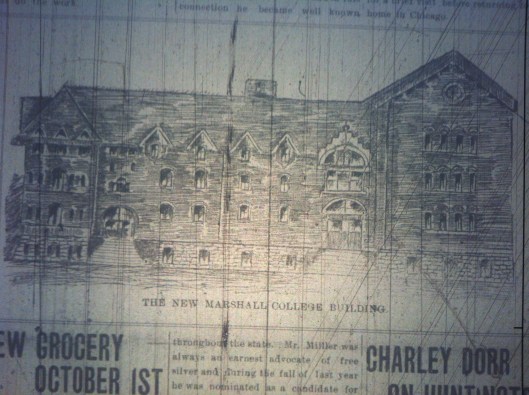
Marshall College (1897)

19 Thursday Oct 2017

Posted by Brandon Ray Kirk in Huntington

≈ Leave a comment

Tags

Appalachia, Cabell County, history, Huntington, Huntington Advertiser, Marshall College, Marshall University

New Marshall Building HuA 08.16.1897

Huntington (WV) Advertiser, 16 August 1897.

New Marshall College Building HuA 12.23.1897

Huntington (WV) Advertiser, 23 December 1897.

Halloween Traditions (1899)

17 Tuesday Oct 2017

Posted by Brandon Ray Kirk in Huntington, Women's History

≈ Leave a comment

Tags

Appalachia, culture, England, Halloween, history, Huntington, Huntington Advertiser, Ireland, Scotland, Wales, West Virginia

From the Huntington Advertiser of Huntington, WV, we find the following story dated October 31, 1899:

Tonight is Halloween and the small boy, as well as many of the larger ones, are happy. Girls ditto.

The lads and lassies, particularly of Scotland and Ireland, and the young people of Wales and England, as well as the youth of this and other countries, have for centuries hailed the night of Halloween, the last night in October, as prophetic.

The first ceremony of Halloween among the Scotch is the pulling of a stock or plant of kale. All the company go out and with eyes closed each pulls the first plant of this kind he or she is able to lay hold of. It being big or little, straight or crooked, is prophetic of the size, shape, and other characteristic of the grand object of all the Halloween spells–the husband or wife. If any earth remains clinging to the root, that signifies fortune, and the state of the heart of the stem, as perceptible to the taste, is indicative of the natural temper and disposition of a future spouse.

Burning nuts is a famous Caledonian charm. Two hazel nuts, sacred to the witches, one bearing the name of the lad and the other the lass, are laid in the fire side by side and accordingly as they burn quietly together or start away from one another so will be the progress and issue of the courtship.

Certain forms must be observed to insure the success of a given spell and in the following one there must be no departure from the formula: A maiden should steal out, entirely alone to the kiln, and throw into the pot a ball of blue yarn, holding fast to the end. She should then begin winding the yarn until it resists, whereupon she should demand, “Who holds this yarn?” An answer will be returned from the kiln-pot, naming the Christian and surname of her future spouse.

Another test is for her to take a candle and going, alone by its light only stand before a mirror and eat an apple. Some traditions say one should comb one’s hair instead of eating the apple. The conditions of the spell being perfect, a shadowy face supposed to be that of the maiden’s future husband will be seen in the glass, as if peeping over her shoulder.

Another Scotch ceremony into which the uncanny largely enters as an element is described as follows: One or more go out, as the case may be (for this is a social spell), to a south running spring or rivulet where “three lairds’ lands meet” and dip the left shirt sleeve. Go to bed in sight of a fire and bang the wet sleeve before it to dry. Lie awake watching carefully, and about midnight an apparition having the exact figure of the grand object in question will come and turn the sleeve as if to dry the other side of it.

An interesting Halloween divination that solves matrimonial doubt and banishes uncertainty is accomplished by arranging three dishes upon the hearth. Into the first is put clean water, into second clouded or muddy water, while the third is left empty. The candidate is securely blindfolded and led to the hearth where the dishes are. The left hand is dipped and if by chance it be in the clean water the wife that is to be will come to the bar of matrimony a maid; if in the muddy water, a widow; but if in the empty dish it foretells with equal certainty no marriage at all. This ceremony is three times repeated, the arrangement of the dishes being each time changed.

Ducking for apples and the attempt to secure by means of the mouth only an apple balanced upon a stick suspended from the ceiling upon the end of which is placed a lighted candle provokes much laughter and no little spirited competition.

For a girl to know if she will marry within the year she must obtain a green pea pod in which are exactly nine peas, hang it over the door, and if the next man guest entering be a bachelor her own marriage will follow within twelve months. This spell is sometimes tried at other times than Halloween, but the conditions then are generally considered less favorable.

Three small rings should be purchased by a maiden during the period of a new moon, each at a different place. She should tie them together with her left garter and place them in her left glove with a scrap of paper cut heart-shaped on which her sweetheart’s name has been written in blue ink. The whole should be placed under her pillow when retiring Halloween and she will dream of her sweetheart if she is to marry him.

The future is sometimes prognosticate on Halloween by candle omens. If a candle burns with an azure tint it signifies the presence or near approach of a spirit or gnome. A collection of tallow rising against the candlestick is styled a winding sheet and is deemed an omen of death in the family. A spark in the candle denotes that the observer will shortly receive a letter.

Two cambric needles are named on Halloween and skillfully placed in a vessel of water. If they float, swimming side by side, the course of true love runs smooth for those they represent. If they sink both together, or if one sinks and the other floats, the persons named will not marry each other.

A printed alphabet is cut into its individual letters, which are placed in water faces downward. On the morrow the initial letters of the favored opposite will be found reversed.

Peel an apple so that the skin remains in unbroken sequence. Whirl this skin three times around the head so that when released it passes over the left shoulder and falls to the floor, assuming the initial letter of the chosen one’s name.

Many young girls fill their mouth with water on Halloween and walk or run around the block, being careful not to swallow the water or suffer it to escape from the mouth. If a girl succeeds in doing this the first man met on returning home will be her husband.

To ascertain one’s standing with a sweetheart select at random an apple and quarter it, carefully gathering the seeds from the core. According to the number found, the following formula is used: 1. I love; 2. I love; 3. I love, I say; 4. I love with all my heart; 5. I cast away; 6. He loves; 7. She loves; 8. They both love; 9. He comes; 10. He tarries; 11. He courts; 12. He marries; 13. Honor; 14. Riches.

At some of the American colleges for women it is customary to celebrate Halloween with straw rides, games, and an annual sheet and pillowcase party, where the illuminations are grotesque pumpkins containing candles, and where cakes containing mystic rings, beans, and a coin are served with the refreshments.

Source: “Hallowe’en Is Now Here,” Huntington (WV) Advertiser, 31 October 1899.

Halloween in Huntington (1899)

13 Friday Oct 2017

Posted by Brandon Ray Kirk in Huntington

≈ Leave a comment

Tags

Appalachia, Cabell County, crime, Halloween, history, Huntington, Huntington Advertiser, West Virginia

From the Huntington Advertiser of Huntington, WV, we find the following story dated October 31, 1899:

EDITOR ADVERTISER:

The observance of the evening of October 31st, in Huntington, seems to have sadly deteriorated, or at least is very different from that in the balance of the world. The old time pleasantness and superstitions connected with “Hallow eve,” are lost sight of here, and in their stead are introduced drunkenness and vandalism. The night is made hideous. Women and children terrorized, property wantonly destroyed and life endangered. The night is looked forward to with dread. Now this is all wrong, and some vigorous measures should be taken to protect citizens and taxpayers from the outrages committed on this night in the past few years. Let the city give us the protection we are entitled to. Put on a special police force sufficiently strong for the purpose. $150 or $200 had better be thus invested than to have this much or more property maliciously destroyed and life made miserable besides. Nay, more than this may be averted. A man’s house is his castle, and if the authorities are inadequate to protect him, and he is subjected to the outrages heretofore perpetrated, he may be forced to protect himself, and some serious tragedy result, which under the circumstances the law can only justify. It is to be hoped the authorities will take action in the matter, and lawless individuals take warning in time.

A TAX PAYER

Source: “Hallow Eve,” Huntington (WV) Advertiser, 31 October 1899.

Burbus Clinton Spurlock

13 Friday Oct 2017

Posted by Brandon Ray Kirk in Big Ugly Creek, Guyandotte River, Huntington, Midkiff

≈ Leave a comment

Tags

Appalachia, Big Ugly Creek, Burbus Clinton Spurlock, genealogy, Hamilton Fry, history, Huntington, Jefferson District, Lincoln County, merchant, Midkiff, Nancy Ann Spurlock, Nancy Fry, Nancy Spurlock, Robinson Spurlock, West Virginia

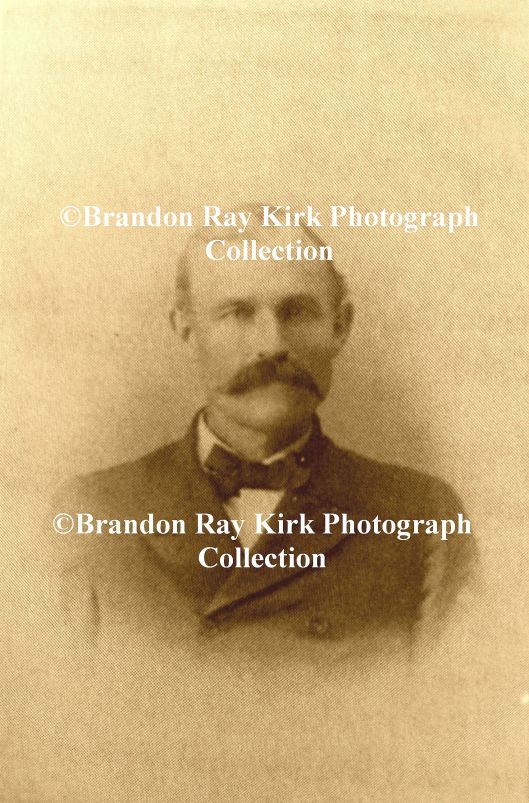
B.C. Spurlock copyright

Burbus Clinton Spurlock (1851-1940), son of Robinson and Nancy (Cummings) Spurlock of Jefferson District, Lincoln County, WV. About 1876, he married Nancy Ann Fry, daughter of Hamilton and Nancy (Hunter) Fry, of Big Ugly Creek. He lived at Midkiff in Lincoln County, where he appears in 1900 and 1910 census records. He was a well-known capitalist in the Guyandotte Valley, retiring to Huntington.

Chapmanville News 07.02.1926

13 Friday Oct 2017

Posted by Brandon Ray Kirk in Chapmanville, Huntington

≈ Leave a comment

Tags

Appalachia, Cam Pridemore, Chapmanville, Democratic Party, deputy sheriff, G.S. Ferrell, H.T. Butcher, history, Hubert Toney, Huntington, John Webb, Logan Banner, Logan County, Martin Johnson, moonshine, moonshining, Peach Creek, Republican Party, Route 10, Squire Barker, Sutton, W.H. Phipps, West Virginia

An unknown correspondent from Chapmanville in Logan County, West Virginia, offered the following items, which the Logan Banner printed on July 2, 1926:

The grading of our road is not quite done, but the road is open to traffic to Huntington.

W.H. Phipps of Peach Creek was here Monday and Tuesday of this week.

Cam Pridemore is the best deputy sheriff we have had for years.

Squire Barker is kept busy hiving bees these hot days.

Ask John Webb what it costs to get a taxi here.

Martin Johnson has purchased the wholesale feed store of G.S. Ferrell. We like to see new capital come to town.

Hubert Toney and wife left his morning for Sutton to visit Mrs. Toney’s parents at that place.

The Democrats can’t see how there comes to be so many Republicans here this time.

H.T. Butcher is making the bootlegger’s life a hard one these days.

Mrs. Henry Clay Ragland’s Obituary (1914)

25 Monday Sep 2017

Posted by Brandon Ray Kirk in Civil War, Huntington, Logan, Matewan, Women's History

≈ 2 Comments

Tags

5th Virginia Cavalry, Appalachia, Aracoma Baptist Church, B.B. Goings, Blaine Creek, Christian Church, G.B. Hamilton, genealogy, Henry Clay Ragland, history, Huntington, John A. Sheppard, Kentucky, Lawrence County, Logan, Logan Banner, Logan County, Lou Ragland, Matewan, Mingo County, Robert W. Buskirk, Urias Buskirk, Urias Hotel, West Virginia, Williamson

From the Logan Banner of Logan, WV, we find the following story dated April 17, 1914:

“GRANDMA” RAGLAND PASSES TO THE BEYOND

MATE OF MAJOR HENRY CLAY RAGLAND, EDITOR OF THE LOGAN BANNER FOR MANY YEARS, PLACED BESIDE HIM EASTER SUNDAY

Mrs. Lou Ragland, mother of the Buskirk family, of this region died last Friday a.m. at the home of her son, Robert W. Buskirk, in the Urias Hotel at Matewan, Mingo county. She had married Henry Clay Ragland, for a long time editor of the Logan Banner, after the death of her first husband, Urias Buskirk. By her first marriage she raised a most interesting family of sons and daughters who are still residing in this section. Mrs. Buskirk was a most remarkable woman in many respects. She had always lived an exemplary and Christian life and assumed her responsibilities after the death of her first husband with efficiency and diligence. She was true to friend and family and was a good and faithful mother and a loving wife. Through her long life she has retained the confidence and respect of all who knew her. We grieve with her relatives and friends at her death. She was near the ninety-two milestone when she died and had been sick only for a few days.

“Grandma” Ragland’s exact age was 91 yrs. 11 mo. 20 days; born on Blain creek, Lawrence county, Ky., May 1st, 1823. For 30 years a member of the Christian church.

On May 1st also (1911) Major Ragland died. He was born on May 7th, 1844; belonged to Co. B 5th Va. Cavalry; member of the Aracoma Baptist church.

Mrs. Ragland’s last request, to rest one night in her old bedroom–the present residence of Rev. Bradshaw–was complied with. This parsonage now becomes the property of the Baptist church, according to the terms of Major Ragland’s deed, at her death.

Her age indicates her wonderful physical endurance, and while she knew she must die soon, retained her usual discretion and fortitude. She made plans with her kindred as to where her last resting place should be and desired that none of her children and friends be troubled about her demise. Up to the last she kept her mind intact and conversed with those near to her.

The mother of the Buskirks has gone, we hope, to a happier sphere. Mother is the dearest friend on earth. We grieve at the bier of the departed with the bereaved, and shed a tear with them in their desolation as we think of our own dear mother. Our sympathies go out to the bereaved ones in the loss of their one best comforter, but we hope and continue to hope that we may meet again in the unknown hereafter.

***

On April 17, 1914, the Logan Banner offered a small additional item: “Among those in attendance at the funeral of ‘Grandma’ Ragland last Sunday were: B.B. Goings, Williamson; Jno. A. Sheppard, Huntington; G.B. Hamilton, Matewan; in addition to the sons of the deceased.”

Old-Timey Children’s Games in Appalachia (1900)

22 Friday Sep 2017

Posted by Brandon Ray Kirk in Huntington

≈ Leave a comment

Tags

A.J. Miser, Appalachia, bull pen, Cabell County, circuit clerk, duck-legs, history, Huntington, Huntington Advertiser, J.L. Thornburg, marbles, R.W. McWilliams, spelling bee, West Virginia

From the Huntington Advertiser of Huntington, WV, we find the following story dated 13 January 1900:

WHEN WE WERE BOYS

THREE CITIZENS TELL OF GAMES WITH WHICH THEY WHILED AWAY THEIR HOURS

“When I was a boy,” said J.L. Thornburg, “great attention was paid to spelling. A long string of youngsters would stand up, and the good spellers would turn the others down. The one who stood at the head of the class received, as a badge of honor, a silver dollar with a hole in it, through which was slipped a ribbon to wear about his neck. I stood next to the top when, for some misdemeanor, I was sent to the foot of the class, and sentenced to carry a stick of wood with me for an entire day. The spelling lesson that day had several breakers in it, but I was not distressed, as I could go no lower in the class. Finally a particularly hard orthographic nut was given to the wearer of the silver dollar. He failed, and one after another, the scholars missed the terrible word as it came down the line. I happened to know the word, spelled it, and with my badge of ignominy, the stick of wood, on my shoulder, went to the top of the class. That evening I wore the silver dollar home.”

“When I was a boy,” said Squire A.J. Miser, “there was a time in the year when all the boys, at the same time, would be seized with the desire to play marbles. Nobody could account for this simultaneous seizure. It appeared and disappeared like an epidemic. There was another epidemic that appeared much like marbles, ravaged the country and was gone for another twelve month. This was stilt-walking, and it was desperately contagious. Perhaps the most malignant form was ‘duck-legs.’ These were short stilts, the handles being sawed off so that they reached the boy’s knees, and from there to the foot-rests were strapped to the legs with rope or leather. It was no easy matter to take off one’s duck-legs when properly strapped on and cross-gartered, and many a time have I gone without dinner rather than take off my wooden pins, my mother having an old-fashioned prejudice running in favor of natural legs at meal time. On some occasion I escaped this maternal surveillance and succeeding in sleeping in my duck legs, to the great disturbance of the circulation off the blood. Heigh-ho! I haven’t seen a pair of duck-legs for forty years or more.”

“When I was a boy,” said Circuit Clerk R.W. McWilliams, a number of out door games, common at that time have long since passed away. One of these was bull pen. It was played by eight boys. Four stood, one at each corner of a rectangular square, and four in the center of the pen. The four on the corners passed the ball rapidly from one to the other, and when it was ‘warm’ the holder threw it at one of the victims in the center. When one in the pen picked up the ball the boys on the corners scattered, for the boys in the pen could then throw at the corner lads. It was a rough game and boys were often struck hard. This was in the early days of India rubber. The rubber shoes were made in South America in a crude way. An old rubber shoe was cut up into strings to make this ball; the strings were wound, covered with yarn and then covered with leather. There was a good deal of bounce in such a ball, and when it kissed a boy there was plenty of sting in it. Another game of that time was fox and hounds. One boy, as the fox, carried a horn. He was given about a hundred yards’ start of the hounds, who were to catch him. I have known such a race to last nearly all day.”

Chapmanville News 06.03.1921

19 Tuesday Sep 2017

Posted by Brandon Ray Kirk in Boone County, Chapmanville, Huntington, Logan

≈ Leave a comment

Tags

Boone County, C.B. Hainor, Chapmanville, Cora McKinney, Decoration Day, E.P. Stowers, Emma Stowers, Erie Blevins, Floyd Barker, genealogy, Henlawson, history, Hughey, Huntington, Logan, Logan Banner, Logan County, Lottie Hainor, Lula Blevins, Manila, Nellie Barker, Robert Hainor, St. Albans, Thermal Hainor, W.G. Willis, West Virginia, Wilsondale

An unknown correspondent from Chapmanville in Logan County, West Virginia, offered the following items, which the Logan Banner printed on June 3, 1921:

Mr. and Mrs. Robert Hainor attended the decoration exercises at Manila Sunday.

W.G. Willis made a business trip to Logan Saturday.

E.P. Stowers and Miss Emma Stowers returned Wednesday from a business trip to Huntington.

Uncle Floyd Barker, of St. Albans, is visiting relatives here this week and attending decoration.

Mrs. Lottie Hainor and daughter Thermal left Sunday afternoon for a visit with relatives at Henlawson.

Mrs. Cora McKinney spent Sunday with friends here.

Miss Erie Blevins, who is staying at Hughey, spent Sunday with her parents at this place.

Miss Nellie Barker was called to Wilsondale Sunday on account of the illness of her sister.

We are glad to say that Miss Lula Blevins, who has been staying at Hughey, has returned to her home here.

Mrs. C.B. Hainor visited friends at Manila Sunday.

An exciting incident occurred on last Saturday evening that might have caused serious loss to the firm of Stowers and Garrett and besmirched the glorious record they have been making the past few weeks as peddlers. As they were returning home, Mr. Garrett noticed a large fowl in a wheat field, he proceeded to capture it and confine it in his chicken coop. Thinking he had captured some rare bird of the tropical jungles, he drove with all speed to the home of Mr. Stowers where some of the family promptly pronounced it to be a turkey but Messrs. Stowers and Garret had their own opinion on the matter and had already decided they had captured a parrot. They had christened him “___m” and were already beginning to teach him to talk. However he didn’t show much aptitude as a pupil, but stood with dull expressionless eyes and his long crooked bill of a mouth wide open. After much deliberation they were finally convinced that they had not captured a “Poll Parrot” but a vulture or more commonly speaking, a buzzard. When they were convinced of this they opened the coop and Mr. Buzzard flew away to his rightful dominion, while their golden dream of selling a parrot to some enterprising Loganite vanished away on the soaring wings of the “Buzzard.”

Chapmanville News 05.27.1921

14 Thursday Sep 2017

Posted by Brandon Ray Kirk in Banco, Chapmanville, Ferrellsburg, Huntington

≈ Leave a comment

Tags

A.H. Curry, Appalachia, Arnold Saunders, Banco, Chapmanville, Charles Hainor, Cleophas Saunders, Emma Stowers, Erie Blevins, Ferrellsburg, genealogy, George Seagraves, ginseng, Glenna Beckett, Hewlette Curry, history, Homer McDonald, Howard Barker, Hughey, Huntington, Ida Blevins, Jeffrey, Jesse Mullins, Jessie Adkins, Lace Browning, Lacy Ball, Logan Banner, Logan County, Nellie Barker, Opal Bryant, Peach Creek, Ross Stowers, Ruth Beckett, Saunders and Barker, Sid Croft, Thermal Hainor, Walton Garrett, West Virginia, Willard Curry

An unknown correspondent from Chapmanville in Logan County, West Virginia, offered the following items, which the Logan Banner printed on May 27, 1921:

Mr. Cleophas Saunders and Sid Croft motored over from Jeffrey Monday to attend to business matters here.

Mrs. George Seagraves was calling on Miss Emma Stowers Tuesday evening.

Mr. and Mrs. Hewlette Curry of Huntington are spending the week with Mr. Curry’s parents here.

Arnold Saunders, the popular young clerk in the store of Saunders and Barker, was called to his home the first of the week on account of the death of a friend.

Miss Jessie Adkins of Ferrellsburg is staying with her sister, Mrs. Lace Browning, of this place.

Mr. and Mrs. Hewlette Curry were the guests of Mrs. Willard Curry Friday evening.

Mr. and Mrs. George Seagraves were calling on Mrs. A.H. Curry Sunday.

Mr. and Mrs. Walton Garrett visited relatives at Banco Sunday.

Miss Erie Blevins left Monday for an extended visit with her sister, Mrs. Homer McDonald at Hughey.

Miss Ross Stowers is spending the week with her sister at Peach Creek.

Lacy Ball of Jeffrey was calling on Miss Nellie Barker Sunday.

Jesse Mullins and family were motoring Sunday.

Miss Ida Blevins was calling on Miss Thermal Hainor Sunday afternoon.

Charles Hainor and  Howard Barker were out ginseng digging Friday. They made a tour of about twelve miles through the hills and only dug six bunches each. Better luck next time, boys.

Misses Glenna and Ruth Beckett were calling on Miss Opal Bryant Sunday.

Note: This entry was dated May 18, 1921.

Corpse Found in River at Chapmanville, WV (1927)

13 Wednesday Sep 2017

Posted by Brandon Ray Kirk in Chapmanville, Guyandotte River, Huntington, Logan

≈ Leave a comment

Tags

Appalachia, B.C. Harris, Branchland, Carlos Hatfield, Chapmanville, Chauncey, E.M. Jeffrey, genealogy, Guyandotte, Guyandotte River, Henlawson, history, Huntington, Island Creek, J.D. Parsley, J.F. May, Lincoln County, Logan, Logan Banner, Logan County, Mud Fork, Omar, West Virginia, Williamson

From the Logan Banner of Logan, WV, we find the following story dated 29 March 1927:

All doubt as to the body of the woman found a mile above Chapmanville last Friday being that of Mrs. J.D. Parsley of Omar was removed that evening. Identification was positive on account of her wedding ring and her shoes.

So badly decomposed was the body, the flesh of the face having wasted away, that identification would have been impossible except for the ring or bits of clothing. In fact, its condition was such that it was recovered with sand at the place where found, after the identification was completed and after Undertaker B.C. Harris reached the scene, it being decided to await instructions from Mr. Parsley. The body had been in water more than three months, for it was on December 21 that she was drowned in the flooded waters of Main Island Creek near her home between Omar and Chauncey. From that point to the point where the  body was found is 22 miles, according to estimates of some deputy sheriffs who are familiar with Logan county distances.

Friday evening Mr. Parsley was located in Huntington, whither he had moved a few weeks ago to engage in the real estate business.

Mr. Parsley came to Chapmanville on the Saturday morning train, bringing a casket with him. Sunday the body was brought on a railway motor to Henlawson and then was taken by way of Charleston to Wayne county for burial. This was done because of the certainty the railway company would not transport the body from Chapmanville to  Huntington or to any other point on a passenger train.

Mr. Parsley, it is said, recognized a scar on his wife’s body–a scar left by a surgical operation.

The finder of the body was a Scarberry boy who lives near the place where it was found. It was lying near the shore, partly covered by silt, with the head wedged under a log or between two logs, according to reports heard here.

From the day of Mrs. Parsley’s tragic death till the body was found scandal-mongers busied themselves circulating reports that she had not drowned but had gone away of her own accord. As late as last Wednesday a Banner reporter was told that she was living in Guyandotte.

Concerning the drowning of Mrs. Parsley The Banner on Friday December 24 published the following account:

In the swollen waters of Main Island Creek Mrs. J.D. Parsley was drowned near her home between Omar and Chauncey at about 5:30 Tuesday evening.

Stepping into a necessary outbuilding that stood on the creek bank behind her home, the building suddenly toppled over and crashed into the swirling tide. Her screams were heard by several persons, among them Carlos Hatfield, a neighbor, who rushed to the rescue. When he reached the bank he saw Mrs. Parsley struggling in the water close to the shore and at the same time being carried swiftly forward by the stream. Just behind her was the building from which she had extricated herself. He waded into the waters and was almost within reach when the building turned over on her and shoved her beneath it out of sight. Before she reappeared on the surface she was too far down stream and too far out in the swift current for Hatfield to reach her.

Reports received here indicate that a son of E.M. Jeffrey of Omar was attracted to the scene and got a glimpse of either Mrs. Parsley or the building, or probably both, and followed along the bank until he saw the building crash into the bridge at Chauncey. The impact shattered the frail structure into pieces that were soon carried from view.

During the night and Wednesday forenoon searchers scanned the banks of the creek in what proved to be a futile effort to find the body.

Mrs. Parsley was nearing her 40th birthday. Her maiden name was Clay, according to her neighbors, and it is said her parents live at Branchland. She leaves no children, though Parsley is the father of several children by a previous marriage.

The Parsleys moved to the present home last August, when he leased a garage from Oscar Napier. This is located near the home of Dr. J.F. May and also close to the garage of Carlos Hatfield, previously mentioned as having tried to rescue the drowning woman. Before moving to the Omar-Chauncey neighborhood, Parsley had a grocery store at Mud Fork. At one time he was in the merchandise business at Williamson.

When the drowning occurred Parsley was at work in his garage. Word came to him that a woman had drowned, but it was half an hour or more before he realized that the victim was his own wife.

Source: “Body Found at Chapmanville is Identified as that of Mrs. Parsley Drowned at Omar on December 21,” Logan Banner, 29 March 1927.

***

Mrs. Parsley’s death record is found here: http://www.wvculture.org/vrr/va_view2.aspx?FilmNumber=1953328&ImageNumber=3233


Chapmanville News 05.20.1921

12 Tuesday Sep 2017

Posted by Brandon Ray Kirk in Chapmanville, Huntington, Logan, Women's History

≈ Leave a comment

Tags

Appalachia, Arda Jeffrey, Beecher Barker, Beecher Curry, C.B. Hainor, Chapmanville, Charlie Garrett, Dr. Stanley, Dyke Garrett, Eliza Garrett, Ella Garrett, Erie Blevins, genealogy, George H. Seagraves, Henry McKinney, Herbert McKinney, history, Huntington, Ida Garrett, J.D. Ball, James Bryant, John Hunter, Kate Barker, Kentucky, Kyle Hill, Lacy Ball, Lacy Browning, Logan, Logan Banner, Logan County, Myrtle McKinney, Nora Stollings, Ohio, Opie Pridemore, P.D. Blevins, Robert Hainor, Rosa Stowers, Russell, Stollie Hainor, tonsilitis, W.G. Willis, Wallace Garrett, Warren, West Virginia, Wilsondale

An unknown correspondent from Chapmanville in Logan County, West Virginia, offered the following items, which the Logan Banner printed on May 20, 1921:

Mrs. George H. Seagraves has returned from a visit with her husband’s relatives in Warren, Ohio. She is preparing for house keeping at Wilsondale.

Miss Rosa Stowers is convalescing from a severe attack of tonsilitis.

Miss Ida Garrett, who is working in Huntington, is spending the week with her parents here.

Most of the boys and some of the men were highly elated over the recent rains which caused a rise in the creek and gave them an excuse to “lay off” the spring work and go fishing.

Miss Kate Barker of Logan spent Saturday and Sunday with relatives here.

Dr. Stanley, veterinarian, of Logan made a professional visit to W.G. Willis’ Saturday.

P.D. Blevins of Logan spent Sunday with his mother here.

Mr. and Mrs. James Bryant of Russell, Kentucky, are visiting relatives here this week.

Lacy Browning, who is working at Logan, spent Sunday with his wife.

The wedding bells were ringing Sunday for two of our young folks. The bride was Miss Arda Jeffrey and the groom Mr. Herbert McKinney. The ceremony was performed at the home of the bride of Rev. W.D. Garrett.

Beecher Curry was calling on Miss Erie Blevins Sunday. It is our opinion that “Uncle Dyke” will be called upon to don his surplice again soon.

C.B. Hainor and family were visiting at J.D. Ball’s Sunday afternoon.

Lacy Ball of Jeffry was seen on our streets Sunday. He seemed to be all smiles. The reason: He was manipulating the “brand new” Ford, and had one of our best looking girls by his side.

Miss Erie Blevins was a charming hostess to a small party of her friends on Saturday night from eight to eleven o’clock. Chocolate fudge was served. Among the invited guests were Misses Eliza and Ella Garrett, Ida Garrett, Nora Stollings and Myrtle McKinney, Messrs. Stollie Hainor, Kyle Hill, Charlie Garrett, Beecher Barker and Henry McKinney. Everyone reported a nice time.

On last Sunday morning at ten o’clock some of the folks of the community under the leadership of Wallace Garrett and Robert Hainor met at the school house for the purpose of organizing a Sunday School. The first meeting of the school will be at 10:30 the 15th. Everybody welcome.

Kyle Hill of Logan was visiting Stollie Hainor Sunday.

Mrs. John Hunter was visiting her daughter Mrs. Opie Pridemore Sunday.

Best wishes for the Banner.

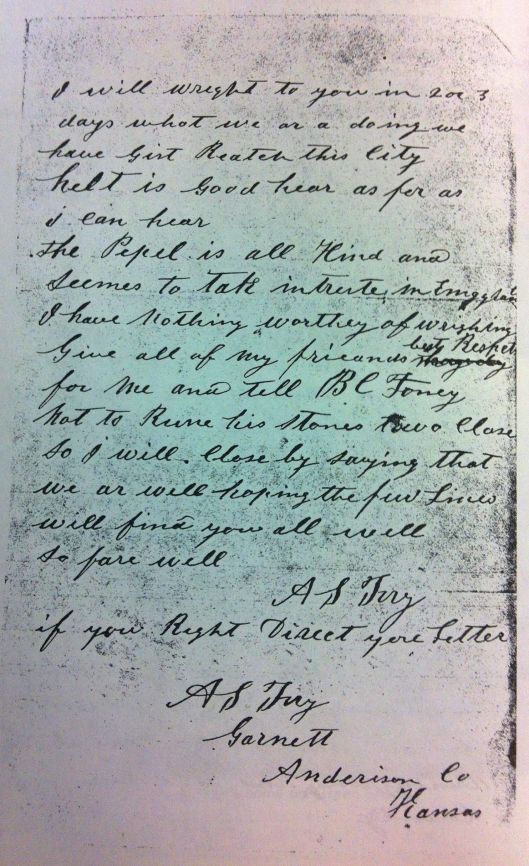
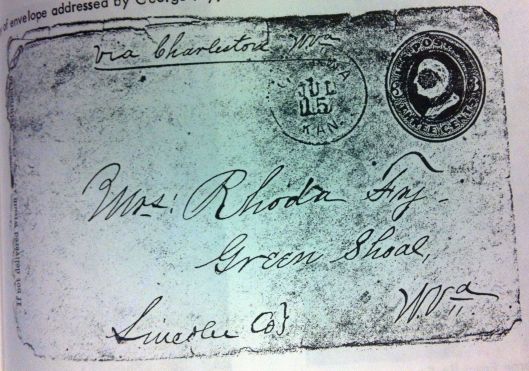
Admiral S. Fry Letter (1880)

11 Monday Sep 2017

Posted by Brandon Ray Kirk in Green Shoal, Huntington, Lincoln County Feud, Music, Women's History

≈ 3 Comments

Tags

Admiral S. Fry, Anderson County, Appalachia, Burbus Toney, Charleston, Cincinnati, Franklin County, Garnett, genealogy, George Fry, Green Shoal, history, Huntington, J.S. Caldwell, Kansas, Lincoln County, music, Ohio, Ottawa, Rhoda Fry, Tolbert S. Godby, West Virginia

A.S. Fry Letter 1A.S. Fry Letter 2A.S. Fry Letter 3

A.S. Fry Letter 4

I descend from three of A.S. Fry’s siblings: Christian Fry, Emily (Fry) Lucas, and Druzilla (Fry) Abbott. A.S. Fry’s son, George Fry, is a central character in my book, “Blood in West Virginia: Brumfield v. McCoy.”

Food in the Logan Coal Fields (1921)

11 Monday Sep 2017

Posted by Brandon Ray Kirk in Barboursville, Coal, Holden, Huntington, Logan

≈ Leave a comment

Tags

Appalachia, Barboursville, coal, history, Holden, Huntington, Logan, Logan Banner, Logan County, Omar, West Virginia

From the Logan Banner of Logan, WV, we find this story about food conditions in the Logan coal fields, dated 9 December 1921:

Seasonal fruits and fresh vegetables brighten the menu of the Logan field miner and his family just as they do the average householder in the larger cities. Visitors have noted with surprise that this is true–that even the most isolated mining communities, cut off from civilization by rugged mountains and difficult creek beds, have their fresh strawberries in season and make quite as much of an event of the canning period as do their northern neighbors.

But what the average visitor cannot know, unless he delves with unusual energy, is the cost in money and time which it means to have such products brought to the miner’s table from the produce centers of the country.

In the first place, many of the mines in the field live five, ten, fifteen and even twenty miles from the town of Logan. The roads in many cases are almost impassible. In others, there are no roads at all. It is common occurrence to use the creek bed as a thoroughfare. A rather hazardous feat, it appears to the visitors on his first trip, but he soon grows accustomed to this. At first he is inclined to cling tight to his seat as the motor truck plows through the shallow water over well rounded stones. The drivers think nothing of fording innumerable creeks. They have lost all solicitude for their tires. In fact, many of them aver that the tires last quite as long as they do on hard-paved roads and point to examples in the form of weather-beaten casing to prove that the usual 10,000 mile guarantee is not at all impossible of achievement in this difficult territory.

Sloshing along through creeks, alternating with mud roads which would bring a rattle to the finest car built they consider the trips to the mines with foodstuffs a mere routine. That it is more than routine, however, is graphically revealed by the wrecks along the roadside–broken-down trucks and motor cars, buggies and wagons.

The road to Holden, four miles from Logan, is a mud road most of the way, featured by innumerable sharp turns. That leading to the mine town of Omar covers nine miles of the most diversified transportation. In that nine miles one single creek must be forded eleven times, and often instead of crossing directly, motor trucks are forced to plow through the water for a considerable distance.

Some sixth sense apparently tells the driver where the “water road” lies, for to the casual observer one part of the creek is as good as another. All he can see is water and, beneath, a solid bed of white boulders. Time has worn them smooth. Sliding down the mud road into the creek bed the driver unerringly picks out the right route. It is as if he carried a sextant, for never, however many times he makes the trip, does he deviate in his course a yard.

Yet despite these difficulties in transportation it is comparatively cheap to get to any mine property in the Logan field. For a dollar, any of the buses operating from Logan, meeting all trains, will carry one to Omar, nine miles of difficult driving, while others take passengers 15 and 20 miles up the creeks for a slightly higher charge. For foodstuffs the cost is proportionately low. Drivers charge 25 to 42 cents per 100 pounds for first class freight to a point within 20 miles of Logan–and take every chance in the world of a breakdown. It is this low haulage charge which enables so many independent and company stores at the mines to meet the prices of retailers in large cities, and it is the dependability of this method of motor transportation which enables them to carry fresh fruits and vegetables in season to tickle the palates of the miners and their numerous progeny. Anyone who imagines that sow-belly and beans constitute the main diet of the miner has never seen the adequate stocks of merchandise kept by mining community establishments.

If there were not enough difficulties in the path of transportation of foods to the mines, the trip from the outside to Logan would provide enough more. Logan is unfortunate in that there are no through freight rates to it. Huntington, the State’s natural distributing point by reason of railroad facilities, does not figure in the traffic to Logan. Merchandise destined for this field must be reshipped at Barboursville, a junction point near Huntington, and this adds a freight charge of from 30 to 40 cents per 100 pounds. Adding this to the cost of haulage by truck to the mines, the differential in favor of the consumers in large cities mounts up. Yet, with all these barriers, prices in the mine towns are low–the result of keen competition and of quantity buying.

Source: “Camps Have the Best of Food: Despite Shipping Obstacles Miners Have Same Food as Their City Neighbors,” Logan (WV) Banner, 9 December 1921.

Chapmanville News 02.25.1927

01 Friday Sep 2017

Posted by Brandon Ray Kirk in Chapmanville, Huntington

≈ Leave a comment

Tags

Appalachia, B.H. Snidow, Big Creek, Chapmanville, Chapmanville School, Charleston, Dr. J.T. Ferrell, Eva Barker, genealogy, Huntington, Logan Banner, Logan County, Mary Click, New Haven, Ravenswood, Robert Carter, Ruby Saunders, West Virginia

An unknown correspondent from Chapmanville in Logan County, West Virginia, offered the following items, which the Logan Banner printed on February 25, 1927:

The revival meeting which had been going on for the past two weeks closed Sunday night.

The Chapmanville school gave a very interesting patriotic program Tuesday afternoon. Everyone seemed to enjoy it immensely.

Dr. J.T. Ferrell returned Monday after spending the week end in New Haven.

Robert Carter of Huntington is visiting his mother here at the present time.

B.H. Snidow made a business trip to Logan Saturday.

Miss Eva Barker was seen on our streets Saturday.

Mrs. Click of Ravenswood spent the week end in Chapmanville with her daughter, Mary Click.

Our school nurse, Miss Collins, spent the week end in Charleston.

Miss Ruby Saunders spent Sunday at Big Creek with her parents.

Kyle seems rather downhearted here of late. Wonder where the little school teacher is?

Daily scenes: Jane and her curls; Kyle going to the offfice; Neolen and her sweater; Vanzel on his way to Chapmanville; Miss Click singing, “Bye, Bye Black Bird”; Inez on her way to school.

← Older posts
Newer posts →

Feud Poll 1

If you had lived in the Harts Creek community during the 1880s, to which faction of feudists might you have given your loyalty?

Categories

  • Adkins Mill
  • African American History
  • American Revolutionary War
  • Ashland
  • Atenville
  • Banco
  • Barboursville
  • Battle of Blair Mountain
  • Beech Creek
  • Big Creek
  • Big Harts Creek
  • Big Sandy Valley
  • Big Ugly Creek
  • Boone County
  • Breeden
  • Calhoun County
  • Cemeteries
  • Chapmanville
  • Civil War
  • Clay County
  • Clothier
  • Coal
  • Cove Gap
  • Crawley Creek
  • Culture of Honor
  • Dingess
  • Dollie
  • Dunlow
  • East Lynn
  • Ed Haley
  • Eden Park
  • Enslow
  • Estep
  • Ethel
  • Ferrellsburg
  • Fourteen
  • French-Eversole Feud
  • Gilbert
  • Giles County
  • Gill
  • Green Shoal
  • Guyandotte River
  • Halcyon
  • Hamlin
  • Harts
  • Hatfield-McCoy Feud
  • Holden
  • Hungarian-American History
  • Huntington
  • Inez
  • Irish-Americans
  • Italian American History
  • Jamboree
  • Jewish History
  • John Hartford
  • Kermit
  • Kiahsville
  • Kitchen
  • Leet
  • Lincoln County Feud
  • Little Harts Creek
  • Logan
  • Man
  • Matewan
  • Meador
  • Midkiff
  • Monroe County
  • Montgomery County
  • Music
  • Native American History
  • Peach Creek
  • Pearl Adkins Diary
  • Pecks Mill
  • Peter Creek
  • Pikeville
  • Pilgrim
  • Poetry
  • Queens Ridge
  • Ranger
  • Rector
  • Roane County
  • Rowan County Feud
  • Salt Rock
  • Sand Creek
  • Shively
  • Spears
  • Sports
  • Spottswood
  • Spurlockville
  • Stiltner
  • Stone Branch
  • Tazewell County
  • Timber
  • Tom Dula
  • Toney
  • Turner-Howard Feud
  • Twelve Pole Creek
  • Uncategorized
  • Warren
  • Wayne
  • West Hamlin
  • Wewanta
  • Wharncliffe
  • Whirlwind
  • Williamson
  • Women's History
  • World War I
  • Wyoming County
  • Yantus

Feud Poll 2

Do you think Milt Haley and Green McCoy committed the ambush on Al and Hollene Brumfield in 1889?

Blogroll

  • Ancestry.com
  • Ashland (KY) Daily Independent News Article
  • Author FB page
  • Beckley (WV) Register-Herald News Article
  • Big Sandy News (KY) News Article
  • Blood in West Virginia FB
  • Blood in West Virginia order
  • Chapters TV Program
  • Facebook
  • Ghosts of Guyan
  • Herald-Dispatch News Article 1
  • Herald-Dispatch News Article 2
  • In Search of Ed Haley
  • Instagram
  • Lincoln (WV) Journal News Article
  • Lincoln (WV) Journal Thumbs Up
  • Lincoln County
  • Lincoln County Feud
  • Lincoln County Feud Lecture
  • LinkedIn
  • Logan (WV) Banner News Article
  • Lunch With Books
  • Our Overmountain Men: The Revolutionary War in Western Virginia (1775-1783)
  • Pinterest
  • Scarborough Society's Art and Lecture Series
  • Smithsonian Article
  • Spirit of Jefferson News Article
  • The Friendly Neighbor Radio Show 1
  • The Friendly Neighbor Radio Show 2
  • The Friendly Neighbor Radio Show 3
  • The Friendly Neighbor Radio Show 4
  • The New Yorker
  • The State Journal's 55 Good Things About WV
  • tumblr.
  • Twitter
  • Website
  • Weirton (WV) Daily Times Article
  • Wheeling (WV) Intelligencer News Article 1
  • Wheeling (WV) Intelligencer News Article 2
  • WOWK TV
  • Writers Can Read Open Mic Night

Feud Poll 3

Who do you think organized the ambush of Al and Hollene Brumfield in 1889?

Recent Posts

  • Logan County Jail in Logan, WV
  • Absentee Landowners of Magnolia District (1890, 1892, 1894)
  • Charles Spurlock Survey at Fourteen Mile Creek, Lincoln County, WV (1815)

Ed Haley Poll 1

What do you think caused Ed Haley to lose his sight when he was three years old?

Top Posts & Pages

  • Anthony Lawson founds Lawsonville
  • Old-Timey Children's Games in Appalachia (1900)
  • Logan Memorial Park in McConnell, WV (1928, 2020)
  • Ben France: Confederate Soldier and Fiddler from Cabell County, WV
  • Banco News 06.04.1926

Copyright

© Brandon Ray Kirk and brandonraykirk.wordpress.com, 1987-2023. Unauthorized use and/or duplication of this material without express and written permission from this blog’s author and/or owner is strictly prohibited. Excerpts and links may be used, provided that full and clear credit is given to Brandon Ray Kirk and brandonraykirk.wordpress.com with appropriate and specific direction to the original content.

Archives

  • February 2025
  • January 2025
  • October 2023
  • September 2023
  • December 2022
  • November 2022
  • May 2022
  • April 2022
  • February 2022
  • November 2021
  • October 2021
  • September 2021
  • June 2021
  • May 2021
  • April 2021
  • March 2021
  • February 2021
  • January 2021
  • December 2020
  • November 2020
  • October 2020
  • July 2020
  • June 2020
  • May 2020
  • April 2020
  • March 2020
  • February 2020
  • January 2020
  • December 2019
  • November 2019
  • October 2019
  • September 2019
  • August 2019
  • July 2019
  • June 2019
  • May 2019
  • April 2019
  • March 2019
  • February 2019
  • January 2019
  • December 2018
  • November 2018
  • October 2018
  • September 2018
  • August 2018
  • July 2018
  • June 2018
  • May 2018
  • April 2018
  • March 2018
  • February 2018
  • January 2018
  • December 2017
  • November 2017
  • October 2017
  • September 2017
  • August 2017
  • July 2017
  • June 2017
  • May 2017
  • April 2017
  • March 2017
  • February 2017
  • January 2017
  • December 2016
  • November 2016
  • October 2016
  • September 2016
  • August 2016
  • July 2016
  • June 2016
  • May 2016
  • April 2016
  • March 2016
  • February 2016
  • January 2016
  • December 2015
  • November 2015
  • October 2015
  • September 2015
  • August 2015
  • July 2015
  • June 2015
  • May 2015
  • April 2015
  • March 2015
  • February 2015
  • January 2015
  • December 2014
  • October 2014
  • September 2014
  • August 2014
  • July 2014
  • June 2014
  • May 2014
  • April 2014
  • March 2014
  • February 2014
  • January 2014
  • December 2013
  • November 2013
  • October 2013
  • September 2013
  • August 2013
  • July 2013
  • June 2013
  • May 2013
  • April 2013
  • March 2013
  • February 2013
  • January 2013
  • December 2012
  • November 2012

Enter your email address to follow this blog and receive notifications of new posts by email.

Join 2,927 other subscribers

Tags

Appalachia Ashland Big Creek Big Ugly Creek Blood in West Virginia Brandon Kirk Cabell County cemeteries Chapmanville Charleston civil war coal Confederate Army crime culture Ed Haley Ella Haley Ferrellsburg feud fiddler fiddling genealogy Green McCoy Guyandotte River Harts Harts Creek Hatfield-McCoy Feud history Huntington John Hartford Kentucky Lawrence Haley life Lincoln County Lincoln County Feud Logan Logan Banner Logan County Milt Haley Mingo County music Ohio photos timbering U.S. South Virginia Wayne County West Virginia Whirlwind writing

Blogs I Follow

  • OtterTales
  • Our Appalachia: A Blog Created by Students of Brandon Kirk
  • Piedmont Trails
  • Truman Capote
  • Appalachian Diaspora

BLOOD IN WEST VIRGINIA is now available for order at Amazon!

Blog at WordPress.com.

OtterTales

Writings from my travels and experiences. High and fine literature is wine, and mine is only water; but everybody likes water. Mark Twain

Our Appalachia: A Blog Created by Students of Brandon Kirk

This site is dedicated to the collection, preservation, and promotion of history and culture in Appalachia.

Piedmont Trails

Genealogy and History in North Carolina and Beyond

Truman Capote

A site about one of the most beautiful, interesting, tallented, outrageous and colorful personalities of the 20th Century

Appalachian Diaspora

  • Subscribe Subscribed
    • Brandon Ray Kirk
    • Join 789 other subscribers
    • Already have a WordPress.com account? Log in now.
    • Brandon Ray Kirk
    • Subscribe Subscribed
    • Sign up
    • Log in
    • Report this content
    • View site in Reader
    • Manage subscriptions
    • Collapse this bar
 

Loading Comments...