• About

Brandon Ray Kirk

~ This site is dedicated to the collection, preservation, and promotion of history and culture in my section of Appalachia.

Brandon Ray Kirk

Tag Archives: Virginia

Isaac Adkins Heirs Deed to Henry Adkins (1855)

12 Wednesday Dec 2018

Posted by Brandon Ray Kirk in Big Harts Creek, Guyandotte River

≈ 2 Comments

Tags

Appalachia, Charles Adkins, county clerk, Edmond Toney, Elizabeth Adkins, genealogy, Guyandotte River, Harts Creek, Henry Adkins, history, Isaac Adkins, Isaiah Adkins, Jane Toney, Lincoln County, Logan County, Lydia Eveline Mullins, Mary Jane Adkins, Parthena Adkins, Spencer A. Mullins, Virginia, W.I. Campbell, West Virginia, William Straton

Isaac Adkins Heirs to Henry Adkins Deed 1

Deed Book C, page 446, Logan County Clerk’s Office, Logan, WV. Isaac and Elizabeth (Adkins) Adkins are my great-great-great-great-grandparents. I descend through their son, Isaiah.

Isaac Adkins Heirs to Henry Adkins Deed 2

Deed Book C, page 446, Logan County Clerk’s Office, Logan, WV. This land is located in present-day Harts, Lincoln County, WV.

Early Anglo Settlers of Logan, WV (1937)

10 Monday Dec 2018

Posted by Brandon Ray Kirk in Guyandotte River, Logan, Native American History, Tazewell County

≈ Leave a comment

Tags

Appalachia, Aracoma, Bluestone Valley, Boling Baker, Deskins Addition, Guyandotte River, Hatfield Island, Henry Mitchell, history, Island Creek, John Breckinridge, John Dempsey, John Dingess, Joseph Workman, Logan, Logan Banner, Logan County, Montgomery County, Nancy McNeely, Native American History, Native Americans, Nimrod Workman, Peter Dingess, Shawnee, Tazewell County, Virginia, West Virginia, William Dingess, Wythe County

From the Logan Banner of Logan, WV, comes this bit of history about Logan’s earliest Anglo settlers in a story printed April 1, 1937:

First White Settler To Make His Home In Logan Lived on Hatfield Island

The first white settler to make his home near Logan was James Workman who was with the force of men who struck the blow that broke the power of the Shawnee in the valley of the Guyandotte.

He was a member of the group of white settlers who pursued Boling Baker from a settlement in the Bluestone valley to the island that is now known as “Hatfield Island” and there burned an Indian village and mortally wounded Princess Aracoma. Boling Baker escaped.

After Workman had a glimpse of the beautiful lush valley of the Guyandotte, it took little persuasion by John Breckinridge, who had been granted much of the valley after the battle of the Islands to get Workman and his two brothers Joseph and Nimrod to make settlement there, Breckinridge was forced to settle the land by the law of 1792 in order to hold title to it.

Workman and his two brothers came to the island in 1794 and built a cabin and planted a few acres of corn. In 1795 and 1796 the brothers planted the same land and James, who was a man of family, brought his wife and children from their old home in Wythe (now Tazewell) county, Virginia, where they continued to live until about the year 1800 when they moved to a farm nearby which was later owned by Henry Mitchell.

The first recorded permanent settlement was made by William Dingess, son of Peter Dingess, a German. Dingess was the oldest in a family of eleven children.

He was born in Montgomery county in 1770 and married Nancy McNeely. He purchased a survey of 300 acres, which covers the present site of the courthouse and a portion of the land across the river which is now Deskins addition.

Dingess moved to his survey in 1799 and made his home. John Dempsey came with him and built a cabin on the island, but afterwards moved to Island Creek.

William Dingess was said to be almost a giant in strength, but so peaceable that no one could induce him to fight. He was a relentless Indian fighter in the Guyan Valley, however. A story is told that he was with a force of whites who pursued a band of Indian marauders as far as the falls of the Guyan where they killed several braves.

Dingess cut a portion of the skin from a forearm of one of the braves and tanned it using it for a razor strop until his death.

The first settler had no children by his first wife. In 1800, Peter Dingess and John Dingess joined him and built their homes in the fertile land on each side of the river near the islands. Other settlers followed in time and the little settlement grew to a thriving frontier town.

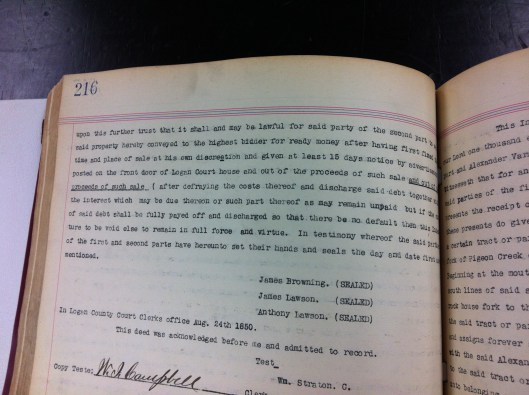
James Browning Trust Deed to James and Anthony Lawson (1850)

04 Tuesday Dec 2018

Posted by Brandon Ray Kirk in Logan

≈ Leave a comment

Tags

Anthony Lawson, Appalachia, county clerk, genealogy, history, James Browning, James Lawson, Logan County, Virginia, West Virginia, William Straton

James Browning Trust Deed to Lawson 1850 1

Deed Book C, page 215, Logan County Clerk’s Office, Logan, WV.

James Browning Trust Deed to Lawson 1850 2

Deed Book C, page 216, Logan County Clerk’s Office, Logan, WV.

History for Jenkins, KY (1928)

04 Tuesday Dec 2018

Posted by Brandon Ray Kirk in Big Sandy Valley, Coal

≈ Leave a comment

Tags

Appalachia, Big Sandy River, C&O Railroad, coal, Consolidation Coal Company, Cumberland Mountains, Devil John Wright, Devil Judd Tolliver, Hazard Herald, history, James A Garfield, Jenkins, John Fox Jr., John W. Wright, Kentucky, Kentucky River, Letcher County, Little Elkhorn Creek, Little Shepherd Amphitheatre, Logan Banner, Nick Dann, photos, Pound Gap, Rocky Branch, Shelby, The Trail of the Lonesome Pine, Virginia, West Virginia

Here is a bit of history for Jenkins, Kentucky, based on a newspaper account provided in 1928:

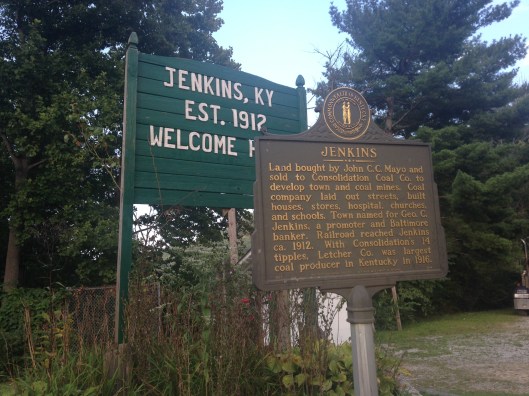
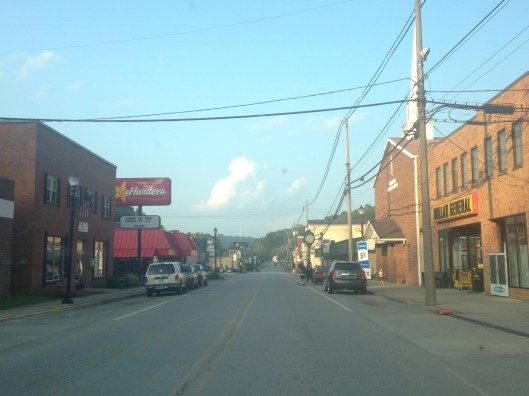
IMG_7109.JPG

Welcome to Jenkins! 26 August 2018.

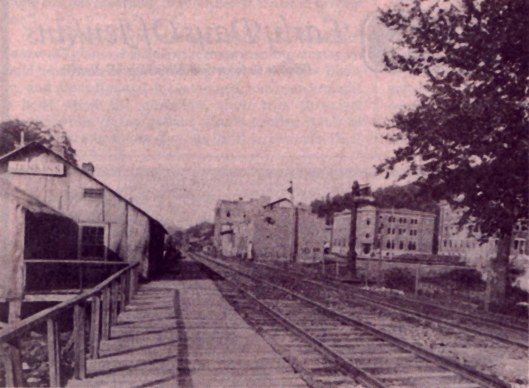
Nestling in the valley of the Little Elkhorn, within “a stone’s throw” of the famous Pound Gap, is Jenkins, one of the few great mining towns of the world. The term “mining camp” cannot rightly be used when speaking of Jenkins, because it is not a “camp” in any sense of the word, but rather a city built by the great Consolidation Coal Company for the accommodation of its thousands of employees.

IMG_7106.JPG

Little Shepherd Amphitheatre. 26 August 2018.

Never was a city planned more carefully, says the Hazard (Ky.) Herald. The men in charge of the construction work were chosen from the top of their respective professions, and the building of the plant was carried out to a plan with the health, safety, education, sanitation, convenience and enjoyment of life by the miners, as its chief object cost was a very secondary consideration.

IMG_5964.JPG

Devil John Wright, dubbed Devil Judd Tolliver by John Fox, Jr. in The Trail of the Lonesome Pine. Photo credit unknown.

Twenty years ago this spot was a wild mountain farm, owned by that famous mountaineer, John W. Wright. His home, a hewn log affair, stood near where the Methodist church has since been erected. For miles in every direction the unbroken forest swept away over hill and down valley, some of which had slept undisturbed since the beginning of time.

IMG_7121.JPG

St. George Catholic Church. 26 August 2018.

The mountaineers, on their seldom made visits to this wild region, would look up at the rugged mountains, like giant sentinels guarding the gates of another world, and wonder, what good could ever come of such a land. At night, the few settlers were lulled to sleep by the hoot owl’s call and awakened in the morning by the yelp of the fox.

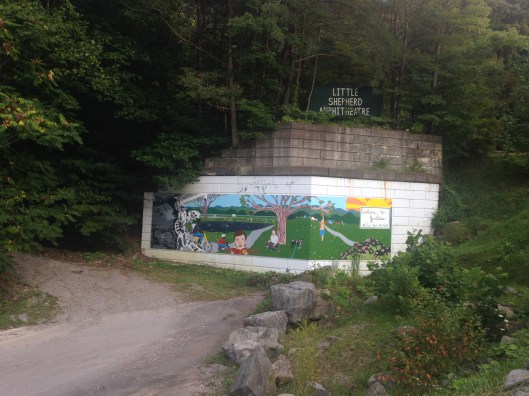
IMG_7108.JPG

This way to Little Shepherd Amphitheatre. 26 August 2018.

Then one day news spread over the hills that Wright had disposed of his lands and that a great town was about to be built by some men from “away off yonder.” Surveying parties were camped on the Kentucky river, and along Elkhorn. Railroads were pushing into the hills from the east and west. Farmers, on their way to mill or meeting, would stop and ask questions of the engineers, learn all they could of the town that “they had heard was going to be” and then hurry home to toll the news to their neighbors, adding to the story until it becomes a fanciful fairy tale.

Jenkins KY

Jenkins. Photo credit unknown.

The roars of explosives soon were heard for many miles, children at first would run screaming to their mother [illegible line] skirts asking to be told what it was they had heard “away over yonder,” while old women smoked their pipes and wondered if “Garfield was coming up the Sandy again.”

IMG_7123.JPG

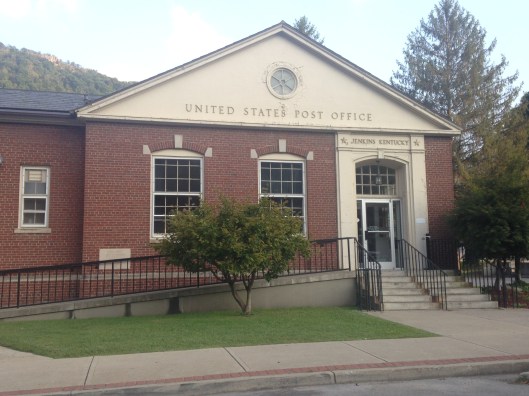
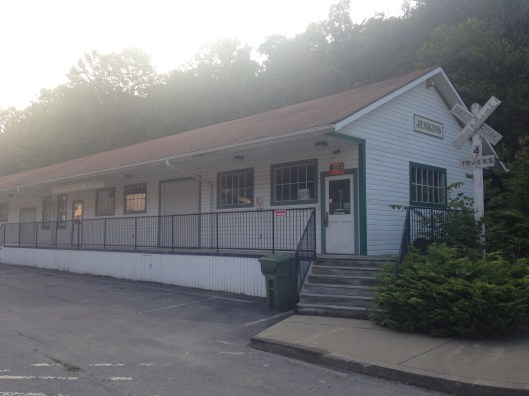
Jenkins Post Office. 26 August 2018.

Coming into wild, rugged country like the head of Elkhorn, and laying off and building a city was a feat worthy of the greatest engineering skill, and that was the sort employed by the Consolidation Company.

The nearest railroad was still miles away. Everything needed in construction must be freighted across the Cumberlands, over roads almost impassable by wagon. For 12 months preparation for this gigantic plant went on before the actual construction work began. Roads were graded across the mountain by Pound Gap and a lumbering concern was induced to build their narrow gauge railroad from Glomorgan to Rocky Branch, leaving only about five miles that supplies must be transported by wagon freight. The Pound Gap country was a beehive of activity. Freighters were so numerous on the road that it took the best part of a day to make the trip from Jenkins to Rocky Branch and return. Every few yards the driver would be forced to turn out so that another could pass.

IMG_9322.JPG

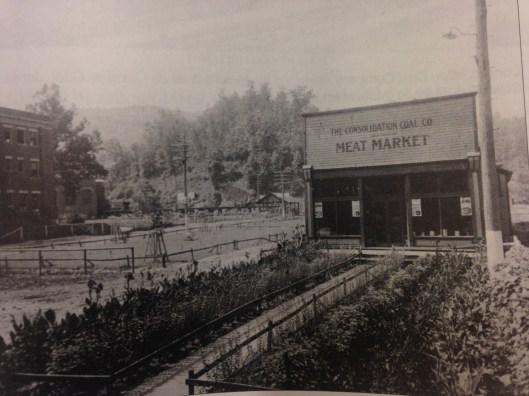
Consolidation Coal Company Meat Market. Photo credit unknown.

Hundreds of carpenters, masons and helpers were at work building houses. The houses they constructed were of a type foreign to the coal fields across the mountains in Virginia. A giant power plant was built, the water of Elkhorn were harnesses to create the power to run the greatest mining plant in the south. The dam built across the stream has formed one of the most beautiful lakes in America, it has been stocked with fish and lined with row boats for the recreation of the coal miners and their families.

IMG_7122.JPG

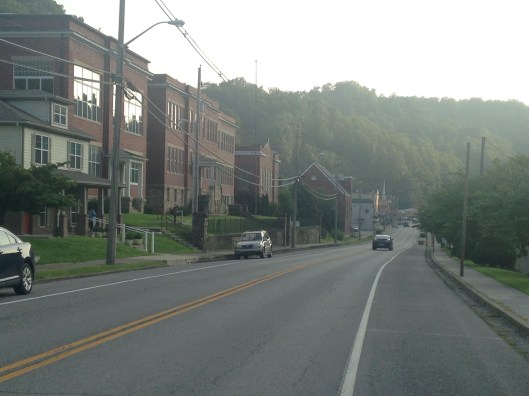
Jenkins. 26 August 2018.

Every home was built for convenience and comfort. Sanitation was provided and each house was wired for electricity. Word went out into the mining camps close by in Virginia that the “Jenkins company” would not tolerate kerosene lamps in their houses and required that their employees use electricity for illumination. These “other camps” were forced to remodel their plants in keeping with the pattern on which the great Consolidation plant was built, until today, the old order has been replaced with the new throughout Virginia, West Virginia and Kentucky: thanks to the lead of the Consolidation Coal Company.

IMG_7112.JPG

Jenkins. 26 August 2018.

Jenkins is well lighted; has an excellent water system; fire department and paved streets in the business section. Many beautiful homes line the handsome drive, skirting the lake. These, unlike the ordinary mining town houses, are set well back from the driveway in park like lawns, well shaded with grand old oaks and other native trees.

Some of the most substantial business buildings to be found in the Cumberland region are here in Jenkins. Among these are the recreation building, housing a drug store, hotel, post office, Western Union office, barber shop, pool room, printing office, and drink stand. The First national Bank building is the most beautiful building in Letcher county; vine-clad with clinging ivy gives it the appearance of having grown there.

IMG_7114

Jenkins Dept. 26 August 2018.

The most widely known business institutions in Jenkins are the Consolidation Coal Company store, the First National bank, the Jenkins Steam Laundry, the Modern Pressing Shop, Nick Dann’s Auto Sales and Repair Shop, and the numerous businesses housed under the roof of the mammoth recreation building. The town is on the Kentucky state highway and is served by the C. & O. railroad system from Shelby junction.

Source: Logan (WV) Banner, 2 October 1928.

Samuel Zook Deed to Thomas Dunn English (1854)

06 Tuesday Nov 2018

Posted by Brandon Ray Kirk in Guyandotte River, Logan

≈ Leave a comment

Tags

Appalachia, Big Ugly Creek, genealogy, Guyandotte River, history, Lincoln County, Logan County, Mile Branch, New York, New York City, Pigeon Roost Branch, Samuel Zook, Thomas Dunn English, Virginia, West Virginia

Samuel Zook to Thomas Dunn English 1.JPG

Deed Book C, page ____, Logan County Clerk’s Office, Logan, WV. This land is located in present-day Lincoln County, WV.

Jake Kinser of Logan County, WV (1936-1937)

20 Saturday Oct 2018

Posted by Brandon Ray Kirk in Big Creek, Big Harts Creek, Boone County, Civil War, Coal, Logan

≈ Leave a comment

Tags

Appalachia, Aracoma, Big Creek, Boone County, Brooke McNeely, Camp Chase, Chapmanville District, Charles Williams, civil war, Claude Ellis, coal, Confederate Army, crime, Dave Kinser, Democratic Party, Douglas Kinser, Elbert Kinser, Ethel, Fort Branch, French River, genealogy, ginseng, Harts Creek, Hetzel, history, J. Green McNeely, Jake Kinser, Jane Mullins, Jefferson Davis, Jim Aldridge, John Carter, John Kinser, Logan, Logan Banner, Logan County, logging, Malinda Kinser, Malinda Newman, Mary Ann Ellis, Mud Fork, Otis Kinser, rafting, Scott Ellis, Smyth County, Stonewall Jackson, timbering, tobacco, Virginia, Washington Township, West Virginia, Wythe County

Jake Kinser Visits LB 06.20.1936 1

Logan (WV) Banner, 20 June 1936. Note: Jacob was not born in 1850, so he does not appear with his family in the 1850 Census for Wythe County, Virginia. He was nine years old in the 1860 Census for Smyth County, Virginia.

Jake Kinser Recollections LB 11.12.1936 2

Logan (WV) Banner, 12 November 1936. Note: Jake Kinser appears as a seventeen-year-old fellow in the 1870 Census for Boone County, West Virginia (Washington Township).

Jake Kinser and Jane Mullins LB 07.07.1937 2

Jake Kinser and his sister Jane Mullins, Logan (WV) Banner, 7 July 1937. 

Jake Kinser and Jane Mullins LB 07.07.1937 3

Jake Kinser and his sister Jane Mullins, Logan (WV) Banner, 7 July 1937. Note: Mary Jane (Kinser) Mullins was eleven years old in the 1860 Census for Smyth County, Virginia. Mr. Kinser died in 1944; his death record can be found here: http://www.wvculture.org/vrr/va_view2.aspx?FilmNumber=571280&ImageNumber=349


James Browning Deed to Josiah Browning (1856)

20 Saturday Oct 2018

Posted by Brandon Ray Kirk in Twelve Pole Creek

≈ 1 Comment

Tags

Appalachia, Cane Patch Fork, county clerk, genealogy, Henry Workman, history, James Browning, Josiah Browning, Laurel Branch, Logan County, Samuel Damron & Company, Twelve Pole Creek, Virginia, W.I. Campbell, West Virginia, William Straton

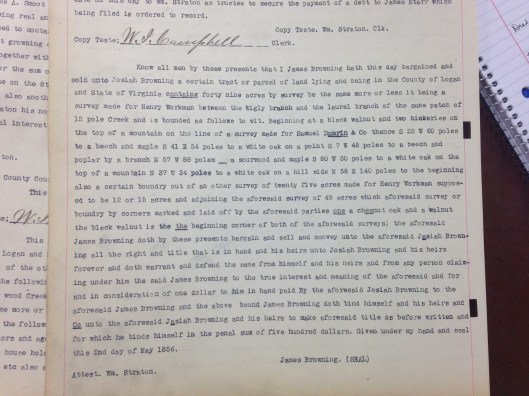
James Browning to Josiah Browning Deed 1

Deed Book C, page 482, Logan County Clerk’s Office, Logan, WV.

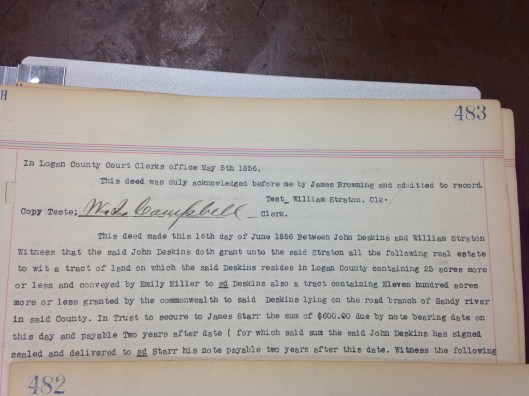
James Browning to Josiah Browning Deed 2

Deed Book C, page 483, Logan County Clerk’s Office, Logan, WV.

Joel Elkins Deed to Reece W. Elkins (1855)

19 Friday Oct 2018

Posted by Brandon Ray Kirk in Guyandotte River, Sand Creek

≈ Leave a comment

Tags

Appalachia, county clerk, genealogy, history, Joel Elkins, Logan County, Miles Elkins, Reece W. Elkins, Sand Island, Spencer A. Mullins, Virginia, W.I. Campbell, West Virginia, William Straton

Joel Elkins to Reece W. Elkins Deed 1.JPG

Deed Book C, page ___, Logan County Clerk’s Office, Logan, WV.

Counterfeiters in Logan County, WV (1836)

18 Thursday Oct 2018

Posted by Brandon Ray Kirk in Logan

≈ Leave a comment

Tags

Appalachia, counterfeiting, crime, history, Logan County, Peter Dingess, Richmond, Richmond Enquirer, Virginia, West Virginia

From the Richmond Enquirer comes this bit of history about counterfeiters in present-day Logan County, WV:

LAWS CASE. At the late term of the Federal Court, Judge Caldwell presiding, holden at Staunton, on the 2d of this month, the trial of Peter Dinges came up on a charge of having passed counterfeit notes purporting to have been issues by the bank of the United States. Upon a full investigation, which lasted several days, the jury found the prisoner guilty of the offense, provided there was then in existence any law which punishes such an offense; upon this verdict the court gave judgment for the prisoner. There were several other indictments against this man for similar offenses, and demurers being filed to all of them, on the ground that the bank charter having expired, all further prosecution was at an end, and the court being of that opinion, the prisoner was discharged; but forthwith taken into custody by the State authorities.

We understand it to be a principle of criminal law, that when a statute creates an offense, and defines its punishment, and is limited in its duration, no conviction can lawfully be had after the expiration of the statue, unless such an event be officially provided for. No such provision is contained in the bank charter.

This man being one of the principal chiefs of counterfeiters, and venders of base money, it is to be, regretted that he was not brought to trial during the existence of the law against which he has offended. His example in the country in which he has resided must have been very pernicious. He possesses considerable property, is a colonel in the militia, and has been elected twice to the House of Delegates by the citizens of Logan county, where he resides.

Two of Dingess’ confederates, of equal consideration with himself, were arrested by the deputy marshals appointed for the purpose, but made their escape, and have left the country. Two others, having a separate establishment, were indicted, and held to bail, and shortly before court sat, left the State, their securities accompanying them. Four others have been sentenced for long periods, one to the penitentiary at Richmond, the others to the penitentiary in the District of Columbia.

These prosecutions have totally broken up the establishment for counterfeiting notes and bills on the Bank of the United States, and on the various Banks of Virginia, which had so long infested the Southwestern part of this State.

Much credit is due to the marshal of this district for the plans laid by him to detect these men, and the address with which he carried them into execution. In this matter he has been engaged for two years past and has accomplished much for the security of society.

Source: Richmond (VA) Enquirer, 7 June 1836

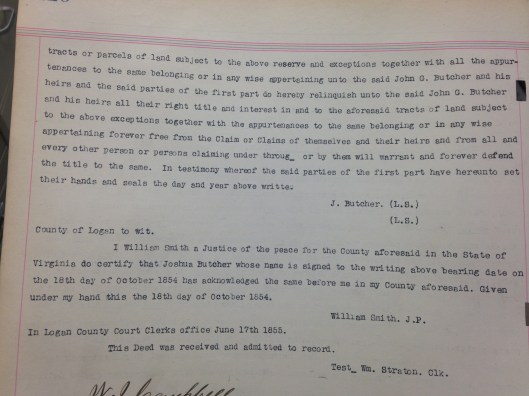
Joshua Butcher Deed to John G. Butcher (1854)

16 Tuesday Oct 2018

Posted by Brandon Ray Kirk in Crawley Creek, Guyandotte River, Timber

≈ Leave a comment

Tags

Appalachia, Crawley Creek, genealogy, Guyandotte River, history, John G. Butcher, John J. Besnoist, Joshua Butcher, justice of the peace, Logan County, Mill Branch, Sarah Butcher, Virginia, Wesley Stollings, West Virginia, William Smith, William Straton

Joshua Butcher to John G. Butcher Deed 1

Deed Book C, page ___, Logan County Clerk’s Office, Logan, WV. Note: References timber.

Joshua Butcher to John G. Butcher Deed 3

Deed Book C, page ___, Logan County Clerk’s Office, Logan, WV.

Rebecca McGuire Deed to Isaiah Adkins (1855)

28 Friday Sep 2018

Posted by Brandon Ray Kirk in Big Harts Creek, Guyandotte River

≈ Leave a comment

Tags

Appalachia, Archibald Elkins, county clerk, Elijah A. Gartin, genealogy, Guyandotte River, Harts Creek, Harvey Elkins, history, Isaiah Adkins, James Dalton, Lincoln County, Logan County, Peter Dingess, Rebecca McGuire, Richard Elkins, Virginia, W.I. Campbell, West Virginia, William Straton

Rebecca McGuire to Isaiah Adkins Deed 1

Deed Book C, page 423, Logan County Clerk’s Office, Logan, WV.

Rebecca McGuire to Isaiah Adkins Deed 2

Deed Book C, page 424, Logan County Clerk’s Office, Logan, WV. This property is likely located in present-day Lincoln County, WV.

Old Records Found in Bank Vault (1936)

27 Thursday Sep 2018

Posted by Brandon Ray Kirk in Big Sandy Valley, Guyandotte River, Hamlin, Huntington, Logan

≈ 3 Comments

Tags

Appalachia, Big Sandy River, Cabell County, Guyan Valley Bank, Guyandotte River, H.M. Booth, Hamlin, history, Huntington, James Barbour, Logan, Logan County, Mary Morris, Pennsylvania, Peter Dingess, Philadelphia, Richmond, Robert Brooke, Robert Morris, Robert Morris Grant, Russell County, Tug Fork, Virginia, West Virginia, William Crammond, Wythe County

Old Peter Dingess Deed LB 08.19.1936 7

320,000 Acres of Land Hereabouts Sold for Five Shillings According to Old Records Found in Old Vault

H.M. Booth, in cleaning out the vault of the old Guyan Valley Bank preparatory to moving his offices from Logan to Hamlin, uncovered a number of old documents that dated back to the time when “horse and buggy days” were a fact and not merely a political equation.

Many of these old papers, including deeds, receipts, account books and other papers of a semi-personal nature, are originals, while others are notarized copies of originals. They make interesting reading in these days of speed, radios, high prices and typewriters.

The old documents were all hand written, in clear, flowing script, the capital letters often decorated with fancy scrolls and shaded lines. Many of them were written with a quill pen.

Of particular interest is one deed, 12 ½ by 15 ½ inches, written on sheepskin. The ink has not faded, and although the skin is old and discolored, the deed is easily read. It was made in the days when Logan county was unheard of, and all this vicinity was part of Cabell county, Virginia. It seems strange, now, to think of a governor in Richmond, Virginia, parceling out land in Logan county.

The deed reads, in part: “James Barbour, Esq., Governor of the Commonwealth of Virginia: To all whom these presents shall come, Greeting: Know ye, that by virtue of a Land office Treasury warrant, No. 6126, upon the 9th day of Sept. 1780, there is granted by the said Commonwealth unto Peter Dingess, a certain Tract or Parcel of Land, containing one hundred and twelve acres, by survey, bearing date the 31st day of March, 1813, situate in the County of Cabell, joining to his own deeded land, and bounded as followeth, to-wit:”

Then follows a detailed description of the boundaries of the land, in which prominent trees and landmarks play a common part. After the description of the land, which was written in pen and ink, came the regular printed form as follows:

“In witness whereof, the said James Barbour, Esq., Governor of the Commonwealth of Virginia, hath hereunto set his Hand, and caused the Seal of the said Commonwealth to be affixed at Richmond, on the twenty-fifth day of October, in the Year of our Lord, One thousand eight hundred and fourteen, and of the Commonwealth the thirty-ninth.”

Down in the lower right hand corner of the paper can be plainly seen the signature of James Barbour, governor of Virginia at that time.

A notarized copy of another land deed was signed by Robert Brooke, Governor of Virginia in 1795, and was dated March 23 of that year. It deeded through the Land Office treasury warrants numbered from 472 to 530, inclusive, a parcel of land containing 480,000 acres, “by a survey made the 10th of September, 1794.” The land was described as being in the county of Wythe, on the Tug and Guyandotte rivers. This grant of land was known as the “Robert Morris Grant.”

Evidently, from the records, Robert Morris became involved in difficulties, for after a considerable amount of legal red tape, all duly recorded, there is a document showing where “Robert Morris and Mary, his wife, of Philadelphia, sell to William Crammond of Philadelphia as well for and in consideration of the sum of five shillings lawful money of Pennsylvania to them well and truly paid do grant bargain and sell, alien and enteoff release and confirm to the purchased 320,000 acres of land in the counties of Wythe and Russell, lying on both sides of Sandy Creek.”

Among the records of accounts paid found by Mr. Booth were numerous fees paid out for “boating freight from Huntington.” Six dollars and fifty cents is entered “for a suit of clothes,” and another entry shows where four dollars and a half were paid for two pair of shoes.

Source: Logan (WV) Banner, 19 August 1936

Lorenzo Hill Deed to Squire Toney (1856)

25 Tuesday Sep 2018

Posted by Brandon Ray Kirk in Guyandotte River

≈ Leave a comment

Tags

Appalachia, county clerk, genealogy, Guyandotte River, history, Isaac Adkins, Lincoln County, Logan County, Lorenzo D. Hill, Mile Branch, Squire Toney, Virginia, W.I. Campbell, West Virginia, William Straton

Lorenzo Hill to Squire Toney Deed 1.JPG

Deed Book C, page 488, Logan County Clerk’s Office, Logan, WV. This property is located in present-day Lincoln County, WV.

Aracoma Memorial in Logan, WV (1936)

22 Saturday Sep 2018

Posted by Brandon Ray Kirk in American Revolutionary War, Logan, Native American History

≈ Leave a comment

Tags

American Revolution, Appalachia, Aracoma, Aracoma Hotel, Bluestone River, Boling Baker, C.A. Davis, Cornstalk, Daughters of the American Revolution, Edwin Goodwin, Elmer McDonald, Harris Funeral Home, history, Jimmy Browning, Logan, Logan Banner, Logan County, Lyle Burdette, M.R. Atkinson, Montgomery County, Native American History, Native Americans, photos, sheriff, Virginia, W.C. Turley, West Virginia

IMG_3735

Aracoma Memorial at the Logan Courthouse, Logan, WV. 18 May 2017.

Princess Aracoma Memorial Given to the Public by D.A.R. Chapter is Formally Unveiled and Dedicated

The monument to Princess Aracoma was dedicated yesterday afternoon by the local chapter of the D.A.R. which bears her name, with a brief ceremony in which the romantic history of the chief of the first tribe known to have settled in this vicinity was reviewed.

The dedication service took place at 4:30 o’clock at the northeast corner of the courthouse, and was opened with an assembly bugle call by Boy Scout Edwin Goodwin. Rev. M.R. Atkinson led in prayer and Jimmy Browning gave the salute to the flag.

Mrs. S. Elmer McDonald, regent of Aracoma chapter, presided, saying, “We have gathered here to honor Princess Aracoma, an Indian princess who with her tribe first settled in this valley.”

W.C. Turley, whom Mrs. McDonald introduced as the descendant of one of the oldest families of the county gave a talk reviewing the traditional settling of the Indians in this vicinity.

“I think it striking evidence of patriotism for your Princess Aracoma chapter to place this monument in memory of Princess Aracoma,” he said.

Mr. Turley said that Princess Aracoma was born somewhere between 1740 and 1745, the daughter of Cornstalk, chief of the Shawnee Indians, who was killed in the first land battle of the Revolution.

“When the princess was a young girl she interceded in behalf of Boling Baker, a white soldier who had deserted from the British army and had been captured by her tribe. Through her plea his life was spared and he was initiated into the tribe.

“According to the Indian custom, when Princess Aracoma became of age she was given a portion of the tribe to settle under her leadership in new hunting grounds, and chose the island first settled in this territory. Shortly after settling in their new home, the Princess and Boling Baker were married at a large ceremony attended by Cornstalk and other chiefs.

“The tribe lived happily and prospered until, in 1776, a plague struck them taking many of their members including all of the children of the princess and her white husband.

“Baker, seeking to replenish the goods of the tribe went with some scouts to a settlement on the Bluestone river, where, posing as an escaped captive, he gained the confidence of the settlers. Then one night he led his scouts in a raid on the camp, stealing their horses and provisions.

“The sheriff of Montgomery county, of which Logan was then a part, designated Col. Breckenridge and Gen. Madison to lead a force of 90 men to seek revenge on the Indians. In the ensuing battle, which took place near where the power plant now stands, Princess Aracoma was killed.

“According to tradition, she was buried somewhere in the vicinity where the Aracoma Hotel and Harris Funeral Home now stand. Skeletons and Indian burial pieces were unearthed when the excavation for these buildings was made.”

At the close of Mr. Turley’s address, the monument was unveiled by Mrs. Lyle Burdette and Mrs. C.A. Davis.

Source: Logan (WV) Banner, 28 October 1936.

NOTE: This article incorrectly references the Battle of Point Pleasant as part of the American Revolutionary War.

Museum and Log Cabin at Breaks Interstate Park in Breaks, VA (2018)

17 Monday Sep 2018

Posted by Brandon Ray Kirk in Civil War, Hatfield-McCoy Feud, Native American History, Timber

≈ Leave a comment

Tags

Appalachia, Battle of Middle Creek, Brandon Kirk, Breaks, Breaks Canyon, Breaks Interstate Park, civil war, fossils, Hatfield-McCoy Feud, history, James A Garfield, Kentucky, Marion, moonshine, moonshining, Native American History, Native Americans, photos, Phyllis Kirk, rafting, Saltville, Union Army, Virginia

IMG_6831

Video showcasing regional history. 25 August 2018.

IMG_6816

Hammerstone and Polishing Stone. 25 August 2018.

IMG_6818

Fully Grooved Axe. 25 August 2018.

IMG_6819

Lt. James A. Garfield, Union hero at the Battle of Middle Creek, KY. 25 August 2018.

IMG_6825.JPG

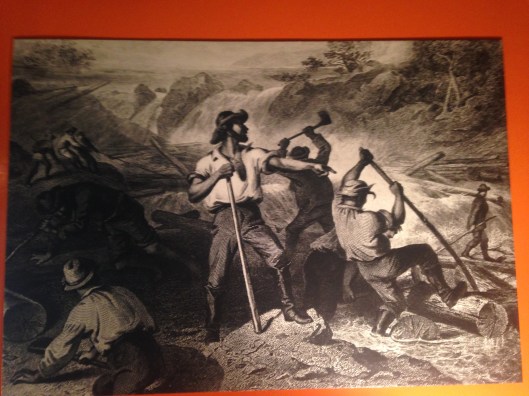
Rafting through Breaks Canyon, c.1885. 25 August 2018.

IMG_6821

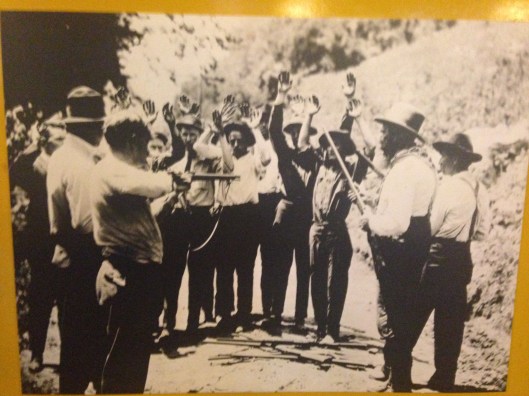
This photo is labeled: “A Confrontation Between the Hatfields and the McCoys.”

IMG_6823

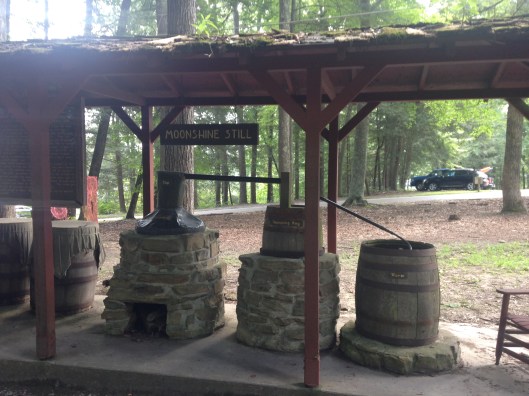
Moonshine still. 25 August 2018.

IMG_6827

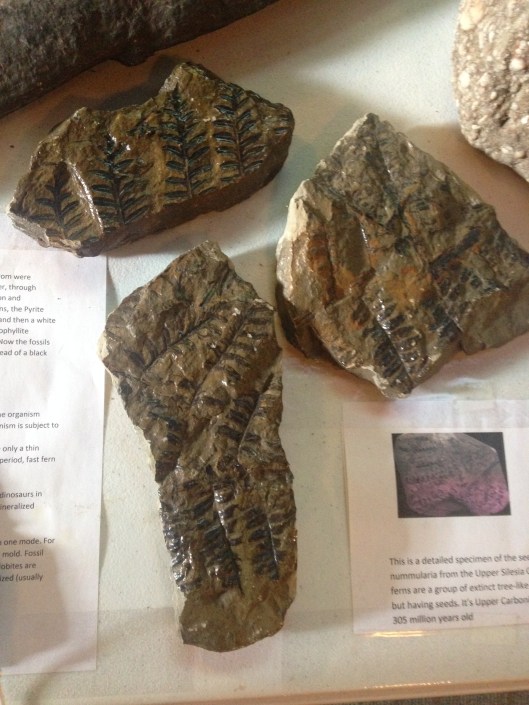
Seed fern fossil, 305 million years old. 25 August 2018.

IMG_6833

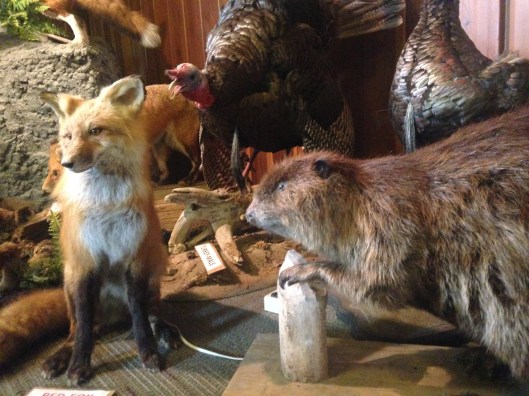
Native wildlife. 25 August 2018.

IMG_6835

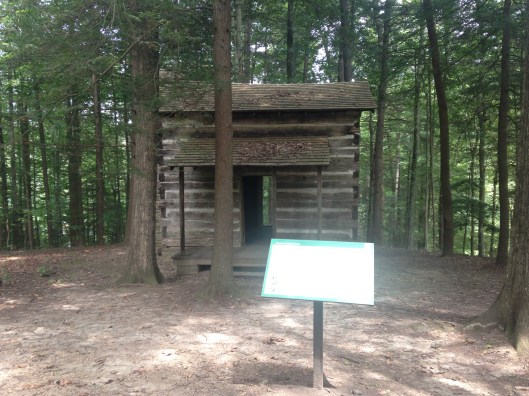
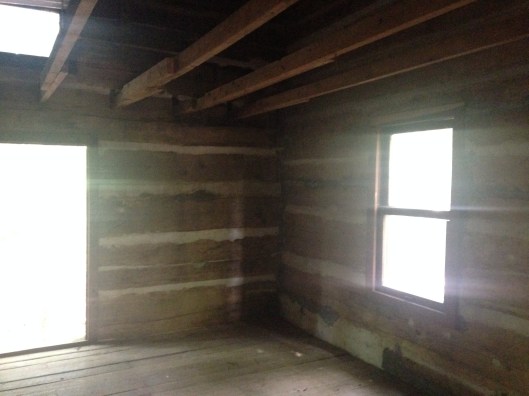
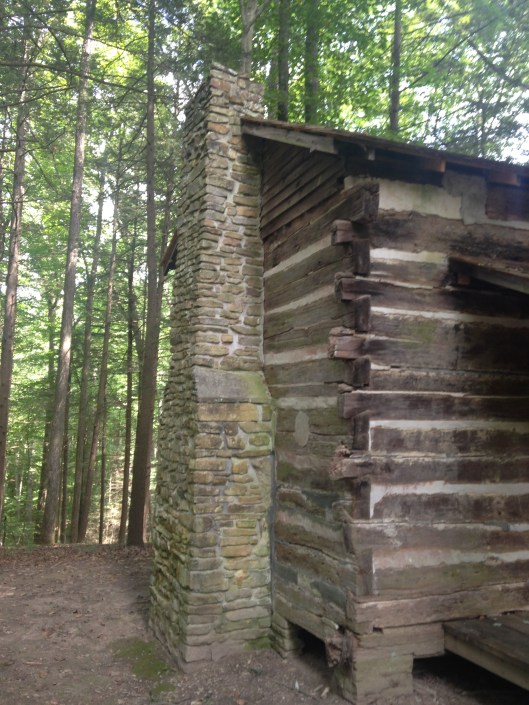
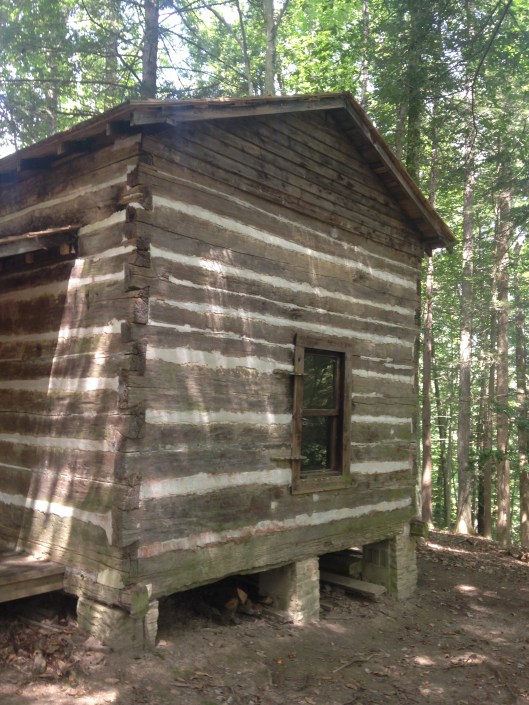
Log cabin. 25 August 2018.

IMG_6839

Log cabin. 25 August 2018.

IMG_6837

Log cabin. 25 August 2018.

IMG_6842

Log cabin. 25 August 2018.

IMG_6840

Log cabin. 25 August 2018.

IMG_6841.JPG

Mom at the cabin. 25 August 2018.

IMG_6844

Moonshine still showing cap, thumping keg, and worm. 25 August 2018.

IMG_6852

Salt kettle cast at Marion, VA, about 1860 and buried to conceal it from Union troops at Saltville, VA, in 1864. 25 August 2018.

“Revolutionary” John Mullins Grave in Clintwood, VA (2018)

15 Saturday Sep 2018

Posted by Brandon Ray Kirk in American Revolutionary War, Big Creek, Cemeteries

≈ 1 Comment

Tags

Appalachia, Big Creek, Boone County, cemeteries, Dickenson County, genealogy, history, John Mullins, Logan County, North Fork, photos, Virginia, West Virginia

IMG_7090

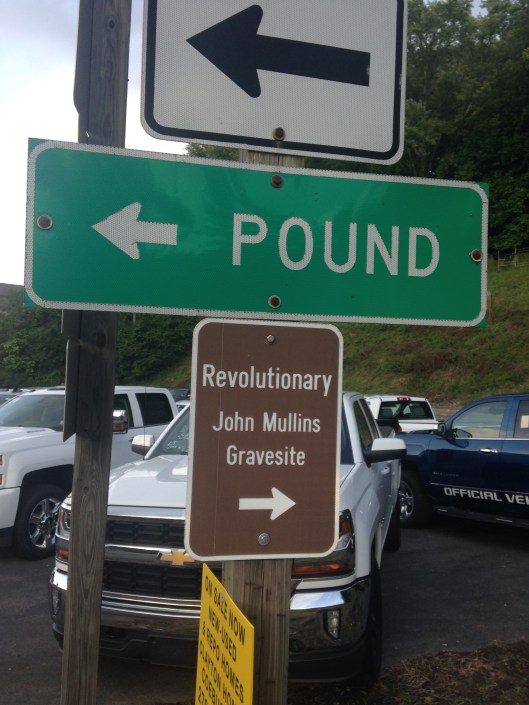
“Revolutionary John” Mullins, sometimes nicknamed “Buttin’ John,” is buried near the intersection of Mullins Avenue and McClure Street in Clintwood, Dickenson County, VA. To reach his grave, park at Johnson’s Chevrolet on McClure Street and walk up the hill. Signs will direct you to the cemetery. 25 August 2018.

IMG_7091

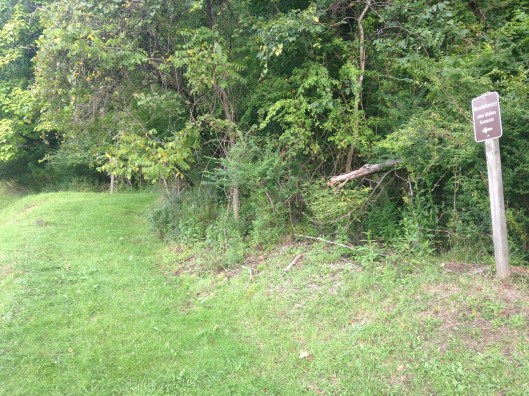
Up this way. You will pass a residence to the right of the road leading up to the cemetery. 25 August 2018.

IMG_7093

Straight ahead… 25 August 2018.

IMG_7096

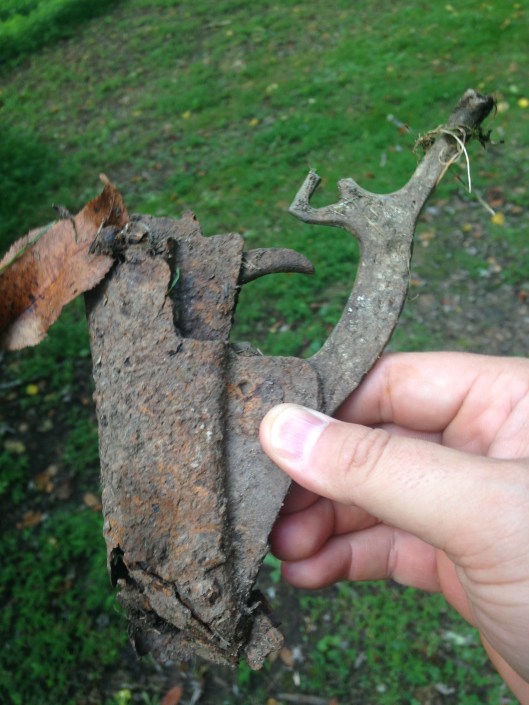
Along the way, I found this old gun piece. 25 August 2018.

IMG_7094

John Mullins grave, 25 August 2018. John is the father of “Money Makin’ Sol” Mullins, who settled on North Fork of Big Creek near the Logan-Boone county line of West Virginia.

Baisden Family Troubles

13 Thursday Sep 2018

Posted by Brandon Ray Kirk in Hatfield-McCoy Feud, Kermit

≈ Leave a comment

Tags

Appalachia, Brit Jones, Buchanan County, Carroll County, Catherine Wills, Catlettsburg Republican, crime, Flora Baisden, Floyd County, genealogy, Grant Bollman, Grover Waldron, Grundy, Harrison Baisden, Harrison Baisden Jr., Hatfield-McCoy Feud, Hiram Wills, history, Ira J. McGinnis, Jack Maynard, James Brewer, Jeffersonville, John Brewer, John Henry Baisden, John Lee White, John Smith Baisden, Johnson County, Kentucky, Lebanon, Lee Brewer, Lewis Dempsey, Logan County, Logan County Banner, Logan Democrat, Marrowbone Creek, Martha Baisden, Mingo County, murder, Naugatuck, Parkersburg Sentinel, Pigeon Creek, R.W. Buskirk, Reuben Baisden, Riley Brewer, Robert Irons, Robert L. Baisden, Ruby Harrison Baisden, Trace Fork, Virginia, West Virginia, William Baisden, William Bevins

Between 1883 and 1891, several members of the Baisden family suffered troubles in their section of West Virginia and Virginia. What follows are some news and other accounts of those events:

At the mouth of Pigeon creek, in Logan county, Grant Bollman and Dr. Harrison Baisden got into a difficulty over a settlement, short words brought blows, when Bollman used a knife severely if not fatally stabbing Baisden. Thereupon he drew a revolver and shot Bollman, who died the same day from the effects of the wound. There is little hopes of the recovery of Baisden.

Parkersburg (WV) Sentinel, 18 August 1883

***

Judge McGinnis has issued a vacation order to the Circuit Clerk of Wayne County admitting Dr. Baisden, charged with the murder of Yancy Bolin, in Logan County, to bail in the sum of $2,000.

Huntington (WV) Advertiser, 31 July 1886

***

According to one item printed in an old genealogy newsletter: “John Smith Baisden was born May 14, 1864. On May 29, 1885 he married Martha Jane Wills who was born in Carroll County, Virginia, on August 4, 1870, the daughter of Hiram and Catherine Massey Wills. Martha had come to Floyd County, Kentucky, in a wagon train in 1879. She was fifteen when she married John Smith Baisden. They had two children: Flora, who was born on January 8, 1888, and Ruby Harrison “Harry” Baisden [February 7, 1890]. On May 4, 1890, John Smith Baisden was shot and killed by John Brewer and John Lee White, while the family was visiting in West Virginia. He was shot in an argument over a horse. It is thought that his murder was indirectly associated with the Hatfield-McCoy Feud. The Baisdens became involved after relatives married McCoys. About the same time of his father’s death, the Hatfields kidnapped and imprisoned Ruby Harrison Baisden (then only a child) and other members of the McCoy clan, and held them in a log barn in what is now Mingo County, West Virginia. Ruby Harrison Baisden was found by a roadside where he had been left for dead. Soon after John S. Baisden’s death, Martha, against the advice of family members, returned to Kentucky by horseback, traveling at night over lonely mountain trails with her son and daughter.”

***

Last week several capias against John Henry Baisden and John Smith Baisden were placed in the hands of the Sheriff of this County. The Baisdens had established the very unenviable name of being dangerous and desperate men, and, a part of the process was placed in the hands of Wm. Bevins with instructions to go by way of Marrowbone to summon a guard who knew the haunts of the Baisdens and to locate them if he could and meet the Sheriff, who was accompanied by Jailor Buskirk, Deputy Sheriff McDonald and several guards, at the mouth of the Trace Fork of Pigeon. Mr. Bevins arrived on Marrowbone on Friday morning and learned that just before his arrival the Baisden boys had made an attack on the house of James Brewer with Winchester Rifles, and that assisted by John Lee White, he had repelled the attack, mortally wounding John Smith Baisden. On learning this Mr. Bevins at once summoned a posse consisting of John Lee White, Brit Jones, James Brewer, Riley Brewer, Lee Brewer and John Brewer and followed the Baisdens to Pigeon Creek. Locating them at Dr. Harrison Baisden’s, Bevins left all of the guard about a quarter of a mile from the house, except John Lee White, who he took with him to find the position of the Baisden boys. As soon as he came in sight of them he demanded their surrender, which they refused to do and fire was opened on them. James Baisden was killed and John Henry Baisden was badly wounded and captured. William Baisden having left the crowd made his escape and is still at large. John Henry Baisden was brought to this place and is now in jail. He was shot through both arms and in the right side, but his wounds are not dangerous. All parties regret the killing of young James Baisden, as there was nothing against him. Heretofore a man in this county had thought that to establish for himself the name of a dangerous man was all the security that he needed against the officers of the law. That is now changed and all of them will hereafter be hunted down.

Logan County (WV) Banner, 24 April 1890

***

John Smith Baisden, who was shot by James Brewer and John Lee White, on April 18th, while making an attack on Brewer’s house, died last Sunday evening.

Logan County (WV) Banner, 8 May 1890

***

On Monday morning John Henry Baisden was turned over by the authorities of West Virginia to Wm. A. Bevins upon a requisition from the Governor of Virginia. Baisden is wanted in Buchanan county, Va., for the murders of a man named Irons. Bevins, accompanied by R.W. Buskirk and Lewis Dempsey, started with Baisden to Jeffersonville, Va., where he will be confined for safe keeping until the Buchanan authorities are ready for his trial. He was not taken to Buchanan as there has been some talk of lynching him there.

Logan County (WV) Banner, 26 June 1890

***

R.W. Buskirk, Wm. Bevin and Lewis Dempsey, who took John Henry Baisden to Virginia on a charge of murder, returned on Sunday. The prisoner was first taken to Jeffersonville, then to Grundy, and finally to Lebanon as neither the Jeffersonville nor Grundy Jail were safe.

Logan County (WV) Banner, 10 July 1890

***

A Logan Man Gone Wrong.

Wm. Baisden, formerly of this county, was last week sentenced to the Virginia penitentiary from Buchanan county, for the term of 18 years, for the murder of a man named Irons, some two years ago. Outside of whisky, Baisden was regarded as a good man, and had a great many friends on the Sandy side of our county, where he was raised, and where his relatives now live.

Logan County (WV) Banner, 6 August 1890

***

Baisdens Allowed to Escape.

John Henry Baisden who killed Robert Irons in Buchanan county, Va. last fall and who afterwards figured in a terrible tragedy in Logan county, W.Va., and who was captured and taken to Virginia has been allowed to escape. After killing Irons, he fled to W.Va. to find another man living with his wife. He got a party of his relatives and went to attack the man, but was met by an officer and posse in search of him. Two desperate fights ensued between the two parties on consecutive days and Jim and John Smith Baisden were killed. John Henry was captured, after being seriously wounded, and lodged in jail. The parties who captured him in W.Va. delivered him to the authorities all right and received the Reward. He was afterwards sent to Russell county jail and being taken back to Buchanan for trial was taken from the guard by his brother. It is thought that the officers were willing that the prisoner should be rescued.

Catlettsburg (KY) Republican via the Logan County (WV) Banner, 21 August 1890

***

Murder on Sandy.

Monday afternoon Harrison Baisden, Jr., a member of the notorious gang of Baisden outlaws came down to the Mouth of Pigeon where there was a whiskey boat moored on this side of the river. He took his horse across to the Kentucky side, and then returning, he walked deliberately up to Jack Maynard, between whom and himself, it appears, there had been some bad blood, and shot him through the head, killing him instantly. The last heard from Baisden he was in Kentucky riding from about five men, who were pursuing him hotly. As the report says he was very drunk and the men were only a mile behind, the chances are that he is captured by now. It is feared that if he is caught that he will be lynched.

Logan County (WV) Banner, 3 September 1891

***

Found Dead.

A rumor has reached us that Reuben Baisden, the murderer of Jack Maynard, was found dead at the head of a lonely creek, in Johnson county, Kentucky, with fifty-three bullet wounds on his body and his dead horse lying on him. It was thought that he had been dead about three days when found. We do not credit the story.

Logan County (WV) Banner, 17 September 1891

***

Manslaughter for Dr. Baisden

In the Mingo criminal court last week, Dr. Robert L. Baisden was found guilty of voluntary manslaughter for killing Grover Waldron, at Naugatuck on April 23, of last year.

The evidence showed that young Waldron was stabbed to the heart on the above named night near the signal tower at Naugatuck. Dr. Baisden was coming down the tower steps when some person threw a beer bottle against a stone wall not far away. Young Waldron and two companions were standing near the foot of the steps.

Using an oath Dr. Baisden inquired who threw the bottle at him and there came a reply and also an oath, that it was for him and some one of the three also called out that they would send Dr. Baisden to hell “feet first” if he was not careful.

Logan (WV) Democrat, 20 April 1911

Darby K. Elkins Deed to Reese W. Elkins (1856)

12 Wednesday Sep 2018

Posted by Brandon Ray Kirk in Atenville, Guyandotte River

≈ Leave a comment

Tags

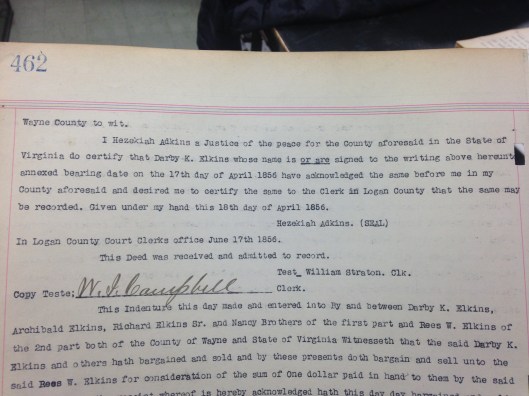
Appalachia, county clerk, Darby K. Elkins, Dry Branch, genealogy, Guyandotte River, Hezekiah Adkins, history, justice of the peace, Logan County, Reese W. Elkins, Sugar Camp Branch, Virginia, W.I. Campbell, Wayne County, West Virginia, William Straton

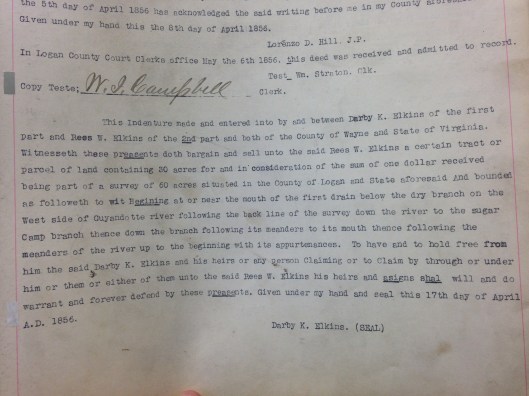
Darby K. Elkins to Reece W. Elkins Deed 1

Deed Book C, page 461, Logan County Circuit Clerk’s Office, Logan, WV. Note: This property is located near present-day Atenville, Lincoln County, WV.

Darby K. Elkins to Reece W. Elkins Deed 2

Deed Book C, page 462, Logan County Circuit Clerk’s Office, Logan, WV

James P. Mullins Grave and the K.S. Colley Cemetery in Breaks, VA (2018)

11 Tuesday Sep 2018

Posted by Brandon Ray Kirk in Big Harts Creek, Cemeteries, Lincoln County Feud

≈ 7 Comments

Tags

Appalachia, Big Branch, Big Harts Creek, Brandon Kirk, Breaks, Dickenson County, feuds, genealogy, history, James P. Mullins, K.S. Colley Cemetery, K.S. Colley Cemetery Road, King Solomon Colley, King Solomon Colley Road, Lincoln County, Lincoln County Feud, photos, Phyllis Kirk, Virginia, West Virginia

IMG_6911

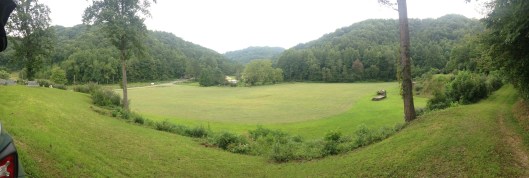
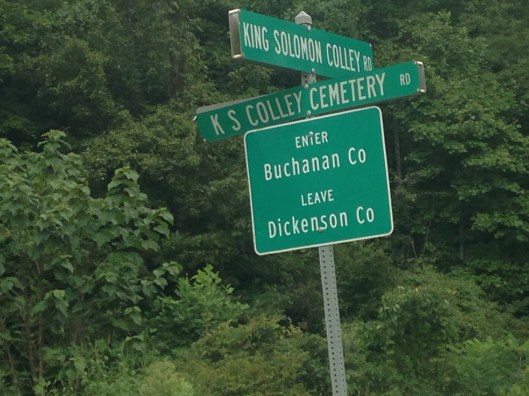
View of K.S. Colley Cemetery Road from the K.S. Colley Cemetery in Breaks, Dickenson County, VA. 25 August 2018.

IMG_6909.JPG

K.S. Colley Cemetery. 25 August 2018.

IMG_6913

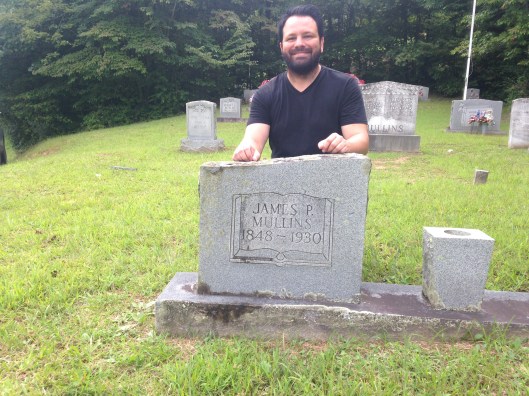
James P. Mullins, once a merchant at Big Branch of Harts Creek in Lincoln County, WV, was involved in the Lincoln County Feud. Photo by Mom. 25 August 2018.

IMG_6920

View of the cemetery from K.S. Colley Cemetery Road. 25 August 2018.

IMG_6924

The K.S. Colley Cemetery is located near the Dickenson-Buchanan county line. 25 August 2018.

Allen Hatfield of Beech Creek, WV (1970s)

11 Tuesday Sep 2018

Posted by Brandon Ray Kirk in Hatfield-McCoy Feud, Matewan, Tazewell County

≈ 4 Comments

Tags

Allen Hatfield, Appalachia, Beech Creek, Beni Kedem, Charleston, Charlie Simpkins, Cincinnati, civil war, Clyde Kiser, Deanna Hatfield, Devil Anse Hatfield, Devon Church of Christ, Doc Mayhorn, Eliza Murphy, Ellison Hatfield, feuds, Frankfort, genealogy, Goldie Hatfield, Gordon Smith, Grapevine Fork, Hatfield-McCoy Feud, history, Hugh C. Boyd Lodge No. 119, Jane Hatfield, Jane Maynard, Joseph Chester Hatfield, Joseph Murphy, Kentucky, Kentucky Colonels, Lawrence Hatfield, Logan County, Major Hatfield, Martha Bell Murphy, Maryland, Mingo County, Norfolk and Western Railroad, North Tazewell, Ohio, Pike County, Plyant Mayhorn, preacher, Raymond Hatfield, Right Hand Fork, Rockville, Thacker, Valentine Wall Hatfield, Virginia, West Virginia, Williamson, Williamson Memorial Hospital, Willis Hatfield

My name is Deanna Hatfield and tonight I would like to share with you a West Virginian, Allen Hatfield, who the community of Beech Creek honored and loved. Allen was born October 11, 1877. He was the youngest child of the pioneer couple, Wall Valentine Hatfield and Jane Maynard Hatfield, who settled on Beech Creek in 1861, the year that the Civil War broke out in this country. His parents had settled at the mouth of Grapevine Fork of Beech Creek. They had occupied a log cabin near the present site of Lawrence Hatfield’s home. He was the nephew of Captain Devil Anse Hatfield, clan leader in the famed Hatfield-McCoy Feud, and a first cousin of Willis Hatfield, the only surviving child of that family.

Almost until the day of his death, Allen carried a sadness in his heart over the death of his father in the days of the famous feud. His father, a peaceable man, was not an active member of the fighting group of the Hatfields during the trouble between his family and the McCoys but was named in warrants along with two of his sons-in-law, Doc and Plyant Mayhorn. Allen Hatfield, but ten years old at the time, remembered that his father Wall, thinking that he had nothing to fear in the courts of Kentucky, wrote the prosecuting attorney of Pike County that he and his sons-in-laws wished to surrender in Pikeville and stand trial for crimes for which they were accused. Allen Hatfield recalled the incident from his boyhood, including the feud. His father did go to Pikeville to voluntarily stand trial and clear his name but he was convicted by a prejudiced jury, the son remembered, and was sentenced to life imprisonment at the Kentucky State Prison in Frankfort. After sentencing, he lived about one year and his burial place is still unknown today. The two Mayhorns served several years and were later pardoned.

One of his fondest memories was that of his mother Jane who took over the management of the home and did a good job of raising a large family after her husband was taken from her. She did chores around the homestead. A great and interesting conversationalist in his adult years, he liked to tell of how he and his friends made bows and arrows–arrows consisting of straight pieces of wood with a horseshoe nails attached as the spike. He became an excellent marksman with the bow and arrow and later with his first rifle as he helped to provide squirrels and other wild game for the family table.

The early years of Hatfield’s life were marked by sadness as a result of the loss of his family in the feud. But his hours spent in the great outdoors hunting and fishing provided a therapy that led to his development to splendid manhood. He was several years old when the Norfolk and Western Railroad Company built an extension from Virginia to southern West Virginia and Mingo County, which still was Logan County at that time.

In 1899, Hatfield was married to Martha Bell Murphy, daughter of Joseph and Eliza (Steele) Murphy. She had just turned fourteen when he proposed and her family thought she was too young to wed. The young couple sort of eloped the night of April 8, 1899, to Allen’s home where they were married by Allen’s brother, Ellison, a country preacher and a granny doctor, as he later recalled. Late that summer, he amassed enough lumber to build their first home—a one-room abode that was erected next to the hillside just north of the present homestead. Allen Hatfield made most of his furniture and his wife tended a garden and dug ginseng to help the family fortune.

During the ensuing years, the Hatfields had eleven children, two of whom preceded them in death. Lawrence Hatfield, who married Dollie Kiser, is now retired and lives with Dollie on Beech Creek at the mouth of Grapevine Fork. Estel Hatfield, who married Virginia Varney, lived with his dad and still lives in the old homeplace. Estel is an agent for the Norfolk and Western Railroad Company. Major Hatfield, who married Mildred Friend, is employed as an agent also for the Norfolk and Western Railroad Company in North Tazewell, Virginia. Rosa Hatfield, married Wayne Simpkins, lives on Beech Creek on Right Hand Fork. Goldie Hatfield married Gordon Smith, and they make their home below Grapevine Fork on Beech Creek. Mamie Hatfield married Charlie Simpkins and makes her home in Rockville, Maryland. Glendeen Hatfield married Douglas Berlin, and they make their home in Louisiana. Etta June Hatfield, never married and lives in Cincinnati, Ohio. Erma Hatfield married Forest Baisden, and she lives in Williamson, West Virginia. Milda Hatfield, deceased, was a retired school teacher and was never married. Joseph Chester Hatfield, died at six months old.

In 1914, Allen bought from his brother Smith a grocery store at the old homeplace and moved the merchandise to a small building at his home. He built a large home later and it was there that most of the children were born. He expanded his business to a larger store building, which still stands, and then he erected the present homeplace. During his early merchandising days, Hatfield was compelled to haul his goods from the railway station at Devon by team and wagon for the roads had not been built and most of the rough team tracks was through the creeks. It was a problem in the wintertime to get through the streams as they were filled with ice. After the county built a road up Beech Creek, he retired his team and wagon and switched to a gasoline-powered vehicle to haul and deliver his goods. He learned carpentry in the early years of his marriage and continued this art until 1964 when he retired. Hatfield was a 57-year member of the Hugh C. Boyd Lodge No. 119 AF & AM at Matewan and received his 50-year service award from the Grand Lodge of West Virginia in 1970. The lodge, when he became a master mason, was known as Thacker No. 119. It was located at Thacker, West Virginia. It later was moved to Matewan. He also belonged to the Beni Kedem Temple of Charleston, being a 50-year member of the Shriners. He also received the honorary commission of a Kentucky Colonel on April 10, 1972. He had been a member of the Devon Church of Christ since 1916 and sponsored the building of the present church that stands near his home on Beech Creek.

In his years of selling groceries, Hatfield said he never lost but 50 dollars in bad debts. He was proud of his heritage, a leader in his community, and in his active life a crack shot with a rifle, pistol, and shotgun. His hunting and fishing kept the table supplied with food. He won beef, hogs, turkeys, and chickens in the old-time rifle matches that were so popular in the Beech Creek area years ago. He and the former Martha B. Murphy were married 71 years before her death on May 25, 1970. His life might have been used as the subject by the poet who wrote, “Let me live by the side of the road and be a friend to man.” Allen Hatfield had spent a lifetime doing just that, living beside a little country road on Beech Creek and being a friend to mankind. On March 2, 1975, Allen was taken to the Williamson Memorial Hospital for ailments associated with his advanced age. He then was released and re-entered the hospital on April 18 in critical condition. On Friday, May 2, 1975, the community of Beech Creek lost one of the dearest old-timers that was ever known. Allen Hatfield, 97, prominently-known Mingo pioneer citizen, retired merchant of Beech Creek, died at 3 a.m. in the Williamson Memorial Hospital of a lingering illness. Funeral services were scheduled at the Chambers Funeral Home Chapel with his beloved ministers Clyde Kiser and Raymond Hatfield officiating. Burial took place in the family cemetery behind the homeplace on Beech Creek. His grandsons and great-grandsons were his pallbearers. Allen would have wanted it this way. Simple.

NOTE: Some of the names may be transcribed incorrectly.

← Older posts
Newer posts →

Feud Poll 1

If you had lived in the Harts Creek community during the 1880s, to which faction of feudists might you have given your loyalty?

Categories

  • Adkins Mill
  • African American History
  • American Revolutionary War
  • Ashland
  • Atenville
  • Banco
  • Barboursville
  • Battle of Blair Mountain
  • Beech Creek
  • Big Creek
  • Big Harts Creek
  • Big Sandy Valley
  • Big Ugly Creek
  • Boone County
  • Breeden
  • Calhoun County
  • Cemeteries
  • Chapmanville
  • Civil War
  • Clay County
  • Clothier
  • Coal
  • Cove Gap
  • Crawley Creek
  • Culture of Honor
  • Dingess
  • Dollie
  • Dunlow
  • East Lynn
  • Ed Haley
  • Eden Park
  • Enslow
  • Estep
  • Ethel
  • Ferrellsburg
  • Fourteen
  • French-Eversole Feud
  • Gilbert
  • Giles County
  • Gill
  • Green Shoal
  • Guyandotte River
  • Halcyon
  • Hamlin
  • Harts
  • Hatfield-McCoy Feud
  • Holden
  • Hungarian-American History
  • Huntington
  • Inez
  • Irish-Americans
  • Italian American History
  • Jamboree
  • Jewish History
  • John Hartford
  • Kermit
  • Kiahsville
  • Kitchen
  • Leet
  • Lincoln County Feud
  • Little Harts Creek
  • Logan
  • Man
  • Matewan
  • Meador
  • Midkiff
  • Monroe County
  • Montgomery County
  • Music
  • Native American History
  • Peach Creek
  • Pearl Adkins Diary
  • Pecks Mill
  • Peter Creek
  • Pikeville
  • Pilgrim
  • Poetry
  • Queens Ridge
  • Ranger
  • Rector
  • Roane County
  • Rowan County Feud
  • Salt Rock
  • Sand Creek
  • Shively
  • Spears
  • Sports
  • Spottswood
  • Spurlockville
  • Stiltner
  • Stone Branch
  • Tazewell County
  • Timber
  • Tom Dula
  • Toney
  • Turner-Howard Feud
  • Twelve Pole Creek
  • Uncategorized
  • Warren
  • Wayne
  • West Hamlin
  • Wewanta
  • Wharncliffe
  • Whirlwind
  • Williamson
  • Women's History
  • World War I
  • Wyoming County
  • Yantus

Feud Poll 2

Do you think Milt Haley and Green McCoy committed the ambush on Al and Hollene Brumfield in 1889?

Blogroll

  • Ancestry.com
  • Ashland (KY) Daily Independent News Article
  • Author FB page
  • Beckley (WV) Register-Herald News Article
  • Big Sandy News (KY) News Article
  • Blood in West Virginia FB
  • Blood in West Virginia order
  • Chapters TV Program
  • Facebook
  • Ghosts of Guyan
  • Herald-Dispatch News Article 1
  • Herald-Dispatch News Article 2
  • In Search of Ed Haley
  • Instagram
  • Lincoln (WV) Journal News Article
  • Lincoln (WV) Journal Thumbs Up
  • Lincoln County
  • Lincoln County Feud
  • Lincoln County Feud Lecture
  • LinkedIn
  • Logan (WV) Banner News Article
  • Lunch With Books
  • Our Overmountain Men: The Revolutionary War in Western Virginia (1775-1783)
  • Pinterest
  • Scarborough Society's Art and Lecture Series
  • Smithsonian Article
  • Spirit of Jefferson News Article
  • The Friendly Neighbor Radio Show 1
  • The Friendly Neighbor Radio Show 2
  • The Friendly Neighbor Radio Show 3
  • The Friendly Neighbor Radio Show 4
  • The New Yorker
  • The State Journal's 55 Good Things About WV
  • tumblr.
  • Twitter
  • Website
  • Weirton (WV) Daily Times Article
  • Wheeling (WV) Intelligencer News Article 1
  • Wheeling (WV) Intelligencer News Article 2
  • WOWK TV
  • Writers Can Read Open Mic Night

Feud Poll 3

Who do you think organized the ambush of Al and Hollene Brumfield in 1889?

Recent Posts

  • Logan County Jail in Logan, WV
  • Absentee Landowners of Magnolia District (1890, 1892, 1894)
  • Charles Spurlock Survey at Fourteen Mile Creek, Lincoln County, WV (1815)

Ed Haley Poll 1

What do you think caused Ed Haley to lose his sight when he was three years old?

Top Posts & Pages

  • Halcyon 4.10.1919
  • Halcyon-Yantus 12.08.1911
  • Civil War Gold Coins Hidden Near Chapmanville, WV
  • Ran'l McCoy's Final Months (1914)
  • Buskirk Cemetery at Buskirk, KY (2015)

Copyright

© Brandon Ray Kirk and brandonraykirk.wordpress.com, 1987-2023. Unauthorized use and/or duplication of this material without express and written permission from this blog’s author and/or owner is strictly prohibited. Excerpts and links may be used, provided that full and clear credit is given to Brandon Ray Kirk and brandonraykirk.wordpress.com with appropriate and specific direction to the original content.

Archives

  • February 2025
  • January 2025
  • October 2023
  • September 2023
  • December 2022
  • November 2022
  • May 2022
  • April 2022
  • February 2022
  • November 2021
  • October 2021
  • September 2021
  • June 2021
  • May 2021
  • April 2021
  • March 2021
  • February 2021
  • January 2021
  • December 2020
  • November 2020
  • October 2020
  • July 2020
  • June 2020
  • May 2020
  • April 2020
  • March 2020
  • February 2020
  • January 2020
  • December 2019
  • November 2019
  • October 2019
  • September 2019
  • August 2019
  • July 2019
  • June 2019
  • May 2019
  • April 2019
  • March 2019
  • February 2019
  • January 2019
  • December 2018
  • November 2018
  • October 2018
  • September 2018
  • August 2018
  • July 2018
  • June 2018
  • May 2018
  • April 2018
  • March 2018
  • February 2018
  • January 2018
  • December 2017
  • November 2017
  • October 2017
  • September 2017
  • August 2017
  • July 2017
  • June 2017
  • May 2017
  • April 2017
  • March 2017
  • February 2017
  • January 2017
  • December 2016
  • November 2016
  • October 2016
  • September 2016
  • August 2016
  • July 2016
  • June 2016
  • May 2016
  • April 2016
  • March 2016
  • February 2016
  • January 2016
  • December 2015
  • November 2015
  • October 2015
  • September 2015
  • August 2015
  • July 2015
  • June 2015
  • May 2015
  • April 2015
  • March 2015
  • February 2015
  • January 2015
  • December 2014
  • October 2014
  • September 2014
  • August 2014
  • July 2014
  • June 2014
  • May 2014
  • April 2014
  • March 2014
  • February 2014
  • January 2014
  • December 2013
  • November 2013
  • October 2013
  • September 2013
  • August 2013
  • July 2013
  • June 2013
  • May 2013
  • April 2013
  • March 2013
  • February 2013
  • January 2013
  • December 2012
  • November 2012

Enter your email address to follow this blog and receive notifications of new posts by email.

Join 2,927 other subscribers

Tags

Appalachia Ashland Big Creek Big Ugly Creek Blood in West Virginia Brandon Kirk Cabell County cemeteries Chapmanville Charleston civil war coal Confederate Army crime culture Ed Haley Ella Haley Ferrellsburg feud fiddler fiddling genealogy Green McCoy Guyandotte River Harts Harts Creek Hatfield-McCoy Feud history Huntington John Hartford Kentucky Lawrence Haley life Lincoln County Lincoln County Feud Logan Logan Banner Logan County Milt Haley Mingo County music Ohio photos timbering U.S. South Virginia Wayne County West Virginia Whirlwind writing

Blogs I Follow

  • OtterTales
  • Our Appalachia: A Blog Created by Students of Brandon Kirk
  • Piedmont Trails
  • Truman Capote
  • Appalachian Diaspora

BLOOD IN WEST VIRGINIA is now available for order at Amazon!

Blog at WordPress.com.

OtterTales

Writings from my travels and experiences. High and fine literature is wine, and mine is only water; but everybody likes water. Mark Twain

Our Appalachia: A Blog Created by Students of Brandon Kirk

This site is dedicated to the collection, preservation, and promotion of history and culture in Appalachia.

Piedmont Trails

Genealogy and History in North Carolina and Beyond

Truman Capote

A site about one of the most beautiful, interesting, tallented, outrageous and colorful personalities of the 20th Century

Appalachian Diaspora

  • Subscribe Subscribed
    • Brandon Ray Kirk
    • Join 789 other subscribers
    • Already have a WordPress.com account? Log in now.
    • Brandon Ray Kirk
    • Subscribe Subscribed
    • Sign up
    • Log in
    • Report this content
    • View site in Reader
    • Manage subscriptions
    • Collapse this bar
 

Loading Comments...