• About

Brandon Ray Kirk

~ This site is dedicated to the collection, preservation, and promotion of history and culture in my section of Appalachia.

Brandon Ray Kirk

Monthly Archives: September 2018

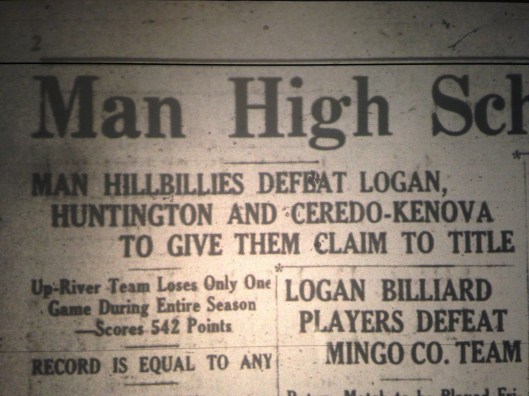
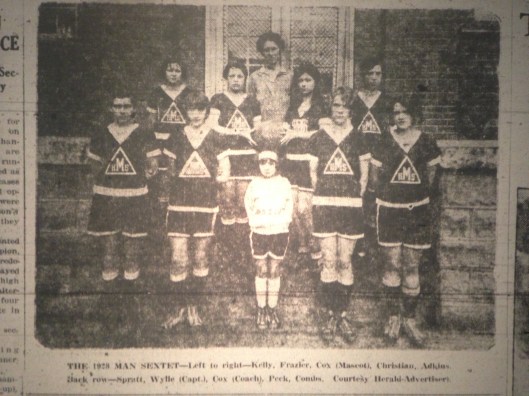
Man High School Girls’ Basketball Team (1928)

13 Thursday Sep 2018

Posted by Brandon Ray Kirk in Boone County, Gilbert, Huntington, Logan, Man, Sports, Women's History, Wyoming County

≈ Leave a comment

Tags

Appalachia, basketball, Burch High School, Ceredo-Kenova High School, Cincinnati, Clothier Independent High School, genealogy, Gilbert High School, history, Huntington High School, Indianapolis, Logan Banner, Logan County, Logan High School, Madison High School, Man High School, Oceana High School, Sports, West Virginia, Wichita

Man HS Girls Basketball Photo LB 03.06.1928 3

Logan (WV) Banner, 6 March 1928.

Man HS Girls Basketball Photo LB 03.06.1928 2

Logan (WV) Banner, 6 March 1928.

Man HS Girls Basketball Photo LB 03.06.1928 4

Logan (WV) Banner, 6 March 1928.

Man HS Girls Basketball Team Goes to Kansas LB 03.27.1928 1

Logan (WV) Banner, 27 March 1928.

Baisden Family Troubles

13 Thursday Sep 2018

Posted by Brandon Ray Kirk in Hatfield-McCoy Feud, Kermit

≈ Leave a comment

Tags

Appalachia, Brit Jones, Buchanan County, Carroll County, Catherine Wills, Catlettsburg Republican, crime, Flora Baisden, Floyd County, genealogy, Grant Bollman, Grover Waldron, Grundy, Harrison Baisden, Harrison Baisden Jr., Hatfield-McCoy Feud, Hiram Wills, history, Ira J. McGinnis, Jack Maynard, James Brewer, Jeffersonville, John Brewer, John Henry Baisden, John Lee White, John Smith Baisden, Johnson County, Kentucky, Lebanon, Lee Brewer, Lewis Dempsey, Logan County, Logan County Banner, Logan Democrat, Marrowbone Creek, Martha Baisden, Mingo County, murder, Naugatuck, Parkersburg Sentinel, Pigeon Creek, R.W. Buskirk, Reuben Baisden, Riley Brewer, Robert Irons, Robert L. Baisden, Ruby Harrison Baisden, Trace Fork, Virginia, West Virginia, William Baisden, William Bevins

Between 1883 and 1891, several members of the Baisden family suffered troubles in their section of West Virginia and Virginia. What follows are some news and other accounts of those events:

At the mouth of Pigeon creek, in Logan county, Grant Bollman and Dr. Harrison Baisden got into a difficulty over a settlement, short words brought blows, when Bollman used a knife severely if not fatally stabbing Baisden. Thereupon he drew a revolver and shot Bollman, who died the same day from the effects of the wound. There is little hopes of the recovery of Baisden.

Parkersburg (WV) Sentinel, 18 August 1883

***

Judge McGinnis has issued a vacation order to the Circuit Clerk of Wayne County admitting Dr. Baisden, charged with the murder of Yancy Bolin, in Logan County, to bail in the sum of $2,000.

Huntington (WV) Advertiser, 31 July 1886

***

According to one item printed in an old genealogy newsletter: “John Smith Baisden was born May 14, 1864. On May 29, 1885 he married Martha Jane Wills who was born in Carroll County, Virginia, on August 4, 1870, the daughter of Hiram and Catherine Massey Wills. Martha had come to Floyd County, Kentucky, in a wagon train in 1879. She was fifteen when she married John Smith Baisden. They had two children: Flora, who was born on January 8, 1888, and Ruby Harrison “Harry” Baisden [February 7, 1890]. On May 4, 1890, John Smith Baisden was shot and killed by John Brewer and John Lee White, while the family was visiting in West Virginia. He was shot in an argument over a horse. It is thought that his murder was indirectly associated with the Hatfield-McCoy Feud. The Baisdens became involved after relatives married McCoys. About the same time of his father’s death, the Hatfields kidnapped and imprisoned Ruby Harrison Baisden (then only a child) and other members of the McCoy clan, and held them in a log barn in what is now Mingo County, West Virginia. Ruby Harrison Baisden was found by a roadside where he had been left for dead. Soon after John S. Baisden’s death, Martha, against the advice of family members, returned to Kentucky by horseback, traveling at night over lonely mountain trails with her son and daughter.”

***

Last week several capias against John Henry Baisden and John Smith Baisden were placed in the hands of the Sheriff of this County. The Baisdens had established the very unenviable name of being dangerous and desperate men, and, a part of the process was placed in the hands of Wm. Bevins with instructions to go by way of Marrowbone to summon a guard who knew the haunts of the Baisdens and to locate them if he could and meet the Sheriff, who was accompanied by Jailor Buskirk, Deputy Sheriff McDonald and several guards, at the mouth of the Trace Fork of Pigeon. Mr. Bevins arrived on Marrowbone on Friday morning and learned that just before his arrival the Baisden boys had made an attack on the house of James Brewer with Winchester Rifles, and that assisted by John Lee White, he had repelled the attack, mortally wounding John Smith Baisden. On learning this Mr. Bevins at once summoned a posse consisting of John Lee White, Brit Jones, James Brewer, Riley Brewer, Lee Brewer and John Brewer and followed the Baisdens to Pigeon Creek. Locating them at Dr. Harrison Baisden’s, Bevins left all of the guard about a quarter of a mile from the house, except John Lee White, who he took with him to find the position of the Baisden boys. As soon as he came in sight of them he demanded their surrender, which they refused to do and fire was opened on them. James Baisden was killed and John Henry Baisden was badly wounded and captured. William Baisden having left the crowd made his escape and is still at large. John Henry Baisden was brought to this place and is now in jail. He was shot through both arms and in the right side, but his wounds are not dangerous. All parties regret the killing of young James Baisden, as there was nothing against him. Heretofore a man in this county had thought that to establish for himself the name of a dangerous man was all the security that he needed against the officers of the law. That is now changed and all of them will hereafter be hunted down.

Logan County (WV) Banner, 24 April 1890

***

John Smith Baisden, who was shot by James Brewer and John Lee White, on April 18th, while making an attack on Brewer’s house, died last Sunday evening.

Logan County (WV) Banner, 8 May 1890

***

On Monday morning John Henry Baisden was turned over by the authorities of West Virginia to Wm. A. Bevins upon a requisition from the Governor of Virginia. Baisden is wanted in Buchanan county, Va., for the murders of a man named Irons. Bevins, accompanied by R.W. Buskirk and Lewis Dempsey, started with Baisden to Jeffersonville, Va., where he will be confined for safe keeping until the Buchanan authorities are ready for his trial. He was not taken to Buchanan as there has been some talk of lynching him there.

Logan County (WV) Banner, 26 June 1890

***

R.W. Buskirk, Wm. Bevin and Lewis Dempsey, who took John Henry Baisden to Virginia on a charge of murder, returned on Sunday. The prisoner was first taken to Jeffersonville, then to Grundy, and finally to Lebanon as neither the Jeffersonville nor Grundy Jail were safe.

Logan County (WV) Banner, 10 July 1890

***

A Logan Man Gone Wrong.

Wm. Baisden, formerly of this county, was last week sentenced to the Virginia penitentiary from Buchanan county, for the term of 18 years, for the murder of a man named Irons, some two years ago. Outside of whisky, Baisden was regarded as a good man, and had a great many friends on the Sandy side of our county, where he was raised, and where his relatives now live.

Logan County (WV) Banner, 6 August 1890

***

Baisdens Allowed to Escape.

John Henry Baisden who killed Robert Irons in Buchanan county, Va. last fall and who afterwards figured in a terrible tragedy in Logan county, W.Va., and who was captured and taken to Virginia has been allowed to escape. After killing Irons, he fled to W.Va. to find another man living with his wife. He got a party of his relatives and went to attack the man, but was met by an officer and posse in search of him. Two desperate fights ensued between the two parties on consecutive days and Jim and John Smith Baisden were killed. John Henry was captured, after being seriously wounded, and lodged in jail. The parties who captured him in W.Va. delivered him to the authorities all right and received the Reward. He was afterwards sent to Russell county jail and being taken back to Buchanan for trial was taken from the guard by his brother. It is thought that the officers were willing that the prisoner should be rescued.

Catlettsburg (KY) Republican via the Logan County (WV) Banner, 21 August 1890

***

Murder on Sandy.

Monday afternoon Harrison Baisden, Jr., a member of the notorious gang of Baisden outlaws came down to the Mouth of Pigeon where there was a whiskey boat moored on this side of the river. He took his horse across to the Kentucky side, and then returning, he walked deliberately up to Jack Maynard, between whom and himself, it appears, there had been some bad blood, and shot him through the head, killing him instantly. The last heard from Baisden he was in Kentucky riding from about five men, who were pursuing him hotly. As the report says he was very drunk and the men were only a mile behind, the chances are that he is captured by now. It is feared that if he is caught that he will be lynched.

Logan County (WV) Banner, 3 September 1891

***

Found Dead.

A rumor has reached us that Reuben Baisden, the murderer of Jack Maynard, was found dead at the head of a lonely creek, in Johnson county, Kentucky, with fifty-three bullet wounds on his body and his dead horse lying on him. It was thought that he had been dead about three days when found. We do not credit the story.

Logan County (WV) Banner, 17 September 1891

***

Manslaughter for Dr. Baisden

In the Mingo criminal court last week, Dr. Robert L. Baisden was found guilty of voluntary manslaughter for killing Grover Waldron, at Naugatuck on April 23, of last year.

The evidence showed that young Waldron was stabbed to the heart on the above named night near the signal tower at Naugatuck. Dr. Baisden was coming down the tower steps when some person threw a beer bottle against a stone wall not far away. Young Waldron and two companions were standing near the foot of the steps.

Using an oath Dr. Baisden inquired who threw the bottle at him and there came a reply and also an oath, that it was for him and some one of the three also called out that they would send Dr. Baisden to hell “feet first” if he was not careful.

Logan (WV) Democrat, 20 April 1911

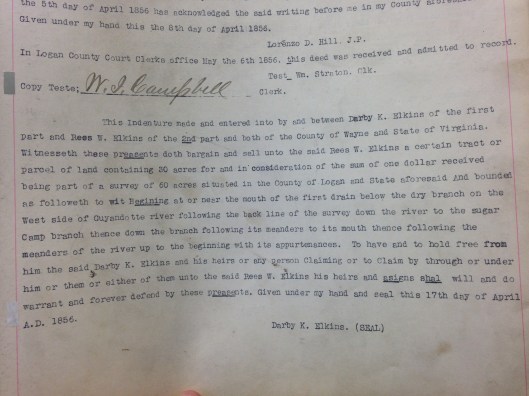
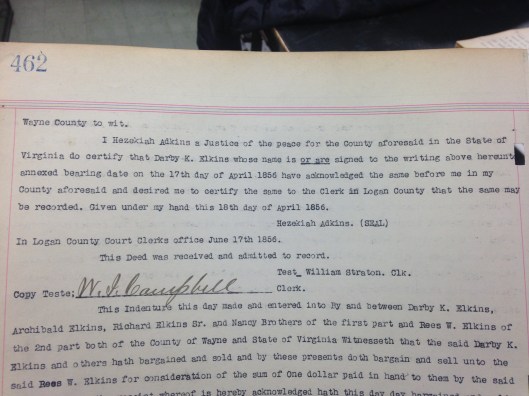
Darby K. Elkins Deed to Reese W. Elkins (1856)

12 Wednesday Sep 2018

Posted by Brandon Ray Kirk in Atenville, Guyandotte River

≈ Leave a comment

Tags

Appalachia, county clerk, Darby K. Elkins, Dry Branch, genealogy, Guyandotte River, Hezekiah Adkins, history, justice of the peace, Logan County, Reese W. Elkins, Sugar Camp Branch, Virginia, W.I. Campbell, Wayne County, West Virginia, William Straton

Darby K. Elkins to Reece W. Elkins Deed 1

Deed Book C, page 461, Logan County Circuit Clerk’s Office, Logan, WV. Note: This property is located near present-day Atenville, Lincoln County, WV.

Darby K. Elkins to Reece W. Elkins Deed 2

Deed Book C, page 462, Logan County Circuit Clerk’s Office, Logan, WV

Chapmanville News 02.01.1929

12 Wednesday Sep 2018

Posted by Brandon Ray Kirk in Chapmanville, Logan

≈ Leave a comment

Tags

Abe Dingess, Appalachia, C.M. Gore, Chapmanville, genealogy, history, Hugh Workman, influenza, Island Creek, Logan, Logan Banner, Logan County, Mud Fork, Wallace Toney, West Virginia

An unknown correspondent from Chapmanville in Logan County, West Virginia, offered the following items, which the Logan Banner printed on February 1, 1929:

A. Dingess, prominent merchant of Mud Fork of Island Creek has been quite indisposed at his home with flu.

Mrs. Hugh Workman has been on the sick list for the past week.

Abe Dingess, manager of Dingess’s grocery store here, was called to Mud Fork to see after his father’s business there.

C.M. Gore was a business visitor in Logan Friday.

Wallace Toney has been sick the past week, but we are glad to say is back with his business again.

Mrs. Lisa Salyers has been on the sick list the past week.

Geo. Chapman of this place is out again after a bad spell with the flu.

Logan’s Dirt Roads (1914)

11 Tuesday Sep 2018

Posted by Brandon Ray Kirk in Logan

≈ Leave a comment

Tags

Appalachia, history, Logan, Logan Banner, Logan County, photos, West Virginia

Taking Care of Logan City's Dirt Roads LB 05.22.1914 3

Taking Care of Logan City’s Dirt Roads, Logan (WV) Banner, 22 May 1914.

Whirlwind News 08.14.1928

11 Tuesday Sep 2018

Posted by Brandon Ray Kirk in Big Harts Creek, Chapmanville, Harts, Queens Ridge, Whirlwind

≈ Leave a comment

Tags

Appalachia, Chapmanville, Charley Gore, Cora Robinson, genealogy, Harts, Harts Creek, history, Hoover Fork, Logan Banner, Logan County, Mary Honaker, Mt. Gay, Nerve Adams, Queens Ridge, Switzer, West Virginia, Whirlwind

An unknown correspondent from Whirlwind in Logan County, West Virginia, offered the following items, which the Logan Banner printed on August 14, 1928:

Charley Gore of Chapmanville was a business visitor to Harts Tuesday.

Mrs. Cora Robinson of Mt. Gay is visiting relatives at Whirlwind this week.

Mrs. Nerve Adams of Switzer is visiting her daughter at Queen’s Ridge for this week.

Mrs. Mary Honaker of Mt. Gay was visiting her sister of Hoover this week end.

James P. Mullins Grave and the K.S. Colley Cemetery in Breaks, VA (2018)

11 Tuesday Sep 2018

Posted by Brandon Ray Kirk in Big Harts Creek, Cemeteries, Lincoln County Feud

≈ 7 Comments

Tags

Appalachia, Big Branch, Big Harts Creek, Brandon Kirk, Breaks, Dickenson County, feuds, genealogy, history, James P. Mullins, K.S. Colley Cemetery, K.S. Colley Cemetery Road, King Solomon Colley, King Solomon Colley Road, Lincoln County, Lincoln County Feud, photos, Phyllis Kirk, Virginia, West Virginia

IMG_6911

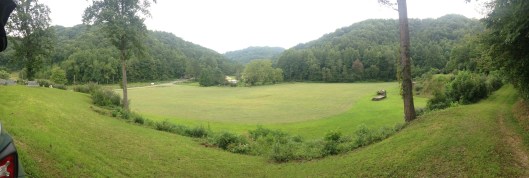
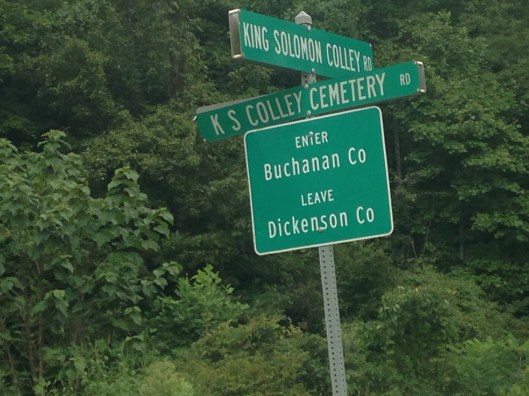
View of K.S. Colley Cemetery Road from the K.S. Colley Cemetery in Breaks, Dickenson County, VA. 25 August 2018.

IMG_6909.JPG

K.S. Colley Cemetery. 25 August 2018.

IMG_6913

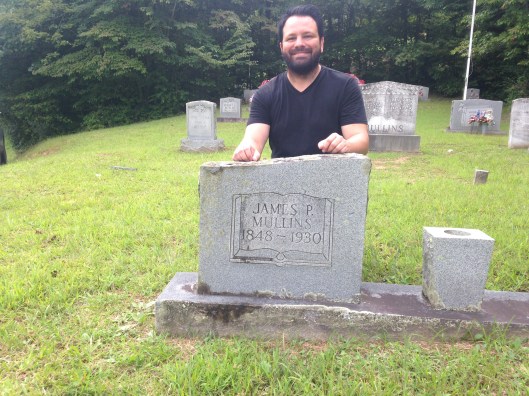
James P. Mullins, once a merchant at Big Branch of Harts Creek in Lincoln County, WV, was involved in the Lincoln County Feud. Photo by Mom. 25 August 2018.

IMG_6920

View of the cemetery from K.S. Colley Cemetery Road. 25 August 2018.

IMG_6924

The K.S. Colley Cemetery is located near the Dickenson-Buchanan county line. 25 August 2018.

Allen Hatfield of Beech Creek, WV (1970s)

11 Tuesday Sep 2018

Posted by Brandon Ray Kirk in Hatfield-McCoy Feud, Matewan, Tazewell County

≈ 4 Comments

Tags

Allen Hatfield, Appalachia, Beech Creek, Beni Kedem, Charleston, Charlie Simpkins, Cincinnati, civil war, Clyde Kiser, Deanna Hatfield, Devil Anse Hatfield, Devon Church of Christ, Doc Mayhorn, Eliza Murphy, Ellison Hatfield, feuds, Frankfort, genealogy, Goldie Hatfield, Gordon Smith, Grapevine Fork, Hatfield-McCoy Feud, history, Hugh C. Boyd Lodge No. 119, Jane Hatfield, Jane Maynard, Joseph Chester Hatfield, Joseph Murphy, Kentucky, Kentucky Colonels, Lawrence Hatfield, Logan County, Major Hatfield, Martha Bell Murphy, Maryland, Mingo County, Norfolk and Western Railroad, North Tazewell, Ohio, Pike County, Plyant Mayhorn, preacher, Raymond Hatfield, Right Hand Fork, Rockville, Thacker, Valentine Wall Hatfield, Virginia, West Virginia, Williamson, Williamson Memorial Hospital, Willis Hatfield

My name is Deanna Hatfield and tonight I would like to share with you a West Virginian, Allen Hatfield, who the community of Beech Creek honored and loved. Allen was born October 11, 1877. He was the youngest child of the pioneer couple, Wall Valentine Hatfield and Jane Maynard Hatfield, who settled on Beech Creek in 1861, the year that the Civil War broke out in this country. His parents had settled at the mouth of Grapevine Fork of Beech Creek. They had occupied a log cabin near the present site of Lawrence Hatfield’s home. He was the nephew of Captain Devil Anse Hatfield, clan leader in the famed Hatfield-McCoy Feud, and a first cousin of Willis Hatfield, the only surviving child of that family.

Almost until the day of his death, Allen carried a sadness in his heart over the death of his father in the days of the famous feud. His father, a peaceable man, was not an active member of the fighting group of the Hatfields during the trouble between his family and the McCoys but was named in warrants along with two of his sons-in-law, Doc and Plyant Mayhorn. Allen Hatfield, but ten years old at the time, remembered that his father Wall, thinking that he had nothing to fear in the courts of Kentucky, wrote the prosecuting attorney of Pike County that he and his sons-in-laws wished to surrender in Pikeville and stand trial for crimes for which they were accused. Allen Hatfield recalled the incident from his boyhood, including the feud. His father did go to Pikeville to voluntarily stand trial and clear his name but he was convicted by a prejudiced jury, the son remembered, and was sentenced to life imprisonment at the Kentucky State Prison in Frankfort. After sentencing, he lived about one year and his burial place is still unknown today. The two Mayhorns served several years and were later pardoned.

One of his fondest memories was that of his mother Jane who took over the management of the home and did a good job of raising a large family after her husband was taken from her. She did chores around the homestead. A great and interesting conversationalist in his adult years, he liked to tell of how he and his friends made bows and arrows–arrows consisting of straight pieces of wood with a horseshoe nails attached as the spike. He became an excellent marksman with the bow and arrow and later with his first rifle as he helped to provide squirrels and other wild game for the family table.

The early years of Hatfield’s life were marked by sadness as a result of the loss of his family in the feud. But his hours spent in the great outdoors hunting and fishing provided a therapy that led to his development to splendid manhood. He was several years old when the Norfolk and Western Railroad Company built an extension from Virginia to southern West Virginia and Mingo County, which still was Logan County at that time.

In 1899, Hatfield was married to Martha Bell Murphy, daughter of Joseph and Eliza (Steele) Murphy. She had just turned fourteen when he proposed and her family thought she was too young to wed. The young couple sort of eloped the night of April 8, 1899, to Allen’s home where they were married by Allen’s brother, Ellison, a country preacher and a granny doctor, as he later recalled. Late that summer, he amassed enough lumber to build their first home—a one-room abode that was erected next to the hillside just north of the present homestead. Allen Hatfield made most of his furniture and his wife tended a garden and dug ginseng to help the family fortune.

During the ensuing years, the Hatfields had eleven children, two of whom preceded them in death. Lawrence Hatfield, who married Dollie Kiser, is now retired and lives with Dollie on Beech Creek at the mouth of Grapevine Fork. Estel Hatfield, who married Virginia Varney, lived with his dad and still lives in the old homeplace. Estel is an agent for the Norfolk and Western Railroad Company. Major Hatfield, who married Mildred Friend, is employed as an agent also for the Norfolk and Western Railroad Company in North Tazewell, Virginia. Rosa Hatfield, married Wayne Simpkins, lives on Beech Creek on Right Hand Fork. Goldie Hatfield married Gordon Smith, and they make their home below Grapevine Fork on Beech Creek. Mamie Hatfield married Charlie Simpkins and makes her home in Rockville, Maryland. Glendeen Hatfield married Douglas Berlin, and they make their home in Louisiana. Etta June Hatfield, never married and lives in Cincinnati, Ohio. Erma Hatfield married Forest Baisden, and she lives in Williamson, West Virginia. Milda Hatfield, deceased, was a retired school teacher and was never married. Joseph Chester Hatfield, died at six months old.

In 1914, Allen bought from his brother Smith a grocery store at the old homeplace and moved the merchandise to a small building at his home. He built a large home later and it was there that most of the children were born. He expanded his business to a larger store building, which still stands, and then he erected the present homeplace. During his early merchandising days, Hatfield was compelled to haul his goods from the railway station at Devon by team and wagon for the roads had not been built and most of the rough team tracks was through the creeks. It was a problem in the wintertime to get through the streams as they were filled with ice. After the county built a road up Beech Creek, he retired his team and wagon and switched to a gasoline-powered vehicle to haul and deliver his goods. He learned carpentry in the early years of his marriage and continued this art until 1964 when he retired. Hatfield was a 57-year member of the Hugh C. Boyd Lodge No. 119 AF & AM at Matewan and received his 50-year service award from the Grand Lodge of West Virginia in 1970. The lodge, when he became a master mason, was known as Thacker No. 119. It was located at Thacker, West Virginia. It later was moved to Matewan. He also belonged to the Beni Kedem Temple of Charleston, being a 50-year member of the Shriners. He also received the honorary commission of a Kentucky Colonel on April 10, 1972. He had been a member of the Devon Church of Christ since 1916 and sponsored the building of the present church that stands near his home on Beech Creek.

In his years of selling groceries, Hatfield said he never lost but 50 dollars in bad debts. He was proud of his heritage, a leader in his community, and in his active life a crack shot with a rifle, pistol, and shotgun. His hunting and fishing kept the table supplied with food. He won beef, hogs, turkeys, and chickens in the old-time rifle matches that were so popular in the Beech Creek area years ago. He and the former Martha B. Murphy were married 71 years before her death on May 25, 1970. His life might have been used as the subject by the poet who wrote, “Let me live by the side of the road and be a friend to man.” Allen Hatfield had spent a lifetime doing just that, living beside a little country road on Beech Creek and being a friend to mankind. On March 2, 1975, Allen was taken to the Williamson Memorial Hospital for ailments associated with his advanced age. He then was released and re-entered the hospital on April 18 in critical condition. On Friday, May 2, 1975, the community of Beech Creek lost one of the dearest old-timers that was ever known. Allen Hatfield, 97, prominently-known Mingo pioneer citizen, retired merchant of Beech Creek, died at 3 a.m. in the Williamson Memorial Hospital of a lingering illness. Funeral services were scheduled at the Chambers Funeral Home Chapel with his beloved ministers Clyde Kiser and Raymond Hatfield officiating. Burial took place in the family cemetery behind the homeplace on Beech Creek. His grandsons and great-grandsons were his pallbearers. Allen would have wanted it this way. Simple.

NOTE: Some of the names may be transcribed incorrectly.

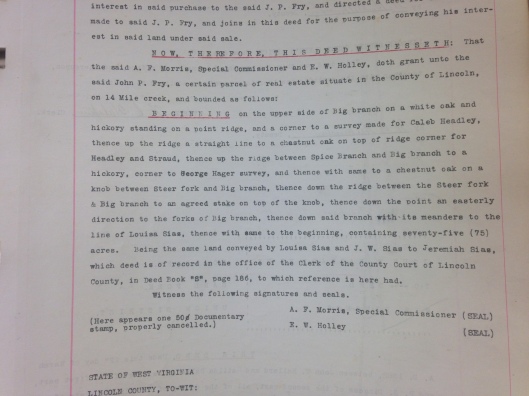
A.F. Morris and E.W. Holley Deed to John P. Frye (1900)

09 Sunday Sep 2018

Posted by Brandon Ray Kirk in Fourteen, Wewanta

≈ Leave a comment

Tags

A.F. Morris, Appalachia, Big Branch, Caleb Headley, E.W. Holley, Fourteen Mile Creek, genealogy, George Hager, history, James Wilson Sias, Jeremiah Sias, John P. Frye, Laurel Hill District, Lincoln County, Louisa Sias, Steer Fork, Sulphur Spring Fork, T.M. Smith, West Virginia

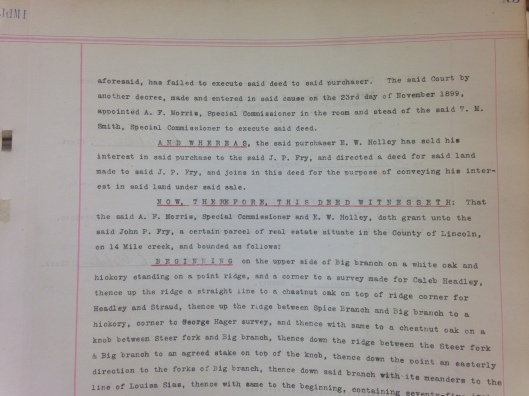
Morris and Holley to John P. Fry 1

Deed Book ___, page ___, Lincoln County Clerk’s Office, Hamlin, WV. John P. Frye is my great-great-grandfather.

Morris and Holley to John P. Fry 2

Deed Book ___, page ___, Lincoln County Clerk’s Office, Hamlin, WV.

Morris and Holley to John P. Fry 3

Deed Book ___, page ___, Lincoln County Clerk’s Office, Hamlin, WV.

Flick Amendment Ratified by Voters of Triadelphia Township, Logan County, WV (1871)

09 Sunday Sep 2018

Posted by Brandon Ray Kirk in Civil War, Man

≈ Leave a comment

Tags

Aaron Altizer, Albert G. Mitchell, Alexander Spratt, Alexander Trent, Appalachia, B.W. White, Ben H. White, civil war, Curtis Ballard, Democratic Party, F.M. White, Flick Amendment, genealogy, George S. Claypool, Harvey Buchanan, Harvey Ellis, history, Hugh Avis, Isaac Browning, James A. White, James H. Brown, James H. Hinchman, James M. White, James Spratt, Jasper Perry, John Claypool, John Riffe, Logan County, Louis Mitchell, Madison Ellis, Patterson Christian, Perry Altizer, Peter Riffe, Phillip Ellis, politics, Preston Perry, Reconstruction, Republican Party, Rhodes D. Ballard, Robert P. Spratt, Sidney Hinchman, Squire Ellis, Triadelphia District, Ulysses Hinchman, W.H.H. Flick, West Virginia, William A. Lee, William Claypool, William W. McDonald

After the Civil War, West Virginia law barred ex-Confederates from voting. The Flick Amendment of 1871, named for Republican W.H.H. Flick, sought to extend suffrage to ex-Confederates and freedmen. Most ex-Confederates were Democrats. Passage of the Flick Amendment ultimately meant that Democrats would rule West Virginia for the next 25 years.

***

Names of all persons voting at Aaron Altizer in Triadelphia Township of Logan County this 27th day of April 1871 on the Ratification or Rejection of the amendment of the constitution of the state of West Virginia.

Ben H. White

John Claypool

Albert G. Mitchell

Peter Riffe

Wm. Claypool

Squire Ellis

B.W. White

Phillip Ellis

Alexander Trent

Isaac Browning

Harvey Buchanan

James Spratt

Robert P. Spratt

Patterson Christian

Michell Carter

John Riffe

Hugh Avis

Harvey Ellis

Perry Altizer

Rhodes D. Ballard

Alexander Spratt

Madison Ellis

Curtis Ballard

Aron Altizer

Wm. W. McDonald

Jasper Perry

James M. White

James H. Brown

Louis Mitchell

F.M. White

Wm. A. Lee

Preston Perry

George S. Claypool

Jas. H. Hinchman

Wm. Wesly

Ulyses Hinchman

Sidney Hinchman

James A. White


Total No. Votes: Thirty Eight


Madison Ellis, Inspector

F.M. White, Inspector


James M. White, Clerk

Wm. A. Lee, Clerk


Tally of the votes cast at the Election held at Aaron Altizer’s in the Township of Triadelphia and county of Logan on the 27th day of April 1871 (on the Ratification or rejection of the proposed amendment to the constitution of the State of West Virginia).

Tally of Votes:

Total of Votes for Ratification: Thirty Eight

***

Compared to the gubernatorial election of 1870, voter turnout for the Flick Amendment was extremely low. West Virginia voters approved the amendment by a vote of 23,546 to 6,323. Only five counties, all located in the northern part of the state, voted against the amendment.

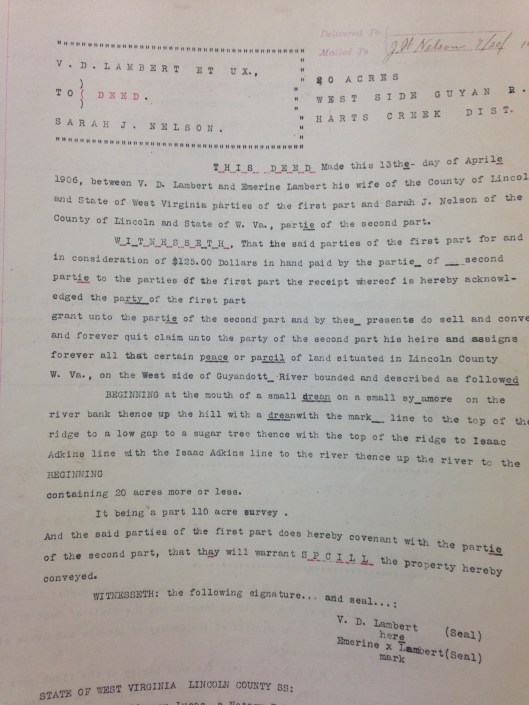
Van Donley Lambert Deed to Sarah J. Nelson (1906)

07 Friday Sep 2018

Posted by Brandon Ray Kirk in Atenville, Guyandotte River, Sand Creek

≈ Leave a comment

Tags

Appalachia, Bend of the River, Emerine Lambert, genealogy, Guyandotte River, history, Isaac Adkins, Jefferson Lucas, Lincoln County, Martha Sias, notary public, Sand Creek, Sarah J. Nelson, Van Donley Lambert, West Virginia

Van Don Lambert to Sarah Nelson 1

Deed Book ___, page ____, Lincoln County Clerk’s Office, Hamlin, WV. This property is likely located at the Bend of the River opposite Sand Creek and below Atenville.

Van Don Lambert to Sarah Nelson 2

Deed Book ___, page ____, Lincoln County Clerk’s Office, Hamlin, WV. I descend from Van Donley’s sister, Martha (Lambert) Sias.

Recollections of McKinley Grimmett of Bruno, WV 4 (1984)

07 Friday Sep 2018

Posted by Brandon Ray Kirk in Coal, Hatfield-McCoy Feud, Italian American History, World War I, Wyoming County

≈ Leave a comment

Tags

Accoville, Appalachia, Bill Mosely, Bruno, Buffalo Creek, Burl Christian, Cap Hatfield, coal, crime, Cub Creek, Democratic Party, deputy sheriff, Devil Anse Hatfield, Don Chafin, Elech Luster, Elech Steven, Elk Creek, genealogy, Harve Grimmett, Henderson Grimmett, history, influenza, Italian-Americans, Joe Browning, Joe Hatfield, justice of the peace, Logan County, Logan Lumber Company, Mallory, Mallory Coal Company, Matilda Hatfield, McKinley Grimmett, Nancy Grimmett, Phil Elkins, Sand Lick, Scott Browning, sheriff, Spice Creek, Tennis Hatfield, Thomas Hatfield, Watt Elkins, West Virginia, World War I, Wyatt Belcher, Wyoming County

McKinley Grimmett was born on November 30, 1896 to Henderson and Nancy (Hatfield) Grimmett at Sand Lick, Logan County, WV. On May 14, 1916, Mr. Grimmett married a Ms. Plymale, who soon died, in Logan County. One child named Alva died on June 21, 1919 of whooping cough, aged fourteen months. His World War I draft registration card dated September 12, 1918 identifies him as having blue eyes and light-colored hair. He was employed by Mallory Coal Company at Mallory, WV. On November 13, 1919, he married Matilda “Tilda” Hatfield, daughter of Thomas Hatfield, in Logan County. He identified himself as a farmer in both of his marriage records. During the 1920s, he served as a deputy under Sheriff Tennis Hatfield.

The following interview of Mr. Grimmett was conducted at his home on July 17, 1984. In this part of the interview, he recalls his occupations. The post-World War I flu pandemic, early Bruno residents, timbering, the Hatfields, politics, and crime are featured.

***

Do you remember the flu that came along after World War I?

Oh yeah, I’ve seen ‘em up here in my graveyard bury as high as three or four in one day. Buried a man and his wife and kid all in one day there. It was bad. I was running a drum at Mallory for the company. I went there well that morning and at 10 o’clock they hauled me back in a jo-wagon. I couldn’t walk with the flu. I was down for four days and the mine didn’t run. I got over it awful quick. The doctor come… Dr. Shrewsbury, used to be at Mallory. Next day was Saturday and Sunday and he told me to stay off for Monday. And he said he’d send after me. Come and get me, bring me back in the evening. All he wanted me to do was run the drum. Not get hot or anything. I got over mine. My sister come there to see me. She had seven kids. She come there and took it. And all her kids come to see her and they all took it. And her husband come to see about them and he took it. And her husband couldn’t talk plain. Keenan Walls was her husband. He called onions “inghams.” My mother would say, Keenan, what do you want to eat today? They fried them. She’d fry them onions. He said, I don’t know hardly unless you fry me some more inghams. Yeah, they’s about 250 graves in that graveyard of mine.

Tape stops.

There’s a lot of people up this creek. Used to be there wasn’t about six families when I was a boy growing up. Wyatt Belcher lived down below the mouth of the creek. And Burl Christian lived up here a little ways. And Watt Elkins lived over there. And my daddy lived next. And my daddy’s brother Harve Grimmett lived next. Phil Elkins lived next. Now in the head of the creek where this backland was, that was before McDonalds got a hold of it. They lived on it, built log houses and everything else. I couldn’t tell you who all… Mountses there. I made several caskets. I made my mother’s coffin. I bought my daddy a steel coffin and I had to take some straw out of it. He was a pretty good sized man like myself. They both had the flu. And she had a lot of chickens here. I lived up at the old homeplace and they lived here. She wanted to know where that straw come from. I told her the truth about it. I told her I had to take it out of Daddy’s casket. It was a little too tight on him and I wouldn’t put him away that way. And said, Kin—she called me Kin, my nickname—said, whenever I die I want you to make my casket. She’d seen me make so many, you know. She wanted me to do that. And so I made it. I went to Logan and I bought the handles. It cost me $105 dollars. Looked like silver. And I bought plush stuff and lined it and everything. And I went down here to this planing mill and I bought the first class lumber. Didn’t have a knot in it. Logan Lumber Company run it then. And I made it. Oh, I’ve made oodles of ‘em. I made the old man Joe Browning’s in Spice Creek up here one time… And he’d sawed beech lumber now for me to make that casket out of. And old man Scott Browning, I got him to help me. And I bet you he weighed about 300 pound. And that beech lumber was 22 inches wide and I still had to put a slab on each side up at his hips down about four inches wide on each side. They couldn’t get enough men around that to lift it. I don’t see how they ever got it down in the grave. I didn’t go to the grave with ‘em. I made the casket and that was all.

Would you rather work with timber or coal?

Well, it’s according to what kind you do with lumber. I believe I would rather work in the mines because I’ve always had a good job in the mines. I worked 44 years and two months around the mines and I never was laid off. Born and raised here in Logan County. Never been in jail. Never been arrested. Never been sued. I never bothered nobody’s business only my own. I’ve been honest with everybody.

Were you ever politically active?

Yeah, I was, whenever them Hatfields was in there. They’d make you, whether you wanted to or not. Tennis and Joe and all of them. You get in that bunch of Hatfields at that day and time you couldn’t get away from ‘em. They’d claim me as their cousin all the time, ‘cause I was half-Hatfield myself. I don’t reckon my mother was any relation to any of them. She didn’t know nothing about them. She was from Wyoming County up on Big Cub Creek, you know. Now she heard lots of talk about Devil Anse and Cap and all of them. She was afraid for me to be with them all the time.

Did you like politics?

Yeah, I liked it pretty good.

Did you ever run for office?

Yeah, I run for JP one time. ’52. Bill Mosely run against me. And I beat Bill over here at his office precinct but he beat me up at Buffalo. Yeah, I run for JP one time. I never did run any more.

Who has impressed you the most in politics?

I reckon Tennis has been the one. Now Joe is a man that was still kind of sulky like. He didn’t seem like that he appreciated what you’d done or something like that. Either that or he thought hisself a little bit higher than you was. Something like that. I don’t know. I couldn’t figure him out. But Cap now, he’d cuss them out and everything else.

Do you remember the ’32 election?

Oh yeah. I remember. Why, coal companies, they went in with the Democrats and they fired us off of the deputy force. The coal companies put us on as guards. And we stayed that way for about three months. And Democrats come in and they cut that law out. And we went on back to work and that didn’t change nothing. I tell you, it was a sight whenever Chafin was in there. Lord, they killed people and everything. Up Buffalo at Accoville, they was building a railroad up through there. Well, that day and time they built camps for their men to stay in and they rode horses, the bosses did, ride him right out on the job. And they’d get up in the morning, Elech Steven and Elech R. Luster was the two bosses—one was superintendent, one was boss—and they’d go around, one had a ball bat and a hole drilled through it and a strap of leather in it and it was a small ball bat now and if them colored people or hunkies and Italians wasn’t up they’d knock the window lights out and then nail the window up instead of buying them a window and putting it back in. And they killed them two, the hunkies and Italians. They come out on ‘em and shot ‘em both and killed ‘em. About eight of them. Well, they killed three of ‘em before they got out of sight, the Americans did, up Accoville Hollow there. And the rest of ‘em come through and they shot one right over the Huff Knob and he rolled plumb from the top of that ridge down just like a dog bouncin’ plumb into the river. That made four of ‘em they got. Then they got two more up here on Elk Creek. Then they got two more up at Spice. Made the eight. Well, they killed them all. And they brought them—I was up there at the store at Elk Creek whenever they brought them two Italians down there… Now, this old raw bacon. Slabs that come that wide and be that long, grease would be running out. And they would cut them off raw meat and throw it to them like throwing it to a dog and they’d eat it.

NOTE: Some names may be transcribed incorrectly.

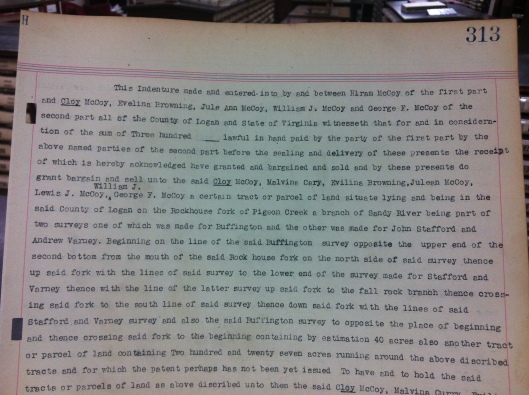
Hiram McCoy Deed to McCoy Heirs (1853)

07 Friday Sep 2018

Posted by Brandon Ray Kirk in Big Sandy Valley, Hatfield-McCoy Feud, Lincoln County Feud

≈ Leave a comment

Tags

Andrew Varney, Appalachia, Big Sandy River, Chloe McCoy, Eveline Browning, genealogy, George F. McCoy, Harts Creek, Hatfield-McCoy Feud, Hiram McCoy, history, John Stafford, Julie Ann McCoy, Lewis J. McCoy, Lincoln County Feud, Logan County, Melvina Curry, Pigeon Creek, Randolph McCoy, Rockhouse Fork, Salena Vance, Sarah McCoy, Virginia, West Fork, West Virginia, William J. McCoy

Hiram McCoy to McCoy Heirs 1853 2

Deed Book C, page 313, Logan County Clerk’s Office, Logan, WV. Note: This property is located in present-day Mingo County, WV.

Hiram McCoy to McCoy Heirs 1853 3

Deed Book C, page 313, Logan County Clerk’s Office, Logan, WV. Hiram McCoy was a brother to Sarah McCoy, wife of Randolph.

Hiram McCoy to McCoy Heirs 1853 4

Deed Book C, page 313, Logan County Clerk’s Office, Logan, WV. Hiram’s granddaughter Salena (Browning) Vance settled on West Fork of Harts Creek and was an important character in the Lincoln County Feud.

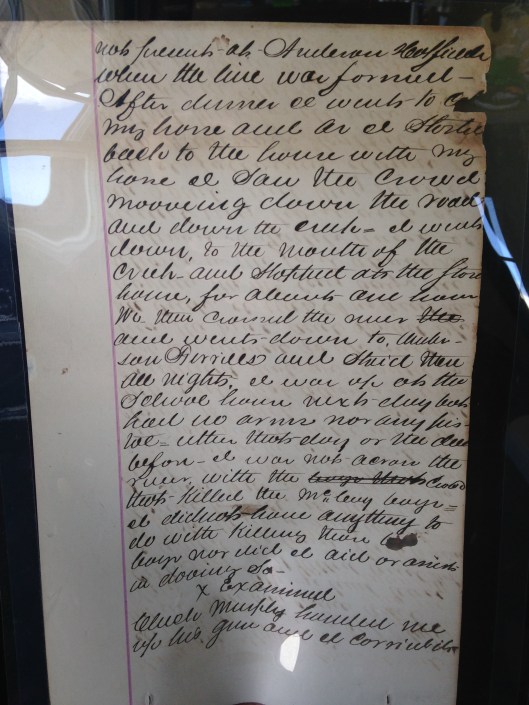
Paw Paw Incident: Doc Mayhorn Deposition (1889)

07 Friday Sep 2018

Posted by Brandon Ray Kirk in Hatfield-McCoy Feud, Matewan

≈ Leave a comment

Tags

Anderson Ferrell, Appalachia, Bud McCoy, crime, Devil Anse Hatfield, Doc Mayhorn, feud, feuds, G.W. Pinson, genealogy, Hatfield-McCoy Feud, history, John Hatfield, murder, Pharmer McCoy, Tolbert McCoy, true crime, Valentine Wall Hatfield

The killing of Tolbert, Pharmer, and Bud McCoy by a Hatfield-led gang on August 8, 1882 represented one of the most sensational events of the Hatfield-McCoy Feud. What follows is Doc Mayhorn’s deposition regarding the affair:

COMMONWEALTH VS DOC MAYHORN &C

Bill of Exceptions

FILED Sept. 1889

G.W. Pinson, Clk

IMG_9740IMG_9741

Dock Mayhorn

I was at home in bed asleep when Walls boy come and said that Ellison had been cut shot and killed and that he wanted his horse ____ to him. We took the horse and went down to Wall at the mouth of Beech. Wall wanted us to go and help get his brother away from where he was shot. We did not know until we got down to Black Berry who had cut and shot Ellison. We then consented that we would go up and hear the trial, and ___ up the creek. I met Ans and th__ ____ the McCoy boys in charge in the ford above Rev. Anderson Hatfields house. I __ my horse out of the road and they passed on. I followed down to Rev. Anderson Hatfields They stopped there for dinner. I ___ my horse in the pasture ___ ____ walk to John Hatfields and got my dinner I was not present at Anderson Hatfields when the line was formed. After dinner I went to ___ my horse and as I started back to the house with my horse I saw the crowd moving down the road and down the creek. I went down to the mouth of the creek and stopped at the store house for ___ one ____ We then crossed the river and went down to Anderson Ferrills and staid there all night. I was up at the school house next day __ had no arms nor any pistol. either that day or the day before. I was not across the river with the crowd that killed the McCoy boys. I didn’t have anything to do with killing those boys nor did I aid or assist in doing so.

Examined

Clucl Murphy ____ me up his ___ and I _____

For more information about this incident, follow these links:

http://explorekyhistory.ky.gov/items/show/785?tour=55&index=3

http://wvpublic.org/post/three-mccoys-killed-hatfields-kentucky-august-8-1882#stream/0

http://hatfield-mccoytruth.com/2017/04/22/in-hatfield-country-blackberry-creek-in-the-1880s/

Mariah (Vance) Adkins Obituary (1931)

06 Thursday Sep 2018

Posted by Brandon Ray Kirk in Big Harts Creek, Cemeteries, Lincoln County Feud, Stiltner, Women's History

≈ 1 Comment

Tags

Abner Vance, Angeline Adams, Appalachia, Blood in West Virginia, Cain Adkins, Cain Adkins Jr., cemeteries, Community Memorial Gardens, Eliza Kelly, genealogy, Harts Creek, history, Jesse Nelson, Kenova, Lena Napier, Lick Creek, Lincoln County, Lincoln County Feud, Mariah Adkins, Mary Jane Jordan, Mittie Adkins, photos, Spicie Fry, Stiltner, Tams, Thomas Vaughan, Walton, Wayne, Wayne County, Wayne County News, West Fork, West Virginia, Williamson, Winchester Adkins

Mariah Adkins Obituary WCN 07.02.1931 1.JPG

Wayne County (WV) News, 2 July 1931. Mariah (Vance) Adkins was born on the West Fork of Harts Creek in present-day Lincoln County, WV. She married Canaan “Cain” Adkins, a preacher, teacher, doctor, and justice of the peace.

IMG_6738

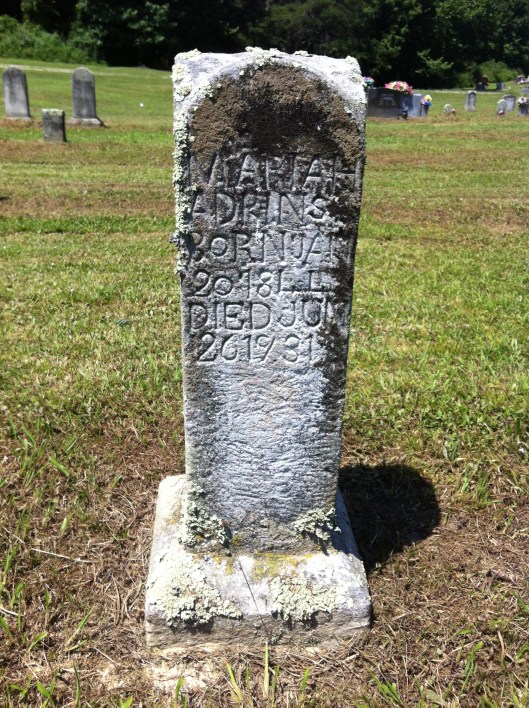
Mariah Adkins grave at Community Memorial Gardens near Wayne, Wayne County, WV. 23 July 2016.

Recollections of McKinley Grimmett of Bruno, WV 3 (1984)

06 Thursday Sep 2018

Posted by Brandon Ray Kirk in Coal, Hatfield-McCoy Feud, Logan, Timber, World War I

≈ Leave a comment

Tags

Appalachia, assessor, blacksmith, Bruno, Burl Stotts, California, Cap Hatfield, Christian, Christmas, coal, Devil Anse Hatfield, drum runner, Edith Grimmett, Elba Hatfield, Elk Creek, Ellison Toler, genealogy, Harvey Ferguson, Harvey Howes, Hatfield-McCoy Feud, Henderson Grimmett, history, Huff Creek, J.G. Hunter, Joe Hatfield, Johnny Davis, justice of the peace, Logan, Logan County, Mallory, Mallory Coal Company, Matilda Hatfield, McKinley Grimmett, mining, Nancy Grimmett, Osey Richey, politics, pushboats, rafting, Ralph Grimmett, Rum Creek, Sand Lick, sheriff, Smoke House Restaurant, Tennis Hatfield, Thomas Hatfield, timber, West Virginia, whooping cough, Willis Hatfield, World War I

McKinley Grimmett was born on November 30, 1896 to Henderson and Nancy (Hatfield) Grimmett at Sand Lick, Logan County, WV. On May 14, 1916, Mr. Grimmett married a Ms. Plymale, who soon died, in Logan County. One child named Alva died on June 21, 1919 of whooping cough, aged fourteen months. His World War I draft registration card dated September 12, 1918 identifies him as having blue eyes and light-colored hair. He was employed by Mallory Coal Company at Mallory, WV. On November 13, 1919, he married Matilda “Tilda” Hatfield, daughter of Thomas Hatfield, in Logan County. He identified himself as a farmer in both of his marriage records. During the 1920s, he served as a deputy under Sheriff Tennis Hatfield.

The following interview of Mr. Grimmett was conducted at his home on July 17, 1984. In this part of the interview, he recalls his occupations. Tennis Hatfield, Cap Hatfield, Joe Hatfield, Willis Hatfield, pushboats, Logan, World War I, coal, and blacksmithing are featured.

***

What about Tennis and Joe Hatfield?

But now they come out, they paid all their debts and everything and stuff like that. They was honest, as far as I know. I think both of ‘em went broke, they was so good to the people. They had all kinds of things… Tennis had a five thousand dollar ring and he pawned it to the First National Bank and somebody got the ring. I don’t know who did. Tennis didn’t get it back. They both lost everything they had. And not just only them. Osey Richey, he was assessor and J.G. Hunter was assessor, and they lost all they had. People just, after they got elected and everything, thought that they had to furnish ‘em whether they had it or whether they didn’t.

Tennis and Joe were too young to participate in the Hatfield-McCoy Feud.

Oh yeah. That happened before I got big enough, Cap and them. Cap was chief deputy, though, while I was on. I can remember some of it. Just hear-says. I don’t know nothing about it. Ellison Toler was related to them someway and he stayed at my daddy’s and they kept him up for killing somebody over there at Welch and they hung him there at Welch yard on a tree. I remember getting into my daddy’s papers and reading the letters after I was just learning in school about such stuff like that. And I thought that was the awfulest thing ever was, writing to him and telling about it.

What changed in the county for the Hatfields between the feud and the 1920s?

Mostly, they died out to tell you the truth. Joe and Tennis died out and nobody else had guts enough to take it, you see? Now, Willis, he was the youngest brother. Elba, now he was JP and after he got out as JP he pulled out and went to California. And Willis, he died here about a year ago up on Rum Creek. And Tennis and Joe both died. And that was all of ‘em. All of the old people. Harvey Howes married their sister, and they’re all dead.

Did you ever talk to Cap or Willis?

Oh yeah. Willis, they’d hang after me all the time. They knowed I was half-Hatfield, you know. Tennis and Joe would, too. They was awful good to me ever way. Now Cap, I never – Cap just had one word for a person. If he wanted to talk with you, he’d say, well let’s talk a while, and if he didn’t, he’d say, get the hell away from here. That was the way Cap was. Devil Anse, he used to kill a beef and roast it every Christmas, you know. I’ve went there and eat with him a lot. They tell me they wouldn’t know that place now. They’ve cleaned the graveyard up, you know. I ain’t been up there in… Be five years in January since I got down and I ain’t been away … Only one takes me anyplace is my daughter Edith and Ralph and Edith’s working all the time and Ralph’s all the time busy and Ralph takes me to the doctor every month and Edith took me to the store back and forth and Ralph took me last Saturday.

How has Downtown Logan changed since you were young?

Oh, it’s changed a big lot. Built more buildings in it and everything. Used to be you had about three or four policeman and that was it. Now I can remember back whenever they had a wooden courthouse. A boxed building. I was just a big boy then. Daddy followed rafting and pushboating. You know what pushboating is? Well, they had a big long boat. He had two. And one of ‘em was about eight feet wide and about 46 feet long. Other one was about twelve feet wide. And they had to catch water to get that big boat. And sixteen foot wide. And they’d take a pair of mules or horses, whichever they had, and they’d go to Logan and buy groceries. He had a store and he boated most of his stuff. They’d kill hogs and take chickens and catch fish and take it down to Logan and sell it and they’d bring groceries back.

And they’d make these trips how often?

He went every week. It would take two days to make it, very best. You had from daylight to dark.

Tell me more about your work history.

Well I was a blacksmith. Worked in electric force. They knew I was going to fire. Harvey Ferguson was superintendent. Johnny Davis was general manager. They knowed how old I was. They knowed I was going to retire. I left Christian over here. They shut down. Johnny Davis offered me a job and offered me a job and I wouldn’t take it. I met him right at the foot of the hill. He was a boss over some Elk Creek mine. Well, I went and worked about six months lacking two days for Burl Stotts over there in Campbell’s Creek, built a tipple he fell off of and got killed. I come back and Johnny had come in home that week and Johnny and Harvey Ferguson had been up here and they wanted me to come around there and talk with them on Saturday night. I went around there. They said Johnny said he wanted me to come back up and work for him. I said, well you won’t give me enough. He said, how much you getting? I told him. He said, well I’ll give you three dollars on the day more. I said, well I’ll do it. The rates was 24 dollars. Union then. He give me 27 dollars. I wasn’t getting 24 and going over there and paying board, you know. So I said, well I’ll go back over there and work next week and pay my board up. I wouldn’t walk right off the job from him. He was a good fellow. And he was good to me. And he liked me and everything. And he give me all he could give me. They said they appreciated that, Davis and Harvey Ferguson both. That I’d do a thing like that. So I went back and worked that week and paid my board and come back and went up there and stayed with him fourteen years and retired. In November 30, 1962.

Do you remember anything about your last day?

No, they give me a pair of gloves and Johnny told me that he was going to put a ten dollar gold piece in my envelope. And he did.

What about World War I?

Well I was called… I was drum runner. The superintendent come down in the drum house where I was at. The superintendent said I see you are called for service. I said, Yeah, two more weeks will be my last. You better get somebody in here and let me learn him while I can. He said, we were studying about that. Do you want to go? I said, no I don’t want to go but I guess I’ll have to go. Kaiser was his name. He said, We’ll see what we can do about it. I’ll let you know and I’ll keep you posted at all times. Well, that was on Monday morning, I believe it was. On Saturday evening, I had to work six days a week, Saturday evening he wanted me to come over to his office. That was around on Huff Creek, at Mallory 1. And I went over there. He said, I think I’ve got you retired. He said, We’ve got to have coal men as well as army men. Just don’t say anything about it to none of the boys. You’ll not have to go. And that was all of it. I never did have to go. But I registered five different times for the service. Last time I registered, they took everybody. They didn’t get too old—I registered them all. And the company put me in a little old room beside the store and furnished my eatings for that day paid me for my day’s work and the government never did pay me a cent for none of it. Five different times. Now at first start I had to take them, I had to keep a tally of how many registered, had to take them to Logan and send them out, call in to Washington and tell them how many I registered and everything. Now the last time, I didn’t have to do that. A man come and got ‘em the next day.

Who taught you how to blacksmith?

Oh, I taught myself. My daddy used to shoe horses and I used to help him in the shop. That’s the hardest job ever I got in, shoeing horses or mules. Dangerous job, too. I’ve had them kick me plumb over top of… At that time you had belluses you blow. They’d kick me plumb over top of them belluses. Almost kill me sometimes.

Were there any blacksmith shops around Logan when you were a boy?

Oh yeah. There was plenty of them. There in Logan there was a big one. A fellow named White was the blacksmith down there. Boy, he’d whip a mule. He kept big old hickory poles in there and a mule or horse that didn’t hold still or anything he’d throw its leg down and grab one of them poles—I’ve been in there and watched him—and he’d beat that mule… I swear, I’d be uneasy about it. Think he was going to kill it. It would just quiver like a leaf.

Where was his shop?

Right where the courthouse sits now. There was a wooden courthouse. Box building. Two-story high. And his blacksmith shop was right on down the street. I’d say it wasn’t quite down to the Smoke House. Not quite down that far. Over on the right hand side. It was a big old boxed building and a shed to it. He’d get dirty coal. He was too tight to buy the coal or something. And he’d have enough smoke go all over that town. Yeah, I remember all about that.

NOTE: Some names may be transcribed incorrectly.

William Jennings Bryan Visits Huntington: “Greatest Crowd Ever Known in State” (1900)

04 Tuesday Sep 2018

Posted by Brandon Ray Kirk in Huntington

≈ 1 Comment

Tags

Appalachia, Cabell County, history, Huntington, Huntington Advertiser, politics, West Virginia, William Jennings Bryan

William Jennings Bryan in Huntington HA 10.22.1900 2

Huntington (WV) Advertiser, 22 October 1900.

William Jennings Bryan in Huntington HA 10.22.1900 1

Huntington (WV) Advertiser, 22 October 1900.

William Straton Accidentally Shoots and Kills Thomas Mullins (1860)

04 Tuesday Sep 2018

Posted by Brandon Ray Kirk in Logan

≈ Leave a comment

Tags

Appalachia, county clerk, genealogy, history, Laurel Fork, Little Coal River, Logan, Logan County, Roanoke Republican, Spruce Fork, Stratton Street, Thomas Mullins, Virginia, West Virginia, William Straton

From the Alexandria (VA) Gazette comes this bit of history for William Straton of Logan County, (West) Virginia, dated December 4, 1860:

FATAL SHOOTING ACCIDENT.

The Roanoke Republican states that on the morning of the 15th ult., Wm. Stratton, esq., Clerk of Logan county, Va., and a young man, Thos. Mullins, of the same county, left the hunting camp on Laurel Fork of Spruce Fork of Little Coal river, in pursuit of deer. They became separated, for some time, and Mr. Stratton thinking he spied a deer, through a small aperture in a laurel thicket, about fifty yards distant, fired at it, and to his horror, found that he had shot his companion, Mr. Mullins, through the body–the ball entering his left side just below the ribs. No one was near, to whom the alarm could be given for aid, as they were about a mile and a half from the camp, and their camp companions may have been in an opposite direction from them. They, however, came to their assistance before night and making a litter on which they placed a bed, bore Mr. Mullins to the camp, which he died about 10 o’clock that night.

NOTE: Stratton Street in Logan is named for Mr. Straton.

Civil War in the Guyandotte and Big Sandy Valleys (1862)

03 Monday Sep 2018

Posted by Brandon Ray Kirk in Big Sandy Valley, Chapmanville, Civil War, Guyandotte River, Pikeville, Tazewell County

≈ Leave a comment

Tags

Abington Virginian, Appalachia, Big Sandy River, Cabell County, Chapmanville, civil war, Confederate Army, genealogy, Guyandotte River, history, John B. Floyd, John Clarkson, John Dils, John Letcher, Kanawha River, Kentucky, Levisa Fork, Lincoln County, Logan County, Ohio River, Pigeon Creek, Pike County, Pikeville, Prestonsburg, Smyth County, Tazewell County, Union Army, Virginia, Virginia State Line, Washington County, Wayne County, West Virginia

Confederate General John B. Floyd composed this letter detailing military activity in the Guyandotte and Big Sandy valleys in late 1862, which was published by the Abington Virginian on January 2, 1863.

***

OFFICIAL REPORT OF GEN. FLOYD

Headquarters Virginia State Line,

Camp Clarkson, Tazewell Co.,

December 17, 1862

His Excellencey, John Letcher,

Governor of Virginia—

SIR: After my last communication to you I prepared an expedition consisting of a strong force of Cavalry under Colonel John Clarkson, to operate against the enemy in the counties of Wayne, Cabell, &c. He set out from Chapmansville on the 14th November, in the direction of Cabell down the Guyandotte river, over a rough and difficult road. The following day he fell in with a detachment of the enemy which he quickly routed and dispersed. He continued the march until a few miles of the Ohio river, breaking up the “Home Guard” organization of the enemy, which are very numerous in all that country, and taking prisoners every day.

A strong guard of Yankee troops, acting as a guard for the Pierpont Assessor for the county of Wayne, was attacked and dispersed after a short skirmish, in which was killed and wounded some of the enemy and took a few prisoners. Col. Clarkson proceeded then, according to the previous directions given him, to the Sandy river, to attack a large and formidable organization of the enemy composed mainly of the native population, and very strong posted amidst the cliffs and forests upon the precipitous banks of that river. He succeeded in taking them by surprise completely, and after killing and wounding a number of them, took a large number of prisoners, and surprised entirely the rest of the force. This force and organization were formidable and extremely dangerous to the peace and quiet of all the country round about for many miles, the loyal people were nearly all driven from their country and all were robbed. After that, Col. Clarkson, according to previous understanding, made a junction with me at the mouth of Pigeon Creek, in Logan county, on the Kentucky border, whither I had gone with the infantry and a section of the mounted howitzer battery.

I learned from Col. Clarkson that the enemy had started a number of boats with valuable supplies, from the mouth of Sandy to a post recently established at Pikeville, a point at the head of navigation on the Louisa Fork of Sandy. These boats were in charge of a strong guard, and were intended to furnish a complete outfit for a force deemed sufficient for them, by their commander, to march upon and destroy the salt works in Smyth and Washington counties.

I determined at once to attack this train, and from its distance, being more than forty miles off, it became necessary to send mounted men. Besides this reason, I found it inconvenient to move the infantry in that direction, on account of the number of prisoners with which we were encumbered. The cavalry and mounted men were put in motion within an hour and proceeded upon the march, which was uninterrupted, day or night, until the enemy were overtaken, attacked and routed.

Our people captured ten of the enemy’s transport boats, laden with valuable supplies. A great deal of these supplies was distributed amongst the men, and much of them was brought off; but a very large amount of most valuable supplies was necessarily destroyed for want of transportation to bring them away. A train of one hundred pack mules would have brought away a very large amount of extremely valuable stores, which were committed to the fire and the river.

The night following the capture of these boats (indeed, just twelve hours after the attack upon the boats,) our forces engaged that of Col. Dils, posted in an extremely strong position on the summit of a mountain on the road leading from Prestonsburg to Pikeville. This position was taken and held without any knowledge on our part, and as the attack was made after the night, and entirely unexpected, we were taken at a great disadvantage. But our men behaved with great steadiness and resolution, received the attack and charged the enemy, driving him from his position, and dispersing them entirely. The rout was complete, and the post at Pikeville, consisting of a thousand men, was entirely broken up. The prisoners and the Union people in that neighborhood reported Colonel Dils as killed in the fight that night.

For more detailed statements of this expedition I refer you to the report of Col. Clarkson. In our operation through the country, we made a number of recruits in the counties of Cabell, Wayne, Logan, &c.

My object in this campaign was, as far as possible, to prevent the occupation by the Yankee forces, of the country between the Kanawha Valley and Kentucky border, as well as to destroy the military organization of the country under the traitor government in Wheeling. Both objects were fully attained, as long as I was able to remain in the country. The military organizations, very numerous and well appointed in every particular, were almost entirely destroyed, and the attempts to set up the spurious government were entirely failed.

I was compelled to leave the country, held by me for more than three months alone, for the want of Quartermaster’s supplies. We were without tents, or clothing, or cooking utensils, or axes; and after the inclement weather of winter set in, we could no longer remain in the field. With these stores supplied, I would have remained in that country throughout the winter months. We were able to procure food (meat and bread) in the country, nearly all of it taken from the enemy.

The campaign, from first to last, was one of hardship and privations; but they were borne without complaint by the men, who are unsurpassed in hardship, activity and capability to endure privations. They deserve great praise for their constancy and general good conduct.

The officers generally deserve commendation, but to Col. Clarkson too much credit cannot be given for his energy, activity and courage. The obstacle she encountered, of every sort, throughout these expeditions, were of the most formidable character, but they were also most gallantly surmounted.

I have the honor to be, very respectfully,

Your obedient servant,

JOHN B. FLOYD,

Maj. Gen. Commanding Va. State Line

NOTE: I bolded Gen. Floyd’s description of activity in the Guyandotte Valley that occurred between Chapmanville and the lower section of the river near present-day Huntington.

“Holly Creek” John Mullins Grave in Clintwood, VA (2018)

03 Monday Sep 2018

Posted by Brandon Ray Kirk in American Revolutionary War, Big Harts Creek, Cemeteries

≈ 4 Comments

Tags

American Revolution, Appalachia, cemeteries, Clintwood, Clintwood Baptist Church, Dickenson County, genealogy, Harts Creek, history, Holly Creek John Mullins, Jane Mullins, John Mullins, Logan County, Revolutionary War, Virginia, West Virginia

IMG_6942

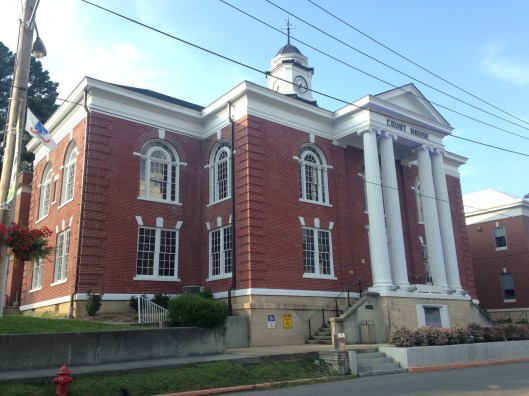
Dickenson County Courthouse in Clintwood, VA.  THIS IS MULLINS COUNTRY. Placed at its front is a large plaque commemorating John Mullins, Sr. (father to “Holly Creek John”), who served in the Revolutionary War. 25 August 2018.

Holly Creek John Mullins Historic Marker

“Holly Creek John” received his nickname because he settled on Holly Creek, near the courthouse. Clintwood is located in the head of Holly Creek.

IMG_6945

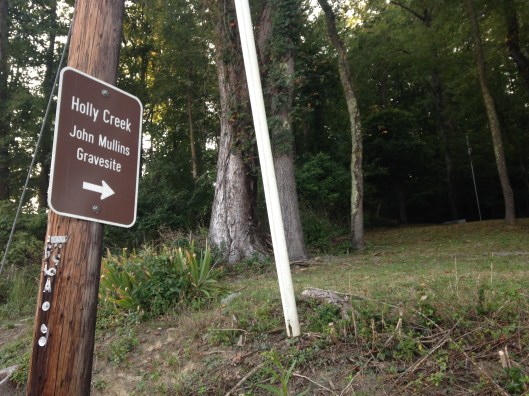
Behind the Clintwood Baptist Church on High Street is the grave of “Holly Creek John” Mullins, son of John and Jane (Bailey) Mullins. There’s really no place to park along this narrow street, so you have to park at the Sleep Inn and Suites Hotel and walk back up the hill just a bit. 25 August 2018.

IMG_6946

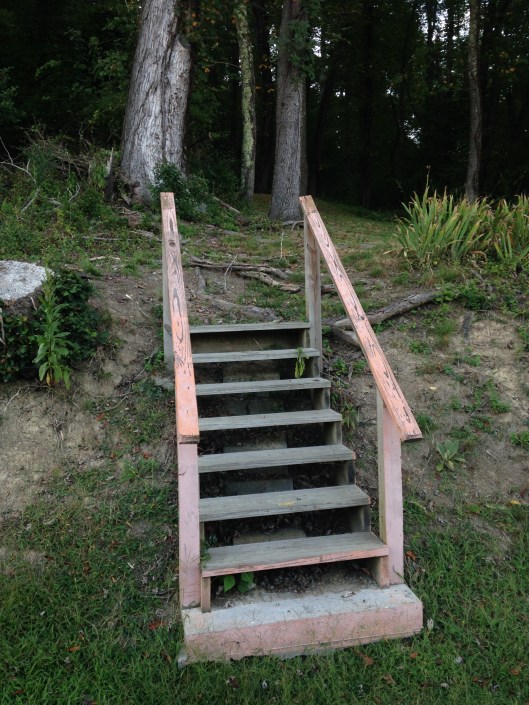
Up this way! These steps literally connect to High Street — parking right here is not really an option! 25 August 2018.

IMG_6947

Straight ahead. For more information about the grave and cemetery, follow this link: https://www.findagrave.com/memorial/64659784/john-mullins

IMG_6948

John and Ollie (Cox) Mullins grave, located in Clintwood, Dickenson County, VA. Their daughter Jane married Peter Mullins and settled on Harts Creek in Logan County, WV. 25 August 2018.

← Older posts
Newer posts →

Feud Poll 1

If you had lived in the Harts Creek community during the 1880s, to which faction of feudists might you have given your loyalty?

Categories

  • Adkins Mill
  • African American History
  • American Revolutionary War
  • Ashland
  • Atenville
  • Banco
  • Barboursville
  • Battle of Blair Mountain
  • Beech Creek
  • Big Creek
  • Big Harts Creek
  • Big Sandy Valley
  • Big Ugly Creek
  • Boone County
  • Breeden
  • Calhoun County
  • Cemeteries
  • Chapmanville
  • Civil War
  • Clay County
  • Clothier
  • Coal
  • Cove Gap
  • Crawley Creek
  • Culture of Honor
  • Dingess
  • Dollie
  • Dunlow
  • East Lynn
  • Ed Haley
  • Eden Park
  • Enslow
  • Estep
  • Ethel
  • Ferrellsburg
  • Fourteen
  • French-Eversole Feud
  • Gilbert
  • Giles County
  • Gill
  • Green Shoal
  • Guyandotte River
  • Halcyon
  • Hamlin
  • Harts
  • Hatfield-McCoy Feud
  • Holden
  • Hungarian-American History
  • Huntington
  • Inez
  • Irish-Americans
  • Italian American History
  • Jamboree
  • Jewish History
  • John Hartford
  • Kermit
  • Kiahsville
  • Kitchen
  • Leet
  • Lincoln County Feud
  • Little Harts Creek
  • Logan
  • Man
  • Matewan
  • Meador
  • Midkiff
  • Monroe County
  • Montgomery County
  • Music
  • Native American History
  • Peach Creek
  • Pearl Adkins Diary
  • Pecks Mill
  • Peter Creek
  • Pikeville
  • Pilgrim
  • Poetry
  • Queens Ridge
  • Ranger
  • Rector
  • Roane County
  • Rowan County Feud
  • Salt Rock
  • Sand Creek
  • Shively
  • Spears
  • Sports
  • Spottswood
  • Spurlockville
  • Stiltner
  • Stone Branch
  • Tazewell County
  • Timber
  • Tom Dula
  • Toney
  • Turner-Howard Feud
  • Twelve Pole Creek
  • Uncategorized
  • Warren
  • Wayne
  • West Hamlin
  • Wewanta
  • Wharncliffe
  • Whirlwind
  • Williamson
  • Women's History
  • World War I
  • Wyoming County
  • Yantus

Feud Poll 2

Do you think Milt Haley and Green McCoy committed the ambush on Al and Hollene Brumfield in 1889?

Blogroll

  • Ancestry.com
  • Ashland (KY) Daily Independent News Article
  • Author FB page
  • Beckley (WV) Register-Herald News Article
  • Big Sandy News (KY) News Article
  • Blood in West Virginia FB
  • Blood in West Virginia order
  • Chapters TV Program
  • Facebook
  • Ghosts of Guyan
  • Herald-Dispatch News Article 1
  • Herald-Dispatch News Article 2
  • In Search of Ed Haley
  • Instagram
  • Lincoln (WV) Journal News Article
  • Lincoln (WV) Journal Thumbs Up
  • Lincoln County
  • Lincoln County Feud
  • Lincoln County Feud Lecture
  • LinkedIn
  • Logan (WV) Banner News Article
  • Lunch With Books
  • Our Overmountain Men: The Revolutionary War in Western Virginia (1775-1783)
  • Pinterest
  • Scarborough Society's Art and Lecture Series
  • Smithsonian Article
  • Spirit of Jefferson News Article
  • The Friendly Neighbor Radio Show 1
  • The Friendly Neighbor Radio Show 2
  • The Friendly Neighbor Radio Show 3
  • The Friendly Neighbor Radio Show 4
  • The New Yorker
  • The State Journal's 55 Good Things About WV
  • tumblr.
  • Twitter
  • Website
  • Weirton (WV) Daily Times Article
  • Wheeling (WV) Intelligencer News Article 1
  • Wheeling (WV) Intelligencer News Article 2
  • WOWK TV
  • Writers Can Read Open Mic Night

Feud Poll 3

Who do you think organized the ambush of Al and Hollene Brumfield in 1889?

Recent Posts

  • Logan County Jail in Logan, WV
  • Absentee Landowners of Magnolia District (1890, 1892, 1894)
  • Charles Spurlock Survey at Fourteen Mile Creek, Lincoln County, WV (1815)

Ed Haley Poll 1

What do you think caused Ed Haley to lose his sight when he was three years old?

Top Posts & Pages

  • Halcyon 4.10.1919
  • Civil War Gold Coins Hidden Near Chapmanville, WV
  • Halcyon-Yantus 12.08.1911
  • Ran'l McCoy's Final Months (1914)
  • Blood in West Virginia: Brumfield v. McCoy (2014)

Copyright

© Brandon Ray Kirk and brandonraykirk.wordpress.com, 1987-2023. Unauthorized use and/or duplication of this material without express and written permission from this blog’s author and/or owner is strictly prohibited. Excerpts and links may be used, provided that full and clear credit is given to Brandon Ray Kirk and brandonraykirk.wordpress.com with appropriate and specific direction to the original content.

Archives

  • February 2025
  • January 2025
  • October 2023
  • September 2023
  • December 2022
  • November 2022
  • May 2022
  • April 2022
  • February 2022
  • November 2021
  • October 2021
  • September 2021
  • June 2021
  • May 2021
  • April 2021
  • March 2021
  • February 2021
  • January 2021
  • December 2020
  • November 2020
  • October 2020
  • July 2020
  • June 2020
  • May 2020
  • April 2020
  • March 2020
  • February 2020
  • January 2020
  • December 2019
  • November 2019
  • October 2019
  • September 2019
  • August 2019
  • July 2019
  • June 2019
  • May 2019
  • April 2019
  • March 2019
  • February 2019
  • January 2019
  • December 2018
  • November 2018
  • October 2018
  • September 2018
  • August 2018
  • July 2018
  • June 2018
  • May 2018
  • April 2018
  • March 2018
  • February 2018
  • January 2018
  • December 2017
  • November 2017
  • October 2017
  • September 2017
  • August 2017
  • July 2017
  • June 2017
  • May 2017
  • April 2017
  • March 2017
  • February 2017
  • January 2017
  • December 2016
  • November 2016
  • October 2016
  • September 2016
  • August 2016
  • July 2016
  • June 2016
  • May 2016
  • April 2016
  • March 2016
  • February 2016
  • January 2016
  • December 2015
  • November 2015
  • October 2015
  • September 2015
  • August 2015
  • July 2015
  • June 2015
  • May 2015
  • April 2015
  • March 2015
  • February 2015
  • January 2015
  • December 2014
  • October 2014
  • September 2014
  • August 2014
  • July 2014
  • June 2014
  • May 2014
  • April 2014
  • March 2014
  • February 2014
  • January 2014
  • December 2013
  • November 2013
  • October 2013
  • September 2013
  • August 2013
  • July 2013
  • June 2013
  • May 2013
  • April 2013
  • March 2013
  • February 2013
  • January 2013
  • December 2012
  • November 2012

Enter your email address to follow this blog and receive notifications of new posts by email.

Join 2,927 other subscribers

Tags

Appalachia Ashland Big Creek Big Ugly Creek Blood in West Virginia Brandon Kirk Cabell County cemeteries Chapmanville Charleston civil war coal Confederate Army crime culture Ed Haley Ella Haley Ferrellsburg feud fiddler fiddling genealogy Green McCoy Guyandotte River Harts Harts Creek Hatfield-McCoy Feud history Huntington John Hartford Kentucky Lawrence Haley life Lincoln County Lincoln County Feud Logan Logan Banner Logan County Milt Haley Mingo County music Ohio photos timbering U.S. South Virginia Wayne County West Virginia Whirlwind writing

Blogs I Follow

  • OtterTales
  • Our Appalachia: A Blog Created by Students of Brandon Kirk
  • Piedmont Trails
  • Truman Capote
  • Appalachian Diaspora

BLOOD IN WEST VIRGINIA is now available for order at Amazon!

Blog at WordPress.com.

OtterTales

Writings from my travels and experiences. High and fine literature is wine, and mine is only water; but everybody likes water. Mark Twain

Our Appalachia: A Blog Created by Students of Brandon Kirk

This site is dedicated to the collection, preservation, and promotion of history and culture in Appalachia.

Piedmont Trails

Genealogy and History in North Carolina and Beyond

Truman Capote

A site about one of the most beautiful, interesting, tallented, outrageous and colorful personalities of the 20th Century

Appalachian Diaspora

  • Subscribe Subscribed
    • Brandon Ray Kirk
    • Join 789 other subscribers
    • Already have a WordPress.com account? Log in now.
    • Brandon Ray Kirk
    • Subscribe Subscribed
    • Sign up
    • Log in
    • Report this content
    • View site in Reader
    • Manage subscriptions
    • Collapse this bar
 

Loading Comments...