
Posted by Brandon Ray Kirk | Filed under Big Harts Creek

15 Sunday Sep 2019
Posted by Brandon Ray Kirk | Filed under Big Harts Creek
15 Sunday Sep 2019
Posted in Stone Branch
Tags
Appalachia, Bessie Dean, Braeholm, Chester Curtis, Cincinnati, genealogy, history, Logan Banner, Logan County, Nellie McKennzie, Nellie Stiltner, Norma Saunders, Ohio, Pearl Mobley, Rebecca McKenzie, Ross Smith, Ruby Lucas, Sadie Ferguson, Sherman Hobbs, Stone Branch, West Virginia
A correspondent named “Three Pals” from Stone Branch in Logan County, West Virginia, offered the following news, which the Logan Banner printed on August 24, 1923:
We are sorry to say that Chester Curtis is on the sick list.
Mrs. McKenzie and Mrs. Smith were calling on Mrs. Williamson Sunday evening.
Mrs. Stiltner and Mrs. McComas were calling on Mrs. Stiltner Sunday.
Martha Roberts has gone to Ohio to pay her mother a visit.
Mrs. Bledsoe was calling on Mrs. Roberts Saturday.
Miss Norma Saunders and Miss Pearl Mabblie have gone to Cincinnati.
Sherman Hobbs and Ross Smith were seen going down the road Saturday.
Mr. Stiltner and Mr. Smith sure do enjoy going to lodge.
Mr. McKenzie and Mr. Marshall were seen going down the road Saturday.
Miss Nella McKenzie was calling on Miss Nellie Stiltner Saturday night.
Miss Rubie Lucas and Miss Sadie Ferguson were the dinner guests of Miss Nellie McKenzie.
Mrs. Rebecca McKenzie called on Mrs. Little Sunday evening.
Some combinations–Boyd and his slop bucket; Gracie and her bonnet; Nellie and her cretonne dress; Sadie and her wrist watch; Rebecca and her silk dress; Mrs. Smith and her milk pail; Ruben and his wagon; Nellie and her silk dress; Gracie and her hair net; Nannie and her business course; Bob Ferrell and his cat; Frank and his milk pail; Lee and his dog.
Mrs. Little was calling on Mrs. McKenzie Sunday evening.
Mrs. Bessie Dean of Braeholm was calling on Mrs. Ferguson.
11 Wednesday Sep 2019

Posted by Brandon Ray Kirk | Filed under Spurlockville
11 Wednesday Sep 2019
Posted in Big Creek, Huntington, Logan, Stone Branch
Tags
Appalachia, Big Creek, Cecil Hager, Charles Harmon, genealogy, Georgia Thomas, Guyan Valley Drug Store, history, Huntington, Linnie Workman, Logan, Logan County, Nannie Lilly, Nannie Mobley, Susie Harmon, Tom Vance, Wert Ellis, West Virginia
A unknown correspondent from Big Creek in Logan County, West Virginia, offered the following news, which the Logan Banner printed on September 12, 1924:
Big Creek is still on the go-go-go.
A large crowd attended the basket meeting on North Fork Sunday.
One of our Big Creek boys, Mr. Tom Vance was injured badly by falling from a telephone pole Sunday.
Mrs. Linnie Workman of this place is moving to Stone Branch.
Mr. Cecil Hager and Miss Nannie Lilly attended the basket meeting Sunday.
Mr. Charles Harmon and Miss Mobley were seen talking once more.
Mrs. Nannie Mobley is purchasing her a new home in Huntington.
Mr. Cecil Hager will leave for Logan September 12, where he will take up clerking in the Guyan Valley Drug store. Won’t Nannie be lonesome.
Miss Susie Harmon left for Huntington Sunday to attend school.
Mr. Wert Ellis and Georgia Thomas were seen out car riding Sunday.
Daily happenings–Pearl S. and drug store; Bill and his keys; Oran and his straw stack; Pearl going to see Tom; Mae and her sweetie; Gladys and her traveling case; Nannie and her dust; Cecil and his Lollipop; Lucile and her slippers; Susie and her chewing gum; Nealin and the chickens; Norma and her Gray; Myrtle and her sun grins.
27 Tuesday Aug 2019
Posted in Atenville, Fourteen, Guyandotte River, Little Harts Creek, Twelve Pole Creek
Tags
Appalachia, Charles Adkins, Charles Lattin, Elizabeth Adkins, Enos Adkins, Evaline Adkins, Fourteen Mile Creek, genealogy, George W. Adkins, Guyandotte River, Harmon Stroud, Henry Adkins, Henry H. Adkins, history, Isaac Nelson, Jacob K. Adkins, Laurel Fork, Lewis Adkins, Lincoln County, Little Harts Creek, Mary Louisa Adkins, notary public, Price Lucas, Reece W. Elkins, Sand Island Branch, Spencer Adkins, Sulphur Spring Fork, Trough Fork, Twelve Pole Creek, West Virginia

Deed Book 59, page 269, Lincoln County Clerk’s Office, Hamlin, WV. Henry Adkins (c.1811-c.1873) was the son of Isaac and Elizabeth (Adkins) Adkins.

Deed Book 59, page 270, Lincoln County Clerk’s Office, Hamlin, WV.
26 Monday Aug 2019
Posted in Huntington, Italian American History, Logan, World War I
Tags
A.D. Collins, A.F. Benjamin, American Legion, Bee Stewart, Betty Davin, Boy Scouts, C.L. Wright, Clarence Bartram, David Hensley, Doris Bradley, Edward Gunther, Favaro, Floyd W. Clay, Gunther-McNeely-Nowlan Post, Hatfield Island, history, Huntington, Italy, James Greever, James L. Robinson, John B. McNeely, John Martin, Keefer Jennings Whitman, Logan, Logan Banner, Logan County, Lorena greever, M.B. Kendall, M.D. Tony Kendall, Madge Adkins, Margaret McNemar, Marshall College, Marshall University, Midelburg Island, Mike Tarka, Morris P. Shawkey, Newton Cook, Oscar Dial, Pete Minotti, Peter White, Robert F. Caverlee, Roy Lowe, Roy Simms, Scotty McDonald, Tony Curia, Ulysses B. Vance, W.C. Turley, West Virginia, Willard Ball, William F. Munsey, Willie F. Smith, World War I
From the Logan Banner of Logan, WV, comes this bit of history about the World War I statue now located at Hatfield/Midelburg Island:

Soldier Monument Dedication Nov. 11
Granite Figure of Doughboy Will Be Set Up This Week, Minotti Says
The $6,000 granite doughboy memorial to World War veterans, the erection of which is being sponsored by Pete Minotti of this city, will be placed on the base near the west Court House entrance sometime during the next three days.
Word was received here by Mr. Minotti that the monument had been shipped from Chicago Monday and that it would arrive in Logan sometime tomorrow. Mr. Minotti said that the figure would be placed on the base and all the work completed this week.
Dedication will be held Sunday afternoon, November 11, at 2 o’clock. The American Legion of this city will have charge of the ceremonies to which the public is invited.
Boy scouts of the community are busy selling tags to help defray expenses of purchasing and erecting the monument. The doughboy figure is larger than life size, being seven feet tall. The figure depicts an American soldier carrying a rifle in one hand and throwing a bomb with the other hand. He is pictured as in the midst of a barb wire entanglement.
Logan (WV) Banner, 30 October 1928
***
8 Tons of Granite In New Monument to Logan Soldiery
Seventeen thousand pounds of Vermont granite will surmount the concrete base of the monument now being erected in the Court House yard. Atop the granite blocks will be placed a seven-foot statue representing an American doughboy carrying a rifle and bomb poised for throwing.
The monument will be 19 feet high, says Pete Minotti, local contractor, who is backing and taking the leading part in providing a suitable memorial for Logan county’s heroic dead. The base will be hidden by an earthen mound or terrace on all four sides.
Dedication of this memorial will be the feature of this year’s celebration of the signing of the Armistice on November 11.
Logan (WV) Banner, 2 November 1928
***
Arrange Plans for Unveiling of Statue
Plans for the dedication of the new monument to the memory of World War participants, living and dead, will be completed at a special meeting of the local post, American Legion, at the Court House Dugout Thursday night at 7:30.
The unveiling and dedicatory services are set for 2 o’clock Sunday afternoon, Armistice day. Pete Minotti, originator of the plan and the donor of the monument, will make the presentation. Formal acceptance will be by M.D. (Tony) Kendall, a leading legionnaire of the city. There will be other addresses and vocal numbers by Mrs. Madge Adkins, popular and talented singer.
Boy Scouts will aid the Legion men in carrying out an appropriate program of exercises.
Logan (WV) Banner, 6 November 1928
***
Monument to Soldiers Ready For Unveiling
Exercises to be Held at Court House at 2:00 O’clock Sunday Afternoon
Minotti is Moving Spirit
Huntington Educator Will Deliver Address–Flag-Raising Comes First
On the tenth anniversary of the signing of the Armistice, Logan county soldiers who paid the supreme price will be honored by their kinsfolk and the citizens of the county when the Pete Minotti memorial is unveiled Sunday afternoon at two o’clock.
The memorial, a fine bronze reproduction of a doughboy mounted on a suitable granite base, was erected near the western entrance to the Court House during the first part of this week and by tomorrow evening everything will be in complete readiness for the dedication exercise.
The American Legion will have charge of the services with the Boy Scouts and several others assisting. The Boy Scouts will conduct a flag-raising just before the unveiling exercises.
The dedicatory address will be delivered by C.L. Wright, superintendent of Huntington schools and a brilliant orator. These exercises will be opened with prayer by Rev. Robert F. Caverlee. Pete Minotti, whose generosity and whose love for his–adopted–country have made this memorial possible, will make the presentation speech. Thereupon the unveiling will take place, with Misses Scotty McDonald, Margaret McNemar, Lorena Greever, Doris Bradley and Betty Davin and James Greever participating. Formal acceptance will be made by M.B. Kendall, commander of Fifth district, department of West Virginia, American Legion. Salute and taps will be followed by benediction by Rev. A.F. Benjamin.
This monument, costing $6,000, is 19 feet high.
A bronze name plate at the statue’s base has inscribed across the top the dates, “1917-1918,” and underneath are the names of the 39 Logan County World War veterans killed, mortally wounded or fatally afflicted by disease while in service. At the bottom is the name, “Pete Minotti Memorial,” and the date, “1928.” The American Legion crest is also on the plate.
Logan (WV) Banner, 13 November 1928
***
Big Concourse At Dedication of Monument
Dr. M.P. Shawkey Delivers Eloquent, Patriotic Address At Sunday’s Exercises
P. Minotti the Generous
Presents Memorial to Legion Post as Custodian–Flag-Raising Ceremony
Logan county paid tribute Sunday to a long list of its heroic dead sleeping in foreign and native soil when hundreds of people witnessed the dedication of the monument to the memory of the warriors who fell in the World War.
The Pete C. Minnotti memorial depicting a khaki-clad doughboy hurling a grenade amid barb wire entanglements was dedicated with fitting ceremonies on the eleventh Armistice Day. Dr. M.P. Shawkey, president of Marshall College, delivered the address. C.L. Wright, superintendent of the Huntington schools, who was unable to be present because of illness, was scheduled to deliver the address and Dr. Shawkey filled his place.
In his presentation speech Mr. Minotti reminded the people that the memorial was erected so that people passing by hurriedly in the pursuit of riches might glance up at the soldier figure and remember the boys who fell fighting for freedom and democracy. Mr. Minotti said that he convicted the idea of erecting some memorial to the dead soldiers last summer as he journeyed through his native land, Italy, and in every city and hamlet, no matter how small, the people had erected some kind of a memorial to their dead heroes.
Generous and Patriotic
“Adjoining counties had honored their soldiers and it was time that Logan county honor their dead with a fitting memorial,” said Mr. Minotti.
During the last two months Mr. Minotti, through the cooperation of the American Legion, has been busy planning for and erecting the monument that now graces the Court House lawn near the western entrances. This generous donor, an Italian by birth and an American by choice, was born at Favaro, Italy, October 22, 1885. He came to Logan county 22 years ago and since that time Logan has been his home.
The monument was accepted by A.D. Collins, commander of Gunther-McNeely-Nowlan post, in behalf of the Legion.
Dr. Shawkey spoke of the prosperity which this country enjoys and the lofty position which the nation commands. Yet he urged that the goal which the people should strive for should be a happy and contented country is preference to wealth and a dominating position.
In the unveiling ceremony Misses Scotty McDonald, Margaret McNemar, Lorena Greever, Doris Bradley, Betty Davin and James Greever participated. Previous to the unveiling the Logan county scouts had charge of the flag raising ceremony. W.C. Turley was chairman of the dedication. Following the ceremony a rifle squad fired three volleys of shots over the monument as a salute to the dead.
C. & O. Band Made Special Music
It is also said that the light in the right hand of the doughboy which represents a grenade is the only one of its kind in the state and it was Mr. Minotti’s original idea.
On the bronze tablet on the base of the monument are inscribed the names of 39 men who died in action of wounds and of disease in Europe.
Roll of Honor
The men killed in action are:
Willard Ball, Clarence Bartram, Floyd W. Clay, Newton Cook, Tony Curia, Oscar Dial, Edward Gunther, David Hensley, Roy Lowe, John B. McNeely, John Martin, William F. Munsey, James L. Robinson, Roy Simms, Willie F. Smith, Bee Stewart, Mike Tarka, Ulysses B. Vance, Peter White, Keefer Jennings Whitman.
Those dying of wounds are: John L. Blankenship, Elmer Cook, Homer Hobbs, Noble J. Lax, Lawrence Marcuzzi, Denver Mullins, William R. Nowland, Haskell Phillips, Henry H. Runyon, Harold Thompson. Those dying of disease in Europe: Allen Bryant, Thomas J. Cox, Fred E. Hahne, Joe Hardy, Clyde Jeffrey, Johnnie Johnson, Allen Tabor, Homer Vance, and Levi J. Vance.
Those who died of disease in the United States but whose names do not appear on the tablet are William O. Bailey, Elbert Billups, James L. Brown, Elbert Carter, Sam Dillard, George D. Fletcher, Bert W. Green, Calvin Hughes, Wilbert S. Jeffreys, Sam Johnson, Claude B. Justice, Druie Mounts, Moss F. Stone, James Weaver, and Roy White.
The soldiers from Logan county who were wounded in action but whose names do not appear on the tablet were Albert Adams, Zatto Adkins, William W. Adkins, Lovell H. Aldridge, Willie Allen, Frank Ball, Elisha Ball, Frank J. Bell, Walter S. Blake, Evert Blankenship, Tom Boring, George F. Breeden, H. Brewster, Charles Brewster, H.C. Brown, Floyd Chambers, James Chapin, Greenway Christian, Gay T. Gonley, George E. Covey, Ella Craddock, Dan Craft, Jim F. Crawford, John H. Crittenden, James Cyrus, Thomas Y. Davis, Bird Dingess, Rector H. Elkins, James M. Ellis, Carl Ellis, Frank Ferrell, Sidney Ferrell, Robert L. Gore, Burton W. Gore, Ben H. Gosney, Meddie Craley, Orvil Grubb, Earl Hager, William E. Hanshaw, John H. Harris, William Harris, Stonewall Hensley, James Jackson, Albert Jeffrey, Henon Jerrell, Ned Johnson, Floyd Johnson, Thomas P. Justice, Luther Lacy, Tony Ladas, Charles Burton Litten, George Luty, Herbert L. McKinney, Nick Mallozzo, Clifton Manns, Bill Manville, Ben Maynard, William D. Maynard, George Meadows, Shellie Moxley, Charlie M. Munsey, Spencer Mullins, Thomas R. Newmann, Clarence W. Parkins, James D. Peters, Arlie J. Price, Alfred Prichard, Finnie Walter Pugh, Bert Rayborn, Frank C. Reynolds, John Roberts, Dennie Robertson, Jennings Robinson, Otto Sanders, Burnie Sanson, Lee Shelton, John A. Shepherd, Clarence Smith, John Smith, Mack Smith, Patsy Vance, Frank Ward, John L. Ward, Charlie Warcovies, Thomas Weir, Joseph White, John B. Wilkinson, Jr., Frank C. Willcoven, Tom Williams, Will Wilson, Jasper Wooten, and Wilson Workman.
Sunday’s exercises were witnessed by a crowd comparable in size to that which greeted Colonel Roosevelt here during the campaign. While the Roosevelt crowd was considerably larger, Sunday’s crowd occupied most of the space fronting the monument and the main entrance to the Court House, and those on the outer edges heard but snatches of the speeches. And of course there were present scores of kinsmen of those whose names appear in rustless bronze on this granite shaft. As they gathered close to scan these names and to note the expression on the face of the doughboy representation, tears poured down the cheeks of Gold Star mothers as if to climax the hallowing of this spot–this heart center of the city and county–this monument to the ashes, this temple to the fame of those who laid their lives on their country’s altar in the greatest crisis in human history.
Much of the time since the dedication, at least during daylight hours, this new monument has been the cynosure of groups of varying size.
Logan (WV) Banner, 13 November 1928
25 Sunday Aug 2019
Posted in Little Harts Creek, Queens Ridge, Twelve Pole Creek
Tags
Erie Perry, Flora Maynard, genealogy, history, Linza Perry, Logan Banner, Milam Creek, Queens Ridge, Roma Maynard, Tracie Toppins, Twelve Pole Creek, Wayne County, West Virginia
A correspondent named “Lonesome Girl” from the Queens Ridge area of Wayne County, West Virginia, offered the following news, which the Logan Banner printed on November 30, 1923:
I thought I would send in some of our Wayne county news to help make part interesting.
Miss Flora Maynard is visiting friends on Mud Fork.
Mr. Roma Maynard has been visiting his grandfather on Twelve Pole.
Mrs. Linza Perry and her daughter Erie Perry was visiting Roma Maynard and his grandmother on Sunday.
Tracie Toppins has been visiting his grandmother on Milam Creek.
10 Saturday Aug 2019
Posted in Cemeteries, Logan, Music
Tags
Appalachia, Brandon Kirk, cemeteries, Coney Isle, Ed Belcher, Elbert Garrett Family Cemetery, fiddler, Fort Branch, Frank Hutchison, genealogy, guitar, harp-organ, history, Lake, Logan Banner, Logan County, music, New York, Okeh Company, Omar Theatre, Peach Creek Theatre, piano, Sheila Brumfield Coleman, Stirrat Theatre, Stollings, West Virginia, West Virginia Rag, William Hatcher Garrett

Logan (WV) Banner, 1 February 1927.

Logan (WV) Banner, 8 March 1927.

Logan (WV) Banner, 25 March 1927.
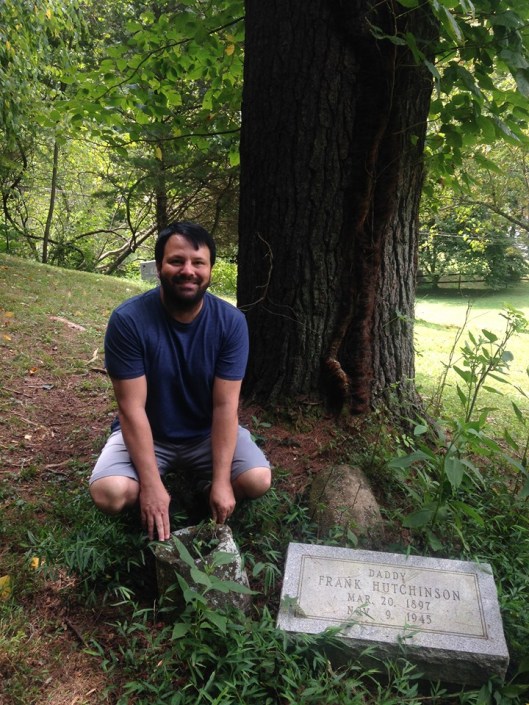
Here we are visiting the Frank Hutchison grave at the Elbert Garrett Family Cemetery at Lake, Logan County, WV. Photo by Sheila Brumfield Coleman. 10 August 2019
10 Saturday Aug 2019
Tags
Appalachia, Bert Curry, Catlettsburg, coal, Cole and Crane Company, Delbarton, Elk Creek, Henry Ferrell, history, Holden, Island Creek, Island Creek Coal Company, Lando Mines, Lenore, logging, Louisa, Mingo County, Mud Fork, Pigeon Creek, rafting, Rock House, splash dams, timber, timbering, Trace Fork, Tug Fork, Wallace Curry, West Virginia
The following interview excerpt of Bert Curry (born c.1901) was conducted at Lenore in Mingo County, WV, on December 5, 1978.
***
How much money was around back then?
The first public works to come into the Pigeon Creek areas was when Cole and Crane come in to cut all of this virgin timber. All of Pigeon Creek. They built a splash dam at Delbarton, one on Elk Creek, and one on Rock House. They come in here in 1910 and they paid seventy-five cents a day and board for a man to work and he worked from daylight til dark and along later some of their best men, their team drivers… Team drivers had to work extra hours. They’d put them on by the month. I remember my brother-in-law got $35 a month, but he’d have to get up at 4 o’clock in the morning and then after supper he’d have to go out and clean the stable and curry his team and doctor ‘em, anything that had to be doctored and feed ‘em and bed ‘em down of the night.
Where did people get most of their income in those days?
If you had a job it was usually helping somebody cut timber. My first job was fifty cents a day carrying water for seventeen men and I was about twelve or thirteen years old.
Was that for loggers?
Well, these was loggers but my brother Wallace had a big field of corn. He had to grow corn to feed his cattle. He had six yokes of cattle and he used cattle in logging and he’d take a big flour barrel full of corn and them cattle would get around and he’d feed that corn to ‘em. They’d eat a barrel of corn each night and they’d let ‘em… Maybe a little fodder, or once in a while in bad weather they’d give ‘em a little hay. But them cattle, they worked ‘em six days a week haulin’ logs. They was trained to work and them six yokes of cattle was worth more than you could get for… You could buy a beef for $25 at that time but if you bought a good oxen that was broke you’d have to give about $50 for him.
What do you remember about the logging operations?
They was very primitive. They had nothin’ like a chain saw. They had a cross cut saw and they had axes and they had cane hooks and they had their teams of oxen and then some had teams of mules and horses. When Cole and Crane come in here they contracted all the cuttin’ of this timber. All the haulin’ it and puttin’ it into the creeks where the waters from the dams would take care of it. They had several contractors. They’d contract a whole boundary, maybe 500 or 1000 acres of timber to cut, and it was all virgin timber. It took six yoke of oxen or two to three big span of mules or horses to pull a tree. They didn’t cut it up into logs like they do now. They cut the whole tree and they didn’t take anything less than 16 inches up to the top. They’d be from 5 to 7 feet down where they cut them off and some of them would be 100 feet long and I’ve seen gorges of logs in Pigeon Creek they claimed had 5,000 trees in it. For a mile it’d be piled up bank to bank as high as they could pile. They’d work sometimes with all the teams they could get around them for three weeks a breaking one gorge. And when they got it to the Tug, they’d raft it. Sometimes they’d raft them and sometimes they would drift them down to the locks at Louisa before they’d raft them and they never went past there. They’d raft them there and then take tug boats and haul them from there to Cincinnati.
How did you raft them? I’m not familiar with that.
They had what you call chain dogs, a little chain about that long (indicates about 12 inches) with a spike on each end. They’d drive a spike in this log here and in this log (indicates two logs laying side by side) to hold it together, one at the front and one at the back, and they’d be oh maybe they’d be 50 feet wide and two or three hundred feet long, the rafts would. Maybe they’d have two or three rafts. One steamboat would be pullin’ maybe two or three rafts.
The logs wouldn’t drift apart?
They’d drive them spikes. Them spikes was about that long (indicating about six inches) and they’d drive them in there and it took a whole lot to pull ‘em out.
Did they work in the winter time, too?
Oh yes! I’ve seen fellers wade Pigeon Creek when they mush ice was a floatin’ and when they’d have to get back in the water to thaw before they could walk.
Was the creek deeper then or about like it is now?
It was more even. They had water all the time but they didn’t have as many severe floods as they have now because this was all covered with timbers, all of everything. See, this mulch in these forests held the water and let it leak out. It didn’t run off like it does now.
The water flow was more evened out this year around?
More evened out. But when they’d have a splash dam at Delbarton, one on Rockhouse up at Lando Mines and one in the head of Elk Creek, they’d time these. They’d know how long it took the water to run from Elk Creek, and they knowed how long it took the water to run from Rock House, and they knowed how long it took the water to meet. They’d try to have them all three come out at once so that they’d have a vast big sudden increase in water. You could look up the creek when they’d splash and you could see a wall floatin’ and a turnin’ in and everything.
And that was to wash the logs out?
Yes, well they washed them out to Tug River that way. That’s the way they got them out of Pigeon Creek.
Do you remember when Island Creek first came into the area?
No. Island Creek first come in about 1901. That was over there. They started when two young fellows come from New York in there looking for oil, to prospect for oil, so they could invest some money. And some old man had a mine open right where No. 1 Island Creek mine is and he was a haulin’ coal with a mule—a mule and a sled. He’d go back in there and he’d haul coal out—a big seam of coal six foot high and good and clean. So they decided that there was where they could make their money. So they got to talkin’ with these fellows and they went and got lawyers and they bought around Holden and Trace Fork and up Mud Fork and a vast area. I don’t know how much: 79,000 acres for 470,000 dollars. And fellows like Henry Ferrell, he counted timber so long. To count timber you have men a goin’ through and selecting the trees and one man a tallying. They’d make a mark on a tree when they’d count it, and the fellow with the tally sheet, he kept the numbers. He said they’d count timber a while and said then they had more money than they had brains. To spend that much money for that much land—470,000 dollars—and he said they put up a band mill and cut the timber and sold the timber and built their camps and sold enough lumber to pay for all of it. They got their coal and their land free. Just cut the timber and sold it and got their money back. People thought they were foolish for paying that kind of prices. Buying some of them farms out with all that timber for thousand dollars—that sounded like an awful lot of money. They didn’t have any money. They weren’t used to money. You worked for fifty cents a day. $1000 seemed like a whole lot.
24 Wednesday Jul 2019
Posted in Huntington, Logan, World War I
Tags
308th Infantry, 77th Division, 92nd Division, Alsace-Lorraine, Appalachia, Bosche, Camp Greenleaf, Chateau Thierry, dentist, Edwin M. Godby, Fifth Avenue, Georgia, Germany, Gwinn Brothers & Company, Herald-Advertiser, history, Huntington, James Godby, Logan, Logan Banner, Logan County, Lost Battalion, United Cigar Stores, University of Cincinnati, West Virginia, World War I
From the Logan Banner of Logan, WV, comes this recollection of World War I by veteran Edwin M. Godby of Huntington, WV, dated July 10, 1928:
LOGAN BOY OF LOST BATTALION LIVED THRU SIX DAYS OF HELL
Dr. E.M. Godby, Now of Huntington, One of 150 Survivors of An Outstanding Episode of World War—Graphic Account of Harrowing Experiences
It has been a little less than 10 years since the story of the Lost Battalion thrilled and horrified the American people.
It was the story of an infantry battalion which pushed its way through in an advance into the German lines while the forces on either flank were being beaten back, writes Wiatt Smith for the Herald-Advertiser.
Of the 1,000 men who went in, only a remnant lived to tell the story of six days in a literal hell. Six days during which they crouched in shell holes and dugouts, without food or water, while the shells from the guns of their own army thundered over them or broke about them and the gas and machine gun fire of a sullen enemy harassed them.
One of those survivors lives in Huntington. He is a dentist and as he goes about his professional work and social life only a slight cough serves to mark him as one who breathed the deadly poison spewed over him by the Bosche.
Dr. Edwin M. Godby, of Fifth Avenue, with offices in the United Cigar Stores building, is the man in question. He told the story to one who had first learned from others of his part in this great drama of the war. Dr. Godby was an ambulance corps man, attached to the Seventy-Seventh division and at the time assigned to Major Whittlesey’s battalion of the 308th infantry for said duty.
Left Logan in 1918
Eldest son of Mr. and Mrs. James Godby of Logan, he was a student of dentistry in the University of Cincinnati when America entered the war. He went from Logan with a draft contingent in March 1918. He trained at Camp Greenleaf, Ga., was assigned to the Medical corps, and crossed the ocean in June as a casual.
Assigned at once to the Seventy-seventh division he first saw the front at post in Alsace-Lorraine.
“There was no action here,” said Dr. Godby. “We were within one kilometer of the enemy but there seemed to be almost an understanding that we wouldn’t bother each other. There was no firing. Occasionally one side or the other would send a raiding party into the others lines, but these were rarely fired upon.
“In July our division went in to replace another division which had helped take Chateau Thierry. We continued in the drive from the Marne to the Aisne. We would advance two or three days and then dig in for perhaps four or five. This went on from July to September.
“Then we moved from the Aisne to the Argonne. One date that stays with me is that of the great barrage which marked the opening of the Argonne drive on the night of September 26.
“On October 13 or 14 we got orders to advance from our position in a 30-mile strip of woods between the headwaters of the Aisne and the Meusc. The Ninety-second division flanked us on the left and two of our regiments and two of the Ninety-second were supposed to advance.
“The advance started as planned, early in the morning, but the right and left flanks were met by such resistance that they fell back to their original positions.
“Major Whittlessey’s men tore through the resisting German line and went forward. It was late in the forenoon before we discovered that we were unsupported on either flank and cut off from the rear.
“We spend six days before we were relieved by another regiment which was almost destroyed in the effort. The battalion was virtually at war strength, having been in only a little while. Of the 1,000 who went in only 150 came back.”
Dr. Godby tells a grim story of the last days. As soon as the soldiers found their situation they began to dig in. It was every man for himself. Dr. Godby says he and two others found a shell hole. They deepened it and were comparatively safe there. But one of the three got too venturesome and raised his head too far above the rim of the crater. His comrades used his body for an additional barricade.
The surviving companion of Dr. Godby was a man named Crane, who had gone in from Pennsylvania. He told Dr. Godby that he had a sister in Huntington whose husband worked for Gwinn Bros. & Co.
“I have often thought I’d try to get race of that sister,” said Dr. Godby, “but I never have.
“We just laid there,” the dentist said, detailing his experience. “Each man had less than a quart of water and no food. After the second day I didn’t have any water. We never missed the food, but of course the thirst was torture. It was terrible, too, to have to wear our gas masks continuously for that becomes torture after the first hour.
“For the first day or two the Germans tried charging us but we were strong enough to beat them back. After that they were content to keep their machine guns turned on us and subject us to a continuous barrage of gas. At the same time we were within the range of our own batteries.
Contemplated Suicide
“American planes passed over us and tried to drop us food, but the Germans got it.
“For the last two or three days nothing mattered. Crane and I tried to devise means of escape. We would work out a plan and then decide it was futile. We decided to commit suicide, but changed our minds. It was simply a matter of trying to keep alive as long as we could. On the fifth night I had only intervals of consciousness. But we had determined to make a dash for freedom and life when daylight came. It would not have been a dash for life, but a dash to death.
I know this is true because we were on the slope of a ravine, the battalion being pocketed on either side of it. We could see the water in the ravine and the bodies of the men who in their desperation had gone there to drink. Not one lived to taste the water.
“But as Crane and I planned to make the final desperate dash I lost consciousness. When I revived I was on a stretcher at a base hospital at Nantes. I never saw Crane again. I have often wondered what became of him.
“Did he,” I asked myself, “live to go for his death drink or was he too rescued?
“I have never talked to anyone who was with the battalion.”
A few days after Dr. Godby revived from his unconsciousness the armistice was signed. He was in the hospital from November 1 until late in December, recovering from the effects of gas. In January 1919, he came back to the United States, received his discharge and resumed his studies. He has been practicing in Huntington two years.
23 Tuesday Jul 2019
Posted in Music
Tags
banjo, banjo contests, Betty Vornbrock, fiddle contests, fiddlers, fiddling, folk festivals, Glenville, history, Lincoln County, music, Paul Gartner, Phyllis Kirk, The Country Store and Museum, The Pioneer Stage, West Virginia, West Virginia State Folk Festival
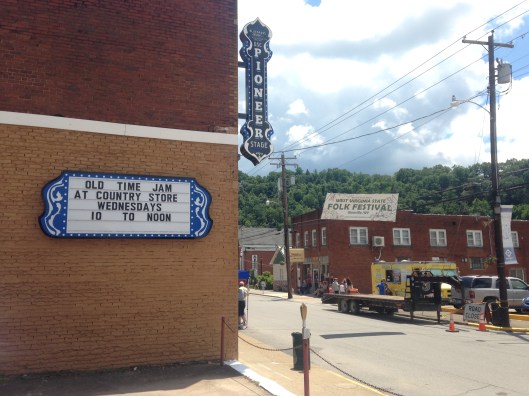
Straight ahead…the WV State Folk Festival! Glenville, WV. 21 July 2019

Here we are early in the day. 21 June 2019
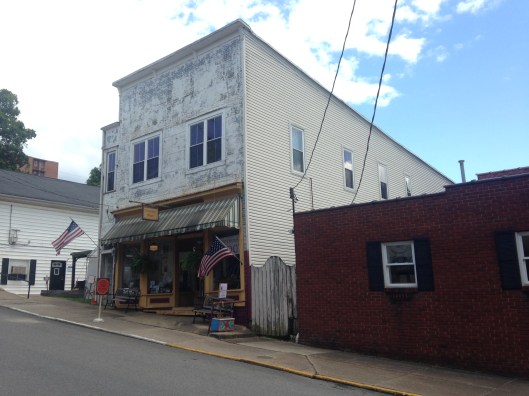
Highlight: The Country Store and Museum. 21 June 2019 https://www.wvstatefolkfestival.com/country-store-and-museum

Inside of The Country Store and Museum are many great things! 21 June 2019

Black Diamond Strings in The Country Store and Museum. 21 June 2019

Here’s Betty Vornbrock winning the fiddle contest. 21 June 2019

Paul Gartner, the winner of the banjo contest, lives in Lincoln County, WV. Photo by Mom. 21 June 2019

Out and about on the grounds. 21 June 2019

Out and about on the grounds. 21 June 2019
23 Tuesday Jul 2019
Posted in Hatfield-McCoy Feud, Matewan
Tags
Albert Simpkins, Ambrose Guzlin, Anderson Ferrell School, Blackberry Creek, Bob Williams, Charles Carpenter, Coon Branch School, Delorme School, Devil Anse Hatfield, Dials Branch School, Dick Bachtel, education, Elias Hatfield, Elias Hatfield School, Ella Hatfield McCoy, feud, feuds, Hatfield School, Hatfield-McCoy Feud, Head of Blackberry School, Henry D. Hatfield, history, Homer Claude McCoy, Jackson County, Johnnie Rutherford, Kate Ray, Kentucky, Lee Rutherford, Logan County, Mate Creek, Mate Creek School, Matewan, Mike Clingenpeel, Mingo County, Mud Fork, Pharmer McCoy, Pike County, Ransom, Sam Jackson, Scott Justice, teacher, Tolbert McCoy, Tug River, Upper Mate Creek School, W.A. McCoy, West Virginia, Will Bachtel
From “The Rise of Education and the Decline of Feudal Tendencies in the Tug River Valley of West Virginia and Kentucky in Relation to the Hatfield and McCoy Feud” by Homer Claude McCoy (1950):
The following list of school houses are given to determine the location of schools at the time of the feud. Most of the information obtained in regard to the existence of schools and their teachers have been received from interviews. These people were actual students at the schools or had brothers or sisters who went to school there. This information has been verified when possible from different interviews.
Mate Creek School: Mate Creek School was located about a mile up Mate Creek from Matewan which is located at its mouth. It was a log structure and had only one room. The schoolhouse was used during the feud as a prison to retain the three McCoy boys in. David Ross was the teacher of the school during the time of the feud, 1882, just a few days after the boys were held there, and there is a possibility that there was school there before the incident and that David Ross was the teacher.
Upper Mate Creek School: It is believed that there was a school at the head of Mate Creek, but the information is not strong enough to be substantiated.
Coon Branch School: Coon Branch School was located in Kentucky across from the site of Matewan. The teacher of the Coon Branch School was Ambrose Guzlin, and was attending in 1887.
Anderson Ferrell School: This school was located on Anderson Ferrell’s farm a mile below Matewan and came into use when the Mate Creek School was closed about 1883. The teacher of this school was Johnnie Rutherford.
Hatfield School: This school was located on the farm of Elias Hatfield in a hollow behind his home. It was a log structure and came into use when the railroad made it necessary to eliminate the Anderson Ferrell School.
Delorme School: The Delorme school was located near the home of Devil Anse, it was believed, for Charles Carpenter mentioned as a schoolteacher taught in that neighborhood. It is doubtful that there was a school there, for no definite record has been found. Charles Carpenter was said to be a teacher in that locality.
The Dial’s Branch School: This school is not substantiated by any strong evidence as being in operation during the early days of the feud, but was known to exist in the latter days of the feud.
Head of Blackberry School: This was at what is known today as Ransom. This school was some distance (about 15 miles from the mouth of Blackberry). Bob Williams taught school there. Dr. H.D. Hatfield attended school at this school.
Kate Ray who was a teacher at the Elias Hatfield School in 1893, says that she went to school there and when she graduated from the fifth grade she took an examination and taught the next year. She says the examination was not hard, and all the teachers gathered at Williamson. Other teachers that taught there were Albert Simpkins, Dr. Rutherford, Lee Rutherford. Scott Justice taught school at Mud Fork. Mike Clingenpeel was another teacher at Mud Fork.
Mrs. Ray stated:
I went to my first school on Mud Fork in 1888. I was only four years old. They didn’t mind for I didn’t give them any trouble. I learned a little at that age. Lee Curry was the teacher that year. He made improvements in the log school. His first improvement was to put backs on the seats. We did not have any desks or any blackboards. Dick and Will Bachtel also taught school at Mud Fork. They came from Jackson County. They stayed at Sam Jackson’s. They paid about $8.00 a month for board. Scott Justice, now a resident of Huntington, West Virginia, taught school on Mud Fork. So did Mack Clingenpeel. Every one liked Mack. He could explain the lessons so well.
When I was in the fifth grade I went to the Hatfield School below Matewan. When I graduated, I took the teachers examination and taught the next year there at the school on Elias Hatfield’s farm about the year 1895.
Sources:
Derived from these interviews by Mr. McCoy:
Ella Hatfield McCoy interview (she “lived on Blackberry Creek during the time of the feud”) (c.1949)
W.A. McCoy interview (c.1949)
Kate Ray interview (c.1949)
17 Wednesday Jul 2019
Posted in Cemeteries, Hatfield-McCoy Feud
Tags
Appalachia, Brandon Kirk, Ellison Hatfield, Floyd Hatfield, genealogy, Hatfield Cemetery, Hatfield-McCoy Feud, history, Mate Creek, Mingo County, Newtown, Phyllis Kirk, Sarah Hatfield, West Virginia
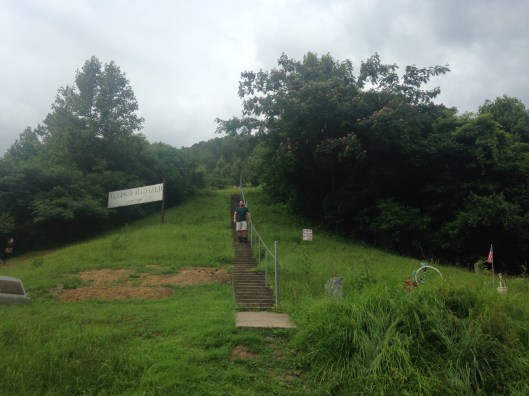
Up this way to the old Hatfield cemetery. Newtown, Mingo County, WV. Photo by Mom. 6 July 2019.

Entering the old Hatfield cemetery. It was a bit weedy! Photo by Mom. 6 July 2019.
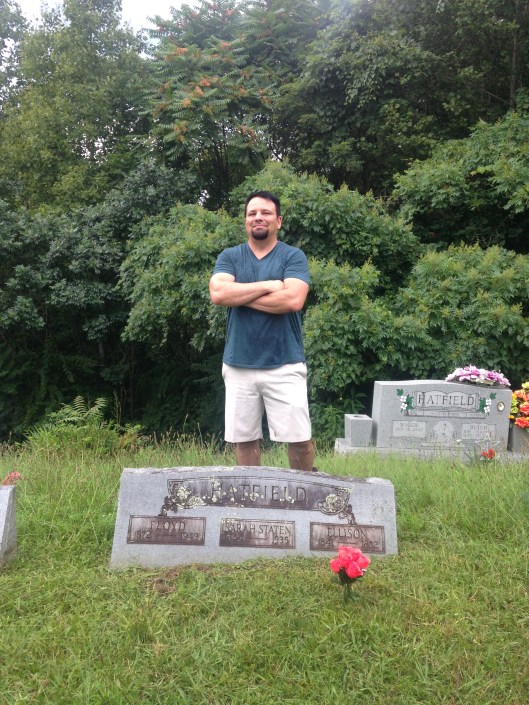
I mowed some of the graves and made sure to place flowers at the grave of Ellison Hatfield. Photo by Mom. 6 July 2019
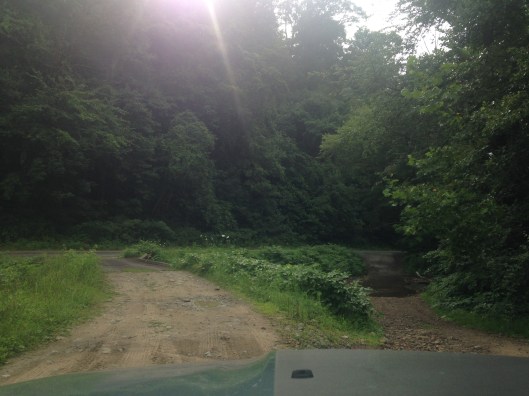
Leaving the cemetery, you can return to the paved road by going left over the bridge or right through Mate Creek. 6 July 2019
15 Monday Jul 2019
Posted in Giles County, Logan, Pecks Mill
Tags
Anna Stuart, Appalachia, Arter White, Battle of New Orleans, Ben White, Betty Radford, Charles White, Editha White, Elijah White, Frank White, Franklin, genealogy, Giles County, Henry Mitchell, Hezekiah Staton, Hiram White, history, Howard White, Indiana, Isaac White, James Buskirk, James Thompson, James White, John Chambers, John Sansom, John White, Judith White, Lark White, Logan, Logan Banner, Logan County, Lucretia Elkins, Major White, Margaret White, Mason White, Maston White, Millard White, Mingo County, Monroe County, Montgomery County, Nancy White, Ohio, Pigeon Creek, Pleasant Chafin, Reuben White, Robert Chambers, Robert Whitt, South Carolina, Susannah Elkins, Susannah Marcum, Thomas White, Viola Ellis, Virginia, Wade Hampton, Wallace White, West Virginia, Will White, William White
From the Logan Banner of Logan, WV, comes this bit of history about the White family in Logan County, West Virginia. The story is dated May 21, 1937.
White Family Among Early Settlers in Logan County
Great Grandfather of Patrolman Frank White Moved From Pecks Mill to Mingo County; His Father Had Settled on Mitchell Farm
Among the pioneer families which settled in and around Logan during the early days of its building from a settlement to a village was the family of John White.
John White came to Logan and settled on the farm later owned by Henry Mitchell with a family of grown men and one daughter. Ben and James had come to Pecks Mill early in the 19th century and built their cabins.
His daughter, Nancy, married Robert Whitt, who afterwards moved to Ohio.
His sons were John, who married Susannah Marcum of Franklin; Ben, who married Anna Stuart of Montgomery; James, who married Lucretia Elkins; and William, who married a daughter of John Sansom, another pioneer of the county.
James, tiring of this section of the country because “hunting was bad”, moved to Mingo county and bought five miles of land on Pigeon Creek for a bear gun and a bear dog.
He reared his family and among his children was John, grandfather of Frank White, city patrolman, Mrs. James Buskirk, Power Plant addition, and Lark, Will, Millard, Howard, Wallace, and Mason, all of Logan.
John was the breadwinner of his family, his father having died not long after his son reached the age of 12. John hunted and filled the soil to take care of his aging mother and several brothers and sisters.
He married Betty Radford, also of Mingo county and was the father of twelve children. They were William, who married Editha White; John, who married Susannah Elkins; Thomas, James, Reuben, Isaac, Charles, Major, Elijah, Hiram, Masten, and Judith, who married James Thompson.
Elijah was the father of the Logan citizens named above. He left Mingo county and came to Logan where he married Viola Ellis.
Thomas, James, and Reuben went to Giles county, Virginia, and Major went to Indiana.
All the others remained in Logan and reared large families.
Ben White was the father of seven children, five sons and two daughters. His sons were John, Arter, Ben, William, and James, and his daughters were Nancy, who married Pleasant Chafin, and Margaret, who married Hezekiah Staton.
James had but one child, a daughter Nancy, who married John Chambers, a son of Robert Chambers of Monroe county.
William, the youngest son, joined the regular army in 1808 and was assigned for duty in a regiment that was being raised by Col. Wade Hampton of South Carolina.
When Hampton was made Brigadier-General in 1806 and assigned to duty at New Orleans, White went with him, and when Hampton was superseded by Wilkinson, White remained with Wilkinson and then under Jackson until after the Battle of New Orleans in which battle he participated.
He returned home in 1816 and married the daughter of John Sansom.
14 Sunday Jul 2019
Posted in Hatfield-McCoy Feud, Meador
Tags
Appalachia, Brandon Kirk, cemeteries, genealogy, Hatfield-McCoy Feud, history, Meador, Meador Cemetery, Mingo County, Nancy Varney, Sarah Jane Mitchell, Tom Mitchell, West Virginia

Heading up to the cemetery. What a rush! 12 July 2019

This cemetery has several names, most commonly Meador, Varney, or Steele Cemetery. 12 July 2019
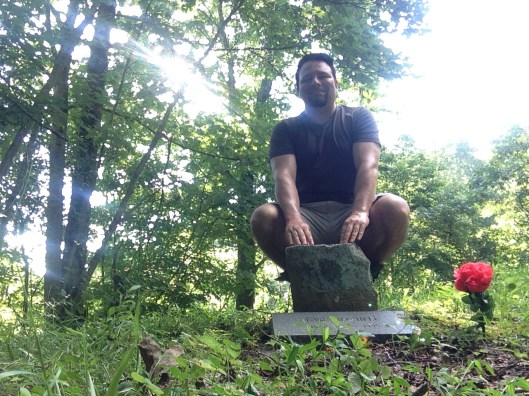
Tom Mitchell is buried to the left just as you enter the cemetery. I made sure to place flowers at his grave. 12 July 2019
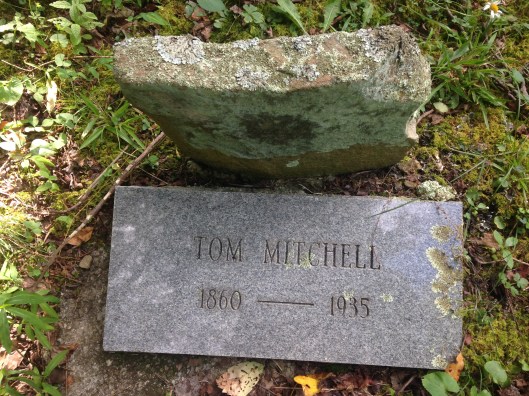
Tom Mitchell (Feb 1865-10/20/1935), son of Sarah Jane Mitchell, married Nancy Varney and fathered at least twelve children. He was a key participant in the Hatfield-McCoy Feud.
14 Sunday Jul 2019
Posted in Big Creek, Big Harts Creek, Civil War, Hamlin, Harts, Logan, Midkiff, Ranger, Spurlockville, Toney
Tags
Appalachia, assistant postmaster, Big Creek, Cabell County, Charles Spurlock, Cheat River, Cincinnati, civil engineer, civil war, doctor, genealogy, gunsmith, Hamlin, history, Jane Spurlock, John Spurlock, Lifas Spurlock, Lincoln County, Logan Banner, Logan County, Logan Post Office, Marshall Spurlock, Midkiff, Montgomery County, Omar, Pete Spurlock, preacher, Ranger, Robertson Spurlock, Seth Spurlock, Sheridan, sheriff, Spurlockville, Stephen Hart, surveyor, Union Army, Virginia, West Virginia
From the Logan Banner of Logan, WV, comes this bit of history about Stephen Hart and Harts Creek in Lincoln and Logan counties, West Virginia. The story is dated April 14, 1937.
Stephen Hart Settled at Cheat River, Pete Spurlock, A Great Grandson, Reveals
P.A. (Pete) Spurlock, assistant postmaster at the Logan post office, this morning revealed the destination of Stephen Hart, who went went after he had lived for a short time at the forks of the creek in the lower end of Logan county which now bears his name.
Spurlock said that Hart went to the Cheat River and settled permanently there to hunt deer and rear a family. He said the family name of Hart is as familiar there as the name Dingess is familiar in Logan county.
A daughter of Stephen, Jane, was Spurlock’s grandmother. She lived until 1913 and told her grandson much of the early history of the family which made its home in and around Spurlocksville, Sheridan, Ranger, and Midkiff.
Charles Spurlock, the progenitor of the Spurlock family, came to what used to be the Toney farm below the mouth of Big Creek in 1805 from Montgomery county, Virginia.
“Uncle Charley was a funny old cuss,” his great grandson Pete said this morning. “The story is told that a sheriff of Cabell county was given a capias to serve on the old codger for some minor offense when he was growing old and rather stout.
“Meeting him in the road one day, the sheriff informed Uncle Charley he had a capias to serve on him.
“None abashed, the old man informed the sheriff he was a law-abiding citizen and laid down in the middle of the road and told the sheriff to take him to jail.
“The ruse worked, for the sheriff chose to look for less obstinate prisoners,” Uncle Charley’s grandson said, chuckling.
Another story about the eccentric “Uncle Charley Spurlock” which has gone down in history, whether true or not, was that he lived for a short time below Big Creek under a rock cliff (known as a rockhouse) during the early summer while he was getting his cabin in shape for winter.
The tale is out that “Uncle Charley” explained his strange dwelling place in this way to his neighbors:
“Well I took Sarah (his wife) in a good substantial frame house in Virginia and she wasn’t quite satisfied. I took her to a log house and she wasn’t satisfied. I took her to a rail pen and still she grumbled. Then I took her to a rock house built by God Almight and still she wasn’t satisfied.
“I don’t know what I’m going to do with Sarah.”
Sarah evidently became accustomed to “Uncle Charley” for the couple reared four sons. They were John, Seth, Lifas and Robertson. There were no daughters.
Seth was P.A. Spurlock’s grandfather. His father, Marshall, is 78 and lives on his farm near Cincinnati.
Spurlock says “Uncle Charley” is buried on a point at Spurlocksville overlooking the haunts of his early manhood.
Robertson was a gunsmith and lived near Hamlin. Seth was a civil engineer and helped survey much of Logan county. He was a Union soldier. John was a country doctor who practiced at Ranger.
Lifas was a preacher for sixty years and lived at Sheridan.
Charles Spurlock, of Omar, is a distant cousin, the assistant postmaster said. He is the only relative that lives in this section of Logan county, Spurlock said.
Spurlock, at Omar, was born at Spurlocksville and is a grandson of one of the original “Charley’s” boys.
11 Thursday Jul 2019
Posted by Brandon Ray Kirk | Filed under Spurlockville
11 Thursday Jul 2019
Posted in Big Ugly Creek, Hamlin, Huntington, Leet, Rector
Tags
Anna Fry, Appalachia, Beulah Ellen Skeens, Edith Frye, Edna Brumfield, Ernest Lucas, Ethel Frye, genealogy, H.M. Gill, Hamlin, history, Horn Skeens, Huntington, Irwin Lucas, Leona Lambert, Lillie Lucas, Linnie Brumfield, Lizzie Frye, Lonnie Lambert, Morrisville, Rector, Thanksgiving, Thelma Huffman, Wayne Brumfield, Wealtha Lambert, West Virginia, Willie Payne
A correspondent named “Baby Doll” from Leet on Big Ugly Creek in Lincoln County, West Virginia, offered the following news, which the Logan Banner printed on November 30, 1923:
Miss Thelma Huffman, her chum, __ ___ Brumfield, have __________.
_________ visiting friends and relatives in Huntington.
Miss Wealtha Lambert gave a party Tuesday night. A nice time was reported.
Mr. Willie Payne left this afternoon for Morrisville, W.Va.
Mr. Lonnie and Leona Lambert will spend Thanksgiving in Hunitngton.
Miss Edna M. Brumfield stayed home all day Sunday. Wonder where her sweetie was?
Edith and Ethel Frye are going to school these days.
School is proceeding nicely on Lore Fork.
Born to Mr. and Mrs. Horn Skeens a 11 pound baby girl, Buleauh Ellen.
Mr. and Mrs. H.M. Gill made a flying trip to Hamlin attending to personal affairs.
Miss Lillie Lucas has a case of chickenpox and is very ill.
Mr. Wayne C. Brumfield will visit home folks Saturday evening.
Ernest and Irwin Lucas attended church at Rector Sunday.
Miss Anna Fry seems to be quite ill now. Hope she will soon recover.
Miss Linnie Brumfield had lots of company Sunday afternoon.
Mr. and Mrs. Guy are planning to go to Huntington this week.
Mrs. Lizzie Frye entertained company Sunday evening.
11 Thursday Jul 2019
Posted in Big Ugly Creek
Tags
Adam Cummings, Allen, Appalachia, Harts Creek District, history, Kanawha County, Lincoln County, Louisa Cummings, photos, Sinclair Cummings, West Virginia

Sinclair Cummings, son of Adam and Louisa (Fry) Cummings, was born in 1890 at Allen in Lincoln County, WV. His family lived in Harts Creek District in 1900. He later lived in Kanawha County.
11 Thursday Jul 2019
Posted in Ashland, Chapmanville, Hamlin, Harts, Queens Ridge
Tags
Appalachia, Ashland, Bob Brumfield, C&O Railroad, Caroline Brumfield, Chapmanville, Charley Brumfield, Ed Brumfield, Enos Dial, genealogy, Hamlin, Harts, Herb Adkins, history, Huntington, Ironton, Jessie Brumfield, Kentucky, Lincoln County, Lizzie Nelson, Logan Banner, Ohio, R.M. Sevin, Verna Johnson, West Virginia
An unnamed correspondent from Harts in Lincoln County, West Virginia, offered the following news, which the Logan Banner printed on April 3, 1925:
Charles Brumfield of Harts has been transacting business in Ironton, Ohio, the past week.
Mrs. Toney Johnson, of Ashland, Ky., has been visiting her mother, Mrs. Chas. Brumfield Harts.
Herbert Adkins of Harts is prospecting business in Huntington.
Miss Jessie Brumfield is teaching a successful school at Rector. She spent the week end with homefolks at Harts and was accompanied by Miss Cora Adkins and Mrs. Herbert Adkins and Mrs. Robert Brumfield of Harts.
Mrs. Robert Brumfield of Harts was shopping in Logan Saturday.
Edward Brumfield of this place is preparing to attend school at Hamlin.
Charles Brumfield is building a fine residence costing about seven thousand dollars at Harts.
Mrs. Robert Dingess of Queen’s Ridge returned to her home after a short visit with her mother, Mrs. Charles Brumfield, of Harts.
Miss Lizzie Nelson of Harts is attending high school at Chapmanville.
R.M. Sevine, C&O brakeman of Huntington was calling on Miss Jessie Brumfield of Harts.
Enos Dials and Edward Brumfield and Miss Jessie Brumfield were seen out walking Sunday evening at Harts.
Writings from my travels and experiences. High and fine literature is wine, and mine is only water; but everybody likes water. Mark Twain
This site is dedicated to the collection, preservation, and promotion of history and culture in Appalachia.
Genealogy and History in North Carolina and Beyond
A site about one of the most beautiful, interesting, tallented, outrageous and colorful personalities of the 20th Century
 Brandon Ray Kirk