• About

Brandon Ray Kirk

~ This site is dedicated to the collection, preservation, and promotion of history and culture in my section of Appalachia.

Brandon Ray Kirk

Tag Archives: Henry Clay Ragland

Aracoma (Part 1)

11 Friday Nov 2022

Posted by Brandon Ray Kirk in Huntington, Logan, Native American History, Women's History

≈ Leave a comment

Tags

Aracoma, Doris Miller, Guyandotte River, Henry Clay Ragland, history, Huntington, Jim Comstock, Logan, Logan County, Logan High School, Native Americans, West Virginia, West Virginia Women, William Madison

Doris Miller (1903-1993), a longtime educator, historian, writer, and poet operating in the area of Huntington, West Virginia, composed this biography of Aracoma, a well-known Native American figure who lived in present-day Logan, West Virginia. This is Part 1 of her composition.

West Virginians can lay claim to one of America’s most romantic legends, the story of Aracoma which has grown in Logan County around the meager authentic details of an incident in the history of the region which occurred some 200 years ago.

It is a legend of romance and tragedy about an Indian Princess who lies buried in the city of Logan. The story tells of her love for a white man taken captive by her tribe, of their happy life together as leaders of a settlement of her people on the Guyandotte River until tragedy wiped out their children and many others of their tribe, and of his depredations which led to her death.

Legends are stories built by folklore on a foundation of historic fact. Folklore is history preserved by tradition by people searching for the heroic. Such is the Logan County legend, a story of a courageous woman whose death brought her to the attention of ancestors of many of the people now living in Logan County, with details added by the romantic imaginations of residents of the region who have preserved and added to the legend.

Aracoma, an Indian word said to mean “corn blossom,” was the name given Colonel (later General) William Madison by a dying Indian woman who appeared to be the leader of a settlement of Indians located on the island where Logan High School now stands. She had been mortally wounded in combat between her people and a party of 90 Virginians led by Colonel Madison, in which all of the Indians were massacred except some braves strong and fast enough to escape when they saw the tide of battle had turned against them and a party of hunters absent when the Virginians made their surprise attack.

In later accounts, Aracoma was described as a woman of dignity and courage who appeared to be about 40 years old. The Virginians had been reared in a culture that still remembered the old chivalric tradition of reverence for women. They quickly forgot their animosity in concern for this woman of noble bearing, and treated their wounded captive with compassion and respect.

Tradition says that for several hours the woman resisted every effort to get her to talk. She lay with closed eyes, stoically awaiting her fate. Then, apparently realizing her life was ebbing away and there was no hope for recapture by her people she asked for their leader.

“My name is Aracoma and I am the last of a mighty line,” she told Colonel Madison. “My father was a great chief and friend of your people. He was murdered in cold blood by your people when he had come to them as a friend to give them warning. I am the wife of a paleface who came across the great waters to make war on our people, but came to us instead and was made one of us. Many moons since, a great plague carried off my children with a great number of my people and they lie buried just above the bend of the river. Bury me with them with my face toward the setting sun that I may see my people in their march toward the happy hunting grounds. For your kindness, I warn you to make haste in returning to your homes, for my people are still powerful and will return to avenge my death.”

It was told that the battle occurred in the afternoon of a spring day in 1780 and that Aracoma died before daybreak of the following morning. After burying her in the place and manner she had requested, the Virginians soon departed to return to their homes.

This story of Aracoma’s death differed but slightly in detail as it was repeated around countless firesides for a century before the late Henry Clay Ragland wrote it into the History of Logan County. It seems to be a reasonably accurate account, authenticated by certain details of historic record.

Source: West Virginia Women, Richwood, WV: Jim Comstock (1974), p. 6-7.

For more about Doris Miller, go here: https://mds.marshall.edu/cgi/viewcontent.cgi?article=1284&context=sc_finding_aids

Hatfield Family History (1937)

03 Sunday Mar 2019

Posted by Brandon Ray Kirk in Big Sandy Valley, Hatfield-McCoy Feud, Huntington, Matewan

≈ Leave a comment

Tags

Abner Vance, Alexander Varney, Ali Hatfield, Andrew Hatfield, Appalachia, B.H. Justice, Bettie Vance, Big Sandy River, Cabell County, Celia Hatfield, Ephraim Hatfield, Ferrell Evans, Frank Evans, genealogy, Guyandotte Valley, Hatfield-McCoy Feud, Henry Clay Ragland, history, Humphrey Trent, Jacob Hatfield, James Hatfield, James Justice, John Justice, John Toler, Joseph Hatfield, Logan, Logan Banner, Logan County, Logan County Banner, Logan Court House, M.A. Hatfield, Matewan, North Spring, Peter Cline, Phoebe Hatfield, sheriff, Thomas Hatfield, Thomas Smith, Valentine Hatfield, West Virginia, William E. Justice, Wyoming County

From the Logan Banner of Logan, WV,  comes this bit of history for the Hatfield family, printed on May 11, 1937:

History Of Hatfield Clan Recorded In Banner Files

Ephraim Hatfield Was One of The Quietest Men In The County—Yet He Was Father Of Those Engaged In Famous Feud

Henry Clay Ragland, editor of The Logan Banner in 1896, was, among other things, a genealogist for Logan county.

He lived at a time when most of the children and grandchildren of Logan county’s first settlers were still alive and he had access to a wealth of first-hand information that has served as the basis for family histories in Logan county up to the present.

An account of the entrance of the Hatfield family into this section of the country is clipped verbatim from a Logan County Banner dated Wednesday, April 29, 1896.

“At what is still known as the Hatfield place on Horsepen, Valentine Hatfield, of Washington county, Va., settled at quite an early day. He was the father of nine sons and three daughters, and from them have sprung many of the Hatfields of the Guyandotte and Sandy Valleys.

“Valentine Hatfield married a Miss Weddington, and he was a half brother of Thomas Smith. His sons were Ali, who married a daughter of Ferrell Evans; Joe, who also married a daughter of Ferrell Evans; Ephraim, who married Bettie Vance; (This Ephraim was one of the quietest men in the county, and was for a long time a justice of the peace, yet he was the father and grandfather of the Hatfields who were engaged in the Hatfield-McCoy feud) Andrew, who married a daughter of Humphrey Trent, and whose descendants live in Wyoming county; Thomas, who married a daughter of Frank Evans; John, who married a daughter of Abner Vance; James, who married a daughter of John Toler; (Squire M.A. Hatfield and James Hatfield are the sons of this marriage) Jacob, who married a daughter of Peter Cline; and Valentine, who was never married.

“Of his three daughters, Phoebe married Alexander Varney; Celia married James Justice, who was at one time sheriff of Logan county, and who was the father of John Justice, a prominent merchant in Logan Court House (the name of the city at that time), B.H. Justice, a merchant and timber dealer of Cabell county, and William E. Justice, a merchant at North Spring and at one time a member of the West Virginia legislature.

“Joseph Hatfield, a brother of Valentine Hatfield, settled about the same time at Matewan.”

Stephen Hart: Origins of Harts Creek (1896/1937)

07 Thursday Feb 2019

Posted by Brandon Ray Kirk in Big Harts Creek, Boone County, Crawley Creek, Native American History, Roane County

≈ 1 Comment

Tags

Appalachia, Boone County, Crawley Creek, Dick Johnson, Elizabeth Hart, Fred B. Lambert, genealogy, Harts Creek, Henderson Dingess, Henry Clay Ragland, history, Jacob Stollings, James Hart, John Baker, Lincoln County, Little Harts Creek, Logan Banner, Logan County, Logan County Banner, Mud River, Native Americans, Roane County, Smokehouse Fork, Stephen Hart, West Virginia

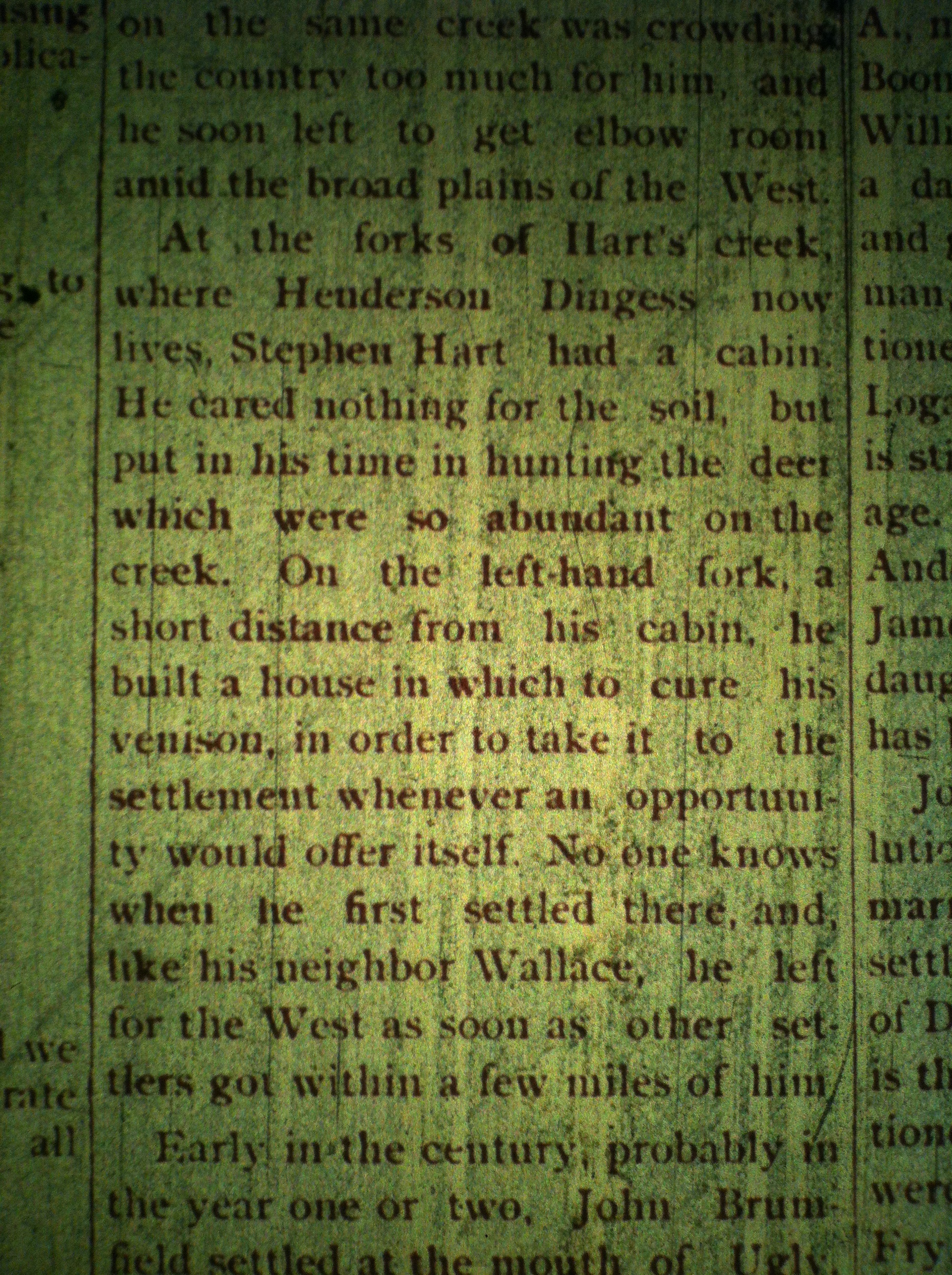
From the Logan County Banner of Logan, WV, comes this bit of history written by amateur historian Henry Clay Ragland relating to Stephen Hart and the naming of Harts Creek in Lincoln and Logan counties, West Virginia, dated 1896:

Stephen Hart Ragland LCB 04.08.1896.JPG

Logan County (WV) Banner, 8 April 1896.

***

On 13 April 1937, the Logan Banner printed another story about Hart and his relationship to Harts Creek. This latter story was generally derived from Ragland’s 1896 history.

Harts Creek Named After Stephen Hart—A Wanderer And Famous Deer Hunter

Much has been told about Harts Creek in late years, but little is known about the first settler who built his home in the long hollow and gave it a name.

Stephen Hart built a cabin on the farm which Henderson Dingess later owned at the forks of Hart’s Creek. He cared nothing for the soil, but spent his time hunting deer and curing the meat. He didn’t stay long in one place.

Near his cabin he built a house in which to store his cured venison between his infrequent trips to the settlements down the river and was altogether self-sufficient. His neighbors knew little about the man. There is no record of a family reared by him and he told neighbors little of his past history.

His was a roaming nature. He, like the Arabs, pitched his tent where the water was clearest, the game gamest, and the soil most fertile.

To commemorate his short stay at the forks of Harts, neighbors named the creek for him after he had loaded his gun, food stores and skins on a pack mule, and started west.

His few friends heard no more about him, but they remembered him as a “quiet man, a good shot, and a good neighbor.”

Just “around the bend and over the ridge,” Jacob Stollings, John Baker, and Dick Johnson brought their families and built their homes. From descendants of this family comes much of the record of Stephen Hart who gave the creek a name.

Hart’s venison was known for miles around as the tenderest, the most delicately cured meat in the Hart’s section and Stollings, Baker, and Johnson always put in a small supply of Hart’s meat for the winter, sometimes to take an unusually large supply off the hunter’s hands but most times just because they liked the venison.

John Baker married a daughter of Jacob Stollings, and Dick Johnson married a sister of Baker’s. Both men reared large families whose names are familiar in the county’s history.

But Hart left only the name of his beloved deer hunting grounds as a reminder that he had first set foot on Hart’s Creek.

MY NOTE: Of importance, much confusion remains regarding the source for the naming of Harts Creek, essentially relating to the fact that Stephen Hart was born too late to have inspired the naming of the stream. I first attempted to unravel this story when I published a profile of Stephen Hart in a Lincoln County newspaper in 1995/6. Stephen Hart, son of James and Elizabeth Hart, was born c.1810 in North Carolina; Harts Creek appears on a map printed prior to 1824 (Hart was still quite young). In the early 1900s, amateur historian Fred B. Lambert noted that Hart’s father had been killed by Native Americans at the mouth of present-day Little Harts Creek (according to a Hart descendant). Possibly it is Mr. Hart’s father who inspired the naming of the local stream. Problematic to this possibility is the fact that, based on Stephen Hart’s estimated year of birth, his father would have been killed in 1809-1811, which is about fifteen to twenty years too late for an Indian attack in the Guyandotte Valley. Stephen Hart did settle locally. He may well have squatted on Harts Creek land, as Ragland reported in 1896. Based on documentary evidence, he acquired 50 acres on Crawley Creek in 1839. He appears in the 1840 Logan County Census and the 1850 Boone County Census. By 1860, he had settled in Roane County, where he died in 1896–the same year that Ragland published his history. He also left plenty of local descendants in the Mud River section of Lincoln County. How did Ragland garble this section of his history so badly? For those who wish to avoid sorting out this confusing tale, consider this version: at least one early account states the creek was named “hart” due to the prevalence of stags in its vicinity.

Harrison Blair v. Anderson Hatfield (1876)

16 Wednesday Jan 2019

Posted by Brandon Ray Kirk in Big Sandy Valley, Hatfield-McCoy Feud

≈ Leave a comment

Tags

Appalachia, crime, Devil Anse Hatfield, Elias Hatfield, Ellison Hatfield, Ephraim Hatfield, Evans Ferrell, G.W. Taylor, genealogy, Harrison Blair, Henry Clay Ragland, history, John Buchanan, John Chafin, Logan County, sheriff, West Virginia

Harrison Blair v. Anderson Hatfield et al 1.jpg

Summons for Anse Hatfield, John Buchanan, Ephraim Hatfield, Ellison Hatfield, Elias Hatfield, and Evans Ferrell, 8 May 1876.

harrison blair v. anderson hatfield et al 2

Executed on Anse Hatfield and Evans Ferrell in Logan County on 25 June 1876 by Sheriff G.W. Taylor.

Boling Baker and Princess Aracoma (1937)

06 Tuesday Nov 2018

Posted by Brandon Ray Kirk in Gilbert, Logan, Native American History, Women's History

≈ 3 Comments

Tags

Abner Vance, Appalachia, Aracoma, Ben Stewart, Ben White, Bluestone River, Boling Baker, Buffalo Creek, Charles Hull, Clear Fork, Dingess Run, Elias Harman, Flat Top Mountain, genealogy, George Berry, Gilbert Creek, Guyandotte River, Henry Clay Ragland, history, Horse Pen Mountain, Huff Creek, Island Creek, James Hensley, James Hines, James White, John Breckinridge, John Carter, John Cook, Joseph Workman, Kentucky, Logan, Logan Banner, Logan County, Logan County Banner, Mallory, Native American History, Native Americans, Oceana, Peter Huff, Rockcastle Creek, Shawnee, West Virginia, William Dingess, William S. Madison

From the Logan Banner of Logan, WV, comes this bit of history concerning Boling Baker and Princess Aracoma, dated March 23, 1937:

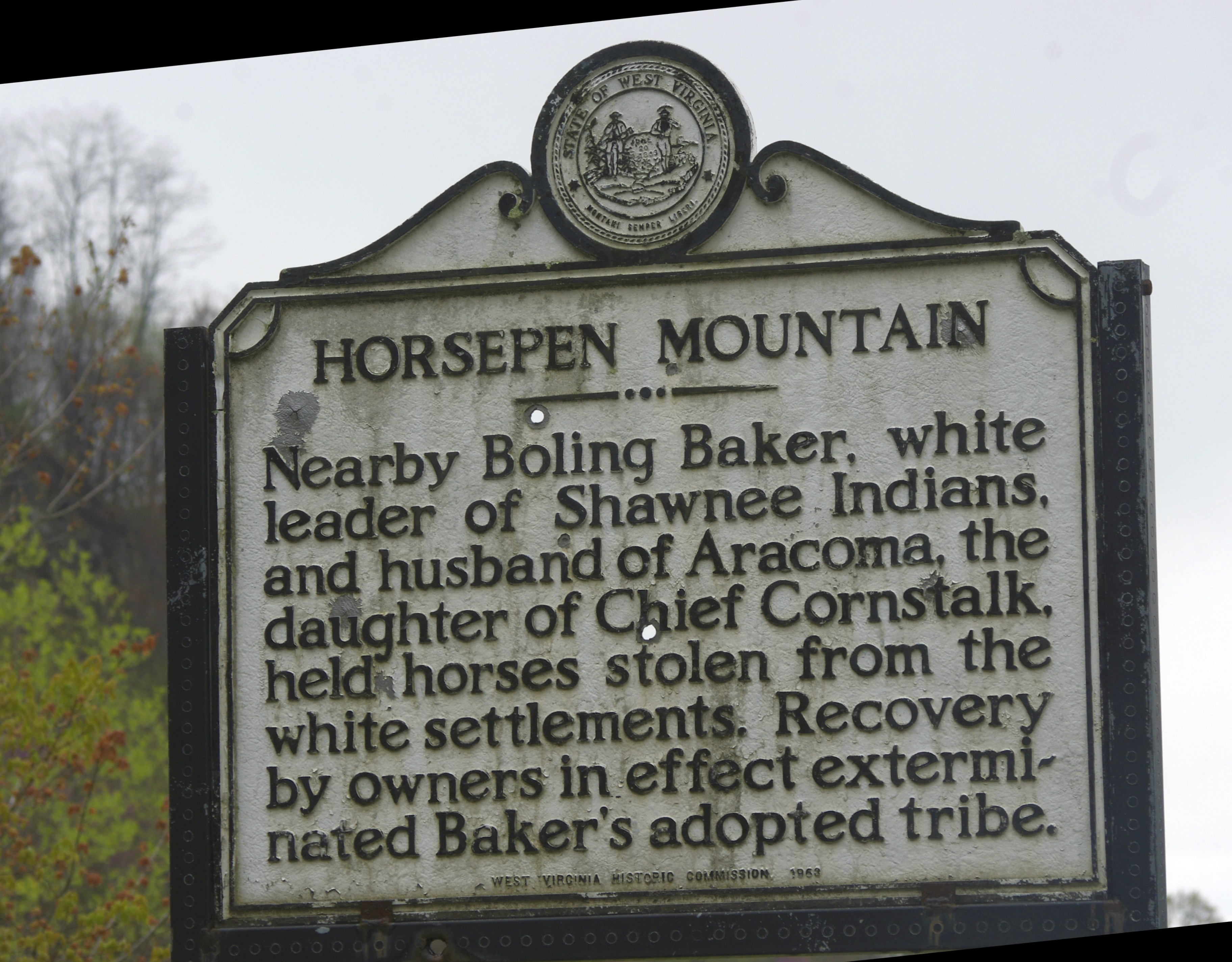
IMG_1668

Historical marker on Horse Pen Mountain near Gilbert, Mingo County, WV. 25 April 2015.

Dying Words of Princess Aracoma Related In Story Taken From Banner Files

Though much has been written on the history of Logan county, just as much has been forgotten about its early development.

One of the county’s first historians, Henry Clay Ragland, mayor of the city, church worker and editor of the Logan County Banner, recorded some of the high spots of the development of Logan county in a series of articles which he ran in his newspaper during 1896.

It is from this series of articles that the following story of the early settlement of Logan county is taken.

Records show that a large number of white men first set foot in what is now Logan county in the spring of 1777, when Captain Charles Hull with 20 men pursued a band of marauding Shawnees to the site where Oceana was later built. They lost the trail at Oceana and had to turn back. The Shawnees had raided a white settlement near the falls of New River one spring night and had stolen thirty head of horses. The army captain and his men set out in pursuit but the redskins had too great a start.

Huff Creek was given its name on this expedition in honor of Peter Huff who was killed in a skirmish on the banks of the stream as the men returned home. Huff was buried near the spot where he was killed, which is believed to have been near where the town of Mallory now stands.

Other men on this expedition and who returned to the valley of the Guyandotte later and built homes were John Cook, James Hines, William Dingess and James Hensley.

The first white man really to be identified with what is now Logan county was Boling Baker, a renegade white, but the old-timers would not give him credit for being a white man. They said: “He lived with the Injins and that makes him an Injin.” Baker, however dastardly he was, was indirectly responsible for the settlement of Logan county in 1780-85.

The renegade had one great weakness. A weakness that they hung men for in those days. He was a horse thief. He would take a party of Indians a hundred miles through the mountain passes of Logan county to raid a white settlement in order to steal 20 or 30 horses.

Baker had gone into the business on a large scale. At the head of Gilbert Creek, on Horse Pen Mountain, where the mountain rises abruptly with almost cliff-like sharpness, he had stripped bark from hickory trees and stretched it from tree to tree making a pen in which to keep his stolen stock.

Old settlers of the county who have had the story passed down to them from their great-grandfathers say that the pen was somewhere in the hollow below the road which leads to the fire tower on Horsepen Mountain. It was from this improvised corral of Boling Baker that the mountain was named.

But, back to how Baker was responsible for the settlement of the county.

He left his Indian camps on the Guyan river in the fall of 1780 and visited the white settlements in the Bluestone valley in the Flat Top mountain territory. There he told the settlers a story of how he had been captured by the Indians when he was a young man and had learned their ways. He said he had just escaped from the Shawnee tribe known to be hunting in the Guyandotte valley and was on his way back east to see his father and mother who lived in Boston. Shrewd chap, this Baker!

The settlers were taken in by his story and allowed him to remain with them for several weeks during which time he got the location of all the settlers barns well in mind and after a time departed “back east.”

Soon after the renegade left the Bluestone settlement the whites awoke one rainy morning late in autumn and found every barn empty. The Indians had come with the storm which lashed the valley and had gone without arousing a person. Thirty horses from the settlement went with them.

An expedition headed by Wm. S. Madison and John Breckinridge—son of the Breckinridges who settled much of Kentucky—was made up in a neighboring settlement and set out in pursuit of the thieving Shawnees.

They trailed the party over Flat Top Mountain and southwest to the headwaters of the Guyan River by way of Rockcastle creek and Clear Fork. Trail marks showed that the band had gone down the river, up Gilbert Creek to Baker’s pen and thence over the mountain.

Madison and his 75 men did not follow the Indian trail over the mountain but the redskins probably brought their herd of 50 or 75 horses down Island Creek to the Guyan.

The white expedition chose to follow the Guyan in a hope that they would find the party encamped somewhere along its banks. Scouts had reported that a large tribe of Indians used the Guyan valley as its hunting grounds.

Madison’s party followed the river down to Buffalo Creek—named because the white men found such a large number of buffalo grazing in its bottoms—crossed Rum Creek and pitched camp for a night at the mouth of Dingess Run because “Guyan” Green and John Carter, scouts sent ahead to reconnoiter, had reported finding ten Indian lodges in the canebrakes of an island formed by the joining of a large creek and the Guyan river.

The men rested on their guns for the night and the following morning divided into two parties and attacked the encampment from the front and rear.

In the furious fighting that followed, nine of the thirty Indians in the camp were killed and ten or twelve wounded. Only a few escaped the slaughter of the white men. Among those captured was an old squaw 50 or 60 years old, who by her bearing, was obviously leader of the party. She was wounded but refused to talk.

Near midnight, however, following the massacre of the camp the old squaw felt death creeping upon her and called Madison to her quarters, and told him in broken English the following:

“I am the wife of a pale face who came across the great waters to make war on my people, but came to us and became one of us. A great plague many moons ago carried off my children with a great number of my people, and they lay buried just above the bend in the river. Bury me with them with my face to the setting sun that I may see my people in their march to the happy hunting ground. For your kindness I warn you to make haste in returning to your homes, for my people are still powerful, and will return to avenge my death.”

The proud princess died before morning and the white men buried her “near the bend in the river.” The Indian captives were all killed.

Four days later the men returned to the valley of the Bluestone.

Among those who helped Wm. S. Madison rout the Shawnees and who vowed to possess the valley of the Guyandotte for themselves and their children were George Booth, George Berry, Elias Harman, Ben Stewart, Abner Vance, Joseph Workman, Ben White and James White. All these names are familiar in the county today.

After the Indians were pushed to the west, surveyors allotted the land to the first settlers who had dared, with Madison, to come into the wilderness of the Guyandotte and open it up for the white man.

Madison owned several thousand acres of land on Island Creek, Gilbert Creek and Dingess Run. Other fighters were given like parcels of land.

Source: Logan (WV) Banner, 23 March 1937

Wife of Logan Banner Editor George A. Dean Disappears (1912-1913)

20 Friday Jul 2018

Posted by Brandon Ray Kirk in Huntington, Logan, Matewan, Tazewell County

≈ Leave a comment

Tags

Albermarle, Appalachia, Bluefield, Buchanan, Collier's Weekly, Dry Fork, genealogy, George A. Dean, Henry Clay Ragland, Herald-Dispatch, history, Huntington, Iaeger, Imperial Order of Redmen, J.B. ellison, Jefferson Hotel, Kentucky, Keyes Sisters, LaRoy Stock Company, Lena Boyd Nelson, Lena Gross, Logan, Logan Banner, Logan County, Logan Democrat, Logan Nest 1442, Matewan, Modern Maccabees, Norfolk and Western Railroad, North Carolina, Order of Owls, Sayersville, Silver Cloud Tribe 138, Tazewell County, Virginia, W.L. Richardson, West Virginia, Williamson

In 1912, Logan Banner editor George A. Dean married the former Lena Gross, who soon thereafter disappeared. Here are a few stories about the event:

Editor Dean Married

On Monday, Nov. 11 in the minister’s study, Geo. A. Dean and Miss Lena Gross of Virginia, were united in marriage by Rev. W.L. Richardson.

Mr. Dean is the hustling editor of the Logan Banner and is well-known in this city and surrounding country as a man of push and energy, while the bride was one of the charming dining room girls at the Hotel Jefferson.

Mr. and Mrs. Dean will be at home to their friends after Nov. 18.

Source: Logan (WV) Democrat, 14 November 1912.

***

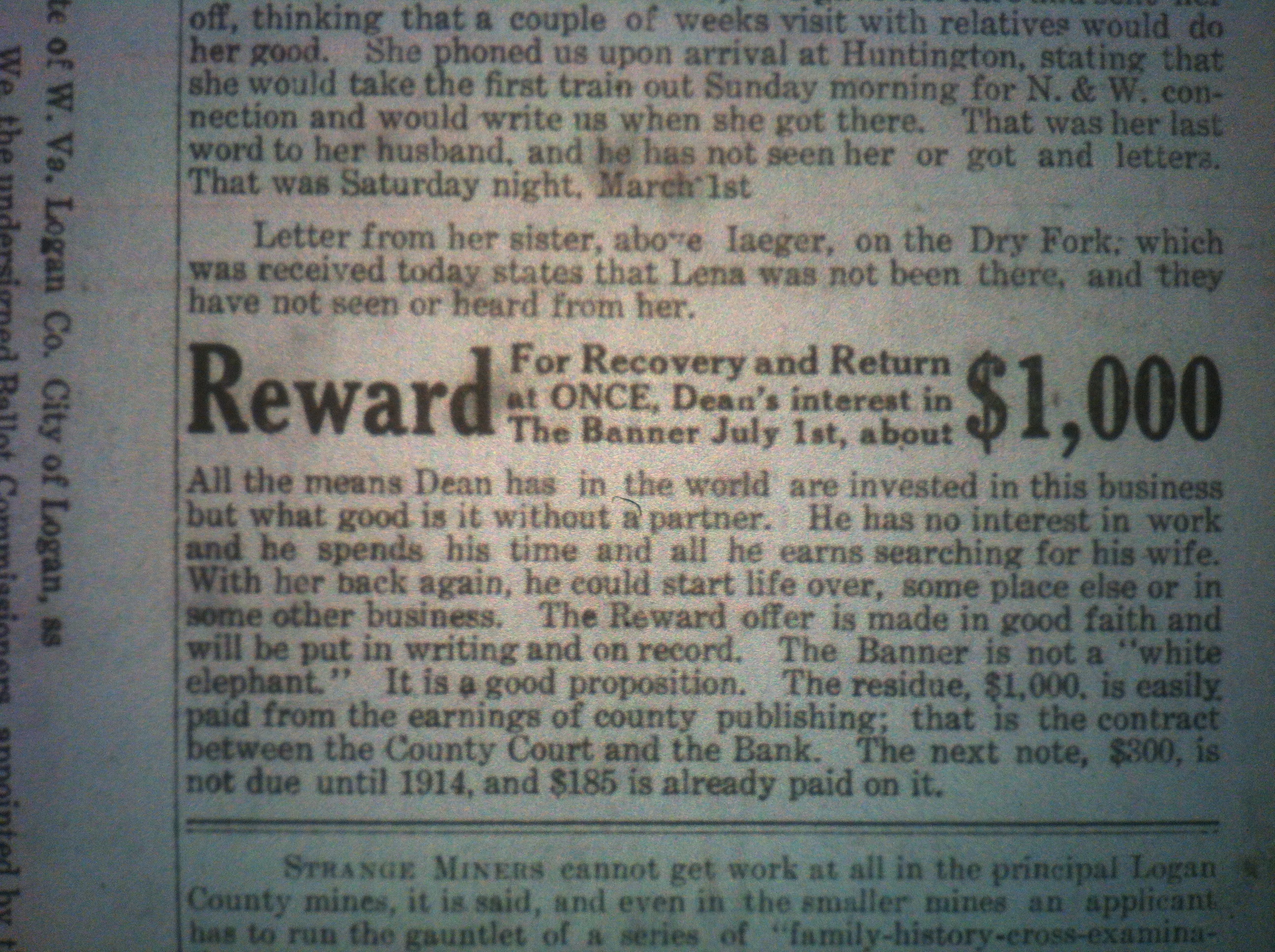
George A. Dean Logan Banner LB 01.24.1913.JPG

Logan (WV) Banner, 24 January 1913.

***

Editor of “Most Fearless Weekly” on the Trail

West Virginia editors who have failed to receive the Logan Banner on their exchange tables during the past three weeks, no doubt, marveled at its absence. But there is a reason–a tragic, gnawing reason which has caused the editor, Geo. A. Dean to suspend temporarily editorial duties and to embark upon a quest which means more to him than journalistic honors or the mere touch of hollow gold.

Readers of the Banner will remember that there appeared graven upon its front page four months ago Mr. Dean’s and his wife’s own announcement of their marriage. The paragraph attracted more than usual attention, partly because of its unique construction and partly because of the unusual manner of its presentation, but more than all because Mr. Dean was very prominently in the editorial limelight because of recent rather prominent mention in Collier’s Weekly. But that is history, and in mere prelude to the situation which now confronts him: to-wit: that of a married man, wifeless, disconsolate, yearning for the things that were.

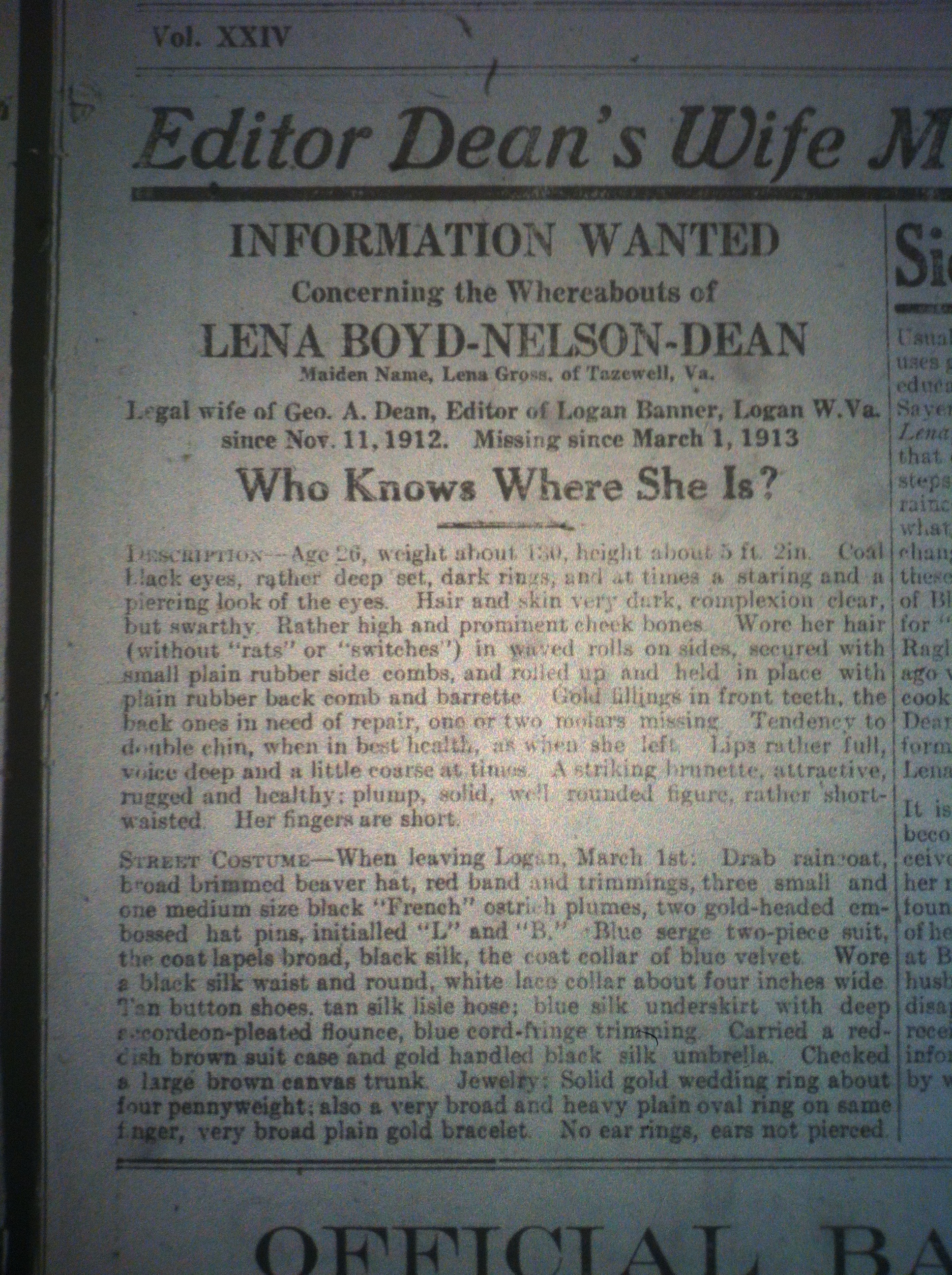
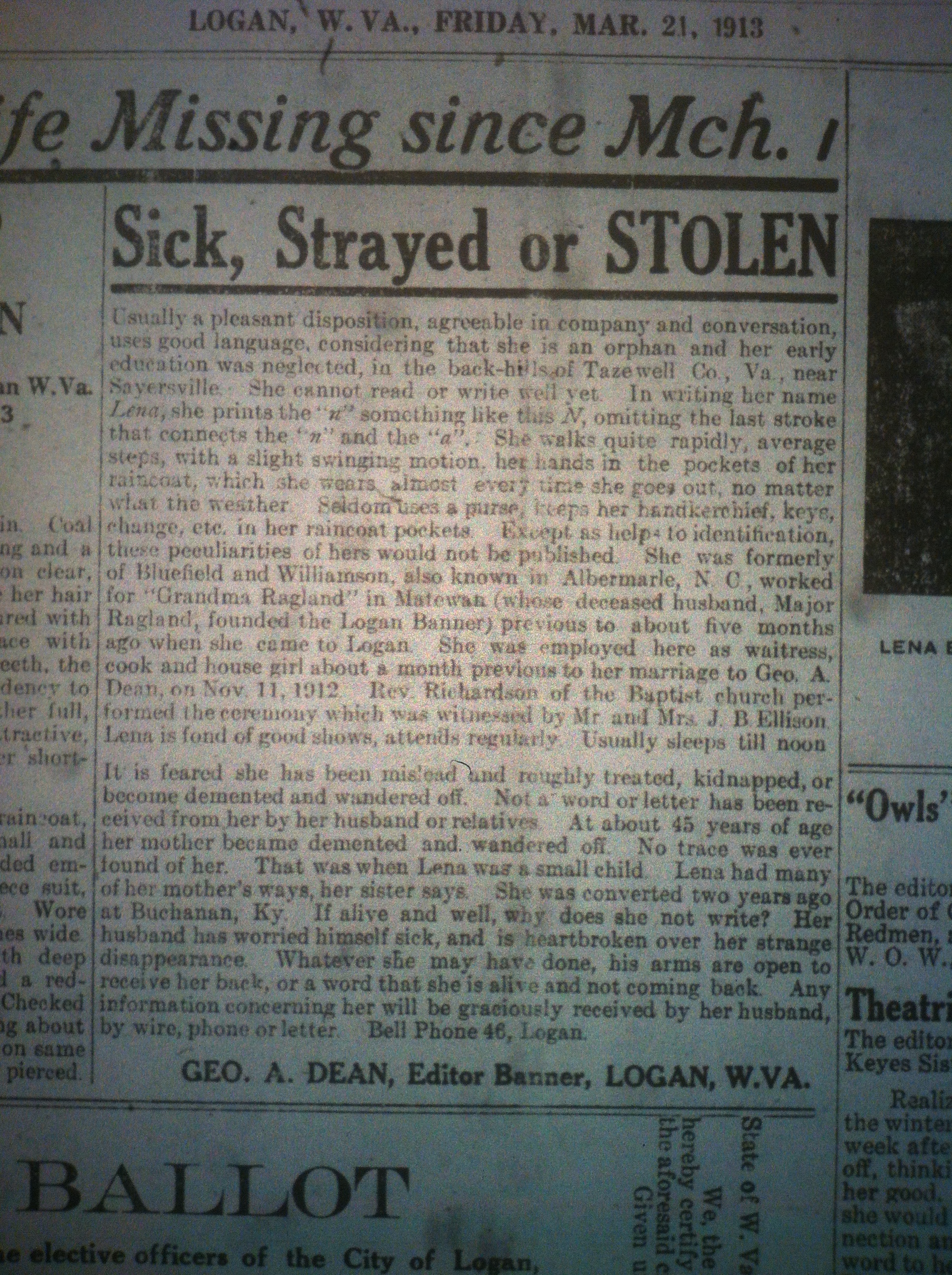
Mr. Dean, who has been in Huntington and vicinity for two days seeking a trace of his evanished spouse, speaks frankly of his bereavement, and is importunate that the home-loving public shall, if possible, assist him in finding and restoring his lost treasure. In brief, Lena Boyd Nelson Dean has gone away and, some fear, forever departed. She went without the tender formality of a farewell husband’s kiss. She went away surreptitiously, mysteriously. She went, and Mr. Dean, who has sounded the very depths of heaven and earth, is no whit the wiser whither. Descriptive circulars, telling her height, weight, complexion, color of eyes and hair, manner of dress, and all that pertains to accurate and dependable description have been scattered broadcast all over the territory in which it might be surmised that she would be obscuring herself from the eyes of love and yearning. Mr. Dean stated last night, in conversation with the Herald-Dispatch, that he had absolutely no heart for business, that he had known no rest, no surcease from the terrible heart-longing that had seized upon him and held with tenacious grip from the morning of his wife’s departure. He has searched high and low. He has communicated with every known relative of his wife, without being able to get even the shadow of a clue tending to lead to the discovery of her whereabouts. He gives the following verbal photograph, which is almost as good as the ordinary studio product, and much better than a tintype:

Lena Boyd Nelson Dean, formerly of Williamson and Matewan and Bluefield. Four months ago she served as waitress, cook, and house girl at Logan, W.Va. Last seen at Kenova on Sunday morning, March 2. Physical description: Age 26. Height 5 ft. 2. Coal-black eyes given to starry twinkle. Raven black hair. Rather full lips. Gold filling in front teeth. Deep, well modulated musical voice, with a tendency to coarseness in time of cold. Can not read or write much as her early education was neglected. Her costume is described as being strict in the style of today. Raincoat, drab-colored; blue-serge, two piece coat suit. Beaver hat, embellished with four black ostrich plumes. Leather suitcase, canvass trunk and gold-headed umbrella.

Mr. Dean feels that his wife may have returned to one of the three occupations ascribed to her in the opening paragraphs.

He has important mail for her, both registered and ordinary, and is awaiting anxiously any news of her, and his arms are open to her return. The Logan editor’s plight is positively pitiful. He has grown emaciated, hollow-eyed, faded, wan. The tireless vigil, the ceaseless search, the anxious waiting hours, have all played their part in preying upon his splendid vitality. He is discouraged but not defeated, and will continue the search as long as human endurance will permit, or else sooner find the partner of his joys and immediate cause of his great and overpowering grief. His plight has elicited much sympathy. For what is life without a partner?

Source: Huntington (WV) Herald-Dispatch via Logan (WV) Democrat, 13 March 1913.

***

George A. Dean's Wife Missing LB 03.21.1913 1

Logan (WV) Banner, 21 March 1913.

George A. Dean's Wife Missing LB 03.21.1913 2

Logan (WV) Banner, 21 March 1913.

George A. Dean's Wife Missing LB 03.21.1913 3

Logan (WV) Banner, 21 March 1913.

George A. Dean's Wife Missing LB 03.21.1913 4

Logan (WV) Banner, 21 March 1913.

George A. Dean's Wife Missing LB 03.21.1913 5

Logan (WV) Banner, 21 March 1913.

George A. Dean's Wife Missing LB 03.21.1913 6

Logan (WV) Banner, 21 March 1913.

U.B. Buskirk of Logan, WV (1893-1894)

25 Friday May 2018

Posted by Brandon Ray Kirk in Logan

≈ 1 Comment

Tags

Appalachia, circuit clerk, Fannie Humphreys, genealogy, Henry Clay Ragland, history, J.B. ellison, J.W. Stowers, justice of the peace, Logan, Logan County, Mattie Buskirk, Nancy Butcher, T.C. Whited, Urias Buskirk, West Virginia

Urias Beckley Buskirk (1856-1962) was the son of a boot and shoe maker who migrated to Logan County from Pennsylvania. Urias, who became Logan’s wealthiest merchant in the 1890s, is profiled elsewhere at this blog.

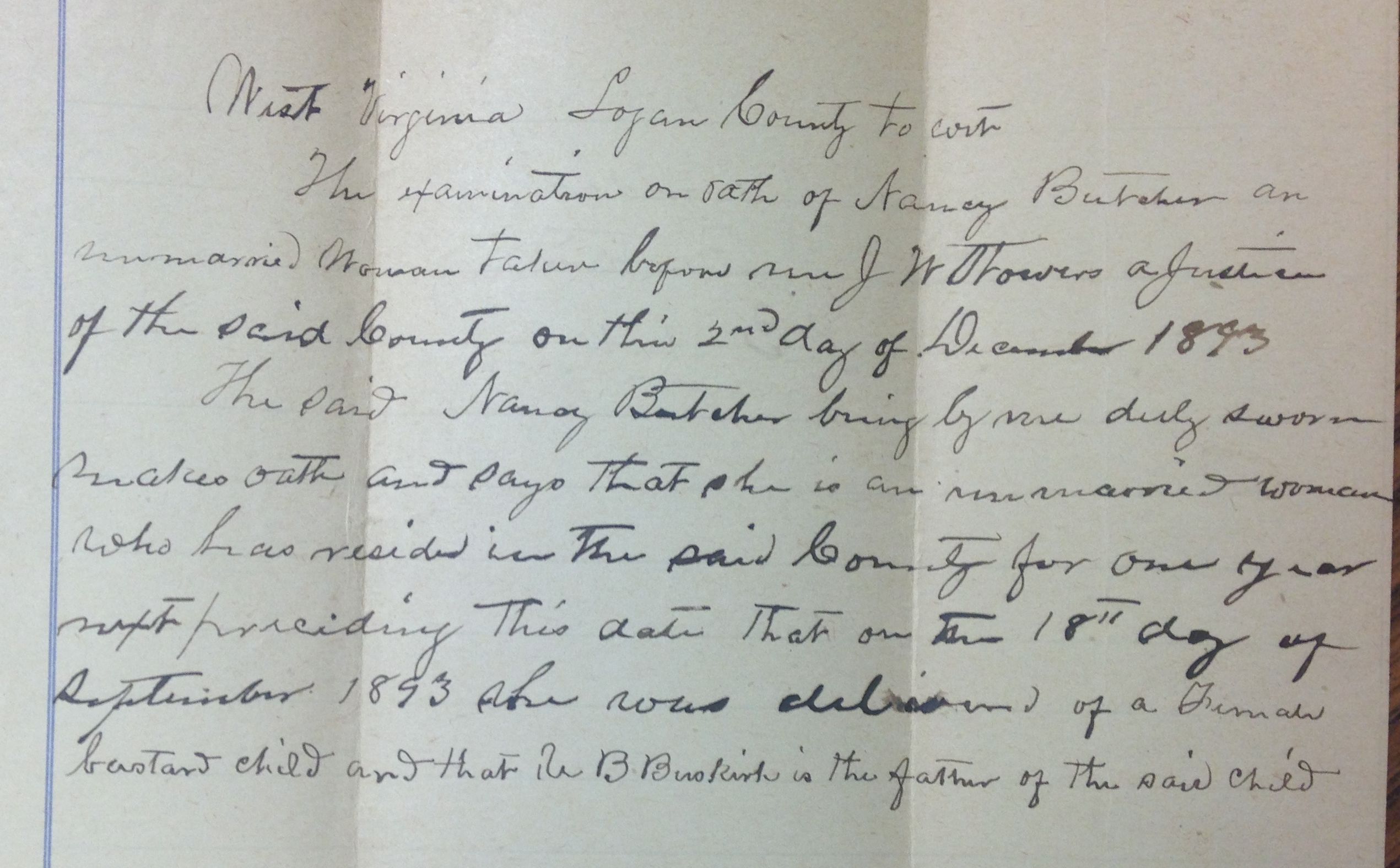
IMG_0463

Logan County Circuit Clerk’s Office, Logan, WV. The child’s name was Mattie Buskirk.

IMG_0467

Logan County Circuit Clerk’s Office, Logan, WV. Mr. Buskirk (1856-1962), the wealthiest merchant in Logan, married to Fannie Humphreys in 1897.

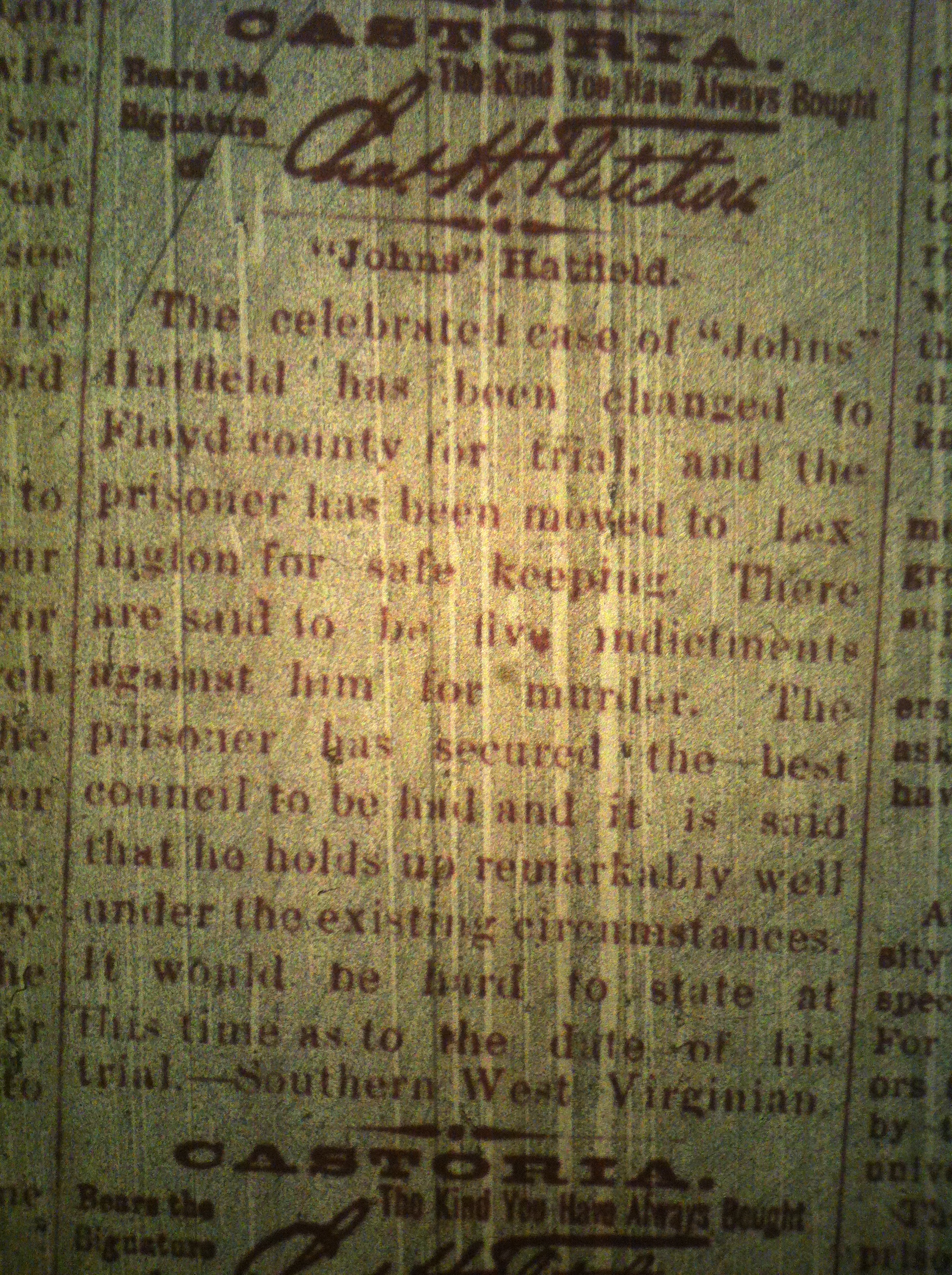
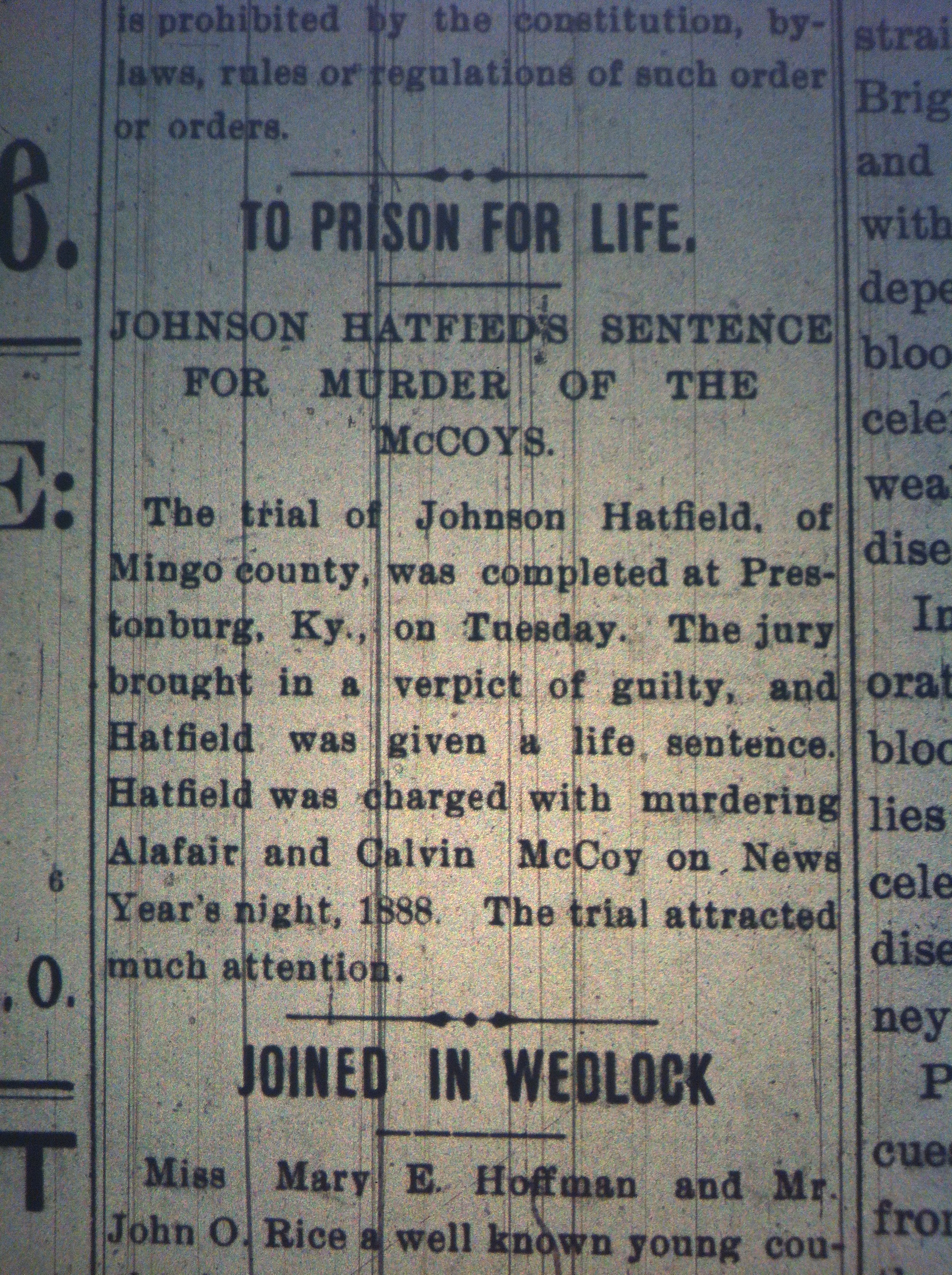
Johnson Hatfield (1890-1900)

28 Tuesday Nov 2017

Posted by Brandon Ray Kirk in Culture of Honor, Gilbert, Hatfield-McCoy Feud, Matewan, Pikeville

≈ Leave a comment

Tags

Alifair McCoy, Appalachia, Beech Creek, Calvin McCoy, Chafinsville, crime, Dan Cunningham, Devil Anse Hatfield, Dollie Hatfield, feud, feuds, Floyd County, Frank Phillips, genealogy, George Hatfield, Gilbert Creek, Greek Milstead, Hatfield-McCoy Feud, Henry Clay Ragland, history, Huntington Advertiser, Johnse Hatfield, Johnson Hatfield, Kentucky, Logan County, Logan County Banner, Matewan, Mingo County, murder, Nancy Hatfield, Norfolk and Western Railroad, Oakland Hotel, Pikeville, Portsmouth Blade, Prestonsburg, Southern West Virginian, T.C. Whited, Thomas H. Harvey, true crime, Vanceville, West Virginia

From the Logan County Banner of Logan, WV, and the Huntington Advertiser of Huntington, WV, come the following items relating to Johnson Hatfield:

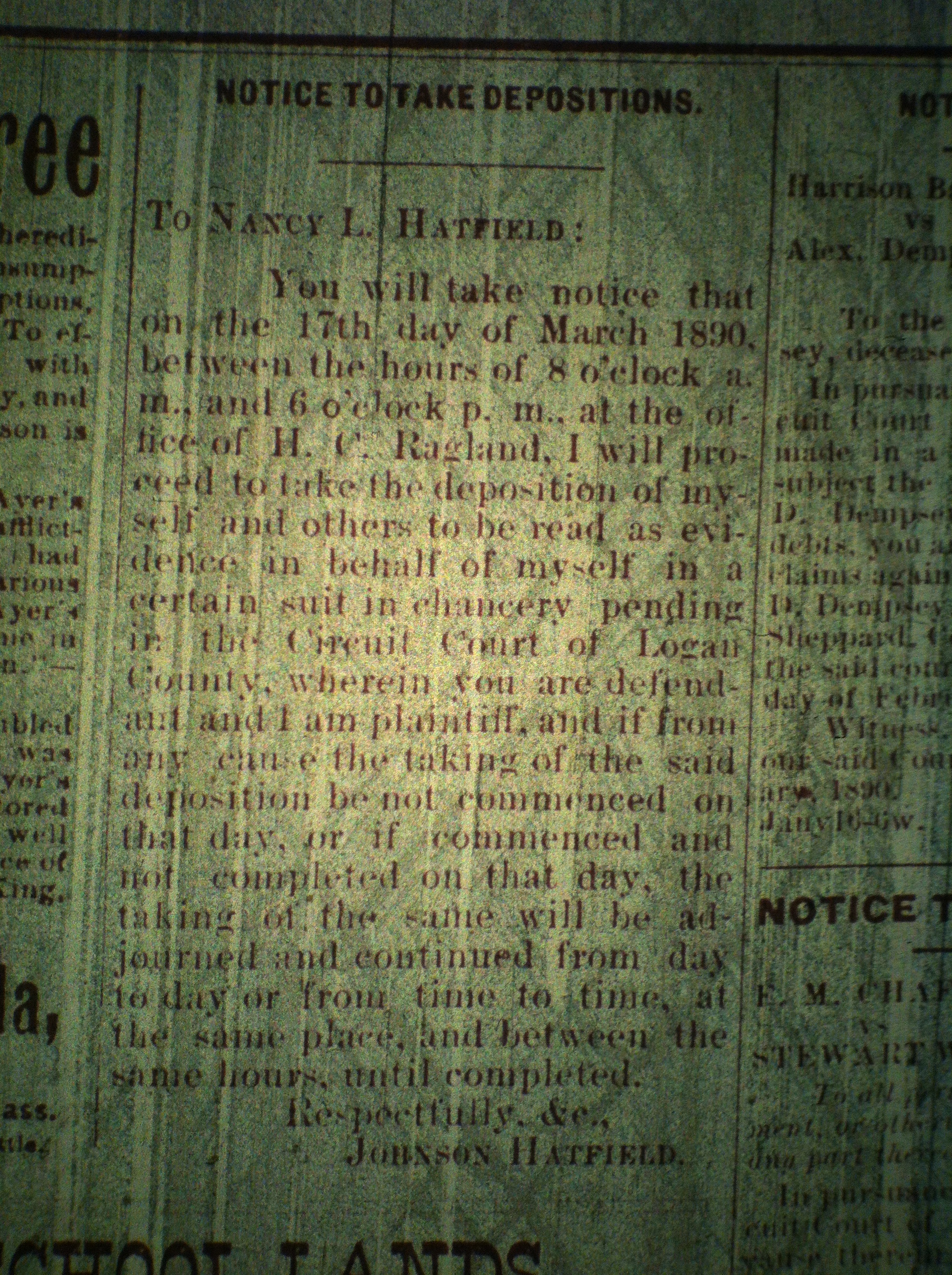
Johnson Hatfield Notice of Deposition LCB 02.20.1890.JPG

Logan County Banner (Logan, WV), 20 February 1890. Also appeared on 13 March 1890.

***

Johnson Hatfield v. N&W RR LCB 07.30.1891.JPG

Logan County Banner (Logan, WV), 30 July 1891.

***

We are glad to see that Johnson Hatfield, who has been confined to his room for the last ___ weeks, is able to be on the street again.

Source: Logan County Banner (Logan, WV), 2 March 1893.

***

There was an unfortunate difficulty at Matewan on Sunday last in which Mr. Johnson Hatfield was severely wounded through the hand. His son had become involved with an officer which drew his father into the trouble.

Source: Southern West Virginian via the Logan County Banner (Logan, WV), 1 January 1896.

***

Johnson Hatfield, accompanied by his daughter, Miss Dollie, left on Monday last for a visit to friends and relatives in Mingo county.

Source: Logan County Banner (Logan, WV), 23 January 1897.

***

Johnson Hatfield and daughter, Miss Dollie, have returned from a visit to friends on Sandy.

Source: Logan County Banner (Logan, WV), 6 February 1897.

***

Johnson Hatfield, the genial proprietor of the Oakland Hotel, is visiting friends at Pikeville, Kentucky.

Source: Logan County Banner (Logan, WV), 28 August 1897.

***

Johnson Hatfield has returned from a visit to Pikeville, Ky.

Source: Logan County Banner (Logan, WV), 9 October 1897.

***

Johnson Hatfield is at Williamson this week.

Source: Logan County Banner (Logan, WV), 23 October 1897.

***

The many friends of Mrs. Johnson Hatfield will regret to learn of her serious illness. She has a very bad attack of rheumatism.

Logan County Banner (Logan, WV), 13 November 1897.

***

Johnson Hatfield and wife, of Mingo, passed through here [Chafinsville] last Sunday en route for Vanceville, where they will make their future home.

Source: Logan County Banner (Logan, WV), 21 April 1898.

***

HATFIELD KIDNAPPED.

TAKEN TO KENTUCKY ON A SERIOUS CHARGE–NOW IN JAIL.

Johnson Hatfield was arrested yesterday and taken to Pikesville, Kentucky, and lodged in jail on a charge of being an accomplice in the murder of Alifair McCoy on New Years night about nine years ago. This murder was committed during the feud of the Hatfields and McCoys.

Source: Huntington (WV) Advertiser, 20 July 1898.

***

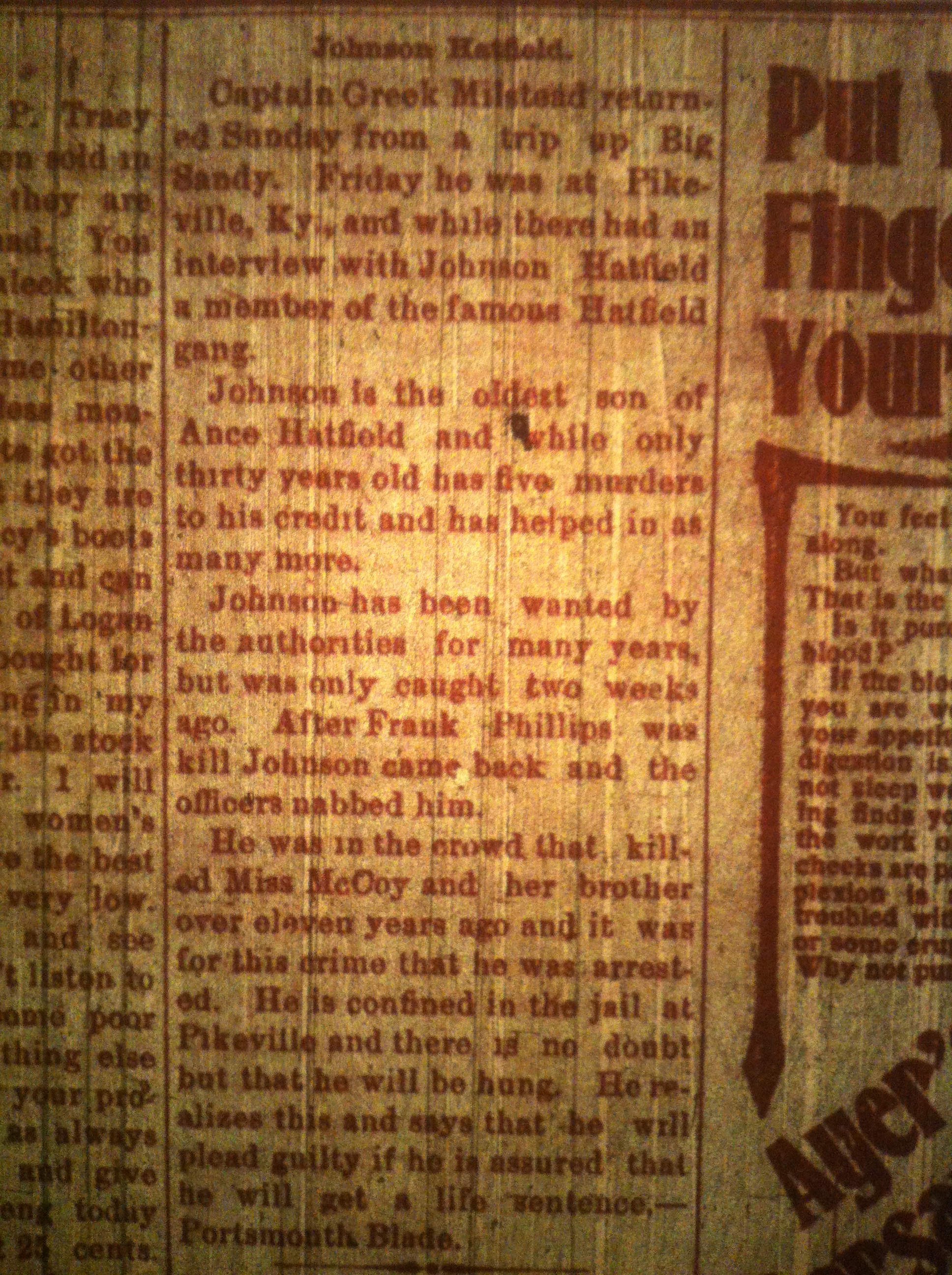
Johns Hatfield Captured LCB 07.21.1898

Logan County Banner (Logan, WV), 21 July 1898.

***

Johnson Hatfield Interview LCB 8.11.1898.JPG

Logan County Banner (Logan, WV), 11 August 1898.

***

Johnson Hatfield LCB 10.20.1898.JPG

Logan County Banner (Logan, WV), 20 October 1898.

***

Johnson Hatfield LCB 1.19.1899.JPG

Logan County Banner (Logan, WV), 19 January 1899.

***

Johnson Hatfield Gets Life HuA 01.21.1899.JPG

Huntington (WV) Advertiser, 21 January 1899.

***

Johnson Hatfield LCB 4.12.00.JPG

Logan County Banner (Logan, WV), 12 April 1900.

NOTE: Not all of these stories may pertain to the Johnson “Johnse” Hatfield of Hatfield-McCoy Feud fame. For instance, items relating to the Oakland Hotel and a daughter named Dollie relate to a Johnson Hatfield (born 1837), son of George and Nancy (Whitt) Hatfield.

Mrs. Henry Clay Ragland’s Obituary (1914)

25 Monday Sep 2017

Posted by Brandon Ray Kirk in Civil War, Huntington, Logan, Matewan, Women's History

≈ 2 Comments

Tags

5th Virginia Cavalry, Appalachia, Aracoma Baptist Church, B.B. Goings, Blaine Creek, Christian Church, G.B. Hamilton, genealogy, Henry Clay Ragland, history, Huntington, John A. Sheppard, Kentucky, Lawrence County, Logan, Logan Banner, Logan County, Lou Ragland, Matewan, Mingo County, Robert W. Buskirk, Urias Buskirk, Urias Hotel, West Virginia, Williamson

From the Logan Banner of Logan, WV, we find the following story dated April 17, 1914:

“GRANDMA” RAGLAND PASSES TO THE BEYOND

MATE OF MAJOR HENRY CLAY RAGLAND, EDITOR OF THE LOGAN BANNER FOR MANY YEARS, PLACED BESIDE HIM EASTER SUNDAY

Mrs. Lou Ragland, mother of the Buskirk family, of this region died last Friday a.m. at the home of her son, Robert W. Buskirk, in the Urias Hotel at Matewan, Mingo county. She had married Henry Clay Ragland, for a long time editor of the Logan Banner, after the death of her first husband, Urias Buskirk. By her first marriage she raised a most interesting family of sons and daughters who are still residing in this section. Mrs. Buskirk was a most remarkable woman in many respects. She had always lived an exemplary and Christian life and assumed her responsibilities after the death of her first husband with efficiency and diligence. She was true to friend and family and was a good and faithful mother and a loving wife. Through her long life she has retained the confidence and respect of all who knew her. We grieve with her relatives and friends at her death. She was near the ninety-two milestone when she died and had been sick only for a few days.

“Grandma” Ragland’s exact age was 91 yrs. 11 mo. 20 days; born on Blain creek, Lawrence county, Ky., May 1st, 1823. For 30 years a member of the Christian church.

On May 1st also (1911) Major Ragland died. He was born on May 7th, 1844; belonged to Co. B 5th Va. Cavalry; member of the Aracoma Baptist church.

Mrs. Ragland’s last request, to rest one night in her old bedroom–the present residence of Rev. Bradshaw–was complied with. This parsonage now becomes the property of the Baptist church, according to the terms of Major Ragland’s deed, at her death.

Her age indicates her wonderful physical endurance, and while she knew she must die soon, retained her usual discretion and fortitude. She made plans with her kindred as to where her last resting place should be and desired that none of her children and friends be troubled about her demise. Up to the last she kept her mind intact and conversed with those near to her.

The mother of the Buskirks has gone, we hope, to a happier sphere. Mother is the dearest friend on earth. We grieve at the bier of the departed with the bereaved, and shed a tear with them in their desolation as we think of our own dear mother. Our sympathies go out to the bereaved ones in the loss of their one best comforter, but we hope and continue to hope that we may meet again in the unknown hereafter.

***

On April 17, 1914, the Logan Banner offered a small additional item: “Among those in attendance at the funeral of ‘Grandma’ Ragland last Sunday were: B.B. Goings, Williamson; Jno. A. Sheppard, Huntington; G.B. Hamilton, Matewan; in addition to the sons of the deceased.”

Henry Clay Ragland Home in Logan, WV (1914)

13 Wednesday Sep 2017

Posted by Brandon Ray Kirk in Civil War, Logan

≈ Leave a comment

Tags

Appalachia, Aracoma Baptist Church, Aracoma Cemetery, Camp Straton, civil war, Confederate Army, Henry Clay Ragland, history, Logan, Logan Banner, Logan County, Logan Wildcats, photos, West Virginia

Ragland Home LB 04.24.1914 2

THE OLD HISTORIC AND SAINTED RAGLAND HOME IN LOGAN: Now parsonage of the Aracoma Baptist Church, where the remains of the late “Grandma” Ragland lay in state, in the exact position of her late husband, the last night in this city, before they were finally laid to rest in Aracoma cemetery, beside those of the beloved “Major” Henry Clay Ragland. The Major is shown at the left, grasping the “Logan Wild Cats” Battle Flag, said to be the only flag of the Confederacy that was never captured. Photo taken Oct. 22, 1906, at the annual Reunion of Camp Straton Confederate Veterans, composed of surviving members of the “Logan Wild Cats” and others of this section. Mr. Ragland was Commandant. Privates numbered 106. Logan Banner, 24 April 1914.

Logan Banner (1914)

31 Monday Jul 2017

Posted by Brandon Ray Kirk in Logan

≈ Leave a comment

Tags

Appalachia, E.T. England, Henry Clay Ragland, history, Ira P. Hager, J.C. Smith, John M. Perry, Logan, Logan Banner, Logan County, Logan County Banner, McDowell Recorder, Naaman Jackson, O.J. Deegan, The Logan Banner Company, W.C. Lawrence Jr., West Virginia

The Logan Banner, formerly the Logan County Banner, is the primary newspaper serving Logan County, West Virginia, and surrounding areas. The first issue of the Banner appeared in 1889 under the editorship of Henry Clay Ragland. Its history serves as an item of interest.

Logan Banner, 26 June 1914

Every name on the combined Banner and Republican lists–paid and not paid–will receive a copy of this week’s “25th-year Souvenir Edition,” also some sample copies are mailed. This is our last invitation, and your last chance to get Dean’s Logan Banner at $1 a year; it goes up to $1.50 a year in advance next issue, and will never come down while the present owner edits it. A blank coupon for remittance will be found below; better send your name and a dollar NOW. All subscribers in arrears will be cut off July 3rd, the date of next issue.

***

Logan Banner, 14 August 1914

Incorporated

A certificate of incorporation has been issued to The Logan Banner Co., to conduct a publishing business at Logan. It has an authorized capital of $10,000, and its incorporators are E.T. England, Ira P. Hager, O.J. Deegan, John M. Perry, Naaman Jackson, W.C. Lawrence, Jr., and J.C. Smith, all of Logan.

***

Logan Banner, 14 August 1914

To the Public:

The Logan Banner has lately changed hands. The new editor will have charge in a few days. The future policy of this newspaper will then be stated. Suffice it to say that the paper will advocate all that pertains to civic righteousness and civic betterment.

The owners believe, as every one should believe, who lives within the confines of Logan county, that progress is the result of the acts of a progressive people, and that Logan county is made up of people who believe that to progress is to succeed, hence the unparalleled development of our county.

The Logan Banner will do all that lies in its power to foster each and everything that has a tendency to develop and uplift the county. In short, the ultimate object will be a greater Logan, city and county.

O.J. Deegan

***

Logan Banner, 21 August 1914

A Word to Our Readers

The Logan Banner, under new auspices, will be published as usual at the same place and at the old subscription price of one dollar per year. It is the ultimate object of the publishers to make The Banner purely a local newspaper, and with this aim in view, will welcome news from every part of the city and county.

We believe that the merchants of Logan will realize the value of The Banner since it is going into every nook and corner of Logan county, and will use it as a medium through which to express themselves to their many customers. While we do not see at this time the name of many local firms among our advertising customers, we believe that such condition will not long exist, especially so since there is not a merchant in the city of Logan who does not greatly appreciate each and every one of his patrons regardless of those patrons’ party affiliations.

There are among the readers of The Banner many from every party represented in the county. There is not an institution in Logan that is not patronized by people affiliated with every party here; therefore we lay claim to the fact that The Logan Banner is entitled to much of the advertising in which the merchants of Logan county participate, and by merit alone do we expect to prove our assertions. We will also please you with our job work; we will allow no alternative to this latter.

Come in and see us; you are welcome.

***

Logan Banner, 4 September 1914 (originally published in the McDowell Recorder)

Changed Hands

The Logan Banner has again changed hands. For two weeks it has had the same salutatory, but we guess it is only gathering wind for its sails.

We certainly wish the new management abundant success, and that with sledge-hammer blows it will smash up the old bourbon democracy of that county.

If the new management cannot install a linotype, it should, by all means, employ a boy who can each week set at least a column or two of real live matter. Don’t catch the grouch that affected Brother Dean.


Henry Clay Ragland Obituary (1911)

13 Tuesday Jun 2017

Posted by Brandon Ray Kirk in Logan

≈ Leave a comment

Tags

Appalachia, genealogy, Henry Clay Ragland, history, lawyer, Logan, Logan Banner, Logan County, Logan County Banner, Logan Democrat, West Virginia

Henry Clay Ragland Dead LD 05.04.1911.JPG

Logan (WV) Democrat, 4 May 1911.

Early Newspapers of Lincoln County, WV

03 Wednesday May 2017

Posted by Brandon Ray Kirk in Hamlin, Huntington

≈ Leave a comment

Tags

Appalachia, B.H. Oxley, C.M. Hall, C.W. Campbell, Cairo, Charleston, Cincinnati, Clipper Publishing Company, David Laird, Dunlow, E.S. Zeveley, Edward I. Holt, Elbert R. Hoffman, Greensboro Beacon, Hamlin, Henry Clay Ragland, Henry H. Hardesty, history, History of Logan County, History of Ritchie County, Hu Maxwell, Huntington, Huntington Advertiser, J. Jerome Haddox, Jamestown, John H. Sanborn, Joseph E. Chilton, Lincoln Citizen, Lincoln Clipper, Lincoln County, Lincoln Guidon, Lincoln News, Linnie Haddox, Logan County Banner, Minnie Kendall Lowther, newspapers, North Carolina, Parkersburg Sentinel, Pennsboro, Populist Party, R.E. Hardwicke, Republican Party, Ritchie Democrat and Beacon Light, Spencer, T.C. Miller, T.T. McDougal, The Institute Daily Lincoln News, Van Zeveley, Virgil H. Mahone, W.M. Workman, Wayne County, West Virginia, West Virginia and Its People

The following newspapers have existed in Lincoln County, WV:

Lincoln Clipper (1881-

“The publication of the Lincoln Clipper, a five column folio newspaper, was begun at Hamlin on the 15th day of September, 1881, by Messrs. C.M. Hall and T.T. McDougal, editors and proprietors. They continued it for several months, when Hall sold his interest to McDougal, by whom it was published until January, 1882, at which time he sold a half interest to Messrs. Joseph E. Chilton, C.W. Campbell and B.H. Oxley, and under the name of the Clipper Publishing Company they issued it until August, 1882, when Edward I. Holt purchased the press and office material, and by him it has been published since. Under his management it has constantly improved and enlarged. On the 18th day of October, 1883, it was made a five column quarto.” Source: Hardesty’s History of Lincoln County, WV (c.1884), p. 97.

“The Lincoln Clipper has again changed hands and is now published by the Lincoln Clipper Publishing Company. The capital stock is not given, but it is something less than $1,000,000.” Parkersburg Sentinel, 4 February 1882


Lincoln Citizen (1886-

“Mr. W.M. Workman will begin the publication of a newspaper called the Lincoln Citizen at Hamlin, Lincoln County, about the 20th inst. We presume the object of its publication is to fill the usual long-felt want, and incidentally to reap the golden reward of West Virginia journalism. We hope Mr. Workman may be successful in his enterprise.” Huntington Advertiser, 10 April 1886

“J. Jerome Haddox is again editor of the Lincoln Citizen. It is needless to say the Citizen is turned up to bold and brilliant things.” Logan County Banner, 18 September 1895

“The History of Logan County, by Hon. Henry Clay Ragland, has begun in The Logan Banner. He starts off like a true historian, and with a master pen blends romance and history together. He begins with the brave little Jamestown colony in 1607, and with a skillful pen and accurate knowledge of the footprints of colonial characteristics is bringing his readers gradually down to the settlements and formation of Logan.” Logan County Banner, 15 January 1896 (via Lincoln Citizen)

“Mr. J. Jerome Haddox, editor of the Lincoln Citizen, was married Sunday afternoon to Miss Linnie Mahone, the daughter of Mr. and Mrs. Virgil H. Mahone, prominent and well-to-do people of that county. The Banner extends congratulations.” Logan County Banner, 19 February 1896

“The Lincoln Citizen is the only exchange that comes to our tables that has the gall to try to keep alive that defunct Populist party. From the look of its dress it may be surmised that the Citizen will soon sink into its predestined grave to sleep until the vision so graphically pictured by Mr. Bellamy arrives which will perhaps be realized about the year 4000 A.D. One by one the ‘pop’ organs have dropped from the ranks until now to see one is a curiosity The Citizen may aptly be styled the last rose of summer in the West Virginia Populist garden.” Huntington Advertiser, 9 May 1896 (via Southern West Virginian)

“The populist convention of Lincoln county instructed their delegates to the State district convention to vote for Jerome J. Haddox, editor of the Lincoln Citizen, for delegate to the National populist Convention at St. Louis. Mr. Haddox was here today and thinks his chances are favorable. He is accompanied by his estimable wife and they will probably remain here for several days.” Huntington Advertiser, 8 June 1896

“The Lincoln Citizen, edited by the only Jerome Haddox, came in on time last evening and was as bright and newsy as ever. Mr. Haddox’s paper always contains some rich, rare, and racy effusions which will bring smiles to the countenance of the most disconsolate.” Huntington Advertiser, 29 January 1897

“Jerome Haddox, the populist editor, of Lincoln county, who has many friends in this city, is the happy father of a nine and one-half pound boy. It was born last Wednesday and Jerome says: ‘He is a middle of the road populist possessing oratorical abilities.'” Huntington Advertiser, 16 March 1897

“Editor Jerome J. Haddox of the Lincoln Citizen has sold out his plant and good will to Elbert R. Hoffman of the Lincoln Guidon but the paper will be known in the future as the Lincoln Citizen and will be republican in politics. Mr. Haddox is one among the most interesting writers in the state and the press generally will be sorry to lose him from the profession. Mr. Hoffman was formerly a well known Charleston newspaper man and will evidently make a success in his new field.” Huntington Advertiser, 26 July 1898.

Lincoln News (1894-

“We notice in the Lincoln News that John H. Sanborn and David Laird, of Dunlow, were in Hamlin a few days ago and subscribed for the Lincoln News. Frank says the sign was the special attraction.” Logan County Banner (Logan, WV), 21 June 1894

“Editor Van Zeveley of Hamlin, is here for a day or two after looking after the interests of his paper, The Lincoln News.” Huntington Advertiser, 10 March 1898

“The Lincoln News comes out this week in new dress and greatly enlarged. We are glad to chronicle the success of Mr. Van Zeveley its editor and owner. The News is doing good for the democracy in Lincoln.” Huntington Advertiser, 15 April 1898

“Editor Van Zeveley of the Lincoln News is in the city and is accompanied by Mrs. Zeveley. They will remain in Huntington over Sunday.” Huntington Advertiser, 13 May 1898

“Van Zeveley of Lincoln who has been in the city for a few days received a telegram yesterday afternoon that his wife who had been visiting out in the interior of the state was very ill and had been taken to the hospital at Wheeling for treatment. Mr. Zeveley left this morning for her bedside. It is hoped that he will find her much improved.” Huntington Advertiser, 6 July 1898

“Van H. Zeveley, the editor of the Lincoln news, is spending a few days here in company with his wife. Van was one of the secretaries of the Spencer convention, and a good one he was too.” Huntington Advertiser, 3 September 1898

“Van Zeveley, the well known editor of the Lincoln News, came in last night from Charleston where he has been spending a few days looking after some business matters. Mr. Zeveley will return home tomorrow morning.” Huntington Advertiser, 14 March 1899

“Editor Van Zeveley of the Lincoln News arrived in the city at noon today from Hamlin, accompanied by his wife. They will remain here until tomorrow morning, when they will leave over the Ohio railroad for Ritchie county, where they will spend a few weeks. Mrs. Zeveley has been in ill health for almost a year past, but is now much improved.” Huntington Advertiser, 20 July 1899.

“Editor Van Zeveley of the Lincoln News arrived here this morning and left this afternoon on the White Collar line steamer for Cincinnati.” Huntington Advertiser, 9 August 1899

“Van Zeveley, Editor of the Lincoln News, one of the leading democratic weeklies in the state, is in the city today looking after some business matters. The many friends of Mr. Zeveley will be sorry to learn that his health has been failing for a few months past. Mr. Zeveley will remain here until the middle of the week.” Huntington Advertiser, 18 September 1899

“Editor R.E. Hardwicke of the Lincoln News and several other prominent citizens of Lincoln are here today and will remain until tomorrow, when they go to Charleston to attend the Western Davis meeting.” Huntington Advertiser, 15 August 1900

“Editor R.E. Hardwicke of the Lincoln News came in from Charleston this morning and will spend a day or so here before returning to his home at Hamlin.” Huntington Advertiser, 21 September 1900

Van Zeveley was the son of E.S. Zeveley. The elder Mr. Zeveley was born in North Carolina in 1818 and began a newspaper called the Greensboro Beacon in 1836. In 1877, he founded the Ritchie Democrat and Beacon Light at Cairo, WV. His son, Van, began a newspaper called The Walking Beam in Volcano, WV. Following the elder Zeveley’s death in 1884, the Democrat passed to his son, Van. Van operated the Beacon Light (renamed and relocated to Pennsboro) until 1893, when he moved to Lincoln County. He edited the Lincoln News for six years until his poor health forced him to retire from the newspaper business. Sources: History of Ritchie County by Minnie Kendall Lowther (1911), p. 454-455; West Virginia and Its People by T.C. Miller and Hu Maxwell (1913), p. 304.

The Institute Daily Lincoln News (1895-

“We are in receipt of several numbers of The Institute Daily Lincoln News. This is the first daily ever published in Lincoln county, and it is bright and newsy and reflects much credit upon the management of the News.” Logan County Banner, 17 July 1895

Lincoln Guidon (1895-

Note: This is a “working” entry and will be updated periodically.


Stephen Hart (1896)

31 Friday Mar 2017

Posted by Brandon Ray Kirk in Big Harts Creek

≈ Leave a comment

Tags

Appalachia, genealogy, Harts Creek, Henderson Dingess, Henry Clay Ragland, history, Logan, Logan County, Logan County Banner, Smokehouse Fork, Stephen Hart, West Virginia

Stephen Hart Ragland LCB 04.08.1896

Logan County Banner (Logan, WV), 8 April 1896.

Johnson Hatfield v. Nancy L. Hatfield (1890)

23 Sunday Oct 2016

Posted by Brandon Ray Kirk in Hatfield-McCoy Feud

≈ Leave a comment

Tags

Alexander Varney, Appalachia, Devil Anse Hatfield, Elza Phillips, Frank Phillips, Hatfield-McCoy Feud, Henry Clay Ragland, history, John B. Gillespie, Johnson Hatfield, Kentucky, Logan County, Nancy L. Hatfield, Pike County, Pleasants Chafin, T.C. Whited, Thomas H. Harvey, Urias Buskirk, West Virginia

Johnson “Johnse” Hatfield’s relationship with Nancy McCoy represents one of the more interesting components of the Hatfield-McCoy Feud. I recently located Hatfield’s 1890 divorce record, which I transcribed as follows:

DOCUMENT 1

State of West Virginia

County of Logan to wit

In the Circuit Court of said County

The Bill of Complaint of Johnson Hatfield filed in the Circuit Court of Logan County against Nancy L. Hatfield.

To the Hon. Thos. H. Harvey, Judge of the Circuit Court of Logan Co.

Humbly complaining your orator Johnson Hatfield would respectfully ____ unto your Honor that on the 14th day of May 1881 he intermarried with the defendant Nancy L. Hatfield, then Nancy L. McCoy, that he was at all times to her a kind and affectionate husband, that some time in 1888 he was forced to leave his home in Logan County West Virginia, and that shortly thereafter the said defendant abandoned his home and went to the state of Kentucky where she has since that time been living in adultery with Frank Phillips, and ____ other lewd and lascivious _____.

Your orator further represents that he cohabitated with the said defendant for the last time on or about the 8th day of March 1888 in Logan County West Virginia and that they last lived together as husband and wife in said County within five years from the institution of this suit.

Your orator further represents that he be informed and so believes that some time in the month of December 1889, the said defendant was delivered of a child, which was as a ____ of more than twelve months since he had last had any sexual intercourse with her.

Your orator further represents that the adultery complained of was not committed by his consent, connivance or procurement or knowledge. He therefore prays that the bonds of matrimony existing between your orator and the said Defendant be dissolved, and that your orator be restored to his ________ rights, and as is duly bound he will ever pray

Johnson Hatfield, By Counsel

DOCUMENT 2

State of West Virginia

To the Sheriff of Logan County, Greeting:

We command you that you summons Nancy L. Hatfield if she be found in your bailiwick, to appear before the Judge of our Circuit Court for the County of Logan at rules to be held in the Clerk’s Office of said Court on the first Monday in February next, to answer a Bill in Chancery exhibited against her in our said Court by Johnson Hatfield

And have then and there this writ.

Witness: T.C. Whited, Clerk of our said Court at the Court House of said County, on the 1st day of February 1890, and in the 27 year of the State.

T.C. Whited, Clerk

DOCUMENT 3

Order of Publication.

State of West Virginia, Logan County, T0-Wit:

At Rules held in the Office of the Clerk of the Circuit Court of said county on Monday the 3rd day of February 1890

Johnson Hatfield v. Nancy L. Hatfield, In chancery

The object of this suit is to obtain a divorce from the bonds of matrimony. This day came the plaintiff by his Attorney and on his motion it appearing from an affidavit filed with the papers of this suit that the defendant is a non-resident of this State, it is therefore ordered that she appear here within one month from the first publication of this order and do what is necessary to protect her interest herein.

Teste: T.C. Whited, Clerk

H.C. Ragland, Sol.

DOCUMENT 4

I, U.B. Buskirk, one of the Publishers of the Logan County Banner, a newspaper published in Logan County, West Virginia, do hereby certify that the annexed notice was duly published in said paper for 4 successive weeks, ending on the 27 day of February 1890.

Given under my hand this 28th day of February 1890

U.B. Buskirk

Printer’s fees: $6.00

DOCUMENT 5

State of West Virginia

Logan County to wit:

Johnson Hatfield the plaintiff whose name is signed to the forgoing bill being first duly sworn upon oath says that the facts and allegations contained in the forgoing bill are true except so far as the same are ______ stated to be upon information and that so far as the same are stated to be upon information he believes ___ to be true.

Johnson Hatfield

Taken, __________ and sworn to before me this 10th day of March 1890.

T.C. Whited, Clerk

DOCUMENT 6

Notice to Take Deposition

To Nancy L. Hatfield. You will take notice that on the 10 day of October, 1890, between the hours of 8 o’clock A.M. and 6 o’clock P.M., at the house of Anderson Hatfield, in Logan County, West Virginia, I will proceed to take the deposition of myself and others to be read as evidence in behalf of myself in a certain suit in chancery now pending in the Circuit Court of Logan County wherein you are Defendant and I am plaintiff and if from any cause the taking of the said deposition be not commenced on that day, or if commenced and not completed on that day, the taking of the same will be adjourned and continued from day to day or from time to time, at the same place, and between the same hours, until completed.

Respectfully, &c., Johnson Hatfield

DOCUMENT 7

The depositions of Johnson Hatfield and others taken before Pleasants Chafins a notary in and for the county of Logan and State of West Virginia  at the house of Anderson Hatfield on Friday October 10 in 1890, to be taken and consider as evidence in a certain chancery cause pending in the Circuit Court of said county wherein Johnson Hatfield is a plaintiff and Nancy L. Hatfield is a defendant.

Present Johnson Hatfield in person and by counsel , no appearance for the defendant.

Johnson Hatfield a witness of lawful age after being first duly sworn deposes in answer _____ as follows:

Q. What is your name, age, and where do you reside?

A.  Johnson Hatfield. I am 28 years old past. I was born and raised in this county.

Q. What relation do you have to this suit?

A. I am plaintiff.

Q. When were you and the defendant Nancy L. Hatfield married?

A. It was on the 14th day of May 1881.

Q. How did you treat her during the time that you and she lived together as man and wife?

A. .I always kept her plenty of everything she wanted and was always good and kind to her.

Q. State about when it was that you and your wife separated.

A. It was on the 18 of March 1888.

Q. Have you lived with her since that time or had sexual intercourse with her?

A. No, sir.

And the next came Alex Varney, witness of lawful age being by me duly sworn, deposed and say as follows:

Q. State your name, age, and residents.

A. Alexander Varney, Age 56 years. Residents Logan County, West Va.

Q. State wither or not you are acquainted with the partys in this suit.

A. I am.

Q. State whether or not you know anything about the defendant Nancy L. Hatfield living in adultery with Frank Phillips or anyone else since her separation from the plaintiff.

A. I saw her in Pike Co. Kentucky on the 13 day of September 1890. She was staying at the house of frank filips and she told me that she was living with him. She showed me her baby and told me that frank filips was its father.

Q. How old do you suppose that the child was.

A. She told me that the child was 9 month and 4 days old and I suppose it was about that old as it was still sucking.

[Deposition of John B. Gillespie]

Q. State whether or not you know anything about the defendant Nancy L. Hatfield living in adultery with any person.

A. I was at a house in Pike County  Ky. Frank Phillips and Nancy L. Hatfield were there. They called it their home.

Q. State whether or not it was the general impression throughout the community that they were living together as man and wife.

A. No, sir. Not as man and wife. It was that they were living together in adultery.

And further this _________ saith not.

John B. Gillespie

[Deposition of Johnson Hatfield]

_______ ________ __________ recalls and deposes as follows:

Q. State whether or not the acts of adultery committed by your late wife Nancy L. Hatfield with one Frank Phillips ______ in the two foregoing depositions were committed by or with your consent, knowledge, __________, or __________.

A. They were not.

And further this _________ saith not.

Johnson Hatfield, Jr.

State of West Virginia

Logan County, to wit:

I, Pleasants Chafins a notary in and for the county and state aforesaid do certify that the foregoing depositions were duly taken, sworn to, and subscribed in my presence at the time and place _____ in the notice here to _____.

Pleasant Chafin, a notary for Logan Co., W.Va.

Notary’s Fee

2 hrs work as notary     $1.50

DOCUMENT 8

Johnson Hatfield v. Nancy Hatfield, In chancery

This day this cause in which the defendant is prosecuted against as a nonresident and it appearing that the order of publication has been duly published and posted as required by law, came on to be heard upon the plaintiff’s bill and the depositions there with filed in support thereof together with the argument of counsel for plaintiff and the same being considered and inspected by the court the court is of the opinion that the plaintiff is entitled to the relief therein prayed for, whereupon it is adjudged, ______, and decreed that the said plaintiff Johnson Hatfield be and he is hereby divorced absolutely from the defendant the said Nancy L. Hatfield and that the bonds of matrimony now existing between himself and the said defendant be dissolved and the said plaintiff Johnson Hatfield be and he is hereby restored to all the rights, privileges and immunities of an unmarried man. And this cause having performed its object, the same is ordered to be stricken from the docket and it appearing that this order was made at the October 1890 term of this Court, and by _________ not entered, it is ordered that the same be entered now as for ____.

Source: Logan County Circuit Clerk’s Office, Logan County, WV, Case No. 33, File No. 35

Logan County, WV, Political Commentary and Voting Trends (1824-1900)

05 Monday Sep 2016

Posted by Brandon Ray Kirk in Chapmanville, Civil War, Logan

≈ Leave a comment

Tags

Abraham Lincoln, Andrew Jackson, Arthur I. Boreman, Battle of Kanawha Gap, Boone County, Boone Democrat, Chapmanville District, Charleston Daily Star, Chesapeake and Ohio Railroad Company, civil war, Confederacy, Democratic Party, First Wheeling Convention, Franklin Pierce, Grover Cleveland, Guyandotte Valley Railroad Company, Hardee District, Henry Clay Ragland, history, Horace Greeley, Horatio Seymour, Isaac E. McDonald, James A. Nighbert, James Buchanan, James K. Polk, James Lawson, John Bell, John Breckenridge, Lewis Cass, Logan Banner, Logan County, Logan County Banner, Logan District, Magnolia District, Martin Van Buren, Parkersburg Sentinel, Parkersburg State Journal, politics, Samuel J. Tilden, Second Wheeling Convention, slavery, Stephen Douglas, Triadelphia District, Virginia Ordinance of Secession, West Virginia, West Virginia Statehood Referendum, William H. Crawford, William Jennings Bryan, William Straton, Winfield Scott Hancock, Wyoming County

Democrats who lived in Logan County, West Virginia, prior to 1896 may best be thought of as Democrats of the Jeffersonian and particularly the Jacksonian variety. The earliest settlers and their immediate progeny likely carried popular political viewpoints across the mountains from Virginia. Logan County Democrats appear to have believed in states’ rights, although few residents owned slaves. The old Democrats of the Civil War generation guided Logan County’s political scene until the 1890s, when the national political climate shifted toward issues relating to gold/silver, imperialism, etc. Still, the Confederate veterans of the county continued activity until the 1910s, even raising the Confederate flag over the courthouse as late as 1911. The Logan County Banner (later the Logan Banner), a Democratic organ since its inception in 1889, remained silent about issues that divided the Democratic Party in the 1890s. Based on its editorials, the Banner—operated by men of the Civil War era—was more concerned about industrial progress, particularly the development of a railroad in the Guyandotte Valley, than the national political issues that emerged in the 1890s. Examination of the active participants in the railroad effort include both Democrats and Republicans, locals and outsiders…

Logan County was organized in 1824. Voting trends from 1824 until 1856 reveal a strong preference for Democratic candidates:

1824: William H. Crawford (Democratic-Republican)
1828: Andrew Jackson (Democrat, 90+ percent)
1832: Andrew Jackson (Democrat, 90+ percent)
1836: Martin Van Buren (Democrat)
1840: Martin Van Buren (Democrat)
1844: James K. Polk (Democrat)
1848: Lewis Cass (Democrat)
1852: Franklin Pierce (Democrat)
1856: James Buchanan (Democrat, 80-90 percent)

We know, based on the above presidential tallies, the county was heavily Democratic. Because the Democratic Party was closely linked to slavery during this era, it is useful to consider local slave statistics.

1850 Logan County Slave Census:  26 slave owners in Logan County; 84 slaves (largest slave owner had 10)

1860 Logan County Slave Census:  27 slave owners in Logan County; 80 slaves (largest slave owner had 7)

We know the county voted heavily for John Breckenridge in the 1860 presidential election. What is remarkable to modern residents is this: Logan Countians gave no votes to Abraham Lincoln (see below):

Logan County Presidential Election Results (1860):
John Breckenridge (Southern Democratic), 271
John Bell (Constitutional Union), 100
Stephen Douglas (Democratic), 6
Abraham Lincoln (Republican), 0

We know Logan County’s delegate to the Virginia Secession Convention favored secession. James Lawson, the delegate to the Secession Convention for Logan, Boone, and Wyoming counties, voted in favor of the Ordinance of Secession on 17 April 1861.

We know the county did not favor anti-secession political developments in Wheeling. Logan declined to send delegates to the First Wheeling Convention (May 13-15, 1861).

We know the voters of Logan County favored secession. Here are results for Logan County regarding the Secession Ordinance in Virginia (23 May 1861):
For: 518
Against: 63

We know Logan County did not support the political gatherings in Wheeling. Logan County sent no delegates to the Second Wheeling Convention, First Session (June 11-25, 1861). Likewise, it sent no delegates to the General Assembly of the Reorganized Government of Virginia (July 1-26, 1861) or to the Second Wheeling Convention, Second Session (August 6-21, 1861).

In the mind of local people, Logan County was invaded in 1861. On 25 September 1861, Union soldiers attacked Confederates at the Battle of Kanawha Gap (Chapmanville). The battle was a Confederate loss.

Due to the absence of its men and election irregularities, Logan County did not vote heavily on the question of “West Virginia.” This was true for many counties in western Virginia: West Virginia Statehood Referendum (24 October 1861): 34 percent turnout statewide; 18,408 for statehood and only 781 opposed! We can be sure that Logan did not favor “West Virginia.” Logan County sent no delegate to the West Virginia Constitutional Convention (26 November 1861).

Logan Countians overwhelmingly enlisted to fight for the Confederacy (60-90%). According to one estimate, Logan County contributed over 780 soldiers to the Confederacy. Contributions to the Union Army were less than 60. Based on the 1890 census, the following number of Union veterans lived in Logan County:
Chapmansville District: 7
Hardee District (later Mingo County): 16
Logan District: 13
Magnolia District (later Mingo County): 9
Triadelphia District: 11

During the war, Logan sent delegates to participate in the Confederate government in Richmond. Isaac E. McDonald represented Logan, Boone, and Wyoming counties at the Confederate General Assembly from 1861 to 1863. James A. Nighbert represented Logan, Boone, and Wyoming counties at the Confederate General Assembly from 1863 to 1865.

Because Logan was known as a Confederate stronghold and recruiting station, the town was invaded in 1862. Union troops burned the Logan Courthouse (15 January 1862).

Logan County was one of 15 counties in WV that did NOT vote in the 1864 U.S. presidential election (most were south of the Kanawha River).

After the war, Logan Countians refused to recognize West Virginia as a legitimate state and refused to pay taxes to the new state. Guerillas and gangs were active in the county. Governor Arthur I. Boreman sent troops into the county in order to collect taxes and maintain order.

Ex-Confederate disenfranchisement was common after the war. In 1868, of 888 voters in Logan County, only 125 voted for president. In 1870, 220 voted for the Democratic candidate for governor while 70 voted for the Republican (total 290). In Logan County, it was difficult to find any men who had NOT served in the Confederacy who could hold political office (or practice law, or teach).

Maj. William Straton (namesake of Stratton Street) typified Logan County political leadership during this time.

After the war, Democrats and Republicans largely chose/maintained party identification based on their views of the war. Logan had been heavily Democratic before the war; Logan was pro-Confederate during the war; Logan was strongly Democratic after the war

Logan County in Presidential Elections After the War:
1868: Horatio Seymour (Democrat)
1872: Horace Greeley (Democrat)
1876: Samuel J. Tilden (Democrat, by 90+ percent)
1880: Winfield Scott Hancock (Democrat, by 90+ percent)
1884: Grover Cleveland (Democrat, by 90+ percent)
Winfield Scott Hancock’s victory in Logan County is somewhat noteworthy considering that he was a former Union general.

On 30 October 1886, the Parkersburg Sentinel reported: “Logan county is so intensely democratic that there are thirteen democratic candidates running for the legislature and only one republican. Nevertheless one of the thirteen democrats will be elected.”

In 1888, Logan Countians voted for Grover Cleveland (Democrat).

The Logan County Banner was established on 7 March 1889 by Henry Clay Ragland (editor) and J.A. Nighbert (business manager). On 28 March 1889, it stated:

The paper will be devoted to the best interests of the people of Logan county. To the improvement of the education and morals of its people, and to the development of its great material resources. Politically, the Banner will be Democratic. Every one connected with it is a Democrat, but at the same time it will be fair to the opposition, and will heartily accord to the Republican party due credit for any good work which it may do. In addressing the questions which may arise in the Democratic party, as to its management and its leaders, the Banner will be Independent and will acknowledge no faction or factions, but will labor earnestly and zealously for the success of the party, and not for any individual.

In 1892, it reported: “Three years ago in order to furnish the people of Logan county with a home paper, we unfurled the Banner. We expected neither money nor glory, and our expectations have been fully realized.” On 3 January 1895, Ragland stated: “When I first went into the newspaper business I had no idea of continuing on for any length of time. My only desire was to see a newspaper in Logan county which would truly reflect the character of its people and be able to defend them from the many slanders which have been heaped upon them by the outside world…”

The Banner‘s reputation as a Democratic organ was well-known. In April 1889, the Parkersburg State Journal referred to it as “Democratic to the core.” On 11 July 1889, the Charleston Daily Star said: “The Logan County Banner is being made one of the best country weeklies in the State. As long as it continues as it has begun Logan may be depended upon for her customary Democratic majority.” On 13 January 1898, the Boone Democrat said of the Banner: “We cheerfully hail it, and hope that it may long continue to wave in the vanguard of Logan Democracy.”

The Banner never failed to applaud Democratic gains. On 6 November 1890, it stated: “Glorious old Chapmansville always does her fully duty. The Democratic vote increased from 205 in 1888 to 210, and the Republican vote decreased from 28 in 1888 to 14.”

This editorial, from 15 September 1892, is one example of Banner political commentary:

We have heard that there are several so-called Democrats born and reared in the mountain fastnesses of old Logan who have avowed their intention of ‘scratching’ one or another of the nominees of our party when they ides of November shall roll around, but we hope for the credit of Logan’s ‘rock-ribbed, copper-bottomed’ democracy that such reports are false. It is but natural that bitter feelings should be engendered by the clashing of the claims of rival candidates before our conventions but the conventions have done their work now, well and conscientiously, and every true Democrat in hearty and earnest response to the bugle call of freedom must face about with his brethren and forgetting all private feuds and grievances join in the charge upon our friends the enemy. That Democrat who falters in his duty in this the crisis of our party’s need betrays the trust reposed in him by the party of the people, forfeits his claim upon the confidence and good will of his compeers and deserves to be incarcerated in the bottom-most pit of damnation. You cannot afford to let a petty desire for revenge prevent you from casting a straight Democratic ticket on the 8th day of November. If you have ever harbored such a thought, exorcise the evil spirit that has taken possession of you and come back to the fold on bended knee and ask forgiveness for the wicked thoughts of your heart. The people have spoken and ‘the voice of the people is the voice of God.’ We feel sorry for that Democrat who, when the glorious news flashes over the wires next November that Cleveland, MacCorkle, Alderson and Mahood are elected can’t forget one or more of them was scratched on his ticket. Verily, like the Judas of old, he will feel like sneaking off with down cast eyes and hanging himself to the nearest tree. Logan expects every Democrat to do his whole duty during this campaign. The eyes of friend and foe alike are turned towards the mountains of old Logan whence cometh our help. Every Republican in the county is alert, active and zealous in the support of his whole ticket, and it behooves every Democrat to see to it that he does not prove a traitor in the camp of his friends. Stop a minute, friend, and think of the issues involved in the fight that is now upon us. Do you want the robber tariff barons to keep on heaping up their multiplied millions from your hard-earned dollars? Do you want your polls to be manned by Federal soldiers or maybe negroes from Virginia or North Carolina?

In 1892, Logan Countians voted for Grover Cleveland (Democrat).

During the mid-1890s, the Banner offered more brief political commentary. Here are some examples. On 21 June 1894, it stated: “The Logan Republican club was organized last Saturday night, with 20 members.” On 9 September 1896: “There is a meeting of the W.J. Bryan club at Chapmansville next Saturday evening. Everybody is invited to attend.”

Logan Countians voted for William Jennings Bryan (Democrat) in 1896 and 1900.

Election of 1892 LCB 11.10.1892

Logan County Banner, 10 November 1892.

Ragland’s History of Logan County (1895)

30 Wednesday Mar 2016

Posted by Brandon Ray Kirk in Logan

≈ Leave a comment

Tags

Appalachia, Aracoma, genealogy, Henry Clay Ragland, history, Logan County, Logan County Banner, West Virginia

Ragland's History LCB 12.11.1895 1

Ragland’s History of Logan County, Logan County (WV) Banner, 11 December 1895.

Ragland's History LCB 12.11.1895 2

Ragland’s History of Logan County, Logan County (WV) Banner, 11 December 1895.

Ragland's History LCB 12.11.1895 3

Ragland’s History of Logan County, Logan County (WV) Banner, 11 December 1895.

Henry Clay Ragland obituary (1911)

27 Saturday Feb 2016

Posted by Brandon Ray Kirk in Civil War, Logan

≈ 5 Comments

Tags

5th Virginia Cavalry, Aracoma Baptist Church, civil war, D.F. Ragland, E.H. Greene, E.T. England, Eliza N.A. Ragland, Eliza Ragland, Goochland County, Grover Cleveland, H. Nich Ragland, Hadensville, Henry Clay Ragland, history, Hugh Davis Ragland, Hugh N. Ragland, J.B. ellison, laywer, Logan, Logan Banner, Logan County, Logan County Banner, Logan County Democratic Executive Committee, Logan Democrat, Louise Ragland, Maryland, Point Lookout, R.A. Ragland, Ragland & Ellison, Ragland & England, Ragland & Greene, teacher, United States Commissioner, Virginia, Wayne County, West Virginia

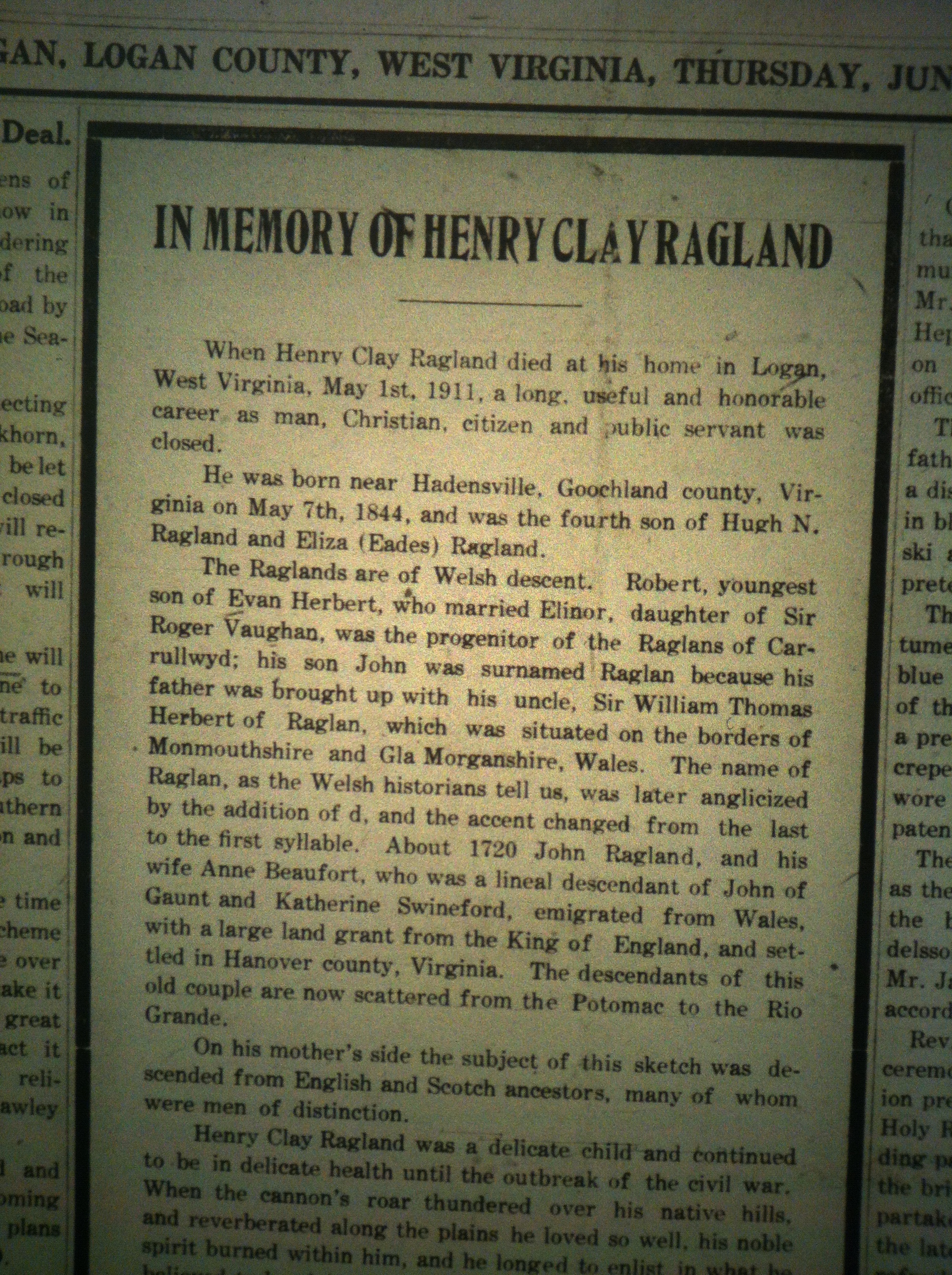
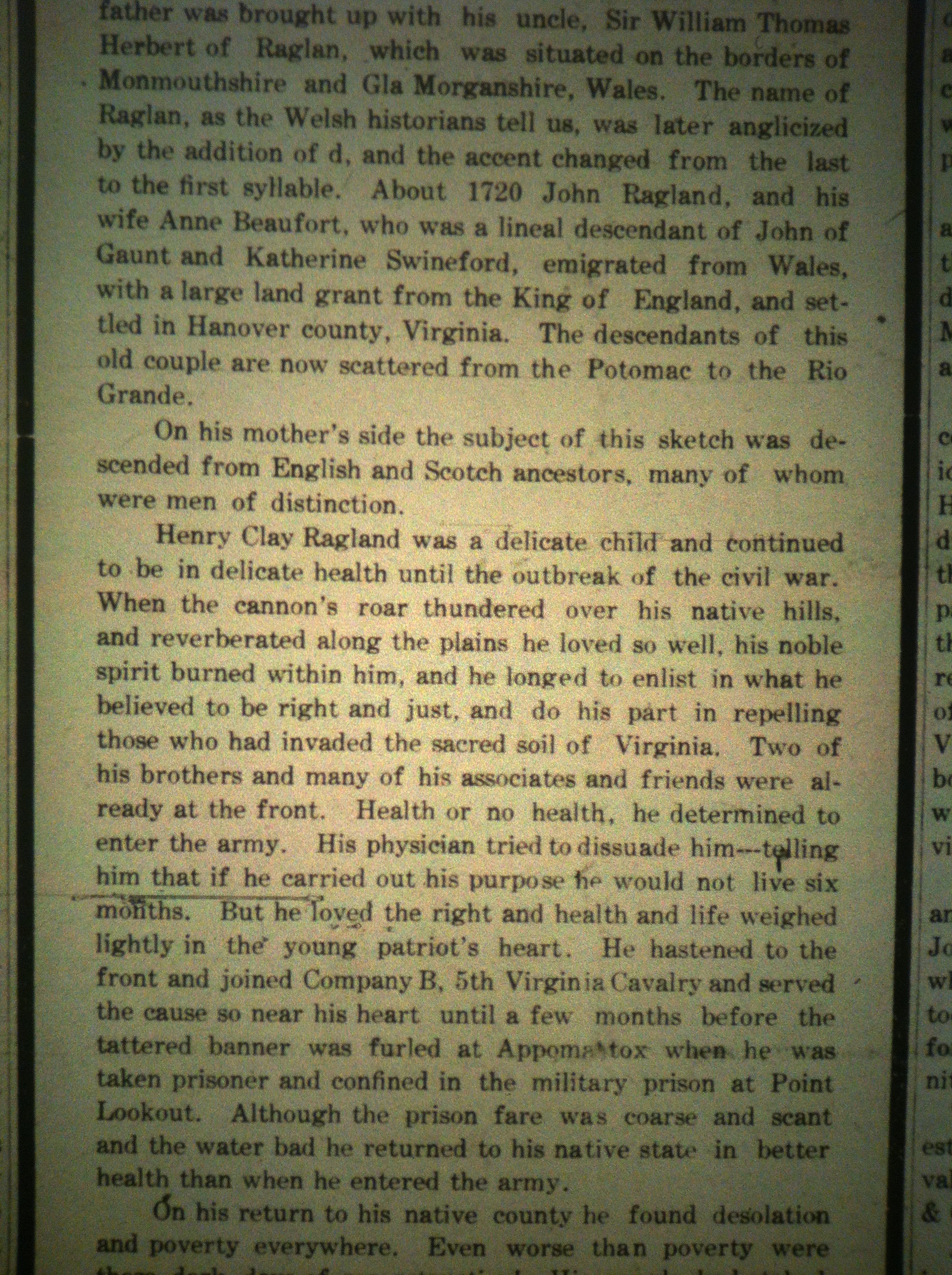
Henry Clay Ragland LD 06.29.1911 1

Logan (WV) Democrat, 29 June 1911.

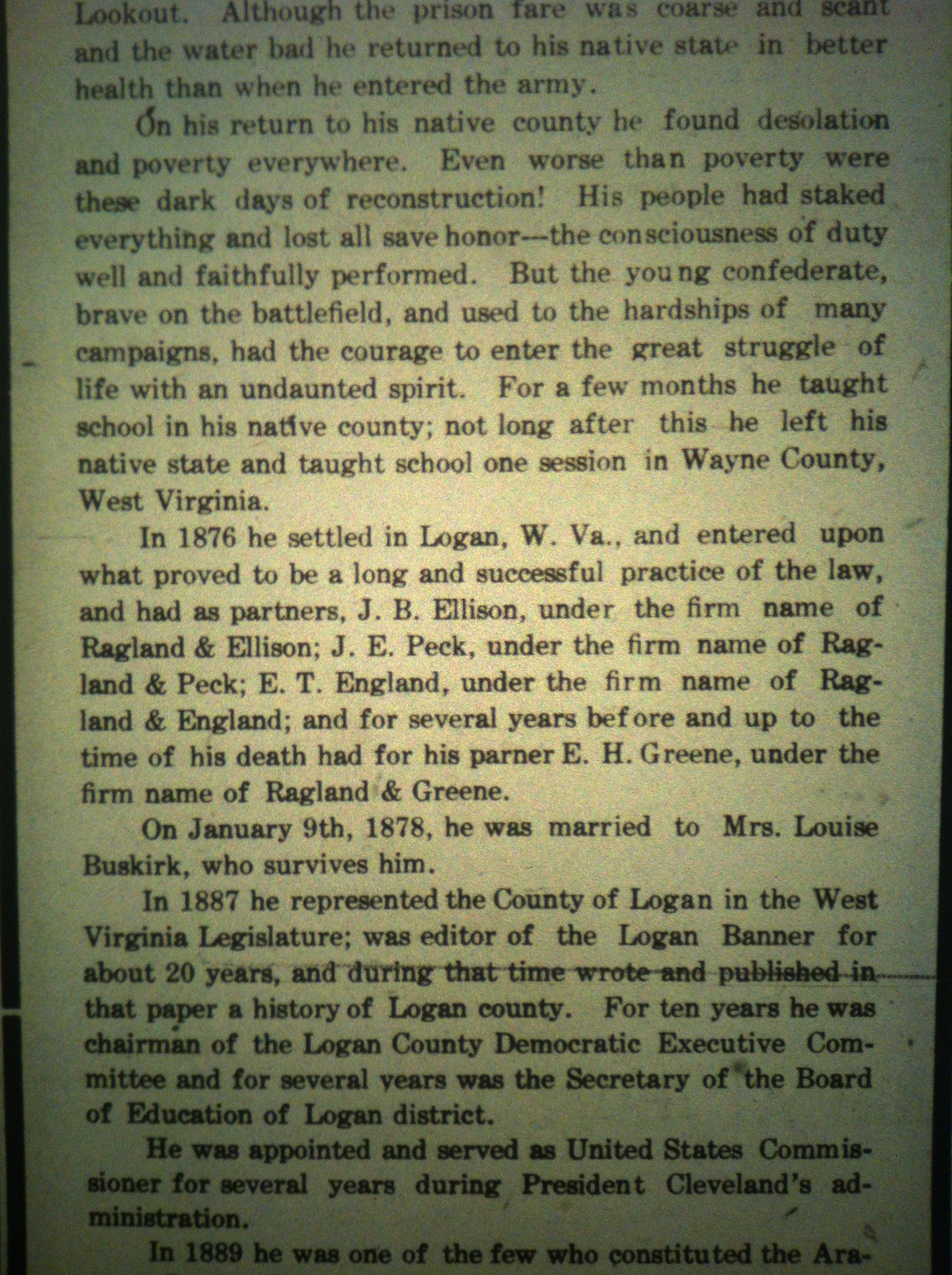
Henry Clay Ragland LD 06.29.1911 2

Logan (WV) Democrat, 29 June 1911.

Henry Clay Ragland LD 06.29.1911 3

Logan (WV) Democrat, 29 June 1911.

Henry Clay Ragland LD 06.29.1911 4

Logan (WV) Democrat, 29 June 1911.

Henry Clay Ragland LD 06.29.1911 5

Logan (WV) Democrat, 29 June 1911.

Henry Clay Ragland LD 06.29.1911 7

Logan (WV) Democrat, 29 June 1911.

Henry Clay Ragland LD 06.29.1911 8

Logan (WV) Democrat, 29 June 1911.

Ragland’s History of Logan County (1895)

17 Thursday Sep 2015

Posted by Brandon Ray Kirk in Logan

≈ 2 Comments

Tags

Appalachia, genealogy, Henry Clay Ragland, history, Logan, Logan Banner, Logan County Banner, U.S. South, West Virginia

Ragland wrote in 1895 LB 01.11.1924

Henry Clay Ragland’s “History of Logan County” was originally printed in the Logan County Banner in 1895. Source: Logan Banner, 01 Nov 1924

Henry Clay Ragland

04 Tuesday Aug 2015

Posted by Brandon Ray Kirk in Civil War, Logan

≈ 6 Comments

Tags

5th Virginia Cavalry, American Revolution, Appalachia, civil war, Confederate Army, Finch Ragland, genealogy, Henry Clay Ragland, Henry H. Hardesty, history, House of Delegates, John Ragland, Kentucky, Lawrence County, lawyer, Logan, Logan County, Logan County Banner, Louisa Ragland, Maryland, Point Lookout, R.A. Brock, Revolutionary War, Richmond, Thomas Eads, U.S. South, Virginia, Virginia and Virginians, Wales, War of 1812, West Virginia

From “Virginia and Virginians, 1606-1888,” published by H.H. Hardesty, we find this entry for Henry Clay Ragland, who resided at Logan, West Virginia:

Is of a family that has long been one of the most influential in the State. The founder of the family in America, John Ragland, came to this country directly from Wales, and settled in Virginia about the year 1630; his great-grandson, Finch Ragland, grandfather of the subject of the sketch, was a patriot of 1776 and fought through the Revolutionary war; his descendants have all inherited the spirit of patriotism, and have ever been foremost in enhancing the interests and defending the rights of their country. Thomas Eads, maternal grandfather of H.C. Ragland, was a soldier in the war of 1812. When the war between the States broke out in 1861 Henry Clay Ragland was among the first to volunteer his services in the cause of the South; he was a member of the 5th Va. Cav., was twice wounded, and was a prisoner at Point Lookout from Sept., 1864, to March, 1865. Since 1874 he has resided in Logan county, W.Va., where he is now editor of the Logan county Banner, besides has an extensive law practice in Logan and adjoining counties, being regarded as one of the leading lights in the profession. From 1886 to 1888 he was a member of the West Virginia legislature, in which he served with honor and distinction. His address is Logan Court House, W.Va. Mr. H.C. Ragland was born in Goochland county, Va., on the 7th of May, 1844; his wife, nee Miss Louisa Goings, was born in Lawrence county, Ky.; they were married at Logan Court House, W.Va., June 9, 1877.

Source: Dr. R.A. Brock, Virginia and Virginians, 1606-1888 (Richmond, VA: H.H. Hardesty, Publisher, 1888), p. 836-837.

← Older posts

Feud Poll 1

If you had lived in the Harts Creek community during the 1880s, to which faction of feudists might you have given your loyalty?

Categories

  • Adkins Mill
  • African American History
  • American Revolutionary War
  • Ashland
  • Atenville
  • Banco
  • Barboursville
  • Battle of Blair Mountain
  • Beech Creek
  • Big Creek
  • Big Harts Creek
  • Big Sandy Valley
  • Big Ugly Creek
  • Boone County
  • Breeden
  • Calhoun County
  • Cemeteries
  • Chapmanville
  • Civil War
  • Clay County
  • Clothier
  • Coal
  • Cove Gap
  • Crawley Creek
  • Culture of Honor
  • Dingess
  • Dollie
  • Dunlow
  • East Lynn
  • Ed Haley
  • Eden Park
  • Enslow
  • Estep
  • Ethel
  • Ferrellsburg
  • Fourteen
  • French-Eversole Feud
  • Gilbert
  • Giles County
  • Gill
  • Green Shoal
  • Guyandotte River
  • Halcyon
  • Hamlin
  • Harts
  • Hatfield-McCoy Feud
  • Holden
  • Hungarian-American History
  • Huntington
  • Inez
  • Irish-Americans
  • Italian American History
  • Jamboree
  • Jewish History
  • John Hartford
  • Kermit
  • Kiahsville
  • Kitchen
  • Leet
  • Lincoln County Feud
  • Little Harts Creek
  • Logan
  • Man
  • Matewan
  • Meador
  • Midkiff
  • Monroe County
  • Montgomery County
  • Music
  • Native American History
  • Peach Creek
  • Pearl Adkins Diary
  • Pecks Mill
  • Peter Creek
  • Pikeville
  • Pilgrim
  • Poetry
  • Queens Ridge
  • Ranger
  • Rector
  • Roane County
  • Rowan County Feud
  • Salt Rock
  • Sand Creek
  • Shively
  • Spears
  • Sports
  • Spottswood
  • Spurlockville
  • Stiltner
  • Stone Branch
  • Tazewell County
  • Timber
  • Tom Dula
  • Toney
  • Turner-Howard Feud
  • Twelve Pole Creek
  • Uncategorized
  • Warren
  • Wayne
  • West Hamlin
  • Wewanta
  • Wharncliffe
  • Whirlwind
  • Williamson
  • Women's History
  • World War I
  • Wyoming County
  • Yantus

Feud Poll 2

Do you think Milt Haley and Green McCoy committed the ambush on Al and Hollene Brumfield in 1889?

Blogroll

  • Ancestry.com
  • Ashland (KY) Daily Independent News Article
  • Author FB page
  • Beckley (WV) Register-Herald News Article
  • Big Sandy News (KY) News Article
  • Blood in West Virginia FB
  • Blood in West Virginia order
  • Chapters TV Program
  • Facebook
  • Ghosts of Guyan
  • Herald-Dispatch News Article 1
  • Herald-Dispatch News Article 2
  • In Search of Ed Haley
  • Instagram
  • Lincoln (WV) Journal News Article
  • Lincoln (WV) Journal Thumbs Up
  • Lincoln County
  • Lincoln County Feud
  • Lincoln County Feud Lecture
  • LinkedIn
  • Logan (WV) Banner News Article
  • Lunch With Books
  • Our Overmountain Men: The Revolutionary War in Western Virginia (1775-1783)
  • Pinterest
  • Scarborough Society's Art and Lecture Series
  • Smithsonian Article
  • Spirit of Jefferson News Article
  • The Friendly Neighbor Radio Show 1
  • The Friendly Neighbor Radio Show 2
  • The Friendly Neighbor Radio Show 3
  • The Friendly Neighbor Radio Show 4
  • The New Yorker
  • The State Journal's 55 Good Things About WV
  • tumblr.
  • Twitter
  • Website
  • Weirton (WV) Daily Times Article
  • Wheeling (WV) Intelligencer News Article 1
  • Wheeling (WV) Intelligencer News Article 2
  • WOWK TV
  • Writers Can Read Open Mic Night

Feud Poll 3

Who do you think organized the ambush of Al and Hollene Brumfield in 1889?

Recent Posts

  • Logan County Jail in Logan, WV
  • Absentee Landowners of Magnolia District (1890, 1892, 1894)
  • Charles Spurlock Survey at Fourteen Mile Creek, Lincoln County, WV (1815)

Ed Haley Poll 1

What do you think caused Ed Haley to lose his sight when he was three years old?

Top Posts & Pages

  • U.B. Buskirk of Logan, WV (1893-1894)
  • Vance Homeplace and Cemetery on West Fork (2017)
  • Tice Elkins in Ferrellsburg, WV
  • Alice Dingess piano
  • Red Rock Cola in Logan, WV (1939)

Copyright

© Brandon Ray Kirk and brandonraykirk.wordpress.com, 1987-2023. Unauthorized use and/or duplication of this material without express and written permission from this blog’s author and/or owner is strictly prohibited. Excerpts and links may be used, provided that full and clear credit is given to Brandon Ray Kirk and brandonraykirk.wordpress.com with appropriate and specific direction to the original content.

Archives

  • February 2025
  • January 2025
  • October 2023
  • September 2023
  • December 2022
  • November 2022
  • May 2022
  • April 2022
  • February 2022
  • November 2021
  • October 2021
  • September 2021
  • June 2021
  • May 2021
  • April 2021
  • March 2021
  • February 2021
  • January 2021
  • December 2020
  • November 2020
  • October 2020
  • July 2020
  • June 2020
  • May 2020
  • April 2020
  • March 2020
  • February 2020
  • January 2020
  • December 2019
  • November 2019
  • October 2019
  • September 2019
  • August 2019
  • July 2019
  • June 2019
  • May 2019
  • April 2019
  • March 2019
  • February 2019
  • January 2019
  • December 2018
  • November 2018
  • October 2018
  • September 2018
  • August 2018
  • July 2018
  • June 2018
  • May 2018
  • April 2018
  • March 2018
  • February 2018
  • January 2018
  • December 2017
  • November 2017
  • October 2017
  • September 2017
  • August 2017
  • July 2017
  • June 2017
  • May 2017
  • April 2017
  • March 2017
  • February 2017
  • January 2017
  • December 2016
  • November 2016
  • October 2016
  • September 2016
  • August 2016
  • July 2016
  • June 2016
  • May 2016
  • April 2016
  • March 2016
  • February 2016
  • January 2016
  • December 2015
  • November 2015
  • October 2015
  • September 2015
  • August 2015
  • July 2015
  • June 2015
  • May 2015
  • April 2015
  • March 2015
  • February 2015
  • January 2015
  • December 2014
  • October 2014
  • September 2014
  • August 2014
  • July 2014
  • June 2014
  • May 2014
  • April 2014
  • March 2014
  • February 2014
  • January 2014
  • December 2013
  • November 2013
  • October 2013
  • September 2013
  • August 2013
  • July 2013
  • June 2013
  • May 2013
  • April 2013
  • March 2013
  • February 2013
  • January 2013
  • December 2012
  • November 2012

Enter your email address to follow this blog and receive notifications of new posts by email.

Join 2,925 other subscribers

Tags

Appalachia Ashland Big Creek Big Ugly Creek Blood in West Virginia Brandon Kirk Cabell County cemeteries Chapmanville Charleston civil war coal Confederate Army crime culture Ed Haley Ella Haley Ferrellsburg feud fiddler fiddling genealogy Green McCoy Guyandotte River Harts Harts Creek Hatfield-McCoy Feud history Huntington John Hartford Kentucky Lawrence Haley life Lincoln County Lincoln County Feud Logan Logan Banner Logan County Milt Haley Mingo County music Ohio photos timbering U.S. South Virginia Wayne County West Virginia Whirlwind writing

Blogs I Follow

  • OtterTales
  • Our Appalachia: A Blog Created by Students of Brandon Kirk
  • Piedmont Trails
  • Truman Capote
  • Appalachian Diaspora

BLOOD IN WEST VIRGINIA is now available for order at Amazon!

Blog at WordPress.com.

OtterTales

Writings from my travels and experiences. High and fine literature is wine, and mine is only water; but everybody likes water. Mark Twain

Our Appalachia: A Blog Created by Students of Brandon Kirk

This site is dedicated to the collection, preservation, and promotion of history and culture in Appalachia.

Piedmont Trails

Genealogy and History in North Carolina and Beyond

Truman Capote

A site about one of the most beautiful, interesting, tallented, outrageous and colorful personalities of the 20th Century

Appalachian Diaspora

  • Subscribe Subscribed
    • Brandon Ray Kirk
    • Join 787 other subscribers
    • Already have a WordPress.com account? Log in now.
    • Brandon Ray Kirk
    • Subscribe Subscribed
    • Sign up
    • Log in
    • Report this content
    • View site in Reader
    • Manage subscriptions
    • Collapse this bar
 

Loading Comments...