Tags
Appalachia, Don Chafin, genealogy, history, Logan, Logan County, Logan Democrat, sheriff, West Virginia
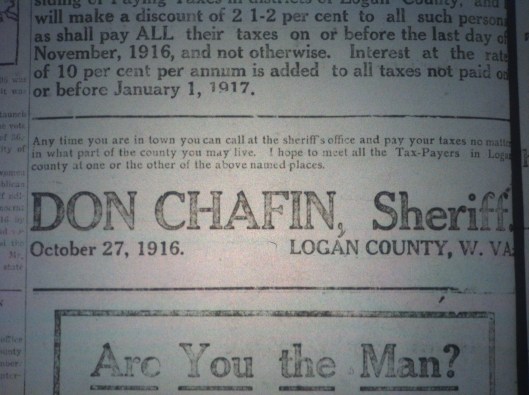
Logan (WV) Democrat, 23 November 1916.
08 Monday Jan 2018
Posted in Logan
Tags
Appalachia, Don Chafin, genealogy, history, Logan, Logan County, Logan Democrat, sheriff, West Virginia
Logan (WV) Democrat, 23 November 1916.
08 Monday Jan 2018
Posted in Big Harts Creek, Whirlwind
Tags
Alice McCloud, Appalachia, Carl Adams, Clinton Adams, Cole Adams, Dixie Adams, Elias Workman, genealogy, Harts Creek, history, Hoover Fork, Johnnie Workman, Logan Banner, Logan County, Micco, Mollie Robinson, Monaville, Mormons, Trace Fork, West Virginia, Whirlwind
An unknown correspondent from Whirlwind in Logan County, West Virginia, offered the following items, which the Logan Banner printed on June 17, 1927:
Here we are with a little news from our busy town.
Johnnie Workman of Micco is visiting his brother Elias Workman, who is very ill at this writing.
Sunday School is progressing nicely at Trace. We are sorry it will soon close.
Carl Adams was visiting at Mollie Robinson’s Sunday.
No one knows who the two good-looking men were who went up Hoover Sunday. They looked like Mormon preachers.
Alice McCloud was calling on friends at Dixie Adams’s Sunday.
Clinton Adams is calling on friends at Monaville this week.
Mrs. Jane Adams was visiting her daughter of Buck Fork one day this week.
Cole Adams spent Sunday at Hoover.
Daily events: Clinton and his rabbit; Wilburn going to Daniel’s; Rush going to the mail box; Mollie and her turkey.
08 Monday Jan 2018
Posted in Big Harts Creek, Cemeteries, Civil War
Tags
129th Regiment Virginia Militia, Appalachia, Brandon Kirk, cemeteries, civil war, Confederate Army, Garland Conley Family Cemetery, genealogy, Harts Creek, history, Logan County, Phyllis Kirk, Smokehouse Fork, West Virginia
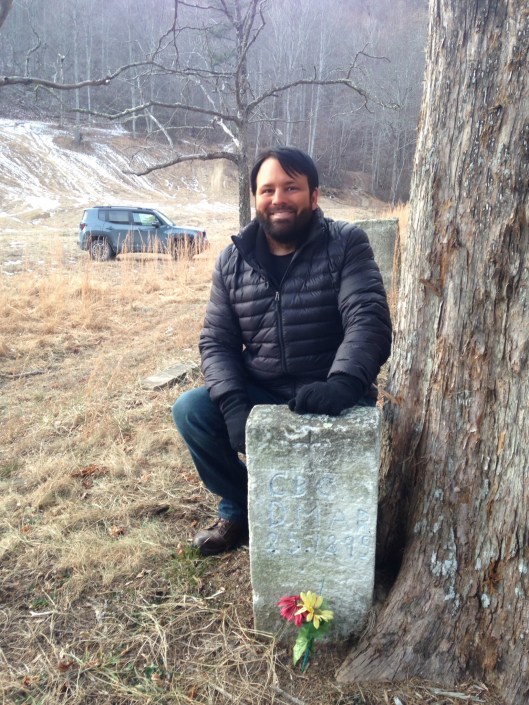
Garland B. Conley (d.1895) was a veteran of Carter’s Company, 129th Regiment Virginia Militia. I recently revisited his grave on Smokehouse Fork of Harts Creek, Logan County, WV. 7 January 2018. Photo by Mom.
08 Monday Jan 2018
Posted in Culture of Honor, Rowan County Feud
Tags
Appalachia, Cabell County, Cook Humphrey, Craig Tolliver, Democratic Party, history, Huntington, Huntington Advertiser, John Martin, Kentucky, Morehead, politics, Republican Party, Rowan County, Rowan County Feud, sheriff, Solomon Bradley, West Virginia
From the Huntington Advertiser of Huntington, WV, dated July 2, 1887 comes this letter about the Rowan County Feud:
The Rowan County War.
Editor Advertiser:
The writer is not surprised that your paper of last week fell into the current of popular opinion and denounced the Toliver gang, of Morehead, Kentucky, as the guilty ones in the celebrated feud which has caused the killing of about thirteen persons. Later advices appear at least to throw doubt on the subject of who is really to blame. Let us see. Here is the Cincinnati Enquirer’s account of the origin of the trouble, taken from that journal of the 23d inst.:
“The beginning of the trouble dates from the August election of 1884, when Cook Humphrey, a Republican, was elected sheriff by a trifling majority. He was a young, spare-built man, fresh from the country, and unsophisticated in appearance and manner. Craig Toliver, at the head of a party of friends, declared that Humphrey should not serve as sheriff. On the evening of the election a row occurred. Pistols were drawn and used, and Solomon Bradley (Democrat), a friend of Toliver’s, was shot and killed. The killing was charged against John Martin, and Toliver swore to be avenged. Subsequently Floyd Toliver and Martin got into a fight and the former (Toliver, Democrat) was killed on the street. From this time it may be said that the Martin (Republican) and Toliver (Democrat) factions were organized in deadly array, both sides determined never to yield, one to the other.”
The analysis of the above is, that the Republicans, having carried the election, became more or less insolent towards the opposition, who were correspondingly depressed and sore over their defeat, and gave utterance to their disappointment, and Craig Toliver used a very foolish expression to the effect that the Republican sheriff elect should not be installed. It is probable that this was accompanied by charges of fraudulent voting on the part of the Republicans–at any rate it was not such an offense as to justify Martin, Republican, in shooting Sol. Bradley, a partisan of Toliver’s. Subsequently Floyd Toliver denounced Martin for having killed Bradley without sufficient provocation and in an unmanly way, and was himself shot by Martin on the instant. So that a war of extermination seems to have been inaugurated by the Martins and their Republican following, against the Bradleys and Tolivers and their Democratic following, and signalized by the cold blooded murder of two of the latter. If this is true, and the record seems to bear it out as true, then the Tolivers were simply defending themselves and their households and party friends against the tumultuous murder of the Martins and their Republican following.
The subsequent getting possession of the person of John Martin (already a double murderer) and his killing at the hands of the Tolivers, whose brother and friend he had slain, was in the nature of retribution, and justified by the circumstances. Later, killings on both sides followed from the hot blooded feud which these had aroused, and while some of them appear to have been barbarous in the extreme, yet they legitimately came of a war of extermination such as had been initiated by the Martins and responded to, and not by the Tolivers and their friends.
A prominent citizen of Cabell Co., now sojourning near the scene of the disorder, in Rowan County, says:
“I suppose the dispatches have told you the war news; how 300 Republicans succeeded in killing four Democrats; but the war has only begun. I hear, to-day, that the Democrats are organizing a company near —— to put down the mob at Morehead who did the killing. He is more than sanguine who thinks the trouble ended.”
Our fellow-citizen, on the ground in Kentucky, evidently thinks the late killing of the three Tolivers unjustified by the facts as they are known to him. Let us wait for the facts.
BEN.
07 Sunday Jan 2018
Posted in Logan
Tags
American Restaurant, Appalachia, history, Logan, Logan County, Logan Democrat, McNeely & Son, Straton Street, Virginian Hotel, West Virginia
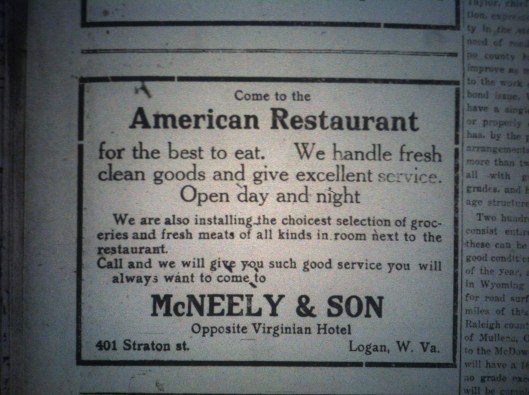
Logan (WV) Democrat, 14 December 1916.
07 Sunday Jan 2018
Posted in Montgomery County
Tags
Absolem Elkins, Appalachia, Archibald Elkins, Barnett Farmer, Camp Creek, Christiansburg, David Elkins, Elizabeth Elkins, genealogy, history, John Bishop, Lydia Elkins, Margaret Elkins, Mary Elkins, Montgomery County, Virginia
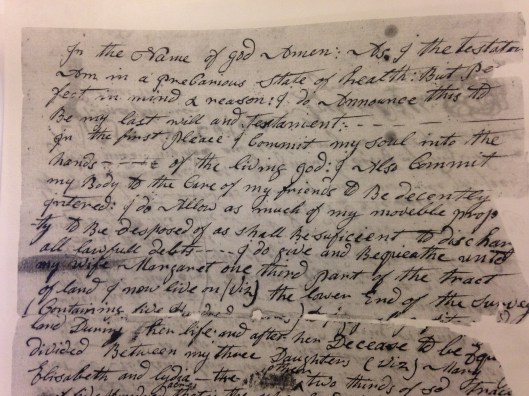
During a recent visit to the Montgomery County Courthouse in Christiansburg, Virginia, I viewed the Last Will and Testament of Archibald Elkins (1735-1791).
In the Name of god Amen: As I the testator am in a prelarious State of health: But perfect in mind & reason: I do Announce this to Be my last will and testament:
In the first place I commit my soul into the hands of the living god. I also commit my Body to the Care of my friends to Be decently intered. I do Allow as much of my moveble property to Be desposed of as shall Be suficient to discharge all lawfulll debts. I do give and Bequeath unto my wife Margaret one third part of the tract of land I now live on (viz) the lower End of the survey (Containing five Hundred acres) ______ land During her life and after her Decease to be fairly divided Between my three Daughters (viz) Mary, Elizabeth and Lydia — the other two thirds of Sd tract off five Hundred acres that is the uper End of the survey to be Equaly divided when my son Absolem shall be twenty one years of age: and I do give and bequeath my sons David and Absolem the Above mentioned division of land to them and their heirs forever: But if either of the forementioned sons should die Before Sd Absolem shall Be of Age Sd division shall be made and devolve on the next lawfull Heir when the time shall relapse that Sd Absolem should have become twenty one years of age– I do also give and Bequeath to my son John one Hundred and thirty acres of land laying on Camp Creek when he is twenty one y ears of age. I do nominate my wife Margaret to be my Executrix to dispose of the movables and profits of all lands above mentioned Acording to the best of her judgment to bring up my Children given under my hand and seal as my last will & testament.
Archibald Elkins
August ____ (page is torn)
Witnesses:
John Bishop
Bonet farmer
Ezekiel Howa__
***
On the paper’s back:
At a court held for montgomery County the 6th Day of Sept. 1791
The Last Will and Testament of Achibald Elkins was Proved by the oaths of Barnett farmer and John Bishop and ordered to be certified.

Source: Wills Box 1791-1799, Circuit Clerk’s Office, Montgomery County Courthouse, Christiansburg, VA.
07 Sunday Jan 2018
Posted in Logan
Tags
Appalachia, genealogy, history, Julian P. Moorman, Logan, Logan Banner, Logan County, Nighbert Memorial Church, photos, Texas, Walter G. Harbin, West Virginia
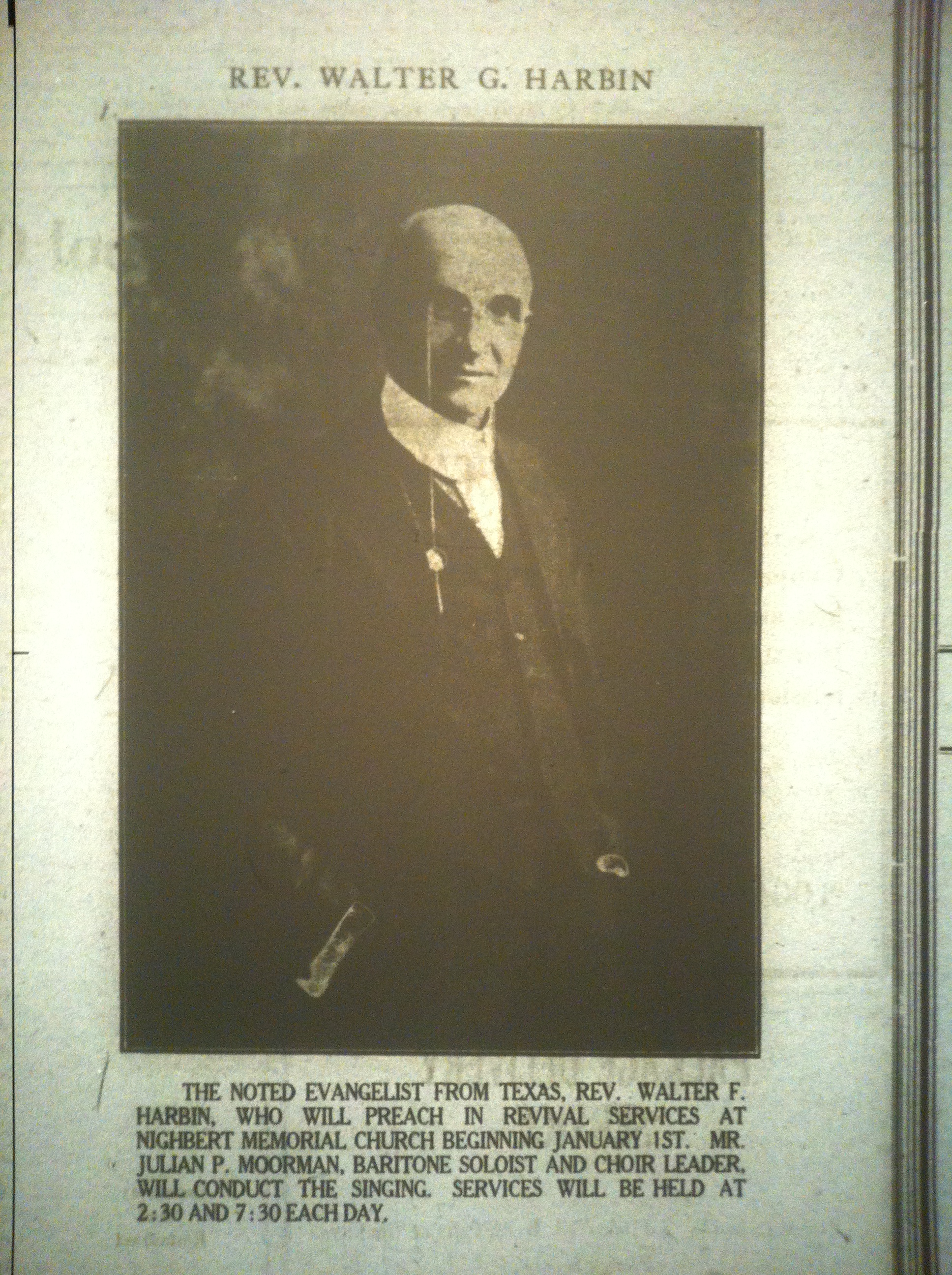
Logan (WV) Banner, 23 December 1921. For more information about Mr. Harbin, follow this link: https://www.findagrave.com/memorial/48625430
07 Sunday Jan 2018
Posted in American Revolutionary War, Montgomery County
Tags
Ann Fry, Appalachia, Barbara Eley, Charity Eley, Charles Duncan, Christiansburg, genealogy, George Fry, history, John Fry, Joseph Benlay, Lincoln County, Mary Adkins, Mary Lucas, Montgomery County, Montgomery County Courthouse, Susanna Byars, Susannah Adkins, Thomas Kirk, Virginia, West Virginia
During a recent visit to the Montgomery County Courthouse in Christiansburg, Virginia, I viewed the Last Will and Testament of my great-great-great-great-great-grandfather George Fry (c.1725-1793).

In the Name of God, Amen: I George Fry of the County of Montgomery and State of Virginia, Farmer, Being very sick and weak in Body But of Perfect Mind and Memory thanks Begiven unto God for his Mercy Calling unto Mind the Mortality of my Body, and Knowing that it is appointed for all men once to Die; do Make and ordain this my Last Will and Testament that is to say Principally and first of all I give and Recommend my Soul into the Hand of Almighty God that gave it. My Body I Recommend to the Earth to be Buried in Decent Christian Buriel at the Discretion of my Executors Nothing Doubting but at the general Resurrection I shall Receive the same again by the Mighty Power of God. And as Touching such Worldly Estate wherewith it hath pleased God To bless me in this Life I give Devise and Dispose of the same in the Following Manner and Form, First I give and Bequeath to Anna Fry, my Dearly Beloved Wife one Mare and Two Cows, her Choice out of My Stock to be her own Right and Property to Dispose of as She Shall think Proper…
Also I give and Bequeath to Ann Fry my Dearly beloved Wife for Dureing the time she Continues my Widow My Dwelling Houses and Household Furniture With Five Head of Sheep and My Stock of Swine and my insuing Crop, also the Present Meet and Grain which is provided for Family Use and My Garden and Meadow and Meadow Orchard Likewise the Sixth part of Grain which is Raised on the said Land For During her Widowhood Continuence on the Sd. place. Then on leaving the Sd. place or at her Decease the Sd. property to be Equally Divided Between my Four Daughers…
Also I give and Bequeath to George Fry My Beloved Son all My Iron Tools and Two Suits of Cloaths, To Dispose of as he Shall think proper…
Also I give and Bequeath to Barbary Eley Two Cows to Dispose of as she shall think proper…
Also I give and Bequeath to Susanna Byars Two Cows to Dispose of as she shall Think proper…
Also I give and Bequeath the Balance of my property to my Dearly Beloved Daughters viz Mary Adkins, Chaty. Eley, Barbary Eley, Susanna Byars to be Equally Divided Then to Despose of as they shall think proper…
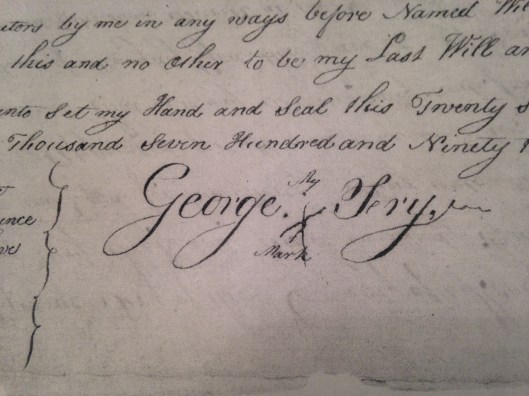
And I do Hereby Utterly Disallow Revoke and Disannul all and Every Other Former Testaments Wills Legacies Bequests and Confirming this and no other to be my Last Will and Testament, In Witness whereof I have here unto set my Hand and seal this Twenty Seventh Day of March in the year of our Lord one Thousand Seven Hundred and Ninety three–
George Fry (My Mark)
Signed sealed and published pronounced and Declared by the Sd. George Fry, as his Last Will and Testament in the presence of us in his presence & in the presence of Each other have Here unto Subscribed our Names…
Charles Duncan
Joseph Benlay
Thomas Kirk
Source: Wills Box 1791-1799, Circuit Clerk’s Office, Montgomery County Courthouse, Christiansburg, VA.
Note: I descend from George Fry through his granddaughter Mary (Fry) Lucas and his grandson John Fry, who settled in present-day Lincoln County, WV. John and another granddaughter Susannah (Fry) Adkins are buried near my residence.
02 Tuesday Jan 2018
Posted in Little Harts Creek
Tags
Abiel A. Low, Appalachia, Francis Fork, genealogy, Guyandotte River, Harts Creek District, history, Isaac Gartin, James I. Kuhn, Kiahs Creek, Lincoln County, Little Harts Creek, Rollum Fork, Samuel Damron, Samuel Short, Twelve Pole Creek, West Virginia, William H. Aspinwall, William Manns, William T. Nichols

Deed Book 53, page 284, Lincoln County Clerk’s Office, Hamlin, WV. Typically, the Kuhn-Lowe deeds granted land already owned by the grantees but reserved mineral rights. The idea was to grant “disputed” surface ownership in exchange for relinquishment of claims to mineral rights. Local property owners who did not wish to challenge the mineral claim in court accepted the Kuhn-Lowe deed. Lincoln County records show many of these deeds.

Deed Book 53, page 285, Lincoln County Clerk’s Office, Hamlin, WV.
02 Tuesday Jan 2018
Posted in Boone County, Coal, Logan
Tags
Appalachia, Boone County, coal, Guyandotte River, history, Island Creek, Logan, Logan Banner, Logan County, Mine Wars, Ramage, Spruce River Coal Company, U.S. Coal & Oil Company, United Mine Workers of America, West Virginia
From the Logan Banner of Logan, WV, comes this commentary about coal miners and union agitation dated March 21, 1913:
STRANGE MINERS cannot get work at all in the principal Logan County mines, it is said, and even in the smaller mines an applicant has to run the gauntlet of a series of “family-history-cross-examination-questions” that would stagger a Philadelphia lawyer, before one gets a job–and then like as not get turned down because he is not of Logan county. The precaution is fully warranted. The United Mine Workers hope to control the Guyan Valley field, if they ever DO–and THEY NEVER WILL–by first “organizing” the smaller, isolated mines by “smuggling in” an agitator or two now and then and finally, with one “grand sweep” capture the big works. If the labor leaders actually KNEW certain conditions and “inside workings” now effective, even in the small works, half so well as they THINK they know them, they’d give up as a bad job their idea of “organizing” Logan county, and go to honest work shoveling coal for a living themselves. During the past year, more than one “undesirable miner” has been shipped “bag and baggage” out of the valley because he let his agitation fever break out too strong, prematurely, spoiling his little game. In another column will be found a news item of the shut-down of the Ramage works of the Spruce River Coal Co. We predict that some of Logan’s mines will turn off their power and “look out” their employees before they will let the United Mine Workers conduct their business for them. So far as the corporation’s finances are concerned, the U.S. Coal & Oil Co. can shut down all of its Island Creek mines, burn its tipples and dump its cars into Guyan river. And that’s what would best suit the competitive coal operators of other States! Likewise the miners’ union agitators and leaders! But there’s another side of the story–the miner and his family need the work in the coal-bank, the merchant needs some of the money he earns, Logan county needs its merchants and the outside world needs West Virginia coal–the BEST that “old mother earth” ever produced!
02 Tuesday Jan 2018
Posted in African American History, Coal, Matewan
Tags
coal, governor, history, John Jacob Cornwell, Logan Democrat, Mine Wars, politics, West Virginia, World War I
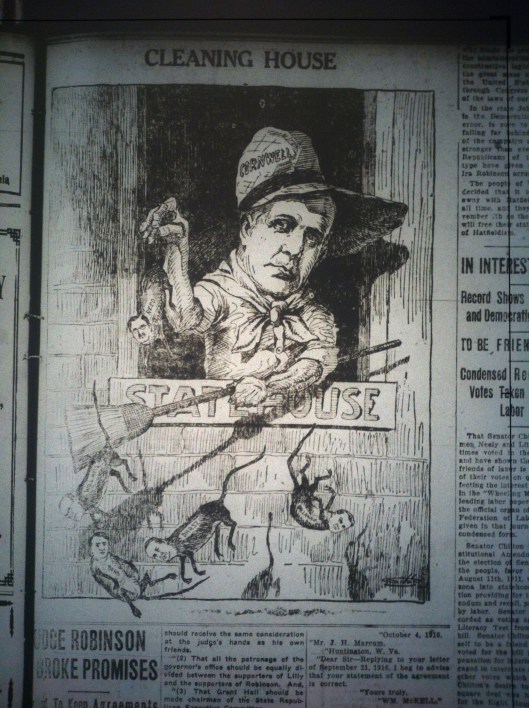
Logan (WV) Democrat, 16 October 1916. Narrowly elected in 1916, Mr. Cornwell served as the fifteenth governor of West Virginia (1917-1921).

Logan (WV) Democrat, 9 November 1916. Mr. Cornwell served as governor during World War I.
Fore more history about Governor Cornwell, visit this site: https://www.wvencyclopedia.org/articles/1604
02 Tuesday Jan 2018
Posted in Giles County, Holden, Logan, Native American History, Tazewell County
Tags
Accawmack Shire, Appalachia, Augusta County, Botetourt County, Cabell County, Cayuga, Charles City Shire, Charles River Shire, Elizabeth City Shire, Essex County, Fincastle County, G.W. Bickley, Giles County, Henrico Shire, history, James City Shire, John Logan, Kanawha County, King and Queen County, King William County, Littletown Tazewell, Logan Banner, Logan County, Mingo County, Montgomery County, Ohio, Orange County, Russell County, Simon Cotterel, Spottsylvania County, Tazewell County, Virginia, Warroskuyoak Shire, Warwick River Shire, Washington County, West Virginia, Wheeling, Wythe County, Yellow Creek, York County
From the Logan Banner of Logan, WV, comes this item relating to county history dated October 22, 1926:
AS POLITICAL SUBDIVISION, LOGAN CO. IS DESCENDANT OF FIRST EIGHT SHIRES
Logan county was formed in 1824 from parts of Tazewell, Giles, Cabell and Kanawha. In 1895 Logan was bisected in two almost equal parts, from the southernmost of which Mingo was created. Logan’s area is 455.82 square miles; Mingo’s 423,50_ square miles.
Tracing this county’s ancestry back through Tazewell it will be found to have a long line of distinguished progenitors.
The county was named after John Logan, a famous Cayuga Indian but not a chief, who was changed from a staunch friend to an unrelenting foe of the whites after his family had been murdered at Yellow Creek, Ohio, not far from Wheeling.
Tazewell was formed from Wythe and Russell in 1799. It derived its name from a political strategem. Simon Cotterel, representative from Russell, introduced a bill to authorize the creation of a new county. A Mr. Tazewell, representing Norfolk County, opposed the measure. Cotterel induced him to suspend his opposition pending the rewriting of the bill. Then Cotterel erased the proposed name and substituted that of Tazewell. That silenced the objector, who then voted for the amended measure. According to G.W. Bickley’s history of Tazewell County, the Tazewell referred to was not Littletown Tazewell, who was governor of the state from 1834 to 1836.
At that time Tazewell county had an area of 3,000 square miles–two and a half times the size of Rhode Island and more than six times the six of Logan county.
Wythe county was formed from Montgomery in 1789, Russell from Washington in 1786, Washington and Montgomery from Fincastle in 1772, Botetourt from Augusta in 1769, Augusta from Orange in 1738, Orange from Spottsylvania in 1724, Spottsylvania from King and Queen, Essex, and King William in 1720, King William from King and Queen, and through a series of changes, descended from Charles River Shire, which was changed to York county, in 1643. Ten years before that “The General Assembly holden at James City the 21st of August, 1633, divided Virginia Colony into eight shires, named James City, Henrico, Warwick River, Warroskuyoak, Charles City, Elizabeth City, Accawmack and Charles River.”
31 Sunday Dec 2017
Posted in Huntington
Tags
Appalachia, Cabell County, history, Huntington, Huntington Advertiser, Marshall College, Marshall University, photos, West Virginia

Huntington (WV) Advertiser, 18 June 1887.
31 Sunday Dec 2017
Posted in Logan
From the Logan Democrat of Logan, WV, comes this story dated November 16, 1916 about whittling:
WHITTLING WOOD IS A LOST ART
Where are the whittlers of yesteryear–the jackknife experts who laboriously fashioned curious keepsakes out of soft wood, or who idly whittled sticks of toothpick dimensions as they sat and debated the problems of the nation in front of village stores? The old time Yankee was often ill at ease unless he had his knife in his hand with a block of wood on which to exercise it. He could not focus his mind on heavy questions–like the elections at the next town meeting–unless he was watching a shaving curl gracefully in the wake of his carefully sharpened knife blade.
Those who had abundant leisure often devoted themselves to elaborate carvings. Sailors were especially gifted in this way–deep sea sailors who occupied themselves on long voyages with miniature ships and other models. And while the back country Yankee was an inveterate whittler, he rarely tried to compete in artistic results with his sea faring brother of the coast.
But whittle, both as a habit and as an art, appears to have practically disappeared. The jackknife is no longer in evidence as it once was either in country towns or along the water front. The pace of life has quickened or else other interests have driven it out. And even the small boy, though he still cherishes his knife, does not number the expert use of it for carving among his ambitions.
In those days every boy who amounted to anything–one who was not a regular mollycoddle–possessed a jackknife, and knew how to use it. He demonstrated this not only by whittling out a hull, which, when supplied with masts and rigging, stood evenly on her keel, but which, when fitted with a suit of calls, rode safely every squall and boisterous sea and showed a clean pair of heels to the other little ships as they slipped across the duck pond.
This was not all the small boy with the handy pocketknife learned to make from inspecting what the sailors brought home. There were the wonderful chains, some square linked, others with double square links with wooden balls running freely within the length of the links, these having been carved out of the middle of the square of which each section of the chain was made.
It was a pretty proud boy who could show one of these chains with three or four links, the last one having a padlock swinging from it, for it gave him a certain high standing with the “fellers” not obtainable for any other reasons.
“I can recollect all the boys began chain carving with a piece of soft pine say an inch and one-half square. And when they had mastered the art they shifted to a hard pine stick, the successful manipulation of which showed the gift the boy had, for often it meant big blisters on the hands, so hard was the cutting.
“I have not seen a boy whittling on one of these chains or anything else in years. I think about the last whittling I saw them doing was in connection with peach stones, out of which they were making little baskets to be hung on the watch chain, and rings for the finger.
“There is another reason why the boy is not whittling as he formerly did. He had to make his kites, fashioning the backbone and making the bow with his knife. His mother furnished the paste by mixing flour and water. He covered the kite with a newspaper which had to be at least a month old before it was allowed to be taken from the closet–people held on to their newspapers in those days. Now he buys a gaudy kite for a few cents, or he don’t fly kites at all, which is more than likely, seeing that there is the attractive lure of the ball game and the ‘movies’.”
31 Sunday Dec 2017
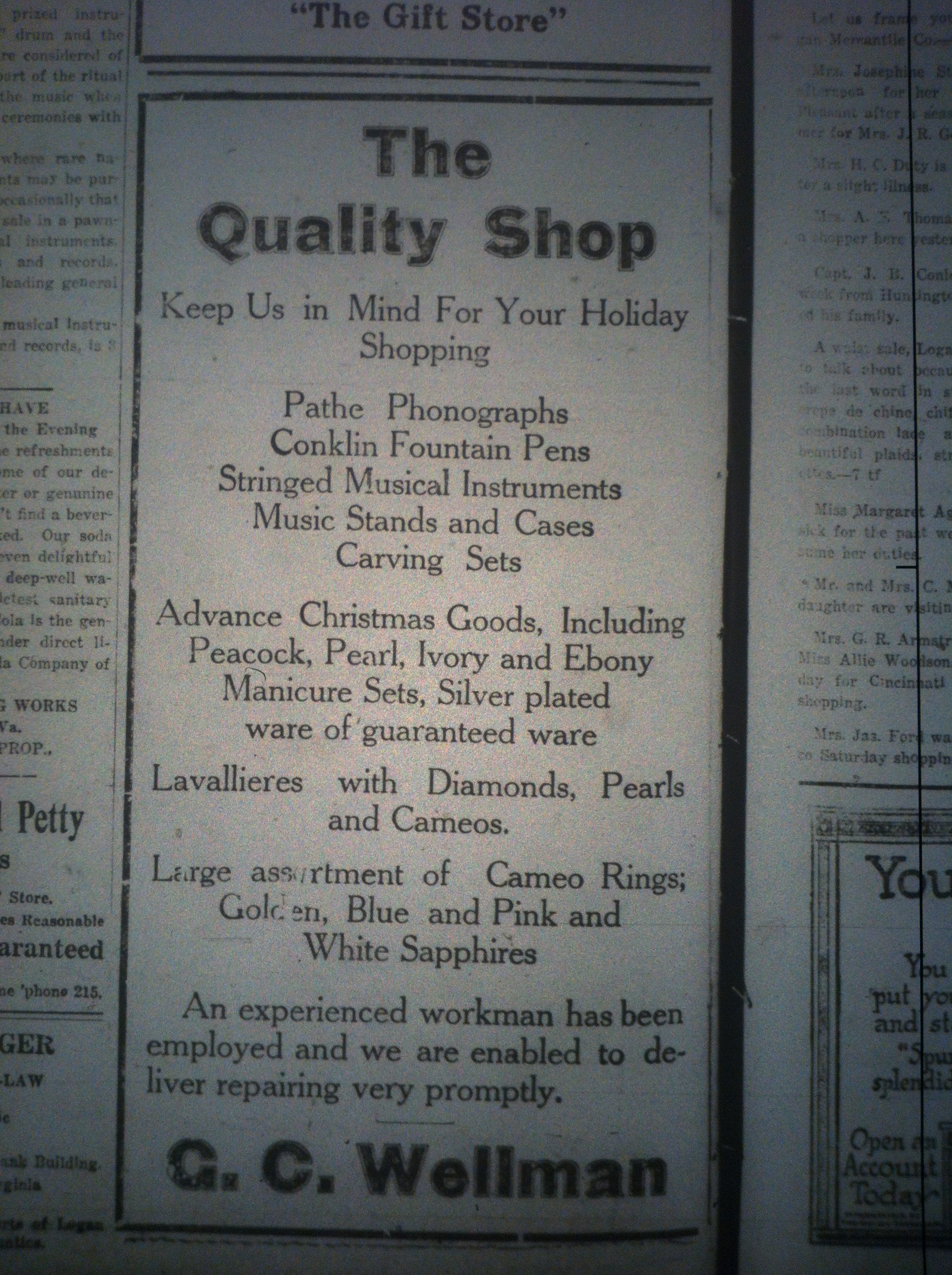
Logan (WV) Democrat, 14 December 1916
31 Sunday Dec 2017
Tags
Allen Robinson, Anthony Tomblin, Appalachia, Barbara Dempsey, Bertha Browning, Big Branch, Big Ugly Creek, Caleb Browning, Caroline Brumfield, Charles Adkins, Charley Brumfield, Charley Curry, Emarine Dempsey, Fourteen Mile Creek, genealogy, Gordon Fry, Grant Farley, Green Shoal Creek, Guyandotte River, Hamlin, Harts Creek, Harts Creek District, Hiram Lambert, history, Ike Fry Branch, Isaiah Adkins, Jacob Adkins, Jefferson Lucas, Jerry Lambert, John Clay Farley, Josephine Robinson, Julia Lambert, justice of the peace, Laurel Fork, Lincoln County, Little Harts Creek, Lydia Evaline Dingess, Mary Clark Burks, Minnie Lambert, notary public, Paris "Witch" Brumfield, Risba Lambert, River Road, Short Bend, Short Bend Branch, Vira Brumfield, Wade Lambert, Wash Dempsey, Wash Dempsey Jr., West Virginia
The following deed index is based on Deed Book 57 at the Lincoln County Clerk’s Office in Hamlin, WV, and relates to residents of the Harts Creek community. These notes are meant to serve as a reference to Deed Book 57. Researchers who desire the most accurate version of this material are urged to consult the actual record book.
Charles and Caroline Brumfield to Paris and Vira Brumfield 70 acres Guyan River land for $750 references Little Harts Creek and River Road, left hand of Short Bend, coal bank, Ike Fry Branch 25 October 1910 p. 74-76
John C. Farley to Grant Farley 55 acres on Fourteen Mile Creek references Short Bend Branch of Fourteen 12 September 1902 Jefferson Lucas, NP p. 94-95
Mary Clark Burks, executrix to Gordon Fry 90 acres Big Ugly Creek references Laurel Fork of Big Ugly Paid $1 17 June 1908 p. 196-198
Lida Evaline Dingess to Charley Curry 45 acres Big Harts Creek references below Charley Curry house Paid $200 19 June 1908 Charles Adkins, JP p. 246-247
W.S. and Julia Lambert to Minnie Lambert 40 acres Greenshoal Creek references the garden 3 December 1910 Jerry Lambert, NP p. 335-336
Allen and Josephine Robinson to Hiram Lambert 30 acres Big Harts Creek references Anthony Tombourlin and Wash Dempsey 14 May 1907 Charles Adkins, JP p. 392-393
Wash and Emmarine Dempsey, Sr. and Barbary Dempsey to Risba Lambert 30 acres Big Harts Creek references Wash Dempsey, Jr., mouth of Big Branch, L.C. Browning Paid $200 25 February 1905 Charles Adkins, JP p. 394-395
L.C. Browning to Bertha Browning et al. 100 acres Big Harts Creek references Big Branch, Jacob Adkins, Isaiah Adkins 18 May 1908 p. 396-397
Note: I copied all of these deeds.
25 Monday Dec 2017
Posted in Big Harts Creek, Guyandotte River, Harts
Tags
Appalachia, genealogy, Guyandotte River, Harts, Harts Creek, Harvey Elkins, history, Jacob Stollings, James Toney, justice of the peace, Lincoln County, Logan County, Richard Elkins, Spencer A. Mullins, Virginia, W.I. Campbell, West Virginia, William Straton

Deed Book C, page __, Logan County Clerk’s Office, Logan, WV. Richard Elkins is recorded as the first permanent settler of Harts Creek, arriving in 1807 or 1815. He died in 1854. I descend through his son Harvey.

Deed Book C, page __, Logan County Clerk’s Office, Logan, WV. James Toney was the son of Poindexter and Jane (Lilly) Toney. I descend from three of his children.

Deed Book C, page __, Logan County Clerk’s Office, Logan, WV. This property is located in present-day Harts, Lincoln County, WV.
25 Monday Dec 2017
Posted in Coal
Tags
Appalachia, C&O Railroad, coal, Guyandotte River, Herald-Dispatch, history, Holden, Holden No. 22, Island Creek Coal Company, J.D. Francis, Logan County, Omar, Peytona Lumber Company, Tug Fork, West Virginia, Wiatt Smith, Y.M.C.A.
From a 1927 story printed in the Logan Banner of Logan, WV, comes this interesting bit of history about Holden No. 22:
Island Creek Co. Plans Building of New Town
Contracts Will Be Let Within 30 Days For Houses, Highways and Also Tipple For Largest Mine In West Virginia, Says Vice President–May Spend $2,000,000.
Within the next year there will arise in one of the remote and hitherto inaccessible regions of Logan county, a new town. It will have a population approximating 2,000. It will have a Y.M.C.A., a community church, modern homes, paved streets, its own water system, electric lights–in fact, all of the modern conveniences. It will be connected by hard road with Logan, Holden and the great world beyond the mountains. At present, it has not even a name, writes Wiatt Smith for the Huntington Herald-Dispatch.
The new town is to arise at operation No. 22 of the Island Creek Coal Company.
Within the next 30 days, J.D. Francis, vice-president of the Island Creek Co., said Tuesday, contracts will be let for the erection of tipples, the building of houses, the paving of streets and the hard surfacing of seven miles of road which will connect the new community with Holden.
Operation No. 22 will represent when completed an additional investment on the part of Island Creek, ranging well beyond a million dollars, perhaps reaching two million, though Mr. Francis refused to hazard an estimate of definite figures.
For a number of months preparations for the opening of a new mine, which will be the largest in southern West Virginia, have been going forward. The two 400 foot shafts which will serve the mine are now nearly complete. The Chesapeake & Ohio is rapidly completing the four mile extension of the Pine creek branch which will provide an outlet for the coal produced. The Island Creek company is completing three miles of siding. Pete Minotti, the contractor, has finished grading the road from Holden to the mine.
By October, it is expected, the road will be surfaced, the town well under way and the great mine in operation. Output at the beginning will be small, as the number of workmen will be necessarily limited until the underground workings have been expanded by the removal of coal. The area to be worked is underlaid, experts say, with 50 or 60 million tons and the mining of the coal will, under normal conditions, require 50 years.
Work at the mine site in advance of the completion of the railroads has been made possible, Mr. Francis explained, by the use of the tram road of the Peytona Lumber company over which many thousands of tons of sand, gravel and supplies have been shipped. The completion of the railroad is awaited for the installation of the bulkier machinery and equipment.
The new rail extension will connect with the Chesapeake & Ohio’s Logan division main lines via Omar. The contact of the operative officials and the workers with the Island Creek center at Holden will be by means of the hard road, the construction of which, in itself represents something like an engineering adventure. For some three miles it follows the ridge that marks the crest of the watershed between the valleys of Guyandotte and Tug Rivers. Then it drops sharply to follow mountain side, hollow and creek valley to the mine operation.
Persons who have traveled the now graded road say that at points on the ridge it affords magnificent views which compare favorably with the most famous in the state. The road was graded and will be hard surfaced entirely at the expense of the coal company, which, in the preparations for its new development has followed the policy adopted many years ago when, upon the opening of its original operations, it established in Holden a mining community which was pointed out as a model throughout the United States.
Island Creek operation No. 22 will be the fifth shaft mine in West Virginia.
Source: Logan (WV) Banner, 25 March 1927.
25 Monday Dec 2017
Posted in Atenville, Little Harts Creek
Tags
Appalachia, Elizabeth Adkins, Enos "Jake" Adkins, genealogy, Guyandotte River, Henry Adkins, history, Isaac Adkins, Isaiah Adkins, James Toney, justice of the peace, Letty Adkins, Lincoln County, Little Harts Creek, Logan County, Nancy Toney, Price Lucas, Spencer A. Mullins, Virginia, W.I. Campbell, West Virginia, William Straton
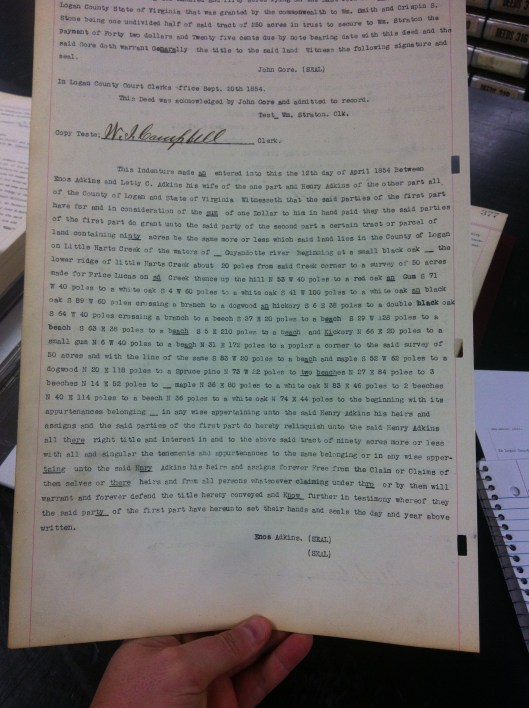
Deed Book C, page 376, Logan County Clerk’s Office, Logan, WV. Elias “Jake” Adkins was the son of Elias and Susannah (Fry) Adkins. Letty Adkins was the daughter of James and Nancy (Gillispie) Toney. Henry Adkins was the son of Isaac and Elizabeth (Adkins) Adkins. Jake and Henry were first cousins. I descend from Henry’s brother, Isaiah.

Deed Book C, page 377, Logan County Clerk’s Office, Logan, WV. This property is located in present-day Lincoln County, WV.
25 Monday Dec 2017
Posted in Logan
Tags
Appalachia, Aracoma, carnival, coyote, Fritz Gerber, Herbert's Greater Shows, history, Japanese Theatre, Joseph Herbert, K.F. Deskins, Logan, Logan County, Logan Democrat, minstrels, Second Virginia Regiment, West Virginia
In May of 1917, Herbert’s Greater Shows carnival visited Logan, WV, and generated several items of news in the Logan Democrat:
GOOD CARNIVAL HERE
The Herbert’s Greater Shows that have been exhibiting here for two weeks are very good, in fact high class shows.
Mr. Joseph Herbert has a reputation all over the country, excelled by no other showman, for carrying clean and up to date amusements.
The Silodrome, the feature attraction is one of the most sensational exhibitions ever witnessed by anyone. The rider, Mr. Fritz Gerber, the man with an iron nerve, is always entirely at the mercy of chance, rides the perpendicular wall with great ease and with his noted smile he always puts great thrill into the hearts of all who pay the Silodrome a visit.
The minstrels, Japanese Theatre are very good. These shows especially are equal to any of the big ones. No gambling devices are operated.
Source: Logan (WV) Democrat, 17 May 1917.
***
WANTED TO JOIN CARNIVAL
A young girl, about 15 years old, tried to hide from her father in a sewer near the power house Tuesday evening so as to run away with the carnival people. People living in the vicinity secured the help of some of those going to the circus and the young lady was induced to surrender to parental authority. When last seen, father and daughter were heading over the hill and from the faint echo of their words it was evident that the rod would not be spared when the woodshed was reached.
Source: Logan (WV) Democrat, 17 May 1917.
***
WILD ANIMAL KILLED
Soldier Shoots Coyote that Escaped From Carnival Thursday Morning
The first coyote to fall a victim of the white man’s rifle in Logan since the days when the dusty Indian maid, Aracoma, romped the hills hereabouts fell last Thursday to the accurate aim of Private Miller of the Second Virginia regiment at the power house.
The coyote belonged to Herbert’s Greater Shows. The animal escaped from his keepers and fled toward Logan. At the Power house a large pig, belonging to K.F. Deskins, suddenly appeared in the path of the coyote. The coyote decided to forego the bright lights of Logan temporarily to feast on $15 a hundred pork and in a few minutes was feasting on the fat of the land.
The pig’s squeals attracted the attention of Private Miller, who wears a medal for sharpshooting. He fired twice at a range of 100 yards and both shots took effect. The coyote keeled over dead.
Source: Logan (WV) Democrat, 24 May 1917.
Writings from my travels and experiences. High and fine literature is wine, and mine is only water; but everybody likes water. Mark Twain
This site is dedicated to the collection, preservation, and promotion of history and culture in Appalachia.
Genealogy and History in North Carolina and Beyond
A site about one of the most beautiful, interesting, tallented, outrageous and colorful personalities of the 20th Century
 Brandon Ray Kirk