• About

Brandon Ray Kirk

~ This site is dedicated to the collection, preservation, and promotion of history and culture in my section of Appalachia.

Brandon Ray Kirk

Tag Archives: West Virginia

Chapmanville News 11.23.1923

28 Tuesday Jan 2020

Posted by Brandon Ray Kirk in Chapmanville, Huntington, Logan

≈ Leave a comment

Tags

A.K. Bowling, Appalachia, B.B. Ward, Basil Robertson, Bennie Robertson, Cecil Ward, Chapmanville, Charleston, Code Tabor, Donald Stone, Dr. Turner, Eva Barker, Floyd Barker, genealogy, Harriet Hill, Hinton, history, Huntington, Kentucky, Lexington, Logan, Logan Banner, Logan County, New York, Opie Robertson, Roscoe Turner, Subinia Ward, Victor Toney, Wallace Ferrell, Washington, Wayne Brown, West Virginia, William Turner, Young People's Epworth League

A correspondent named “Old Man Grump” from Chapmanville in Logan County, West Virginia, offered the following news, which the Logan Banner printed on November 23, 1923:

Last week was a sad week on account of the death of Dr. Turner and we failed to write. We all are much grieved over his death.

Rev. Chambers conducted a two weeks service and had quite a few joiners and several were baptized Sunday. Rev. Chambers left Sunday afternoon for Lexington, Ky.

Mr. Cecil Ward left Monday for Charleston where he will spend his vacation. Wish you a happy time, Cecil.

The Young People’s Epworth League are doing great work and the young and old people seem to be interested in it. We hope they still hold out for I am sure it will be a great help to all the young people.

Mr. Opie Robertson spent Sunday in Chapmansville with his mother, Mrs. A.K. Bowling.

We have seen in the papers so much about Hazel Maud, Hazel E. McCloud, but we haven’t never been able to find out which is Hazel M. and Hazel E. but we see them quite often.

Ima Nutt, we sure are glad you come to our little town, but we would be pleased if you would let yourself be known and not be so bashful. Now don’t get mad as we are just joking.

Mr. Donald Stone left Monday for Charleston for an extended visit. We haven’t been able to find out how long.

Mr. Basil Robertson spent Sunday with his mother of this place.

Seems like some of the girls like to quarrel on their way home from church, don’t they Hazel?

Mr. Victor Toney and Miss Bennie Robertson were seen out walking Sunday afternoon.

Mr. Floyd Barker spent Saturday in Chapmansville with friends. Mr. Barker is here from the army on a three [day?] vacation, then he will return and stay another year.

Mr. Code Tabor of Logan was visiting in Chapmansville Saturday.

Roscoe Turner, a brother of Dr. Turner, from New York, attended the funeral of his brother last week.

Mr. and Mrs. Wallace Ferrell of Huntington spent last week here with Mrs. Ferrell’s sister, Mrs. Turner.

Mr. and Mrs. King of Hinton attended the burial of Dr. Turner. Mrs. King is a sister of Dr. Turner.

Mrs. William Turner, mother of the late Dr. Turner, and his sister, Mrs. Mankins of Washington, D.C., attended the burial services.

Mrs. Subinia Ward was calling on Mr. and Mrs. B.B. Ward Sunday.

Mr. Wayne Brown and Miss Harriet Hill were seen out walking Sunday evening.

Miss Eva Barker and Mr. Wilkie were seen out car riding Sunday.

Civil War in the Kanawha Valley: Hoge House (2019)

24 Friday Jan 2020

Posted by Brandon Ray Kirk in Civil War

≈ 2 Comments

Tags

Appalachia, Battle of Charleston, Battle of Winfield, Charles Brown, civil war, Confederate Army, history, Hoge House, James W. Hoge, John Bowyer, Kanawha Valley, National Register of Historic Places, Phillip James Thurmond, Putnam County, slavery, Tallyrand Brown, Terry Lowry, Virginia Secession Convention, West Virginia, Winfield

IMG_0694

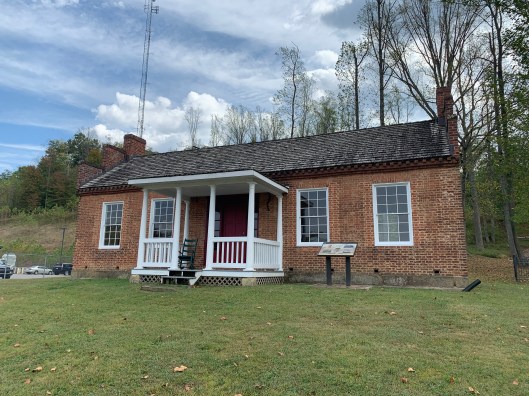
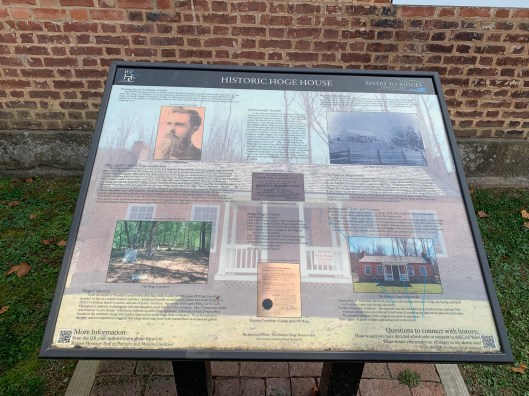
Terry Lowry is THE authority on the Civil War in the Kanawha Valley. Stop 10 on his tour: James W. Hoge House in Winfield, WV. 29 September 2019. Here is a link to Terry’s latest book, The Battle of Charleston (2016): https://wvcivilwar.com/now-available-the-battle-of-charleston/

IMG_0704

Built in 1838 by Charles Brown, his son Tallyrand sold it to Capt. John Bowyer. James W. Hoge acquired the home in 1857. He represented Putnam County at the Virginia Secession Convention in 1861, voting against secession.

IMG_0686

Moved from its original location in 2004, the home was listed on the National Register of Historic Places in 2007.

IMG_0691

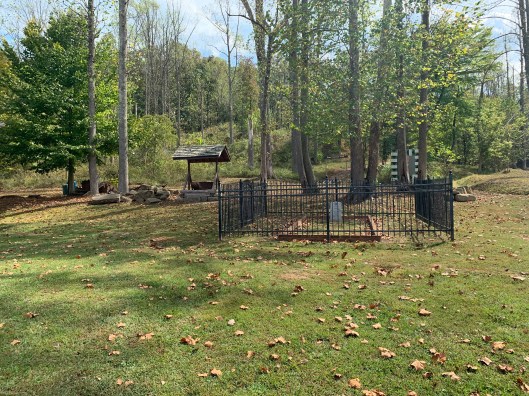
This is the grave of Confederate Captain Phillip James Thurmond, who was mortally wounded in the Battle of Winfield (1864). For more about Capt. Thurmond, follow this link: https://www.herald-dispatch.com/news/putnam_news/confederate-soldier-reburied-with-fanfare-military-rites/article_0c234fe9-6083-5fbf-b7ac-79d2fd87b889.html

Recollections of Laura Hinchman at Combs Addition, WV (1984), Part 1

24 Friday Jan 2020

Posted by Brandon Ray Kirk in African American History, Civil War, Coal, Guyandotte River, Huntington, Logan, Man, Timber, Women's History, Wyoming County

≈ 5 Comments

Tags

African-Americans, Alfred Beckley, Anna Brooke Hinchman, Bruno, Buffalo City, civil war, Claypool, Clean Eagle Coal Company, coal, Combs Addition, Confederate Army, Cyclone, Cyclone Post Office, Davin, Elk Creek, Forkner, genealogy, Guyandotte River, history, Hollow A. Davin, Huntington, John L. Lewis, Lake Claypool, Laura Hinchman, Logan, Logan County, logging, Lorenzo Dow HInchman, Mallory, Man, Man High School, Morris Harvey College, Oceana, Paul Hinchman, Pete Toler, postmaster, rafting, Raleigh County, Rosa Hinchman, splash dams, timbering, Ulysses Hinchman, United Mine Workers of America, Vic McVey, Walter Hinchman, West Virginia, Woodrow Hinchman, Wyoming County

Laura C. Hinchman was born on March 22, 1919 to Walter and Anna Brooke (McVey) Hinchman at Mallory in Logan County, WV. She was an educator for over fifty years and was very active in civic affairs. For more information about her background, see her obituary at this location: https://www.findagrave.com/memorial/140834185/laura-caryl-hinchman

The following interview of Ms. Hinchman was conducted on July 16, 1984. In this part of the interview, she discusses her ancestry, community history, timbering, and coal mining.

***

Miss Hinchman, how did your family first come to this area?

Well, when West Virginia was being settled, people who were willing to come here were given land grants by governors of Virginia over different periods of years. This property was given by the governor of the commonwealth of Virginia at that time, Governor Nicholson. It was given in 1815 to my great grandfather, Dr. Ulysses Hinchman, who was a member of the legislature. He had land holdings in Wyoming County, and he laid out the town of Oceana. He is recorded in a lot of the books of the history of Wyoming and Logan Counties. According to the West Virginia Blue Book, that is how Man got its name. At first it was called Buffalo City. Then they decided to change the name. They thought Hinchman was too long and there was already a place called Hinch, so they named it Man in honor of my great grandfather. Now, that’s according to the West Virginia Blue Book.

Do you remember what your grandparents were like?

Now, both my grandfather and grandmother Hinchman died before I was born, so I don’t remember either of them. At that time, this was all timber land. My grandfather Hinchman, whose name was Lorenzo Dow Hinchman, was a timberman. We have a lot of records here in the house where he kept books of how much he paid the men and how much he sold, and all that. After this was cleared, then, of course, it became farmland. Now, they had no way of getting the logs that were cut to a market. So down there just below Woodrow’s, and this happened several places, they built what was called splash dams. They made a dam and dammed the water up and filled it with logs. Then there would be a great big lot of excitement. Everybody would gather and they would tear the dam lose and let the logs float down to the Guyan River. There were men who went with them, I suppose on rafts, and rafted the logs together, and floated them down the Guyan River to the Guyandotte. Now, my mother’s father, who came from Raleigh County, was Uncle Vic McVey. Of course, I remember him well, he lived here with us until he died at the age of ninety-four. He was one of the men who followed floating those logs down the river, and then they would walk back from Huntington. They had places that they stayed on their way back. I don’t know how many days it took.

Now, my grandmother Hinchman was a Chambers, which is also one of the early settler families in this area. She was a schoolteacher. At that time, it was possible to teach school when you got through the eighth grade, you were given a certificate. All first teachers in the one room schools here were just graduates of the eight grade, because the high school at Man was not built until 1919 or 1920, and that’s all they had. Now some people taught after they finished the eighth grade, and then went on when it was possible. I have a cousin Lake Claypool–that’s another old family in this area for which Claypool is named–that she taught after she finished the eighth grade then she went on to Man and finished high school and then went to Morris Harvey. But all the older teachers were just eighth grade. There was a one room school down here at Claypool. There was a one room school up at Vance’s. There were several one room schools on Buffalo Creek. There was a one room school up–what’s that creek up Bruno called–Elk Creek. My grandmother was a teacher, but as I say, both died before I was ever born. Now then, this place was called Cyclone. This is where Cyclone was. My grandmother Hinchman kept the Cyclone Post Office here for forty years. After she passed away, my mother–she was a McVey–and she married my father, Walter Hinchman, in 1910, and came here. I had Aunt Rosa Hinchman, who had never married at that time, who helped her keep the post office. The mail was carried on horseback from Huntington and the West, came that way, and from Oceana, from that direction they carried it. The postmasters met here, and they ate dinner here every day. My mother–ever who all was here, and at that time, you never knew who might be there for dinner… But when this house was built, this part wasn’t part of it. The kitchen and the dining room were in separate buildings. Now, of course, in the south they had slaves and all, but I do recall their talking about on black man, by the name of Sam. I don’t remember much about him but that’s the only black person that they ever had here, you know, on the farm.

I do remember my granddad McVey quite well, and my great-grandfather came to Raleigh County with General Beckley and settled there. Then my mother’s grandfather was a Confederate soldier in the Civil War. His name was Zirkle, which is the German word for circle. He ran away from home during the Civil War and joined the Confederate Army. After the war he came here and settled. He also lived with us until he was in his nineties. But my mothers’ mother, my grandmother McVey, died when my mother was only, maybe two years old, so I never knew any of my real grandparents except, you know, my granddad McVey.

Were you born here, at this house?

I was born here on March 22, 1919. My father passed away in February of 1920 when I was eleven months old. There were three of us Hinchman children: Woodrow, Paul, and I was the youngest, of course. I don’t remember my father, but Woodrow does. Then my mother married Pete Toler when I was twenty-three months old, a year after my father died. I remember his as my real father because he reared me. He worked this farm and I remember the first time I called him Daddy, now I don’t know how old I was.

There was a mine at Davin that was first called Forkner, and it was changed to the name of Davin after Hollow A. Davin, a prominent man in Logan who probably owned the mine, and that started in 1923. Then the post office was taken up the creek and then we had a post office at Davin. Then my dad ran a coal cutting machine. Men took those jobs by contract and they were paid for the number of cars that they cut. They could work as many hours as they wanted. The men who loaded the coal–they may have loaded themselves, I don’t know–they loaded the coal into wooden cars. Now, in order to get credit of the coal car that they had loaded they had a–what was it called? Well, it was a little round piece of metal with a number on it that they hung on that coal car. The coal was hauled out of the mine by mule or ponies. There was a tipple and everything there at Davin. Then the Clean Eagle mine went in later, I don’t remember when, but my dad worked there, and he also worked at Mallory. But when we were children, we never saw our dad until the weekend because he went to work before daylight, before we ever thought of getting up and he never came in until after we had gone to bed. That sort of thing kept up with miners until John L. Lewis, you see, organized the union.

Civil War in the Kanawha Valley: Battle of Scary Creek Monument (2019)

23 Thursday Jan 2020

Posted by Brandon Ray Kirk in Civil War

≈ Leave a comment

Tags

Albert Gallatin Jenkins, Appalachia, Battle of Charleston, civil war, Confederate Army, George S. Patton, history, Kanawha Valley, Putnam County, Saint Albans Chapter, Terry Lowry, United Daughters of Confederacy, West Virginia

IMG_0677

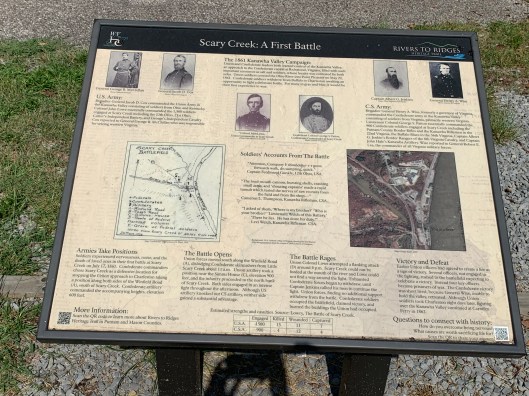
Terry Lowry is THE authority on the Civil War in the Kanawha Valley. Stop 9 on his tour: Battle of Scary Creek Monument near Saint Albans, WV. 29 September 2019. Here is a link to Terry’s latest book, The Battle of Charleston (2016): https://wvcivilwar.com/now-available-the-battle-of-charleston/

IMG_0678

Confederates led by Colonel George S. Patton supported by Captain Albert Gallatin Jenkins won the Battle of Scary Creek.

IMG_0680

For more information, go here: https://www.wvencyclopedia.org/articles/190

Stone Branch News 09.14.1923

23 Thursday Jan 2020

Posted by Brandon Ray Kirk in African American History, Stone Branch

≈ Leave a comment

Tags

Appalachia, Bob Ferrell, Bonnie Covert, genealogy, history, Logan Banner, Logan County, Lorado, Malinda Workman, Nannie Lilly, Rosa Workman, Sadie Ferguson, Stone Branch, West Virginia

A correspondent named “Snow Ball” from Stone Branch in Logan County, West Virginia, offered the following news, which the Logan Banner printed on September 14, 1923:

As Rosebud didn’t write last week, think I will try and write this week.

The weather is very unpleasant at this writing.

Mr. Bob Ferrell is seen out car riding occasionally.

We are sorry to say that our friend Malinda Workman is very ill at this writing.

Miss Bonnie Covert has been entertaining relatives the last few days.

Miss Rosa Workman and Miss Sadie Ferguson seem to enjoy carrying water.

Miss Nannie Lilly was seen reading a letter containing 13 pages Friday. I wonder if it wasn’t from Lorado? She said not.

Civil War in the Kanawha Valley: Morgan Kitchen Museum (2019)

22 Wednesday Jan 2020

Posted by Brandon Ray Kirk in Civil War

≈ Leave a comment

Tags

Albert Sidney Johnston Morgan, Appalachia, Battle of Charleston, Battle of Scary Creek, civil war, history, Jacob D. Cox, John Morgan, Kanawha County, Morgan Kitchen Museum, St. Albans, Terry Lowry, Union Army, West Virginia

IMG_0671

Terry Lowry is THE authority on the Civil War in the Kanawha Valley. Stop 8 on his tour: Morgan Kitchen Museum in Saint Albans, WV. 29 September 2019. Here is a link to Terry’s latest book, The Battle of Charleston (2016): https://wvcivilwar.com/now-available-the-battle-of-charleston/

IMG_0675

Morgan kitchen was built in 1846 near the present-day location of John Amos Power Plant. During the war, the kitchen was used to serve meals to Union soldiers wounded at the Battle of Scary Creek. It was moved to this site in 1972.

IMG_0673

For more information about the kitchen, go here: http://www.stalbanshistory.com/morgans-kitchen.html

Big Creek News 06.22.1923

22 Wednesday Jan 2020

Posted by Brandon Ray Kirk in Big Creek

≈ Leave a comment

Tags

Appalachia, Big Creek, Dorothy Matthews, genealogy, history, Lincoln County, Lizzie Sanders, Logan Banner, Logan County, Mae Lucas, Nell Perry, Thelma Freeman, West Virginia

A correspondent named “Blue Eyes” from Big Creek in Logan County, West Virginia, offered the following news, which the Logan Banner printed on June 22, 1923:

We are having some very nice weather at this writing.

May Lucas visits Lincoln quite often since Minie(?) has come here.

Nell Perry sure does like bobbed hair.

Thelma Freeman and Dorothy Matthews are real good chums.

Franklin wears a rose on his cap and I guess he is looking for a girl.

Thelma looks lonesome. Wonder what’s wrong? Did she lose a friend?

Lizzie Sanders has put up a restaurant in Big Creek.

Civil War in the Kanawha Valley: Littlepage Mansion (2019)

20 Monday Jan 2020

Posted by Brandon Ray Kirk in Civil War, Women's History

≈ Leave a comment

Tags

Adam Littlepage, Appalachia, architecture, Camp Two Mile, Charleston, civil war, Confederate Army, Gallipolis, George B. McClellan, Henry Wise, history, Kanawha County, Kanawha Valley, Littlepage Mansion, National Register of Historic Places, Ohio, Rebecca Littlepage, Ripley, Terry Lowry, The Battle of Charleston, Two Mile Creek, Union Army, West Virginia

IMG_0669

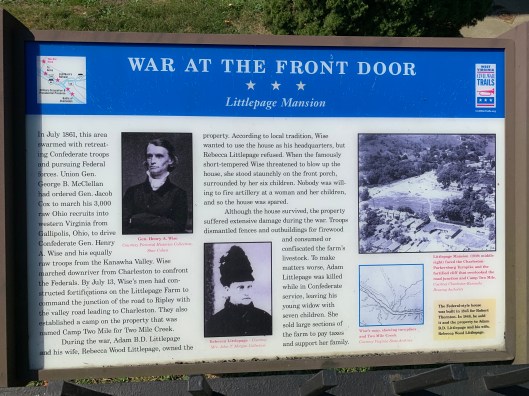
Terry Lowry is THE authority on the Civil War in the Kanawha Valley. Stop 7 on his tour: Littlepage Mansion in Charleston, WV. 29 September 2019. Here is a link to Terry’s latest book, The Battle of Charleston (2016): https://wvcivilwar.com/now-available-the-battle-of-charleston/

IMG_0670

Built in 1845, the Littlepage mansion is one of only six antebellum houses remaining in Charleston, WV. It is listed on the National Register of Historic Places. 29 September 2019

IMG_0667

Rebecca Littlepage reportedly refused to allow Confederate General Henry A. Wise to occupy her home as a headquarters. According to the historical marker: “When the famously short-tempered Wise threatened to blow up the house, she stood staunchly on the front porch, surrounded by her six children. Nobody was willing to fire artillery at a woman and her children, and the house was spared.” For more history about the Littlepage mansion, go here: https://www.wvencyclopedia.org/exhibits/23?section=7

Chapmanville News 11.30.1923

20 Monday Jan 2020

Posted by Brandon Ray Kirk in Big Creek, Chapmanville, Coal, Holden, Logan

≈ Leave a comment

Tags

A.K. Bowling, Appalachia, Bernie Ward, Big Creek, Bill Carper, Bill Cooper, Chapmanville, Charleston, Chester Barker, coal, Dr. J.D. Turner, Fannie Brown, genealogy, Guyan Hospital, Henlawson, history, Holden, Logan, Logan Banner, Logan County, Man, merchant, Molly Conley, O.C. Winters, Oliver Shuff, Oscar Langton, T.A. Rogers, West Virginia

A correspondent named “Pug Nose” and “Let All-Alone Blues” from Chapmanville in Logan County, West Virginia, offered the following news, which the Logan Banner printed on November 30, 1923:

We are having some rainy weather here now.

Fannie Brown, Miss Daniels and Mrs. Bernie Ward have some attraction in Big Creek, as they go down every evening on 51 and back on 52.

Mr. A.K. Bowling was home Sunday from Man, W.Va.

Mrs. Collins of Holden was calling on homefolks SUnday.

Borned to Mr. and Mrs. Oscar Langton, a fine boy last Friday. Mrs. Langton before marriage was Miss Fannie Brown.

Some one said wedding bells will ring at Henlawson soon.

Mr. Bill Cooper is able to be home from the Guyan Hospital at Logan.

Mr. T.A. Rogers was in Logan last Thursday on business.

We are having lots of new houses built now.

Oliver Shuff is building him a house here.

***

As there hasn’t been any one here writing I will try and see what I can do.

Last week was sad on account of the death of Dr. J.D. Turner. We are much grieved over the loss of him.

Mr. Bill Carper was seriously hurt in the mines while driving. He was caught between two cars. Mr. Carper was taken to the Guyan Valley hospital.

Miss Molly Conley and Mr. Chester Barker were seen coming from church one night last week.

Ferrells and Winters store seems to be doing great business under the general manager, Mr. O.C. Winters.

Combinations: Everett and his sweater; Inez and her dancing; Anna and her apron; Bena and beans; Mrs. A.K. Bowling and her cap; Mrs. Ward and her hotel; Eva and her parcel; Cecil going to Charleston.

Chapmanville News 10.12.1923

14 Tuesday Jan 2020

Posted by Brandon Ray Kirk in Chapmanville, Holden, Logan, Man, Sports

≈ 1 Comment

Tags

A.K. Bowling, Annie Ward, Appalachia, Basil Robertson, Bennie Robertson, Bernard Ward, Bob Ferrell, Chapmanville, Charleston General Hospital, Charlie Stone, football, genealogy, history, Holden, Homer Langdon, Ina Barker, Logan, Logan Banner, Logan County, Man, Nell Bryant, Oran Mobley, pie supper, revenue agents, Ula Barker, West Virginia, Willie Boothe

A correspondent named “The Black Cat” from Chapmanville in Logan County, West Virginia, offered the following news, which the Logan Banner printed on October 12, 1923:

Quite a large crowd attended the musical Saturday night at Ula Barker’s store.

Mr. Bob Ferrell was calling on Miss Barnette Sunday.

A large number was presented at the pie supper Thursday night. It was given by the school. Pies and candy sold well with auctioneer Mr. Charlie Stone, Prof. Stiles and Mr. Eyrial.

There was much excitement here Friday when two of our dry law officers were thrown by the white mule and were seriously wounded. They were taken to the Charleston General Hospital.

We are sure glad to see Ima Nutt back on the job again. We have missed him so much.

Mr. Homer Langdon spent Sunday with his mother of this place.

Mr. Bernard Ward spent Saturday in Holden.

Quite a large crowd attended the party Friday night at Mr. and Mrs. Bernard Ward’s. After an evening of fun, refreshments were served.

Some of our most popular young men have left here and gone to Holden to work.

Mr. and Mrs. N. Muncy returned last week after a few weeks visiting in Virginia. They report a good trip.

Mrs. Annie Ward and Mrs. A.K. Bowling were visiting in Man this week.

Mr. Oran Mabley is seen in Chapmanville pretty often now.

Misses Ina Barker, Bennie Robertson, Messrs. Darnald Stone and Bacil Robertson and Mr. and Mrs. Bernard Ward attended the football game at Logan.

Mr. Willie Boothe and Miss Nell Bryant seem to enjoy themselves walking in the sunshine.

Messrs. Joe Glim and George Ohler returned home after a long vacation.

State v. Edgar Combs (1923): Statement of Clarence H. Frey, No. 17

12 Sunday Jan 2020

Posted by Brandon Ray Kirk in Battle of Blair Mountain, Logan

≈ Leave a comment

Tags

Appalachia, Blair Mountain, Clarence H. Frey, coal, editor, history, Logan, Logan Banner, Logan County, Lola Herald, Mine Wars, West Virginia

Document 17-1Document 17-2

Chapmanville News 11.02.1923

12 Sunday Jan 2020

Posted by Brandon Ray Kirk in Chapmanville

≈ Leave a comment

Tags

Appalachia, Chapmanville, Chapmanville Post Office, Clyde White, Darnell Stone, genealogy, Hazel E. McCloud, Hazel M. McCloud, history, Inez Barker, Logan Banner, Logan County, Victor Toney, West Virginia, Young People's Christian Endeavor

Correspondents named “Evelyn and Marie” from Chapmanville in Logan County, West Virginia, offered the following news, which the Logan Banner printed on November 2, 1923:

We are having nice weather at this writing.

We are all glad to know Mr. Darnell Stone and Miss Inez Barker were out joy riding Sunday. Wonder what Inez will say when she finds out his car was shot all to pieces. Ask Darnell. He knows.

Mr. Victor Toney and Miss Hazel E. McCloud attended church Sunday night.

Miss Hazel M. McCloud attended the Young People’s Christian Endeavor Sunday night.

Wonder what makes Miss Hazel E. McCloud visit the post office so much? Ask Hazel M. McCloud. She ought to know.

Mr. Clyde White was visiting in this little burg Sunday.

Civil War in the Kanawha Valley: Glenwood Estate (2019)

12 Sunday Jan 2020

Posted by Brandon Ray Kirk in Civil War

≈ Leave a comment

Tags

Appalachia, Charleston, civil war, Glenwood Estate, history, Kanawha County, Kanawha Valley, Terry Lowry, The Battle of Charleston, West Virginia

IMG_0665

Terry Lowry is THE authority on the Civil War in the Kanawha Valley. Stop 6 on his tour: Glenwood Estate in Charleston, WV. 29 September 2019. Here is a link to Terry’s latest book, The Battle of Charleston (2016): https://wvcivilwar.com/now-available-the-battle-of-charleston/

IMG_0666

For more information about Glenwood, go here: https://www.marshall.edu/graduatehumanities/the-glenwood-project/

Big Creek News 09.05.1924

12 Sunday Jan 2020

Posted by Brandon Ray Kirk in Big Creek, Guyandotte River, Huntington, Logan

≈ Leave a comment

Tags

Appalachia, basket meetings, Big Creek, Burke McComas, Cecil Hager, Charleston, Florence Wheeler, genealogy, Gladys Saunders, Guyandotte Valley, history, Huntington, Jess Harmon, John Mitchell, John Mobley, Laura Hager, Lillie Estep, Lloyd Ellis, Logan, Logan Banner, Logan County, Lonna Hager, Lulu Harmon, merchant, Myrtle Mobley, Nannie Lilly, Nannie Mobley, Norma Saunders, P.D. Bradbury, Pearl Mobley, Peter M. Toney, Tom Vance, Ward Shively, West Virginia

An unnamed correspondent from Big Creek in Logan County, West Virginia, offered the following news, which the Logan Banner printed on September 5, 1924:

Dear old Banner, here I am with a bit of news from our little city Big Creek, one of the most leading little cities on the Guyan Valley.

Miss Lulu Harmon is very ill at this writing.

Mrs. John Mitchell was calling on Mrs. John Mobley Sunday.

It was sad to see Mr. Burke McComas baptized Sunday. He is very ill and not expected to live.

Mr. Lloyd Ellis seems to be enjoying himself of late.

Misses Florence Wheeler and Gladys Saunders has returned home after a short stay in Huntington.

A fine new boy arrived at the home of Mr. and Mrs. John Mobley.

Don’t forget the basket meeting Sunday on Big Creek. Everybody invited.

Misses Nannie Lilly, Myrtle Mobley, and Cecil Hager were out car riding Sunday.

Mr. Jess Harmon and Miss Norma Saunders were out picnicking Sunday.

Mr. Tom Vance and Miss Pearl Mobley motored to Logan Sunday.

John Mobley has accommodated all loafers. He has made a loafers bench under his shade tree near his store.

Ward Shively has returned to his home after a short stay in Charleston.

Peter M. Toney made a flying trip to Huntington to see his home folks.

We all were sorry when Mr. P.D. Bradbury found his span of mules drowned Sunday. They were tied with a rope and fell over the high bank.

Mrs. Nannie Mobley was kodaking Sunday evening.

Miss Lillie Estepp returned home after a short stay with her parents.

Miss Gladys Saunders and Miss Myrtle Mobley had a happy meeting when first they met after Gladys’ return home.

There are plenty of cars and good drivers nowadays.

Mrs. Lonna Hager of Huntington is the guest of her sisters, Laura Hager.

Richard and Spencer Adkins Deed to Sarah Adkins (1892)

13 Friday Dec 2019

Posted by Brandon Ray Kirk in Fourteen, Ranger

≈ Leave a comment

Tags

Appalachia, county clerk, David F. Smith, Eliza Adkins, F.M. Johnson, Fourteen Mile Creek, genealogy, H.C. Adkins, history, justice of the peace, Laurel Hill District, Lewis Adkins, Lincoln County, Olive F. Adkins, Richard Adkins, Sarah Adkins, Spencer Adkins, West Virginia

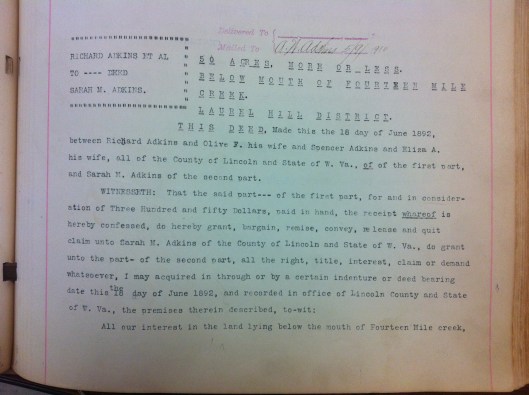
Richard Adkins to Sarah Adkins 1

Deed Book __, page __, Lincoln County Clerk’s Office, Hamlin, WV.

Richard Adkins to Sarah Adkins 2

Deed Book __, page __, Lincoln County Clerk’s Office, Hamlin, WV.

Hungarian News from the WV Coalfields (1923, 1927-1929)

13 Friday Dec 2019

Posted by Brandon Ray Kirk in Coal, Hungarian-American History, Huntington, Inez, Logan, Music, Williamson

≈ 1 Comment

Tags

Appalachia, Beauty, Charleston, Cinder Bottom, coal, crime, dancing, Elizabeth Nagy, Ellis Park, Emmett Scaggs, Himlerville, history, Hungarian Benevolent Association, Hungarian Miners' Journal, Hungarian-Americans, Hungarians, Huntington, Joe Hatfield, Kentucky, Keystone, Logan, Logan Banner, Logan County, Martin County, McDowell County, Mingo County, Mud Fork, Rose Mustapha, Warfield, Welch, West Virginia, Williamson, Williamson Daily News

Between 1900 and 1920, a large number of Hungarians settled in West Virginia. Most were employed as coal miners. As of 1920, 6,260 Hungarians lived in West Virginia, primarily in Logan and McDowell counties. The Logan Banner, seated in Logan, WV, offered coverage of Hungarian news. It also commented on items published by Martin Himler in the Hungarian Miners’ Journal.

New Marathon Dance Record Is Made Here

Rose Mustapha, Pretty Hungarian Starts the Step Believed to Be the record.

At nigh noon Sunday, Rose Mustapha, a beautiful Hungarian girl, tripped the starting step in a terpsichorean debauch, that is believed to have established a record for sustained dancing in groups. Rose led a cotillion of thirty of her countrymen over a stretch of nineteen hours of continual dancing.

The dance started at twelve o’clock Sunday noon and continued without intermission till seven o’clock Monday morning. The jolly spirit of old Budapest struck color with jazz hilarity as the dancers spun in a vortez over the polished floor.

Hundreds of the dancers’ admirers rimmed the floor, hailing the participants in a half dozen different languages and dialects. Three wheezy but quite animated violins provided the music, which ran in wild Magyar strains and jazzy syncopation.

For the most part the dancers adhered to their native folk dances, but occasionally a couple would break into a fox trot, or a one step. At six o’clock Sunday evening, the dancers were given liquid nourishment as they whirled, and at midnight the same was repeated.

Most of the dancers finished strong, but several of the weaker sex had to be helped from the floor by their friends. Long distance dancing is quite common in their native land, and had the participants been in trim the task would have been comparatively easy, they say. As it was all of the men, who are miners, reported for work Monday morning and so far no ill results have been reported of the affair.

Logan (WV) Banner, 3 August 1923

***

Hungarian Dance

Several hundred persons enjoyed the dance given by the Hungarian Benevolent Association at Ellis Park skating rink last Saturday night. The program included many attractive features and novelties. Miss Elizabeth Nagy of Mud Fork was the winner of the beauty prize. She received a fine watch and $5 in gold.

Logan (WV) Banner, 29 November 1927

***

Hungarian Paper Tells of Resorts Hereabouts

Sensational Charges Prompt Williamson News to Demand Investigation and “Clean-Up”–Logan and Neighboring Cities Are Mentioned In This Alleged Expose

A Hungarian paper published at Himlerville, Ky., not far from Williamson, is running a series of sensational articles on vice conditions in Logan, Williamson, Huntington and Charleston. These articles are printed both in English and Hungarian and are attracting much attention, many copies of the paper having been sent to the cities named.

Two articles about Logan have mentioned various resorts in which it is charged that vice is rampant, that protection is obtained by bribery of officials, and that conditions are getting worse. Local officers brand these so-called disclosures as either baseless or greatly exaggerated.

In Williamson the expose has attracted much attention, particularly since the Williamson Daily News carried the following editorial, under the heading, “A Clean City.”

It’s a sad commentary on our city, county, and state police officials when the leaders of the foreign element in our midst are forced to take the lead in cleaning up moral conditions.

Through the Hungarian paper published at Himlerville, Ky., a campaign is being waged to clean up Williamson, Logan, Huntington and Charleston.

We are primarily concerned in Williamson and this paper charges that Williamson is harboring not less than eleven Hungarian brothels and some fifteen speak-easies. The editor of the paper has furnished the Williamson Daily News with the names of eight hotels and rooming houses where he says “light o’ love ladies” may be found.

It is common knowledge in Williamson that what he charges is true. Furthermore it is also common knowledge that there is hardly a hotel from the best to the worst in the city that does not harbor women of prostitution.

These women are debauching our manhood and spreading disease and there are attendant demoralizing evils which add to the indictment against them.

Not only are there Hungarian brothels in Williamson, but there are brothels that cater to every race and condition. The fact that they exist is known to practically every person in Williamson.

In this same Himlerville paper in an article published in this week’s issue it is stated that “Protection fees vary between twenty-five and seventy-five dollars weekly” suggesting a reason why no action is taken to remedy conditions.

We have had every reason to believe that Williamson was infested with brothels of every degree of degradation, but until the bold statement is made in the Hungarian paper, we had no reason to suspect that some persons were receiving protection fees.

However, such a state of things is a natural noncomitant, in view of the laws of the land. It would be very easy for city, state or county officers to take action, and if they do not the question immediately arises: Why?

It cannot be argued that it is impossible to clean up the city in this respect. We all know better. The chief of police and four good policemen, with proper backing of the mayor and the citizens of Williamson could do the job, and do it thoroughly in ten days. In doing it they could be so impressively earnest that there would be no recurrence of the evil for months to come. If instances of violations of the law of this character did occur in the future they could enforce the law with such vigor as to deter others. Williamson would soon be classed as a “clean city.”

Even the notorious “Cinder Bottom” at Keystone has been cleaned up. Welch, the county seat of McDowell county, is known far and wide as a “clean city.” Chippies and their like give it a wide berth. Why? Because the mayor and the chief of police of Welch, with a determined citizenship back of them, will not tolerate the evil. Merchants and business men of Welch generally are unreservedly in favor of an absolute ban against women of evil character being allowed to remain in hotels and rooming houses, because they know it hurts business and is a thoroughly demoralizing factor.

Primarily the question is one for the mayor and the chief of police at Williamson to handle, but there are other law enforcement agencies that could function.

For instance, the prosecuting attorney has an effective weapon at hand if he wants to use it. We refer to the state padlock law, upheld by the supreme court. With this weapon he could close every hotel and rooming house in the city that harbored women of ill fame. And there would be no question of securing sufficient evidence to act. It is ready at hand.

There is another agency, the state police. This efficient body of men could take action and bring the matter to a hand.

The state health department is aware of the fact that Williamson is one of the vilest cities in the way of brothels in the state. It has investigated conditions here and has data that could be used by officials who wanted to take action. Furthermore the state health department, on request of the city or county officials, would send investigators here to ascertain true conditions. But, if we understand the situation rightly there is no need for further investigation. The brothels are conducted more or less openly, are well advertised and unfortunately are well patronized.

There would be no lack of information to proceed upon if city, county or state officials wanted to take action. And first of all, it is up to our city officials to act.

Logan (WV) Banner, 27 January 1928

***

NOTICE TO LOGAN

With newly sharpened sticks the Hungarian Miners Journal, published at Himlerville, Ky., continues to prod into vice conditions hereabouts. Its latest issue is devoted largely to a further exposure at Williamson’s intrenched vice, but Logan has not been forgotten. In fact, in a large type box on the first page notice is given that the spotlight will be turned again soon on the garden spot. It says:

“The brother-situation of Williamson is taking up all our space and our energies for a few days.

“This does not mean that we have nothing more to say about Logan brothels.

“A score of Hungarian criminals, keepers of brothels and white-slavers are harbored in and by Logan, to the great detriment of the decent Hungarians in the Logan field.

“We demand the expulsion of these criminals and we will turn to Logan in a very short time.

“Surely the decent citizens of Logan are not going to build a roof over their town to designate THE red-light district.”

Logan (WV) Banner, 3 February 1928

***

Hungarian Paper Reverts to Logan’s Need of Reformation

Editor Fisher Takes Crack at The Banner, Sheriff Hatfield and Chief Scaggs–Long Silence Broken By Familiar, Rasping Outcry

Remember the Magyar Banyaszlap, a newspaper formerly published at Warfield, Ky., not far from Williamson, W.Va. A year or more ago it probed conditions in Logan and carried some sensational strictures about county and city officials. Finally, an officious and offensively inquisitive soul, the editor hisself, came in person and before he left was given quite a thumping by Chief of Police Scaggs.

Some time later the coal company located at Warfield and Hungarian-owned, went into the hands of a receiver and whether the Banyaszlap then suspended publication or not it ceased to come to this office. The other day a copy came. It is published in Columbus now but its editor is evidently still interested in conditions here. After scanning its eight pages, the writer of these lines found but one article printed in English. That embraced a clipping from The Banner and the Banyaszlap’s comments thereupon. The article clipped appeared to the Banner on April 9 and had to do with reports that the sheriff’s forces were determined to suppress the liquor traffic in boarding and lodging houses that cater to foreign-born miners. Most Banner readers will recall that news item and for that reason it will not be reproduced here, but what the Columbus paper says may be of some interest.

“We are glad to note the sudden interest of Sheriff Hatfield, and the rather mild interest of the Logan Banner, in the speak-easyes.

“The officers do not have to ‘trail’ these boarding houses, for we have published a list of them.

“And we have also published a long-long list of speak-easyes and brothels in Logan, W.Va., with addresses, and names, with locations and any other needed informations.

“Why not start a housecleaning right here in Logan, W.Va., and spread it then to the coal field?

“We can promise Logan and its vicinity that others than the sheriff will also be interested in these affairs.

“When the gunman (called chief of police) of Logan so heroically objected to our articles, we have promised that we will have the matter attended to in good time.

“It will happen soon.

“Perhaps hence the sudden interest in the Logan vice.”

Logan (WV) Banner, 23 April 1929

***

For more information about Hungarians in West Virginia, go here: https://www.appalachianhistory.net/2017/03/magyars-in-morgantown.html

For more information about Martin Himler, Himlerville (Beauty), and the Magyar Banyaszlap: Hungarian Miners’ Journal, go here: https://www.appalachianhistory.net/2014/11/saving-himler-house.html

Jack Dempsey’s Broadway Restaurant Location in New York City (2019)

12 Thursday Dec 2019

Posted by Brandon Ray Kirk in Holden, Logan

≈ 3 Comments

Tags

boxing, Brill Building, history, Jack Dempsey, Jack Dempsey's Broadway Restaurant, Logan County, Madison Square Garden III, New York, New York City, Sports, The Godfather, West Virginia

Jack Dempsey's Restaurant

Jack Dempsey (1895-1983), heavyweight boxing champion of the world from 1919-1926, was raised in Logan County, WV. In 1935, Dempsey opened a restaurant at 8th Avenue W 50th Street near Madison Square Garden III in NYC. In 1938, he relocated his restaurant to Brill Building (1619 Broadway). The business front was featured in the 1972 movie The Godfather. Photo credit unknown. For more about the 1974 closure of Jack Dempsey’s Broadway Restaurant, go here: https://www.nytimes.com/1974/10/06/archives/jack-dempseys-restaurant-is-closing-original-dempseys-recalled.html

Here is the site of Jack Dempsey’s restaurant (1938-1974) as it appears today. 7 December 2019. For more history of the business, go here: https://ephemeralnewyork.wordpress.com/2018/05/21/eating-at-jack-dempseys-in-times-square/

Here is the site of Jack Dempsey’s restaurant as it appears today. 7 December 2019

Milk Fed Squabs (1923)

16 Saturday Nov 2019

Posted by Brandon Ray Kirk in Logan, Women's History

≈ Leave a comment

Tags

Appalachia, history, Logan Banner, Logan County, Milk Fed Squabs, West Virginia

Milk Fed Squabs LB 04.06.1923 2.JPG

Logan (WV) Banner, 6 April 1923

Armed March: Logan County Officers Thwarted in Pomeroy, OH (1921)

16 Saturday Nov 2019

Posted by Brandon Ray Kirk in Battle of Blair Mountain, Coal, Logan, Matewan

≈ Leave a comment

Tags

A.M. Belcher, Appalachia, Charleston, coal, deputy sheriff, Ed Reynolds, Edgar Combs, George Munsey, Harold W. Houston, Harry R. Barnes, history, Jackson Arnold, James Miller, James Swanner, John Chafin, John Gore, justice of the peace, Lee Belcher, Logan, Logan Banner, Mason City, Matewan, Meigs County, Mine Wars, Ohio, Point Pleasant, Pomeroy, Savoy Holt, U.S. Cantley, United Mine Workers of America, W.M. Swanner, Wallace Chafin, Welch, West Virginia, William Chafin

From the Logan Banner of Logan, WV, comes this bit of history about the armed march of 1921:

OFFICERS SAY OHIO MOB THREATENED LIVES

“Let’s Make It a Matewan-Welch Affair,” Yells Citizens of Pomeroy

Officers Say Lives Were Threatened

Another tragic sequel to the miners “armed march” on Logan was narrowly averted at Pomeroy, Ohio, Monday, when a mob of about three hundred persons are said to have threatened the lives of Deputy Sheriffs Wallace Chafin and Lee Belcher, and Mr. Chafin’s son William, who went to Pomeroy to visit his grandfather. The officers were sent to Pomeroy with requisition papers for the removal of Savoy Holt, and U.S. Cantley, who are wanted in Logan on the charge of being accessory before the fact of the killing of George  Munsey and John Gore, during the “armed march.”

A statement was given out by Officer Chafin Wednesday, which he described in detail the affair at Pomeroy. Bearing requisition papers for the removal of Holt drawn by the Governor of Ohio and later held up by the agreement of attorneys of both the defense and prosecution till after the trial of James Miller. Officers Chafin and Belcher reported to the sheriffs of Meigs county. They were sent to the Prosecuting Attorney’s office of the county where they were advised that they would have to get other papers for their purpose. They then went before Justice of Peace Harry R. Barnes and swore out a fugitive warrant for the two men wanted. “A crowd of seventy-five or a hundred gathered around the jail. All of the men wore coats and did not  seem friendly,” Mr. Chafin said. “We returned to the Prosecuting Attorney’s office, and as I came out there was considerable commotion among the large crowd of men. Persons were  being waved back and told to stand aside. These directions were being made by members of the crowd,” Officer Chafin said. Chafin returnerd to the Sheriff’s office and was told that he had been called away, and that he could not see Holt.

“Officer Belcher, myself and my son were directed to the Mayor’s office. We were told that the Mayor had a telegram for us from Governor Donahey, which said that Holt should not be delivered and that if we were ___ to run us out of town and tell us not to return. We did not go to the Mayor’s office, and thought if we were really causing trouble it would be best for us to leave immediately. From the time I arrived in town I noticed that the atmosphere had changed since I was last there. Not an officer could be found anywhere. People gazed out on the streets from their houses in great numbers. And several people were noticed to follow us from the time we arrived in town.”

“When we decided to leave, we hired a taxi cab with the intention of going to Point Pleasant. Again, the crowd which seemed to be growing surrounded the cab, and the driver fled, leaving us standing amidst the crowd in the middle of the street. We heard some one in the crowd say, ‘Let’s make it another Welch or Matewan affair.’ A man who said he was a newspaper reporter began to ask questions as the crowd pushed in against the cab. We were asked if we weren’t Logan county thugs, and if we were not in the gang that opposed the ‘armed march.’ We told them that we were regular Logan county officers and had been serving as Deputy Sheriffs for some time, also that we had been sent there with the proper papers to return Savoy Holt to Logan. They were told that I had been a Deputy for two years and that Belcher had been in office for six years. The crowd dropped back and we got our bags and endeavored to hire another taxi, but evidently the drivers had been given instructions not to drive us. They all refused and we were forced to go to the ferry. The crowd continued to swell and they followed us to the ferry. The ferry boat was on the West Virginia side and we were forced to endure the jeers and threats of the crowd until the boat returned to the Ohio side.

While on the ferry ten or twelve men came in a group and demanded me to get off, saying that I had given a false name. I told them if they wanted me they would have to come and get me. They approached and requested me to show further identifications and I compiled by showing them my Masonic cards.”

“Upon arriving on the West Virginia side I saw several of the same men I had seen in Pomeroy. Another taxi was hired to take us to Point Pleasant. As we started we were hailed. The taxi was stopped and we were told that the driver could not take us. We concluded that we would walk to the next station to avoid trouble. A short distance below the town we were surrounded by about twelve men in automobiles. Heading for the river, and afraid that they would kill my son, we returned to the station at Mason City to wait for a train. While sitting in the station group after group of men came to the doors and men swarmed around. I believe they would have fired on us in the station if there had not been several women sitting near us. The first train to arrive was an east bound train which we took to Parkersburg. The last words we heard from the crowd was from a large man who seemed to act in capacity of spokesman. He yelled, ‘I’m damn sorry boys we did not make this another Welch or Matewan affair.'”

Mr. Chafin reported the affair to Governor Morgan at Charleston Tuesday. He was instructed by the governor that the removal of Holt and Cantley would be affected by the state authorities. It is understood that Colonel Jackson Arnold has been sent to Columbus, Ohio, to get the proper extradition papers for the men’s removal. Cantley is still at large and Holt is being held in the county jail at Pomeroy, where he has been held as a witness in the case of James Miller who was sentenced from two to twenty years for the killing of E. Reynolds and W.M. Swanner. Holt was in the Miller home in Pomeroy at the time of the shooting which took place in Miller’s front yard.

Logan (WV) Banner, 3 August 1923

***

POMEROY, OHIO, IS A REFUGE AFTER CRIMES ARE COMMITTED, SAID

A.M. Belcher, Attorney, Says the Failure of Meigs County to Relinquish Prisoners Is Proof.

MAKES STATEMENT WHILE CALLING ON PROSECUTOR

“The attack on Deputy Sheriffs Wallace Chafin and Lee Belcher, at Pomeroy, Ohio, where they were threatened by a mob when they attempted to return Savoy Holt to West Virginia for trial in connection with the armed march on Logan, in 1921, is only added proof to the claim that the Pomeroy Band is serving as a refuge for various crimes in West Virginia,” said A.M. Belcher, state counsel in the prosecution of the so-called armed march cases.

Mr. Belcher was here Thursday to assist Prosecuting Attorney John Chafin resist an application for a change of venue for Harold W. Houston, chief counsel for District 17, United Mine Workers and Edgar Combs, a member of the mine workers union, for their alleged connection with the murders which grew out of the armed march.

“The refusal of the Meigs county authorities to turn over Holt to the custody of the Logan county sheriffs was in a direct violation of an agreement we had made with attorneys representing the defense,” said Mr. Belcher.

“At the time J.E. Miller was indicted for the murder of James Swanner and Ed Reynolds, Holt was indicted as an accessory to that crime. He was also wanted by the Logan county authorities for his participation in the march, but an agreement was made with Miller’s attorneys that if he were allowed to remain in Meigs county until after the Miller trial that he would immediately be returned to Logan.”

Requisition papers for Holt’s return were honored at the time by Governor Donahey but at the request of Miller’s attorneys West Virginia decided not to insist upon Holt’s immediate return, relying on the defense’s promise that he would be surrendered as soon as the trial was over.

“When Deputies Chafin and Belcher went to Pomeroy Tuesday they had in their possession the requisition papers issued at the time we instituted the original proceedings. They were signed by Governor Donahey on May 15. Neither of the two deputies expected any resistance but to their surprise they were met by a mob of 300 men who not only drove them out of town but pursued them across the river into West Virginia territory.

It would appear that there is something radically wrong with the state’s government that would permit a mob’s action to override its official decisions. The Pomeroy Band has become the refuge of scores of miners who took part in the uprising against Logan county. The entire section apparently is in sympathy with the band of radicals who fostered the march against the citizens of a peaceful county.

The temper of the mob which threatened the two Logan county deputies is seen in the fact that it was only by a miracle that the two officers escaped with their lives. “Let’s make it another Matewan affair” was their battle cry; and the reason that two more West Virginians did not meet death in Pomeroy as did Jim Swanner and Ed Reynolds is due to the courage and coolness of the two officers.

Holt was once in custody of the Logan county officers but was released on bail. Soon after his release he is said to have gone to the headquarters of the United Mine Workers at Charleston and then on the following day left for Pomeroy. It was on the next day that Swanner and Reynolds went to Pomeroy to offer Miller immunity if he would return to Logan county and testify for the state in the armed march cases.

Miller met the two men at the door of his home near Pomeroy and shot both of them to death, though neither of the Logan deputies were armed. Holt, it is said, was in the house at the time of the shooting.

Logan (WV) Banner, 10 August 1923

Civil War in the Kanawha Valley: Magic Island Park (2019)

16 Saturday Nov 2019

Posted by Brandon Ray Kirk in Civil War

≈ Leave a comment

Tags

Appalachia, Battle of Charleston, civil war, Confederate Army, history, Jacob D. Cox, Joseph A. Lightburn, Kanawha County, Kanawha Valley, Magic Island Park, Point Pleasant, Terry Lowry, Union Army, West Virginia, William W. Loring

IMG_0662.JPG

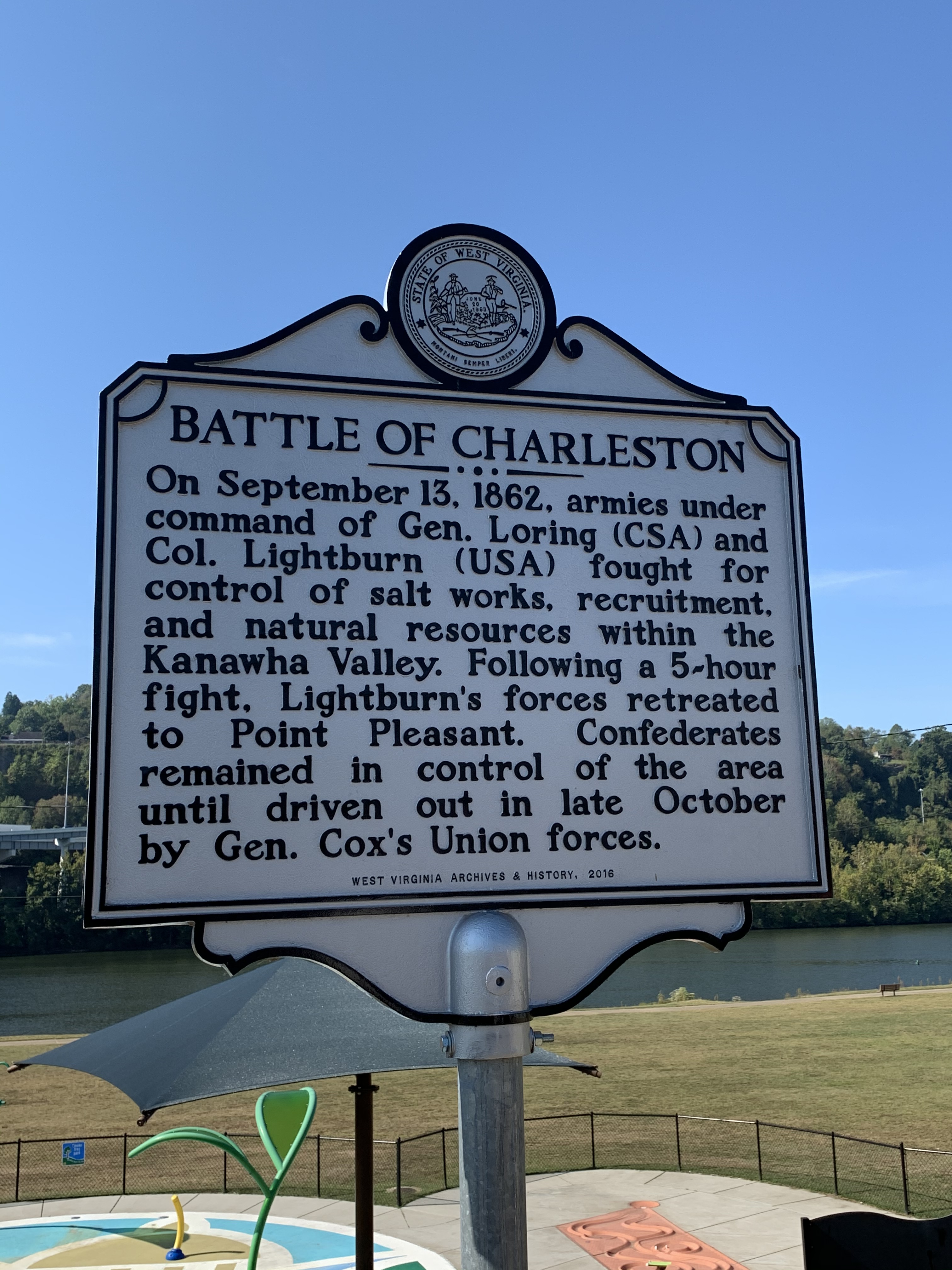
Terry Lowry is THE authority on the Civil War in the Kanawha Valley. Stop 5 on his tour: Magic Island Park in Charleston, WV. 29 September 2019. Here is a link to Terry’s latest book, The Battle of Charleston (2016): https://wvcivilwar.com/now-available-the-battle-of-charleston/

← Older posts
Newer posts →

Feud Poll 1

If you had lived in the Harts Creek community during the 1880s, to which faction of feudists might you have given your loyalty?

Categories

  • Adkins Mill
  • African American History
  • American Revolutionary War
  • Ashland
  • Atenville
  • Banco
  • Barboursville
  • Battle of Blair Mountain
  • Beech Creek
  • Big Creek
  • Big Harts Creek
  • Big Sandy Valley
  • Big Ugly Creek
  • Boone County
  • Breeden
  • Calhoun County
  • Cemeteries
  • Chapmanville
  • Civil War
  • Clay County
  • Clothier
  • Coal
  • Cove Gap
  • Crawley Creek
  • Culture of Honor
  • Dingess
  • Dollie
  • Dunlow
  • East Lynn
  • Ed Haley
  • Eden Park
  • Enslow
  • Estep
  • Ethel
  • Ferrellsburg
  • Fourteen
  • French-Eversole Feud
  • Gilbert
  • Giles County
  • Gill
  • Green Shoal
  • Guyandotte River
  • Halcyon
  • Hamlin
  • Harts
  • Hatfield-McCoy Feud
  • Holden
  • Hungarian-American History
  • Huntington
  • Inez
  • Irish-Americans
  • Italian American History
  • Jamboree
  • Jewish History
  • John Hartford
  • Kermit
  • Kiahsville
  • Kitchen
  • Leet
  • Lincoln County Feud
  • Little Harts Creek
  • Logan
  • Man
  • Matewan
  • Meador
  • Midkiff
  • Monroe County
  • Montgomery County
  • Music
  • Native American History
  • Peach Creek
  • Pearl Adkins Diary
  • Pecks Mill
  • Peter Creek
  • Pikeville
  • Pilgrim
  • Poetry
  • Queens Ridge
  • Ranger
  • Rector
  • Roane County
  • Rowan County Feud
  • Salt Rock
  • Sand Creek
  • Shively
  • Spears
  • Sports
  • Spottswood
  • Spurlockville
  • Stiltner
  • Stone Branch
  • Tazewell County
  • Timber
  • Tom Dula
  • Toney
  • Turner-Howard Feud
  • Twelve Pole Creek
  • Uncategorized
  • Warren
  • Wayne
  • West Hamlin
  • Wewanta
  • Wharncliffe
  • Whirlwind
  • Williamson
  • Women's History
  • World War I
  • Wyoming County
  • Yantus

Feud Poll 2

Do you think Milt Haley and Green McCoy committed the ambush on Al and Hollene Brumfield in 1889?

Blogroll

  • Ancestry.com
  • Ashland (KY) Daily Independent News Article
  • Author FB page
  • Beckley (WV) Register-Herald News Article
  • Big Sandy News (KY) News Article
  • Blood in West Virginia FB
  • Blood in West Virginia order
  • Chapters TV Program
  • Facebook
  • Ghosts of Guyan
  • Herald-Dispatch News Article 1
  • Herald-Dispatch News Article 2
  • In Search of Ed Haley
  • Instagram
  • Lincoln (WV) Journal News Article
  • Lincoln (WV) Journal Thumbs Up
  • Lincoln County
  • Lincoln County Feud
  • Lincoln County Feud Lecture
  • LinkedIn
  • Logan (WV) Banner News Article
  • Lunch With Books
  • Our Overmountain Men: The Revolutionary War in Western Virginia (1775-1783)
  • Pinterest
  • Scarborough Society's Art and Lecture Series
  • Smithsonian Article
  • Spirit of Jefferson News Article
  • The Friendly Neighbor Radio Show 1
  • The Friendly Neighbor Radio Show 2
  • The Friendly Neighbor Radio Show 3
  • The Friendly Neighbor Radio Show 4
  • The New Yorker
  • The State Journal's 55 Good Things About WV
  • tumblr.
  • Twitter
  • Website
  • Weirton (WV) Daily Times Article
  • Wheeling (WV) Intelligencer News Article 1
  • Wheeling (WV) Intelligencer News Article 2
  • WOWK TV
  • Writers Can Read Open Mic Night

Feud Poll 3

Who do you think organized the ambush of Al and Hollene Brumfield in 1889?

Recent Posts

  • Logan County Jail in Logan, WV
  • Absentee Landowners of Magnolia District (1890, 1892, 1894)
  • Charles Spurlock Survey at Fourteen Mile Creek, Lincoln County, WV (1815)

Ed Haley Poll 1

What do you think caused Ed Haley to lose his sight when he was three years old?

Top Posts & Pages

  • Manns Knob Fire Tower and Residence (2017)
  • Let's Boost Old Logan (1911)
  • Early Anglo Settlers of Logan, WV (1937)
  • Civil War Hanging in Logan County, WV (1937)
  • Battle of Kanawha Gap (1861)

Copyright

© Brandon Ray Kirk and brandonraykirk.wordpress.com, 1987-2023. Unauthorized use and/or duplication of this material without express and written permission from this blog’s author and/or owner is strictly prohibited. Excerpts and links may be used, provided that full and clear credit is given to Brandon Ray Kirk and brandonraykirk.wordpress.com with appropriate and specific direction to the original content.

Archives

  • February 2025
  • January 2025
  • October 2023
  • September 2023
  • December 2022
  • November 2022
  • May 2022
  • April 2022
  • February 2022
  • November 2021
  • October 2021
  • September 2021
  • June 2021
  • May 2021
  • April 2021
  • March 2021
  • February 2021
  • January 2021
  • December 2020
  • November 2020
  • October 2020
  • July 2020
  • June 2020
  • May 2020
  • April 2020
  • March 2020
  • February 2020
  • January 2020
  • December 2019
  • November 2019
  • October 2019
  • September 2019
  • August 2019
  • July 2019
  • June 2019
  • May 2019
  • April 2019
  • March 2019
  • February 2019
  • January 2019
  • December 2018
  • November 2018
  • October 2018
  • September 2018
  • August 2018
  • July 2018
  • June 2018
  • May 2018
  • April 2018
  • March 2018
  • February 2018
  • January 2018
  • December 2017
  • November 2017
  • October 2017
  • September 2017
  • August 2017
  • July 2017
  • June 2017
  • May 2017
  • April 2017
  • March 2017
  • February 2017
  • January 2017
  • December 2016
  • November 2016
  • October 2016
  • September 2016
  • August 2016
  • July 2016
  • June 2016
  • May 2016
  • April 2016
  • March 2016
  • February 2016
  • January 2016
  • December 2015
  • November 2015
  • October 2015
  • September 2015
  • August 2015
  • July 2015
  • June 2015
  • May 2015
  • April 2015
  • March 2015
  • February 2015
  • January 2015
  • December 2014
  • October 2014
  • September 2014
  • August 2014
  • July 2014
  • June 2014
  • May 2014
  • April 2014
  • March 2014
  • February 2014
  • January 2014
  • December 2013
  • November 2013
  • October 2013
  • September 2013
  • August 2013
  • July 2013
  • June 2013
  • May 2013
  • April 2013
  • March 2013
  • February 2013
  • January 2013
  • December 2012
  • November 2012

Enter your email address to follow this blog and receive notifications of new posts by email.

Join 2,925 other subscribers

Tags

Appalachia Ashland Big Creek Big Ugly Creek Blood in West Virginia Brandon Kirk Cabell County cemeteries Chapmanville Charleston civil war coal Confederate Army crime culture Ed Haley Ella Haley Ferrellsburg feud fiddler fiddling genealogy Green McCoy Guyandotte River Harts Harts Creek Hatfield-McCoy Feud history Huntington John Hartford Kentucky Lawrence Haley life Lincoln County Lincoln County Feud Logan Logan Banner Logan County Milt Haley Mingo County music Ohio photos timbering U.S. South Virginia Wayne County West Virginia Whirlwind writing

Blogs I Follow

  • OtterTales
  • Our Appalachia: A Blog Created by Students of Brandon Kirk
  • Piedmont Trails
  • Truman Capote
  • Appalachian Diaspora

BLOOD IN WEST VIRGINIA is now available for order at Amazon!

Blog at WordPress.com.

OtterTales

Writings from my travels and experiences. High and fine literature is wine, and mine is only water; but everybody likes water. Mark Twain

Our Appalachia: A Blog Created by Students of Brandon Kirk

This site is dedicated to the collection, preservation, and promotion of history and culture in Appalachia.

Piedmont Trails

Genealogy and History in North Carolina and Beyond

Truman Capote

A site about one of the most beautiful, interesting, tallented, outrageous and colorful personalities of the 20th Century

Appalachian Diaspora

  • Subscribe Subscribed
    • Brandon Ray Kirk
    • Join 787 other subscribers
    • Already have a WordPress.com account? Log in now.
    • Brandon Ray Kirk
    • Subscribe Subscribed
    • Sign up
    • Log in
    • Report this content
    • View site in Reader
    • Manage subscriptions
    • Collapse this bar
 

Loading Comments...