• About

Brandon Ray Kirk

~ This site is dedicated to the collection, preservation, and promotion of history and culture in my section of Appalachia.

Brandon Ray Kirk

Tag Archives: Mingo County

Levisa Hatfield (1927-1929)

03 Monday Dec 2018

Posted by Brandon Ray Kirk in Big Sandy Valley, Hatfield-McCoy Feud, Holden, Huntington, Logan, Matewan, Pikeville, Wharncliffe, Women's History

≈ 1 Comment

Tags

Abraham Lincoln, Appalachia, Barnabus, Ben Creek, Betty Caldwell, Betty Hatfield, Bob Hatfield, C.C. Lanham, Cap Hatfield, Charles Dardi, Charleston, deputy sheriff, Devil Anse Hatfield, E. Willis Wilson, Elias Hatfield, Elliott R. Hatfield, F.M. Browning, Fayette County, feud, genealogy, governor, Halsey Gibson, Hatfield-McCoy Feud, Henry D. Hatfield, Hibbard Hatfield, history, Holden, Huntington, Island Creek, J.O. Hill, Jim McCoy, Joe Hatfield, John Caldwell, John J. Jackson, Johnson Hatfield, Kentucky, L.W. Lawson, Levicy Hatfield, Logan, Logan Banner, Logan County, Lundale, Marion Browning, Mary Howes, Mate Creek, Matewan, Matilda Chafin, Mingo County, Nancy Carey, Nancy Mullins, Nathaniel Chafin, Omar, Pike County, Pikeville, Pittsburgh, pneumonia, R.A. Woodall, Randolph McCoy, Rebecca Hatfield, Rose Browning, sheriff, Tennis Hatfield, Tom Chafin, Troy Hatfield, Tug River, W.R. Eskew, West Virginia, Wharncliffe

The following news items from the Logan Banner of Logan, WV, provide some history about the final years of Levisa Hatfield, widow of Anse Hatfield:

Levisy Hatfield Dies LB 03.15.1929 1.JPG

MRS. HATFIELD BETTER

Mrs. Levicy Hatfield, widow of Ance Hatfield, continues to recuperate from a serious illness and is now able to walk about the home of her daughter, Mrs. F.M. Browning, of Holden, where she has been cared for. She is 84 years old.

Source: Logan (WV) Banner, 03 June 1927

***

Mrs. Hatfield Hurt

Mrs. Lovisa Hatfield, widow of the late “Devil Anse” Hatfield, is suffering from injuries received in a fall at her home on Island Creek Sunday. She hurt her hip and shoulder and forehead and her condition was such as to cause some concern, yet she was able to sit up yesterday. Two or three of her daughters are helping to take care of her. She is 85 years old.

Source: Logan (WV) Banner, 20 September 1927

***

DEVIL ANSE’S WIDOW, AGED 86, RECOVERS FROM PNEUMONIA

In recovering from her recent severe illness Mrs. Levisa Hatfield, widow of the late “Devil Anse,” has again demonstrated her remarkable vitality. Though in her 87th year, she is now recovering from pneumonia with which she was stricken on December 28. Monday of this week her lungs began to clear up, and her son, Sheriff Joe Hatfield, said yesterday that she seemed to be assured of recovery.

So critical was her illness for several days that half a dozen physicians were summoned to her bedside. These included Dr. H.D. Hatfield, L.W. Lawson, J.O. Hill, Brewer and Moore as well as Dr. E.R. Hatfield, of Charleston, a son of the aged patient.

Mrs. Hatfield celebrated her 86th birthday at the Hatfield homestead near the head of Island Creek on December 20.

Source: Logan (WV) Banner, 18 January 1929.

***

Devil Anse’s Widow Died Early Today

Mrs. Levisa Hatfield Succumbs Unexpectedly In 87th Year

10 Living Children

Hers Was Life of Storm And Stress for Several Decades

Funeral services for Mrs. Hatfield will be held at 2:30 Sunday at the Hatfield cemetery on Island Creek.

Mrs. Levisa Hatfield, widow of “Devil Anse” of Hatfield-McCoy feud fame, died at the family homestead up near the head of Island Creek at about 8 o’clock this morning. Though she was frail and had been in ill health all winter, the news of her passing caused much surprise and regret among relatives and friends outnumbered. Still, her condition yesterday was unsatisfactorily, indicating she had suffered a backset.

Mrs. Hatfield celebrated her 86th birthday on December 20. Eight days later she was stricken with pneumonia, and for several weeks her condition was alarming. Despite her advanced age, her indomitable grit and wiry strength and endurance triumphed, having as she did the tender, constant care of her children and other kinfolk, neighbors, and friends.

Hers was a stout heart, otherwise it could not have, withstood the storms that raged about her home and her family for many years. But long before her interesting career ended, peace and contentment had come into her life, and her declining days were brightened by the successes that had come to her children and grandchildren.

The decedent was born and reared on Mate Creek in what was then Logan county but now in Mingo. She was a daughter of Nathaniel Chafin. In her teens she was married to a neighbor youth, William Anderson Hatfield, who shortly thereafter entered the Confederate army and attained the rank of captain. That was a trying experience for a bride, but a longer and more terrifying one came in the early ‘80s when her family became involved in a now historic private war with the McCoys, a large family living on the Kentucky side of the Tug River. Even after the feud ended and a tacit agreement was carried out whereby her family moved back from the Tug and over the county divide and their foes went farther away from the Tug in the opposite direction, tragedies cast their shadows across her pathway. Chief of these was the slaying of her sons Troy and Elias by a drunken miner in Fayette county in 1911. The miner, too, was riddled with bullets after his victims had fallen mortally wounded.

Ten children survive Mrs. Hatfield and three are dead, Johnson, the oldest, having died in 1922 on Ben Creek, Mingo county. The living are: William A. (Cap), who shared with his father the leadership of their clan in the days of the feud, now a deputy sheriff and living at Stirrat; Robert L., Wharncliffe; Mrs. Nancy Mullins, living just above the Hatfield place; Dr. Elliott R., Charleston; Mrs. Mary Howes, at home; Mrs. John (Betty) Caldwell, Barnabus; Sheriff Joe D. Hatfield; Mrs. Marion (Rose) Browning, Holden; Willis, deputy sheriff at Lundale; Tennis, former sheriff.

She is survived by two sisters and a brother: Mrs. Betty Hatfield, widow of Elias Hatfield and mother of U.S. Senator H.D. Hatfield; Mrs. Rebecca Hatfield, of Logan, mother of Hibbard Hatfield, and Tom Chafin, who lives on Mate Creek.

Mrs. Hatfield and devoted to her home and family. And her home as well as herself was widely known for hospitality. There the friend or wayfarer ever found a welcome. She was a member of the Church of Christ and was baptized along with her husband by Uncle Dyke Garrett some years before her husband’s death.

No announcement was made this forenoon as to the funeral arrangements. Squire Elba Hatfield, a grandson, said he supposed the funeral would be held Sunday. Burial will be in the family cemetery.

Source: Logan (WV) Banner, 15 March 1929

***

Great Crowd At Funeral of Mrs. Hatfield

Throng Surpassed That of Any Previous Funeral In County

Pictures Are Taken

News of Death of “Devil” Anse’s Widow Travels Far and Wide

Hundreds of relatives and friends and neighbors paid their last tribute of affection to Mrs. Lovisa Hatfield Sunday afternoon. It is declared to be, by persons capable of judging, the largest funeral crowd ever assembled in the county. Perhaps the maximum attendance of the afternoon was no larger than that at the funeral of Charles Dardi last November, but on Sunday people were coming and going for an hour or more before the hour set–2:30–for the services and until the services were concluded.

Early in the afternoon a crowd began to form both at the Hatfield cemetery and the homestead. A cool, steady, stiff breeze made it uncomfortable for those who gathered at the cemetery, with the result that they did not tarry long there; and on account of weather conditions a great many did not leave their cars, which were closely parked along both sides of the highway from Sheriff Joe Hatfield’s home up to and beyond the home of the decedent.

The attendance at Sunday’s rites exceeded that of the funeral of Mrs. Hatfield’s widely known husband, “Devil Anse,” which was held on Sunday, January 9, 1921. At that time there was but a semblance of a highway up toward the head of Island Creek and most of those who attended the rites of the old feudist chieftain rode on a special train that was run that day or walked for a great distance.

At the homestead there were scripture readings, sermons, and tributes by Rev. Joe Hatfield, a nephew of the decedent, of Matewan; Rev. Halsey Gibson and Rev. C.C. Lanham, pastor of the first Methodist church of Logan. Before the cortege left the house R.A. Woodall, local photographer, took pictures of the body at rest in a beautiful metallic casket and of the grandchildren and perhaps others who were grouped on the porch.

At the grave the services were conducted by Rev. W.R. Eskew of Omar and a solo by a Mr. Woods of Huntington featured the singing. Mr. Eskew paid a tribute to the generosity and hospitality of Mrs. Hatfield, to her love of home and her devotion to her children and other loved ones.

As related in Friday’s paper, Mrs. Hatfield died at about 8 o’clock that morning, after having nearly recovered from pneumonia. Her age was 86 years, two months and 25 days. She was a daughter of Nathaniel and Matilda Varney Chafin and was born on Mate Creek, now in Mingo county. Her sisters, Mrs. Elizabeth Hatfield of Huntington , Mrs. Nancy Carey, Pittsburgh, and Mrs. Rebecca Hatfield of Logan, and her brother Tom Chafin of Mingo were at the funeral.

All over the country the news of Mrs. Hatfield’s death was flashed and it called forth much comment on the old Hatfield-McCoy feud that for a long time held the close attention evidently of millions of newspaper readers.

—

An old sketch of “Devil Anse” says he had none of the attributes of “bad men” in his character. He was always recognized as a loyal friend of the many who had some sort of claim to his friendship. Numbered among those who believed he had been right in the position he took during the feud days were the late Judge John J. Jackson, known as the “Iron Judge,” who was appointed to the federal bench by President Lincoln, and the late Governor E.W. Wilson, the former protecting Hatfield when he was called into court, and the latter refusing to honor a requisition of the Governor of Kentucky for the arrest of Devil Anse on a charge of killing some particular member of the McCoy family.

Detectives, real and alleged, had arranged for the capture of Hatfield, spurred by a reward, after they had seen to it that he was indicted on a charge of whiskey selling; in 1888, Judge Jackson, hearing of these plans, sent word to him that if he would appear in court voluntarily the court would see that he had ample protection until he returned to his home in this county.

Uncle Anse appeared and was acquitted of the charge against him. Some of the detectives pounced on him soon after he left the court room, but Judge Jackson summoned all of them before him, threatened to send them to jail, and directed special officers to see that Hatfield was permitted to reach his home. After Hatfield was well on his way, Judge Jackson told the detectives that if they wanted to get him they could proceed, just as the McCoys had been doing for a number of years. They never went.

Captain Hatfield spent the last 20 years of his life peacefully on his farm then in an isolated section of the county. Once he was prevailed upon by some enterprising amusement manager to go on the vaudeville stage but the lure of his home in the mountains soon proved stronger than the lure of the footlights.

—

In the splendid account of the death of Mrs. Anderson Hatfield, estimable woman who passed away at her home Friday, it was stated that Mrs. Hatfield was one of the last of either the Hatfield or McCoy family directly connected with the feud and that all the McCoy principals are believed to be dead. This last is in error as James McCoy, who resided in Pikeville for many years and latter came here, where he lived with his family for a number of years, and after the death of his wife only a few years ago again returned to Pikeville and is now living there. He is a highly respected and esteemed citizen and was the eldest son of the late Randall McCoy, of Pike county, and was one of the main principals of the feud.

Catlettsburg cor. in Huntington Advertiser

Source: Logan (WV) Banner, 19 March 1929.
Mingo County Prosecutor Bristles at New York Times Story (1924)

23 Friday Nov 2018

Posted by Brandon Ray Kirk in Hatfield-McCoy Feud

≈ Leave a comment

Tags

Alex Hatfield, Appalachia, crime, feuds, Hatfield-McCoy Feud, history, Lafe Chafin, Logan Banner, Mingo County, New York, New York Times, prosecuting attorney, West Virginia

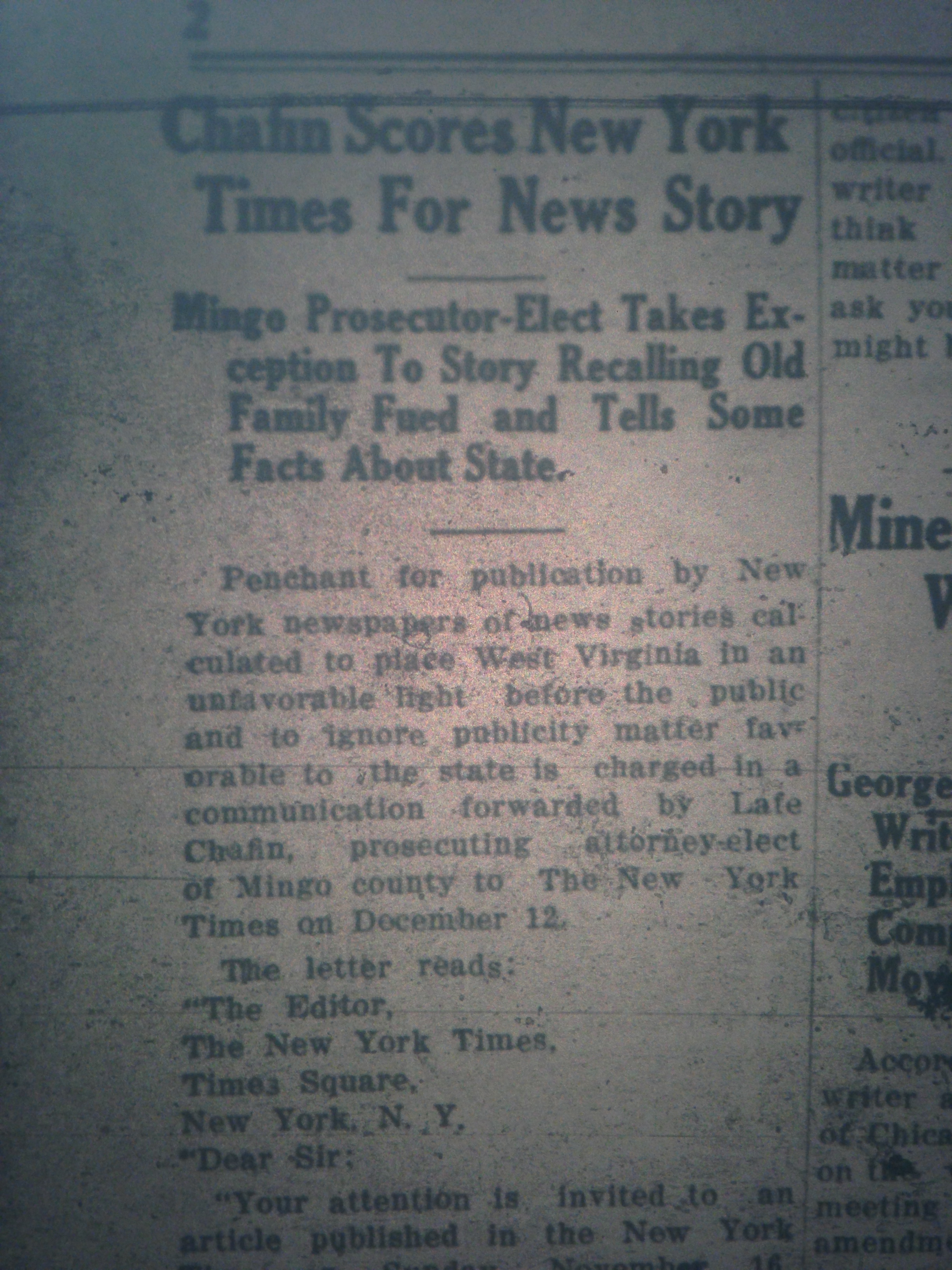
Perceptions of the Hatfield-McCoy Feud and of Southern Appalachia in general often differ greatly among insiders and outsiders. The following letter from Lafe Chafin of Mingo County, WV, reveals his disdain for inaccurate reporting by the New York Times about the feud and his community:

IMG_0083.JPG

Chafin Scores New York Times For News Story

Mingo Prosecutor-Elect Takes Exception To Story Recalling Old Family Feud and Tells Some Facts About State.

Penchant for publication by New York newspapers of news stories calculated to place West Virginia in an unfavorable light before the public and to ignore publicity matter favorable to the state is charged in a communication forwarded by Lafe Chafin, prosecuting attorney-elect of Mingo county in The New York Times on December 12.

The letter reads:

The Editor

The New York Times.

Times Square

New York, N.Y.

Dear Sir:

Your attention is invited to an article published in the New York Times on Sunday, November 16, 1924, on page 20 of section 8, headlined, “One More Hatfield Bites the West Virginia Dust.” The article appears on the back page of section 8. Hence, it is apparent to the reader that you did not care to dignify it as news matter for the public but simply used as filler. No doubt you had run out of anything else to print on this page and so ran this in the thought that it would be interesting reading for those who have heard of the feud days in West Virginia. The article is unsigned. Hence, I am taking you, as editor, to task for permitting the publication of it and what I shall say will be offered in a spirit of friendly criticism and I hope you will accept it as such.

To begin with, you deliberately publish an untruth when you say, at the head of the article, that Alex Hatfield was killed and that Mingo county was humming and teaming with excitement. It is true that a man by the name of Alex Hatfield was shot about ten days prior to the recent election, but it is not true that he was killed, or even seriously wounded. He sustained a flesh wound and this is known only to a few people. Alex Hatfield is not the son of the mountaineer who started as bloody a feud as the south has ever known. In fact, he is not related in any way to the Hatfields who were involved in the so-called Hatfield-McCoy feud. The writer of the article simply seized upon the fact that a Hatfield had been shot as an excuse to rehearse his conception of the so-called Hatfield-McCoy feud, and he proceeds to write in a dime-novel fashion his notion of what happened in the fight between the Hatfields and the McCoys.

If it were not for the fact that your paper is read so universally and by people who do not know of conditions in West Virginia and Mingo county, I should not write you this letter. The so-called Hatfield-McCoy feud is dead and has been dead for twenty-five years or more. Every community, like every family, has its family skeleton, but we bury our skeletons and try to keep them buried until someone like you comes along and resurrects them.

I shall not take the time to point out all the slander and untruths included in this article, because most of it is untrue, as all who know conditions here will attest. I want particularly to call your attention to the fact that the apparent excuse for the article, if any there is, lies in the fact that a man by the name of Hatfield was shot about ten days prior to the recent election. Notwithstanding the fact that he only sustained a flesh wound, you carry a story in this article almost a month later, to-wit, November 16, 1924, that he was killed and that the county was all in excitement and that it has never forgotten the days of the so-called feud. A publication of the standing of The Times cannot afford to publish such misstatements and to libel this community in such manner.

Would it not be better to publish facts about West Virginia and about our community? In the thought that you were misinformed in this instance, I purpose giving you some facts that you can publish with safety and without fear of contradiction.

The population of West Virginia in 1920 was 1,500,000. Ninety per cent of the population is native white American. Less than four per cent is foreign born. Ninety-eight per cent of the farm population is native American stock. Less than six per cent of the population is illiterate. The per capita wealth is $1,429.64. There are twelve state educational institutions to train for leadership in the professions. There are 213 high schools, with an enrollment of 35,000. There are 1,800 high school teachers. Five thousand five hundred complete high school courses each year. There are 500,000 enrolled in the elementary schools. The per capita cost of education based on enrollment is $44.20.

This is the kind of publicity we want and we feel it is the kind that we deserve. Our natural resources are unmatched by any other state in the union. While these resources are decreasing, our human resources are increasing, in value. Like any community, we have had, and how have our problems, but we are doing our best to solve them. You are not helping us to solve them by publishing such articles as you published in our issue of November 16.

I would be glad to know that you have given some attention to this letter, and it seems to me that in justice and fairness to our county the party responsible for the article appearing in your issue of November 16, should be taken to task.

It so happens that I am the prosecuting attorney-elect of Mingo county and I resent such libel, not only as a citizen of the county, but as an official. Since I cannot prosecute the writer of the article for this libel, I think I at least ought to take this matter up with you as the editor and ask you to correct it insofar as you might be able to do so.

Yours very truly,

Lafe Chafin

Source: Logan (WV) Banner, 19 December 1924.

Confederate Pensions in West Virginia (1929)

24 Monday Sep 2018

Posted by Brandon Ray Kirk in African American History, Big Creek, Big Harts Creek, Boone County, Civil War, Crawley Creek, Holden, Logan, Man, Pecks Mill, Whirlwind

≈ Leave a comment

Tags

A.B. White, A.L. Browning, A.V. Pauley, African-Americans, Andrew Jackson, Appalachia, Band Mill Hollow, Big Creek, Boone County, C.H. Gilkinson, civil war, Confederacy, Confederate Army, Crawley Creek, Curry, Dave Bryant, Dyke Bryant, Dyke Garrett, Ethel, genealogy, Gettysburg, Green Thompson, Harrison White, Harts Creek, Harvey Chafin, Henlawson, Henry Mitchell, history, Holden, House of Delegates, Hugh Avis, J. Matt Pauley, Jackson McCloud, James Zirkles, John Bryant, John Neece, Joseph Lowe, Judy Bryant, Kistler, Leslie Mangus, Logan, Logan Banner, Logan County, Lucinda Spry, M.T. Miller, Madison, Man, Martha Jane Smith, Melvin Plumley, Mingo County, Monaville, Mt. Gay, Pecks Mill, preacher, Shegon, Slagle, slavery, Steve Markham, Stollings, Union Army, W.C. Turley, Wade Bryant, Wayne County, West Virginia, Whirlwind, William C. Lucas, William Chafin, William Workman, Zan Bryant

In 1929, the State of West Virginia nearly opted to allocate a monthly pension to its Confederate veterans, as well as blacks who had served the Confederate Army in service roles. In covering the story, the Logan Banner of Logan, WV, compiled a list of its remaining Confederate veterans.

HOW MANY VETERANS?

A pension of $20 a month is provided for Confederate veterans of the state by a bill passed by the Senate last week and sent in the House for concurrence. Senator M.T. Miller, of Boone county, who said he could not vote to pension men who had carried arms against their government, cast the only vote against the proposal.

A Charleston paper says there are only about 60 Confederate veterans living. This paper cannot believe that, although it has no information on the subject. How many are there in Logan county? Does anyone know? Has anyone an approximately correct list? If so, will he or she make the fact known? Uncle Dyke Garrett probably knows most of them.

The Banner would like to obtain a list of both Confederate and Union veterans still living in the county, together with their post office address.

Source: Logan Banner, 26 February 1929.

***

AS TO OLD SOLDIERS

The Banner’s request for information about old soldiers living in Logan county has not been in vain, nor has the response been satisfactory. The names of four confederate veterans have been turned in, as follows:

Rev. Dyke Garrett, Curry, beloved and venerable minister; William Workman, Shegon, who fought at Gettysburg and is now 88; Steve Markham, Holden No. 20, who has been blind for 20 years; and William Chafin, who lives with his son Harvey, at Holden 5 and 6.

Who are the others? Send in their names and addresses and any information you deem of interest concerning their careers as soldiers and citizens. The same information about Union soldiers, residents of the county, is likewise desired.

Logan Banner, 5 March 1929.

***

PREPARING THE ROLL

Another name has been added to the list of old soldiers that The Banner has undertaken to compile. Reference is to J. Matt Pauley, residing in Band Mill Hollow, post office Stollings. He was in the Confederate army, fought throughout the war and was wounded, writes Mrs. A.V. Pauley of Ethel. He is of the same age as Uncle Dyke Garrett.

The names of four survivors of the War Between the States, all living in Logan county, were published in Tuesday’s paper. There must be others. Who are they?

Today, W.C. Turley brought in a list of eight Confederate veterans, including the following new names: Wm. C. Lucas, Big Creek; Henry Mitchell, Henlawson; Hugh Avis, Green Thompson and John Neece, Logan; Harrison White, Pecks Mill.

Logan Banner, 8 March 1929.

***

On Confederate Roll

Two more names have been added to the roll of Confederate veterans that The Banner is preparing. These are James Zirkles of Man, whose name was sent in by Leslie Mangus, of Kistler, and Zan Bryant of Whirlwind, whose name was recalled by County Clerk McNeely. Are there not others besides nine or ten previously published?

Logan Banner, 12 March 1929.

***

Confederate Veterans Living Here Number at Least 17

There Are Probably  Others–Will You Help to Enroll Them–All Merit the Tender Interest of Younger Folk

Seventeen names of Confederate soldiers, residents of the county, have been collected by The Banner. Wonder if any have been overlooked, or if the appended list is in error in including any Union veterans? If any reader knows of a Confederate soldier not listed here, please send in the name and address AT ONCE. There will be no further request or reminder.

This paper undertook to make up a list of these old soldiers for two reasons. Chief of these was a desire to prevent any of them being overlooked in case a bill to pension them was passed by the legislature–but the writer does not know yet whether or not that bill was enacted into law. Another reason for assuming the task was to test in a limited way a statement in a Charleston paper that there were only 60 Confederate veterans left in the state. That statement was doubted, and with good reason judging from the number polled in this county. Anyhow, the ranks have become terribly thinned. Every few days we all read of taps being sounded for another one here and there.

Middle-aged men and young folk should esteem it a privilege to do something to brighten the lives of these old soldiers. As the years roll by our pride will increase as we recall our acquaintance with and our kindness toward the “boys of ’61 and ’65.”

Here is the list. Look it over, and if there is a name that should be added or a name that should be stricken out, or any error or omission that should be corrected or supplied, speak up:

James Zirkles, Man; Zan Bryant, Whirlwind; J. Matt Pauley, Ft. Branch; Uncle Dyke Garrett, Curry; William C. Lucas, Big Creek; Henry Mitchell, Henlawson; Hugh Avis, Green Thompson and John Neece, all of Logan; Harrison White, Pecks Mill; Melvin Plumley, Crawleys Creek (post office not known); William Workman, Shegon; Steve Markham, Holden No. 20; William Chafin, No. 5 and 6.

Logan Banner, 15 March 1929.

***

Two Names Added Confederate Roll

Bill to Pension Them is Defeated By Parliamentary Tactics in House

Names of two more Confederate soldiers living in the county have been sent to The Banner. They are: C.H. Gilkinson, minister, resident of Holden, who was born and reared in Wayne county, and is the father of Dr. L.W. Gilkinson. Jackson McCloud, a resident of Whirlwind on Harts Creek. His name was supplied by A.L. Browning of Monaville, who says he feels sure that Mr. McCloud was in the Confederate service and fought at Gettysburg.

Assuming both names should be added to the roll, it means that there are at least 19 Confederate veterans still living in Logan county, seventeen names having been listed and published a week ago.

For many of them there will be disappointment in the information that the bill to pension them did not pass. Sponsored in the Senate by ex-governor A.B. White, the son of a Union soldier, the bill passed, that body, Senator M.T. Miller of Madison casting the only vote against it. In the House of Delegates it was amended, by a majority of one, to include Negroes, whether slave or free, who had served in the Confederate army of cooks, personal servants, or otherwise, and later tabled.

Source: Logan Banner, 22 March 1929.

***

Slagle Man 17th in Confederate List

Zan Bryant Probably Oldest Veteran In County–Born in Jackson’s Time

Joseph Lowe of Slagle is the latest name to be added to the list of Confederate veterans that has been compiled by The Banner. However, that leaves the count at 17, as the name of Melvin Plumley of Crawleys Creek was erroneously included in the published list. He was a Union soldier, it seems.

Of all those listed Zan Bryant of Whirlwind must be the oldest. He is said to be 98 years old and his wife, Judie Hensley Bryant, 91. They have been married for 75 years and have a son, Dave Bryant, who is 73. There are five other children, Dave, John, Wade and Dyke all live on Harts Creek, most of them near their parents; Mrs. Martha Jane Smith at Gay, and Mrs. Lucinda Spry of Mingo county.

This venerable couple have spent all their years in the isolated Harts country, their home being on White Oak fork, and can be reached only by a long horseback ride.

When Zan was born Andrew Jackson was president and Logan county as a political subdivision was but five years old. He was 23 years old when married and 30 when the War Between the States began.

Logan Banner, 26 March 1929.


Baisden Family Troubles

13 Thursday Sep 2018

Posted by Brandon Ray Kirk in Hatfield-McCoy Feud, Kermit

≈ Leave a comment

Tags

Appalachia, Brit Jones, Buchanan County, Carroll County, Catherine Wills, Catlettsburg Republican, crime, Flora Baisden, Floyd County, genealogy, Grant Bollman, Grover Waldron, Grundy, Harrison Baisden, Harrison Baisden Jr., Hatfield-McCoy Feud, Hiram Wills, history, Ira J. McGinnis, Jack Maynard, James Brewer, Jeffersonville, John Brewer, John Henry Baisden, John Lee White, John Smith Baisden, Johnson County, Kentucky, Lebanon, Lee Brewer, Lewis Dempsey, Logan County, Logan County Banner, Logan Democrat, Marrowbone Creek, Martha Baisden, Mingo County, murder, Naugatuck, Parkersburg Sentinel, Pigeon Creek, R.W. Buskirk, Reuben Baisden, Riley Brewer, Robert Irons, Robert L. Baisden, Ruby Harrison Baisden, Trace Fork, Virginia, West Virginia, William Baisden, William Bevins

Between 1883 and 1891, several members of the Baisden family suffered troubles in their section of West Virginia and Virginia. What follows are some news and other accounts of those events:

At the mouth of Pigeon creek, in Logan county, Grant Bollman and Dr. Harrison Baisden got into a difficulty over a settlement, short words brought blows, when Bollman used a knife severely if not fatally stabbing Baisden. Thereupon he drew a revolver and shot Bollman, who died the same day from the effects of the wound. There is little hopes of the recovery of Baisden.

Parkersburg (WV) Sentinel, 18 August 1883

***

Judge McGinnis has issued a vacation order to the Circuit Clerk of Wayne County admitting Dr. Baisden, charged with the murder of Yancy Bolin, in Logan County, to bail in the sum of $2,000.

Huntington (WV) Advertiser, 31 July 1886

***

According to one item printed in an old genealogy newsletter: “John Smith Baisden was born May 14, 1864. On May 29, 1885 he married Martha Jane Wills who was born in Carroll County, Virginia, on August 4, 1870, the daughter of Hiram and Catherine Massey Wills. Martha had come to Floyd County, Kentucky, in a wagon train in 1879. She was fifteen when she married John Smith Baisden. They had two children: Flora, who was born on January 8, 1888, and Ruby Harrison “Harry” Baisden [February 7, 1890]. On May 4, 1890, John Smith Baisden was shot and killed by John Brewer and John Lee White, while the family was visiting in West Virginia. He was shot in an argument over a horse. It is thought that his murder was indirectly associated with the Hatfield-McCoy Feud. The Baisdens became involved after relatives married McCoys. About the same time of his father’s death, the Hatfields kidnapped and imprisoned Ruby Harrison Baisden (then only a child) and other members of the McCoy clan, and held them in a log barn in what is now Mingo County, West Virginia. Ruby Harrison Baisden was found by a roadside where he had been left for dead. Soon after John S. Baisden’s death, Martha, against the advice of family members, returned to Kentucky by horseback, traveling at night over lonely mountain trails with her son and daughter.”

***

Last week several capias against John Henry Baisden and John Smith Baisden were placed in the hands of the Sheriff of this County. The Baisdens had established the very unenviable name of being dangerous and desperate men, and, a part of the process was placed in the hands of Wm. Bevins with instructions to go by way of Marrowbone to summon a guard who knew the haunts of the Baisdens and to locate them if he could and meet the Sheriff, who was accompanied by Jailor Buskirk, Deputy Sheriff McDonald and several guards, at the mouth of the Trace Fork of Pigeon. Mr. Bevins arrived on Marrowbone on Friday morning and learned that just before his arrival the Baisden boys had made an attack on the house of James Brewer with Winchester Rifles, and that assisted by John Lee White, he had repelled the attack, mortally wounding John Smith Baisden. On learning this Mr. Bevins at once summoned a posse consisting of John Lee White, Brit Jones, James Brewer, Riley Brewer, Lee Brewer and John Brewer and followed the Baisdens to Pigeon Creek. Locating them at Dr. Harrison Baisden’s, Bevins left all of the guard about a quarter of a mile from the house, except John Lee White, who he took with him to find the position of the Baisden boys. As soon as he came in sight of them he demanded their surrender, which they refused to do and fire was opened on them. James Baisden was killed and John Henry Baisden was badly wounded and captured. William Baisden having left the crowd made his escape and is still at large. John Henry Baisden was brought to this place and is now in jail. He was shot through both arms and in the right side, but his wounds are not dangerous. All parties regret the killing of young James Baisden, as there was nothing against him. Heretofore a man in this county had thought that to establish for himself the name of a dangerous man was all the security that he needed against the officers of the law. That is now changed and all of them will hereafter be hunted down.

Logan County (WV) Banner, 24 April 1890

***

John Smith Baisden, who was shot by James Brewer and John Lee White, on April 18th, while making an attack on Brewer’s house, died last Sunday evening.

Logan County (WV) Banner, 8 May 1890

***

On Monday morning John Henry Baisden was turned over by the authorities of West Virginia to Wm. A. Bevins upon a requisition from the Governor of Virginia. Baisden is wanted in Buchanan county, Va., for the murders of a man named Irons. Bevins, accompanied by R.W. Buskirk and Lewis Dempsey, started with Baisden to Jeffersonville, Va., where he will be confined for safe keeping until the Buchanan authorities are ready for his trial. He was not taken to Buchanan as there has been some talk of lynching him there.

Logan County (WV) Banner, 26 June 1890

***

R.W. Buskirk, Wm. Bevin and Lewis Dempsey, who took John Henry Baisden to Virginia on a charge of murder, returned on Sunday. The prisoner was first taken to Jeffersonville, then to Grundy, and finally to Lebanon as neither the Jeffersonville nor Grundy Jail were safe.

Logan County (WV) Banner, 10 July 1890

***

A Logan Man Gone Wrong.

Wm. Baisden, formerly of this county, was last week sentenced to the Virginia penitentiary from Buchanan county, for the term of 18 years, for the murder of a man named Irons, some two years ago. Outside of whisky, Baisden was regarded as a good man, and had a great many friends on the Sandy side of our county, where he was raised, and where his relatives now live.

Logan County (WV) Banner, 6 August 1890

***

Baisdens Allowed to Escape.

John Henry Baisden who killed Robert Irons in Buchanan county, Va. last fall and who afterwards figured in a terrible tragedy in Logan county, W.Va., and who was captured and taken to Virginia has been allowed to escape. After killing Irons, he fled to W.Va. to find another man living with his wife. He got a party of his relatives and went to attack the man, but was met by an officer and posse in search of him. Two desperate fights ensued between the two parties on consecutive days and Jim and John Smith Baisden were killed. John Henry was captured, after being seriously wounded, and lodged in jail. The parties who captured him in W.Va. delivered him to the authorities all right and received the Reward. He was afterwards sent to Russell county jail and being taken back to Buchanan for trial was taken from the guard by his brother. It is thought that the officers were willing that the prisoner should be rescued.

Catlettsburg (KY) Republican via the Logan County (WV) Banner, 21 August 1890

***

Murder on Sandy.

Monday afternoon Harrison Baisden, Jr., a member of the notorious gang of Baisden outlaws came down to the Mouth of Pigeon where there was a whiskey boat moored on this side of the river. He took his horse across to the Kentucky side, and then returning, he walked deliberately up to Jack Maynard, between whom and himself, it appears, there had been some bad blood, and shot him through the head, killing him instantly. The last heard from Baisden he was in Kentucky riding from about five men, who were pursuing him hotly. As the report says he was very drunk and the men were only a mile behind, the chances are that he is captured by now. It is feared that if he is caught that he will be lynched.

Logan County (WV) Banner, 3 September 1891

***

Found Dead.

A rumor has reached us that Reuben Baisden, the murderer of Jack Maynard, was found dead at the head of a lonely creek, in Johnson county, Kentucky, with fifty-three bullet wounds on his body and his dead horse lying on him. It was thought that he had been dead about three days when found. We do not credit the story.

Logan County (WV) Banner, 17 September 1891

***

Manslaughter for Dr. Baisden

In the Mingo criminal court last week, Dr. Robert L. Baisden was found guilty of voluntary manslaughter for killing Grover Waldron, at Naugatuck on April 23, of last year.

The evidence showed that young Waldron was stabbed to the heart on the above named night near the signal tower at Naugatuck. Dr. Baisden was coming down the tower steps when some person threw a beer bottle against a stone wall not far away. Young Waldron and two companions were standing near the foot of the steps.

Using an oath Dr. Baisden inquired who threw the bottle at him and there came a reply and also an oath, that it was for him and some one of the three also called out that they would send Dr. Baisden to hell “feet first” if he was not careful.

Logan (WV) Democrat, 20 April 1911

Allen Hatfield of Beech Creek, WV (1970s)

11 Tuesday Sep 2018

Posted by Brandon Ray Kirk in Hatfield-McCoy Feud, Matewan, Tazewell County

≈ 4 Comments

Tags

Allen Hatfield, Appalachia, Beech Creek, Beni Kedem, Charleston, Charlie Simpkins, Cincinnati, civil war, Clyde Kiser, Deanna Hatfield, Devil Anse Hatfield, Devon Church of Christ, Doc Mayhorn, Eliza Murphy, Ellison Hatfield, feuds, Frankfort, genealogy, Goldie Hatfield, Gordon Smith, Grapevine Fork, Hatfield-McCoy Feud, history, Hugh C. Boyd Lodge No. 119, Jane Hatfield, Jane Maynard, Joseph Chester Hatfield, Joseph Murphy, Kentucky, Kentucky Colonels, Lawrence Hatfield, Logan County, Major Hatfield, Martha Bell Murphy, Maryland, Mingo County, Norfolk and Western Railroad, North Tazewell, Ohio, Pike County, Plyant Mayhorn, preacher, Raymond Hatfield, Right Hand Fork, Rockville, Thacker, Valentine Wall Hatfield, Virginia, West Virginia, Williamson, Williamson Memorial Hospital, Willis Hatfield

My name is Deanna Hatfield and tonight I would like to share with you a West Virginian, Allen Hatfield, who the community of Beech Creek honored and loved. Allen was born October 11, 1877. He was the youngest child of the pioneer couple, Wall Valentine Hatfield and Jane Maynard Hatfield, who settled on Beech Creek in 1861, the year that the Civil War broke out in this country. His parents had settled at the mouth of Grapevine Fork of Beech Creek. They had occupied a log cabin near the present site of Lawrence Hatfield’s home. He was the nephew of Captain Devil Anse Hatfield, clan leader in the famed Hatfield-McCoy Feud, and a first cousin of Willis Hatfield, the only surviving child of that family.

Almost until the day of his death, Allen carried a sadness in his heart over the death of his father in the days of the famous feud. His father, a peaceable man, was not an active member of the fighting group of the Hatfields during the trouble between his family and the McCoys but was named in warrants along with two of his sons-in-law, Doc and Plyant Mayhorn. Allen Hatfield, but ten years old at the time, remembered that his father Wall, thinking that he had nothing to fear in the courts of Kentucky, wrote the prosecuting attorney of Pike County that he and his sons-in-laws wished to surrender in Pikeville and stand trial for crimes for which they were accused. Allen Hatfield recalled the incident from his boyhood, including the feud. His father did go to Pikeville to voluntarily stand trial and clear his name but he was convicted by a prejudiced jury, the son remembered, and was sentenced to life imprisonment at the Kentucky State Prison in Frankfort. After sentencing, he lived about one year and his burial place is still unknown today. The two Mayhorns served several years and were later pardoned.

One of his fondest memories was that of his mother Jane who took over the management of the home and did a good job of raising a large family after her husband was taken from her. She did chores around the homestead. A great and interesting conversationalist in his adult years, he liked to tell of how he and his friends made bows and arrows–arrows consisting of straight pieces of wood with a horseshoe nails attached as the spike. He became an excellent marksman with the bow and arrow and later with his first rifle as he helped to provide squirrels and other wild game for the family table.

The early years of Hatfield’s life were marked by sadness as a result of the loss of his family in the feud. But his hours spent in the great outdoors hunting and fishing provided a therapy that led to his development to splendid manhood. He was several years old when the Norfolk and Western Railroad Company built an extension from Virginia to southern West Virginia and Mingo County, which still was Logan County at that time.

In 1899, Hatfield was married to Martha Bell Murphy, daughter of Joseph and Eliza (Steele) Murphy. She had just turned fourteen when he proposed and her family thought she was too young to wed. The young couple sort of eloped the night of April 8, 1899, to Allen’s home where they were married by Allen’s brother, Ellison, a country preacher and a granny doctor, as he later recalled. Late that summer, he amassed enough lumber to build their first home—a one-room abode that was erected next to the hillside just north of the present homestead. Allen Hatfield made most of his furniture and his wife tended a garden and dug ginseng to help the family fortune.

During the ensuing years, the Hatfields had eleven children, two of whom preceded them in death. Lawrence Hatfield, who married Dollie Kiser, is now retired and lives with Dollie on Beech Creek at the mouth of Grapevine Fork. Estel Hatfield, who married Virginia Varney, lived with his dad and still lives in the old homeplace. Estel is an agent for the Norfolk and Western Railroad Company. Major Hatfield, who married Mildred Friend, is employed as an agent also for the Norfolk and Western Railroad Company in North Tazewell, Virginia. Rosa Hatfield, married Wayne Simpkins, lives on Beech Creek on Right Hand Fork. Goldie Hatfield married Gordon Smith, and they make their home below Grapevine Fork on Beech Creek. Mamie Hatfield married Charlie Simpkins and makes her home in Rockville, Maryland. Glendeen Hatfield married Douglas Berlin, and they make their home in Louisiana. Etta June Hatfield, never married and lives in Cincinnati, Ohio. Erma Hatfield married Forest Baisden, and she lives in Williamson, West Virginia. Milda Hatfield, deceased, was a retired school teacher and was never married. Joseph Chester Hatfield, died at six months old.

In 1914, Allen bought from his brother Smith a grocery store at the old homeplace and moved the merchandise to a small building at his home. He built a large home later and it was there that most of the children were born. He expanded his business to a larger store building, which still stands, and then he erected the present homeplace. During his early merchandising days, Hatfield was compelled to haul his goods from the railway station at Devon by team and wagon for the roads had not been built and most of the rough team tracks was through the creeks. It was a problem in the wintertime to get through the streams as they were filled with ice. After the county built a road up Beech Creek, he retired his team and wagon and switched to a gasoline-powered vehicle to haul and deliver his goods. He learned carpentry in the early years of his marriage and continued this art until 1964 when he retired. Hatfield was a 57-year member of the Hugh C. Boyd Lodge No. 119 AF & AM at Matewan and received his 50-year service award from the Grand Lodge of West Virginia in 1970. The lodge, when he became a master mason, was known as Thacker No. 119. It was located at Thacker, West Virginia. It later was moved to Matewan. He also belonged to the Beni Kedem Temple of Charleston, being a 50-year member of the Shriners. He also received the honorary commission of a Kentucky Colonel on April 10, 1972. He had been a member of the Devon Church of Christ since 1916 and sponsored the building of the present church that stands near his home on Beech Creek.

In his years of selling groceries, Hatfield said he never lost but 50 dollars in bad debts. He was proud of his heritage, a leader in his community, and in his active life a crack shot with a rifle, pistol, and shotgun. His hunting and fishing kept the table supplied with food. He won beef, hogs, turkeys, and chickens in the old-time rifle matches that were so popular in the Beech Creek area years ago. He and the former Martha B. Murphy were married 71 years before her death on May 25, 1970. His life might have been used as the subject by the poet who wrote, “Let me live by the side of the road and be a friend to man.” Allen Hatfield had spent a lifetime doing just that, living beside a little country road on Beech Creek and being a friend to mankind. On March 2, 1975, Allen was taken to the Williamson Memorial Hospital for ailments associated with his advanced age. He then was released and re-entered the hospital on April 18 in critical condition. On Friday, May 2, 1975, the community of Beech Creek lost one of the dearest old-timers that was ever known. Allen Hatfield, 97, prominently-known Mingo pioneer citizen, retired merchant of Beech Creek, died at 3 a.m. in the Williamson Memorial Hospital of a lingering illness. Funeral services were scheduled at the Chambers Funeral Home Chapel with his beloved ministers Clyde Kiser and Raymond Hatfield officiating. Burial took place in the family cemetery behind the homeplace on Beech Creek. His grandsons and great-grandsons were his pallbearers. Allen would have wanted it this way. Simple.

NOTE: Some of the names may be transcribed incorrectly.

Nancy Hatfield, Widow of Cap, Identifies the Cause of the Hatfield-McCoy Feud (1937)

31 Friday Aug 2018

Posted by Brandon Ray Kirk in Hatfield-McCoy Feud

≈ 2 Comments

Tags

Appalachia, Bill Staten, Bob Hatfield, Cap Hatfield, crime, Devil Anse Hatfield, Ellison Hatfield, feuds, genealogy, Hatfield-McCoy Feud, history, Howard Alley, Island Creek, Kentucky, Logan, Logan Banner, Logan County, Mingo County, Nancy Hatfield, Paris McCoy, Pike County, Randolph McCoy, Sam McCoy, Tolbert McCoy, true crime, West Virginia

From the Logan Banner of Logan, WV, comes this story by Howard Alley titled “The Hatfield-McCoy Feud” and dated May 10, 1937:

The Hatfield-McCoy Feud…

“Aunt Nancy” Hatfield, Widow of “Cap” Hatfield, Relates That Historic Feud Actually Started Over An Election Argument When “Uncle” Ellison Was Killed Following Argument With a McCoy

Much has been said and many volumes have been written about the historic Hatfield-McCoy feud which took place in Logan and Mingo counties in the latter part of the last century. Lecturers have said the feud started over a razor-backed hog, and novelists have written that it began when a McCoy married a Hatfield lass and deserted her after he learned that she was to bear him a child. Both theories have their foundation in tradition, but neither Hatfield nor McCoy close to the feud has been quoted as saying either was right. Yesterday the mystery was cleared up. Because it seemed so utterly preposterous that two solid, level-headed mountain families with the solidity of the English for a background could wage a ten-year killing spree over a razor-backed sow when the woods were full of the animals, and because it was equally as improbable that the feud started over unhappy marital relationships when it is an established fact that mountaineers let their offspring take care of their own home life, we decided yesterday afternoon to find out what event was the spark which actually set off the powder magazine of mountain passion which rocked the hills of this section for nearly a decade.

And in the warm sunshine of a late spring Sunday afternoon we sat on the porch of the late William A. (Cap) Hatfield’s rambling frame home on the upper stretches of Main Island Creek and talked to “Cap’s” wife, the last survivor of those who were closest to the Hatfield clan in the feud.

“Aunt Nancy”, who has survived seventy winters and admits that she is “young and has the ‘hang’ of it,” but “don’t think I can do it again”, gazed reminiscently out over the newly-turned acres of her husband’s creek bottom estate, and her eyes grew misty as she told us of the closing years of the last century when Hatfield and McCoy alike expected death at every bend of the creek.

“That feud didn’t start over no ‘hog lawsuit’ and it didn’t start over a Hatfield-McCoy marriage,” Mrs. Hatfield said in a tone that showed plainly her disgust for those writers who had written of the feud and by twisting the facts had capitalized on it. “I’ve got a red-backed book two inches thick here that one of my sons brought to me and said: “Read this, Ma, and you’ll find out why we fought the McCoys.’ I read it–two pages of it–and it’s layin’ in there now with dust on its backs. Not a word o’ truth in it.”

She grew repentant.

“But they have to make their livin’, I guess. You want to know how it started? I’ll tell you. The Hatfields was always a political family, and it was their politics which got ’em into this fight. If they hadn’t gone to that election in Pike county in August of 1882, ‘Uncle’ Ellison would never have been killed and Ellison’s brother, ‘Devil’ Anse would never have been drawn into it. But I’m gettin’ ahead of my story. The way it was, ‘Uncle’ Ellison Hatfield was an officer in Logan county in 1882 and was sent out to arrest Sam and Paris McCoy who was supposed to have killed Bill Staten, ‘Uncle’ Ellison’s brother-in-law. These boys warn’t sons of Randall McCoy, ringleader of the McCoys. They were just cousins. He got the two boys and brought them to Logan county jail in Logan and afterwards testified agin’ them in a trial. The McCoys were ‘sent up’ for the killin’. Then in August ‘Uncle’ Ellison went to Pike county to ‘work’ at the polls, and it was so ordered that he was working for a man that the McCoys were agin’. Well, the only thing that could happen did happen. One of Randall McCoy’s sons, just a little twenty-one-year-old shaver, started a argument with ‘Uncle’ Ellison, and Ellison, who was always too high tempered for his own good, slapped him down. The little feller bounced up, and Ellison slapped him down agin’. But this time he jumped on top of him, and ’bout the time he drawed back his fist, aimin’ to end the fight, a shot rung out and ‘Uncle’ Ellison toppled over. He weren’t dead though. He told his friends to call ‘Devil’ Anse, who come a runnin’, and the McCoys ‘cleared out.’ ‘Devil’ Anse took his brother home and he lived from that Saturday until the next Wednesday. Just before he died, he said to Anse: ‘Anse, I want you to give the McCoys the ‘law’.’ And that’s what ‘Devil’ Anse did. He gave ’em the ‘law’ as he knowed it–and that was just about the only law in them days–and lived to see the justice handed out. And, well, you know as much about what happened after ‘Uncle’ Ellison died as I do. I don’t want to add any more tales to the list.”

We took the hint, and willingly began to talk about the celebration of “Aunt Nancy’s” birthday last September when she fell off her back porch and was told by one of her sons that “she shouldn’t have been trying to turn handsprings at her age.”

“I wasn’t hurt bad enough to keep me from cuttin’ my birthday cake. And I gave Bob the smallest piece because he was so smart about me fallin’.”

Recollections of McKinley Grimmett of Bruno, WV 1 (1984)

31 Friday Aug 2018

Posted by Brandon Ray Kirk in African American History, Coal, Dingess, Guyandotte River, Holden, Logan, Man, Timber, Wyoming County

≈ 4 Comments

Tags

African-Americans, Alva Grimmett, Appalachia, Austin Grimmett, Baileysville, Big Cub Creek, Bruno, Buffalo Creek, Christian, Cole and Crane Company, Devil Anse Hatfield, Dingess, Edith Grimmett, education, Elk Creek, Ettie Grimmett, farming, genealogy, general store, Green Perry, Guyandotte River, Guyandotte Valley, Henderson Browning, Henderson Grimmett, history, Holden, Horse Pen Mountain, Johnny Grimmett, Landsville, Lilly Grimmett, Logan, Logan County, logging, Madison Creek, Mallory, Man, McGuffey Readers, McKinley Grimmett, Mingo County, Mud Fork, Nancy Grimmett, rafting, Ralph Grimmett, Rose Grimmett, Sand Lick, Sanford Grimmett, Slater Hatfield, Tennis Hatfield, Thomas Hatfield, Tilda Hatfield, timber, timbering, Travis Grimmett, Verner, Walter Buchanan, West Virginia, whooping cough, World War I, Wyatt Belcher, Wyoming County

McKinley Grimmett was born on November 30, 1896 to Henderson and Nancy (Hatfield) Grimmett at Sand Lick, Logan County, WV. On May 14, 1916, Mr. Grimmett married a Ms. Plymale, who soon died, in Logan County. One child named Alva died on June 21, 1919 of whooping cough, aged fourteen months. His World War I draft registration card dated September 12, 1918 identifies him as having blue eyes and light-colored hair. He was employed by Mallory Coal Company at Mallory, WV. On November 13, 1919, he married Matilda “Tilda” Hatfield, daughter of Thomas Hatfield, in Logan County. He identified himself as a farmer in both of his marriage records. During the 1920s, he served as a deputy under Sheriff Tennis Hatfield.

The following interview of Mr. Grimmett was conducted at his home on July 17, 1984. In this part of the interview, he recalls his family background and early occupations. Logging and rafting in the Guyandotte Valley are featured.

***

Would you mind telling me when and where you were born?

Right here. I was born about a mile up above here. I was borned in Logan County. The post office was Christian at that time. Christian, WV. It’s changed now. They throwed Christian out – it was over here at Christian – and they throwed it out and moved it over here to Bruno. Christian went… The mines stopped over there. And that’s where I was born, right here at Bruno, Logan County. Been here all my life.

What day were you born?

November 30, 1896.

Who were your parents?

Henderson Grimmett and Nancy Hatfield Grimmett.

What kind of work did they do?

They did logging work. All they had that day and time. Mule teams and ox teams.

Where did your dad do his work?

All over Logan County.

Did he have his own farm?

Oh yeah. Yeah.

How big was his farm?

It was about 287 acres.

Can you describe his house?

Well, the house was a two-story building. But he never did get… He took the fever and he never did get the upper story, all of it completed. He died at a very early age of 74. He put him up a little store. Got ahead a little bit. Had a store here. Come down and bought this place off Walter Buchanan and he deeded his five kids the homeplace up there. And then he stayed on it from ’21 to ’29. He died 19th day of January, 1929.

Who were your mother’s parents?

Oh, Lord, I can’t… Slater Hatfield was her daddy’s name. And I don’t know my grandma. My daddy, now they both was born in Wyoming County. Baileysville or somewhere in there. I think my mother was born over there in Big Cub Creek. She was a Hatfield. I don’t know where…

How many brothers and sisters do you have?

I had three brothers and three sisters. Sanford was the oldest one. Austin and Johnny. They’re all dead. I’m the only one that’s living. All my three sisters… Lilly was the oldest one, and Rose was the next one, and Ettie was the youngest. They’re all dead. All of ‘em but me.

Were you educated in Logan County schools?

Yeah, that’s all we got. Free schools. I believe we started off about three months out of the year. Right over there where that first house is sitting – a one-room school house. All of us kids.

What was the last year of school you completed?

I believe it was about 1914, I’m not right sure. ’15.

Did you use the McGuffey Readers?

That’s all we had. And the spelling books. And in the late years, why we had a U.S. history… A small one. Most of it was just about West Virginia. It wasn’t about the whole United States. And geography, we had that. Arithmetic. That was about all we had in free schools. We had to buy them all then. They weren’t furnished.

How did you meet your wife?

She was born and raised over here at Horse Pen in Mingo County. And that’s how we met. We were just neighbors.

What was her maiden name?

She was a Hatfield, too. But now they were… There’s three or four sets of them.

Was her family related to Devil Anse Hatfield?

Well, they was some… Not very close, though, I don’t think.

Which church did you belong to?

I don’t belong to any.

Did you belong to a church when you were younger?

No, never did. If I ever would have joined, I’d have stayed with it.

Do you remember the year of your marriage?

Yeah, I sure do. November 13, 1919.

How many children do you have?

Four. We have two boys and two girls. Travis Grimmett is the oldest. And Ralph, Edith, and Nancy.

What was your wedding like?

Well, we just got married and come right home. At that time, they didn’t have such things, to tell you the truth.

Who was the preacher?

Green Perry. Rev. Green Perry on Elk Creek. Rode a horse back when I went up there to get married. A pair of mules. I rode them mules.

Where did you first live after you married?

Right about a mile above here at the old homeplace.

You have lived here all of your life?

All of our life.

Was it always this populated?

No, no. Wasn’t three or four houses on this creek at that day and time. It was farm land. It’s all growed up now. All them hills was put in corn, millets, and stuff like that. If they couldn’t get a machine to it, they cut it by hand. Some of them raised oats and some of them raised millet, corn. Raised hogs and cattle and sheep and selling ‘em.

Who owned this property back then?

Burl Christian owned this here, but I don’t know… My daddy bought his… A fellow by the name of Wyatt Belcher. Wait a minute. Browning. I can’t think of his name. He lived over here on Christian and he bidded in… It sold for back taxes and he bidded in. Henderson Browning.

What kind of work did you do after you married?

Just the same thing as I worked at before I got married. I first started out – my daddy was a boss for Cole and Crane on this river. I first started out working in the log business. I worked two years at that and then I decided… Mule team – I worked about eighteen months at that. Then in 1913 the coal company started in and I went to work in carpenter work. I helped build all of these houses down here at Landville. The superintendent, we got done, they was wanting to hire men, he give me a job keeping time for a while. And he wanted me to learn to run the drum – that’s letting coal off the hill. I learned it and about the third day I was up there, a preacher was running it, and he told me they’d just opened up and they didn’t have much coal to run off the hill, he told me, that preacher, he rolled out two cards and he said if that preacher fails to go out and work on that side track today you give him one of these cards. Well, I didn’t give him a card. But he come out that evening, the boss did. And he said, did the preacher work. And I said, no he refused. He said, I’ll fix him. He fired him. And I took the job and stayed with it four years and then I got married and then I went to work over here at Christian running a drum and I stayed there 34 years.

When you worked for Cole and Crane, did either of those men ever come up here?

Oh yeah. One of them was. Cole was. I don’t think Crane was ever here. A little slim fella.

Did you get a chance to talk to them?

No, they wouldn’t talk to us working men. They’d talk to the boss. They’d go away from us and talk to theirselves. We just got a $1.10 for ten hours. Eleven cents an hour.

What kind of a person did Cole seem to be?

Well, he knowed how the men was. They’d raft timber and go down this river to Guyandotte. Had what they called locks and dams there to catch the logs. This river was full of logs. He bought timber everywhere. Plumb at the head of it.

Did you ever ride a raft?

Oh, yeah. I went with my daddy. I wasn’t grown.

Can you describe it?

Oh, they’d raft the logs, poplar. Now they didn’t raft hardwoods. They’d sink on them. Some rafts, a big one would be 160 to 200 feet long, about 24 to 26 feet wide. Oar on each end of it. If it was a big raft, they had two men up front all the time plumb in to Guyandotte. I was the second man on it when I got to go out on it. My dad had timber and he rafted it, took it there and sold it. Took what they called dog wedges and cut little basket oaks and rafted them, stringers across ‘em, you know. Lots of people get drowned, too.

Were you ever in an accident?

No, I never was in no big one. I’ve seen about six or eight drown.

Could you describe how it happened?

Oh, if he couldn’t swim, sometimes the best swimmer drowned, you know, if he got under a lot of logs or something. According to whatever happened there with him. He could get out if there wasn’t no logs on top of him no where to hold him under, you know. If logs were on top of him, he was gone. Now about the last ones I seen drowned was two colored people. They was building a railroad from Logan to Man up Buffalo Creek. So we was working on a log gorge down there at the lower end of Landville. And there was four colored men… 1921. Had a saloon up here at Verner. They wouldn’t allow one in Logan County. And they went up there on the 21st day of December to get ‘em a load of whisky. And they come back… They’d seen white people ride these logs. Some county people would get on one log and ride it plumb to Logan, as far as you wanted to go. And they thought they could ride it. And they got on. Rode ‘em off the gorge and they was running into eddy water and they would hit the back end, it would, and the other end would swarp out and they’d pull out that way. And they got on ‘em with their whisky and everything and two of ‘em got out and two of ‘em drowned.

When you rode the raft to Guyandotte, how did you get back to Logan?

Oh, we had to walk. We’d get a train up to Dingess over here. You know where that’s at? We’d ride down up to there. And then we’d have to get off and walk across the hill there and come right straight out at the mouth of Mud Fork, Holden there, and up another little drain and down Madison Creek down here. And walk… Man alive, our feet would be so sore, I’d be up for two or three weeks I couldn’t walk, my feet would be wore out so.

NOTE: Some names may be transcribed incorrectly.

History for Wyoming County, WV (1927-1928)

23 Monday Jul 2018

Posted by Brandon Ray Kirk in Coal, Native American History, Wyoming County

≈ Leave a comment

Tags

A.F. Wysong, Appalachia, architecture, Baileysville District, Barkers Ridge District, Center District, Charleston, Clear Fork District, coal, crime, Early Brothers, Gertrude of Wyoming, Guyan Heating and Plumbing Company, history, Huff's Creek District, Logan, Logan Banner, Logan County, Maughwaiwama, Mingo County, Mullens, Native American History, Native Americans, Oceana, Oceana District, Pineville, Princeton, Slab Fork District, Thomas Campbell, West Virginia, Wyoming County, Wysong & Bengston

From the Logan Banner of Logan, WV, comes this bit of history about Wyoming County, dated 1927 and 1928:

Wyoming County In the Public Eye

Now that three railroads are contesting for the authority to build a branch line across Wyoming county, increased interest is shown in the probable early development in that bailiwick.

Wyoming has coal resources equal to those of any other county in the state, it is said, and it has wide valleys of fine farming land, and an unusually picturesque mountain country. Like Mingo, it was carved out of Logan territory, its formation having been authorized by an act of the general assembly passed January 26, 1850. With an area of 507.30 square miles it is more than 50 miles larger than this county, yet its population in 1920 was only 15,180.

That county’s valuation for taxation purposes exceeded $28,000,000 last year.

Wyoming county is divided into seven magisterial districts, as follows: Baileysville, Barkers Ridge, Center, Clear Fork, Huff’s Creek, Oceana and Slab Fork districts.

Wyoming county was stricken off from the older county of Logan, which took its name from a celebrated Indian chief. Another county was formed from Logan, many years later, and to this was given the name of Mingo, the tribe to which Logan belonged. Logan, Mingo and Wyoming are the three counties in West Virginia whose names are derived from the original settlers.

Wyoming county bears the name of an Indian tribe, and this tribe was later honored by having its name adopted by one of our great western States. While the derivation of the name, in its application to the county, seems to be clear, the origin of the name itself is veiled in obscurity. By some authorities it is said to be a corruption of the Indian Maughwaiwama, signifying a plain, or open space. Others assert that it is a creation of Thomas Campbell, the poet, and author, of “Gertrude of Wyoming.”

Pineville, the present county seat, is located near the center of the county. It has an elevation of 1,323 feet above the level of the sea and had a population of 304 in 1920. Later estimates do not greatly increase this figure. Pineville became the county seat years ago, having secured the removal of the seat of justice from the older town of Oceana.

Mullens, a prosperous town and center of the coal industry, had a population of 1,425 in 1920.

Oceana, long the county seat before its removal to Pineville, had at the last census a population of 90.

Source: Logan (WV) Banner, 25 November 1927.

***

WYOMING COUNTY HAS NEW JAIL–NATIVE STONE USED–COST $150,000

Wyoming county’s new jail at Pineville has been accepted by the architects and will be formally turned over within the next few days.

Erected at a cost of approximately $150,000, the new bastille is perhaps one of the finest buildings of its kind in the southern part of the state. It is built of native stone throughout, and is a most imposing and beautiful building and one of which the county may well pride itself, says the Mullins Advocate.

It is three full stories high above the basements, heated by vapor, containing room for 70 prisoners with comfort, and can accommodate twice that number, if necessary. The cells and jail construction is of tool proof steel, equipped with the latest locking devices. A prisoner when confined in a cell, must go through three sets of tool proof steel bars to make an escape.

The building contains a large and comfortable residence for the jailer, including a large, well furnished and equipped kitchen, is supplied with hot and cold water throughout, including shower baths on the inside corridors of the jail, padded cells for the insane, hospitals for the sick and detention rooms for juveniles of both sexes.

In the basement there is an incinerator, together with a laundry and large supply rooms.

The building was formally approved on January 9th by A.F. Wysong of the firm of Wysong & Bengston architects, of Charleston, who had the construction of this building in charge. Early Brothers, of Mullens, contractors, constructed the building, while the heating system was installed by the Guyan Heating and Plumbing company, of Mullens. The plumbing was done by Wickline of Princeton. Mr. Wysong, after going over the jail carefully, approved the construction and recommended payment of the balance due on the several contracts.

Source: Logan (WV) Banner, 17 January 1928.

Whirlwind News 02.03.1928

29 Friday Jun 2018

Posted by Brandon Ray Kirk in Big Harts Creek, Queens Ridge, Whirlwind

≈ Leave a comment

Tags

Appalachia, Carl Adams, Charley Adams, genealogy, George McCloud, Harts Creek, history, Ireland Mullins, Logan Banner, Logan County, Mingo County, Peter Mullins, Queens Ridge, Robert Martin, Susan McCloud, Twelve Pole Creek, West Virginia, Whirlwind

An unknown correspondent from Whirlwind in Logan County, West Virginia, offered the following items, which the Logan Banner printed on February 3, 1928:

Carl Adams was visiting friends on Twelve Pole Friday.

Ireland Mullins was the all night guest at Mollie Robinson’s Friday.

Charley Adams is very ill at this writing.

We are glad that Carl Adams is improving.

George McCloud spent Friday night with his uncle R.L. Martin of Queens Ridge.

Susan McCloud was calling on friends at Peter Mullins’ Wednesday.

“Bad” Frank Allen (1927)

24 Sunday Jun 2018

Posted by Brandon Ray Kirk in Big Harts Creek, Culture of Honor

≈ 1 Comment

Tags

Andrew Howlett, Appalachia, Augustus Fowler, Ben Bartram, Bill Driver, Boone County, C.S. Wilson, Carroll County, constable, crime, Delbarton, Floyd Allen, Frank Adams, Frank Allen, genealogy, Harts Creek, Hillsville, history, Kirk, Leonard Conley, Lew Webb, Logan, Logan Banner, Logan County, McDowell County, Mingo County, moonshining, Moundsville, Nancy E. Ayres, Shanklin Creek, Sidna Allen, T.L. Massie, Virginia, W.M. Foster, W.M. Ray, Wallace Dillon, Welch, West Virginia, West Virginia State Penitentiary, Williamson, Wythe County

In 1912, Floyd Allen and other members of his family participated in a sensational gunfight during a trial at the Carroll County Courthouse in Hillsville, Carroll County, Virginia. The incident resulted in the death of Judge T.L. Massie, Prosecutor W.M. Foster, Sheriff L.F. Webb, juror Augustus Fowler, and witness Nancy E. Ayres, while seven others were wounded. In 1927, Frank Allen–a reputed relative of Carroll County Allens–was captured on Harts Creek in Logan County, WV.

Frank Allen Caught On Murder Charge

“Bad Frank” Allen was captured on Harts Creek last night and was lodged in jail here at 6 o’clock this morning. An hour or so later he was taken to Williamson to answer to a murder charge.

State police from Williamson, accompanied by Trooper Wilson and Constable Frank Adams, made the capture. They went to a house where he was known to be and called him to the door. As he appeared in view he was “covered” by high powered rifle and was commanded to drop a pistol he held in his hand. He refused to let go but one of the officers walked up to him and took possession.

Source: Logan (WV) Banner, 11 November 1927.

“Bad” Frank Allen Moved to Welch Jail for Safe-Keeping

Charged With Murder, He Eluded Officers from October 1 Until Captured on Harts Creek Week Ago–Kinsmen of Allens of Carroll Court House Fame.

“Bad Frank” Allen, who was captured on Harts Creek a week ago last night, to answer to a murder charge in Mingo county, was subsequently moved from the Williamson jail to the Welch jail for safe-keeping. Boys with hard heads or big feet are in the habit of kicking holes in the Williamson bastile, but a ball bearing nutmeg grater will be presented to the first one who bumps his way to freedom through the thick walls of the McDowell prison.

Allen is accused of killing Wallace Dillon at a horsetrading carnival held near the Baptist Association meeting on Shanklin Creek October 1. Stories of the affray are conflicting. It is said Dillon and others had a whale of a fight, after there had been much imbibing of strong liquor. In the free-for-all Dillon was a star performer, upsetting friends and foes with little regard for consequences. Allen missed the “party,” but when he heard that Dillon had beat up the other participants in the affray, he is said to have construed it as a challenge. Saddling his horse he rode to the scene of the fight and presumably without any provocation fired at Dillon with fatal effect. He escaped after the shooting and officials of both Mingo and Logan county waged a strenuous man hunt in an effort to capture him.

The arrest was made at the home of Leonard Conley in a wild and isolated corner of Harts Creek. His captors were Deputy Sheriffs Bill Driver and Ben Bartram, of Williamson; State Police Wamsley and McClure, of Delbarton, and State Trooper C.S. Wilson, of the Logan detachment.

Conley, wanted on a liquor charge, was not at home, but the officers had a tip that “Bad Frank” was there. One yelled for him to come out and he appeared in the doorway, pistol in hand, and ready to “shoot it out,” until he saw several high-powered rifles leveled at him. Even then he ignored the command to drop his gun, but stood motionless as an officer approached him and took possession of the weapon, which proved to be of 45-calibre.

Allen told his captors that during the six weeks he was a fugitive he had slept in caves and barns and had nearly starved at times. It is thought he fared much better in the hospitable hills of Harts, altho he said that was the first night he had sought shelter in a human habitation.

Big Shoot Recalled

Allen hails from Wythe county, Virginia, and is said to be a kinsmen of the Allens who shot up the Hillsville court house on March 14, 1912. Two of the clan were executed for the crime and Sidney Allen was released from prison on a conditional pardon a year or more ago, the first fusillade in the court upon Judge T.L. Massie and Sheriff Lew F. Webb fell dead. Augustus Fowler, a juror was shot through the head and died two days later. Commonwealth’s Attorney Forst was also shot. Andrew Howlett, another juror, was shot through the _____st. Another juror and Clerk of the court Dextor Goad were wounded but recovered. Miss Elizabeth Ayres received a death wound. Sidna and Allen Floyd were wounded also.

Source: Logan (WV) Banner, 18 November 1927.

Penitentiary Awaits “Bad” Frank Allen

“Bad” Frank Allen, whose recent capture under dramatic circumstances on Harts Creek, will be recalled by Banner readers, was found guilty of voluntary manslaughter in the circuit court at Williamson this week. Sentence has not been pronounced but that offense is punishable by from one to five years in the penitentiary.

This desperado of a picturesque type killed Wallace Dillon at a horse-trading gathering near Kirk, on October 1. State’s evidence indicated he rode on the scene when the crowd was watching a fight between Dillon’s brother and another man and shot Dillon without any provocation. Allen testified he shot in self-defense, claiming there was no ill feeling between them and that they were unacquainted.

Allen is 28 and said to be related to the Allens of Hillsville court house fame.

Source: Logan (WV) Banner, 16 December 1927.

“Bad” Frank Allen Escapes from Pen

“Bad” Frank Allen, said to be one of the Hillsville Allens and known in these parts, has escaped from the penitentiary and is at large. W.M. Ray, a Boone county man serving a two-year sentence for moonshining, escaped with him. They were missed at the prison mine Monday.

The usual reward of $50 has been offered for Allen’s recapture, but those familiar with his record are likely to believe the reward is too small to be tempting.

Allen entered the pen last December 26 to serve a term for shooting and killing Wallace Dillon at a horse-trading carnival near the Baptist Association meeting on Shanklin Creek, Mingo county, October 1. After that affray he escaped but late in November was captured at the isolated home of Leonard Conley on Harts Creek. State policemen armed with rifles and pistols surrounded the house and several were pointed at the front door when Conley, .45 pistol in hand, opened the door in response to a knock. He ignored commands to drop his gun but allowed an officer to seize it.

During the six weeks preceding his capture, Allen stayed in the wilds, subsisting on nuts and fruits largely, he told his captors, though he fared better after getting into the hospitable Harts Creek country.

Source: Logan (WV) Banner, 24 April 1928.

Hatfield-McCoy Reunion Festival at Matewan, WV (2018)

22 Friday Jun 2018

Posted by Brandon Ray Kirk in Coal, Hatfield-McCoy Feud, Lincoln County Feud, Matewan

≈ 3 Comments

Tags

Appalachia, art, Blood in West Virginia, Bob Hatfield, Brandon Kirk, Buskirk and Hamilton, Devil Anse Hatfield, Green McCoy, Hatfield-McCoy Reunion Festival, history, Kentucky, Lincoln County Feud, Lisha Breeding, Louisa Mullins, Matewan, Matewan Depot, Mine Wars, Mingo County, Norfolk and Southern Railroad, Phyllis Kirk, Pike County, Randy Marcum, Sid Hatfield, Thacker, West Virginia, West Virginia Division of Culture and History

On June 15-16, 2018, the town of Matewan, WV, hosted the Hatfield-McCoy Reunion Festival. Matewan Depot hosted us for a book event. THANK YOU, Matewan Depot!

IMG_5591

Matewan Depot is a must-see destination! NOTE: For more information about the town and depot, please follow this link: http://www.historicmatewan.com/

IMG_2614

Here is a photo of our revamped Lincoln County Feud display at the Hatfield-McCoy Reunion Festival. Green McCoy, a Pike County (Ky.) McCoy, participated in the Lincoln feud; Bob Hatfield, son of Anse, married Louisa Mullins, a Lincoln feudist. 15 June 2018.

IMG_2690

Green McCoy’s great-niece Lisha Breeding made my day when she visited the Lincoln County Feud exhibit. 16 June 2018. Photo by Mom.

IMG_2687

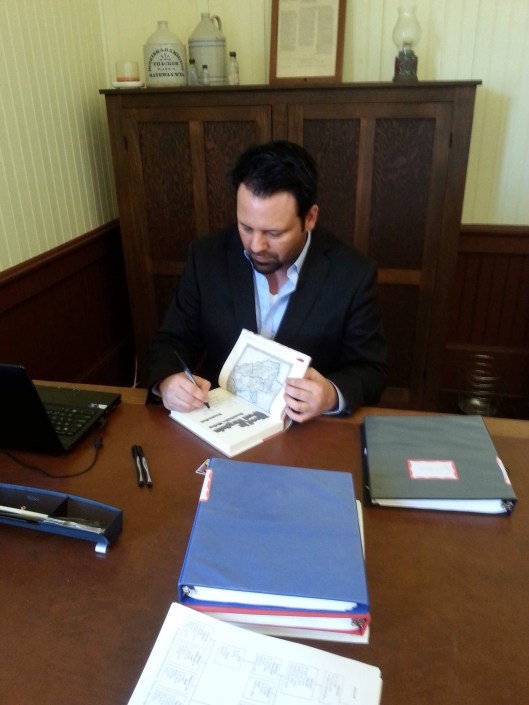
We met nice people and sold copies of the book at the Hatfield-McCoy Reunion Festival. All proceeds were donated to the depot, which I greatly SUPPORT — it’s a significant asset that promotes regional history and tourism. 16 June 2018. Photo by Randy Marcum.

IMG_2635

The Matewan Depot features a free museum. The museum offers historical items related to town history, the Hatfield-McCoy Feud, the Norfolk & Southern Railroad, and the Mine Wars. 15 June 2018.

IMG_2636

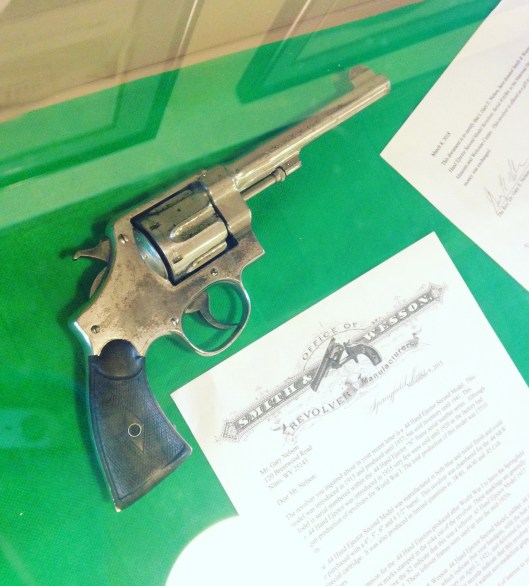
Sid Hatfield gun with accompanying documentation. 15 June 2018.

IMG_2681

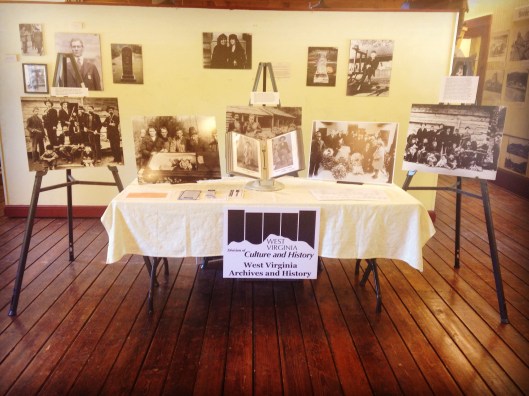
The West Virginia Division of Culture and History showcased a Hatfield-McCoy exhibit at the Hatfield-McCoy Reunion Festival. 16 June 2018.

IMG_2677

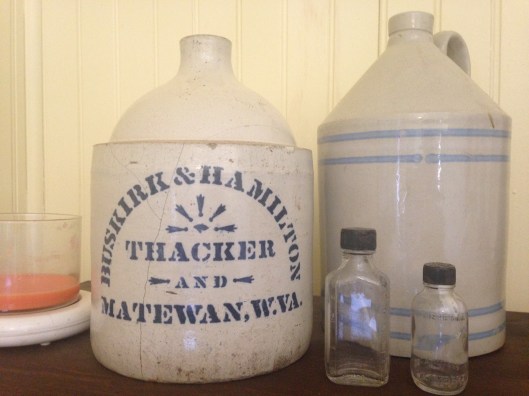
Some of the many artifacts located inside of the Matewan Depot. 16 June 2018.

IMG_9704.JPG

The depot features a worthy selection of books and other items related to regional history and culture. This photo shows a sample of books: t-shirts, stickers, videos, art, and many other items can also be found here. If you visit, be sure to take a peak at my book, “Blood in West Virginia: Brumfield v. McCoy.” May 2018.

Whirlwind News 12.06.1927

16 Saturday Jun 2018

Posted by Brandon Ray Kirk in Big Harts Creek, Dingess, Logan, Whirlwind

≈ Leave a comment

Tags

Anna Mullins, Appalachia, Buck Fork, Charleston, Curtis Hamlin, Daniel McCloud, Dingess, Elias Workman, Frank McCloud, genealogy, Gertrude Clendenin, Harts, Harts Creek, history, Hoover Fork, Joe Martin, Logan, Logan County, Mingo County, Ohio, Twelve Pole Creek, West Virginia, Whirlwind, Wilburn Mullins

An unknown correspondent from Whirlwind in Logan County, West Virginia, offered the following items, which the Logan Banner printed on December 6, 1927:

Miss Gertrude Clendenin has just returned from Ohio where she has been visiting her parents.

Wilburn Mullins made a business trip to Dingess Monday.

Elias Workman made a business trip to Charleston last week.

Daniel McCloud was a business caller in Logan Monday.

Frank McCloud made a visit to Hoover one night last week.

Anna Mullins of Twelvepole was a visitor of Harts Sunday.

Curtis Hamlin is on the sick list this week.

Joe Martin and family of Buck Fork motored to Hoover Sunday.

Guyandotte River Navigation (1927)

28 Monday May 2018

Posted by Brandon Ray Kirk in Gilbert, Guyandotte River, Logan

≈ Leave a comment

Tags

Appalachia, Bernard Call, Boy Scouts, Gilbert, Guyandotte River, history, Logan, Logan Banner, Logan County, Mingo County, Tom Johnson, West Virginia

Guyan River Navigation LB 08.23.1927.JPG

Logan (WV) Banner, 23 August 1927.

Paw Paw Incident: M.A. Ferrell Deposition (1889)

28 Monday May 2018

Posted by Brandon Ray Kirk in Culture of Honor, Hatfield-McCoy Feud, Matewan

≈ Leave a comment

Tags

Appalachia, Bud McCoy, Doc Mayhorn, G.W. Pinson, genealogy, Hatfield-McCoy Feud, history, Logan County, M.A. Ferrell, Mingo County, Pharmer McCoy, Tolbert McCoy, West Virginia

The killing of Tolbert, Pharmer, and Bud McCoy by a Hatfield-led gang on August 8, 1882 represented one of the most sensational events of the Hatfield-McCoy Feud. What follows is M.A. Ferrell’s deposition regarding the affair:

COMMONWEALTH VS DOC MAYHORN &C

Bill of Exceptions

FILED Sept. 1889

G.W. Pinson, Clk

IMG_9723.JPG

I am acquainted with the Defendants, have known them, ten year. Am acquainted with their General moral character in the neighborhood in which they live and it was & is good.

Recollections of A. Peterson Christian of Simon, WV (c.1943)

28 Monday May 2018

Posted by Brandon Ray Kirk in Big Creek, Gilbert, Guyandotte River, Logan, Timber, Wyoming County

≈ Leave a comment

Tags

Appalachia, Betty Shoals, Big Branch Shoal, Big Creek, Big Cub Creek, Blackburn Mullins, Burrell Morgan, Byron Christian, Chapman Browning, Charley Toler, Copperas Fork, Ed Robertson, Eli Blankenship, Eli Morgan, Elk Creek, Ellis Toler, Epson Justice, Fred B. Lambert, Fred B. Lambert Papers, G. Pendleton Goode, genealogy, Gilbert, Guyandotte, Guyandotte River, H.C. Avis, Hickory Shute, history, Hugh Toney, Humphrey Cline, Huntington, James A. Nighbert, James Pine Christian, Jesse Belcher, John Buchanan, John Justice, justice of the peace, Lane Blankenship, Lark Justice, Leatherwood Shoal, Lewis Mitchell, Little Kanawha Lumber Company, Logan County, Logan Court House, logging, Marshall University, Mingo County, Morrow Library, Paren Christian, Peter Cline Jr., Peter Cline Sr., Peterson Christian, Pineville, pushboats, rafting, Raleigh County, Roughs of Guyan, Salt River Shute, Sanford Morgan, Simon, Spice Creek, Staffords Mill, West Virginia, White Oak Cliff, Wyatt Toler, Wyoming County

Recollections of A. Peterson Christian of Simon, WV, provided by G. Pendleton Goode of Pineville, WV, January 1, 1944:

I was born on Spice Creek, Logan Co., now Mingo County, West Va. on Oct. 12, 1857 — Now 86 years of age, Son of Rev. Byron Christian, and grandson of James Pine Christian (1800-1892), one of the justices who organized Logan County in 1824.

About 1867, people began what we called saw-logging. Dr. Warren from Big Creek brought the first six yoke ox team to our neighborhood, used them two years and then sold them to Chapman Browning who lived on Spice Creek. There sprang up among us, what we called timber merchants, among those were Paren Christian, Chapman Browning, Col. John Buchanan, H.C. Avis, Blackburn Mullins and Epson Justice and many others. Besides hauling and rafting their own timber, they would buy rafts of other parties and run them to Logan Court House and sell others to John and Lark Justice and afterwards to Ed Robertson and James Nighbert.

I entered the logging business in 1875, on a small scale. Lewis Mitchell and I bought some timber and made up a raft, and when the river reached rafting stage, Brother Mont Lewis and I started down the river with the raft which swung across the head of “Island 16,” but when the big July 12th freshet came it swept our raft away and we lost it. My next adventure in logging was in the spring of 1876, when Mont and I bought some timber in the bluff opposite the mouth of Elk Creek and with some loose logs in “Island 16,” we made up two rafts, but there was no rafting stage that summer, but when the ice went out the next winter, both rafts went with it and we lost them also.

Rafting down Guyandotte River from Reedy to Logan Court house was a great art during the 1870s and 80s. There were different opinions about the bad places along the stream. People at Logan Court house thought that the river from Spice down was real bad; but the river men around Spice did not mind running from there down, but said that up Copperas Fork, the Betty Shoals, Staffords Mill, and the White Oak Cliff was too bad for anybody to run a raft. The river men around about Gilbert said that the river from there down was a little rough but they didn’t mind it, but from Epson Justice’s up to Reedy was so rough that no person had any business trying it. But when you came up to Big Cub, Long Branch and Reedy and talked with the old pilots, such as Jesse Belcher, Lane Blankenship, Peter Cline Jr., Humphrey Cline and Peter Cline Sr. and numerous other persons such as oar carriers and seconds they would say something like this, “Well, the river for a few miles is pretty rough, especially at Wyatt Toler’s mill dam, the Fall Rock, near Charley Toler’s mill dam, the Hickory Shute, the Leatherwood Shoal, the Big Branch Shoal and the Salt River Shute, but if a man has good judgment about the drain and the water he will have but little trouble.” So you see all depends on whom you are talking to as to where the rough is on the Guyandotte River. The only way to find this out is to go through on a raft yourself.

I remember very well the thrill I got the first time I went through the “Roughs” on a raft. I got on at the mouth of Big Cub Creek; in a few minutes we were at the upper end of Leatherwood Shoal. We worked the raft to the proper position in the hole of water just above the shoal. We could look along the top of the water to the upper end of the shoal but there was such a fall there we could see the water until we dropped over the upper end of the shoal. The bow of the raft struck a wave and the water flew over our heads. I was carrying the oar and held the stern down on the raft while my second held my clothes to keep the oar from throwing me off. From there on to the lower end of the shoals (about ¼ mile) as soon as the raft would rise on one wave, it would plunge into another until we got through the shoal. From that time (1876), I followed running from Reedy to Guyandotte until about 1890.

It took 4 men to run a raft from Reedy or Cub to Spice. Then 2 men could take it from there to Logan C.H. Then we would latch two of those rafts together and 2 men would take those rafts through to Guyandotte.

In 1889, the Little Kanawha Lumber Co. came to Wyoming County and began logging on a big scale. The winter was warm and rainy. All goods and supplies were hauled from Prince Station on the C. and O. Ry. The roads through Raleigh were so muddy that a four-horse team could pull only 1000 or 1200 pounds, so in April Alec, Henry Blankenship and I made a push boat 50 feet long and 6 feet wide and 18 inches deep. We landed it at the mouth of Reedy Creek and started to Guyandotte with five men. I had about $95.00 in money, and the men from here to Elk sent money by me to buy flour. When I left Elk, I had about $260.00. Among the men that sent money by me to buy flour were Burrell Morgan, Ellis Toler, Eli Blankenship, Eli Morgan, Sanford Morgan and Chapman Browning and the only one alive now is Burrell Morgan. We reached Guyandotte the 3d day, where I bought 45 lbs of flour, 300 lbs of bacon and a lot of other things and after laying over at Capt. Toney’s for 2 days on account of high water, we arrived at the mouth of Spice Creek in 8 days from Guyandotte. I received $125 per 100 lbs. freight which gave me a nice profit for my trip. At that time and long before the people of Logan brought their goods up on push boats.”

Source: Fred B. Lambert Papers, Special Collections Department, Morrow Library, Marshall University, Huntington, WV.

Chafin and Dingess in Dingess, WV

24 Saturday Mar 2018

Posted by Brandon Ray Kirk in Dingess

≈ Leave a comment

Tags

Andrew Jackson Dingess, Appalachia, Dingess, Dingess Branch, Don Chafin, F. Marion Chafin, genealogy, history, J.A. Dingess, Logan County, map, Mingo County, Norfolk and Western Railroad, Ohio Extension, Twelve Pole Creek, West Virginia

IMG_6631.JPG

Source: Logan County Circuit Clerk’s Office, Logan, WV. Note: Marion Chafin, a sheriff of Logan County, was the father of Don Chafin.

IMG_6632

The map is undated. This property is located in present-day Mingo County.

Dingess Petroglyphs (2018)

15 Thursday Mar 2018

Posted by Brandon Ray Kirk in Dingess, Native American History

≈ Leave a comment

Tags

Appalachia, Brandon Kirk, Dingess, Dingess Petroglyphs, history, Laurel Lake Wildlife Management Area, Mingo County, Native American History, Native Americans, petroglyphs, photos, Phyllis Kirk, West Virginia

IMG_6253

Dingess Petroglyphs, Laurel Lake Wildlife Management Area, Dingess, WV. 10 March 2018.

IMG_6254

Dingess Petroglyphs, Laurel Lake Wildlife Management Area, Dingess, WV. 10 March 2018.

IMG_6256

Dingess Petroglyphs, Laurel Lake Wildlife Management Area, Dingess, WV. 10 March 2018. Photo by Mom.

IMG_6255

Dingess Petroglyphs, Laurel Lake Wildlife Management Area, Dingess, WV. 10 March 2018.

Hatfield Items

12 Monday Mar 2018

Posted by Brandon Ray Kirk in Big Sandy Valley, Cemeteries, Hatfield-McCoy Feud, Huntington, Logan, Wyoming County

≈ Leave a comment

Tags

A.J. Shepherd, Appalachia, Calico, Devil Anse Hatfield, Dewey Boaz, Elias Hatfield, genealogy, Greenway Hatfield, history, Horse Pen Fork, hunting, Huntington, Island Creek, jailer, Joe Hatfield, John Totten Vance, Joseph Hatfield, Logan Banner, Logan County, Logan County Banner, Logan Democrat, M.K. Diamond, Melvin Runyon, Mingo County, Moundsville, New River, Omar, Stirrat, Tennis Hatfield, Thacker, Tom Hatfield, West Virginia, West Virginia Coal & Coke Company, Willard Hatfield, William E. Glasscock, William Hatfield, Williamson, Willis Hatfield, Wyoming County

From the Logan County Banner, the Logan Banner and the Logan Democrat of Logan, WV, come the following items about the Hatfields:

In some way our watchful jailor Elias Hatfield learned that some week or to days ago, the wife of Melvin Runyon, who is confined in jail here for the murder of John Vance at Thacker had been trying to get a pistol in the jail to him. On Monday, Mrs. Runyon, with a brother of Runyon, and Mr. A.J. Shepherd came over to see him. Mr. Hatfield thought it was his duty to search Mrs. Runyon before she was allowed to go into the jail, which he did at once, and found a hatchet under her dress. The hatchet was taken from her and she was not allowed to go in. Mr. Shepherd and Mr. Runyon were, however, allowed to go in and talk with the prisoner. The jailor is commended by all for his action.

Source: Logan County Banner, 17 April 1895.

***

Tennis Hatfield is reported on the sick list.

Source: Logan Democrat, 23 January 1913.

***

Tennis Hatfield, who has been confined to his room for several weeks, is improving under the care of Dr. Steele.

Source: Logan Democrat, 30 January 1913.

***

Tennis Hatfield who has been confined to his room for two months at Calico left last week for New River.

The many friends of Willis Hatfield here are glad to hear that Gov. Glasscock paroled him from a four year sentence at Moundsville for killing Dr. Thornhill in Wyoming county.

Source: Logan Democrat, 20 March 1913.

***

Mr. Hatfield caught five ground hogs Tuesday and said that it was not a good day for them either.

Source: Logan Democrat, 24 April 1913.

***

Joe Hatfield, of New River, visited his parents at Calico last week.

Source: Logan Democrat, 15 May 1913.

***

William Hatfield Injured LB 07.22.1927

Logan Banner, 22 July 1927.

***

HATFIELD HELD

Postmaster Willard Hatfield of Williamson was bound over to court yesterday following a row in which Police Officer Dewey Boaz was shot in the foot. Hatfield waived examination and his bond for $1,000 was signed by his father, Greenway Hatfield.

Source: Logan Banner, 5 August 1927.

***

Church Meeting at Anse Hatfield's Home LB 09.06.1927 1.JPG

Logan Banner, 6 September 1927.

Dingess, WV (2016, 2018)

11 Sunday Mar 2018

Posted by Brandon Ray Kirk in Dingess

≈ Leave a comment

Tags

Appalachia, Brandon Kirk, Dingess, Dingess Post Office, Dingess tunnel, history, Mingo County, Muncy Bottom, photos, West Virginia

IMG_0582.JPG

Dingess Post Office, Muncy Bottom, Dingess, WV. 4 April 2016.

IMG_0597

Dingess Post Office, Dingess, WV. 4 April 2016. Photo by Kathy Adams.

IMG_0596

Old Dingess Residence, Dingess, WV. 4 April 2016.

IMG_6176

Muncy Bottom, Dingess, WV. 10 March 2018.

IMG_6293

Dingess Tunnel, Dingess, WV. 10 March 2018.


Logan County Game Preserve (1927)

06 Tuesday Mar 2018

Posted by Brandon Ray Kirk in Logan

≈ Leave a comment

Tags

Appalachia, circuit clerk, conservation, Guyandotte River, H.M. Moore, history, Horsepen Mountain, Island Creek, John A. Ellis, Logan Banner, Logan County, Logan County Game Preserve, Mingo County, West Virginia, Wild Life League

From the Logan Banner of Logan, WV, comes this story about the Logan County Game Preserve dated February 1, 1927:

35,000-ACRE GAME PRESERVE HERE IS FOR BENEFIT OF ALL THE PEOPLE–JOHN ELLIS NEW GAME PROTECTOR

Sport lovers in Logan–and they are legion–recently decided to adopt some method for the protection of game and wild fowls which are being rapidly exterminated in the county; consequently they met and formed a body for the purpose of establishing a game preserve in Logan.

H.M. Moore was made president of this association and under his direction the work was undertaken in earnest. Up to this time there has been approximately 35,000 acres of mountain land dedicated to this purpose by the owners. The land lies between the waters of Main Island Creek and Guyan river and extends over the Mingo county line into the Horsepen section.

Contrary to an erroneous impression that has gone out over the county this land is not set aside for the purpose of furnishing a hunting ground for members of this Wild Life League of Logan county but will be used for the propagation of game for people of the entire county during the open seasons as defined by the statutes.

John A. Ellis, former circuit clerk, and one of the most ardent lovers of wild life to be found in the county, has been commissioned by the state as local game protector. No better selection could have been made for Mr. Ellis, in addition to being acquainted with the people of the county and all of this section of the state, knows almost every foot of land lying in the preserve and believes in the propagation of game. Mr. Ellis was commissioned January 17, and has already entered upon his duties.

It is the intention of the promoters of the project to stock this preserve with deer, wild turkeys, pheasants, quail, and the streams with various kind of game fish. As soon as this is done the parties behind the movement will ask the state game and fish commission to take over the preserve and maintain it. This proposition will be submitted to the proper state officials when the commission meets the first Thursday in April of the present year.

← Older posts
Newer posts →

Feud Poll 1

If you had lived in the Harts Creek community during the 1880s, to which faction of feudists might you have given your loyalty?

Categories

  • Adkins Mill
  • African American History
  • American Revolutionary War
  • Ashland
  • Atenville
  • Banco
  • Barboursville
  • Battle of Blair Mountain
  • Beech Creek
  • Big Creek
  • Big Harts Creek
  • Big Sandy Valley
  • Big Ugly Creek
  • Boone County
  • Breeden
  • Calhoun County
  • Cemeteries
  • Chapmanville
  • Civil War
  • Clay County
  • Clothier
  • Coal
  • Cove Gap
  • Crawley Creek
  • Culture of Honor
  • Dingess
  • Dollie
  • Dunlow
  • East Lynn
  • Ed Haley
  • Eden Park
  • Enslow
  • Estep
  • Ethel
  • Ferrellsburg
  • Fourteen
  • French-Eversole Feud
  • Gilbert
  • Giles County
  • Gill
  • Green Shoal
  • Guyandotte River
  • Halcyon
  • Hamlin
  • Harts
  • Hatfield-McCoy Feud
  • Holden
  • Hungarian-American History
  • Huntington
  • Inez
  • Irish-Americans
  • Italian American History
  • Jamboree
  • Jewish History
  • John Hartford
  • Kermit
  • Kiahsville
  • Kitchen
  • Leet
  • Lincoln County Feud
  • Little Harts Creek
  • Logan
  • Man
  • Matewan
  • Meador
  • Midkiff
  • Monroe County
  • Montgomery County
  • Music
  • Native American History
  • Peach Creek
  • Pearl Adkins Diary
  • Pecks Mill
  • Peter Creek
  • Pikeville
  • Pilgrim
  • Poetry
  • Queens Ridge
  • Ranger
  • Rector
  • Roane County
  • Rowan County Feud
  • Salt Rock
  • Sand Creek
  • Shively
  • Spears
  • Sports
  • Spottswood
  • Spurlockville
  • Stiltner
  • Stone Branch
  • Tazewell County
  • Timber
  • Tom Dula
  • Toney
  • Turner-Howard Feud
  • Twelve Pole Creek
  • Uncategorized
  • Warren
  • Wayne
  • West Hamlin
  • Wewanta
  • Wharncliffe
  • Whirlwind
  • Williamson
  • Women's History
  • World War I
  • Wyoming County
  • Yantus

Feud Poll 2

Do you think Milt Haley and Green McCoy committed the ambush on Al and Hollene Brumfield in 1889?

Blogroll

  • Ancestry.com
  • Ashland (KY) Daily Independent News Article
  • Author FB page
  • Beckley (WV) Register-Herald News Article
  • Big Sandy News (KY) News Article
  • Blood in West Virginia FB
  • Blood in West Virginia order
  • Chapters TV Program
  • Facebook
  • Ghosts of Guyan
  • Herald-Dispatch News Article 1
  • Herald-Dispatch News Article 2
  • In Search of Ed Haley
  • Instagram
  • Lincoln (WV) Journal News Article
  • Lincoln (WV) Journal Thumbs Up
  • Lincoln County
  • Lincoln County Feud
  • Lincoln County Feud Lecture
  • LinkedIn
  • Logan (WV) Banner News Article
  • Lunch With Books
  • Our Overmountain Men: The Revolutionary War in Western Virginia (1775-1783)
  • Pinterest
  • Scarborough Society's Art and Lecture Series
  • Smithsonian Article
  • Spirit of Jefferson News Article
  • The Friendly Neighbor Radio Show 1
  • The Friendly Neighbor Radio Show 2
  • The Friendly Neighbor Radio Show 3
  • The Friendly Neighbor Radio Show 4
  • The New Yorker
  • The State Journal's 55 Good Things About WV
  • tumblr.
  • Twitter
  • Website
  • Weirton (WV) Daily Times Article
  • Wheeling (WV) Intelligencer News Article 1
  • Wheeling (WV) Intelligencer News Article 2
  • WOWK TV
  • Writers Can Read Open Mic Night

Feud Poll 3

Who do you think organized the ambush of Al and Hollene Brumfield in 1889?

Recent Posts

  • Logan County Jail in Logan, WV
  • Absentee Landowners of Magnolia District (1890, 1892, 1894)
  • Charles Spurlock Survey at Fourteen Mile Creek, Lincoln County, WV (1815)

Ed Haley Poll 1

What do you think caused Ed Haley to lose his sight when he was three years old?

Top Posts & Pages

  • New Year's Raid (1888): Randolph McCoy's Testimony
  • Civil War Gold Coins Hidden Near Chapmanville, WV
  • Feudist Jim McCoy (1929)
  • Paw Paw Incident: Dan Whitt Deposition (1889)
  • Red Rock Cola in Logan, WV (1939)

Copyright

© Brandon Ray Kirk and brandonraykirk.wordpress.com, 1987-2023. Unauthorized use and/or duplication of this material without express and written permission from this blog’s author and/or owner is strictly prohibited. Excerpts and links may be used, provided that full and clear credit is given to Brandon Ray Kirk and brandonraykirk.wordpress.com with appropriate and specific direction to the original content.

Archives

  • February 2025
  • January 2025
  • October 2023
  • September 2023
  • December 2022
  • November 2022
  • May 2022
  • April 2022
  • February 2022
  • November 2021
  • October 2021
  • September 2021
  • June 2021
  • May 2021
  • April 2021
  • March 2021
  • February 2021
  • January 2021
  • December 2020
  • November 2020
  • October 2020
  • July 2020
  • June 2020
  • May 2020
  • April 2020
  • March 2020
  • February 2020
  • January 2020
  • December 2019
  • November 2019
  • October 2019
  • September 2019
  • August 2019
  • July 2019
  • June 2019
  • May 2019
  • April 2019
  • March 2019
  • February 2019
  • January 2019
  • December 2018
  • November 2018
  • October 2018
  • September 2018
  • August 2018
  • July 2018
  • June 2018
  • May 2018
  • April 2018
  • March 2018
  • February 2018
  • January 2018
  • December 2017
  • November 2017
  • October 2017
  • September 2017
  • August 2017
  • July 2017
  • June 2017
  • May 2017
  • April 2017
  • March 2017
  • February 2017
  • January 2017
  • December 2016
  • November 2016
  • October 2016
  • September 2016
  • August 2016
  • July 2016
  • June 2016
  • May 2016
  • April 2016
  • March 2016
  • February 2016
  • January 2016
  • December 2015
  • November 2015
  • October 2015
  • September 2015
  • August 2015
  • July 2015
  • June 2015
  • May 2015
  • April 2015
  • March 2015
  • February 2015
  • January 2015
  • December 2014
  • October 2014
  • September 2014
  • August 2014
  • July 2014
  • June 2014
  • May 2014
  • April 2014
  • March 2014
  • February 2014
  • January 2014
  • December 2013
  • November 2013
  • October 2013
  • September 2013
  • August 2013
  • July 2013
  • June 2013
  • May 2013
  • April 2013
  • March 2013
  • February 2013
  • January 2013
  • December 2012
  • November 2012

Enter your email address to follow this blog and receive notifications of new posts by email.

Join 2,925 other subscribers

Tags

Appalachia Ashland Big Creek Big Ugly Creek Blood in West Virginia Brandon Kirk Cabell County cemeteries Chapmanville Charleston civil war coal Confederate Army crime culture Ed Haley Ella Haley Ferrellsburg feud fiddler fiddling genealogy Green McCoy Guyandotte River Harts Harts Creek Hatfield-McCoy Feud history Huntington John Hartford Kentucky Lawrence Haley life Lincoln County Lincoln County Feud Logan Logan Banner Logan County Milt Haley Mingo County music Ohio photos timbering U.S. South Virginia Wayne County West Virginia Whirlwind writing

Blogs I Follow

  • OtterTales
  • Our Appalachia: A Blog Created by Students of Brandon Kirk
  • Piedmont Trails
  • Truman Capote
  • Appalachian Diaspora

BLOOD IN WEST VIRGINIA is now available for order at Amazon!

Blog at WordPress.com.

OtterTales

Writings from my travels and experiences. High and fine literature is wine, and mine is only water; but everybody likes water. Mark Twain

Our Appalachia: A Blog Created by Students of Brandon Kirk

This site is dedicated to the collection, preservation, and promotion of history and culture in Appalachia.

Piedmont Trails

Genealogy and History in North Carolina and Beyond

Truman Capote

A site about one of the most beautiful, interesting, tallented, outrageous and colorful personalities of the 20th Century

Appalachian Diaspora

  • Subscribe Subscribed
    • Brandon Ray Kirk
    • Join 787 other subscribers
    • Already have a WordPress.com account? Log in now.
    • Brandon Ray Kirk
    • Subscribe Subscribed
    • Sign up
    • Log in
    • Report this content
    • View site in Reader
    • Manage subscriptions
    • Collapse this bar
 

Loading Comments...