Tags
Appalachia, Deskins Addition, history, Logan, Logan Banner, Logan County, Logan Sanitary Baths, Turkish baths, West Virginia

Logan (WV) Banner, 17 September 1926

15 Tuesday Aug 2017
Posted in Logan
Tags
Appalachia, Deskins Addition, history, Logan, Logan Banner, Logan County, Logan Sanitary Baths, Turkish baths, West Virginia
Logan (WV) Banner, 17 September 1926
15 Tuesday Aug 2017
Tags
Appalachia, ballads, Clayton Buchanan, crime, history, John C. Elkins, John Harrington Cox, Logan, Logan Banner, Logan County, Logan County Jail, Logan Court House, Market Square, Moundsville, music, West Virginia Folklore Society, West Virginia University
“Logan County Court House” or “Logan County Jail” is one of several songs written about events in Logan County, West Virginia. From the Logan Banner of Logan, WV, dated 24 September 1926, we find this:
“For a dual purpose The Banner herewith reproduces one of the four known variants of the song entitled “Logan County Court House.” In the first place it should be of interest to those who have never read it or any similar version. Secondly, this paper is desirous of learning something about the authorship of the song.
“Who wrote it? And when and under what circumstances? Many a Banner reader may have some information on this matter which he or she should be willing to communicate.
“The variants of this song are reproduced in Prof. John Harrington Cox’s volume of ‘Folk-Songs of the South’ published last year. The following one was sent to that author, a member of the faculty of West Virginia University, by Miss Snoah McCourt, of Ornoff, Webster county, this state:
When I was a little boy, I worked on Market Square.
O’ money I did pocket, but I never did it fair.
I rode upon the lakes and learned to rob and steal,
And when I made a great haul, how happy I did feel.
I used to wear the white hat, my horse an’ buggy fine.
I used to court a pretty girl I always thought was mine.
I courted her for beauty, her love for me was great.
And when I’d go to see her, she’d meet me at the gate.
One night as I lay sleeping, I dreamed a mighty dream.
That I was marching down on the golden stream.
I woke all broken-hearted, in Logan County jail,
And not a friend around me for to go my bail.
Down came the jailer about ten o’clock,
And the key in his hand he shoved against the lock.
“Cheer up, cheer up, my prisoner!” I thought I heard him say.
“You’re going around to Moundsville, seven long years to stay.”
Down came the jailer about ten o’clock,
And with the key in his hand he shoved against the lock.
“Cheer up, cheer up, my prisoner!” I thought I heard him say,
“You’re going around to Moundsville, seven long years to stay.”
Down came my true love, ten dollars in her hand.
“O my dearest darling, I’ve done all that I can!
And may the Lord be with you, wherever you may go,
And Satan snatch the jury for sending you below.”
Sitting in the railroad, waiting for the train,
“I am going away to leave you, to wear the ball and chain.
I’m going away to leave you. Darling, don’t you cry.
Take a glass of whiskey and let it all pass by.”
A subsequent story printed on 28 September 1926, provided more information about the song’s history:
“Publication in last Friday’s Banner of the old ‘Logan County Jail’ song, with an inquiry as to its authorship, has brought a reward in the form of an interesting letter from John C. Elkins of the sheriff’s office. This letter reveals the name of the songwriter, and gives a glimpse into his life after his soul found a measure of relief in rime and rhythm.
“Doubtless many of those who last week read the song for the first time and others who re-read it with more or less eagerness will be interested and even pleased to learn that the prisoner escaped from jail and a long term at Moundsville: went west, reformed, and entered the ministry; then in the flickering twilight of his eventful life, he came back to die amid the mountains he loved so well.
“Here is the letter dated Sept. 27, which outlines the strange story:
“Question: Who was the author of the song ‘The Logan County Jail’?
“Answer: This song was composed by a Logan county boy whose childhood had been thrilled by the horrors of the war of 1861-65. His song tells the story of his life, his crime, his sentence, his thoughts of and goodbye to the girl he left behind, the invitation to take a glass of whiskey and let all worries pass by. He climbed the prison walls and made his escape into the west. There he became a minister. Some years later, broken in health, he returned to his native county and died about 20 years ago. The song was written 50 years ago and its author was Clayton Buchanan.
“J.C.E.
“To the Banner these revelations come with an irresistible appeal; and while thanking Mr. Elkins, the regret is expressed that he did not go into greater detail in unfolding this story–a story teeming with dramatic values.”
One additional story about the song appeared in the Banner on 5 October 1926:
“What the Banner has been publishing in recent issues relative to the authorship of the ‘Logan County Jail’ song has been read with interest by Prof. John H. Cox, head of the department of English, West Virginia University. It was from his book, ‘Folk Songs of the South,’ that this song was reproduced in these columns.
“From Prof. Cox the following letter dated September 30 was received by The Banner:
“This is to thank you for the clipping from The Logan Banner concerning the origin of the song, ‘Logan County Jail.’ It is very interesting and I have no doubt it is correct. I wonder if any records of Clayton Buchanan’s trial are in Logan County courthouse? I should like very much to have the details of the crime, the trial, the escape, and the death of this man for the files of the West Virginia Folk-Lore Society, of which I happen to be the president, archivist, and general editor. Could you not prevail upon Mr. John C. Elkins either to write out or dictate to some stenographer all that he knows about the case and have it printed in The Banner? It would be a real worthwhile piece of work.
“You may be interested to know that I am at work on a second volume of West Virginia Folk-lore, a volume which we hope to make as interesting and valuable as the first. We shall be glad to have any material of any kind that may be found.
“Sincerely yours,
“John H. Cox
“34 Campus Driveway
“P.S. A transcript of the record in the courthouse, if there is one, would be especially valuable.”
15 Tuesday Aug 2017
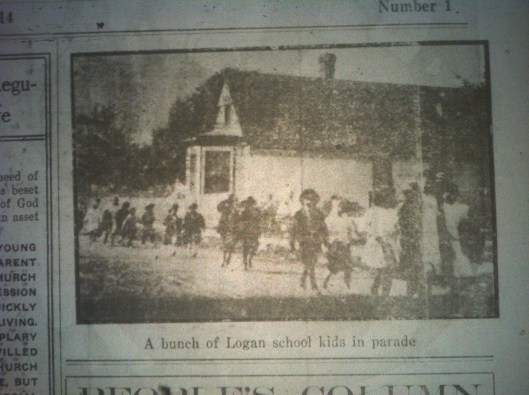
Logan (WV) Banner, 3 July 1914.
15 Tuesday Aug 2017
Posted in Coal, Guyandotte River, Logan
Tags
Appalachia, C&O Railroad, Christmas, coal, Guyandotte River, history, Logan, Logan Banner, Logan County, West Virginia
From the Logan Banner of Logan, West Virginia, dated January 5, 1911, we find this editorial:
“The bounteous harvest of holiday business is past, and the so-called dull season is upon our business man. But why a dull season? Some of our business men are going around with a face as long as a shingle, and to see them and hear them talk about dull business reminds one of a man in the last stages of consumption who is resigned to his fate. They appear as though they see bankruptcy staring them in the face. What they need is a little stiffening of the backbone. They need not expect business to be as good as it was through the holiday season, but they should remember that the people of this generation must be fed and clothed and furnished with whatever comforts they can afford, and as long as this is the case, there will be a continued demand for goods and merchandise of all kinds, and business will go on in the same old way. The trouble with the business men of this city is that they talk down instead of talking up. If the merchant talks dull times, the farmer, the miner, the teamster, the carpenter, the professional man and all others will catch the contagion, and then business will be dull, but if they take an optimistic view of the matter and talk up, the opposite will be the result.
“There is no county in the state, and probably not in the union, that has a more brilliant future than Logan. Logan is today the best town of the state of its size, and it has much to be proud of. The coming year will witness greater development throughout the county than any two previous years, and instead of our business men going around with their lips hung down, they should be right now planning a vigorous campaign to capture their fair share of the prosperity that is sure to abound. Let them rouse themselves from the lethargy which now enshrouds them and be up and doing. Logan is all right. The fault is your own if you do not prosper. It is here for you. If you don’t get it, it will be your own fault. With the railroad going on up the river, and new coal operations opening up within sight of one another, and with our fine quality of coal and timber, nothing but Divine intervention can keep the Guyan Valley from blossoming as the rose. Stop your whining or get off the earth. Take hold and boost or the wheels of progress will mash you into smithereens.
“Logan is all right.
“It may be that you are too slow to keep up.”
13 Sunday Aug 2017
Posted in Logan
Tags
Appalachia, history, Logan, Logan Banner, Logan County, Methodist Episcopal Church South, pastor, photos, R.H. Scaggs, West Virginia
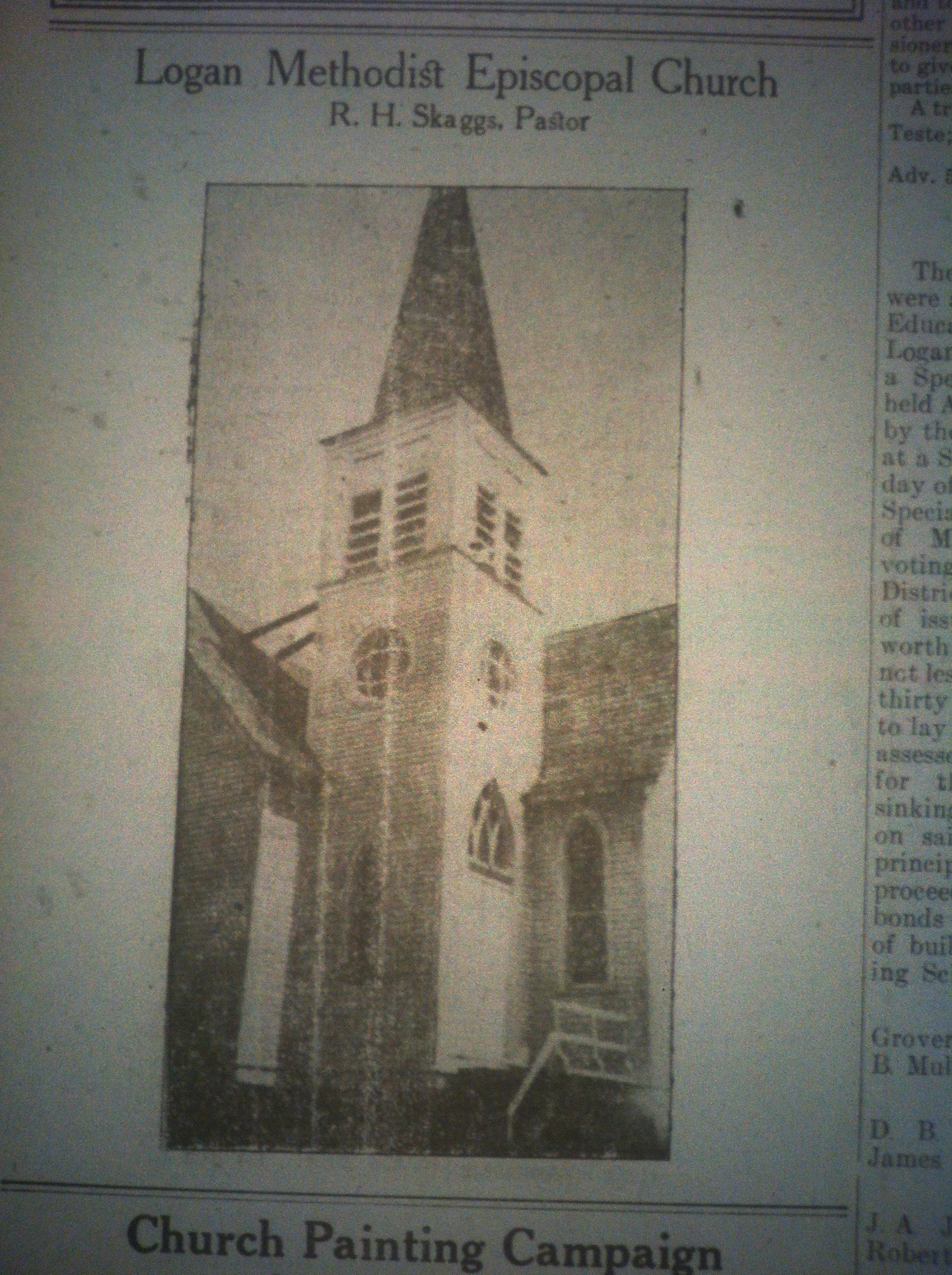
Logan Methodist Episcopal Church South, Logan (WV) Banner, 1 May 1914.
13 Sunday Aug 2017
Posted in Big Harts Creek, Shively
Tags
Appalachia, Bob Bryant, Calvary Bryant, Con Chafin, crime, Cush Chambers, Floyd Bryant, genealogy, Harts Creek, Henderson Bryant, history, Logan, Logan Banner, Logan County, Marion Bryant, moonshine, moonshining, Nellie Bryant, prosecuting attorney, Robert Bland, West Virginia
In a story titled “111 True Bills Found By Grand Jury Which Submits Final Report” and printed in the Logan Banner of Logan, WV, on October 12, 1926, we find this item (excerpted here):
“Concluding a four-day session the grand jury made its final report and was discharged last night by Circuit Judge Robert Bland. There were 111 indictments returned, 66 for felonies and 45 for misdemeanors–a total somewhat larger than the average for Logan county grand juries. Names of those indicted are withheld from publication for the reason that some persons involved are not in custody. Capiases will be issued forthwith for those indicted and not in jail, while those in jail and all who are apprehended without delay will be arraigned very soon. Court attaches are of the opinion that none of these will be tried until next month as there was already a big criminal docket. However, considerable progress has been made so far. Having caught up with the calendar, court adjourned yesterday morning for the remainder of the day, after a short session.
“Victory has come to the Bryants, who live on Old House Branch of Harts Creek, and who were indicted for operating a still last December. The joint indictment embraced Hent Bryant and his sons Calvary, Bob, and Floyd. When the case was called on Tuesday the defendants elected to be tried separately, whereupon Prosecuting Attorney Con Chafin chose to try Calvary first. There was a large volume of testimony for each side. The case was submitted to the jury without argument at 9 o’clock Tuesday night and in a few minutes a verdict of acquittal was returned. C.C. Chambers represented the defense.
“The State’s evidence showed that an official raiding party found a spot about three-fourths of a mile from the Bryant home where a still had been in operation and where a quantity of mash had been poured out shortly before the arrival of the officers. The Bryant premises were then searched, but no still or whiskey was found. However, Marion Bryant, a cousin of Calvary, testified that Calvary had employed him to assist him in the operation of a still.
“From the Bryants there came positive denials of any interest in any still or of any knowledge of a still having ever been in operation at the spot in the woods where the officers thought that they had made a significant discovery. The defense attacked the credibility of Marion Bryant’s testimony, claiming that he was actuated by spite. It was testified by members of the family that Marion, after staying at Hent Bryant’s home for a while and doing odd jobs, had been requested to leave; that he made threats against the family at that time because Nellie Bryant, a daughter of Hent, spurned his love and his proposals of marriage.
“After the jury returned its verdict, the cases against the other Bryants were continued to the next regular term.”
01 Tuesday Aug 2017
Posted in Logan
Tags
Appalachia, history, Logan, Logan Banner, Logan County, Virginia Cafe, Virginia Five, West Virginia

Logan (WV) Banner, 26 October 1926.
01 Tuesday Aug 2017
Posted in Hamlin
Tags
Appalachia, Falls City Construction Company, Hamlin, history, Kentucky, Lincoln County, Lincoln Court House, Logan Democrat, Louisville, West Virginia
The Lincoln County Courthouse located in Hamlin, WV, burned in 1909. Most county records since 1867 were destroyed by fire. The following story provides some useful information on the reconstructed courthouse.
New Court House for Lincoln
After a year and a half of waiting Lincoln county is now assured of a new court house, which will be erected on the old site, which will be a credit to the county, and a lasting monument to those who were instruments in securing the erection.
The burning of the old court house marks the greatest epoch in the history of Lincoln county, and nothing but the undaunted courage of a people born and reared among the hills of Lincoln county, prevented a period of utter chaos.
A splendid temporary organization was effected, temporary quarters secured as a court house, and official quarters, until, but for the destruction of some records which can never be replaced, the average citizen hardly realizes that on the 19th day of November, 1909, Lincoln county suffered a loss, which ordinarily, would have retarded the growth and development of the county for a decade.
The contract is awarded to the Falls City Construction Company, of Louisville, Ky., one of the largest building concerns in the United States, at a cost of $71,000.00 and was secured by them by competitive bids, the next closest bid being $73,750.00.
Work will be started on the new building within the next 30 days, and by January 1, 1912, the County will have its new home completed.
Source: Logan (WV) Democrat, 11 May 1911
31 Monday Jul 2017
Posted in Logan
Tags
Appalachia, history, Logan, Logan Banner, Logan County, Logan Court House, photos, West Virginia

Logan Court House, Logan (WV) Banner, 8 October 1926.
31 Monday Jul 2017
Posted in Logan
Tags
Appalachia, E.T. England, Henry Clay Ragland, history, Ira P. Hager, J.C. Smith, John M. Perry, Logan, Logan Banner, Logan County, Logan County Banner, McDowell Recorder, Naaman Jackson, O.J. Deegan, The Logan Banner Company, W.C. Lawrence Jr., West Virginia
The Logan Banner, formerly the Logan County Banner, is the primary newspaper serving Logan County, West Virginia, and surrounding areas. The first issue of the Banner appeared in 1889 under the editorship of Henry Clay Ragland. Its history serves as an item of interest.
Logan Banner, 26 June 1914
Every name on the combined Banner and Republican lists–paid and not paid–will receive a copy of this week’s “25th-year Souvenir Edition,” also some sample copies are mailed. This is our last invitation, and your last chance to get Dean’s Logan Banner at $1 a year; it goes up to $1.50 a year in advance next issue, and will never come down while the present owner edits it. A blank coupon for remittance will be found below; better send your name and a dollar NOW. All subscribers in arrears will be cut off July 3rd, the date of next issue.
***
Logan Banner, 14 August 1914
Incorporated
A certificate of incorporation has been issued to The Logan Banner Co., to conduct a publishing business at Logan. It has an authorized capital of $10,000, and its incorporators are E.T. England, Ira P. Hager, O.J. Deegan, John M. Perry, Naaman Jackson, W.C. Lawrence, Jr., and J.C. Smith, all of Logan.
***
Logan Banner, 14 August 1914
To the Public:
The Logan Banner has lately changed hands. The new editor will have charge in a few days. The future policy of this newspaper will then be stated. Suffice it to say that the paper will advocate all that pertains to civic righteousness and civic betterment.
The owners believe, as every one should believe, who lives within the confines of Logan county, that progress is the result of the acts of a progressive people, and that Logan county is made up of people who believe that to progress is to succeed, hence the unparalleled development of our county.
The Logan Banner will do all that lies in its power to foster each and everything that has a tendency to develop and uplift the county. In short, the ultimate object will be a greater Logan, city and county.
O.J. Deegan
***
Logan Banner, 21 August 1914
A Word to Our Readers
The Logan Banner, under new auspices, will be published as usual at the same place and at the old subscription price of one dollar per year. It is the ultimate object of the publishers to make The Banner purely a local newspaper, and with this aim in view, will welcome news from every part of the city and county.
We believe that the merchants of Logan will realize the value of The Banner since it is going into every nook and corner of Logan county, and will use it as a medium through which to express themselves to their many customers. While we do not see at this time the name of many local firms among our advertising customers, we believe that such condition will not long exist, especially so since there is not a merchant in the city of Logan who does not greatly appreciate each and every one of his patrons regardless of those patrons’ party affiliations.
There are among the readers of The Banner many from every party represented in the county. There is not an institution in Logan that is not patronized by people affiliated with every party here; therefore we lay claim to the fact that The Logan Banner is entitled to much of the advertising in which the merchants of Logan county participate, and by merit alone do we expect to prove our assertions. We will also please you with our job work; we will allow no alternative to this latter.
Come in and see us; you are welcome.
***
Logan Banner, 4 September 1914 (originally published in the McDowell Recorder)
Changed Hands
The Logan Banner has again changed hands. For two weeks it has had the same salutatory, but we guess it is only gathering wind for its sails.
We certainly wish the new management abundant success, and that with sledge-hammer blows it will smash up the old bourbon democracy of that county.
If the new management cannot install a linotype, it should, by all means, employ a boy who can each week set at least a column or two of real live matter. Don’t catch the grouch that affected Brother Dean.
21 Friday Jul 2017
Posted in Logan

Logan (WV) Banner, 5 October 1926.
21 Friday Jul 2017
Posted in Atenville, Big Creek, Chapmanville, Hamlin, Harts, Huntington, Logan, Whirlwind
Tags
Appalachia, Beatrice Adkins, Big Creek, Bill Adkins, Bob Brumfield, Bob Dingess, Caroline Brumfield, Chapmanville, Charley Brumfield, Coal Branch City, Cora Adkins, Dallas McComas, Dr. Ferrell, Fisher B. Adkins, genealogy, Harts, Hawkins Perry, Herb Adkins, history, Hollena Ferguson, Huntington, Indiana, Jeff Mullins, Jessie Brumfield, Joe Brumfield, Lincoln County, Logan, Logan Banner, Minerva Brumfield, New Orleans, teacher, Tom Brumfield, Valparaiso, Verna Johnson, Ward Brumfield, West Fork, West Virginia, Whirlwind
An unknown correspondent from Harts in Lincoln County, West Virginia, offered the following items, which the Logan Banner printed on January 14, 1927:
After all the sadness and sorrow Harts has mingled back again.
Mrs. Ward Brumfield met the county court in Hamlin Monday to be appointed Ward Brumfield’s administrator.
Mrs. Charles Brumfield is looking after business matters in Logan this week.
Miss Cora Adkins spent Saturday in Huntington.
Herbert Adkins was a business caller in Huntington Monday.
Mrs. Hollena Ferguson spent several days in Logan visiting friends.
Hawkins Perry is our new operator here this week.
Mrs. Toney Johnson from New Orleans is here visiting her mother, Mrs. Chas. Brumfield.
Wonder why Dr. Ferrell of Chapmanville is so interested in Harts now?
Mr. and Mrs. Dallas McComas spent Saturday and Sunday in Huntington.
Mrs. Beatrice Adkins from West Fork was in Harts Saturday.
Miss Jessie Brumfield is progressing nicely with her school at Atenville now.
Bill Adkins will leave here soon for Valparaiso, Indiana where he will be engaged in school for some time.
Mrs. Jeff Mullins of Big Creek spent Saturday visiting relatives here.
Robert Dingess of Whirlwind was a business caller in this town Monday.
Robert and Joe Brumfield are looking after business matters in Logan this week.
Fisher B. Adkins was in Hamlin Monday looking after his contest which will come off the March term of court.
Mrs. Herbert Adkins has purchased a fine radio.
Tom Brumfield seems to be very much pleased these days. Wonder why? Guess the wedding bells will ring soon.
Bill Adkins from Coal Branch City was in town Monday.
20 Thursday Jul 2017
Posted in Big Harts Creek, Halcyon
Tags
Appalachia, crime, Doc Workman, Harts Creek, history, Logan County, photos, true crime, West Virginia, Workman Fork

Doc Workman (1893-1956) lived and died here on Workman Fork of Harts Creek in Logan County, WV.
19 Wednesday Jul 2017
Tags
34th Battalion Virginia Cavalry, 3rd West Virginia Cavalry, Battle of Curry Farm, Benjamin F. Curry, Big Buffalo Creek, Blountsville, Brandon Kirk, Brandy Station, Cabell County, Carroll District, civil war, Confederate Army, Curry Chapel, Curry Chapel Cemetery, Curry Farm, Duval District, George A. Holton, Granville Curry, Hamlin, Hamlin Chapel, Henry H. Hardesty, history, Hurricane Bridge, Isaac Jackson, James A. Holly, Jeremiah Witcher, John L. Chapman, John S. Witcher, John Scites, John W. Harshbarger, Lincoln County, Logan County, Mathias Kayler, Milton, photos, Phyllis Kirk, Pound Gap, Raleigh County, Russell County, Sheridan, Straight Fork, Tennessee, Union Army, Virginia, West Virginia, West Virginia Division of Culture and History, White Hall, William A. Holstein, William C. Mahone, Winchester
This entry compiles information relating to the Battle or Skirmish at Curry Farm, which occurred as part of the War Between the States in May of 1864 at Hamlin in present-day Lincoln County, WV. It is a working entry and will be updated based on the discovery of new information.
On May 29, 1864, Confederates commanded by Captain John L. Chapman of Company B, 34th Battalion Virginia Cavalry, attacked a detachment of the 3rd West Virginia Cavalry, Company G, commanded by 1st Lt. John W. Harshbarger at Curry Farm near Hamlin in present-day Lincoln County. H.H. Hardesty’s History of Lincoln County, West Virginia, compiled in c.1883, provides the only known account of the battle: “The Federals had marched from Hurricane Bridge and were proceeding up Mud river when they were fired upon by the Confederates, who were concealed on the opposite side of the river. The Federal commander at once ordered a charge and the Confederates retreated without loss. The Federals had one killed, a man named Mathias Kayler from Raleigh county, and two wounded — one being Isaac Jackson, who was shot through the left arm; and another, a member of Company K” (98-99).
Prior to the battle, on May 10, 1864, Capt. John Chapman had been sent with a detachment of dismounted men from the area of Russell County, Virginia, into Cabell and Logan counties “to gather up absentees and deserters from the 34th Battalion” (Cole, 80). Capt. Chapman had been wounded in action at Brandy Station, Virginia, on August 14, 1863 and at Blountsville, Tennessee, on March 10, 1864 (Cole, 147).
Isaac Jackson, one of the two Union soldiers wounded at Curry Farm, was a private in Company G, 3rd WV Cavalry, formerly commanded by Captain John S. Witcher (who had been promoted to major in April 1864). Hardesty cites Mr. Jackson as “wounded in action at Currys Farm, May 29, 1864” (98). Following the battle, on July 6, 1864, 1st Lt. Harshbarger was promoted to captain of Company G. On December 7, 1864, an Adjutant General’s Report shows Company G, 3rd WV Cavalry, stationed near Winchester, VA. The muster roll shows 108 names, citing Private Isaac Jackson as “Wounded in skirmish, May 5, 1864. In hospital since this date.” (Note how this record provides a different date of his wounding from the date provided by Hardesty, who compiled his history about 1881.) http://www.rootsweb.ancestry.com/~wvwayne/roster3G.htm
Curry Farm, according to Hardesty, was located 1/4 mile above Hamlin (Hardesty, 90, 98).
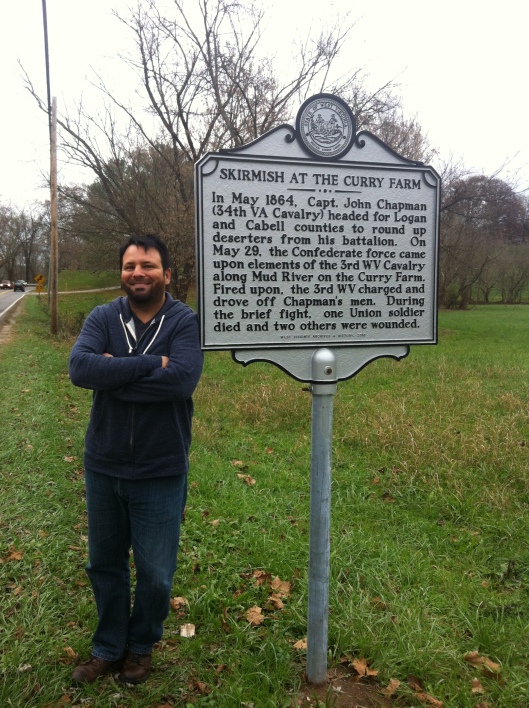
The West Virginia Division of Culture and History has recently erected this historical marker on Curry Farm. 12 November 2017. Photo by Mom.
Capt. John Chapman left Cabell and Logan counties and rejoined the 34th Battalion Virginia Cavalry in the vicinity of Pound Gap, Virginia, by the end of June 1864 (Cole, 82).
Capt. John W. Harshbarger (1836-1909) is buried here: https://www.findagrave.com/cgi-bin/fg.cgi?page=gr&GRid=35761174
Selected Sources:
Scott C. Cole, 34th Battalion Virginia Cavalry (Lynchburg, VA: H.E. Howard, Inc., 1993) 80, 82, 121, 147.
Michael Graham, The Coal River Valley in the Civil War (Charleston, SC: The History Press, 2014) 150-151.
Some modern writers have misunderstood the Battle of Curry Farm as occurring at the Curry farm located four miles north of Hamlin on Big Buffalo Creek, near Hamlin Chapel (later Curry Chapel). Hamlin Chapel is important for the role it played in the creation of Lincoln County in 1867. “The first meeting of the Board of Supervisors was held on the 11th day of March, 1867, in what was known as Hamlin chapel, an old church which stood on the Curry farm, about one-fourth of a mile above the present county seat. There were present: William C. Mahone, of Carroll District; John Scites, of Sheridan, and William A. Holstein, of Duval. W. C. Mahone was made president, and Benjamin F. Curry, clerk, the latter giving bond in the penalty of $2000, with James A. Holly and Jeremiah Witcher as his securities. It was then ordered that the Board of Supervisors have the White Hall, a Southern Methodist church one-fourth of a mile below where the county seat now stands arranged for holding the courts until the proper buildings could be erected, George A. Holton and a majority of the trustees consenting thereto” (Hardesty, 90-91). Curry Chapel no longer stands but its former location can be found near the intersection of Route 1 and Route 3/11 above the mouth of Straight Fork of Big Buffalo Creek.
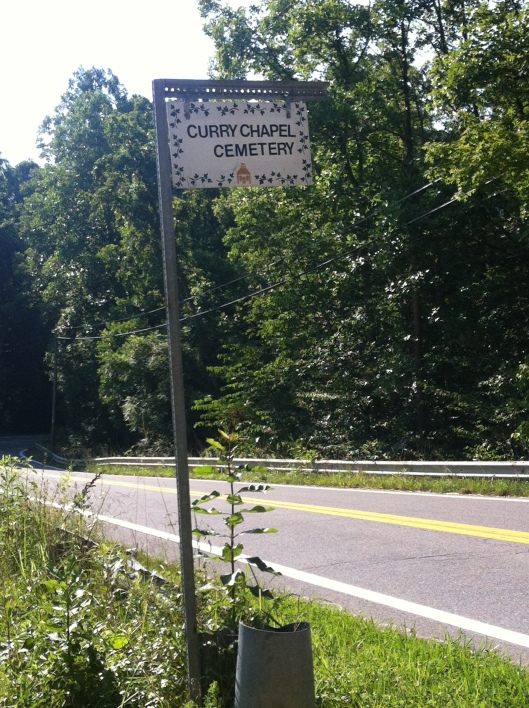
Curry Chapel Cemetery, 18 July 2017. The battle did not occur here.
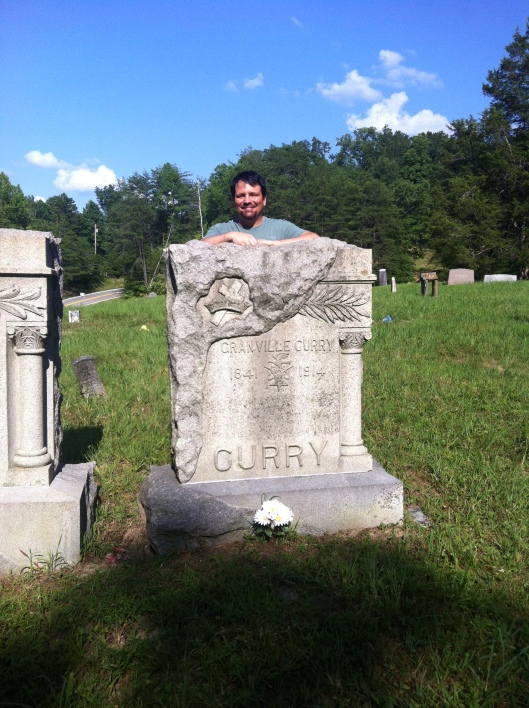
Granville Curry grave, 18 July 2017. Photo by Mom. The battle did not occur here.
![IMG_7076[1]](https://brandonraykirk.com/wp-content/uploads/2017/07/img_70761.jpg?w=529)
Curry Chapel Cemetery, north of Hamlin. The battle did not occur here. Instead, it occurred just to the left of the [3] in the above map.
19 Wednesday Jul 2017
Posted in Culture of Honor, Logan
Tags
Appalachia, guns, history, Logan, Logan Banner, Logan County, shotguns, West Virginia, Winchester

Logan (WV) Banner, 30 October 1914.
19 Wednesday Jul 2017
Posted in Big Harts Creek, Holden, Whirlwind
Tags
Appalachia, Charles Curry, cholera, genealogy, Harts Creek, history, Holden, Isaac Fry, Joe Blaine, John Workman, Logan Banner, Logan County, Luke Curry, McCloud School, miller, Rum Creek, Sol Riddle, Vinson Collins, West Virginia, Whirlwind, Will Farley
An unknown correspondent from Whirlwind in Logan County, West Virginia, offered the following items, which the Logan Banner printed on December 18, 1914:
We are glad to note that our people are busy, happy and peaceful in these parts.
Will Farley has added a new industry to our town, a gasoline grist mill.
Our drummer, Sol Riddle, has just returned from a trip through his territory.
Revs. Adams and Fry preached at Head of Heart last Sunday.
Mrs. Vinson Collins is very ill at this writing.
Joe Blaine has moved from this place to Holden.
Forest fires are very frequent here of late.
Rev. Charley Curry was elected pastor of the church at McCloud school house recently.
Revs. Border and Vance will preach at McCloud school house the second Sunday.
Luke Curry has returned home from Rum, where he has been working for some time.
Cholera has been raging among the hogs in this vicinity. Several people have lost hogs.
John Workman will move back to his farm in the spring, he says.
Good luck to The Banner and a happy Xmas to its readers.
17 Monday Jul 2017
Tags
Alex Johnson, Amos Jones, Appalachia, Charles Stovall, D.C. Dean, Daughters of Pocahontas, Fayetteville, H.N. Saunders, history, Holden, Independent Order of Red Men, J.M. Ellis, James Carey, Logan Banner, Logan County, Mitchell Jackson, T.T. Page, Tallahassee Tribe No. 48, West Virginia, William Jones
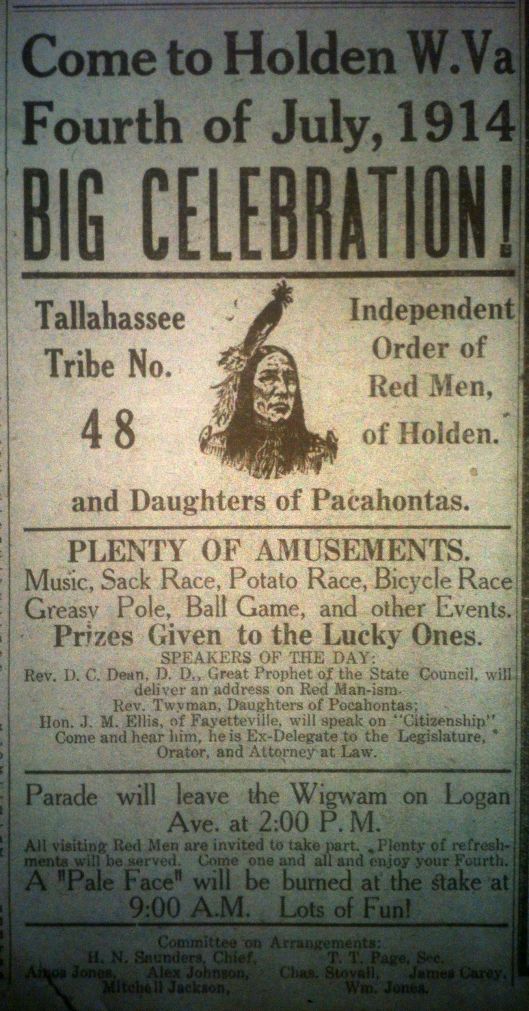
Logan (WV) Banner, 26 June 1914.
17 Monday Jul 2017
Posted in Big Harts Creek, Dingess, Whirlwind
Tags
Appalachia, baseball, Bible school, Breeden, Buck Fork, Bulwark, Burlie Riddle, Charles Curry, Charleston, croup, David Tomblin, Dora Workman, Earsel Farley, Ethel Chafin, gambling, genealogy, Harts Creek, history, Jacob Alperin, James Baisden, James Mullins, John M. Adams, Julia Mullins, Logan Banner, Logan County, Mamie Adkins, McCloud School, merchant, Mingo County, Mose Tomblin Jr., Naaman Borders, Roxie Mullins, Thomas Carter, Tom Smith, W.J. Bachtel, Wayne, West Virginia, Whirlwind, Will Farley
An unknown correspondent from Whirlwind in Logan County, West Virginia, offered the following items, which the Logan Banner printed on November 14, 1914:
Forest fires have done considerable damage in this section recently.
Drs. Carter and Ratcliff were Whirlwind visitors one day the first of the week.
Mrs. James Baisden of Dingess died at her home Thursday, November 12th.
Miss Burlie Riddle was shopping at this place on Tuesday last.
Misses Julia and Roxie Mullins were Whirlwind visitors one day this week.
Miss Mamie Adkins was visiting at Uncle Tom Smith’s Friday.
W.J. Bachtel transacted business in Mingo county the first of the week.
T.J. Carter is on the sick list at this writing.
Mrs. David Tomblin of Buck Fork was here Wednesday.
J.M. Adams transacted business at Whirlwind Friday of last week.
Mose Tomblin, Jr., made a business trip to Bulwark Friday.
Jacob Alperin of Charleston was here on business one day recently.
Rev. N. Barber returned Sunday from a business trip to Mingo county.
Miss Ethel Chaffin of Wayne is visiting Naaman Borders at this place.
Little Earsel, the five-year-old child of Will Farley, took the croup last Saturday and died in a few hours. The bereaved ones have our sympathy.
Miss Dora Workman of this place visited relatives at Breeding last week.
The schools of this place taught by Mr. and Mrs. Borders are progressing nicely.
James Mullins, our prominent merchant, bought a fine span of mules recently.
Revs. Vance, Curry, and Border preached at McCloud school house Sunday.
The folks on Buck Fork have organized a Bible school, which all the folks are invited to take a part. That begins to look like the good people of that place are moving in the right way. If all our neighbors would do the same, our young men would find it even more interesting that the disgraceful card table or Sunday baseball. And I am sure it would do more to elevate our country. People are going to engage in something on Sunday, if it is things that are sinful. So let us interest them in something that is elevating and has a wholesome moral uplift. Where we have a Bible school or Sunday school we have a sort of round table in which all may have a say in the subject. There are a thousand and one things that are intensely interesting in the Good Old Book that many educated people are wholly ignorant of, and I am surprised to see so few school teachers that take such little interest in these things. How long will things be thus?
Now that the election is over and the lucky ones are happy and the unlucky ones have bid their loved ones at home goodbye and are on their way up the hated Salt River we wish the dear fellows all a safe voyage.
‘Lasses makin’ is over and the frost is on the pumpkin and the fodder’s in the shock.
15 Saturday Jul 2017
Posted in Logan
Tags
Alice Lawson, Aracoma, assistant postmaster, Ben Bolt, Charleston Gazette, Edgar Allan Poe, George T. Swain, George Washington, Guyandotte River, history, Karl Myers, Logan, Logan Banner, Logan County, logging, mayor, New York Mirror, Pennsylvania, poems, poetry, postmaster, rafting, Rafting on the Guyandotte, Savage Grant, St. Albans, Thomas Dunn English, timbering, Vicie Nighbert, Walt Whitman, West Virginia, writers
Thomas Dunn English (1819-1902) was a Pennsylvania-born writer who lived briefly in present-day Logan, WV, before the Civil War. At one time, many Loganites believed he wrote his famous work titled “Ben Bolt” while a resident of Logan, then called Aracoma. For more information about his biography, follow this link: https://www.wvencyclopedia.org/articles/2205
The following story appeared in the Logan Banner on November 23, 1926:
“Logan gains quite a bit of notoriety from the fact that the song ‘Ben Bolt’ was written here,” said G.T. Swain in his short history of Logan county, published in 1916. Dr. English wrote “Ben Bolt” for the New York Mirror about 10 years before he ever came to Logan. So here explodeth another nice literary myth–if a myth concerning “Ben Bolt” may be called a literary one. They even tell how Dr. English laid aside his law and medicine practice, his novel writing, and his duties as assistant postmaster and politician and dreamily to go to the shades of certain elm trees overlooking the Guyandotte and there wrote the poem to a sweetheart of other days. The truth is that English wrote the poem while in the east at the request of “The Mirror” and while trying to compose a sea song he suddenly hit upon the sentimental mood and dashed it off, tacking the first four lines of the sea song-in-the-making onto the one in question. He sent it to the editor and told him the story and remarked that if it was not worth using to burn it. It was always a matter of chagrin to Dr. English that it was the best received piece he ever wrote and his prestige in congress was largely due to his fame from the song.
“For information relating to Dr. English we are indebted to Mrs. Vicie Nighbert, who gave us the information as told to her by her mother, and to Mr. Bryan [who] was personally acquainted [with English, now in his] 80th year and living at present in Straton street,” said Mr. Swain. “Mr. Bryan was personally acquainted with Dr. English, having at one time been postmaster of the town and employed Dr. English as assistant postmaster.”
English was mayor of Logan, according to Swain, in 1852. Mr. Swain said that Dr. English suddenly disappeared while living in Logan and showed up again with a woman and two children. Dr. English announced at the time that he had married a widow but rumors around the Logan chimney corners had it that the versatile gentleman had added that of wife stealing to his accomplishments. He did not permit the woman to visit or receive but a few friends “and she always carried a look of apprehension.” It is known that English, by act of the general assembly, had the names of the children changed to his own.
Although the whole thing is not worth refuting or proving, English did not write his “Ben Bolt” as told in Logan county. Mrs. Nighbert told the author of this historical sketch that “Dr. English used to often visit the large elm trees that stood by the bank of the Guyandotte near the woman’s residence. It was beneath the shade of the elm that stands today by the railroad bridge that he composed the song ‘Ben Bolt.'” Dr. English was a frequent visitor to the home of the Lawson’s, but the story to the effect that this song was dedicated to Alice Lawson is only imaginary for there was at that time none of the Lawson children bearing the name of Alice, nor were any of the girls at that time large enough to attract the attention of Dr. English.
The “Ben Bolt” myth is comparable to the story around Charleston that Poe wrote some of his works at St. Albans. Poe was never at St. Albans. It is like that pet tradition of the Huntington D.A.R. that George Washington surveyed lands in the Savage grant, the first grants involving the present site of Huntington.
Dr. English wrote a thousand rimes and jingles and couplets but no poems. “Ben Bolt” is a spurt of sentimentality of which the author was ashamed. Its popularity began when the German air was adapted to it, and has lived only on the strength of the music which is a sort the folk will not forget.
BEN BOLT
Don’t you remember sweet Alice, Ben Bolt…
Sweet Alice whose hair was so brown.
Who wept with delight when you gave her a smile.
And trembled with fear at your frown?
In the old churchyard in the valley, Ben Bolt.
In a corner obscure and alone,
They have fitted a slab of the granite so grey,
And Alice lies under the stone.
And so forth. English was at a loss how to open the verses when he hit upon the idea of tacking the first four lines of a sea song he was trying to compose for Willis, editor of “The Mirror,” and his last lines reflect the influence of the idea:
Your presence a blessing, your friendship a truth.
Ben Bolt, of the salt sea gale.
English wrote “Rafting on the Guyandotte” and two other “poems” while waiting on the return of a friend he was visiting, taking about an hour to [write] the poem. The opening to his poem is:
Who at danger never laughed,
Let him ride upon a raft
Down Guyan, when from the drains
Pours the flood from many rains,
And a stream no plummet gauges
In a furious freshet rages
With a strange and rapturous fear
Rushing water he will hear;
Woods and cliffsides darting by,
These shall terribly glad his eye.
He shall find his life blood leaping
Feel his brain with frenzy swell;
Faster with the current’s sweeping;
Hear his voice in sudden yell…
And so on for a 100 lines or more he describes the thrills of rafting. It would be interesting to have the collectors of West Virginia verse to rise up [illegible] now and tell exactly their reaction to this “beautiful verse” and why they like it, or why they attach importance to the scribbling pastimes of Dr. English, politician, physician, and lawyer.
Although he went to congress on “Ben Bolt,” there is no legitimate claims to list him as a West Virginia poet. Karl Myers writes much better verse than English ever achieved. A sixth grade pupil of native brightness a notch or two above his classmates can write pages of rhymes as good as the rafting poem. It is the sort of rhyme that is easier to do than not to do, once you establish the swing of it. Youngsters have been known to turn in history examination papers done in rhyme as good as this. But West Virginia is so anxious to claim some poets. Why this should worry the state is a mystery, for European critics say that the whole of America has produced but a poet and a half… Edgar Allan Poe the poet and Walt Whitman the half poet. So why should we feel sensitive about it?
Source: Charleston Gazette via the Logan Banner, 23 November 1926.
15 Saturday Jul 2017
Posted in Logan
Tags
Appalachia, Halloween, history, life, Logan, Logan Armory, Logan Banner, Logan Booster Club, Logan County, West Virginia

Logan Banner, 19 October 1926.
Writings from my travels and experiences. High and fine literature is wine, and mine is only water; but everybody likes water. Mark Twain
This site is dedicated to the collection, preservation, and promotion of history and culture in Appalachia.
Genealogy and History in North Carolina and Beyond
A site about one of the most beautiful, interesting, tallented, outrageous and colorful personalities of the 20th Century

