Interview with Tom Farley (2002)

Tags

, , , , , , , , , , , , , , , , , , , , , , , , , ,

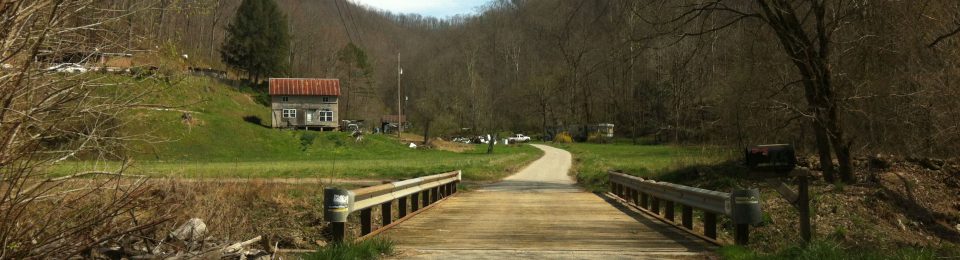
Back in Harts, Brandon and Billy visited Tom Farley on the Marsh Fork of West Fork of Harts Creek. Tom was the grandson of Burl Farley, one of the ringleaders in the Brumfield-Dingess mob of 1889. He was a great storyteller and knew a lot of interesting tales about the old vigilantes around Harts.

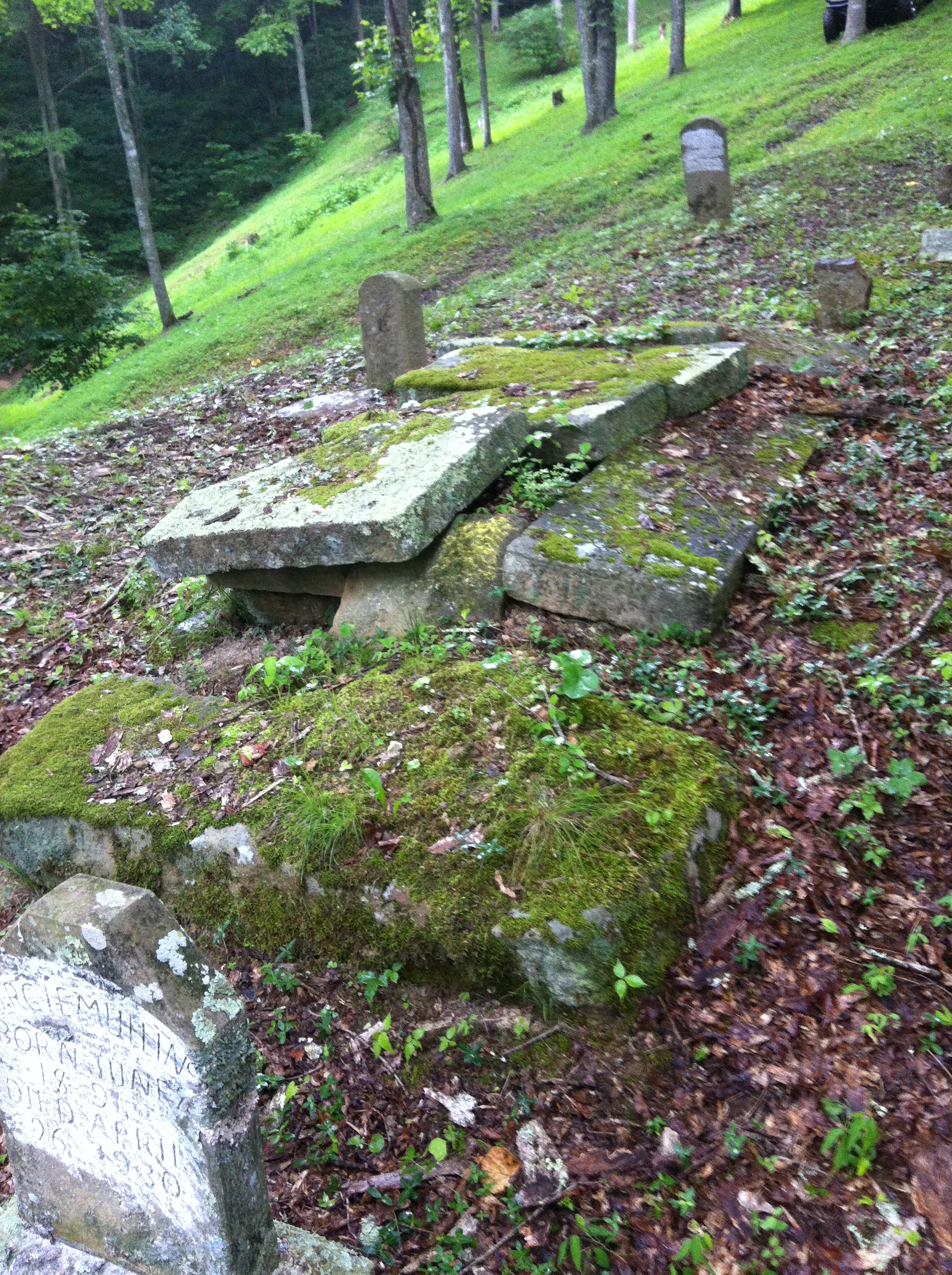
“Milt Haley and Green McCoy, my grandpa Burl Farley was in that,” Tom said. “Dealer Dave Dingess was in that. Dealer Dave Dingess played the fiddle for them when they chopped them boys’ heads off. He wasn’t a mean fellow. Burl Farley and them just got him drunk. French Bryant and Burl Farley was supposed to been the men who went over and chopped their heads off. My uncle Lewis Farley was in it.”

French Bryant, Tom said, married his aunt Polly Dingess.

“I’ve heard that Polly was one of the hatefulest women that ever took a breath,” he said. “A lot of people said she was the Devil’s grandma. French Bryant, he took her by the hair of the head and he tied her up to that apple tree. She took pneumonia fever and died.”

Tom told a great story about Bryant.

“French Bryant, I know a story they told me. It might be a lie. He was hooked up with the Ku Klux Klan. Was a captain of them. This is an old story. It’s supposed to happened right up here in this hollow. Dealer Dave and a bunch of them had their moonshine still set up in here. There was some young men came back in this country looking for Burl trying to get them timber jobs. They thought they was spying on them. This might every bit be lies but I was told this by all them old-timers. Burl Farley, Dealer Dave Dingess, French Bryant, Lewis Farley, and a bunch of them was supposed to’ve beheaded them right under that beech tree, my daddy always told. This story goes that they come in here looking for work. The Ku Klux Klan brought them here, made old Polly Dingess cook them a midnight supper. Dealer Dave played the fiddle for them and they danced all night. The next day at twelve o’clock Polly fixed a big dinner. Their last meal. One of them told the other two, said, ‘We just might as well eat. This is the end of the line for us.’ One of them just kept eating. He told the other two, said, ‘You better eat because this is the last meal we’ll ever eat.’ Said French Bryant cussed them and said, ‘Eat because you’ll never eat another meal.’ Dealer Dave asked them, ‘What do you want me to do as your last request?’ Said two of them cried and wouldn’t say a word. Said that one boy that eat so much told Dealer Dave, said, ‘Play ‘Satan’s Nightmare’.’ Took them out there at one o’clock under that beech tree and laid their heads across the axe and chopped two of their heads off. Said two of them cried and wouldn’t say a word. Said that one boy that eat so much told Dealer Dave, said, ‘Play ‘Satan’s Nightmare’.’ They chopped their heads off. Said French took their heads and set them on the mantle.”

So Dealer Dave Dingess was a fiddler?

“Dealer Dave played the fiddle,” Tom said. “I remember seeing old man Dave. He was tall and skinny. He played ‘Blackberry Mountain’ and a bunch of stuff. ‘Wild Horse’. Dealer Dave was the biggest coward that ever put on a pair of shoes. When it would start to get dark, my daddy and my uncle Bill Dingess — just tiny kids — they’d have to walk up this hollow with him. One would walk in front of him and the other one behind him. Said Lee Dingess cussed him all to pieces, told him, said, ‘Dealer Dave, nobody’s gonna hurt you. There ain’t a man alive that’s gonna bother you.’ Dave said, ‘Hush, Lee. I’m not afraid of the living. I’m afraid of the dead.’ Afraid to pass that cemetery. They called him Dealer Dave because he horse-traded so much and every time he got cheated he cried and he had to trade back with you. Make a trade today and tomorrow he’d cry till you give him his horse back. They said he was good on the fiddle. They said he played for square dances.”

Big Creek News 04.12.1923

Tags

, , , , , , , , , , , , , , , , , , , , , , , , , , , , , , , , , , , , ,

An unnamed local correspondent from Big Creek in Logan County, West Virginia, offered the following items, which the Lincoln Republican printed on Thursday, April 12, 1923:

Charley Lilly is in very poor health.

Arline, daughter of Mr. and Mrs. J.H. Kitchen, has been very ill during the past week.

Mrs. Robert Stone was a business visitor in Huntington the past week.

The Stone Branch school closed on April 5th. Many were present and all report a fine time.

Mr. Tom Vance was a recent visitor in our midst.

Mrs. Floyd Lilly left Saturday for Charleston where she will pay an extended visit to her sister, Mrs. Nellie Parsons.

Miss Maggie Lucas has just closed a successful term of school at Lime Stone. The pupils there all want Miss Lucas back next year.

Mr. D.E. Owens, of Columbus, Ohio, was calling on friends here recently.

Mr. K.E. Toney, of Toney, who has large business interests in this city was here the early part of the week looking after business affairs and mingling with friends.

Rev. J. Green McNeely, of Logan, delivered very able sermons to the Baptist congregation in this city, at the M.E. Church, South, Saturday night and Sunday afternoon. Rev. McNeely is a splendid expounder of the gospel and the people of our city are always delighted to hear him.

Miss Dixie Toney returned home Saturday evening from a shopping visit in Huntington.

Mr. Walter Fry, prominent young citizen of Rector, was in the city yesterday on matters of business.

Uncle Hub Vance continues in very poor health.

Mr. W. Birchard Toney, of this place attended Logan Lodge, No. 391, B.P.O.E., Thursday evening.

Miss Flossie Barker, of Logan, spent Easter with friends here.

Gilbert Thompson, of Holden, was the recent guest of friends in our midst.

In Search of Ed Haley 344

Tags

, , , , , , , , , , , , , , , , , , , , , , , , , , , , , , , , , ,

Around that time, Brandon and I received confirmation from Doug Owsley at the Smithsonian that he was interested in exhuming the Haley-McCoy grave. Doug gave us instructions on what we needed to do before his office could actually become involved — most importantly, to get permission from the state authorities, as well as from Milt’s and Green’s descendants. We felt pretty good about our chances of getting support from the family but weren’t sure what to expect from “officials.” For some guidance in that department, we called Bobby Taylor and Deborah Basham at the Cultural Center in Charleston, who told us all about exhumation law and codes in West Virginia. They felt, considering the interest of the Smithsonian, that we would have no trouble on the bureaucratic end of things.

Meanwhile, Rounder Records was in the final stages of releasing a two-CD set of Ed’s recordings called Forked Deer. The sound quality was incredible on the re-masters although to the uninitiated ear some of the music still sounded like it was coming from behind a waterfall in a cellophane factory. In addition to Forked Deer, Rounder was slated to release two more CDs of Ed’s music under the title of Grey Eagle in the near future.

I was very excited about all of these tunes getting out because I had fantasies of some “young Turk” fiddler getting a hold of them and really doing some damage.

In July, I called Pat Haley to tell her about the CDs, but we ended up talking more about her memories of Ed.

“I know when we lived in 1040 Greenup — when I first came over here — Pop would play very little. Only if he was drinking and maybe Mona would get him to play. I never knew of Pop ever playing sober. I didn’t hear Pop play too much but then his drinking days were just about over. But Mom would play. They had a mandolin and might have been a banjo and Mom would play a little bit. I didn’t know their brother, Ralph. He passed away, I believe, in ’46 or ’47 and I didn’t come into the family until ’48 — when I met Larry — but we married in ’49.”

Pat and I talked more about Ed’s 1951 death.

“Larry and I lived with Mom and Pop on 2144 Greenup Avenue and little Ralph lived with us,” she said. “Clyde had just come home from San Quentin, and a couple of months before Pop died Patsy was due to have Scott and so she moved into the house with us. Her and Jack had the front living room as their bedroom so that Patsy could be close to the hospital. Scott was born January 4th. My Stephen was born January 27th. We were all in the same house when Pop died. But about three days before Pop died, Clyde decided to rob his mother and came in in the middle of the night and stole her sweeper and radio while we were sleeping and he was picked up by the police and he was in jail when his daddy died. He didn’t get to come to his daddy’s funeral. His mother’s either, actually. He was in a Michigan prison when his momma died.”

In Search of Ed Haley 343

Tags

, , , , , , , , , , , , , , , , , , , , , , , , , , ,

Not long after visiting Ugee, I received some great information in the mail regarding Rector Hicks, a fiddler and nephew to Ed’s friend Laury Hicks. Rector grew up watching his uncle Laury play the fiddle.

“Rector was born out in the country around Chloe, Calhoun County, West Virginia, in 1914,” Joe LaRose wrote in Traditional Music and Dance in Northeast Ohio (March 1985). “His father was a good mouth harp player, but no one else in his family played music. Rector learned from fiddlers who lived in his area, beginning to play the instrument when he was around ten years old. Rector learned a lot from time spent with a distant cousin, Laury Hicks, a generation older than Rector and one of the foremost fiddlers in the area. ‘I don’t know of a fiddle player, really, that played like him. Ed Haley said Laury was the best fiddler he ever heard on the old time tunes, you know, and old fast ones. Hisself, he said that. And I always thought he was.'”

While at Laury’s, Rector Hicks also had the opportunity to see Ed.

“He was hard to figure out,” Rector told LaRose. “When I was around him most I didn’t know too much about fiddling, and a lot of that stuff I could pick up now if I was around him. How he got all that in there with his bow like he did you’d never believe it. He just set there this way (passes the length of the bow back and forth across the strings) but everything seemed like it just come in there. If you’d hear him play… Now that record, that’s not Ed Haley. That’s him, but that’s no good. You don’t get a lot of what he puts in. But he puts every note in that thing. His left hand, his fingers just flew. But his right hand… He just set there and his fiddle laid on his arm, set there and rocked. That’s the way he played. All them fastest tunes he played, didn’t seem like he put any of the bow in hardly. But it was all in there.”

Rector seemed to idolize Haley, at least according to Kerry Blech, a fiddling buff and friend of mine.

“Rector, when he was a teenager, had saved up some money and got him a pretty good fiddle and when Ed would come and stay at Laury’s house Rector would always come over,” Kerry wrote. “For a couple of years, Ed would tease him and say, ‘Well, I really like that fiddle you got, Rector. We should swap.’ And once he did and went off and played in some other town, then came back through about a week later and got his fiddle back. Rector said he was just really thrilled to’ve had Ed’s fiddle for even a week.”

As Rector got older and learned more about the fiddle, he really patterned after Haley’s style.

“Rector’s approach to playing has much in common with Haley’s,” LaRose wrote of Hicks. “Like Haley, Rector holds his fiddle against his upper arm and chest and supports it with his wrist (he does not rock the fiddle under the bow, though, like Haley did.) Rector uses a variety of bow strokes. Like Haley, he uses the length of the bow, sometimes playing a passage of several notes with one long stroke, deftly rocking the bow as he plays. He will accent the melody at chosen times with short, quick strokes. Rather than overlay the melody with a patterned or constant bow rhythm as some dance-oriented fiddlers do, Rector adapts his bowing to the melody of the particular tune he’s playing. Much of the lilt and movement of his tunes is built into the sequence of notes played with his left hand.”

Rector apparently kept in touch with Ed’s family, who he sometimes visited long after Haley’s death, and was very disappointed with the quality of fiddling on the Parkersburg Landing album.

“When I met Rector in the mid-70s, the Haley LP had just come out and Rector called me up to tell me it was awful,” Kerry wrote. “He said it was not representative of the man’s genius. He told me that he knew the man, and although many years had passed, the Haley genius was still in his mind’s eye. He also said that there were many other home recordings beyond what Gus Meade had copied. He said that Haley’s children had split up the recordings, that Lawrence had a number of them, and that a daughter, who lived in the Akron-Canton area, had over a hundred of them, and that Rector occasionally went over there and listened. He said that the family was irritated by how the Rounder record came to be and did not want to be involved with any of us city folk any more, afraid that someone would exploit their father’s music.”

At that time in his life, Rector mostly played Tommy Jarrell tunes but also several Ed Haley tunes, like “Birdie”, “Sugar in the Morning” (“Banjo Tramp”), “Ragpicker Bill”, “Black Sheep”, and “Staggerlee”.

Big Creek News 04.05.1923

Tags

, , , , , , , , , , , , , , , , , , , , , , , , , , , , , , , , , , , , , , , ,

An unnamed local correspondent from Big Creek in Logan County, West Virginia, offered the following items, which the Lincoln Republican printed on Thursday, April 5, 1923:

Uncle Hub Vance is suffering from the flu.

Miss Mary Sanders attended Federal Court in Huntington the past week.

Miss Hoaner Ferrell has returned from Parkersburg, where she has been attending Mountain State Business College.

Miss Dixie Toney was the guest of Mrs. Clyde W. Peters, of Huntington the past week.

Miss Cora M. Adkins, the popular teacher, was in Huntington the past week making arrangements to attend Marshall College.

Miss Birdie Linville was calling on friends at Toney, Sunday.

Miss Ida Lucas, who has a position with the First National Bank of Huntington, was here recently enroute to her home on Big Creek.

Mr. K.E. Toney is in Logan this week on matters of business.

Mr. John Thompson, of the Hunt-Forbes Cons. Co., was in town today. He reports that the Company’s contract in Harts Creek district will be completed within one month.

M.D. Bledsew was a recent visitor in Williamson.

J.W. Stowers, merchant of Ferrellsburg, was a recent visitor of his sister, Mrs. Ward Lucas, of this place.

Roy Anderson, Chief Clerk in the Logan Assessor’s office was the Sunday guest of K.E. Toney.

Elbert Baisden has been appointed Asst. Supt. of the Daisy Coal Co.

Miss Hazel Toney will complete her business course at the Capitol City Commercial College about April 15th, and will, we are informed be employed in the Sheriff’s office in Logan.

Miss Maud Gill’s school closed last Friday. Miss Gill is a fine teacher and met with great success in her work this year.

Miss Maud Ellis, of Logan, was the recent guest of Mrs. Ella Baisden.

In Search of Ed Haley 342

Tags

, , , , , , , , , , , ,

Just before Brandon and I left, Ugee told us about the last time she saw Ed. It was the late 1940s and he lived on 45th Street in Ashland. Aunt Rosie Day made the trip with her, but warned her that the chances of hearing any music were slim because Ed and Ella had played little music since Ralph’s death.

“Oh, well,” Ugee told her. “They’ll play for me or I’ll tear his house down.”

She could tell upon arriving at the Haley home, though, that Ed and Ella were “different people.” When she asked to hear some music, Ella said, “We ain’t got nothing to sing about anymore.” Aunt Rosie kinda took the hint, saying to Ugee, “Well, we better go home now.” But Ugee refused, saying, “No, I’m staying all night. The fight’s on.”

Ella tried to appease her by getting out the homemade records (which were already scratched up), but Ugee said, “Ed, you’re talking to the wrong woman. You’re going to play music tonight or we’re gonna break your music box. Now get your fiddle and get your mandolin and let’s hear some music. The fight’s on.”

She said Ed threw his head back and laughed with a “big chaw of tobacco” in his mouth, then said, “I reckon we might as well play for her. She ain’t gonna shut her mouth till we do.”

Ugee admitted that she “was really carrying on awful.” When Ed started playing, “he played some of the saddest things that I ever heard. You know, he was down in the dumps – and Ella, too. It didn’t even sound like them. I let them play three or four and I said, ‘Now I’m tired of that stuff.  I don’t like that stuff.’ That ain’t music at all.’ It didn’t sound like them. I said, ‘Now, I want some music.’”

Ed whispered to Ella, “Watch this,” then went all out for “Calhoun County Blues”. Ugee took off dancing and Ed “got to laughing” and then fiddled up a storm.

“That’s the first time they’s been any laughing and going on in this house since Ralph died,” Ella said.

A little later, “Ed said he was getting sleepy. He was wanting to go to bed, but he didn’t want to go to bed and leave me and Ella setting up in there. He kept saying, ‘Well ain’t you fellers getting tired?’ I said, ‘No we ain’t a bit tired.’ And I’d punch Ella. I said, ‘Not a bit in the world.’ Ed said, ‘Ugee you ain’t got any more sense than you ever had.’ And I said, ‘Well, you don’t act like you know too much, either.’ Well, we got in there and went to bed and we laid there and talked and carried on and laughed. I was sleeping with Ella and he was over in the other bed. He said, ‘Now I’m a going to sleep.’ I said, ‘Well, quit your laughing then.’ He said, ‘I wish you’d shut your mouth.’ Well Mom came down the next day from up in Calhoun County. I didn’t tell them she was a coming. You ought to have heard Ed and them tell how I came down there and picked on them. Mom said, ‘You ought to run her off.’ He said, ‘I tried to but she didn’t have sense enough to leave.’ And then he got to playing some music. And I said, ‘He don’t know how to play. He’s lost all of his touch. And Ella, she can’t play the mandolin,’ and all that kind of stuff with them. And Ella said, ‘You know we haven’t played any since Ralph died.’”

Ugee’s visit apparently cheered Ed and Ella up, because they tried to get her to stay all summer. Ed told her, “That’s what we need down here,” but she teased them about being “dead people” and said she’d never do it.

Gill News 04.05.1923

Tags

, , , , , , , , , , , , , , , , , ,

“Reporter,” a local correspondent from Gill in Lincoln County, West Virginia, offered the following items, which the Lincoln Republican printed on Thursday, April 5, 1923:

Prof. Lee Adkins, of near Palermo, has just closed a successful singing school here, and is going to teach another one in the near future.

There is a lot of sickness in this neighborhood.

The Sunday school has opened up at this place with a good attendance.

Philip Sperry was a business visitor at Branchland last week.

The Big Ugly Coal Co. has closed down operation here.

There is some talk that the Railroad Co. is going to double track the Guyan Valley from Logan to Barboursville in the near future.

Forest fires have been raging in and around Gill the past week.

Mr. and Mrs. Alvin Spurlock, from Spurlockville, were the recent guests of Mr. and Mrs. W.M. Sperry.

In Search of Ed Haley 341

Tags

, , , , , , , , , , , , , , , , , ,

Ugee said, “I never will forget the first time I seen Ella. I’d fixed cabbage for supper — big head of cabbage. Next morning, Ed said, ‘Where’s the cabbage?’ I said, ‘Well you don’t want cabbage for breakfast.’ ‘Oh,’ Ella said, ‘We love cabbage for breakfast.’ I went and got that cabbage and heated it up. I wish you’d a seen her eating that cabbage. I didn’t know anyone ate cabbage for breakfast. I was a fixing eggs and bacon.”

Brandon asked about Ella’s appearance.

“Ella wasn’t no bad looking woman at all,” Ugee said. “She was a nice looking woman, I thought. When I seen her, she had had three kids and she was a little heavier then. She kept herself nice-looking. She liked to wear nice dresses and she liked to wear hose. You’d be surprised to see her wash them kids and clean them. Now really you would. She’d pick them kids up and say, ‘Come here, you’ve got a dirty face.’ How she knowed they had a dirty face, I don’t know.”

I asked Ugee if Ed ever got into any fights, because his face looked lop-sided in one of his pictures.

“Aw, he’s fell a lot of times,” she said. “I’ve seen his boy Clyde and that Ralph — wasn’t his son, but he called him his son — I’ve seen them lead him across logs and let him fall down and laugh about it. Yeah, they didn’t care for doing anything like that. No wonder when he’d get up, if he could get to one of them, he’d whoop one of them. They was into everything. I never seen Lawrence or Jack either one into anything. But you turned Ralph or Clyde loose anyplace, they might ‘weigh’ chickens and kill your chickens. Maybe put a string around their neck and hold them up and maybe kill two or three hens — choke them to death. Why, Ed’d get mad. Ella would, too, over things like that. She’d say, ‘My, my, my.’ They’d run in and grab their purse and take their money. Ella’d buy anything they wanted.”

Even though Ed’s kids treated him rough, Ugee said he “liked to joke and talk and laugh. I never seen Ed Haley mad but once in my life. Me and him almost fit, too, that time. He whooped Clyde. He oughta whipped Clyde but not like he did. Clyde aimed to jerk him off the porch. If he had, he’d a killed him. And he jerked his belt off and he went to whooping Clyde. And he was whooping hard. He was trying to beat him to death. I walked out on the porch and said, ‘That’s enough, Ed.’ And he said, ‘Damn him. He tried to kill me.’ I grabbed a hold of the belt. He said, ‘Ugee, let loose of it.’ I said, ‘I ain’t letting loose of it. You’ve whooped him enough and I don’t want to see no more of that. While I’m living, don’t you ever hit one of them kids with a belt. I don’t allow that.’ He said, ‘I’ll whip them with a belt when I’m damn good and ready.’ I said, ‘You’ll not whip them here — not like that.’ I mean, he was beating him.”

Brandon asked if the other boys were mean to Ed or ever got whipped and Ugee said, “Clyde’s the only one I ever seen him whoop. They was about to send him to reform school — stealing, I think. He musta been about fourteen years old. That there Ralph, he was ornerier than… That Ralph even shot hisself with a gun to see how it’d feel to be shot. That was up where we lived. My mother doctored him. Mona, she was ornery. She’d steal off her mom. Take stuff out and destroy it. She was pretty as she could be. She’d just look at you as if to say, ‘I’ll do as I please.’ Ed swore she was just like her aunt on her mother’s side. And Noah was sneaking — dangerous sneaking. He was into everything and he’d lie. Noah was awful bad about gambling.”

Ugee really contrasted Ralph, Clyde, Noah, and Mona with Jack and Lawrence.

“Jack and Lawrence was gentlemen,” she said. “None of them come up with Lawrence, far as I’m concerned. He would lead his mom and dad anyplace. I can see how careful he was. That little hand of his leading his mother around this mud hole, ’round this log and stuff. Really, I’m not taking up for him because he’s dead or anything like that. I always called him ‘my little boy.’ He was always littler than the rest of them.”

Harts area businesses (1923-1924)

Tags

, , , , , , , , , , , , , , , , , , , , , , , , , , , , , , , , , , , , , , , , , , , , , , , , , , , , , ,

The following entries were published in R.L. Polk’s West Virginia State Gazetteer and Business Directory (1923-1924):

FERRELLSBURG. Population 100. On the Guyandotte Valley branch of the C&O Ry, in Lincoln County, 30 miles south of Hamlin, the county seat, and 18 north of Logan, the nearest banking town. Telephone connection. Express, American. Tel, W U Mail daily.

J.W. Stowers, general store

HARTS. (R.R. name is Hart.) Population 150. On the Guyandot Valley branch of the C&O R.R., in Lincoln County, 30 miles south of Hamlin, the county seat, and 21 from Logan, the banking point. U.B. church. Express, American. Telephone connection. Herbert Adkins, postmaster

Anthony Adams, general store

Adkins Barber Shop

Catherine Adkins, general store

Della Adkins, general store

Hazel Adkins, ice cream parlor

HERBERT ADKINS, Real Estate, Postmaster,  R R and Tel Agt

Watson Adkins, general store

Hendrix Brumfield, lawyer

Rev. Charles Curry, pastor (UB)

John Dingess, blacksmith

John Dingess Lumber Co.

Hollena Ferguson, general store

Wesley Ferguson, poultry breeder

John Garten, justice of the peace

Jeremiah Lambert, general store

Porter Hotel (Saddie Adkins)

C.W. Rice, physician

John Thompson, general store

William M. Workman, general store

WHIRLWIND. Population 275. In Logan County, 16 miles northwest of Logan, the county seat and banking point, and 2 from Dingess, the shipping point. Express, American. Baptist church. Mail daily. James Mullins, postmaster.

D. Adams, apiarist

Frank Adams, produce

Grover Adams, ginseng grower

Sol Adams, lumber mfr

Lindsey Blair, watchmaker

Reece Dalton, live stock

G.W. Damron, R R and express agt

C.W. Mullins, ginseng grower

George Mullins, horse dealer

JAMES MULLINS, General Store, Photographer and Postmaster

Willie Tomblin, blacksmith

Peter Workman, barber

In Search of Ed Haley 340

Tags

, , , , , , , , , , , , , , , , , , , , , , , , , , , , , , , , , , ,

I asked Ugee if Laury ever listened to the Grand Ole Opry and she said, “Yes. He got to hear it the year before he died. He got a radio. Let’s see, what is his name? George Hayes. We had Hayeses that lived down at Arnoldsburg. And he brought Dad up a little radio when Dad was down sick.”

Now, did Ed Haley ever hear the Grand Ole Opry?

“Oh, yes. He heard it down in Kentucky.”

Did he like it?

“No. He went to Cincinnati one time. They was a gonna make records — him and Ella — but they wanted to pick out the one for him to play. Nobody done him that a way. So he said, ‘I’ll pick my own.’ He went to Nashville once. I don’t know as he went to the Grand Ole Opry but he went to Nashville. Somebody drove him, took him down. But when he found out what they done, he didn’t have no use for that.”

Ugee made it clear that she had missed out on most of Ed’s wild times. She knew nothing about his running around with people like Doc White or chasing women. She did say he was bad about telling “dirty jokes.”

“Many a time he’s told me, ‘All right, Ugee. You better get in the kitchen. I’m gonna tell a dirty joke.’ And he’d tell some kind and you could hear the crowd out there just a dying over it. Ella’d say, ‘Mmm, I’ll go to the kitchen, too.'”

I asked Ugee about Ed’s drinking and she told the story again about her brother Harvey giving him drinks to play “Sweet Florena”. She sang some of it for me:

Oncest I bought your clothes, sweet Florena.

Oncest I bought your clothes, sweet Florene

Oncest I bought your clothes but now I ain’t got no dough

And I have to travel on, sweet Florene.

After finishing that verse, Ugee said, “That’s part of the song. And Ella didn’t like to hear that song. I think it reminded her of some of his old girlfriends or something. And she didn’t like for him to play ‘Buttermilk Mountain’, either. He’d throw back his head and laugh. She’d say, ‘Don’t play that thing. I don’t want to hear that thing.’ But she’d second it. She’d draw her eyes close together.”

Brandon asked Ugee about her aunt Rosie Hicks, who was Laury’s sister and a close friend to the Haley family. She said Aunt Rosie was working in Ed’s home in Catlettsburg when she met Blind Bill Day (her sixth husband) during the early years of the Depression. It was a rocky marriage, according to Rosie’s only child, Nora (Davis) Martin.

“I was gonna tell you about him hitting Aunt Rosie,” Ugee said. “He came through the house and Aunt Rosie was upstairs quilting and all at once — Nora said she was in the kitchen cooking — and she heard the awfulest noise a coming down the stairs and said, ‘Mommy had old Bill Day by the leg and was bringing him bumpety-bump down the stairs, dragging him. Got him in the kitchen. He just walked up and hit her with that left hand right in the mouth. She just jerked his britches off of him and started to sit his bare hind-end on the cook stove — and it red hot.’ And Nora said, ‘Oh, Mommy, don’t do that. You’ll kill him.’ She said, ‘That’s what I’m a trying to do.’ And she grabbed her mother and him both and jerked them away from there.”

Ugee was more complimentary of Day’s colleague, Jean Thomas.

“I’ve got cards from her and letters and pictures,” she said. “I’ve been to her house — stayed all night with her. She was nice. She was too good to Bill Day. She spent money on him and give him the name of Jilson Setters. Sent him to England and he played for the queen over there.”

Brandon wondered if Bill Day was a very good fiddler.

“Well, I’m gonna tell ya, I stayed all night with Aunt Rosie and Bill Day one time,” Ugee said. “They lived on 45th Street in Ashland, Kentucky. My brother took me and my mom down there and he hadn’t seen Aunt Rosie for a long time. She’d married again and she lived down there in Ashland, Kentucky. And we aimed to see Ed and Ella, but they was in Cincinnati playing music. That’s who we went to see. So Harvey, he filled hisself up with beer. That’s the first time I ever seen a quart bottle of beer. Anyway, we went up there to hear Uncle Bill play. Harvey laid down on the bed like he was sick. He wasn’t sick: he wanted me just to listen to that fellow play that fiddle. He knowed I’d get sick of it. And he played that song about the Shanghai rooster. I never got so tired in my life of hearing anything as I did that. He only played three pieces. Harvey laid there, he’d say, ‘Play that again. I love it.’ And I had to sit there and listen to it, ’cause I didn’t want to embarrass him by getting up and walking out. I walked over to Harvey and I said, ‘You’re not sick and you’re not tired, so you get up.’ Said, ‘Ugee, I’ve got an awful headache. I drove all the way down here.’ I said, ‘That bottle that you drank give you the headache, so you get up and you listen to your Uncle Bill.’ He went to the toilet. I said, ‘I’m telling you right now — you’re gonna listen to Uncle Bill if I have to listen to him.’ Harvey said, ‘I’m not listening to him no longer. I’ve heard all I want to hear of Uncle Bill.’ I got Harvey up and then I run and jumped in the bed and I covered my head up with a pillow. But we stayed all night and Aunt Rosie went home with us. She told him she’s a going up to Nora’s, but she went to Calhoun with us in the car, and I reckon while she’s gone old Bill tore up the house. I don’t think they lived together very long after that ’cause it wasn’t very long till she come back home. It was home there at my dad’s.”

Brandon asked if Day ever played with Ed in Calhoun County and Ugee said, “Oh, no. If he had, Dad woulda kicked him out.”

Okay, I thought: so Laury had no tolerance for lesser fiddlers. What about Ed?

“Ed Haley, if somebody was playing a piece of music and they wasn’t hitting it right, he’d stick his hands in his pockets and say, ‘Goddamn, goddamn,'” Ugee said. “Dad’d say, ‘Boy, ain’t he good?’ Ed would cuss a blue streak. Then after the man was gone, whoever it was, Dad and Ed would go to mocking him. Dad and Ed Haley was like brothers. They loved each other. Ella and Mom, too. Jack was the baby the first time I seen Ed after he was married. They was expecting Lawrence, so they named him after my dad. Then when she had Mona, why instead of calling her Minnie, she named her after Mom.”