In Search of Ed Haley 339

Tags

, , , , , , , , , , , , , , , , , , , , , , , , , , , , , , ,

As Ugee spoke about her life, I pulled out the Laury Hicks fiddle and began to play. For Ugee, hearing it painted pictures and conjured up images from long ago. Her eyes teared up, full of emotion and melancholy.

“I never thought I’d hear Dad’s fiddle played again,” she said, after I played one tune.

For the next half-hour, I played for her, intermittently asking things like, “Did you ever hear Ed play ‘The Star Spangled Banner’?”

“I certainly have.”

What about “Dixie”?

“Oh my god, yes. Him and Dad both played ‘Dixie’.”

Did they play “West Fork Gals”?

“Oh, yeah. I don’t think they was any fiddling pieces back then they didn’t know.”

Before putting the fiddle back in the case, I asked what Ed did when he needed repairs on his fiddles.

“They didn’t work on their fiddles very much,” Ugee said. “They kept their fiddles in good shape. I’ve seen Dad string the bow hair off a horse’s tail. Seen him do that a many a time. He’d string up the bows for Ed, too. Dad could do all of that.”

Did Ed trade fiddles a lot?

“Oh, yeah. Anybody that came along. He’s been there with three or four. He used to come and try to trade some of them off to Dad. Sometimes Dad’d trade with him, sometimes he didn’t. I’ve seen my dad have as high as seven fiddles.”

I showed Ed’s fiddle to Ugee and she said, “Ed Haley got that fiddle from Dad. Ed traded him a real dark-looking fiddle. Ed got my guitar, too. He wanted it for Ralph.”

Brandon asked Ugee about her father’s background, a very important thing considering his strong presence in Ed’s life. She said he was born in 1880 to Washington and Elizabeth (McCune) Hicks in Calhoun County.

“Well, he come very near to getting killed when he was young,” she said. “Perry Meadows stabbed him seven times with a knife right around the heart in a fight. They didn’t think he’d live at all. He told Perry if he lived, ‘I’ll get you.’ He liked to beat Perry to death after he got older. Old Mrs. Meadows was gonna indict Dad over it it but Dad rode a pony horse and went with Ab Moss’ mother to Mount Airy, North Carolina. Back then, they wasn’t no roads — just trails. Took his big dog with him named Ring. He come very near to beating Perry to death, though, I guess. They was friends afterwards. Perry lived down the road just about half a mile below us. Dad never cared that much about Perry but he treated him right.”

Ugee spoke little about Laury’s bachelor days but implied that his musical skill and talent at square dancing made him popular with the ladies.

“They wouldn’t have a square dance in the country without having Laury Hicks,” she bragged.

She felt Laury inherited his musical talent from his mother’s side of the family, the McCunes. Laury’s uncle Jim McCune, who lived at the infamous “Booger Hole,” had musical children: John was a good fiddler on two or three tunes, while Jasper was the best banjoist in the area. Another son Tom “could play the banjo, but he was the best whistler I ever heard in my life. Dad give him a dollar a day to come up and whistle for him when he was bad sick.”

“All them McCunes could play music and they could dance, too,” Ugee said, before adding that they were mostly known as singers.

In 1904, Laury married Minnie Shaver. Because he was so close to his mother (he was her “favorite”), he remained living at home with his new bride. Years later, he played his fiddle and sang for his mother at her deathbed. Ugee sang all she could remember of the song:

There was an old man, he had a wooden leg.

He had no tobaccer but tobaccer he’d beg.”

“That was Grandpap Hicks’ favorite and the night that Granny died in 1923 I was putting her to bed and he was just see-sawing on the fiddle. She said ‘Laury, play your dad’s tune,’ and he said, ‘Oh Mam, I have to change the key.’ She said, ‘Don’t make no difference. Play Wash’s piece.’ I never will forget: I went to the kitchen and he was playing that and he hollered, ‘Hey, Ugee! Come here quick!’ And I come back in and seen they was something wrong with Granny. And I run and aimed to work with her…she was gone.”

Ugee couldn’t remember the title of her grandfather’s favorite tune, nor any more words to it, but Brandon later found those lyrics in a song recorded by Gid Tanner and His Skillet Lickers called “Hinkey Dinkey Dee”.

Wewanta News 06.22.1922

Tags

, , , , , , , , , , , , , , , , , , , , , , , , , ,

An unnamed local correspondent from Wewanta in Lincoln County, West Virginia, offered the following items, which the Lincoln Republican printed on Thursday, June 22, 1922:

Mr. and Mrs. P.J. Williamson entertained a number of friends Sunday, among whom were: Mrs. Rachel Adkins, Mrs. Shirlie Hankles, Mrs. Elias Williamson, Jackson Mullins, of Maynard, and Mr. Elias Williamson.

Arthur Napier and Boyd Wiley, of this place, attended singing at East Fork of Fourteen, Saturday.

Milton Nelson, of Gill, tells of finding a dead man in the Guyan river near Gill. Inquest was held by Wm. Adkins at Ranger. Dr. Crockett was called and after examination, stated that he had been dead about three months. He had very costly cuff links, and a fine bill-book. He also had insurance papers on which his name and address, John Smith, of Huntington, W.Va., appeared. His bill-book contained $2. His body was in such a bad state that not much could be told of his features, but it is believed that he was a colored man. The body was found by Sherman Nelson and his son, Milton, while out fishing.

Garrett Webb was a visitor at Wm. Webb’s Sunday.

In Search of Ed Haley 338

Tags

, , , , , , , , , , , , , , , , , , , , , , , , , , , , ,

On April 12, 1997, Brandon and I went to see Ugee Postalwait in Rogersville, Alabama. For the most part, she repeated a lot of the same stories I’d heard before, maybe with a new detail or two here and there. We began with her memories of Ed and Johnny Hager, who came to her father’s house around 1913. Brandon asked her specific questions about Johnny, which caused her to say: “He was a little short fella, slender. He was a nice person. Well-mannered. He was a good banjo-player. John Hager was a good friend of Dad and Mom’s both — all of us. Us kids, too. He used to write Mom and Dad. He wrote them from Webster Springs and he wrote them from Greenbrier. Different places where he was at. John wrote a letter back home and said he quit traveling with Ed ’cause Ed drank. He couldn’t take it. I’ve often wondered and studied about what become of him.”

Later, Ed sometimes came with a guitar player, but Ugee couldn’t recall his name.

Brandon was curious to know how far Ed traveled with his music, so he asked if Ed and Ella ever played around Parkersburg.

“I’m pretty sure they have,” Ugee said, “and Marietta, too. Harvey took them up to Akron to play music and they crowded that street so bad up there that they passed a law up there, you couldn’t stand on the corner and play music any more. They wouldn’t allow them to stand on the street. They had to move. See, they was such a crowd got around them.”

I asked, “How much do you reckon Ed would take in of a night?”

Ugee said, “I have seen Ed and Ella take in as much as a hundred dollars right there in Spencer.”

Wow, were they using a cup or a hat to collect money?

“They never used no cup. Just sit a box down or hat down and people come through and throwed money in it. Anyone that come along and dropped money in there, they’d play just the same.”

Would he play me anything I’d ask for?

“Why sure. He’d play it for you and then maybe if you asked for it again he might play you something else and call it that. He didn’t care to rename songs, like ‘Soldiers Joy’. He might call that ‘Runnin’ the Soldier’ or ‘Runnin’ the Track’ or something like that.”

I reminded Ugee that she heard Ed say he just picked up a fiddle and started playing it when he was small and she said, “Oh, yeah. He’d sit in the floor and play on that fiddle. Somebody brought something in that had two strings on it. He wasn’t very old. Just barely a walking, he said. Just like him a talking to me one time, telling me about his dad. Telling about them a lynching him. He said, ‘Goddamn him, they oughta lynched him.’ And I never asked him why. Why would a man say that about his dad? Maybe he was thinking about that man putting him in that barrel of water and causing him to be blind. But Ella’s eyes, they was ate out with blue vitriol.”

Ugee fully believed that measles had caused Ed’s blindness because they almost “put her blind,” too, when she was a girl.

“I must have been about five years old,” she said. “Well, Ed musta been there, too. Musta been the same year he was there that I had the measles and I went blind in my eyes. Couldn’t see nothing for three or four days. Had Granny’s bed set up by the side of the fireplace. I remember that instead of springs, it had rope. And Christmas time come up. And Dad, he played Santa Claus, I reckon. He got me jellybeans. I couldn’t see nothing for two or three weeks. I didn’t think I’d ever see again. Back then, they called them the ‘big’ measles and the ‘little’ measles. The big ones, they called the German measles. And I had them bad. Harvey come around — he was older than I was — he’d say, ‘You stink’, ’cause he could smell that fever on me.”

Brandon asked Ugee what year she was born in, to kind of help us better understand the time frame of her memories.

“I was born in 1907,” she said. “I got married in 1924. I left and went to Akron, but we come back ever month for a long time. If we knowed Ed was a coming in, we was there. I moved back in 1930. We lived on the farm until 1941. Then we went to a farm at the mouth of Stinson.”

At some point, Ugee moved back to Akron, where she lived when I first met her in 1991.

In Search of Ed Haley 337

Tags

, , , , , , , , , , , , , , , , , , , , , , , , , , , , , ,

Brandon and I also called Bob Bryant, a son of the infamous French Bryant, who lived with his son at the mouth of Piney Creek on West Fork. Billy Adkins had encouraged us to call Bob, saying that he would probably tell us what he knew of the Haley-McCoy murders. When we called Bob, his son said we were welcome to talk with his dad, although he warned us that his memory wasn’t very good.

Bob said he was born on Piney in 1911.

When I asked him about French Bryant he said he knew very little about him because his dad “was pretty old” when he was born. He said he did remember his father talking “some” about the Haley-McCoy affair.

“Milt and Green were pretty rough fellers who got in a lot of trouble all the time,” Bob said. “They were bad to drink. Milt Haley and Green McCoy was fiddlers — I think so. Maybe they was. Yeah, I almost know they was. One of them picked the banjo, I believe, but I don’t know for sure.”

Bob said Hugh Dingess, who was “kind of an outlaw,” organized a posse to fetch Milt and Green after they shot Al and Hollena Brumfield. They found them over around Wolf Creek in Martin County, Kentucky.

“Them Dingesses up there killed them,” Bob said. “It didn’t take much to get them to shoot you back then. People’d shoot you just to be a doing something.”

I asked Bob if he ever heard anything about who took part in what he kept calling “the shooting” and he said, “Hugh Dingess and four or five more.”

He paused, then said, “A few of them I wouldn’t want to tell you.”

We were just waiting for him to say his father’s name when he said, “Short Harve Dingess was pretty rough. Seems like he was in that bunch some way.”

Some of the others were: Al Brumfield, Charley Brumfield, Fed Adkins, and Burl Farley.

Bob never identified his father as a member of the mob but mentioned that his father was a friend to the Dingesses on Smokekouse.

He said he remembered seeing Ed play at the schoolhouse above the mouth of Piney when he was nineteen years old.

“He was a real fiddler,” Bob said.

In subsequent weeks, Brandon and I went through most of our information — processing it, sorting it, discussing it. We thought more about the story of Milt causing Ed’s blindness by dipping him in ice water and wondered how anyone would have ever equated those as cause-effect events. I got on the phone with Dr. Tom Holzen, a doctor-friend of mine in Nashville, who said Milt’s dipping of Ed in ice water, while a little crude, was actually the right kind of thing to do in that it would have lowered his fever. Based on that, Milt seems to have been a caring father trying to save Ed’s life or ease his suffering. Was it the act of a desperate man who had already lost other children to disease?

Church of Jesus Christ, General Assembly (1915)

Tags

, , , , , , , , , , , , , , , , , , , , , , , , , , , , , , , , , , , , , , , , , , , , , , , , ,

General Assembly of the Church of Jesus Christ, meeting at Radnor, Wayne County, WV, 1915

General Assembly of the Church of Jesus Christ, meeting at Radnor, Wayne County, WV, 1915

Harts Creek and Big Ugly Creek land grants (prior to 1850)

Tags

, , , , , , , , , , , , , , , , , , , , , , , , , , , , , , , , , , , , , , , , , , , , , , , , , , , , ,

Listed below are land grants and early deeds citing the Harts Creek and Big Ugly Creek areas of what was then Logan and Cabell counties, Virginia. The list will be updated and improved periodically.

1812   Squire Toney         100 acres   1 1/2 poles from A.W. grave

1813   Jacob Stollings       185 acres   Harts Creek, mouth

1814   Henry Conley         N/A            Hearts Creek

1815   George Spears       300 acres   Guyan River at upper end of William Brumfield’s line

1817   Edmund Toney       40 acres     Guyan River near Harts Creek

1819   William Brumfield   75 acres     Below Big Ugly on Guyan River

1819   William Brumfield   75 acres     Waters Guyandotte

1821   Charles Spurlock     N/A           mouth of Harts Creek

1824   Jacob Stollings       50 acres     N/A

1824   Peter Dingess        170 acres    Harts Creek

1827   John Goare           N/A             Marsh Fork

1828   Elias Adkins          N/A              Waters Guyandotte

1828   Richard Elkins       18 acres       Harts Creek

1828   John Fry               N/A              Green Shoal Creek

1833   Isaac & Elias Adkins   N/A          Mouth of Harts Creek from Richard Elkins

1834   Henry Conley        N/A              Harts Creek

1834   Abner Vance, Jr.   N/A              Harts Creek

1834   Richard Vance       N/A              Smokehouse

1835   Isaac Adkins          N/A              Waters Guyandotte

1835   Moses Brown          N/A              Guyandotte River

1835   John H. Brumfield   N/A              Waters Guyandotte

1836   Harvey Elkins          N/A             Harts Creek

1836   Richard Elkins          N/A             Harts Creek

1836   Squire Toney           N/A             Ugly Creek

1837   Richard Vance         25 acres      Trace Fork

1838   Joseph Adams         100 acres     Mouth Rockhouse Fork from Guy Dingess

1838   John H. Brumfield    255 acres     Big Ugly Creek

1838   Ralph Lucas            N/A              Ugly Creek, Green Shoal

1838   John Rowe              38 acres       Ugly Creek

1841   Joseph Adams         30 acres       Buck Fork

1841   Moses & John Workman   N/A      Harts Creek

1842   Joseph Adams         N/A              Harts Creek

1842   Robert Hensley        N/A              Smokehouse

1842   Lorenzo Dow Hill      N/A              Buck Fork of Harts Creek

1842   Peter Mullins            25 acres      Harts Creek, from Abijah Workman and Mekin Vance

1842   Burbus Toney          N/A              Limestone

1843   Joshua Butcher        N/A              Smokehouse

1843   Price Lucas              N/A              Harts Creek

1843   James White, Jr.      N/A              Rockhouse?

1844   Joseph Adams         N/A              Four Tracts, Harts Creek and Buck Fork

1844   Peter Mullins            50 acres       First lower branch of Trace Fork

1844   Meken Vance           N/A              Harts Creek

1846   John Workman         N/A              Hoover Fork

1847   William Dalton          N/A             2 Tracts, Harts Creek, Kiahs Fork

1847   Samuel Lambert       N/A             Marsh Fork

1847   Arnold Perry             N/A             Hoover’s Fork

1847   Obediah Workman    N/A             Henderson’s Branch

1848   Joseph Fry               N/A             Ugly Creek

1849   John H. Brumfield     N/A             Ugly Creek

1849   Levi Collins              N/A             Ugly Creek

1849   Peter Mullins            N/A             Harts Creek

1849   Patten Thompson     N/A             Marsh Fork

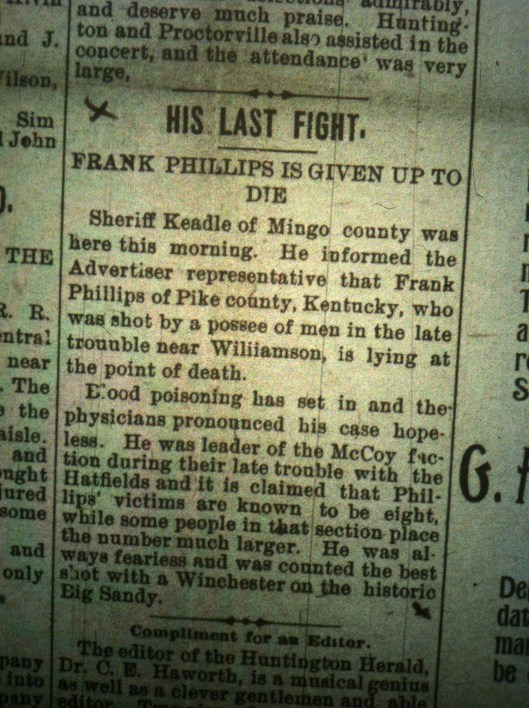
Frank Phillips is Given Up to Die (1895)

Tags

, , , , , , , , , , , , , , ,

Frank Phillips HA 09.28.1895

“His Last Fight: Frank Phillips is Given Up to Die,” Huntington (WV) Advertiser, 28 September 1895

In Search of Ed Haley 336

Tags

, , , , , , , , , , , , , , , , , , , , , , , , , , , , , , , ,

By the spring of 1997, Brandon and I were at a reflective point in our research efforts. We had begun to lose our edge. After all, how many times could we ask, “Now, how did Ed Haley hold the bow?” or “Do you remember the names of any tunes he played”? We decided to step away from interviewing people and focus on writing what we knew about Ed’s life and music. I spent long hours in Nashville at my dining room table listening to Ed’s recordings and working with the fiddle, while Brandon — in his three-room house in Ferrellsburg — transcribed interviews, re-checked facts, and constructed a manuscript. This went on for quite some time.

Eventually, Brandon came to visit and we decided to telephone a few people and ask more questions. Our first call went out to Edith Dingess, the only surviving child of Ed’s uncle, Peter Mullins. Andy and Dobie Mullins had told us about her several months earlier when we visited them on Harts Creek. Edith, they said, had recently moved from her home on Mud Fork in Logan to stay with a daughter in Columbus, Ohio. When we dialed her up, her daughter said, “She might be able to give you some information. Her memory is pretty bad. She’s 81 years old and she’s had a couple of real major heart attacks.”

I first asked Edith if she knew about Ed’s mother — her aunt — who apparently died in the early 1890s. Unfortunately, Edith didn’t know anything about her. As a matter of fact, she said she barely remembered Ed, who we knew had been practically raised by her father. She said he was a “nice person, likeable” who would “laugh and joke and go on.”

“I know Ed Haley used to come to our house with Mrs. Haley and they had a little girl. Might’ve had some boys — older,” Edith said. “I believe they lived down around Huntington. They’d come up home when my dad was a living and we was all home — I was young then — and they’d play music and we’d have company. We used to have some square dances at our house. We had some good times when he come up there.”

Edith said Ed’s children led him around, but he also got around using a cane.

Before we hung up, Edith gave us the telephone number of her niece, “Little Liza,” who lived with a daughter in Lancaster, Ohio. This was wonderful; I had first heard about Little Liza from Lawrence and Pat Haley in 1991. Little Liza had grown up in Uncle Peter’s home and was a featured face in family photographs. Prior to this lead, I wasn’t even sure if she was still alive.

When we called Liza, we first spoke with her daughter, Ora Booth, who gave the familiar introduction: “I don’t know if you’ll get too much out of her or not. She’s kinda forgetful and she repeats herself a lot. All I can do is put her on the phone and see what you get out of her. She’s seventy-six and her mind just comes and goes on a lot of things.”

I told Liza that I was good friends to Lawrence and Pat Haley, had heard a lot about her, and was very interested in Ed’s life. She said Ed used to stay a week or two with Uncle Peter — who she called “Poppy” — before heading back to Ashland. To our surprise, she had no idea exactly how Ed was related to her family.

“It’s been so long and you know I’ve been sick and everything and been operated on for cancer and stuff and I just don’t feel good,” she said. “When you get old, your mind just comes and goes.”

Just when I thought Liza’s memories of Ed had all but disappeared, she said, “I tell you, he was awful bad to drink all the time. Lord, have mercy. Anything he could drink, he’d drink it. That might have been half what killed him. He was a mean man. Just mean after women and stuff. I don’t know whether he could see a bit or not, but you’d get and hide from him and he’d come towards ya. I was scared of him.”

I asked Liza who Ed played music with when he visited at Peter’s and she said, “He just played with his wife. He didn’t have nobody else to play with. Lord, him and her’d get into a fight and they’d fight like I don’t know what.”

I wondered if Ed fought with his kids.

“Yeah, they liked to killed Ed Haley one time up there,” she said. “They’d just get into a fight and the kids’d try to separate their mommy and daddy and it’d just all come up. I had to holler for Ewell to come down there and get them boys off’n Ed Haley ’cause I was afraid they’s a gonna kill him. I didn’t want that to happen, you know? He got down there and buddy he put them boys a going. They was mean. I guess they took that back after Ed Haley. Yeah, he’d come up there and go here and yonder. After Mommy and Poppy got so bad off, people’d bring him down there and set him off and I had to take care of them, so Poppy just told him, said, ‘Ed, she has to wait on us and she can’t wait on you. You’ll just have to go somewhere else.’ He did.”

That was a horrible image.

Atenville and Fourteen 04.14.1918

Tags

, , , , , , , , , , , , , , , , , , , , , , , , , ,

“Flossie,” a local correspondent from Atenville or Fourteen in Lincoln County, West Virginia, offered the following items, which the Lincoln Democrat printed on Thursday, April 4, 1918:

Mr. and Mrs. Millard Sias and little daughter Maymie have returned to their home at Yates after spending a week with the former’s parents, Mr. and Mrs. Billy Midkiff of Atenville.

Elbert Smith of Ranger has been very ill with small pox.

Elijah Midkiff has returned to his work at Earling after a visit with his parents.

Misses Anna and Cuba Adkins and their brother Bill returned to their work near Logan Monday morning.

Miss A. Adkins is very low with fever.

Miss Emmar Midkiff is visiting her sister Mrs. Millard Sias this week.

Woodrow Bills purchased five fine hogs from Billy Midkiff Monday.

Mr. and Mrs. Noah Resnic of Virginia are visiting their aunt.

The school on Fourteen is progressing nicely this term.

Miss Sarah Midkiff made a flying trip to Atenville Monday morning.

Best wishes for the Lincoln Democrat.

Ferrellsburg Fancies 04.04.1918

Tags

, , , , , , , , , , , , , , , , , , , , , , , , , ,

“Pinkey,” a local correspondent from Ferrellsburg in Lincoln County, West Virginia, offered the following items, which the Lincoln Democrat printed on Thursday, April 4, 1918:

Dr. Cline of Hamlin quarantined a few cases of small pox here in this community one day last week.

Mr. Reynolds of West Hamlin was here on business recently.

General Adkins has been clearing land and sowing oats the past week.

Herbert Adkins of Harts passed through here Saturday from Fry where he had been transacting business.

Our old friend C.S. McCoy took dinner with Mr. and Mrs. Ira Adkins one day last week.

Mr. and Mrs. General Adkins accompanied by his father, Hansford Adkins were the guests of Bilton and Milcie McNeely Sunday.

Little Miss Cuba Nelson and Mary Jones were visiting Mrs. S.H. Adkins Sunday.

We have several more cases of small pox reported in our neighborhood.

Mrs. Oma Messer is very ill.

The cross tie business is looking good.

Dr. Robert Maslowski endorses “Blood in West Virginia”

Tags

, , , , , , , , , , , , , , , , , , , , , , ,

I proudly announce Dr. Robert Maslowski’s endorsement of my book, Blood in West Virginia: Brumfield v. McCoy. Dr. Maslowski, President of the Council for West Virginia Archaeology and graduate professor at the Marshall University Graduate College, ranks as one of Appalachia’s most dedicated and accomplished scholars. A retired archaeologist for the Huntington District of the U.S. Army Corps of Engineers, he is popularly known as the editor of West Virginia Archaeologist and as executive producer of three award-winning archaeology films: Red Salt & Reynolds (2003), Ghosts of Green Bottom (2005), and Secrets of the Valley: Prehistory of the Kanawha (2010). Throughout his long professional career, he has worked with the Smithsonian Institution, the National Geographic Society, the National Park Service, and the U.S. military. In so many ways, he has made significant contributions to our understanding of Appalachian history and culture. A personal note: during my time as a graduate student at Marshall University, Dr. Maslowski was my favorite instructor. Receiving praise from such an accomplished scholar and an outstanding instructor means a great deal to me.

Here is Dr. Maslowski’s endorsement of Blood in West Virginia:

“Not only does Blood in West Virginia present a compelling narrative of a little known feud in southern West Virginia, it provides valuable insights into the local politics, economy, timber industry, and family life in Lincoln County during the late 1800s.”

Harts Happenings 04.04.1918

Tags

, , , , , , , , , , , , , , , , , , , , ,

An unnamed correspondent from Harts in Lincoln County, West Virginia, offered the following items, which the Lincoln Democrat printed on Thursday, April 4, 1918:

Will Adkins, of Canoe Fork of Ruff hollow was visiting his friend Herbert Adkins Sunday.

J.F. Willhoit was a business visitor in Huntington recently.

Miss Kathleen Vass is visiting friends in Branchland this week.

B.C. Powers sold Herbert Adkins a fine Black Beauty wheel this week.

Mrs. Heallinea Willnoit was in Huntington the past week.

Miss Virgie Brumfield who has been staying with her grandmother for the last two weeks was visiting home folks Saturday and Sunday.

Misses Bessie and Anna Brumfield were shopping in Harts last week.

F.B. Adkins of Ferrellsburg was here recently and purchased a five year old mule. He is intending to raise a large corn and tobacco crop this season. He is very much pleased with his trade.

Lewis Dempsey & Sons have rented Herbert Adkins’ farm on which they are preparing to raise a large potato crop. They have quit the stave business.

James Brumfield of Greenshoal passed through town Sunday en route to S.H. Adkins and returned with five bushels of soup beans, he is preparing for the scarcity of provision.

Catherine Adkins, merchant of Harts has been on the sick list for the past few days but is recovering slowly. We regret her illness.