• About

Brandon Ray Kirk

~ This site is dedicated to the collection, preservation, and promotion of history and culture in my section of Appalachia.

Brandon Ray Kirk

Category Archives: Boone County

Battle of Kanawha Gap (1861)

10 Sunday Jun 2018

Posted by Brandon Ray Kirk in Barboursville, Big Creek, Boone County, Chapmanville, Civil War, Guyandotte River, Tazewell County

≈ 5 Comments

Tags

129th Regiment Virginia Militia, 1st Kentucky Infantry, 34th Ohio Volunteer Infantry Regiment, 5th Virginia Regiment, Abram S. Piatt, Appalachia, Baltimore & Ohio Railroad, Barboursville, Battle of Kanawha Gap, Big Creek, Big Sandy River, Boone County, Burlington Weekly Hawk-Eye, Camp Enyart, Ceredo, Chapmanville, Charleston, Chicago Daily Tribune, Cincinnati Daily Press, Cincinnati Gazette, civil war, Cleveland Morning Leader, Coal River, Confederate Army, Daily Green Mountain Freeman, David S. Enyart, Eli Thayer, Evening Star, George McClellan, Greenbrier County, Guyandotte River, H.C. Evans, Harpers Ferry, Herman Evans, history, J.V. Guthrie, J.W. Davis, Jacob D. Cox, John Dejernatt, Kanawha River, Kanawha Valley, Logan County, Logan Court House, M.H. Wood, National Republican, O.P. Evans, Ohio, Ohio River, Parkersburg, Pomeroy Weekly Telegraph, Portsmouth, Richmond Whig, Robert E. Lee, Samuel Smoot, Sewell Mountain, Southwestern Times, Staunton Spectator, T.W. Rathbone, Tazewell County, Tug Fork, Union Army, Virginia, West Virginia, West Virginia Division of Culture and History, Wheeling, William Baisden, William Rosecrans, William S. Rosecrans, Zouaves

The following newspaper accounts describe the Battle of Kanawha Gap near present-day Chapmanville, Logan County, WV, which occurred on September 25, 1861:

Cleveland (OH) Morning Leader, 3 October 1861

GALLIPOLIS, Oct. 2.

The expedition planned by Col. J.V. Guthrie of the First Kentucky Regiment, and sent out under Lieut. Col. Enyart and Col. Piatt, has returned. They encountered the enemy at Chapmansville under Col. J. Lucien Davis, of Greenbrier, and utterly routed them. The enemy lost between fifty and sixty killed. Our loss was four killed. The expedition returned to Charleston on the 30th ult.

david s. enyart photo

Col. David S. Enyart, 1st Kentucky Infantry (Union).

Evening Star (Washington, DC), 4 October 1861

A Confederate Camp in Western Virginia Broken Up and Routed

CINCINNATI, Oct. 3 — A body of Federal troops, under Lieut. Col. Enyart, attacked a camp of rebels at Chapmansville, in Logan county, Va., near the Kentucky line, routing them, killing sixty and taking seventy prisoners. The same body of rebels were afterward intercepted in their retreat by Col. Piatt, who killed forty and made a large number prisoners.
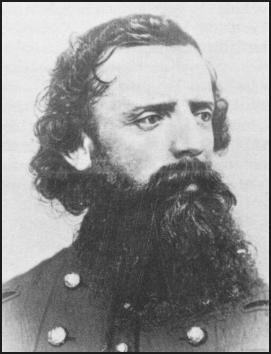
abram s. piatt photo

Col. Abram S. Piatt (1821-1908), 34th Ohio Infantry Regiment.

New York (NY) Herald, 4 October 1861

FIGHT WITH THE REBELS AT CHAPMANSVILLE

Cincinnati, Oct. 3, 1861.

The Kanawha correspondent of the Commercial of this city says that five companies of the First Kentucky regiment, four companies of the Thirty-fourth Ohio regiment and one company of the Fifty Virginia regiment, under Lieutenant Colonel Enyart, surrounded and attacked the rebels at Chapmansville, and after a short engagement completely routed them, killing sixty and taking seventy prisoners. The rebels in escaping were intercepted by Colonial Piatt, who killed forty and took a large number of prisoners. The country between Charleston and Wyandot river is now freed from secession power. This is the most effective blow given the rebels in this part of the valley.

IMG_2256.JPG

One section of the Kanawha Gap Battle Site, Chapmanville, Logan County, WV, 9 June 2018.

Daily Green Mountain Freeman (Montpelier, VT), 7 October 1861

Chapmansville, Va., the scene of the most recent engagement, is a small post village in Logan county, Va. Logan county is in the extreme Western portion of Virginia, the Tug Fork of the Big Sandy being the boundary line between it and the State of Kentucky. It is one of the largest, wildest and most sparsely inhabited counties in the State.

IMG_2238.JPG

Part of the Kanawha Gap Battle Site, Chapmanville, Logan County, WV, 9 June 2018.

National Republican (Washington, DC), 7 October 1861

THE SITUATION.

The two affairs at Chapmansville, reported three or four days since, in which the enemy lost one hundred killed and a proportionate number of wounded, will, it is supposed, restore permanent peace to the Virginia counties western of the Kanawha. Chapmansville is on the turnpike from Charleston to Logan county Court-house, and is about twenty-five miles to the south of Barboursville, the shire town of Cabell county. The secessionists in that part of Western Virginia have been numerous and pertinacious. They have once had possession of Guyandotte on the Ohio river and for a long time they threatened Ceredo (Mr. Thayer’s colony,) which lies on the river between Guyandotte and the Kentucky line. There have been two engagements with them in the rear of Ceredo, one at Barboursville, one at Logan county Court-house, one at Boone county Court-house (which town was burnt by the national troops,) and finally two at Chapmansville. The truth is, that in large portions of numerous, and, but for the early occupation of that region by the National troops, would have controlled it, not because they were the majority, but because one secessionist is, everywhere, a match for three Union men.

The secessionists are reckless, violent, and desperate, while their opponents, if not timid are at any rate remarkably pacific. We doubt, indeed, from all the information we can get, whether throwing out of the account Wheeling and Parkersburg, the terminal on the Ohio river of the Baltimore and Ohio railroad, Western Virginia had more elements of Union strength than the Valley of Virginia. From Harper’s Ferry south for fifty miles, the Union men have been numerous from the first, and it is a matter of deep regret that it did not consist with the plans of military strategy adopted at the headquarters of the army here, to occupy (at least) the northern part of the Valley of Virginia. It is consoling, that a different policy was adopted in retrospect to Western Virginia. That region was promptly taken possession of, cleared of the rebel armies by Gen. McClellan, and has since been victoriously held by Gen. Rosecrans. All attempts of the enemy to affect a re-entrance into Western Virginia are promptly repulsed.

34th Ohio Volunteer Infantry Regiment, Piatt's Zouaves Flag Photo.jpg

Staunton (VA) Spectator, 8 October 1861

Status at Sewell’s Mountain.

The enemy, under Gen. Rozencrantz, and our forces under Gen. Lee, are both upon Sewell Mountain very near each other. A fight has been daily expected there for some time, but the enemy have been fortifying ever since they have been there, and there will not be a fight unless we attack them in their entrenchments. They are afraid to attack us, and it is probable that our force is too weak to risk an attack on them within their fortification. It may, therefore, be some time before an engagement will take place. We understand that we had sent a force of four regiments to their rear for the purpose of cutting off their supplies—that we succeeded in getting around them, but were compelled to return because we did not have sufficient supplies ourselves. We also learn that Col. Jas. W. Davis of Greenbrier, whilst commanding a force of militia in Logan county, attacked a part of the enemy, and was shot down at the first fire. The militia, after several rounds caught the Yankee fever which made their cowardly legs run off with their brave hearts, and they left their commander in the hands of the enemy, who, we fear, has died from his wound.

IMG_2923

New historical sign placed by the WV Division of Culture and History located at the 119 ramp in Chapmanville, WV. 26 April 2017.

Chicago (IL) Daily Tribune, 9 October 1861

A Splendid Achievement of the Ohio Zouaves–“Wood Up” the Battle Cry.

[The following letter is exclusively devoted to the fight which the Piatt Zouaves had with the rebels near Chapmansville, Va. It is distinct from the victorious fight which the command of Lieut. Col. Enyart had with another body of rebels, in the same vicinity. EDS. CINCINNATI COM]

CAMP ENYART, KANAWHA, Oct. 2, 1861. EDS. COM.: The Zouave Thirty-fourth Regimens, Ohio, have had a chance to show their metal. This was on Wednesday, on Kanawha Gap, near Chapmansville, Va. After marching 42 miles, they came upon the enemy, who were behind breastworks, but could not stand our boys’ steady fire, for they retreated in utter consternation, their Col. J.W. Davis, of Greenbrier, Va, (but the traitor is a native of Portsmouth, Ohio,) being mortally wounded. We killed 20, took 3 prisoners, a secesh flag, 20 feet long with FIFTEEN STARS, 4 horses, 1 wagon, 10 rifles (one of which I claim), 12 muskets, and commissary stores (very low.) We lost 3 killed, 9 wounded, one since died. The route of the enemy was complete, although they had a brave, skillful commander, and strong position, with two days’ information of our intentions. They fled the moment their commander fell. The fight lasted about 10 minutes opposite the breastworks, but a running fire was kept up previous to that, by the Bushwhackers and rebel cavalry for two hours. At every turn of the road over the mountains, they would fire upon our advance men, wheel round, and gallop away. This kind of fight was kept up till we came suddenly upon their breastworks, immediately in line of our entire column. It was made on the side of a knoll, between two mountain sides, the road running between the mountain on our left. The wily rebel commander had adroitly cut down the brush on the right, placing a force of 100 men on the mountain top on our right, who raked our column from the front to the center. This was to draw our attention from their breastworks. Our men naturally fired upon the rebels on their right, steadily advancing up the road, until within 20 feet of the enemy’s works, when the rebels suddenly opened fire, from their right, left and center. The order from Col. Piatt and Lieut. Col. Toland, to flank right and left was immediately responded to by the Zouaves with a hurrah, a Zouave yell, and a cry of “wood up” from Little Red; a dash by our boys upon the enemy’s breastworks, above which about 300 rebel heads suddenly appeared, unknown by our men till that moment. They sent a perfect storm of bullets around, over, under, and into our men. A few minutes more and our boys were inside the breastworks, chasing them over the mountains, the enemy running away like cowards as they proved to be. They left 29 dead behind. Their force was 450 infantry and 50 cavalry. Our force was 560.

We buried our three brave dead comrades that night, carried our wounded to the house wherein the rebel Colonel lay, mortally wounded, deserted by all his men but one. Our whole column finally marched into the little town of Chapmansville, formerly headquarters of the enemy, and camped for the night.

34th Ohio Volunteer Infantry Regiment, Piatt's Zouaves Captain Photo.jpg

34th Ohio Volunteer Infantry Regiment, Piatt’s Zouaves, Captain Photo.

Pomeroy (OH) Weekly Telegraph, 11 October 1861

Brilliant Action in the Kanawha Valley.

CHARLESTON, Va., Sept. 30, ’61. Eds. Cin. Com.–Information having been brought to Col. J.V. Guthrie, commanding this post, that a large force of Rebels were gathered at Logan Co., Lt. Col. Enyart, of the 1st Kentucky, was at once sent to engage them. His force was composed of five companies of the 1st Kentucky, four companies of the 34th Ohio–German Regiment–under command of Col. A.S. Piatt, and one company of the 5th Virginia Regiment, under command of Maj. M.H. Wood.

Col. Enyart, with the Kentucky force, surrounded and attacked the Rebels at Chapmanville, and after a short but decisive engagement, completely routed them, killing 60 and taking 70 prisoners. The Rebels, in escaping, were intercepted by Col. Piatt, who surprised them and killed 40 men, and took a large number of prisoners.

The force of the Rebels is now completely broken up, and the country between this point and Guyandotte River is now freed from Secession power. This is the most effective blow given the Rebels in this part of the Valley.

In great haste. Further particulars by next boat.

Very respectfully,

M. CLEMENS,

Lieut. Col. 5th Va. Reg’t.

34th Ohio Volunteer Infantry Regiment, Piatt's Zouaves Soldier Photo

34th Ohio Volunteer Infantry Regiment, Piatt’s Zouaves, Soldier.

Evening Star (Washington, DC), 11 October 1861

THE BATTLE OF KANAWHA GAP.

The Western Virginia correspondent of the Cincinnati Gazette gives the following account of the late engagement at Kanawha Gap:

There were about 1,050 troops under the command of Colonels Enyart and Piatt, who left their camp Monday morning, 30th ulto., and took up their line of march for the enemy.

The forces moved together until they reached Peytona, on Cole river, where they separated; Col. Enyart going up Cole river. Col. Enyart did not meet the enemy in force at any place but his men did meet and ford swollen rivers, and marched on short rations, and were anxious to meet with the running enemy of Old Virginia. Col. Enyart did not meet Col. Piatt until they met on the Kanawha, on their return.

Col. Piatt’s command immediately proceeded thence to Boone Court House, and camped that night one mile beyond. The next day, after proceeding some sixteen miles,t hey came up with the advance guard of the enemy, consisting of cavalry, when a brisk fire was exchanged, the cavalry retreating. After the retreat of cavalry the battalion was immediately put in order of battle. The advance guard of fifteen men was led forward by Adj’t Clarke, proceeding along the road. Scouts were sent out on either side of the road to meet and repulse the sharp-shooters of the enemy.

The force proceeded in this order for about two miles, meeting the pickets of the enemy, exchanging shots with them incessantly, and driving them back with increased confusion at each charge.

Being unable to ascertain the position of the rebels, the entire force halted for a few moments, and Col. Piatt rode in advance and took observations with his glass, but could not ascertain their force and position, as it was covered with a thick growth of underbrush. After these observations a command was issued to forward the column. The scouts moved on the rapidity and enthusiasm, the main body moving up the narrow road cautiously and firmly. The fire continued to increase, and shots were rapidly exchanged from the right and left with the enemy, until our advanced guard reached within sixty yards of their main force. The column was some eighty yards from the enemy when they received a perfect volley of fire upon their right, indicating that the rebels were in force in that direction. Company “A,” commanded by Capt. Rathbone, was ordered to deploy as skirmishers to the right, up the side of the mountain, and if possible to flank the enemy on the left. Company “C,” commanded by Capt. Miller, was ordered to the right, up a similar mountain, to flank the enemy on their left. Company “I,” commanded by Capt. Anderson, was ordered directly up the ravine, on the left. In this position he drew the concentrated fire of the rebels upon his company, who made use of the knowledge thus obtained by rapidly charging upon and destroying the enemy’s breastworks. The center moved directly up the road. With this disposition of the forces, Col. Piatt routed them from their confusion. Capt. Anderson was the first to mount their breastworks, his men following him in the face of a terrible fire without flinching or confusion.

As Capt. Anderson sealed the breastwork, Capt. Miller closed upon the left and Capt. Rathbone came in upon the right, his men crying “Zouave!” The main column moving up the road in double quick–until they were brought to a temporary halt by obstructions placed in the road by the enemy.

The rebels, terrified by the strange bravery and almost wild enthusiasm that was exhibited by each advancing column, ran in confusion, leaving their dead, wounded, clothing, guns, horses, &c., making their escape by Capt. Rathbone’s right; his company being too far up the mountain to cut off their retreat. Capt. West, commanding company F, was detailed to scour the mountain on the west, on the left of the road. Capt. O.P. Evans on the west side of the mountain, on the right side of the road. Capt. Herman Evans, commanding Company H, on the east side of the mountain, on the left of the road.

Each of these companies moved with dispatch, yet such was the knowledge of the rebels of teh by-paths in the mountains, and belonging to the “F.F.V.’s,” and having been drilled at running all summer, that but two were captured.

Among interesting objects captured was a genuine secession flag, captured by Lieut. Brown.

The enemy’s loss was thirty killed and fifty wounded.

We regret to know that four of our men were killed and eight wounded.

34th Ohio Volunteer Infantry Regiment, Piatt's Zouaves Soldiers Photo 2.jpg

34th Ohio Volunteer Infantry Regiment, Piatt’s Zouaves, Soldiers. Here’s a link to Captain T.W. Rathbone’s Civil War diary: http://resources.ohiohistory.org/ohj/browse/displaypages.php?display[]=0071&display[]=33&display[]=56

Burlington (IA) Weekly Hawk-Eye, 12 October 1861

The fight at Chapmansville was a sharp and bloody affair. Five of Piatt’s Zouaves were killed. The rebels lost thirty-five killed.
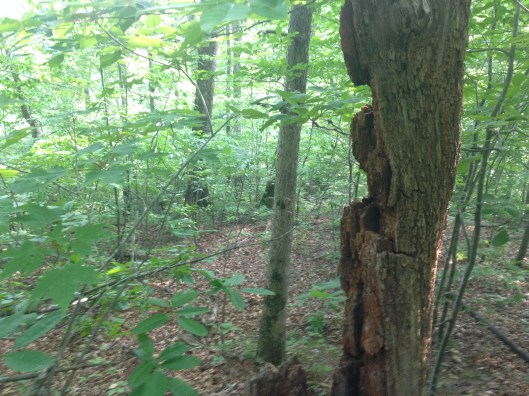
IMG_2235.JPG

Part of the Kanawha Gap Battle Site, Chapmanville, Logan County, WV, 9 June 2018.

National Republican (Washington, DC), 17 October 1861

The thirty-fourth regiment (first Zouaves) have been actively engaged since they came to the Kanawha Valley. Since the glorious victory they won near Chapmansville where the rebel commander, Colonel Davis, was mortally wounded, the Union sentiment has advanced on the Cole River. Two companies have been organized, and are ready to go to work to defend their own homes and give the organized regiments an opportunity to advance into the heart of the enemy’s country.

IMG_2254.JPG

Part of the Kanawha Gap Battle Site, Chapmanville, Logan County, WV, 9 June 2018.

Cincinnati (OH) Daily Press, 22 October 1861

Captain H.C. Evans, of Piatt’s Zouave Regiment, yesterday called in our office and exhibited a Secesh flag, captured at the Chapmansville fight, on the 24th ult.
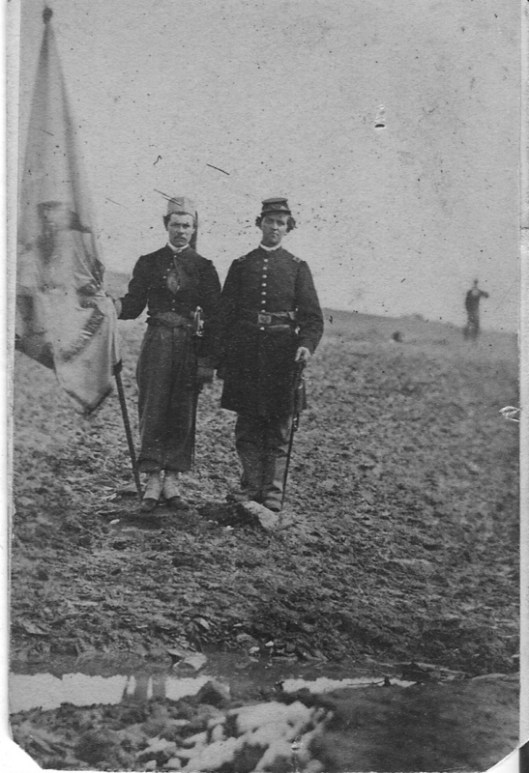
34th Ohio Volunteer Infantry Regiment, Piatt's Zouaves Soldiers Photo

34th Ohio Volunteer Infantry Regiment, Piatt’s Zouaves, Soldiers.

Clarksville (TN) Chronicle, 25 October 1861

The Fight in Logan County, Va.

[From the Richmond Whig of the 15th.]

We yesterday published the Yankee account of a battle in Logan county, which as usual, was manufactured out of whole cloth. The following are the facts as given by the South-western Times, (Tazewell county) of the 10th inst.:

From Samuel Smoot, Esq., of Boone county, who was in the fight, we learn the following particulars of the battle near Chapmanville, Logan county, on the 25th ult: The Yankees numbered 700, and commenced the attack upon our troops–the Logan militia–in a low gap between Guyandotte river and Big Creek, where they were engaged in raising a temporary breastwork. Our troops numbered 220, but there were only about 80 of them engaged in the fight. They were commanded by Col. J.W. Davis, of Greenbrier, a brave and gallant officer, who was severely, but not dangerously wounded, in the arm and breast. As soon as it became known that Col. Davis was wounded, the militia commenced a retreat. The commanding officer of the Lincoln troops afterwards confessed to Col. Davis, who was taken prisoner, that at the same moment a portion of the Yankees were running, and that one more round would have completely dispersed them.

The loss of the Yankees, by their own confession to Col. Davis, was 40 killed and a number wounded; among the former were four Union men, all of whom are represented by the Yankees to be most arrant thieves and cowards. Our loss was two killed and three or four wounded, besides Col. Davis, whose valuable services are at present lost to the Confederacy, being paroled by the enemy.

On the following day our scouts killed one of their pickets, and wounded another, at a point about half way between Logan Court House and Chapmanville, promising to give them particular thunder before daylight next morning. This with some news from a lady on the road, and some account of the militia of the surrounding counties, found on the person of Col. Davis, caused a hasty stampede for their headquarters, in the valley of the Kanawha. It seems that high water, bad roads, nor anything else could impede their rapid flight. They tore down a meeting house in Boone county to make rafts whereon to cross the river. They drowned two of their wounded, lost a wagon containing their entire stock of ammunition, and were fully persuaded that they were followed by two thousand cavalry, of which the Yankees in the West are about as fearful as their Eastern brothers are of masked batteries.

Upon the whole, we are much gratified at the result of this fight. It has, for the present, driven the cowardly thieves from the country, given renewed energy to the true patriots of Logan and the adjoining counties, fully convincing them that with the assistance of two or three hundred of their gallant friends in Tazewell county, they will be fully able to thrash any number that Gen. Cox or his friends shall dare to send against them.”

Note: An almost identical version of this story appeared in the Staunton (VA) Spectator on 22 October 1861.
IMG_7149.JPG

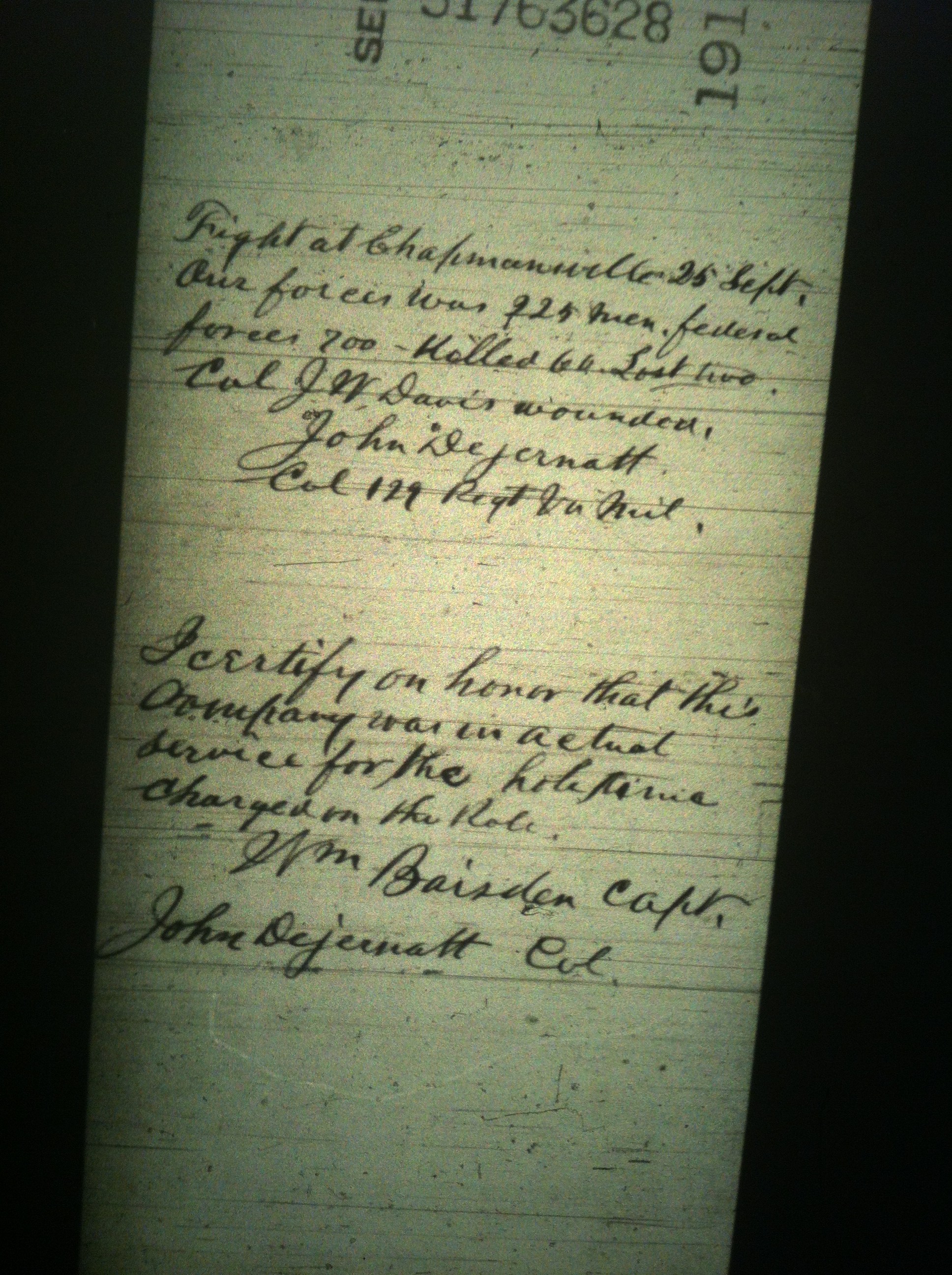
Record relating to the 129th Virginia Militia (Confederate), which was present at the Battle of Kanawha Gap.

Island Creek Roads (1927)

19 Thursday Apr 2018

Posted by Brandon Ray Kirk in Boone County, Gilbert, Hamlin, Huntington, Logan, Ranger, West Hamlin, Wharncliffe

≈ Leave a comment

Tags

Appalachia, Beech Creek, Ben Creek, Bluefield, Bluestone River, Bob Browning, Boone County, Bramwell, Cabell County, Charleston, Coal Valley News, Commissioner of Agriculture, Crum, Davy, Devil Anse Hatfield, farming, Gilbert, Gilbert Creek, ginseng, Griffithsville, Guyandotte River, Hamlin, history, Horsepen Creek, Huntington, Iaeger, Island Creek, John W. Smith, Kanawha River, Lincoln County, Logan, Logan Banner, Logan County, M.L. Jones, Mate Creek, Pigeon Creek, Ranger, Route 10, Route 2, Route 3, Sarepta Workman, Tug Fork, Twelve Pole Creek, Wayne, Welch, West Hamlin, West Virginia, West Virginia by Rail and Trail, West Virginia Hills, Williamson

From the Logan Banner of Logan, WV, comes this bit of history about Route 3 dated October 14, 1927:

“Changes Can Be Noted” In Island Creek Hills

Madison Editor Waxes Interesting on Old Times and Primitive Conditions–Surfaced Highways Mark the Paths Through Woodland That Were Traveled a Generation Ago.

An article of special interest to Logan folk is here reproduced from the Coal Valley News (Madison) of which M.L. Jones is editor. In a reminiscent mood he tells of road conditions and other conditions that prevailed hereabouts a generation ago. Exceptions might be taken to one or two statements, but the whole article is interesting indeed and informative.

It is considered appropriate that West Virginians should sing the “West Virginia Hills,” and year after year the teachers in their institution disturb their neighbors with this song, while “Tears of regret will intrusively swell.” There is some romance and merit in the song; but it strikes us that it is about time for a revision of this line.

“But no changes can be noticed in the West Virginia Hills.”

To prove our point we quote from memory.

For some years after 1882, there lived in the extreme head of the left fork of Island Creek, or Main Island Creek, a man named Bob Browning. It was 18 miles from Logan. The house was a two-room log cabin, surrounded by palings; and the valley was so narrow that it was difficult to find enough level ground for a garden. Apple trees and peach trees were scattered over a few acres of cleared mountain side. The family subsisted by a little farming, a little hunting and much ginsenging.

This place was between two low mountain gaps. A dim road, usable for wagons in dry weather, led down the creek to Logan, and forked at Browning’s house. One fork led east over one gap to Horsepen and Gilbert of Guyan; the other went west over the other gap to Pigeon creek, and by more or less roundabout ways connected with Ben Creek, Beech Creek, Mate Creek and Pigeon Creek, all of Tug river. Hence, it was a possible road route.

The nearest house down Island creek and on Horsepen creek was two miles; and on Pigeon creek about three-fourths of a mile. A wagon, lightly loaded, passed here on the average six times a year. Horsemen may have averaged one a day, though often a whole week passed without a traveler. It was simply a log shack in the head of the hollow, four miles from a school, ten miles from a store, without anything “which exalts and embellishes civilized life,” and so very remote from the haunts of men that when “Devil” Anse Hatfield and his followers concluded to surrender Tug river to Frank Phillips and the McCoys, they picked their “last stand” on Island creek, four miles below the spot we have been talking about.

Now, in the close of 1927, can “changes be noticed?” We have not been there for over 30 years. But we recently received a present from John W. Smith, commissioner of agriculture , Charleston, W.Va., entitled “West Virginia by Rail and Trail,” containing 22 maps and 174 pictures reproduced from photographs of different parts of the state, and for which we sincerely thank whoever got our name on Mr. Smith’s mailing list.

From this book we learn that when we laboriously trudged through the Horsepen gap or the Pigeon gap, from 45 to 35 years ago, we failed to foresee that within on generation men would pick those two gaps, within less than a miles of each other, as a route for one of West Virginia’s leading roads; and not only for one, but for two, of West Virginia’s leading roads. As we will explain:

Route 3, connects Huntington, Wayne, Crum, Williamson, Gilbert, Iaeger, Davy, Welch, Bramwell, and Bluefield. From Huntington to Wayne and about 15 miles above Wayne, it is mostly on the waters of Twelve Pole creek. It then bears west to Tug river and follows it from Crum to Williamson, about 25 miles. It then bears east to Pigeon Creek, which it follows to the spot we are writing about, in the head of Island creek, some 20 miles. It then goes through the two gaps and down Horsepen creek to Gilbert, on Guyan; up Guyan and Little Huff’s creek, of Guyan, and across the mountain to Iaeger, on Tug river. It then follows up Tug, by Welch, to the head of Elkhorn and then on the waters of Bluestone to Bluefield.

In all, Route 3 is in seven counties, though less than a mile of it is in Logan county, in the head of Island creek. It is graded all the way about 60 percent of it is hard surfaced, including about 25 miles at and near the Bob Browning place. Thus Bob, if alive, can ride on a hard surfaced road from his old home almost to Williamson, one way, and to Gilbert on Guyan the other way; and he could continue south by graded road, until he strikes hard surface again. The last fifty miles next to Bluefield is all hard surfaced, also the lower 25 miles next to Huntington.

But this is not the only big state route hitting this “head of the hollow.”

Route 10 runs from Huntington to the very same spot, a distance of 100 miles, through Cabell, Lincoln and Logan, and is all on Guyan or its tributaries. It is paved, or hard surfaced, from Huntington to West Hamlin, on Guyan where the Hamlin-Griffithsville hard-surfaced road turns off. It is also marked paved for seven miles north of Logan and twelve miles up Island creek. This leaves six miles up by the “Devil” Anse Hatfield place to the Bob Browning place to pave, and it is marked, “paved road under construction.” The only drawback to No. 10 is that from West Hamlin to Ranger is a patch where the grading is not yet satisfactory. Doubtless, within three years both 3 and 10 will be hard surfaced all the way. Even now, from the Browning place, the people can take their choice between an evening’s entertainment in Logan or Williamson.

But that is not all yet. The chances are heavy that there will never be but one hard surfaced road from Logan to Williamson. There will always be a heavy travel from Charleston to Williamson. It will be by our No. 2 to Logan; by No. 10 to the Browning place; and by No. 3 to Williamson. Within a few months it will all be hard surfaced.

From all this we conclude.

First; that we let a good chance slip when we failed to buy a half acre of land where No. 10 joints No. 3 for a hotel and filling station. We could have multiplied our investment by one thousand. But so far as we could see that spot was fit only to hold and the rest of the Earth’s surface together, and to get away from as rapidly as possible.

Second; that “changes can be noticed in the West Virginia Hills.”

We might add that thousands can remember crossing the Kanawha at Charleston on the ferry, because there was no bridge; and few, if any, three-story homes. The writer hereof did his first plowing with a two-horse turning plow in the center of what is now Huntington. It was a cornfield then. It is a fashionable residence district now. He boarded at an isolated log house on a hill back of the Huntington bottom, where now are miles of mansions on paved streets. Even in and about Madison and all over Boone county, it is hard for people to visualize how things looked a short ten years ago. Mrs. Sarepta Workman, on her recent visit to her old…

Jack Dempsey’s Mother (1927)

15 Sunday Apr 2018

Posted by Brandon Ray Kirk in Boone County, Chapmanville, Holden, Huntington, Logan, Sports, Women's History

≈ Leave a comment

Tags

Boone County, boxer, boxing, Cecilia Dempsey, Cecilia Smoot, Chapmanville, Charles Smoot, Chicago, Colorado, Don Ellis, Dyke Garrett, Enoch Baker, Gay Coal and Coke Company, Gene Tunney, Hiram Dempsey, history, Holden, Huntington, Huntington Hotel, Island Creek, J. Kenneth Stolts, Jack Dempsey, Jack Kearns, John B. Ellis, Joseph Ellis, Logan, Logan Banner, Logan County, Manassa, Salt Lake City, Scott Justice, Simpson Ellis, Stratton Street, The Long Count Fight, Utah, West Virginia, Wiatt Smith

From the Logan Banner of Logan, WV, comes this bit of history about champion boxer Jack Dempsey dated September 9, 1927:

Jack Dempsey’s Mother Pays Visit to Logan

Travels from Utah to See Relatives and Old Friends and Neighbors

Maiden Name Cecilia Smoot

Uncle Dyke Garrett Among Welcomers; Dempseys Once Owned Site of Holden.

While Jack Dempsey is fighting to regain the heavyweight championship of the world, his mother Mrs. Hiram Dempsey will be the guest of Logan relatives and friends. She is expected to arrive at any hour for an extended visit to the scenes of her childhood.

Mrs. Dempsey arrived at Huntington Sunday and then planned to come here the next day. Later, word came that she would complete today the last lap of a motor trip from Salt Lake City to Logan.

Interviewed at Huntington Mrs. Dempsey told of her desire to revisit girlhood scenes and inquired about old friends. She spoke of Uncle Dyke Garrett and was pleasantly surprised to learn that he is still living. Uncle Dyke read the interview (his wife is an aunt of Wiatt Smith, the interviewer) and despite the nearness of his 86th birthday, came back up from his home back of Chapmanville to welcome Mrs. Dempsey.

This beloved old mountain minister never knew Jack Dempsey, but he remembers Jack’s mother as a girl, her maiden name being Cecilia Smoot. She was a daughter of Charles Smoot, who came to Logan from Boone county, and who lived and died up on Island Creek. After his death, Mrs. Smoot (Jack Dempsey’s grandmother) married Simpson Ellis, who died but a few years ago, after serving a long period on the county court.

Scott Justice, who divides his time between Huntington and Logan, was among those who greeted Mrs. Dempsey at the Huntington Hotel yesterday. He remembers the marriage of Hiram Dempsey and Cecilia Smoot, and also recalls that the site on which the town of Holden now stands was sold by Hiram Dempsey to Mr. Justice’s father when the family decided to migrate westward.

According to Mr. Justice, the tract of 200 acres changed hands for a consideration of $600.

“Uncle” Enoch Baker was another caller to greet the challenger’s mother. Mr. Baker was engaged in business in Logan county when the Dempseys lived here, being well acquainted with the family.

Mrs. Dempsey was accompanied by Mr. and Mrs. J. Kenneth Stolts of Salt Lake City. They made the trip from Utah, where Jack’s mother now has her permanent home, in a large automobile, traveling in easy stages. They arrived in Huntington Sunday evening and are leaving there today.

She called her famous son in Chicago by telephone Sunday night to advise him she had arrived here safely.

While in Logan, Mrs. Dempsey will visit her half-brothers, Don Ellis of Stratton Street, and Joseph and John B. Ellis of Island Creek, and others.

She has never seen Jack in the ring and will probably receive the result of the coming battle from friends in Logan.

The difference in the ages of the champion and challenger will not be an advantage to Tunney, Jack’s mother thinks. “If Tunney will stand up and fight, I expect Jack will give a good account of himself. But if Jack has to chase him all the time, Tunney may turn around and give him a licking in the end. I believe they are pretty evenly matched and lucky may figure in the outcome,” she said.

The Dempseys left Logan in 1887 and William Harrison (Jack) was born in Manassa, Colo., in June ’95. While he was a mere child they returned to Logan county. Jack remained here until a young man, having been employed by the Gay Coal and Coke Company as late as 1913, and then went west alone to seek pugilistic fortune. He met Jack Kearns on the Pacific coast, from which point his spectacular climb to the pinnacle of the heavyweight division furnished the sport with one of its most romantic episodes.

In view of the fact that Dempsey is said to have lived in this county and because of the interest in the approaching fight, the foll

Banco News 10.05.1926

03 Tuesday Apr 2018

Posted by Brandon Ray Kirk in Banco, Big Creek, Boone County, Estep

≈ Leave a comment

Tags

Amanda Justice, Angie Lucas, Ann Duty, Annie Duty, Appalachia, B.E. Ferrell, Banco, Basil Duty, Big Creek, C.E. Justice, D.H. Harmon, Danville, Den Gillenwater, Elm Street, Estep, Fannie Brumfield, Francis Lucas, genealogy, history, Howard Ballard, John Hager, Kenner Reeder, Logan Banner, Logan County, Lucille Vickers, Marea Lucas, Marsella Adkins, Mary Hager, Mason Justice, Mt. Sinai, Mud Fork, R.L. Lucas, Robert Varney, Sallie Lucas, Spring Dale, Ted Hager, Virgil Gillenwater, Wandal Gillenwater, West Virginia

An unknown correspondent from Banco on Big Creek in Logan County, West Virginia, offered the following items, which the Logan Banner printed on October 5, 1926:

Among those whom Mr. and Mrs. C.E. Justice took out for a joy ride last Sunday were: Mrs. R.L. Lucas and children, Mrs. Francis Lucas and daughter, Angie, Lucille Vickers, Fannie Brumfield and Marea Lucas.

Mr. and Mrs. Robert Varney and children left for their home at Mud Fork accompanied by Mrs. Varney’s mother, Mrs. Annie Duty and children of Spring Dale last Sunday.

Mr. and Mrs. Den Gillenwater and sons, Virgil and Wandal and Mr. and Mrs. Ted Hager of Big Creek were the Saturday night and Sunday guests of Mr. and Mrs. Jno. Hager of this place.

Basil Duty sure is popular around Banco and Estep. He has two or more girls in each town.

Mr. and Mrs. Howard Ballard and children motored through Banco Sunday enroute to their home at Danville.

Mr. and Mrs. B.E. Ferrell and children of Mt. Sinai were visiting Mr. and Mrs. Kenner Reeder at Big Creek Sunday.

Mrs. Amanda Justice and two children, Mason and Marsella Adkins of Elm Street were visiting Aunt Ann Duty at Spring Dale Sunday afternoon.

Miss Marea Lucas made a short call in Banco last Sunday.

Those who were calling on Mrs. D.H. Harmon last Sunday were Mrs. Sallie Lucas and Mrs. Mary Hager.

Banco News 08.06.1926

03 Saturday Mar 2018

Posted by Brandon Ray Kirk in Banco, Big Creek, Boone County, Chapmanville, Estep

≈ Leave a comment

Tags

Appalachia, Banco, Basil Duty, Big Creek, Bill Butcher, C.L. Hager, Chapmanville, Charles Garrett, Charlie Stone, Clara Harmon, Curry, Daisy, Ed Stone Branch, Elm Street, Estep, Etta Thomas, F.L. Estep, genealogy, Grayce McComas, H.F. Lucas, Hazel Thomas, Hewett, history, J.B. Lucas, J.M. Harmon, Jesse Justice, John Queen, Logan Banner, Logan County, Lynn Street, Manila, Marea Lucas, Mary Jane Drake, Needmore, Peach Creek, Pearl Hager, Risby Stone, Ruby May Stone, Ruby Sanders, Samuel Pardee, Son Ball, Stone Branch, Thomas' Circle, Tiny Chafin, W.J. Vance, West Virginia

An unknown correspondent from Banco on Big Creek in Logan County, West Virginia, offered the following items, which the Logan Banner printed on August 6, 1926:

Banco is getting livelier every day. One can look out just any time and see an ice truck, lumber truck or furniture truck. We are sure glad to see our town so rapidly improving.

Charles Garrett of Curry, our ice man, will turn a cold shoulder on all the girls on Monday, Wednesday and Friday of each week.

Miss Pearl Hager of this place is spending the week with her brother, C.L. Hager at Stone Branch.

Misses Clara Harmon and Marea Lucas were the Sunday evening guests of Mr. and Mrs. J.B. Lucas.

Jesse Justice of Elm Street was calling on his old girl at Manila last Sunday.

Charlie Stone, small son and daughter and Ruby May, Bill Butcher, Ruby Sanders and Tiny Chafin motored to Banco Wednesday evening.

H.F. Lucas and sister Marea of Elm Street motored to Manila last Saturday, attended church and were the all-night guests of their aunt, Mary Jane Drake.

J.M. Harmon and W.J. Vance of Peach Creek motored through Banco last Monday.

F.L. Estep of this place made a business call in Estep last Wednesday evening.

Mr. and Mrs. Son Ball and baby of Hewitt have been visiting Mrs. Ball’s parents, Mr. and Mrs. Samuel Pardee, at this place this week.

Aunt Rispa Stone has returned to her home on Ed Stone Branch. She has been absent from this place for some time. Her entire family and all her friends were glad to see her back again.

Mrs. Etta Thomas and daughter Hazel of Thomas Circle were Wednesday night guests of Mrs. Thomas’ daughter, Mrs. Grayce McComas, at Daisy.

Mr. and Mrs. J.B. Lucas motored to Chapmanville last Tuesday where they attended the primary.

Wonder what has become of Basil Duty? We haven’t seen him in town for two or three days. There must be some attraction on Lynn Street.

Mr. and Mrs. Jno. Queen of Logan motored through Banco last Sunday enroute to Needmore.

Good luck and good wishes.

Banco News 08.03.1926

01 Thursday Mar 2018

Posted by Brandon Ray Kirk in Banco, Barboursville, Battle of Blair Mountain, Big Creek, Boone County, Guyandotte River, Huntington

≈ Leave a comment

Tags

Appalachia, B.R. Lucas, Banco, Barboursville, Basil Duty, Battle of Blair Mountain, Big Creek, Big Ugly Creek, C.C. Varney, C.E. Adkins, Charlie Duty, Clara Harmon, crime, D.H. Harmon, Danville, Ed Stone Branch, Fraud Estep, Freddie Lunsford, Gardner Baisden, genealogy, Granville Mullens, Guyandotte River, H.F. Lucas, Henlawson, history, Huntington, Ida Hager, J.A. Stone, J.P. Mullins, Jesse Justice, John Hager, Lane Church, Logan Banner, Logan County, Lon Vannatter, Marea Lucas, Nelle Varney, Pearl Hager, Ruby Sanders, Stone Brothers, Thomas' Circle, Tiny Chafin, Tom Vannatter, Trace Fork, true crime, West Virginia

An unknown correspondent from Banco on Big Creek in Logan County, West Virginia, offered the following items, which the Logan Banner printed on August 3, 1926:

Among those who attended church at the Lane church from Banco last Sunday were: Mr. and Mrs. John Hager and daughter, Pearl, Mr. and Mrs. C.E. Adkins, Charlie Duty and son, Basil, B.R. Lucas, H.F. Lucas and Jesse Justice and Misses Marea Lucas and Clara Harmon.

J.A. Stone bid Banco adieu Tuesday and left for Blair, where he will take an interest in the Stone Bros. store.

Basil Duty is touring the meanders of Guyan river in a huckster truck this week.

J.P. Mullins of Danville and Mr. Granville Mullens of Big Creek were the dinner guests of Mr. and Mrs. D.H. Harmon Saturday.

Mrs. Freddie Lunsford and Mrs. Ida Hager of Big Creek were berry picking on the Ed Stone Branch Tuesday and were the dinner guests of Mrs. John Hager.

Rev. White of Henlawson was calling in our town early last Wednesday.

A very shocking tragedy occurred on Big Ugly Sunday night when Lon Vanatter was shot and killed instantly at his home just after dark. He is survived by a wife and several children his mother and father. Mr. and Mrs. Tom Vanatter and a great many relatives.

Gardner Baisden was transferring Fraud Estep’s furniture from Estep to Banco Tuesday. Wonder if he saw his sweetie when he passed Thomas’ Circle?

Mr. and Mrs. C.C. Varney and daughter made a business trip to Big Creek last week.

Miss Nelle Varney of Thomas Circle was shopping in our town Wednesday.

Miss Ruby Sanders returned to her  home here Monday evening after several days spent in Barboursville and Huntington, accompanied by her cousin, Miss Tiny Chafin.

H.F. Lucas motored to the mouth of Trace Fork Tuesday to pick berries. Stay with it, H.F. The berries will soon be gone.

Success in one and all.

Banco News 07.13.1926

08 Thursday Feb 2018

Posted by Brandon Ray Kirk in Banco, Battle of Blair Mountain, Big Creek, Boone County, Chapmanville, Hamlin, Huntington, Logan, Timber

≈ Leave a comment

Tags

Albert Estep, Appalachia, Banco, Battle of Blair Mountain, Big Creek, C.A. Justice, Chapmanville, Charleston, Charlie Stone, Cornell Chapman, Dr. J.T. Ferrell, Estep, Fourth of July, genealogy, H.F. Lucas, Hamlin, Hazel Saunders, history, Huntington, J.A. Pardue, J.A. Stone, J.B. Lucas, Jeanne Eleanor Lucas, John Vance, Joseph Varney, Limestone, Logan, Logan County, Luther Bias, Minta Jeffrey, Nellis, Polly Ellis, Ruby Saunders, Samuel Pardue, Sarah Ferrell, singing schools, Spring Dale, Sylvia Hinds, T.D. Butcher, Ted Hager, Thomas' Circle, timbering, W.M. Gullett, West Virginia, Wilkinson

An unknown correspondent from Banco on Big Creek in Logan County, West Virginia, offered the following items, which the Logan Banner printed on July 13, 1926:

Mr. and Mrs. Joseph Varney and children of Thomas Circle attended the singing school at Banco last Sunday conducted by Prof. Albert Estep of Limestone.

Mr. and Mrs. T.D. Butcher and children of Wilkinson motored through Banco Monday.

Mr. and Mrs. Ted Hager of Banco left for their home in Big Creek Monday.

Charlie Stone of Blair was the all-night guest of his parents Mr. and Mrs. J.A. Stone at this place last Wednesday.

Mr. and Mrs. John Vance and children motored to Hamlin in their new Ford last Tuesday.

J.A. Pardue and sister-in-law, Miss Sylvia Hinds, of Huntington motored to Banco last Sunday were the all-day guest of Mr. Pardue’s parents, Mr. and Mrs. Samuel Pardue.

Rev. Jeffrey of Chapmanville was visiting his mother, Mrs. Minta Jeffrey, near Banco last week.

Spring Dale is getting livelier every day. W.M. Gullett has purchased a new truck to haul lumber.

Misses Hazel and Ruby Saunders spent the Fourth in Logan.

Miss Ollie and Mattie Varney and Irene Lunsford were calling in our town one evening last week.

H.F. Lucas, mother, and little sister Jeanne Eleanor returned from Nellis, W.Va., Monday. Mrs. Lucas reports her brother, C.A. Justice, who recently removed from Charleston hospital where he was operated on for appendicitis, is getting along nicely.

Mrs. Polly Ellis of Big Creek and Miss Cornell Chapman of Estep and Dr. Ferrell of Chapmanville were out motoring last Wednesday.

Luther Bias of Chapmanville sure does think a lot of the girls as he had three in his little Ford last Monday evening. Be careful, Bias. Don’t get too many. Someone might get jealous.

Mr. and Mrs. J.B. Lucas spent the Fourth of July with Mr. Lucas’ aunt, Mrs. Sarah Ferrell at Chapmanville.

Banco News 07.09.1926

05 Monday Feb 2018

Posted by Brandon Ray Kirk in Banco, Big Creek, Boone County, Chapmanville, Music

≈ Leave a comment

Tags

Alice Justice, Appalachia, Banco, Basil Duty, Big Creek, Chapmanville, Charles Duty, Charleston, Clara Harmon, Crissie Simmons, Ed Stone Branch, Elm Street, Estep, Ethel Ferrell, genealogy, Glasgow, H.F. Lucas, history, Jeanne Lucas, John Hager, John Vance, Logan, Logan Banner, Logan County, Manbar, Marea Lucas, music, Needmore, Nellis, Okey Justice, Robert Varney, Rosa Ellis, Spring Dale, Vickers Branch, W.H. Perry, West Virginia

An unknown correspondent from Banco on Big Creek in Logan County, West Virginia, offered the following items, which the Logan Banner printed on July 9, 1926:

Here we come with a rush and a bound,

No better news from Banco can be found.

Everybody around Banco is lively. A large crowd attended the singing sat this place Sunday.

H.F. Lucas and mother and little sister Jeanne motored to Nellis, W.Va., last Saturday to visit Mrs. Lucas’ brother who is in the Charleston hospital.

Mr. and Mrs. Crissie Simmons and children of Glasgow are the guests of Mrs. Simmons’ parents, Mr. and Mrs. W.H. Perry of Vicker’s Branch.

Mrs. Rosa Ellis of Needmore left for Logan Sunday where she spent the Fourth.

Mrs. Ethel Ferrell and daughter of Estep were visiting Mrs. Jno. Hager on Ed Stone Branch last Sunday.

Basil Duty spent Saturday and Sunday in Logan.

John Vance has purchased a new model Ford.

Mr. and Mrs. Okey Justice and little daughter Alice are visiting Mr. Justice’s parents on Elm street this week.

Mr. and Mrs. Robert Varney and children of Manbar were calling on Mr. and Mrs. Charles Duty at Spring Dale Saturday and Sunday.

Wonder what has become of Mr. Bias of Chapmanville that we never see him anymore?

Miss Clara Harmon spent Sunday on Elm street with Miss Marea Lucas. They enjoyed the evening playing music.

Good luck to one and all.

Strange Miners Cannot Get Hired in Logan County, WV (1913)

02 Tuesday Jan 2018

Posted by Brandon Ray Kirk in Boone County, Coal, Logan

≈ Leave a comment

Tags

Appalachia, Boone County, coal, Guyandotte River, history, Island Creek, Logan, Logan Banner, Logan County, Mine Wars, Ramage, Spruce River Coal Company, U.S. Coal & Oil Company, United Mine Workers of America, West Virginia

From the Logan Banner of Logan, WV, comes this commentary about coal miners and union agitation dated March 21, 1913:

STRANGE MINERS cannot get work at all in the principal Logan County mines, it is said, and even in the smaller mines an applicant has to run the gauntlet of a series of “family-history-cross-examination-questions” that would stagger a Philadelphia lawyer, before one gets a job–and then like as not get turned down because he is not of Logan county. The precaution is fully warranted. The United Mine Workers hope to control the Guyan Valley field, if they ever DO–and THEY  NEVER WILL–by first “organizing” the smaller, isolated mines by “smuggling in” an agitator or two now and then and finally, with one “grand sweep” capture the big works. If the labor leaders actually KNEW certain conditions and “inside workings” now effective, even in the small works, half so well as they THINK they know them, they’d give up as a bad job their idea of “organizing” Logan county, and go to honest work shoveling coal for a living themselves. During the past year, more than one “undesirable miner” has been shipped “bag and baggage” out of the valley because he let his agitation fever break out too strong, prematurely, spoiling his little game. In another column will be found a news item of the shut-down of the Ramage works of the Spruce River Coal Co. We predict that some of Logan’s mines will turn off their power and “look out” their employees before they will let the United Mine Workers conduct their business for them. So far as the corporation’s finances are concerned, the U.S. Coal & Oil Co. can shut down all of its Island Creek mines, burn its tipples and dump its cars into Guyan river. And that’s what would best suit the competitive coal operators of other States! Likewise the miners’ union agitators and leaders! But there’s another side of the story–the miner and his family need the work in the coal-bank, the merchant needs some of the money he earns, Logan county needs its merchants and the outside world needs West Virginia coal–the BEST that “old mother earth” ever produced!

Douglas Branch (2017)

26 Thursday Oct 2017

Posted by Brandon Ray Kirk in Boone County, Cemeteries, Ferrellsburg, Giles County, Green Shoal, Lincoln County Feud, Women's History

≈ 2 Comments

Tags

Adkins-Davis Family Cemetery, Al Brumfield, Albert Adkins, Appalachia, Boone County, Brandon Kirk, Douglas Branch, Elizabeth Jane Hager, Emery Mullins, Emma Jane Adkins, Ferrellsburg, genealogy, Giles County, Gilmer County, Green McCoy, Green Shoal, history, Jacob Douglas, Jake Adkins, Lettie Adkins, Lincoln County, Lincoln County Feud, Logan County, Milt Haley, Philip Hager, photos, Phyllis Kirk, Sallie Fry, Virginia, West Virginia

IMG_9195

Douglas Branch, located in present-day Ferrellsburg, Lincoln County, WV, was named for Jacob Douglas, husband of Sallie Fry, who settled in the area by 1829-30 from Giles County, Virginia. Mr. Douglas, born about 1804, appears in the 1830 Logan County Census. In 1850, he lived in Boone County. He died in 1855 in Gilmer County.

IMG_9199

Enos “Jake” and Leticia “Lettie” McKibbon (Toney) Adkins were early residents of Douglas Branch. Following the Haley-McCoy murders at the mouth of Green Shoal in 1889, Al Brumfield rode up this hollow and spent the night under a beech tree. In the early 1920s, my great-great-grandfather Emery Mullins just up this hollow and to the left.

IMG_9219

Emma Jane (Hager) Adkins was the daughter of Philip and Elizabeth Jane (Dalton) Hager. On July 14, 1888, she married Albert G. Adkins, a son of Jake and Lettie Adkins. Adkins-Davis Family Cemetery, Douglas Branch, Lincoln County, WV. 21 October 2017. Photo by Mom.

Joel E. Stollings Obituary (1897)

24 Tuesday Oct 2017

Posted by Brandon Ray Kirk in Boone County, Logan

≈ Leave a comment

Tags

Appalachia, Aubrey Stollings, Boone County, Boone Court House, Democratic Party, Ethel Stollings, genealogy, history, Joel E. Stollings, Logan County Banner, Madison, merchant, Opie Stollings, Pearl Stollings, politics

Joel Stollings obit LCB 10.02.1897 1.JPG

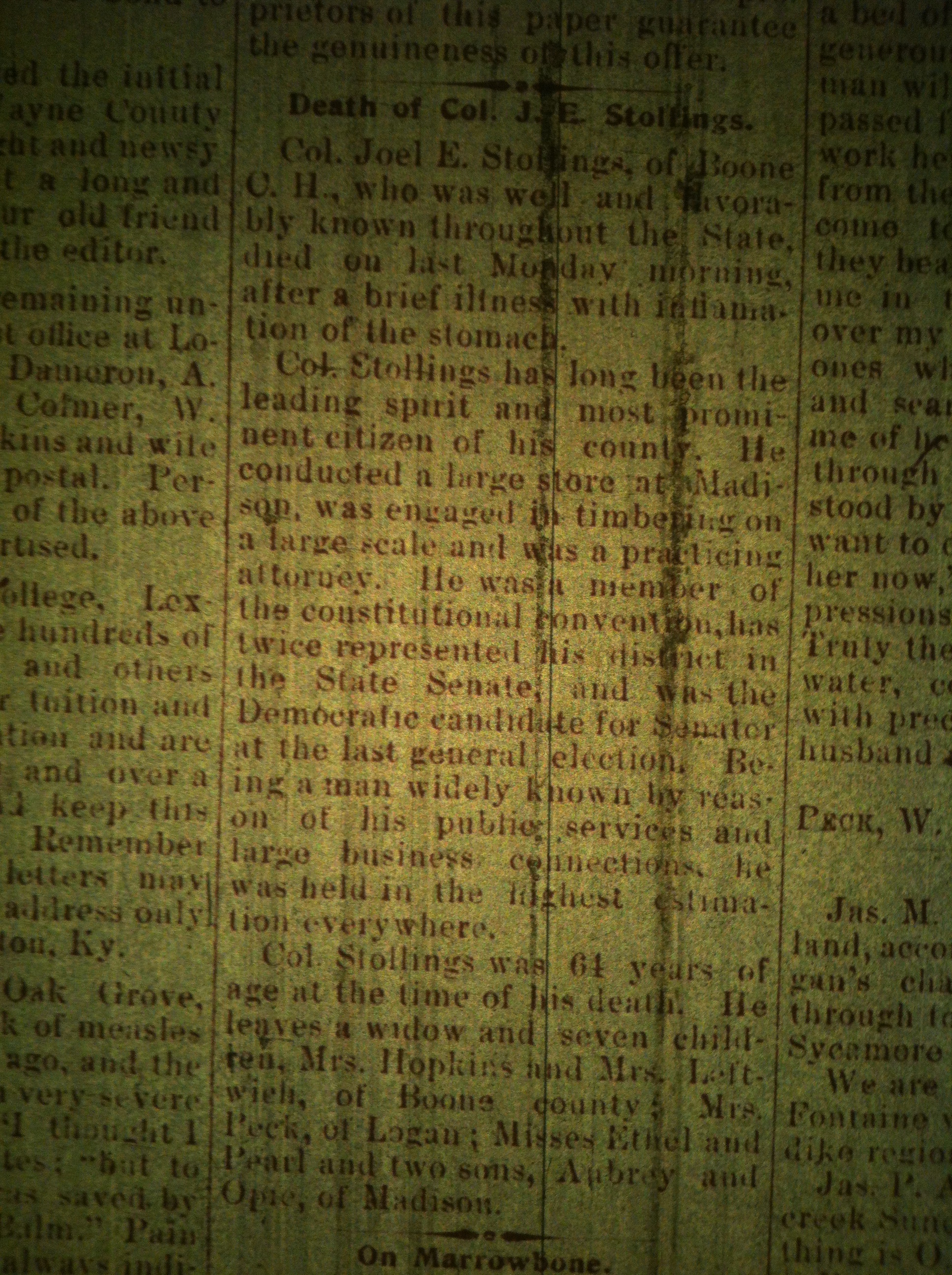
Col. Joel E. Stollings, of Boone C.H., who was well and favorably known throughout the State, died on last Monday morning, after a brief illness with inflammation of the stomach.

Col. Stollings has long been the leading spirit and  most prominent citizen of his county. He conducted a large store at Madison, was engaged in timbering on a large scale and was a practicing attorney. He was a member of the constitutional convention, has twice represented his district in the State Senate, and was the Democratic candidate for Senator at the last general election. Being a man widely known by reason of his public services and large business connections, he was held in the highest estimation everywhere.

Col. Stollings was 64 years of age at the time of his death. He leaves a widow and seven children, Mrs. Hopkins and Mrs. Leftwich, of Boone county; Mrs. Peck, of Logan; Misses Ethel and Pearl and two sons, Aubrey and Opie, of Madison.

“Col. Joel E. Stollings,” Logan County Banner (Logan,WV), 2 October 1897.


Chapmanville News 06.03.1921

19 Tuesday Sep 2017

Posted by Brandon Ray Kirk in Boone County, Chapmanville, Huntington, Logan

≈ Leave a comment

Tags

Boone County, C.B. Hainor, Chapmanville, Cora McKinney, Decoration Day, E.P. Stowers, Emma Stowers, Erie Blevins, Floyd Barker, genealogy, Henlawson, history, Hughey, Huntington, Logan, Logan Banner, Logan County, Lottie Hainor, Lula Blevins, Manila, Nellie Barker, Robert Hainor, St. Albans, Thermal Hainor, W.G. Willis, West Virginia, Wilsondale

An unknown correspondent from Chapmanville in Logan County, West Virginia, offered the following items, which the Logan Banner printed on June 3, 1921:

Mr. and Mrs. Robert Hainor attended the decoration exercises at Manila Sunday.

W.G. Willis made a business trip to Logan Saturday.

E.P. Stowers and Miss Emma Stowers returned Wednesday from a business trip to Huntington.

Uncle Floyd Barker, of St. Albans, is visiting relatives here this week and attending decoration.

Mrs. Lottie Hainor and daughter Thermal left Sunday afternoon for a visit with relatives at Henlawson.

Mrs. Cora McKinney spent Sunday with friends here.

Miss Erie Blevins, who is staying at Hughey, spent Sunday with her parents at this place.

Miss Nellie Barker was called to Wilsondale Sunday on account of the illness of her sister.

We are glad to say that Miss Lula Blevins, who has been staying at Hughey, has returned to her home here.

Mrs. C.B. Hainor visited friends at Manila Sunday.

An exciting incident occurred on last Saturday evening that might have caused serious loss to the firm of Stowers and Garrett and besmirched the glorious record they have been making the past few weeks as peddlers. As they were returning home, Mr. Garrett noticed a large fowl in a wheat field, he proceeded to capture it and confine it in his chicken coop. Thinking he had captured some rare bird of the tropical jungles, he drove with all speed to the home of Mr. Stowers where some of the family promptly pronounced it to be a turkey but Messrs. Stowers and Garret had their own opinion on the matter and had already decided they had captured a parrot. They had christened him “___m” and were already beginning to teach him to talk. However he didn’t show much aptitude as a pupil, but stood with dull expressionless eyes and his long crooked bill of a mouth wide open. After much deliberation they were finally convinced that they had not captured a “Poll Parrot” but a vulture or more commonly speaking, a buzzard. When they were convinced of this they opened the coop and Mr. Buzzard flew away to his rightful dominion, while their golden dream of selling a parrot to some enterprising Loganite vanished away on the soaring wings of the “Buzzard.”

Early Coal Mines in Logan County, WV

01 Friday Sep 2017

Posted by Brandon Ray Kirk in Battle of Blair Mountain, Big Creek, Boone County, Coal, Holden, Logan, Stone Branch

≈ 2 Comments

Tags

A.D. Robertson, Albert F. Holden, Amherst Coal Company, Appalachia, Big Creek Coal Company, Blair Mountain, Boone County Coal Company, Buffalo Creek, Buffalo Creek Coal and Coke Company, Buskirk Hotel, Clothier, coal, Cole and Crane Company, Cora Coal Company, Dobra, Draper Coal Company, engineer, G.W. Robertson, Gay Coal and Coke Company, Gay Coal Company, George M. Jones, Guyan Valley Coal Operators Association, Harry S. Gay, Herbert Jones, history, Holden, Huddleston Coal Company, Illinois, Island Creek Coal Company, John B. Wilkinson, John Laing, Logan County, Logan County Coal Operators Association, Madison, Main Island Creek Coal Company, Monclo Corporation, Monitor Coal Company, Moses Mounts, Mounts-White Fisher Company, Omar, Omar Mining Company, Pennsylvania, Peru, Princess Coal Company, Shamokin, Sharples, Stone Branch Coal Company, U.S. Coal and Oil Company, Vicie Nighbert, Virginia-Buffalo Company, West Virginia, West Virginia Coal and Coke, Wheeling-Pittsburgh Coal Company, Wilkinson, William H. Coolidge, William J. Clothier, Yuma Coal and Coke Company

What follows are brief notes from a forgotten source regarding early coal mines in Logan County, WV. Each of these companies and their communities have storied histories.

Gay Coal and Coke (organized in 1903)

Soon after 1900, Harry S. Gay, a mining engineer, came from Shamokin, PA, to observe the Logan coal fields. He stayed at the Buskirk Hotel. With money from friends A.D. and G.W. Robertson, he leased 800 acres from Moses Mounts of the Mounts-White Fisher Company for $20,000. G.W. Robertson was president of Gay Coal and Coke, while Gay was its secretary-treasurer. The company opened the Number One mine in the spring of 1903.

Monitor Coal Company (organized in 1904)

Monitor Coal Co. was organized in 1904 on the land of John B. Wilkinson. The accompanying town was named Wilkinson. Monitor merged with Yuma Coal and Coke Co. in 1935. In 1942, Wilkinson consisted of 166 company-owned houses. The mines eventually played out and real estate was sold through Monclo Corporation.

In 1905, seven coal companies existed in Logan County: Big Creek, Cora, Draper, Gay, Monitor, Stone Branch, and U.S. Coal and Oil Co. (Island Creek).

Island Creek Coal

Island Creek Coal also came to Logan during that time and created Holden. About 1902, William H. Coolidge and Albert F. Holden bought land from Vicie Nighbert. In early 1905, they established Island Creek Coal Sales Co. Holden was built by 1912.

Yuma Coal and Coke Company

Organized in 1905 by the same Pennsylvania interests behind Monitor Coal and Coke Co., Yuma Coal merged with Monitor in 1935.

In 1910, seventeen coal companies existed in Logan County.

Boone County Coal Company (organized in 1911)

Organized in 1911, the Boone County Coal Co. was headquartered at Clothier. William J. Clothier served as its first president. Its buildings burned and new buildings were erected at Sharples. The company held 30,000 acres just above Madison and about 2000 of it came into Logan to the top of Blair Mountain. The company had stores at Clothier, Sharples, Monclo, and Dobra.

Amherst Coal Company

In 1911, George M. Jones and his brother Herbert became interested in the Logan field. They leased 1300 acres on Buffalo Creek and organized Amherst Coal Company in January of 1912. In 1916, the company purchased the Virginia-Buffalo Company and the Huddleston Coal Company. It later purchased Buffalo Creek Coal and Coke Company.

Main Island Creek

In 1913, John Laing leased 30,000 acres in Omar from Cole and Crane Company of Peru, Illinois. Mr. Laing was the first president of the company. Later, West Virginia Coal and Coke, the Omar Mining Company, and Wheeling-Pittsburgh Coal Company mined this land.

In 1913, the Guyan Valley Coal Operators Association organized. In 1918, it became known as the Logan County Coal Operators Association. (For more on the association, follow this link: http://www.wvculture.org/history/ms90-82.html.)

In 1920, over seventy coal companies existed in Logan County (most were small and few survived).

By 1960, there were about fifty coal companies in Logan County; four coal companies accounted for about eighty percent of production. The four companies were Island Creek, Amherst, Omar, and Princess.

Chapmanville News 02.11.1927

26 Saturday Aug 2017

Posted by Brandon Ray Kirk in Boone County, Chapmanville, Huntington, Logan

≈ Leave a comment

Tags

Appalachia, Bernice Ward, Carlos Ferrell, Chapmanville, Church of God, Garland Mounts, genealogy, Hallie Godby, Hassell Perdue, Herman Lucas, history, Huntington, Logan, Logan Banner, Logan County, Madison, O.F. Ferrell, Owen Moses, Tollie Ferrell, West Virginia

An unknown correspondent from Chapmanville in Logan County, West Virginia, offered the following items, which the Logan Banner printed on February 11, 1927:

Misses Tollie Ferrell and Hallie Godby from Logan spent Sunday with Miss Ferrell’s parents here.

Owen Moses’ parents and sister from Huntington visited him Sunday. They were dinner guests of Mr. and Mrs. Hassell Perdue.

It is sad to note the death of the small son of Mr. and Mrs. Garland Mounts. They have our sympathy.

Herman Lucas is spending a few days at Madison.

Carlos Ferrell made a flying trip to Logan Wednesday and hasn’t returned.

Miss Bernice Ward spent Sunday with her mother here.

The revival at the Church of God is still going on. We wish them success.

O.F. Ferrell is still improving over the fall while out hunting some time ago. We wish him quick recovery.

Mrs. Hoover continues ill at this writing. We wish her quick recovery as she has been ill for some time.

T. Lowe, the assessor of this district was a business caller in Logan Thursday.

The power line from Logan has been doing some work in our town for the last few days.

Good luck to the Banner.

Shay Locomotive in Boone County, WV (1890)

17 Thursday Aug 2017

Posted by Brandon Ray Kirk in Boone County, Timber

≈ Leave a comment

Tags

Appalachia, Boone County, history, logging, photos, timber, timbering, West Virginia

Shay Engine Boone County 1890 2

Shay locomotive in Boone County, WV. Photo credit undetermined.             https://www.youtube.com/watch?v=TbsbcZKCWDY


Interview with Frank Hill of Big Creek, WV (2004) 2

20 Saturday May 2017

Posted by Brandon Ray Kirk in Banco, Big Creek, Boone County, Ed Haley, Music

≈ 1 Comment

Tags

Albert Stone, Annie Elizabeth Hill, Appalachia, Big Creek, Billy Adkins, Boone County, Brandon Kirk, California, Carlos Clark, Chapmanville High School, Church of Christ, Civilian Conservation Corps, Ed Haley, education, Edward W. Hill, Ellis Fork, fiddler, fiddling, Frank Hill, genealogy, Great Depression, guitar, Hell Among the Heffers, history, Huntington, Johnny Hager, Lloyd Ellis, Logan, Logan County, Madison, Melvin White, North Fork, Pope Dial, Pure Oil Company, Seymour Ellis, Six Mile Creek, square dances, Stone School, tobacco, Vernon Mullins, Walter Fowler, West Virginia, Whitman Creek

On June 2, 2004, Billy Adkins and I visited Frank Hill. Mr. Hill, a retired farmer, bus driver, and store keeper, made his home on Ellis Fork of North Fork of Big Creek in Boone County, West Virginia. Born in 1923, he was the son of Edward W. and Annie Elizabeth (Stollings) Hill. Billy and I were interested in hearing about Mr. Hill’s Fowler ancestry and anything he wanted to share about his own life. We greatly enjoyed our visit. What follows is a partial transcript of our interview:

FRANK HILL

I was born April 22, 1923 up the Ellis Fork Road. When I was born there, we had a four-room Jenny Lind house. It was an old-timer: double fireplace that burned coal and wood, you know. My mother had eleven children and I was the last one. When she saw me, she give up.

EDUCATION

I went to the Stone School, a one-room school just up Ellis Fork. My wife’s grandpa, Albert Stone, gave them land to build this school. It wasn’t a big lot – it might have been 300 feet square. We played ball there in the creek. We didn’t have much dry ground. Well, I went through the 8th grade around there. Arithmetic was my best subject. I had good handwriting, too. I thought I could go into the 9th at Chapmanville but they wouldn’t let me. They said I hadn’t took this test you were supposed to take as you left the 8th grade.

I walked a mile and six-tenths to school. We’d had bad teachers. They couldn’t get no control over the students. Dad got this old fellow from Madison and he said, “Now, I’ll give you ten dollars extra on the month.” I think the board paid fifty dollars a month. Back then, young men and women went to school. Twenty, twenty-five years old. They were so mean the teachers couldn’t hardly handle them. I had an older brother that was one of them. A teacher whipped a younger brother he had one day and he said, “Old man, wait till I catch you out. I’ll give you a good one.” And he meant it, too.

JOHNNY HAGER

Little Johnny Hager was a fiddle player. He was a little man, never was married. And he never had a home. All he had was a little suitcase with a few clothes in it. He’d stay with people maybe a month or two and the way he paid his keep was he whittled out lids or fed their pigs and stuff like that. He’d stay there a month or two till he felt he’d wore out his welcome then he’d go to another house. He was a well-liked little guy. Us boys, we followed him wherever he went cause he could sure play that fiddle. He played one tune called “Hell Among the Heffers”.

DEPRESSION

We had a hard time in this world. You couldn’t buy a job then. I had a brother-in-law that worked for the Pure Oil Company in Logan that was the only man that had a public job in this whole hollow. People grew tobacco to pay their taxes and bills they had accumulated. It was terrible. I remember my daddy had a little barrel of little potatoes when spring come and this old fellow lived above us, he was a musician. His name was Carlos Clark. He’d come out of the coalfields in Logan and he lost his home. His wife was a cousin of mine. He was trying to teach me to play the guitar. I’d go there and she’d lead the singing and he’d pick the guitar and I’d try to play second. He give me eleven lessons for that barrel of potatoes.

We had two or three around here that went to work in the CCC camps. Lloyd Ellis from Whitman’s Creek was one of them and Seymour Ellis was another one from Six Mile. In his last days, that was all he wanted to talk about. They went plumb into California in the CC camps. Then war broke out and they just switched them camps over to the Army. The Army operated those camps anyhow. That’s why they was so successful. They had control over boys to teach them how to do things.

DANCES

We got just as wild as any of them. Ed Haley used to come over here and play. The Barker family had a full band. Now, they could make the rafters roar. There was an old lady lived in here married to Walter Fowler who called the dances and there wasn’t a one of us really knowed how to dance but we put on a show anyhow. They had them in people’s homes. No drinking allowed but there was always a few that did. They always had a lot of good cakes.

CHURCHES

It was mostly Church of Christ around here. The main preacher up here in these parts was Pope Dial from Huntington. I’ll tell you another one that came in here that followed him sort of was Melvin White. Vernon Mullins followed up years later when he preached in here. I remember the first sermon he ever preached was around here in the one-room Stone School. He established a lot of different churches in the country but that was the first one. He’d talk about how he started here, preached his first sermon. Every funeral he conducted on this creek, he’d tell that story.

Native American Mound in Boone County, WV (1898)

05 Wednesday Apr 2017

Posted by Brandon Ray Kirk in Boone County, Native American History

≈ Leave a comment

Tags

Appalachia, Boone County, burial mound, history, Indian Creek, Jackson County, Logan County Banner, mounds, Native American History, Native Americans, Racine, W.D. Fontaine, West Virginia

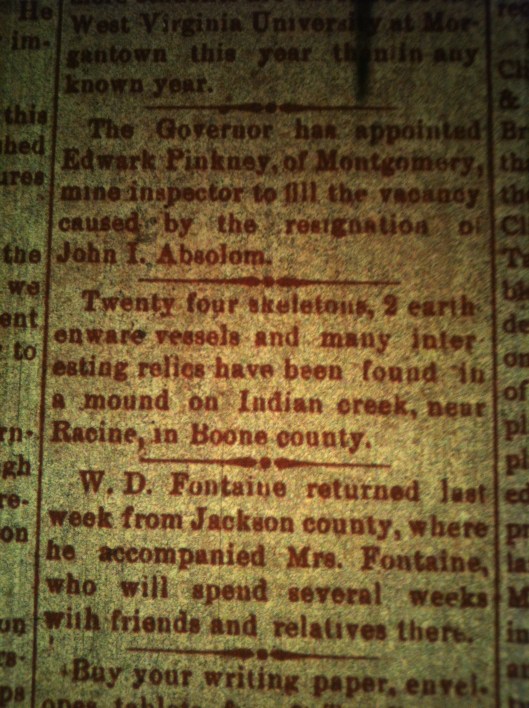
Boone County Mound LCB 04.21.1898

Logan County Banner (Logan, WV), 21 April 1898.

Evi Sias

05 Wednesday Apr 2017

Posted by Brandon Ray Kirk in Boone County, Civil War

≈ Leave a comment

Tags

Andrew Lewis Sias, Appalachia, Boone County, Bradford Hill, commissioner of reassessments, Confederate Army, Evi Sias, Fayette County, genealogy, Gettysburg, Henry C. Sias, Henry H. Hardesty, history, Ira Sias, Isaac Sias, James B. Sias, James Sias, James Wilson Sias, Jefferson District, justice of the peace, Left Hand Fork, Lelia Sias, Lincoln County, Missionary Baptist Church, Mud River, Noah Sias, Olivia F. Sias, Rebecca A. Sias, Rebecca Sias, Sallie R. Sias, Sarah B. Hill, Sarah B. Sias, Spurlockville, Union Army, Union District, Washington District, West Virginia

From “Hardesty’s History of Lincoln County, West Virginia,” published by H.H. Hardesty, we find this entry for Evi Sias, who resided at Spurlocksville in Lincoln County, West Virginia:

One of the farming population of Jefferson district, Lincoln county, was born in Fayette county, (then) Virginia, in 1835, and he is a son of James and Rebecca (Adkins) Sias, who came to Lincoln county in 1857. Sallie R., daughter of Bradford and Sarah B. (Thomas) Hill, was born in Boone county, (now) West Virginia, in 1852. Her parents settled in Lincoln county in 1852, and in this county, in 1871, she became the wife of Evi Sias, and six children are the result of their union: Sarah B., born July 8, 1872; Rebecca A., November 28, 1873; Olivia F., September 4, 1875, died in August, 1877; James B., October 22, 1877; Ira, September 28, 1879; Lelia, January 14, 1882. Five brothers of Evi Sias served in the late war: Isaac, James W., Noah, and Henry C. were in the Federal service, and Andrew L., joined the Confederate ranks, and was wounded at the battle of Gettysburg. Evi Sias was elected justice of the peace, and in 1880 was re-elected; he is commissioner of reassessments of land and secretary of the board of education in Jefferson district. Mr. Sias has been a strong advocate of free schools, and taught the first free school in Washington district, Boone county, and the first in Union district, Lincoln county. He has a farm of 100 acres on the Left Hand fork of Mud river; a part is heavily timbered, contains mineral, coal and iron ore, and the remainder in cultivation, with a large orchard. Evi Sias is a member of the Missionary Baptist Church, and a man respected by all. Address, Spurlocksville, Lincoln county, West Virginia.

Source: The West Virginia Encyclopedia, Vol. 7 (Richwood, WV: Jim Comstock, 1974), p. 148.

NOTE: I descend from Evi’s brothers, James Wilson Sias and Andrew Lewis Sias.

Estep News 04.16.1926

29 Wednesday Mar 2017

Posted by Brandon Ray Kirk in Banco, Big Ugly Creek, Boone County, Cemeteries, Estep

≈ Leave a comment

Tags

Alvin Hill, Appalachia, Banco, Belle Miller, Big Creek, Big Ugly Creek, Earling, Edith Chapman, Elbert Ferrell, Ellis Fork, Estep, flappers, Frank Chapman, genealogy, Gince Hollow, history, Ida Thomas, J.A. Thomas, Logan Banner, Logan County, measles, Miller Cemetery, North Fork, Robert Varney Jr., Thomas' Circle, Turtle Creek, West Virginia, Woodrow Adkins

An unknown local correspondent from Big Creek in Logan County, West Virginia, offered the following items, which the Logan Banner printed on April 9, 1926:

There are a great many sick people in our town at present. There has been about ten cases of measles in and near this place.

Frank Chapman of East End has a Sweetie somewhere in town. Wonder if any of the boys know who she is. She wears bobbed hair. You know the “Flapper Reigns.”

Some of our young folks visited Thomas’ Circle last Saturday, thinking that the school at that place closed that day, but it closed Friday.

Miss Ida Thomas of this place left for Earling last Thursday where she will assist in nursing her little cousin Master Robert Varney, Jr., who is very ill with measles.

Mrs. Alvin Hill of Ellis Fork is reported to be slowly convalescing after a long illness with measles.

Elbert Ferrell and J.A. Thomas of Estep have broken the record planting potatoes. They have planted nearly all of the Gince Hollow, a tributary of North Fork, near Estep.

Miss Edith Chapman of East End was seen going through this hamlet last Friday afternoon enroute for the town of Banco.

The school at Thomas’ Circle closed last Friday on account of measles.

Mrs. Woodrow Adkins died at her home on Big Ugly last Sunday of blood poisoning. Interment took place at the head of Turtle Creek at the Miller cemetery, near Mrs. Belle Miller’s.

James P. Mullins

04 Saturday Mar 2017

Posted by Brandon Ray Kirk in Big Harts Creek, Boone County, Harts, Lincoln County Feud

≈ 2 Comments

Tags

Albert Mullins, Appalachia, Big Branch, Boone County, Buchanan County, Dicy Collins, Dorcas Mullins, genealogy, Harts, Harts Creek, Henry H. Hardesty, history, Isham Collins, James A. Mullins, James P. Mullins, Kentucky, Lincoln County, Louisa Jane Mullins, Mary J. Mullins, merchant, Minnie B. Mullins, Victoria Mullins, Virginia, West Virginia

From “Hardesty’s History of Lincoln County, West Virginia,” published by H.H. Hardesty, we find this entry for James P. Mullins, who resided at Big Branch of Harts Creek in Lincoln County, West Virginia:

Came to Lincoln county in 1877, and now owns 250 acres of fine farming land on Hart creek. The farm has good improvements, and a large orchard. Mr. Mullins was born in Kentucky in 1848, and he is a son of James P. and Dorcas (Mullins) Mullins, residents of Boone county, West Virginia. Elizabeth J., daughter of Isham and Dicy (Johnson) Collins, was born in Kentucky, October 5, 1855, and in Buchanan county, Virginia, May 25, 1872, she became the wife of James P. Mullins. Five children are the result of their union: Mary J., born October 5, 1873; Victoria, April 23, 1876; Albert, July 18, 1877; Minnie B., July 1, 1879; James A., November 13, 1883. Mr. Mullins is a man of good business qualifications, and is prosperously engaged in merchandising, with business headquarters on Hart creek, one and one-half miles from its mouth. He may be addressed at Hart, Lincoln county, West Virginia.

Source: The West Virginia Encyclopedia, Vol. 7 (Richwood, WV: Jim Comstock, 1974), p. 136.

← Older posts
Newer posts →

Feud Poll 1

If you had lived in the Harts Creek community during the 1880s, to which faction of feudists might you have given your loyalty?

Categories

  • Adkins Mill
  • African American History
  • American Revolutionary War
  • Ashland
  • Atenville
  • Banco
  • Barboursville
  • Battle of Blair Mountain
  • Beech Creek
  • Big Creek
  • Big Harts Creek
  • Big Sandy Valley
  • Big Ugly Creek
  • Boone County
  • Breeden
  • Calhoun County
  • Cemeteries
  • Chapmanville
  • Civil War
  • Clay County
  • Clothier
  • Coal
  • Cove Gap
  • Crawley Creek
  • Culture of Honor
  • Dingess
  • Dollie
  • Dunlow
  • East Lynn
  • Ed Haley
  • Eden Park
  • Enslow
  • Estep
  • Ethel
  • Ferrellsburg
  • Fourteen
  • French-Eversole Feud
  • Gilbert
  • Giles County
  • Gill
  • Green Shoal
  • Guyandotte River
  • Halcyon
  • Hamlin
  • Harts
  • Hatfield-McCoy Feud
  • Holden
  • Hungarian-American History
  • Huntington
  • Inez
  • Irish-Americans
  • Italian American History
  • Jamboree
  • Jewish History
  • John Hartford
  • Kermit
  • Kiahsville
  • Kitchen
  • Leet
  • Lincoln County Feud
  • Little Harts Creek
  • Logan
  • Man
  • Matewan
  • Meador
  • Midkiff
  • Monroe County
  • Montgomery County
  • Music
  • Native American History
  • Peach Creek
  • Pearl Adkins Diary
  • Pecks Mill
  • Peter Creek
  • Pikeville
  • Pilgrim
  • Poetry
  • Queens Ridge
  • Ranger
  • Rector
  • Roane County
  • Rowan County Feud
  • Salt Rock
  • Sand Creek
  • Shively
  • Spears
  • Sports
  • Spottswood
  • Spurlockville
  • Stiltner
  • Stone Branch
  • Tazewell County
  • Timber
  • Tom Dula
  • Toney
  • Turner-Howard Feud
  • Twelve Pole Creek
  • Uncategorized
  • Warren
  • Wayne
  • West Hamlin
  • Wewanta
  • Wharncliffe
  • Whirlwind
  • Williamson
  • Women's History
  • World War I
  • Wyoming County
  • Yantus

Feud Poll 2

Do you think Milt Haley and Green McCoy committed the ambush on Al and Hollene Brumfield in 1889?

Blogroll

  • Ancestry.com
  • Ashland (KY) Daily Independent News Article
  • Author FB page
  • Beckley (WV) Register-Herald News Article
  • Big Sandy News (KY) News Article
  • Blood in West Virginia FB
  • Blood in West Virginia order
  • Chapters TV Program
  • Facebook
  • Ghosts of Guyan
  • Herald-Dispatch News Article 1
  • Herald-Dispatch News Article 2
  • In Search of Ed Haley
  • Instagram
  • Lincoln (WV) Journal News Article
  • Lincoln (WV) Journal Thumbs Up
  • Lincoln County
  • Lincoln County Feud
  • Lincoln County Feud Lecture
  • LinkedIn
  • Logan (WV) Banner News Article
  • Lunch With Books
  • Our Overmountain Men: The Revolutionary War in Western Virginia (1775-1783)
  • Pinterest
  • Scarborough Society's Art and Lecture Series
  • Smithsonian Article
  • Spirit of Jefferson News Article
  • The Friendly Neighbor Radio Show 1
  • The Friendly Neighbor Radio Show 2
  • The Friendly Neighbor Radio Show 3
  • The Friendly Neighbor Radio Show 4
  • The New Yorker
  • The State Journal's 55 Good Things About WV
  • tumblr.
  • Twitter
  • Website
  • Weirton (WV) Daily Times Article
  • Wheeling (WV) Intelligencer News Article 1
  • Wheeling (WV) Intelligencer News Article 2
  • WOWK TV
  • Writers Can Read Open Mic Night

Feud Poll 3

Who do you think organized the ambush of Al and Hollene Brumfield in 1889?

Recent Posts

  • Logan County Jail in Logan, WV
  • Absentee Landowners of Magnolia District (1890, 1892, 1894)
  • Charles Spurlock Survey at Fourteen Mile Creek, Lincoln County, WV (1815)

Ed Haley Poll 1

What do you think caused Ed Haley to lose his sight when he was three years old?

Top Posts & Pages

  • About
  • Perry A. Cline Deed to Anderson Hatfield (1877)
  • Hugh Dingess Family Cemetery (2014)
  • Anderson Blair Account with William A. Dempsey (1854-1855)
  • Peterstown, WV (2016)

Copyright

© Brandon Ray Kirk and brandonraykirk.wordpress.com, 1987-2023. Unauthorized use and/or duplication of this material without express and written permission from this blog’s author and/or owner is strictly prohibited. Excerpts and links may be used, provided that full and clear credit is given to Brandon Ray Kirk and brandonraykirk.wordpress.com with appropriate and specific direction to the original content.

Archives

  • February 2025
  • January 2025
  • October 2023
  • September 2023
  • December 2022
  • November 2022
  • May 2022
  • April 2022
  • February 2022
  • November 2021
  • October 2021
  • September 2021
  • June 2021
  • May 2021
  • April 2021
  • March 2021
  • February 2021
  • January 2021
  • December 2020
  • November 2020
  • October 2020
  • July 2020
  • June 2020
  • May 2020
  • April 2020
  • March 2020
  • February 2020
  • January 2020
  • December 2019
  • November 2019
  • October 2019
  • September 2019
  • August 2019
  • July 2019
  • June 2019
  • May 2019
  • April 2019
  • March 2019
  • February 2019
  • January 2019
  • December 2018
  • November 2018
  • October 2018
  • September 2018
  • August 2018
  • July 2018
  • June 2018
  • May 2018
  • April 2018
  • March 2018
  • February 2018
  • January 2018
  • December 2017
  • November 2017
  • October 2017
  • September 2017
  • August 2017
  • July 2017
  • June 2017
  • May 2017
  • April 2017
  • March 2017
  • February 2017
  • January 2017
  • December 2016
  • November 2016
  • October 2016
  • September 2016
  • August 2016
  • July 2016
  • June 2016
  • May 2016
  • April 2016
  • March 2016
  • February 2016
  • January 2016
  • December 2015
  • November 2015
  • October 2015
  • September 2015
  • August 2015
  • July 2015
  • June 2015
  • May 2015
  • April 2015
  • March 2015
  • February 2015
  • January 2015
  • December 2014
  • October 2014
  • September 2014
  • August 2014
  • July 2014
  • June 2014
  • May 2014
  • April 2014
  • March 2014
  • February 2014
  • January 2014
  • December 2013
  • November 2013
  • October 2013
  • September 2013
  • August 2013
  • July 2013
  • June 2013
  • May 2013
  • April 2013
  • March 2013
  • February 2013
  • January 2013
  • December 2012
  • November 2012

Enter your email address to follow this blog and receive notifications of new posts by email.

Join 2,925 other subscribers

Tags

Appalachia Ashland Big Creek Big Ugly Creek Blood in West Virginia Brandon Kirk Cabell County cemeteries Chapmanville Charleston civil war coal Confederate Army crime culture Ed Haley Ella Haley Ferrellsburg feud fiddler fiddling genealogy Green McCoy Guyandotte River Harts Harts Creek Hatfield-McCoy Feud history Huntington John Hartford Kentucky Lawrence Haley life Lincoln County Lincoln County Feud Logan Logan Banner Logan County Milt Haley Mingo County music Ohio photos timbering U.S. South Virginia Wayne County West Virginia Whirlwind writing

Blogs I Follow

  • OtterTales
  • Our Appalachia: A Blog Created by Students of Brandon Kirk
  • Piedmont Trails
  • Truman Capote
  • Appalachian Diaspora

BLOOD IN WEST VIRGINIA is now available for order at Amazon!

Blog at WordPress.com.

OtterTales

Writings from my travels and experiences. High and fine literature is wine, and mine is only water; but everybody likes water. Mark Twain

Our Appalachia: A Blog Created by Students of Brandon Kirk

This site is dedicated to the collection, preservation, and promotion of history and culture in Appalachia.

Piedmont Trails

Genealogy and History in North Carolina and Beyond

Truman Capote

A site about one of the most beautiful, interesting, tallented, outrageous and colorful personalities of the 20th Century

Appalachian Diaspora

  • Subscribe Subscribed
    • Brandon Ray Kirk
    • Join 787 other subscribers
    • Already have a WordPress.com account? Log in now.
    • Brandon Ray Kirk
    • Subscribe Subscribed
    • Sign up
    • Log in
    • Report this content
    • View site in Reader
    • Manage subscriptions
    • Collapse this bar
 

Loading Comments...