• About

Brandon Ray Kirk

~ This site is dedicated to the collection, preservation, and promotion of history and culture in my section of Appalachia.

Brandon Ray Kirk

Category Archives: Big Sandy Valley

Absentee Landowners of Magnolia District (1890, 1892, 1894)

18 Tuesday Feb 2025

Posted by Brandon Ray Kirk in Big Sandy Valley, Matewan, Tazewell County

≈ Leave a comment

Tags

A.D. Bright, A.M. Bailey, Alex McClintock, Anthony Lawson, Appalachia, C.B. Taylor, C.R. McNutt, Canada, Charleston, Cincinnati, Cora McInturff, E.H. Stewart, Egbert Mills Jr., Elkhorn Sandy River Trust Company, George W. Duty Jr., Grayton Mining Company, Grayton Water Works and Improvement Company, H.R. Phillips, H.S> White, H.W. Sibley, Howard S. Graham, J.C. Williamson, J.D. Sergeant, J.E. Price, Jacob Smith, James Hatfield, James OKeeffe, L.M. Hall, Lewis Ferrell, Logan County, M.F. Meighen, Magnolia District, McDowell County, Mercer County, Mingo County, Morehead, Moundsville, New York, Philadelphia, Pike County, Richard Torpin Jr., Roanoke, Rowan County, Sauel Walton, Stuart Wood, Tazewell County, Virginia, W.E. Chilton, W.W. Adams, Warren Alderson, West Virginia, Wheeling, William P. Payne

What follows is a list of absentee landowners in Magnolia District of Logan County, WV, for 1890, 1892, and 1894… There are three significant types of absentee landowners: 1) those who live outside of Logan County; 2) those who live in Logan County but outside of Magnolia District; and 3) those who own property, for example, at Mate Creek but reside, for example, at Grapevine Creek (both within the district). This list does not include the latter type.

1890

J.D. Sergeant, Philadelphia, PA, 9495.91 acres

James O’Keeffe, Tazewell County, VA, 2963 acres

Stuart Wood, Philadelphia, PA, 2813 acres

Walton and O’Keeffe, Tazewell County, VA, 1933 acres

Elkhorn Sandy River Trust Company, no address given, 1699 acres

Warren Alderson, Morehead, KY, 800 acres

J.C. Alderson, Wheeling, 792 acres

J.D. Sergeant and James O’Keeffe, ________, 783.5 acres

E.H. Stewart, trustee, Roanoke, VA, 684 acres

Lewis Ferrell heirs, Pike County, KY, 600 acres

W.B. Payne, McDowell County, 582 acres

F. Stukenburgh, Cincinnati, OH, 350 acres

1892

Richard Torpin, Jr. et al, trustee, no residence given, 9326.66 acres

H.R. Phillips, NY, 6095 acres

J.E. Price, trustee, NY, 5853 acres

Samuel Walton, Tazewell County, VA, 4439.5 acres

Walton and O’Keeffe, Tazewell County, VA, 4102 acres

W.E. Chilton, trustee, Charleston, 3953.5 acres

Stuart Wood, Philadelphia, PA, 2813 acres

J.D. Sargeant, Philadelphia, PA, 1668.5 acres

James O’Keeffe, Tazewell County, VA, 1650 acres

C.R. McNutt, Mercer County, 1509 1/16 acres

H.S. White, Charleston, 1500 acres

Alderson and Adams, Wheeling, 920.5 acres

Alex McClintock, Lexington, KY, 843 acres

E.H. Stewart, Roanoke, VA, 684 acres

Jacob Smith, Pike County, KY, 550 acres

W.B. Payne, McDowell County, 532 acres

J.F. Paull, trustee, Wheeling, 509 acres

James Hatfield, Rowan County, KY, 147 acres

J.C. Alderson, Wheeling, 59 acres

H.W. Sibley, Tazewell County, VA, 36 acres

George W. Dewty, Jr., Pike County, KY, 22 acres

1894

Richard Torpin, Jr., trustee, no address given, 9326.66 acres

H.R. Phillips, trustee, NY, 6345 acres

Grayton Mining Company, Philadelphia, PA, 6022.5 acres

J.E. Price, trustee, NY, 5853 acres

Egbert Mills, Jr., trustee, NY, 4374.5 acres

Walton and O’Keeffe, Tazewell County, VA, 4052 acres

Stuart Wood, Philadelphia, PA, 3097 acres

C.R. McNutt, Mercer County, 3018 1/8 acres

L.M. Hall et al, Towanda, PA, 2572 acres

Howard S. Graham et al, trustee, Philadelphia, PA, 1790 acres

J.F. Poull, trustee, Wheeling, 954 acres

Alderson and Adams et al, Wheeling, 920.5 acres

J.D. Sergeant, Philadelphia, PA, 877.5 acres

Grayton Water Works and Improvement Company, Philadelphia, PA, 767 acres

E.H. Stewart, trustee, Roanoke, VA, 684 acres

W.B. Payne, McDowell County, 532 acres

J.C. Williamson, Pike County, KY, 470.5 acres plus three lots in Matewan

A.D. Bright, NY, 374 acres

Jacob Smith, Pike County, KY, 350 acres

C.B. Taylor, Canada, 200 acres

J.C. Alderson, Wheeling, 193 acres

H.W. Sibley, Tazewell County, VA, 36 acres

George W. Duty, Jr., Pike County, KY, 22 acres

Cora McInturff, KY, 1 acre

A.M. Bailey, McDowell County, 0.5 acres

B.F. Meighen, Moundsville, two lots in Matewan

Source: Land Book 1887-1892 and Land Book 1893-1899.
Feudist Jim McCoy (1929)

29 Wednesday Jan 2025

Posted by Brandon Ray Kirk in Big Sandy Valley, Hatfield-McCoy Feud, Pikeville, Williamson

≈ Leave a comment

Tags

Appalachia, Byrd Gilliam, Cap Hatfield, Catlettsburg, Crit Weddington, Detroit, Dollie McCoy, Fannie Charles, Finnie McCoy, Frank Phillips, Hatfield-McCoy Feud, Huntington, Jim McCoy, Kentucky, Lark McCoy, Logan Banner, M.A. Dunlap, Mossy Bottom, New York City, Pike County, Pike County News, Pikeville, Randolph McCoy, Raymond Daugherty, Stoney Amick, Tennis Hatfield, Williamson

Jas. McCoy, Old Feudist Leader, Dies

At Four Score Years Old, Warrior Dies with Boots Off at Pikeville Home

Last of McCoy Clan who Long Fought the Hatfields

“James McCoy, 80, the last of the men who were actively engaged in the Hatfield-McCoy feud about forty years ago, passed away last Friday in Pikeville at the home of Mr. and Mrs. Stoney Amick. But one other member of the older family survives him, Mrs. Fannie Charles of Williamson.

“The Hatfield-McCoy feud was one of the most noted struggles of the mountains in the last century. And of all the men on the McCoy side one could scarcely pick a more picturesque one than James McCoy.

“Soon after the fighting started and the two families became warring factions, all over an election dispute, James McCoy was made deputy sheriff of Pike county. Acting in this capacity he, at one time, arrested some of the Hatfield family and brought them to Pikeville for trial. In most every encounter he was usually found fighting for his family, and the Hatfields learned to fear the name of James McCoy.

“But the years have wiped out the hatred that once existed, the warring families having been induced to settle their differences some twenty-five years ago by a mountain preacher.

“For a long time Mr. McCoy has made his home with Mr. and Mrs. Stoney Amick in Pikeville. About a year ago he became ill with a sickness that, at his age, proved too serious and he died last Friday. The funeral services were held in the Presbyterian church last Saturday afternoon and the body was taken to Catlettsburg where he is now sleeping beside his wife, who passed away a number of years ago.

“A number of children survive him; Mrs. Stoney Amick of Pikeville, Mrs. Crit Weddington of Mossy Bottom, Byrd Gilliam of Huntington, Mrs. Raymond Daugherty of Detroit, Mich., Miss Dollie McCoy of Huntington, W.Va., Mrs. M.A. Dunlap of New York City, and Mr. Finnie McCoy of Douglas. Three other children have preceded Jim in death.

Source: Logan (WV) Banner reprinted from the Pike County (KY) News, 20 September 1929.

***

‘Cap’ Hatfield Speaks Kindly of Late Jim McCoy

Denies, However, That Decedent was Formidable Figure in the Feud, Thus Taking Issue with Obituary Writers

“‘Neither fear nor hatred ever ran strong in the Hatfields for the late Jim McCoy,’ declared ‘Cap’ Hatfield while here Wednesday. His statement was made to a Banner reporter when the subject of the recent death of the McCoy feudist was mentioned.

“According to Cap, who is credited with knowing more about the Hatfield-McCoy troubles than anyone else, living or dead, by reason of his leading part therein and of his amazing memory, Jim McCoy was among the least active of the recognized adherents of that clan. It is not believed that he killed any of the Hatfields or their supporters.

“Cap further stated that those of the Hatfield clan never felt particularly hostile to Jim McCoy and he mentioned the fact that when Tennis Hatfield had occasion to visit Pikeville, Ky., a year or more ago, he and Jim fraternized and even posed together for a picture. ‘I had long intended,’ continued Cap, ‘to ask and urge Jim McCoy to come over and visit me. Had he come I would have done my best to be considerate and hospitable. Jim did nothing against us that caused us to harbor hatred for him; he did only what was natural for him to do under the circumstances. But I insist the Hatfields did not fear him, nor did they consider him among the more dangerous men on the McCoy side. Frank Phillips, of course, was the outstanding gunfighter of the McCoy side.’

“Jim McCoy, son of Randall, who was commonly credited with leadership of the McCoy forces, died at his home in Pikeville, August 30. He was 80 years old.

“Perhaps it should be added that contrary to the statement widely published immediately after his death, Jim was not the last survivor of his clan’s feud fighters. Lark McCoy, who was more active as a feudist, is still living. It is said that both he and Jim were in the attacking party when Jim Vance was killed on Thacker mountain and when ‘Cap’ narrowly escaped death or capture.”

Source: Logan (WV) Banner, 20 September 1929.

Interview of Dr. Leonard Roberts, Part 3 (Summer 1982)

29 Friday Sep 2023

Posted by Brandon Ray Kirk in Big Sandy Valley, Civil War, Hatfield-McCoy Feud

≈ Leave a comment

Tags

civil war, crime, Floyd Hatfield, Hatfield-McCoy Feud, Kentucky, Leonard Roberts, Preacher Anse Hatfield, Preservation Council Press, Randolph McCoy, Truda McCoy, West Virginia

Truda Williams McCoy’s The McCoys: Their Story (1976) is a classic book about the Hatfield-McCoy Feud. Truda, a McCoy descendant born in 1902 who married a grandson of Ran’l McCoy, collected her stories directly from feud participants and close family members prior to and during the 1930s. Truda was unable to publish her manuscript, but after her death in 1974 Dr. Leonard W. Roberts located and edited the manuscript, then published it through Preservation Council Press. In this 1982 interview, Dr. Roberts contemplates general issues about the feud:

Was the Hatfield-McCoy Feud one in which more people were killed?

I suppose there were fewer people killed in this feud than say some others, although we don’t have any documentation of that one. But the number killed runs anywhere from 20 to 75, let’s say, Hatfields and McCoys. Some of the elements in this fight might be noted. Notice the first time there was some fighting was over a hog that had pigs and the owner Randolph McCoy had marked his ears with a mark. He found those in a pen of a Hatfield. Now rather than pulling a gun—guns on each other—they weren’t that savage, all they wanted was law to take its course. Randolph simply went to the magistrate of the district and brought out a warrant against Floyd Hatfield for the return of his hogs. The old sow had had pigs, you see, by this time. And what happened? The magistrate was a Hatfield. And he knew it. Yet he thought that everybody would play fair and square. We had just come out of the Civil War. We were righting wrongs. They were going to, if they were ever going to. And it seemed they wanted law and order to take over. But it didn’t hardly take over in this case. The fellow Hatfield [presumably, he means Preacher Anse] who brought the trial decided on a jury. Rather than just have two or three testify here or there and let him then make the decision himself, he called in twelve jurors. And then they started voting. And they came out 7 to 5 in favor of Hatfield to keep the hogs.

What should we really remember about the feud? How is it important to us today?

Well that it was simply honest men and women living in a kind of rough and tumble era, especially just after the Civil War when emotions and values were pretty badly mocked and pretty badly thrown aside. But remember that some people including Hatfields and McCoys tried to see that law was established again. Rather than simply running amuck as they had done in small groups, robbing and killing. Remember the Civil War and the conditions of the times. Coming out of the war was this idea of posse or idea of organizing a group. It was almost as if any time there was a fight going between one man and another, pretty soon he was backed by fifteen or twenty men that he’d drawn in, either through persuasion or through kinship or access to mercenary ways—they offered him a piece of land or help him build his home or something of that kind to come in and fight—and so it developed in some cases into a kind of mercenary situation. But let’s remember that there weren’t too many actually killed and eventually the governors began to try to stop it and almost got in a war themselves. Finally threw the thing in the courts and even the Supreme Court made a decision about what states could do and what they couldn’t do in handling and controlling their citizens. So law and order did begin to develop. And of course we began to have the recovery of America after the Civil War. Timber. Lots of fuel and coal, things of this kind. So pretty soon, business began to boom in the mountains where there was plenty of timber, plenty of coal, plenty of resources. And so by 1900 the thing had sort of drifted over. And nowadays when you go into the area, here’s a McCoy that’s married to a Hatfield, Hatfield married to a McCoy, and down and down the line. And unless you name it to them they have forgotten about anything like a feud.

Is there anything else you would want someone to know about the story?

Well, I guess it’s generally unknown or understood that Hatfields and McCoys are simply decent, honest, migratory people who had come into the mountains from their areas back in the east and eventually further back, you know, in Scotland and Ireland. And they settled here in the mountains and they began to pick up land in the legal and rightful ways and establish their families. And actually the first decade or the first generation, they’d married within one another. They’d lived on the West Virginia side at the time and then later on the Kentucky side. What drove a wedge between them probably was not the Civil War alone but notice what the Civil War produced. It produced a separation of Virginia from West Virginia. Now how would you feel if you were fighting for your mother country living across here on the Tug River side and all at once you were, you became another state that was with the Union? So the people was thrown into kind of a quandary. The Hatfields on the West Virginia side were largely Southern because they were for the South and their mother country immediately was changed for the North. And so they were trying to live a decent life going along with the Southerners and here these people just across the river accusing them of course of rebellion and joining and fighting against the Union. That’s one big thing that we might leave out, the historical patterns and problems that developed pretty fast on the frontier here.

Interview of Dr. Leonard Roberts, Part 2 (Summer 1982)

28 Thursday Sep 2023

Posted by Brandon Ray Kirk in Big Sandy Valley, Civil War, Hatfield-McCoy Feud

≈ Leave a comment

Tags

Appalachia, Bill Staton, civil war, Confederate Army, Dr. Leonard W. Roberts, Harmon McCoy, history, Kentucky, Lexington, Paris McCoy, Randolph McCoy, Squirrel Huntin' Sam McCoy, Truda McCoy, Union Army

Truda Williams McCoy’s The McCoys: Their Story (1976) is a classic book about the Hatfield-McCoy Feud. Truda, a McCoy descendant born in 1902 who married a grandson of Ran’l McCoy, collected her stories directly from feud participants and close family members prior to and during the 1930s. Truda was unable to publish her manuscript, but after her death in 1974 Dr. Leonard W. Roberts located and edited the manuscript, then published it through Preservation Council Press. In this 1982 interview, Dr. Roberts recollects the story of Squirrel Huntin’ Sam McCoy and contemplates bigger questions about the feud:

Did Squirrel Huntin’ Sam McCoy ever kill anyone?

He doesn’t say that he did in his manuscript. He says that he protected people. Now outside of the manuscript, he tells a story to his grandson who was visiting that “Yes, I did kill a man. It’s not in my manuscript. I just skipped it. I didn’t like to have it in there.” Or something like that. But when he and his brother Paris were out hunting they ran into one of the Ellison [Bill Staton] boys—I can’t think of the name right quick—ran into one of the boys that was on the other side most of the time. And this boy began to shoot and pretty soon he and Paris had been shot through and had fallen to the ground and—what was his name—Ellison [Bill Staton] was on top and was trying to twist this fellow’s head off or something like that and Squirrel Huntin’ Sam said, “I saw then I just had to shoot.” And he got up and shot and killed him. But then in telling this story, he said, “The reason I don’t tell this story much, I dread that it happened.” And you ask him why and he’d say, “Well, when we went up there to him, my enemy’s gun was already empty.”

Why did this feud get such nationwide attention?

Well, about three or four things there that maybe I can’t think of… One at a time. Let’s start out with the, let’s say problems with the Civil War. It’s a long story, but one of Randolph McCoy’s brothers had gone into the army on the Union side in the State of Kentucky. Went and fought in Kentucky down around Lexington and central Kentucky. Got discharged. Come back home. By that time the rebels had been organizing posses and groups to patrol the whole situation. So they’d heard that Harmon—this was the person’s name—had come back home. Been out fighting for the Union. Now he’s come back home. So they traced him down. And it seems that he stayed with his family only one night after two years in the war until he was shot at. Nobody could go out and get wood or water. Why, they’d be shot at. So he slipped out after midnight and went to the little cave back on the hillside. Well, by then, by the time he escaped it had been snowing a bit. So this posse who had come after him traced him in the snow and found him back in that cave, dragged him out, and killed him. The war was going on then. And everybody was away from home fighting on one side the other. And that sort of didn’t take hold, didn’t cause any hard feelings, until they all came back. And then it was understood that Harmon’s—he had four sons and two daughters—the four sons seem to have sworn that they would avenge their father’s murder now or sometime else. So they started to look for the enemy and continued looking for almost twenty years almost before it broke out into fighting.

How does this feud compare to the other feuds?

When you read about… Now we’re beginning to study Appalachia really in some depth and we find out that there were probably two hundred small or large blood feuds that happened before the war, you know, fighting over which ones are going and why you’re going, during the war when the posses and the bushwhackers began to come in, and then as soon as it settled down and the South was whipped, we might say, or worsted, and they came back, those soldiers came back and began to try and establish their names, the first thing they’d try to do is run for office and then they would hear sharp criticism about what they did and how they fought for the enemy and how they were beaten and so forth. And so the feuds began to erupt soon after the Civil War all up and down the Mississippi, Ohio, and up and down the mountains and rivers and so forth of the middle area. See, we’re talking about the buffer area here. When the Civil War was going on was between Kentucky, Arkansas, Tennessee, those are buffer states that goes between North and South.

Interview of Dr. Leonard W. Roberts, Part 1 (Summer 1982)

27 Wednesday Sep 2023

Posted by Brandon Ray Kirk in Big Sandy Valley, Hatfield-McCoy Feud, Pikeville

≈ 2 Comments

Tags

Appalachia, Bill Staton, Dr. Leonard W. Roberts, Hatfield-McCoy Feud, Judith Bowling, Kentucky, Orville McCoy, Paul McCoy, Pike County, Pikeville, Pikeville College, Preservation Council Press, Randolph McCoy, Squirrel Huntin' Sam McCoy, Truda McCoy

Truda Williams McCoy’s The McCoys: Their Story (1976) is a classic book about the Hatfield-McCoy Feud. Truda, a McCoy descendant born in 1902 who married a grandson of Ran’l McCoy, collected her stories directly from feud participants and close family members prior to and during the 1930s. Truda was unable to publish her manuscript, but after her death in 1974 Dr. Leonard W. Roberts located and edited the manuscript, then published it through Preservation Council Press. In this 1982 interview, Dr. Roberts recollects the story behind the book and how it led him to find another manuscript written by Squirrel Huntin’ Sam McCoy:

How did you get involved in Hatfield-McCoy research?

Well, if you want me to come right down to a fine point, it happened one spring when we were putting on a little program of art exhibitions and so forth in the little park of Pikeville, near Pikeville College, where I taught. And the leader of the arts and crafts just happened to be talking you know about how he would get up and steer the county and this sort of thing and finally he said something like, “We’d like to name this road from here to Williamson, West Virginia, the Hatfield-McCoy Highway, but we don’t know much about the Hatfields and McCoys. It’s just largely hearsay.” Well almost before he snapped off, a woman called him and said, “Wait a minute now, why my mother (which most people know was a poet) wrote a pretty good history of the feud, but she sent it off and she couldn’t get it published so she willed it to my brother and he has it in his trunk right now.” Well that liked to bowled a man over. We didn’t expect that sort of windfall. So I was on the group… I was secretary, actually. And as secretary, I got to go and hunt this person and she let me have a copy of this manuscript and I was reading it before we heard from the owner who began to object by saying he “hadn’t give permission for her to give that to you.” And so after a good bit of wrangling and so forth I finally got to read the manuscript. And it was an excellent almost unheard of story of the Hatfield-McCoy Feud. Because she had been a teacher. Truda McCoy was her name. And she had walked all over Pike County teaching and that sort of thing and interviewing people in the ‘30s. And built up a manuscript of four or five hundred pages. And there it was.

It reads almost like fiction with dialect and all. You edited this book. How much did you change it?

How much did I change it? I changed it so little that you can’t tell it really. As the editor said in the preface, Leonard has taken this material and seemingly has done a good job but we can’t see his tracks anywhere. I simply touched it here and there in a matter of maybe a word or something of this kind and that’s all that I did for it. And since it’s the first story written especially with the viewpoint of the McCoys, the only one that we have, alongside numbers of books by the Hatfields, this turns out to be probably the best history now and probably the best history we will ever have of the Hatfield-McCoy Feud entirely. She didn’t just talk about the McCoys. She showed the compassion and so forth of the Hatfields in the story, too.

How important was her documentation of where she found the stories?

Well, she knew that… Since she was trying to sell it apparently as documentary material, she footnoted it herself. Her material. I think that certainly is what saved the book and made it authentic. Because she, in the early thirties and even before that, had interviewed people still alive who knew about the feud and even had been in the feud, had fought and died and sweated in the feud. And she put those names, well she footnoted the original manuscript. I simply left it out to some extent and put them in separate statements below the end of chapters. So it seems an authentic book by having those documented there by the McCoys and Hatfields themselves.

Why were the people willing to talk to her?

That was the key to the entire thing because after the feud was over and everybody had been killed off that was going to be killed off the thing settled down into kind of a limbo. The Hatfields had been put away pretty well, you see, in the novels and books that had been written about them. But the McCoys had not had that much publicity and most of it seemed bad so they simply did not talk about the feud. Didn’t want to talk about the feud. And I’ve met people who still won’t talk about the feud. But some few that I got the names of from Mrs. McCoy’s book and from inquiring, while I was at their home they did let me hear from them. And especially when they showed me McCoy artifacts that they had. And them show me pictures on the wall that had been taken back during the time. And so you see the pictures are quite authentic and valuable too that fill the book.

What are the feelings today about the feud?

Well now that we have heard from the McCoys and they have taken… When this book came out, some McCoys maybe didn’t want to buy it. But when it caught on, you might say, we began to get orders from all over the United States from both Hatfields and McCoys, and in-laws and so forth, saying they were kin to the Hatfields and McCoys. So it seems except for rare exceptions the McCoys have simply gone ahead and accepted the story and accepted the material. And some have been willing to offer their information fairly freely. After the book came out, I’ve been able to collect a good bit of stuff, including the old Squirrel Huntin’ Sam McCoy manuscript that I found with another McCoy: Orville McCoy.

Does he talk about the feud?

Squirrel Huntin’ Sam McCoy was in the feud. And here’s the only person I’ve heard from on either side that really can tell almost all of the feud. So he fled under attack as late as 1910 from people who was still picking at him and went West. And when he settled out at Joplin… He first went all around the United States. But he settled in Joplin. And there in 1931… He got a little tablet, a schoolroom tablet, and he started writing and putting chapters and verses and subject matter of the heading and he was writing an epic. Wrote page after page, handwriting. And he condensed it. And he told a pretty good story in 52 pages of manuscript. And Orville McCoy had that and was willing, after the other book had come out and after he had learned me and came and visited me, and I promised him of course them royalties, that I was able to put together the Squirrel Huntin’ Sam McCoy manuscript.

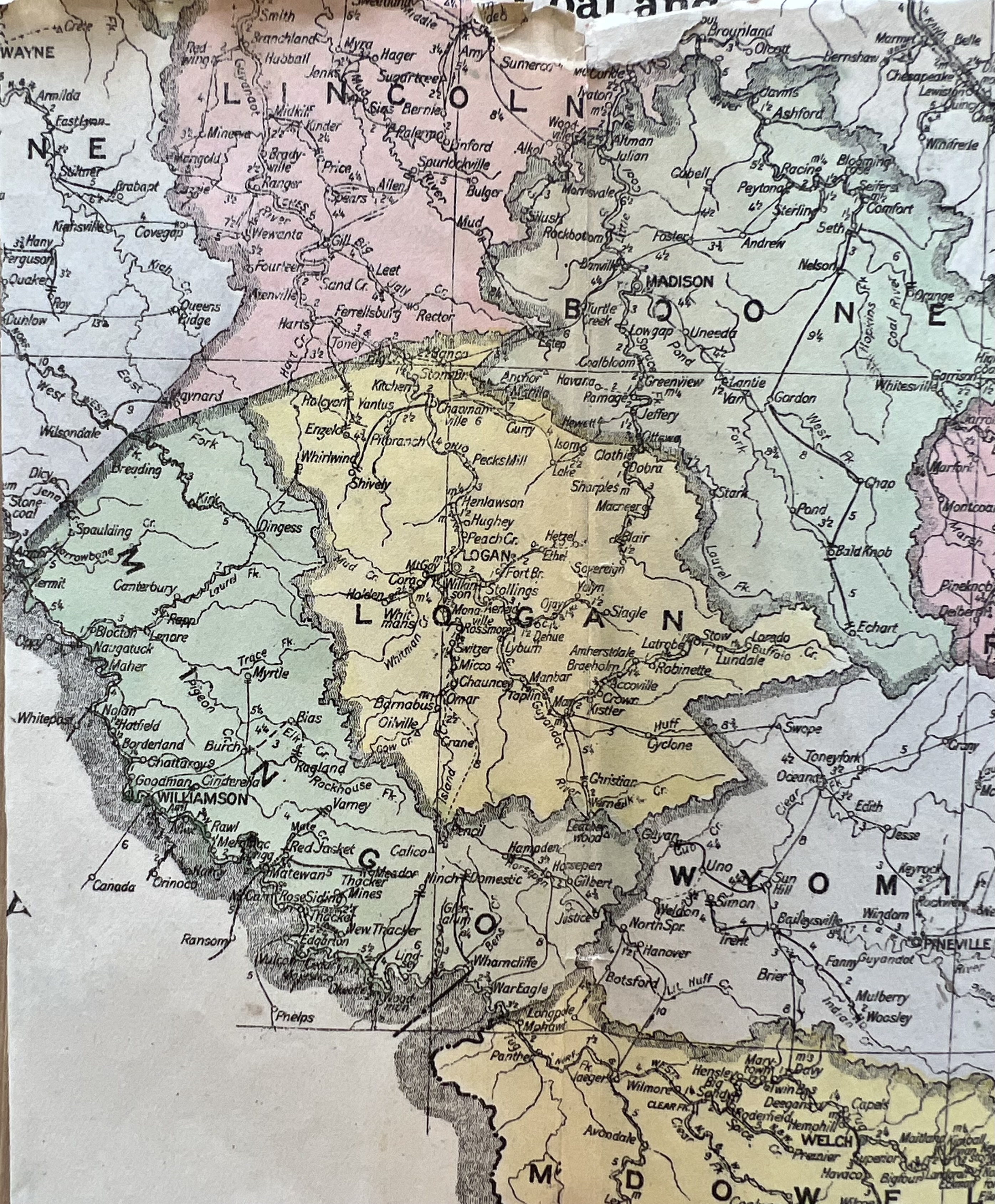
Map: Southwestern West Virginia (1918-1919)

08 Thursday Dec 2022

Posted by Brandon Ray Kirk in Atenville, Banco, Beech Creek, Big Creek, Big Harts Creek, Big Sandy Valley, Big Ugly Creek, Boone County, Breeden, Chapmanville, Clothier, Cove Gap, Crawley Creek, Dingess, Dunlow, East Lynn, Enslow, Ferrellsburg, Fourteen, Gilbert, Gill, Green Shoal, Guyandotte River, Halcyon, Hamlin, Harts, Holden, Kermit, Kiahsville, Kitchen, Leet, Little Harts Creek, Logan, Man, Matewan, Meador, Midkiff, Pecks Mill, Peter Creek, Queens Ridge, Ranger, Rector, Sand Creek, Spurlockville, Stiltner, Stone Branch, Toney, Twelve Pole Creek, Wayne, West Hamlin, Wewanta, Wharncliffe, Whirlwind, Williamson, Wyoming County, Yantus

≈ Leave a comment

Tags

Appalachia, Big Sandy River, Boone County, Guyandotte River, Hamlin, history, Lincoln County, Logan, Logan County, Madison, map, maps, McDowell County, Mingo County, Pineville, Polk's State Gazetteer and Business Directory, Tug Fork, Twelve Pole Creek, Wayne, Wayne County, Welch, West Virginia, Williamson, Wyoming County

West Virginia State Gazetteer and Business Directory, 1918-1919, published by R.L. Polk and Company.

Logan-Boone Highway in WV (1928)

05 Monday Dec 2022

Posted by Brandon Ray Kirk in Big Sandy Valley, Boone County, Coal, Huntington, Logan, Native American History, Williamson

≈ Leave a comment

Tags

Appalachia, Aracoma, Aracoma Hotel, Boone County, Charleston, Chief Cornstalk, Chief Logan, coal, Daniel Boone, farming, history, Huntington, Kanawha County, Logan, Logan-Boone Highway, logging, Madison, Marmet, Midland Trail, mining, Tug Fork, West Virginia, West Virginia Biographical Association, Williamson

From West Virginians, published by the West Virginia Biographical Association in 1928, comes this profile of the Logan-Boone Highway in southwestern West Virginia:

Boone County, south of Kanawha, has been opened up by a hard road from Marmet, across the Kanawha from the Midland Trail. A second connection with Charleston is offered by a highway on the south side of the Kanawha. The county was named for Daniel Boone, the great hunter and Indian fighter, who lived in West Virginia many years. Madison is the county seat. Logan, county seat of Logan County, was named for Chief Logan, the speech-making Indian chief, who has been made one of the numerous story book heroes of the Indian race. Whether or not Chief Logan ever shot a deer or pitched his wig-wam in this county is much in doubt. The modern hotel at Logan, the Aracoma, further reflects the Indian influence with the name of this member of Chief Cornstalk’s family. Coal mining, lumbering and farming are the principal activities of Logan and Boone counties. Most of the road south is also hard-surfaced, and will eventually form the link between the Midland Trail to the North and the Huntington-Williamson highway along Tug River.

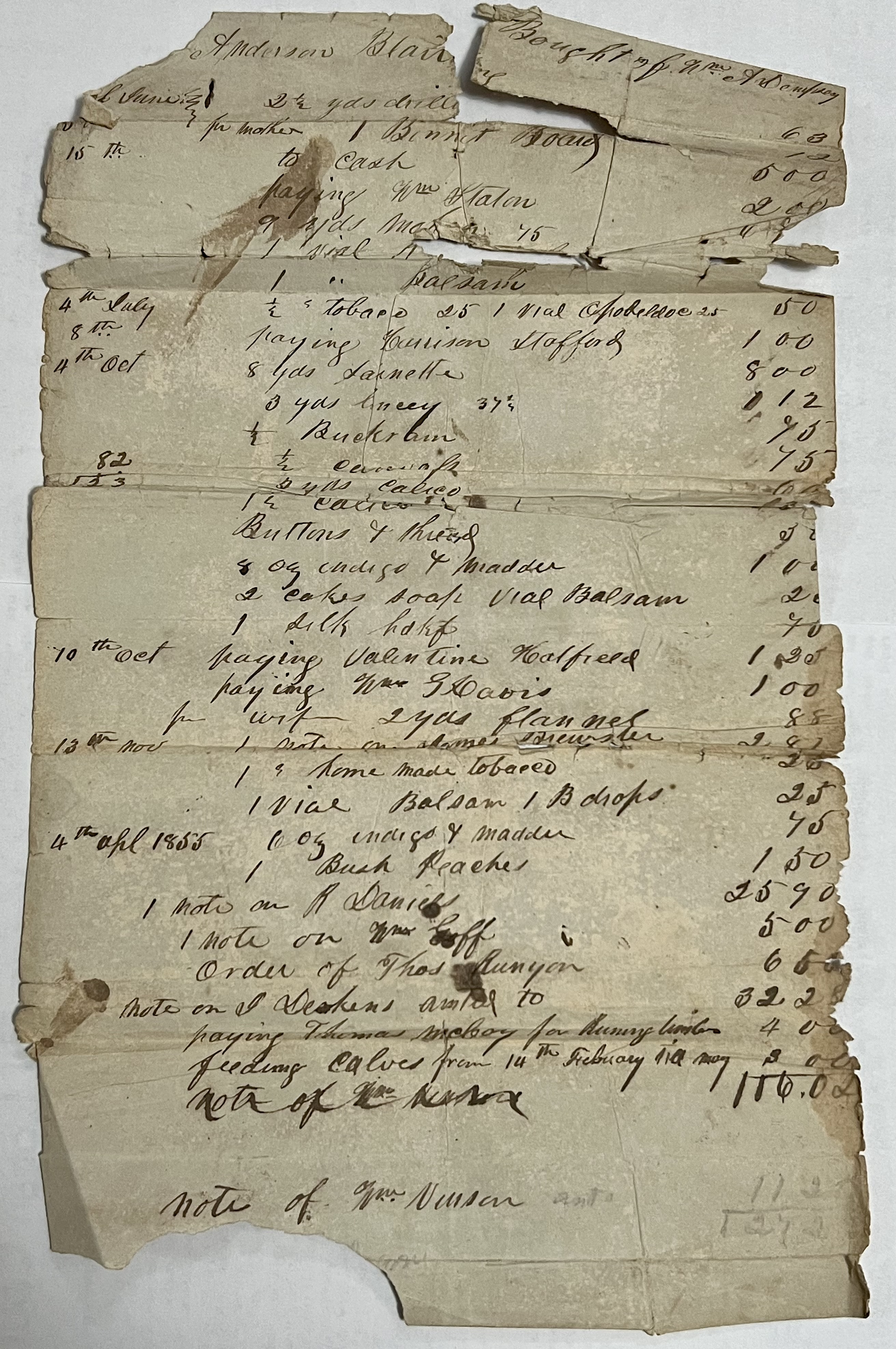
Anderson Blair Account with William A. Dempsey (1854-1855)

05 Monday Dec 2022

Posted by Brandon Ray Kirk in Big Sandy Valley, Hatfield-McCoy Feud, Timber

≈ Leave a comment

Tags

Anderson Blair, Appalachia, genealogy, Harrison Stafford, history, James Brewster, Logan County, logging, Mingo County, Thomas McCoy, Thomas Runyon, Valentine Hatfield, West Virginia, William A. Dempsey, William Staton, William Vinson

On June 15, 1854, William Staton was paid $2.00. On October 10, 1854, Valentine Hatfield was paid $1.25. On April 4, 1855, Thomas McCoy was paid $4.00 for running timber. Logan County, Virginia, now Mingo County, West Virginia.

Hatfield Tunnel at Sprigg, WV (2022)

03 Saturday Dec 2022

Posted by Brandon Ray Kirk in Big Sandy Valley, Matewan

≈ 1 Comment

Tags

Allen River Wall Hatfield, Appalachia, Ben Patterson, Bend of the River, Brandon Kirk, Catlettsburg, Greenway Hatfield, Hatfield Tunnel, John Wallace Hatfield, Kentucky, Mingo County, Norfolk and Western Railroad, Phyllis Kirk, Pike County, Sprigg, West Virginia

A video from the 1990s features commentary from two sons of Allen “River Wall” Hatfield (1892-1978), who lived in Pike County, Kentucky. Scenes include Hatfield Tunnel, the Allen Hatfield farm, and the John Wallace Hatfield Family Cemetery. One person who is shown in the video died in 1997, so the video dates to 1990-1997.

Scene 1

…other side over there at the end of the bridge is West Virginia. And over on this side is Kentucky. My dad [Allen “River Allen” Hatfield, son of John Wallace Hatfield] walked up those beams and carried water—he was a water boy—while they were putting in this bridge here. This is a bridge that goes through the mountain that cuts off where the river makes a circle called the Bend of the River. And the Bend of the River is where the Hatfields lived. And over here is the tunnel. Hatfield Tunnel. And I have walked through this tunnel. You walk through this tunnel. There was man-holes through this tunnel and you could walk through here and… Step on the side when you hear a train coming. My dad and Ben Patterson who used to be the tunnel watchman here took a handcar and went over to Sprigg and put a self-playing piano on a handcar, brought it through the tunnel and took it across the river here and we unloaded it and hauled it down to our house, which was the Greenway Hatfield farm. Ben Patterson and my dad were very close friends. This is the tunnel and place where the Hatfields used to go down to Catlettsburg and they used to go down to Catlettsburg and as they took rafts down by the river and get at Catlettsburg and they’d buy whisky. The way they brought it back they brought a casket and put the whisky in a casket and put the casket in the coach car like there was somebody had died. So they’d get the train to stop right here at this tunnel and let the corpse off, you know. So they could get by with bringing in whisky from Catlettsburg.

Hatfield Tunnel, erected in 1914. Sprigg, Mingo County, WV. October 2022
Hatfield Tunnel, erected in 1914. Sprigg, Mingo County, WV. October 2022. Photo by Mom.

Hatfield Pioneers by Coleman A. Hatfield (1952)

14 Monday Nov 2022

Posted by Brandon Ray Kirk in Big Sandy Valley, Hatfield-McCoy Feud, Matewan

≈ 2 Comments

Tags

Anna Musick, Appalachia, Big Sandy River, Blackberry Creek, Clinch River, Coleman A. Hatfield, David Musick, Devil Anse Hatfield, Ephraim Hatfield, Hatfield-McCoy Feud, history, Honaker, Joseph Hatfield, Kentucky, Logan County, Mary Smith Hatfield, Mate Creek, Mingo County, Mud Lick Branch, Native American History, New Garden District, Pike County, Red Jacket, River Wall Hatfield, Russell County, Shawnee, Sprigg, Thompson's Creek, Tug Fork, Valentine Hatfield, Virginia, West Virginia

Here is an excerpt of Hatfield Pioneers composed by Coleman A. Hatfield, grandson of Devil Anse Hatfield. It was published in 1952.

New Year’s Raid (1888): Daniel Whitt’s Testimony

23 Tuesday Nov 2021

Posted by Brandon Ray Kirk in Big Sandy Valley, Hatfield-McCoy Feud

≈ 1 Comment

Tags

Appalachia, Bob Hatfield, Cap Hatfield, Charles Gillespie, Christmas, Court of Appeals, crime, Daniel Whitt, Devil Anse Hatfield, Elias Hatfield, Elliot Hatfield, feuds, Frankfort, Hatfield-McCoy Feud, Henry Mitchell, history, Jim McCoy, Jim Vance, Johnse Hatfield, Kentucky, Pike County, Pocahontas, Randolph McCoy, Tom Chambers, Tom Mitchell, true crime

Daniel Whitt’s testimony in the Johnse Hatfield murder trial provides one version of the Hatfield raid upon Randolph McCoy’s home on January 1, 1888:

Q. “Do you know Randolph McCoy?”

A. “Yes sir.”

Q. “Do you know Cap Hatfield?”

A. “Yes sir.”

Q. “Do you know Robert Hatfield, Ellison Mounts, Elliot Hatfield, Charles Gillespie, Thomas Mitchell, and Anderson Hatfield?”

A. “Yes sir.”

Q. “Do you remember of the old man McCoy’s house being burned?”

A. “Yes sir, I heard of it.”

Q. “Where were you a short time before that occurred?”

A. “Three days before Christmas I was in the neighborhood of the Hatfield’s.”

Q. “Who was with you?”

A. “Ance Hatfield, Jim Vance, Johnson Hatfield, Cap Hatfield, Charles Gillespie, and Tom Mitchell, I believe about all of the bunch.”

Q. “What were you doing together and how long had you been together?”

A. “About three days and nights.”

Q. “Were all of you armed?”

A. “Yes sir.”

Q. “What were you doing armed and together?”

A. “Just traveling in the woods most of the time.”

Q. “What did you sleep on?”

A. “We carried our quilts with us.”

Q. “Who was your captain?”

A. “Jim Vance.”

Q. “What was the purpose of your getting together?”

A. “They claimed the purpose was to get out of the way of the Kentucky authorities.”

Q. “What else did they claim?”

A. “When I left them we came to Henry Mitchell’s to get dinner. They wouldn’t let me hear what they had to talk about. Cap asked me if I was going to Kentucky with them. Said they were going to Kentucky to kill Randolph and Jim McCoy and settle the racket. He asked me if I was going with them and I said that I was not. He said that I would go or I would go to hell. I said that I would go to hell. Elias came and took me off. We slept in a shuck pen. When he got to sleep I ran away and went to Pocahontas and was there when this occurred.”

Q. “Was Johnson present when Cap was talking?”

A. “He was in the yard close enough to hear, and he came up to me when Cap was talking and took Cap out and had a talk with him.”

Source: Bill of exceptions at the office of the Clerk of the Court of Appeals in Kentucky, Frankfort, KY.

Nancy E. Hatfield Memories, Part 4 (1974)

30 Saturday Oct 2021

Posted by Brandon Ray Kirk in Big Sandy Valley, Hatfield-McCoy Feud, Logan, Matewan, Women's History

≈ Leave a comment

Tags

Appalachia, attorney, attorney general, Big Sandy River, Bill Smith, Cap Hatfield, Catlettsburg, Devil Anse Hatfield, feuds, genealogy, Georgia, Hatfield-McCoy Feud, history, Howard B. Lee, Huntington, Jim Comstock, Joe Glenn, Kentucky, Logan, Logan County, logging, Mate Creek, Matewan, Mingo County, Nancy E. Hatfield, Ohio, Ohio River, Portsmouth, Tennessee, timbering, Tug Fork, University Law School, Wayne County, West Virginia, Wyoming County

Howard B. Lee, former Attorney General of West Virginia, provided this account of Nancy Hatfield (widow of Cap) in the early 1970s:

“Mrs. Hatfield, we have talked much about an era that is gone. Feuds are ended, railroads and paved highways have come, the huge coal industry has developed, churches and schools are everywhere, and people are educated. Now, I would like to know something about you.”

This is the brief life-story of the remarkable and unforgettable Nancy Elizabeth Hatfield, as she related it to me.

She was Nancy Elizabeth Smith, called “Nan” by her family and friends, born in Wayne County, West Virginia, September 10, 1866. (She died August 24, 1942). In her early years, she lived “close enough to the Ohio River,” she said, “to see the big boats that brought people and goods up from below.” She attended a country school three months out of the year, and acquired the rudiments of a common school education, plus a yearning for wider knowledge.

While she was still a young girl her parents moved by push-boat up the Big Sandy and Tug rivers into what is now Mingo County, then Logan County. They settled in the wilderness on Mate Creek, near the site of the present town of Matewan.

“Why they made that move,” said Nancy Elizabeth, “I have never understood.”

In her new environment, in the summer of 1880, when she was 14 years old, Nancy Elizabeth married Joseph M. Glenn, an enterprising young adventurer from Georgia, who had established a store in the mountains, and floated rafts of black walnut logs, and other timber, down the Tug and Big Sandy rivers to the lumber mills of Catlettsburg, Ky., and Portsmouth, Ohio.

Two years after their marriage Glenn was waylaid and murdered by a former business associate, named Bill Smith–no relation to Nancy Elizabeth. Smith escaped into the wilderness and was never apprehended. The 16-year-old widow was left with a three-weeks old infant son, who grew into manhood and for years, that son, the late Joseph M. Glenn, was a leading lawyer in the city of Logan.

On October 11, 1883, a year after her husband’s death, at the age of 17, Nancy Elizabeth married the 19-year-old Cap Hatfield, second son of Devil Anse.

“He was the best looking young man in the settlement,” she proudly told me.

But at that time Cap had little to recommend him, except his good looks. He was born Feb. 6, 1864, during the Civil War, and grew up in a wild and lawless wilderness, where people were torn and divided by political and sectional hatreds and family feuds–a rugged, mountain land, without roads, schools, or churches.

When he married, Cap could neither read nor write, but he possessed the qualities necessary for survival in that turbulent time and place–he was “quick on the draw, and a dead shot.”

“When we were married, Cap was not a very good risk as a husband,” said Nancy Elizabeth. “The feud had been going on for a year, and he was already its most deadly killer. Kentucky had set a price on his head. But we were young, he was handsome, and I was deeply in love with him. Besides, he was the best shot on the border, and I was confident that he could take care of himself–and he did.”

Nancy Elizabeth taught her handsome husband to read and write, and imparted to him the meager learning she had acquired in the country school in Wayne County. But, more important, the she instilled into him her own hunger for knowledge.

Cap had a brilliant mind, and he set about to improve it. He and Nancy Elizabeth bought and read many books on history and biography, and they also subscribed for and read a number of the leading magazines of their day. In time they built up a small library or good books, which they read and studied along with their children.

At the urging of Nancy Elizabeth, Cap decided to study law, and enrolled at the University Law School at Huntington, Tennessee. But six months later, a renewal of the feud brought him back to the mountains. He never returned to law school, but continued his legal studies at home, and was admitted to the bar in Wyoming and Mingo counties. However, he never practiced the profession.

Nancy Elizabeth and Cap raised seven of their nine children, and Nancy’ss eyes grew moist as she talked of the sacrifices she and Cap had made that their children might obtain the education fate had denied to their parents. But her face glowed with a mother’s pride as she said:

“All our children are reasonably well educated. Three are college graduates, and the others attended college from one to three years. But, above everything else, they are all good and useful citizens.”

As I left the home of the remarkable and unforgettable Nancy Hatfield, I knew that I had been in the presence of a queenly woman–a real “Mountain Queen.”

Source: West Virginia Women (Richwood, WV: Jim Comstock, 1974), p. 153-154.

Log Rafting on Big Sandy River (1900)

26 Saturday Jun 2021

Posted by Brandon Ray Kirk in Big Sandy Valley, Timber

≈ Leave a comment

Tags

Appalachia, art, Big Sandy River, Blennerhassett Museum, history, logging, Parkersburg, rafting, timber, timbering, West Virginia

Blennerhassett Museum in Parkersburg, WV.

New Year’s Raid (1888): Randolph McCoy’s Testimony

11 Friday Jun 2021

Posted by Brandon Ray Kirk in Big Sandy Valley, Hatfield-McCoy Feud, Matewan

≈ 1 Comment

Tags

Alifair McCoy, Appalachia, Calvin McCoy, Court of Appeals, Frankfort, Hatfield-McCoy Feud, Hence Chambers, history, Johnse Hatfield, Kentucky, Melvin McCoy, Pike County, Randolph McCoy, Sarah McCoy

Randolph McCoy’s testimony in the Johnse Hatfield murder trial provides one version of the Hatfield raid upon McCoy’s home on January 1, 1888:

Q. “How old are you?”

A. “I was born in 1825.”

Q. “Begin in your own way, and tell all about the case that you know.”

A. “The first thing I knew about it the dogs woke me up. My boy came to the bed and said, ‘Pa, they are coming. Get up.’ And by that time I was up on the floor, and they had surrounded the house and 1 heard one of them say, ‘God damn ye, come out and surrender yourselves, prisoners of war.’ We never spoke. By that time, they had come past the upper house as we called it. We got behind that door that broke. They fired a volley each way in the house and I moved for I saw that I could not stay there. Next, I went to the fireplace. Calvin went to the back of the house. They shot cross shots from each side of the door, through the doors. I stayed there a good while. They kept shooting and, finally, I went into the loft. The firing kept up a long time. I thought it a long time. Finally, they fired the house, the room that I was in, me and my wife, Calvin, and Melvin was in the same room. I took a cup and when the blaze would come through the house I would throw water on it and it out. Finally, the water gave out. The boy had gone up in the loft and I went up where he was. We stayed in the house until three of the joists had burned and the end of the joists had fell down before we had attempted to leave the house. The boy then came to me and said, ‘Pa, ye stay here, I can out-run you and I will go to the barn and try to attract their attention in that direction and maybe I can save you.’ He started and got past the corner of the house when they began firing again. He never got to the barn. The little boy hung onto me but I shoved him loose at the door and went out among them. I stepped out of the house and saw Johnson Hatfield standing eight or ten steps from the rest of them, and just as I stepped out of the house and looked up his gun fired in the direction of Calvin. I discovered that his gun had caught fowl and he was humped down working on it. I fired into the crowd then turned and fired at Johnson. I aimed to shoot him in the neck, but I aimed too low and shot him in the shoulder. The burning house made it as light as day and I know that it was Johnson.”

Q. “What did you do when you shot Johnson, the defendant?”

A. “I ran down the creek.”

Q. “Where did you go then?”

A. “I crawled into the shuck pen.”

Q. “Did you have on your night clothes?”

A. “Yes sir.”

Q. “Where was Alafair McCoy?”

A. “She was in the upper part of the house. They did not fire that until the shots were fired at the other—the room we were in.”

Q. “What did you hear at that time?”

A. “I heard Alafair say, ‘Cap Hatfield and Hence Chambers, you would not shoot a poor innocent woman, would you?’ Then they said, ‘Shoot her, God damit, shoot her down. Spare neither men nor woman,’ and they shot her in the left breast. I heard her fall and struggle near the door. This was all before I came out of the house.”

Q. “Where did you stay that night?”

A. “In the shuck pen, I went back at daylight.”

Q. “What did you find?”

A. “I found my son lying there dead. My daughter dead with her hair froze in her blood to her heart.”

Q. “Was the house there?”

A. “No sir, it was burned up. The little girl had dragged her sister off from the house.”

Q. “How far from the house?”

A. “About thirty yards.”

Q. “How many shots did they fire?”

A. “No man could count them. They came in volleys and platoons.”

Q. “Did you have a gun too?”

A. “Yes sir.”

Q. “Was your wife in her night clothes?”

A. “Yes sir, they thought they had killed her, no doubt, or I think they would have done so.”

Source: Bill of exceptions at the office of the Clerk of the Court of Appeals in Kentucky, Frankfort, KY.

Sarah Ann McCoy Property in Magnolia District (1873-1887)

12 Wednesday May 2021

Posted by Brandon Ray Kirk in Big Sandy Valley

≈ Leave a comment

Tags

Appalachia, Big Sandy River, genealogy, history, John Ferrell, Logan County, Magnolia District, Mingo County, Sally McCoy, Sarah Ann McCoy, West Virginia

The following land information is derived from Land Book 1873-1874 and Land Book 1880-1886 at the Logan County Clerk’s Office in Logan, WV:

Sally McCoy (of Logan County)

No property listed in 1865-1872.

[Note: Her name is given as Sally McCoy in 1873-1874, then as Sarah Ann McCoy in 1875-1876.]

1873-1874: Magnolia District

200 acres John Ferrell Farm and Vance &c $2.50 per acre no building $500 total

[Transferred from E. Rutherford.]

1875-1876: Magnolia District

200 acres Sandy River $2.50 per acre $25 building $500 total

1877: Magnolia District

No records for this year for Magnolia District

1878: Magnolia District

200 acres Sandy River $2.50 per acre $25 building $500 total

[Note: Her name is listed as Sary Ann McCoy of Logan County.]

1879: Magnolia District

No records for this year for Magnolia District

1880: Magnolia District

200 acres Sandy River $2.50 per acre $25 building $500 total

1881: Magnolia District

200 acres Sandy River $3 per acre $30 building $350 total

1882: Magnolia District

Missing pages.

1883: Magnolia District

Pages are mostly blank.

1884: Magnolia District

200 acres Sandy River $3.50 per acre $30 building $790 total

1885: Magnolia District

200 acres Sandy River $3.50 per acre $30 building $700 total

1886-1887: Magnolia District

200 acres Sandy River $3.50 per acre no building $700 total

William McCoy Property in Magnolia District (1878-1887)

12 Wednesday May 2021

Posted by Brandon Ray Kirk in Big Sandy Valley, Matewan

≈ Leave a comment

Tags

Appalachia, Asa McCoy, Big Sandy River, genealogy, history, Logan County, M.B. Lawson, Magnolia District, Mingo County, Nellie McCoy, West Virginia, William McCoy

The following land information is derived from Land Book 1873-1874, Land Book 1880-1886, and Land Book 1887-1892 at the Logan County Clerk’s Office in Logan, WV:

William McCoy (of Logan County)

No property listed in 1865-1877.

1878: Magnolia District

[On February 11, 1878, Asa and Nellie McCoy deeded 150 acres to William McCoy for $500. References the mouth of Mate Creek and the land occupied by William McCoy. Ephraim Hatfield was justice of the peace. Deed Book __, page 484-485.]

150 acres Sandy River $1.75 per acre no building $262.50 total

[Transferred from Asa McCoy.]

1879: Magnolia District

No records for this year for Magnolia District

1880: Magnolia District

150 acres Sandy River $1.75 per acre no building $262

1881: Magnolia District

150 acres Sandy River $2.50 per acre $25 building $500 total

[100 acres to S. Simpkins and M.B. Lawson]

1882: Magnolia District

Pages missing.

1883: Magnolia District

Pages are mostly blank

1884-1885: Magnolia District

50 acres Sandy River $4 per acre $25 building $200 total

1886-1887: Magnolia District

50 acres Sandy River $4 per acre no building $200 total

L.D. McCoy Property in Magnolia District (1875-1878)

12 Wednesday May 2021

Posted by Brandon Ray Kirk in Big Sandy Valley

≈ Leave a comment

Tags

Appalachia, Big Sandy River, genealogy, history, L.D. McCoy, Logan County, Magnolia District, Moses Mounts, Steep Gut Branch, Tug Fork, West Virginia

The following land information is derived from Land Book 1873-1874 and Land Book 1880-1886 at the Logan County Clerk’s Office in Logan, WV:

L.D. McCoy (of Logan County)1

No property listed in 1865-1875.

[In 1875, Moses Mounts deeded 200 acres on Tug Fork to L.D. McCoy. Deed Book F, page 252.]

1876: Magnolia District

200 acres Steep? Gut Sandy River $2 per acre no building $400 total

[Transferred from Peter Mounts and others.]

1877: Magnolia District

No records for this year for Magnolia District

1878: Magnolia District

200 acres Steep Gut Branch $1 per acre no building $200 total

1879: Magnolia District

No records for this year for Magnolia District

No property listed for 1880.

No property listed in 1881.

***

1Most likely, Lorenzo Dow McCoy, son of Selkirk. Perhaps son of John and Nancy McCoy.

Asa McCoy Property in Magnolia District (1859, 1866-1886)

12 Wednesday May 2021

Posted by Brandon Ray Kirk in Big Sandy Valley, Matewan

≈ Leave a comment

Tags

Alafair Davis, Albert G. McCoy, Appalachia, Asa McCoy, Ephraim Hatfield, genealogy, H.S. Davis, history, Jane Ferrell, John Ferrell, justice of the peace, Logan County, Magnolia District, Magnolia Township, Nellie McCoy, Pigeon Creek, Thacker Fork, Tug Fork, West Virginia, William Tiller

The following land information is derived from Land Book 1866-1872, Land Book 1873-1874, Land Book 1880-1886, and Land Book 1887-1892 at the Logan County Clerk’s Office in Logan, WV:

Asa McCoy (of Logan County)1

[On June 4, 1859, Asa McCoy deeded __ acres on Pigeon Creek to John Ferrell for $__. Deed Book __, page 54. Only part of this deed is recorded. Ephraim Hatfield2 and William Tiller were justices of the peace.]

No property listed in 1865.

1866: Magnolia Township

290 acres South Side Pigeon and Thacker Fork $0.50 per acre no building $145 total

820 acres North Side Pigeon $0.50 per acre no building $410 total

No property listed for 1867-1870.

[On February 29, 1869, John and Jane Ferrell deeded 500 acres on Tug Fork of Sandy River and Sulphur Creek to Asa McCoy for $900. References the store house on the bank of the river, near the mouth of Mates Creek. William Tiller was justice of the peace. Deed Book __, page 208-209.]

1871-1874: Magnolia District

500 acres Sulphur and Sandy River $2 per acre no building $1000 total

1875-1876: Magnolia District

500 acres Sandy River and Sulphur $1.75 per acre $100 building $875 total

[On August 19, 1876, Asa and Nelly McCoy deeded 100 acres between Sulphur Creek and Tug River to Alafair Davis3 (wife of H.S. Davis) for $200. Deed Book __, page __.]

1877: Magnolia District

No records for this year for Magnolia District

1878: Magnolia District

[On February 11, 1878, Asa and Nellie McCoy deeded 150 acres to William McCoy for $500. References the mouth of Mate Creek and the land occupied by William McCoy. Ephraim Hatfield7 was justice of the peace. Deed Book __, page 484-485.]

350 acres Sandy River and Sulphur $1.75 per acre $100 building $612.50 total

1879: Magnolia District

No records for this year for Magnolia District

[On April 15, 1880, Asa and Nellie McCoy deeded 75 acres to A.G. McCoy for $200. References the first hollow below the forks of Sulphur Creek. A.W. Ferrell was a justice of the peace. Deed Book __, page 189-190.]

[On April 15, 1880, Asa and Nellie McCoy deeded 50 acres to Albert G. McCoy for $50. References the first hollow on the right hand side of Sulphur. Deed Book __, page __.]

1880: Magnolia District

350 acres Sandy River and Sulphur $1.75 per acre $100 building $612.50 total

1881: Magnolia District

225 acres Sandy River $1.75 per acre no building $262.50 total

1882: Magnolia District

Pages missing.

1883: Magnolia District

125 acres Sulphur Branch Sandy River $2 per acre [rest blank]

1884-1885: Magnolia District

125 acres Sulpher Branch and Sandy River $2 per acre $75 building $250 total

1886: Magnolia District

125 acres Sulphur of Sandy $2 per acre $75 building $75 total

1887: Magnolia District

125 acres Sulphurr of Sandy River $2 per acre $75 building $250 total

***

1Brother to Sallie (McCoy) McCoy.

2Most likely, this is the father to Devil Anse Hatfield.

3Daughter of Asa and Nelly McCoy

Randolph McCoy Property in Magnolia District (1866)

11 Tuesday May 2021

Posted by Brandon Ray Kirk in Big Sandy Valley

≈ Leave a comment

Tags

Anna McCoy, Appalachia, Big Sandy River, Cordelia McCoy, David Mounts, Elizabeth Vance, H.H. Williamson, Hezekiah Blankenship, John Ferrell, justice of the peace, Kentucky, Little Blackberry Creek, Logan County, Magnolia Township, Pigeon Roost Bottom, Pike County, Pleasant McCoy, Randolph McCoy, Richard Vance, West Virginia, William A. Dempsey, William McCoy

The following land information is derived from Land Book 1866-1872 at the Logan County Clerk’s Office in Logan, WV:

Randolph McCoy (of Logan County)1

[On December 15, 1837, Randolph McCoy of Logan County deeded 83 acres to Hezekiah Blankenship for $150. References Pigeon Roost Bottom. John Ferrell and David Mounts were justices of the peace. Deed Book __, page 136.]

[On September 17, 1845, Randolph and Anna McCoy of Pike County, KY, deeded 200 acres to Daniel McCoy for $300. Deed Book B, page 538-539.]

[On February 11, 1854, Elizabeth Vance2 deeded __ acres to Randolph McCoy for $300 all her land in Logan County excepting what she has sold to H.H. Williamson and William A. Dempsey. Beginning below the mill seat; references the island below Little Blackberry Creek and the ash gap in the horse ridge. Pleasant McCoy was a justice of the peace. Deed Book __, page 337.]

[On February 11, 1854, Richard Vance3 deeded __ acres to Randolph McCoy for $200 all of his lands in Logan County. Joseph Murphy and P. McCoy were justices of the peace. Deed Book C, page 444-445.]

No property listed in 1865.

1866: Magnolia Township

199 acres Sandy River $2.50 per acre no building $497 total

75 acres Sandy River $1.75 per acre no building $431 total

No property listed thereafter.

***

1Son of William and Cordelia (Campbell) McCoy.

2Mother of Jim Vance.

3Brother of Jim Vance.

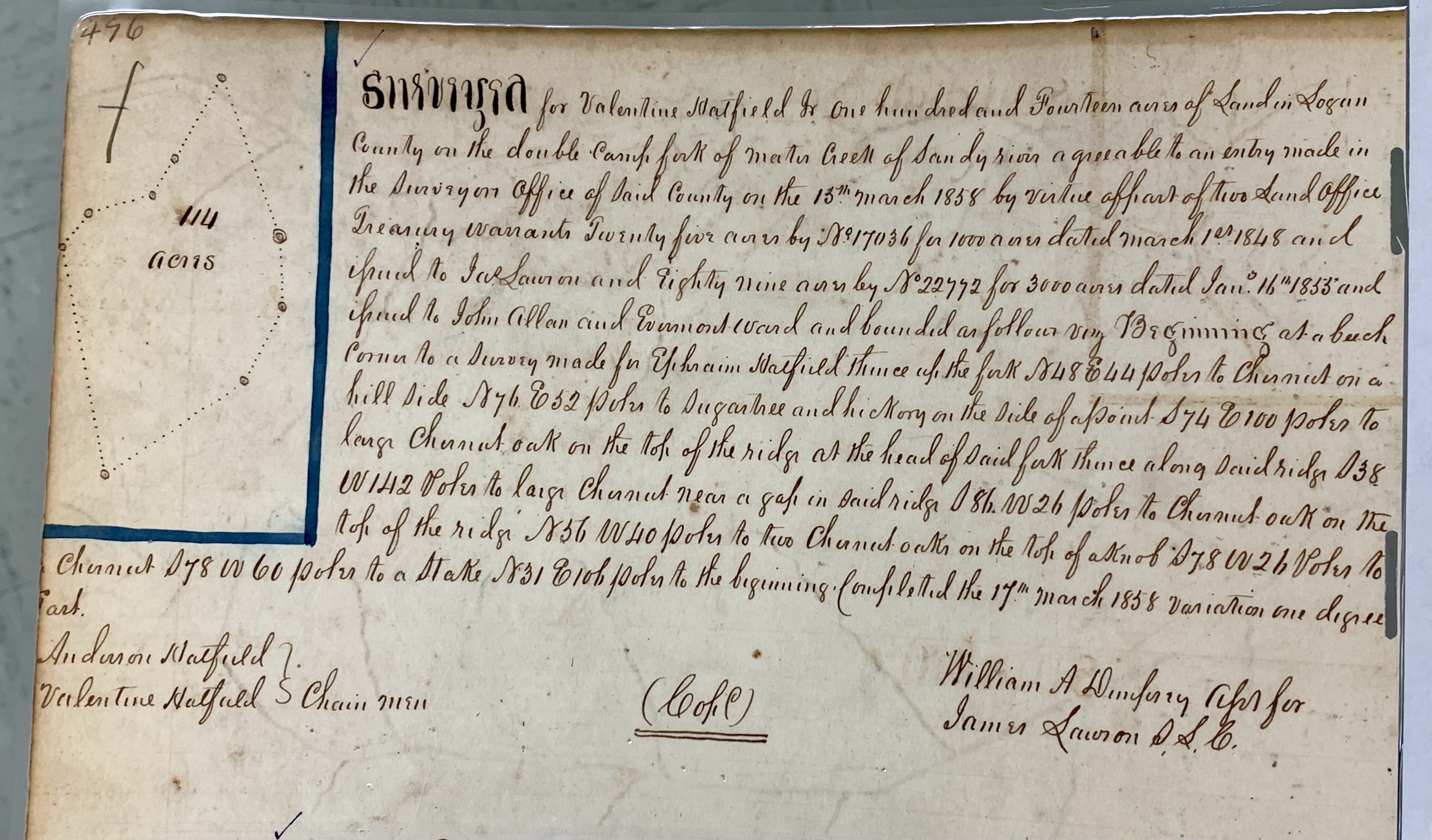
Valentine Hatfield, Jr. Survey (1858)

11 Tuesday May 2021

Posted by Brandon Ray Kirk in Big Sandy Valley, Matewan

≈ Leave a comment

Tags

Anderson Hatfield, Appalachia, Ephraim Hatfield, Evermont Ward, genealogy, history, James Lawson, John Allen, Logan County, Mates Creek, Mingo County, Valentine Hatfield, Virginia, West Virginia, William A. Dempsey

Surveyors Record Book B, p. ____, Logan County Clerk’s Office, Logan, WV.
← Older posts

Feud Poll 1

If you had lived in the Harts Creek community during the 1880s, to which faction of feudists might you have given your loyalty?

Categories

  • Adkins Mill
  • African American History
  • American Revolutionary War
  • Ashland
  • Atenville
  • Banco
  • Barboursville
  • Battle of Blair Mountain
  • Beech Creek
  • Big Creek
  • Big Harts Creek
  • Big Sandy Valley
  • Big Ugly Creek
  • Boone County
  • Breeden
  • Calhoun County
  • Cemeteries
  • Chapmanville
  • Civil War
  • Clay County
  • Clothier
  • Coal
  • Cove Gap
  • Crawley Creek
  • Culture of Honor
  • Dingess
  • Dollie
  • Dunlow
  • East Lynn
  • Ed Haley
  • Eden Park
  • Enslow
  • Estep
  • Ethel
  • Ferrellsburg
  • Fourteen
  • French-Eversole Feud
  • Gilbert
  • Giles County
  • Gill
  • Green Shoal
  • Guyandotte River
  • Halcyon
  • Hamlin
  • Harts
  • Hatfield-McCoy Feud
  • Holden
  • Hungarian-American History
  • Huntington
  • Inez
  • Irish-Americans
  • Italian American History
  • Jamboree
  • Jewish History
  • John Hartford
  • Kermit
  • Kiahsville
  • Kitchen
  • Leet
  • Lincoln County Feud
  • Little Harts Creek
  • Logan
  • Man
  • Matewan
  • Meador
  • Midkiff
  • Monroe County
  • Montgomery County
  • Music
  • Native American History
  • Peach Creek
  • Pearl Adkins Diary
  • Pecks Mill
  • Peter Creek
  • Pikeville
  • Pilgrim
  • Poetry
  • Queens Ridge
  • Ranger
  • Rector
  • Roane County
  • Rowan County Feud
  • Salt Rock
  • Sand Creek
  • Shively
  • Spears
  • Sports
  • Spottswood
  • Spurlockville
  • Stiltner
  • Stone Branch
  • Tazewell County
  • Timber
  • Tom Dula
  • Toney
  • Turner-Howard Feud
  • Twelve Pole Creek
  • Uncategorized
  • Warren
  • Wayne
  • West Hamlin
  • Wewanta
  • Wharncliffe
  • Whirlwind
  • Williamson
  • Women's History
  • World War I
  • Wyoming County
  • Yantus

Feud Poll 2

Do you think Milt Haley and Green McCoy committed the ambush on Al and Hollene Brumfield in 1889?

Blogroll

  • Ancestry.com
  • Ashland (KY) Daily Independent News Article
  • Author FB page
  • Beckley (WV) Register-Herald News Article
  • Big Sandy News (KY) News Article
  • Blood in West Virginia FB
  • Blood in West Virginia order
  • Chapters TV Program
  • Facebook
  • Ghosts of Guyan
  • Herald-Dispatch News Article 1
  • Herald-Dispatch News Article 2
  • In Search of Ed Haley
  • Instagram
  • Lincoln (WV) Journal News Article
  • Lincoln (WV) Journal Thumbs Up
  • Lincoln County
  • Lincoln County Feud
  • Lincoln County Feud Lecture
  • LinkedIn
  • Logan (WV) Banner News Article
  • Lunch With Books
  • Our Overmountain Men: The Revolutionary War in Western Virginia (1775-1783)
  • Pinterest
  • Scarborough Society's Art and Lecture Series
  • Smithsonian Article
  • Spirit of Jefferson News Article
  • The Friendly Neighbor Radio Show 1
  • The Friendly Neighbor Radio Show 2
  • The Friendly Neighbor Radio Show 3
  • The Friendly Neighbor Radio Show 4
  • The New Yorker
  • The State Journal's 55 Good Things About WV
  • tumblr.
  • Twitter
  • Website
  • Weirton (WV) Daily Times Article
  • Wheeling (WV) Intelligencer News Article 1
  • Wheeling (WV) Intelligencer News Article 2
  • WOWK TV
  • Writers Can Read Open Mic Night

Feud Poll 3

Who do you think organized the ambush of Al and Hollene Brumfield in 1889?

Recent Posts

  • Logan County Jail in Logan, WV
  • Absentee Landowners of Magnolia District (1890, 1892, 1894)
  • Charles Spurlock Survey at Fourteen Mile Creek, Lincoln County, WV (1815)

Ed Haley Poll 1

What do you think caused Ed Haley to lose his sight when he was three years old?

Top Posts & Pages

  • Baisden Family Troubles
  • History for Boone County, WV (1928)
  • Armed March Trial (1923): Convicted Man Flees to Mexico
  • Civil War Gold Coins Hidden Near Chapmanville, WV
  • Crotch Grabs

Copyright

© Brandon Ray Kirk and brandonraykirk.wordpress.com, 1987-2023. Unauthorized use and/or duplication of this material without express and written permission from this blog’s author and/or owner is strictly prohibited. Excerpts and links may be used, provided that full and clear credit is given to Brandon Ray Kirk and brandonraykirk.wordpress.com with appropriate and specific direction to the original content.

Archives

  • February 2025
  • January 2025
  • October 2023
  • September 2023
  • December 2022
  • November 2022
  • May 2022
  • April 2022
  • February 2022
  • November 2021
  • October 2021
  • September 2021
  • June 2021
  • May 2021
  • April 2021
  • March 2021
  • February 2021
  • January 2021
  • December 2020
  • November 2020
  • October 2020
  • July 2020
  • June 2020
  • May 2020
  • April 2020
  • March 2020
  • February 2020
  • January 2020
  • December 2019
  • November 2019
  • October 2019
  • September 2019
  • August 2019
  • July 2019
  • June 2019
  • May 2019
  • April 2019
  • March 2019
  • February 2019
  • January 2019
  • December 2018
  • November 2018
  • October 2018
  • September 2018
  • August 2018
  • July 2018
  • June 2018
  • May 2018
  • April 2018
  • March 2018
  • February 2018
  • January 2018
  • December 2017
  • November 2017
  • October 2017
  • September 2017
  • August 2017
  • July 2017
  • June 2017
  • May 2017
  • April 2017
  • March 2017
  • February 2017
  • January 2017
  • December 2016
  • November 2016
  • October 2016
  • September 2016
  • August 2016
  • July 2016
  • June 2016
  • May 2016
  • April 2016
  • March 2016
  • February 2016
  • January 2016
  • December 2015
  • November 2015
  • October 2015
  • September 2015
  • August 2015
  • July 2015
  • June 2015
  • May 2015
  • April 2015
  • March 2015
  • February 2015
  • January 2015
  • December 2014
  • October 2014
  • September 2014
  • August 2014
  • July 2014
  • June 2014
  • May 2014
  • April 2014
  • March 2014
  • February 2014
  • January 2014
  • December 2013
  • November 2013
  • October 2013
  • September 2013
  • August 2013
  • July 2013
  • June 2013
  • May 2013
  • April 2013
  • March 2013
  • February 2013
  • January 2013
  • December 2012
  • November 2012

Enter your email address to follow this blog and receive notifications of new posts by email.

Join 2,925 other subscribers

Tags

Appalachia Ashland Big Creek Big Ugly Creek Blood in West Virginia Brandon Kirk Cabell County cemeteries Chapmanville Charleston civil war coal Confederate Army crime culture Ed Haley Ella Haley Ferrellsburg feud fiddler fiddling genealogy Green McCoy Guyandotte River Harts Harts Creek Hatfield-McCoy Feud history Huntington John Hartford Kentucky Lawrence Haley life Lincoln County Lincoln County Feud Logan Logan Banner Logan County Milt Haley Mingo County music Ohio photos timbering U.S. South Virginia Wayne County West Virginia Whirlwind writing

Blogs I Follow

  • OtterTales
  • Our Appalachia: A Blog Created by Students of Brandon Kirk
  • Piedmont Trails
  • Truman Capote
  • Appalachian Diaspora

BLOOD IN WEST VIRGINIA is now available for order at Amazon!

Blog at WordPress.com.

OtterTales

Writings from my travels and experiences. High and fine literature is wine, and mine is only water; but everybody likes water. Mark Twain

Our Appalachia: A Blog Created by Students of Brandon Kirk

This site is dedicated to the collection, preservation, and promotion of history and culture in Appalachia.

Piedmont Trails

Genealogy and History in North Carolina and Beyond

Truman Capote

A site about one of the most beautiful, interesting, tallented, outrageous and colorful personalities of the 20th Century

Appalachian Diaspora

  • Subscribe Subscribed
    • Brandon Ray Kirk
    • Join 787 other subscribers
    • Already have a WordPress.com account? Log in now.
    • Brandon Ray Kirk
    • Subscribe Subscribed
    • Sign up
    • Log in
    • Report this content
    • View site in Reader
    • Manage subscriptions
    • Collapse this bar
 

Loading Comments...