Tags
Appalachia, history, Logan, Logan County, Lola Herald, merchant, Mine Wars, Sol Bloom, United Mine Workers of America, West Virginia



31 Sunday Mar 2019
20 Wednesday Mar 2019
Posted in Big Harts Creek, Logan, Whirlwind
Tags
Amanda Mullins, Appalachia, Bluefield, Buck Fork, C.H. McCloud, Charlie Mullins, Cherry Tree, genealogy, Harts Creek, history, James Baisden, John Jackson, Logan, Logan Banner, Logan County, moonshining, Ohio, Randy Baisden, revenue agents, S.W. Dalton, Trace Fork, Troy Vance, Weltha Mullins, West Virginia, Whirlwind
A correspondent named “Blue Belle” from Whirlwind on Harts Creek in Logan County, West Virginia, offered the following items, which the Logan Banner printed on January 12, 1923:
The roads are rocky but they won’t be rocky long.
Troy Vance has returned from Ohio. He reported a nice time.
The Revenue Officers sure are raiding Harts Creek.
C.H. McCloud said that he was going to run a baggage truck from Logan to Harts Creek. $2.50 will be the charge.
I saw Charlie Mullins going to Trace Fork Sunday. He said goodbye to the Buck Fork girls.
Wonder who it was that was visiting the widow last Saturday night?
Mr. Randy Baisden has forsaken the Whirlwind girls and has gone to Cherry Tree.
John Jackson and Weltha Mullins and Amanda Mullins were seen going through Mullins town some time ago. The girls sure were hanging to Johnnie.
James Baisden and S.W. Dalton have just returned from Bluefield and both reported a good time.
20 Wednesday Mar 2019
Posted in Big Harts Creek, Logan, Spottswood, Whirlwind
Tags
Anna Adams, Appalachia, Buck Fork, Eula Adams, genealogy, Harts Creek, Harts Creek School, history, Howard Adams, Logan, Logan Banner, Logan County, Nora Adams, Ora Mullins, Shirley Mullins, singing schools, Weltha Mullins, West Virginia
A correspondent named “Baby Doll” from Harts Creek in Logan County, West Virginia, offered the following items, which the Logan Banner printed on January 19, 1923:
As we have begun writing, I suppose we had better not stop, so here goes.
Miss Ora Mullins is very ill at this writing.
Mrs. Baisden is also on sick list this week.
Singing school is still progressing nicely.
Harts has such a terrible rep. I’m sure some would reverse their opinion if they would just visit our singing school.
In my opinion, Harts Creek is as good or maybe better, than any place I know. Come on Harts Creeker, and help me cheer Harts.
Strawberry shortcake
Huckleberry pie,
V-I-C-T-O-R-Y,
Are we “It”?
I say yes.
–Citizens of Harts Creek school
Howard Adams, Eula Adams, Anna Adams, and Nora Adams all have gone back to Logan to attend school.
Mrs. Shirley Mullins is conducting a good school on Buck Fork. We really appreciate her work and wish to thank her.
How many know that there is to be a wedding in this hamlet soon? You don’t know? Well, how do you like the way you found out?
Miss Weltha Mullins has been visiting her parents of this place.
Some of the people in Logan seem to think that the people on Harts Creek never saw a car. Pahaw, fella. They make ‘em climb trees in our burg.
20 Wednesday Mar 2019
Posted in Ferrellsburg, Guyandotte River
Tags
Appalachia, C&O Railroad, Crispin S. Stone, Ferrellsburg, Guyandotte River, Harts, history, Kirk Street, Lincoln County, Lincoln County Commission, Logan, Main Street, map, Railroad Avenue, River Avenue, West Virginia
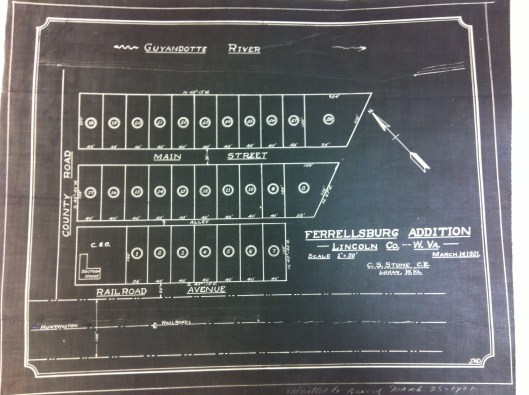
Today, the county road and Main Street are called Kirk Street. Railroad Avenue is Mullins Avenue. In the 1980s, the county road became Kirk Street, Main Street became River Avenue, and Railroad Avenue retained its original name. In the late 1990s, the Lincoln County Commission approved the names of several new streets in town. In the early 2000s, 911 disregarded history and our county commission and improperly renamed many of our streets–and required that we use HARTS as our town address. NOTE: The county road led to a ferry at the river.
19 Tuesday Mar 2019
Posted in Battle of Blair Mountain, Coal, Logan
09 Saturday Mar 2019
Posted in Logan
Tags
Appalachia, Aracoma, G.W. Morgan, history, J.B. Buskirk, John A. Sheppard, Leander Cary, Logan, Logan Banner, Logan County, S.B. Robertson, Thomas C. Whited
From the Logan Banner of Logan, WV, comes this bit of history about Logan (then known as Aracoma) dated July 17, 1937:
Logan’s First Mayor Had Comparatively Few Worries
City “Clean-ups” Were Practically Unknown When J.B. Buskirk Served As Logan’s First Executive Back In 1893
Unlike the present-day affairs in the city of Logan with gambling, bootlegging, and all forms of vice causing the mayor, the police force, and the city council no little concern, the early residents of the city and their administrative bodies had little trouble in making and enforcing the laws.
Ordinances that would almost escape notice today, were they brought before the city legislative group, assumed the importance of grave administrative matters.
City “cleanups” were practically unknown, unless one could consider the annual spring drives against muddy thoroughfares and broken hitching posts as “clean ups.”
City legislators concerned themselves not at all with approving beer license ordinances, public health ordinances, and street marking programs. As to beer, the corner saloon was always handy and was somewhat a refuge from the law.
There was no such thing as “public” health, except in cases of epidemics when each citizen would pitch in and get everything as “clean as a hound’s tooth.”
Street marking in the early days could be construed only as the placing of a line of large rocks at regular intervals across strategic spots on the city’s one thoroughfare to enable pedestrians to cross from one side of the street to the other during the rainy season.
J.B. Buskirk, the first mayor of which there is record, elected with a city council to work with him, lived a life of ease compared with the administration of a present-day mayor.
Buskirk held sway in 1893 and, except for numerous resignations of public officials being continually tendered him, he had little cause to worry. Evidently the city fathers pined away in their chairs from boredom.
Record is made of the long-remembered council meeting of June 27, 1893, when Buskirk, with his council composed of Leander Cary, G.W. Morgan, John A. Sheppard, T.C. Whited, and S.B. Robertson met and passed the following ordinance:
“Be it ordained by the common council of the town of Aracoma: That any person found guilty of pitching horse shoes, rings or anything of like manner, or playing quoits, ball, marbles, or any similar game or games upon the streets or alleys of the town of Aracoma, shall be fined not less than one dollar nor more than five dollars at the discretion of the Mayor.”
The council did not indicate whether or not they considered these practices gambling.
Those were the days—from a mayor’s point of view.
NOTE: Aracoma was Logan’s official name in 1893.
09 Saturday Mar 2019
Posted in Chapmanville, Ferrellsburg, Huntington, Logan
Tags
Appalachia, Belle Dingess, Chapmanville, Charles Curry, Cora Adkins, Cora Kelly, Dude Tomblin, Easter, Ferrellsburg, Ferrellsburg School, fox hunting, genealogy, Gracy Horns, history, Homer Tomblin, Hugh Farris, Huntington, John Dan, John Lucas, John Pitts, Lincoln County, Logan, Logan Banner, Logan County, Lula Tomblin, Martha Fowler, Martha Mullins, merchant, Piney Fork, Ross Fowler, Route 10, sawmilling, Stella Mullins, Walt Stowers, Wayne Brumfield, West Virginia, Wilburn
A correspondent named “Blue Eyes” from Ferrellsburg in Lincoln County, West Virginia, offered the following items, which the Logan Banner printed on April 6, 1923:
The hard road is being rapidly worked on here at this place. We hope Logan County will keep her part of this road worked to make a speedy finish.
Mr. J.W. Stowers is still at home; he doesn’t go out much. Sometimes he fox hunts with his hounds.
Hugh Farris, a merchant from Piney, is here looking after business interests.
Mr. John Lucas made a rushing trip to Chapmanville Tuesday.
Mr. Bartley returned from a home visit in Huntington Monday.
Miss Martha Fowler made a trip to Logan Monday looking after business matters.
Mrs. Belle Dingess is visiting her sister Miss Martha Fowler this week.
Rev. Charles Curry and other Baptist ministers preached at Ferrellsburg school house Easter Sunday.
A Holiness revival will begin here this week by Brother Wellman and wife. We are certainly proud to announce the meeting because the people in this section have got their eyes on this highway of holiness. We are expecting a large crowd and a good meeting.
Mrs. Cora Adkins has been very ill for the past few weeks, but is improving now.
Mrs. Stella Mullins is visiting her sister in Ferrellsburg, Mrs. M. Tomblin.
Mr. John Pitts was on his way to work Saturday night when he fell and shot himself and now is in the Logan hospital.
The beauty of this place left here yesterday—Miss Cora Kelly.
Mr. W.E. Fowler, a merchant of Ferrellsburg, has gone to saw milling.
Mrs. Martha Mullins isn’t very well pleased with this noisy place.
Miss Gracy Horns returned to Ferrellsburg yesterday after visiting her sister at Wilburn, W.Va.
Mr. W.C. Brumfield was calling on Miss Lula Tomblin Saturday and Sunday.
The girls in Ferrellsburg are very sad at this writing on account of bad weather and bad roads, and are hoping the hard roads will be completed in a short time so they can begin joy riding.
Mr. Homer Tomblin and friend John Dan are taking a vacation this week. They will begin work Monday.
03 Sunday Mar 2019
Posted in Big Sandy Valley, Hatfield-McCoy Feud, Huntington, Matewan
Tags
Abner Vance, Alexander Varney, Ali Hatfield, Andrew Hatfield, Appalachia, B.H. Justice, Bettie Vance, Big Sandy River, Cabell County, Celia Hatfield, Ephraim Hatfield, Ferrell Evans, Frank Evans, genealogy, Guyandotte Valley, Hatfield-McCoy Feud, Henry Clay Ragland, history, Humphrey Trent, Jacob Hatfield, James Hatfield, James Justice, John Justice, John Toler, Joseph Hatfield, Logan, Logan Banner, Logan County, Logan County Banner, Logan Court House, M.A. Hatfield, Matewan, North Spring, Peter Cline, Phoebe Hatfield, sheriff, Thomas Hatfield, Thomas Smith, Valentine Hatfield, West Virginia, William E. Justice, Wyoming County
From the Logan Banner of Logan, WV, comes this bit of history for the Hatfield family, printed on May 11, 1937:
History Of Hatfield Clan Recorded In Banner Files
Ephraim Hatfield Was One of The Quietest Men In The County—Yet He Was Father Of Those Engaged In Famous Feud
Henry Clay Ragland, editor of The Logan Banner in 1896, was, among other things, a genealogist for Logan county.
He lived at a time when most of the children and grandchildren of Logan county’s first settlers were still alive and he had access to a wealth of first-hand information that has served as the basis for family histories in Logan county up to the present.
An account of the entrance of the Hatfield family into this section of the country is clipped verbatim from a Logan County Banner dated Wednesday, April 29, 1896.
“At what is still known as the Hatfield place on Horsepen, Valentine Hatfield, of Washington county, Va., settled at quite an early day. He was the father of nine sons and three daughters, and from them have sprung many of the Hatfields of the Guyandotte and Sandy Valleys.
“Valentine Hatfield married a Miss Weddington, and he was a half brother of Thomas Smith. His sons were Ali, who married a daughter of Ferrell Evans; Joe, who also married a daughter of Ferrell Evans; Ephraim, who married Bettie Vance; (This Ephraim was one of the quietest men in the county, and was for a long time a justice of the peace, yet he was the father and grandfather of the Hatfields who were engaged in the Hatfield-McCoy feud) Andrew, who married a daughter of Humphrey Trent, and whose descendants live in Wyoming county; Thomas, who married a daughter of Frank Evans; John, who married a daughter of Abner Vance; James, who married a daughter of John Toler; (Squire M.A. Hatfield and James Hatfield are the sons of this marriage) Jacob, who married a daughter of Peter Cline; and Valentine, who was never married.
“Of his three daughters, Phoebe married Alexander Varney; Celia married James Justice, who was at one time sheriff of Logan county, and who was the father of John Justice, a prominent merchant in Logan Court House (the name of the city at that time), B.H. Justice, a merchant and timber dealer of Cabell county, and William E. Justice, a merchant at North Spring and at one time a member of the West Virginia legislature.
“Joseph Hatfield, a brother of Valentine Hatfield, settled about the same time at Matewan.”
27 Wednesday Feb 2019
Posted in Logan
Tags
Appalachia, Aracoma Hotel, F.R. Remlinger, history, Logan, Logan Banner, Logan County, West Virginia

Aracoma Hotel advertisement, Logan (WV) Banner, 31 March 1922.
27 Wednesday Feb 2019
Posted in Coal, Huntington, Logan
Tags
Appalachia, Bank of Huntington, Bob Greever, Bud McDaniel, C.W. Jones, Cabell County, Frank James, Henlawson, Henry Lawson, history, Huntington, Island Creek, Jesse James, Logan, Logan County, Merrill Mines, Robert T. Oney, Tennessee, West Virginia
From the Logan Banner of Logan, WV, comes this bit of history about the James Gang’s robbery of a Huntington bank…and the fate of a safe:
Historic Safe In Offices Merrill Mines, Henlawson
Bank Safe Robbed by Jesse James’ Gang at Huntington in 1875 Now in Fire-proof Vault at Henlawson
Used As Storage For Old Files
The Merrill Mines at Henlawson have a safe in their payroll office which has a unique history.
The safe is being used by the company as a storage place for old records and is in a fire-proof vault.
But it was not always thus.
According to Bob Greever, payroll clerk, who became interested in the history of the safe and clipped a news story from a Huntington newspaper to support his story, the depository was once in the old Bank of Huntington on Third avenue and Twelfth street and was robbed by members of Jesse James gang, who made their getaway with $14,500 on Twelfth street to Fourth avenue, thence to Tenth street and out Tenth street to the hills, closely pursued by a hastily formed posse.
Old-timers in Logan still remember the posse which followed the gang to Logan and lost its trail at the forks of Island Creek long enough for the gang to make their escape to Tennessee.
Reports came back to Logan that the posse overtook the band in Tennessee, killed one of the gang, Bud McDaniel, and arrested another by the name of Webb or Keen. The man the police arrested was brought back to West Virginia and was sentenced to the penitentiary for 20 years. Most of the money was recovered.
An excerpt from the news article describing the bank robbery reads:
“On Monday, September 6, 1875, between the hours of 1 and 2 o’clock a group of men later discovered to have been members of the dreaded James gang, descended on the Bank of Huntington and, at the point of a pistol, forced Robert T. Oney, cashier, to open the bank’s safe in order that they might rifle the contents.
“They complimented the cashier on his courage and insisted on restoring to him an amount of money shown to be his by a credit slip on the counter.
“Reaching the outside of the bank the four men sprung into their saddles, brandished their pistols in the air and galloped away, yelling like Comanche.”
“It was definitely learned that Jesse James was not among them, but there was uncertainty as to whether or not Frank James was in the party. Colder Young was present and may have been leader of the detachment.”
C.W. Jones, general manager of the Merrill Mines, said that the old safe, which weighs every bit of two tons, was first owned by Henry Lawson, lumber operator at Henlawson.
Lawson brought the safe from Huntington by pushboat and put it in his lumber offices on the site of the Merrill Mine offices.
When the Merrill Mines opened their workings, the safe was left near its original site and a fireproof vault was built around it.
The safe is showing the ravages of nearly a century of service. The combination is broken, it squeaks on its hinges, and some of the cement which is encased between steel plates on the safe doors is beginning to crack.
However, the safe is in its final resting place, the door of the vault is too small to get the safe through.
Logan (WV) Banner, 13 May 1937
23 Saturday Feb 2019
Tags
Andrew Lewis, Appalachia, Aracoma, Battle of the Island, Big Creek, Boling Baker, Coal River, Dingess Run, Elizabeth Madison, George Booth, Gilbert Creek, Guyandotte River, Hatfield Island, history, Island Creek, John Breckinridge, Kentucky, Logan, Logan Banner, Logan County, Mingo County, Montgomery County, Native American History, Native Americans, Spruce Fork, Thomas Madison, Virginia, Washington County, West Virginia
From the Logan Banner of Logan, WV, comes this bit of information about Logan’s early history printed on April 26, 1937:
Land On Which City Of Logan Now Stands First Owned by Breckinridge
The tract of land on which the city of Logan now stands and the Island–now “Hatfield’s Island”–once belonged to John Breckinridge, scion of an old Kentucky family and leader of the attacking party which broke the control of the Shawnee Indians in the Guyandotte valleys in the “Battle of the Islands.”
Princess Aracoma was killed in this battle and Boling Baker, her renegade white husband, was banished forever from the lush river valley where he had spent his days since his desertion from the English forces in Virginia.
Captain Breckenridge led the attack which made the valley safe for white settlers, and, in appreciation of his services, the new government allowed him 300 acres at the mouth of Island creek.
The land grant was made early in the 1780s along with a few others on Island Creek, Dingess Run, Gilbert Creek, Big Creek and the Spruce Fork of Cole River.
Surveying parties from Montgomery and Washington county, Virginia, braved the wilderness and apportioned the land in Guyan Valley and vicinity to early Indian fighters who had contributed their services to opening the valley for white settlement.
Included in the surveys made by deputy surveyors from Montgomery county were grants apportioning much of Island Creek, Spruce Fork, and Dingess Run to persons whose names are still remembered in the county has holders of much of this county’s land.
In these early surveys Andrew Lewis was given 3000 acres on Island Creek along with 2000 acres on Big Creek, and 3000 acres on Gilbert Creek.
Thomas Madison was given 2000 acres on Spruce Fork, 1000 acres on Dingess Run, and 2000 acres on Gilbert Creek.
Others who figured in this early allocation of land were Elizabeth Madison, who was given much of Spruce Fork; George Booth, who was awarded several thousand acres along Guyan River and on Island Creek; and George Booth [same name listed twice in this story], who received much of the land along Island Creek.
Later in the waning years of the 19th century other grants were made by the new government with the stipulation that settlement be made immediately, but these early grants were rewards for work well done in opening the valley of the Guyandotte for settlement.
14 Thursday Feb 2019
Posted in Big Harts Creek, Halcyon
Tags
Appalachia, Freddie Dingess, genealogy, Halcyon, Harts Creek, history, Logan, Logan Banner, Logan County, May Cooper, moonshine, Shamrock, Tom Dingess, Von Dingess, West Virginia
A correspondent named “Jennings” from Halcyon on Harts Creek in Logan County, West Virginia, offered the following items, which the Logan Banner printed on August 11, 1922:
Miss Freddie Dingess and Miss May Cooper were visitors in Halcyon this week. The girls seemed to enjoy themselves very much. They went in bathing in the creek, rode a log, turned turtle, went barefooted, rode a mule and so on. They sure were a jolly couple. They took back to Shamrock bottom lots of sunshine. Most of the people take back moonshine.
Miss Tom Dingess from the Logan hospital and Von Dingess of Shamrock Bottom were visitors in Halcyon recently. The jolly things they did were innumerable and is believed they took away both moonshine and sunshine to Shamrock valley.
Everything is unusual around here. We have good crops of which we are reaping the benefit of now. All are jolly and the goose is hanging high.
12 Tuesday Feb 2019
Posted in Battle of Blair Mountain, Coal, Logan
11 Monday Feb 2019
Posted in Logan, World War I

Logan (WV) Banner, 21 July 1922.
07 Thursday Feb 2019
Posted in Coal, Guyandotte River, Logan
Tags
Appalachia, coal, genealogy, Guyandotte River, Guyandotte Valley, history, Logan, Logan Banner, Logan County, Logan County Health Department, West Virginia
From the Logan Banner of Logan, WV, comes this bit of history relating to coal and the Guyandotte River, dated 1927:
UNPLEASANT AND HARMLESS TASTE NOTED IN CITY WATER—IS CAUSED BY PHENOL WASHED INTO RIVER
The local water company has lately been flooded with telephone calls relative to a strange taste and odor in the city water supply. At the request of the water company the County Health Department has made an investigation. It has been found that the queer taste and odor is not due to excessive use of chlorine disinfectant, as most people seem to believe. A great many people have remarked that the odor especially resembles that of carbolic acid. As a matter of fact, the compound causing it does not belong to the same family. The taste is caused by a phenol compound which is a coal tar product found in coal mine wastes. The heavy rains this week have washed some of this deposit from the upper Guyan Valley coal fields into the river. There is no known satisfactory method to remove phenol from water, so it goes through the water paint; part of it combining with the chlorine used for disinfecting and producing the taste so prevalent for the last few days.
The water is entirely safe and it is not injurious to health. It will probably last only a few days, until the flood waters in the rivers subside.
The situation is not a new one; various towns over the state, using stream water from coal field drainage districts, report “chloro-phenol” taste from time to time. The only remedy is to keep the coal waste from draining into the streams. Some work has been done in Pennsylvania along this line but so far little has been accomplished in West Virginia.
Logan County Health Department
Source: Logan (WV) Banner, 21 October 1927
06 Wednesday Feb 2019
Posted in Logan
Tags
Appalachia, author, authors, Footprints from City to Farm, From the Rio Grande to the Rhine, genealogy, George Martin Nathaniel Parker, history, jails, John B. Wilkinson, Kentucky, Kingsport, Lights in the Old Home Window, Logan, Logan County, Mt. Nebo, North Carolina, Princeton, prison reform, Reservoir Hill, teacher, Tennessee, Tennis Hatfield, West Virginia, writers
From the Logan Banner of Logan, WV, comes this bit of history about author George Martin Nathaniel Parker, dated 1926:
WELL KNOWN AUTHOR FINDS LOGAN JAIL BEST MANAGED IN WEST VA.
EATS UNUSUAL DINNER OF PRISONERS
Having inspected more than 100 jails in West Virginia as a humanitarian effort to better conditions for his fellow man, G.M.N. Parker, author, editor, and former Logan school teacher, this week visited the Logan county jail and highly commended the administration of the institution under the jurisdiction of Sheriff Hatfield and the management of Jailer Kummler.
He wrote a description for The Banner giving his impressions of the Logan county institution. The writer was born in Mt. Nebo, N.C., and became a school teacher in his youth. Forty years ago he was persuaded by Judge John B. Wilkinson to come to Logan from Kentucky, where he then was teaching, to take charge of the school here in the old wooden building on Reservoir Hill. He taught here a year.
From the school work, Parker devoted himself to writing books in connection with editorial newspaper work. Of late years, he has made his home at Princeton, W.Va.
Published books of this writer include “From the Rio Grande to The Rhine,” “Lights In The Old Home Window,” and “Footprints From City to Farm.” His latest volume is “The Key to Continent,” now on the press.
“In this connection,” said Parker, “at Kingsport, Tenn., in the back woods one of the largest book publishing plants in the United States. Here my books are published. The plant turns out one and one-half million volumes monthly. The paper, cloth, and other materials used in the books are manufactured in one big plant. It ought to be a matter of pride to the South to realize that the biggest bookmaking plant in the nation is in Tennessee.
“I came back to Logan for a brief visit with old friends being hungry for the hills. I was born in the hills and like to come back to them from time to time.
“In addition to noting the remarkable change in the Logan county jail, I note other remarkable progressive changes in Logan.
“Of the 100 or more jails in West Virginia I have inspected, I find that the Logan county institution is the most progressive and best type and best operated institution of its kind.”
The article dealing with his visit at the Logan county jail follows:
Even at its best, human life ever has been and ever will be a continual battle; education battling against ignorance, society against selfishness, democracy against aristocracy, right against wrong.
Right is synonymous with law, and law is synonymous with legal master. As the rod is to the parent in the home, so is the prison to the legal master in the country. As the rod is to the home, so the prison is to correct disobedient men and women in the county.
Some prisons correct them only with punishment. These are usually political plums passed out as rewards for campaign activities, and those to whom they are passed go on the philosophy that the more the punishment, the more successful in the correction.
Under this philosophy, prison keepers swell their bank deposits by shrinking the prisoners’ food and by furnishing an inferior quality; a quality so poorly prepared that only the half-starved can eat it; so poorly prepared that the most consecrated Christian could not consistently say grace over it.
The prisons are no better. I have visited some whose floors were common cuspidors so thickly covered with tobacco quids that their sickening fumes almost knocked me back as I entered the door. On my way along the corridors, I have heard prisoners beg for bunks that were free from lice, and have seen green flies swarming in the cells.
We measure the strength of the chain by its weakest link. We measure the morale of the county by its prison. This measurement is an enviable tribute to Logan. In the management of the prison the county sees more than money; sees men. Sees more than punishment; sees purity. Seeing we are all human chameleons in that we absorb our surroundings; that suggestions are the steps in the mental and moral stairs; that cleanliness is the rising road. Logan county has adopted cleanliness as a creed and requires all prisoners to live up to it so that the air circulating through the cells is as free from offensive odors as the breezes that fit the leaves on the surrounding forest peaks.
A word about the way the jail food is prepared. Though a stranger and visitor, an unexpected one at that, I went to the prison when the court house clock was striking 12, and asked the keeper to let me eat dinner with the prisoners. He unlocked the iron door and passed me in—at the same time saying that dinner would be sent in directly.
I was not expecting roast lamb, quail on toast, an English pudding—neither did I get them. All I got were the old familiar Bs: bread, bacon, and beans. But they were good, as good as my mother prepared, way back when I plowed corn in Logan’s hills. In fact, while chasing a chunk of bacon around through my pan of beans—trying to make it stop long enough to cut off a mouthful with my spoon—I seemed again to be a plowboy—happy because I had more than I had when plowing barefooted on the backwoods farm.
Amid the rattling of spoons on the tin pans I watched the prisoners, most of them young, some good and some bad—some are good or better than you or I. All qualified and encouraged to go forth like the graduates from a school and bless the country with ideal citizenship.
I said then that Logan’s prison ought to become as famous as Denver’s juvenile court; that what Denver’s juvenile court was doing for boys and girls, Logan’s prison was doing for young men and young women.
Source: Logan (WV) Banner, 24 August 1926
02 Saturday Feb 2019
Posted in Huntington, Irish-Americans, Logan
Tags
baseball, Brazil, Canada, England, genealogy, history, Huntington, Ireland, Jerry Crowley, Logan, Logan Banner, Logan County, Marietta, Mt. Gay, Murphy's Restaurant, New York, Ohio, repairman, Stratton Street, Syracuse, Wales, West Virginia
From the Logan Banner of Logan, WV, comes this bit of history about J.E. “Dad” Crowley, a familiar Irish repairman, in 1937:
J.E. “Dad” Crowley Here Since 1884 As Repairman
Ninety-Year-Old Irishman Worked on Sewing Machines In Brazil, England, Ireland, Wales and Canada; Never Sick A Day
This will be the first time that Jerry E. “Dad” Crowley’s name has been in a newspaper.
Not that Dad doesn’t have an interesting story to tell, but just because no one ever “discovered” him before. (Dad has never been in jail, either, though he has walked twice across the continent and calls himself a “tramp.”)
Dad Crowley, 90-year-old sewing machine repairman who has been working spasmodically in Logan county since 1884, was born in Syracuse, New York, member of a family of 14 children.
During the 90 years since the time of his birth he has walked twice across the United States, gone across the continent more than 100 times by rail and has repaired sewing machines in Brazil, Wales, England, Canada, and Ireland.
Dad says he has never been sick more than a half day in his life, has had only one contagious illness, has never taken a drop of medicine to date and up to now has had no ache or pain more serious than a toothache or a corn.
His only illness was whooping cough. He had this affliction at Marietta, Ohio, when he was 76 years old.
“I guess the Master just figured I was entering my second childhood and had better give me something to remind me of the fact,” Dad said with a chuckle.
“I just whooped ‘er out, though. No doctor, no medicine, no thing.”
“Dad” says he’s not bothered with any aches or pains now.
“I haven’t any teeth no, so—toothache won’t bother me, and my feet are so battered up that a pain there wouldn’t be noticeable.”
When asked how many miles he believed he had walked during his 90 years, the leathery, little Irishman—he’s “Shelalaigh Irish” and proud of it—rattled off the figure of 23, 367, 798, 363 miles without a blink of the eye, then later admitted that “I lost track of mileage after the first 20 billion miles.”
Dad declared that in his first and last job of work that he held for a person other than for himself he walked more than 10,000 miles.
He was operator of a treadmill for a Syracuse citizen named Hamilton from whom he learned the mechanism of the sewing machine, thus making it possible for him later to be independent of all bosses.
The whitehaired old chap repaired his first sewing machine on the Mounts farm in Mount Gay in 1884 when he first came into this section of West Virginia from Huntington.
Since that time during his intermittent visits to Logan county he has canvassed nearly every home here and has worked on many of the sewing machines in the county.
Dad is a close friend of the Murphys who operate a restaurant and poolroom on Stratton street. He affectionately calls Mrs. Murphy “Mom” because he thinks she looks like his mother, who died when he was only two years old.
Dad can be found at Murphy’s Restaurant any afternoon when the baseball scores are coming in. Baseball next to repairing sewing machines, is his consuming passion. One will find Dad wearing a cap on his graying locks, smiling broadly and ever ready to spin a yarn or talk baseball.
Source: Logan (WV) Banner, 1 July 1937
01 Friday Feb 2019
Posted in Chapmanville, Coal, Logan
Tags
Appalachia, Arnold Christian, Chapmanville, Charley Bryant, Christian Church, Church of God, Clinton Ferrell, Everett Fowler, Fannie Brown, genealogy, George Chapman, history, John Bry, Logan, Logan Banner, Logan County, Lucy Ellis, Monaville, Newt Muncy, Sidney Ferrell, Tompkins mines, West Virginia
A correspondent named “Big Peat” from Chapmanville in Logan County, West Virginia, offered the following items, which the Logan Banner printed on March 17, 1922:
Our school is progressing nicely at this place.
We are having some nice weather now, and it makes us think about making gardens.
Charley Bryant was very seriously injured when he fell from the porch where he had been working for Arnold Christian Saturday.
Millard and Pearlie seemed to enjoy the sunshine Sunday.
Say, Jim, don’t you think you had more than your share of girls Sunday?
Rev. Carter of Monaville has moved to Chapmanville to take charge of the Church of God.
Annie looked blue Sunday.
Miss Fannie Brown was very ill Sunday, but we are glad to say she is able to be out again.
Miss Maud had a ten cent smile on Sunday.
We saw Rev. Hensley in town Sunday.
Miss Lucy Ellis is visiting out of town.
Mr. McNeeley looked tired Sunday. He said he was not used to walking so much in one day.
Mr. Clinton Ferrell of Logan was calling on some of our girls Sunday.
Sidney Ferrell was calling on his friends in Chapmanville Sunday.
We understand Everett Fowler is going to be the new manager of the Tompkins mines.
Clinton, were you with the blonde or the brunette Sunday?
Julius, did you dye those trousers white?
Is John Bry our bank boss now?
Mr. Newt Muncy, one of our business men here, attended services at the Holiness Church Sunday.
The Children’s Prayer meeting conducted at the Christian Church is well attended.
Mr. George Chapman was seen riding through our streets Monday.
Will call on you again if this escapes the waste basket.
29 Tuesday Jan 2019
Posted in Chapmanville, Guyandotte River, Logan
Tags
A.K. Bowling, Abraham, Alma Wagner, Anna Bowling, Appalachia, Busy Bee Pool Room, Butcher Pool Room, Chapmanville, Ed Conley, Eunice Ward, Everett Fondee, genealogy, Gordon Adams, Guy Dingess, Guyandotte River, history, J.D. Turner, John Dingess, Logan, Logan County, Millard Brown, Monroe Conley, Mont Tabor, Omar, P.M. Ferrell, Ray Swann, Silas Smith, Star Supply, West Virginia, Wonderland Theatre
A correspondent named “Slow Sam” from Chapmanville in Logan County, West Virginia, offered the following items, which the Logan Banner printed on March 10, 1922:
The revival at the Holiness church, conducted by Rev. Johnson, is still going on.
Three very interesting sermons by Rev. Langdon were delivered at the Christian church.
Monroe Conley’s house was destroyed by fire Wednesday morning.
We are glad to say that Dr. J.D. Turner’s baby is improving rapidly.
Mrs. Larkin, of Omar, is visiting her parents, Rev. and Mrs. Langdon of this place.
Mr. Silas Smith, of Abraham, was visiting at A.K. Bowling’s Monday.
The free show given at the Wonderland Theatre was well attended Tuesday night.
Mont Tabor, of Logan, was seen on our streets Sunday.
Mr. Everett Fondee and Miss Eunice Ward were calling on Miss Anna Bowling Wednesday evening.
Mr. P.M. Ferrell and Miss Alma Wagner were seen walking our streets a fine evening ago.
Wanda looks lonesome this week!
Mr. Millard Brown is calling quite often at the Star Supply. There is a good looking girl working there.
Mr. Gordon Adams killed a fine hog, Ernest said.
Mrs. Ferrell is visiting friends here.
John Dingess looks pleased. Wonder why?
Guy Dingess was seen talking to some girls down the street one day this week.
Jim was glad the show was free!
Mr. Ray Swann is working at Chapmanville now.
The Busy Bee pool room is doing good business.
The music is fine in the Butcher pool room as well as the business.
Mr. Mathenie has moved back to his home at this place.
Ed Conley has moved across the river.
Good luck to The Banner!
29 Tuesday Jan 2019
Posted in Logan
Tags
Appalachia, Beverly Spencer, Elm Tree Club, Gordon Riffe, Harmon McNeely, history, John Lee Buskirk, Kelly McNeely, Lee Justice, Logan, Logan Banner, Logan County, Wallace Perry, West Virginia, William Forbes, Yie Buskirk
From the Logan Banner of Logan, WV, comes this bit of history for the old “Court House Elm” that once stood at the Logan County Courthouse:
Court House Elm is Slowly Dying
The old elm that has stood on the western end of the court house plaza has given evidence that it is about ready to give up the ghost and pass away. Efforts have been made this week to water the roots and otherwise assist Mother Nature in bringing life into the old trunk that has stood there for many years. This tree has afforded shade for practically every inhabitant of the county and under its spreading boughs has, for many years, gathered what is known as the “Elm Tree Club,” composed of citizens who have grown in age and who are inclined to enjoy the comforts of the seats on the plaza and the breeze as well and to enjoy viewing all passing traffic. Should the old tree die, it is understood, Lee Justice will be called upon to deliver the funeral oration. It is said that Yie Buskirk, father of several of the prominent Buskirks who have lived in Logan, gathered the shrub while roaming in the mountains and brought it to the village and planted it where it now stands. The tender shrub grew with years until it gained a huge size, but recently when that part of the lawn was concreted, not sufficient amount of earth was left about its trunk to afford moisture and the tree has been declining for years.
Although it gives signs of budding forth this year, it will not remain with us many more years to afford us a pleasant shade.
Source: Logan (WV) Banner, 14 April 1922
***
Dying Elm Inspires Many Reminiscences
The article in the Banner of last week relative to the dying elm tree on the southwest corner of the court house square has brought the older citizens of the city to reminiscence of the days gone by when the “Elm Tree Club” was in full bloom.
This club was organized in 1908 and consisted of 8 charter members. The object of the club was to gather daily under the shade of this tree, swap jokes, tell tales of past experiences in life and otherwise entertain all who cared to listen while the members viewed the never ending line of traffic as it passed by every moment of the day.
The club was organized by Lee Justice, who was honored by being made President. William Forbes was elected secretary and the charter members consisted of these two gentlemen with Beverly Spencer, Kelly McNeely, Gordon Riffe, John Lee Buskirk, Wallace Perry, and Harmon McNeely forming the nucleus around which a large membership has grown at the present day.
The old elm is a favorite meeting place for people with a few idle moments to spare and the seats found there afford comfort and ease to the weary who are pleased to find a place to relax and rest while at the same time they are able to observe principally all the traffic for this point is traversed by practically all the traffic of the city.
Source: Logan (WV) Banner, 21 April 1922
Writings from my travels and experiences. High and fine literature is wine, and mine is only water; but everybody likes water. Mark Twain
This site is dedicated to the collection, preservation, and promotion of history and culture in Appalachia.
Genealogy and History in North Carolina and Beyond
A site about one of the most beautiful, interesting, tallented, outrageous and colorful personalities of the 20th Century


 Brandon Ray Kirk