Tags
Appalachia, crime, Harts Creek, history, Logan Banner, Logan County, moonshine, moonshining, West Virginia
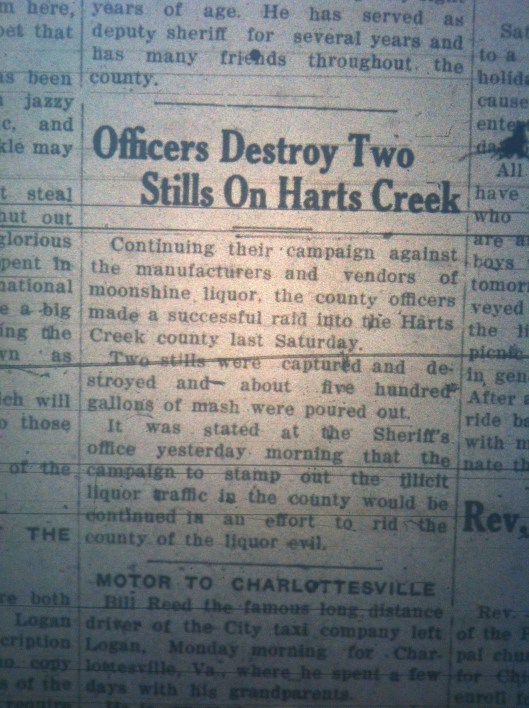
Harts Creek Stills, Logan (WV) Banner, 19 June 1925.

28 Monday Mar 2016
Posted in Whirlwind
Tags
Appalachia, crime, Harts Creek, history, Logan Banner, Logan County, moonshine, moonshining, West Virginia
Harts Creek Stills, Logan (WV) Banner, 19 June 1925.
09 Sunday Aug 2015
Posted in Big Ugly Creek
Tags
Abraham Shelton, Appalachia, assault, Cabell County, crime, Daniel Neil, Edward Franklin, genealogy, Henry Walker, history, James McCormack, James Stuart, Joel Estes, John Irwin, Obediah Bias, U.S. South, Virginia, West Virginia, William Hampton, William Wirt Brumfield
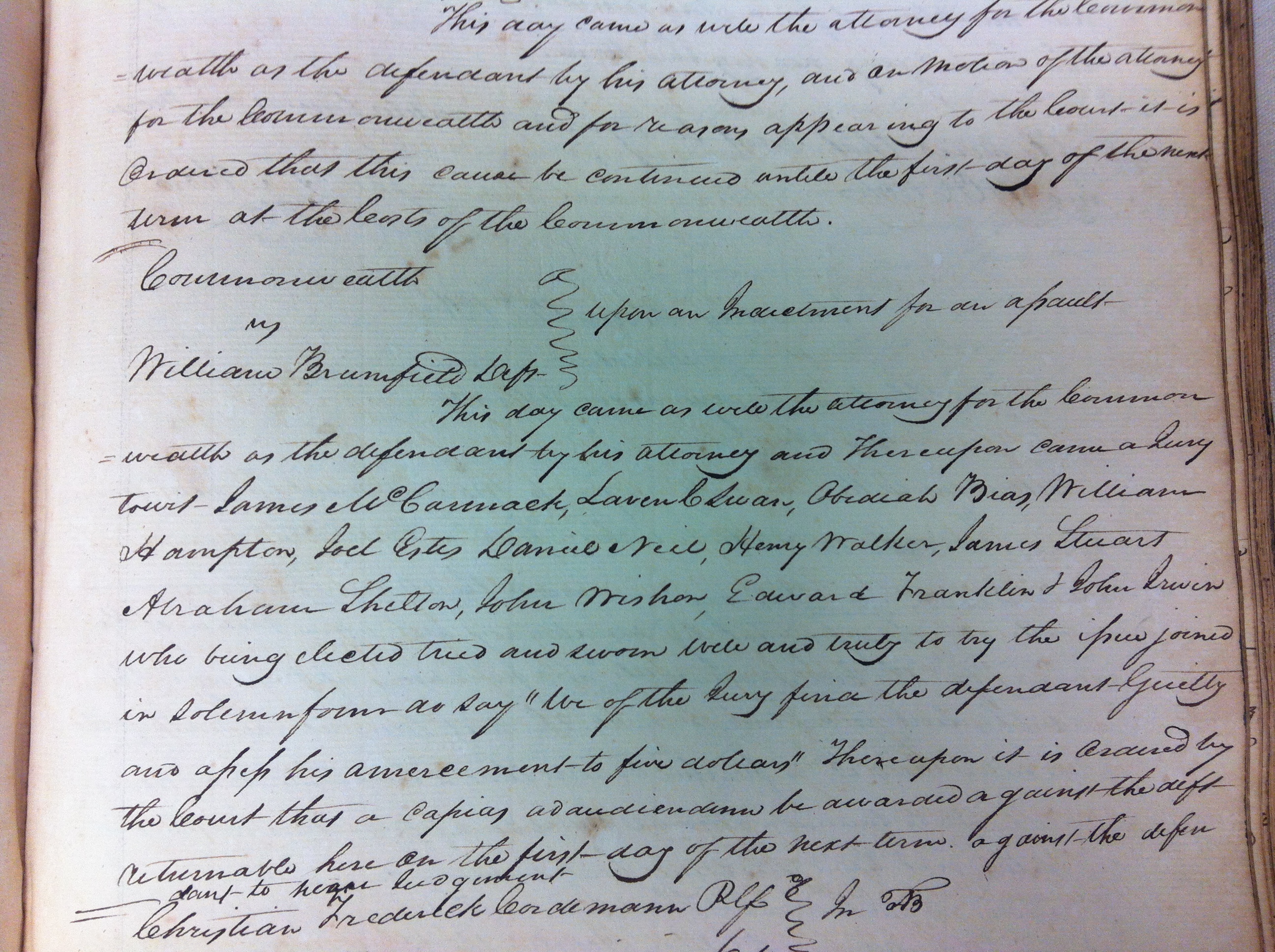
William Wirt Brumfield was found guilty of assault and fined $5. Cabell Law Order Book 1, County Clerk’s Office, Huntington, WV
04 Tuesday Aug 2015
Posted in Big Sandy Valley, Hatfield-McCoy Feud
Tags
Appalachia, Bud McCoy, crime, David Straton, feuds, Frank Phillips, genealogy, George McCoy, Hatfield-McCoy Feud, history, James McCoy, Jasper McCoy, John B. Dotson, John Norman, Joseph F. Smith, Lark McCoy, Logan County, Samuel King, Samuel McCoy, West Virginia, William Saunders
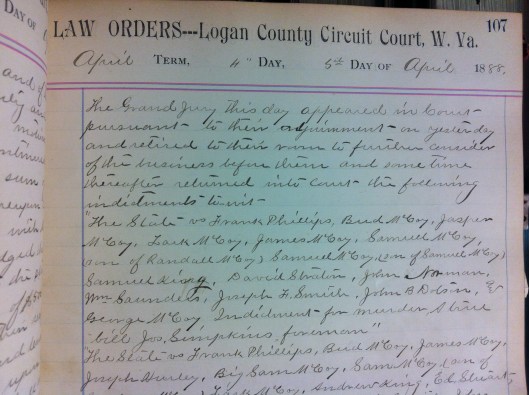
State v. Frank Phillips, Bud McCoy, Jasper McCoy, Lark McCoy, James McCoy, Samuel McCoy (son of Randall), Samuel McCoy (son of Samuel), Samuel King, David Straton, John Norman, William Saunders, Joseph F. Smith, John B. Dotson, and George McCoy (5 April 1888), Law Orders Book E, 1887-1890 (p. 107), Logan County Clerk’s Office, Logan, WV.
26 Tuesday May 2015
Posted in Big Harts Creek, Lincoln County Feud
Tags
Appalachia, Blood in West Virginia, circuit clerk, crime, genealogy, Henderson Dingess, history, Lincoln County Feud, Logan, Logan County, U.S. South, West Virginia

Henderson Dingess and others serve as jurors (March Term of Court, 1866). Source: Law Orders Book A (1868-1875), p. 146, Logan County Circuit Clerk’s Office, Logan, WV.
27 Monday Apr 2015
Posted in Civil War
Tags
Brandon Kirk, Charles Town, civil war, crime, history, Jefferson County, John Brown, West Virginia

Here I am just a few weeks ago standing at the Jefferson County Courthouse in Charles Town, WV. This courthouse hosted John Brown’s 1859 trial.
25 Saturday Apr 2015
Posted in Big Harts Creek, Lincoln County Feud
Tags
Appalachia, Blood in West Virginia, cemeteries, crime, Floyd Dingess, genealogy, Harts Creek, Henderson Dingess Family Cemetery, history, Lincoln County Feud, Logan County, photos, U.S. South, West Virginia

Floyd Dingess grave, located on Smokehouse Fork of Harts Creek, Logan County, WV.
22 Wednesday Apr 2015
Posted in Hatfield-McCoy Feud
Tags
Appalachia, crime, detective, Frank Phillips, genealogy, history, Logan County Banner, Shang Ferrell, Tennessee, U.S. South, West Virginia, Will Bevins, William Cole
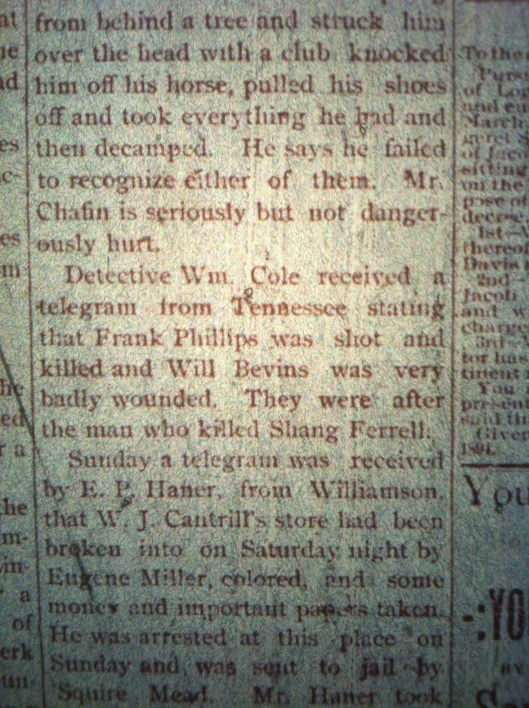
Source: Logan County (WV) Banner, 19 April 1894
15 Wednesday Apr 2015
Posted in Culture of Honor
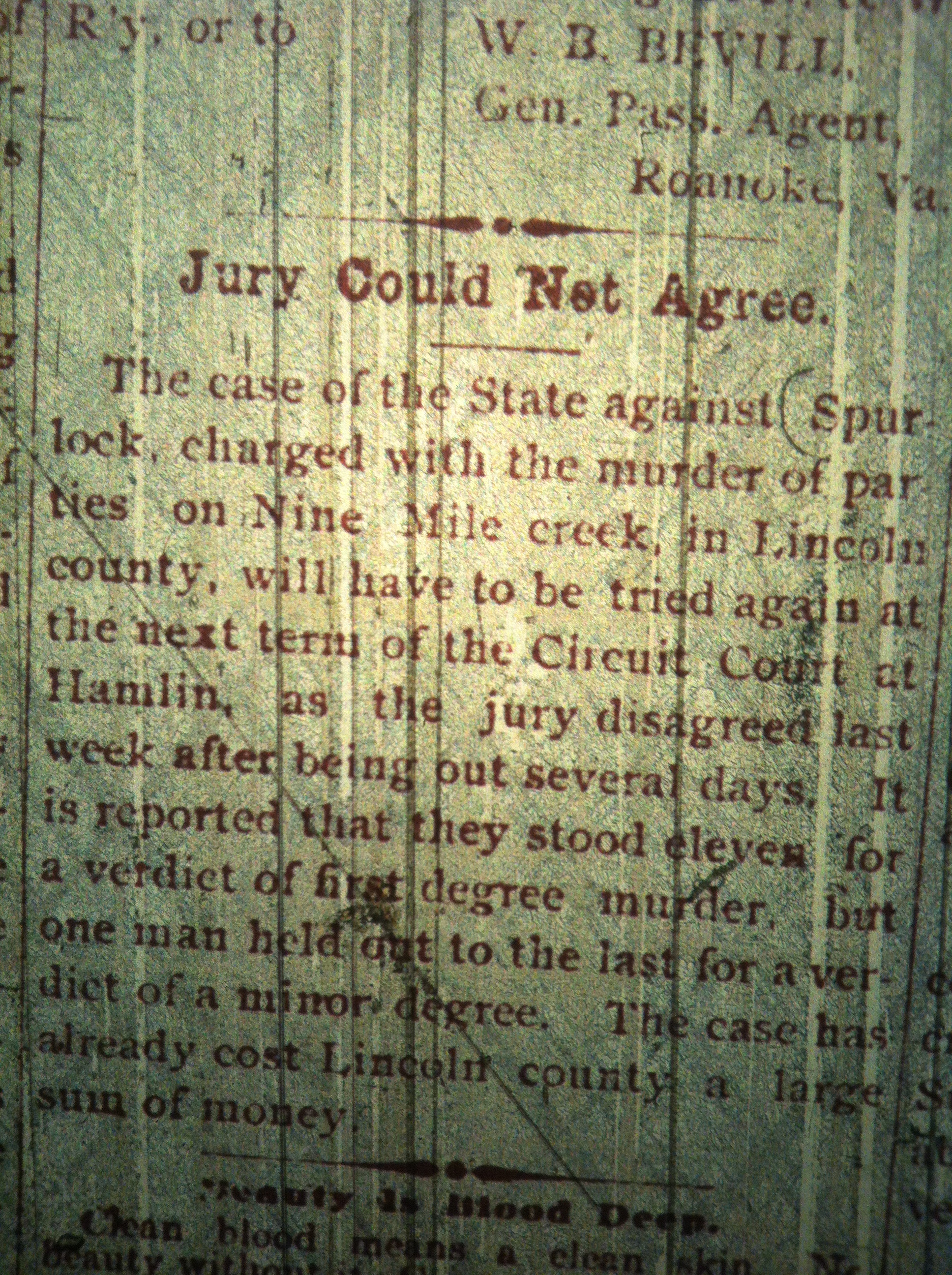
Logan County (WV) Banner, 7 September 1899
13 Friday Mar 2015
Posted in Culture of Honor, Hatfield-McCoy Feud
Tags
Appalachia, crime, Ellison Hatfield, feud, feuds, genealogy, Hatfield-McCoy Feud, history, Kentucky, Kentucky Penitentiary, Logan County Banner, Pharmer McCoy, Tolbert McCoy, true crime, Valentine Wall Hatfield, West Virginia

Logan County (WV) Banner, 13 March 1890.
16 Saturday Aug 2014
Posted in Big Harts Creek, Culture of Honor, Ed Haley, John Hartford, Lincoln County Feud, Warren
Tags
Ben Adams, Bertha Mullins, Bill Thompson, Billie Brumfield, Brandon Kirk, Buck Fork, Cas Baisden, crime, Dingess, Dump Farley, Ed Haley, Ewell Mullins, Greasy George Adams, Green Shoal, Harts Creek, history, Imogene Haley, Jim Martin, John Frock Adams, John Hartford, Jonas Branch, Lincoln County Feud, Liza Mullins, Milt Haley, moonshining, Peter Mullins, Weddie Mullins, West Virginia, writing
Cas knew that Ed sold his homeplace at the mouth of Jonas Branch to Ewell Mullins. He said it originally stood below a big sugar tree in the bottom above Uncle Peter’s. (It was moved on logs.) It was a “little old two-room plank house” consisting of the “eating room,” which had a flat-rock chimney in the back with a fireplace and a “sleeping room.”
Cas best described the kitchen, which was just “out at the back” of the house.
“They wasn’t no floor in it,” he said. “It just sat on the ground. It was the length of the house — I guess maybe about eight feet wide — and they cooked out there in that. They cooked out there, packed it in, and set it on the table and they eat and everything in the same house. I’ve seen that old woman, Ewell’s wife, put fence rails in the stove — had a cook stove — and she’d stick them in there and set a chair on them till they burnt up to where they wouldn’t fall out. Me and her old man and his brother, we’d go up on that cliff and drag wood down that creek and the snow knee deep.”
Brandon asked Cas about the fate of Ewell’s house and he said they first enlarged it.
“We moved an old storehouse we had down the field there out there and put it beside of it,” he said. “It was there when the old man Ewell died ’cause the old storehouse had a crack up over the bed and his mother come in there and she was whining about that. Man, the snow’d blow in at him.”
Cas continued, “Then we turned around and tore that down and built this other to it. Tore that other’n down and built it back, too.”
He said the newer home was built on the same spot as the old one but it didn’t resemble it in any way.
Based on this testimony, we concluded that Ewell’s original home was truly gone.
Speaking of Uncle Peter, Brandon asked about him.
“Ah, he was a tomcat now, that old man was,” Cas said. “He was crippled in one foot and he walked on the back of it. Had his shoe made turned back. Prohibition men would come in and… I’ve seen him down there right below where Kate lived — he’d go out and hit that cliff. He’d get them bushes and swing up and go right up over them cliffs. He was bad to drink in his last few years. Well, they all the time made liquor and fooled with it. Finally got to drinking the stuff.”
Cas said Peter was bad to fight if provoked but Aunt Liza “was just like all other old women. She was a good old woman. She just stood and cooked.”
Cas thought that Ed’s mother was related to Uncle Peter, but wasn’t sure how.
“Wasn’t his dad named Milt Haley?” he asked.
Yeah.
“Well, you know they killed him down there around Green Shoal,” he said. “I heard somebody not too long ago a talking about them taking them over there and hanging them. I never did know too much about it. Nobody never talked too much about things back then.”
Cas had also heard about Ben Adams but didn’t know of his involvement in the 1889 troubles. He said Ben was a “pretty mean fellow” who lived in a log cabin still standing just up the creek.
“He had some kind of a brewery up here,” Cas said. “They had it built back in the bank. Sold booze there. Bootleg joint. I don’t know if all the old rocks and things is gone from there or not. He lived on Trace when he killed Jim Martin.”
Part of Ben’s old mill-dam was reportedly still visible in the creek at the Greasy George Adams place.
Cas told us again about Weddie Mullins’s death at Dingess, West Virginia. Weddie was an uncle to Ed Haley.
“I never did know too much about it,” he said. “We was little when that happened, I guess. Him and some of them Dingesses got into it and they shot and killed Weddie. And old man John Adams went down and looked at him, said, ‘What do you think about him?’ ‘Oh, I believe he’ll make it.’ Said he just hoisted that pistol, brother, and shot him right in the head and killed him. Said, ‘I know he won’t make it now.'”
This “old man John Adams” was Emma Haley’s half-brother, “John Frock.”
Cas said John could be ruthless.
“His wife was a coming out the gate and he shot her in the head and killed her,” he said. “Shot her whole head off. He was a little feller. He lived right there where Louie and them lived.”
Cas didn’t know what that killing was over.
“Back here at one time it was dangerous to even stick your head out of the door, son,” he said. “Why, everybody packed guns. Anybody’d kill you.”
The jockey grounds were rough places.
“A fella tried to run a horse over me up there at the mouth of Buck Fork and Billie Brumfield laid a pistol between his eyes and said, ‘You run that horse over him, you’ll never run it over nobody else.’ I believe it was before he killed his daddy.”
Cas said Dump Farley was at a jockey ground one time “right down under the hill from where Bill Thompson lived in that cornfield playing poker and he shot the corn all down. Talk about fellers a rolling behind the stumps and things.”
31 Thursday Jul 2014
Posted in Harts, Lincoln County Feud, Timber
Tags
Appalachia, Blood in West Virginia, crime, Harts, history, Lincoln County, Lincoln County Feud, photos, U.S. South, West Virginia, Will Adkins
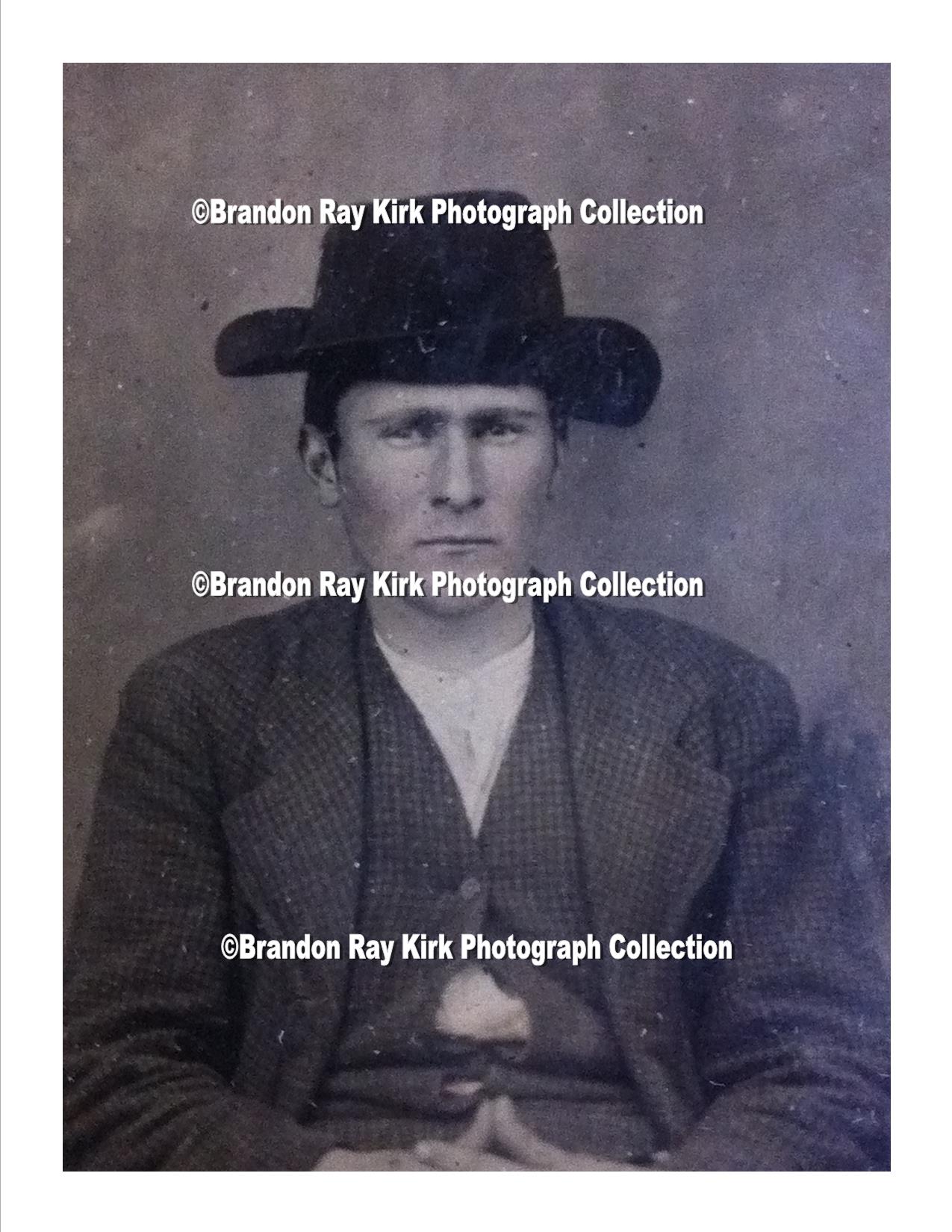
G.W. “Will” Adkins, member of the 1889 mob, resident of Harts, Lincoln County, WV
31 Thursday Jul 2014
Posted in Big Harts Creek, Ed Haley, Lincoln County Feud, Shively
Tags
Alton Conley, Big Creek, blind, Blood in West Virginia, Brown's Run, Burl Farley, Charles Conley Jr., Charlie Conley, Clifford Belcher, Conley Branch, crime, Ed Belcher, Ed Haley, Ella Haley, fiddler, fiddling, Green McCoy, Green Shoal, Guyandotte River, Harts Creek, history, John Brumfield, Lincoln County Feud, Logan, Logan County, Milt Haley, Mona Haley, music, Robert Martin, Smokehouse Fork, Warfield, West Virginia, Wirt Adams, writing
From Clifton’s, we went to see Charlie Conley, Jr., a fiddler who lived on the Conley Branch of Smokehouse Fork of Harts Creek. Wirt Adams had mentioned his name to us the previous summer. We found Charlie sitting on his porch and quickly surrounded him with a fiddle, tape recorder, and camera.
When I told him about my interest in Ed Haley’s life, he said Ed played so easy it was “like a fox trotting through dry leaves.”
Charlie said Ed was a regular at Clifford Belcher’s tavern.
“Right there, that’s where we played at on the weekends,” he said. “He used to play there a lot, the old man Ed Haley did. Me and another boy, Alton Conley — he’s my brother-in-law, just a kid… I bought him a guitar and he learned how to play pretty good. He could second pretty good to me, but he couldn’t keep up with that old man. He knowed too many notes and everything for him. The old man realized he was just a kid.”
Charlie told us an interesting story about how Ed came to be blind.
“Milt and Burl Farley, they was drinking where Burl lived down at the mouth of Browns Run. And Ed was just a little baby — been born about a week. Old man Burl said to Milt, ‘Take him out here and baptize him in this creek. It’ll make him tough.’ And it was ice water. He just went out and put him in that creek and baptized the kid and the kid took the measles and he lost his eyes. That’s how come him to be blind.”
That was an interesting picture: Milt and Burl hanging out on Browns Run. We had never really thought about it, but there was a great chance that all the men connected up in the 1889 troubles knew each other pretty well and maybe even drank and played cards together on occasion. For all we knew, Milt may have worked timber for Farley.
Brandon asked Charlie if he knew what happened to Milt Haley.
“They said the Brumfields killed him,” Charlie said. “Him and his uncle was killed over at a place called Green Shoal over on the river somewhere around Big Creek. They were together when they got killed. That was way back. I never knew much about it.”
Obviously Green McCoy wasn’t Ed’s uncle, but I had to ask Charlie more about him.
“All I can tell you is he was old man Ed’s uncle,” he said. “They lived over there on the river, around Green Shoal.”
So Ed was raised on the river?
“No, he lived down here on the creek, right where that old man baptized him in that cold water at the mouth of Browns Run,” Charlie said. “That’s where he was born and raised at, the old man was.”
I guess Charlie meant that Green lived “over there on the river,” which was sorta true.
He didn’t know why Milt Haley was killed, but said, “Back then, you didn’t have much of a reason to kill a man. People’d get mad at you and they wouldn’t argue — they’d start shooting. Somebody’d die. I know the Conleys and the Brumfields had a run in over there on the river way back. Oh, it’s been, I guess, ninety year ago. Man, they had a shoot-out over there and right to this day they got grudges against the Conley people. I’ve had run-ins with them several times. I say, ‘Look man, this happened before my time. Why you wanna fool with me for?’ But they just had a grudge and they wouldn’t let go of it.”
When we asked Charlie about local fiddlers, he spoke firstly about Robert Martin.
“They said Robert was a wonderful fiddler,” he said. “I had a half-brother that used to play a guitar with him when he played the fiddle named Mason Conley. I used to play with his brothers over there on Trace and with Wirt and Joe Adams. Bernie Adams — he was my first cousin. They said Robert was a wonderful fiddler.”
What about Ed Belcher?
“Yeah, Ed was pretty good, but he couldn’t hold old man Ed Haley a light to fiddle by. Belcher was more of a classical fiddler. Now, he could make a piano talk, that old guy could. I knowed him a long time ago. I noticed he’d go up around old man Ed and every oncest in a while he’d call out a tune for him to play. Ed’d look around and say, ‘Is that you, Belcher?’ Said, ‘Yeah,’ and he’d set in a fiddling for him. Maybe he’d throw a half a dollar in his cup and walk on down the street.”
Brandon said to Charlie, “Ed Belcher lived up at Logan, didn’t he?” and Charlie blew us away with answer: “Well now, old man Ed Haley lived up there then at that time. They lived out there in an apartment somewhere. The little girl was about that high the last time I seen her.”
Well, that was the first I heard of Ed living in Logan — maybe it was during his separation from Ella, or maybe there was an earlier separation, when Mona was a little girl.
I asked about a tune called “Warfield” and Charlie said, “That ‘Warfield’ is out of my vocabulary, buddy. I’ve done forgot them old tunes, now.”
27 Sunday Jul 2014
Posted in Big Harts Creek, Culture of Honor, Halcyon, Lincoln County Feud, Music
Tags
Bill Dingess, Billy Adkins, Blackberry Mountain, Brandon Kirk, Burl Farley, crime, Dave "Dealer Dave" Dingess, fiddler, French Bryant, Green McCoy, Harts Creek, history, Ku Klux Klan, Lee Dingess, Lewis Farley, life, Logan County, Marsh Fork, Milt Haley, murder, Polly Bryant, Satan's Nightmare, Tom Farley, West Fork, West Virginia, Wild Horse, writing
Back in Harts, Brandon and Billy visited Tom Farley on the Marsh Fork of West Fork of Harts Creek. Tom was the grandson of Burl Farley, one of the ringleaders in the Brumfield-Dingess mob of 1889. He was a great storyteller and knew a lot of interesting tales about the old vigilantes around Harts.
“Milt Haley and Green McCoy, my grandpa Burl Farley was in that,” Tom said. “Dealer Dave Dingess was in that. Dealer Dave Dingess played the fiddle for them when they chopped them boys’ heads off. He wasn’t a mean fellow. Burl Farley and them just got him drunk. French Bryant and Burl Farley was supposed to been the men who went over and chopped their heads off. My uncle Lewis Farley was in it.”
French Bryant, Tom said, married his aunt Polly Dingess.
“I’ve heard that Polly was one of the hatefulest women that ever took a breath,” he said. “A lot of people said she was the Devil’s grandma. French Bryant, he took her by the hair of the head and he tied her up to that apple tree. She took pneumonia fever and died.”
Tom told a great story about Bryant.
“French Bryant, I know a story they told me. It might be a lie. He was hooked up with the Ku Klux Klan. Was a captain of them. This is an old story. It’s supposed to happened right up here in this hollow. Dealer Dave and a bunch of them had their moonshine still set up in here. There was some young men came back in this country looking for Burl trying to get them timber jobs. They thought they was spying on them. This might every bit be lies but I was told this by all them old-timers. Burl Farley, Dealer Dave Dingess, French Bryant, Lewis Farley, and a bunch of them was supposed to’ve beheaded them right under that beech tree, my daddy always told. This story goes that they come in here looking for work. The Ku Klux Klan brought them here, made old Polly Dingess cook them a midnight supper. Dealer Dave played the fiddle for them and they danced all night. The next day at twelve o’clock Polly fixed a big dinner. Their last meal. One of them told the other two, said, ‘We just might as well eat. This is the end of the line for us.’ One of them just kept eating. He told the other two, said, ‘You better eat because this is the last meal we’ll ever eat.’ Said French Bryant cussed them and said, ‘Eat because you’ll never eat another meal.’ Dealer Dave asked them, ‘What do you want me to do as your last request?’ Said two of them cried and wouldn’t say a word. Said that one boy that eat so much told Dealer Dave, said, ‘Play ‘Satan’s Nightmare’.’ Took them out there at one o’clock under that beech tree and laid their heads across the axe and chopped two of their heads off. Said two of them cried and wouldn’t say a word. Said that one boy that eat so much told Dealer Dave, said, ‘Play ‘Satan’s Nightmare’.’ They chopped their heads off. Said French took their heads and set them on the mantle.”
So Dealer Dave Dingess was a fiddler?
“Dealer Dave played the fiddle,” Tom said. “I remember seeing old man Dave. He was tall and skinny. He played ‘Blackberry Mountain’ and a bunch of stuff. ‘Wild Horse’. Dealer Dave was the biggest coward that ever put on a pair of shoes. When it would start to get dark, my daddy and my uncle Bill Dingess — just tiny kids — they’d have to walk up this hollow with him. One would walk in front of him and the other one behind him. Said Lee Dingess cussed him all to pieces, told him, said, ‘Dealer Dave, nobody’s gonna hurt you. There ain’t a man alive that’s gonna bother you.’ Dave said, ‘Hush, Lee. I’m not afraid of the living. I’m afraid of the dead.’ Afraid to pass that cemetery. They called him Dealer Dave because he horse-traded so much and every time he got cheated he cried and he had to trade back with you. Make a trade today and tomorrow he’d cry till you give him his horse back. They said he was good on the fiddle. They said he played for square dances.”
19 Saturday Jul 2014
Posted in Calhoun County, Ed Haley, John Hartford, Music, Roane County
Tags
Akron, Alabama, blind, Brandon Kirk, Calhoun County, Christmas, crime, Ed Haley, Ella Haley, fiddle, fiddling, Harvey Hicks, history, John Hartford, Johnny Hager, Laury Hicks, Marietta, measles, Milt Haley, music, Ohio, Parkersburg, Rogersville, Soldiers Joy, Spencer, Stinson, Ugee Postalwait, Webster Springs, West Virginia, writing
On April 12, 1997, Brandon and I went to see Ugee Postalwait in Rogersville, Alabama. For the most part, she repeated a lot of the same stories I’d heard before, maybe with a new detail or two here and there. We began with her memories of Ed and Johnny Hager, who came to her father’s house around 1913. Brandon asked her specific questions about Johnny, which caused her to say: “He was a little short fella, slender. He was a nice person. Well-mannered. He was a good banjo-player. John Hager was a good friend of Dad and Mom’s both — all of us. Us kids, too. He used to write Mom and Dad. He wrote them from Webster Springs and he wrote them from Greenbrier. Different places where he was at. John wrote a letter back home and said he quit traveling with Ed ’cause Ed drank. He couldn’t take it. I’ve often wondered and studied about what become of him.”
Later, Ed sometimes came with a guitar player, but Ugee couldn’t recall his name.
Brandon was curious to know how far Ed traveled with his music, so he asked if Ed and Ella ever played around Parkersburg.
“I’m pretty sure they have,” Ugee said, “and Marietta, too. Harvey took them up to Akron to play music and they crowded that street so bad up there that they passed a law up there, you couldn’t stand on the corner and play music any more. They wouldn’t allow them to stand on the street. They had to move. See, they was such a crowd got around them.”
I asked, “How much do you reckon Ed would take in of a night?”
Ugee said, “I have seen Ed and Ella take in as much as a hundred dollars right there in Spencer.”
Wow, were they using a cup or a hat to collect money?
“They never used no cup. Just sit a box down or hat down and people come through and throwed money in it. Anyone that come along and dropped money in there, they’d play just the same.”
Would he play me anything I’d ask for?
“Why sure. He’d play it for you and then maybe if you asked for it again he might play you something else and call it that. He didn’t care to rename songs, like ‘Soldiers Joy’. He might call that ‘Runnin’ the Soldier’ or ‘Runnin’ the Track’ or something like that.”
I reminded Ugee that she heard Ed say he just picked up a fiddle and started playing it when he was small and she said, “Oh, yeah. He’d sit in the floor and play on that fiddle. Somebody brought something in that had two strings on it. He wasn’t very old. Just barely a walking, he said. Just like him a talking to me one time, telling me about his dad. Telling about them a lynching him. He said, ‘Goddamn him, they oughta lynched him.’ And I never asked him why. Why would a man say that about his dad? Maybe he was thinking about that man putting him in that barrel of water and causing him to be blind. But Ella’s eyes, they was ate out with blue vitriol.”
Ugee fully believed that measles had caused Ed’s blindness because they almost “put her blind,” too, when she was a girl.
“I must have been about five years old,” she said. “Well, Ed musta been there, too. Musta been the same year he was there that I had the measles and I went blind in my eyes. Couldn’t see nothing for three or four days. Had Granny’s bed set up by the side of the fireplace. I remember that instead of springs, it had rope. And Christmas time come up. And Dad, he played Santa Claus, I reckon. He got me jellybeans. I couldn’t see nothing for two or three weeks. I didn’t think I’d ever see again. Back then, they called them the ‘big’ measles and the ‘little’ measles. The big ones, they called the German measles. And I had them bad. Harvey come around — he was older than I was — he’d say, ‘You stink’, ’cause he could smell that fever on me.”
Brandon asked Ugee what year she was born in, to kind of help us better understand the time frame of her memories.
“I was born in 1907,” she said. “I got married in 1924. I left and went to Akron, but we come back ever month for a long time. If we knowed Ed was a coming in, we was there. I moved back in 1930. We lived on the farm until 1941. Then we went to a farm at the mouth of Stinson.”
At some point, Ugee moved back to Akron, where she lived when I first met her in 1991.
17 Thursday Jul 2014
Posted in Culture of Honor, Fourteen, Hamlin, Wewanta
Tags
crime, Cum Sias, Fourteen Mile Creek, Hamlin, Harrison Neace, history, Lincoln County, Lincoln Republican, murder, West Virginia

Cum Sias murders Harrison Neace, Lincoln (WV) Republican, 28 April 1921
16 Wednesday Jul 2014
Posted in Big Sandy Valley, Culture of Honor, Hatfield-McCoy Feud
Tags
Appalachia, Big Sandy River, blood poisoning, crime, Frank Phillips, genealogy, Hatfield-McCoy Feud, history, Huntington Advertiser, Kentucky, Mingo County, Pike County, Sheriff Keadle, U.S. South, West Virginia, Williamson
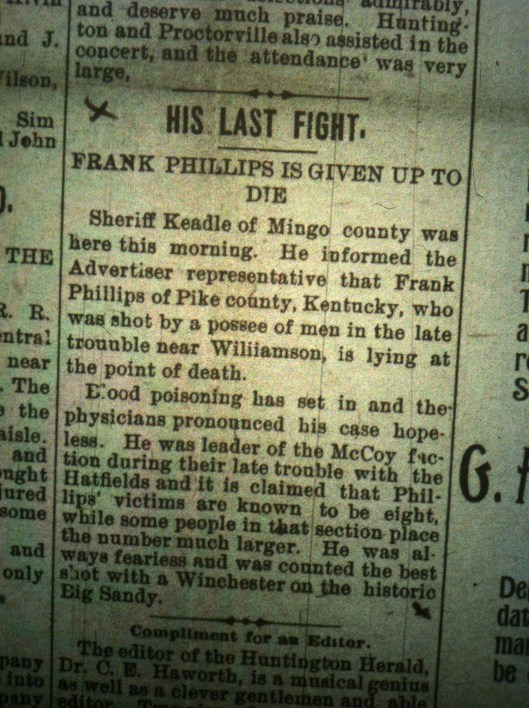
“His Last Fight: Frank Phillips is Given Up to Die,” Huntington (WV) Advertiser, 28 September 1895
14 Monday Jul 2014
Posted in Big Harts Creek, Culture of Honor, Harts
Tags
Appalachia, constable, crime, handcuffs, Harts Creek District, history, Lincoln County, photos, U.S. South, West Virginia
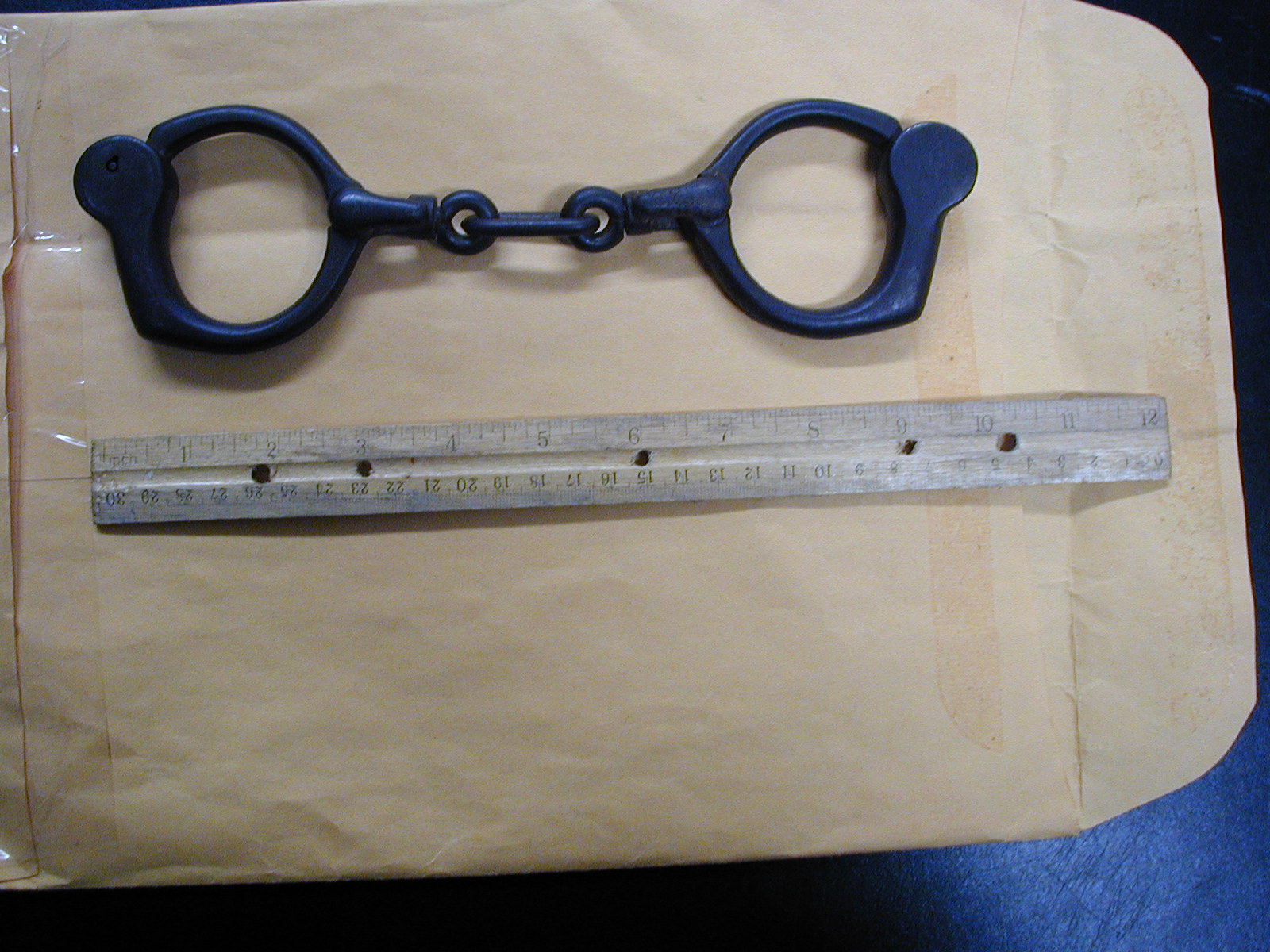
Harts Creek District constable handcuffs, owned by descendants of the Dingess family, Lincoln County, WV
12 Saturday Jul 2014
Posted in Culture of Honor, Fourteen, Lincoln County Feud, Shively, Timber, Wewanta
Tags
Al Brumfield, Albert Neace, Blood in West Virginia, Brandon Kirk, Burl Farley, Cole and Crane Company, crime, distilling, Fourteen Mile Creek, Green McCoy, history, Kentucky, Lincoln County, Lincoln County Feud, Logan County, merchant, Milt Haley, Pigeon Creek, Sulphur Spring Fork, Ward Adkins, West Virginia, Will Headley, writing
Not long after talking with Mr. Dingess, Brandon went to see his good friend Ward Adkins, an elderly resident of nearby Fourteen Mile Creek. Ward said his grandfather Albert Neace used to help Al Brumfield make whisky, barrel it, and ship it downriver on flatboats. Making whiskey was Brumfield’s major source of income.
“You know dern well he didn’t make his fortune in a little old store up there at that day and time,” Ward said. “About all he sold was soap, salt, and soda — a little sugar.”
When Albert quit the business, Brumfield said, “You won’t tell nothing will you, Albert?” to which he replied, “No, you know better than that.”
Albert knew it wasn’t smart to cross Al because “the people who worked around” him “had a way of dealing” with his enemies.
“When they took a notion to kill somebody, they’d go out the day before and dig the grave,” Ward said. “Then they’d play up to whoever it was they aimed to kill…talk them into going squirrel hunting with them. They’d squirrel hunt around close to that grave. Kill them, roll them in it, and cover it up.”
Ward’s step-grandfather, Will Headley, had told him about witnessing Milt’s and Green’s murder.
“They stood them up beside of a house and shot them in public because they wanted to teach people a lesson,” Ward said.
Will’s uncle Burl Farley went with the Brumfields to fetch them in Kentucky. Ward knew a lot about Burl.
“He started out in timbering,” Ward said. “He worked for Cole & Crane Timber Company up on Browns Fork of Pigeon Creek. Uncle Burl was pretty well to do. He was dangerous mean. He was an Atheist. He felt you just did what you wanted to do on this earth and then died and that was the end of it so he didn’t have nothing to fear. Of course, I liked the old man. If he liked you, he was good to you. He ruled over his domain down there. What he said went. It was just strictly law. There wasn’t no bucking him. There wasn’t no law to fool with Uncle Burl.”
11 Friday Jul 2014
Posted in Big Harts Creek, Culture of Honor, Ed Haley, Lincoln County Feud, Warren
Tags
Al Brumfield, Albert Dingess, Anthony Adams, Ben Adams, Bill Brumfield, Bill's Branch, Billy Adkins, blind, Blood in West Virginia, Boardtree Bottom, Brandon Kirk, Buck Fork, Burl Farley, Carolyn Johnnie Farley, Cecil Brumfield, Charley Brumfield, Charlie Dingess, crime, Ed Haley, Fed Adkins, fiddling, French Bryant, George Fry, Green McCoy, Green Shoal, Hamlin, Harts Creek, Harve "Short Harve" Dingess, Hell Up Coal Hollow, Henderson Dingess, history, Hugh Dingess, John Brumfield, John Dingess, Kentucky, life, Lincoln County Feud, Low Gap, Milt Haley, murder, Paris Brumfield, Polly Bryant, Smokehouse Fork, Sycamore Bottom, Tom Maggard, Trace Fork, Vilas Adams, West Fork, West Virginia, Will Adkins, Williamson, writing
Al rounded up a gang of men to accompany him on his ride to fetch the prisoners in Williamson. Albert and Charlie Dingess were ringleaders of the posse, which included “Short Harve” Dingess, Hugh Dingess, John Dingess, Burl Farley, French Bryant, John Brumfield, and Charley Brumfield. Perhaps the most notorious member of the gang was French Bryant – “a bad man” who “did a lot of dirty work for the Dingesses.” On the way back from Kentucky, he tied Milt and Green by the arms and “drove them like a pair of mules on a plow line.”
“French Bryant run and drove them like a pair of horses ahead of these guys on the horses,” John said. “That’s quite a ways to let them walk. Old French, he married a Dingess. I knew old French Bryant. When he died, he was a long time dying and they said that he hollered for two or three days, ‘Get the ropes off me!’ I guess that come back to him.”
When the gang reached the headwaters of Trace Fork — what John called “Adams territory” — they sent a rider out ahead in the darkness to make sure it was safe to travel through that vicinity.
Waiting on the Brumfield posse was a mob of about 100 men hiding behind trees at Sycamore Bottom, just below the mouth of Trace Fork. This mob was led by Ben and Anthony Adams and was primarily made up of family members or people who worked timber for the Adamses, like Tom Maggard (“Ben’s right hand man”).
As the Brumfield rider approached their location, they began to click their Winchester rifles — making them “crack like firewood.” Hearing this, the rider turned back up Trace Fork, where he met the Brumfields and Dingesses at Boardtree Bottom and warned them about the danger at the mouth of Trace. They detoured safely up Buck Fork, then stopped at Hugh Dingess’ on Smokehouse where they remained for two or three days, not really sure of what to do with their prisoners. They made a “fortress” at Hugh’s by gathering about 100 men around them, fully aware that Ben Adams might make another effort to recapture Milt and Green.
While at Hugh’s, they got drunk on some of the red whiskey and apple brandy made at nearby Henderson’s. They also held a “trial” to see if Milt and Green would admit their guilt. They took one of the men outside and made him listen through the cracks between the logs of the house as his partner confessed on the inside. About then, the guy outside got loose and ran toward Bill’s Branch but was grabbed by “Short Harve” Dingess as he tried to scurry over a fence.
After this confession, the Brumfields and Dingesses considered killing Milt and Green on the spot but “got scared the Adamses was gonna take them” and headed towards Green Shoal.
John didn’t know why they chose George Fry’s home but figured Mr. Fry was a trusted acquaintance. He said they “punished” them “quite a bit there” but also got one to play a fiddle.
“These people that killed them, they made them play their last tune,” John said. “One of them would play and one guy, I think, he never would play for them. I forgot which one, but they never could get one guy to do much. The other one’d do whatever they’d tell him to do. That’s just before they started shooting them. The tune that they played was ‘Hell Up Coal Hollow’. I don’t know what that tune is.”
After that, the mob “shot their brains out” and left them in the yard where the “chickens ate their brains.”
A neighbor took their bodies through Low Gap and buried them on West Fork.
John said there was a trial over Haley and McCoy’s murders, something we’d never heard before. Supposedly, about one hundred of the Brumfields and their friends rode horses to Hamlin and strutted into the courtroom where they sat down with guns on their laps. The judge threw the case out immediately because he knew they were fully prepared to “shoot up the place.”
This “quick trial,” of course, didn’t resolve the feud. Back on Harts Creek, Ben Adams often had to hide in the woods from the Dingesses. One time, Hugh and Charlie Dingess put kerosene-dowsed cornstalks on his porch and set them on fire, hoping to drive him out of his house where they could shoot him. When they realized he wasn’t home, they extinguished the fire because they didn’t want to harm his wife and children. Mrs. Adams didn’t live long after the feud. Ben eventually moved to Trace Fork where he lived the rest of his life. Charlie never spoke to him again.
John also said there seemed to have been a “curse” on the men who participated in the killing of Haley and McCoy. He said Albert Dingess’ “tongue dropped out,” Al Brumfield “was blind for years before he died,” and Charlie Dingess “died of lung cancer.” We had heard similar tales from Johnny Farley and Billy Adkins, who said mob members Burl Farley and Fed Adkins both had their faces eaten away by cancer. Vilas Adams told us about one of the vigilantes drowning (Will Adkins), while we also knew about the murders of Paris Brumfield, John Brumfield, Charley Brumfield, and Bill Brumfield.
Just before hanging up with John, Brandon asked if he remembered Ed Haley. John said he used to see him during his younger days on Harts Creek.
“When he was a baby, old Milt wanted to make him tough and he’d take him every morning to a cold spring and bath him,” he said. “I guess he got a cold and couldn’t open his eyes. Something grew over his eyes so Milt took a razor and cut it off. Milt said that he could take that off so he got to fooling with it with a razor and put him blind.”
John said Ed made peace with a lot of the men who’d participated in his father’s killing and was particularly good friends with Cecil Brumfield, a grandson of Paris.
10 Thursday Jul 2014
Posted in Big Harts Creek, Culture of Honor, Lincoln County Feud, Warren
Tags
Al Brumfield, Ben Adams, Blood in West Virginia, Brandon Kirk, Chapman Dingess, Charlie Dingess, Cole Branch, Connecticut, crime, feud, Green McCoy, Harts Creek, Harvey "Long Harve" Dingess, Henderson Dingess, history, John Dingess, John Frock Adams, Joseph Adams, Kentucky, Lincoln County War, Milt Haley, Sallie Dingess, Smokehouse Fork, Thompson Branch, Tug River, Victoria Adams, West Virginia, World War II
That winter, Brandon made contact by telephone with John Dingess, a Connecticut resident who proved to be one of our best sources on the 1889 feud. John was born on the Smokehouse Fork of Harts Creek in 1918. A grandson to Henderson Dingess, he moved away from West Virginia after serving his country in World War II.
John said Henderson Dingess met his wife Sallie while boarding with her father Joseph Adams on Harts Creek. Henderson didn’t care much for his in-laws (he said they were “hoggish”), particularly his brother-in-law Ben Adams. Ben lived over the mountain from Henderson on main Harts Creek where he operated a small store. He and Henderson feuded “for years.” At some point, Henderson’s oldest son Charlie Dingess got into a racket with Ben over a yoke of cattle and “almost killed him in a fight” at Cole Branch.
The feud between Henderson’s family and Ben Adams reached a new level of tension when Ben refused to pay the sixteen-cents-per-log fee required by Al Brumfield to pass logs through his boom at the mouth of Harts Creek. Brumfield “was more of a businessman” than a feudist but “got into it” with Adams at his saloon near the boom. In the scrape, Ben pulled out his pistol and shot Al, who was spared from harm only because of a button on his clothes. Al subsequently fetched a gun and chased Ben up the creek — a very humiliating thing as there was probably a whole gang of people to witness his flight.
Ben soon gathered up a party of men with plans to force his timber out of Harts Creek under the cover of darkness. Before he could put his plan into action, though, the Dingesses caught wind of it and warned the Brumfields who promptly armed themselves with .38 Winchesters and .44 Winchesters and gathered in ambush on the hill at Panther Branch near the mouth of Harts.
Ben, anticipating trouble, put his wife, the former Victoria Dingess, at the front of his gang in the hopes that it might discourage her cousins from shooting at him as they came down the creek. It was a bad idea: the Brumfields and Dingesses shot “her dress full of holes.”
This was particularly horrible since she was probably pregnant at the time.
The next day, she came to her uncle Henderson’s to show him what his boys had done to her dress but he never punished them.
At that point, Ben was probably hell-bent on revenge and arranged for Milt Haley and Green McCoy, who John called two “professional gunmen,” to “bump Al off.”
John was sure of Ben’s role in the events of 1889.
“Ben Adams, my father’s uncle, he gave them a .38 Winchester apiece and a side of bacon to kill Al Brumfield,” he said.
Milt and Green caught Al one Sunday as he made his way back down Harts Creek after visiting with Henderson Dingess. He rode alone, while Hollena rode with her younger brother, Dave Dingess. As they neared Thompson Branch, Milt and Green fired down the hill at them from their position at the “Hot Rock.” Al was shot in the elbow, which knocked him from his horse and broke his arm, while Hollena was shot in the face. Al somehow managed to make it over a mountain back to Henderson Dingess’, while Hollena was left to crawl half a mile down to Chapman Dingess’ at Thompson Branch for help.
Upon learning of the ambush, Harvey Dingess (John’s father) hitched up a sled to one of his father’s yokes of cattle and fetched Hollena, who remained at Henderson’s until she recovered.
Immediately after the shootings, there was a lot of gossip about who’d been behind the whole affair. John said there was some talk that Long John Adams had been involved “but the Dingess and Brumfield people never believed it.” Everyone seemed to focus in on Milt and Green, who’d recently disappeared into Kentucky (where McCoy was from).
“They used to, if you committed a crime in West Virginia, would run away to Kentucky,” John said. “In the hill part of Kentucky there on the Tug River.”
Brumfield put up a $500 reward and it wasn’t long until a man rode up to Henderson Dingess’ claiming to have caught Milt and Green in Kentucky. He was sent to Brumfield’s home near the mouth of Harts where he found Al out back shoeing an ox steed. They talked for a while, then Brumfield told him, “You put them across the Tug River and when I identify them you’ll get your money.”
Writings from my travels and experiences. High and fine literature is wine, and mine is only water; but everybody likes water. Mark Twain
This site is dedicated to the collection, preservation, and promotion of history and culture in Appalachia.
Genealogy and History in North Carolina and Beyond
A site about one of the most beautiful, interesting, tallented, outrageous and colorful personalities of the 20th Century
 Brandon Ray Kirk