• About

Brandon Ray Kirk

~ This site is dedicated to the collection, preservation, and promotion of history and culture in my section of Appalachia.

Brandon Ray Kirk

Tag Archives: Charleston

Leet News 11.09.1923

05 Wednesday Jun 2019

Posted by Brandon Ray Kirk in Big Ugly Creek, Gill, Green Shoal, Leet, Logan

≈ Leave a comment

Tags

Appalachia, Belva Reynolds, Big Ugly Creek, Bill Cooper, Bob Gilbert, Bruce Hatfield, Bunch Lambert, Charleston, Edith Frye, Edna Brumfield, Emma Lucas, Eunice Deal, Evermont Ward Spears, genealogy, Georgia Smith, Gertie Smith, Gill, Green Shoal, H.M. Gill, history, Irvin Lucas, James Gue, Kentucky, Laura Frye, Leet, Lillie Curry, Lincoln County, Lindsey Huffman, Lizzie Payne, Logan, Logan Banner, Lucas, Luther Harper, Milt Ferrell, Pea Ridge, Pearl Brumfield, Shorty Toney, Sid Nelson, teacher, Thelma Huffman, Tom Frye, Virginia Brumfield, Wayne Brumfield, Weltha Lambert, West Virginia, Willie Payne

A correspondent named “Red Wings” from Leet on Big Ugly Creek in Lincoln County, West Virginia, offered the following items, which the Logan Banner printed on November 9, 1923:

We are having some nice weather at this writing.

We certainly are having some real good meetings at this place. Most everybody enjoyed themselves going.

Miss Edna Brumfield is teaching school at Green Shoal, W.Va.

Miss Lizzie Payne arrived home Saturday evening.

Miss Girtie Smith, Laura and Edith Frye were the dinner guests of Miss Thelma Huffman Saturday.

Miss Lillie and Lonnie (Lincoln?) attended church Sunday at Lucas, W.Va.

Born to Mr. and Mrs. E.W. Spears a fine girl baby.

Mr. Wayne Brumfield was calling on Miss Thelma Huffman Sunday and Thursday night.

Mr. Willie Payne has returned home after visiting friends and relatives in Kentucky.

Mr. Sid Nelson and Miss Lillie Curry were united in wedlock this week.

Miss Pearl Brumfield visited home folks Friday.

Mr. and Mrs. James Gue made a flying trip to Gill, W.Va., Friday.

Mr. Bruce Hatfield was calling on Miss Weltha Lambert Sunday afternoon.

Mr. and Mrs. Luther Harper visited home folks last week.

Mrs. Georgia Smith is on the sick list now. We hope she will soon recover.

Mr. Lindsey Huffman returned to Logan Sunday.

Miss Belva Reynolds visited Miss Thelma Huffman Sunday.

Mr. and Mrs. Bill Cooper are taking a vacation on Pea Ridge, W.Va.

Mr. Wayne Brumfield will spend a few days in Charleston this week.

Mr. Irvin Lucas was calling at the home of Miss Eunice Deal Sunday evening.

Mr. Tom Frye was the guest of Mr. and Mrs. Huffman Sunday.

Miss Thelma Huffman and Miss Pearl Brumfield were seen out horse back riding Sunday.

Miss Virginia Brumfield was shopping in Logan Saturday.

Bunch Lambert, Bob Gilbert, and Shorty Toney were seen riding down the big road Sunday morning.

Mr. Emma Lucas went to church Sunday at Gill, W.Va.

Mr. and Mrs. H.M. Gill attended church Sunday.

Mr. Milt Ferrell seems to be very ill now. Hope he will be able to be out again soon.

Chapmanville News 02.03.1922

18 Friday Jan 2019

Posted by Brandon Ray Kirk in Chapmanville, Coal

≈ Leave a comment

Tags

Appalachia, Chapmanville, Charleston, Chilton Chapman, Devonah Butcher, Gay Stone, genealogy, history, Jim Bryant, Julia Conley, Logan Banner, Logan County, Lola Ferrell, Maud McCloud, Maude Ferrell, Millard Brown, New York, Tompkins mines, W.J. Bachtel, West Virginia

A correspondent named “Cutie” from Chapmanville in Logan County, West Virginia, offered the following items, which the Logan Banner printed on February 3, 1922:

We are having some nice weather at this writing and everybody seems to be enjoying life.

School is progressing nicely here under the management of W.J. Bachtel, principal.

Rev. Langdon is holding a revival here at present. He is having great success, large attendance and several have been converted.

We think the Tompkins mines will have to be enlarged since the Chapmanville boys have gone to work.

Mr. Chilton Chapman took Miss Lola Ferrell home Sunday night. Call again, Chilton.

Red caps are stylish here now. I wish I were a girl, but you know boys don’t wear red caps.

There is a bunch of boys and girls employed here in letting S (?) pass.

Miss Maude Ferrell was wearing a ten cent smile. Wanda, did you get a good letter?

Miss Devonah Butcher will leave for Charleston the first of the month where she will enter high school.

Mr. Jim Bryant and Millard Brown have just returned from New York where they have been taking mechanical training.

Mr. Klinger and Miss Gay Stone seem to be enjoying the morning air. Gay says Klinger is all right. Now, what do you girls think about it?

We are sorry to say that Mrs. Julia Conley is very ill at this time.

Miss Maud McCloud seems to be very lonely now days. Cheer up, Pearlie will come back again soon.

Will see you again next week.

Big Creek News 08.31.1923

12 Saturday Jan 2019

Posted by Brandon Ray Kirk in Big Creek, Logan

≈ Leave a comment

Tags

Albert Hager, Appalachia, Big Creek, Bill Stollings, C&O Railroad, Carlisle Toney, Charleston, Cincinnati, College of Beauty Culture, Detroit, Dyke Garrett, Francis Mobley, Frank Estep, Franklin Estep Jr., genealogy, history, Ida Mae Agee, Jess Harmon, Jess Toney, Logan, Logan Banner, Logan County, Lula Mobley, Maud Belcher, Myrtle Mobley, Norma Sanders, Ohio, Ott Wilson, Pauline Mobley, Pearl Mobley, West Virginia, Willie Dingess

A correspondent named “Peggy” from Big Creek in Logan County, West Virginia, offered the following items, which the Logan Banner printed on August 31, 1923:

Miss Pauline Mobley has just returned home for a short visit with her mother. She has been attending the College of Beauty Culture in Detroit. She will return to take up her studies sometime this month. She was a guest of her sister in Logan Friday.

Dr. Whitehill will return to his work sometime in September. He is visiting relatives in Ohio. We are anxious for his return.

Mrs. Franklyn McKinney announced the arrival of a son, Franklin, Jr.

Franklyn Estep has a new girl but her name is a secret just now. He was seen with her Sunday night.

Bill Stollings has a new meat market. Seen him driving a calf up Main Street Thursday.

Misses Francis, Lula, Pauline and Myrtle Mobley entertained friends Sunday and Sunday night.

Mrs. C. Clark is the guest of her mother, Mrs. G. Mullins, this weekend.

Mr. Willie Dingess planned a visit to Big Creek but unfortunately the girl ran away. She thought she was too young to receive callers.

Miss Lula Mobley of Logan will accompany her sister as far as Cincinnati on her return to Detroit.

Mrs. Jess Toney entertained friends Sunday. They were out driving Sunday afternoon.

Ott Wilson of Logan and his Packard is seen in Big Creek frequently.

Carlisle Toney was hit by a car Thursday evening.

Rev. Dyke Garrett will hold a basket meeting Sunday, September 2nd. Everybody is welcome to attend.

Ida Mae Agee and Maud Belcher were visitors in Big Creek Friday.

Miss Pearl Mobley and Norma Sanders are visiting Mrs. Albert Hager of Cincinnati this week.

Mrs. Jess Harmon, who was the guest of his mother Monday, has returned to Charleston where he is employed by the C. & O. R.R. Co.

Big Creek News 02.17.1922

15 Saturday Dec 2018

Posted by Brandon Ray Kirk in Big Creek, Huntington, Stone Branch

≈ Leave a comment

Tags

Appalachia, Big Creek, Charleston, coal, Daisy, Daisy Coal Company, David Crockett, Gordon Lilly, H.J. Markham, history, Huntington, James B. Toney, Logan Banner, Logan County, Peter M. Toney, pneumonia, Stone Branch, W.H. McKinney, West Virginia

An unknown correspondent from Big Creek in Logan County, West Virginia, offered the following items, which the Logan Banner printed on February 17, 1922:

In the last few days Daisy Coal mines started up after being shut down for about four months.

Mr. West, mining engineer of Charleston, has been in Big Creek looking after business matters the last few days.

Mr. P.M. Toney, member of the County Court, has been to Charleston and other places pertaining to business matters for the last few days.

Mrs. J.B. Toney and family of Huntington have been visiting relatives in Big Creek for several days.

Mr. and Mrs. H.J. Markham have been visiting relatives here for the last few days.

There has been a lot of sickness here in the last two weeks and a number of cases of pneumonia.

Mr. and Mrs. W.H. McKinney, who have been visiting relatives, have gone to house keeping and decided to stay here. Mr. McKinney is employed as electrician for the Daisy Coal Co.

A new baby was born to Mr. and Mrs. Millard Sanders.

Mr. and Mrs. J.W. Stone of Peach Creek are visiting Mr. Stone’s mother at Big Creek.

A bad cough and cold is interfering with Uncle Gord Lilly’s matrimonial arrangements as announced by him. But Uncle Gord tells us that this matter will be attended to promptly.

Dr. Crockett has been away attending to business matters in Charleston.

A great protracted meeting has been going on at Stone Branch for the past two weeks. There were sixteen conversions. A number will be baptized Sunday.

Levisa Hatfield (1927-1929)

03 Monday Dec 2018

Posted by Brandon Ray Kirk in Big Sandy Valley, Hatfield-McCoy Feud, Holden, Huntington, Logan, Matewan, Pikeville, Wharncliffe, Women's History

≈ 1 Comment

Tags

Abraham Lincoln, Appalachia, Barnabus, Ben Creek, Betty Caldwell, Betty Hatfield, Bob Hatfield, C.C. Lanham, Cap Hatfield, Charles Dardi, Charleston, deputy sheriff, Devil Anse Hatfield, E. Willis Wilson, Elias Hatfield, Elliott R. Hatfield, F.M. Browning, Fayette County, feud, genealogy, governor, Halsey Gibson, Hatfield-McCoy Feud, Henry D. Hatfield, Hibbard Hatfield, history, Holden, Huntington, Island Creek, J.O. Hill, Jim McCoy, Joe Hatfield, John Caldwell, John J. Jackson, Johnson Hatfield, Kentucky, L.W. Lawson, Levicy Hatfield, Logan, Logan Banner, Logan County, Lundale, Marion Browning, Mary Howes, Mate Creek, Matewan, Matilda Chafin, Mingo County, Nancy Carey, Nancy Mullins, Nathaniel Chafin, Omar, Pike County, Pikeville, Pittsburgh, pneumonia, R.A. Woodall, Randolph McCoy, Rebecca Hatfield, Rose Browning, sheriff, Tennis Hatfield, Tom Chafin, Troy Hatfield, Tug River, W.R. Eskew, West Virginia, Wharncliffe

The following news items from the Logan Banner of Logan, WV, provide some history about the final years of Levisa Hatfield, widow of Anse Hatfield:

Levisy Hatfield Dies LB 03.15.1929 1.JPG

MRS. HATFIELD BETTER

Mrs. Levicy Hatfield, widow of Ance Hatfield, continues to recuperate from a serious illness and is now able to walk about the home of her daughter, Mrs. F.M. Browning, of Holden, where she has been cared for. She is 84 years old.

Source: Logan (WV) Banner, 03 June 1927

***

Mrs. Hatfield Hurt

Mrs. Lovisa Hatfield, widow of the late “Devil Anse” Hatfield, is suffering from injuries received in a fall at her home on Island Creek Sunday. She hurt her hip and shoulder and forehead and her condition was such as to cause some concern, yet she was able to sit up yesterday. Two or three of her daughters are helping to take care of her. She is 85 years old.

Source: Logan (WV) Banner, 20 September 1927

***

DEVIL ANSE’S WIDOW, AGED 86, RECOVERS FROM PNEUMONIA

In recovering from her recent severe illness Mrs. Levisa Hatfield, widow of the late “Devil Anse,” has again demonstrated her remarkable vitality. Though in her 87th year, she is now recovering from pneumonia with which she was stricken on December 28. Monday of this week her lungs began to clear up, and her son, Sheriff Joe Hatfield, said yesterday that she seemed to be assured of recovery.

So critical was her illness for several days that half a dozen physicians were summoned to her bedside. These included Dr. H.D. Hatfield, L.W. Lawson, J.O. Hill, Brewer and Moore as well as Dr. E.R. Hatfield, of Charleston, a son of the aged patient.

Mrs. Hatfield celebrated her 86th birthday at the Hatfield homestead near the head of Island Creek on December 20.

Source: Logan (WV) Banner, 18 January 1929.

***

Devil Anse’s Widow Died Early Today

Mrs. Levisa Hatfield Succumbs Unexpectedly In 87th Year

10 Living Children

Hers Was Life of Storm And Stress for Several Decades

Funeral services for Mrs. Hatfield will be held at 2:30 Sunday at the Hatfield cemetery on Island Creek.

Mrs. Levisa Hatfield, widow of “Devil Anse” of Hatfield-McCoy feud fame, died at the family homestead up near the head of Island Creek at about 8 o’clock this morning. Though she was frail and had been in ill health all winter, the news of her passing caused much surprise and regret among relatives and friends outnumbered. Still, her condition yesterday was unsatisfactorily, indicating she had suffered a backset.

Mrs. Hatfield celebrated her 86th birthday on December 20. Eight days later she was stricken with pneumonia, and for several weeks her condition was alarming. Despite her advanced age, her indomitable grit and wiry strength and endurance triumphed, having as she did the tender, constant care of her children and other kinfolk, neighbors, and friends.

Hers was a stout heart, otherwise it could not have, withstood the storms that raged about her home and her family for many years. But long before her interesting career ended, peace and contentment had come into her life, and her declining days were brightened by the successes that had come to her children and grandchildren.

The decedent was born and reared on Mate Creek in what was then Logan county but now in Mingo. She was a daughter of Nathaniel Chafin. In her teens she was married to a neighbor youth, William Anderson Hatfield, who shortly thereafter entered the Confederate army and attained the rank of captain. That was a trying experience for a bride, but a longer and more terrifying one came in the early ‘80s when her family became involved in a now historic private war with the McCoys, a large family living on the Kentucky side of the Tug River. Even after the feud ended and a tacit agreement was carried out whereby her family moved back from the Tug and over the county divide and their foes went farther away from the Tug in the opposite direction, tragedies cast their shadows across her pathway. Chief of these was the slaying of her sons Troy and Elias by a drunken miner in Fayette county in 1911. The miner, too, was riddled with bullets after his victims had fallen mortally wounded.

Ten children survive Mrs. Hatfield and three are dead, Johnson, the oldest, having died in 1922 on Ben Creek, Mingo county. The living are: William A. (Cap), who shared with his father the leadership of their clan in the days of the feud, now a deputy sheriff and living at Stirrat; Robert L., Wharncliffe; Mrs. Nancy Mullins, living just above the Hatfield place; Dr. Elliott R., Charleston; Mrs. Mary Howes, at home; Mrs. John (Betty) Caldwell, Barnabus; Sheriff Joe D. Hatfield; Mrs. Marion (Rose) Browning, Holden; Willis, deputy sheriff at Lundale; Tennis, former sheriff.

She is survived by two sisters and a brother: Mrs. Betty Hatfield, widow of Elias Hatfield and mother of U.S. Senator H.D. Hatfield; Mrs. Rebecca Hatfield, of Logan, mother of Hibbard Hatfield, and Tom Chafin, who lives on Mate Creek.

Mrs. Hatfield and devoted to her home and family. And her home as well as herself was widely known for hospitality. There the friend or wayfarer ever found a welcome. She was a member of the Church of Christ and was baptized along with her husband by Uncle Dyke Garrett some years before her husband’s death.

No announcement was made this forenoon as to the funeral arrangements. Squire Elba Hatfield, a grandson, said he supposed the funeral would be held Sunday. Burial will be in the family cemetery.

Source: Logan (WV) Banner, 15 March 1929

***

Great Crowd At Funeral of Mrs. Hatfield

Throng Surpassed That of Any Previous Funeral In County

Pictures Are Taken

News of Death of “Devil” Anse’s Widow Travels Far and Wide

Hundreds of relatives and friends and neighbors paid their last tribute of affection to Mrs. Lovisa Hatfield Sunday afternoon. It is declared to be, by persons capable of judging, the largest funeral crowd ever assembled in the county. Perhaps the maximum attendance of the afternoon was no larger than that at the funeral of Charles Dardi last November, but on Sunday people were coming and going for an hour or more before the hour set–2:30–for the services and until the services were concluded.

Early in the afternoon a crowd began to form both at the Hatfield cemetery and the homestead. A cool, steady, stiff breeze made it uncomfortable for those who gathered at the cemetery, with the result that they did not tarry long there; and on account of weather conditions a great many did not leave their cars, which were closely parked along both sides of the highway from Sheriff Joe Hatfield’s home up to and beyond the home of the decedent.

The attendance at Sunday’s rites exceeded that of the funeral of Mrs. Hatfield’s widely known husband, “Devil Anse,” which was held on Sunday, January 9, 1921. At that time there was but a semblance of a highway up toward the head of Island Creek and most of those who attended the rites of the old feudist chieftain rode on a special train that was run that day or walked for a great distance.

At the homestead there were scripture readings, sermons, and tributes by Rev. Joe Hatfield, a nephew of the decedent, of Matewan; Rev. Halsey Gibson and Rev. C.C. Lanham, pastor of the first Methodist church of Logan. Before the cortege left the house R.A. Woodall, local photographer, took pictures of the body at rest in a beautiful metallic casket and of the grandchildren and perhaps others who were grouped on the porch.

At the grave the services were conducted by Rev. W.R. Eskew of Omar and a solo by a Mr. Woods of Huntington featured the singing. Mr. Eskew paid a tribute to the generosity and hospitality of Mrs. Hatfield, to her love of home and her devotion to her children and other loved ones.

As related in Friday’s paper, Mrs. Hatfield died at about 8 o’clock that morning, after having nearly recovered from pneumonia. Her age was 86 years, two months and 25 days. She was a daughter of Nathaniel and Matilda Varney Chafin and was born on Mate Creek, now in Mingo county. Her sisters, Mrs. Elizabeth Hatfield of Huntington , Mrs. Nancy Carey, Pittsburgh, and Mrs. Rebecca Hatfield of Logan, and her brother Tom Chafin of Mingo were at the funeral.

All over the country the news of Mrs. Hatfield’s death was flashed and it called forth much comment on the old Hatfield-McCoy feud that for a long time held the close attention evidently of millions of newspaper readers.

—

An old sketch of “Devil Anse” says he had none of the attributes of “bad men” in his character. He was always recognized as a loyal friend of the many who had some sort of claim to his friendship. Numbered among those who believed he had been right in the position he took during the feud days were the late Judge John J. Jackson, known as the “Iron Judge,” who was appointed to the federal bench by President Lincoln, and the late Governor E.W. Wilson, the former protecting Hatfield when he was called into court, and the latter refusing to honor a requisition of the Governor of Kentucky for the arrest of Devil Anse on a charge of killing some particular member of the McCoy family.

Detectives, real and alleged, had arranged for the capture of Hatfield, spurred by a reward, after they had seen to it that he was indicted on a charge of whiskey selling; in 1888, Judge Jackson, hearing of these plans, sent word to him that if he would appear in court voluntarily the court would see that he had ample protection until he returned to his home in this county.

Uncle Anse appeared and was acquitted of the charge against him. Some of the detectives pounced on him soon after he left the court room, but Judge Jackson summoned all of them before him, threatened to send them to jail, and directed special officers to see that Hatfield was permitted to reach his home. After Hatfield was well on his way, Judge Jackson told the detectives that if they wanted to get him they could proceed, just as the McCoys had been doing for a number of years. They never went.

Captain Hatfield spent the last 20 years of his life peacefully on his farm then in an isolated section of the county. Once he was prevailed upon by some enterprising amusement manager to go on the vaudeville stage but the lure of his home in the mountains soon proved stronger than the lure of the footlights.

—

In the splendid account of the death of Mrs. Anderson Hatfield, estimable woman who passed away at her home Friday, it was stated that Mrs. Hatfield was one of the last of either the Hatfield or McCoy family directly connected with the feud and that all the McCoy principals are believed to be dead. This last is in error as James McCoy, who resided in Pikeville for many years and latter came here, where he lived with his family for a number of years, and after the death of his wife only a few years ago again returned to Pikeville and is now living there. He is a highly respected and esteemed citizen and was the eldest son of the late Randall McCoy, of Pike county, and was one of the main principals of the feud.

Catlettsburg cor. in Huntington Advertiser

Source: Logan (WV) Banner, 19 March 1929.

Thomas Dunn English and “Ben Bolt” (1928)

06 Tuesday Nov 2018

Posted by Brandon Ray Kirk in Guyandotte River, Huntington, Logan, Poetry

≈ Leave a comment

Tags

Appalachia, Battle of Buena Vista, Ben Bolt, Charles Porter, Charleston, Edgar Allan Poe, George P. Morris, Green Gables Inn, history, Huntington, Know Nothing Party, Logan, Logan Banner, Logan Grazier, McDowell County, N.P. Willis, Nelson F. Kneass, New York Mirror, Philadelphia, poems, poetry, Rafting on the Guyan, Roy Fuller, Staunton, Thomas Dunn English, Vicie Nighbert, Wayne County, Welch, West Virginia, West Virginia Review, Wyoming Hunter

From the Logan Banner of Logan, WV, comes this bit of history concerning Thomas Dunn English and his famous poem “Ben Bolt,” which was reportedly composed in Logan:

Poem Ben Bolt Not Written In This City

Legend Concerning Thomas Dunn English Is Refuted by Roy Fuller in Magazine Article

Another forceful kick has been directed against the legend that Thomas Dunn English wrote the poem Ben Bolt under the big elms back of the former Vicie Nighbert home, now known as the Green Gables Inn.

Though all reliable investigators agree that this famous poem was written before Dr. English settled in this community, the legend survives with a strange pertinacity.

The subject is discarded in an interesting and enlightening way in the current number of the West Virginia Review by J. Roy Fuller. He has written before in a similar vein for other publications.

Fuller, a native of Wayne county, had been connected with Charleston, Huntington, and Welch papers for several years. Recently he went to New York to take an editorial position on Picture Play. On the subject “As to Ben Bolt,” he writes as follows:

If a man writes a poem a little more sentimental than any other, and then some ten years later moves to another state, it seems that the towns and counties around his new home will, years later, recall the very spot where the poem was written. Such has been the case with Ben Bolt, by Thomas Dunn English. The people of Logan county point with pride to the very tree under which the poet scribbled Ben Bolt, and time and again articles have been written in support of the legend, and people who speak of it choose to believe nothing else. Why this should be considered in the least important is amusing. But that is not all. In McDowell county, it is said, Thomas Dunn English wrote the feverish lines while at the old county seat town, now called English. A clerk in a hotel informed this writer that he knew exactly where Ben Bolt was written and offered to show him the house somewhere just over the Virginia state line.

The rare honor of being the birthplace of Ben Bolt cannot be claimed truthfully for this section at all. It was written in Philadelphia nine years before he ever came to West Virginia. There was no romantic posing over the grave of the beloved lady in the song as it has been said in Logan county. A New York editor asked English to write something for him. He insisted, and finally English mailed the verses with instructions to burn them if not satisfactory, after combining parts of two poems into one. So any weeping we do can be for our own images, and not for sympathy with the poor poet.

English was once postmaster of Logan (1857), and also a resident doctor, politician, poet and lawyer. One time he attended a convention in Staunton where he made a speech that was influential in helping to bring about the downfall of Know-Nothingism. He wrote many local poems such as Rafting on the Guyan, Logan Grazier, and Wyoming Hunter. Before coming to the south he was well known in the east and was mentioned—unfavorably—by Edgar Allan Poe in his Literati. For calling him Thomas Dunn “Brown,” English wrote a severe criticism of Poe. Some time later Poe answered him in a Philadelphia paper, and brought suit against him. Poe was awarded $225 damages for English’s sarcastic literary thrust.

It has always been a matter of chagrin to English that his Ben Bolt was the most popular of his literary works. He himself called the song “twaddle.” But the German melody, mention of old mills, school, a loved one, friendship—these things made it take hold of the heart.

He wrote Ben Bolt in 1843 after having dabbled in his professions for several years, and quite unexpectedly found himself famous. The story of the song will show how far removed it is from the cherished pastoral story told in Logan county. The story persists, however, this being one of the cases where the “moving finger writes,” etc., and nothing more can be done about it.

N.P. Willis and George P. Morris had revived the old New York Mirror. The former asked English to write a poem for the paper and suggested a sea song. English tried to write it after renewed pressure but he reported to the editors that his muse was not working. Later he drifted into reminiscence and produced four and a half stanzas of the well known song. His muse balked again, and after some thought he added the first four lines of a sea song he had started and sent the whole with a note to Willis telling him that he would send something else when he was in a better writing mood. The poem was printed with a little puff, and was signed with the author’s initial.

Later it was suggested that the poem be set to music, but several attempts failed. English composed a melody for it, but another got the start of his. In 1846 Charles Porter, manager of the Pittsburgh theatre had Nelson F. Kneass, a fine tenor, in his company. Porter told the singer that if he could find a song suitable for his voice he would cast him in The Battle of Buena Vista. An Englishman, a sort of hanger-on named Hunt, had read Ben Bolt and could recall most of it. The gaps were patched up and to this Kneass adapted a German air and sang the piece. The drama was soon dropped but the song took the country by

Source: Logan (WV) Banner, 11 December 1928

Teddy Roosevelt, Jr. Visits Logan, WV (1928)

14 Sunday Oct 2018

Posted by Brandon Ray Kirk in Huntington, Logan, Williamson, Women's History, World War I

≈ Leave a comment

Tags

A.A. Lilly, American Legion, Appalachia, Beckley, Braeholm, C.C. Lanham, Calvert Estill, Casey M. Jones, Charleston, Emmett Scaggs, First Methodist Church, G.R. Claypool, Guyandotte Valley, Harrisville, Henry D. Hatfield, Herbert Hoover, history, Hugh Ike Shott, Huntington, John M. Mitchell, John W. Davis, Kentucky, Logan, Logan Banner, Logan County, Lundale, M.Z. White, Naaman Jackson, Peach Creek, photos, Point Pleasant, politics, Princeton, Republican Party, Ripley, Teddy Roosevelt Jr., W.C. Lybarger, W.C. Price, W.G. Conley, W.J. Fields, Welch, West Virginia, Williamson, Woman's Christian Temperance Union, World War I, YMCA

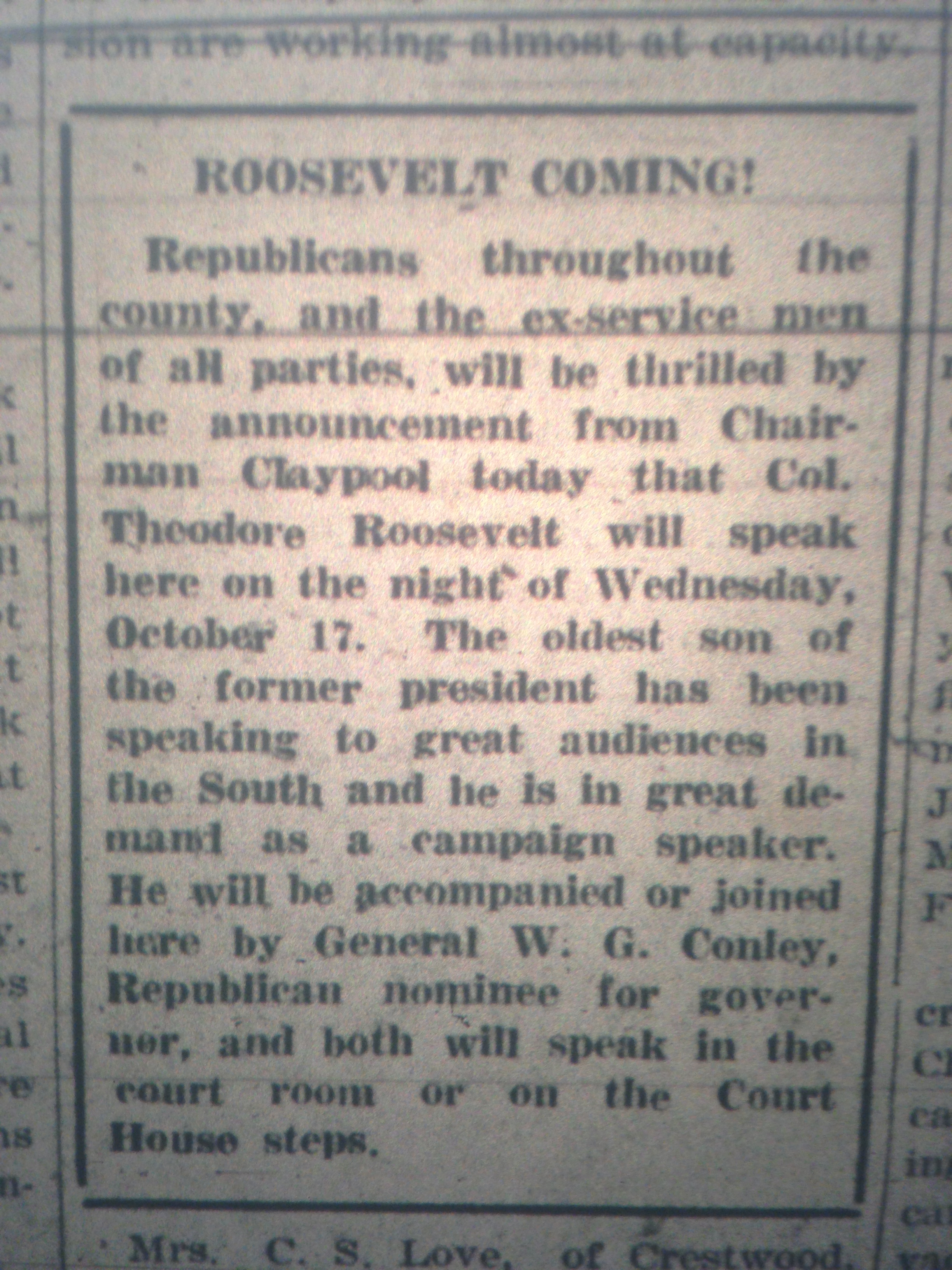
On October 17, 1928, Theodore Roosevelt, Jr. visited Logan, WV, and gave a speech to approximately 10,000 people. The Logan Banner offered plenty of coverage for the event:

Tedd Roosevelt Jr. is Coming LB 10.05.1928.JPG

Logan (WV) Banner, 5 October 1928

***

War-Time Buddies to Greet Col. Roosevelt

After His Meeting Here Wednesday Night–General Conley Will Also Speak at Open-Air Meeting That Night–Whale of Rally Assured

Every ex-service man in Logan county is urged to meet Col. Theodore Roosevelt when he comes here to deliver a campaign address in front of the Court House next Wednesday night. A reception in honor of the distinguished son of a distinguished sire will be held in Republican headquarters on the fifth floor of the White & Browning building after the political meeting is ended. There he will be greeted by his war “buddies” and every soldier, sailor and marine who served in the World War, regardless of political affiliations, is asked to be present.

Col. Roosevelt is billed three speeches on Tuesday. He is expected to speak at Welch in the afternoon and at Princeton at 5 p.m. and at Beckley that night. He is in great demand and Logan Republicans are elated over the definite promise from state headquarters that he is coming here.

General W.G. Conley, Republican nominee for Governor, will accompany or join Col. Roosevelt here and both will speak at the Wednesday night meeting. It is probable, too, that Dr. H.D. Hatfield and A.A. Lilly, former attorney general, will be here at the same time. General Lilly is billed for a speech at Braeholm on Monday night.

Logan (WV) Banner, 12 October 1928

***

Col. Roosevelt and General Conley Speak in Logan Tomorrow Night

Open-Air Rally at Court House Expected to Attract Delegations From All Sections of County–Service Men to Hold Reception for Col. Roosevelt After Speaking Is Ended

With the coming of Theodore Roosevelt and General W.C. Conley tomorrow for what is expected to be a memorable night meeting, the speaking campaign in this county may reach a climax. They will be the chief speakers at an open-air meeting in front of the Court House. It is probable that Governor Gore will come also and in that event he may serve as chairman of the meeting.

A.A. Lilly, former attorney general and Hugh Ike Shott, Republican nominee for congress, who addressed a huge gathering at Braeholm and Lundale last night, will speak at Peach Creek tonight; Senator Jackson and E.F. Scaggs also spoke at last night’s gatherings. Mr. Shott will remain in the county up to Wednesday night.

Governor W.J. Fields of Kentucky will address a Democratic meeting in the court room tonight.

Widespread interest has been aroused in the Roosevelt-Conley meeting and delegations are looked for from every section of the county. Ex-service men are to turn out in force to meet and greet the distinguished soldier-son of the beloved soldier-president of the same name. A reception to which all ex-service men are invited will be held on the fifth floor of the White & Browning building after the big meeting is concluded. Roosevelt’s war record, his activity in helping to organize the American Legion, and his fondness for those who served with him have endeared him to World War men everywhere.

A prohibition rally sponsored by the W.C.T.U. will be held at the Court House at 7:30 Friday p.m. Everyone is urged to come. The speakers for this occasion have not been announced.

Teddy Roosevelt Jr. in Logan LB 10.16.1928 2.JPG

Logan (WV) Banner, 16 October 1928.

***

Col. Roosevelt Center of Interest of Biggest Crowd Ever Seen Here

Republicans Stage Rally Eclipsing Any of the Past in Guyan Valley, With Attentive, Enthusiastic Crowd Estimated At Around 10,000 Mark

GEN. CONLEY AND OTHERS TAKE PART

Ex-Service Men Add Zest to Ovation for Gallant Soldier Son of Beloved T.R.–Rev. Mr. Lanham Is Chairman–Flowers For Teddy

Before the largest crowd ever assembled in Logan county, Col. Theodore Roosevelt, eldest son of the late president, made an eloquent and elaborate appeal in front of the Court House Wednesday night for the election of Hoover and Curtis on November 6.

His oratory, his Rooseveltian grimaces, his deep-furrowed smiles, his warm and radiant fellowship, and genuine camaraderie in meeting and greeting ex-service men, won the hearts of all. And how game he was! Exhausted by his effort to make himself heard to the far corners of the crowd confronting him and really surrounding him, following a strenuous ordeal of many days, traveling at night and speaking several times a day, he had difficulty making his way from the platform back through the crowd and into the Court House corridor. To several companions he hoarsely confided, “I’m a wreck!” Nevertheless, he tried to shake every hand and exchange a friendly greeting with those who swarmed about him. His exit was marked by a renewal of the ovation that greeted him when he, General W.G. Conley, Senator M.Z. White, County Chairman and Mrs. G.R. Claypool, Casey M. Jones, Calvert Estill and others in the party wormed their way through the crowd to the platform erected at the foot of the steps on the side of the Court House.

After the meeting the distinguished visitor was whisked to Republican headquarters where ex-service men in large numbers held a reception in his honor. Again and again he was “dee-lighted” and thrilled to find some “buddy” who had belonged to some military unit with whose history Roosevelt is familiar. Then he would cry out to his pal Casey Jones, Charleston newspaperman and bosom friend for more than a decade,” What do you know about it, Casey, here’s an old pal that served with” so-and-so company or regiment.

Not only ex-service men but more than one professional man of Logan, miners and others whispered to him, or yelled out to his wake, “We’ll be voting for you some time, Teddy!”

Hits the Line Hard

After the reception the Colonel returned to Charleston, to make ready for a busy schedule yesterday. He was billed for speeches at Harrisville, Ripley and Pt. Pleasant, and had arranged to get back to Charleston last night and to speak both at Beckley and Welch today. All day yesterday here whenever the matter of his visit was discussed in any group the prediction was advanced that he was too terribly exhausted to adhere to his schedule. And his Logan friends are sincerely concerned about him. However, he will return to New York at the end of the week.

Wednesday night’s rally will be remembered for years, say political observers, not only because of its size but also because of its direct bearing on a momentous contest for supremacy.

Most estimates of the attendance hover around the 10,000 mark. John M. Mitchell, court bailiff, who has been familiar with political activities in this county for half a century, said it exceeded twice over any crowd he had ever seen in the county. Others say the only meeting ever held here worthy of comparison was that addressed by Senator Pat Harrison in the 1924 campaign. To the writer the crowd seemed more than half as large as that which heard John W. Davis in Huntington in 1924. That crowd was estimated at 25,000, but that was an obvious exaggeration–a characteristic of the estimates of political assemblages.

The Folks Were There

Cloudy weather and a light rain that set in at the hour when the meeting was scheduled to start doubtless kept away a considerable number and caused scores to leave. On the outer edges it was impossible to hear the speakers and so there was a steady going and coming of persons wishing to see and hear. windows in about half a dozen buildings were occupied, small boys were atop the Old Stone building, and there was a good-sized crowd clustered on and about the platform, steps, windows, portico and corridors of the Court House.

Roosevelt has a good voice but it was put to a terrific test here, considering what he had undergone recently. His voice is better than his father’s was and he is more humorous, but the only striking resemblance between the two as public speakers is that grinning grimace that once seen can never be forgotten. In his speech he did not delve exhaustively into any one issue or phase of the campaign but he gave a comprehensive review of the issues and personalities that Republicans generally assume to be involved in this campaign. As for Tammany he panned it as it has never been panned before hereabouts. He recalled, too, that his grandfather had fought the greedy Tiger: “My father fought it; I am fighting it, and if it lives 20 years longer, I expect and hope my son Teddy III will be fighting it.”

Rev. Lanham Presides

It was after 8 o’clock when the speakers arrived–more than half an hour late–whereas all available seats and many vantage points had been occupied for nearly if not fully two hours. At the home of Mr. and Mrs. G.R. Claypool they had been entertained at dinner–or supper, as Teddy and most of us call it. Besides the Colonel and General Conley there were six other guests: Hugh Ike Shott, Republican nominee for representative in Congress; Senator M.Z. White, Williamson; C.M. Jones, publicity man and side for Mr. Conley; Calvert N. Estill, Charleston correspondent for the Ogden chain of newspapers, and Senator Naaman Jackson.

Rev. C.C. Lanham, pastor of the First Methodist Church, who has been a leader in the fight to avert any backward step on prohibition, was chairman of the meeting. He filled the role with tact and good judgment and introduced the various speakers in happy style.

General Conley was the first speaker, but sensing the crowd’s desire to hear the Colonel he cut short his remarks. He did not take up state or national issues but after a word of congratulation to those who had sponsored such an immense turnout he withdrew.

Flowers For Colonel

Next a pretty little surprise was sprung. Mrs. W.C. Price, of Huntington, who is taking the lead in organizing the Republican women of the county, was introduced. Turning to Col. Roosevelt, after bringing a basket full of beautiful flowers into view, she told him of the esteem in which he is held by the women and presented the flowers in behalf of the woman’s Republican Club as a token of appreciation of his services in this campaign and of his zeal in promoting the public welfare. His face wreathed in wrinkles and aglow, he replied: “I accept with thanks. And I would much rather stand high in the esteem of women than of men. They are more important. I know, for I am married.”

The chairman then introduced W.C. Lybarger, secretary of the railway Y.M.C.A. at Peach Creek, who in turn introduced Col. Roosevelt. He paid the visitor a splendid tribute for his valor on the battlefields of France, touched the high points of his political career, and said he had a leading part in organizing the American Legion.

At the outset Roosevelt sketched the character and growth of the orphaned Hoover and gave some intimate glimpses into the habits of living and of thought, of his working and his industry and resourcefulness in solving problems of public and playing, of his zeal in tackling concern. Between these two men there is a close friendship, and there was no mistaking Roosevelt’s whole-hearted admiration for the farm boy of Iowa who has risen to a position of pre-eminence in the minds and hearts of his countrymen and even of the folk of many other lands.

Logan (WV) Banner, 19 October 1928

Jack Dempsey (1928)

02 Tuesday Oct 2018

Posted by Brandon Ray Kirk in Sports

≈ Leave a comment

Tags

Appalachia, Armand Emanuel, boxing, California, Charleston, Charleston Gazette, Estelle Dempsey, Gene Tunney, history, Hollywood, Jack Dempsey, James J. Corbett, Logan Banner, Los Angeles, Mickie Walker, Mike McTigue, New York City, photos, San Francisco, Summers Street, Virginia Street, West Virginia

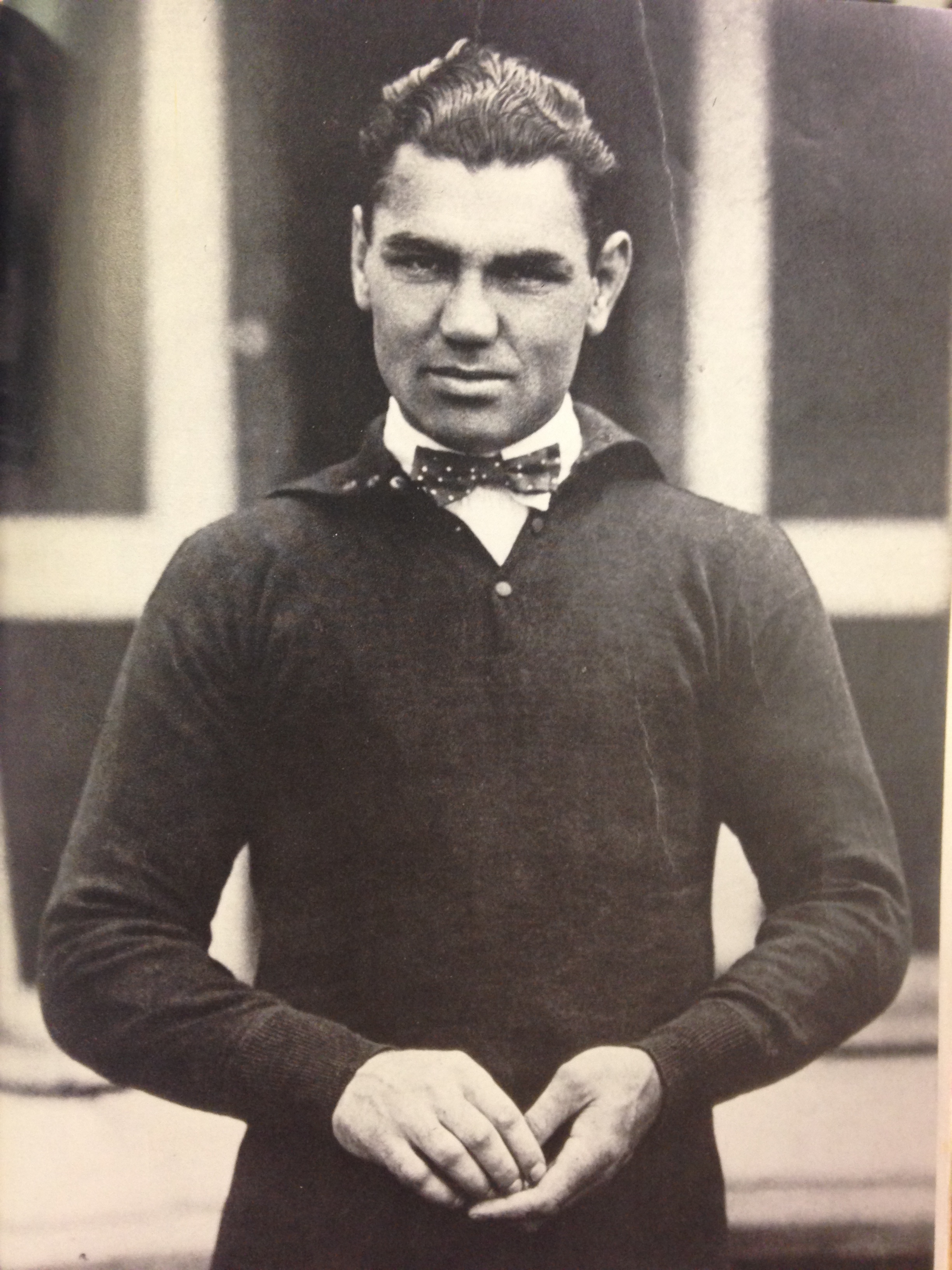
The following items relating to Jack Dempsey, heavyweight champion of the world from 1919-1926, were printed in the Logan Banner of Logan, WV, in 1928:

IMG_8125.JPG

Jack Dempsey, 1924. Photo credit unknown.

“Fight Gene, Sure” Says Jack Dempsey

Jack Dempsey has begun light training, says a dispatch from Los Angeles, but says he is merely trying to keep fit.

“There’s nothing in the wind. I don’t want to get fat, and the only way to keep from it is to have a regular training diet,” he is quoted as having said.

“Fight Tunney again? Sure. But I’m not in the mood to do any elimination bouting to get another crack at the title.

“Of course, I might take on one or two preliminary scraps if there was a definite program in sight, but there’s absolutely nothing to report that one has been drawn up.”

Source: Logan (WV) Banner, 10 January 1928

***

DEMPSEY WINS ANOTHER TILT

Jack Dempsey came out with flying colors in court at New York City last week when a jury decided that he did not owe his former manager something like $700,000. Kearns sued Dempsey claiming that he was entitled to a certain percentage of the profits earned by Dempsey, but the jury decided in favor of Dempsey, and did not award Kearns one penny. It was a sad blow for the former manager of the former champion, who now makes a living piloting Mickie Walker, middle-weight champion.

Now that Dempsey has all the legal worries off his mind he will get down to business to pick up a little soft dough managing his twenty-two-year-old protégé, Armand Emanuel, of San Francisco. Dempsey sent word to Emanuel last Wednesday to start for New York at once, as he had a mach in view. Emanuel boarded the first train from San Francisco east.

When Emanuel arrives in New York, James J. Corbett, former heavy-weight champion, will look him over. Corbett is a graduate of the Olympic Club in San Francisco and so is Emanuel. The latter was the national amateur heavyweight title in 1925. He has been a professional since 1926. He has not lost a decision in 28 bouts. His last fight took place in San Francisco Monday night when he fought a draw with the veteran Mike McTigue, of New York City.

Source: Logan (WV) Banner, 1 May 1928

***

DEMPSEY LIVED IN CHARLESTON CLAIMS GAZETTE

Jack Dempsey, retired pugilist and former world’s champion, once spent several months in Charleston, according to several here who knew him well. He is said to have made his headquarters in the old Hauck and Schmit billiard room at Summers and Virginia streets. He is remembered as serving as “bouncer” in the place, living in a room above. He kept in the best of condition, taking long walks and engaging in boxing exhibitions that finally took him to other sections.

Now Mr. Dempsey is in New York where he went from Hollywood, Calif., to see the Tunney-Heeney fight. Estelle Taylor Dempsey, his wife, has left the Pacific coast to see Jack in New York to make a movie picture, it is stated.

Source: Logan (WV) Banner, 3 August 1928

Allen Hatfield of Beech Creek, WV (1970s)

11 Tuesday Sep 2018

Posted by Brandon Ray Kirk in Hatfield-McCoy Feud, Matewan, Tazewell County

≈ 4 Comments

Tags

Allen Hatfield, Appalachia, Beech Creek, Beni Kedem, Charleston, Charlie Simpkins, Cincinnati, civil war, Clyde Kiser, Deanna Hatfield, Devil Anse Hatfield, Devon Church of Christ, Doc Mayhorn, Eliza Murphy, Ellison Hatfield, feuds, Frankfort, genealogy, Goldie Hatfield, Gordon Smith, Grapevine Fork, Hatfield-McCoy Feud, history, Hugh C. Boyd Lodge No. 119, Jane Hatfield, Jane Maynard, Joseph Chester Hatfield, Joseph Murphy, Kentucky, Kentucky Colonels, Lawrence Hatfield, Logan County, Major Hatfield, Martha Bell Murphy, Maryland, Mingo County, Norfolk and Western Railroad, North Tazewell, Ohio, Pike County, Plyant Mayhorn, preacher, Raymond Hatfield, Right Hand Fork, Rockville, Thacker, Valentine Wall Hatfield, Virginia, West Virginia, Williamson, Williamson Memorial Hospital, Willis Hatfield

My name is Deanna Hatfield and tonight I would like to share with you a West Virginian, Allen Hatfield, who the community of Beech Creek honored and loved. Allen was born October 11, 1877. He was the youngest child of the pioneer couple, Wall Valentine Hatfield and Jane Maynard Hatfield, who settled on Beech Creek in 1861, the year that the Civil War broke out in this country. His parents had settled at the mouth of Grapevine Fork of Beech Creek. They had occupied a log cabin near the present site of Lawrence Hatfield’s home. He was the nephew of Captain Devil Anse Hatfield, clan leader in the famed Hatfield-McCoy Feud, and a first cousin of Willis Hatfield, the only surviving child of that family.

Almost until the day of his death, Allen carried a sadness in his heart over the death of his father in the days of the famous feud. His father, a peaceable man, was not an active member of the fighting group of the Hatfields during the trouble between his family and the McCoys but was named in warrants along with two of his sons-in-law, Doc and Plyant Mayhorn. Allen Hatfield, but ten years old at the time, remembered that his father Wall, thinking that he had nothing to fear in the courts of Kentucky, wrote the prosecuting attorney of Pike County that he and his sons-in-laws wished to surrender in Pikeville and stand trial for crimes for which they were accused. Allen Hatfield recalled the incident from his boyhood, including the feud. His father did go to Pikeville to voluntarily stand trial and clear his name but he was convicted by a prejudiced jury, the son remembered, and was sentenced to life imprisonment at the Kentucky State Prison in Frankfort. After sentencing, he lived about one year and his burial place is still unknown today. The two Mayhorns served several years and were later pardoned.

One of his fondest memories was that of his mother Jane who took over the management of the home and did a good job of raising a large family after her husband was taken from her. She did chores around the homestead. A great and interesting conversationalist in his adult years, he liked to tell of how he and his friends made bows and arrows–arrows consisting of straight pieces of wood with a horseshoe nails attached as the spike. He became an excellent marksman with the bow and arrow and later with his first rifle as he helped to provide squirrels and other wild game for the family table.

The early years of Hatfield’s life were marked by sadness as a result of the loss of his family in the feud. But his hours spent in the great outdoors hunting and fishing provided a therapy that led to his development to splendid manhood. He was several years old when the Norfolk and Western Railroad Company built an extension from Virginia to southern West Virginia and Mingo County, which still was Logan County at that time.

In 1899, Hatfield was married to Martha Bell Murphy, daughter of Joseph and Eliza (Steele) Murphy. She had just turned fourteen when he proposed and her family thought she was too young to wed. The young couple sort of eloped the night of April 8, 1899, to Allen’s home where they were married by Allen’s brother, Ellison, a country preacher and a granny doctor, as he later recalled. Late that summer, he amassed enough lumber to build their first home—a one-room abode that was erected next to the hillside just north of the present homestead. Allen Hatfield made most of his furniture and his wife tended a garden and dug ginseng to help the family fortune.

During the ensuing years, the Hatfields had eleven children, two of whom preceded them in death. Lawrence Hatfield, who married Dollie Kiser, is now retired and lives with Dollie on Beech Creek at the mouth of Grapevine Fork. Estel Hatfield, who married Virginia Varney, lived with his dad and still lives in the old homeplace. Estel is an agent for the Norfolk and Western Railroad Company. Major Hatfield, who married Mildred Friend, is employed as an agent also for the Norfolk and Western Railroad Company in North Tazewell, Virginia. Rosa Hatfield, married Wayne Simpkins, lives on Beech Creek on Right Hand Fork. Goldie Hatfield married Gordon Smith, and they make their home below Grapevine Fork on Beech Creek. Mamie Hatfield married Charlie Simpkins and makes her home in Rockville, Maryland. Glendeen Hatfield married Douglas Berlin, and they make their home in Louisiana. Etta June Hatfield, never married and lives in Cincinnati, Ohio. Erma Hatfield married Forest Baisden, and she lives in Williamson, West Virginia. Milda Hatfield, deceased, was a retired school teacher and was never married. Joseph Chester Hatfield, died at six months old.

In 1914, Allen bought from his brother Smith a grocery store at the old homeplace and moved the merchandise to a small building at his home. He built a large home later and it was there that most of the children were born. He expanded his business to a larger store building, which still stands, and then he erected the present homeplace. During his early merchandising days, Hatfield was compelled to haul his goods from the railway station at Devon by team and wagon for the roads had not been built and most of the rough team tracks was through the creeks. It was a problem in the wintertime to get through the streams as they were filled with ice. After the county built a road up Beech Creek, he retired his team and wagon and switched to a gasoline-powered vehicle to haul and deliver his goods. He learned carpentry in the early years of his marriage and continued this art until 1964 when he retired. Hatfield was a 57-year member of the Hugh C. Boyd Lodge No. 119 AF & AM at Matewan and received his 50-year service award from the Grand Lodge of West Virginia in 1970. The lodge, when he became a master mason, was known as Thacker No. 119. It was located at Thacker, West Virginia. It later was moved to Matewan. He also belonged to the Beni Kedem Temple of Charleston, being a 50-year member of the Shriners. He also received the honorary commission of a Kentucky Colonel on April 10, 1972. He had been a member of the Devon Church of Christ since 1916 and sponsored the building of the present church that stands near his home on Beech Creek.

In his years of selling groceries, Hatfield said he never lost but 50 dollars in bad debts. He was proud of his heritage, a leader in his community, and in his active life a crack shot with a rifle, pistol, and shotgun. His hunting and fishing kept the table supplied with food. He won beef, hogs, turkeys, and chickens in the old-time rifle matches that were so popular in the Beech Creek area years ago. He and the former Martha B. Murphy were married 71 years before her death on May 25, 1970. His life might have been used as the subject by the poet who wrote, “Let me live by the side of the road and be a friend to man.” Allen Hatfield had spent a lifetime doing just that, living beside a little country road on Beech Creek and being a friend to mankind. On March 2, 1975, Allen was taken to the Williamson Memorial Hospital for ailments associated with his advanced age. He then was released and re-entered the hospital on April 18 in critical condition. On Friday, May 2, 1975, the community of Beech Creek lost one of the dearest old-timers that was ever known. Allen Hatfield, 97, prominently-known Mingo pioneer citizen, retired merchant of Beech Creek, died at 3 a.m. in the Williamson Memorial Hospital of a lingering illness. Funeral services were scheduled at the Chambers Funeral Home Chapel with his beloved ministers Clyde Kiser and Raymond Hatfield officiating. Burial took place in the family cemetery behind the homeplace on Beech Creek. His grandsons and great-grandsons were his pallbearers. Allen would have wanted it this way. Simple.

NOTE: Some of the names may be transcribed incorrectly.

Recollections of McKinley Grimmett of Bruno, WV 2 (1984)

03 Monday Sep 2018

Posted by Brandon Ray Kirk in Battle of Blair Mountain, Coal, Italian American History, Logan, Man

≈ Leave a comment

Tags

Alva Grimmett, Appalachia, Barnabus, Blair Mountain, Bruno, Buffalo Creek, Cabin Creek, Campbell's Creek, carpenter, Charleston, Christian, coal, Democratic Party, deputy sheriff, Don Chafin, drum runner, Ed Goodman, Emmett Scaggs, George McClintock, Great Depression, Hatfield Bottom, Henderson Grimmett, history, Joe Hatfield, John Chafin, Kanawha County, Kistler, Landsville, Logan County, Mallory, Mallory Coal Company, Matilda Hatfield, McKinley Grimmett, moonshining, Nancy Grimmett, prosecuting attorney, Republican Party, Sand Lick, sheriff, Superintendent of Schools, Tennis Hatfield, Thomas Hatfield, United Mine Workers of America, West Virginia, Wild Goose Saloon

McKinley Grimmett was born on November 30, 1896 to Henderson and Nancy (Hatfield) Grimmett at Sand Lick, Logan County, WV. On May 14, 1916, Mr. Grimmett married a Ms. Plymale, who soon died, in Logan County. One child named Alva died on June 21, 1919 of whooping cough, aged fourteen months. His World War I draft registration card dated September 12, 1918 identifies him as having blue eyes and light-colored hair. He was employed by Mallory Coal Company at Mallory, WV. On November 13, 1919, he married Matilda “Tilda” Hatfield, daughter of Thomas Hatfield, in Logan County. He identified himself as a farmer in both of his marriage records. During the 1920s, he served as a deputy under Sheriff Tennis Hatfield.

The following interview of Mr. Grimmett was conducted at his home on July 17, 1984. In this part of the interview, he recalls his occupations. Coal, Don Chafin, Tennis Hatfield, unionization, and the Great Depression are featured.

***

Did you ever go to work in the mines?

Oh yeah. I’ve been… That’s what I done over here for 44 years and two months, in and around the mines.

Who hired you?

Yeah, a fellow by the name of Frazier down here at Logan. Superintendent. Not at Logan. Landsville. I stayed there four years, pretty nigh of five years. Then I quit down there and I come to Christian and I stayed up here. A fellow by the name of Harry Venebale hired me over here, the superintendent. And I stayed with him 34 years. Wouldn’t let nobody else hold a lever but me. Drum runner. I’d run as high as 35 railroad cars a day off of that hill. I’ve done it many a day.

Did you do other jobs?

Oh yeah. Days the mines didn’t work I was the carpenter boss. That is, I was overseer over ‘em all. After the union come in, why I wouldn’t take it as a boss. They just run me as a leader, you know. At that time, I’d either have to go in as a boss or get off the union, you know. And I knowed the union was the best for me and I stayed with the union.

Did you have any role in organizing the union?

Oh yeah. I had a big… They wouldn’t let us organize on their property. We had to go across an island over there in the river and have our meeting to organize.

Is it true that local men had the union organized and were waiting for Washington to allow it?

Yeah, that’s about right. We got it. No, they come from Cabin Creek and Kanawha County and Campbell’s Creek over there and tried to organize us. Don Chafin was the high sheriff. He got so much ton per coal and everything. And we couldn’t do a thing because he had every child, woman, and everything else on his side to block us every way. They come to Blair Mountain and had fights. Killed several people, too. Both sides. But I never was in it. I was running a drum and they never did ask me to go. But they paid ‘em. They did go from over there. And went from around here, too. To fight against them, you know. And there was several of them got killed up Dingess Run there. I’ve been at the place where one fellow, sink hole he was in. There was four of them got killed: deputy sheriffs. George Gore and a fellow by the name of Mitchem. I don’t know the other two. I’ve forgot ‘em now. George Gore and Mitchem. But I know where they was at and everything there.

Can you describe Don Chafin?

I’m not too familiar with him now. But he controlled Logan County all the time. Whatever he said, why they had to do or they’d get around you and beat you to death or something like that, throw you in the river, tie your hands behind you – stuff like that.

Were you a Chafin deputy?

I worked for Tennis Hatfield and Joe.

How did Tennis hire you?

Well, Emmett Scaggs run against him. And the County Court was Democratic and they give it all to Emmett. Tennis carried it up to the high court and he won it. About that time, that’s when it was, 1922 I believe it was, last part of 1922, well Emmett, he was a well-educated fellow, he had been the superintendent of schools and everything, he turns around and registers and turned to be a Republican, well then they appointed him prosecuting attorney. You understand? Give him a job. Now the Democrats didn’t do that—Tennis and all of them did. It made a full change around whenever Tennis was elected. The County Court had been Democratic all the time and it turned over, changed hands, and make a Republican County Court. Just like they’ve got now, it’s all Democratic. And a Republican couldn’t get nothing. I’ve seen John Chafin and Hi beat an Italian man. He had two ducks carrying them. Had to wade the river. They fired him over there at Christian. Had to ride horses that day and time. Didn’t have no cars. And they jumped off their horses after they overtook him and they beat him until he couldn’t walk. My dad had a store down at the mouth of the creek and he went and got him and got him up to the store and his ducks got loose. And Mother got the ducks and she raised all kinds of ducks from ‘em. But I haven’t seen that man from that day to this. He’s dead now. But they liked to beat him to death. Now Henry Allen was another one. They barred him from the union. He was a big organizer when it first started. And he got to playing crooked work and they put him out of the union. And he’d done something or other to the party. And they beat him around there at Kistler so hard – the creek was up. Buffalo was a big creek any way. They throwed him up there at Ben Gall’s store in the creek and he washed down there at Kistler and lodged up behind the middle pier at the railroad track. Some men run in and helped him out. I forget who it was. I didn’t see that go off but that’s what happened. Well, he come up here, Henry did, to where I was walking and wanted me to get him a job. Well, I told him I would talk to the boss. A fellow by the name of George Kore. George Kore give him a job working for Tony Lumber Company, helping build houses, you know. He worked about three days and why George fired him and wouldn’t have nothing more to do with him. Henry’s dead now. That’s the last I knowed of him.

Do you remember the names of any early union organizers?

I never did meet ‘em. I tell you they kept me busy all the time as a repair man and drum runner, and days that the mines didn’t run I had to do repair work on the houses and tipples and stuff. Them organizers was, one of ‘em was a fellow by the name of Hall. I’ve seen him but I forget his first name. He had an office over there in Charleston. He was president of the union then. Don Chafin went over there and aimed to tell him what to do and he shot Don. It put Don in the hospital for a long time. After he got out there, Don Chafin and Tennis Hatfield had been in to the Wild Goose business selling bootlegging moonshine whisky up at Hatfield Bottom [in Barnabus]. And they fell out. And Tennis, he goes before the federal grand jury. I forget who the judge was. I knowed him. [George McClintock] And Tennis indicted him and sent him to the pen for four years. But they never did do nothing to Hall for shooting him over there in the miners’ office. But he never did go back in it anymore.

You remember when the mines began to mechanize?

Oh, yeah. I was in there then. I worked up til ’62.

How did the mines change?

Well, they loaded by the car that day and time when they first started. Then they got conveyors in. And they cut the coal and they throwed it on them conveyors by hand. And they built belt-lines from here all across the river, just as far as you wanted to, you know. Had different offsets in it and different motors pulling the belt line. And it come out into a big tipple and dumped into a tipple and then I took it from that. I run it 2100 feet down the incline over there on two monitors on three rails. Now you figure that out. Ten tons to each monitor Now they come up there to the middle way place and they put four rails, you understand? And then one monitor passed the other one at that middle place. All the time. They had a big drum. The drum was twelve foot in diameter and fourteen foot long that way. Built out of gum. Six by six gum. Rope was inch and a quarter.

Was there much bitterness among people when mechanization started?

Oh, no. They was all for it. They was everything was settled. Whatever the union said, they had to do at that time. It was all loaded by the ton by the car. There wasn’t no weighing or nothing like that ‘til they got the union. Then they had to put scales in, you know, and weigh these cars of coal and they had to pay so much a ton. Why, there was people over there at Christian – I never will forget it. Ed Goodman was his name. He’d be broke every week. He’d never load over four or five cars. Just 35 cents a car and a car would hold about four tons, five. And they was starving him to death. He’d come in there on paydays and I’d come in. I was always the last man getting off the hill. He was wanting on dollar scrip. He’d come over and whisper to me and tell me they wouldn’t let him have a one dollar scrip. And I’d vouch for him. Sometimes I’d pull my pay envelope out—they put your money in a pay envelope, you know—and I’ve pull out my pay envelope and give him a dollar and that would do him until Monday. He had a big family. They all weren’t home at that time. He managed. And then when the union come in, they had to treat him the way they did the rest of them.

Did you maintain steady work during the Great Depression?

Yeah. I’ve always had work. I get awful good Social Security. I study all the time – they worked me too much. I actually couldn’t stand it hardly. They’d work me Sunday and every other day. But now I never got no big money at that time. I started off at four dollars a day and I ended up with two hundred and fifty dollars a month. I stayed on that way for 19 years. They wouldn’t give me a raise. I asked ‘em for more money. Miners got a raise, you know. They said no, he couldn’t give it. Was going broke. I said well if you won’t give it I’ll be leaving you first of the month. And he didn’t think I would. Day before I was supposed to quit I sent my toolbox off the hill and everything. They had a man-car there that they rode backwards and forwards that people rode up and down the hill in. That night the man said if I would stay he would split the difference with me. Give me half. Give me twenty-five dollars. I said no I won’t do it. I’ve made you a fortune here. So he wouldn’t come up to fifty dollars and I wouldn’t come off it. Next day they had a wreck. A fella was running… I was sitting here. And they wasn’t no timber around there and I could see the monitors from here. And he wrecked and I never seen such dust in all of my life. And I got in my car and went over there. And they tore one up so bad they had to buy a new one. A monitor. That cost ‘em some money, too.

NOTE: Some names may be transcribed incorrectly.

History for Boone County, WV (1927)

28 Saturday Jul 2018

Posted by Brandon Ray Kirk in Boone County, Civil War, Native American History

≈ Leave a comment

Tags

Albert Allen, Appalachia, Ballardsville Methodist Church, Boone County, Cabell County, Charleston, civil war, Coal River, crime, Crook District, Daniel Boone, Danville, Edgar Mitchell, Frankfort, French and Indian War, genealogy, history, Jack Dotson, Johnson Copley, Kanawha County, Kanawha River, Kanawha Valley, Kentucky, Lee Sowards, Lewisburg, Logan Banner, Logan County, Madison, Missouri, Nathan Boone, North Carolina, Pennsylvania, Peytona District, Point Pleasant, Pond Fork, Ruckers Branch, Scott District, Sherman District, Spruce Fork, St. Albans, Virginia Assembly, Washington District, West Virginia, West Virginia Synodical School, Yadkin Valley

From the Logan Banner of Logan, WV, comes this bit of history about Boone County in a story dated December 9, 1927:

BOONE COUNTY

Boone county was created in 1847 of parts of Kanawha, Cabell and Logan counties. Its area is 06 miles, 65 miles larger than Logan, and in 1920 its population was 18,145. It is divided into five magisterial districts, as follows: Crook, Peytona, Scott, Sherman and Washington.

Boone county commemorates in West Virginia the name of Daniel Boone, the pathfinder to the west. It is an honor worthily bestowed, for who has not heard of Daniel Boone and the story of his efforts as an explorer, hunter, land-pilot and surveyor. His was a romantic life, picturesque and even pathetic. For more than a century he has he has been held as the ideal of the frontiersman, perhaps for the reason that his course in life was not marked by selfishness and self-seeking. He fought with the Indians, but was not tainted with the blood-lust that so often marred the border warrior and made him even more savage than the red man whom he sought to expel; he built and passed on to newer fields, leaving to others the fruits of his industry and his suffering. As a man needing plenty of “elbow room,” his places of residence mark the border between civilization and savagery for a period of fifty years. And there was a time, a period of nearly ten years, when his cabin home was on the banks of the Kanawha, a short distance above the present City of Charleston.

Daniel Boone was born in the Schulykill Valley, Pennsylvania, on November 2, 1734, but in 1750 removed with his parents to the Yadkin Valley, in North Carolina. Here he grew to manhood, married and reared a family, but was active as an Indian trader, frontiersman and defender of the feeble settlement. He was with Braddock’s army at its defeat on the Monongahela in 1755, and a few years later became the founder and defender of Kentucky. He strove with the red man with force and stratagem, and many are the fire-side tales recounted and retold in West Virginia homes of his prowess with the rifle; his ready plans and nimble wit that helped him out of situations that seemed almost impossible. Many, perhaps, are without foundation of fact; others contain enough of truth to leaven the story. Of his service to the western settlers, records preserved in the archives of state and nation show that he was indefatigable. At the Indian uprising in 1774, Boone was sent out to warn the settlers and surveyors, ranging from the settlement on the Holston river throughout all of what is now southern West Virginia to Lewisburg. In 1788, after he had lost his property in Kentucky through defective titles and failure to properly enter land grants, Boone and his family removed to Point Pleasant, at the mouth of the Great Kanawha, where they remained about one year. Contrary to his habit, his next move was toward the east to a site near the City of Charleston. When Kanawha county was formed in 1789 Boone was a resident and was named the first Lieutenant Colonel of the militia, and the following year, 1790, was elected a member of the lower house of the Virginia assembly. Colonel Boone left the Kanawha valley in 1799, removing to Missouri where he had been granted a thousand arpents of land by the Spanish government and had been appointed a Syndic for the Femme-Osage district–a local office combining the duties of sheriff, jury and military commandant. Colonel Boone died at the home of his youngest son, Colonel Nathan Boone, on the Femme Osage river, Missouri, September 26, 1820. His remains, with those of his wife, were some years later taken to Frankfort, Kentucky, and re-interred with pomp and ceremony. A monument erected by the state marks his last resting place.

Madison, the present county seat, is located at the junction of Pond Fork and Spruce Fork, which form Coal River, is 603 feet above sea level and in 1920 had a population of 604. It was incorporated as a town by the circuit court of that county in 1906. At the organization of the county in 1847, the seat of justice was located on the lands of Albert Allen, at the mouth of Spruce Fork, opposite the present town of Madison. The original court house was burned by Federal troops during the Civil War, and for a time thereafter the seat of justice was located at the Ballardsville Methodist Church. In 1866 the court house was re-located on the lands of Johnson Copley, opposite the old site, and the public buildings erected, which were used until 1921 when the present fine court house was erected.

The West Virginia Synodical School maintained and operated by the Presbyterian church, occupies the site of the original court house, opposite the present county seat.

Danville, another incorporated town in that county, had a population of 327 in 1920.

Source: Logan (WV) Banner, 9 December 1927.

Old Trees at Boone Courthouse, Hangings LB 03.22.1927.JPG

Logan (WV) Banner, 22 March 1927.

History for Wyoming County, WV (1927-1928)

23 Monday Jul 2018

Posted by Brandon Ray Kirk in Coal, Native American History, Wyoming County

≈ Leave a comment

Tags

A.F. Wysong, Appalachia, architecture, Baileysville District, Barkers Ridge District, Center District, Charleston, Clear Fork District, coal, crime, Early Brothers, Gertrude of Wyoming, Guyan Heating and Plumbing Company, history, Huff's Creek District, Logan, Logan Banner, Logan County, Maughwaiwama, Mingo County, Mullens, Native American History, Native Americans, Oceana, Oceana District, Pineville, Princeton, Slab Fork District, Thomas Campbell, West Virginia, Wyoming County, Wysong & Bengston

From the Logan Banner of Logan, WV, comes this bit of history about Wyoming County, dated 1927 and 1928:

Wyoming County In the Public Eye

Now that three railroads are contesting for the authority to build a branch line across Wyoming county, increased interest is shown in the probable early development in that bailiwick.

Wyoming has coal resources equal to those of any other county in the state, it is said, and it has wide valleys of fine farming land, and an unusually picturesque mountain country. Like Mingo, it was carved out of Logan territory, its formation having been authorized by an act of the general assembly passed January 26, 1850. With an area of 507.30 square miles it is more than 50 miles larger than this county, yet its population in 1920 was only 15,180.

That county’s valuation for taxation purposes exceeded $28,000,000 last year.

Wyoming county is divided into seven magisterial districts, as follows: Baileysville, Barkers Ridge, Center, Clear Fork, Huff’s Creek, Oceana and Slab Fork districts.

Wyoming county was stricken off from the older county of Logan, which took its name from a celebrated Indian chief. Another county was formed from Logan, many years later, and to this was given the name of Mingo, the tribe to which Logan belonged. Logan, Mingo and Wyoming are the three counties in West Virginia whose names are derived from the original settlers.

Wyoming county bears the name of an Indian tribe, and this tribe was later honored by having its name adopted by one of our great western States. While the derivation of the name, in its application to the county, seems to be clear, the origin of the name itself is veiled in obscurity. By some authorities it is said to be a corruption of the Indian Maughwaiwama, signifying a plain, or open space. Others assert that it is a creation of Thomas Campbell, the poet, and author, of “Gertrude of Wyoming.”

Pineville, the present county seat, is located near the center of the county. It has an elevation of 1,323 feet above the level of the sea and had a population of 304 in 1920. Later estimates do not greatly increase this figure. Pineville became the county seat years ago, having secured the removal of the seat of justice from the older town of Oceana.

Mullens, a prosperous town and center of the coal industry, had a population of 1,425 in 1920.

Oceana, long the county seat before its removal to Pineville, had at the last census a population of 90.

Source: Logan (WV) Banner, 25 November 1927.

***

WYOMING COUNTY HAS NEW JAIL–NATIVE STONE USED–COST $150,000

Wyoming county’s new jail at Pineville has been accepted by the architects and will be formally turned over within the next few days.

Erected at a cost of approximately $150,000, the new bastille is perhaps one of the finest buildings of its kind in the southern part of the state. It is built of native stone throughout, and is a most imposing and beautiful building and one of which the county may well pride itself, says the Mullins Advocate.

It is three full stories high above the basements, heated by vapor, containing room for 70 prisoners with comfort, and can accommodate twice that number, if necessary. The cells and jail construction is of tool proof steel, equipped with the latest locking devices. A prisoner when confined in a cell, must go through three sets of tool proof steel bars to make an escape.

The building contains a large and comfortable residence for the jailer, including a large, well furnished and equipped kitchen, is supplied with hot and cold water throughout, including shower baths on the inside corridors of the jail, padded cells for the insane, hospitals for the sick and detention rooms for juveniles of both sexes.

In the basement there is an incinerator, together with a laundry and large supply rooms.

The building was formally approved on January 9th by A.F. Wysong of the firm of Wysong & Bengston architects, of Charleston, who had the construction of this building in charge. Early Brothers, of Mullens, contractors, constructed the building, while the heating system was installed by the Guyan Heating and Plumbing company, of Mullens. The plumbing was done by Wickline of Princeton. Mr. Wysong, after going over the jail carefully, approved the construction and recommended payment of the balance due on the several contracts.

Source: Logan (WV) Banner, 17 January 1928.

Chapmanville News 04.06.1928

17 Tuesday Jul 2018

Posted by Brandon Ray Kirk in Chapmanville, Huntington

≈ Leave a comment

Tags

A. Lunsford, A.F. Carper, Appalachia, Chapmanville, Chapmanville School, Charleston, Demosthenian Literary Society, genealogy, Glenna Beckett, Henlawson, history, Huntington, Inez Barker Grace, Logan Banner, Logan County, Platonian Literary Society, Sid Ferrell, W.D. Nunley, West Virginia

An unknown correspondent from Chapmanville in Logan County, West Virginia, offered the following items, which the Logan Banner printed on April 6, 1928:

The Platonian Literary Society of the Chapmanville school entertained the Demosthenian Literary Society Friday evening, with a party at the school building. Every student present reported a very enjoyable time.

We are sorry to report the death of Mr. and Mrs. A. Lunsford’s baby, which occurred Saturday, March 31.

Mrs. Renner spent the week end in Huntington with homefolks.

Mrs. Inez Barker Grace spent the week end in Huntington with Mr. and Mrs. W.D. Nunley.

Mrs. A.F. Carper who has been very sick is able to be out again.

Miss Glenna Beckett of Charleston is visiting homefolks here at the present time.

Sid Ferrell of Henlawson spent Sunday in Chapmanville.

P.H. Noyes v. Anderson Hatfield and John R. Browning (1891-1893)

17 Sunday Jun 2018

Posted by Brandon Ray Kirk in Guyandotte River, Hatfield-McCoy Feud

≈ Leave a comment

Tags

Appalachia, Charles M. Turley, Charleston, Cincinnati, circuit clerk, deputy sheriff, Devil Anse Hatfield, Guyandotte, Guyandotte River, Hatfield-McCoy Feud, Henry W. Sentz, history, J.B. Buskirk, John R. Browning, Kanawha County, lawyer, Logan County, Logan Court House, M.B. Mullins, Marion Chafin, P.H. Noyes & Company, pushboats, sheriff, steamboats, traveling salesman, W.W. Adams, West Virginia

On October 27, 1891, P.H. Noyes and Company sued Anderson Hatfield and John R. Browning relating to an 1890 debt. The following depositions provide some details about the case:

NOTICE TO TAKE DEPOSITIONS.

To Anderson Hatfield Sr. and John R. Browning. You will take notice that on the 28th day of March 1892, between the hours of 8 o’clock A.M., and 6 o’clock P.M., at the Law office of Adams and Smith’s at the City of Charleston in Kanawha County, we will proceed to take the deposition of P.H. Noyes and others to be read as evidence in behalf of ourselves in a certain suit at Law pending in the Circuit Court of Logan County, West Virginia wherein you are defendant and we are plaintiffs and if from any cause the taking of the said deposition be not commenced on that day, or if commenced and not completed on that day, the taking of the same will be adjourned and continued from day to day or from time to time, at the same place, and between the same hours, until completed.

Respectfully, P.H. Noyes & Co., By Counsel

Executed the within notice on the within named John R. Browning and Anderson Hatfield Sr. on the 2nd day of March 1892 by giving to each of them a true office copy of the same.

J.B. Buskirk, Dept. for F.M. Chafin, S.L.C.

***

DEPOSITIONS of Witnesses, taken before the undersigned authority, in and for the County of Kanawha, in the State of West Virginia pursuant to the annexed notice, at the law office of Adams & Smith at the City of Charleston W.Va on the 28 day of March 1892 between the hours of 8 o’clock A.M., and 6 o’clock P.M., of that day, to be read in evidence on behalf of the plaintiff, in a certain suit pending in the Circuit Court of Logan County West Virginia, in which suit P.H. Noyes & Company are Plaintiff and Anderson Hatfield Sr. and John R. Browning are Defendants.

Present: W.W. Adams for Plaintiff and no appearance for Defendant.

Deposition 1: Henry W. Sentz

Q: State your name, age, residence and occupation.

A: My name is Henry W. Sentz. I am 25 years old. I reside in Charleston, W.Va. and am a traveling salesman.

Q: What connection if any have you with the plaintiffs P.H. Noyes & Co.?

A: I am employed by them as a traveling salesman.

Q: Do you know anything about the matter in controversy in this suit between plaintiffs and defendants?

A: I sold him the bill of goods and he paid me in cash the sum of $400 for the residue. He executed the note upon which this suit is based. Since that time he has paid $100 on this note.

Q: Did you ever have any conversation with the defendant Anderson Hatfield in regard to the claim for which this suit is brought? If so, when and where?

A: I am not positive as to the time, but we had conversations in regard to the claim on two or three different occasions before the institution of this suit. These conversations were had at Logan Court House.

Q: State what was said by you and by him in said conversations.

A: He spoke of the debt, and when the note became due he asked for more time on it. He said if we would give him a little more time he would pay it, and I agreed to it as far as I could and explained the matter to the house. This was before the note was sent to Mr. Turley for collection. At the expiration of the time Mr. Hatfield asked should be given him on the note, I had another conversation with him. He still wanted more time, stating that he had a land deal on foot with M.B. Mullins, and said he thought it would only be a short time until the note was paid.

Q: What if anything did he say in these conversations, about the acts on which this suit was afterwards brought?

A: He said the debt was just and he wanted to pay it.

Q: When did these conversations occur?

A: The first conversation occurred about the time the note was due. The note was for three months, I think. The second conversation occurred about two months after the first. Both of these conversations occurred before the note was placed with Turley for collection.

Q: Has the house ever given Hatfield any other credit than the $100 credit above mentioned on the note?

A: Yes. At the time the goods were sold I figured up the amount of the bill. He paid at that time $400 and then sent in the note in controversy for the residue before the goods were shipped. When the goods were shipped, it was found that the amount of the note and the $400 was in excess of the amount of the bill for the goods, and credit was given on the note for this excess.

Q: What if anything did said defendant say in said conversations with reference to the condition of the goods for which this note was given? I mean their condition when he received them?

A: He said nothing.

Q: When did he first claim that the goods were damaged for which the note was given?

A: I can’t give the exact time but it was after the two conversations above mentioned, and before I had put the note for collection in C.M. Turley’s hands, that the defendant stated to me that some of the flour had been damaged, but that he did not blame P.H. Noyes & Co. for it as the goods had been a long time in transit and he did not get them home as early as he had expected to. Part of the flour had lain at Logan Court House for some time, I think in J.B. Buskirk’s stable.

Q: By what route and conveyance were these goods carried in Logan Court House?

A: They were shipped from Charleston to Guyandotte by steamboat, and from there to Logan Court House by push-boat, which is about 80 miles up Guyandotte River. The flour was shipped from Cincinnati to Guyandotte.

Q: When did you first hear of any claim on the defendant’s part and that he was entitled to an offset because said goods were damaged?

A: It was after the institution of the suit I saw the offset filed with the papers.

Q: Has the defendant made any payments on said note except the one of which you have spoken?

A: None that I know of.

Deposition 2: M.B. Mullins

Q: State your name, residence and occupation.

A: My name is M.B. Mullins, Logan County, West Virginia, Real estate dealer.

Q: Did you ever have any conversation with the defendant Anderson Hatfield in regard to the claim of P.H. Noyes & Co. v. him which is in controversy in this suit?

A: Yes.

Q: When and where?

A: I think it has been some nine months ago at Logan C.H. We first had the conversation in Buskirk’s store and then in Turley’s office.

Q: What did he say about said debt in that conversation?

A: He and I were on a trade for some land. He said he owed this debt and asked me in connection with the trade to pay it. This I agreed to do provided he could make good title to his land.

Q: At that time, who held this note for collection?

A: C.M. Turley said he had the note for collection. He is an attorney at Logan Court House. And part of the above conversation with Mr. Hatfield was had in the presence of Mr. Turley.

Q: Do you remember anything else Mr. Hatfield said to you about this debt on that occasion?

A: He asked me to write P.H. Noyes & Co. and ask them to give him a little time on this debt until this trade went through and he would pay it, and not to sue him. I did this.

Q: How long ago do you say this conversation occurred?

A: Nine months or more and I think I wrote the letter before I left Turley’s office. The date of the letter will show the date of the conversation.

Q: Did C.M. Turley take part in said conversation between you and Hatfield?

A: Yes, sir. My recollection is that Mr. Turley said he would give us time and hold up on the suit until the title to the land for which we were dealing was examined. Turley also wanted me to write P.H. Noyes & Co. so that they would understand why he had not brought suit v. Hatfield.

Q: Did Mr. Hatfield say anything about the goods Noyes & Co. had sent him being damaged or having any offset against said claim?

A: He did not at that time and I don’t remember of his having ever told me so. My recollection of his language is that he said “it is a just debt and I want to pay it.”

***

Additional notations derived from the Logan County Circuit Clerk’s Office, Logan, WV:

Law Orders Book G, p. 277 (27 October 1891): initial entry

Law Orders Book H, p. 112-113 (24 November 1892): case continued

Law Orders Book H, p. 113 (25 November 1892): jury could not decide, jury discharged

Law Orders Book H, p. 254 (28 April 1893): no notation

Law Orders Book H, p. 254 (28 April 1893): plaintiff wins $321.95 with interest

NOTE: This case does not appear to have any connection to the Hatfield-McCoy Feud.

Whirlwind News 12.06.1927

16 Saturday Jun 2018

Posted by Brandon Ray Kirk in Big Harts Creek, Dingess, Logan, Whirlwind

≈ Leave a comment

Tags

Anna Mullins, Appalachia, Buck Fork, Charleston, Curtis Hamlin, Daniel McCloud, Dingess, Elias Workman, Frank McCloud, genealogy, Gertrude Clendenin, Harts, Harts Creek, history, Hoover Fork, Joe Martin, Logan, Logan County, Mingo County, Ohio, Twelve Pole Creek, West Virginia, Whirlwind, Wilburn Mullins

An unknown correspondent from Whirlwind in Logan County, West Virginia, offered the following items, which the Logan Banner printed on December 6, 1927:

Miss Gertrude Clendenin has just returned from Ohio where she has been visiting her parents.

Wilburn Mullins made a business trip to Dingess Monday.

Elias Workman made a business trip to Charleston last week.

Daniel McCloud was a business caller in Logan Monday.

Frank McCloud made a visit to Hoover one night last week.

Anna Mullins of Twelvepole was a visitor of Harts Sunday.

Curtis Hamlin is on the sick list this week.

Joe Martin and family of Buck Fork motored to Hoover Sunday.

Battle of Kanawha Gap (1861)

10 Sunday Jun 2018

Posted by Brandon Ray Kirk in Barboursville, Big Creek, Boone County, Chapmanville, Civil War, Guyandotte River, Tazewell County

≈ 5 Comments

Tags

129th Regiment Virginia Militia, 1st Kentucky Infantry, 34th Ohio Volunteer Infantry Regiment, 5th Virginia Regiment, Abram S. Piatt, Appalachia, Baltimore & Ohio Railroad, Barboursville, Battle of Kanawha Gap, Big Creek, Big Sandy River, Boone County, Burlington Weekly Hawk-Eye, Camp Enyart, Ceredo, Chapmanville, Charleston, Chicago Daily Tribune, Cincinnati Daily Press, Cincinnati Gazette, civil war, Cleveland Morning Leader, Coal River, Confederate Army, Daily Green Mountain Freeman, David S. Enyart, Eli Thayer, Evening Star, George McClellan, Greenbrier County, Guyandotte River, H.C. Evans, Harpers Ferry, Herman Evans, history, J.V. Guthrie, J.W. Davis, Jacob D. Cox, John Dejernatt, Kanawha River, Kanawha Valley, Logan County, Logan Court House, M.H. Wood, National Republican, O.P. Evans, Ohio, Ohio River, Parkersburg, Pomeroy Weekly Telegraph, Portsmouth, Richmond Whig, Robert E. Lee, Samuel Smoot, Sewell Mountain, Southwestern Times, Staunton Spectator, T.W. Rathbone, Tazewell County, Tug Fork, Union Army, Virginia, West Virginia, West Virginia Division of Culture and History, Wheeling, William Baisden, William Rosecrans, William S. Rosecrans, Zouaves

The following newspaper accounts describe the Battle of Kanawha Gap near present-day Chapmanville, Logan County, WV, which occurred on September 25, 1861:

Cleveland (OH) Morning Leader, 3 October 1861

GALLIPOLIS, Oct. 2.

The expedition planned by Col. J.V. Guthrie of the First Kentucky Regiment, and sent out under Lieut. Col. Enyart and Col. Piatt, has returned. They encountered the enemy at Chapmansville under Col. J. Lucien Davis, of Greenbrier, and utterly routed them. The enemy lost between fifty and sixty killed. Our loss was four killed. The expedition returned to Charleston on the 30th ult.

david s. enyart photo

Col. David S. Enyart, 1st Kentucky Infantry (Union).

Evening Star (Washington, DC), 4 October 1861

A Confederate Camp in Western Virginia Broken Up and Routed

CINCINNATI, Oct. 3 — A body of Federal troops, under Lieut. Col. Enyart, attacked a camp of rebels at Chapmansville, in Logan county, Va., near the Kentucky line, routing them, killing sixty and taking seventy prisoners. The same body of rebels were afterward intercepted in their retreat by Col. Piatt, who killed forty and made a large number prisoners.
abram s. piatt photo

Col. Abram S. Piatt (1821-1908), 34th Ohio Infantry Regiment.

New York (NY) Herald, 4 October 1861

FIGHT WITH THE REBELS AT CHAPMANSVILLE

Cincinnati, Oct. 3, 1861.

The Kanawha correspondent of the Commercial of this city says that five companies of the First Kentucky regiment, four companies of the Thirty-fourth Ohio regiment and one company of the Fifty Virginia regiment, under Lieutenant Colonel Enyart, surrounded and attacked the rebels at Chapmansville, and after a short engagement completely routed them, killing sixty and taking seventy prisoners. The rebels in escaping were intercepted by Colonial Piatt, who killed forty and took a large number of prisoners. The country between Charleston and Wyandot river is now freed from secession power. This is the most effective blow given the rebels in this part of the valley.

IMG_2256.JPG

One section of the Kanawha Gap Battle Site, Chapmanville, Logan County, WV, 9 June 2018.

Daily Green Mountain Freeman (Montpelier, VT), 7 October 1861

Chapmansville, Va., the scene of the most recent engagement, is a small post village in Logan county, Va. Logan county is in the extreme Western portion of Virginia, the Tug Fork of the Big Sandy being the boundary line between it and the State of Kentucky. It is one of the largest, wildest and most sparsely inhabited counties in the State.

IMG_2238.JPG

Part of the Kanawha Gap Battle Site, Chapmanville, Logan County, WV, 9 June 2018.

National Republican (Washington, DC), 7 October 1861

THE SITUATION.

The two affairs at Chapmansville, reported three or four days since, in which the enemy lost one hundred killed and a proportionate number of wounded, will, it is supposed, restore permanent peace to the Virginia counties western of the Kanawha. Chapmansville is on the turnpike from Charleston to Logan county Court-house, and is about twenty-five miles to the south of Barboursville, the shire town of Cabell county. The secessionists in that part of Western Virginia have been numerous and pertinacious. They have once had possession of Guyandotte on the Ohio river and for a long time they threatened Ceredo (Mr. Thayer’s colony,) which lies on the river between Guyandotte and the Kentucky line. There have been two engagements with them in the rear of Ceredo, one at Barboursville, one at Logan county Court-house, one at Boone county Court-house (which town was burnt by the national troops,) and finally two at Chapmansville. The truth is, that in large portions of numerous, and, but for the early occupation of that region by the National troops, would have controlled it, not because they were the majority, but because one secessionist is, everywhere, a match for three Union men.

The secessionists are reckless, violent, and desperate, while their opponents, if not timid are at any rate remarkably pacific. We doubt, indeed, from all the information we can get, whether throwing out of the account Wheeling and Parkersburg, the terminal on the Ohio river of the Baltimore and Ohio railroad, Western Virginia had more elements of Union strength than the Valley of Virginia. From Harper’s Ferry south for fifty miles, the Union men have been numerous from the first, and it is a matter of deep regret that it did not consist with the plans of military strategy adopted at the headquarters of the army here, to occupy (at least) the northern part of the Valley of Virginia. It is consoling, that a different policy was adopted in retrospect to Western Virginia. That region was promptly taken possession of, cleared of the rebel armies by Gen. McClellan, and has since been victoriously held by Gen. Rosecrans. All attempts of the enemy to affect a re-entrance into Western Virginia are promptly repulsed.

34th Ohio Volunteer Infantry Regiment, Piatt's Zouaves Flag Photo.jpg

Staunton (VA) Spectator, 8 October 1861

Status at Sewell’s Mountain.

The enemy, under Gen. Rozencrantz, and our forces under Gen. Lee, are both upon Sewell Mountain very near each other. A fight has been daily expected there for some time, but the enemy have been fortifying ever since they have been there, and there will not be a fight unless we attack them in their entrenchments. They are afraid to attack us, and it is probable that our force is too weak to risk an attack on them within their fortification. It may, therefore, be some time before an engagement will take place. We understand that we had sent a force of four regiments to their rear for the purpose of cutting off their supplies—that we succeeded in getting around them, but were compelled to return because we did not have sufficient supplies ourselves. We also learn that Col. Jas. W. Davis of Greenbrier, whilst commanding a force of militia in Logan county, attacked a part of the enemy, and was shot down at the first fire. The militia, after several rounds caught the Yankee fever which made their cowardly legs run off with their brave hearts, and they left their commander in the hands of the enemy, who, we fear, has died from his wound.

IMG_2923

New historical sign placed by the WV Division of Culture and History located at the 119 ramp in Chapmanville, WV. 26 April 2017.

Chicago (IL) Daily Tribune, 9 October 1861

A Splendid Achievement of the Ohio Zouaves–“Wood Up” the Battle Cry.

[The following letter is exclusively devoted to the fight which the Piatt Zouaves had with the rebels near Chapmansville, Va. It is distinct from the victorious fight which the command of Lieut. Col. Enyart had with another body of rebels, in the same vicinity. EDS. CINCINNATI COM]

CAMP ENYART, KANAWHA, Oct. 2, 1861. EDS. COM.: The Zouave Thirty-fourth Regimens, Ohio, have had a chance to show their metal. This was on Wednesday, on Kanawha Gap, near Chapmansville, Va. After marching 42 miles, they came upon the enemy, who were behind breastworks, but could not stand our boys’ steady fire, for they retreated in utter consternation, their Col. J.W. Davis, of Greenbrier, Va, (but the traitor is a native of Portsmouth, Ohio,) being mortally wounded. We killed 20, took 3 prisoners, a secesh flag, 20 feet long with FIFTEEN STARS, 4 horses, 1 wagon, 10 rifles (one of which I claim), 12 muskets, and commissary stores (very low.) We lost 3 killed, 9 wounded, one since died. The route of the enemy was complete, although they had a brave, skillful commander, and strong position, with two days’ information of our intentions. They fled the moment their commander fell. The fight lasted about 10 minutes opposite the breastworks, but a running fire was kept up previous to that, by the Bushwhackers and rebel cavalry for two hours. At every turn of the road over the mountains, they would fire upon our advance men, wheel round, and gallop away. This kind of fight was kept up till we came suddenly upon their breastworks, immediately in line of our entire column. It was made on the side of a knoll, between two mountain sides, the road running between the mountain on our left. The wily rebel commander had adroitly cut down the brush on the right, placing a force of 100 men on the mountain top on our right, who raked our column from the front to the center. This was to draw our attention from their breastworks. Our men naturally fired upon the rebels on their right, steadily advancing up the road, until within 20 feet of the enemy’s works, when the rebels suddenly opened fire, from their right, left and center. The order from Col. Piatt and Lieut. Col. Toland, to flank right and left was immediately responded to by the Zouaves with a hurrah, a Zouave yell, and a cry of “wood up” from Little Red; a dash by our boys upon the enemy’s breastworks, above which about 300 rebel heads suddenly appeared, unknown by our men till that moment. They sent a perfect storm of bullets around, over, under, and into our men. A few minutes more and our boys were inside the breastworks, chasing them over the mountains, the enemy running away like cowards as they proved to be. They left 29 dead behind. Their force was 450 infantry and 50 cavalry. Our force was 560.

We buried our three brave dead comrades that night, carried our wounded to the house wherein the rebel Colonel lay, mortally wounded, deserted by all his men but one. Our whole column finally marched into the little town of Chapmansville, formerly headquarters of the enemy, and camped for the night.

34th Ohio Volunteer Infantry Regiment, Piatt's Zouaves Captain Photo.jpg

34th Ohio Volunteer Infantry Regiment, Piatt’s Zouaves, Captain Photo.

Pomeroy (OH) Weekly Telegraph, 11 October 1861

Brilliant Action in the Kanawha Valley.

CHARLESTON, Va., Sept. 30, ’61. Eds. Cin. Com.–Information having been brought to Col. J.V. Guthrie, commanding this post, that a large force of Rebels were gathered at Logan Co., Lt. Col. Enyart, of the 1st Kentucky, was at once sent to engage them. His force was composed of five companies of the 1st Kentucky, four companies of the 34th Ohio–German Regiment–under command of Col. A.S. Piatt, and one company of the 5th Virginia Regiment, under command of Maj. M.H. Wood.

Col. Enyart, with the Kentucky force, surrounded and attacked the Rebels at Chapmanville, and after a short but decisive engagement, completely routed them, killing 60 and taking 70 prisoners. The Rebels, in escaping, were intercepted by Col. Piatt, who surprised them and killed 40 men, and took a large number of prisoners.

The force of the Rebels is now completely broken up, and the country between this point and Guyandotte River is now freed from Secession power. This is the most effective blow given the Rebels in this part of the Valley.

In great haste. Further particulars by next boat.

Very respectfully,

M. CLEMENS,

Lieut. Col. 5th Va. Reg’t.

34th Ohio Volunteer Infantry Regiment, Piatt's Zouaves Soldier Photo

34th Ohio Volunteer Infantry Regiment, Piatt’s Zouaves, Soldier.

Evening Star (Washington, DC), 11 October 1861

THE BATTLE OF KANAWHA GAP.

The Western Virginia correspondent of the Cincinnati Gazette gives the following account of the late engagement at Kanawha Gap:

There were about 1,050 troops under the command of Colonels Enyart and Piatt, who left their camp Monday morning, 30th ulto., and took up their line of march for the enemy.

The forces moved together until they reached Peytona, on Cole river, where they separated; Col. Enyart going up Cole river. Col. Enyart did not meet the enemy in force at any place but his men did meet and ford swollen rivers, and marched on short rations, and were anxious to meet with the running enemy of Old Virginia. Col. Enyart did not meet Col. Piatt until they met on the Kanawha, on their return.

Col. Piatt’s command immediately proceeded thence to Boone Court House, and camped that night one mile beyond. The next day, after proceeding some sixteen miles,t hey came up with the advance guard of the enemy, consisting of cavalry, when a brisk fire was exchanged, the cavalry retreating. After the retreat of cavalry the battalion was immediately put in order of battle. The advance guard of fifteen men was led forward by Adj’t Clarke, proceeding along the road. Scouts were sent out on either side of the road to meet and repulse the sharp-shooters of the enemy.

The force proceeded in this order for about two miles, meeting the pickets of the enemy, exchanging shots with them incessantly, and driving them back with increased confusion at each charge.

Being unable to ascertain the position of the rebels, the entire force halted for a few moments, and Col. Piatt rode in advance and took observations with his glass, but could not ascertain their force and position, as it was covered with a thick growth of underbrush. After these observations a command was issued to forward the column. The scouts moved on the rapidity and enthusiasm, the main body moving up the narrow road cautiously and firmly. The fire continued to increase, and shots were rapidly exchanged from the right and left with the enemy, until our advanced guard reached within sixty yards of their main force. The column was some eighty yards from the enemy when they received a perfect volley of fire upon their right, indicating that the rebels were in force in that direction. Company “A,” commanded by Capt. Rathbone, was ordered to deploy as skirmishers to the right, up the side of the mountain, and if possible to flank the enemy on the left. Company “C,” commanded by Capt. Miller, was ordered to the right, up a similar mountain, to flank the enemy on their left. Company “I,” commanded by Capt. Anderson, was ordered directly up the ravine, on the left. In this position he drew the concentrated fire of the rebels upon his company, who made use of the knowledge thus obtained by rapidly charging upon and destroying the enemy’s breastworks. The center moved directly up the road. With this disposition of the forces, Col. Piatt routed them from their confusion. Capt. Anderson was the first to mount their breastworks, his men following him in the face of a terrible fire without flinching or confusion.

As Capt. Anderson sealed the breastwork, Capt. Miller closed upon the left and Capt. Rathbone came in upon the right, his men crying “Zouave!” The main column moving up the road in double quick–until they were brought to a temporary halt by obstructions placed in the road by the enemy.

The rebels, terrified by the strange bravery and almost wild enthusiasm that was exhibited by each advancing column, ran in confusion, leaving their dead, wounded, clothing, guns, horses, &c., making their escape by Capt. Rathbone’s right; his company being too far up the mountain to cut off their retreat. Capt. West, commanding company F, was detailed to scour the mountain on the west, on the left of the road. Capt. O.P. Evans on the west side of the mountain, on the right side of the road. Capt. Herman Evans, commanding Company H, on the east side of the mountain, on the left of the road.

Each of these companies moved with dispatch, yet such was the knowledge of the rebels of teh by-paths in the mountains, and belonging to the “F.F.V.’s,” and having been drilled at running all summer, that but two were captured.

Among interesting objects captured was a genuine secession flag, captured by Lieut. Brown.

The enemy’s loss was thirty killed and fifty wounded.

We regret to know that four of our men were killed and eight wounded.

34th Ohio Volunteer Infantry Regiment, Piatt's Zouaves Soldiers Photo 2.jpg

34th Ohio Volunteer Infantry Regiment, Piatt’s Zouaves, Soldiers. Here’s a link to Captain T.W. Rathbone’s Civil War diary: http://resources.ohiohistory.org/ohj/browse/displaypages.php?display[]=0071&display[]=33&display[]=56

Burlington (IA) Weekly Hawk-Eye, 12 October 1861

The fight at Chapmansville was a sharp and bloody affair. Five of Piatt’s Zouaves were killed. The rebels lost thirty-five killed.
IMG_2235.JPG

Part of the Kanawha Gap Battle Site, Chapmanville, Logan County, WV, 9 June 2018.

National Republican (Washington, DC), 17 October 1861

The thirty-fourth regiment (first Zouaves) have been actively engaged since they came to the Kanawha Valley. Since the glorious victory they won near Chapmansville where the rebel commander, Colonel Davis, was mortally wounded, the Union sentiment has advanced on the Cole River. Two companies have been organized, and are ready to go to work to defend their own homes and give the organized regiments an opportunity to advance into the heart of the enemy’s country.

IMG_2254.JPG

Part of the Kanawha Gap Battle Site, Chapmanville, Logan County, WV, 9 June 2018.

Cincinnati (OH) Daily Press, 22 October 1861

Captain H.C. Evans, of Piatt’s Zouave Regiment, yesterday called in our office and exhibited a Secesh flag, captured at the Chapmansville fight, on the 24th ult.
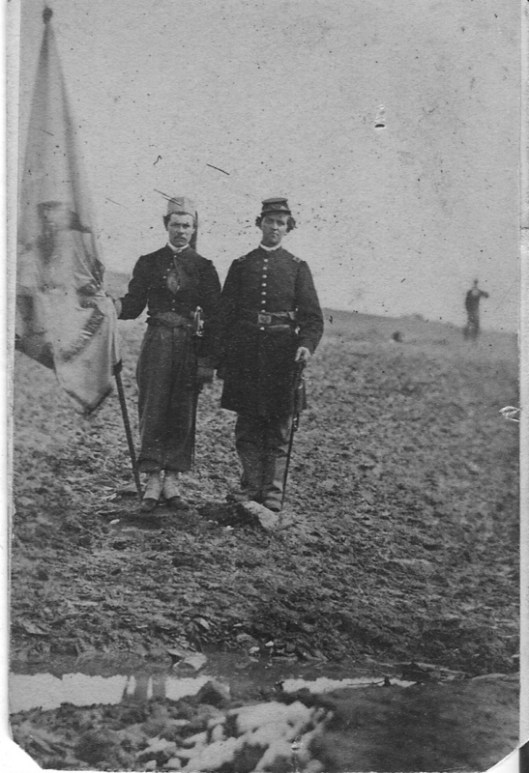
34th Ohio Volunteer Infantry Regiment, Piatt's Zouaves Soldiers Photo

34th Ohio Volunteer Infantry Regiment, Piatt’s Zouaves, Soldiers.

Clarksville (TN) Chronicle, 25 October 1861

The Fight in Logan County, Va.

[From the Richmond Whig of the 15th.]

We yesterday published the Yankee account of a battle in Logan county, which as usual, was manufactured out of whole cloth. The following are the facts as given by the South-western Times, (Tazewell county) of the 10th inst.:

From Samuel Smoot, Esq., of Boone county, who was in the fight, we learn the following particulars of the battle near Chapmanville, Logan county, on the 25th ult: The Yankees numbered 700, and commenced the attack upon our troops–the Logan militia–in a low gap between Guyandotte river and Big Creek, where they were engaged in raising a temporary breastwork. Our troops numbered 220, but there were only about 80 of them engaged in the fight. They were commanded by Col. J.W. Davis, of Greenbrier, a brave and gallant officer, who was severely, but not dangerously wounded, in the arm and breast. As soon as it became known that Col. Davis was wounded, the militia commenced a retreat. The commanding officer of the Lincoln troops afterwards confessed to Col. Davis, who was taken prisoner, that at the same moment a portion of the Yankees were running, and that one more round would have completely dispersed them.

The loss of the Yankees, by their own confession to Col. Davis, was 40 killed and a number wounded; among the former were four Union men, all of whom are represented by the Yankees to be most arrant thieves and cowards. Our loss was two killed and three or four wounded, besides Col. Davis, whose valuable services are at present lost to the Confederacy, being paroled by the enemy.

On the following day our scouts killed one of their pickets, and wounded another, at a point about half way between Logan Court House and Chapmanville, promising to give them particular thunder before daylight next morning. This with some news from a lady on the road, and some account of the militia of the surrounding counties, found on the person of Col. Davis, caused a hasty stampede for their headquarters, in the valley of the Kanawha. It seems that high water, bad roads, nor anything else could impede their rapid flight. They tore down a meeting house in Boone county to make rafts whereon to cross the river. They drowned two of their wounded, lost a wagon containing their entire stock of ammunition, and were fully persuaded that they were followed by two thousand cavalry, of which the Yankees in the West are about as fearful as their Eastern brothers are of masked batteries.

Upon the whole, we are much gratified at the result of this fight. It has, for the present, driven the cowardly thieves from the country, given renewed energy to the true patriots of Logan and the adjoining counties, fully convincing them that with the assistance of two or three hundred of their gallant friends in Tazewell county, they will be fully able to thrash any number that Gen. Cox or his friends shall dare to send against them.”

Note: An almost identical version of this story appeared in the Staunton (VA) Spectator on 22 October 1861.
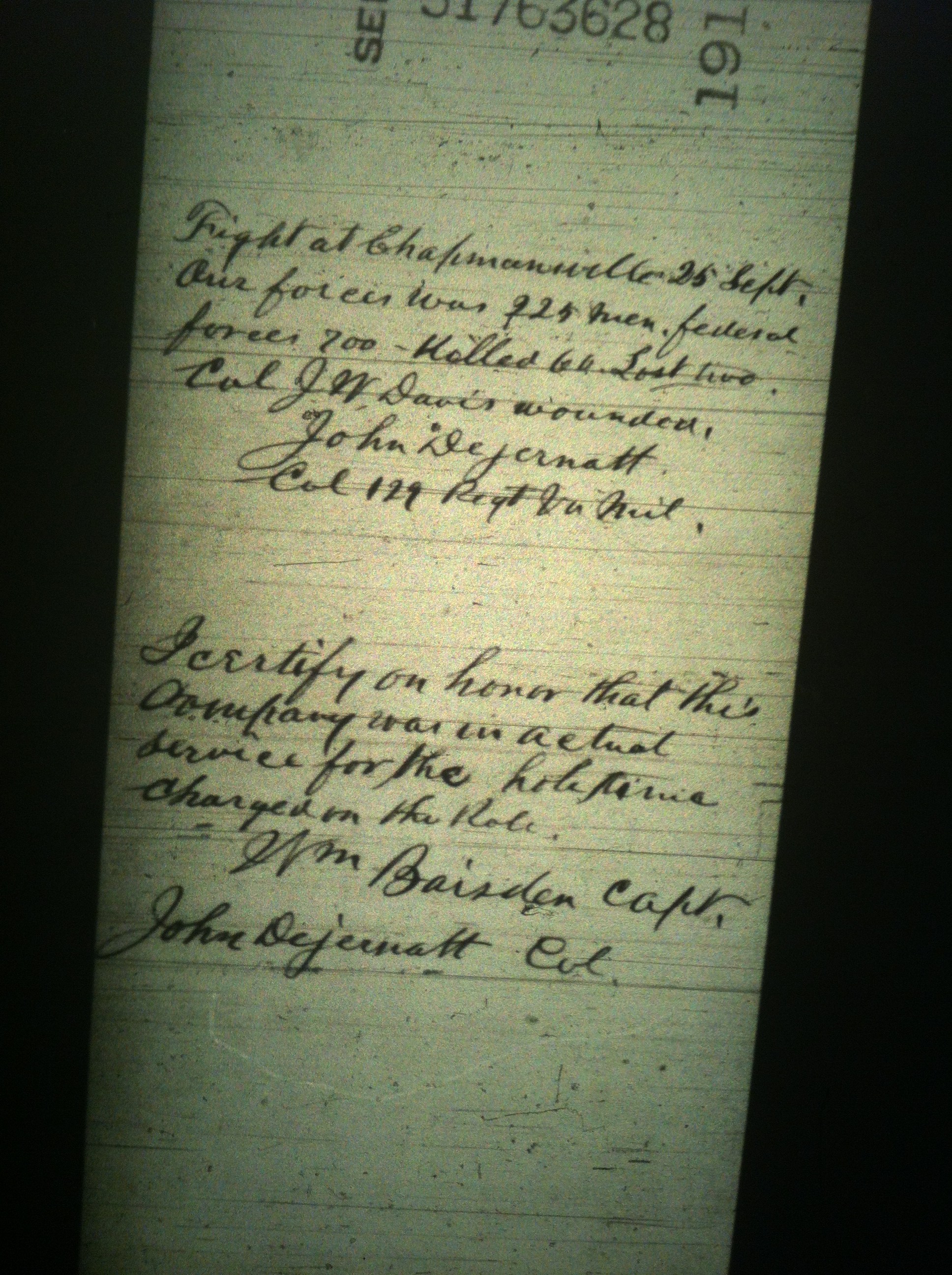
IMG_7149.JPG

Record relating to the 129th Virginia Militia (Confederate), which was present at the Battle of Kanawha Gap.
Charleston, WV: One Century Ago (1927)

25 Friday May 2018

Posted by Brandon Ray Kirk in Coal, Giles County, Native American History, Tazewell County

≈ Leave a comment

Tags

Alex W. Quarrier, Andrew Donnally, Benjamin F. Morris, C&O Railroad, Cabell County, Charles Droddy, Charles Page, Charleston, Clendenin, coal, Coal River, Coalsmouth, Daniel Boone, David Ruffner, Davis Creek, Donnally's Fort, Ebenezer Oakes, Elk River, Fleming Cobb, Fort Tackett, genealogy, Giles County, Greenbrier County, Henry Ruffner, Herbert P. Gaines, history, John P. Huddleston, John Young, Josiah Hughes, Kanawha County, Kanawha Court House, Kanawha Salines, Kanawha Valley, L.H. Oakes, Leonard Morris, Logan Banner, Logan County, Malden, Marmet, Mason Campbell, Mercer Academy, Michael Newhouse, Native Americans, Owen Jarrett, Point Pleasant, Roy J. Morris, salt, South Charleston, St. Albans, Tazewell County, The Western Virginian, Walton, West Virginia, William Cobb

From the Logan Banner of Logan, WV, in a story titled “Conditions Century Ago: Charleston Educator Tells of Settlement of Kanawha County Which Embraced Part of What Is Now Logan–With 550 Population Charleston Was Metropolis of Kanawha Valley,” comes this bit of history for the city of Charleston dated October 14, 1927:

Josiah Hughes, principal of the South Charleston graded schools, has written a sketch of Kanawha county, telling of the activities of a century and more ago. It is of interest here, because Logan county was created in 1824 from parts of Kanawha, Cabell, Giles and Tazewell, and because some of the pioneers he names have descendants in Logan. Kanawha county was formed Oct. 5, 1789. His article in part follows.

Charleston was the largest town in the valley, and had a population of approximately 550. It had its stores, its schools, its court house, its jail, its pillory, and its whipping post.

The postoffice at Charleston was “Kanawha C.H.” established under that name in 1801, and was so called until late in 1879. Among those who received their mail here one century ago were the following: Leonard Morris (an ancestor of Roy J. Morris, who is in the local C. & O. ticket office), probably the earliest of the pioneers of the valley; Fleming Cobb, the noted Indian scout, who lies buried near the mouth of Davis Creek; John P. Huddleston, who hunted and trapped with Daniel Boone; Alex W. Quarrier, who was many years clerk of the courts of Kanawha county; Herbert P. Gaines, founder of the first newspaper in Charleston; John Young, whose father saved him and his mother from death by Indians when Fort Tackett at the mouth of Coal River was destroyed about 1789; Dr. William Cobb, the first physician in this valley and the ancestor of the Cobb family near Clendenin; Michael Newhouse, a noted pioneer of Elk river; Ebenezer Oakes, a near ancestor of our townsman, L.H. Oakes; Charles Droddy, the first settler at Walton; Owen Jarrett, noted ancestor of the Jarrett family in Kanawha county; Col. David Ruffner, the noted business man whose enterprise made possible the establishment of Mercer Academy in Charleston one hundred and ten years ago; Benjamin Morris, a noted pioneer and near ancestor of Benjamin F. Morris of Marmet; Col. Andrew Donnally, whose father built Donnally’s Fort in Greenbrier county.

During the years 1825-1829. “The Western Virginian,” as it was called, was the only newspaper published in Charleston. Mason Campbell was editor.

50 Salt Furnaces

The first great industry in the Great Kanawha Valley was the manufacturing of salt. One hundred years ago more than fifty salt furnaces were in active operation. A few years later the annual production of salt reached upwards of 3,000,000 bushels.

Kanawha Salines, now Malden, was the center of the great industrial area. The salt companies had greater stores than could be found in Charleston and many of the citizens of Charleston went to Kanawha Salines to do their trading.

One hundred years ago only a few coal mines had been opened up. Wood was the principal fuel used at the salt furnaces. Prior to 1830 but little coal was used by the salt makers. The coal industry in this valley was of comparatively small value until the opening of the Chesapeake and Ohio railroad in 1873.

By 1827 three steamboats had succeeded in reaching Charleston. In 1830 the first towboat on the Kanawha reached Charleston.

Before the close of the first quarter of the nineteenth century missionaries of various churches had visited the valley and preached in the homes of the pioneers. The Protestant Episcopal church established parishes in Kanawha valley about 1821. The Rev. Charles Page was the preacher for the churches at Point Pleasant, Charleston and Coalsmouth (St. Albans). But the Presbyterian church was probably the pioneer in the valley, although small congregations of communicants of the Baptist and Methodist churches may have worshiped in the homes of some of the pioneers. Dr. Henry Ruffner organized the first Presbyterian church in Kanawha county in 1818. The church was organized in Charleston.

Origin of Coal (1927)

06 Sunday May 2018

Posted by Brandon Ray Kirk in Coal

≈ Leave a comment

Tags

Appalachia, Charles E. Krebs, Charleston, coal, history, Logan, Logan Banner, Mine Inspectors Institute of America, West Virginia

From the Logan Banner of Logan, WV, in a story titled “Origin of Coal,” comes this bit of coal history dated May 24, 1927:

ORIGIN OF COAL

It is a self evident fact that coal is of vegetable origin, and the evidence of which can be briefly stated, based on present scientific study of this subject:

1. Vegetable remains long extinct are found plentiful in close proximity with coal seams; stumps, roots, leaves and stems are found int eh slate overlying the seam and under clay, and are found even imbedded in the seams themselves.

2. This vegetation is associated with the coal seam and often becomes coal whiles till retaining its original form and structure.

3. This vegetation is found and recognized in the whole coal seam, even the coal ashes carefully examined under a powerful microscope show vegetable cells.

4. The perfect gradation may be traced from wood through the different kind of coal, and by chemical analysis.

5. Peats may be manufactured into a substance having many of the qualities of coal, and we may say further that all carbon and hydro carbon have organic matter.

The Flora or plant life of the coal measures are of the most abundant and perfect of all the extinct plants. It has been estimated that there are about 2000 known species of plant fossils in the coal measures. This Flora is really interesting to the geologist in that it furnishes a key to the evolution of the land plants. These plants are found preserved in some form in the coal seams in the overlying slate and rocks and underlying clays and slates.

From address by Charles E. Krebs, at convention of Mine Inspectors Institute of America, in session at Charleston last week.

Albert Dingess Family Cemetery (2018)

04 Friday May 2018

Posted by Brandon Ray Kirk in Cemeteries, Shively, Timber

≈ Leave a comment

Tags

Albert Dingess, Albert Dingess Family Cemetery, Appalachia, cemeteries, Charleston, genealogy, Harts Creek, history, James Bryant, Logan County, Martha Ann Dingess, Minerva Adkins, Shively, Shively Post Office, Smokehouse Fork, West Virginia, West Virginia State Archives, Works Progress Administration

IMG_9139

Albert Dingess Family Cemetery, Shively, Smokehouse Fork of Harts Creek, Logan County, WV. You can see the old Shively Post Office down past the trees and along the road. 28 April 2018.

IMG_9136

Albert Dingess Family Cemetery, Shively, Smokehouse Fork of Harts Creek, Logan County, WV. 28 April 2018.

Albert Dingess Grave 1

Albert Dingess was an important splasher and timberman on Harts Creek in Logan County, WV. His sister, Minerva (Dingess) Adkins, is my great-great-great-grandmother. 8 March 2013.

Martha Ann Bryant Dingess Grave

Martha Ann (Bryant) Dingess was Albert’s second wife. 8 March 2013.

Albert Dingess Cemetery Map

Here’s an old WPA map of the cemetery that shows graves for Albert Dingess and his father-in-law, James Bryant. Courtesy of the WV State Archives, Charleston, WV.

Island Creek Roads (1927)

19 Thursday Apr 2018

Posted by Brandon Ray Kirk in Boone County, Gilbert, Hamlin, Huntington, Logan, Ranger, West Hamlin, Wharncliffe

≈ Leave a comment

Tags

Appalachia, Beech Creek, Ben Creek, Bluefield, Bluestone River, Bob Browning, Boone County, Bramwell, Cabell County, Charleston, Coal Valley News, Commissioner of Agriculture, Crum, Davy, Devil Anse Hatfield, farming, Gilbert, Gilbert Creek, ginseng, Griffithsville, Guyandotte River, Hamlin, history, Horsepen Creek, Huntington, Iaeger, Island Creek, John W. Smith, Kanawha River, Lincoln County, Logan, Logan Banner, Logan County, M.L. Jones, Mate Creek, Pigeon Creek, Ranger, Route 10, Route 2, Route 3, Sarepta Workman, Tug Fork, Twelve Pole Creek, Wayne, Welch, West Hamlin, West Virginia, West Virginia by Rail and Trail, West Virginia Hills, Williamson

From the Logan Banner of Logan, WV, comes this bit of history about Route 3 dated October 14, 1927:

“Changes Can Be Noted” In Island Creek Hills

Madison Editor Waxes Interesting on Old Times and Primitive Conditions–Surfaced Highways Mark the Paths Through Woodland That Were Traveled a Generation Ago.

An article of special interest to Logan folk is here reproduced from the Coal Valley News (Madison) of which M.L. Jones is editor. In a reminiscent mood he tells of road conditions and other conditions that prevailed hereabouts a generation ago. Exceptions might be taken to one or two statements, but the whole article is interesting indeed and informative.

It is considered appropriate that West Virginians should sing the “West Virginia Hills,” and year after year the teachers in their institution disturb their neighbors with this song, while “Tears of regret will intrusively swell.” There is some romance and merit in the song; but it strikes us that it is about time for a revision of this line.

“But no changes can be noticed in the West Virginia Hills.”

To prove our point we quote from memory.

For some years after 1882, there lived in the extreme head of the left fork of Island Creek, or Main Island Creek, a man named Bob Browning. It was 18 miles from Logan. The house was a two-room log cabin, surrounded by palings; and the valley was so narrow that it was difficult to find enough level ground for a garden. Apple trees and peach trees were scattered over a few acres of cleared mountain side. The family subsisted by a little farming, a little hunting and much ginsenging.

This place was between two low mountain gaps. A dim road, usable for wagons in dry weather, led down the creek to Logan, and forked at Browning’s house. One fork led east over one gap to Horsepen and Gilbert of Guyan; the other went west over the other gap to Pigeon creek, and by more or less roundabout ways connected with Ben Creek, Beech Creek, Mate Creek and Pigeon Creek, all of Tug river. Hence, it was a possible road route.

The nearest house down Island creek and on Horsepen creek was two miles; and on Pigeon creek about three-fourths of a mile. A wagon, lightly loaded, passed here on the average six times a year. Horsemen may have averaged one a day, though often a whole week passed without a traveler. It was simply a log shack in the head of the hollow, four miles from a school, ten miles from a store, without anything “which exalts and embellishes civilized life,” and so very remote from the haunts of men that when “Devil” Anse Hatfield and his followers concluded to surrender Tug river to Frank Phillips and the McCoys, they picked their “last stand” on Island creek, four miles below the spot we have been talking about.

Now, in the close of 1927, can “changes be noticed?” We have not been there for over 30 years. But we recently received a present from John W. Smith, commissioner of agriculture , Charleston, W.Va., entitled “West Virginia by Rail and Trail,” containing 22 maps and 174 pictures reproduced from photographs of different parts of the state, and for which we sincerely thank whoever got our name on Mr. Smith’s mailing list.

From this book we learn that when we laboriously trudged through the Horsepen gap or the Pigeon gap, from 45 to 35 years ago, we failed to foresee that within on generation men would pick those two gaps, within less than a miles of each other, as a route for one of West Virginia’s leading roads; and not only for one, but for two, of West Virginia’s leading roads. As we will explain:

Route 3, connects Huntington, Wayne, Crum, Williamson, Gilbert, Iaeger, Davy, Welch, Bramwell, and Bluefield. From Huntington to Wayne and about 15 miles above Wayne, it is mostly on the waters of Twelve Pole creek. It then bears west to Tug river and follows it from Crum to Williamson, about 25 miles. It then bears east to Pigeon Creek, which it follows to the spot we are writing about, in the head of Island creek, some 20 miles. It then goes through the two gaps and down Horsepen creek to Gilbert, on Guyan; up Guyan and Little Huff’s creek, of Guyan, and across the mountain to Iaeger, on Tug river. It then follows up Tug, by Welch, to the head of Elkhorn and then on the waters of Bluestone to Bluefield.

In all, Route 3 is in seven counties, though less than a mile of it is in Logan county, in the head of Island creek. It is graded all the way about 60 percent of it is hard surfaced, including about 25 miles at and near the Bob Browning place. Thus Bob, if alive, can ride on a hard surfaced road from his old home almost to Williamson, one way, and to Gilbert on Guyan the other way; and he could continue south by graded road, until he strikes hard surface again. The last fifty miles next to Bluefield is all hard surfaced, also the lower 25 miles next to Huntington.

But this is not the only big state route hitting this “head of the hollow.”

Route 10 runs from Huntington to the very same spot, a distance of 100 miles, through Cabell, Lincoln and Logan, and is all on Guyan or its tributaries. It is paved, or hard surfaced, from Huntington to West Hamlin, on Guyan where the Hamlin-Griffithsville hard-surfaced road turns off. It is also marked paved for seven miles north of Logan and twelve miles up Island creek. This leaves six miles up by the “Devil” Anse Hatfield place to the Bob Browning place to pave, and it is marked, “paved road under construction.” The only drawback to No. 10 is that from West Hamlin to Ranger is a patch where the grading is not yet satisfactory. Doubtless, within three years both 3 and 10 will be hard surfaced all the way. Even now, from the Browning place, the people can take their choice between an evening’s entertainment in Logan or Williamson.

But that is not all yet. The chances are heavy that there will never be but one hard surfaced road from Logan to Williamson. There will always be a heavy travel from Charleston to Williamson. It will be by our No. 2 to Logan; by No. 10 to the Browning place; and by No. 3 to Williamson. Within a few months it will all be hard surfaced.

From all this we conclude.

First; that we let a good chance slip when we failed to buy a half acre of land where No. 10 joints No. 3 for a hotel and filling station. We could have multiplied our investment by one thousand. But so far as we could see that spot was fit only to hold and the rest of the Earth’s surface together, and to get away from as rapidly as possible.

Second; that “changes can be noticed in the West Virginia Hills.”

We might add that thousands can remember crossing the Kanawha at Charleston on the ferry, because there was no bridge; and few, if any, three-story homes. The writer hereof did his first plowing with a two-horse turning plow in the center of what is now Huntington. It was a cornfield then. It is a fashionable residence district now. He boarded at an isolated log house on a hill back of the Huntington bottom, where now are miles of mansions on paved streets. Even in and about Madison and all over Boone county, it is hard for people to visualize how things looked a short ten years ago. Mrs. Sarepta Workman, on her recent visit to her old…

← Older posts
Newer posts →

Feud Poll 1

If you had lived in the Harts Creek community during the 1880s, to which faction of feudists might you have given your loyalty?

Categories

  • Adkins Mill
  • African American History
  • American Revolutionary War
  • Ashland
  • Atenville
  • Banco
  • Barboursville
  • Battle of Blair Mountain
  • Beech Creek
  • Big Creek
  • Big Harts Creek
  • Big Sandy Valley
  • Big Ugly Creek
  • Boone County
  • Breeden
  • Calhoun County
  • Cemeteries
  • Chapmanville
  • Civil War
  • Clay County
  • Clothier
  • Coal
  • Cove Gap
  • Crawley Creek
  • Culture of Honor
  • Dingess
  • Dollie
  • Dunlow
  • East Lynn
  • Ed Haley
  • Eden Park
  • Enslow
  • Estep
  • Ethel
  • Ferrellsburg
  • Fourteen
  • French-Eversole Feud
  • Gilbert
  • Giles County
  • Gill
  • Green Shoal
  • Guyandotte River
  • Halcyon
  • Hamlin
  • Harts
  • Hatfield-McCoy Feud
  • Holden
  • Hungarian-American History
  • Huntington
  • Inez
  • Irish-Americans
  • Italian American History
  • Jamboree
  • Jewish History
  • John Hartford
  • Kermit
  • Kiahsville
  • Kitchen
  • Leet
  • Lincoln County Feud
  • Little Harts Creek
  • Logan
  • Man
  • Matewan
  • Meador
  • Midkiff
  • Monroe County
  • Montgomery County
  • Music
  • Native American History
  • Peach Creek
  • Pearl Adkins Diary
  • Pecks Mill
  • Peter Creek
  • Pikeville
  • Pilgrim
  • Poetry
  • Queens Ridge
  • Ranger
  • Rector
  • Roane County
  • Rowan County Feud
  • Salt Rock
  • Sand Creek
  • Shively
  • Spears
  • Sports
  • Spottswood
  • Spurlockville
  • Stiltner
  • Stone Branch
  • Tazewell County
  • Timber
  • Tom Dula
  • Toney
  • Turner-Howard Feud
  • Twelve Pole Creek
  • Uncategorized
  • Warren
  • Wayne
  • West Hamlin
  • Wewanta
  • Wharncliffe
  • Whirlwind
  • Williamson
  • Women's History
  • World War I
  • Wyoming County
  • Yantus

Feud Poll 2

Do you think Milt Haley and Green McCoy committed the ambush on Al and Hollene Brumfield in 1889?

Blogroll

  • Ancestry.com
  • Ashland (KY) Daily Independent News Article
  • Author FB page
  • Beckley (WV) Register-Herald News Article
  • Big Sandy News (KY) News Article
  • Blood in West Virginia FB
  • Blood in West Virginia order
  • Chapters TV Program
  • Facebook
  • Ghosts of Guyan
  • Herald-Dispatch News Article 1
  • Herald-Dispatch News Article 2
  • In Search of Ed Haley
  • Instagram
  • Lincoln (WV) Journal News Article
  • Lincoln (WV) Journal Thumbs Up
  • Lincoln County
  • Lincoln County Feud
  • Lincoln County Feud Lecture
  • LinkedIn
  • Logan (WV) Banner News Article
  • Lunch With Books
  • Our Overmountain Men: The Revolutionary War in Western Virginia (1775-1783)
  • Pinterest
  • Scarborough Society's Art and Lecture Series
  • Smithsonian Article
  • Spirit of Jefferson News Article
  • The Friendly Neighbor Radio Show 1
  • The Friendly Neighbor Radio Show 2
  • The Friendly Neighbor Radio Show 3
  • The Friendly Neighbor Radio Show 4
  • The New Yorker
  • The State Journal's 55 Good Things About WV
  • tumblr.
  • Twitter
  • Website
  • Weirton (WV) Daily Times Article
  • Wheeling (WV) Intelligencer News Article 1
  • Wheeling (WV) Intelligencer News Article 2
  • WOWK TV
  • Writers Can Read Open Mic Night

Feud Poll 3

Who do you think organized the ambush of Al and Hollene Brumfield in 1889?

Recent Posts

  • Logan County Jail in Logan, WV
  • Absentee Landowners of Magnolia District (1890, 1892, 1894)
  • Charles Spurlock Survey at Fourteen Mile Creek, Lincoln County, WV (1815)

Ed Haley Poll 1

What do you think caused Ed Haley to lose his sight when he was three years old?

Top Posts & Pages

  • Early Schools of Logan County, WV (1916)
  • Jack Dempsey’s Broadway Restaurant Location in New York City (2019)
  • Cotton Production in Antebellum Pike County, KY
  • Blood in West Virginia: Brumfield v. McCoy (2014)
  • Blood in West Virginia

Copyright

© Brandon Ray Kirk and brandonraykirk.wordpress.com, 1987-2023. Unauthorized use and/or duplication of this material without express and written permission from this blog’s author and/or owner is strictly prohibited. Excerpts and links may be used, provided that full and clear credit is given to Brandon Ray Kirk and brandonraykirk.wordpress.com with appropriate and specific direction to the original content.

Archives

  • February 2025
  • January 2025
  • October 2023
  • September 2023
  • December 2022
  • November 2022
  • May 2022
  • April 2022
  • February 2022
  • November 2021
  • October 2021
  • September 2021
  • June 2021
  • May 2021
  • April 2021
  • March 2021
  • February 2021
  • January 2021
  • December 2020
  • November 2020
  • October 2020
  • July 2020
  • June 2020
  • May 2020
  • April 2020
  • March 2020
  • February 2020
  • January 2020
  • December 2019
  • November 2019
  • October 2019
  • September 2019
  • August 2019
  • July 2019
  • June 2019
  • May 2019
  • April 2019
  • March 2019
  • February 2019
  • January 2019
  • December 2018
  • November 2018
  • October 2018
  • September 2018
  • August 2018
  • July 2018
  • June 2018
  • May 2018
  • April 2018
  • March 2018
  • February 2018
  • January 2018
  • December 2017
  • November 2017
  • October 2017
  • September 2017
  • August 2017
  • July 2017
  • June 2017
  • May 2017
  • April 2017
  • March 2017
  • February 2017
  • January 2017
  • December 2016
  • November 2016
  • October 2016
  • September 2016
  • August 2016
  • July 2016
  • June 2016
  • May 2016
  • April 2016
  • March 2016
  • February 2016
  • January 2016
  • December 2015
  • November 2015
  • October 2015
  • September 2015
  • August 2015
  • July 2015
  • June 2015
  • May 2015
  • April 2015
  • March 2015
  • February 2015
  • January 2015
  • December 2014
  • October 2014
  • September 2014
  • August 2014
  • July 2014
  • June 2014
  • May 2014
  • April 2014
  • March 2014
  • February 2014
  • January 2014
  • December 2013
  • November 2013
  • October 2013
  • September 2013
  • August 2013
  • July 2013
  • June 2013
  • May 2013
  • April 2013
  • March 2013
  • February 2013
  • January 2013
  • December 2012
  • November 2012

Enter your email address to follow this blog and receive notifications of new posts by email.

Join 2,927 other subscribers

Tags

Appalachia Ashland Big Creek Big Ugly Creek Blood in West Virginia Brandon Kirk Cabell County cemeteries Chapmanville Charleston civil war coal Confederate Army crime culture Ed Haley Ella Haley Ferrellsburg feud fiddler fiddling genealogy Green McCoy Guyandotte River Harts Harts Creek Hatfield-McCoy Feud history Huntington John Hartford Kentucky Lawrence Haley life Lincoln County Lincoln County Feud Logan Logan Banner Logan County Milt Haley Mingo County music Ohio photos timbering U.S. South Virginia Wayne County West Virginia Whirlwind writing

Blogs I Follow

  • OtterTales
  • Our Appalachia: A Blog Created by Students of Brandon Kirk
  • Piedmont Trails
  • Truman Capote
  • Appalachian Diaspora

BLOOD IN WEST VIRGINIA is now available for order at Amazon!

Blog at WordPress.com.

OtterTales

Writings from my travels and experiences. High and fine literature is wine, and mine is only water; but everybody likes water. Mark Twain

Our Appalachia: A Blog Created by Students of Brandon Kirk

This site is dedicated to the collection, preservation, and promotion of history and culture in Appalachia.

Piedmont Trails

Genealogy and History in North Carolina and Beyond

Truman Capote

A site about one of the most beautiful, interesting, tallented, outrageous and colorful personalities of the 20th Century

Appalachian Diaspora

  • Subscribe Subscribed
    • Brandon Ray Kirk
    • Join 789 other subscribers
    • Already have a WordPress.com account? Log in now.
    • Brandon Ray Kirk
    • Subscribe Subscribed
    • Sign up
    • Log in
    • Report this content
    • View site in Reader
    • Manage subscriptions
    • Collapse this bar
 

Loading Comments...