Boling Baker and Princess Aracoma (1937)

Tags

, , , , , , , , , , , , , , , , , , , , , , , , , , , , , , , , , , , , , , , , , , ,

From the Logan Banner of Logan, WV, comes this bit of history concerning Boling Baker and Princess Aracoma, dated March 23, 1937:

IMG_1668

Historical marker on Horse Pen Mountain near Gilbert, Mingo County, WV. 25 April 2015.

Dying Words of Princess Aracoma Related In Story Taken From Banner Files

Though much has been written on the history of Logan county, just as much has been forgotten about its early development.

One of the county’s first historians, Henry Clay Ragland, mayor of the city, church worker and editor of the Logan County Banner, recorded some of the high spots of the development of Logan county in a series of articles which he ran in his newspaper during 1896.

It is from this series of articles that the following story of the early settlement of Logan county is taken.

Records show that a large number of white men first set foot in what is now Logan county in the spring of 1777, when Captain Charles Hull with 20 men pursued a band of marauding Shawnees to the site where Oceana was later built. They lost the trail at Oceana and had to turn back. The Shawnees had raided a white settlement near the falls of New River one spring night and had stolen thirty head of horses. The army captain and his men set out in pursuit but the redskins had too great a start.

Huff Creek was given its name on this expedition in honor of Peter Huff who was killed in a skirmish on the banks of the stream as the men returned home. Huff was buried near the spot where he was killed, which is believed to have been near where the town of Mallory now stands.

Other men on this expedition and who returned to the valley of the Guyandotte later and built homes were John Cook, James Hines, William Dingess and James Hensley.

The first white man really to be identified with what is now Logan county was Boling Baker, a renegade white, but the old-timers would not give him credit for being a white man. They said: “He lived with the Injins and that makes him an Injin.” Baker, however dastardly he was, was indirectly responsible for the settlement of Logan county in 1780-85.

The renegade had one great weakness. A weakness that they hung men for in those days. He was a horse thief. He would take a party of Indians a hundred miles through the mountain passes of Logan county to raid a white settlement in order to steal 20 or 30 horses.

Baker had gone into the business on a large scale. At the head of Gilbert Creek, on Horse Pen Mountain, where the mountain rises abruptly with almost cliff-like sharpness, he had stripped bark from hickory trees and stretched it from tree to tree making a pen in which to keep his stolen stock.

Old settlers of the county who have had the story passed down to them from their great-grandfathers say that the pen was somewhere in the hollow below the road which leads to the fire tower on Horsepen Mountain. It was from this improvised corral of Boling Baker that the mountain was named.

But, back to how Baker was responsible for the settlement of the county.

He left his Indian camps on the Guyan river in the fall of 1780 and visited the white settlements in the Bluestone valley in the Flat Top mountain territory. There he told the settlers a story of how he had been captured by the Indians when he was a young man and had learned their ways. He said he had just escaped from the Shawnee tribe known to be hunting in the Guyandotte valley and was on his way back east to see his father and mother who lived in Boston. Shrewd chap, this Baker!

The settlers were taken in by his story and allowed him to remain with them for several weeks during which time he got the location of all the settlers barns well in mind and after a time departed “back east.”

Soon after the renegade left the Bluestone settlement the whites awoke one rainy morning late in autumn and found every barn empty. The Indians had come with the storm which lashed the valley and had gone without arousing a person. Thirty horses from the settlement went with them.

An expedition headed by Wm. S. Madison and John Breckinridge—son of the Breckinridges who settled much of Kentucky—was made up in a neighboring settlement and set out in pursuit of the thieving Shawnees.

They trailed the party over Flat Top Mountain and southwest to the headwaters of the Guyan River by way of Rockcastle creek and Clear Fork. Trail marks showed that the band had gone down the river, up Gilbert Creek to Baker’s pen and thence over the mountain.

Madison and his 75 men did not follow the Indian trail over the mountain but the redskins probably brought their herd of 50 or 75 horses down Island Creek to the Guyan.

The white expedition chose to follow the Guyan in a hope that they would find the party encamped somewhere along its banks. Scouts had reported that a large tribe of Indians used the Guyan valley as its hunting grounds.

Madison’s party followed the river down to Buffalo Creek—named because the white men found such a large number of buffalo grazing in its bottoms—crossed Rum Creek and pitched camp for a night at the mouth of Dingess Run because “Guyan” Green and John Carter, scouts sent ahead to reconnoiter, had reported finding ten Indian lodges in the canebrakes of an island formed by the joining of a large creek and the Guyan river.

The men rested on their guns for the night and the following morning divided into two parties and attacked the encampment from the front and rear.

In the furious fighting that followed, nine of the thirty Indians in the camp were killed and ten or twelve wounded. Only a few escaped the slaughter of the white men. Among those captured was an old squaw 50 or 60 years old, who by her bearing, was obviously leader of the party. She was wounded but refused to talk.

Near midnight, however, following the massacre of the camp the old squaw felt death creeping upon her and called Madison to her quarters, and told him in broken English the following:

“I am the wife of a pale face who came across the great waters to make war on my people, but came to us and became one of us. A great plague many moons ago carried off my children with a great number of my people, and they lay buried just above the bend in the river. Bury me with them with my face to the setting sun that I may see my people in their march to the happy hunting ground. For your kindness I warn you to make haste in returning to your homes, for my people are still powerful, and will return to avenge my death.”

The proud princess died before morning and the white men buried her “near the bend in the river.” The Indian captives were all killed.

Four days later the men returned to the valley of the Bluestone.

Among those who helped Wm. S. Madison rout the Shawnees and who vowed to possess the valley of the Guyandotte for themselves and their children were George Booth, George Berry, Elias Harman, Ben Stewart, Abner Vance, Joseph Workman, Ben White and James White. All these names are familiar in the county today.

After the Indians were pushed to the west, surveyors allotted the land to the first settlers who had dared, with Madison, to come into the wilderness of the Guyandotte and open it up for the white man.

Madison owned several thousand acres of land on Island Creek, Gilbert Creek and Dingess Run. Other fighters were given like parcels of land.

Source: Logan (WV) Banner, 23 March 1937

Thomas Dunn English and “Ben Bolt” (1928)

Tags

, , , , , , , , , , , , , , , , , , , , , , , , , , , , , ,

From the Logan Banner of Logan, WV, comes this bit of history concerning Thomas Dunn English and his famous poem “Ben Bolt,” which was reportedly composed in Logan:

Poem Ben Bolt Not Written In This City

Legend Concerning Thomas Dunn English Is Refuted by Roy Fuller in Magazine Article

Another forceful kick has been directed against the legend that Thomas Dunn English wrote the poem Ben Bolt under the big elms back of the former Vicie Nighbert home, now known as the Green Gables Inn.

Though all reliable investigators agree that this famous poem was written before Dr. English settled in this community, the legend survives with a strange pertinacity.

The subject is discarded in an interesting and enlightening way in the current number of the West Virginia Review by J. Roy Fuller. He has written before in a similar vein for other publications.

Fuller, a native of Wayne county, had been connected with Charleston, Huntington, and Welch papers for several years. Recently he went to New York to take an editorial position on Picture Play. On the subject “As to Ben Bolt,” he writes as follows:

If a man writes a poem a little more sentimental than any other, and then some ten years later moves to another state, it seems that the towns and counties around his new home will, years later, recall the very spot where the poem was written. Such has been the case with Ben Bolt, by Thomas Dunn English. The people of Logan county point with pride to the very tree under which the poet scribbled Ben Bolt, and time and again articles have been written in support of the legend, and people who speak of it choose to believe nothing else. Why this should be considered in the least important is amusing. But that is not all. In McDowell county, it is said, Thomas Dunn English wrote the feverish lines while at the old county seat town, now called English. A clerk in a hotel informed this writer that he knew exactly where Ben Bolt was written and offered to show him the house somewhere just over the Virginia state line.

The rare honor of being the birthplace of Ben Bolt cannot be claimed truthfully for this section at all. It was written in Philadelphia nine years before he ever came to West Virginia. There was no romantic posing over the grave of the beloved lady in the song as it has been said in Logan county. A New York editor asked English to write something for him. He insisted, and finally English mailed the verses with instructions to burn them if not satisfactory, after combining parts of two poems into one. So any weeping we do can be for our own images, and not for sympathy with the poor poet.

English was once postmaster of Logan (1857), and also a resident doctor, politician, poet and lawyer. One time he attended a convention in Staunton where he made a speech that was influential in helping to bring about the downfall of Know-Nothingism. He wrote many local poems such as Rafting on the Guyan, Logan Grazier, and Wyoming Hunter. Before coming to the south he was well known in the east and was mentioned—unfavorably—by Edgar Allan Poe in his Literati. For calling him Thomas Dunn “Brown,” English wrote a severe criticism of Poe. Some time later Poe answered him in a Philadelphia paper, and brought suit against him. Poe was awarded $225 damages for English’s sarcastic literary thrust.

It has always been a matter of chagrin to English that his Ben Bolt was the most popular of his literary works. He himself called the song “twaddle.” But the German melody, mention of old mills, school, a loved one, friendship—these things made it take hold of the heart.

He wrote Ben Bolt in 1843 after having dabbled in his professions for several years, and quite unexpectedly found himself famous. The story of the song will show how far removed it is from the cherished pastoral story told in Logan county. The story persists, however, this being one of the cases where the “moving finger writes,” etc., and nothing more can be done about it.

N.P. Willis and George P. Morris had revived the old New York Mirror. The former asked English to write a poem for the paper and suggested a sea song. English tried to write it after renewed pressure but he reported to the editors that his muse was not working. Later he drifted into reminiscence and produced four and a half stanzas of the well known song. His muse balked again, and after some thought he added the first four lines of a sea song he had started and sent the whole with a note to Willis telling him that he would send something else when he was in a better writing mood. The poem was printed with a little puff, and was signed with the author’s initial.

Later it was suggested that the poem be set to music, but several attempts failed. English composed a melody for it, but another got the start of his. In 1846 Charles Porter, manager of the Pittsburgh theatre had Nelson F. Kneass, a fine tenor, in his company. Porter told the singer that if he could find a song suitable for his voice he would cast him in The Battle of Buena Vista. An Englishman, a sort of hanger-on named Hunt, had read Ben Bolt and could recall most of it. The gaps were patched up and to this Kneass adapted a German air and sang the piece. The drama was soon dropped but the song took the country by

Source: Logan (WV) Banner, 11 December 1928

Whirlwind News 03.22.1929

Tags

, , , , , , , , , , , , ,

An unknown correspondent from Whirlwind in Logan County, West Virginia, offered the following items, which the Logan Banner printed on March 22, 1929:

Miss Mandy Farley was the all night guest of Mrs. Daniel McCloud Saturday.

We are listening for the wedding bells to ring on Hoover. Hurry up, Leonard.

Burl Mullins made a business trip to Huntington Monday.

Miss Garnet Mullins is on the sick list this week.

Wash Dempsey Deed to Risba Lambert (1905)

Tags

, , , , , , , , , , , , , , , , ,

Wash Dempsey to Risby Lambert Deed 3

Deed Book ____, page 394, Lincoln County Clerk’s Office, Hamlin, WV.

Wash Dempsey to Risby Lambert Deed 4

Deed Book ____, page 395, Lincoln County Clerk’s Office, Hamlin, WV. Justice Charles Adkins, who certified this deed, is my great-great-great-grandfather.

Democratic Party Intimidation in Logan County, WV (1924)

Tags

, , , , , , , , , , , , , , , , , , , , , , , , , , ,

Political history for Logan County, West Virginia, during the 1920s was particularly eventful; it included the latter years of Sheriff Don Chafin’s rule, the Mine Wars (“armed march”), Republican Party ascendancy, and the rise of Republican sheriffs Tennis and Joe Hatfield. What follows are selected primary source documents relating to this period:

UNITED STATES OF AMERICA

SOUTHERN DISTRICT OF WEST VIRGINIA,

HUNTINGTON DIVISION

Before the undersigned authority, Ira P. Hager, a United States Commissioner in and for said District, Ed Dingess, who after being by me first duly sworn, says that he is thirty-seven years of age, married, resides at Cherry Tree Bottom, Logan County, and works in the ice business during the summer season.

That on November 2nd, 1924, affiant was in the Marshal’s office at Logan, when a man who lived at Cora came in and reported that Lee Belcher had ordered him to leave Cora, where he lived, on account of his having Republican literature on his car and house, stating that the said Lee Belcher, Deputy Sheriff had threatened to do him bodily injury, that affiant along with Henry Sansom was deputized by one of the Deputy Marshals to go to Cora and protect the man, he being afraid to return to his home without protection. That affiant and the said Henry Sansom were in Cora, guarding the man, and Lee Belcher came up and said, “Are you fellows here to guard these men out of here?” And I said, “Yes.” And he said, “The county ought to be filled up with good looking men like us.” And I replied “that it was pretty well full.” He then went away and did not make any trouble for us. On the night of the election I went to the Court House at Logan to ascertain the results of the election, and as I went through the corridors of the Court House I met Lee Belcher, and he said, “What was you doing in Cora, you god-damned son-of-a-bitch, that is my town.” He said, “I am running Cora,” and made at me with his pistol, and John Dingess, who used to be a deputy, pulled his pistol and said, “Give it to him, god-damned son-of-a-bitch,” and repeated it several times. John Dingess kept his pistol drawn on me while Lee Belcher beat me about the face. The scars and bruises are visible on my face where I was struck. I tried to shove off his licks, but he hit me twice, and Simp Thompson ran in and stopped him, and I presume that Thompson saved me.

I bled right much and suffered considerable pain as a result of the blows.

Ed Dingess

Taken, subscribed and sworn to before me this the 8th day of November, A.D., 1924.

Ira P. Hager

United States Commissioner as aforesaid.

***

UNITED STATES OF AMERICA

SOUTHERN DISTRICT OF WEST VIRGINIA,

HUNTINGTON DIVISION

Before the undersigned authority this day personally came Thomas Fisher, who after being by me first duly sworn, says:

That he was deputized by Hugh Deskins, at Mud Fork, on election day, after the said Hugh Deskins, Deputy U.S. Marshal, had been assaulted by Don Chafin, Sheriff of Logan County, and that the said Hugh Deskins gave affiant a pistol, and about thirty minutes after affiant was deputized, the said Don Chafin came around and arrested affiant, and took the pistol away from affiant, and turned affiant over to Deputy Sheriff Randolph Dial, who took affiant to jail, where affiant was kept until the next morning. Affiant lost his vote. Affiant asked the said Randolph Dial to let him vote, having told the said Randolph Dial that affiant had not voted, and the said Randolph Dial said, “I haven’t time to fool with you.” So affiant lost his vote.

Affiant saw Don Chafin assault Hugh Deskins, Deputy U.S. Marshal. Hugh Deskins was standing on the election ground and Don Chafin drove up in his car. Hugh was standing with his hands folded and Chafin walked up and hit him on the side of the face under the left ear. Deskins backed off, and Chafin said, “Don’t you like that? If you don’t, I will give you some more.” Chafin drove off in his car and in a little while came back and one of the Mounts boys called to Don and pointed me out and then Don arrested me. When Chafin arrested me I told him that I was deputized by a United States Deputy Marshal and he said, “That don’t go here.”

Thomas Fisher

Taken, subscribed and sworn to before me this the 8th day of November, 1924.

Ira P. Hager

U.S. Commissioner

Jake Kinser of Logan County, WV (1936-1937)

Tags

, , , , , , , , , , , , , , , , , , , , , , , , , , , , , , , , , , , , , , , , , , , , , , , , , ,

Jake Kinser Visits LB 06.20.1936 1

Logan (WV) Banner, 20 June 1936. Note: Jacob was not born in 1850, so he does not appear with his family in the 1850 Census for Wythe County, Virginia. He was nine years old in the 1860 Census for Smyth County, Virginia.

Jake Kinser Recollections LB 11.12.1936 2

Logan (WV) Banner, 12 November 1936. Note: Jake Kinser appears as a seventeen-year-old fellow in the 1870 Census for Boone County, West Virginia (Washington Township).

Jake Kinser and Jane Mullins LB 07.07.1937 2

Jake Kinser and his sister Jane Mullins, Logan (WV) Banner, 7 July 1937. 

Jake Kinser and Jane Mullins LB 07.07.1937 3

Jake Kinser and his sister Jane Mullins, Logan (WV) Banner, 7 July 1937. Note: Mary Jane (Kinser) Mullins was eleven years old in the 1860 Census for Smyth County, Virginia. Mr. Kinser died in 1944; his death record can be found here: http://www.wvculture.org/vrr/va_view2.aspx?FilmNumber=571280&ImageNumber=349


Paw Paw Incident: James McCoy Deposition (1889)

Tags

, , , , , , , , , , , , , , , , , , , , , , , , , , , , , , , , , , ,

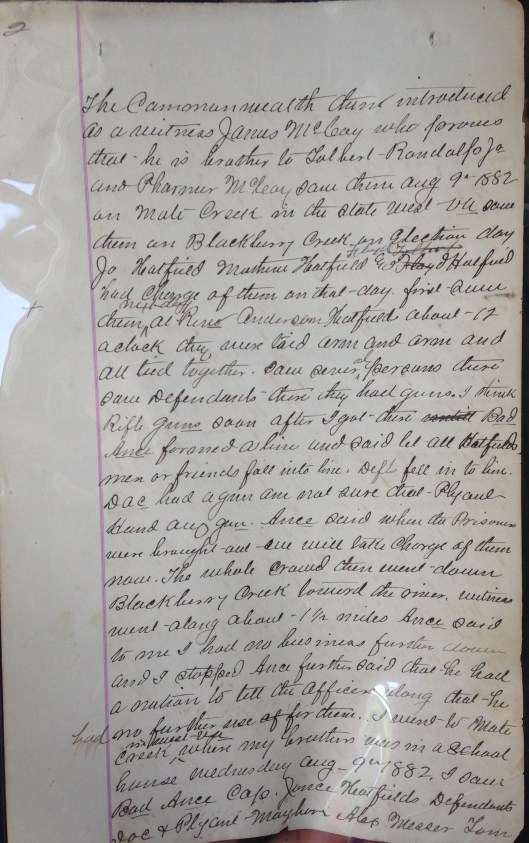
The killing of Tolbert, Pharmer, and Bud McCoy by a Hatfield-led gang on August 8, 1882 represented one of the most sensational events of the Hatfield-McCoy Feud. What follows is Plyant Mayhorn’s deposition regarding the affair:

COMMONWEALTH VS DOC MAYHORN &C

Bill of Exceptions

FILED Sept. 1889

G.W. Pinson, Clk

IMG_9720.JPG

The Commonwealth then introduced as a witness James McCoy who proves that he is brother to Tolbert, Randolp (sic) Jr. and Pharmer McCoy. Saw them Aug 9, 1882 on Mate Creek in the state West Va. Saw them on Blackberry Creek on Election day. Jo Hatfield, Mathew Hatfield and Floyd Hatfield had charge off them on that day. First saw them next day at Rev. Anderson Hatfield about 12 o’clock. They were tied arm and arm and all tied together. Saw several persons there. Saw Defendants there. They had guns. I think Rifle guns. Soon after I got there Bad Ance formed a line and said let all Hatfield men or friends fall into line. Deft. fell in to line. Doc had a gun. Am not sure that Plyant had any gun. Ance said when the Prisoners were brought out we will take charge of them now. The whole crowd then went down Blackberry Creek toward the river. Witness went along about 1 ½ miles. Ance said to me I had no business further down and I stopped. Ance further said that he had a notion to tell the officers along that he had no further use for them. I went to Mate Creek in West Va. where my brothers was in a School house Wednesday Aug 9th 1882. I saw Bad Ance, Cap, Jonce Hatfields Defendants Doc & Plyant Mayhorn, Alex Messer, Tom Mitchell and some others. Defendants had guns some times. I left there about 3 o’clock p.m. Went down to mouth Mate Creek, staid a few minutes at Sam Simpkin’s. Then went to Asa McCoy’s at mouth Sulphur. I saw Wall with a papers. Do not know what it contained and heard Wall call for signers. Saw Plyant walk up to Wall but can not say whether he signed it or not. Saw Plyant with Wall & Elias Hatfield and Elijah Mounts that evening late at the mouth Mate Creek. They went up river. Saw them again just after dark pass down by the mouth of Sulphur. I was there and they had not been gone by perhaps 20 minutes when I heard a volley of guns or pistols fired on the Ky side of the river about ½ way between Mouth Sulphur and Mate Creek but on the opposite side of the river from Sulphur. My brothers was dead when I found them. Anderson Ferrell went with him to find them. Found on the Ky shore short distance from river in a sink or flat all tied together and to two Paw Paw Bushes. Tolbert had one hand over his head. Made an examination of my brothers and found Pharmer shot 16 times. Randolph with the whole top of his head shot off. Six or seven shots in Tolbert. We removed them in a sled. They were all burried in one coffin. Elias Hatfield had a gun as they passed me at the mouth of Sulphur, there was one horse in the crowd was considerably excited at times. The officers had the boys in charge for murdering Ellison Hatfield. There were a great many men along who had guns that are not indicted. There was six or seven guards and some that were not guards along with my brothers. I do not know where any one objected to my brothers being brought to Pikevill or not. I can not tell all the parties who had guns. Ellison Hatfield died about 2 ½ or 3 oclock Wednesday Aug 9, 1882. The men who taken the corps of Ellison Hatfield to Elias Hatfields was a part of the men he had seen at the school house. My brothers were found dead in Pike County Ky. Wall Hatfield is the brother of Ance, Elison & Elias Hatfield, and the father in law of the defts. When I saw my brothers at Rev. Anderson Hatfield’s there was also present Ance, Cap, Johns, Wall & Elias Hatfield. Carpenter, Dan Whitt, Messer, Murphy, Mose Christian and defts. When I found my brothers dead they were tied together and to two paw paw bushes. When Wall, Elias, & deft. Plyant Mahorn found me near the mouth of Sulphur at dark they were passing from the direction of Joe Davis’ at mo. Blackberry and going in the direction of the mouth Mate. From Jo Davis’ to mouth of Sulphur is about ½ mile, and from Sulphur to mouth Mate is about ½ mile. From the point where my brothers were found dead in Pike Co Ky is _____ in WVa immediately opposite is about 125 yards. As soon as they passed me near the mouth of Sulphur I ___ my horse pulled some grass and fed him, went back and sat down on the porch, and the firing directly began. I think it was 20 minutes after they passed until the firing began. I think I heard 50 shots. After the volley ceased there was one loud shot.

Written in the margin: Soon after this I went down to Ferrell’s and ___ Simpkins and myself went and found my brothers.

For more information about this incident, follow these links:

http://explorekyhistory.ky.gov/items/show/785?tour=55&index=3

http://wvpublic.org/post/three-mccoys-killed-hatfields-kentucky-august-8-1882#stream/0

http://hatfield-mccoytruth.com/2017/04/22/in-hatfield-country-blackberry-creek-in-the-1880s/

James Browning Deed to Josiah Browning (1856)

Tags

, , , , , , , , , , , , , , ,

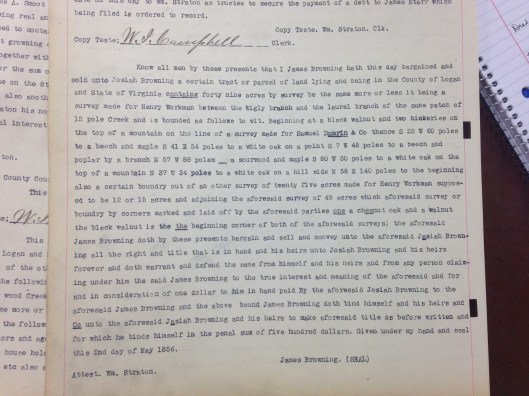
James Browning to Josiah Browning Deed 1

Deed Book C, page 482, Logan County Clerk’s Office, Logan, WV.

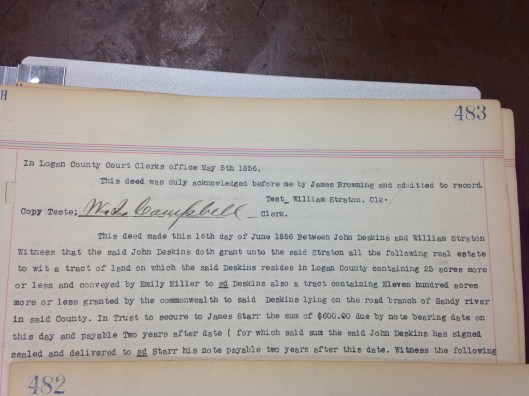
James Browning to Josiah Browning Deed 2

Deed Book C, page 483, Logan County Clerk’s Office, Logan, WV.

Democratic Party Intimidation in Logan County, WV (1924)

Tags

, , , , , , , , , , , , , , , , , , , , , , , , ,

Political history for Logan County, West Virginia, during the 1920s was particularly eventful; it included the latter years of Sheriff Don Chafin’s rule, the Mine Wars (“armed march”), Republican Party ascendancy, and the rise of Republican sheriffs Tennis and Joe Hatfield. What follows are selected primary source documents relating to this period:

UNITED STATES OF AMERICA

SOUTHERN DISTRICT OF WEST VIRGINIA,

HUNTINGTON DIVISION

John Cooley being by the undersigned authority first duly sworn, says that on the 5th day of November, A.D., 1924, he was on his way from work, and was traveling along the county road through the Town of Switzer, in Logan County, having been a mule driver, was riding his mule. Orville Hall was with affiant. I was riding and Orville was walking. We saw a car coming, with Jack Meadows and Buck Adams, Deputy Sheriffs in the car, with some other men we did not know. When they approached us, about 300 yards away, they began firing their pistols shooting down by the side of the car into the ground. They kept shooting until they came up where we were, and shot by the side of the mule I was riding, and frightened him right much, but the mule did not throw me. They shot within about three feet of the mule. Several citizens heard the shots in Switzer, and some of them saw it.

We went before G.F. Gore to get a warrant for the men, and he ask us who did the shooting, and we told him, and he said, “They are deputies. I do not see how you can do anything with them.”

John Colley

Taken, subscribed and sworn to before me this the 8th day of November, A.D., 1924.

Ira P. Hager

United States Commissioner as aforesaid.

***

UNITED STATES OF AMERICA

SOUTHERN DISTRICT OF WEST VIRGINIA,

HUNTINGTON DIVISION

Before the undersigned authority, Ira P. Hager, a United States Commissioner in and for said District, personally appeared this day Jesse Yeager, who after being by me first duly sworn, says that he resides at Stollings (or McConnell), Logan County, in said District.

That on November 5th, 1924, being election day, affiant went to the Court House to ascertain the results of the election, and affiant was standing in the crowded room. Wayne Grover came up to affiant and said, “God dam you, you haven’t any business here. You are legging for the Republican Party.” And at the same time struck this affiant in the side of the head with some sort of weapon, which affiant believes was a black-jack. That affiant fell to the floor in a dazed condition, very much injured, and affiant’s hip was almost broken, and affiant suffered a great deal on account of the same.

There were no arrests made. He ran back into the crowd as soon as he struck me. Affiant never had any trouble or hard feelings against the said Wayne Grover, and there was no excuse or provocation for the assault, except that affiant worked for the Republican Party in the election.

Jesse Yeager

Taken, subscribed and sworn to before me this the 8th day of November, 1924.

Ira P. Hager

United States Commissioner as aforesaid.

Paw Paw Incident: Plyant Mahon Deposition (1889)

Tags

, , , , , , , , , , , , , , , , , , , , , , , , , , , , ,

The killing of Tolbert, Pharmer, and Bud McCoy by a Hatfield-led gang on August 8, 1882 represented one of the most sensational events of the Hatfield-McCoy Feud. What follows is Plyant Mayhorn’s deposition regarding the affair:

COMMONWEALTH VS DOC MAYHORN &C

Bill of Exceptions

FILED Sept. 1889

G.W. Pinson, Clk

IMG_9733.JPG

PLYANT MAHORN

The defendant had sworn as a witness Plyant Mahorn who proves that I was at Doc Mayhorn house on Beech Creek when Eaf Hatfield came and said that Ellison Hatfield had been stabbed shot and killed and that his father had Wall Hatfield had sent word for them to send him his horse and Doc went down to Wall’s House. He was away from home and at the mouth of beech. I went back home and got my horse and at the request of Wall’s wife who is my mother in law me and Doc took Wall’s Horse to him. We found him near the mouth of Beech Creek some ten miles above Blackberry. We all concluded we would come down and see Ellison that at that nor no other time was there any thing said by him or by Wall or any other person in his presents that they was to be any harm done to any person. That he did not know who had hurt Ellison until he got to Blackberry Creek. Then they learned who it was and that they had taken Ellison out and they then heard that the boys that had cut and shot him. Ellison was to have a trial up on Blackberry that day and they that is he and Doc and some others concluded to go up and hear the trial. They went up and Just above Rev. Anderson Hatfield’s they met quite a crowd coming down the creek with the McCoy boys. Ance, Capt., Jonce, Wall & Elias Hatfield, C. Carpenter, Alex Messer, & others were along. I reined my horse and of the ___ and let them pass and fell in behind. They went on down to Rev. Anderson Hatfield when they all stopped for dinner me, Doc, John C. France, Mose Christian and perhaps others turned our horses in the pasture below the house and after dinner we got tired waiting for trial and went down into the field to catch our horses and while or as we came up through the field with our horses the crowd was going down around the field. We come out and soon got on our horses and went on down. When got to the mouth of Blackberry I seen the McCoy boys sitting on a log. Me and Doc went across to McFannin’s store and I went in. Did not see them cross the river. Doc was in the yard and I heard they had crossed and [I cropped bottom of photo] an hour me and Doc got on our horses and went on down to Anderson Ferrell’s where Ellison Hatfield was and staid there and helped to wait on him all night. Did not see the McCoy boys until next morning. Went to the school house. Was there a short time. Did not see Mrs. McCoy there. Was back there again that evening and did not see her there. He did not see her over there. Was only at the school House twice. Had no gun nor pistol from the time I left home during the whole time I was gone. Was not across the river in Kentucky any more until after the Boys was killed. Had no understanding with any one nor did I know that such a thing was to be done. He heard no intimidation from any one that the boys were to be killed. That he went up the river with Wall & Elias Hatfield and Elijah Mounts to Jo Davis and staid a short time and went back and went just below the mouth of Sulphur ___ heard the firing of guns or pistols. I said to Mounts want (sic) in the worlds does that mean and Mounts said I don’t know. I was shocked. Did not know what __ ____. Went on down River and up Mate. Me & Doc staid at Henry Mitchell’s all night next went and helped bury Ellison and went across the hill home. Remained there at work until we was brot over here I had at no time any purpose of mind in me or any intention of doing harm to the McCoy boys or any one else. I was a good friend to the McCoy boys. Never had any thing against them when we met them coming down blackberry __ between Rev. Andersons once what called the waste hous it was about ¼ mile above Andersons me and them Did not hear an owl hoot or a person hoot like an owl between the time we left Jo Davis and the time the crowd from over the river come to us on Mate that he heard nothing that was said between Jo Davis Wall & Elias Hatfield. He was ten or 15 steps away at the time. My brother Sam and Dock went with me to the mouth of Beech and we left with Wall about day. It is about 3 miles from Wall Hatfields to the mo. Beech.

Written on left margin (and marked through): We left home on Tuesday and got a ___ ____ of Br__ where Wall was about daylight.

For more information about this incident, follow these links:

http://explorekyhistory.ky.gov/items/show/785?tour=55&index=3

http://wvpublic.org/post/three-mccoys-killed-hatfields-kentucky-august-8-1882#stream/0

http://hatfield-mccoytruth.com/2017/04/22/in-hatfield-country-blackberry-creek-in-the-1880s/

Counterfeiters in Logan County, WV (1836)

Tags

, , , , , , , , ,

From the Richmond Enquirer comes this bit of history about counterfeiters in present-day Logan County, WV:

LAWS CASE. At the late term of the Federal Court, Judge Caldwell presiding, holden at Staunton, on the 2d of this month, the trial of Peter Dinges came up on a charge of having passed counterfeit notes purporting to have been issues by the bank of the United States. Upon a full investigation, which lasted several days, the jury found the prisoner guilty of the offense, provided there was then in existence any law which punishes such an offense; upon this verdict the court gave judgment for the prisoner. There were several other indictments against this man for similar offenses, and demurers being filed to all of them, on the ground that the bank charter having expired, all further prosecution was at an end, and the court being of that opinion, the prisoner was discharged; but forthwith taken into custody by the State authorities.

We understand it to be a principle of criminal law, that when a statute creates an offense, and defines its punishment, and is limited in its duration, no conviction can lawfully be had after the expiration of the statue, unless such an event be officially provided for. No such provision is contained in the bank charter.

This man being one of the principal chiefs of counterfeiters, and venders of base money, it is to be, regretted that he was not brought to trial during the existence of the law against which he has offended. His example in the country in which he has resided must have been very pernicious. He possesses considerable property, is a colonel in the militia, and has been elected twice to the House of Delegates by the citizens of Logan county, where he resides.

Two of Dingess’ confederates, of equal consideration with himself, were arrested by the deputy marshals appointed for the purpose, but made their escape, and have left the country. Two others, having a separate establishment, were indicted, and held to bail, and shortly before court sat, left the State, their securities accompanying them. Four others have been sentenced for long periods, one to the penitentiary at Richmond, the others to the penitentiary in the District of Columbia.

These prosecutions have totally broken up the establishment for counterfeiting notes and bills on the Bank of the United States, and on the various Banks of Virginia, which had so long infested the Southwestern part of this State.

Much credit is due to the marshal of this district for the plans laid by him to detect these men, and the address with which he carried them into execution. In this matter he has been engaged for two years past and has accomplished much for the security of society.

Source: Richmond (VA) Enquirer, 7 June 1836

Democratic Party Intimidation in Logan County, WV (1924)

Tags

, , , , , , , , , , , , , , , , , , , , , , ,

Political history for Logan County, West Virginia, during the 1920s was particularly eventful; it included the latter years of Sheriff Don Chafin’s rule, the Mine Wars (“armed march”), Republican Party ascendancy, and the rise of Republican sheriffs Tennis and Joe Hatfield. What follows are selected primary source documents relating to this period:

UNITED STATES OF AMERICA

SOUTHERN DISTRICT OF WEST VIRGINIA,

HUNTINGTON DIVISION

Before the undersigned authority this day personally came Orville Hall, who after being by me first duly sworn, deposes and says that he is sixteen years of age, resides at Switzer, Logan County, and is employed by the Switzer Collier Company, at Switzer.

That on the 5th day of November, 1924, after affiant had voted for the Republican Party in the election held November 4th, 1924, affiant was coming up the road, having come out of the mines, and I was walking. John Cooley was riding a mule, which mule we had been using in the mines. After we had gone some distance, Jack Meadows, Deputy Sheriff came along in a car and commenced shooting at the lower end of the camp of the Switzer Collier Company. He was shooting toward the ground. Buck Adams, Deputy Sheriff, was in the car with Jack Meadows, and another man or two that we did not know. They first shot at a point about the middle of the camp, having fired several shots. I got back out of the road, as far as I could, to let them pass in the car, and they shot right below me, and Jack Meadows took some shells out of his gun and threw them out in front of me and laughed, and he went on up the road, with the pistol in his hand, the car still running. They shot within about two feet of the mule. Two men shooting at the same time. Buck Adams and Jack Meadows were both shooting. The mule became frightened and John held on and was not thrown off; it was about four o’clock when this happened.

Orville Hall

Taken, subscribed and sworn to before this the 8th day of November, 1924.

Ira P. Hager

United States Commissioner as aforesaid.

***

UNITED STATES OF AMERICA

SOUTHERN DISTRICT OF WEST VIRGINIA,

HUNTINGTON DIVISION

BEFORE THE UNDERSIGNED authority, Ira P. Hager, a United States Commissioner in and for said District, personally appeared this day Wilburn Adams, who after being first duly sworn says that he run his car on election day, and hauled Republican voters to the election; that he was approached by John T. Gore, a Deputy Sheriff, while on the election ground, and the said Gore said to this affiant, “You did not go into the election to win, but you went into the election for contrariness, and we are going to set on you.”

I am informed by my son, Burl Farley, Wash Farley and Roy Adams that the said Deputy John T. Gore is threatening to do me bodily injury, or “beat me to death.” I being sick at the time he made these threats, which threats have been made since the election.

Wilburn Adams

Taken, subscribed and sworn to before me this the 8th day of November, 1924.

Ira P. Hager

United States Commissioner as aforesaid.

NOTE: Wilburn Adams and Deputy Sheriff Anthony “Buck” Adams were brothers. Wilburn married a sister to my great-great-grandmother.

Democratic Party Intimidation in Logan County, WV (1924)

Tags

, , , , , , , , , , , , , , , , , , , , , , , , , , , ,

Political history for Logan County, West Virginia, during the 1920s was particularly eventful; it included the latter years of Sheriff Don Chafin’s rule, the Mine Wars (“armed march”), Republican Party ascendancy, and the rise of Republican sheriffs Tennis and Joe Hatfield. What follows are selected primary source documents relating to this period:

UNITED STATES OF AMERICA

SOUTHERN DISTRICT OF WEST VIRGINIA,

HUNTINGTON DIVISION

Before the undersigned authority this day personally came FRANK BELL, who after being by me first duly sworn, deposes and says that he resides at Taplin, Logan County, in said District; that he is a contractor in the mines at Cora, Logan County. That Lee Belcher, Deputy sheriff came to affiant’s employees yesterday and told affiant’s employees that affiant was a Republican and that he “was going to get him.” That on last night they fired several shots all around affiant’s house and some shots into affiant’s house, some of them kept parading and firing pistols around the walls of the house all night, and affiant did not sleep any, but kept his clothes on all night.

That affiant looked out and saw some of the men and knew one of them to be Tom Chafin, Deputy Sheriff.

Frank Bell

Taken, subscribed and sworn to before me this the 6th day of November, 1924.

Ira P. Hager

United States Commissioner as aforesaid.

***

UNITED STATES OF AMERICA

SOUTHERN DISTRICT OF WEST VIRGINIA,

HUNTINGTON DIVISION

Before the undersigned authority, Ira P. Hager, a United States Commissioner in and for said District, personally appeared this day Annie Meade who after being by me first duly sworn, says: That on election day, November 4th, 1924, she voted a Republican Ticket at Cherry Tree Bottom, and that after affiant voted W.E. White, Jailor of Logan County, and John T. Gore, a Deputy Sheriff of Logan County, and John Harris, Constable of Logan District, and John Parmer, whose business is unknown to affiant, followed affiant down the street to the home of Charley Stollings, where affiant stopped, and they ordered affiant to get off the public highway. I was then standing in front of Charley Stollings’s house on the hard road. They then said, “If you open your mouth we will take you and put you in jail on your head.” I answered Squire White by telling him that he would not do it. Deputy John T. Gore then said, “You will see if I do not do it.” They then abused me for voting the Republican ticket.

Affiant is forty-four years of age.

Anna Meade

Taken, subscribed and sworn to before me this the 7th day of November, 1924.

Ira P. Hager

United States Commissioner as aforesaid.

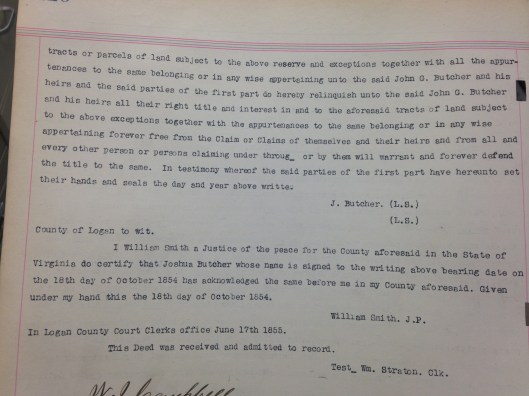
Joshua Butcher Deed to John G. Butcher (1854)

Tags

, , , , , , , , , , , , , , , ,

Joshua Butcher to John G. Butcher Deed 1

Deed Book C, page ___, Logan County Clerk’s Office, Logan, WV. Note: References timber.

Joshua Butcher to John G. Butcher Deed 3

Deed Book C, page ___, Logan County Clerk’s Office, Logan, WV.

Halloween in Huntington, WV (1899)

Tags

, , , , , ,

From the Huntington Advertiser of Huntington, WV, comes this letter from “a tax payer” regarding Halloween, dated October 31, 1899:

EDITOR ADVERTISER:

The observance of the evening of October 31st, in Huntington, seems to have sadly deteriorated, or at least is very different from that in the balance of the world. The old time pleasantness and superstitions connected with “Hallow eve,” are lost sight of here, and in their stead are introduced drunkenness and vandalism. The night is made hideous. Women and children terrorized, property wantonly destroyed and life endangered. The night is looked forward to with dread. Now this is all wrong, and some vigorous measures should be taken to protect citizens and taxpayers from the outrages committed on this night in the past few years. Let the city give us the protection we are entitled to. Put on a special police force sufficiently strong for the purpose. $150 or $200 had better be thus invested than to have this much or more property maliciously destroyed and life made miserable besides. Nay, more than this may be averted. A man’s house is his castle, and if the authorities are inadequate to protect him, and he is subjected to the outrages heretofore perpetrated, he may be forced to protect himself, and some serious tragedy result, which under the circumstances the law can only justify. It is to be hoped the authorities will take action in the matter, and lawless individuals take warning in time.

A TAX PAYER.

Source: Huntington (WV) Advertiser, 31 October 1899.