Tags
Ed Haley, Ella Haley, genealogy, history, Ironton, Kentucky, life, Mona Haley, Ohio, photos

Mona Haley Mullins-Hager, daughter of Ed Haley.

20 Wednesday Nov 2013
Posted in Ed Haley
Tags
Ed Haley, Ella Haley, genealogy, history, Ironton, Kentucky, life, Mona Haley, Ohio, photos
Mona Haley Mullins-Hager, daughter of Ed Haley.
20 Wednesday Nov 2013
Posted in Ed Haley
Tags
Ashland, blind, Catlettsburg, Ed Haley, Ella Haley, fiddling, Green McCoy, history, Mona Haley, music, Pat Haley, Ralph Haley, Wicks Music Store
A few days later, Pat Haley called me from Ashland with news that Mona was visiting. This was a new development: Pat and Mona were apparently patching up some of their differences. Pat knew I would want to speak with Mona and, in spite of whatever hard feelings existed between them, she was willing to give me access to her.
When Mona took the telephone, I told her about getting the new copies of Ed’s recordings. She immediately began to talk about her father making them.
“I was only about fourteen, fifteen,” she said. “I didn’t pay much attention. My oldest brother made the records, him and his wife.”
The whole thing took place around the dining room table.
“You know, they were made on plastic,” Mona said. “And they would brush the plastic strips away as the thing would cut the records. It was kinda tedious, I do remember that.”
Mona said Ed sat about three feet across the table from the recording machine, while Ella was a little closer.
“It shows in the records, don’t it?” she said. I didn’t want to say anything but I totally agreed.
She remembered that Ed listened to each record after it was made and liked what he heard.
“He was talking mostly to my oldest brother,” she said.
I had other questions for Mona, mostly dealing with her general childhood memories. I asked, “Do you remember the house being dark when you were growing up, because obviously they didn’t have any need for light.”
“We had gas lights at home, and after that we had electric,” she said. “Not overly dark, no. We had plenty of light. Always except bedtime, and then my mother would get her big New York Point books out and read to us in the dark.”
“Could your dad see any light at all?” I asked.
“No,” Mona said. “They were both completely blind. My mother said the only thing she remembered was daylight. And I don’t know how old she was when she went blind, but it was infancy, toddler, something like that.”
Mona seemed to be in a particularly talkative mood, so I pressed her for clues about Ed’s music. I asked her how her father’s eyes appeared when he played and she said, “He looked straight out. He never slouched unless he was drinking and then he put one leg behind him and one in front of him.”
Mona said Ed was not a short bow fiddler.
“Long bow, except where it was needed. But he always played that bow to the end,” she insisted.
She didn’t remember her father “rotating” the fiddle at all, although Lawrence Haley (and others) had sure made a big deal out of it. She said Pop always rosined his bow up “real good” before playing but never had any caked on the fiddle. She thought he used Diamond steel strings, which he bought in a local music store named Wicks. He patted his foot in what I call two-four-time when fiddling but “it didn’t override the music.”
I asked Mona if Ed was a loud fiddler and she said, “Oh, yes. You know his voice was strong, too. I’ve been around places with Pop and Mom and people would hear him from far off and come to him. You know, like in the workplace. He always had a crowd around him — always. Always when he played on the street or at the court house square or when he played at the Catlettsburg Stock Market.”
I asked if she remembered Ed playing on trains and she said, “Yes, we’d get in the backseat longways the width of the train and he’d play.” People sometimes gave him money but he mainly played for himself. “Just to pass time,” Mona said.
I was very curious about Ed’s mode of travel, especially considering his blindness and the great distance of ground he covered in his lifetime. I asked Mona if her father hitchhiked a lot and she said, “I don’t think he did. I think he walked more than he hitchhiked.”
Did he sing or whistle while he walked?
“No,” she said. “My mother did that for our benefit, you know. To pacify us, I guess.”
Mona said Ed loved playing for dances because he “enjoyed hearing people dance” and preferred it to the street “a hundred percent.”
I told her that someone said Ella didn’t care a whole lot for playing on the street and she said, “I never heard Mom complain about nothing except Pop drinking.”
I wondered if Ed drank on general principles.
“Whenever he felt like it,” she said. “Whenever somebody brought him something and asked him to take a drink, he would. And there’s times he has gone out and got it, too. Aw he’d cuss real bad. He’d say, ‘god almighty goddamn,’ like he was disgusted with the whole world. We lived down on Greenup Avenue between Greenup and Front and trains went by. His bedroom was in the front, and he cussed one time. I’ll never forget it. He said, ‘Them god almighty goddamn trains just act like they put their damn whistles in the window and blow.'”
I said, “Let me ask you this. In their relationship, was your mother or your father the dominant one, would you say?”
Mona surprised me a little bit when she said, “I’d say my mother was the dominant one until Pop was drinking.”
Ella was also the disciplinarian.
“Mom, she’d pinch a piece out of you, buddy,” Mona said. “She wouldn’t make a scene in a store or anything but she’d just grab you and pinch you and say, ‘Quieten down.’ She did it to me.”
Just before I hung up with Mona, I told her some of the things I’d found out about Ed’s genealogy on my recent trip to Harts. She listened quietly, then said, “Well see, the story I got was that Green McCoy shot this lady. And that’s the story that Pop told me, that I understood. Now, it may be wrong. My memory might be wrong or maybe I didn’t want to believe it the other way.”
20 Wednesday Nov 2013
Posted in John Hartford
20 Wednesday Nov 2013
Posted in Ed Haley
Tags
Bruce Nemerov, Ed Haley, fiddling, history, John Hartford, Lee Hazen, Lynn Davis, Mark Wilson, music, Nashville, Parkersburg Landing, writing
When I got back to Nashville, I had this boxed package in the mail from Mark Wilson, the folklorist who co-produced Parkersburg Landing. Inside the box was a pile of wire recordings, looking very much like a gossamer bird’s nest, which Mark said were Lynn Davis’ recordings of Ed Haley from the forties. I had no idea why Mark had these wires, or really why he had sent them to me. Some years before, I had called him about Ed and received a cool reception, sort of like, “Why don’t you leave all of this to the real folklorists?”
I took the wire recordings to Lee Hazen, a studio engineer and friend whose life-long hobby was wire recordings, and he told me right away that they were way beyond hope. “Even if you took pieces of them and run them through and taped them and then assembled the tape?” I asked.
Nope.
He said it would require someone with enough patience to spend the rest of their life untangling them. I decided to keep them safe though and maybe someday, who knows? But wouldn’t it be awful to get them all together and discover that they were not even of Ed?
Later that spring, Bruce Nemerov notified me that he’d completed his work on Ed Haley’s recordings. I got a hold of the new copies, which included an audio log. There were several records that Bruce didn’t copy.
19 Tuesday Nov 2013
Posted in Ferrellsburg, Music
Tags
culture, guitar, history, J.M. "Doc" Mullins, life, Minnis "Mink" Mullins, music, Ona "Teaberry" Mullins, Standard Mullins, Vernon Mullins, West Virginia

J.M. “Doc” Mullins and sons, Ferrellsburg, Lincoln County, WV, 1920s.
19 Tuesday Nov 2013
Tags
Abner Vance, Andrew D. Robinson, Anthony Adams, Burl Farley, Cain Adkins, Caleb Headley, Elisha Vance, Enoch Baker, Evermont Ward Brumfield, George T. Holton, Henry H. Hardesty, Imogene Haley, Jeremiah Lambert, John H. Napier, Milt Haley, Patton Thompson, Robert Mullins, writing
Cain Adkins arrived on the West Fork of Harts Creek around 1870. During the decade, he purchased a 40-acre farm from his father-in-law, Abner Vance, situated on West Fork and valued at $2.00 (and then $4.00) per acre. In 1880, according to census records, Adkins was a farmer and neighbor to Boney Lucas (his son-in-law), Elisha Vance (his brother-in-law), Abner Vance, Overton McCloud (his brother-in-law) and Marvel Vance (his brother-in-law). In 1881, Abner Vance deed him a 25-acre tract. In that same year, he was listed in land records as owning a $50 building on the 40-acre tract. The next year, the value of his 25-acre tract increased from $1.50 per acre to $2.00 per acre. In 1884, he bought 140 more acres from A.A. Low, attorney, and E. and O. Estep. One part of this, a 40-acre tract, contained a building valued at $100. It was situated between his 25-acre tract and a 185-acre 1852 grant and an 860-acre 1856 grant to Isaiah Adkins. The other 100-acre tract of land was part of the 247-acre 1856 grant to Vance.
According to the Adkins family history, Cain was a United Baptist preacher, farmer, teacher, and justice of the peace. He taught school throughout the 1870s, according to educational records. But he was best known as a preacher; his name appears frequently in county marriage books. In 1877, he married Burl Farley (a member of the future 1889 mob) and Mary Ann Dingess, sister to Hollena Brumfield. In 1884, he married Milt Haley and Emma Mullins: “Thomas M. Hauley, age 25, born Cabell County, son of B.H. Hauley and N. Muncy, married Imogene Mullins, age 15, born Logan County, daughter of J. Mullins and C. Gore, on the 22nd day of March 1884 by Canaane Adkins, Minister, at Logan, WV.”
Cain’s various occupations would have made him a real renaissance man in the community. First of all, as a country doctor, he would have been in contact with most local families. As a teacher, he would have taught many of the local children at his school. In those days, church congregations usually met in schoolhouses — as there were no church buildings — so Cain would have preached to many members of the community at his school. Again, this occupation would put him in close touch with many locals — preaching funerals, marrying people, and so forth. As a law officer, he would have had to deal with local criminal activity — which (in addition to his preaching) may have put him in direct conflict with Paris Brumfield.
In addition to Adkins, Roberts, Mullins and Fowler, John H. Napier, a 41-year-old physician, was a prominent resident at the mouth of Harts Creek. John had settled in Harts in 1879 with his young wife (a niece to Cain Adkins), five children and a nephew. He quickly took up business, although he never bought property. “Mr. Napier is a prosperous merchant in Hart Creek district, with business headquarters at the mouth of the creek,” Hardesty wrote.
By the mid-1880s, the local economy was humming along, spurred by the timber industry. In 1884, the same year that Milt Haley and Emma Haley were married, a new post office called Warren was established five miles up Harts Creek on the bank of its south side below the mouth of Smokehouse Fork. In that vicinity, which encompassed Milt Haley’s section of the community, Andrew D. Robinson was postmaster, Van B. Prince (a former schoolteacher) was a physician, Benjamin Adams was a general store operator and Joseph Williamson was a mason. Henderson Dingess (father to Hollena Brumfield) and Benjamin Hager were distillers, and Anthony Adams and Robert Mullins were blacksmiths. McCloud & Company was the major general store in the vicinity. The post office serviced three to five hundred people semi-weekly.
At that time, according to Hardesty, Jeremiah Lambert of the Bend of the River was a justice of the peace and Aaron Adkins of Little Harts Creek was a constable. Evermont W. Brumfield — a brother to Paris Brumfield — was the county jailer. Patton Thompson was a constable and a deputy-sheriff. Caleb Headley — a brother-in-law to Burl Farley — was a physician on Fourteen Mile Creek. There were ten public school buildings in the district with a student population of 334. George Thomas Holton of Fourteen was a local schoolteacher. Enoch Baker, a Nova Scotian, was busy in timber with a “lower dam” on Brown’s Run of Smokehouse Fork according to 1883 deed records.
18 Monday Nov 2013
Posted in Harts
Tags
Appalachia, Harts, Henry S. Godby, history, Lincoln County, West Virginia, Wheeling Intelligencer
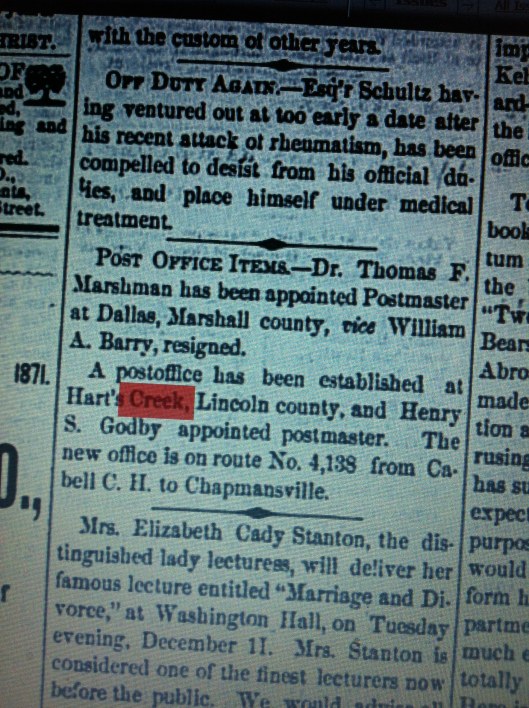
Wheeling Intelligencer, December 3, 1870.
18 Monday Nov 2013
Posted in Chapmanville, Civil War, Ed Haley, Green Shoal, Guyandotte River, Harts
Tags
Admiral S. Fry, Andrew D. Robinson, Andrew Robinson, Appalachia, Big Branch, Bill Fowler, Chapmanville, Confederate Army, Dicy Roberts, Elias Adkins, Francis Fork, G.S. Fry, general store, Green Shoal, Harts, Harts Creek, Harts Creek District, Henry H. Hardesty, Henry S. Godby, history, Hollena Brumfield, Isham Roberts, Jack Johnson, James P. Mullins, Joseph Workman, Marsh Fork, Martha Jane Brumfield, merchant, Milt Haley, Paris Brumfield, Sallie Dingess, Sand Lick Run, teacher, Thomas H. Buckley, timber, West Fork
The town of Harts — originally named Hart’s Creek — was established at the mouth of Big Harts Creek in the summer or fall of 1870 when Henry S. Godby, a peg-legged Confederate veteran from Chapmanville, petitioned the government for the creation of a post office called “Hart’s Creek.” At that time, Green Shoal was the most thriving spot in the Harts section of the Guyandotte River. A.S. Fry was its chief businessman and postmaster. Godby’s effort to establish Harts as a postal town was a short-lived venture. By 1876, Green Shoal still reigned supreme in local affairs. According to a business directory, it could boast a gristmill, free school and a Baptist and Methodist church. T.H. Buckley and G.S. Fry were physicians, while Joseph Workman was a clergyman.
Around that time, in 1876, Bill Fowler — a local general storekeeper — petitioned the government for the creation of a “Hearts Creek” post office and established his business headquarters at Harts. Fowler had migrated to the area in 1847 and married a daughter of Elias Adkins, an early settler. After a short stint as a schoolteacher in 1871, Fowler was by 1876 a general storekeeper and owner of some 30 acres of land on the Marsh Fork of West Fork. In March of 1877, he became postmaster of “Hearts Creek;” he was also a saloon keeper according to oral tradition. As his business interest generated profits (primarily in timber), he extended his land holdings. In 1878, he purchased 75 acres on the Guyan River from Abner Vance, valued at $5.00 per acre. The following year, he added a 90-acre tract to his estate on the west side of the Guyan River, valued at $3.25 per acre, which he purchased from brothers-in-law, Aaron and Enos Adkins.
Throughout the period, Fowler was unquestionably the chief businessman in Harts. Curiously, Andrew D. Robinson replaced him as postmaster of Hearts Creek in 1879. Robinson was a Union veteran and former township clerk, justice of the peace, and secretary of the district board of education. He was a brother-in-law to Ben Adams, as well as Sallie Dingess (Hollena Brumfield’s mother). In 1881, Robinson shortened the name of the Hearts Creek post office to “Hart.”
The Green Shoal area, meanwhile, fell into a state of decline as a local economic center. A.S. Fry gave up his postmaster position in 1878. He maintained his local business interests well into the next decade, then turned them over to his son George and left to pursue a hotel business in Guyandotte, a town situated at the mouth of the river in Cabell County. The Green Shoal post office was discontinued in 1879.
By 1880 — roughly the time that Milt Haley came to Harts from “over the mountain” — Harts reigned supreme as the hub of local business affairs. In that year, according to census records, the population of the Harts Creek District was 1,116. There were 1,095 white residents, fifteen blacks and six mulattos. 93-percent of locals were born in Virginia or West Virginia, while six percent were born in Kentucky. Most men worked at farming, although A.S. Fry and Paris Brumfield both had stores. In 1882-1883, Brumfield was listed in a state business directory as a distiller.
At that time, Bill Fowler was the undisputed kingpin of the local business scene. According to Hardesty’s History of Lincoln County, published around 1884, Fowler owned 200 acres of land at the mouth of Harts Creek and 254 acres on Mud River. He also owned 200 acres on Sand Lick Run, a branch of Francis Fork, based on land records at the Lincoln County Courthouse. “That situated on Hart creek produces well,” Hardesty wrote, “and has a good orchard and a part is heavily timbered with oak, poplar and pine; coal and iron ore are quite abundant.” Fowler was the father of four small children, recently born to his second wife.
There were other notable business folks in the neighborhood, namely Isham Roberts, who operated a store near Fowler on the Guyandotte River. He was the son of Dicy Roberts and the stepson of Jack Johnson, a local farmer. In the early 1880s, he married Martha Jane Brumfield, a daughter of Paris Brumfield, and opened a store on rental property at the mouth of Harts Creek. By 1884, when Hardesty wrote his history of the county, he referred to Roberts as “a prosperous young merchant in Hart Creek district, having his headquarters on Guyan river, at the mouth of Big Hart creek. His prices are the most reasonable and the business very extensive.” Roberts was the postmaster at Harts from 1883 until 1884, when Dr. T.H. Buckley replaced him.
James P. Mullins, who operated a general store building above Roberts at Big Branch, was also a budding merchant. By 1882, Mullins was the owner of a $200 storebuilding situated on a 203-acre tract of land. Over the next few years, he added another 55 acres on lower Harts Creek and 150 acres on Francis Fork (this latter tract likely acquired for timbering purposes). Hardesty referred to Mullins as being “of good business qualifications and prosperously engaged in merchandising, with business headquarters on Hart creek, one and one-half miles from its mouth.” In that year, Mullins purchased an additional 93 acres on Harts Creek. One year later, the value of his store building increased by $100, hinting at his growing prosperity.
16 Saturday Nov 2013
Posted in Ferrellsburg
Tags
Appalachia, culture, Ferrellsburg, history, Isaac Marion Nelson, life, Lincoln County, photos, West Virginia
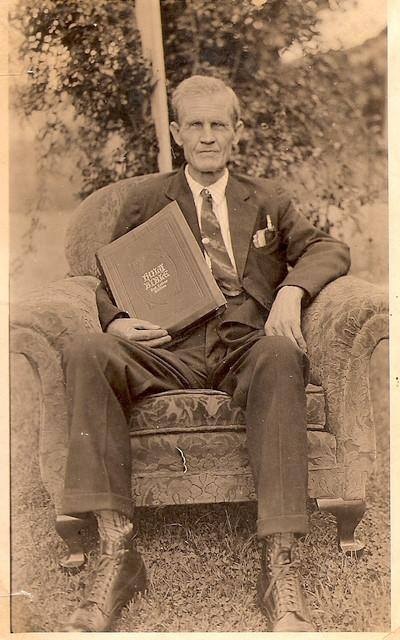
Isaac Marion Nelson, resident preacher of Ferrellsburg, Lincoln County, WV, c.1920s
16 Saturday Nov 2013
Posted in Ed Haley
Tags
Big Ugly Creek, Bill Duty, Billy Adkins, Ed Haley, Green McCoy, history, John E. Fry, Maude Duty, Milt Haley, Tucker Fry, writing
After visiting with Ida, Billy directed us to Maude Duty, who lived on Big Ugly Creek. Born in 1905, Maude was a daughter of John E. Fry, a longtime justice-of-the-peace in the district, and a niece to Tucker Fry, one-time occupant of the “murder house.” At the time of our visit, Maude was bed-fast, physically feeble, and near death. She hadn’t seen Billy for a few years but soon remembered him and began to whisper answers to his questions concerning the murder house and her husband’s family, the Dutys. She agreed with Billy that the murder of Milt and Green had taken place at her Uncle Tucker’s house at the mouth of Green Shoal. She didn’t know anything about Milt living with Bill Duty but remembered that Ed Haley visited him fairly often on Broad Branch. She said she used to dance to his fiddling when he came to her father’s home.
It was a small but crucial bit of information indicating a strong connection between Ed, Milt, and the Duty family that went beyond the 1870 census.
13 Wednesday Nov 2013
Posted in Lincoln County Feud
Tags
Appalachia, Charley Brumfield, crime, culture, feud, Harts, history, life, Lincoln County, photos, West Virginia
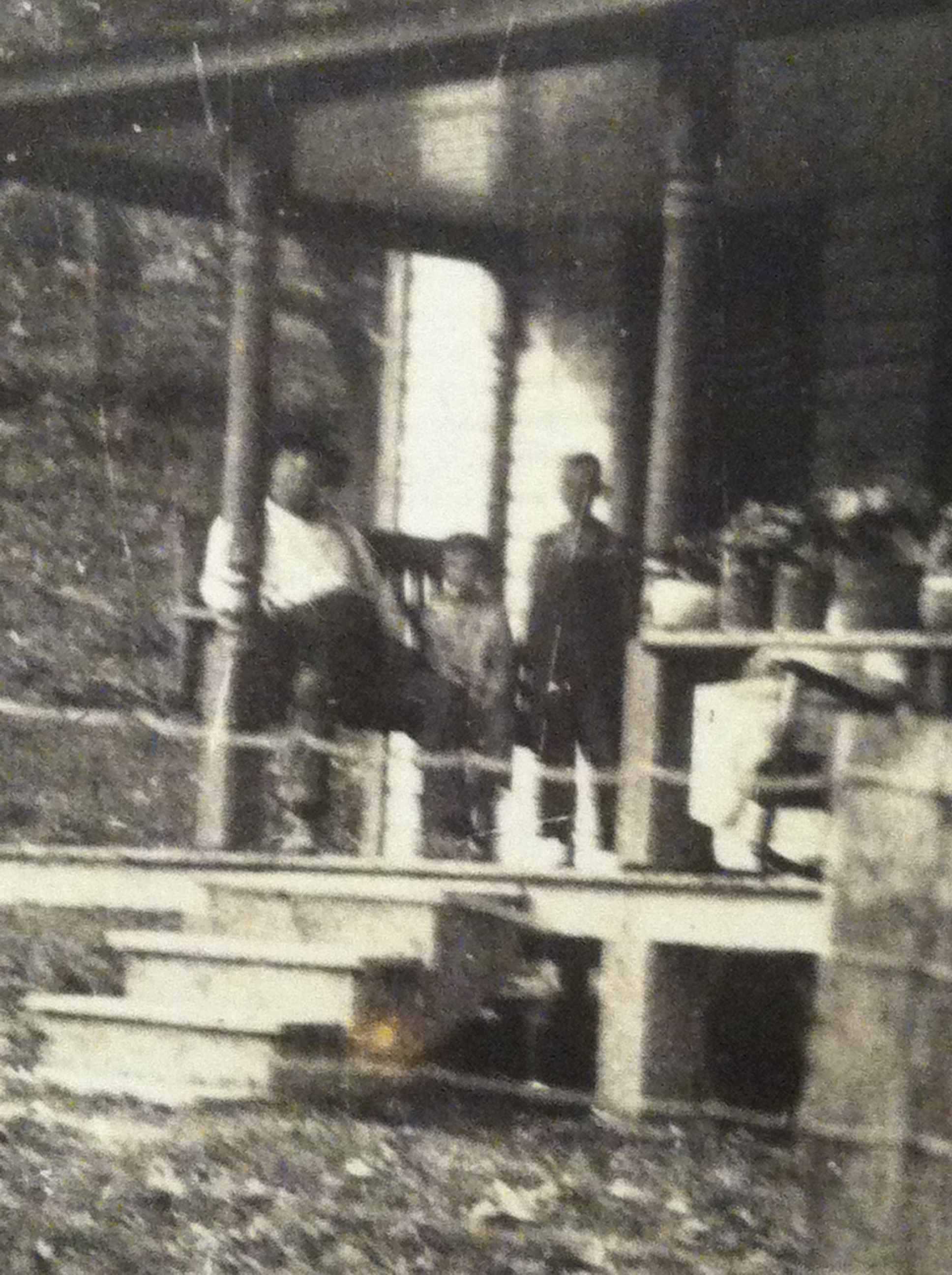
Charley Brumfield on his porch with children, Harts, Lincoln County, WV, 1915-1926
13 Wednesday Nov 2013
Posted in Ed Haley
Tags
Al Brumfield, Bill Brumfield, Cat Fry, Charley Brumfield, Green McCoy, Hollena Brumfield, Ida Taylor, Jim Brumfield, John Fry, Letilla Dial, Milt Haley, writing
At that point, Ida gave us her account of the Haley-McCoy murders.
“Some man that lived down there at Hart had a business and Al Brumfield had a business,” she said. “Al Brumfield, he wanted to get rid of him so he would get all the trade and so he was supposed to paid them so much to kill him. And they hid as they come out of Harts Creek, they said, one Sunday afternoon, I believe. They were hired to shoot and kill Al, but they hit the woman. She was riding on behind him on a horse. I can remember seeing her. She married again after that — a Ferguson. She wasn’t a very large woman. She died with a big hole in her cheek there where they shot her. They said they went into Kentucky and got them and they was supposed to delivered them back to the law over at Hamlin, our county seat. And they stopped down there to stay overnight. That was supposed to been the house of John Fry across the track there, I was told. That was a stop-off place. Do you know where Lonnie lives now? Well now, there’s where the log house stood.”
Ida stopped, thinking, then said, “I used to hear Dad and them talk about it. He said where their horses were tied in those fences… You know how they used to build the old log rail fences? He said they tore that place apart that night, those horses and all the shooting and everything going on. And said when they were eating supper that night — Green McCoy and Milt Haley — said one looked over to the other’n and told him, said, ‘You better eat all you want because this will be our last meal.’ Sure enough it was. Started shooting them in the bed and they was handcuffed together. I don’t know what hour it was but it was some time in the nighttime, you know, after they’d gone to bed. Now Grandma Cat was at that house that night when those men were killed. And they said when that was going on she hid up a chimney — big open fireplace. She hid up in there. It was kindly a rough time, they said.”
I asked Ida if she ever heard anyone mention the names of the vigilantes.
“Who was in the pack?” she said, laughing. “People just surmised it, I guess. I wasn’t told but my daddy, he always thought Uncle Charley — that was one of his brothers — was in on it. He was a huge man, Uncle Charley was. As well as I remember, he was real fair-complected. He finally got killed afterwards. Uncle Charley, I went to his funeral. He was a big, fat round-faced fellow and he had bullet wounds in his cheeks. Back then, the undertakers, you know, they didn’t have all that stuff to work with then.”
Brandon asked Ida if Bill Brumfield was in the gang and she said, “Uncle Bill? Now, I never did hear his name mentioned. He was accused of murdering, you know, but not them.”
Billy said, “They was about 20 or 30 of them. Wild times.”
I asked Ida if she ever saw the “murder house” and she said, “No, but my mother told me about it. At that time, she was going to school around at what they call the Toney Addition. And she said when they went out of Green Shoal that morning to school, you know, Milt and Green was laying out in the yard still handcuffed together. Mother thought they was colored people. They were beat up, I guess, and shot, you know, and blood all together — that’s the reason she thought they looked like colored people. That’s what she said. Now, she seen them. And I remember tales they’d left a little stream of blood run down through the yard. There was blood all over. I remember that very clearly, her telling us that.”
Ida said the old Fry home at the mouth of Green Shoal was torn down years ago, probably when the site was “built up” by the railroad around 1904.
12 Tuesday Nov 2013
Posted in Lincoln County Feud
Tags
Appalachia, crime, feud, George Fry, Green McCoy, Green Shoal, history, Milt Haley, photos, West Virginia
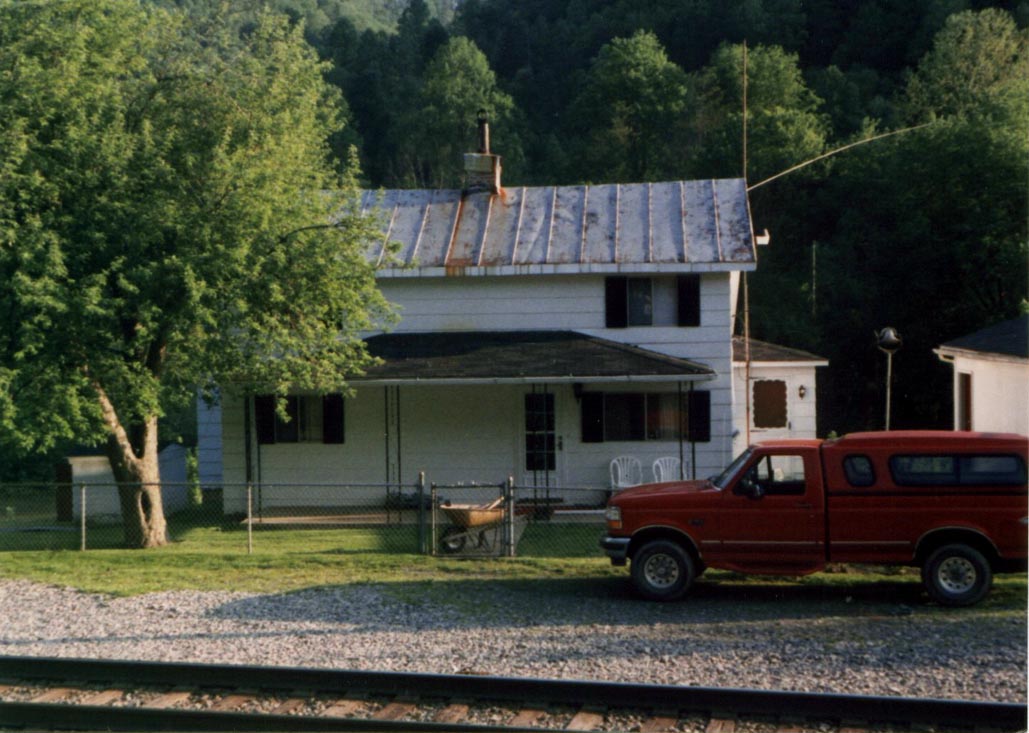
The Murder House? Green Shoal, Lincoln County, WV, 1995
12 Tuesday Nov 2013
Posted in Ed Haley
Tags
Boney Lucas, Cat Fry, Charley Brumfield, crime, genealogy, history, Hollena Brumfield, Ida Taylor, Jim Brumfield, Letilla Dial, Paris Brumfield, Sarah Lucas, writing
To get to Ida’s house, we drove a short distance up Green Shoal Road, a somewhat narrow strip of pavement that snaked its way alongside the creek. We were welcomed inside by some of her family, who knew Billy and Brandon. Just inside the door, I spotted Ida sitting in a chair near a bed and a fireplace. In the initial small talk, we learned that Ida was born on Green Shoal in 1914 and had lived there all of her life. Brandon began by showing her a picture of her grandfather, Paris Brumfield. She said her father Jim Brumfield (1880-1965) had spoken of him.
“Dad said he kindly mistreated their mother,” she said. “He drinked an awful lot. The children were afraid of him. Now, I can remember Dad talking about seeing him get killed. Uncle Charley was the one killed him, his own son. I think Dad said he was about 16 years old — maybe older. Dad said he was hid up on the hill behind a foddershock when Uncle Charley shot him. Said he was laying down the drawbars and said Charley told him not to come any farther and he just kept going and he shot him in the back. He said he saw the dust jump out of his jacket. He’s told us kids that lots of times.”
Jim was practically raised by his brother Al in Harts because his mother died not too long after his father’s murder. In 1900, he was with his brother John at Chapmanville when they were attacked by the Conleys. He was stabbed and carried a piece of the knife blade in his body for the rest of his life. A little later, he fell out with his older siblings (Al, Rachel, and Charley), who he felt had “swindled” him out of some of the family property.
Brandon asked Ida if she remembered going to visit Hollena Brumfield and she said, “I never was there. Dad didn’t think much of her as a sister-in-law.”
Ida said she’d kinda been raised away from all the Brumfields around Harts.
“They used to come here, but we never was down in there too much,” she said. “The first time I was ever in Uncle Charley’s house is when I attended his funeral. And Uncle Bill’s house, I never was there at all. But I always liked him. He was here quite a bit, Uncle Bill was, you know. Spent a little time in jail for killing a man. I was afraid of him, though. He was a little guy and wore a little sandy mustache. He dodged around up in here after they found this man dead. He’d been dead quite a while and he’s supposed to got beat up at Uncle Bill’s house. I think he beat him up with an axe handle as well as I remember. They carried him back in there someplace. That’s what we were told. Billie killed Uncle Bill. Said he was drinking whiskey out of a half a gallon jar and Billie slipped around the house and shot him. They thought that was over his mother, too. They was really rough down in there.”
Ida said she heard about the Haley-McCoy killings from her mother Letilla Dial and grandmother Cat Fry (the infamous “Aunt Cat”). Ida’s mother Til was raised by Sarah Lucas, who married a Brumfield and then later a Workman. Hearing the name Lucas caused me to ask Ida if she knew anything about Boney Lucas.
“Oh, yeah,” she said. “They was raised up on the creek here. Boney Lucas — I’m not sure but I believe that was Aunt Sarah Workman’s brother. I can remember hearing her talk about Boney Lucas. Now, they were raised down here someplace in a log house.”
11 Monday Nov 2013
Posted in Green Shoal, Lincoln County Feud
Tags
Appalachia, crime, feud, George Fry, Green McCoy, Green Shoal, history, Lincoln County, Lincoln County Feud, Milt Haley, murder, photos, West Virginia

Site of the Haley-McCoy murders, Green Shoal, Lincoln County, WV.
11 Monday Nov 2013
Posted in Ed Haley
Tags
Appalachia, Bill Adkins, Dood Dalton, Doran Lambert, Ed Haley, feud, Green Shoal, Harts, history, Ida Taylor, Jim Brumfield, Tucker Fry, writing
Early the next day, Brandon and I met Billy at his home, with plans to go see the site of the “murder house” at Green Shoal. We found his father, Bill, Sr., seated in a wooden rocking chair very much “in his own world.” He’d been born in 1906, making him one of the oldest citizens living in Harts. Curious, I got my fiddle out and played a few tunes for him. The old gentleman just stared at me like I was crazy. He never said a word. Billy told him we were interested in Ed Haley’s life and he surprised us all when he said Ed used to stay with his father for two or three days at a time. Oh yeah, he said…Ed even slept in the same bed with him and his brothers, who were children at the time. Wow! Bill said Haley was a very serious guy (“not carrying on much”) and had a reputation for being “bad to fight.” He often got with a local fiddler named Dood Dalton and played all night for a house full of people at the Adkins home. Bill also remembered him playing in front of the old Adkins Store/Harts Post Office around 1916 when it faced the railroad tracks. All he could recall about Ed’s technique was that he tapped his feet and pulled a long, smooth bow.
After talking with Bill, Billy, Brandon, and I drove out of Harts Bottom onto Route 10 past the old Adkins store and on up the road to Green Shoal. At that location, standing in a little drizzle, we surveyed the possible sites of the murder house. Suddenly, an older man Brandon and Billy recognized as Doran Lambert came walking down to where we stood on the railroad tracks. A descendant of Paris Brumfield, he lived where the Tucker Fry home stood in 1889. Doran said the murders didn’t happen at Tucker’s place, as Billy thought, but at the present-day location of his father’s garage just up the river between the Guyan River and the C&O Railroad.
We asked Doran more about the Haley-McCoy killings. He said his aunt Ida Taylor, who lived just up Green Shoal, could tell us all about it. A niece to Al Brumfield, her father Jim was Paris’ youngest son. We decided right away to try and see her.
11 Monday Nov 2013
Posted in Big Harts Creek, Civil War, Whirlwind
Tags
34th Battalion Virginia Cavalry, Appalachia, Barney Carter, civil war, genealogy, Harts Creek, history, Hoover Fork, Logan County, photos, West Virginia

Capt. Barney Carter (1821-1902), resident of Hoover Fork of Big Harts Creek, Logan County, West Virginia, served as captain of Company D, 34th Battalion Virginia Cavalry.
11 Monday Nov 2013
Posted in Ed Haley
Tags
Big Ugly Creek, Bill Duty, Billy Adkins, Brandon Kirk, genealogy, Harts, history, Imogene Haley, John Hartford, Maude Duty, Milt Haley, Solomon Mullins, writing
I asked Billy about Bill Duty. We had found Milt living with Duty’s family in an 1870 Logan County census and knew from reading an interview with his son in the Lambert Collection that his family settled on Big Ugly Creek in the early 1880s. Billy turned us loose with his Duty notebook, where we soon located his notes on the family of “William Marshall Duty” (1838-c.1910). He said the family originally came to the area looking for work in timber. In 1900 and 1910, Bill Duty lived on the Broad Branch of Big Ugly Creek. We could find no apparent “blood connection” between him and Milt Haley but his wife Emma Ferrell was a great-granddaughter of Money Makin’ Sol Mullins (Ed’s great-great-grandfather). It was a seemingly distant family connection that might have played a part in Milt’s choice of Emma Mullins for a wife. Billy said we should talk with Maude Duty, a widow of one of Bill Duty’s grandsons, for more information along those lines.
That night, after hours of watching Billy and Brandon shuffle through genealogy books, census records and notebooks filled with handwriting, I realized just how difficult it would be to familiarize myself with all the characters and family relationships in the story of Milt Haley’s death. While I had little chance to memorize them, I made the effort to at least document them because they seemed to help explain a lot about Milt’s story. There were other things, of course, to mix into the blend, such as grudges, hatreds, and dislikes.
There was another important reason for documenting the genealogy: knowing how people were connected to each other helped me to objectively weigh in any slant in their stories (whether intentional or not). For instance, if I were talking to a nephew of “Uncle Al Brumfield,” I would probably get a somewhat complimentary account of his character; but if I were talking to someone whose family had feuded with him, comments might be less than flattering. It seemed obvious, then, that who I talked to, their genealogical connection to who they spoke of, where I talked to them, in whose company I talked to them, and what exactly they said (or didn’t say) were all important to note.
06 Wednesday Nov 2013
Posted in Ed Haley
Tags
Angeline Lucas, Billy Adkins, Boney Lucas, Don Morris, feud, Green McCoy, Harkins Fry, history, Imogene Haley, Milt Haley, music, Paris Brumfield, Sherman McCoy, Spicie McCoy, Tucker Fry, Vinnie Workman, writing
I said, “That’s the very same story that Ed Haley’s people told. They would have just as much shame about the incident as Ed Haley’s folks. I wonder if Spicie and Emma got together and got their stories straight before they went their separate ways? I wonder if Spicie knew Emma Jean?”
Billy said, “Grandmaw I believe said them women come over that night and begged for them men — for them not to kill them. She said her mother was telling her about it. Her mother was the Fry where they lived at there. They wouldn’t listen to them. Now I don’t know if that’s true or not. That’s just what was passed down to her. Now I’ll tell you, that table had bullet holes in it.”
Oh, yeah…the table where Milt and Green ate their final meal. Brandon asked Billy who had it last and he said, “My grandmother, Vinnie Workman. I don’t know whether I can remember it or if I was just told about it.”
I told Billy that it sure would be nice to find that table, so he called up his Aunt Don Morris, who had eaten many meals on it as a child. When he got off the telephone, he confirmed, “The table they had their last meal in ended up with my Grandmother Vinnie (Thompson) Workman. And there were bullet holes in the table. Of course my aunt wasn’t there, but she said she can verify there was bullet holes in the table under the bottom of it — not on the top of it. You know, how side pieces are on a table. But when they’d be under the table as kids playing under the table, they’d see the bullet holes. She doesn’t know where the table is.”
And why did Vinnie end up with the table?
“I don’t know,” Billy said. “Uncle Tucker Fry, the one that owned the house where they was killed at, was my grandmother’s uncle. He may have just give the table to her. They was just probably getting rid of it and she took it.”
After thinking about it for a while, Billy said the table might be stored in his parents’ abandoned house next door. We walked over to the dark house and searched in vain.
Back at Billy’s, we returned to the family histories. I noticed there seemed to be a great deal of musical talent in Green and Spicie McCoy’s family. The Fry history referred to Spicie as a “well-known quartet singer” and featured a photograph of her in a quartet with her son, guitarist Sherman McCoy, and her grandsons, Charles and Raymond McCoy. Whether their talent came from Spicie or Green (or both) I didn’t know, but I took note of the fact that some of the children by Spicie’s second husband were also musical. According to Adkins, Harkins Fry of Huntington was a “song writer and publisher, and music teacher.”
My head was filled with images of Milt, Green and Spicie playing dances around Harts.
There was another surprise: according to the Adkins book, Spicie’s sister Angeline married Monteville “Mounty P.” Lucas (a brother to Mrs. George Fry) – a.k.a. “Boney Lucas.” Boney, then, was a brother-in-law to Green McCoy — making his death closely connected to the troubles of 1889. He and Angeline had several children: Eliza Lucas (1877), Julie A. Lucas (1879), Millard Fillmore Lucas (1880-1971), Blackburn Lucas (1882-1946), Ruth “Spicey Jane” Lucas (1883-1971), Taylor Lucas (1889-1966) and Wilda Lucas, born in 1891. Boney died around 1891, according to the Adkins history, when the “Brumfield brothers killed him by cutting his throat while Angeline watched.” According to Billy’s notes, Boney was “killed by Paris Brumfield while he was running from Paris.”
03 Sunday Nov 2013
Tags
Al Brumfield, Black John Adkins, Cain Adkins, Cat Fry, Fed Adkins, feud, Green McCoy, history, John W Runyon, Milt Haley, Paris Brumfield, Will Adkins, writing
Brandon asked Billy what he knew about the old vigilantes around Harts Creek, and he said his grandfather Fed Adkins had been affiliated with the Brumfields and their gang. (We use the word “affiliated” lightly since Fed and Hollena Brumfield supposedly had a long-term affair that produced an illegitimate daughter in 1892.) They were a rough bunch, Billy said, but usually had good intentions.
“These guys’d set big poles — big switches — on the porches of whoever they wanted to try and correct in some way,” he said. “When you got up that morning and saw switches sitting on your front porch — big long poles I’m talking about, what we’d call saplings — you knew to straighten up. And if what they didn’t do wasn’t corrected, they’d hold them and whip them with those big long switches. And if that didn’t work, they’d burn their house down.”
I had to interrupt Billy by asking, “Would you know what it was you was doing wrong?”
“Yeah, oh yeah,” he said. “You was either interfering with some of their business practices or courting the wrong woman.”
Billy said the Haley-McCoy trouble started when John Runyon moved to Harts and put in a store and saloon across the creek from Al Brumfield. There was intense competition between him and Brumfield. At some point, Runyon went to Washington, DC, and tried to have the government declare Harts Creek as a navigable stream — and thus force Brumfield to dismantle his log boom. Billy heard that Al was in the process of arranging Runyon’s death when Milt and Green ambushed him. They fled to the Mingo County area after accidentally shooting Al’s wife, Hollena.
Billy said his great-uncle Will Adkins was in the mob that executed Milt and Green. Several other participants were recorded in his notebooks: “Paris Brumfield, Al Brumfield, Charley Brumfield, Bill Brumfield, Albert Dingess and other Dingesses, Will Adkins, Black John Adkins (held the horses), French Bryant.” Billy figured his grandfather Fed Adkins was also in the gang, because he hung pretty close to his brother Will and cousin “Black John” Adkins, a mulatto.
Brandon wondered why the Adkinses sided with the Brumfields in the feud since many of the old stories pitted them as enemies.
“Dad and them was real close with the Brumfields,” Billy said. “They fought amongst each other but they still was together when they needed to be.”
Billy’s notebooks finished the story.
“The mob from Harts went to get them with extradition papers. Old Cane Adkins and John Runyon had another mob at Big Branch (another story goes at the mouth of Smokehouse) to ambush and recapture and free Haley and McCoy. But a spy tipped the Harts boys off and they went up Smokehouse, Bill’s Branch, down Piney, up Frank and Catherine Fleming’s hollow, down Abbott’s Branch and killed them at the George Fry house where Gov. Sperry’s house is now.”
Billy corrected the Gov. Sperry part of his notation, saying, “That’s written back 25 years ago, this is, so it wouldn’t be there. I’d be where Doran Lambert owns now. There’s a nun lives there.”
I told Billy, “Now, there’s a story that they came in and told everybody to clear out and there was a little girl in the house and she hid in the fireplace and she saw the whole thing happen.”
“Is that supposed to be Aunt Cat?” he asked. “Yeah, I’ve heard that but I don’t know whether that’s true or not.”
I continued, “And then Roxie Mullins said that after it happened the girl ran out of the house and jumped over the bodies and ran out into the woods.”
Billy said, “Would she have been old enough to done that?”
I said, “I guess, she was the one that told Bob Adkins the story.”
Okay, so how old was she? Based on Billy’s notes, she was born in 1862, making her 27 years old in 1889…a far cry from the “child witness” portrayed in stories. Her reasons for being present at George Fry’s at the time of the murders probably had something to do with the fact that George had married her aunt (and his first cousin).
So who was the “child witness” to Milt and Green’s murder? Maybe it was Cat’s seven-year-old daughter Letilla, who Brandon said later married one of Paris Brumfield’s sons. Or was it George Fry’s six-year-old daughter, Bertha?
And what were the chances that Cat had just made up her version of the story?
“Cat Fry and all of them, they’d tell you anything in the world,” Billy said. “I’m not saying it weren’t true, but just ’cause they told you that don’t mean it was true.”
Billy said Cain Adkins and his family were the ones who fetched Milt and Green’s bodies from Green Shoal for burial. Brandon figured the burial party probably crossed the Guyandotte using the old Ferrellsburg ferryboat.
A Harts mob eventually found John Runyon in Kentucky.
“John Runyon, he went to Kentucky, the way I heard it, and a group from here went to find him,” Billy said. “My grandfather and my uncle was supposed to have been in the bunch and some of the Brumfield boys. They was a big posse of them and they found the creek that John Runyon lived on and they said they had come to get him. He walked out and met them and he said, ‘Boys, you sure you want to take me?’ And they said, ‘Yeah, we come to getcha.’ He said, ‘Boys, I don’t wanna see anybody get hurt but you better look around you.’ And they started looking and they’s probably 150 or 200 rifles up on both hillsides pointed right down at them in the creek. They’s riding up the creek there. They wasn’t any road. And he said, ‘Now, the best thing you can do is turn around and go right back to Harts Creek.’ And they did. They didn’t look back.” Billy laughed, “He said, ‘Now don’t look back.'”
Writings from my travels and experiences. High and fine literature is wine, and mine is only water; but everybody likes water. Mark Twain
This site is dedicated to the collection, preservation, and promotion of history and culture in Appalachia.
Genealogy and History in North Carolina and Beyond
A site about one of the most beautiful, interesting, tallented, outrageous and colorful personalities of the 20th Century
 Brandon Ray Kirk