• About

Brandon Ray Kirk

~ This site is dedicated to the collection, preservation, and promotion of history and culture in my section of Appalachia.

Brandon Ray Kirk

Category Archives: Guyandotte River

Recollections of Laura Hinchman at Combs Addition, WV (1984), Part 1

24 Friday Jan 2020

Posted by Brandon Ray Kirk in African American History, Civil War, Coal, Guyandotte River, Huntington, Logan, Man, Timber, Women's History, Wyoming County

≈ 5 Comments

Tags

African-Americans, Alfred Beckley, Anna Brooke Hinchman, Bruno, Buffalo City, civil war, Claypool, Clean Eagle Coal Company, coal, Combs Addition, Confederate Army, Cyclone, Cyclone Post Office, Davin, Elk Creek, Forkner, genealogy, Guyandotte River, history, Hollow A. Davin, Huntington, John L. Lewis, Lake Claypool, Laura Hinchman, Logan, Logan County, logging, Lorenzo Dow HInchman, Mallory, Man, Man High School, Morris Harvey College, Oceana, Paul Hinchman, Pete Toler, postmaster, rafting, Raleigh County, Rosa Hinchman, splash dams, timbering, Ulysses Hinchman, United Mine Workers of America, Vic McVey, Walter Hinchman, West Virginia, Woodrow Hinchman, Wyoming County

Laura C. Hinchman was born on March 22, 1919 to Walter and Anna Brooke (McVey) Hinchman at Mallory in Logan County, WV. She was an educator for over fifty years and was very active in civic affairs. For more information about her background, see her obituary at this location: https://www.findagrave.com/memorial/140834185/laura-caryl-hinchman

The following interview of Ms. Hinchman was conducted on July 16, 1984. In this part of the interview, she discusses her ancestry, community history, timbering, and coal mining.

***

Miss Hinchman, how did your family first come to this area?

Well, when West Virginia was being settled, people who were willing to come here were given land grants by governors of Virginia over different periods of years. This property was given by the governor of the commonwealth of Virginia at that time, Governor Nicholson. It was given in 1815 to my great grandfather, Dr. Ulysses Hinchman, who was a member of the legislature. He had land holdings in Wyoming County, and he laid out the town of Oceana. He is recorded in a lot of the books of the history of Wyoming and Logan Counties. According to the West Virginia Blue Book, that is how Man got its name. At first it was called Buffalo City. Then they decided to change the name. They thought Hinchman was too long and there was already a place called Hinch, so they named it Man in honor of my great grandfather. Now, that’s according to the West Virginia Blue Book.

Do you remember what your grandparents were like?

Now, both my grandfather and grandmother Hinchman died before I was born, so I don’t remember either of them. At that time, this was all timber land. My grandfather Hinchman, whose name was Lorenzo Dow Hinchman, was a timberman. We have a lot of records here in the house where he kept books of how much he paid the men and how much he sold, and all that. After this was cleared, then, of course, it became farmland. Now, they had no way of getting the logs that were cut to a market. So down there just below Woodrow’s, and this happened several places, they built what was called splash dams. They made a dam and dammed the water up and filled it with logs. Then there would be a great big lot of excitement. Everybody would gather and they would tear the dam lose and let the logs float down to the Guyan River. There were men who went with them, I suppose on rafts, and rafted the logs together, and floated them down the Guyan River to the Guyandotte. Now, my mother’s father, who came from Raleigh County, was Uncle Vic McVey. Of course, I remember him well, he lived here with us until he died at the age of ninety-four. He was one of the men who followed floating those logs down the river, and then they would walk back from Huntington. They had places that they stayed on their way back. I don’t know how many days it took.

Now, my grandmother Hinchman was a Chambers, which is also one of the early settler families in this area. She was a schoolteacher. At that time, it was possible to teach school when you got through the eighth grade, you were given a certificate. All first teachers in the one room schools here were just graduates of the eight grade, because the high school at Man was not built until 1919 or 1920, and that’s all they had. Now some people taught after they finished the eighth grade, and then went on when it was possible. I have a cousin Lake Claypool–that’s another old family in this area for which Claypool is named–that she taught after she finished the eighth grade then she went on to Man and finished high school and then went to Morris Harvey. But all the older teachers were just eighth grade. There was a one room school down here at Claypool. There was a one room school up at Vance’s. There were several one room schools on Buffalo Creek. There was a one room school up–what’s that creek up Bruno called–Elk Creek. My grandmother was a teacher, but as I say, both died before I was ever born. Now then, this place was called Cyclone. This is where Cyclone was. My grandmother Hinchman kept the Cyclone Post Office here for forty years. After she passed away, my mother–she was a McVey–and she married my father, Walter Hinchman, in 1910, and came here. I had Aunt Rosa Hinchman, who had never married at that time, who helped her keep the post office. The mail was carried on horseback from Huntington and the West, came that way, and from Oceana, from that direction they carried it. The postmasters met here, and they ate dinner here every day. My mother–ever who all was here, and at that time, you never knew who might be there for dinner… But when this house was built, this part wasn’t part of it. The kitchen and the dining room were in separate buildings. Now, of course, in the south they had slaves and all, but I do recall their talking about on black man, by the name of Sam. I don’t remember much about him but that’s the only black person that they ever had here, you know, on the farm.

I do remember my granddad McVey quite well, and my great-grandfather came to Raleigh County with General Beckley and settled there. Then my mother’s grandfather was a Confederate soldier in the Civil War. His name was Zirkle, which is the German word for circle. He ran away from home during the Civil War and joined the Confederate Army. After the war he came here and settled. He also lived with us until he was in his nineties. But my mothers’ mother, my grandmother McVey, died when my mother was only, maybe two years old, so I never knew any of my real grandparents except, you know, my granddad McVey.

Were you born here, at this house?

I was born here on March 22, 1919. My father passed away in February of 1920 when I was eleven months old. There were three of us Hinchman children: Woodrow, Paul, and I was the youngest, of course. I don’t remember my father, but Woodrow does. Then my mother married Pete Toler when I was twenty-three months old, a year after my father died. I remember his as my real father because he reared me. He worked this farm and I remember the first time I called him Daddy, now I don’t know how old I was.

There was a mine at Davin that was first called Forkner, and it was changed to the name of Davin after Hollow A. Davin, a prominent man in Logan who probably owned the mine, and that started in 1923. Then the post office was taken up the creek and then we had a post office at Davin. Then my dad ran a coal cutting machine. Men took those jobs by contract and they were paid for the number of cars that they cut. They could work as many hours as they wanted. The men who loaded the coal–they may have loaded themselves, I don’t know–they loaded the coal into wooden cars. Now, in order to get credit of the coal car that they had loaded they had a–what was it called? Well, it was a little round piece of metal with a number on it that they hung on that coal car. The coal was hauled out of the mine by mule or ponies. There was a tipple and everything there at Davin. Then the Clean Eagle mine went in later, I don’t remember when, but my dad worked there, and he also worked at Mallory. But when we were children, we never saw our dad until the weekend because he went to work before daylight, before we ever thought of getting up and he never came in until after we had gone to bed. That sort of thing kept up with miners until John L. Lewis, you see, organized the union.

Big Creek News 09.05.1924

12 Sunday Jan 2020

Posted by Brandon Ray Kirk in Big Creek, Guyandotte River, Huntington, Logan

≈ Leave a comment

Tags

Appalachia, basket meetings, Big Creek, Burke McComas, Cecil Hager, Charleston, Florence Wheeler, genealogy, Gladys Saunders, Guyandotte Valley, history, Huntington, Jess Harmon, John Mitchell, John Mobley, Laura Hager, Lillie Estep, Lloyd Ellis, Logan, Logan Banner, Logan County, Lonna Hager, Lulu Harmon, merchant, Myrtle Mobley, Nannie Lilly, Nannie Mobley, Norma Saunders, P.D. Bradbury, Pearl Mobley, Peter M. Toney, Tom Vance, Ward Shively, West Virginia

An unnamed correspondent from Big Creek in Logan County, West Virginia, offered the following news, which the Logan Banner printed on September 5, 1924:

Dear old Banner, here I am with a bit of news from our little city Big Creek, one of the most leading little cities on the Guyan Valley.

Miss Lulu Harmon is very ill at this writing.

Mrs. John Mitchell was calling on Mrs. John Mobley Sunday.

It was sad to see Mr. Burke McComas baptized Sunday. He is very ill and not expected to live.

Mr. Lloyd Ellis seems to be enjoying himself of late.

Misses Florence Wheeler and Gladys Saunders has returned home after a short stay in Huntington.

A fine new boy arrived at the home of Mr. and Mrs. John Mobley.

Don’t forget the basket meeting Sunday on Big Creek. Everybody invited.

Misses Nannie Lilly, Myrtle Mobley, and Cecil Hager were out car riding Sunday.

Mr. Jess Harmon and Miss Norma Saunders were out picnicking Sunday.

Mr. Tom Vance and Miss Pearl Mobley motored to Logan Sunday.

John Mobley has accommodated all loafers. He has made a loafers bench under his shade tree near his store.

Ward Shively has returned to his home after a short stay in Charleston.

Peter M. Toney made a flying trip to Huntington to see his home folks.

We all were sorry when Mr. P.D. Bradbury found his span of mules drowned Sunday. They were tied with a rope and fell over the high bank.

Mrs. Nannie Mobley was kodaking Sunday evening.

Miss Lillie Estepp returned home after a short stay with her parents.

Miss Gladys Saunders and Miss Myrtle Mobley had a happy meeting when first they met after Gladys’ return home.

There are plenty of cars and good drivers nowadays.

Mrs. Lonna Hager of Huntington is the guest of her sisters, Laura Hager.

Veola Ann Runyon: Authoress-Poet of Logan County (1922)

08 Tuesday Oct 2019

Posted by Brandon Ray Kirk in Ashland, Coal, Guyandotte River, Man, Poetry

≈ Leave a comment

Tags

Appalachia, Ashland, author, authors, coal, Guyandotte Valley, history, Kentucky, Logan Banner, Logan County, physician, poems, poetry, Thomas Dunn English, Three Forks, Viola Ann Runyon, West Virginia, writers, writing

From the Logan Banner of Logan, WV, comes this bit of history about Veola Ann Runyon, authoress-poet of Logan County. The story is dated January 13, 1922:

LOGAN COUNTY HAS AN AUTHORESS-POET

Mrs. Veola Ann Runyon, of Three Forks, Has Had Much of Her Work Published.

We never know in what nook or corner we may find unknown talent or beneath what bushel measure we may and a shining light unless, perchance, we may trip across a clue that may lead us to a welcome discovery. Such was the case with a representative of The Banner on a recent trip to Three Forks, when he fortunately learned of the presence there of Mrs. Veola Anne Runyon, a poet and talented writer of fact and fiction.

Mrs. Runyon was born in Ashland, Ky. Her grandfather was a French physician and author. From him she derived the gifted talent at at the early age of sixteen she began writing stories and for the past ten years she has been a regular contributor to several of the largest magazines of our country. She has in preparation at the present time a romance which will be happily connected with the coal mining industry, while she has in the hands of her publisher two other  books, one dealing with scientifical and botanical work and the other on entomological facts.

The story now in preparation will be eagerly sought by all readers in Logan County, due to the fact that part of the plot will be based upon knowledge gained within this county. Mrs. Runyon was requested by her publishers to write a story closely connected with the mining industry and so not knowing the details connected with the industry she came to Three Forks, and while stopping at the Club House there she is gathering facts that will prove invaluable in her latest work.

Mrs. Runyon is a gifted writer and is filled with the love of the work. She is also deeply interested in botanical work and the study of nature. Through persuasion we were able to secure some of her poems for publication in The Banner, and we are pleased to announce that arrangements have been made with her for regular contributions to the columns of this paper.

Her presence here will recall to mind another author who came to Logan County in years gone by. Dr. Thos. Dunn English recognized the beauty of these mountains and the nearness of true nature and came here during the period between 1850 and 1860. Some of his poems deal with life in the Guyan Valley.

With her ability and fluency of language, Mrs. Runyon should find in these grand majestic mountains and wonderful natural beauty an invaluable aid to inspiration that will enable her to complete a wonderful story that should attract the favorable attention of the most critical.

Note: I cannot locate any biographical information for this writer. Three Forks, according to one source, is also known as Saunders (Buffalo Creek).

Henry Adkins Deed to Elizabeth Adkins et al (1870)

27 Tuesday Aug 2019

Posted by Brandon Ray Kirk in Atenville, Fourteen, Guyandotte River, Little Harts Creek, Twelve Pole Creek

≈ Leave a comment

Tags

Appalachia, Charles Adkins, Charles Lattin, Elizabeth Adkins, Enos Adkins, Evaline Adkins, Fourteen Mile Creek, genealogy, George W. Adkins, Guyandotte River, Harmon Stroud, Henry Adkins, Henry H. Adkins, history, Isaac Nelson, Jacob K. Adkins, Laurel Fork, Lewis Adkins, Lincoln County, Little Harts Creek, Mary Louisa Adkins, notary public, Price Lucas, Reece W. Elkins, Sand Island Branch, Spencer Adkins, Sulphur Spring Fork, Trough Fork, Twelve Pole Creek, West Virginia

Henry Adkins to Elizabeth Adkins 2

Deed Book 59, page 269, Lincoln County Clerk’s Office, Hamlin, WV. Henry Adkins (c.1811-c.1873) was the son of Isaac and Elizabeth (Adkins) Adkins.

Henry Adkins to Elizabeth Adkins 3

Deed Book 59, page 270, Lincoln County Clerk’s Office, Hamlin, WV.

Big Creek, Logan County, WV (1924-1925)

14 Tuesday May 2019

Posted by Brandon Ray Kirk in Big Creek, Guyandotte River

≈ Leave a comment

Tags

Appalachia, B.L. Saunders, Big Creek, E.E. Garrett, Ferrell Addition, Ferrell Street, First Street, Guyandotte River, history, Laura Hager, Logan County, map, O.J. Conley, River View Addition, Second Street, Stone Street, T.B. Stone, West Virginia

IMG_5494

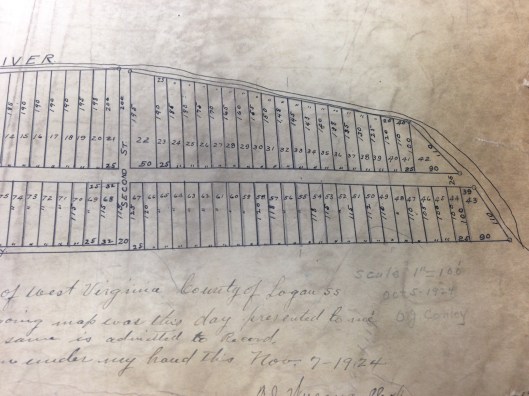
River View Addition, 1924

IMG_5495

River View Addition, 1924

IMG_5496

River View Addition, 1924

IMG_5497

River View Addition, 1924

IMG_5490

Ferrell Addition, 1925

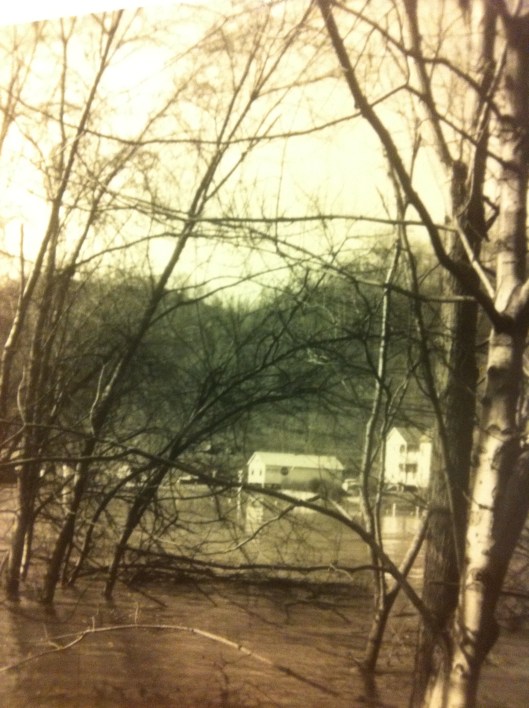
Guyandotte River Flood

13 Monday May 2019

Posted by Brandon Ray Kirk in Guyandotte River

≈ Leave a comment

Tags

Appalachia, Guyandotte River, history, Jill Baisden, Logan County, photos, West Virginia

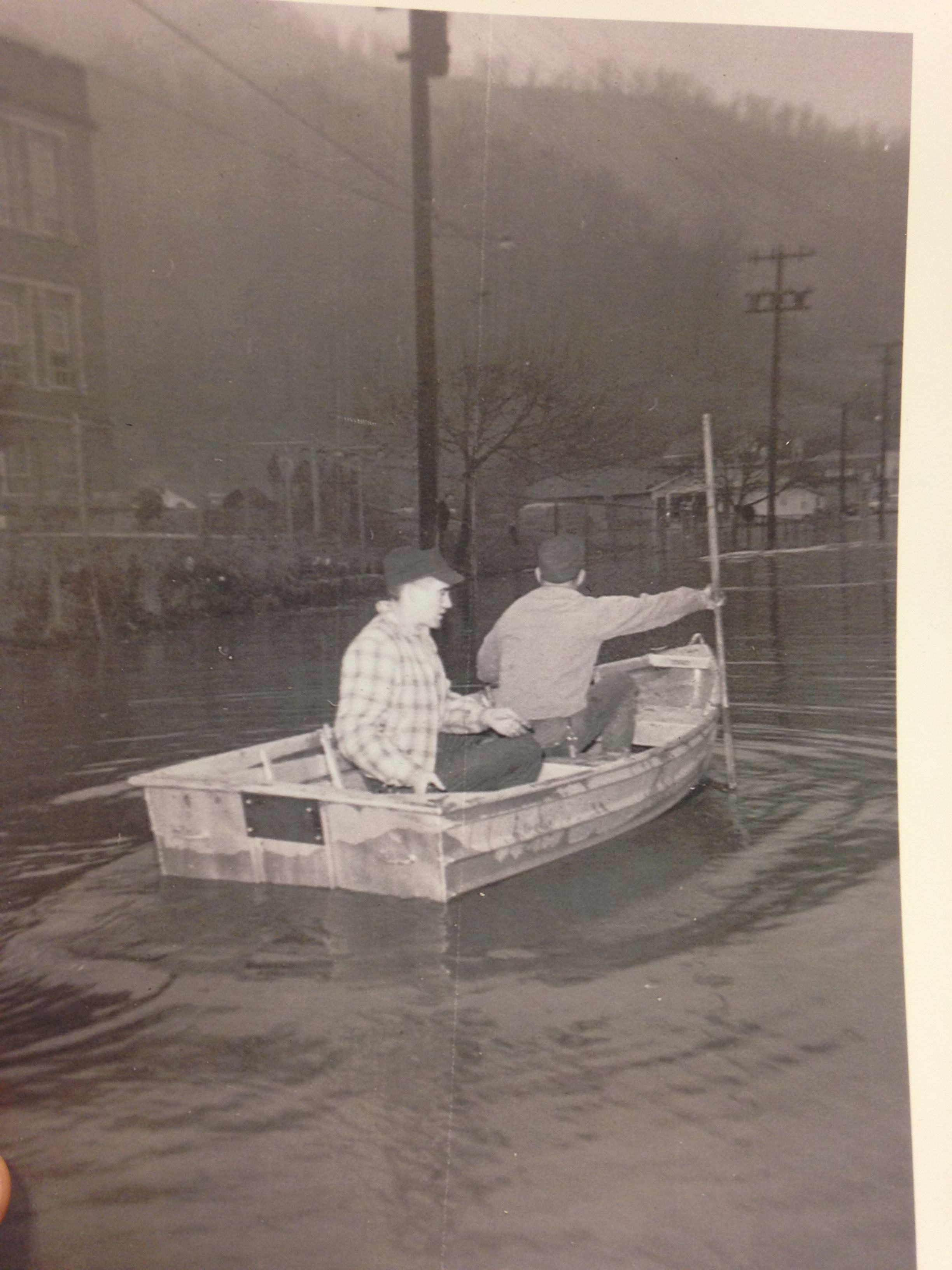
IMG_1096.JPG

Likely Logan County, WV, 1960s. Photo courtesy of Jill (Mullins) Baisden.

Chapmanville, WV (1923-1924, 1942)

26 Friday Apr 2019

Posted by Brandon Ray Kirk in Chapmanville, Guyandotte River

≈ Leave a comment

Tags

Appalachia, Ball Addition, C&O Railroad, Chapmanville, Dingess Street, Division Street, Ed Conley, engineer, Ferrell Street, George S. Ferrell, Guyandotte River, history, Huntington, J.D. Perry, J.D. Turner, J.H. Vickers, Logan, Logan County, map, O'Dell Street, R.E. Vickers, Riverside Drive, Rupert W. Stone, surveyor, West Virginia, William J. Ellis

IMG_5449

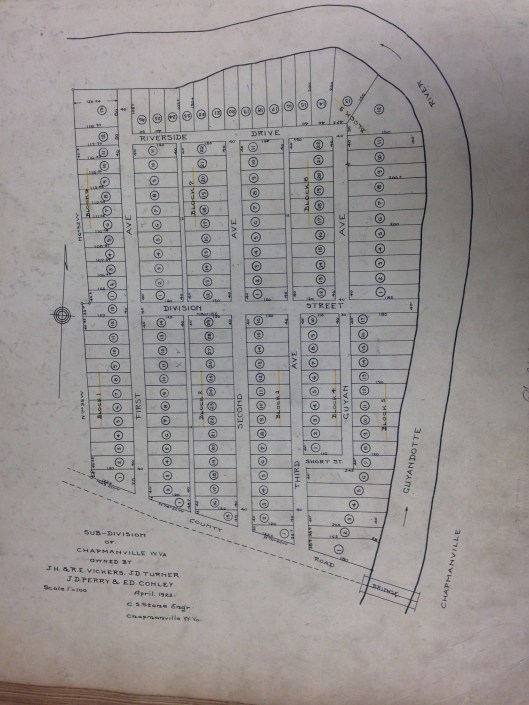
Sub-division of Chapmanville, WV.

IMG_5467

Sub-division of Chapmanville, WV.

IMG_5561

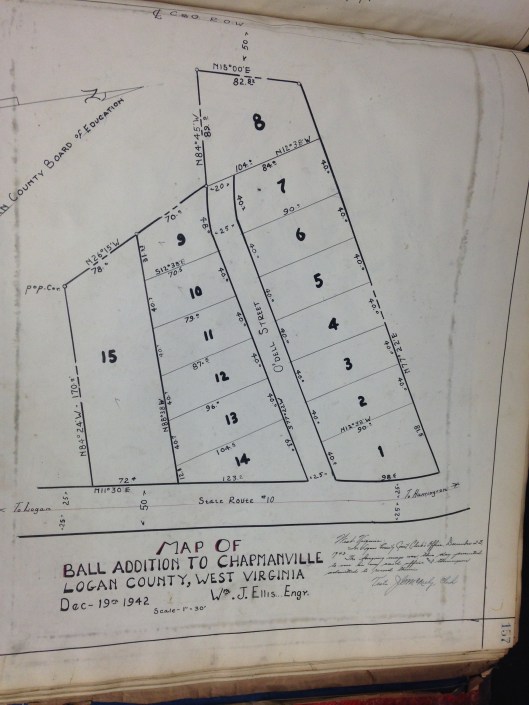
Ball Addition to Chapmanville, WV.

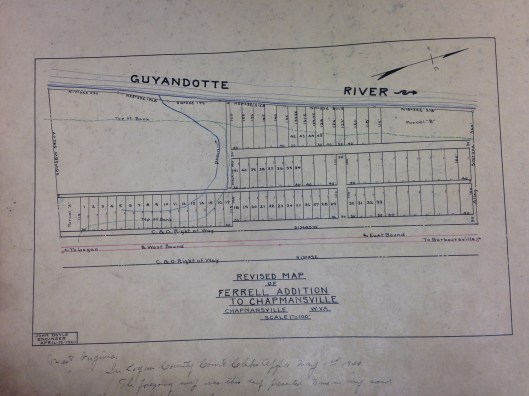
Chapmanville, WV (1920, 1923)

24 Wednesday Apr 2019

Posted by Brandon Ray Kirk in Chapmanville, Guyandotte River

≈ Leave a comment

Tags

Appalachia, C&O Railroad, Chapmanville, Crispin S. Stone, Dingess Street, E.R. Chapman, Elm Street, Ferrell Addition, Guyandotte River, history, L.W. Chapman, Logan County, Main Street, Matheny Lot, Stone Street, West Virginia

IMG_5437

Ferrell Addition of Chapmanville, WV.

IMG_5448

Chapman Addition of Chapmanville, WV.

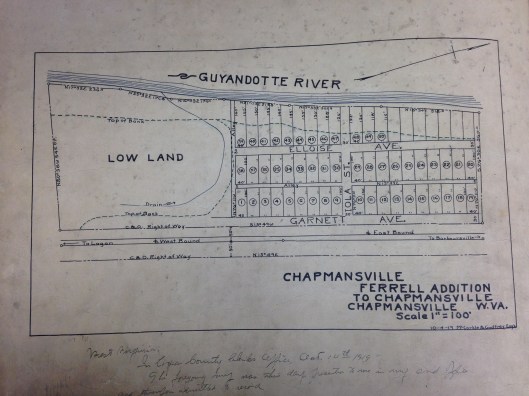
Chapmanville, WV (1919)

23 Tuesday Apr 2019

Posted by Brandon Ray Kirk in Chapmanville, Guyandotte River

≈ Leave a comment

Tags

Appalachia, C&O Railroad, Chapman Alley, Chapmanville, Elloise Avenue, Ferrell Addition, Garnett Avenue, Guyandotte River, history, Johnston Boulevard, Logan County, maps, West Virginia

IMG_5431

Ferrell Addition to Chapman(s)ville, WV.

IMG_5432

Ferrell Addition #2 to Chapmanville, WV.

Guyandotte River Flood, Harts, WV (1963)

20 Wednesday Mar 2019

Posted by Brandon Ray Kirk in Guyandotte River, Harts

≈ Leave a comment

Tags

Appalachia, Guyandotte River, Harts, history, Lincoln County, photos, West Virginia

Flood March 1963 1.jpg

Guyandotte River flood at Harts, Lincoln County, WV. March 1963.

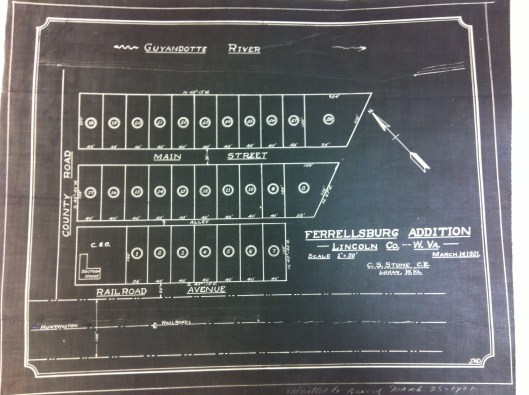
Ferrellsburg, WV (1921)

20 Wednesday Mar 2019

Posted by Brandon Ray Kirk in Ferrellsburg, Guyandotte River

≈ Leave a comment

Tags

Appalachia, C&O Railroad, Crispin S. Stone, Ferrellsburg, Guyandotte River, Harts, history, Kirk Street, Lincoln County, Lincoln County Commission, Logan, Main Street, map, Railroad Avenue, River Avenue, West Virginia

IMG_1266.JPG

Today, the county road and Main Street are called Kirk Street. Railroad Avenue is Mullins Avenue. In the 1980s, the county road became Kirk Street, Main Street became River Avenue, and Railroad Avenue retained its original name. In the late 1990s, the Lincoln County Commission approved the names of several new streets in town. In the early 2000s, 911 disregarded history and our county commission and improperly renamed many of our streets–and required that we use HARTS as our town address. NOTE: The county road led to a ferry at the river.

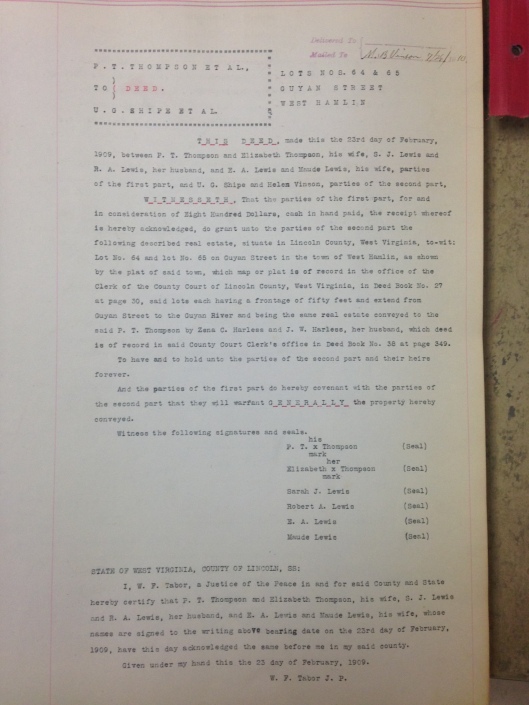
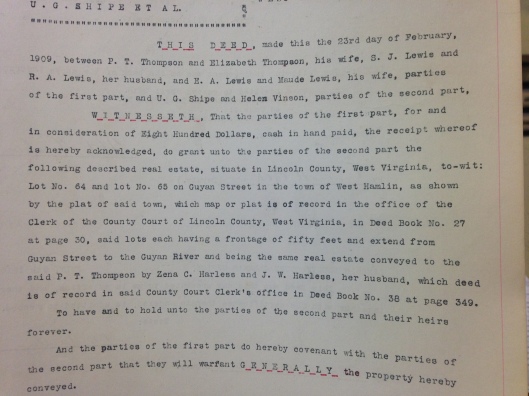
Patton Thompson et al Deed to U.G. Shipe (1909)

23 Saturday Feb 2019

Posted by Brandon Ray Kirk in Guyandotte River, West Hamlin

≈ Leave a comment

Tags

county clerk, E.A. Lewis, Elizabeth Thompson, genealogy, Guyan Street, Guyandotte River, Helen Vinson, history, J.W. Harless, justice of the peace, Lincoln County, Maude Lewis, Patton Thompson, Robert A. Lewis, S.J. Lewis, U.G. Shipe, W.F. Tabor, West Hamlin, West Virginia, Zena C. Harless

Patton Thompson Deed 3

Deed Book __, page __, Lincoln County Clerk’s Office, Hamlin, WV. Patton Thompson (1824-1909) was my great-great-great-grandfather. He died May 22, 1909.

Patton Thompson Deed 2

Deed Book __, page __, Lincoln County Clerk’s Office, Hamlin, WV.

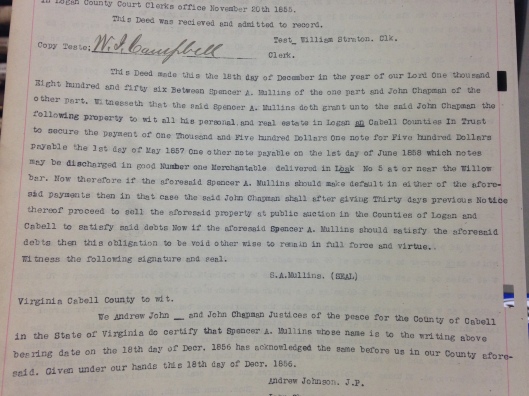
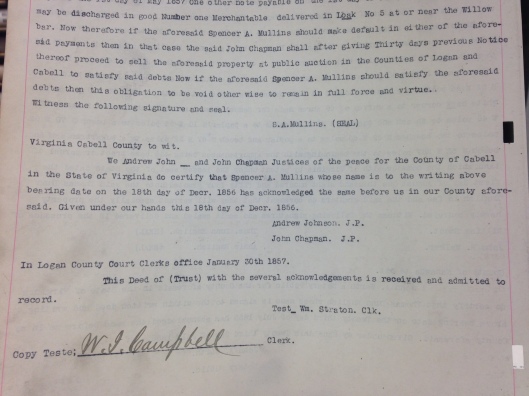
Spencer A. Mullins Trust Deed to John Chapman (1856)

07 Thursday Feb 2019

Posted by Brandon Ray Kirk in Atenville, Guyandotte River

≈ Leave a comment

Tags

Andrew Johnson, Appalachia, Atenville, Cabell County, county clerk, genealogy, Guyandotte River, Guyandotte Valley Navigation Company, history, John Chapman, justice of the peace, Lincoln County, Lock No. 5, Logan County, Spencer A. Mullins, Virginia, W.I. Campbell, West Virginia, William Straton, Willow Bar

Spencer A. Mullins to John Chapman Deed 1

Deed Book C, page ___, Logan County Clerk’s Office, Logan, WV. Spencer A. Mullins lived at present-day Atenville in Lincoln County, WV.

Spencer A. Mullins to John Chapman Deed 2

Deed Book C, page ___, Logan County Clerk’s Office, Logan, WV.

Phenol Taints Logan’s Water Supply (1927)

07 Thursday Feb 2019

Posted by Brandon Ray Kirk in Coal, Guyandotte River, Logan

≈ Leave a comment

Tags

Appalachia, coal, genealogy, Guyandotte River, Guyandotte Valley, history, Logan, Logan Banner, Logan County, Logan County Health Department, West Virginia

From the Logan Banner of Logan, WV, comes this bit of history relating to coal and the Guyandotte River, dated 1927:

UNPLEASANT AND HARMLESS TASTE NOTED IN CITY WATER—IS CAUSED BY PHENOL WASHED INTO RIVER

The local water company has lately been flooded with telephone calls relative to a strange taste and odor in the city water supply. At the request of the water company the County Health Department has made an investigation. It has been found that the queer taste and odor is not due to excessive use of chlorine disinfectant, as most people seem to believe. A great many people have remarked that the odor especially resembles that of carbolic acid. As a matter of fact, the compound causing it does not belong to the same family. The taste is caused by a phenol compound which is a coal tar product found in coal mine wastes. The heavy rains this week have washed some of this deposit from the upper Guyan Valley coal fields into the river. There is no known satisfactory method to remove phenol from water, so it goes through the water paint; part of it combining with the chlorine used for disinfecting and producing the taste so prevalent for the last few days.

The water is entirely safe and it is not injurious to health. It will probably last only a few days, until the flood waters in the rivers subside.

The situation is not a new one; various towns over the state, using stream water from coal field drainage districts, report “chloro-phenol” taste from time to time. The only remedy is to keep the coal waste from draining into the streams. Some work has been done in Pennsylvania along this line but so far little has been accomplished in West Virginia.

Logan County Health Department

Source: Logan (WV) Banner, 21 October 1927

Chief Logan (1937)

01 Friday Feb 2019

Posted by Brandon Ray Kirk in American Revolutionary War, Guyandotte River, Native American History

≈ 2 Comments

Tags

American Revolution, Andrew Lewis, Appalachia, Battle of Point Pleasant, Cayuga, Chief Cornstalk, Chief Logan, Daniel Greathouse, England, governor, Guyandotte Valley, history, Iroquois, James Logan, John Murray, Lord Dunmore, Michael Cresap, Mingo, Native American History, Native Americans, Ohio, Oneida, Pennsylvania, Six Nations, Susquehanna

From the Logan Banner of Logan, WV, comes this bit of history for Chief Logan, printed in 1937:

Family of Chief Logan Was Brutally Murdered After Battle of Pt. Pleasant

Chief Logan, the Cayuga Indian leader who was an important figure in the Indian Confederation in the early days of the Revolutionary war and for whom the city of Logan was named, was an instrument in the hands of Governor Dunmore, appointed by the English Parliament to conduct the affairs of the 13 colonies.

The family of Chief Logan was brutally murdered soon after the battle of Point Pleasant on October 10, 1774, in order to incite to new acts of murder and rapine the Indians whose order for fighting the courageous white settler was beginning to wane.

In the Battle of Point Pleasant the Indian Confederacy, commanded by Chief Cornstalk faced the white settlers under General Andrew Lewis and got a taste of the treatment they might expect in event England and the Colonies went to war with themselves on the side of the mother country.

Dr. Connelly, a deputy of Governor Dunmore, realized that the Indian desire for white scalps was somewhat satiated by the battle of Point Pleasant and the tribes were once gain becoming interested in their everyday life of hunting and shing. In order to offset this feeling of contentment, Dr. Connelly employed the English trader named Greathouse to incite the Indians to new acts of bloodshed.

Trader Greathouse knew of the popularity of the Cayuga chief Logan and rightly judged that an injustice done him would be an injustice to the majority of the tribes of the Confederacy.

Greathouse well-versed in the Indian situation west of the Alleghenies set out to the greatest harm to the Indians in the shortest time and chose the family of Chief Logan as the best possible victims of a white man’s outrage, knowing full well that Dr. Connelly had chosen a colonist well-known to the Indians to hold the “bag.”

The trader, posing as a representative of the English government, gained admittance to Chief Logan’s camp deep in the wilds of the Alleghenies while the latter was away on a hunting expedition. At an opportune moment when he knew that he would not be detected, Greathouse entered Chief Logan’s family circle of tepees and murdered the squaw and the Chief’s favorite children.

When the outrage was discovered by the braves, Greathouse, by instruction from Connelly, told of seeing a white Army officer’s horse near the camp that night before but though it to be of a courier. The unsuspecting braves took the explanation as good and allowed Greathouse to leave soon afterward.

Chief Logan returned from his hunting trip, found his family murdered and demanded retribution from the English.

Dr. Connelly definitely fixed the murder on a Captain Cresap, who at the time of the slaying was at his home in Maryland.

This, however, was enough for Chief Logan. A colonist, a member of the paleface band with whom a treaty had been made following the battle of Point Pleasant, had violated the trust. He returned to his Confederacy and began the work that Governor had anticipated.

The Indian tribes began new raids on the white settlers homes in the West and sufficiently retarded organization of a settlers’ regiment to allow Dunmore to make new inroads on the angry colonists in the East who were laying plans which culminated in the rebellion in 1776.

Dunmore’s strategy triumphed and probably held up the Revolution for at least a year.

Logan (WV) Banner, 19 April 1937

***

Life of Chief Logan Is An Interesting Narrative

Indian Chief Was Peaceful Until Massacre Of Family At Pt. Pleasant Changed Him To A Veritable Devil; Father Was French

Logan, chief of the Mingos, stands out as a romantic figure in the history of Indian warfare of this section.

His was a tragic role player on the shifting stage of border warfare between the white settlers who were attempting to penetrate the “wilderness” and the Indian tribes who were attempting to cling to their priority rights in this section before being pushed farther westward to the plains.

Logan was his place in history as an orator as well as a famed Indian warrior.

He was a true friend of the white man until, through the machinations of the English in an effort to incite the Indians to further bloodshed, his family was killed by a treacherous white trader named Greathouse.

Logan’s father was a French child who was captured by the Indians and adopted by the Oneida tribe that inhabited Eastern Pennsylvania and Western New York.

When he grew to manhood, he was possessed not only of a commanding stature, but of all the arts, wiles, traits, and characteristics endowed by nature and intellect to an Indian warrior.

By virtue of these he became chief of the tribe of the Susquehannas, who made their home in the Susquehanna valley of Pennsylvania.

The mother of Logan was a Mingo, or Cayuga, which tribe was a derelict branch of the Iroquois and the Six Great Nations.

It is believed that the influence of Logan’s mother on her son caused him to have attitude of tolerance and friendship toward the whites. Whether he husband influenced her sentiments for the whites is not definitely known.

As a matter of fact it was she who christened her son, the great and mighty warrior, “Logan,” in honor of James Logan, who was then secretary for Pennsylvania.

Logan’s Indian name was Tah-gah-jute, meaning “the young and mighty warrior.”

He was after a time chosen chief of the Mingo tribe of this section. As chief of the Mingos he was slow to anger, indulgent, considerate, and dealing in a kindly manner with those who dealt kindly with him.

Chief Logan married an Indian maiden whose name is not recorded. He reared a family in territory of the Guyandotte watershed and was relatively happy, living at peace, with man, until the English changed him from a peaceful Indian to a veritable devil by having massacred his family at a camp in the Ohio.

The stories of Chief Logan’s campaign against the white man after the atrocious murder of his family is recorded in history and tradition.

He lived to see his beloved hunting grounds desecrated by the white man and died a broken-hearted old chieftain somewhere in a camp on the Ohio.

A bronze replica of the mighty warrior has been erected in front of the courthouse at Williamson in memory of the Mingo chief. Logan and Logan county has honored his name by taking it for themselves.

Logan (WV) Banner, 1 May 1937

Chapmanville News 03.10.1922

29 Tuesday Jan 2019

Posted by Brandon Ray Kirk in Chapmanville, Guyandotte River, Logan

≈ Leave a comment

Tags

A.K. Bowling, Abraham, Alma Wagner, Anna Bowling, Appalachia, Busy Bee Pool Room, Butcher Pool Room, Chapmanville, Ed Conley, Eunice Ward, Everett Fondee, genealogy, Gordon Adams, Guy Dingess, Guyandotte River, history, J.D. Turner, John Dingess, Logan, Logan County, Millard Brown, Monroe Conley, Mont Tabor, Omar, P.M. Ferrell, Ray Swann, Silas Smith, Star Supply, West Virginia, Wonderland Theatre

A correspondent named “Slow Sam” from Chapmanville in Logan County, West Virginia, offered the following items, which the Logan Banner printed on March 10, 1922:

The revival at the Holiness church, conducted by Rev. Johnson, is still going on.

Three very interesting sermons by Rev. Langdon were delivered at the Christian church.

Monroe Conley’s house was destroyed by fire Wednesday morning.

We are glad to say that Dr. J.D. Turner’s baby is improving rapidly.

Mrs. Larkin, of Omar, is visiting her parents, Rev. and Mrs. Langdon of this place.

Mr. Silas Smith, of Abraham, was visiting at A.K. Bowling’s Monday.

The free show given at the Wonderland Theatre was well attended Tuesday night.

Mont Tabor, of Logan, was seen on our streets Sunday.

Mr. Everett Fondee and Miss Eunice Ward were calling on Miss Anna Bowling Wednesday evening.

Mr. P.M. Ferrell and Miss Alma Wagner were seen walking our streets a fine evening ago.

Wanda looks lonesome this week!

Mr. Millard Brown is calling quite often at the Star Supply. There is a good looking girl working there.

Mr. Gordon Adams killed a fine hog, Ernest said.

Mrs. Ferrell is visiting friends here.

John Dingess looks pleased. Wonder why?

Guy Dingess was seen talking to some girls down the street one day this week.

Jim was glad the show was free!

Mr. Ray Swann is working at Chapmanville now.

The Busy Bee pool room is doing good business.

The music is fine in the Butcher pool room as well as the business.

Mr. Mathenie has moved back to his home at this place.

Ed Conley has moved across the river.

Good luck to The Banner!

Guyandotte Valley Drought of 1881

18 Friday Jan 2019

Posted by Brandon Ray Kirk in Big Harts Creek, Ferrellsburg, Guyandotte River, Harts, Pecks Mill

≈ Leave a comment

Tags

Albert Dingess, Appalachia, black tongue, Ferrellsburg, Guyandotte River, Harts, Harts Creek, history, J.E. Ned Peck, Lincoln County, Logan Banner, Logan County, Pecks Mill, West Virginia

On June 4, 1937, the Logan Banner of Logan, WV, offered an interview with an elderly resident who recounted a terrible dry season in the Guyandotte Valley in 1881.

IMG_2423.JPG

Guyandotte River between Harts and Ferrellsburg, Lincoln County, WV. June 2015.

Pioneer Citizen Recalls Dreadful Drought of 1881

Attorney J.E. (Ned) Peck Says Weather Was So Hot That Corn Was Hoed In Moonlight; Animals Died From “Black Tongue”

Attorney J.E. (Uncle Ned) Peck was in a reminiscent mood early this week as a result of the hot weather which preceded the storms yesterday and the day before.

While everyone else was complaining about the extremely hot weather coming so early in the spring. Uncle Ned contentedly maintained his usual tenor of life and kept himself cool with memories of the summer in 1881 when a drought of proportions such as have never been heard of before or since struck Logan county and lasted for four months.

Attorney Peck told how the weather became so hot that everybody hoed their corn by moonlight to keep the stalks from withering under the blazing sun which would begin to bear down at 7 o’clock each morning and increase in intensity until 6:30 in the evening when the mountain peaks would give some surcease from the bright yellow infernos of mid-day heat which surrounded everything in a furnace-like grasp.

Uncle Ned related that the banks of the Guyan were lined with animals from the hills, all enmity forgotten, staking their thirst side by side for days on end.

He was just 13 years old then, but he says he distinctly remembers standing in the yard of his home at Pecks Mill with his mother and counting more than a score of deer in a river bottom cornfield below the house.

Wild animals died like flies and a plague of “Black Tongue” ravaged the many herds of deer which roamed the mountains and river valleys of Logan county.

A total of 1500 deer died that summer, Uncle Ned said, and Albert Dingess, old resident of Harts Creek, found 101 deer, dead and dying, their tongues blackened and swollen from their mouths, packed, in a lick near his home.

Deer pelts sold for $4 each, but the flesh was inedible after the animal had died of the plague. Licks throughout the county were rancid with the smell of burning carcasses which had been skinned and stacked in huge piles to be made into pyres.

Water in Guyan river became so low that one could stop the flow over shoals with the hand, and his father had to slow corn meal production to one grinding a week at their grist mill, Attorney Peck said.

The only way that corn could be ground was to allow the dam which spanned the river to fill and then run the mill until the water was used. Then it would take another week for the dam to refill.

No persons died of heat in the county that summer and the crops were not materially damaged, though the toll on animal life was high.

When the leaves began to turn and light frosts added a crispness to the air, the animals started an exodus from the river valley back to their haunts along creeks and in dark hollows and Logan countians knew that the drought was ended.

With such an experience, and with the summer of 1881 in mind, it is easy for Uncle Ned Peck to say in all sincerity: “We’re having a mighty cool spring this year.”

Isaac Adkins Heirs Deed to Henry Adkins (1855)

12 Wednesday Dec 2018

Posted by Brandon Ray Kirk in Big Harts Creek, Guyandotte River

≈ 2 Comments

Tags

Appalachia, Charles Adkins, county clerk, Edmond Toney, Elizabeth Adkins, genealogy, Guyandotte River, Harts Creek, Henry Adkins, history, Isaac Adkins, Isaiah Adkins, Jane Toney, Lincoln County, Logan County, Lydia Eveline Mullins, Mary Jane Adkins, Parthena Adkins, Spencer A. Mullins, Virginia, W.I. Campbell, West Virginia, William Straton

Isaac Adkins Heirs to Henry Adkins Deed 1

Deed Book C, page 446, Logan County Clerk’s Office, Logan, WV. Isaac and Elizabeth (Adkins) Adkins are my great-great-great-great-grandparents. I descend through their son, Isaiah.

Isaac Adkins Heirs to Henry Adkins Deed 2

Deed Book C, page 446, Logan County Clerk’s Office, Logan, WV. This land is located in present-day Harts, Lincoln County, WV.

Early Anglo Settlers of Logan, WV (1937)

10 Monday Dec 2018

Posted by Brandon Ray Kirk in Guyandotte River, Logan, Native American History, Tazewell County

≈ Leave a comment

Tags

Appalachia, Aracoma, Bluestone Valley, Boling Baker, Deskins Addition, Guyandotte River, Hatfield Island, Henry Mitchell, history, Island Creek, John Breckinridge, John Dempsey, John Dingess, Joseph Workman, Logan, Logan Banner, Logan County, Montgomery County, Nancy McNeely, Native American History, Native Americans, Nimrod Workman, Peter Dingess, Shawnee, Tazewell County, Virginia, West Virginia, William Dingess, Wythe County

From the Logan Banner of Logan, WV, comes this bit of history about Logan’s earliest Anglo settlers in a story printed April 1, 1937:

First White Settler To Make His Home In Logan Lived on Hatfield Island

The first white settler to make his home near Logan was James Workman who was with the force of men who struck the blow that broke the power of the Shawnee in the valley of the Guyandotte.

He was a member of the group of white settlers who pursued Boling Baker from a settlement in the Bluestone valley to the island that is now known as “Hatfield Island” and there burned an Indian village and mortally wounded Princess Aracoma. Boling Baker escaped.

After Workman had a glimpse of the beautiful lush valley of the Guyandotte, it took little persuasion by John Breckinridge, who had been granted much of the valley after the battle of the Islands to get Workman and his two brothers Joseph and Nimrod to make settlement there, Breckinridge was forced to settle the land by the law of 1792 in order to hold title to it.

Workman and his two brothers came to the island in 1794 and built a cabin and planted a few acres of corn. In 1795 and 1796 the brothers planted the same land and James, who was a man of family, brought his wife and children from their old home in Wythe (now Tazewell) county, Virginia, where they continued to live until about the year 1800 when they moved to a farm nearby which was later owned by Henry Mitchell.

The first recorded permanent settlement was made by William Dingess, son of Peter Dingess, a German. Dingess was the oldest in a family of eleven children.

He was born in Montgomery county in 1770 and married Nancy McNeely. He purchased a survey of 300 acres, which covers the present site of the courthouse and a portion of the land across the river which is now Deskins addition.

Dingess moved to his survey in 1799 and made his home. John Dempsey came with him and built a cabin on the island, but afterwards moved to Island Creek.

William Dingess was said to be almost a giant in strength, but so peaceable that no one could induce him to fight. He was a relentless Indian fighter in the Guyan Valley, however. A story is told that he was with a force of whites who pursued a band of Indian marauders as far as the falls of the Guyan where they killed several braves.

Dingess cut a portion of the skin from a forearm of one of the braves and tanned it using it for a razor strop until his death.

The first settler had no children by his first wife. In 1800, Peter Dingess and John Dingess joined him and built their homes in the fertile land on each side of the river near the islands. Other settlers followed in time and the little settlement grew to a thriving frontier town.

Roma Spears Deed to Allen Estep (1909)

09 Sunday Dec 2018

Posted by Brandon Ray Kirk in Big Ugly Creek, Guyandotte River

≈ Leave a comment

Tags

Allen Estep, Appalachia, Big Ugly Creek, Ella Spears, G.W. Estep, genealogy, Guyandotte River, history, L.A. Ellis, Lincoln County, Logan County, notary public, Roma Spears, Trace Branch, Trace Fork, West Virginia

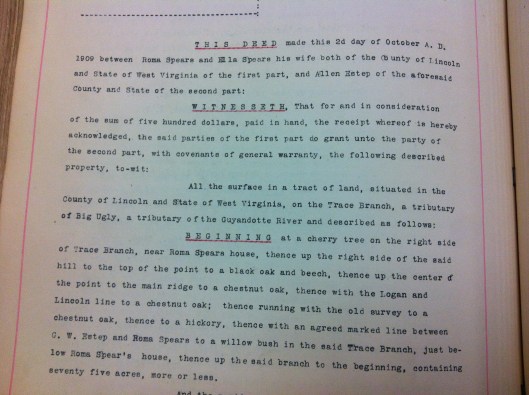
Roma Spears to Allen Estep 1

Deed Book 55, page 364, Lincoln County Clerk’s Office, Hamlin, WV.

Roma Spears to Allen Estep 2

Deed Book 55, page 364, Lincoln County Clerk’s Office, Hamlin, WV.

Roma Spears to Allen Estep 3

Deed Book 55, page 364, Lincoln County Clerk’s Office, Hamlin, WV.

Roma Spears to Allen Estep 4

Deed Book 55, page 365, Lincoln County Clerk’s Office, Hamlin, WV.

← Older posts
Newer posts →

Feud Poll 1

If you had lived in the Harts Creek community during the 1880s, to which faction of feudists might you have given your loyalty?

Categories

  • Adkins Mill
  • African American History
  • American Revolutionary War
  • Ashland
  • Atenville
  • Banco
  • Barboursville
  • Battle of Blair Mountain
  • Beech Creek
  • Big Creek
  • Big Harts Creek
  • Big Sandy Valley
  • Big Ugly Creek
  • Boone County
  • Breeden
  • Calhoun County
  • Cemeteries
  • Chapmanville
  • Civil War
  • Clay County
  • Clothier
  • Coal
  • Cove Gap
  • Crawley Creek
  • Culture of Honor
  • Dingess
  • Dollie
  • Dunlow
  • East Lynn
  • Ed Haley
  • Eden Park
  • Enslow
  • Estep
  • Ethel
  • Ferrellsburg
  • Fourteen
  • French-Eversole Feud
  • Gilbert
  • Giles County
  • Gill
  • Green Shoal
  • Guyandotte River
  • Halcyon
  • Hamlin
  • Harts
  • Hatfield-McCoy Feud
  • Holden
  • Hungarian-American History
  • Huntington
  • Inez
  • Irish-Americans
  • Italian American History
  • Jamboree
  • Jewish History
  • John Hartford
  • Kermit
  • Kiahsville
  • Kitchen
  • Leet
  • Lincoln County Feud
  • Little Harts Creek
  • Logan
  • Man
  • Matewan
  • Meador
  • Midkiff
  • Monroe County
  • Montgomery County
  • Music
  • Native American History
  • Peach Creek
  • Pearl Adkins Diary
  • Pecks Mill
  • Peter Creek
  • Pikeville
  • Pilgrim
  • Poetry
  • Queens Ridge
  • Ranger
  • Rector
  • Roane County
  • Rowan County Feud
  • Salt Rock
  • Sand Creek
  • Shively
  • Spears
  • Sports
  • Spottswood
  • Spurlockville
  • Stiltner
  • Stone Branch
  • Tazewell County
  • Timber
  • Tom Dula
  • Toney
  • Turner-Howard Feud
  • Twelve Pole Creek
  • Uncategorized
  • Warren
  • Wayne
  • West Hamlin
  • Wewanta
  • Wharncliffe
  • Whirlwind
  • Williamson
  • Women's History
  • World War I
  • Wyoming County
  • Yantus

Feud Poll 2

Do you think Milt Haley and Green McCoy committed the ambush on Al and Hollene Brumfield in 1889?

Blogroll

  • Ancestry.com
  • Ashland (KY) Daily Independent News Article
  • Author FB page
  • Beckley (WV) Register-Herald News Article
  • Big Sandy News (KY) News Article
  • Blood in West Virginia FB
  • Blood in West Virginia order
  • Chapters TV Program
  • Facebook
  • Ghosts of Guyan
  • Herald-Dispatch News Article 1
  • Herald-Dispatch News Article 2
  • In Search of Ed Haley
  • Instagram
  • Lincoln (WV) Journal News Article
  • Lincoln (WV) Journal Thumbs Up
  • Lincoln County
  • Lincoln County Feud
  • Lincoln County Feud Lecture
  • LinkedIn
  • Logan (WV) Banner News Article
  • Lunch With Books
  • Our Overmountain Men: The Revolutionary War in Western Virginia (1775-1783)
  • Pinterest
  • Scarborough Society's Art and Lecture Series
  • Smithsonian Article
  • Spirit of Jefferson News Article
  • The Friendly Neighbor Radio Show 1
  • The Friendly Neighbor Radio Show 2
  • The Friendly Neighbor Radio Show 3
  • The Friendly Neighbor Radio Show 4
  • The New Yorker
  • The State Journal's 55 Good Things About WV
  • tumblr.
  • Twitter
  • Website
  • Weirton (WV) Daily Times Article
  • Wheeling (WV) Intelligencer News Article 1
  • Wheeling (WV) Intelligencer News Article 2
  • WOWK TV
  • Writers Can Read Open Mic Night

Feud Poll 3

Who do you think organized the ambush of Al and Hollene Brumfield in 1889?

Recent Posts

  • Logan County Jail in Logan, WV
  • Absentee Landowners of Magnolia District (1890, 1892, 1894)
  • Charles Spurlock Survey at Fourteen Mile Creek, Lincoln County, WV (1815)

Ed Haley Poll 1

What do you think caused Ed Haley to lose his sight when he was three years old?

Top Posts & Pages

  • U.B. Buskirk of Logan, WV (1893-1894)
  • Vance Homeplace and Cemetery on West Fork (2017)
  • Tice Elkins in Ferrellsburg, WV
  • Alice Dingess piano
  • John Hartford's home

Copyright

© Brandon Ray Kirk and brandonraykirk.wordpress.com, 1987-2023. Unauthorized use and/or duplication of this material without express and written permission from this blog’s author and/or owner is strictly prohibited. Excerpts and links may be used, provided that full and clear credit is given to Brandon Ray Kirk and brandonraykirk.wordpress.com with appropriate and specific direction to the original content.

Archives

  • February 2025
  • January 2025
  • October 2023
  • September 2023
  • December 2022
  • November 2022
  • May 2022
  • April 2022
  • February 2022
  • November 2021
  • October 2021
  • September 2021
  • June 2021
  • May 2021
  • April 2021
  • March 2021
  • February 2021
  • January 2021
  • December 2020
  • November 2020
  • October 2020
  • July 2020
  • June 2020
  • May 2020
  • April 2020
  • March 2020
  • February 2020
  • January 2020
  • December 2019
  • November 2019
  • October 2019
  • September 2019
  • August 2019
  • July 2019
  • June 2019
  • May 2019
  • April 2019
  • March 2019
  • February 2019
  • January 2019
  • December 2018
  • November 2018
  • October 2018
  • September 2018
  • August 2018
  • July 2018
  • June 2018
  • May 2018
  • April 2018
  • March 2018
  • February 2018
  • January 2018
  • December 2017
  • November 2017
  • October 2017
  • September 2017
  • August 2017
  • July 2017
  • June 2017
  • May 2017
  • April 2017
  • March 2017
  • February 2017
  • January 2017
  • December 2016
  • November 2016
  • October 2016
  • September 2016
  • August 2016
  • July 2016
  • June 2016
  • May 2016
  • April 2016
  • March 2016
  • February 2016
  • January 2016
  • December 2015
  • November 2015
  • October 2015
  • September 2015
  • August 2015
  • July 2015
  • June 2015
  • May 2015
  • April 2015
  • March 2015
  • February 2015
  • January 2015
  • December 2014
  • October 2014
  • September 2014
  • August 2014
  • July 2014
  • June 2014
  • May 2014
  • April 2014
  • March 2014
  • February 2014
  • January 2014
  • December 2013
  • November 2013
  • October 2013
  • September 2013
  • August 2013
  • July 2013
  • June 2013
  • May 2013
  • April 2013
  • March 2013
  • February 2013
  • January 2013
  • December 2012
  • November 2012

Enter your email address to follow this blog and receive notifications of new posts by email.

Join 2,925 other subscribers

Tags

Appalachia Ashland Big Creek Big Ugly Creek Blood in West Virginia Brandon Kirk Cabell County cemeteries Chapmanville Charleston civil war coal Confederate Army crime culture Ed Haley Ella Haley Ferrellsburg feud fiddler fiddling genealogy Green McCoy Guyandotte River Harts Harts Creek Hatfield-McCoy Feud history Huntington John Hartford Kentucky Lawrence Haley life Lincoln County Lincoln County Feud Logan Logan Banner Logan County Milt Haley Mingo County music Ohio photos timbering U.S. South Virginia Wayne County West Virginia Whirlwind writing

Blogs I Follow

  • OtterTales
  • Our Appalachia: A Blog Created by Students of Brandon Kirk
  • Piedmont Trails
  • Truman Capote
  • Appalachian Diaspora

BLOOD IN WEST VIRGINIA is now available for order at Amazon!

Blog at WordPress.com.

OtterTales

Writings from my travels and experiences. High and fine literature is wine, and mine is only water; but everybody likes water. Mark Twain

Our Appalachia: A Blog Created by Students of Brandon Kirk

This site is dedicated to the collection, preservation, and promotion of history and culture in Appalachia.

Piedmont Trails

Genealogy and History in North Carolina and Beyond

Truman Capote

A site about one of the most beautiful, interesting, tallented, outrageous and colorful personalities of the 20th Century

Appalachian Diaspora

  • Subscribe Subscribed
    • Brandon Ray Kirk
    • Join 787 other subscribers
    • Already have a WordPress.com account? Log in now.
    • Brandon Ray Kirk
    • Subscribe Subscribed
    • Sign up
    • Log in
    • Report this content
    • View site in Reader
    • Manage subscriptions
    • Collapse this bar
 

Loading Comments...