• About

Brandon Ray Kirk

~ This site is dedicated to the collection, preservation, and promotion of history and culture in my section of Appalachia.

Brandon Ray Kirk

Category Archives: Coal

Early Coal Mines in Logan County, WV

01 Friday Sep 2017

Posted by Brandon Ray Kirk in Battle of Blair Mountain, Big Creek, Boone County, Coal, Holden, Logan, Stone Branch

≈ 2 Comments

Tags

A.D. Robertson, Albert F. Holden, Amherst Coal Company, Appalachia, Big Creek Coal Company, Blair Mountain, Boone County Coal Company, Buffalo Creek, Buffalo Creek Coal and Coke Company, Buskirk Hotel, Clothier, coal, Cole and Crane Company, Cora Coal Company, Dobra, Draper Coal Company, engineer, G.W. Robertson, Gay Coal and Coke Company, Gay Coal Company, George M. Jones, Guyan Valley Coal Operators Association, Harry S. Gay, Herbert Jones, history, Holden, Huddleston Coal Company, Illinois, Island Creek Coal Company, John B. Wilkinson, John Laing, Logan County, Logan County Coal Operators Association, Madison, Main Island Creek Coal Company, Monclo Corporation, Monitor Coal Company, Moses Mounts, Mounts-White Fisher Company, Omar, Omar Mining Company, Pennsylvania, Peru, Princess Coal Company, Shamokin, Sharples, Stone Branch Coal Company, U.S. Coal and Oil Company, Vicie Nighbert, Virginia-Buffalo Company, West Virginia, West Virginia Coal and Coke, Wheeling-Pittsburgh Coal Company, Wilkinson, William H. Coolidge, William J. Clothier, Yuma Coal and Coke Company

What follows are brief notes from a forgotten source regarding early coal mines in Logan County, WV. Each of these companies and their communities have storied histories.

Gay Coal and Coke (organized in 1903)

Soon after 1900, Harry S. Gay, a mining engineer, came from Shamokin, PA, to observe the Logan coal fields. He stayed at the Buskirk Hotel. With money from friends A.D. and G.W. Robertson, he leased 800 acres from Moses Mounts of the Mounts-White Fisher Company for $20,000. G.W. Robertson was president of Gay Coal and Coke, while Gay was its secretary-treasurer. The company opened the Number One mine in the spring of 1903.

Monitor Coal Company (organized in 1904)

Monitor Coal Co. was organized in 1904 on the land of John B. Wilkinson. The accompanying town was named Wilkinson. Monitor merged with Yuma Coal and Coke Co. in 1935. In 1942, Wilkinson consisted of 166 company-owned houses. The mines eventually played out and real estate was sold through Monclo Corporation.

In 1905, seven coal companies existed in Logan County: Big Creek, Cora, Draper, Gay, Monitor, Stone Branch, and U.S. Coal and Oil Co. (Island Creek).

Island Creek Coal

Island Creek Coal also came to Logan during that time and created Holden. About 1902, William H. Coolidge and Albert F. Holden bought land from Vicie Nighbert. In early 1905, they established Island Creek Coal Sales Co. Holden was built by 1912.

Yuma Coal and Coke Company

Organized in 1905 by the same Pennsylvania interests behind Monitor Coal and Coke Co., Yuma Coal merged with Monitor in 1935.

In 1910, seventeen coal companies existed in Logan County.

Boone County Coal Company (organized in 1911)

Organized in 1911, the Boone County Coal Co. was headquartered at Clothier. William J. Clothier served as its first president. Its buildings burned and new buildings were erected at Sharples. The company held 30,000 acres just above Madison and about 2000 of it came into Logan to the top of Blair Mountain. The company had stores at Clothier, Sharples, Monclo, and Dobra.

Amherst Coal Company

In 1911, George M. Jones and his brother Herbert became interested in the Logan field. They leased 1300 acres on Buffalo Creek and organized Amherst Coal Company in January of 1912. In 1916, the company purchased the Virginia-Buffalo Company and the Huddleston Coal Company. It later purchased Buffalo Creek Coal and Coke Company.

Main Island Creek

In 1913, John Laing leased 30,000 acres in Omar from Cole and Crane Company of Peru, Illinois. Mr. Laing was the first president of the company. Later, West Virginia Coal and Coke, the Omar Mining Company, and Wheeling-Pittsburgh Coal Company mined this land.

In 1913, the Guyan Valley Coal Operators Association organized. In 1918, it became known as the Logan County Coal Operators Association. (For more on the association, follow this link: http://www.wvculture.org/history/ms90-82.html.)

In 1920, over seventy coal companies existed in Logan County (most were small and few survived).

By 1960, there were about fifty coal companies in Logan County; four coal companies accounted for about eighty percent of production. The four companies were Island Creek, Amherst, Omar, and Princess.

The Majesty of Coal (1927)

24 Thursday Aug 2017

Posted by Brandon Ray Kirk in Coal

≈ Leave a comment

Tags

Appalachia, Cincinnati, Cincinnati Enquirer, coal, history, Kentucky, Logan, Logan Banner, Manhattan, Ohio, Statue of Liberty, U.S. South, West Virginia

From the Cincinnati Enquirer via the Logan Banner of Logan, WV, we find this editorial about coal dated 8 February 1927:

Coal is one of the present greatest factors in the life of civilization. But for this “bottled sunlight” we should have little other light or power. We ride the street cars, pass under the luminance of arc lights, enjoy the soft glow of the incandescents; we operate our mills and factories, we speed across the continents and oceans on trains and steamers largely because we have coal. Some day something else may take its place, but at present coal is the nerve of modern life and industry, of trade and commerce.

In the program being carried forward to make this city better known to its own people and to other peoples, the Chamber of Commerce does well to stress the importance of the city as a soft-coal center. The city is, in fact, the soft-coal center of the nation. The great cosmopolitan communities of the country would often be in hard way but for Cincinnati and its facilities with reference to soft coal distribution. We not only are the gateway to the South, but the gateway through which flows the essence which fires and lights practically the life and industry of the mightiest nation on the face of the earth.

The coal of West Virginia and Kentucky makes life brighter and more worth living on the island of Manhattan; it goes to the areas of cold and bleakness on, and beyond, the Northern lakes. It helps to feed the trains and ships which carry millions of passengers and billions of dollars worth of freight. It helps to light the Statue of Liberty and warm the halls of legislation. Blow out, over night, the effectiveness and influence of Cincinnati to serve the nation and chaos would be invited for a time.

There is a good deal to be known about Cincinnati–much that is valuable to the city, and much that is of value to the nation and to the world.

Poet Norman Schlichter Visits Logan, WV (1926)

17 Thursday Aug 2017

Posted by Brandon Ray Kirk in Coal, Logan, Poetry

≈ 1 Comment

Tags

Appalachia, author, authors, Chicago News, coal, Elk River Coal and Lumber Company, Fancy's Hour, history, Island Creek Coal Company, J.G. Bradley, Logan, Logan Banner, Logan County, Monaville, Mud Fork, National Industrial Secretary, Norman Schlichter, poetry, Rivers of West Virginia, West Virginia, Whitman Creek, Y.M.C.A.

From the Logan Banner of Logan, WV, we find this item dated 5 November 1926:

“Norman Schlichter, poet and story writer, has been reading from his books to the pupils of schools of the Island Creek Coal Company properties, at Whitmans, Mud Fork, Monaville, this week. His coming was due to the desire of General Manager Beisel and General Superintendent Hunt to give the schools an opportunity to hear work that is being received with delight by boys and girls all over the United States.

“Mr. Schlichter was for many years National Industrial Secretary of the Y.M.C.A. and is widely known among the mining men of the State. Recently he has been devoting all his time to writing and lecturing. His children’s poems and stories are attracting wide attention. The Chicago News radioed his book, ‘Fancy’s Hour.’ The author is loud in his praise of the great educational advances in West Virginia, especially in the mining communities. Last week he was the guest of Mr. J.G. Bradley at the properties of the Elk River Coal and Lumber Company. He is the author of the ‘Rivers of West Virginia,’ a poem widely known in his state. This poem is reproduced in another column.”

Let’s Boost Old Logan (1911)

15 Tuesday Aug 2017

Posted by Brandon Ray Kirk in Coal, Guyandotte River, Logan

≈ Leave a comment

Tags

Appalachia, C&O Railroad, Christmas, coal, Guyandotte River, history, Logan, Logan Banner, Logan County, West Virginia

From the Logan Banner of Logan, West Virginia, dated January 5, 1911, we find this editorial:

“The bounteous harvest of holiday business is past, and the so-called dull season is upon our business man. But why a dull season? Some of our business men are going around with a face as long as a shingle, and to see them and hear them talk about dull business reminds one of a man in the last stages of consumption who is resigned to his fate. They appear as though they see bankruptcy staring them in the face. What they need is a little stiffening of the backbone. They need not expect business to be as good as it was through the holiday season, but they should remember that the people of this generation must be fed and clothed and furnished with whatever comforts they can afford, and as long as this is the case, there will be a continued demand for goods and merchandise of all kinds, and business will go on in the same old way. The trouble with the  business men of this city is that they talk down instead of talking up. If the merchant talks dull times, the farmer, the miner, the teamster, the carpenter, the professional man and all others will catch the contagion, and then business will be dull, but if they take an optimistic view of the matter and talk up, the opposite will be the result.

“There is no county in the state, and probably not in the union, that has a more brilliant future than Logan. Logan is today the best town of the state of its size, and it has much to be proud of. The coming year will witness greater development throughout the county than any two previous years, and instead of our business men going around with their lips hung down, they should be right now planning a vigorous campaign to capture their fair share of the prosperity that is sure to abound. Let them rouse themselves from the lethargy which now enshrouds them and be up and doing. Logan is all right. The fault is your own if you do not prosper. It is here for you. If you don’t get it, it will be your own fault. With the railroad going on up the river, and new coal operations opening up within sight of one another, and with our fine quality of coal and timber, nothing but Divine intervention can keep the Guyan Valley from blossoming as the rose. Stop your whining or get off the earth. Take hold and boost or the wheels of progress will mash you into smithereens.

“Logan is all right.

“It may be that you are too slow to keep up.”


Harlan, Kentucky (1928)

06 Thursday Jul 2017

Posted by Brandon Ray Kirk in Coal, Culture of Honor, Turner-Howard Feud

≈ Leave a comment

Tags

Appalachia, crime, feud, feuds, Harlan, Harlan County, history, Kentucky, photos, Turner-Howard Feud

Harlan, KY 1928 copyright.jpg

Harlan, Kentucky. 1928. Population, 1910: 657. Population, 1920: 2647. Population, 1930: 4327. Population today (2010): 1745.

Whirlwind News 11.16.1926

06 Thursday Jul 2017

Posted by Brandon Ray Kirk in Big Harts Creek, Coal, Whirlwind

≈ Leave a comment

Tags

Appalachia, Carl Adams, coal, Daniel McCloud, genealogy, Gillis Adams, Harts Creek, history, Hoover Fork, J.I. Mullins, Jane Adams, Logan Banner, Logan County, Lucy McCloud, Mildred Adams, Mollie Robinson, Pearl McCloud, Peter Mullins, Ruth McCloud, Sallie Bunn, Si Tomblin, Twelve Pole Creek, West Virginia, Whirlwind, Wilburn Mullins

An unknown correspondent from Whirlwind in Logan County, West Virginia, offered the following items, which the Logan Banner printed on November 16, 1926:

We are having some nice weather at this writing.

Mrs. Peter Mullins is very ill, we are sorry to say.

Wilburn Mullins was the guest of Daniel McCloud Saturday.

Mrs. Jane Adams was calling on friends at Mollie Robinson’s Sunday.

Miss Mildred Adams was shopping in Whirlwind Thursday.

We are all wondering who put the stone in Gillis Adams’ path up the left fork of Hoover.

Lucy McCloud was the guest of Mrs. Sallie Bunn Sunday morning.

Si Tomblin was calling on friends at Mollie Robinson’s Monday.

Daniel McCloud was seen shopping in Whirlwind Monday.

Pearl and Ruth McCloud made a flying trip up Hoover Monday.

Carl Adams is the coal digger of Hoover. Stay with it, Carl. Winter will soon be here.

Mildred, cheer up and don’t look so blue. J.I. Mullins has just gone to Twelve Pole.

Wonder if Carl Adams saw the girl he was looking for Sunday?

Sad news was ringing on Hoover Saturday. Mollie Robinson’s dog died.

Some combinations: Clinton and his flash light; Garfield and his potatoes; Carl and his coal; Mildred and her blues; Fred and his baby; Lucy and her smiles; Wilburn and his pumpkin; Rush going to Sunday School.

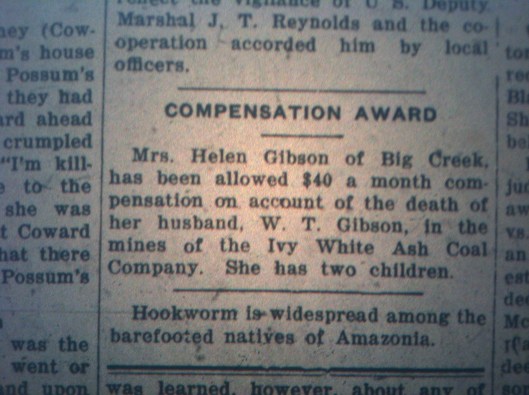
Compensation for Dead Coal Miner’s Wife (1926)

02 Sunday Jul 2017

Posted by Brandon Ray Kirk in Big Creek, Coal

≈ 2 Comments

Tags

Appalachia, Big Creek, coal, Helen Gibson, history, Ivy White Ash Coal Company, Logan, Logan Banner, Logan County, W.T. Gibson, West Virginia

Compensation for Dead Miner's Wife LB 11.02.1926

Logan (WV) Banner, 2 November 1926.

Company House in Logan, WV (1914)

28 Wednesday Jun 2017

Posted by Brandon Ray Kirk in Coal, Logan

≈ Leave a comment

Tags

Appalachia, Aracoma Coal Company, coal, Coal Branch, history, Logan, Logan Banner, Logan County, photos, West Virginia

Company House at Coal Branch LB 06.26.1914 1.jpg

Logan (WV) Banner, 26 June 1914.

Whiffs from Whirlwind (1914)

21 Wednesday Jun 2017

Posted by Brandon Ray Kirk in Big Harts Creek, Coal, Man, Whirlwind

≈ Leave a comment

Tags

Appalachia, Barney Carter, Belvia Mullins, Burlie Riddle, Canterbury, Charles Curry, Charley Mullins, coal, genealogy, Harts Creek, history, Hoover Fork, J.H. Workman, James Mullins, John McCloud, Julia Mullins, Lawrence Mullins, Logan Banner, Logan County, McCloud Cemetery, Mosco Mullins, New York City, Oilville, Peter Mullins, Pink Mullins, Pond Creek, Sam Mullins, singing schools, Sol Riddell, teacher, Twelve Pole Creek, West Virginia, Whirlwind

J.M., a correspondent from Whirlwind in Logan County, West Virginia, offered the following items, which the Logan Banner printed on February 20, 1914:

Business is dull in this section.

S. Riddell left Thursday for New York City.

Miss Belvia Mullins is visiting friends at Canterbury this week.

Peter Mullins left Tuesday for Oilville where he will engage in the carpenter’s trade.

Singing school is progressing nicely under the skillful management of Rev. Chas. Curry.

A large crowd attended church at Hoover Sunday.

J.H. Workman has accepted a position as clerk in S. Riddell’s store at this place.

Sam Mullins returned to his work on Pond Creek Monday.

Miss Julia Mullins was shopping at Pink Mullins’ Saturday.

Charley Mullins is on the sick list this week.

Mrs. Jno. McCloud died at her home on Twelve Pole Friday and was buried in the McCloud cemetery.

Lawrence Mullins and Barney Carter are getting out a fine lot of telegraph poles at this place.

Mosco Mullins died here last Wednesday. Fits was the cause of death.

Burglars made a raid on James Mullins’ store a few nights ago; names of visitors not learned yet.

John Carter is furnishing the town with coal this winter.

Miss Burlie Riddle is teaching school on Hoover.

Eden Park Coal Company (1922)

13 Tuesday Jun 2017

Posted by Brandon Ray Kirk in Atenville, Coal, Eden Park, Harts

≈ Leave a comment

Tags

Appalachia, Atenville, Big Creek, C&O Railroad, coal, crime, Dr. D.P. Crockett, Eden Park, Eden Park Coal Company, Green Porter, Hadley, Hamlin, Harts, history, Huntington, J.X. Hill, John D. Shelton, Lincoln County, Philip Hager, photos, Sand Creek, Shelby Shelton, Silas Gibson, West Virginia

Eden Park is an extinct coal town located between Harts and Atenville along the C&O Railroad and Guyandotte River in Lincoln County, WV. Eden Park Coal Company created the town in the early 1920s. What follows is the company’s founding document:

Eden Park Coal Company

Date: August 24, 1922

Headquarters: Atenville

Chief works: Eden Park

Capital stock: $50,000

500 shares of $100

Incorporators:

Dr. D.P. Crockett of Big Creek, WV: 45 shares

Mrs. D.P. Crockett of Huntington, WV: 5 shares

John D. Shelton of Sand Creek, WV: 50 shares

Philip Hager of Hamlin, WV: 50 shares

Shelby Shelton of Sand Creek, WV: 50 shares

Note: Corporation will expire in fifty years.

Source: Corporation Record Book 2, Lincoln County Clerk’s Office, Hamlin, WV.

OLYMPUS DIGITAL CAMERA

Eden Park hosted at least two murders, one of which essentially closed the mine. Reportedly, the company left much of its equipment inside of the mine. Photo by Mom.

eden_park 009.jpg

Mr. Silas Gibson, in an interview conducted on 1 August 1927, stated that J.X. Hill sold his property at present-day Hadley, WV, and moved here…where he was killed by Green Porter. Photo by Mom.

Chapmanville News 05.14.1926

23 Tuesday May 2017

Posted by Brandon Ray Kirk in Banco, Chapmanville, Coal, Logan

≈ Leave a comment

Tags

A.L. Sansom, Appalachia, Banco, Chapmanville, coal, Democratic Party, deputy sheriff, Dryden, Dwyer Coal Company, G.C. Hoover, genealogy, history, J.H. Vickers, J.V. Lucas, Logan, Logan Banner, Logan County, New York, P.C. Dingess, Republican Party, W.A. McCloud, West Virginia

An unknown local correspondent from Chapmanville in Logan County, West Virginia, offered the following items, which the Logan Banner printed on May 14, 1926:

This kid was real sick last week so that accounts for new news from this burg.

Dwyer Coal Co. is in operation again.

Quite a scramble here among the Republicans and some Democrats to see who shall be deputy sheriff.

Rev. G.C. Hoover, an evangelist of Dryden, N.Y., is holding a revival meeting at the Holiness church this week.

Both Democrats and Republicans here seem to be pleased with the candidacy of J.H. Vickers for member of the County Court.

School will close here next week and we think everybody will be happy.

W.A. McCloud was a business visitor to Logan Monday.

A.L. Sansom was laying up a few political fences at Logan Monday.

Mr. and Mrs. P.C. Dingess were shopping in this city Tuesday.

Mrs. J.V. Lucas of Banco was in town Tuesday.

The new road is going about just fine. I knew Stonie could do it.

We have some of the best whistlers here of any town in the state.

Ossie Dial (1929)

22 Monday May 2017

Posted by Brandon Ray Kirk in Big Creek, Coal, Logan, Man

≈ 4 Comments

Tags

Appalachia, Big Creek, Bruce Dial, coal, genealogy, Goldie Lucas, history, Linnie Dial, Logan, Logan County, Lorado, Lundale, Ossie Dial, photos, West Virginia

Ossie Dial copyright

Ossie Dial, son of Bruce and Linnie (Conley) Dial, was born about 1909 in Big Creek, Logan County, WV. This photo was taken on 29 August 1929 at Lundale in Logan County. Mr. Dial married the next year to Goldie Lucas. He was injured in a coal mining accident on 19 September 1934 at Lorado, Logan County. He died on 11 November 1934 in Logan, WV.

Chapmanville News 04.20.1926

11 Thursday May 2017

Posted by Brandon Ray Kirk in Cemeteries, Chapmanville, Coal

≈ Leave a comment

Tags

Appalachia, barber, Bernard Forbes, Bethesda, C&O Railroad, Chapmanville, Chapmanville High School, coal, Columbus, Dallas Hollingsworth, genealogy, Godby Branch Cemetery, history, Hugh Thompson School, Huntington, J.D. Price, L.H. Strader, Logan Banner, Logan County, marbles, Odell Butcher, Ohio, Peter Dingess, Philippi, Tennis Hatfield, Tim's Fork, Vickers Coal Mine, W.A. McCloud, West Virginia

An unknown local correspondent from Chapmanville in Logan County, West Virginia, offered the following items, which the Logan Banner printed on April 20, 1926:

The Hugh Thompson school is progressing nicely under the tutorship of Mr. Bernard Forbes.

Dallas Hollingsworth of Tim’s Fork has left for his home in Bethesda, Ohio.

Peter Dingess was seen looking at a barber shop. Wonder why?

O’Dell Butcher is visiting Chapmanville this week. O’Dell Butcher is the best marble player in Chapmanville.

J.D. Price of this place died in a Huntington hospital last Saturday night. Interment was made in the Godby Branch cemetery on Tuesday.

Mr. Bias, the ladies man, is back on duty with the C. & O. this week.

The Vickers mines are resuming work after being closed down for quite a while.

H.T. Butcher is attending federal court at Charleston this week.

The high school is up to the voters now. The election has been called.

There were five transactions in real estate here last week. Pretty good for a village like this.

W.A. McCloud is planning a trip to Columbus, O., in the next few days.

Prof. L.H. Strader of Philippi was visiting friends here last week.

Now that the election contest is over, the people are expecting great things from Sheriff Hatfield and the county court. No further reason why this district should not have a member to represent us.

Next week I will give a list of all whom are sick, unless the list is too big for publication.


Migration to the Guyandotte Valley (1910)

05 Friday May 2017

Posted by Brandon Ray Kirk in Big Sandy Valley, Coal, Guyandotte River, Logan

≈ Leave a comment

Tags

Appalachia, Big Sandy River, C&O Railroad, coal, Guyandotte Valley, history, Holden, Huntington, Huntington Advertiser, Kentucky, Levisa Fork, Logan County, West Virginia

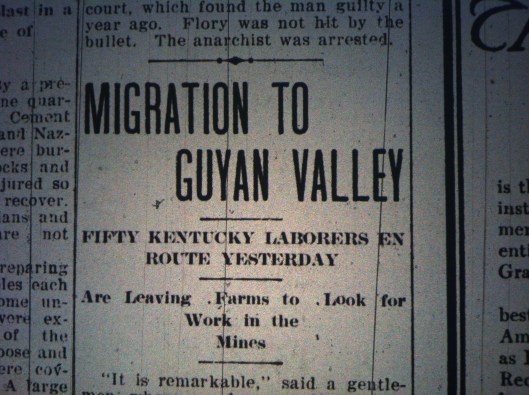
Migration to Guyandotte Valley HA 04.14.1910 1

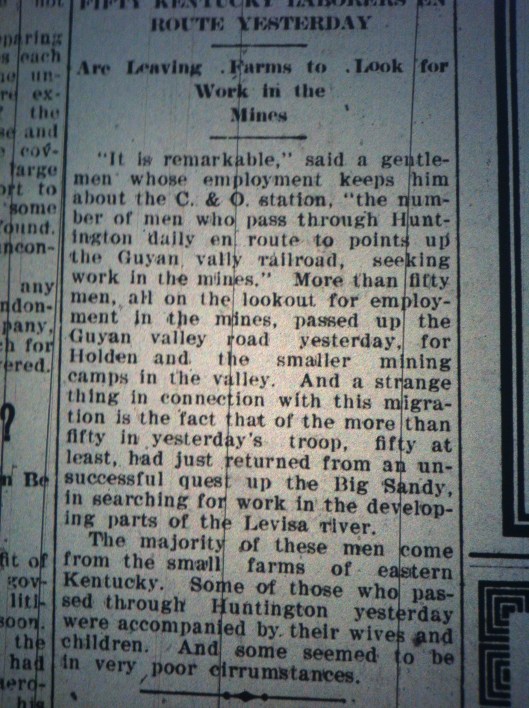
Migration to Guyandotte Valley HA 04.14.1910 2

Huntington (WV) Advertiser, 14 April 1910

Burrell Spurlock

19 Wednesday Apr 2017

Posted by Brandon Ray Kirk in Civil War, Coal, Hamlin, Native American History, Timber

≈ 3 Comments

Tags

7th West Virginia Cavalry, Allen Spurlock, Appalachia, Battle of Floyd Mountain, Battle of Lynchburg, Battle of New River Bridge, Boone County, Burrell Spurlock, Charles Spurlock, civil war, coal, Eli Spurlock, Elizabeth Spears, Emily Alice Spurlock, Emily Spurlock, Evermont Green Spurlock, farming, genalogy, Hamlin, Henry H. Hardesty, history, Lawrence County, Leander Filmore Spurlock, Lincoln County, Louisa Jane Spurlock, Maria Spurlock, Mary Elizbaeth Spurlock, Mary Spurlock, Methodist Episcopal Church, Native Americans, Ohio, Phoebe Jane Spurlock, Preston Spears, Robert Spurlock, Sarah Ellen Spurlock, Thomas Preston Spears, timber, Union District, Victoria Spurlock, West Virginia, Wirt Spurlock

From “Hardesty’s History of Lincoln County, West Virginia,” published by H.H. Hardesty, we find this entry for Burrell Spurlock, who resided near Hamlin in Lincoln County, West Virginia:

Son of Eli and Mary (Cummings) Spurlock, was born in Boone county, (now) West Virginia, April 14, 1833, and in Lincoln county, January 7, 1857, he wedded Phoebe Jane, daughter of Preston and Elizabeth (Haskins) Spears. The children of this union number twelve, born as follows: Emily, December 17, 1858, died February 21, 1859; Louisa Jane, December 25, 1859; Emily Alice, October 10, 1861, died January 19, 1880; Robert, September 17, 1864; Allen and Wirt, twins, October 25, 1867; Evermont Green, born February 17, 1870; Sarah Ellen, May 20, 1873, died September 22, 1878; Victoria, February 19, 1876; Leander Filmore, June 30, 1878, died December 8, 1878; Maria, March 26, 1880; Mary Elizabeth, July 7, 1883. Mrs. Spurlock was born in Lawrence county, Ohio, June 10, 1840; she has been a member of the Methodist Episcopal Church for fifteen years. A brother of Mrs. Spurlock, Thomas Preston Spears, served in teh late war in the Federal army, and died a prisoner. The subject of this sketch was in the civil war, serving in the Federal army, in Company K, 7th West Virginia Cavalry. He enlisted, March 10, 1864, participated in the battles at Floyd Mountain, New River Bridge, Lynchburg, fighting continuously from Lynchburg to Kanawha valley, and was discharged August 5, 1865. Charles Spurlock, grandfather of Burrell, was born and raised ____. The country then was inhabited mostly by Indians. Burrell Spurlock is a farmer in union district, owning 360 acres of farming land, located on Big Laurel, nine miles from Hamlin. The timber on this land consists of pine, poplar, locust, sugar, maple, beech, hickory, and oak; good orchard; superior cannel and stone coal, and iron ore. Address Mr. Spurlock at Hamlin, Lincoln county, West Virginia.

Source: The West Virginia Encyclopedia, Vol. 7 (Richwood, WV: Jim Comstock, 1974), p. 132.

Coal Advertisement (1897)

31 Friday Mar 2017

Posted by Brandon Ray Kirk in Coal, Dingess, Huntington

≈ Leave a comment

Tags

Appalachia, Cabell County, Camp Branch Mines, coal, history, Huntington, Huntington Advertiser, Mingo County, Mundy and Company, West Virginia

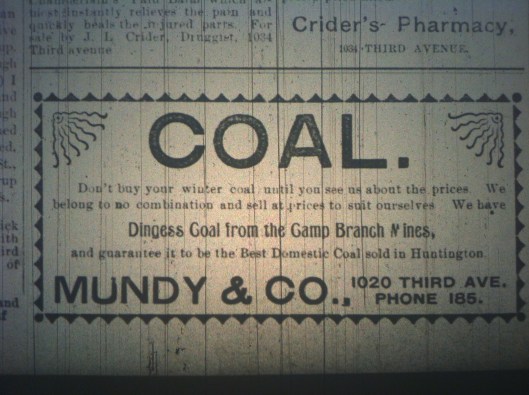
Coal Dingess ad HuA 10.19.1897.JPG

Huntington (WV) Advertiser, 19 October 1897.

Kiahs Creek Surface Mine (2016)

17 Thursday Nov 2016

Posted by Brandon Ray Kirk in Coal, Kiahsville, Queens Ridge

≈ 2 Comments

Tags

Appalachia, coal, Kiahs Creek, photos, Queens Ridge, Wayne County, West Virginia

img_2532

Queens Ridge, Kiahs Creek, Wayne County, WV. 29 October 2016

If We Were A Miner (1926)

11 Friday Nov 2016

Posted by Brandon Ray Kirk in Coal, Logan

≈ Leave a comment

Tags

Appalachia, coal, history, Logan, Logan Banner, UMWA, West Virginia

The following “poem” appeared in the Logan Banner of Logan, West Virginia, on March 5, 1926.

The other day

We read in the paper

That the big strike

Of union miners

Just over the hill

Had been called off

For this reason:

Funds were short

And no more aid could be given.

The men and their families

Who had weathered the storms

Of the past two years

In their tent and rags

On the small amounts

Allowed by the union.

And from time to time

They would get notice

From headquarters

That the meager amounts

Were to be cut down

Until at last the order came

That all aid would be stopped

And they could go back to work

With nothing gained

After two years of suffering.

But at the same time

We could see

A set of officers

In big fine offices

Drawing big salaries

Enjoying life in good homes

And never a time

Did we hear one say

“We will go live in the tents

And draw our rations as they do

And we will stick to the end?”

Nor did we hear them say

“We will cut our salaries

To provide more aid

For them who are out in the cold.”

But we do know this:

They draw big money

And live in the fine homes.

Their families are well fed

And they all enjoy life

And at the same time

They will tell you and me

To stick tight and rough it out

For in the end we are sure to win.

And in the end

If we win they win.

If we lose they win.

Do you see the point?

Just another reason why

We wouldn’t be a member

Of the U.M.W.A.

If we were a miner.

Poor Whites (1896)

18 Sunday Sep 2016

Posted by Brandon Ray Kirk in African American History, Coal, Native American History

≈ Leave a comment

Tags

Adirondack Mountains, Allegheny Mountains, Appalachia, Blue Ridge Mountains, Chattanooga, Chattanooga Times, Cherokee, Choctaw, culture, history, Huntington, Huntington Advertiser, indentured servants, Native Americans, New York, North Carolina, Pennsylvania, slavery, Tennessee, Virginia, West Virginia

On July 15, 1896, the Huntington Advertiser of Huntington, West Virginia, printed a story titled “The Poor Whites: Origin of a Distinct Class Living in the South.” Subtitled “The ‘Cracker of the Hills’ is the Direct Descendant of the ‘Sold Passengers’ Who Came to This Country in the Seventeenth Century,” the story initially appeared in the Chattanooga Times of Chattanooga, Tennessee. And here it is:

The notion that the poor white element of the southern Appalachian region is identical with the poor people generally over the country is an error, and an error of enough importance to call for correction. The poor white of the south has some kinfolk in the Adirondack region of New York and the Blue and Alleghany [sic] mountains of Pennsylvania, but he has few relatives any place else about the Mason-Dixon line. The states of New York and Pennsylvania were slave states until the early part of this century.

This poor white mountaineer descends direct from those immigrants who came over in the early days of the colonies; from 1620 to about or some time after the Revolutionary war period, as “sold passengers.” They sold their services for a time sufficient to enable them to work out their passage money. They were sold, articled to masters, in the colonies for their board and fixed wage, and thus they earned the cost of their migration.

The laws under which they were articled were severe, as severe as apprentice laws in those days. The “sold passenger” virtually became the slave of the purchaser of his labor. He could be whipped if he did not do the task set [before] him, and woe to the unlucky wight [sic] if he ran away. He was sure to be caught and cruelly punished.

And though he was usually a descendant of the lowest grade of humanity on the British islands, he still had enough of the Anglo-Saxon spirit about him to make him an unsatisfactory chattel.

From 1620 forward–the year when the Dutch landed the first cargo of African slaves on the continent–the “sold passenger” was fast replaced by negroes, who took more naturally and amiably to the slave life.

The poor white naturally came to cherish a bitter hatred for the blacks that were preferred over him. He already hated his domineering white master. When he was free to go, he put as many miles as his means and his safety from Indian murderers permitted between himself and those he hated and hoped he might never see again. In that early time the mountain region was not even surveyed, let alone owned by individual proprietors.

The English, Scotch, Irish and continental immigrant who had some means sat down on the rich valleys, river bottoms and rolling savannahs, and the poor white was made welcome to the foothills and mountain plateaus.

These descendants of the British villain of the feudal era grew and multiplied, became almost as distinct a people from the lords of the lowlands as the Scotch highlander was, as related to his lowland neighbor, in the sixteenth and seventeenth centuries.

The stir of the period since the close of our civil war has made somewhat indistinct the line that separates the mountaineer from the plainsman of the south, especially in the foothills and at points where the two have intermingled in traffic, in the schoolhouse and church, and especially where the poor whites have been employed at mining, iron making, etc. But go into the mountains far enough and you will find the types as clear cut as it was 100 years ago, with its inimitable drawling speech and curious dialect, its sallow complexion, lanky frame, lazy habits and immorality–all as distinctly marked as they were when hundreds of these people found Cherokee wives in Georgia and Tennessee in the early part of the century and bleached most of the copper out of the skin of the Choctaw as well as out of the Cherokee.

It is a pity that some competent anthropological historian has not traced the annals of this interesting and distinctive section of our population, and made record of it in the interest of science, no less than in the interest of the proper education and elevation of the mountain people. It has become, especially in the Piedmont section of the south, a most important labor element. The cotton mill labor by thousands comes from the “Cracker of the Hills,” and it is destined o become a great power, that labor population, social and political.

The redemption of the poor white began when slavery went down in blood and destruction, and it has gone on faster and traveled further than some of us think.

Marrowbone Creek (2016)

10 Saturday Sep 2016

Posted by Brandon Ray Kirk in Coal, Kermit

≈ Leave a comment

Tags

Appalachia, Brandon Ray Kirk, coal, history, Kermit, Marrowbone Creek, Mingo County, Norfolk and Southern Railroad, Norfolk and Western Railroad, photos, West Virginia

bk-at-marrowbone-2

Norfolk & Southern Railway Tunnel No. 3, Marrowbone Creek, Mingo County, WV. 20 August 2016. Photo by Mom.

← Older posts
Newer posts →

Feud Poll 1

If you had lived in the Harts Creek community during the 1880s, to which faction of feudists might you have given your loyalty?

Categories

  • Adkins Mill
  • African American History
  • American Revolutionary War
  • Ashland
  • Atenville
  • Banco
  • Barboursville
  • Battle of Blair Mountain
  • Beech Creek
  • Big Creek
  • Big Harts Creek
  • Big Sandy Valley
  • Big Ugly Creek
  • Boone County
  • Breeden
  • Calhoun County
  • Cemeteries
  • Chapmanville
  • Civil War
  • Clay County
  • Clothier
  • Coal
  • Cove Gap
  • Crawley Creek
  • Culture of Honor
  • Dingess
  • Dollie
  • Dunlow
  • East Lynn
  • Ed Haley
  • Eden Park
  • Enslow
  • Estep
  • Ethel
  • Ferrellsburg
  • Fourteen
  • French-Eversole Feud
  • Gilbert
  • Giles County
  • Gill
  • Green Shoal
  • Guyandotte River
  • Halcyon
  • Hamlin
  • Harts
  • Hatfield-McCoy Feud
  • Holden
  • Hungarian-American History
  • Huntington
  • Inez
  • Irish-Americans
  • Italian American History
  • Jamboree
  • Jewish History
  • John Hartford
  • Kermit
  • Kiahsville
  • Kitchen
  • Leet
  • Lincoln County Feud
  • Little Harts Creek
  • Logan
  • Man
  • Matewan
  • Meador
  • Midkiff
  • Monroe County
  • Montgomery County
  • Music
  • Native American History
  • Peach Creek
  • Pearl Adkins Diary
  • Pecks Mill
  • Peter Creek
  • Pikeville
  • Pilgrim
  • Poetry
  • Queens Ridge
  • Ranger
  • Rector
  • Roane County
  • Rowan County Feud
  • Salt Rock
  • Sand Creek
  • Shively
  • Spears
  • Sports
  • Spottswood
  • Spurlockville
  • Stiltner
  • Stone Branch
  • Tazewell County
  • Timber
  • Tom Dula
  • Toney
  • Turner-Howard Feud
  • Twelve Pole Creek
  • Uncategorized
  • Warren
  • Wayne
  • West Hamlin
  • Wewanta
  • Wharncliffe
  • Whirlwind
  • Williamson
  • Women's History
  • World War I
  • Wyoming County
  • Yantus

Feud Poll 2

Do you think Milt Haley and Green McCoy committed the ambush on Al and Hollene Brumfield in 1889?

Blogroll

  • Ancestry.com
  • Ashland (KY) Daily Independent News Article
  • Author FB page
  • Beckley (WV) Register-Herald News Article
  • Big Sandy News (KY) News Article
  • Blood in West Virginia FB
  • Blood in West Virginia order
  • Chapters TV Program
  • Facebook
  • Ghosts of Guyan
  • Herald-Dispatch News Article 1
  • Herald-Dispatch News Article 2
  • In Search of Ed Haley
  • Instagram
  • Lincoln (WV) Journal News Article
  • Lincoln (WV) Journal Thumbs Up
  • Lincoln County
  • Lincoln County Feud
  • Lincoln County Feud Lecture
  • LinkedIn
  • Logan (WV) Banner News Article
  • Lunch With Books
  • Our Overmountain Men: The Revolutionary War in Western Virginia (1775-1783)
  • Pinterest
  • Scarborough Society's Art and Lecture Series
  • Smithsonian Article
  • Spirit of Jefferson News Article
  • The Friendly Neighbor Radio Show 1
  • The Friendly Neighbor Radio Show 2
  • The Friendly Neighbor Radio Show 3
  • The Friendly Neighbor Radio Show 4
  • The New Yorker
  • The State Journal's 55 Good Things About WV
  • tumblr.
  • Twitter
  • Website
  • Weirton (WV) Daily Times Article
  • Wheeling (WV) Intelligencer News Article 1
  • Wheeling (WV) Intelligencer News Article 2
  • WOWK TV
  • Writers Can Read Open Mic Night

Feud Poll 3

Who do you think organized the ambush of Al and Hollene Brumfield in 1889?

Recent Posts

  • Logan County Jail in Logan, WV
  • Absentee Landowners of Magnolia District (1890, 1892, 1894)
  • Charles Spurlock Survey at Fourteen Mile Creek, Lincoln County, WV (1815)

Ed Haley Poll 1

What do you think caused Ed Haley to lose his sight when he was three years old?

Top Posts & Pages

  • Halcyon 4.10.1919
  • Civil War Gold Coins Hidden Near Chapmanville, WV
  • Halcyon-Yantus 12.08.1911
  • Ran'l McCoy's Final Months (1914)
  • Jack Dempsey’s Broadway Restaurant Location in New York City (2019)

Copyright

© Brandon Ray Kirk and brandonraykirk.wordpress.com, 1987-2023. Unauthorized use and/or duplication of this material without express and written permission from this blog’s author and/or owner is strictly prohibited. Excerpts and links may be used, provided that full and clear credit is given to Brandon Ray Kirk and brandonraykirk.wordpress.com with appropriate and specific direction to the original content.

Archives

  • February 2025
  • January 2025
  • October 2023
  • September 2023
  • December 2022
  • November 2022
  • May 2022
  • April 2022
  • February 2022
  • November 2021
  • October 2021
  • September 2021
  • June 2021
  • May 2021
  • April 2021
  • March 2021
  • February 2021
  • January 2021
  • December 2020
  • November 2020
  • October 2020
  • July 2020
  • June 2020
  • May 2020
  • April 2020
  • March 2020
  • February 2020
  • January 2020
  • December 2019
  • November 2019
  • October 2019
  • September 2019
  • August 2019
  • July 2019
  • June 2019
  • May 2019
  • April 2019
  • March 2019
  • February 2019
  • January 2019
  • December 2018
  • November 2018
  • October 2018
  • September 2018
  • August 2018
  • July 2018
  • June 2018
  • May 2018
  • April 2018
  • March 2018
  • February 2018
  • January 2018
  • December 2017
  • November 2017
  • October 2017
  • September 2017
  • August 2017
  • July 2017
  • June 2017
  • May 2017
  • April 2017
  • March 2017
  • February 2017
  • January 2017
  • December 2016
  • November 2016
  • October 2016
  • September 2016
  • August 2016
  • July 2016
  • June 2016
  • May 2016
  • April 2016
  • March 2016
  • February 2016
  • January 2016
  • December 2015
  • November 2015
  • October 2015
  • September 2015
  • August 2015
  • July 2015
  • June 2015
  • May 2015
  • April 2015
  • March 2015
  • February 2015
  • January 2015
  • December 2014
  • October 2014
  • September 2014
  • August 2014
  • July 2014
  • June 2014
  • May 2014
  • April 2014
  • March 2014
  • February 2014
  • January 2014
  • December 2013
  • November 2013
  • October 2013
  • September 2013
  • August 2013
  • July 2013
  • June 2013
  • May 2013
  • April 2013
  • March 2013
  • February 2013
  • January 2013
  • December 2012
  • November 2012

Enter your email address to follow this blog and receive notifications of new posts by email.

Join 2,927 other subscribers

Tags

Appalachia Ashland Big Creek Big Ugly Creek Blood in West Virginia Brandon Kirk Cabell County cemeteries Chapmanville Charleston civil war coal Confederate Army crime culture Ed Haley Ella Haley Ferrellsburg feud fiddler fiddling genealogy Green McCoy Guyandotte River Harts Harts Creek Hatfield-McCoy Feud history Huntington John Hartford Kentucky Lawrence Haley life Lincoln County Lincoln County Feud Logan Logan Banner Logan County Milt Haley Mingo County music Ohio photos timbering U.S. South Virginia Wayne County West Virginia Whirlwind writing

Blogs I Follow

  • OtterTales
  • Our Appalachia: A Blog Created by Students of Brandon Kirk
  • Piedmont Trails
  • Truman Capote
  • Appalachian Diaspora

BLOOD IN WEST VIRGINIA is now available for order at Amazon!

Blog at WordPress.com.

OtterTales

Writings from my travels and experiences. High and fine literature is wine, and mine is only water; but everybody likes water. Mark Twain

Our Appalachia: A Blog Created by Students of Brandon Kirk

This site is dedicated to the collection, preservation, and promotion of history and culture in Appalachia.

Piedmont Trails

Genealogy and History in North Carolina and Beyond

Truman Capote

A site about one of the most beautiful, interesting, tallented, outrageous and colorful personalities of the 20th Century

Appalachian Diaspora

  • Subscribe Subscribed
    • Brandon Ray Kirk
    • Join 789 other subscribers
    • Already have a WordPress.com account? Log in now.
    • Brandon Ray Kirk
    • Subscribe Subscribed
    • Sign up
    • Log in
    • Report this content
    • View site in Reader
    • Manage subscriptions
    • Collapse this bar
 

Loading Comments...