Tags
Appalachia, crime, Green McCoy, Harts Creek, history, Hugh Dingess, Logan County, Milt Haley, photos, West Virginia
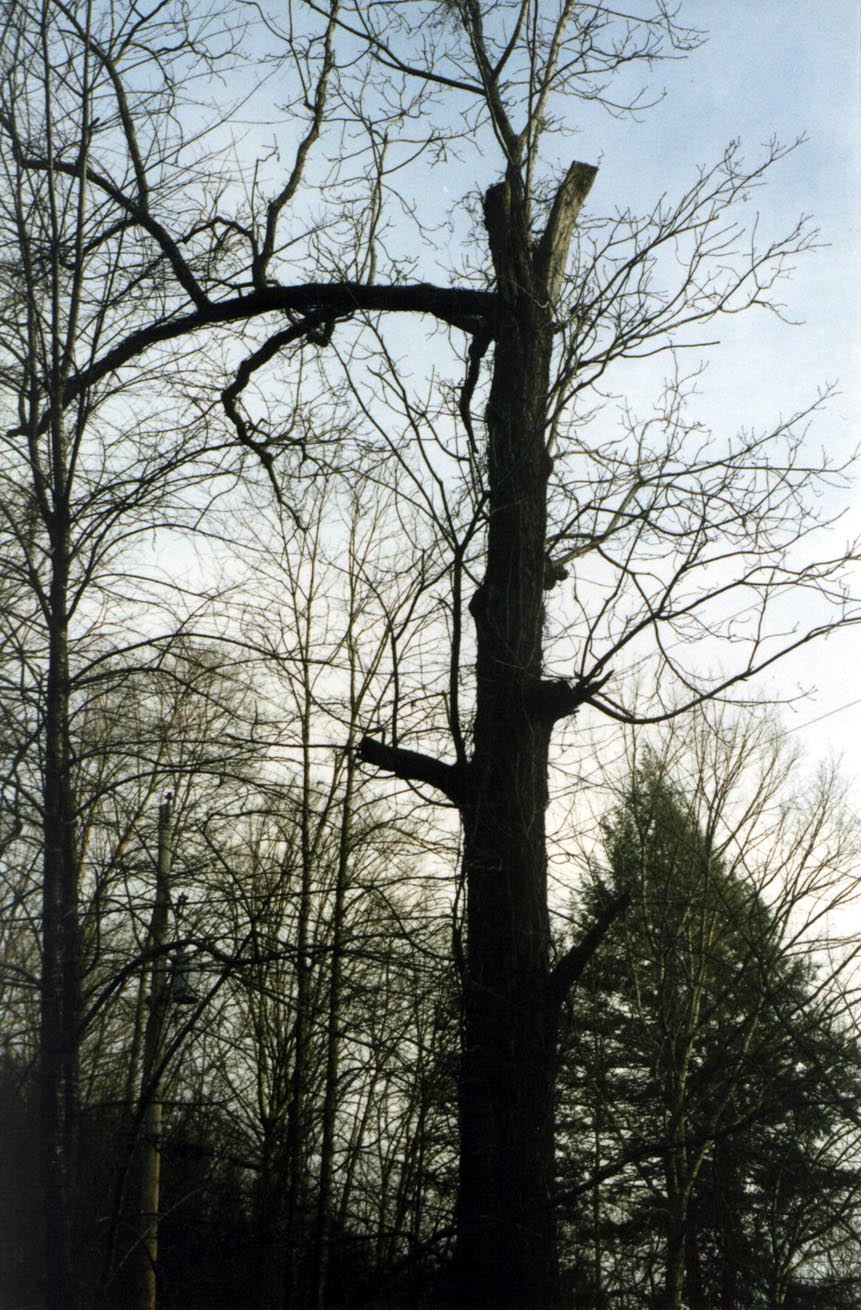
The “hanging” tree,” 1995

22 Saturday Mar 2014
Posted in Big Harts Creek, Culture of Honor, Ed Haley, Lincoln County Feud, Timber
Tags
Appalachia, crime, Green McCoy, Harts Creek, history, Hugh Dingess, Logan County, Milt Haley, photos, West Virginia
The “hanging” tree,” 1995
22 Saturday Mar 2014
Posted in Big Harts Creek, Whirlwind
Tags
Alex Henderson, Alex Hensley, Budda Carter, Burlie Riddle, Charleston, Dingess, Frank Adams, genealogy, history, influenza, Joseph Blair, Kentucky, Logan County, Logan Democrat, moonshining, Moses Tomblin, Mud Fork, South Carolina, Wes Vance, West Virginia, Whirlwind, World War I
“Blue Eyed Beauty,” a local correspondent at Whirlwind in Upper Hart, Logan County, West Virginia, offered the following items, which the Logan Democrat printed on Thursday, January 9, 1919:
We are having some real winter weather here at this writing.
Alex Hensley, who has been in the training camp at Charleston, So. Car., arrived home Sunday.
Joseph Blair is staying with the homefolks, helping nurse him through the influenza.
Alex Henderson is spending the winter with “Budda” Carter.
We hear that Burlie Riddle will leave in a few days for an extended visit with relatives in Kentucky.
Frank Adams, mail carrier, became water bound and was unable to make his usual trip between Whirlwind and Dingess Wednesday and Thursday.
United States marshals were in this vicinity Wednesday looking for illicit stills. It is said they failed to find any, but arrested Rev. Wese Vance for harboring deserters.
Mrs. Mae Thompson is staying with her mother, Mrs. Ona Blair.
Moses Tomblin quit his work on Mud fork Thursday on account of bad weather.
21 Friday Mar 2014
Posted in Big Harts Creek, Ed Haley, John Hartford
Tags
Appalachia, art, genealogy, Harts Creek, Harve Dingess, history, Hugh Dingess, John Hartford, Logan County, photos, West Virginia
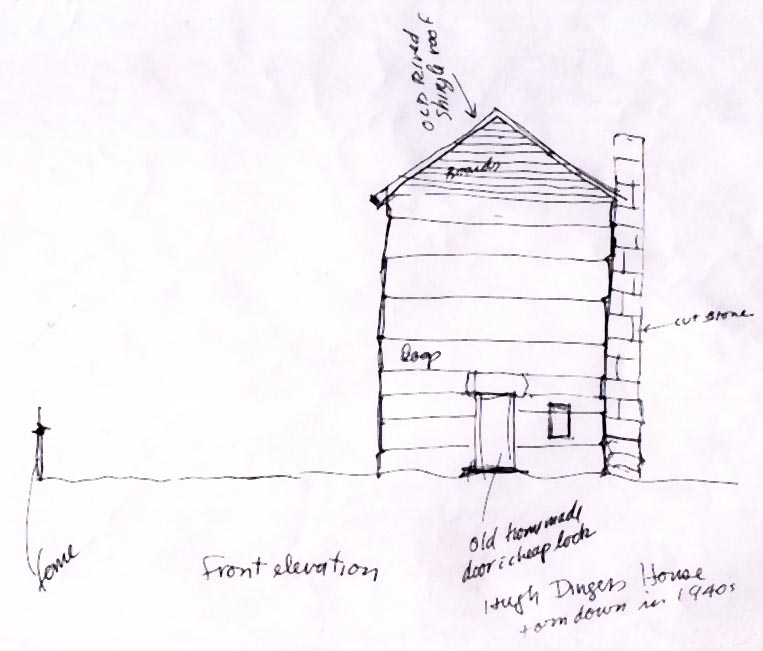
John Hartford’s sketch of the Hugh Dingess home, October 1995
21 Friday Mar 2014
Posted in Big Harts Creek, Ed Haley
Tags
Al Brumfield, Billy Adkins, crime, French Bryant, genealogy, Harts Creek, Harve Dingess, history, Hollene Brumfield, Hugh Dingess, Logan County, Maude Dingess, Millard Dingess, Paul Dingess, West Virginia, writing
After talking with Oris, we drove back onto Smoke House Fork to locate the site of the old Hugh Dingess home. I wanted to see where Milt Haley had played his last tune. Some twenty minutes later, we parked in a driveway at Bill’s Branch and met Paul Dingess, one of Hugh’s many descendants, and a local resident. Paul gave us a walking tour of the Hugh Dingess farm, showing us what was left of the old Dingess place — a small pile of chimney stones — as well as the “hanging tree” where the mob almost hung Milt and Green. He said his grandfather Millard Dingess had inherited the property years ago. With darkness fast approaching, we thanked Paul and took off down Smoke House.
A short time later, we stopped to visit Harvey and Maude Dingess, a neat elderly couple who lived in a nice brick home just below the old Hugh Dingess homeplace. Maude, Billy said, was a niece to Hollena Brumfield and a granddaughter to Henderson Dingess. Her husband Harvey was raised on West Fork near the likes of French Bryant and others. These were incredibly close connections and I was very excited at the prospects of what they might know.
Inside, after all the proper introductions, we sat down at the kitchen table. I had Hugh Dingess’ hued log home on my mind, so I asked about it first. Harve said Hugh’s son Millard lived in it after Hugh’s death. The old-timers told all kinds of ghost stories about it.
“They said they would take pack-peddlers in there and take them upstairs and kill them and take their money and whatever they had and then take them out in the woods somewhere and just get rid of them,” he said.
I had heard similar stories about the Al Brumfield house in Harts so I had to ask if there was any truth to those kind of stories. I mean, did the Brumfields and Dingesses really murder these old pack-peddlers?
“I don’t know,” Harve said, “but it was talked. People’d swear that Hugh’s house was haunted, the upstairs part. It was pretty well dark up there. Them kids would go up there and play and they’d come running down the stairs. They’d swear it was haunted and they wouldn’t hardly go upstairs in that old house ’cause they’d told tales about it over the years, I guess. And they said Millard, back when he’d drink, he’d get down drunk and he’d swear that he could hear things up them stairs. Millard said it was all haunted up there.”
So what happened to it?
“About in the ’40s, they quit living in it for a long time,” Harve said, “and then it just kindly squashed down — the heavy snow and stuff — and it just laid there like a junk pile for a long time. They kept getting a little bit out at a time till it just got away — all but the old chimney rocks.”
21 Friday Mar 2014
Posted in Big Harts Creek, Ed Haley, Whirlwind
Tags
Appalachia, culture, Ellen Adams, genealogy, Harts Creek, history, life, Logan County, Minnie Smith, photos, Sherman Smith, Sol Adams, West Virginia, Whirlwind

Squire Sol Adams cabin, constructed in 1869, Whirlwind, Logan County, WV, 1995.
21 Friday Mar 2014
Posted in Big Harts Creek, Whirlwind
Tags
Bill Tomblin, Crit Blair, Eli Workman, Everett Adams, genealogy, Gordon Farley, history, influenza, Island Creek, Island Creek Coal Company, James Mullins, Jesse Mullins, Jim Tomblin, John Wokrman, Logan, Logan County, Marion Riddle, Moses Tomblin, Mud Fork, West Virginia, Whirlwind, World War I, Yuma
“Blue Eyed Beauty,” a local correspondent at Whirlwind in Upper Hart, Logan County, West Virginia, offered the following items, which the Logan Democrat printed on Thursday, January 2, 1919:
James Mullins, postmaster at this place, has sufficiently recovered from an attack of influenza as to be able attend to his duties in the office.
“Uncle Jim” Tomblin is spending the winter with relatives in this community.
Everett Adams, Jesse Mullins and Crit Blair have received their discharges from the army and have returned home.
Bill Tomblin was a visitor on Island Creek Christmas day.
Gordon Farley was released from jail in Logan in time to spend Christmas with his family.
Marion Riddle was a business visitor at Yuma Friday.
John Workman, who has been at Eli Workman’s sick with the influenza has returned home much improved in health.
Moses Tomblin has resumed his work for the Island Creek Coal Co. on Mud Fork.
17 Monday Mar 2014
Posted in Big Harts Creek, Ed Haley
Tags
Appalachia, Bob Mullins Cemetery, culture, genealogy, Harts Creek, history, Logan County, photos, West Virginia

Bob Mullins Cemetery, looking down toward Ticky George Hollow, Harts Creek, Logan County, WV
17 Monday Mar 2014
Tags
Ben Adams, Billy Adkins, Bob Mullins Cemetery, Brandon Kirk, Cat Fry, Chapmanville, Eunice Mullins, Ewell Mullins, Greasy George Adams, Green McCoy, Harts Creek, Hell Up Coal Hollow, history, Hugh Dingess, Imogene Haley, John Frock Adams, John Hartford, Johnny Hager, Little Harts Creek, Louie Mullins, Milt Haley, Oris Vance, Peter Mullins, Sherman McCoy, Sol Bumgarner, Spicie McCoy, Ticky George Adams, Turley Adams, writing
Back in the car, I mentioned to Brandon and Billy that we hadn’t made any real progress on learning what happened to Emma Haley. Billy suggested trying to locate her grave in the old Bob Mullins Cemetery at the mouth of Ticky George Hollow on Harts Creek. He said it was one of the largest and oldest cemeteries in the area. I told him that I was all but sure that Emma was buried in one of the “lost” graves on the hill behind Turley Adams’ house but wouldn’t mind checking it out anyway.
We drove out of Smoke House and up main Harts Creek to the Bob Mullins Cemetery, which was huge and very visible from the road. We parked the car and walked up a steep bank into a large number of gravestones. Some were modern and easily legible but most were of the eroded sandstone vintage with faded writing or completely unmarked. I located one stone with crude writing which read “E MULL BOR 69 FEB ?8 DEC 1 OCT 1899.” It could have easily been Emma Haley — who was born around 1868 and died before 1900. However, Brandon read it as “E MULL19 SEP 188?-1? OCT 1891.” We couldn’t agree on the markings well enough to satisfy ourselves.
As we stood at the “E MULL” grave, Brandon pointed across Harts Creek.
“Greasy George lived over there where that yellow house is,” he said.
He then pointed across Ticky George Hollow to Louie Mullins’ house, saying, “That’s where ‘John Frock’ Adams lived.”
John Frock was Ed Haley’s uncle and a suspect in the Al Brumfield ambush at Thompson Branch.
“Ticky George lived on up in the hollow,” Brandon said.
We walked down the hill to speak with Louie but learned from his wife Eunice Mullins that he’d passed away several years ago. Eunice was a daughter of Greasy George Adams. She said Ed used to play music at her father’s home. She also confirmed that Ewell Mullins, her father-in-law, bought Ed’s property on Trace. He lived there for years and was a storekeeper before moving to the site of her present home, where he operated yet another store. Ed played a few times at this latter location before it was torn down around 1950.
From Eunice’s, we went to Trace Fork to take a closer look at Ed’s old property. Along the way, as we drove by Uncle Peter’s place, we bumped into Sol Bumgarner walking near the road. He invited us up to his house, where we hung out for about half an hour on the porch. I played a few fiddle tunes and asked about people like Uncle Peter, Ben Adams, and Johnny Hager.
Bum said Uncle Peter Mullins lived at the present-day location of a tree and swing near the mouth of the hollow in a home that was part-log. Ben Adams, he said, lived further up Trace and hauled timber out of the creek with six yoke of cattle. He remembered Ed’s friend Johnny Hager standing on his hands and walking all over Trace.
I reminded Bum of an earlier story he told about Ed splintering his fiddle over someone’s head at Belcher’s tavern on Crawley Creek. He really liked that story — which he re-told — before mentioning that Ed composed the tune “Hell Up Coal Hollow” and named it after the Cole Branch of Harts Creek. Cole Branch, Brandon said, was the home of his great-great-grandfather Bill Brumfield who kept the hollow exciting around the turn of the century.
After an hour or so on Trace Fork, we decided to see Oris Vance, an old gentleman on Little Harts Creek who Billy said was knowledgeable about early events in Harts. We drove out of Harts Creek to Route 10, then turned a few minutes later onto Little Harts Creek Road. As we progressed up the creek on a narrow paved road past trailers, chicken coops, and old garages, I noticed how the place quickly opened up into some beautiful scenery with nice two-story brick homes.
In the head of Little Harts Creek, near the Wayne County line, we found Oris walking around outside in his yard. He was a slender, somewhat tall fellow, well-dressed, and obviously intelligent. His grandfather Moses Toney was a brother-in-law to Paris Brumfield. Toney and his family had fled the mouth of Harts Creek due to Brumfield sometime before the 1889 feud.
Oris told us the basic story of Milt Haley’s and Green McCoy’s murders as we knew it up to their incarceration at Green Shoal. He said Hugh Dingess, a grandson to the “old” Hugh Dingess, was his source for the tale. At Green Shoal, one of the prisoners begged the Brumfield gang not to kill him so that he could see his children, but the mob gave no mercy and blew Milt’s and Green’s brains out.
“Cat Fry looked out of a window in the top of the house and saw out into the yard,” Oris said, apparently referencing her view of their grisly corpses.
Oris said he saw Green McCoy’s widow at a singing convention in Chapmanville in the early ’30s. She was an alto singer in a gospel quartet with her guitar-playing son. When Oris saw her, she was sitting with songbooks in her lap near a hotdog sale across the road from the old high school.
16 Sunday Mar 2014
Posted in Big Harts Creek, Ed Haley, Lincoln County Feud, Timber
Tags
Appalachia, Burl Farley, Cabell County, culture, genealogy, history, life, photos, Roach, West Virginia, writing

Burl Farley, Roach, Cabell County, WV
16 Sunday Mar 2014
Posted in Big Harts Creek, Culture of Honor, Ed Haley, Lincoln County Feud, Timber
Tags
Anthony Adams, Appalachia, Ben Adams, Burl Farley, Cabell County, Carolyn Johnnie Farley, culture, Ed Haley, Green McCoy, Harts Creek, Hattie Farley, history, Imogene Haley, James Pig Hall, John Frock Adams, Lewis Farley, life, Logan County, Milt Haley, moonshine, Roach, timbering, West Virginia, writing
After the Milt Haley murder, Burl Farley was involved in several other feuds on Harts Creek. Around 1910, he and his brother-in-law Anthony Adams “had it out” over a “mix-up” of logs.
“The Adamses were mean,” Johnnie said. “They’d kill each other.”
Burl also beat up a neighbor named Pig Hall and dared him to ever frequent his property again.
Eventually, Burl left Harts Creek. He timbered briefly at Bluewater in Wayne County then sold his property on Brown’s Run to Johnnie’s father in 1918. He settled at Roach, near Salt Rock, in Cabell County.
Burl’s involvement in Milt Haley’s death apparently haunted him in his later life. Johnnie remembered him being drunk and talking about it.
“I believe it bothered his mind,” she said. “When you do something dirty, it usually hurts your mind. And the cancers eat his face up and killed him. It eat him completely — his ears off, nose off.”
We asked Johnnie if she ever heard what happened to Ed’s mother and she said, “I always thought from what I heard that she stayed with some people around in the Harts Creek area until she died. Before she died and after he died, she was able to work some and she’d go out and work for the neighbors to keep herself up and not ask nobody for nothing. She was an independent person. Don’t know where she’s buried nor nothing.”
Billy wondered if maybe Emma had remarried and Johnnie said, “Well, I’d say — going by some experiences I’ve saw — my dad died when my mother was 48 years old — you can’t call that old — and she never married nor never looked at a man and she lived to be 75 years old on the day she was buried.”
Was there a chance that Ed’s mother might have shacked up with someone?
“No, I don’t believe so,” Johnnie said. “The old women back then was different from the women today. I’ll just put it like I believe it: they were not sex crazy and they lived their life decent. They believed the Bible. They believed one man to one woman and when death parted them…stay single. I’d say my mother was happily married — she had twelve children and to have twelve children she musta loved him or she wouldn’t a stayed with him, would she? My dad, he drank a lot and he abused her a lot, but you know what? When he died and was put in the ground, my mother made a statement. She says, ‘I’ll never be married again.’ She said, ‘There goes my first love and that’s it.’ I’ve saw men ask my mother if she was ready to get married. She said, ‘I wouldn’t look at a man.’ She had the opportunity to marry into some good families, but she wouldn’t do it. And Mom raised nine of us children by herself and buddy she worked hard to raise us. She taught school.”
We asked Johnnie if she’d heard anything about Ben Adams hiring Milt and Green to ambush Al Brumfield.
“I never could get the full details on who was the ringleader behind it,” she said. “They always got to be a leader, and he’s the one that agitates and gets them out and gives them the whisky that gets them drunk. I’m gonna tell you something. Old Ben Adams was mean as a snake, honey. He didn’t care. And old man John Adams was just as mean. Ben was a brother to Grandpaw Anthony.”
Times were pretty wild on Harts Creek in those days.
“They’d go have associations and campaign rallies and they’d kill all kinds of hogs and sheep and stuff you know and have a big dinner set out for them,” Johnnie said. “And buddy they’d just go there and campaign and fight like dogs and cats. Get drunk. I remember in elections and stuff about what they’d do to my dad. They’d get him drunk and he’d walk up and take a knife and just cut a man’s tie off’n his neck as though it wasn’t nothing. Everybody with a big half a gallon of moonshine under his arm. Pistol in his pocket. Now that went on around here, honey. In the sixties, they stopped.”
I asked Johnnie where the old association grounds were and she said, “Well, they’d have one here at Grandpa Burl’s farm and then they’d go on down in Lincoln County and post another’n and they’d ride mules and horses and run them to death.”
Johnnie figured Ed played at the association grounds “because he liked to drink and he was where the action was. He played wherever he could find him a drink.”
15 Saturday Mar 2014
Posted in Ed Haley, Lincoln County Feud
Tags
Appalachia, Burl Farley, Cabell County, culture, genealogy, history, life, Mary Ann Farley, photos, Roach, West Virginia
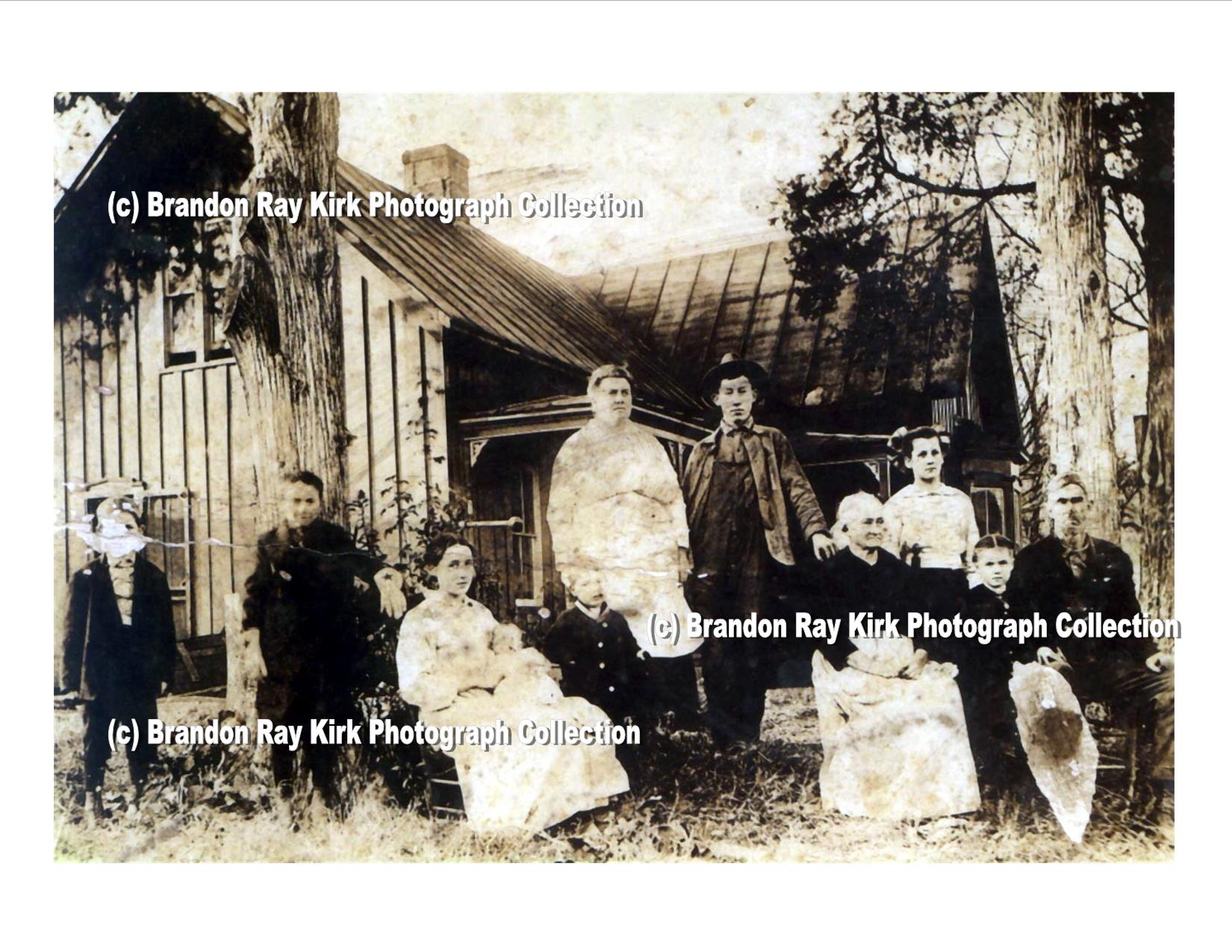
Burl Farley (extreme right), Roach, Cabell County, WV
15 Saturday Mar 2014
Posted in Big Harts Creek, Culture of Honor, Ed Haley, Lincoln County Feud, Timber
Tags
Al Brumfield, Burl Farley, Carolyn Johnnie Farley, Charley Brumfield, crime, French Bryant, George Dump Farley, Green McCoy, history, Hollene Brumfield, Hugh Dingess, Milt Haley, timbering, Wash Farley, writing
Johnnie had also heard a lot about Milt Haley.
“Yeah, I knowed about Milt. Well, as you know, they used to raft timber in this country. That was their work. That’s what they fed their families with. They’d cut their logs and they’d roll them in these bottoms and then they’d back up the creeks till they could get water enough to float those logs into Guyandotte. And my dad — he was a young man — they would all float them into Huntington, you know, to where they could get their pay out of them. My granddad owned everything in here and he had plenty of timber, so somebody got jealous or got mad or some way ‘nother and — if I remember right in what I’ve heard all my life — they hitched Milt and another fellow up to shoot Grandpa Burl Farley and Uncle Al Brumfield. They was together — they was like brothers.
“So they laywaid Grandpa Burl and Uncle Al and some more boys that was a rafting the timber down through there. Well, Aunt Hollene was behind Uncle Al on the horse, so whenever they aimed to shoot Uncle Al they shot Aunt Hollene. And she was Burl’s wife’s sister so they had it out. Somebody took Aunt Hollene on to get her doctor but the men took out after them and catched them. They didn’t wait. They took them down here on the creek at the mouth of Bill’s Branch to Hugh Dingess’ old big log house and they made them cook chickens. Milt Haley and Green McCoy — they were both musicians — and they played a fiddle and a banjo all night. Hugh Dingess took his family and went to his brother’s house whenever this all took place.”
I asked Johnnie who told her that Milt and Green had played music before their deaths and she said, “My grandpaw Burl told us. I was raised right under my grandpaw’s feet. They rode somewhere and got these instruments but I forgot where Grandpaw said it was. They packed instruments into this house.”
Brandon asked about the members of the mob.
“Well, from what I understand, they was my grandpaw Burl, his brother Wash, and his brother Dump, Al Brumfield, Charley Brumfield — a whole bunch of them, all together,” Johnnie said. “French Bryant was in it.”
She looked at me and said, “They tortured them, John. That was my way of looking at it. I’d call it torture. If I shoot you in the leg here and foul you up here some way to you couldn’t do nothing to me and directly take a big drink of liquor and just shoot you again somewhere I’d call that torture. Now they didn’t kill them right in the house. They took them outside to shoot them about four in the morning. They didn’t want no blood or nothing left over in their house.”
Billy asked who fired the first shot.
“I don’t know which one fired the first shot, whether it was Uncle Al or Grandpaw Burl,” Johnnie said. “It was one of the two.”
After Milt and Green were shot, they were hung from a walnut tree.
Johnnie said, “One of my uncles said that was the cruelest thing he ever saw and he crawled back under the bed and hid and said two or three weeks later he had to fight my grandpaw over that. That was Uncle Dump. It hurt that old man, it really did. He crawled under the bed, John. He said that they done them so cruel and mean. They musta been a knocking them around you know.”
Brandon asked why Dump had joined the mob if he had no intentions of participating in Milt’s and Green’s punishment.
“He didn’t have no idea,” Johnnie said. “He just figured they’d be a drinking. From the way he talked, he didn’t know they was a gonna do it. Whenever he’d go to talking about it, tears would just fall down his cheeks. He’d say, ‘You know, people pays for these things.’ Dump was a good man as long as you didn’t try to do something mean to him. If you did, you paid, too. He’d never back talk Grandpaw Burl cause he’d just a knocked him down. Grandpaw was a big man and Dump was a little man.”
We were kinda surprised to hear Johnnie speak so frankly about her Grandpa Burl.
“My grandpaw was wicked, John, and mean. He packed guns and he was the meanest old man I ever heard tell of. Well, anybody that crossed him they had to pay. Grandpaw was mean after women. He ‘bumped’ every woman he could get with. I’ll tell you what. They wasn’t none of us kids loved him good enough to go stay all night with him. We was afraid of him. We actually was afraid of him.”
I said, “Well now, it was talked around that Milt Haley and Green McCoy were pretty mean themselves…”
Johnnie said, “Well, they were from all accounts.”
I continued, “…so there was a kind of a feeling that the guys that killed them had kinda done the neighborhood a favor.”
Johnnie said, “Yeah, they felt that way, John.”
It also seemed as if there was a deliberate attempt for everyone to “get blood on their hands” so no one could talk.
Johnnie said many of the men who participated in Milt’s and Green’s murder hung together after the feud.
“You know, after them killings, I believe that they was afraid they’d be ganged, too, and they was people went to different states.”
Burl always kept a gang of men around him for protection.
Johnnie said, “You never met a man what didn’t have a gun. People drinking would ride horses right up on your porch. I’ve seen them do it.”
14 Friday Mar 2014
Posted in Big Harts Creek, Ed Haley, Music, Women's History
Tags
Appalachia, Carolyn Johnnie Farley, culture, genealogy, Harts Creek, history, life, Lincoln County, music, photos, West Virginia
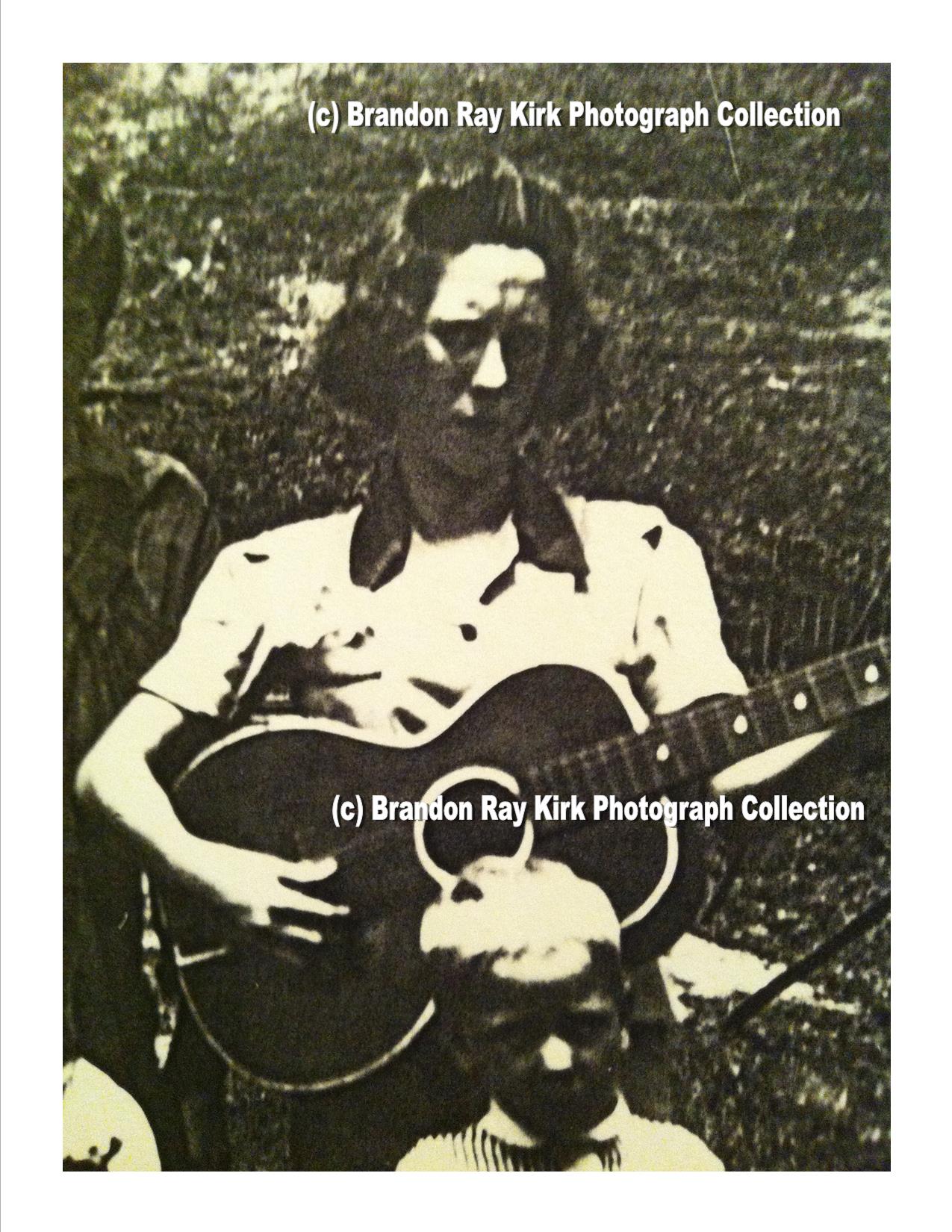
Carolyn “Johnnie” Farley of Brown’s Run of Smokehouse Fork of Big Harts Creek, Logan County, WV.
14 Friday Mar 2014
Posted in Big Harts Creek, Ed Haley, Music
Tags
Billy Adkins, Brandon Kirk, Carolyn Johnnie Farley, Ed Belcher, Ed Haley, fiddler, fiddling, George Mullins, guitar, Harts Creek, Hattie Farley, history, Hollene Brumfield, Lewis Farley, Logan County, Mary Ann Farley, Mason Conley, music, Rosa Mullins, West Virginia, writing
The next day — the 106th anniversary of Milt Haley’s death – Billy Adkins suggested that we go see Carolyn “Johnnie” Farley on Brown’s Run of Smoke House Fork. She was a granddaughter to Burl Farley, one of the ringleaders of the Brumfield mob. There were other interesting connections: her grandmother was Hollena Brumfield’s sister and her mother was Ben Adams’ niece. Her ancestors, then, represented both sides of the trouble, helping to make her a great source on the 1889 feud. Billy said she was old enough to remember Ed, too. His notes showed her as being born in 1924.
Without really hesitating, we went outside through a small rain shower and boarded the car and took off up the creek. We were oblivious to the poor weather and kept pointing to spots that were probably only significant to us.
“Now that was part of the old Al Brumfield farm.”
“There’s where the old boom was.”
“Here’s where the ambush took place.”
Our fascination with all the sites continued after we turned up the Smoke House Fork.
“There’s the Hugh Dingess Elementary School.”
“There’s the old Henderson Dingess place.”
“There’s where the old Dingesses are buried.”
“There’s Cecil Brumfield’s place. Ed used to visit there.”
We finally reached Browns Run. Johnnie Farley’s white house was just up the branch on the left, accessed by a muddy driveway filled with ruts and sharp jutting rocks. We parked behind the house, where several wooly dogs and a flock of tiny chickens surrounded us — three strangers ankle-deep in mud holes.
Almost immediately, Johnnie came out the back door and spotted Billy — one of the most recognized and popular guys in Harts — and told us to come on inside. She led us through the kitchen and a hallway, past a giant photograph of her grandmother, Mary Ann Farley (Hollena’s sister), and into a very dim living room. We all sat down on furniture that was literally surrounded by papers, books and pictures. Johnnie was obviously a packrat — a woman after my own heart.
Billy began introducing Brandon and I, but Johnnie stopped him short and looked at me with her ice blue eyes and said, “Oh I know who you are. I’ve got some of your records.” Her spirit and energy were immediately apparent — she spoke as if we were old friends. Her husband sat quietly nearby in a comfortable chair. He was in poor health.
I asked Johnnie if she remembered Ed and she said, “Yes, I knowed Ed Haley. He used to come through this country and pick and play the fiddle. I knowed Uncle Ed good. That old man could stop at any man’s house and they’d take him in and keep him all night and feed him. And he’d come through and stop you know and Mom and the girls would have a meal on the table. They’d just say, ‘Uncle Ed, come on.’ And they’d help him, show him the wash-pan and stuff, let him wash his hands, and he’d just go sit right down and eat with us. Whenever he’d come through out of the Chapmanville area he’d stay with one of my uncles and aunts that lived across the hill. That was George and Rosa Mullins. He’d go across the mountain ’cause he liked drinking and they had it over there — moonshine. And he stayed there week in and week out. People was good to him. He wasn’t mistreated.”
I asked Johnnie how old she was when Ed used to come around and she said, “I was about 10, maybe 12.”
She tried to describe him.
“Well, Ed was a little bit maybe heavier than you are, ’bout as tall. I know he kinda had a great, big belly on him. He was a great big fat man. I’d say Ed weighed around 170 pound. To my recollection, Ed had slim hands and slim fingers. He wore shaded glasses and he wore an overcoat — a brown one — and he had an old brown hat. I believe he smoked a pipe. He wore real old-fashioned shoes and old yarn socks. Uncle Ed drunk a lot. He was a good person. He was humble. He didn’t bother nobody. The only harm you could say he done was to hisself and that was drinking. He was around a lot of people, but Uncle Ed didn’t talk too much. He wouldn’t confront his own feelings. He wouldn’t open up fully to nobody.”
I asked Johnnie if she ever saw Ed drunk and she said, “I never did see him drunk — really drunk, no. I’ve seen him drink but not drunk.”
What about singing?
“No. I heard him fiddle but never sing. He played old tunes. ‘Turkey in the Straw’ and just quite a lot of the old-fashioned first fiddle player’s tunes. Uncle Ed was a good fiddler. He could make a fiddle talk. Mason Conley played the guitar and he’d get with him and play. And they was an old man traveled a lot with him named Ed Belcher. They had an old tune they played called ‘Sally Goodin’.”
Now, what happened to Ed Haley?
“I believe Ed died up around Ed Belcher and them. He drinked himself to death.”
13 Thursday Mar 2014
Posted in Big Harts Creek, Ed Haley, Music
Tags
Appalachia, culture, Dood Dalton, fiddler, Harts Creek, history, Laura Adkins, life, Lincoln County, love, Nary Dalton, photos, West Virginia
Dood Dalton, Nary (Adkins) Dalton, unknown man, Laura Tomblin
13 Thursday Mar 2014
Posted in Big Harts Creek, Ed Haley, Music
Tags
Clabe Tomblin, Dood Dalton, Ed Haley, Ella Haley, Ezra Jake Dalton, Harts Creek, history, Jeff Mullins, Lincoln County, Liza Mullins, Logan, music, Nary Dalton, Tootsie Tomblin, West Virginia, writing
We later drove to see Tootsie Tomblin, a younger sister to Jake and a neighbor on Big Branch. Tootsie greeted us at the door, flanked by her tall husband Clabe, and a small nut-cracking housedog that barked at our every movement — even after we’d sat down at a large eating table in the dining room.
Tootsie referred to Ed Haley as “Uncle Ed” and said her whole family loved him. She said he was “a great person…so understanding.” Ed was particularly close to her mother, Nary Dalton.
“Ed thought the world of my mother. He thought my mother was the finest woman he had ever laid his eyes on. And he’d tell her, he’d say, ‘Come over here Nary and set down beside me. I want to talk to you a little bit.’ And he’d tell her everything about hisself, and about his wife, his children and everything. He loved her cooking.”
Tootsie laughed.
“Daddy had a whole litter of kids and we all had nicknames but Mommy insisted on calling us by our real names. And Ed, being blind, couldn’t figure out why there were so many kids in the home. He called for Mom. ‘Hey Nary, come in here and set down beside of me.’ Mom went to him and said, ‘What are you a wanting, Ed?’ He said, ‘I’ve listened for three or four days and I’m kind of buffaloed.’ She said, ‘What are you buffaloed on?’ Ed said, ‘You got too many kids. All of these names don’t add up. What are we a doing with all these names?’ Mom laughed and then explained it to him.”
Before we could ask Tootsie any more questions, she showed us several small boxes of old family photographs while feeding us donuts, pie and milk. I asked her if she remembered much about Ed coming to her father’s house.
“They was a funny family of people,” she said. “I mean, they had peculiar ways. They was different. Them people went clean as pins. You never seen them dirty. Ed could take care of them good as I could mine and me with eyes. When Ed spoke, he spoke with authority. They knew he meant what he was saying. He’d say, ‘Now, that’s enough,’ and that was it. He never had to whip his kids.”
Tootsie said Ed mostly visited Dood at his first home (“Jake’s place”) and never brought his wife with him. Later, after her father built his new house in 1951 (her current home), Ed only came a time or two. On his last trip, he had a Jacob Stainer or a Stradivarius violin with him.
“He was here in the fall and died the next summer or maybe that winter,” she said. “One of his boys brought him here.”
When Ed was in Harts, he traveled a lot with Jeff Mullins, a simple-minded man and brother to Aunt Liza who stayed with the Adams family. In Logan, he played with his wife or a colored man.
I asked Tootsie if she remembered a lot about how her father played the fiddle. She said she was sure that he played with the fiddle under his chin. Some of his tunes were “Cacklin’ Hen”, “Wednesday Night Waltz”, and “Bear Dog” — basically what Ed played. He could also play a little on the guitar and sing. Tootsie really bragged on Ed’s singing — like his “Coming Around the Mountain” — and kind of caught us off guard when she said, “Buddy, Ed Haley could dance. He was a chubby fellow but he could move. That old man could move.”
12 Wednesday Mar 2014
Posted in Harts, Women's History
Tags
Appalachia, Caroline Brumfield, Charley Brumfield, culture, Ethel Brumfield, Harts, history, life, Lincoln County, photos, West Virginia

Ethel Brumfield, daughter of Charles and Caroilne (Dingess) Brumfield
12 Wednesday Mar 2014
Posted in Big Harts Creek, Culture of Honor, Ed Haley, Music
Tags
blind, Cow Shed Inn, Crawley Creek, crime, Dood Dalton, Ed Haley, Ezra Jake Dalton, fiddlers, fiddling, Green McCoy, Green Shoal, Harts Creek, history, Hollene Brumfield, John Hartford, Lincoln County, Milt Haley, music, Rockhouse Fork, Ward Brumfield, West Virginia, World War II, writing
Around that time, I got my fiddle out to see if I could coax Jake into playing a few tunes. He said he couldn’t play anything — he’d quit years ago.
“I got shot through this shoulder with a high-powered rifle during World War II,” he said. “My fingers is stiff and my arm don’t operate just right. You’ve got to have a good bow hand to play a fiddle. I used to fiddle, but I can’t do no good no more.”
I asked Jake if he remembered any of Ed’s tunes and he said, “I don’t know — he played so many. ‘Hell Among the Yearlings’, ‘Wild Horse’, ‘The Cacklin’ Hen’, ‘Cluck Old Hen’, ‘Casey Jones’. They was all kinds — you could just keep naming them. Never did hear Ed sing.”
Thinking back to those times caused Jake to say, “Dad fiddled with Ed, you know. Dad never did own a fiddle. Ward Brumfield gave him one and he kept it all of his life. My dad used to like one called ‘The Blackberry Blossom’. ‘The Money Musk’ — man, it was a fast tune when he played it. They’d play ‘The Sourwood Mountain’. Pluck that string, you know. Play that ‘Sally Goodin’. Called one ‘Bear Dog’. It was something like ‘Bonaparte’s’, more or less. I used to, when my dad fiddled, get me two sticks this a way and beat on the strings of the fiddle.”
I asked Jake if he ever heard a tune called “Pharaoh’s Dream” or “Getting Off the Raft” and he said, “I’ve heard of ‘Pharaoh’s Dream’ but never heard of ‘Getting Off the Raft’. Can you play that ‘Danced all night with a bottle in my hand. Swing around the corner with the other man?'”
I asked Jake if he knew anything about Ed’s father and he said, “His dad was a mean guy. My dad has told me many times that Ed had the measles when he was a kid and his daddy took him out up here on Rockhouse and stuck him in the creek and that’s what made old man Ed Haley blind. His daddy stuck him in the creek. His daddy was a bad character. They went on a rampage, him and Green McCoy. My daddy knowed them from the beginning. They shot old Aunt Hollene Brumfield with a .30/.30 Winchester and it come out in her mouth. Never killed her. These fellers went to Kentucky — Ed’s daddy and Green McCoy — and they went and got them somewhere and took them up to Green Shoal up in there and massacred them. Someone took them up on the West Fork and buried them kindly up on the side of the hill. They probably just dug a hole and put them in it.”
Jake remembered Hollena Brumfield well.
“She was an old lady that run a store,” he said. “She was bad to drink — fell down a stairway and broke both of her thighs. She couldn’t get around very good. She had a big garden right there where Taylor Brumfield’s wife’s home is and she’d get out there… She’d keep every bum that come along and work them. She was good to them — she’d feed them, you know — and put them out there in that garden. She’d have them take her a chair out there and she’d hobble out there and sit in that chair and watch them work that garden. Boy, I dreaded her. When she’d talk, the spit would work out that hole there.”
Just before we left Jake’s, I asked him if he knew anything about Ed’s death. He basically repeated what Stump had told us earlier.
“I don’t know what happened. They killed him on the Crawley Creek side of the mountain over there. They beat him to death over there in a beer joint called the Cow Shed Inn. Some drunks did it, you know.”
I was flabbergasted. I mean, how could those Dalton boys tell such an off-target story?
11 Tuesday Mar 2014
Posted in Big Harts Creek, Big Sandy Valley, Civil War, Culture of Honor, Harts, Lincoln County Feud, Music, Timber
Tags
Al Brumfield, Appalachia, Blood in West Virginia, Brandon Kirk, Cain Adkins, feud, Green McCoy, Henderson Dingess, history, John W Runyon, Lincoln County, Paris Brumfield, West Virginia, writers, writing

You may pre-order my book directly at Pelican Publishing Company’s website or at the website of any major bookseller. http://www.pelicanpub.com/index.php
11 Tuesday Mar 2014
Posted in Big Harts Creek, Ed Haley, Music
Tags
Bernie Adams, Billy Adkins, Dood Dalton, Ed Haley, Ella Haley, Ezra Jake Dalton, fiddlers, fiddling, Harts Creek, history, Lincoln County, Logan, Mona Haley, moonshine, Nary Dalton, West Virginia, World War II, writing
Along the way, we stopped and picked up Billy Adkins, who guided us to Jake’s home on Big Branch. Jake, we found, was a little skinny fellow, somewhat quiet, and — I was told — a decorated World War II veteran.
I asked Jake if he remembered the first time he ever saw Ed.
“I don’t remember that,” he said right away. “I was born in 1916 but I didn’t stay at home like the rest of my family. I’d slip off from home here when I was a little bitty fella and maybe stay a week or two before I come back or they’d come get me or something another. Then after I got up in years, I joined the Army and I stayed over four years in the Army. I was in there nineteen months before they bombed Pearl Harbor. So I didn’t stay home like the rest of the kids.”
A little later in the conversation, Jake made it clear that he remembered more about Ed and his family than he realized.
“He stayed with Mother and Dad a lot, Ed did, and them young’ns,” he said. “She was a music teacher, the old woman was. She was from out of Kentucky and he was off’n Harts Creek. They had about five, six children.”
I asked Jake how long Ed usually stayed with his father and he said, “Aw, he might stay a week. They’d go up there at the courthouse at Logan and play music, him and her, and she had this little boy tied to the rope so she could draw him in you know out on the sidewalk. And somebody give him some pennies and he had them pennies you know and he dropped them and she started drawing them in. He ripped out a big oath, ‘Wait till I get my money!’ You know, they couldn’t see what they done or nothing.”
Sometimes, Ed left his kids with Dood when he was playing in Logan.
“Now them kids, they was pretty mean, but people most of the time helped him correct them,” Jake said. “They raised one girl, Mona. That girl, she was a bad one. She’d run up and down the road with them boys if Dad didn’t get after her. She was just a young gal, you know. Ed, he didn’t care if you corrected them kids. If you busted the hide on one that was all right.”
Jake didn’t remember much about Ed’s appearance other than that his eyes were “milky-looking.”
When Brandon asked him what it was like to hang around with Ed, Jake said, “He talked to Dad a whole lot. He said to my dad one time, ‘Dood, where do you think hell’s gonna be at?’ Dad said, ‘I never thought about where it’s gonna be, Ed.’ He said, ‘I have an idea where it’s gonna be. I believe it’ll be on the outside of this world.’ He was a good ole man in a way, but he was bad to drink in a way.”
Oh…so Jake remembered Ed drinking.
I asked him if Ed drank a lot and he said, “No, I never did see him come to Dad’s drunk. Dad didn’t allow no bad stuff around his house, even when he wasn’t a Christian.”
Jake thought for a second, then said, “Ed was a healthy eater. He’d come in there — get up for breakfast — he’d say to my mother, ‘Nary, have you got ary onion?’ And she’d get him an onion. He’d eat an onion head for breakfast. My mother was a person that would feed anybody that came along. It didn’t make no difference whether he was a drunk, a hobo, or what he mighta been, Mom would feed him. We had a big long table with a bench on one side and about ten people to eat off of it besides who come in. We kept Bernie Adams half the time. He was the puniest feller that ever you saw — a plumb weakling he was — and he’d stay with Dad for maybe two or three weeks.”
Jake tried to describe his memories of Ed and Dood playing around the house.
“We just had an old log house,” he said. “A door over there and one here and one room and Dad had a lot of trees around here. They’d sit out there in the yard. They’d start in on Saturday evening and they’d be a sitting right there when Monday morning come with a half a gallon of moonshine playing music. They’d fiddle that long.”
Writings from my travels and experiences. High and fine literature is wine, and mine is only water; but everybody likes water. Mark Twain
This site is dedicated to the collection, preservation, and promotion of history and culture in Appalachia.
Genealogy and History in North Carolina and Beyond
A site about one of the most beautiful, interesting, tallented, outrageous and colorful personalities of the 20th Century
 Brandon Ray Kirk