Tags
Appalachia, Harts Creek, history, inspiration, life, Pearl Adkins, photos, thoughts, U.S. South, West Virginia, writers, writing

Pearl Adkins, circa 1918

01 Saturday Dec 2012
Posted in Pearl Adkins Diary
Tags
Appalachia, Harts Creek, history, inspiration, life, Pearl Adkins, photos, thoughts, U.S. South, West Virginia, writers, writing
Pearl Adkins, circa 1918
01 Saturday Dec 2012
Posted in Pearl Adkins Diary
Tags
Appalachia, Harts Creek, history, inspiration, life, love, Pearl Adkins, thoughts, U.S. South, West Virginia, writers, writing
At that time, Pearl’s head was full of dreams. Based on entries in her diary, she had become fixated on a local beau who made occasional visits to the Adkins home.
“It’s been a many sad and dreary days since I had last seen him,” Pearl wrote on February 6, 1922. “I almost count the hours and minutes of his absence. So why worry? Life is what we make it. Oh dear, when shall I see you again?”
“Oh, you are here,” she wrote later that day. “As I looked up from my work I gazed straight into the kindest eyes I’d ever seen — deep and unfathomable like a well of clear, pure water where my famished soul might drink. His clear sweet voice broke the spell, and I dropped my gaze while the hot blood burned over my neck and cheeks. It has the same affect now as I write this as when it happened. It causes my heart to beat wildly and my hand to tremble so I can’t work at my sewing.”
The following day, Pearl’s thoughts drifted away from romance and more toward her handicap.
“A day remembered by me if by no other,” she wrote on February 7, “but no one remembers me or my lonely life. Shut up here a helpless cripple for all this time.”
Four days later, on February 11, Pearl was stirred to write again about the object of her affection.
“Oh, I wish I could see my darling boy this evening. It seems that every one comes — all but the one I love.”
“Now alone in my little hut,” she wrote on the 12th, “but my thoughts and dreams has wondered to one in a far distant country.”
“He has completely gone out of my presence but not out of my mind,” Adkins wrote on March 14. “He is always with me in my day dreams. He will never be mine but nothing can prevent my loving him forever and ever. I see him now as I last saw him as he stood gazing out the window at the mist and rain. Aw, how he looked and looked as if he was grieving about some thing. He made a sad picture. It makes me cry when alone and to imagine him standing there. Oh God, that could I shut that out of my mind my life wouldn’t be so lonely. I don’t see what makes me always think of him when I know he cares nothing for me. All there is left for me to do is hope and pray for his love.”
On March 29, Pearl wrote, “Oh, what a sweet dream I had last night and I feel that it’s coming to pass. Why shouldn’t it come to pass? Haven’t I suffered long enough?”
01 Saturday Dec 2012
Posted in Big Harts Creek, Culture of Honor, Fourteen
Tags
Adkins Conspiracy Case, Appalachia, Bill Brumfield, Charley Brumfield, feud, Harts Creek, history, John Fleming, John Henan Fry, U.S. South, West Virginia, writers, writing
While John Fleming was away serving a term of imprisonment at the West Virginia state penitentiary, his wife Lizzie returned home to live with her father, John Henan Fry, at Fourteen. “Aunt Lizzie ran away from John and came home to Fourteen,” said Willard Frye, nephew to Lizzie, in a 2003 interview. She secured a divorce from Fleming and began an affair with Charley McCoy, a man who newspapers later dubbed a “bitter enemy” to Fleming. Fleming didn’t take the news well. He swore that he would have her back after his release.
On Saturday, March 13, 1909, Fleming was freed from prison. On his way home from Moundsville, he made preparations to recapture Lizzie from McCoy. “When John Fleming returned home from the penitentiary, on his way back, at Huntington, he proceeded to supply himself with the necessary guns and ammunition to start a young war in Harts Creek district,” reported the Lincoln Republican of Hamlin, West Virginia. “It is said he stated to parties on the G.V. train that he would go to John Henan Fry’s home, where his former wife was staying and have her or kill every man on Fourteen.”
“When the intrepid John got back to his native haunts,” reported the Republican, “he got his brother Bob Fleming and together they proceeded to the home of their cousin, Herf Fleming, who was a merchant and a very good citizen and persuaded him to go with them to go to the home of John Henan Fry on their desperate mission.”
Hariff, born illigitimately in August 1878 to Lucinda Fleming, was a first cousin to John and Bob. He had settled in West Virginia around the same time as the other Flemings where, in 1896, he married Delphia Workman. In the summer of 1899, after killing a local bully in self-defense, he had moved with his wife and children to Clintwood, Virginia. Not long before cousin John’s release from prison, however, Hariff had returned to Harts Creek. At the time of John’s visit, he lived at Workman Fork with his family.
“The good wife of Herif’s — Delphia by name, pursued her husband with tears in her eyes to stay at home saying that Bob and John had just been in trouble and was going to get into it again,” reported the Republican. “But as vengeance rankled in the bosom of John for the man who wooed and won his wife in his absence to the pen, he plead with his relatives and companions to pursue their journey.”
Hariff told his worrying wife that he would use the trip downriver as an opportunity to get back a yoke of cattle he sold to a man on Ten Mile Creek.
Before making the trip to Fourteen, Fleming reunited with his familiar confederates, including Charley and Bill Brumfield. These men, like Fleming, had only lately been released from prison for their role in the Adkins conspiracy case. All together, they constituted some of the more mischievous outlaws in the community — men who newspapers claimed had “terrorized Harts Creek.”
“John sent word that he was coming to get his wife, but Aunt Lizzie’s family sent word back to not try it,” said Mr. Frye.”They came with the Charley Brumfield gang.”
The Fry clan was ready for them.
“My dad was there,” said Mr. Frye. “He was Aunt Lizzie’s brother. His brothers were there, too. Uncle Caleb and Albert and Anthony. Poppy was 19 years old. The Fryes and Headleys and Neaces gathered in ambush in barns and behind trees.”
Upon reaching the vicinity of the Frye home, “John Fleming called for his former wife” to leave with him, the Republican reported, “which she refused to do whereupon the trouble started, and John Henan Fry, who was a small, weakly man, started down the branch at about a 2-40 gait.”
At that juncture, someone began firing.
“The guns became much in evidence,” reported the Republican, “and a general shooting affray took place. Herf Fleming was killed by a bullet from a Winchester said to have been fired by Charley McCoy the new lover of the recent Mrs. Fleming who had secreted himself on the hillside in the woodland near the home of his lady lover. He shot into the bunch and shot John Fleming through the arm, and then it is said, sought safety in flight.
“It is useless to state that Mrs. John Henan Fry and children were scared so Mrs. Fry went under the bed after her husband had run off and left the home; but she had a son there and a young man by the name of Caleb Headley who went out at the rear door of the little home and came out to see the result of the battle whereupon John Fleming leveled his pistol on them and maliciously attempted to murder these two unarmed and helpless boys, his aim was so accurate that he cut a lock of hair from Caleb Headley’s head.”
This Caleb Headley was the 19-year-old nephew to John Henan Fry.
“The former Mrs. Fleming,” wrote the Republican, “seeing that she had no further protection against this desperate criminal capitulated, not for any love or affection she had for him but by being put in fear of her life, started to leave with him, and after going a short distance, being stung from his wounds, and remembering his cousin, Herf Fleming having been killed, sent her back to see after him; and she returned to the bullet riddled little home to tell her mother and brothers and sisters that the battle was over for the present, at least.”
“Grandpa Hariff was shot through the shoulder and down through the stomach,” said one grandson, in a 2003 interview. “He lived a while. A little child, maybe named John, came and told Grandma Delph about it. Samp Davis took a wagon with a mattress and bedsprings on it to get him. Ene Adkins and Bud Workman went too. Grandma killed a chicken to make Grandpa a dinner but he was already dead when the wagon got there for him.”
Regional newspapers carried the story. On March 17, 1909, the Marion Daily Mirror of Marion, Ohio, offered a piece titled “Desperate Men Shot.” That same day, the Times Dispatch of Richmond, Virginia printed a story titled: “Shot From Ambush: Members of Feud Gang in West Virginia Waylaid.” On March 20, the Watchman and Southron of Sumter, South Carolina gave one account (“Feudist Shot from Ambush.”) On April 16, the Times Dispatch reported this: “FREELING, Va., April 15 — Hariff Bryant, formerly of this county, was killed on Hart’s Creek, in Logan county, W.Va., according to a late dispatch. He was engaged in an altercation with one John McCoy, a member of the old Hatfield-McCoy feud, when the latter fired the fatal shot. Bryant was about thirty years old and married.”
By that time, county authorities had initiated proceedings against the belligerent parties.
“The next grand jury after the shooting John Fleming was indicted and charged with the shooting at Caleb Headley with intent to kill, and Chas. McCoy was indicted and charged with the murder of Herf Fleming,” the Republican reported.
Unfortunately, many participants in the case had fled West Virginia to avoid possible legal entanglements.
“Poppy and Jesse Headley went to Virginia for a while,” said Mr. Frye. “There were no indictments brought against them.”
John Fleming was also gone. It was later learned that he left West Virginia and traveled to Florida, North Carolina, South Carolina and Tennessee. A capias was issued for him on January 4, 1910, March 16, 1910, March 30, 1910, June 30, 1910, October 8, 1910, January 9, 1911 and February 8, 1912.
“Grandma Delph put out a reward of $500 or $1,000,” said a Fleming descendant.
01 Saturday Dec 2012
Posted in Pearl Adkins Diary
Tags
Appalachia, culture, dreams, Harts Creek, history, life, Pearl Adkins, superstitions, thoughts, U.S. South, West Virginia, writers, writing
The opening fourteen pages of Pearl’s first volume consist of short poems and sayings written by Pearl and her sister, Cora.
“You may meet with many faces gliding down life’s merry stream,” Cora wrote to Pearl, “but remember my dear sister you are always in my dreams.”
Following such light-hearted entries was a superstitious passage of unknown origin dealing with dreams.
“Dreams come to pass when the moon is so many days old,” Pearl wrote. “Within 24 hours of a new moon, what is dreamt on will be fortunate and pleasing to the dreamer. On the third day, whatever is dreamed will prove true. On the fifth, the dreams will be tolerably successful. On the 6th day, the dream will not immediately come to pass. 7 do not tell your dreams for much depends on concealing them. On the 8th day the dreams will come to pass. The 9th differs very little from the 8th. On the 12th the dreams are rather fortunate. On the 13th the dreams will prove true in a very short time. On the 20th the dreams are true. On the 26th day the dreams are certain. 27th day is very favorable for dreams.”
On a tiny scrap of paper inserted in that section of the diary was written the word “clairvoyant.”
01 Saturday Dec 2012
Posted in Ed Haley
Tags
Appalachia, Ashland, blind, Ed Haley, Ella Haley, fiddler, history, John Hartford, Kentucky, music, U.S. South, writers, writing
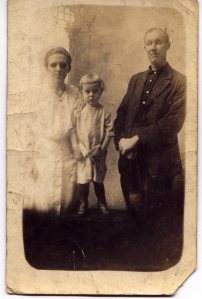
Ella, Ralph and Ed Haley, about 1920
01 Saturday Dec 2012
Posted in Ed Haley
Tags
Appalachia, Ashland, blind, Ed Haley, Ella Haley, fiddler, history, John Hartford, Kentucky, Lawrence Haley, music, Pat Haley, U.S. South, writers, writing
Lawrence seemed to think of his parents as traveling musicians leading exciting lives — always on the go meeting new people and covering a rather large geographical area. I wondered what affect such a lifestyle had on the Haley children.
“You’ve got to remember, we didn’t start going with them — or I didn’t — until I was about seven years old, and that had to be in the summertime,” Lawrence said. “Sometimes I’d go with my mother, sometimes I’d go with my dad and my mother, sometimes my dad would take off somewhere on his own. If some of his old friends or something come around and said, ‘Ed, I want you to go with me,’ he’d be gone a week maybe somewhere. And they’d go off and play here or there.”
I asked if Ella ever got aggravated when Ed took off and Lawrence said, “I don’t think so. You know, two blind people like that trying to raise kids, I guess Mom felt that she could just stay home with her children and be a housewife. She done her own cooking and sometimes Rosie’d be around. I call her Aunt Rosie, but she was no kin to me, see? She was a big old strong stout woman — just raw-boned. Rosie married Bill Day. I guess she met Bill Day by being down here with Mom and Pop.”
Bill Day, I knew from talking with Annadeene Fraley, was Jean Thomas’ second choice to role-play Jilson Setters — after Haley. He once lived a house away from the Haleys on Halbert Avenue (now Blackburn Avenue). I wanted to get Lawrence’s spin on the Ed Haley-Bill Day relationship.
“He was a left-handed fiddler and he was a ‘Mississippi sawyer,’ I guess,” Lawrence said. “Well, at one time they lived about a quarter a mile of us, I guess. But he was the one that Jean Thomas picked for Jilson Setters. See, this Jean Thomas was supposed to take Bill Day over and play before the Queen of England or something. I don’t think that ever happened.”
Pat said, “I know I’ve heard Larry’s mother tell that Bill Day was supposed to have gone to England and played for the king and queen. And my mother-in-law said, ‘That’s impossible for them to have gone there and back in that short of time.’ When I came over in 1949, it was eight and a half days on the ocean, so it would have taken seventeen back when he went.” Lawrence laughed, “He seemed to think he went there but I think she took him out on a trip down the river somewhere and back.”
That was a really funny image but I told Lawrence that Bill’s trip overseas was pretty well documented.
“Really, Pop didn’t have much for Bill Day,” he said flatly.
As I suspicioned, Haley didn’t think much of Thomas, either, and didn’t tell her “no” politely when she offered him the part of Jilson Setters. Pat told me about meeting her years later, long after Pop’s death.
“Larry and I went out there to see if we could bring the cub scouts through her McGuffey School. She was very nice to start with and then when Larry told her who he was and who his father was she didn’t want any part of him and she told him in no uncertain terms that Pop was a drunk and a blasphemer. She was very rude to Larry and Larry was very upset about it. He stormed out and told her to go to hell. He was deeply hurt by that. I was embarrassed.”
Lawrence said he had few memories of his father toward the end of his life because he enlisted in the Air Force in 1946 and was stationed away from the family for about three years. At that time, Ed was almost completely bald and “stretched back” a lot and shook his hands, probably due to heart problems.
“Every time I’d come home on leave or something, I’d get a fifth of whisky and me and him would sit there and drink whiskey and he’d play the fiddle for us,” Lawrence said. “I’d get him to cross-tune down that bass string and he’d play such pieces as ‘Old Sledge’ and ‘Bonaparte’s Retreat’ and ‘Lost Indian’ for me. And a lot of other pieces.”
So Ed would take a drink?
“Yeah,” Lawrence said. “Of course, my mother didn’t like Pop to drink, but I always tried to see that he didn’t drink too much — if I didn’t drink too much myself.”
“Uh oh,” I thought, well aware that drinking is one of the chief occupational hazards of a fiddler.
Between swigs of Jim Beam, Ed told Lawrence that music never stopped, that it went on forever into outer space. He even talked about Armageddon and had “visions of the hereafter.”
Lawrence said he was stationed in England when he met Pat. By the fall of 1949, Lawrence and Pat were married and renting a two-story home at 1040 Greenup Avenue in Ashland. Lawrence’s older brother Jack lived upstairs with his wife Patsy and paying a rent of forty-five dollars per month, while Ed and Ella lived downstairs with a grandson, Ralph Mullins, paying fifty dollars a month rent.
“Downstairs was a very small bedroom on the left as you went through the front door,” Pat said. “That was Pop’s. He had a little table in there where he kept his Prince Albert tobacco and he kept a Prince Albert tobacco can for a spittoon and his bed was like an Army cot. Mom and Ralph’s bedroom was at the end of the hall. And on the right, there was the living room and then there was the dining room. The bathroom was off of the dining room and then from the dining room you went straight into the kitchen. They were large rooms with high ceilings. Linoleum on the floor. Mom and Pop were big on radios. The Victrola was in the living room. Pop used to listen to the radio in the living room. He would run that dial up and down and cup his ear up to it when he couldn’t get what he wanted on it and cuss like the devil. But Mom had one in the dining room and she had a little one in her room. You could go to the upstairs through the kitchen or you could go upstairs through the hall. Jack and Patsy had a living room, kitchen, bedroom, and bathroom upstairs and Larry and I had a bedroom. It’s a used car lot now.”
Not long after Lawrence and Pat moved in at 1040 Greenup, Jack and Patsy moved to a little cottage on a farm outside of town. “When they moved from 1040 Greenup, Mom could not afford the rent for upstairs and down,” Pat said, so the family soon moved to 2144 Greenup. At that time Ed received sixteen dollars a month for a blind pension, while Ella received nine. Lawrence drew twenty dollars a week from the Air Force and was attending watch-making school.
“Mom was also going to Cincinnati to sell newspapers and pencils,” Pat said. “She’d ride the bus on Thursday and stay till Saturday with her brother Allie. If they had a falling out, she’d stay with Sissy. I can’t ever remember her taking an instrument with her. Larry would pick her up at the bus depot on Saturday night. Sometimes we would drive to Cincinnati and get her. If we picked her up, she always gave us money for gas. If we went to Uncle Allie’s in Cincinnati and they fixed us supper, Mom always paid them for it. But when they got back to the house, Mom and Larry would always go to her room and there he would count the money. And that was always their secret.”
At 2144 Greenup — today the site of a mental health center — the Haleys rented the downstairs of a place.
“When we moved up the street to 2144 the rent was forty-five dollars a month for the downstairs,” Pat said. “There was the front room, then we had the middle room, the dining room, Mom’s room was off of the dining room, and then through the dining room you went into the kitchen and Pop’s room was off the left from the kitchen. Mom had it fixed pretty nice. She didn’t have end tables with lamps — anything like that. They didn’t need anything they would stumble over. Their furnishings were very plain. I remember the winter of 1950 was very bad and Patsy was pregnant, so Jack and Pat came in from the farm and moved in with us. They turned the front room into a bedroom for Pat and Jack.”
01 Saturday Dec 2012
Posted in Harts, Pearl Adkins Diary, Women's History
Tags
Adkins Conspiracy Case, Appalachia, Beecher Avenue, Billy Adkins, Custer McCann, Fed Adkins, Ferrellsburg, Guyandotte River, Harts, history, Isaac Adkins Branch, Lincoln County, Pearl Adkins, polio, Rinda Adkins, Sand Creek, U.S. South, Watson Adkins, West Virginia, writers, writing
Some years ago, I located a diary kept by Pearl Adkins, a physically handicapped and romantically frustrated intellect. A life-long resident of Harts, West Virginia, Pearl was born on August 1, 1904 to Fed and Rinda (Davis) Adkins. At the time of her birth, her parents resided in a two-story plank house situated at the mouth of Isaac Adkins Branch on Guyandotte River. Her father’s involvement in the famous Adkins conspiracy case of 1907 and subsequent incarceration in the West Virginia state penitentiary and loss of property disrupted her childhood and prompted a move. In 1908, the family relocated to a rental dwelling situated above the Adkins store, just back of the original homeplace. Between 1914 and 1916, Pearl and her family lived elsewhere in Hart Bottom. Thereafter, they resided at Sand Creek (1916-1921), then Ferrellsburg — a community above Hart. At this latter location, the Adkins clan briefly operated a store.
“I knew Pearl real well,” said Custer McCann, an 83-year-old retired schoolteacher and Harts resident in June 2002. “I worked for her brother Watson Adkins and stayed around there a lot. She was Watson’s half-sister. She was highly intelligent and she read widely. I’d say she was self-educated. She was a very kind-hearted person. I never did hear her say a bad word about any one.”
Polio crippled Pearl at a young age.
“I’ve always heard my sister Inez [Pearl’s friend and sister-in-law] say that Pearl walked until she was twelve years old,” said McCann. “She had a sick spell and never got over that. But her mother did a real job taking care of her. When she got out of bed, they’d put her in a wheelchair. She had no control with her legs at all.”
According to the genealogy notebooks of nephew Billy Adkins of Harts, “Pearl was five feet, one inch tall and had brown hair and blue eyes. She was a very intelligent woman. She read a lot. She was a very wise woman and counseled people. She was a good listener.”
Pearl’s three volume diary appears to chronicle thoughts and events from January 30, 1922 until May 6, 1928, although it is full of undated or vaguely dated entries. At the time of her writing, Pearl was a young woman approximately eighteen to twenty-four years old still living at home with her parents. The family resided on Beecher Avenue in a small single-story house situated on property owned by Watson Adkins.
01 Saturday Dec 2012
Posted in Ed Haley
Tags
Appalachia, Ashland, Beckley, Bluefield, Chillicothe, Ed Haley, Ella Haley, Farmers, fiddler, fiddlers, fiddling, Gallipolis, Gene Goforth, Hazard, history, Jenkins, Jess Adams, John Hartford, Kentucky, Lawrence Haley, Lexington, Missouri, Morehead, music, Nila Adams, Ohio, Pat Haley, Pikeville, Portsmouth, Pound, Princeton, Shannon County, U.S. South, Virginia, West Virginia, Winchester, writers, writing
Ed Haley spent his young bachelor days just “running around all over,” Lawrence said. He didn’t know any specifics about that time in his life but I could fill in the blanks based on memories of myself at that age. When I was growing up in Missouri, Gene Goforth, the great Shannon County fiddler took me into some of the darkest dives I could ever imagine — real “skull orchards.” Those places were filled with hot-tempered, burly men who were mean enough to fight or kill anyone. Even though Gene and I felt safe around them because we played their type of music, there was always an unpredictable danger in the air. I bet Ed’s music at that time in his life was as exciting as anything I would’ve ever wanted to hear, but to stay in some of those old taverns to hear it would’ve been like being in a cave full of rattlesnakes.
I asked Lawrence if he had any idea about how far Ed traveled with his music and he said, “I don’t know where he went when he was single, running the country. The way people talked, he started out about the time he married my mother. Hell, he was going twenty years before that. When he married my mother was more or less his settling down time. Well, I know he’s been all the way south through Beckley and Princeton and Bluefield, West Virginia and all the way down into Pikeville, Kentucky and over into Pound, Virginia. I guess he’s been as far as Hazard and Jenkins, Kentucky and all those little towns. County seats mostly is where he played.”
Lawrence didn’t think Ed made it as far west as Lexington, Kentucky. “They say that he never was down through the Bluegrass, but I’m pretty sure he’s been as far west into Kentucky as Winchester,” he said. “And I know he’s been to Morehead and Farmers; that’s a little town just outside of Morehead, Kentucky. He’s been to Chillicothe and Portsmouth, Gallipolis — up in Ohio that a way. Now, I don’t think he ever made it into the Carolinas or Johnson City, Tennessee but if he did it was before my time.”
Lawrence said his parents supported the family by playing music on the streets, but would play just about anywhere money could be made. “Pop used to go down to Portsmouth to a steel mill. It’s closed down now. It was a pretty good sized mill. They made everything from steel plate down to wire nails and fencing and everything else in there. It was Detroit Steel or one of those. He used to go down there, and he’d go to the railroad YMCA, too, because there was all the time train men coming and going on the N&W train line. A lot of train crews’d come in there and stay all night and Pop and Mom used to go in there and play right in the YMCA building. They used to do it down here at the Russell Y.”
Lawrence told me more about seeing Ed and Ella play for dances. “I’ve walked Mom and Pop to Morehead down the C&O Railroad tracks to Farmers — that’s six or seven miles — to play at a home. They’d take any rugs and furniture out of a room and pack them in another room and then dance. It might have been seven to nine o’clock sets, but it seemed to me like they lasted all night. I’ve seen Pop sit one set right after another without really stopping. When he’d play a piece of music, he’d play it as long as the caller wanted to call. Pop’d play ten minutes on a piece of music if that’s what was requested. Them was awful long sets. I’d get up and we’d start home at daybreak.”
I asked how Ed was paid for a dance and he said, “It would be more or less passing the hat or somebody coming up and wanting a certain piece of music played in a set or something. I don’t think they ever contracted a certain monetary fee for anything. They just took it as it came.”
Lawrence obviously preferred to think of Ed and Ella playing at dances instead of on the sidewalks, probably because street musicians are often regarded as being little more than talented bums. It was surely more romantic to think of them at county fairs, courthouses or little country houses. No doubt, he thought his father was above the street scene and likely had strong memories of long hot or cold days spent on sidewalks with passersby throwing out nickels and occasional slurs.
Pat gave me a little insight into that facet of Ed’s life story when she asked Lawrence if he’d told me about his “winter coat.” Lawrence said no because I wanted to know about Pop — not him — but she said, “Oh, I thought that was cute. He was a little boy and he was with his mama and they were in Cincinnati. It was very, very cold and he didn’t have a coat. And they were standing — you know his mama was playing — and his mother had told him he would get his winter coat for Christmas and he said, ‘Santa Claus better hurry up, Mama, ’cause I won’t be here.’ His mother went that very day and bought him that winter coat so he got his coat from Santa Claus a little bit early.”
Those were clearly memories that Lawrence didn’t care to re-hash.
“Sometimes it was good, sometimes it was lean,” he said. “Apparently, Mom and Pop was making enough. They always kept some kind of roof over our heads. We didn’t have anything fancy. Mom swept her own floors a lot of times, and she swept barefooted, and that’s the way she knew her floor was clean. She felt with her toes and her feet.”
Pat said, “My mother-in-law was very, very particular. She couldn’t stand to feel the least little thing on her — it bothered her. And if she sat down at your table — even though somebody would say, ‘These are very clean people’ — she would put her hand in the cup or the glass and run her hands over the plate. And I’ve heard people tell that they had the cleanest clothes in the area because she scrubbed them on a board and she would scrub twice as hard and twice as long to be sure those clothes were clean.”
On occasion, according to Pat, Ella even hired out neighbors to work for her. “Aunt Nila Adams worked some for your Mom,” she said to Lawrence. “She did a lot of the big cleaning.” She looked at me, “And his mother paid them well,” seemingly in an effort to compensate for the “winter coat” story. “She paid better than the average.”
Lawrence said, “Well, people like Nila Adams and Jess Adams — he was a hard-working man. He just was uneducated and that’s all he ever knew was hard work. And a lot of times that ditch-digging and hard work wasn’t around, so I guess Mom helped Nila Adams. When she’d come clean house for Mom she was helping Nila Adams keep her household together, too, in a way.”
One thing was to be understood: Ed Haley and his wife were not bums on the street begging for money. They were professional musicians who earned a decent living and who raised their children as well as any one else in the neighborhood.
30 Friday Nov 2012
Posted in Big Harts Creek, Big Sandy Valley, Fourteen, Harts
Tags
A.L. Smith, Adkins Conspiracy Case, Albert Adkins, Arty Fleming, Bill Brumfield, Charleston Gazette, Charley Brumfield, Christian Fry, Cosby Fry, crime, Dan Cunningham, Elizabeth Fry, Elizabeth Lizzie Fleming, Elliott Northcott, Emory Mullins, Fed Adkins, Fourteen Mile Creek, Harts Creek, Henry Mullins, history, J.P. Douglas, Jake Davis, John Fleming, John H. Mullins, John Henan Fry, Kentucky, Lace Marcum, Lillie Fleming, Lincoln County, Logan County, Luraney Fleming, Man Adkins, Margaret Adkins, Pike County, Preston Fleming, Raleigh County, Robert Fleming, Rosa Mullins, Squire Dial, Thomas H. Harvey, Upper Elkhorn Creek, West Virginia, Willard Fleming, Willard Frye, William Brumfield, William Fleming, William M.O. Dawson, writers, writing, Wyoming County
Over one hundred years ago, John Fleming, a desperado twice sentenced to serve time in the West Virginia State Penitentiary, escaped from the Lincoln County jail and disappeared forever in the mountains of the Big Sandy Valley.
John P. Fleming was born in February 1868 to Preston and Arty (Mullins) Fleming at Upper Elkhorn Creek in Pike County, Kentucky. Nothing is known of his early life except that he had a daughter named Roxie by Lucy Mullins in 1887. In the late 1880s, John and his family migrated to West Virginia and settled in the Abbott Branch area of Logan County, just above Harts Creek. In 1891, his brother William married Luraney Frye, a daughter of Christian and Elizabeth (Hunter) Frye, in Logan County. In 1897, his sister Sarah married Squire Dial in Logan County. The next year, brother Robert, or Bob, married Lillie Dempsey, also in Logan County.
On December 25, 1892, Fleming murdered his uncle, John H. Mullins, at Big Creek, Logan County. Essentially, the story went like this: Mr. Mullins’ sons, Henry and Emory, were in a quarrel and Fleming intervened. The elder Mullins came to settle the matter and Fleming fled across a creek. Mullins pursued, knife in hand. At the creek, Fleming shot his uncle. He was immediately taken before Squire Garrett, who discharged him. When a new warrant was sworn out for him, he fled the county. In March of 1893, his wife attempted to meet him but became ill and died at Dunlow, Wayne County. Fleming was at her bedside when authorities arrested him. A Logan County jury found him guilty of second degree murder and Judge Thomas H. Harvey sentenced him to eighteen years in the West Virginia state penitentiary in Moundsville. In the 1900 census, he is listed there under the name of “J.P. Flemons,” inmate. Curiously, he claimed to have been married for one year.
During Fleming’s incarceration, his siblings continued to marry into local families. In 1900, brother Willard married Caroline Caldwell, a daughter of Floyd Caldwell, in Logan County. In 1902, sister Lucy married James F. Caldwell, a son of Hugh Caldwell, in Logan County. Around 1903, brother George married Minnie Tomblin.
After his release from prison, John married Sarah Elizabeth “Lizzie” Frye, a daughter of John Henan and Ida Cosby (Headley) Frye. The Fryes lived on Sulphur Springs Fork of Fourteen Mile Creek, several miles below Harts Creek. Lizzie, born around 1887, was roughly eighteen years younger than John. They may have become acquainted through John’s brother, William, who had married Lizzie’s aunt, Luraney Frye, in 1891.
“Aunt Lizzie was married to John Fleming,” said Willard Frye, an elderly resident of Frye Ridge, in a 2003 interview. “John was a mean man who packed two .45 pistols. He was a member of Charley Brumfield’s gang. He was mean to Aunt Lizzie.”
Fleming’s involvement in the Brumfield gang soon led to more prison time. In the summer of 1907, the “feudist,” as newspapers would later call him, became entangled in the peculiar “Adkins conspiracy case.”
A little earlier, in December of 1906, Margaret Adkins, Fisher B. Adkins, Floyd Enos Adkins, Albert G. Adkins and Fed Adkins — all associates in an Adkins general store business in Harts — took out a four-month loan for $600 from the Huntington National Bank. By April 1907, they had not paid any money toward the loan and asked for a four-month extension. In late June or July, Margaret Adkins, sister to Fed, filed a bankruptcy petition. On July 3, the District Court of the United States for the Southern District of West Virginia adjudged her bankrupt. J.P. Douglass (later a Speaker of the West Virginia House of Delegates) was appointed as receiver in the case and arrived in Hart to survey the business. A.L. Smith stood guard at the store.
On July 5, after the government had taken control of the merchandise in the store, a vigilante group called the Night Riders robbed the store and hid the various goods in neighbors’ homes and barns.
Following the robbery, detectives descended on Harts in an effort to unravel the details of the crime. The most famous of these detectives was Dan Cunningham, a one-time participant in the Hatfield-McCoy Feud. More recently, Mr. Cunningham had been employed by Governor William M.O. Dawson in Raleigh and Wyoming Counties. During his Harts Creek investigation, he boarded with locals and eavesdropped on conversations between suspects. Those involved in the store heist, meanwhile, used various means to suppress information. But as the pressure of the investigation bore down on locals, neighbors began to snitch on each other.
By December of 1907, the State had evidence against eleven men in what the Charleston Gazette called “the celebrated Adkins Bankruptcy Case” which “if proven by witnesses for the government, will equal any novel ever written by Victor Hugo.” Those accused — described by the Huntington Herald-Dispatch as “eleven brawny mountaineers” — were Fed Adkins, Charles Brumfield, Albert “Jake” Davis, Manville Adkins, John Fleming, Willard Fleming, Robert “Bob” Fleming, John Adkins, Albert G. Adkins, Floyd Enos Adkins and William “Bill” Brumfield. The state charged the gang with “conspiracy to defraud the government and to impede the administration of justice after the government had taken possession of Adkins store.”
U.S. District Attorney Elliott Northcott prosecuted the case, while Lace Marcum argued for the defendants. In opening remarks on December 5, according to the Herald-Dispatch, District Attorney Northcott fiercely denounced “the eleven men who have been a terror to the country surrounding the village of Hart, in Lincoln county, for the past six months. He stated in words burning with bitterness that the government expected to prove beyond any reasonable doubt that crimes that would narrow the very souls of every juror had been committed in the vicinity of Hart, and had the story been told him three weeks ago he would have thought it a piece of fiction pure and simple… He also alluded to the fact that the government would prove by witnesses who would tell of the horror that had been created in the neighborhood: houses burned, men shot down from ambush, houses with unprotected women had been shot up and the inmates terrorized until they were afraid to venture outdoors. It was a thrilling recital of the worst crimes that have taken place in this state in a decade.” According to the Herald-Dispatch, the eleven defendants “showed but little interest except to look at each other and smile when the crimes were talked of.”
In Marcum’s opening remarks on December 5, he stated that he would prove the goods found at the homes of the defendants were there several weeks before the Adkins store went bankrupt.
On December 6, Northcott questioned Rosa “Sis” Mullins, a sister to Emory and a resident of Abbotts Branch, who swore that she saw John Fleming’s brothers — Bob and Willard — go by her house the night of the robbery on their way to the Adkins store.
“Nearly every witness who testified yesterday,” the Charleston Gazette reported on December 7, “showed just how desperate these defendants are, and the testimony of Capt. Dan Cunningham unraveled a tale of horror that was realistic in every sense of the word.”
On December 7, Lace Marcum began his defense of John Fleming and the ten other Harts men. Bob Fleming, John’s brother, was the second witness called to the stand. He swore that he knew nothing of the robbery until the day after it happened and that he never saw any of the stolen goods. Willard Fleming, John’s other brother, said he stayed with Charley Brumfield the night of the robbery and saw no one armed. John, referenced in one newspaper account as being a “paroled prisoner,” testified along the same lines, as did all the defendants who were called to the stand. “The entire list of defendants swore to very near the same thing,” reported the Gazette.
For the most part, Marcum’s defense of the eleven Harts men had little chance of success considering the evidence against them. In his closing remarks, he was forced to put them at the court’s mercy by claiming that they had acted the way they did because they didn’t know any better. In the end, ten of the accused were sentenced to twelve- or eighteen-month terms in the West Virginia state penitentiary.
30 Friday Nov 2012
Posted in Timber
Tags
Guyandotte River, Henlawson, Hewett Lumber Company, history, Logan, Logan County, Lucian Mitchell, Paris Brumfield, rafting, timbering, West Virginia, writers, writing
In the early decades of the twentieth century, Fred B. Lambert, a local historian and educator in southwestern West Virginia, interviewed Lucian Mitchell of Henlawson, Logan County, regarding his memories of the rafting industry in the Guyandotte Valley.
“I was born July 20, 1885,” Mitchell began. “I ran many rafts. I worked for the Hewett Lumber Company about 1922 for 5 years and then for Jeff Gill, who bought and sold lumber. I often went on rafts and put up at Guyandotte with the Stephenson Hotel.”
In those days, thousands of Guyan Valley logs were tied into rafts and piloted down the river by pilots to the now defunct town of Guyandotte.
“It took two days to get out from Logan,” Mitchell said. “The man on the bow of the raft didn’t have to know much. The man at the stern knew where to go, where the shoals were and how to work up to the point on a hard bend and knew the Jordan sands at the mouth of Bear Creek.
“Sometimes a raft would cork the river by bowing and swinging around in such a position as to get both ends foul. If another raft came down it was rulable to hit this raft in the middle and cut it in two pieces. Most raftsmen could swim so not many got drowned.”
Among the many turn-of-the-century pilots, Elijah Mobley of Big Creek was memorable.
“Elijah Mobley of Big Creek below Chapmansville was an eccentric river man — a pilot,” Mitchell said. “He went barefooted and bareheaded in summer and even went that way into Huntington — with his pants rolled up. He was killed by a C&O detective. He had been to Catlettsburg in the West Virginia prohibition days — three or four hoboes were with him — and he tried to bluff the detective by putting his hand in or near his pocket.”
At some point, the loggers traveling downriver stopped their rafts and boarded overnight with local residents.
“We took our lunches along and tied up at night,” Mitchell said. “I have stayed at Hubball with James Bench, with W.J. Hatfield at Ranger, with Norma Spurlock at Nine Mile and Burton Hensley at Dusenberry Dam. I stayed with a doctor who lived on the riverbank above Martha who kept about 600 to 700 game chickens. He lived some distance above the Turn Hole.”
As these trips were often made in the winter months, raftsmen had to survive the freezing cold of river travel.
“I have had fires on rafts in winter by closing small cracks between logs, but never knew of any cooking to be done,” Mitchell said.
Upon arriving in Guyandotte, timbermen were paid for their logs and usually used their money to buy liquor and raise all kinds of hell.
“I’ve seen some fancy fights in Huntington among the raftsmen,” Mitchell said. “Policemen usually didn’t interfere. Dolph Spratt of Mingo County or Paris Brumfield hit ‘Doc’ Suiter. He toned down after this.”
At the end of his interview, Mitchell recalled the time the Cole and Crane log boom broke at the mouth of the Guyandotte River.
“The Cole and Crane boom at Guyandotte broke once and came down and struck the piers of the suspension bridge and took it into the Ohio River,” he said.
28 Wednesday Nov 2012
Posted in Ed Haley
Tags
Appalachia, Arthur Smith, Benny Thomasson, books, Cacklin Hen, Clark Kessinger, Clayton McMichen, Dr. Charles Wolfe, Earl Spielman, Eck Robertson, Ed Haley, fiddler, Forked Deer, Georgia Slim Rutland, history, J P Fraley, John Hartford, Ladies on the Steamboat, music, Nashville, National Folklore Festival, Parkersburg Landing, Skeets Williamson, Snake Chapman, Tennessee, Texas, The Devil's Box, Tug Boat, U.S. South, writers, writing
Back in Nashville, I thought a great deal about Ed Haley’s place in relation to other fiddlers of his time. I’m not much on categorizing people but I agreed with Dr. Wolfe, who put Ed in a “creative” class of fiddlers that included Eck Robertson, Clark Kessinger, Arthur Smith and Clayton McMichen. These fiddlers, according to Dr. Wolfe, felt that technique was just as important as repertoire – one of the trademarks of the Texas contest fiddling style so popular today.
“I like to flavor up a tune so that nobody in the world could tell what I’m playing,” Haley once told Skeets Williamson.
For creative fiddlers, writes forensic musicologist Earl Spielman in The Devil’s Box, “a fiddle tune is not just an ornamented melody; a melody is merely the raw, undeveloped, unprocessed material out of which a tune can grow and reach maturity. In Texas, instead of playing a repetition of the melody, the fiddler plays a variation of the original material. Each new variation can be radically different from the preceding one. The object of the fiddler is to avoid duplication and to be as innovative as possible within the limits of what is acceptable. As might be expected, any regular pattern of bowing is avoided. The bowing characteristic of Texas fiddling consists of fairly long bow strokes executed very smoothly with the bow rarely leaving the strings and with the number of notes played on each stroke varying from a single note to as many as seven or eight.”
Creation of the Texas contest style is accredited to Benny Thomasson, who competed with rival Major Franklin to such a fierce degree that he started improvising tunes and adding new parts onto them.
“Back when I started they had only two part tunes, and that was it,” Thomasson said in a 1982 interview. “In the older days when I began to come up I took these old tunes and began to build different sections to them. Like there would be two parts. Well, I’d add another. It would be the same part but in a different position. The old-timey fiddling that they try and hang onto nowadays, it’s all right. It’s good to listen to but we take those same tunes and just weave a web around them and make it come out real pretty.”
Many fiddle scholars agree that Benny Thomasson got his ideas about adding onto tunes from Texas fiddler, Eck Robertson. He was inspired enough by Robertson’s multi-part version of “Sally Gooden” (recorded in 1922) to say that Eck played it “better than anyone else in the world.” Haley was also proficient at adding parts; his “Forked Deer” had four parts, while his “Cacklin’ Hen” had eleven.
While there is no documented evidence that Ed Haley ever met Eck Robertson or Benny Thomasson, there is a link between Thomasson and Ed through Clark Kessinger and Georgia Slim Rutland. Benny borrowed heavily from Kessinger’s Haley-like early records, particularly “Tug Boat”, which Kessinger had gotten from Haley’s “Ladies on the Steamboat”. Likewise, Georgia Slim Rutland – one of radio’s top fiddlers in the 1940s – “allegedly spent one year in Ashland listening to Ed Haley play,” according to Parkersburg Landing, and was personally acquainted with Thomasson.
Because of Haley’s connection to Clark Kessinger and Georgia Slim, and their subsequent influence on Benny Thomasson, I began to formulate a theory that Haley was a “grandfather” of the Texas contest fiddling style. I must have been onto something because when I later mentioned it to J.P. Fraley, he said, “Well see, I knew Benny Thomasson and he knew about Ed Haley because I was playing at the National Folklore Festival and he wanted to know about that fella.”
Aside from such speculation, I also tried to discover more about Haley’s music from Parkersburg Landing. Hearing Snake Chapman and J.P. Fraley’s account of their experiences with him made my thirst to know more about his life and music overwhelming. I hated that I would never be able to see him play or talk to him. My family kidded me about trying to make up for that impossibility by doing everything short of digging him up and screwing him back together. They were aware – even before I – that I was obsessed with his story. My wife often poked her head into my office thinking I’d gone crazy listening to his recordings over and over. To her, they were nothing more than a bunch of surface noise and static, but the music was there and the feelings and pictures it made were unforgettable.
27 Tuesday Nov 2012
Posted in Ed Haley
Tags
Annadeene Fraley, Appalachia, Ashland, Ballad Makin' in the Mountains of Kentucky, Bert Hatfield, Bill Day, Birdie, Black Mountain Rag, Bloody Ground, Bonaparte's Retreat, books, Canada, Catlettsburg, David Haley, Dick Fraley, Doc Chapman, Dry and Dusty, Ed Haley, fiddler, fiddlers, fiddling, Gallagher's Drug Store, Grey Eagle, history, Horse Branch, J P Fraley, Jean Thomas, Jilson Setters, John F. Day, John Hartford, Kentucky, Lawrence Haley, Maysville, music, New Money, Paul David Smith, Pikeville, Snake Chapman, The Singin' Fiddler of Lost Hope Hollow, The Wheel, Wee House in the Wood, White Rose Waltz, writers, writing
As soon as my schedule cleared, I loaded my car and traveled north on I-65 out of Nashville toward the home of J.P. and Annadeene Fraley in Carter County, Kentucky. I took the Bluegrass Parkway northeast to Lexington, where I boarded I-64 and drove eastward past Winchester, Mt. Sterling and Owingsville. In a short time, I was in “Ed Haley country,” passing by Morehead — birthplace of Mrs. Ed Haley — and through the northern end of the Daniel Boone National Forest. A little later, I took the Grayson exit, where I found J.P. and Annadeene at their beautiful log home in a small settlement called Denton.
In the initial small talk, J.P. told about seeing Ed Haley play on the streets of Ashland. He specifically remembered him playing at Gallagher’s Drug Store where he sat cross-legged “like an Indian” with his back against the wall “right by the doors where you go in.” Ed kept a hat out for money and knew people by the sound of their voices. In the cold months, he played inside for square dances, Kiwanis Club events, and at local beer joints like “The Wheel.” J.P. said, “Now business people treated him good but the general public, they didn’t know what they was doing.”
At that point, we got our instruments out and squared up to play some tunes. As J.P. worked through his repertoire — “Birdie” (Haley’s version), “New Money”, “White Rose Waltz” — he sang little ditties and gave some of the history behind his tunes. He played a great tune called “Maysville” and said, “Daddy played it. What it was, they wasn’t no tobacco warehouses in Morehead or Flemingsburg so they had to haul their tobacco plumb into Maysville to sell it. When they was going there, they played the tune fast because they was happy. They were going to get that tobacco check, see? On the way back, they was playing it slow because they were drunk. They all had hangovers.”
J.P. also played “Grey Eagle”, “Black Mountain Blues” and “Bonaparte’s Retreat”. His treatment of this latter piece was somewhat unique — he began it with “Dry and Dusty” (“Daddy’s introduction”) — although he really bragged on Haley’s version. “If you listen to that record you got, you can hear… It’s just like cannons going off. I mean he was doing it on the fiddle. Man he had the best version of that. Ed Haley was colorful with his fiddle tunes.”
In between all of the fiddling and reminiscing, little comments spilled out about Haley. Things like, “His fingers was like a girls.” Then more fiddling.
Some time later, J.P. and I put our instruments away and sat down to dinner. Between bites, I asked him where he remembered Haley playing in Ashland.
“His range was right along 15th – 16th Street on Winchester Avenue. When you went down between Winchester and Greenup, there was shoe shops and a saloon or two and a poolroom where mostly a congregation of men were. Then over on Greenup the women’d be shopping. Sometimes he played on Front Street, but that was a wild part of town. I don’t ever remember his wife being over in there but I seen him there when the boy was picking with him. Down by the railroad over on Front Street, there used to be stores over there — and on Greenup. I mean, grocery stores, family stores. I can remember seeing him play in front of one — had to be down there. I guess around 14th Street on Greenup. I guess hunting season was going on because wild rabbits was hung up out there for sale…with the fur still on them. And stocks of bananas. Slabs of bacon, hams. I mean they wasn’t bound up to keep the flies off of them.”
After dinner, I played some of Haley’s music on cassette tapes for J.P. He casually told how people sometimes griped about Ella’s accompaniment being too loud. He also brought up how people occasionally complained when Haley played inside Ashland businesses. J.P.’s father once confronted a store owner who had asked Ed to leave his store. “Daddy told me he’d went in that hardware store, you know, to take up for Ed,” J.P. said. “The storeowner knowed Dad. He said, ‘Now Dick, you forget about it ’cause I’d ruther for him to be out there a fiddling as all them people to come in here that’s been a complaining about him.’ It wasn’t really a problem.” I said, “So he fiddled outside the hardware store all the time?” and J.P. said, “Right in that vicinity. If it was rainy or a real hot sun, you’d find him along there playing.”
Annadeene and I made plans to visit Ed’s son, Lawrence Haley, in Ashland the following day. J.P. showed me to a guest bedroom, presumably to turn in for the night, but we were soon playing music again. He cranked out “Goin’ Back to Kentucky”, then said, “I bet you money Ed Haley played that because Asa Neal did.”
The next morning, Annadeene and I hopped onto US Route 60 and made the thirty-minute drive into Ashland, the place where Ed Haley lived the last thirty years of his life. In those days, Ashland was a somewhat affluent industrial town on the Ohio River. Today, its population has dwindled to around 20,000 and its once prominent river culture seems long gone. It is best known as the hometown of country music stars, Naomi and Wynonna Judd, as well as movie actress Ashley Judd. It was clear that the place seemed to be somewhat depressed in the way most river towns are in this section of the Ohio River, outside of a budding shopping center to the northeast.
Annadeene and I drove around town for about an hour. She pointed out all the places she remembered Ed playing and told me all about his relationship with Jean Thomas, the late Ashland folklorist. I had heard of Jean Thomas and was roughly aware of the arguments for and against her work in Ashland to preserve and perpetuate mountain culture. She was the creator of the American Folksong Festival, an annual production held at the “Wee House in the Wood.” The central character in Thomas’ festival was Jilson Setters, a blind fiddler character “from Lost Hope Hollow” who Annadeene said had been inspired by Haley. She was sure of this, having served as Thomas’ personal secretary years ago.
In The Singin’ Fiddler of Lost Hope Hollow (1938), Thomas gave an account of her first encounter with ‘Jilson’ at a local courthouse: “There under the great leafy oak in the court house yard, the sun gleaming on its wet leaves, stood an old man, tall, gaunt, with a hickory basket on his arm, a long oil cloth poke clutched in his hand. It was the poke that caught my eye. Already a crowd was gathering about him. He put down the basket, then took off his dilapidated wide-brimmed felt and placed it, upturned, on the wet grass at his feet. Carefully he untied the string on the oilcloth poke and – to my surprise – took out a fiddle! In another moment, fiddle to chin, his sightless eyes raised to heaven, he swept the bow across the strings with masterly ease…and sang in a strong, a vibrant voice for one so old. While he fiddled a measure, before starting the next stanza, I fairly flew across the road. I wanted to be close at the old minstrel’s side, lest I lose a word that fell from his lips. When the song was ended I clapped loud and long, like the rest, and like them, too, tossed a coin into the old fellow’s hat.”
Annadeene said Thomas first offered Haley the opportunity to role-play Jilson Setters but he refused. He likely agreed with writer John F. Day, who offered a scathing criticism of Thomas in Bloody Ground (1941). “The trouble with most ballad-pushers, as well as of the other ‘native culturists,’ is that they’re seeking their own exultation under a guise of working for the benefit of the mountain people,” Day wrote. “One wonders as he watches the American Folksong Festival whether it’s all for the glory of God, art, and mountain balladry, or Jean Thomas, Jean Thomas and Jean Thomas. After reading one of Jean Thomas’ books I feel ill. Everything is so lovely and quaint; so damnably, sickeningly quaint. Writers like Jean Thomas would have one believe that every-other mountaineer goes around singing quaint, beautiful sixteenth-century ballads as he plunks on a dulcimer. The people of Kentucky laugh at Miss Thomas’ stuff, but the people outside the state are willing to lap it up. Now in the first place thousands of hill dwellers know no old ballads and other thousands know the old ones but prefer the newer ones. In the second place 90 per cent of the ballads and 90 per cent of the ballad singers stink. Further, the only dulcimers left in the hills are gathering dust on the walls of the settlement schools. The mountain people found out long ago there wasn’t any music in the damned things, and so they discarded them for fiddles, banjos, and guitars.”
After Haley refused to play the part of Jilson Setters, Thomas chose Blind Bill Day, a left-handed fiddler and migrant to Ashland. At some point, she took him to play his fiddle for the Queen of England. Based on Thomas’ book, Ballad Makin’ In The Mountains of Kentucky (1939), Day met his future wife “Rhuhamie” (actually named Rosie) on Horse Branch in Catlettsburg, Kentucky.
I went to Ed Haley’s the day it was bright
I met with a woman I loved at first sight.
I asked her some questions about her past life.
She told me she was single – but had been a wife.
In deep conversation I studied her mind,
She had come down to Brushy to wait on the blind;
The labor was hard and the wages was small,
I soon saw that she did not like Horse Branch at all.
Needless to say, the entire concept of Jilson Setters went a long way in destroying Thomas’ credibility as an authentic folklorist. John F. Day wrote: “The mountaineers had to be quaint. Such determination led to hoaxes like the one Jean Thomas perpetrated with ‘Jilson Setters, the Singing Fiddler of Lost Hope Hollow.’ She took this ‘typical representative of the quaint mountain folk of Kentucky’ to New York and to London and made quite a name for herself and him. But though he might have been Jilson Setters to the New Yorkers and the English he was James William Day (nicknamed ‘Blind Bill’ Day) to the people of Kentucky who knew him. There may be a ‘Lost Hope Hollow’ – they name them everything – but nobody in the Kentucky mountains ever heard of it. There was no particular harm of course in changing Bill Day’s name to Jilson Setters if the latter sounded more poetic – or something. Names are changed every day in Hollywood. The harm came in pawning off Bill, well-coached in quaintness, as a representative of the Kentucky mountain people. But the most laughable part of the whole affair was that Bill Day had lived for years in Ashland and Catlettsburg, and of all the sections of the Kentucky mountains, that in which the two cities lie is the most modern. Ashland is an industrial city of more than 30,000 population, and Catlettsburg is almost a suburb. The Big Sandy Valley was opened up years before southeastern Kentucky, and thus if one is to find any ‘quaintness’ at all he must get out of the Big Sandy country.”
Annadeene and I drove around Ashland for about an hour discussing such things before heading to nearby Catlettsburg, Kentucky on US Route 23. According to J.P. Fraley, Catlettsburg — a former boomtown for loggers who rafted timber out of the Big Sandy River at the turn of the century — served as Ed Haley’s place of residence during the twenties and early thirties. Today, its historic and interesting downtown area — featuring the Boyd County Courthouse and other buildings that attest to its short prosperous history — is almost hidden from view due to a railroad to the south and a large floodwall to the north. Its most visible section is a modern strip along US Route 23, consisting of a slow-moving four-lane road dotted with gas stations, old dwelling houses and fast-food restaurants. A sign proclaims Catlettsburg as a town of 6000 residents and maps show it situated across the Big Sandy River from the town of Kenova, West Virginia and across the Ohio River from South Point, Ohio.
After looking over the place, Annadeene and I drove back to Ashland on Winchester Avenue and turned onto 45th Street at a large, brick Presbyterian church. We drove up a narrow and curvy street until it crested at Gartrell Street, where Annadeene pointed out the home of Lawrence Haley, an unpretentious white one-and-a-half-story residence. We parked on the street and eased out of the car toward the Haley porch. As I stood there preparing to ring the doorbell, I noticed the original picture of Ed Haley featured on Parkersburg Landing hanging just inside a window on the living room wall. I had goose bumps in realizing how much this experience meant to me. After a few rings of the bell, it was clear that no one was home.
Just as we were ready to step off of the porch, a young girl with a wonderful smile came up from next door and said that her grandparents had gone over into Ohio. I realized just then that she was Ed’s great-granddaughter and was instantly as impressed as if I’d just met the daughter of the President of the United States. A stocky man with a dark mustache followed her over and introduced himself as her father, David Haley. Annadeene and I talked with him briefly, then said we’d come back some time when his parents were home. I walked out of the Haley yard wondering if the girl or her father had inherited any of Ed’s musical talent.
Later in the day, after parting ways with the Fraleys, I drove south through the Big Sandy Valley on US Route 23 to see Snake Chapman, the fiddler who remembered seeing Ed Haley so often during his youth in Pike County, Kentucky. At Pikeville, I took US Route 119 to Snake’s mountain home up Chapman Hollow near a settlement called Canada. Snake was a retired coalminer who spent most of his time caring for his sick wife. He was very mild-spoken — almost meek — and had what seemed like hundreds of cats all over his yard (even on the roof of his house). Once we began playing music, it was clear that he was a great old-time fiddler. I had a blast with his buddies, Bert Hatfield (a relative of the feuding Hatfields) and Paul David Smith.
Snake told me a little about his father, Doc Chapman. “He was an herb doctor, Dad was. Everybody knowed him by Doc Chapman. He knowed every herb that growed here in the mountains and what they was for and doctored people all around.” Doc was also a fiddler.
Snake took up his fiddle and played several more tunes, including Haley’s version of “Birdie”. Snake was a man of few words, so most of my visit consisted of playing old-time tunes. I spent the night at Bert Hatfield’s, then left eastern Kentucky on US 119 and US 25E via the Cumberland Gap.
25 Sunday Nov 2012
Tags
accordion, Alan Jabbour, American Folklife Center, Appalachia, Ashland, Blackberry Blossom, blind, books, Charles Wolfe, Charleston, Clark Kessinger, Dick Burnett, Ed Haley, Ella Haley, fiddler, Fire on the Mountain, Forks of Sandy, Great Depression, guitar, Gus Meade, history, John Hartford, Kentucky, Ladies on the Steamboat, Lawrence Haley, Leonard Rutherford, Library of Congress, Logan, Man of Constant Sorrow, mandolin, Mark Wilson, Money Musk, Monticello, Murfreesboro, music, Nashville, National Fiddlers Association, Ohio, Parkersburg Landing, Ralph Haley, Rounder Records, Salt River, Tennessee, Tommy Magness, Washington DC, West Virginia, writers, writing
In the early days of my interest in Ed Haley, I did locate one enthusiast of his music. Dr. Charles Wolfe, a foremost country music historian at Murfreesboro, Tennessee regarded Haley as “a misty legend – perhaps the most influential of all the early eastern Kentucky traditional fiddlers…whose contributions [to country music has] been little known or appreciated.” Of the Haley recordings he had written: “The quality of the fiddling comes through even on these scratchy home recordings, and makes us wonder what this man might have sounded like in his twenties or thirties.”
Dr. Wolfe said Clark Kessinger, the famous fiddler from Charleston, West Virginia was a huge fan of Haley’s music. “Ed Haley, an old blind fellow, he was from over around Logan, close to the Kentucky-West Virginia line,” Kessinger said in an interview several years before his 1975 death. “Yeah, he was a great fiddler…he was a smooth fiddler. Oh, that Haley I thought was the best. Him and Tommy Magness used to play around Nashville, Grand Ole Opry.” There was a reference on Parkersburg Landing to Haley liking Kessinger’s fiddling, although he “once complained that Kessinger always shied away from playing in front of him.”
Clark Kessinger, born in 1896, was only slightly younger than Haley. He took up the fiddle at the age of five and was playing for dances when he was ten. By the twenties, he was a local radio star and recording artist. His career fizzled during the Great Depression, although the National Fiddlers Association declared him as the “fiddling champion of the East” in 1936. All of these accolades were in sharp contrast to Haley, who refused to make a commercial record for fear of having his music “stolen” and who sometimes shied away from contests because they were often rigged.
“Ed was always afraid the companies would take advantage of a blind man,” Parkersburg Landing claimed. “This suspicion also kept him from the folklorists recording in Ashland.”
In time, Kessinger was rediscovered. During the folk music revival of the sixties and seventies, he made appearances on the Today show, at the White House and even at the Grand Ole Opry.
Dr. Wolfe also mentioned Dick Burnett, the blind minstrel of Monticello, Kentucky. Burnett traveled extensively through the South with Leonard Rutherford during the early decades of the twentieth century. Haley played Burnett’s “Man of Constant Sorrow”, while Burnett credited him as his source for “Ladies on the Steamboat” and “Blackberry Blossom”.
“Ed Haley was the first man to play that in the State of Kentucky that I know of,” Burnett said, referencing the latter tune. “He was a blind fiddler in Ashland, Kentucky. I played in Ashland different times. He’d go down every day to meet the crowds comin’ in at the river. He was a good fiddler. He played that, and Bob Johnson of Paintsville, Kentucky, he learned it. I never heard any words to it. It’s just an old time hillbilly piece.”
Dr. Wolfe told me about Mark Wilson and Gus Meade, the two scholars who had produced Parkersburg Landing in the mid-seventies. He said they first heard about Haley from older fiddlers in the Tri-State region of West Virginia, Kentucky and Ohio. Inspired by stories of his greatness, they located Haley’s son Lawrence in Ashland, Kentucky. Lawrence Haley had most of his father’s home recordings and he agreed to allow the Library of Congress to copy them. This led to the release of Parkersburg Landing in 1976 by Rounder Records. Since then, Lawrence had made it clear that he wanted to keep his father’s records only in the family. Dr. Wolfe suggested I contact him for more information on Haley’s life and music.
The next time I was in Washington, DC, I visited Gus Meade at his home near Alexandria, Virginia. Gus had spent years of his spare time at the Library of Congress making lists of fiddle tunes, fiddlers, and old-time recordings, scanning newspapers, documenting fiddlers’ contests, studying the evolution of tunes, and going on expeditions with fiddle-buffs John Harrod and Mark Wilson. I spent much of my visit looking through various manifestations of his research, most of which was congested in the basement of his home. He had more copies of Haley’s recordings than what was used on Parkersburg Landing, which he agreed to share with me so long as I didn’t tell anyone about it.
I next went to the Library of Congress to access its complete archive of Haley’s home recordings. I initially spoke with Alan Jabbour, head of the American Folklife Center. Alan had supervised the original copying of the records with Lawrence Haley. Within a few minutes, I was given a mimeographed list of Haley’s recordings, which included the following introductory notes:
Three 10″ reels of tape double-track at 7.5 ips. Copy of 54 original discs of Ed Haley, fiddle and vocal, Mrs. Haley, mandolin, accordion, and vocal, and their son Ralph Haley, guitar. Recorded April and September 1946 and (probably) other occasions by Ralph Haley. Lent for duplication by Lawrence Haley (son of Mr. and Mrs. Ed Haley), May 23-25, 1973. An interview of Lawrence Haley by Alan Jabbour (May 25, 1973) concludes the B-side of tape 3. The interview concentrates on the musical life of his parents, who were traveling professional musicians throughout eastern Kentucky and southern and central West Virginia during the first half of the 20th century. They were both blind and relied upon music for their livelihood.
Just before giving me access to the recordings, Alan warned me of their poor sound quality. He said the Library had secured the best copies possible by playing them on a special turntable with weighted tone arms and hi-tech filters and equalization but had been unable to overcome their general overuse and fragility.
A few minutes later, I was lightly searched – no recording equipment was allowed – and placed in a booth with a volume knob, where I communicated with an engineer on the other side of a wall by use of a talkback switch. Referencing the mimeographed list, I called out the names of Ed’s tunes one by one: “Forks of Sandy”, “Money Musk”, “Salt River”, “Fire on the Mountain”… As they played back to me, it seemed like they were coming through the radio on a distant station during a rainstorm.
25 Sunday Nov 2012
Posted in Ed Haley
Tags
Appalachia, blind, books, Ed Haley, Ella Haley, fiddler, history, John Hartford, Kentucky, Logan County, music, Ohio, West Virginia, writers, writing
When Haley was about thirty years old, he married a blind musician named Martha Ella, from Morehead, Kentucky. “She had been educated as a piano teacher at the Louisville School for the Blind,” according to Parkersburg Landing. “They were married in 1914 and settled in Ashland, which was to be their homebase for the rest of their lives. Mrs. Haley learned to accompany Ed on the mandolin and the two traveled widely together. They would play to incoming arrivals in Ashland or take day trips to Portsmouth or Charleston. Once or twice a year Ed returned to Logan County for an extended stay since he kept many friends in the area and was always assured of a place to stay.”
I tried to imagine Haley and his wife, two blind musicians, making their way between towns during the Roaring Twenties and gloomy Depression. I could picture them walking in the darkness, feeling for those familiar spots to stop and play the music.
“It was an event of major importance when the Haleys came to visit an isolated mountain town,” according to Parkersburg Landing. “Someone would invariably offer them lodging and to take them where they needed to play. Virtually every evening a dance would be scheduled at someone’s house. Ed had great endurance and would often play continuously all night, without even pausing between sets. If someone gave him a dollar to play a special tune, he might play it for ten minutes or more. Before the depression, Ed made as much as twenty dollars a day. Tips grew leaner as times got harder but the Haleys managed to put all of their six children through school and to maintain a stable home in Ashland.”
The fact Haley traveled so frequently partially explains why he was able to play so many different fiddle styles and had such a large repertoire of tunes. “He traveled extensively in West Virginia and eastern Kentucky, ranging north to Parkersburg, east to White Sulphur Springs and south to Harlan County,” according to Parkersburg Landing. “Within this region, there existed a large variety of local styles and Ed seems to have adapted his playing to the preferences of each locale. Informants from different regions offer surprisingly different responses as to what were ‘Ed Haley’s tunes.'”
25 Sunday Nov 2012
Posted in Ed Haley
Tags
Appalachia, blind, books, Ed Haley, fiddler, Jesse Stuart, John Hartford, Kentucky, music, Nashville, Tennessee, writers, writing
These thoughts and pursuits filled many hours of my time. At home, in my studio or on my porch overlooking the Cumberland River, I supplemented what little I knew about Haley’s background with any related material I could find. When I was out on the road in my bus, I kept a small selection of Haley-related reading selections. In The Man With a Bull Tongue Plow (1934), Jesse Stuart (easily the most esteemed eastern Kentucky writer of his time) memorialized Haley as a fictional character named “Blind” Frailey. Stuart watched Haley play in Greenup, Kentucky. “I’ve seen country people reach into their pockets and give him their last nickel or quarter just to hear one more song,” he said. There was this passage in Man With a Bull Tongue Plow:
When old “Blind” Frailey starts his magic fiddle
And a Plum Grove man is there by chance,
You ought to watch this man step out and dance.
Of course he has some patches on his pants
And by his side the old men jig a little
And laugh and listen to the talking fiddle.
“Blind” Frailey stops for resin on his bow
And when he starts to fiddle up he cries:
“‘Girl With the Blue Dress On!’ Boys, let’s go!”
And then coarse shoes like mauls thug on the ground
Until they nearly drown the fiddle sound,
And soon a jolly crowd is gathered there
With the best of drink upon the courthouse square
And talk about dancing and the fiddling there!
The boys give freely to “Blind” Frailey here, –
Nickels, dimes and quarters that the boys can spare,
The boys pay freely for good drinks of booze,
And they pay dearly for new soles on shoes;
But it is dance and drink these countrymen choose.
And of all days first Mondays are the best
Of each month when the boys come in to rest,
Come in to town to rest and buy and sell –
This day of all the merchants wish them well.
But fiddler Frailey takes the boys by spell,
They dance and let all business go to hell,
Under the maples on the courtyard square,
And all you have to do is venture there
And listen to “Blind” Frailey play the fiddle
Where a crowd is parted under the maple tree
And dancing men step up and down the middle.
But as much as I was curious about Haley’s life, it was his music that mostly held my attention. I was very interested in his motivation to take up music, as well as to know about his early musical influences. The reason for his playing, I surmised, was connected to his blindness as many blind children have been encouraged take up an instrument throughout history. According to Parkersburg Landing, “a neighbor made him a cornstalk fiddle for a toy [when he was young], but he soon graduated to a full-sized violin. He followed the old-time fiddlers of his vicinity [by] resting the fiddle against his upper arm and chest, supported solely by his left hand.” Who were these fiddlers, I wondered, and what else did they contribute to Haley’s playing?
From the outset, I also wanted to know how Ed Haley played the way he did. From Parkersburg Landing, I could glean this one hint which served as a source of interest and amusement for me: “Holding the fiddle against his chest allowed Haley to develop an unusual skill, apparently unique to him and a few of his followers. Instead of moving his bow, Ed would often rock the violin body underneath the bow as he played. This device allowed him to execute many difficult transitions from low to high strings as well as facilitating his particular approach to syncopation.”
I remember sitting in my office trying to replicate that technique and laughing about it.
24 Saturday Nov 2012
Posted in Ed Haley
Tags
Appalachia, blind, books, crime, Ed Haley, feud, fiddler, Harts Creek, John Hartford, Logan County, music, U.S. South, West Virginia, writers, writing
It was only natural that I would want to know more about this man who had such a strong grip on me. I first turned to a brief biography written on the Parkersburg Landing album cover. Right away, his life interested me almost as much as did his music.
“James Edward Haley was born in 1883 on Hart’s Creek in Logan County, West Virginia. When he was quite young, his mother was killed in an altercation with the Hatfield and McCoy feud. He was subsequently raised by his Aunt Liza. An attack of the measles when he was three left him completely blind. He received no formal schooling [and] on occasion food was so scarce that his dinner would consist of nothing but a bunch of wild onions washed in a nearby stream.”
Like most Americans, I was somewhat familiar with the Hatfield-McCoy feud. I knew the names Devil Anse Hatfield and Randolph McCoy. I remembered hearing about some kind of trouble over a pig. But after looking through a few books about the feud, I could find no reference to any Haleys killed in it. Actually, maps showed Harts Creek – the place of Haley’s birth – situated a significant distance from feud sites. Haley was born in the Guyandotte Valley of northern Logan County, while the Hatfield-McCoy Feud occurred primarily in the Tug Fork Valley of western Logan County (now Mingo County).
I wondered about Haley’s family life. What happened to his father? How old was he when his mother was murdered? And what influences did either parent have on his life? Did he have any siblings? And who was “Aunt Liza”?
I was also fascinated by Haley’s blindness. There is a long history of blind musicians, from Turlough O’Carolan, the famous eighteenth century Irish harper, to Doc Watson, the legendary guitar player from North Carolina. Surely, the optic perception and visual hallucinations of a blind man is much more intense and interesting than what sighted people see. There’s no telling what incredible pictures Haley saw in his mind when he played music, when he was in the “zone,” seeing the colors and smelling the smells. I found it interesting that Haley, unlike most of the blind musicians I knew, had not been born blind. According to Parkersburg Landing, he lost his eyesight at the age of three. It was possible, then, that he possessed faint memories of sight. Did he remember his mother’s face? His father’s hands?
Parkersburg Landing revealed that measles caused Haley’s blindess. In the late nineteenth century, measles constituted a serious childhood disease. Its initial symptoms, as per Household Cyclopedia of General Information (1881), were “inflammatory fever, drowsiness, pain in the pit of the stomach, pain in the back. [and] vomiting.” On the third day, little red points resembling flea bites appear on the face, neck and breast. Two days later, “little round vesicles filled with a transparent fluid appear on the top of each pimple. The eruptive fever now declines. On the ninth day the pustules are perfectly formed, being round and filled with a thick, yellow matter, the head and face also swelling considerably. On the eleventh day the matter in the pustules is of a dark yellow color, the head grows less, while the feet and hands begin to swell. The secondary fever now makes its appearance. The pustules break and dry up in scabs and crusts, which at last fall off, leaving pits, which sufficiently mark the cause.”
Ed Haley likely contracted a particularly terrible case of measles, called “the confluent.” In that case, according to Household Cyclopedia, “all the symptoms are more violent from the beginning. There is delirium, preceded by great anxiety, heat, thirst, vomiting, etc. The eruption is irregular, coming out on the second day in patches, the vesicles of which are flatted in; neither does the matter they contain turn to a yellow, but to a brown color. Instead of the fever going off on the appearance of the eruption, it is increased after the fifth day, and continues throughout the complaint. The face swells in a frightful manner, so as to close the eyes; sometimes putrid symptoms prevail from the commencement.”
While there were various treatments for measles, Household Cyclopedia recommended the victim be placed “in a cool, airy room” and “lightly covered with bed clothes. Purge him moderately with salts, and give him thirty drops of laudanum every night. The diet should consist of panada, arrow-root, etc., and his drink consist of lemonade or water. If from any cause the eruption strikes in, put him into a warm bath, give a little warm wine whey, or the wine alone, and apply blisters to the feet. Obstinate vomiting is to be quieted by the effervescing draught, with the addition of a few drops of laudanum. If the eyes are much affected, it will be necessary to bathe them frequently with warm milk, and to smear the lids with some simple ointment.”
Measles can cause corneal blindness through several mechanisms, including acute vitamin A deficiency, exposure keratitis, herpes simplex keratitis, secondary infection and harmful traditional remedies. Vitamin A deficiency, a common condition today among poor people of the world, begins with night blindness. If untreated, it causes the conjunctiva, the mucous membrane lining the inner surface of the eyelids and extending over the forepart of the eyeball, to dry. Thereafter, the cornea shrivels up and becomes ulcerated. Triangular gray spots may appear on the white of the eye. Finally, total and irreversible blindness results due to inflammation and infection in the interior of the eye.
I could just picture little Ed Haley, suffering from measles, stumbling and grasping in an ever-darker world without the words to express himself. And all he may have needed to save his sight was a strong diet of liver, eggs, milk and carrots.
Writings from my travels and experiences. High and fine literature is wine, and mine is only water; but everybody likes water. Mark Twain
This site is dedicated to the collection, preservation, and promotion of history and culture in Appalachia.
Genealogy and History in North Carolina and Beyond
A site about one of the most beautiful, interesting, tallented, outrageous and colorful personalities of the 20th Century
 Brandon Ray Kirk