Tags
Aly Hatfield, Anthony Lawson, Appalachia, Big Sandy River, genealogy, history, James Lawson, Logan County, Mingo County, Tug Fork, Virginia, West Virginia, William Collins

03 Thursday Dec 2020
Posted in Big Sandy Valley
Tags
Aly Hatfield, Anthony Lawson, Appalachia, Big Sandy River, genealogy, history, James Lawson, Logan County, Mingo County, Tug Fork, Virginia, West Virginia, William Collins
05 Thursday Nov 2020
Posted in Boone County, Civil War, Logan
Tags
Appalachia, Aracoma, Ballardsville, Boone County, Camp Piatt, Charleston, civil war, Coal River, history, Logan, maps, Virginia, West Virginia
06 Monday Jul 2020
Posted in Big Harts Creek, Chapmanville, Civil War, Huntington, Logan, Poetry
Tags
Anna Meadows, Appalachia, Chapmanville, Charles S. Whited, Charleston, civil war, Craneco, deputy clerk, Ella Godby, Ewell Deskins, genealogy, George W. McClintock, H.A. Callahan, Harriet Totten, Harts Creek, Hattie Rothrock, history, Huntington, J. Green McNeely, J.C. Cush Avis, John A. Totten, John W. Buskirk, Logan, Logan Banner, Mud Fork, poetry, preacher, Raleigh County, Robert Whited, Russell County, Slagle, Southern Methodist Church, T.C. Whited, teacher, Thomas Harvey Whited, U.S. Commissioner, Virginia, W.B. Johnson, W.G. Whited, W.W. Beddow, West Virginia
From the Logan Banner we find this entry for Thomas C. Whited, who resided at Logan, West Virginia:
“Uncle Tom” Whited, United States commissioner, one of the county’s oldest citizens, and poet, came to Logan, or the present site of Logan, on October 11, 1877.
He was born on a Russell county, Virginia, farm in a one-room log cabin on November 25, 1854, the son of Robert and Anna Meadows Whited, who reared a family of ten children, nine boys and one girl.
“Uncle Tom” has only one brother living, the Rev. Charles S. Whited, a preacher in Raleigh county. His sister is dead.
His home was broken up by the Civil War, and Mr. Whited began the life of a vagabond, wandering about over the country seeking happiness, but never finding it until he came to Logan. He discovered the little frontier settlement as he was making his way on foot back to his Virginia home to take a job in a store.
“I just dropped in here, tired and sore-footed and decided to attend a teacher’s examination that was advertised for the town–mostly just to see what kind of a certificate I could get among strangers,” Mr. Whited said.
He received his certificate and taught his first term of school at the mouth of Mud Fork in 1877. Then followed terms at Chapmanville, Craneco, Logan and Hart’s Creek until 1883 when he was asked to take a position in the clerk’s office as deputy clerk.
Among the well-known citizens that “Uncle Tom” taught in his educational forays in Logan county were the Rev. J. Green McNeely; Ewell Deskins; Mrs. Ella Godby of Huntington, mother of Mrs. W.W. Beddow of Slagle; J.C. (Cush) Avis, and several of the Conley family.
From the position as deputy clerk, Mr. Whited rose in succession to circuit clerk, county superintendent of schools, city councilman, and United States Commissioner. He served a total of 18 years as circuit clerk of Logan county.
In 1930 Federal Judge George W. McClintic appointed “Uncle Tom” United States Commissioner which office he will hold for life unless removed by the judge on charges of misconduct.
“Uncle Tom” is a poet of no mean ability. His poetry is recognized throughout the county and some think his best work was a poem dedicated to the old elm tree in the court house square which was recently cut down.
He was instrumental in saving the tree when it was just a sprout and John W. Buskirk was about to dig it up to plant a locust orchard near the site of the present courthouse. “Uncle Tom” requested that the sprout be left to grow. It was not moved from the original spot where it sprouted until it was cut down in 1931, Mr. Whited said.
Mr. Whited married Miss Harriet Totten, daughter of the Rev. John A. Totten, pastor of the Southern Methodist Church in Logan, on March 4, 1887.
The couple reared a family of five children–two boys and three girls. All are still living. They are Mrs. W.B. Johnson, W.G. Whited, and Mrs. H.A. Callahan, all of Logan; Mrs. Hattie Rothrock, Charleston; and Thomas Harvey Whited whose residence is unknown.
Though 81 years old, “Uncle Tom” still manages the affairs of U.S. Commissioner and finds time to dash off a line or so of poetry now and then.
Source: Logan (WV) Banner, 17 April 1937.
20 Saturday Jun 2020
Tags
Appalachia, Beech Creek, Ben Creek, Big Bottom Fork, Big Creek, Big Fork, Bluff Mountain, Bone Lick Bottom, Breckenridge's Fork, Clear Fork, Coal Branch, Coal River, Cow Creek, Crawley Creek, Crooked Creek, Crooked Run, Defeats Branch, Double Camp Branch, Drew's Creek, Elkhorn Branch, Elkhorn River, Flat Top Mountain, Grapevine Creek, Green Shoal Creek, Guyandotte River, Harts Creek, history, Horsepen Creek, Huff's Creek, Indian Creek, Ingrams Branch, Island Creek, Laurel Creek, Laurel Fork, Lick Branch, Lincoln County, Little Coal River, Little Huffs Creek, Logan County, Marsh Fork, Mate Creek, Middle Fork, Mill Creek, Millers Branch, Mingo County, New River, North Fork, Peach Tree, Peter Huffs Creek, Pigeon Creek, Pine Creek, Pond Fork, Rattlesnake Branch, Rock Creek, Rock House Fork, Rum Creek, Sand Lick Fork, Shannon Branch, Skin Fork, Spruce Fork, Trace Fork, Tug Fork, Turtle Creek, Twelve Pole Creek, Virginia, West Fork, West Virginia, Wolf Pen Creek
The following list of regional place names of streams is derived from Surveyors Record Book A at the Logan County Clerk’s Office in Logan, WV. Each document generally lists three dates for the survey; I chose to identify the earliest (Treasury warrant date) and the latest date (survey completion date). The purpose of this list is to document the earliest usage and spelling of a place name in my region. Logan County was extremely large in the 1820s and has since been partitioned to create new counties, so many of these places are not located in Logan County today. This list will be updated periodically.
Beech, a branch of Tug Fork (24 May 1825, 12 October 1825, p. 64)
Ben (26 July 1826, 13 October 1826, p. 89)
Bend of Guyandotte (30 April 1823, 3 March 1831, p. 129)
Big and Clear Fork of Guyandotte River (1 October 1818, 26 June 1826, p. 79)
Big Bottom Fork of Guyandotte (12 February 1823, 25 October 1827, p. 100)
Big Creek (11 December 1817, 25 October 1824, p. 34)
Big Fork of Guyandotte River (18 July 1825, 17 February 1826, p. 73)
Big Island [Logan] (16 February 1825, 17 January 1827, p. 94)
Bluff Mountain (1 October 1818, 21 February 1825, p. 37)
Bone Lick Bottom, New River (19 January 1824, 31 July 1830, p. 123)
Breckenridge’s forks of Cole River (31 January 1825, 27 February 1827, p. 100)
Buffalo (10 February 1825, 6 February 1827, p. 99)
Coal Branch of Guyandotte River (17 December 1824, 31 March 1825, p. 42)
Cow Creek of Island Creek (13 December 1823, 11 October 1826, p. 87-88)
Crawley (10 June 1824, 8 July 1825, p. 47)
Crawleys Creek (16 February 1825, 17 January 1827, p. 95)
Crooked Creek (16 February 1825, 1 April 1825, p. 43-44)
Defeats Branch on Little Huffs Creek (7 October 1830, 27 July 1831, p. 131)
Double Camp Branch of Clear Fork (1 June 1821, 29 December 1825, p. 69)
Drew’s Creek, one of the forks of Peech Tree, a branch of Marsh Fork of Cole River (22 July 1826, 15 October 1828, p. 109)
Elk, a branch of Guyandotte (14 January 1830, 22 November 1830, p. 127)
Elk, a branch of Pigeon (16 February 1825, 18 August 1825, p. 51)
Elkhorn Branch of Tug Fork (30 April 1825, 12 November 1826, p. 93)
Elkhorn River (30 April 1825, 1 November 1825, p. 65)
Flat Top Mountain (22 November 1824, 14 February 1826, p. 72)
Gilbert (14 January 1830, 26 August 1830, p. 121)
Grapevine, a small branch called Grapevine (8 July 1825, 14 October 1825, p. 63)
Green Shoal Creek (15 March 1826, 10 October 1826, p. 86-87)
Harts Creek (17 February 1824, 10 October 1826, p. 87)
Hewetts Creek, a branch of Spruce Fork of Coal River (20 May 1813, 11 April 1825, p. 44)
Horse Creek (10 February 1825, 22 July 1826, p. 92)
Horsepen Creek, a fork of Gilbert (14 January 1830, 26 August 1830, p. 121)
Huff Creek (11 December 1822, 11 March 1825, p. 40)
Huffs Creek (18 July 1825, 14 March 1828, p. 104-105)
Indian Creek (22 July 1826, 8 February 1827, p. 99)
Ingrams Branch, New River (6 October 1829, 4 December 1829, p. 117)
Island of Guyandotte [Logan] (17 December 1824, 18 January 1827, p. 96)
Island tract [Logan] (4 May 1826, 12 May 1830, p. 120)
Jacks Branch of Clear Fork (6 January 1824, 16 December 1825, p. 66)
Laurel Fork of Guyandotte River (17 February 1824, 27 August 1830, p. 122)
Left Fork of Island Creek (4 February 1817, 28 October 1824, p. 35)
Left Hand Fork of Ben, waters of Tug Fork (13 December 1823, 11 October 1826, p. 88)
Laurel Creek and Crooked Run, New River (10 May 1825, 25 August 1825, p. 56)
Laurel Fork of Pigeon Creek (17 December 1824, 10 October 1826, p. 85)
Laurel Fork of Twelve Pole (3 November 1813, 19 March 1825, p. 40)
Lick Branch (24 May 1825, 10 October 1826, p. 85)
Little Huff’s Creek (4 May 1826, 27 May 1829, p. 116)
Loop of New River (20 February 1821, 26 February 1825, p. 90)
Main Right Hand Fork of Big Creek (24 May 1825, 8 September 1825, p. 54)
Marsh Fork of Cole River (17 February 1823, 9 March 1825, p. 39)
Marshes of Cole River (30 April 1825, 3 February 1830, p. 118)
Mate, a branch of the Tug Fork of Sandy (8 July 1825, 11 October 1825, p. 62)
Mazzel, Little Huffs Creek (12 February 1825, 18 September 1829, p. 116)
Mill Creek, a branch of Guyandotte (18 July 1825, 28 January 1831, p. 128)
Mill Creek of Island Creek (10 January 1823, 29 October 1824, p. 36)
Millers Branch of Tug Fork (4 May 1826, 16 September 1826, p. 81)
North Branch of Big Creek (18 July 1825, 7 September 1825, p. 52-53)
North Fork of Big Creek (4 April 1825, 9 September 1825, p. 54)
Old Island survey [Logan] (22 July 1826, 17 January 1827, p. 95)
Peach Tree, a small branch called the Peach Tree (24 May 1824, 7 October 1825, p. 60)
Pete Huff’s Creek (18 July 1825, 27 August 1830, p. 125)
Peter Huffs Creek (13 December 1823, 12 November 1825, p. 66)
Pigeon Creek (16 February 1825, 15 October 1825, p. 63)
Pine Creek of Island Creek (4 February 1817, 27 October 1824, p. 35)
Pond Fork of Cole River (8 March 1826, 13 November 1828, p. 112-113)
Rock Creek (22 July 1826, 11 August 1828, p. 106)
Rock House Fork of Middle Fork of Island Creek (17 February 1824, 5 October 1825, p. 59)
Rock House Fork of Pigeon (6 February 1825, 22 March 1825, p. 41)
Rum Creek (23 November 1824, 17 July 1828, p. 105)
Sand Lick Fork of Cole River (14 May 1826, 31 January 1827, p. 97)
Shannon branches, Tug Fork (6 December 1828, 2 September 1830, p. 125-126)
Skin Fork of Cole River (12 February 1825, 29 October 1828, p. 111)
Spruce Fork of Coal River (16 February 1825, 22 April 1825, p. 45)
Tonies Fork of Big Cole and Horse Creek (10 February 1825, 22 July 1826, p. 92)
Trace Fork of Big Creek (16 February 1825, 8 September 1825, p. 52)
Tug Fork of Sandy River (10 March 1825, 24 March 1825, p. 42)
Turtle Creek, a branch of Little Coal River (13 December 1824, 12 April 1825, p. 45)
West Fork of Cole River (12 February 1825, 10 November 1828, p. 111-112)
Wolf Pen Creek, branch of New River (10 May 1825, 25 August 1825, p. 56)
Wolf Pen Creek at mouth of Rattlesnake Branch (10 February 1825, 11 January 1826, p. 71)
24 Sunday May 2020
Posted in Coal, Guyandotte River, Timber
Tags
Andrew Elkins, Appalachia, Burbus Toney, coal, Corbin Bryant, David Dingess, farming, flatboats, Francis Browning, genealogy, Guyandotte River, Harvey S. Dingess, Henderson Dingess, Henry Conley, history, James Bailey, Jefferson Thompson, Kanawha County, Logan County, navigation, rafting, Ralph Lucas, sheep, Squire Toney, timber, tobacco, Virginia, West Virginia, West Virginia State Archives, William E. Browning, William Farley, William Toney
The following petition is imperfectly transcribed and will be corrected at a later date:
A Petition of Citizens of Logan County praying for the appropriation of money to clear out the obstruction in the navigation of the Guyandotte River (July 17, 1848)
Petition to the Senate and House of Representatives of the Virginia Legislature by the “citizens of the County of Logan” who “represent to your body that they live in a County of Boundless resources of wealth, with a soil adapted to the growth and culture of all most all the substantial ___ of Life. The Indian corn, Rye, oats, Tobacco, hemp, Flax, potatoes, cabbages, carrots, pumpkins are grown as well perhaps in this county as any other region in the commonwealth whilst there is no county can exceed it on firsts: Particularly Peaches by planting on the North Hill Sides they never fail to yield their fruits and the peaches often measure from 2 1/2 to 3 inches in diameter, it is believed also that the ___ would grow well and by proper and well directed enterprize and industry ___ may yet be made in our County to gladden the Hearts of the Citizens and strangers. That your Humble body may have some Idea of the Rich character of our County. They respectfully State as cattle can be gotten of the county, better than almost anything else, in which they could spend their capital or employ their time, that many cattle are annually raisen and drove from the County. That these vast herds of cattle live through the winter without being far from the Produce of the farm with the exception of a few days of Heavy snow and __ rains from the rich character of our hills fine grapes will soon upon them it is believed that no portion of the world would be better adapted to the growing of sheep as not much attention hath yet been paid to the growing of sheep there is no fine Breeds in the county yet our sheep are large and very thrifty. There is perhaps no county that can boast of finer growth of timber which now is and must continue to be in great demand upon the Ohio river and we have no doubt our County abounds with valuable minerals of many descriptions. There is every portion of in the county Rich and deep veins of Bituminous coal and several Banks of the Canal Coal have been found and doubtless the county is filled with it, this Coal above if it could be gotten to market would bring in a great resource of wealth.”
“Yet all of these vast resources are locked and remain valueless for the want of outlet or the means of getting them to market and the necessaries of Life brought to the county for Sale owing to the obstruction of the navigation of the Guyandotte river, and taxed something like one cent on the Pound, this on ___ coffee, nails, Tobacco &c, operates verry __ the Guyandotte River is here. Great chance of communication–the articles of salt may be brought across the county from Kanawha But almost everything else must and __ be Brought up the river and there is no other Possible __ of getting out with our lumber and coal and wool and other products.”
The petition hopes the “Honorable Body” will “appropriate a sufficient sum of money together with what may be raised By individuals to remove the obstructions of the navigation of said river By the ___ upheavals and the Flat Boat and Rafts Downwards at the proper stages of the tide.”
Some signatures of interest to me (there were many others):
Ralf Lucas
Burbus Toney
Henry Conley
Corbon Bryant
Squire Toney
Francis Browning
James Bailey
William E. Browning
Andrew Elkins
H.S. Dingess
William Farley
Henderson Dingess
Jefferson Thompson
William Toney
David Dingess
Source: Library of Virginia, General Assembly Legislative Petitions, Logan County, Reel 111,” located at the WV State Archives.
26 Thursday Sep 2019
Posted in Big Harts Creek, Twelve Pole Creek
Tags
Appalachia, Arnold Perry, Catherine Perry, genealogy, history, Hoover Fork, John McCloud, justice of the peace, Logan County, Pretty Branch, Samuel Dawson, Stephen Marcum, Twelve Pole Creek, Virginia, Wayne County, West Virginia
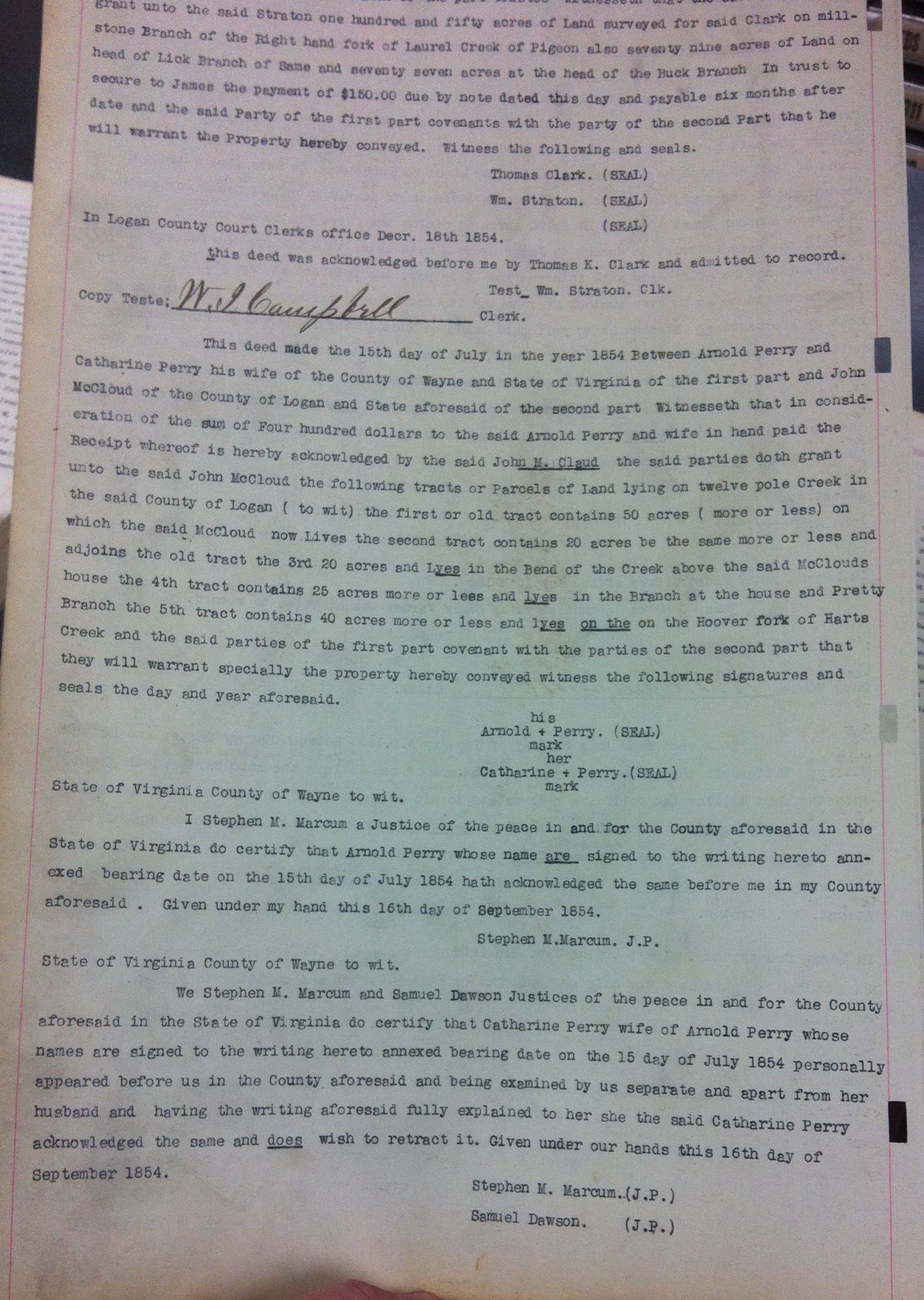
Deed Book C, page ___, Logan County Clerk’s Office, Logan, WV.
21 Saturday Sep 2019
Posted in Big Harts Creek
Tags
Appalachia, Charles Adkins, Cole Branch, Elias Adkins, Elizabeth Adkins, genealogy, Harts Creek, Henry Adkins, history, Isaac Adkins, Isaac Adkins Jr., Isaiah Adkins, Lincoln County, Logan County, Lydia Eveline Mullins, Parthena Adkins, Polly Adkins, Spencer A. Mullins, Virginia, West Virginia

Deed Book ___, page 447, Logan County Clerk’s Office, Logan, WV. Note: This property is located in present-day Lincoln County.

Deed Book ___, page 448, Logan County Clerk’s Office, Logan, WV. Note: Isaiah Adkins is my great-great-great-great-grandfather.
19 Thursday Sep 2019
Posted in Big Ugly Creek
Tags
Anderson Barker, Appalachia, Big Ugly Creek, county clerk, genealogy, history, justice of the peace, Levi Collins, Lincoln County, Logan County, Nancy Collins, Ralph Lucas, Virginia, W.I. Campbell, West Virginia, William Smith, William Straton

Deed Book __, page 471, Logan County Clerk’s Office, Logan, WV. This property is located in present-day Lincoln County.

Deed Book __, page 471, Logan County Clerk’s Office, Logan, WV.
15 Monday Jul 2019
Posted in Giles County, Logan, Pecks Mill
Tags
Anna Stuart, Appalachia, Arter White, Battle of New Orleans, Ben White, Betty Radford, Charles White, Editha White, Elijah White, Frank White, Franklin, genealogy, Giles County, Henry Mitchell, Hezekiah Staton, Hiram White, history, Howard White, Indiana, Isaac White, James Buskirk, James Thompson, James White, John Chambers, John Sansom, John White, Judith White, Lark White, Logan, Logan Banner, Logan County, Lucretia Elkins, Major White, Margaret White, Mason White, Maston White, Millard White, Mingo County, Monroe County, Montgomery County, Nancy White, Ohio, Pigeon Creek, Pleasant Chafin, Reuben White, Robert Chambers, Robert Whitt, South Carolina, Susannah Elkins, Susannah Marcum, Thomas White, Viola Ellis, Virginia, Wade Hampton, Wallace White, West Virginia, Will White, William White
From the Logan Banner of Logan, WV, comes this bit of history about the White family in Logan County, West Virginia. The story is dated May 21, 1937.
White Family Among Early Settlers in Logan County
Great Grandfather of Patrolman Frank White Moved From Pecks Mill to Mingo County; His Father Had Settled on Mitchell Farm
Among the pioneer families which settled in and around Logan during the early days of its building from a settlement to a village was the family of John White.
John White came to Logan and settled on the farm later owned by Henry Mitchell with a family of grown men and one daughter. Ben and James had come to Pecks Mill early in the 19th century and built their cabins.
His daughter, Nancy, married Robert Whitt, who afterwards moved to Ohio.
His sons were John, who married Susannah Marcum of Franklin; Ben, who married Anna Stuart of Montgomery; James, who married Lucretia Elkins; and William, who married a daughter of John Sansom, another pioneer of the county.
James, tiring of this section of the country because “hunting was bad”, moved to Mingo county and bought five miles of land on Pigeon Creek for a bear gun and a bear dog.
He reared his family and among his children was John, grandfather of Frank White, city patrolman, Mrs. James Buskirk, Power Plant addition, and Lark, Will, Millard, Howard, Wallace, and Mason, all of Logan.
John was the breadwinner of his family, his father having died not long after his son reached the age of 12. John hunted and filled the soil to take care of his aging mother and several brothers and sisters.
He married Betty Radford, also of Mingo county and was the father of twelve children. They were William, who married Editha White; John, who married Susannah Elkins; Thomas, James, Reuben, Isaac, Charles, Major, Elijah, Hiram, Masten, and Judith, who married James Thompson.
Elijah was the father of the Logan citizens named above. He left Mingo county and came to Logan where he married Viola Ellis.
Thomas, James, and Reuben went to Giles county, Virginia, and Major went to Indiana.
All the others remained in Logan and reared large families.
Ben White was the father of seven children, five sons and two daughters. His sons were John, Arter, Ben, William, and James, and his daughters were Nancy, who married Pleasant Chafin, and Margaret, who married Hezekiah Staton.
James had but one child, a daughter Nancy, who married John Chambers, a son of Robert Chambers of Monroe county.
William, the youngest son, joined the regular army in 1808 and was assigned for duty in a regiment that was being raised by Col. Wade Hampton of South Carolina.
When Hampton was made Brigadier-General in 1806 and assigned to duty at New Orleans, White went with him, and when Hampton was superseded by Wilkinson, White remained with Wilkinson and then under Jackson until after the Battle of New Orleans in which battle he participated.
He returned home in 1816 and married the daughter of John Sansom.
14 Sunday Jul 2019
Posted in Big Creek, Big Harts Creek, Civil War, Hamlin, Harts, Logan, Midkiff, Ranger, Spurlockville, Toney
Tags
Appalachia, assistant postmaster, Big Creek, Cabell County, Charles Spurlock, Cheat River, Cincinnati, civil engineer, civil war, doctor, genealogy, gunsmith, Hamlin, history, Jane Spurlock, John Spurlock, Lifas Spurlock, Lincoln County, Logan Banner, Logan County, Logan Post Office, Marshall Spurlock, Midkiff, Montgomery County, Omar, Pete Spurlock, preacher, Ranger, Robertson Spurlock, Seth Spurlock, Sheridan, sheriff, Spurlockville, Stephen Hart, surveyor, Union Army, Virginia, West Virginia
From the Logan Banner of Logan, WV, comes this bit of history about Stephen Hart and Harts Creek in Lincoln and Logan counties, West Virginia. The story is dated April 14, 1937.
Stephen Hart Settled at Cheat River, Pete Spurlock, A Great Grandson, Reveals
P.A. (Pete) Spurlock, assistant postmaster at the Logan post office, this morning revealed the destination of Stephen Hart, who went went after he had lived for a short time at the forks of the creek in the lower end of Logan county which now bears his name.
Spurlock said that Hart went to the Cheat River and settled permanently there to hunt deer and rear a family. He said the family name of Hart is as familiar there as the name Dingess is familiar in Logan county.
A daughter of Stephen, Jane, was Spurlock’s grandmother. She lived until 1913 and told her grandson much of the early history of the family which made its home in and around Spurlocksville, Sheridan, Ranger, and Midkiff.
Charles Spurlock, the progenitor of the Spurlock family, came to what used to be the Toney farm below the mouth of Big Creek in 1805 from Montgomery county, Virginia.
“Uncle Charley was a funny old cuss,” his great grandson Pete said this morning. “The story is told that a sheriff of Cabell county was given a capias to serve on the old codger for some minor offense when he was growing old and rather stout.
“Meeting him in the road one day, the sheriff informed Uncle Charley he had a capias to serve on him.
“None abashed, the old man informed the sheriff he was a law-abiding citizen and laid down in the middle of the road and told the sheriff to take him to jail.
“The ruse worked, for the sheriff chose to look for less obstinate prisoners,” Uncle Charley’s grandson said, chuckling.
Another story about the eccentric “Uncle Charley Spurlock” which has gone down in history, whether true or not, was that he lived for a short time below Big Creek under a rock cliff (known as a rockhouse) during the early summer while he was getting his cabin in shape for winter.
The tale is out that “Uncle Charley” explained his strange dwelling place in this way to his neighbors:
“Well I took Sarah (his wife) in a good substantial frame house in Virginia and she wasn’t quite satisfied. I took her to a log house and she wasn’t satisfied. I took her to a rail pen and still she grumbled. Then I took her to a rock house built by God Almight and still she wasn’t satisfied.
“I don’t know what I’m going to do with Sarah.”
Sarah evidently became accustomed to “Uncle Charley” for the couple reared four sons. They were John, Seth, Lifas and Robertson. There were no daughters.
Seth was P.A. Spurlock’s grandfather. His father, Marshall, is 78 and lives on his farm near Cincinnati.
Spurlock says “Uncle Charley” is buried on a point at Spurlocksville overlooking the haunts of his early manhood.
Robertson was a gunsmith and lived near Hamlin. Seth was a civil engineer and helped survey much of Logan county. He was a Union soldier. John was a country doctor who practiced at Ranger.
Lifas was a preacher for sixty years and lived at Sheridan.
Charles Spurlock, of Omar, is a distant cousin, the assistant postmaster said. He is the only relative that lives in this section of Logan county, Spurlock said.
Spurlock, at Omar, was born at Spurlocksville and is a grandson of one of the original “Charley’s” boys.
19 Wednesday Jun 2019
Posted in Logan, Women's History
Tags
Anna Mae Wright, Appalachia, Aracoma Hotel, Chamber of Commerce, D.M. Staples, First National Bank, Helen Caldwell, history, Logan, Logan Banner, Logan County, Logan Planing Mill, Main Street, Norfolk, Portsmouth, rats, Virginia, West Virginia
From the Logan Banner of Logan, WV, come these stories of rats in the city, printed in 1922-1923:
Oh, Rats!
The Chamber of Commerce has collected quite a few rat tails since its announcement some days ago of the contest which ends on July 15th with a grand prize to the person having collected the greatest number from rats killed. The tails are delivered to Mr. McGuire each Saturday morning at the Chamber’s offices over the First National Bank building, at which time five cents are paid for each tail. The big prize will be given on July 15th, so it’s up to those who have been interested to get busy for the next two weeks.
Logan (WV) Banner, 30 June 1922
***
Extermination of Rats Contest Continues While Longer
Secretary Announces It Such a Success That Contest Will Continue
Five Pennies a Rat
Mr. Davis of East End, Leads in Contest With 113 of Rodents Killed
Such interest is being taken in the rat contest as inaugurated by the Chamber of Commerce that the body has decided not to close the contest July 15, as formally announced. The closing date will be announced later and in the meantime the Chamber wants every boy, girl, man or woman to be an active soldier in the extermination of this rodent.
So far Mr. Davis who lives near the Logan Planing Mill in the eastern portion of the city, has the largest number of rat tails to his credit, having delivered a total of 113 on last Saturday. These pests are said to be unusually numerous and active in this vicinity of the city and Mr. Davis has been unusually busy in killing everyone that he has been able to find. He is yet adding to his honor roll and will evidently keep the good work going until the end of the campaign when it is hoped he will be so fond of slaying rats he will continue the good work through life.
Many other citizens of the city are making records and there is one thing sure—when the rat campaign is over there will be a smaller number of the rodents in the city than there were when the contest opened.
Secretary McGuire calls for the citizens to keep up the good fight and announces that the more money the Chamber has to pay out for rat tails the better it pleases them and that he will be on hand each Saturday to reward the faithful exterminators and he hopes to see the number grow larger as each week-end roll around.
Logan (WV) Banner, 14 July 1922
***
Rodent Carries Ladies’ Outfit, But Dial Gets It
Chief of police Dial had a rather funny experience the other day. He was crossing Main street when he saw some sort of an animal moving down the street with a large package on its back that almost hid the animal from view. For some moments his brain was puzzled at the queer sight. He thought for an instant his eyes might be playing him a prank. Rubbing his eyes, he looked again and there it was moving along down the road.
Dial could not remember of imbibing any amount of “hootch” that might cause him to see things so he pulled his trusty pocket gun and fired away. The beast tumbled over and the package felt o the paved highway. Imagine his surprise when he discovered one of the large rats that inhabit the post office had escaped from the building and was making a get-away with a huge parcel post package. The address had been removed from the package by the rodent and several large holes punctured through the wrapping.
An examination of the package brought to light one voile skirt, a pink corset, two crepe de chine waists, 4 pair of bright colored hose, 1 chemise, 2 princess slips, 3 corset covers, 1 pair “knickers,” 2 pair of “Teddy’s,” 1 pair of fancy garters, 5 hair nets, 1 hair rat of auburn hue and two powder puffs.
The “he” rat had evidently made an inspection of the package and found therein a quantity of material with which to dress up Mrs. Rat and was on his way home with the package when he met his untimely death at the hands of the ever watchful chief of the city of Logan.
It is understood the post office rats held funeral services in the local office last Saturday night. There was much sorrow at the loss of one of their members but with the birth rate at a high figure his place will soon be filled and the deceased rat soon forgotten in the rush of rodents at the Logan post office.
Logan (WV) Banner, 11 August 1922
***
Pretty Poisoners Here For War On Rodents
Misses Wright and Caldwell Arrive in County For Rat Crusade
A rat extermination campaign was launched in Logan this week when Miss Anna Mae Wright, pretty Portsmouth, Va., girl and Miss Helen Caldwell, her aid-de-camp, began a cooperative drive with the city health department against the destructive rodents.
Women have entered many fields of endeavor but few of them have been of wider benefit to humanity than has Miss Wright in her plan of rat killing, municipal officials in nineteen states have testified following successful campaigns conducted in hundreds of towns and cities.
The germ of the idea for a national rat extermination was created in the mind of Miss Wright three years ago while she was assisting in a civic campaign against rats at Norfolk, Va. It was in this campaign that a government-tested West Virginia product was found to give best results. This product, barium carbonate, is a mineral manufactured from the waste products of West Virginia mines and through its use thousands of rats have been eradicated.
Enthused by the success of the Norfolk campaign and acting under the encouragement of the prominent health authorities in the east, Miss Wright, accompanied by a friend, Mrs. D.M. Staples, started on a tour of southern states during which they met with unusual success.
Romance, however, finally interrupted the partnership oft ese two young ladies in their strange business venture, when Mrs. Staples, a widow met and married a prominent Virginian. Undaunted, Miss Wright has continued her work and is coming to Logan to aid the municipal health department in its efforts to rid the city of rats.
A study of the rat family, made from statistics compiled from all parts of the United States, reveals that there are an average of two rats to every inhabitant in any city or town.
“On this basis,” Miss Wright explained, “Logan and vicinity has a population of 10,000 which costs the people $18,000 annually to feed.”
Upon the arrival of the young ladies in Logan, the Mayor was communicated with and they found him a willing helper. He secured for them the endorsement of the various civic bodies and then brought them to The Banner for the publicity campaign.
Their interviewer forgot at times these girls were “rat killers” and as the conversation would naturally turn to other channels he was soon reminded the campaign was against rats and not hearts.
“We’re not afraid of rats,” the girls answered to a query. “You see, we seldom see the live creatures anyway. We help set the bait and wait for results.”
The campaign was started in the business section immediately after their arrival and the girls are calling on the larger firms and assisting in the work. The residential sections cannot all be reached by them, but a supply of the barium carbonate may be had at any of the stores and if the directions are not thoroughly understood or proper results not obtained, Miss Wright or Miss Caldwell will be found at the Aracoma hotel and either will gladly help any person.
Miss Wright’s plan to work is quite simple, she explained. The right proportion of barium carbonate is mixed with delicate morsels of food which are invitingly displayed along the walls of rooms or in known runaways used by rats.
This powder is tasteless but deadly in its work, she explained. There is little to be feared of the rats dying underground or in the walls of buildings after they have eaten of the poison. Its action is such, she stated, that the afflicted rat always comes out into the open air in order to breathe more easily. It is a death of strangulation and the doped animals always come out of their retreats when they feel themselves afflicted.
The barium carbonate used in the local campaign will be furnished by Miss Wright at a nominal cost, city officials announced.
Logan (WV) Banner, 27 April 1923
14 Sunday Apr 2019
Posted in Twelve Pole Creek
Tags
A.C. Ferrell, Appalachia, county clerk, genealogy, Henry Workman, history, James Browning, justice of the peace, Laurel Branch, Nancy Workman, Samuel Damron, Twelve Pole Creek, Virginia, W.I. Campbell, Washington Adkins, Wayne County, West Virginia, Wiley Branch, Witchers Branch

Deed Book C, page __, Logan County Clerk’s Office, Logan, WV.

Deed Book C, page ___, Logan County Clerk’s Office, Logan, WV.
02 Tuesday Apr 2019
Posted in Big Sandy Valley
Tags
Appalachia, crime, G.W. Nighbert, genealogy, history, John W. Hatfield, Logan County, petit larceny, Virginia, Warren Alderson, West Virginia
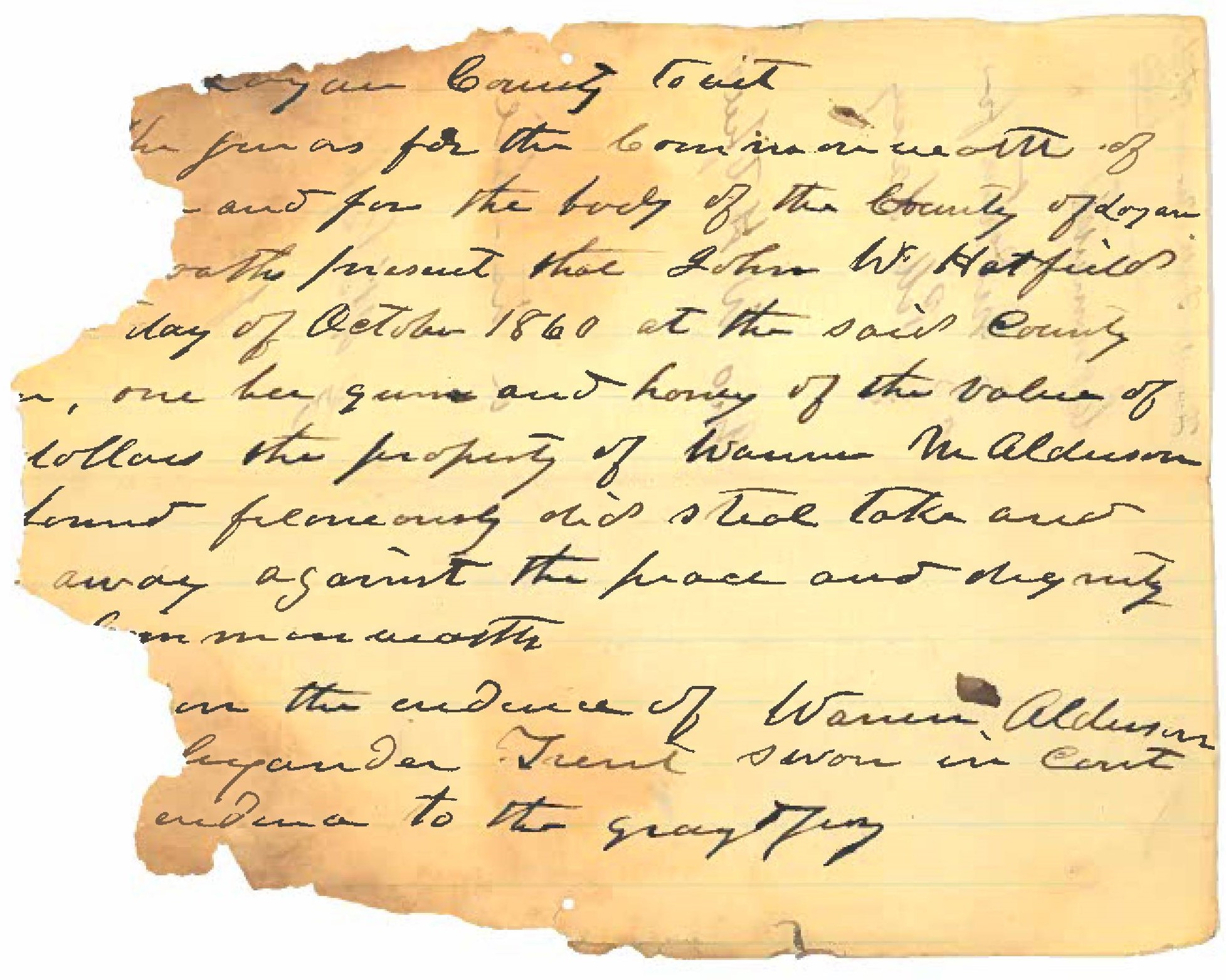
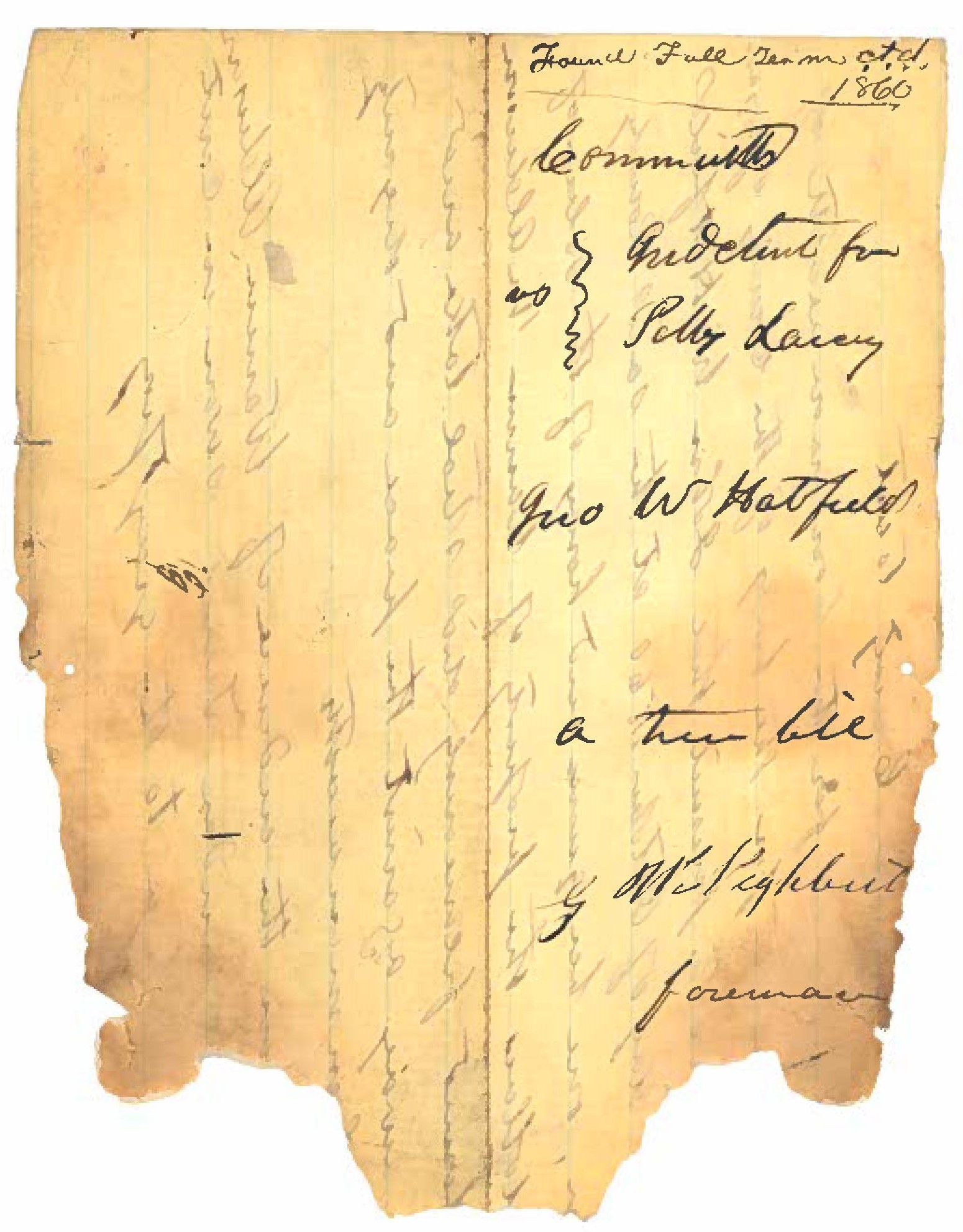
Warren Alderson accused John W. Hatfield of stealing one bee gum and honey (1860).
09 Saturday Mar 2019
Posted in Culture of Honor
Tags
Appalachia, Big Stone Gap, crime, Devil John Wright, feuds, history, photos, Southwest Virginia Museum, Virginia

Devil John Wright saber (1901), Southwest Virginia Museum, Big Stone Gap, VA. 26 August 2018
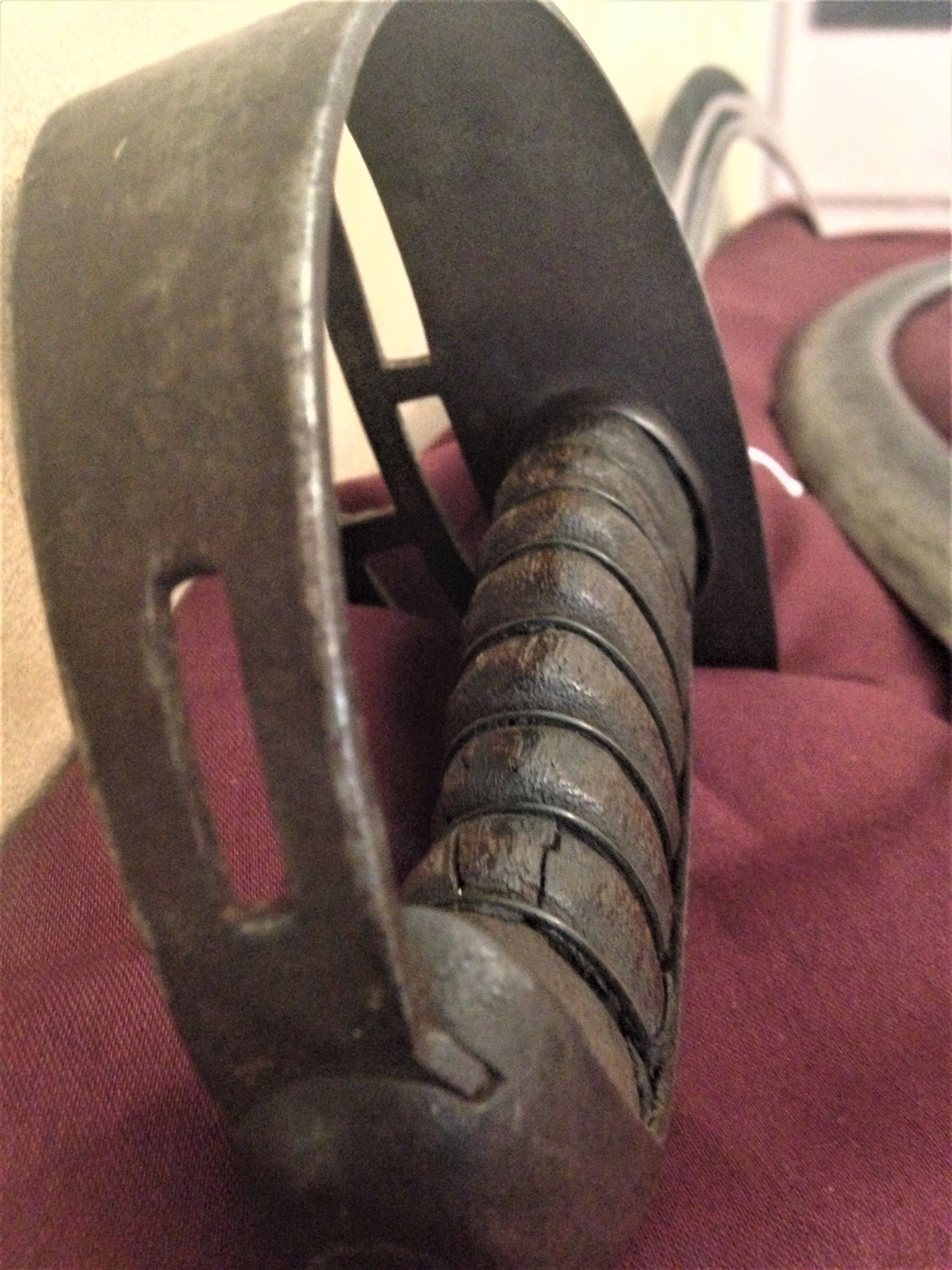
Devil John Wright saber (1901), Southwest Virginia Museum, Big Stone Gap, VA. 26 August 2018
04 Monday Mar 2019
Posted in Civil War, Pecks Mill
Tags
129th Regiment Virginia Militia, 12th Regiment Virginia Militia, Abner Vance, Adam Browning, Appalachia, Barney Carter, Big Creek, Calvary Hatfield, Chapmanville District, Charles Staton, civil war, David Mullins, Eli Gore, Evans Ferrell, genealogy, George Avis, George Bryant, Gilbert Creek, Gordon Riffe, Granville Riffe, Green A. Clark, Guyandotte River, Hardy District, Harts Creek, Harvey Ellis, history, Huff's Creek, Jack Dempsey, James H. Hinchman, James J. Hinchman, John Chapman, John DeJournett, John Dempsey, John Hager, John Hatfield, John Starr, Joseph B. Browning, Joseph Hinchman, Logan Banner, Logan County, Louis White, Magnolia District, Martin Doss, Mingo County, Nathan Elkins, Pecks Mill, physician, Reece Browning, Triadelphia District, Ulysses Hinchman, Union District, Virginia, West Virginia, Wheeling, William Dempsey, William McDonald, William Stollings, Wyoming County
From the Logan Banner of Logan, WV, comes this bit of history for Logan County printed on November 3, 1936:
Time-Dimmed Record of Early Logan County Families in 1852-1877 Period in Old Books Found at Pecks Mill
Thumbing the now-dimmed pages of a yellowed book which recently came to light in old Peck’s Mill, members of Logan county’s oldest families may read in a painstakingly-kept record of the years 1852 to 1877 how their forefathers were brought into the world, married, educated, governed.
The record is written in pen and ink with the quaint flourishes and old-fashioned double letters of the 1800s by James J. Hinchman, who was clerk of the 12th regiment of the Virginia militia from 1852 to 1858; and by one, Ulysses Hinchman, who was clerk of the 129th regiment from 1858 to the Civil War; and later pastor, doctor, and trader.
The first entry, dated Nov. 3, 1852, records the meeting “at the house of Wm. McDonald near the mouth of Huffs Creek” of the Twelfth regiment of the Virginia militia in the days when Logan county was the property of Virginia.
Among the officers present were Major John Hager and Capt. James J. Hinchman, who was also clerk.
Most of the records at the first, which deal entirely with the regiment, are devoted to the salaries paid for “drumming and fifing,” the fines of 50 cents each for failure to report at meetings, and the excuse of members from duty “because of physical infirmities.”
Among the interesting entries is one relating, it is believed, to an ancestor of ex-champion Jack Dempsey, which reads:
“William Dempsey for fifing one day in Capt. Miller’s company.”
Two dollars, according to numerous accounts, was the regular salary paid for a day of fifing or drumming. For three days training, officers received $10.
Among regiment members mentioned are Calvary Hatfield and Reece Browning, forefathers of the Hatfield and Browning families of today.
On Sept. 10, 1858, the record is transferred to that of the 129th and is kept by Ulysses Hinchman. His first entry tells of a meeting at which John De Journett was elected colonel; K. McComas, first major; Reece Browning, second major; and Ulysses Hinchman, clerk. Officers attending were Captains George Avis, James H. Hinchman, John Starr, John Hatfield, John Chapman, and Barnabus Carter; and Lieutenants Martin Doss, George Bryant, Granville Riffe, Louis White, Charles Staton and Green A. Clark.
Interesting in these pages are the forming of new companies in which the names of the creeks and localities are for the most part the same as today. Among the familiar names are Huffs, Gilbert, Harts and Big Creek, Guyandotte river, and Trace Fork.
There is no mention of the Civil War, but it is mutely attested to by two entries, the first, dated 1862 at the bottom of one page and the second dated 1866 at the top of the next, which read:
“Apr. 5, 1862—Abner Vance and Nathan Elkins received their claims.
1866—Rec’d of Eli Gore, county treasurer for my last year’s services, $50.
“Ulysses Hinchman, superintendent of schools.”
The next year, we are gratified to learn, his salary has increased to $300.
We learn that Logan, which then included Mingo and Wyoming counties, was at that time composed of five districts, Union, Triadelphia, Hardy, Chapmanville, and Magnolia; and that the county’s finances were all handled through Wheeling, then the only city of size in West Virginia.
The records contain long lists of certificates awarded to teachers for $1, among the recipients being John Dempsey, Eli Gore, Joseph Hinchman, Harvey Ellis and Evans Ferrell.
In the midst of the records of 1866 and ’67 we come upon the terse paragraph which informs that:
“The sheriff failed to settle for taxes of 1861.”
The board of education’s budget for 1869 was $2077.60 and was apportioned to these clerks of the various townships; Union, David Mullins; Triadelphia, Gordon Riffe; Magnolia, Joseph B. Browning; Hardy, Adam Browning; and Chapmanville, Wm. Stollings. Increased expenses that year made it necessary to levy a tax of “5 cents on $100.”
An enumeration of all children “between the ages of 6 and 21” in 1868 totaled 2139.
In 1871, our patient scribe becomes “Dr. U.S. Hinchman” and the record his personal account book. We learn much of the practices and hardships of the first country doctors and that his troubles in collecting the pitifully small fees of those days were as great as those of any “specialist” of today.
Dr. Hinchman had no set rates, but based on his charges upon the number of miles traveled (usually 50 cents per mile); the number of days and nights spent, and—quite evidently—the circumstances of his patient.
His customary charge for a delivery, if it chanced to come in the day time, appeared to be $5.50; but if the child arrived in the night and required many miles of travel it was a more expensive proposition—the fees sometimes reaching as high as $9.
The birth of one of these $9 babies is graphically recorded as follows:
“Labor two nights and days–$7
10 miles at 50 cents–$5
Administering–$1
Received $5.”
The doctor’s highest charge was one of $10 on a case which required three days and nights.
Interspersed freely with the accounts of births, and sicknesses are frequent entries of marriages at $2 each.
Toward the last of the book, in 1877, the author’s handwriting becomes more labored and the fine shadings and flourishing gradually disappear—evidence that his years of soldiering, school teaching, and doctoring were taking their toll.
At this time, too, he begins to record not only his receipts, but his expenditures and trades, and we read, not without envy, of purchases of “one bushel of sweet potatoes, 50 cents,” and “one and a half bushel of Irish potatoes, 75 cents.”
One of the last entries, dated Aug. 1877, tells of his receiving for his professional services a large amount of coffee which he traded for $5 cash, a suit, and a round of shoes,” the latter evidently referring to horseshoes.
As, regretfully, we close the book; we feel that we know that patient and prolific old settler of Logan County, Ulysses Hinchman—his honor as a soldier and officer, his strict accounting of himself as a public official, his hardships and struggles as a country doctor; and through all, his conscientious, faithful keeping of records. And we share, with his descendants, a great pride in him.
Somehow we know that when, with failing hand, he concluded his long accounts in another book; his record was clear and straight—his house was in order.
23 Saturday Feb 2019
Tags
Andrew Lewis, Appalachia, Aracoma, Battle of the Island, Big Creek, Boling Baker, Coal River, Dingess Run, Elizabeth Madison, George Booth, Gilbert Creek, Guyandotte River, Hatfield Island, history, Island Creek, John Breckinridge, Kentucky, Logan, Logan Banner, Logan County, Mingo County, Montgomery County, Native American History, Native Americans, Spruce Fork, Thomas Madison, Virginia, Washington County, West Virginia
From the Logan Banner of Logan, WV, comes this bit of information about Logan’s early history printed on April 26, 1937:
Land On Which City Of Logan Now Stands First Owned by Breckinridge
The tract of land on which the city of Logan now stands and the Island–now “Hatfield’s Island”–once belonged to John Breckinridge, scion of an old Kentucky family and leader of the attacking party which broke the control of the Shawnee Indians in the Guyandotte valleys in the “Battle of the Islands.”
Princess Aracoma was killed in this battle and Boling Baker, her renegade white husband, was banished forever from the lush river valley where he had spent his days since his desertion from the English forces in Virginia.
Captain Breckenridge led the attack which made the valley safe for white settlers, and, in appreciation of his services, the new government allowed him 300 acres at the mouth of Island creek.
The land grant was made early in the 1780s along with a few others on Island Creek, Dingess Run, Gilbert Creek, Big Creek and the Spruce Fork of Cole River.
Surveying parties from Montgomery and Washington county, Virginia, braved the wilderness and apportioned the land in Guyan Valley and vicinity to early Indian fighters who had contributed their services to opening the valley for white settlement.
Included in the surveys made by deputy surveyors from Montgomery county were grants apportioning much of Island Creek, Spruce Fork, and Dingess Run to persons whose names are still remembered in the county has holders of much of this county’s land.
In these early surveys Andrew Lewis was given 3000 acres on Island Creek along with 2000 acres on Big Creek, and 3000 acres on Gilbert Creek.
Thomas Madison was given 2000 acres on Spruce Fork, 1000 acres on Dingess Run, and 2000 acres on Gilbert Creek.
Others who figured in this early allocation of land were Elizabeth Madison, who was given much of Spruce Fork; George Booth, who was awarded several thousand acres along Guyan River and on Island Creek; and George Booth [same name listed twice in this story], who received much of the land along Island Creek.
Later in the waning years of the 19th century other grants were made by the new government with the stipulation that settlement be made immediately, but these early grants were rewards for work well done in opening the valley of the Guyandotte for settlement.
07 Thursday Feb 2019
Posted in Atenville, Guyandotte River
Tags
Andrew Johnson, Appalachia, Atenville, Cabell County, county clerk, genealogy, Guyandotte River, Guyandotte Valley Navigation Company, history, John Chapman, justice of the peace, Lincoln County, Lock No. 5, Logan County, Spencer A. Mullins, Virginia, W.I. Campbell, West Virginia, William Straton, Willow Bar

Deed Book C, page ___, Logan County Clerk’s Office, Logan, WV. Spencer A. Mullins lived at present-day Atenville in Lincoln County, WV.

Deed Book C, page ___, Logan County Clerk’s Office, Logan, WV.
01 Friday Feb 2019
Tags
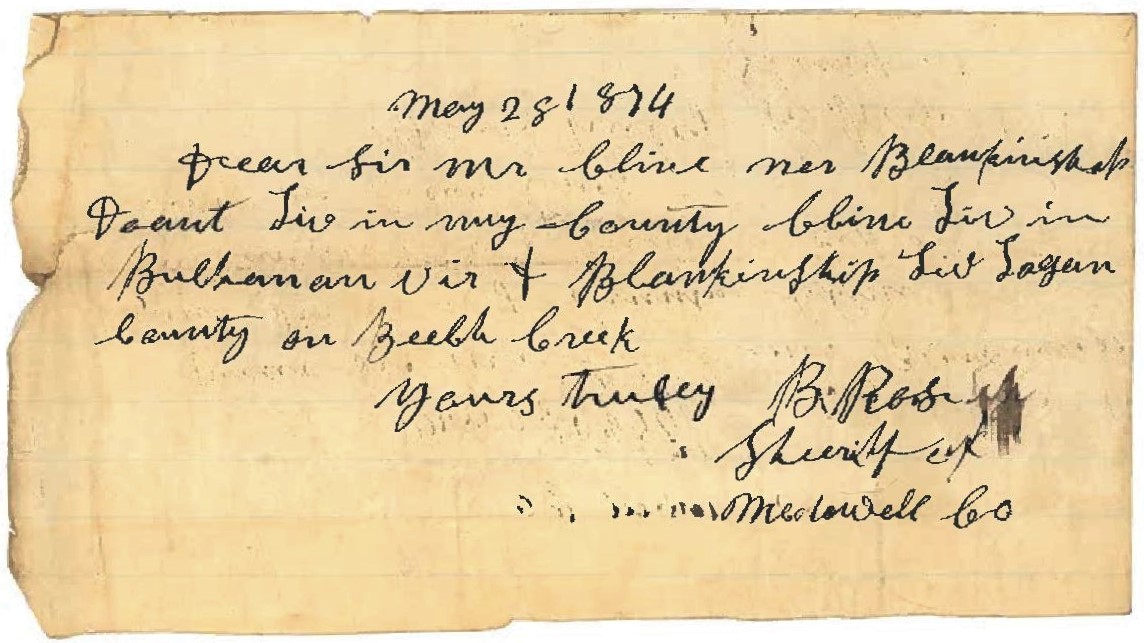
Appalachia, Beech Creek, Buchanan County, crime, genealogy, history, Logan County, McDowell County, Mingo County, sheriff, Virginia, West Virginia
Posted by Brandon Ray Kirk | Filed under Big Sandy Valley
25 Friday Jan 2019
Posted in Chapmanville
Tags
Appalachia, Chapmanville, Cleveland, Devona Butcher, Everett Fowler, G.S. Ferrell, genealogy, George Hensley, Gladys Bryant, Green Simms, Guy Dingess, history, Jim Bryant, Logan Banner, Logan County, Millard Brown, minister, Mont Coal, Newport News, Oscar Langdon, Pearl McCloud, Tennessee, Virginia, West Virginia
A correspondent named “Two Chums” from Chapmanville in Logan County, West Virginia, offered the following items, which the Logan Banner printed on February 17, 1922:
The Chapmanville school is progressing nicely.
Mr. Guy Dingess was calling at G.S. Ferrell’s Sunday.
I hear Miss Devona Butcher is going on the stage for an actress next year.
Miss Gladys Bryant returned from Newport News recently.
Mr. Oscar Langdon is looking hungry now days.
Mr. Millard Brown and Miss Pearl McCloud seemed to be enjoying themselves out walking Sunday.
Green Simms arrived Saturday evening from Camp Dix, N.M.
Mr. Jim Bryant had a 75 cent smile on when he came in the theatre Saturday night.
Mr. Everett Fowler is going to take a journey to Mont Coal in a few days.
Mr. George Hensley has taken a flying trip to Cleveland, Tenn. to graduate and become a minister.
28 Friday Dec 2018
Tags
Appalachia, civil war, constable, crime, Eli Gore, Emmett Scaggs, Frank McKesson, genealogy, George Scaggs, Henry S. Walker, history, justice of the peace, lawyer, Logan Banner, Logan County, Man, Raleigh County, Stollings, Taplin Hollow, Virginia, West Virginia
From the Logan Banner of Logan, WV, comes this bit of history about a Civil War hanging in present-day Logan County, West Virginia.
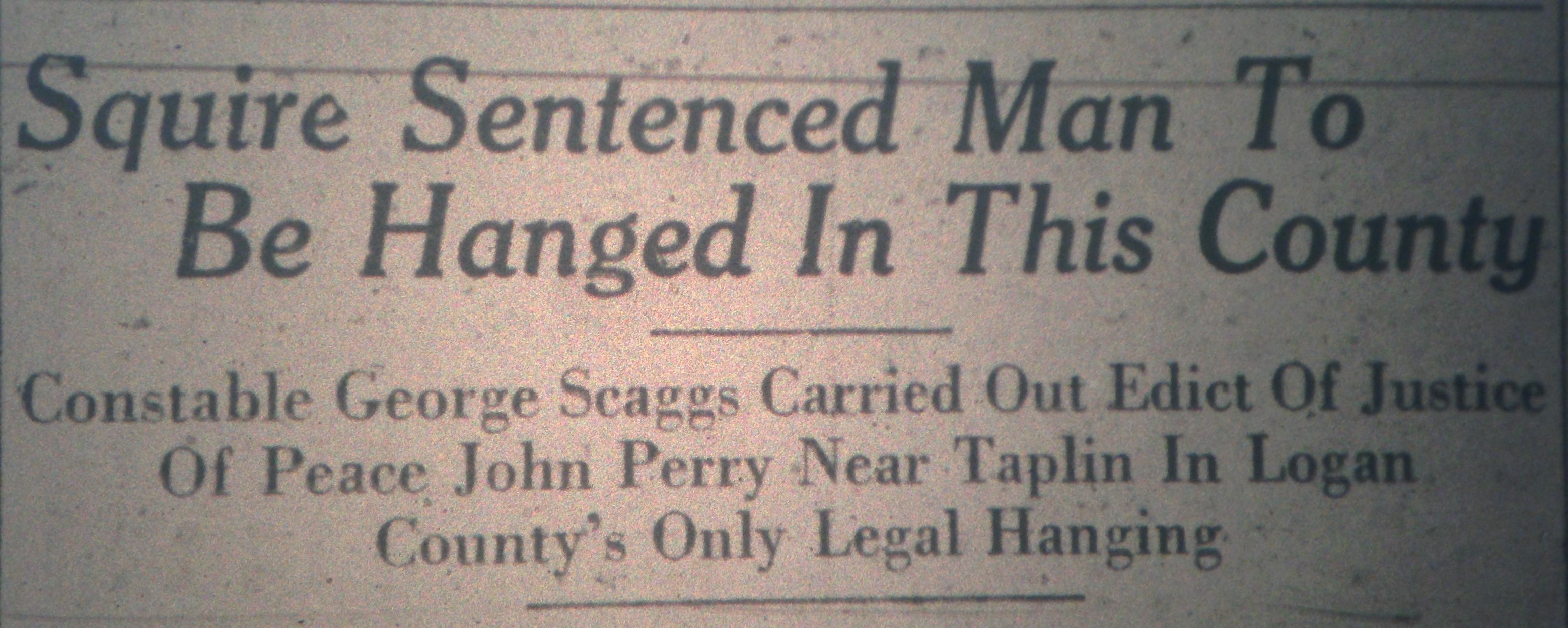
Squire Sentenced Man To Be Hanged In This County
Constable George Scaggs Carried Out Edict Of Justice Of Peace John Perry Near Taplin In Logan County’s Only Legal Hanging
Nothing but the gnarled weather beaten stump of an old locust tree remains today to mark the scene of Logan county’s only legal hanging.
The stump is standing just below the highway at the mouth of Taplin hollow and is the only landmark which calls to mind the hanging of Henry S. Walker, convicted of murder by Squire John Perry of Man in the spring of 1862 and hanged the same day by Constable George Scaggs, uncle of Emmett Scaggs, prominent lawyer, and brother-in-law of Eli Gore, old resident of Stollings.
A story is told that Henry Walker came down Taplin Hollow late one night in the closing months of the civil war on a “scouting” tour. He entered the home of Uncle Frank McKesson and for no apparent reason seized a double bitted axe and chopped to lifeless, bleeding masses the bodies of Uncle Frank and his wife and then fled to Raleigh county.
One week later Constable George Scaggs arrested the man in the county where he was hiding and brought him before Justice of the Peace John Perry.
Squire John Perry had a fine eye for justice and he was meting it out under the Virginia law which allowed a justice of the peace to pass the death sentence.
George Scaggs was delegated as executioner and Walker was put on a wagon and brought to Taplin down the river road to the spot where he committed the crime.
Old-timers say that a crowd of men, women and children laughing and passing jokes on the show they were to see followed the wagon to the scene of the proposed hanging and watched tensely as a rope was thrown over the limb of the locust tree and the noose was placed snuggly around the neck of the murderer.
He was placed on the flour barrel, a couple of feet of the slack in the rope was taken up and tied securely to the trunk of the tree, and George Scaggs, without any preliminaries, kicked the flour barrel from under the man.
The man fell to within six inches of the ground and the awed onlookers gasped as they heard an audible crack which told them the murderer’s neck had snapped. He hung quivering at the end of the rope several minutes before the peace officer cut him down and placed him in the wagon to be taken to Man for burial.
The same crowd followed the wagon back to Man, but it was a crowd of sober individuals who had seen a human life pass into oblivion. There was no joking and even the children talked in muted undertones.
Source: Logan (WV) Banner, 01 June 1937.
Writings from my travels and experiences. High and fine literature is wine, and mine is only water; but everybody likes water. Mark Twain
This site is dedicated to the collection, preservation, and promotion of history and culture in Appalachia.
Genealogy and History in North Carolina and Beyond
A site about one of the most beautiful, interesting, tallented, outrageous and colorful personalities of the 20th Century
 Brandon Ray Kirk