• About

Brandon Ray Kirk

~ This site is dedicated to the collection, preservation, and promotion of history and culture in my section of Appalachia.

Brandon Ray Kirk

Tag Archives: Raleigh County

George Wolfe Answers John L. Lewis (1925)

07 Monday Dec 2020

Posted by Brandon Ray Kirk in Coal

≈ Leave a comment

Tags

Beckley, Central Competitive Field, coal, Fayette County, George Wolfe, Illinois Department of Mines, Indianapolis, Jacksonville Wage Scale, John L. Lewis, Logan, Logan Banner, R.M. Lambie, Raleigh County, secretary, United Mine Workers of America, West Virginia, West Virginia Department of the Mines, Winding Gulf Operators Association

From the Logan Banner of Logan, WV, comes this bit of history about John L. Lewis and the United Mine Workers of America. The story is dated May 15, 1925.

WOLFE ANSWERS LEWIS’ BARRAGE; QUOTES FIGURES

Points out That Miners of Central Competitive Field Always Opposed Aims of West Virginia Miners–Tells How American Plans Gets Results

The statement of John L. Lewis, president of the United Mine Workers of America, to the effect that it would make no difference to the coal mining industry if the wages of the miners ________________ time scale “as the public burns 500,000,000 tons of coal annually anyway” was characterized as “ridiculous rubbish” by George Wolfe, Secretary of the Winding Gulf Operators Association, of Beckley. He said that Lewis is not looking at the industry from a practical business standpoint, when he makes such a statement, but is merely blustering to hear himself talk.

“There are 24 states in the union that are producing coal and that means there is competition,” said Mr. Wolfe. “The union miners in the Central Competitive Field are banded together in an effort to keep the ‘outlying fields’ out of the market and already have an unwarranted advantage for the inferior coal mined by them in the matter of widened freight differentials. The Central Competitive Field employs the vast majority of union miners and contributes the major share of the Indianapolis organization’s finances.

“Even when West Virginia had a large union delegation its delegates had nothing to do with making the scale and passed it over to the West Virginia delegation to enforce. West Virginia is mentioned especially as one of the most affected outlying fields against which the union is fighting. It isn’t a question of union or non-union but it is a case where the miners of the Central Competitive Field led by Lewis are seeking to curtail the production of this state, which produces one fifth of the nation’s best coal.

“That’s why Lewis is lending his personal influence and sending scores of agitators into West Virginia to try and coerce satisfied miners into joining his organization. They can either work and receive satisfactory pay or join the union and strike–in the interests of the union miners of other states who want to sell their coal instead of the West Virginia fuel. They have had the nerve to say that West Virginia should never have been developed until the other older fields that now produce a coal inferior to ours had been completely exhausted. Then they could have moved down to West Virginia and done the mining that was necessary, they say. But since they can’t come right away they want to hold up West Virginia’s progress, blight the prosperous mining villages and towns that exist today, and stay the wheels of time until such time as they can come to West Virginia and handle the situation. But the miners of West Virginia are wise enough to see this and the scheme is getting them nowhere.

“One needs look no further than the annual report of R.M. Lambie, chief of the West Virginia Department of the Mines, to see that these schemes of mice and men are ganging aft agles. Not only did the West Virginia mines ship more coal last year but the tonnage per man has increased–and thus the cost of mining is being reduced, instead of being saddled with the extra costs and working conditions imposed by the Indianapolis organization. The men of Southern West Virginia are perfectly satisfied with the American plan of mining, which implies that the miners are human beings capable of making their own agreements, and not dumb driven cattle herded together by organizers.

“The miners of West Virginia have been misled before and now they alone are the ones to take an interest in their own welfare. Their jobs are the things that support their wives and families and they mean to make the most of them. They are working more consistently and turning out more coal per man. In turn getting bigger pay checks. This in turn keeps the coal moving, and they then get a bigger share of work than those mines dominated by Lewis and his Indianapolis lieutenant.

“In 1923 West Virginia operation gave employment to 121,280 miners who worked an average of 158 days a year to mine 37,475,177 tones of coal, according to Mr. Lambi’s report. Before 1924 the American plan had spread through the industry and it only took 115,964 miners, working an average of 155 days a year to mine 103,325,960 tons of coal. In other words, with fewer working days and 5,000 fewer men in the mines, the state produced 6,000,000 tons more coal in 1924.

“Compare that with the annual report of the Illinois Department of Mines. Due to the Jacksonville Wage Scale, which is so high that it closes many markets to mines operating it despite the exceptional freight rate handicaps accorded them, the union miners were not nearly as well off as the West Virginia miners working under the American plans. The Illinois men average but 140 days work during the year. The report shows that __,765 miners in Illinois produced 72,308,665 tons of coal during 1924, which was 3,205,430 tons less than was mined in 1923. And the average tonnage per man was about one-fourth of a ton less per day.

“It isn’t necessary to answer Lewis’ statement regarding ‘starvation wages’ paid miners in West Virginia. You don’t have to give a theoretical answer to that. Just note the scores of loaders and cutlers who are making from $15 to $18 a day. Note those men to Raleigh and Fayette counties who claim championships in loading, who have averaged better than $20 a day–not for one or two days but for months at a time. Then figure out what $20 a day means, in fair weather and foul because there isn’t any rain underground, and you’ll see why Southern West Virginia doesn’t have to advertise outside of West Virginia to get all the miners it needs to produce the record tonnages from this state. All we need is a chance to get to the markets under a reasonable freight rate, and our coal will do the rest, backed by thousands of satisfied miners who are making new production records daily.”
Thomas C. Whited

06 Monday Jul 2020

Posted by Brandon Ray Kirk in Big Harts Creek, Chapmanville, Civil War, Huntington, Logan, Poetry

≈ 1 Comment

Tags

Anna Meadows, Appalachia, Chapmanville, Charles S. Whited, Charleston, civil war, Craneco, deputy clerk, Ella Godby, Ewell Deskins, genealogy, George W. McClintock, H.A. Callahan, Harriet Totten, Harts Creek, Hattie Rothrock, history, Huntington, J. Green McNeely, J.C. Cush Avis, John A. Totten, John W. Buskirk, Logan, Logan Banner, Mud Fork, poetry, preacher, Raleigh County, Robert Whited, Russell County, Slagle, Southern Methodist Church, T.C. Whited, teacher, Thomas Harvey Whited, U.S. Commissioner, Virginia, W.B. Johnson, W.G. Whited, W.W. Beddow, West Virginia

From the Logan Banner we find this entry for Thomas C. Whited, who resided at Logan, West Virginia:

“Uncle Tom” Whited, United States commissioner, one of the county’s oldest citizens, and poet, came to Logan, or the present site of Logan, on October 11, 1877.

He was born on a Russell county, Virginia, farm in a one-room log cabin on November 25, 1854, the son of Robert and Anna Meadows Whited, who reared a family of ten children, nine boys and one girl.

“Uncle Tom” has only one brother living, the Rev. Charles S. Whited, a preacher in Raleigh county. His sister is dead.

His home was broken up by the Civil War, and Mr. Whited began the life of a vagabond, wandering about over the country seeking happiness, but never finding it until he came to Logan. He discovered the little frontier settlement as he was making his way on foot back to his Virginia home to take a job in a store.

“I just dropped in here, tired and sore-footed and decided to attend a teacher’s examination that was advertised for the town–mostly just to see what kind of a certificate I could get among strangers,” Mr. Whited said.

He received his certificate and taught his first term of school at the mouth of Mud Fork in 1877. Then followed terms at Chapmanville, Craneco, Logan and Hart’s Creek until 1883 when he was asked to take a position in the clerk’s office as deputy clerk.

Among the well-known citizens that “Uncle Tom” taught in his educational forays in Logan county were the Rev. J. Green McNeely; Ewell Deskins; Mrs. Ella Godby of Huntington, mother of Mrs. W.W. Beddow of Slagle; J.C. (Cush) Avis, and several of the Conley family.

From the position as deputy clerk, Mr. Whited rose in succession to circuit clerk, county superintendent of schools, city councilman, and United States Commissioner. He served a total of 18 years as circuit clerk of Logan county.

In 1930 Federal Judge George W. McClintic appointed “Uncle Tom” United States Commissioner which office he will hold for life unless removed by the judge on charges of misconduct.

“Uncle Tom” is a poet of no mean ability. His poetry is recognized throughout the county and some think his best work was a poem dedicated to the old elm tree in the court house square which was recently cut down.

He was instrumental in saving the tree when it was just a sprout and John W. Buskirk was about to dig it up to plant a locust orchard near the site of the present courthouse. “Uncle Tom” requested that the sprout be left to grow. It was not moved from the original spot where it sprouted until it was cut down in 1931, Mr. Whited said.

Mr. Whited married Miss Harriet Totten, daughter of the Rev. John A. Totten, pastor of the Southern Methodist Church in Logan, on March 4, 1887.

The couple reared a family of five children–two boys and three girls. All are still living. They are Mrs. W.B. Johnson, W.G. Whited, and Mrs. H.A. Callahan, all of Logan; Mrs. Hattie Rothrock, Charleston; and Thomas Harvey Whited whose residence is unknown.

Though 81 years old, “Uncle Tom” still manages the affairs of U.S. Commissioner and finds time to dash off a line or so of poetry now and then.

Source: Logan (WV) Banner, 17 April 1937.

Recollections of Laura Hinchman at Combs Addition, WV (1984), Part 1

24 Friday Jan 2020

Posted by Brandon Ray Kirk in African American History, Civil War, Coal, Guyandotte River, Huntington, Logan, Man, Timber, Women's History, Wyoming County

≈ 5 Comments

Tags

African-Americans, Alfred Beckley, Anna Brooke Hinchman, Bruno, Buffalo City, civil war, Claypool, Clean Eagle Coal Company, coal, Combs Addition, Confederate Army, Cyclone, Cyclone Post Office, Davin, Elk Creek, Forkner, genealogy, Guyandotte River, history, Hollow A. Davin, Huntington, John L. Lewis, Lake Claypool, Laura Hinchman, Logan, Logan County, logging, Lorenzo Dow HInchman, Mallory, Man, Man High School, Morris Harvey College, Oceana, Paul Hinchman, Pete Toler, postmaster, rafting, Raleigh County, Rosa Hinchman, splash dams, timbering, Ulysses Hinchman, United Mine Workers of America, Vic McVey, Walter Hinchman, West Virginia, Woodrow Hinchman, Wyoming County

Laura C. Hinchman was born on March 22, 1919 to Walter and Anna Brooke (McVey) Hinchman at Mallory in Logan County, WV. She was an educator for over fifty years and was very active in civic affairs. For more information about her background, see her obituary at this location: https://www.findagrave.com/memorial/140834185/laura-caryl-hinchman

The following interview of Ms. Hinchman was conducted on July 16, 1984. In this part of the interview, she discusses her ancestry, community history, timbering, and coal mining.

***

Miss Hinchman, how did your family first come to this area?

Well, when West Virginia was being settled, people who were willing to come here were given land grants by governors of Virginia over different periods of years. This property was given by the governor of the commonwealth of Virginia at that time, Governor Nicholson. It was given in 1815 to my great grandfather, Dr. Ulysses Hinchman, who was a member of the legislature. He had land holdings in Wyoming County, and he laid out the town of Oceana. He is recorded in a lot of the books of the history of Wyoming and Logan Counties. According to the West Virginia Blue Book, that is how Man got its name. At first it was called Buffalo City. Then they decided to change the name. They thought Hinchman was too long and there was already a place called Hinch, so they named it Man in honor of my great grandfather. Now, that’s according to the West Virginia Blue Book.

Do you remember what your grandparents were like?

Now, both my grandfather and grandmother Hinchman died before I was born, so I don’t remember either of them. At that time, this was all timber land. My grandfather Hinchman, whose name was Lorenzo Dow Hinchman, was a timberman. We have a lot of records here in the house where he kept books of how much he paid the men and how much he sold, and all that. After this was cleared, then, of course, it became farmland. Now, they had no way of getting the logs that were cut to a market. So down there just below Woodrow’s, and this happened several places, they built what was called splash dams. They made a dam and dammed the water up and filled it with logs. Then there would be a great big lot of excitement. Everybody would gather and they would tear the dam lose and let the logs float down to the Guyan River. There were men who went with them, I suppose on rafts, and rafted the logs together, and floated them down the Guyan River to the Guyandotte. Now, my mother’s father, who came from Raleigh County, was Uncle Vic McVey. Of course, I remember him well, he lived here with us until he died at the age of ninety-four. He was one of the men who followed floating those logs down the river, and then they would walk back from Huntington. They had places that they stayed on their way back. I don’t know how many days it took.

Now, my grandmother Hinchman was a Chambers, which is also one of the early settler families in this area. She was a schoolteacher. At that time, it was possible to teach school when you got through the eighth grade, you were given a certificate. All first teachers in the one room schools here were just graduates of the eight grade, because the high school at Man was not built until 1919 or 1920, and that’s all they had. Now some people taught after they finished the eighth grade, and then went on when it was possible. I have a cousin Lake Claypool–that’s another old family in this area for which Claypool is named–that she taught after she finished the eighth grade then she went on to Man and finished high school and then went to Morris Harvey. But all the older teachers were just eighth grade. There was a one room school down here at Claypool. There was a one room school up at Vance’s. There were several one room schools on Buffalo Creek. There was a one room school up–what’s that creek up Bruno called–Elk Creek. My grandmother was a teacher, but as I say, both died before I was ever born. Now then, this place was called Cyclone. This is where Cyclone was. My grandmother Hinchman kept the Cyclone Post Office here for forty years. After she passed away, my mother–she was a McVey–and she married my father, Walter Hinchman, in 1910, and came here. I had Aunt Rosa Hinchman, who had never married at that time, who helped her keep the post office. The mail was carried on horseback from Huntington and the West, came that way, and from Oceana, from that direction they carried it. The postmasters met here, and they ate dinner here every day. My mother–ever who all was here, and at that time, you never knew who might be there for dinner… But when this house was built, this part wasn’t part of it. The kitchen and the dining room were in separate buildings. Now, of course, in the south they had slaves and all, but I do recall their talking about on black man, by the name of Sam. I don’t remember much about him but that’s the only black person that they ever had here, you know, on the farm.

I do remember my granddad McVey quite well, and my great-grandfather came to Raleigh County with General Beckley and settled there. Then my mother’s grandfather was a Confederate soldier in the Civil War. His name was Zirkle, which is the German word for circle. He ran away from home during the Civil War and joined the Confederate Army. After the war he came here and settled. He also lived with us until he was in his nineties. But my mothers’ mother, my grandmother McVey, died when my mother was only, maybe two years old, so I never knew any of my real grandparents except, you know, my granddad McVey.

Were you born here, at this house?

I was born here on March 22, 1919. My father passed away in February of 1920 when I was eleven months old. There were three of us Hinchman children: Woodrow, Paul, and I was the youngest, of course. I don’t remember my father, but Woodrow does. Then my mother married Pete Toler when I was twenty-three months old, a year after my father died. I remember his as my real father because he reared me. He worked this farm and I remember the first time I called him Daddy, now I don’t know how old I was.

There was a mine at Davin that was first called Forkner, and it was changed to the name of Davin after Hollow A. Davin, a prominent man in Logan who probably owned the mine, and that started in 1923. Then the post office was taken up the creek and then we had a post office at Davin. Then my dad ran a coal cutting machine. Men took those jobs by contract and they were paid for the number of cars that they cut. They could work as many hours as they wanted. The men who loaded the coal–they may have loaded themselves, I don’t know–they loaded the coal into wooden cars. Now, in order to get credit of the coal car that they had loaded they had a–what was it called? Well, it was a little round piece of metal with a number on it that they hung on that coal car. The coal was hauled out of the mine by mule or ponies. There was a tipple and everything there at Davin. Then the Clean Eagle mine went in later, I don’t remember when, but my dad worked there, and he also worked at Mallory. But when we were children, we never saw our dad until the weekend because he went to work before daylight, before we ever thought of getting up and he never came in until after we had gone to bed. That sort of thing kept up with miners until John L. Lewis, you see, organized the union.

Civil War Hanging in Logan County, WV (1937)

28 Friday Dec 2018

Posted by Brandon Ray Kirk in Civil War, Man

≈ Leave a comment

Tags

Appalachia, civil war, constable, crime, Eli Gore, Emmett Scaggs, Frank McKesson, genealogy, George Scaggs, Henry S. Walker, history, justice of the peace, lawyer, Logan Banner, Logan County, Man, Raleigh County, Stollings, Taplin Hollow, Virginia, West Virginia

From the Logan Banner of Logan, WV, comes this bit of history about a Civil War hanging in present-day Logan County, West Virginia.

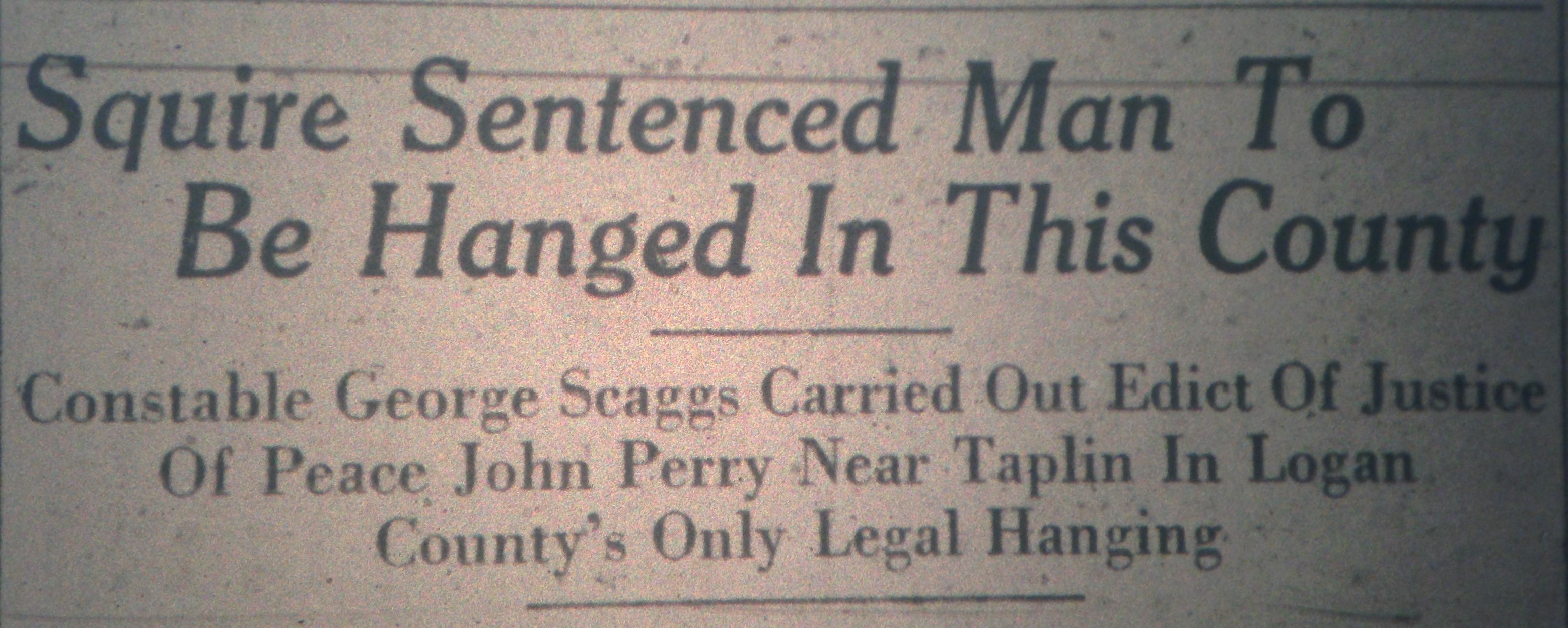
Civil War Hanging in Logan 1862 LB 06.01.1937 1.JPG

Squire Sentenced Man To Be Hanged In This County

Constable George Scaggs Carried Out Edict Of Justice Of Peace John Perry Near Taplin In Logan County’s Only Legal Hanging

Nothing but the gnarled weather beaten stump of an old locust tree remains today to mark the scene of Logan county’s only legal hanging.

The stump is standing just below the highway at the mouth of Taplin hollow and is the only landmark which calls to mind the hanging of Henry S. Walker, convicted of murder by Squire John Perry of Man in the spring of 1862 and hanged the same day by Constable George Scaggs, uncle of Emmett Scaggs, prominent lawyer, and brother-in-law of Eli Gore, old resident of Stollings.

A story is told that Henry Walker came down Taplin Hollow late one night in the closing months of the civil war on a “scouting” tour. He entered the home of Uncle Frank McKesson and for no apparent reason seized a double bitted axe and chopped to lifeless, bleeding masses the bodies of Uncle Frank and his wife and then fled to Raleigh county.

One week later Constable George Scaggs arrested the man in the county where he was hiding and brought him before Justice of the Peace John Perry.

Squire John Perry had a fine eye for justice and he was meting it out under the Virginia law which allowed a justice of the peace to pass the death sentence.

George Scaggs was delegated as executioner and Walker was put on a wagon and brought to Taplin down the river road to the spot where he committed the crime.

Old-timers say that a crowd of men, women and children laughing and passing jokes on the show they were to see followed the wagon to the scene of the proposed hanging and watched tensely as a rope was thrown over the limb of the locust tree and the noose was placed snuggly around the neck of the murderer.

He was placed on the flour barrel, a couple of feet of the slack in the rope was taken up and tied securely to the trunk of the tree, and George Scaggs, without any preliminaries, kicked the flour barrel from under the man.

The man fell to within six inches of the ground and the awed onlookers gasped as they heard an audible crack which told them the murderer’s neck had snapped. He hung quivering at the end of the rope several minutes before the peace officer cut him down and placed him in the wagon to be taken to Man for burial.

The same crowd followed the wagon back to Man, but it was a crowd of sober individuals who had seen a human life pass into oblivion. There was no joking and even the children talked in muted undertones.

Source: Logan (WV) Banner, 01 June 1937.

Dorothy, WV (1910s)

02 Tuesday Oct 2018

Posted by Brandon Ray Kirk in Coal

≈ 1 Comment

Tags

Appalachia, coal, Dorothy, history, photos, Raleigh County, West Virginia, West Virginia State Archives

IMG_4443

Dorothy, Raleigh County, WV. Original photo owned by the West Virginia State Archives.

IMG_4450

Dorothy Company Store, Raleigh County, WV, 1915. Original photo owned by the West Virginia State Archives.

Recollections of A. Peterson Christian of Simon, WV (c.1943)

28 Monday May 2018

Posted by Brandon Ray Kirk in Big Creek, Gilbert, Guyandotte River, Logan, Timber, Wyoming County

≈ Leave a comment

Tags

Appalachia, Betty Shoals, Big Branch Shoal, Big Creek, Big Cub Creek, Blackburn Mullins, Burrell Morgan, Byron Christian, Chapman Browning, Charley Toler, Copperas Fork, Ed Robertson, Eli Blankenship, Eli Morgan, Elk Creek, Ellis Toler, Epson Justice, Fred B. Lambert, Fred B. Lambert Papers, G. Pendleton Goode, genealogy, Gilbert, Guyandotte, Guyandotte River, H.C. Avis, Hickory Shute, history, Hugh Toney, Humphrey Cline, Huntington, James A. Nighbert, James Pine Christian, Jesse Belcher, John Buchanan, John Justice, justice of the peace, Lane Blankenship, Lark Justice, Leatherwood Shoal, Lewis Mitchell, Little Kanawha Lumber Company, Logan County, Logan Court House, logging, Marshall University, Mingo County, Morrow Library, Paren Christian, Peter Cline Jr., Peter Cline Sr., Peterson Christian, Pineville, pushboats, rafting, Raleigh County, Roughs of Guyan, Salt River Shute, Sanford Morgan, Simon, Spice Creek, Staffords Mill, West Virginia, White Oak Cliff, Wyatt Toler, Wyoming County

Recollections of A. Peterson Christian of Simon, WV, provided by G. Pendleton Goode of Pineville, WV, January 1, 1944:

I was born on Spice Creek, Logan Co., now Mingo County, West Va. on Oct. 12, 1857 — Now 86 years of age, Son of Rev. Byron Christian, and grandson of James Pine Christian (1800-1892), one of the justices who organized Logan County in 1824.

About 1867, people began what we called saw-logging. Dr. Warren from Big Creek brought the first six yoke ox team to our neighborhood, used them two years and then sold them to Chapman Browning who lived on Spice Creek. There sprang up among us, what we called timber merchants, among those were Paren Christian, Chapman Browning, Col. John Buchanan, H.C. Avis, Blackburn Mullins and Epson Justice and many others. Besides hauling and rafting their own timber, they would buy rafts of other parties and run them to Logan Court House and sell others to John and Lark Justice and afterwards to Ed Robertson and James Nighbert.

I entered the logging business in 1875, on a small scale. Lewis Mitchell and I bought some timber and made up a raft, and when the river reached rafting stage, Brother Mont Lewis and I started down the river with the raft which swung across the head of “Island 16,” but when the big July 12th freshet came it swept our raft away and we lost it. My next adventure in logging was in the spring of 1876, when Mont and I bought some timber in the bluff opposite the mouth of Elk Creek and with some loose logs in “Island 16,” we made up two rafts, but there was no rafting stage that summer, but when the ice went out the next winter, both rafts went with it and we lost them also.

Rafting down Guyandotte River from Reedy to Logan Court house was a great art during the 1870s and 80s. There were different opinions about the bad places along the stream. People at Logan Court house thought that the river from Spice down was real bad; but the river men around Spice did not mind running from there down, but said that up Copperas Fork, the Betty Shoals, Staffords Mill, and the White Oak Cliff was too bad for anybody to run a raft. The river men around about Gilbert said that the river from there down was a little rough but they didn’t mind it, but from Epson Justice’s up to Reedy was so rough that no person had any business trying it. But when you came up to Big Cub, Long Branch and Reedy and talked with the old pilots, such as Jesse Belcher, Lane Blankenship, Peter Cline Jr., Humphrey Cline and Peter Cline Sr. and numerous other persons such as oar carriers and seconds they would say something like this, “Well, the river for a few miles is pretty rough, especially at Wyatt Toler’s mill dam, the Fall Rock, near Charley Toler’s mill dam, the Hickory Shute, the Leatherwood Shoal, the Big Branch Shoal and the Salt River Shute, but if a man has good judgment about the drain and the water he will have but little trouble.” So you see all depends on whom you are talking to as to where the rough is on the Guyandotte River. The only way to find this out is to go through on a raft yourself.

I remember very well the thrill I got the first time I went through the “Roughs” on a raft. I got on at the mouth of Big Cub Creek; in a few minutes we were at the upper end of Leatherwood Shoal. We worked the raft to the proper position in the hole of water just above the shoal. We could look along the top of the water to the upper end of the shoal but there was such a fall there we could see the water until we dropped over the upper end of the shoal. The bow of the raft struck a wave and the water flew over our heads. I was carrying the oar and held the stern down on the raft while my second held my clothes to keep the oar from throwing me off. From there on to the lower end of the shoals (about ¼ mile) as soon as the raft would rise on one wave, it would plunge into another until we got through the shoal. From that time (1876), I followed running from Reedy to Guyandotte until about 1890.

It took 4 men to run a raft from Reedy or Cub to Spice. Then 2 men could take it from there to Logan C.H. Then we would latch two of those rafts together and 2 men would take those rafts through to Guyandotte.

In 1889, the Little Kanawha Lumber Co. came to Wyoming County and began logging on a big scale. The winter was warm and rainy. All goods and supplies were hauled from Prince Station on the C. and O. Ry. The roads through Raleigh were so muddy that a four-horse team could pull only 1000 or 1200 pounds, so in April Alec, Henry Blankenship and I made a push boat 50 feet long and 6 feet wide and 18 inches deep. We landed it at the mouth of Reedy Creek and started to Guyandotte with five men. I had about $95.00 in money, and the men from here to Elk sent money by me to buy flour. When I left Elk, I had about $260.00. Among the men that sent money by me to buy flour were Burrell Morgan, Ellis Toler, Eli Blankenship, Eli Morgan, Sanford Morgan and Chapman Browning and the only one alive now is Burrell Morgan. We reached Guyandotte the 3d day, where I bought 45 lbs of flour, 300 lbs of bacon and a lot of other things and after laying over at Capt. Toney’s for 2 days on account of high water, we arrived at the mouth of Spice Creek in 8 days from Guyandotte. I received $125 per 100 lbs. freight which gave me a nice profit for my trip. At that time and long before the people of Logan brought their goods up on push boats.”

Source: Fred B. Lambert Papers, Special Collections Department, Morrow Library, Marshall University, Huntington, WV.

Chapmanville News 11.16.1926

26 Thursday Oct 2017

Posted by Brandon Ray Kirk in Chapmanville, Huntington

≈ Leave a comment

Tags

Agnes Whitman, Andy Lunsford, Appalachia, Bernice Ward, Callie Ferrell, Carlos Ferrell, Carrie Raines, Chapmanville, Clinton Ferrell, Connie Bentley, Dr. Ferrell, Ella Jane Toney, Emmett Raines, genealogy, Gladys Lowe, Hazel Conley, history, Huntington, J.D. Turner, J.H. Vickers, John Whitman, Kennie Perry, Lizzie Crislip, Logan Banner, Logan County, Lyle Swan, Marea Lowe, Margaret Ballard, Minnie Ferrell, Ossie Workman, Preston Cooper, Raleigh County, Sara Ferrell, Stollings, typhoid fever, Vivian Ferrell, Walter Crislip, Walter Ferrell, Walter Workman, West Virginia, Wetzel Raines, Willa Lowe

An unknown correspondent from Chapmanville in Logan County, West Virginia, offered the following items, which the Logan Banner printed on January 16, 1926:

We are having some nice weather now. As the election is over some of the folks are well pleased because J.H. Vickers was elected as commissioner of the county court.

Clinton Ferrell and family from Stollings were visiting homefolks Saturday and Sunday.

Mr. and Mrs. Kennie Perry and Walter Crislip motored to Huntington Sunday.

We are sorry to say Andy Lunsford is very ill with typhoid fever.

Miss Ella Jane Toney seemed to be enjoying herself Sunday. Wonder where Marea was?

Lyle Swan escorted Miss Connie Bentley home Saturday night.

There was a large bunch of girls and boys seen out kodaking Sunday. Did they break your kodak, Bill?

Emmett Raines escorted Miss Willa Lowe home from church Saturday night.

Preston Cooper is seen on our streets almost every day.

Walter Ferrell was calling on Miss Carrie Raines Sunday.

Miss Marea Lowe and Mrs. Lizzie Crislip made a flying trip to Huntington Monday.

Misses Vivian Ferrell, Callie Ferrell, and Wetzel Raines were seen out walking Sunday evening.

Walter Workman seems very sad these days. Cheer up, Walter. Hazel still loves you.

John Whitman was calling on Miss Hazel Conley Sunday.

Osie workman was calling on Miss Agnes Whitman Sunday.

Mrs. J.D. Turner is visiting friends in Raleigh county the week end.

Misses Gladys Lowe, Bernice Ward, Margaret Ballard, Ella Jane Toney, and Carlos and Walter Ferrell were seen out walking Sunday.

Dr. Ferrell delivered a very nice speech to the junior high school Friday which we appreciated very much.

Misses Minnie and Sara Ferrell were seen out walking Sunday evening.

Wishing all the good luck to The Banner. We are hoping to see the news from our little town again.

Daily happenings: Grace and Jim going to milk; Carrie going to the post office; Gladys and Minnie going to school; Carlos going up the road; Kyle going to see Inas; Ruth and Julius going to church; Miss Click teaching school.

Civil War Dispatches From Wayne County, WV (1865-1866)

07 Thursday Sep 2017

Posted by Brandon Ray Kirk in Big Sandy Valley, Civil War, Timber

≈ Leave a comment

Tags

Abel Segur, Abraham Lincoln, Appalachia, Arthur I. Boreman, Bill Smith, Burlington, Cabell County, Cassville, Catlettsburg, Ceredo, Charleston, civil war, Confederate Army, crime, David Bartram, David Frasher, Department of West Virginia, deputy sheriff, G.W. Brown, Gallipolis, Gallipolis Journal, George Crook, Greenbrier County, Guyandotte, history, Ironton Register, Isaac Bloss, J.W. Merricks, Jack Meadows, Jefferson Davis, Jim Turner, John B. Bowen, John W. Holt, Kentucky, Logan County, Monroe County, Ohio, Ohio River, Pete Jeffers, Pike County, Pocahontas County, Point Pleasant, Raleigh County, sheriff, The Weekly Register, Tug Fork, Union Army, Wayne County, Webster County, West Virginia, Wheeling Intelligencer, William Wirt Brumfield

Below are several dispatches relating to the Civil War and immediate post-war era in Wayne County, West Virginia. These dispatches appeared in pro-Union newspapers.

Wheeling Intelligencer, 21 January 1865

WEST VIRGINIA AS A PLACE TO LIVE. I could not conscientiously recommend any one to come here now to live, although investment in farms will surely be profitable. The trouble now, chiefly, is that the guerrillas have broken up their organization, if they ever had any, and scattered into small squads to rob and steal. A schoolmistress, passing along a lonely road not far from Ceredo, was robbed of all her money, the amount she had just received for three months’ teaching, by three ruffians. A few nights ago men went to the house of a quiet farmer, one mile from Ceredo, and robbed him of a few dollars, all he had, and boots and some clothing. Some of the citizens keep arms in their houses, and intend to use them if visited in that way. One of these shot one of a gang of six one night not long ago, but became frightened himself, and ran off, giving the robbers a chance to take their wounded companion away. He has not been troubled since. Geo. Crook, commanding the Department of West Virginia, has issued a circular notifying the people that they must organize for their own protection, and recommends them to hunt the bushwhackers and kill them. Governor Boreman offers to furnish arms and ammunition. It will be done, and the guerrillas will decrease every week, I hope.

The Weekly Register (Point Pleasant, WV), 26 January 1865

GIVING THEMSELVES UP. — We learn that Lieut. Samuels, brother of Judge Samuels, formerly Adjutant General of this State, recently came into Wayne county, accompanied by a dozen or fifteen other rebel soldiers, all of whom took the amnesty oath. They say they are tired of fighting for nothing and freezing to death.

Wheeling Intelligencer, 21 February 1865

A GUERRILLA MURDER. We learn from citizens of Wayne county, who arrived yesterday, that a few days ago a guerrilla murder was committed at Ceredo, on the Ohio river in that county. It appears that a gang of men, under command of the notorious Bill Smith, came down to Ceredo and entered the house of Jack Meadows, a citizen, shot him through the heart, drove his wife and children out of doors, and set fire to the premises. Mrs. Meadows who fortunately armed with a revolver, shot one of the guerrillas dead and seriously wounded another, but not until one of her legs had been broken by a blow with a gun in the hands of one of the rebels. The rebels having completely destroyed the house of Mr. Meadows, and with all its contents, fled to their hiding places, leaving their dead companion unburied. Mrs. Meadows and her children were taken to Catlettsburg, Ky., where she still remains.

Wheeling Intelligencer, 23 February 1865

GUERRILLAS. — During the debate yesterday in the House of Delegates, upon the bill to provide for the better organization of the State Guards, some horrible pictures were presented of the condition of the loyal people of the border counties. Mr. Ferguson said that every part of the county of Wayne on the Ohio river, was held by guerrillas. In the county of Cabell only one two, Guyandotte, was held by the Federal troops. The rebels have their headquarters up in Logan county, and they make forays down toward the Ohio river, stealing, murdering and devastating the country. They enter the houses of loyal people and steal household furniture and bed clothing, and frequently strip women and children of wearing apparel and leave them in an actual state of nudity. Mr. Wells, of Raleigh, and Mr. Gregory, who represents Webster and Pocahontas, gave similar accounts of the condition of things in their respective localities.

Gallipolis Journal, 2 March 1865

CEREDO, WEST VIRGINIA. — Since the breaking out of the rebellion, “I give bread” town has been subjected to many vicissitudes. Its prospects when projected, in 1854, and later, was that of a great manufacturing city. Early in 1862, many of the Yankee citizens anticipated the coming storm, and either disposed of their property or left it to the despoiler. At one time it had a regiment quartered in its midst, but of late no troops have been nearer than Guyandotte. Disloyalty has cropped out under drunkenness and personal hate, until one’s life is endangered at any moment. Guerrillas and rebel sympathizers occupy the principal houses vacated by the owners. Not a public building stands untouched. The window and door frames, flooring and every sleeper of the hotel have been torn out and burned up. The dismantling of the steam saw mill and Glass Factory have long since been accomplished. Night is made hideous by the continued debaucheries of certain desperate characters, such as Jack Meddows and Pete Jeffers. There is not a loyal family left in Ceredo.

The Weekly Register (Point Pleasant, WV), 9 March 1865

A correspondent of the Ironton Register, writing from Burlington, O., says: The murder of Jack Middaughs, at Ceredo, on the 13th inst., was attended with some circumstances that deserve mention. The guerrillas surrounded his house before he knew of their presence. Then with a single revolver he drove them a little, wounding two of them. His wife then seized the revolver and threatened them, while Jack made his motions for escape. It was then that the rebs pressed forward to get up the stairs, Mrs. Middaugh standing at the head. Jim Turner was in advance, and finding Mrs. Middaugh in his way, swung his gun and with a blow smashed her foot. She then shot him through the breast, and he fell. At this moment Jack sprang down the stairs knocking down all in his path. He got out and nearly reached the woods, when he was met by three or four mounted men, who surrounded and killed him. — There were thirty-five men in the gang, with Smith, and it would be safe to say that twenty of them were at the house. Through this crowd Jack heroically fought his way and would have escaped but for the guards near the woods. The treatment of Mrs. Middaugh was barbarous in the extreme. It has been equaled only by the cruelties practiced by the Indians in the early times in this country. After she was disabled they took her and her children out, and made her lie down upon the ground, half dressed, refusing to permit her to get a single article from the house, while they were setting fire to it. On that bitter cold night of the 13th of February, in her condition, she was compelled to remain until the savages left. The conduct of this heroic woman is duly appreciated by the citizens of Catlettsburg and they have generously provided for her and her little ones.

Wheeling Register, 6 June 1865

The following resolutions were passed at a meeting of the citizens of Wayne county, West Virginia, held at the Court House on the 18th ult.:

WHEREAS, Our country is just emerging from civil war, which has laid waste our fields and drenched the land in fraternal blood; and

WHEREAS, It is to the interest of all to restore permanent peace and harmonize the elements necessary to a well regulated society; therefore, we, the people of Wayne county, in Mass Meeting assembled, do Resolve:

1st. That in the preservation and perpetuity of the principles set forth in the Constitution and Government of our fathers, we most sincerely and devoutly acknowledge an all wise Providence, who is the Giver of every good and perfect gift, and the common Father of us all; and we will, in time to come, rely implicitly upon Him for His protection and guidance.

2d. That it is the duty of every individual to lend his active aid and energy to the establishment of civil law, both State and National, and to its enforcement for the protection of life, liberty and property.

3d. That we justify and approve the Amnesty of President Lincoln. Its results have been beneficial, and the croakers and fault finders of the policy are morally arrayed against the Government and its best interest, and are not found among those who have fought its battles and borne it through the ordeal of war with success.

4th. That we concur in the convention called by the citizens of Greenbrier and Monroe, to meet at Charleston on the third day of June next, for the purpose of suppressing the lawless persons, and the restoration of order throughout the State, and do appoint and constitute Messrs. Abel Segur, John B. Bowen, R. Banton, and Isaac Bloss as delegates to represent Wayne county in said convention.

W.W. Brumfield, President

J.W. Merricks, Secretary

Wheeling Intelligencer, 25 April 1866

AFFAIRS IN WAYNE COUNTY. Cassville, Wayne Co., W.Va., March 23d, 1866. To the Governor of the State of West Virginia: Dear Sir: — After respects, I wish to call your immediate attention to some facts, as follows: Sometime last Spring you commissioned me as a notary public, and I was sworn and gave bond as the law directs. I am also assessor of the 2d district of Wayne county. I live and keep my office in Cassville; and it is with extreme difficulty and under great danger and hard threats that I am getting along. My entire neighborhood is rebel with the exception of old Squire Bartram and his boys, one of whom is our high Sheriff and another Capt. David Bartram our deputy Sheriff. I have forborne for a long time calling for men and arms, thinking the rebels would quiet down; but sir, we cannot execute the civil law unless something is done. We have been beaten by mobs and shot at on the streets and dared to help ourselves. They say they can’t have power, and we shan’t have it. Now, Governor, I suggest and absolutely insist that a company of one hundred volunteer militia be raised for our protection. The rebels say if you call out the militia, they will be in the majority but we do not want more than one hundred men. Our county is mostly quiet except around Cassville. A commander and company is not necessary for the enforcement of civil law in the lower end of the county. If in your judgment you see fit to commission and arm men, I would suggest that William Shannon be commissioned Captain. He is an honorable and upright man and knows something of both civil and military matters. Further, that David Frasher be commissioned as Lieutenant, to be stationed at Cassville. We must have from 25 to 50 men here in Cassville, or else we must get out of here. This is the landing place for all lumber that comes down Tug river. Those big buck rebels come down in time of high water sometimes by dozens from Logan county and from Pike county, Ky., with their navies [revolvers] buckled around them, hurrahing “for Jeff Davis,” cursing the Government, cursing Union men, and then we have to get out. Sir, I frequently see men come in here who are indicted for murder in Kentucky, defying everybody. Not more than eight miles from here, as some of the Home Guards were on their way home from being paid off a company of rebels fell on them and beat and abused them severely, calling the party “damned abolitionists,” and swore they would not submit to our laws. A few days ago they gathered in here and raised a riot with our Sheriff, and fell on him with clubs and weights and tried to kill him and his brother. His brother ran into my house for protection. They stoned my window out, knocked two panels out of my door and nearly killed my little child. If you see fit to protect us send the commissions immediately. The men can be raised in a few days. Send full instructions and special orders. You may send arms if you think proper, for there will be no doubt about recruiting the men immediately. We have plenty of guns here which belong to the State that can be gathered up. This company should be armed with revolvers instead of guns. I refer you to Major Brown [Col. G.W. Brown, Q.M. General], the man who came here and paid the home guards. He formed some acquaintance with me when he was here, also with Shannon and Lieut. Frasher. Yours, with respect, John W. Holt.


Battle of Curry Farm (1864)

19 Wednesday Jul 2017

Posted by Brandon Ray Kirk in Civil War, Hamlin

≈ 1 Comment

Tags

34th Battalion Virginia Cavalry, 3rd West Virginia Cavalry, Battle of Curry Farm, Benjamin F. Curry, Big Buffalo Creek, Blountsville, Brandon Kirk, Brandy Station, Cabell County, Carroll District, civil war, Confederate Army, Curry Chapel, Curry Chapel Cemetery, Curry Farm, Duval District, George A. Holton, Granville Curry, Hamlin, Hamlin Chapel, Henry H. Hardesty, history, Hurricane Bridge, Isaac Jackson, James A. Holly, Jeremiah Witcher, John L. Chapman, John S. Witcher, John Scites, John W. Harshbarger, Lincoln County, Logan County, Mathias Kayler, Milton, photos, Phyllis Kirk, Pound Gap, Raleigh County, Russell County, Sheridan, Straight Fork, Tennessee, Union Army, Virginia, West Virginia, West Virginia Division of Culture and History, White Hall, William A. Holstein, William C. Mahone, Winchester

This entry compiles information relating to the Battle or Skirmish at Curry Farm, which occurred as part of the War Between the States in May of 1864 at Hamlin in present-day Lincoln County, WV. It is a working entry and will be updated based on the discovery of new information.

On May 29, 1864, Confederates commanded by Captain John L. Chapman of Company B, 34th Battalion Virginia Cavalry, attacked a detachment of the 3rd West Virginia Cavalry, Company G, commanded by 1st Lt. John W. Harshbarger at Curry Farm near Hamlin in present-day Lincoln County. H.H. Hardesty’s History of Lincoln County, West Virginia, compiled in c.1883, provides the only known account of the battle: “The Federals had marched from Hurricane Bridge and were proceeding up Mud river when they were fired upon by the Confederates, who were concealed on the opposite side of the river. The Federal commander at once ordered a charge and the Confederates retreated without loss. The Federals had one killed, a man named Mathias Kayler from Raleigh county, and two wounded — one being Isaac Jackson, who was shot through the left arm; and another, a member of Company K” (98-99).

Prior to the battle, on May 10, 1864, Capt. John Chapman had been sent with a detachment of dismounted men from the area of Russell County, Virginia, into Cabell and Logan counties “to gather up absentees and deserters from the 34th Battalion” (Cole, 80). Capt. Chapman had been wounded in action at Brandy Station, Virginia, on August 14, 1863 and at Blountsville, Tennessee, on March 10, 1864 (Cole, 147).

Isaac Jackson, one of the two Union soldiers wounded at Curry Farm, was a private in Company G, 3rd WV Cavalry, formerly commanded by Captain John S. Witcher (who had been promoted to major in April 1864). Hardesty cites Mr. Jackson as “wounded in action at Currys Farm, May 29, 1864” (98). Following the battle, on July 6, 1864, 1st Lt. Harshbarger was promoted to captain of Company G. On December 7, 1864, an Adjutant General’s Report shows Company G, 3rd WV Cavalry, stationed near Winchester, VA. The muster roll shows 108 names, citing Private Isaac Jackson as “Wounded in skirmish, May 5, 1864. In hospital since this date.” (Note how this record provides a different date of his wounding from the date provided by Hardesty, who compiled his history about 1881.) http://www.rootsweb.ancestry.com/~wvwayne/roster3G.htm

Curry Farm, according to Hardesty, was located 1/4 mile above Hamlin (Hardesty, 90, 98).

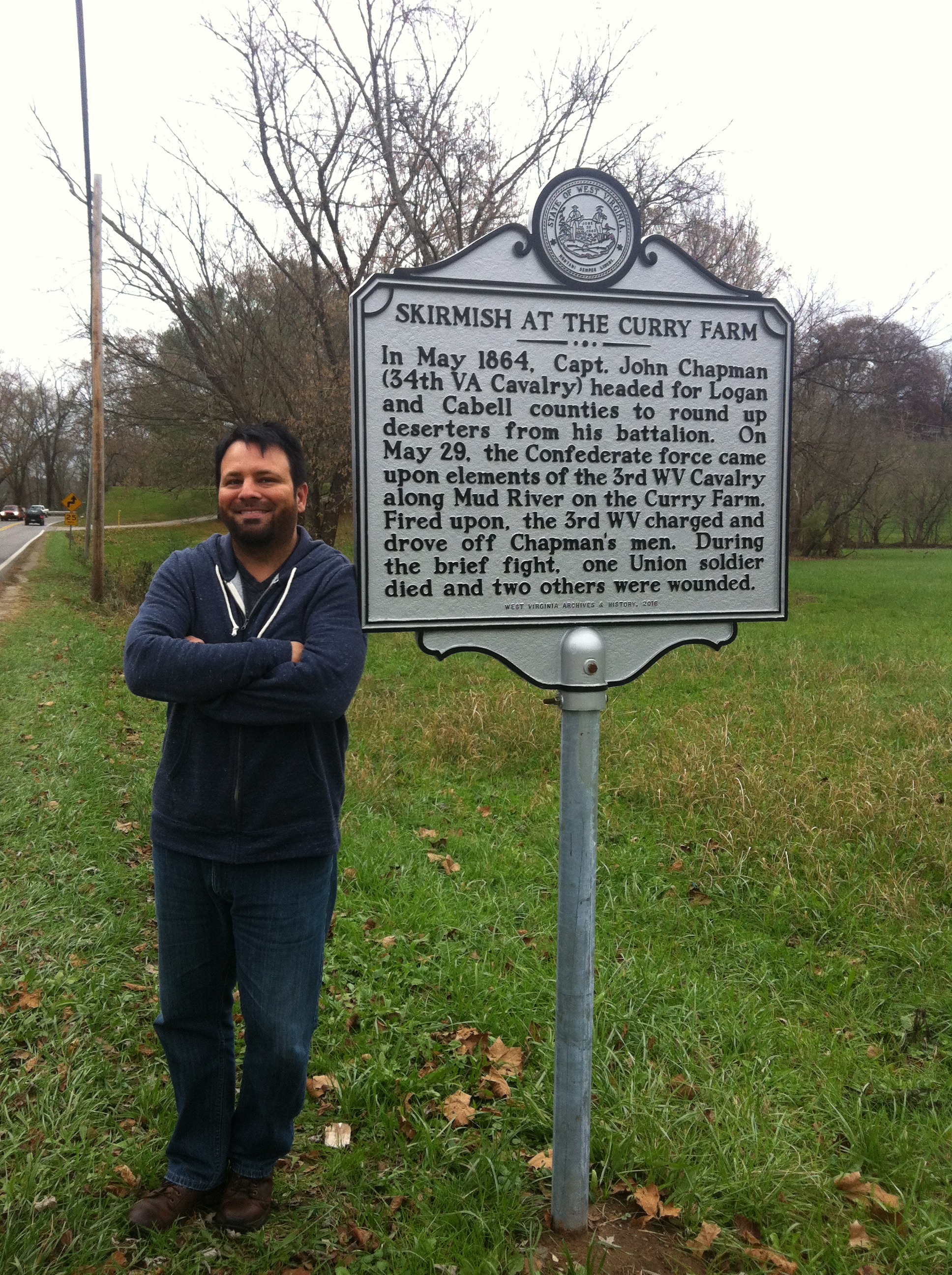
IMG_9626

The West Virginia Division of Culture and History has recently erected this historical marker on Curry Farm. 12 November 2017. Photo by Mom.

Capt. John Chapman left Cabell and Logan counties and rejoined the 34th Battalion Virginia Cavalry in the vicinity of Pound Gap, Virginia, by the end of June 1864 (Cole, 82).

Capt. John W. Harshbarger (1836-1909) is buried here: https://www.findagrave.com/cgi-bin/fg.cgi?page=gr&GRid=35761174

Selected Sources:

Scott C. Cole, 34th Battalion Virginia Cavalry (Lynchburg, VA: H.E. Howard, Inc., 1993) 80, 82, 121, 147.

Michael Graham, The Coal River Valley in the Civil War (Charleston, SC: The History Press, 2014) 150-151.

Some modern writers have misunderstood the Battle of Curry Farm as occurring at the Curry farm located four miles north of Hamlin on Big Buffalo Creek, near Hamlin Chapel (later Curry Chapel). Hamlin Chapel is important for the role it played in the creation of Lincoln County in 1867. “The first meeting of the Board of Supervisors was held on the 11th day of March, 1867, in what was known as Hamlin chapel, an old church which stood on the Curry farm, about one-fourth of a mile above the present county seat. There were present: William C. Mahone, of Carroll District; John Scites, of Sheridan, and William A. Holstein, of Duval. W. C. Mahone was made president, and Benjamin F. Curry, clerk, the latter giving bond in the penalty of $2000, with James A. Holly and Jeremiah Witcher as his securities. It was then ordered that the Board of Supervisors have the White Hall,  a Southern Methodist church one-fourth of a mile below where the county seat now stands arranged for holding the courts until the proper buildings could be erected, George A. Holton and a majority of the trustees consenting thereto” (Hardesty, 90-91). Curry Chapel no longer stands but its former location can be found near the intersection of Route 1 and Route 3/11 above the mouth of Straight Fork of Big Buffalo Creek.

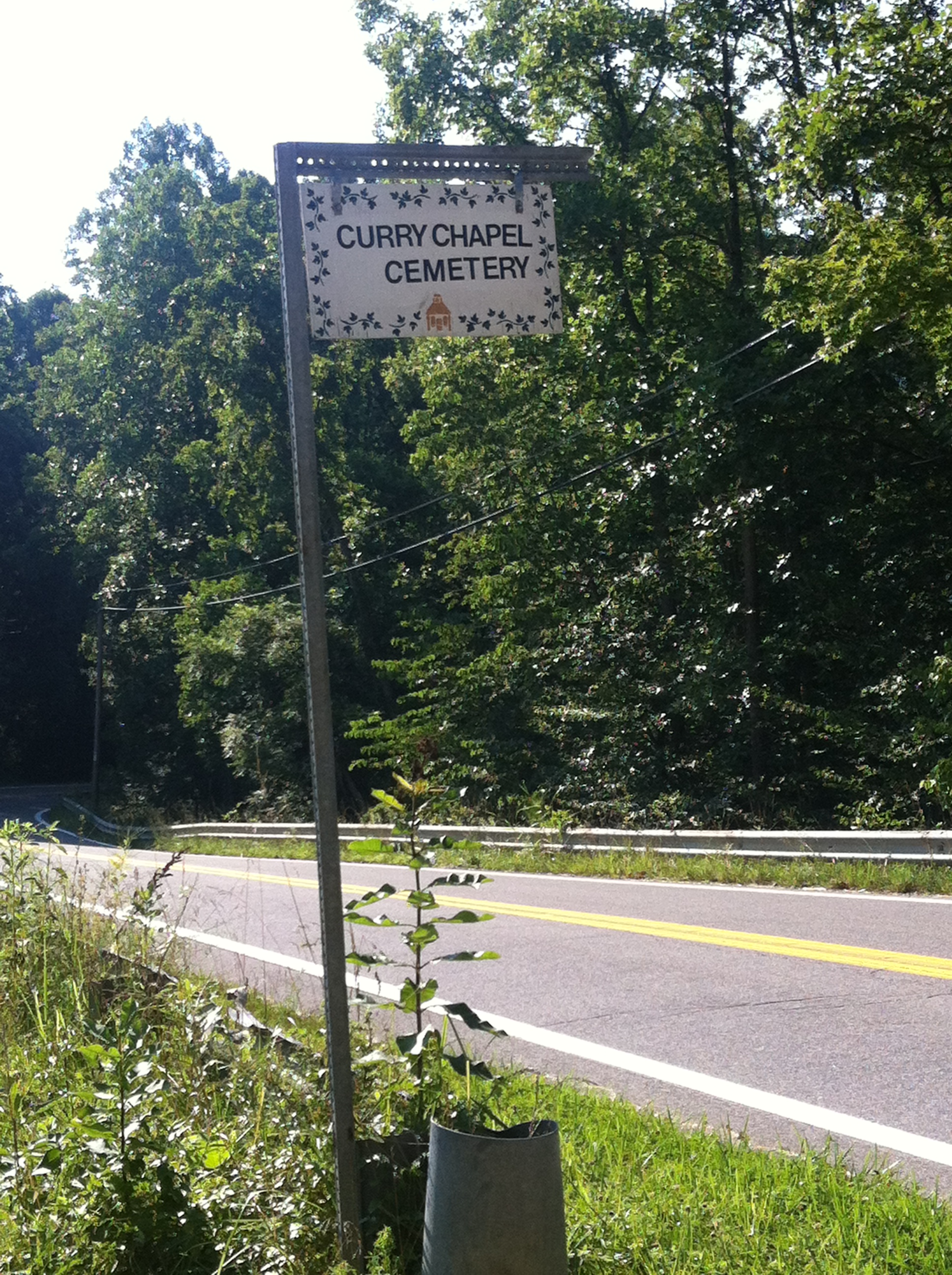
IMG_7068

Curry Chapel Cemetery, 18 July 2017. The battle did not occur here.

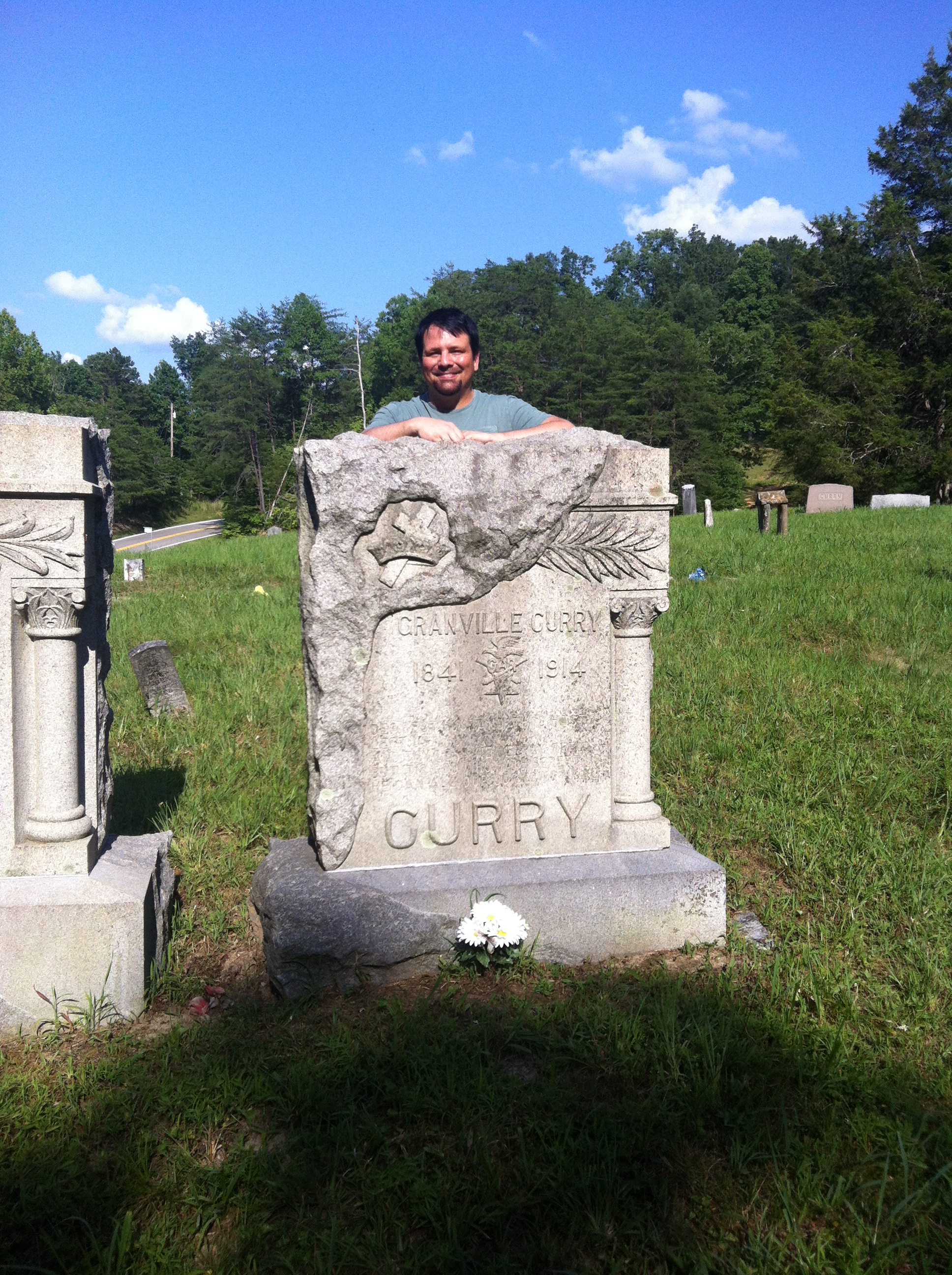
IMG_7062

Granville Curry grave, 18 July 2017. Photo by Mom. The battle did not occur here.

IMG_7076[1]

Curry Chapel Cemetery, north of Hamlin. The battle did not occur here. Instead, it occurred just to the left of the [3] in the above map.

Winchester Adkins and Cain Adkins, Jr.

21 Wednesday Jun 2017

Posted by Brandon Ray Kirk in Adkins Mill, Big Harts Creek, East Lynn, Harts, Lincoln County Feud, Music

≈ 2 Comments

Tags

Appalachia, Cain Adkins, Cain Adkins Jr., fiddler, fiddlers, genealogy, Grand Ole Opry, history, Lincoln County, Lincoln County Feud, Mariah Adkins, Matoaka, Mercer County, Mingo County, Mingo County Ramblers, Norfolk and Western Railroad, Raleigh County, West Virginia, Williamson, Winchester Adkins

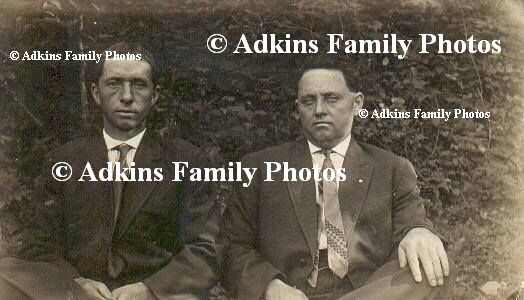
Winchester and Cain Adkins Jr. copyright.jpg

Winchester Adkins (left) and Cain Adkins, Jr. (right), sons of Cain and Mariah (Vance) Adkins. Winchester (1874-1938) lived in Williamson, WV, where he was employed by the Norfolk and Western Railroad (and used the surname of Atkins). He was a fiddler who played on the Grand Ole Opry with a band called the Mingo County Ramblers. Cain Adkins, Jr. (1880-1943) lived in Matoaka, Mercer County, WV, and Raleigh County, WV. He was also a fiddler. Both men were children during their father’s involvement in the Lincoln County Feud. Photo courtesy of Adkins family descendants.

Lewis Hatfield

01 Wednesday Jul 2015

Posted by Brandon Ray Kirk in Wyoming County

≈ Leave a comment

Tags

Appalachia, Blankenship, board of education, Dorcas Hatfiefld, farming, genealogy, Henry H. Hardesty, history, James Hatfield, justice of the peace, Kenna Hatfield, Kentucky, Laura A. Hatfield, Lewis Hatfield, Logan County, Lucinda Lester, Marga L. Hatfield, Oce O. Hatfield, Pike County, Pleasant Lester, R.A. Brock, Rachel Hatfield, Raleigh County, Richmond, Susan B. Hatfield, Virginia, Virginia and Virginians, Virginia Hatfield, West Virginia, William J. Hatfield

From “Virginia and Virginians, 1606-1888,” published by H.H. Hardesty, we find this entry for Lewis Hatfield, who resided at Blankenship, West Virginia:

Son of James and Rachel (Toler) Hatfield, was born Feb. 20, 1848, in Logan county, W.Va. His parents are now living in Wyoming county, the father born May 19, 1824, in Pike county, Ky., and his mother was born in Logan county. On March 8, 1873, Lewis Hatfield was joined in marriage with Dorcas D. Lester, who was born in this county on Nov. 5, 1845; she died on May 3, 1889, leaving five living children: Laura A., born May 13, 1874; William J., born June 25, 1877; Marga L., born Dec. 12, 1880; Kenna, born May 28, 1883; and Oce O., born April 6, 1887; two daughters, Virginia, born May 25, 1879, died Nov. 13, same year, and Susan B., born Aug. 20, 1885, and died June 3, 1887. Mr. Hatfield is a farmer, and has filled offices of trust and importance; was elected president of the board of education in 1883-5, and justice of the peace in 1885-9; post office address, Blankenship, W.Va. Mrs. Hatfield is a daughter of Pleasant and Lucinda (Miller) Lester, who were united in holy wedlock June 15, 1843; her mother’s birth occurred in Raleigh county, W.Va., Feb. 7, 1823. Pleasant Lester was born in Logan county, W.Va., Jan. 24, 1822; he has passed most of his life in this county, where he is honored and esteemed by all who know him; he is now engaged in farming, but has officiated as justice of the peace, filling the office with highest integrity and efficiency.

Source: Dr. R.A. Brock, Virginia and Virginians, 1606-1888 (Richmond, VA: H.H. Hardesty, Publisher, 1888), p. 832.

John B. Ellison

21 Sunday Jun 2015

Posted by Brandon Ray Kirk in Logan

≈ Leave a comment

Tags

Appalachia, Boone County, genealogy, Henry H. Hardesty, history, John B. Ellison, lawyer, Logan, Logan County, Monroe County, R.A. Brock, Raleigh County, Richmond, U.S. South, Virginia, Virginia and Virginians, West Virginia, Wyoming County

From “Virginia and Virginians, 1606-1888,” published by H.H. Hardesty, we find this entry for John B. Ellison, who resided at Logan Court House, West Virginia:

Attorney and counselor at law, Logan Court House, West Va., is a native of Monroe county, Va., where he was born Jan. 15, 1853. He first began the practice of his profession in 1878, and has since practiced in Boone, Raleigh, Wyoming and Logan counties; is also notary public; the duties of this position are ably executed by him. He is a lawyer of superior ability and has won a distinguished position in his profession; being gifted with a brilliant intellect, he has by close study and extensive practice acquired a thorough knowledge of law that can compete with the oldest and most learned at the bar, but it is his indefatigable energy and zeal in the interest of his clients for which he is most conspicuous. He resides at Logan Court House, and practices in all the neighboring counties.

Source: Dr. R.A. Brock, Virginia and Virginians, 1606-1888 (Richmond, VA: H.H. Hardesty, Publisher, 1888), p. 829.

Charles F. Cook

20 Wednesday May 2015

Posted by Brandon Ray Kirk in Wyoming County

≈ Leave a comment

Tags

Addie P. Cook, Alice L. Cook, Anna Laurie Cook, Appalachia, Boone County, Charles F. Cook, Charles W. Cook, coal, Edgar Cook, genealogy, George W. Cook, Henry H. Hardesty, history, Huff's Creek, John Cook, Lucinda Cook, Marshall Cook, Mary A. Cook, Nannie G. Cook, Oceana, Perry C. Cook, R.A. Brock, Raleigh County, Richmond, timbering, Virginia, Virginia and Virginians, West Virginia, Wyoming County

From “Virginia and Virginians, 1606-1888,” published by H.H. Hardesty, we find this entry for Charles F. Cook, who resided at Oceana, West Virginia:

Was born in Wyoming county, Jan. 3, 1843; was married to Lucinda O’Neal in Raleigh county, Nov. 12, 1868; their union has been blessed with nine children, eight of whom are at the present time residing with their parents: Edgar, Anna Laurie (died when three years old), Charles W., Nannie G., Marshall, Addie P., Perry C., George W., and Alice L. His father, John Cook, was born in Wyoming county, W.Va., June 20, 1818, and died there May 25, 1887. Mary A. Jarrell was born in Boone county, W.Va., March 8, 1818, and died in Wyoming county, March 10, 1873; they were married May 5, 1831. Mr. Cook owns a beautiful home, situated on Huff’s Creek, Wyoming county; he also has other estates, consisting of extensive coal and timber lands. He is descended from one of the oldest and best families of that county; is a man of high moral character, and has the esteem of all who know him. His post office address is Oceana, W.Va.

Source: Dr. R.A. Brock, Virginia and Virginians, 1606-1888 (Richmond, VA: H.H. Hardesty, Publisher, 1888), p. 825-826.

Thomas Buchanan

29 Wednesday Apr 2015

Posted by Brandon Ray Kirk in Civil War, Logan

≈ Leave a comment

Tags

4th West Virginia Volunteer Cavalry, assessor, Charles B. Buchanan, clerk, coal, Eliza Ann Buchanan, Floyd Buchanan, genealogy, George Buchanan, Guyandotte River, Henry H. Hardesty, history, James Buchanan, John Buchanan, Lillie May Buchanan, Logan, Logan County, Mary Buchanan, R.A. Brock, Raleigh County, recorder, Tazewell County, Thomas Buchanan, timbering, Virginia, Virginia and Virginians, West Virginia

From “Virginia and Virginians, 1606-1888,” published by H.H. Hardesty, we find this entry for Thomas Buchanan, who resided at Logan Court House, West Virginia:

Was born in Tazewell county, Va., Nov. 26, 1821; his wife, nee Mary Ellis, in Logan county, W.Va., Oct. 12, 1817; they were joined in wedlock in her native county, July 27, 1843. The only child of this marriage is Floyd Buchanan, who was born in Logan county, W.Va., Feb. 24, 1849; he was married in this county June 10, 1869, to Eliza Ann Williams, who was born in Raleigh county, W.Va., June 9, 1852. The children of this union are: Charles B., born Aug. 22, 1870; Thomas, born March 28, 1873; Mary, born May 19, 1876, died Jan. 6, 1888; John, born Feb. 8, 1879, died Dec. 24, 1887; James, born Jan. 10, 1882; George, born Jan. 20, 1885, died Dec. 23, 1887; Lillie May, born Feb. 27, 1889. The Buchanan family is one of the oldest and most highly honored in Logan county. During the late war the subject of this sketch enlisted in the 4th W.Va. V.C.; served through the war as second lieutenant, and was honorably discharged in 1865, at Wheeling. As a private citizen he has filled many offices of trust. He was appointed assessor by State Auditor, held the office two years; was then elected recorder of Logan county, and held this office two years; was next elected clerk of the court, which office he also held during two years, and was at the same time clerk of board of supervisors. He was postmaster for six years, and has at one time held seven offices of importance. No man in the county stands higher, or is more beloved by his acquaintances. He owns extensive coal and timber lands in Logan county, where he now resides at his beautiful home on Guyandotte River, near Logan Court House; this town is his post office.

Source: Dr. R.A. Brock, Virginia and Virginians, 1606-1888 (Richmond, VA: H.H. Hardesty, Publisher, 1888), p. 821-822.

What happened to John Fleming? 1

30 Friday Nov 2012

Posted by Brandon Ray Kirk in Big Harts Creek, Big Sandy Valley, Fourteen, Harts

≈ Leave a comment

Tags

A.L. Smith, Adkins Conspiracy Case, Albert Adkins, Arty Fleming, Bill Brumfield, Charleston Gazette, Charley Brumfield, Christian Fry, Cosby Fry, crime, Dan Cunningham, Elizabeth Fry, Elizabeth Lizzie Fleming, Elliott Northcott, Emory Mullins, Fed Adkins, Fourteen Mile Creek, Harts Creek, Henry Mullins, history, J.P. Douglas, Jake Davis, John Fleming, John H. Mullins, John Henan Fry, Kentucky, Lace Marcum, Lillie Fleming, Lincoln County, Logan County, Luraney Fleming, Man Adkins, Margaret Adkins, Pike County, Preston Fleming, Raleigh County, Robert Fleming, Rosa Mullins, Squire Dial, Thomas H. Harvey, Upper Elkhorn Creek, West Virginia, Willard Fleming, Willard Frye, William Brumfield, William Fleming, William M.O. Dawson, writers, writing, Wyoming County

Over one hundred years ago, John Fleming, a desperado twice sentenced to serve time in the West Virginia State Penitentiary, escaped from the Lincoln County jail and disappeared forever in the mountains of the Big Sandy Valley.

John P. Fleming was born in February 1868 to Preston and Arty (Mullins) Fleming at Upper Elkhorn Creek in Pike County, Kentucky. Nothing is known of his early life except that he had a daughter named Roxie by Lucy Mullins in 1887. In the late 1880s, John and his family migrated to West Virginia and settled in the Abbott Branch area of Logan County, just above Harts Creek. In 1891, his brother William married Luraney Frye, a daughter of Christian and Elizabeth (Hunter) Frye, in Logan County. In 1897, his sister Sarah married Squire Dial in Logan County. The next year, brother Robert, or Bob, married Lillie Dempsey, also in Logan County.

On December 25, 1892, Fleming murdered his uncle, John H. Mullins, at Big Creek, Logan County. Essentially, the story went like this: Mr. Mullins’ sons, Henry and Emory, were in a quarrel and Fleming intervened. The elder Mullins came to settle the matter and Fleming fled across a creek. Mullins pursued, knife in hand. At the creek, Fleming shot his uncle. He was immediately taken before Squire Garrett, who discharged him. When a new warrant was sworn out for him, he fled the county. In March of 1893, his wife attempted to meet him but became ill and died at Dunlow, Wayne County. Fleming was at her bedside when authorities arrested him. A Logan County jury found him guilty of second degree murder and Judge Thomas H. Harvey sentenced him to eighteen years in the West Virginia state penitentiary in Moundsville. In the 1900 census, he is listed there under the name of “J.P. Flemons,” inmate. Curiously, he claimed to have been married for one year.

During Fleming’s incarceration, his siblings continued to marry into local families. In 1900, brother Willard married Caroline Caldwell, a daughter of Floyd Caldwell, in Logan County. In 1902, sister Lucy married James F. Caldwell, a son of Hugh Caldwell, in Logan County. Around 1903, brother George married Minnie Tomblin.

After his release from prison, John married Sarah Elizabeth “Lizzie” Frye, a daughter of John Henan and Ida Cosby (Headley) Frye. The Fryes lived on Sulphur Springs Fork of Fourteen Mile Creek, several miles below Harts Creek. Lizzie, born around 1887, was roughly eighteen years younger than John. They may have become acquainted through John’s brother, William, who had married Lizzie’s aunt, Luraney Frye, in 1891.

“Aunt Lizzie was married to John Fleming,” said Willard Frye, an elderly resident of Frye Ridge, in a 2003 interview. “John was a mean man who packed two .45 pistols. He was a member of Charley Brumfield’s gang. He was mean to Aunt Lizzie.”

Fleming’s involvement in the Brumfield gang soon led to more prison time. In the summer of 1907, the “feudist,” as newspapers would later call him, became entangled in the peculiar “Adkins conspiracy case.”

A little earlier, in December of 1906, Margaret Adkins, Fisher B. Adkins, Floyd Enos Adkins, Albert G. Adkins and Fed Adkins — all associates in an Adkins general store business in Harts — took out a four-month loan for $600 from the Huntington National Bank. By April 1907, they had not paid any money toward the loan and asked for a four-month extension. In late June or July, Margaret Adkins, sister to Fed, filed a bankruptcy petition. On July 3, the District Court of the United States for the Southern District of West Virginia adjudged her bankrupt. J.P. Douglass (later a Speaker of the West Virginia House of Delegates) was appointed as receiver in the case and arrived in Hart to survey the business. A.L. Smith stood guard at the store.

On July 5, after the government had taken control of the merchandise in the store, a vigilante group called the Night Riders robbed the store and hid the various goods in neighbors’ homes and barns.

Following the robbery, detectives descended on Harts in an effort to unravel the details of the crime. The most famous of these detectives was Dan Cunningham, a one-time participant in the Hatfield-McCoy Feud. More recently, Mr. Cunningham had been employed by Governor William M.O. Dawson in Raleigh and Wyoming Counties. During his Harts Creek investigation, he boarded with locals and eavesdropped on conversations between suspects. Those involved in the store heist, meanwhile, used various means to suppress information. But as the pressure of the investigation bore down on locals, neighbors began to snitch on each other.

By December of 1907, the State had evidence against eleven men in what the Charleston Gazette called “the celebrated Adkins Bankruptcy Case” which “if proven by witnesses for the government, will equal any novel ever written by Victor Hugo.” Those accused — described by the Huntington Herald-Dispatch as “eleven brawny mountaineers” — were Fed Adkins, Charles Brumfield, Albert “Jake” Davis, Manville Adkins, John Fleming, Willard Fleming, Robert “Bob” Fleming, John Adkins, Albert G. Adkins, Floyd Enos Adkins and William “Bill” Brumfield. The state charged the gang with “conspiracy to defraud the government and to impede the administration of justice after the government had taken possession of Adkins store.”

U.S. District Attorney Elliott Northcott prosecuted the case, while Lace Marcum argued for the defendants. In opening remarks on December 5, according to the Herald-Dispatch, District Attorney Northcott fiercely denounced “the eleven men who have been a terror to the country surrounding the village of Hart, in Lincoln county, for the past six months. He stated in words burning with bitterness that the government expected to prove beyond any reasonable doubt that crimes that would narrow the very souls of every juror had been committed in the vicinity of Hart, and had the story been told him three weeks ago he would have thought it a piece of fiction pure and simple… He also alluded to the fact that the government would prove by witnesses who would tell of the horror that had been created in the neighborhood: houses burned, men shot down from ambush, houses with unprotected women had been shot up and the inmates terrorized until they were afraid to venture outdoors. It was a thrilling recital of the worst crimes that have taken place in this state in a decade.” According to the Herald-Dispatch, the eleven defendants “showed but little interest except to look at each other and smile when the crimes were talked of.”

In Marcum’s opening remarks on December 5, he stated that he would prove the goods found at the homes of the defendants were there several weeks before the Adkins store went bankrupt.

On December 6, Northcott questioned Rosa “Sis” Mullins, a sister to Emory and a resident of Abbotts Branch, who swore that she saw John Fleming’s brothers — Bob and Willard — go by her house the night of the robbery on their way to the Adkins store.

“Nearly every witness who testified yesterday,” the Charleston Gazette reported on December 7, “showed just how desperate these defendants are, and the testimony of Capt. Dan Cunningham unraveled a tale of horror that was realistic in every sense of the word.”

On December 7, Lace Marcum began his defense of John Fleming and the ten other Harts men. Bob Fleming, John’s brother, was the second witness called to the stand. He swore that he knew nothing of the robbery until the day after it happened and that he never saw any of the stolen goods. Willard Fleming, John’s other brother, said he stayed with Charley Brumfield the night of the robbery and saw no one armed. John, referenced in one newspaper account as being a “paroled prisoner,” testified along the same lines, as did all the defendants who were called to the stand. “The entire list of defendants swore to very near the same thing,” reported the Gazette.

For the most part, Marcum’s defense of the eleven Harts men had little chance of success considering the evidence against them. In his closing remarks, he was forced to put them at the court’s mercy by claiming that they had acted the way they did because they didn’t know any better. In the end, ten of the accused were sentenced to twelve- or eighteen-month terms in the West Virginia state penitentiary.

Feud Poll 1

If you had lived in the Harts Creek community during the 1880s, to which faction of feudists might you have given your loyalty?

Categories

  • Adkins Mill
  • African American History
  • American Revolutionary War
  • Ashland
  • Atenville
  • Banco
  • Barboursville
  • Battle of Blair Mountain
  • Beech Creek
  • Big Creek
  • Big Harts Creek
  • Big Sandy Valley
  • Big Ugly Creek
  • Boone County
  • Breeden
  • Calhoun County
  • Cemeteries
  • Chapmanville
  • Civil War
  • Clay County
  • Clothier
  • Coal
  • Cove Gap
  • Crawley Creek
  • Culture of Honor
  • Dingess
  • Dollie
  • Dunlow
  • East Lynn
  • Ed Haley
  • Eden Park
  • Enslow
  • Estep
  • Ethel
  • Ferrellsburg
  • Fourteen
  • French-Eversole Feud
  • Gilbert
  • Giles County
  • Gill
  • Green Shoal
  • Guyandotte River
  • Halcyon
  • Hamlin
  • Harts
  • Hatfield-McCoy Feud
  • Holden
  • Hungarian-American History
  • Huntington
  • Inez
  • Irish-Americans
  • Italian American History
  • Jamboree
  • Jewish History
  • John Hartford
  • Kermit
  • Kiahsville
  • Kitchen
  • Leet
  • Lincoln County Feud
  • Little Harts Creek
  • Logan
  • Man
  • Matewan
  • Meador
  • Midkiff
  • Monroe County
  • Montgomery County
  • Music
  • Native American History
  • Peach Creek
  • Pearl Adkins Diary
  • Pecks Mill
  • Peter Creek
  • Pikeville
  • Pilgrim
  • Poetry
  • Queens Ridge
  • Ranger
  • Rector
  • Roane County
  • Rowan County Feud
  • Salt Rock
  • Sand Creek
  • Shively
  • Spears
  • Sports
  • Spottswood
  • Spurlockville
  • Stiltner
  • Stone Branch
  • Tazewell County
  • Timber
  • Tom Dula
  • Toney
  • Turner-Howard Feud
  • Twelve Pole Creek
  • Uncategorized
  • Warren
  • Wayne
  • West Hamlin
  • Wewanta
  • Wharncliffe
  • Whirlwind
  • Williamson
  • Women's History
  • World War I
  • Wyoming County
  • Yantus

Feud Poll 2

Do you think Milt Haley and Green McCoy committed the ambush on Al and Hollene Brumfield in 1889?

Blogroll

  • Ancestry.com
  • Ashland (KY) Daily Independent News Article
  • Author FB page
  • Beckley (WV) Register-Herald News Article
  • Big Sandy News (KY) News Article
  • Blood in West Virginia FB
  • Blood in West Virginia order
  • Chapters TV Program
  • Facebook
  • Ghosts of Guyan
  • Herald-Dispatch News Article 1
  • Herald-Dispatch News Article 2
  • In Search of Ed Haley
  • Instagram
  • Lincoln (WV) Journal News Article
  • Lincoln (WV) Journal Thumbs Up
  • Lincoln County
  • Lincoln County Feud
  • Lincoln County Feud Lecture
  • LinkedIn
  • Logan (WV) Banner News Article
  • Lunch With Books
  • Our Overmountain Men: The Revolutionary War in Western Virginia (1775-1783)
  • Pinterest
  • Scarborough Society's Art and Lecture Series
  • Smithsonian Article
  • Spirit of Jefferson News Article
  • The Friendly Neighbor Radio Show 1
  • The Friendly Neighbor Radio Show 2
  • The Friendly Neighbor Radio Show 3
  • The Friendly Neighbor Radio Show 4
  • The New Yorker
  • The State Journal's 55 Good Things About WV
  • tumblr.
  • Twitter
  • Website
  • Weirton (WV) Daily Times Article
  • Wheeling (WV) Intelligencer News Article 1
  • Wheeling (WV) Intelligencer News Article 2
  • WOWK TV
  • Writers Can Read Open Mic Night

Feud Poll 3

Who do you think organized the ambush of Al and Hollene Brumfield in 1889?

Recent Posts

  • Logan County Jail in Logan, WV
  • Absentee Landowners of Magnolia District (1890, 1892, 1894)
  • Charles Spurlock Survey at Fourteen Mile Creek, Lincoln County, WV (1815)

Ed Haley Poll 1

What do you think caused Ed Haley to lose his sight when he was three years old?

Top Posts & Pages

  • Baisden Family Troubles
  • Jeff Baisden
  • Man High School Girls' Basketball Team (1928)
  • Jeff and Harriet Baisden
  • Origin of Place Names in Logan County, WV (1937)

Copyright

© Brandon Ray Kirk and brandonraykirk.wordpress.com, 1987-2023. Unauthorized use and/or duplication of this material without express and written permission from this blog’s author and/or owner is strictly prohibited. Excerpts and links may be used, provided that full and clear credit is given to Brandon Ray Kirk and brandonraykirk.wordpress.com with appropriate and specific direction to the original content.

Archives

  • February 2025
  • January 2025
  • October 2023
  • September 2023
  • December 2022
  • November 2022
  • May 2022
  • April 2022
  • February 2022
  • November 2021
  • October 2021
  • September 2021
  • June 2021
  • May 2021
  • April 2021
  • March 2021
  • February 2021
  • January 2021
  • December 2020
  • November 2020
  • October 2020
  • July 2020
  • June 2020
  • May 2020
  • April 2020
  • March 2020
  • February 2020
  • January 2020
  • December 2019
  • November 2019
  • October 2019
  • September 2019
  • August 2019
  • July 2019
  • June 2019
  • May 2019
  • April 2019
  • March 2019
  • February 2019
  • January 2019
  • December 2018
  • November 2018
  • October 2018
  • September 2018
  • August 2018
  • July 2018
  • June 2018
  • May 2018
  • April 2018
  • March 2018
  • February 2018
  • January 2018
  • December 2017
  • November 2017
  • October 2017
  • September 2017
  • August 2017
  • July 2017
  • June 2017
  • May 2017
  • April 2017
  • March 2017
  • February 2017
  • January 2017
  • December 2016
  • November 2016
  • October 2016
  • September 2016
  • August 2016
  • July 2016
  • June 2016
  • May 2016
  • April 2016
  • March 2016
  • February 2016
  • January 2016
  • December 2015
  • November 2015
  • October 2015
  • September 2015
  • August 2015
  • July 2015
  • June 2015
  • May 2015
  • April 2015
  • March 2015
  • February 2015
  • January 2015
  • December 2014
  • October 2014
  • September 2014
  • August 2014
  • July 2014
  • June 2014
  • May 2014
  • April 2014
  • March 2014
  • February 2014
  • January 2014
  • December 2013
  • November 2013
  • October 2013
  • September 2013
  • August 2013
  • July 2013
  • June 2013
  • May 2013
  • April 2013
  • March 2013
  • February 2013
  • January 2013
  • December 2012
  • November 2012

Enter your email address to follow this blog and receive notifications of new posts by email.

Join 2,925 other subscribers

Tags

Appalachia Ashland Big Creek Big Ugly Creek Blood in West Virginia Brandon Kirk Cabell County cemeteries Chapmanville Charleston civil war coal Confederate Army crime culture Ed Haley Ella Haley Ferrellsburg feud fiddler fiddling genealogy Green McCoy Guyandotte River Harts Harts Creek Hatfield-McCoy Feud history Huntington John Hartford Kentucky Lawrence Haley life Lincoln County Lincoln County Feud Logan Logan Banner Logan County Milt Haley Mingo County music Ohio photos timbering U.S. South Virginia Wayne County West Virginia Whirlwind writing

Blogs I Follow

  • OtterTales
  • Our Appalachia: A Blog Created by Students of Brandon Kirk
  • Piedmont Trails
  • Truman Capote
  • Appalachian Diaspora

BLOOD IN WEST VIRGINIA is now available for order at Amazon!

Blog at WordPress.com.

OtterTales

Writings from my travels and experiences. High and fine literature is wine, and mine is only water; but everybody likes water. Mark Twain

Our Appalachia: A Blog Created by Students of Brandon Kirk

This site is dedicated to the collection, preservation, and promotion of history and culture in Appalachia.

Piedmont Trails

Genealogy and History in North Carolina and Beyond

Truman Capote

A site about one of the most beautiful, interesting, tallented, outrageous and colorful personalities of the 20th Century

Appalachian Diaspora

  • Subscribe Subscribed
    • Brandon Ray Kirk
    • Join 787 other subscribers
    • Already have a WordPress.com account? Log in now.
    • Brandon Ray Kirk
    • Subscribe Subscribed
    • Sign up
    • Log in
    • Report this content
    • View site in Reader
    • Manage subscriptions
    • Collapse this bar
 

Loading Comments...