• About

Brandon Ray Kirk

~ This site is dedicated to the collection, preservation, and promotion of history and culture in my section of Appalachia.

Brandon Ray Kirk

Tag Archives: Paris Brumfield

Interview with John Dingess 2 (1996)

11 Friday Jul 2014

Posted by Brandon Ray Kirk in Big Harts Creek, Culture of Honor, Ed Haley, Lincoln County Feud, Warren

≈ Leave a comment

Tags

Al Brumfield, Albert Dingess, Anthony Adams, Ben Adams, Bill Brumfield, Bill's Branch, Billy Adkins, blind, Blood in West Virginia, Boardtree Bottom, Brandon Kirk, Buck Fork, Burl Farley, Carolyn Johnnie Farley, Cecil Brumfield, Charley Brumfield, Charlie Dingess, crime, Ed Haley, Fed Adkins, fiddling, French Bryant, George Fry, Green McCoy, Green Shoal, Hamlin, Harts Creek, Harve "Short Harve" Dingess, Hell Up Coal Hollow, Henderson Dingess, history, Hugh Dingess, John Brumfield, John Dingess, Kentucky, life, Lincoln County Feud, Low Gap, Milt Haley, murder, Paris Brumfield, Polly Bryant, Smokehouse Fork, Sycamore Bottom, Tom Maggard, Trace Fork, Vilas Adams, West Fork, West Virginia, Will Adkins, Williamson, writing

Al rounded up a gang of men to accompany him on his ride to fetch the prisoners in Williamson. Albert and Charlie Dingess were ringleaders of the posse, which included “Short Harve” Dingess, Hugh Dingess, John Dingess, Burl Farley, French Bryant, John Brumfield, and Charley Brumfield. Perhaps the most notorious member of the gang was French Bryant – “a bad man” who “did a lot of dirty work for the Dingesses.” On the way back from Kentucky, he tied Milt and Green by the arms and “drove them like a pair of mules on a plow line.”

“French Bryant run and drove them like a pair of horses ahead of these guys on the horses,” John said. “That’s quite a ways to let them walk. Old French, he married a Dingess. I knew old French Bryant. When he died, he was a long time dying and they said that he hollered for two or three days, ‘Get the ropes off me!’ I guess that come back to him.”

When the gang reached the headwaters of Trace Fork — what John called “Adams territory” — they sent a rider out ahead in the darkness to make sure it was safe to travel through that vicinity.

Waiting on the Brumfield posse was a mob of about 100 men hiding behind trees at Sycamore Bottom, just below the mouth of Trace Fork. This mob was led by Ben and Anthony Adams and was primarily made up of family members or people who worked timber for the Adamses, like Tom Maggard (“Ben’s right hand man”).

As the Brumfield rider approached their location, they began to click their Winchester rifles — making them “crack like firewood.” Hearing this, the rider turned back up Trace Fork, where he met the Brumfields and Dingesses at Boardtree Bottom and warned them about the danger at the mouth of Trace. They detoured safely up Buck Fork, then stopped at Hugh Dingess’ on Smokehouse where they remained for two or three days, not really sure of what to do with their prisoners. They made a “fortress” at Hugh’s by gathering about 100 men around them, fully aware that Ben Adams might make another effort to recapture Milt and Green.

While at Hugh’s, they got drunk on some of the red whiskey and apple brandy made at nearby Henderson’s. They also held a “trial” to see if Milt and Green would admit their guilt. They took one of the men outside and made him listen through the cracks between the logs of the house as his partner confessed on the inside. About then, the guy outside got loose and ran toward Bill’s Branch but was grabbed by “Short Harve” Dingess as he tried to scurry over a fence.

After this confession, the Brumfields and Dingesses considered killing Milt and Green on the spot but “got scared the Adamses was gonna take them” and headed towards Green Shoal.

John didn’t know why they chose George Fry’s home but figured Mr. Fry was a trusted acquaintance. He said they “punished” them “quite a bit there” but also got one to play a fiddle.

“These people that killed them, they made them play their last tune,” John said. “One of them would play and one guy, I think, he never would play for them.  I forgot which one, but they never could get one guy to do much. The other one’d do whatever they’d tell him to do. That’s just before they started shooting them. The tune that they played was ‘Hell Up Coal Hollow’. I don’t know what that tune is.”

After that, the mob “shot their brains out” and left them in the yard where the “chickens ate their brains.”

A neighbor took their bodies through Low Gap and buried them on West Fork.

John said there was a trial over Haley and McCoy’s murders, something we’d never heard before. Supposedly, about one hundred of the Brumfields and their friends rode horses to Hamlin and strutted into the courtroom where they sat down with guns on their laps. The judge threw the case out immediately because he knew they were fully prepared to “shoot up the place.”

This “quick trial,” of course, didn’t resolve the feud. Back on Harts Creek, Ben Adams often had to hide in the woods from the Dingesses. One time, Hugh and Charlie Dingess put kerosene-dowsed cornstalks on his porch and set them on fire, hoping to drive him out of his house where they could shoot him. When they realized he wasn’t home, they extinguished the fire because they didn’t want to harm his wife and children. Mrs. Adams didn’t live long after the feud. Ben eventually moved to Trace Fork where he lived the rest of his life. Charlie never spoke to him again.

John also said there seemed to have been a “curse” on the men who participated in the killing of Haley and McCoy. He said Albert Dingess’ “tongue dropped out,” Al Brumfield “was blind for years before he died,” and Charlie Dingess “died of lung cancer.” We had heard similar tales from Johnny Farley and Billy Adkins, who said mob members Burl Farley and Fed Adkins both had their faces eaten away by cancer. Vilas Adams told us about one of the vigilantes drowning (Will Adkins), while we also knew about the murders of Paris Brumfield, John Brumfield, Charley Brumfield, and Bill Brumfield.

Just before hanging up with John, Brandon asked if he remembered Ed Haley. John said he used to see him during his younger days on Harts Creek.

“When he was a baby, old Milt wanted to make him tough and he’d take him every morning to a cold spring and bath him,” he said. “I guess he got a cold and couldn’t open his eyes. Something grew over his eyes so Milt took a razor and cut it off. Milt said that he could take that off so he got to fooling with it with a razor and put him blind.”

John said Ed made peace with a lot of the men who’d participated in his father’s killing and was particularly good friends with Cecil Brumfield, a grandson of Paris.

Interview with Nellie Thompson of Wayne, WV (1996)

05 Saturday Jul 2014

Posted by Brandon Ray Kirk in Culture of Honor, Harts, Lincoln County Feud, Twelve Pole Creek, Wayne

≈ Leave a comment

Tags

Al Brumfield, Andrew D. Robinson, Beech Fork, Ben Adams, Bob Dingess, Brandon Kirk, crime, diptheria, Goble Richardson, Green McCoy, Green Shoal, Guyandotte River, Harrison McCoy, Harts, Harts Creek, history, Lincoln County Feud, Lynza John McCoy, Milt Haley, Monroe Fry, music, Paris Brumfield, Ross Fowler, Sallie Dingess, Sherman McCoy, Spicie McCoy, Warren, Wayne, Wayne County, Wayne County News, West Fork, writing

A few weeks later, Brandon called Nellie Thompson in Wayne, West Virginia. Nellie reportedly had the picture of Milt Haley and Green McCoy.

“I don’t know if I have anything like that or not,” Nellie said, “but I do have an old letter from Green McCoy.”

What?

Almost hyperventilating, he asked her to read it over the telephone.

Nellie fetched it from somewhere in the house, said it was dated May 19, 1889, then read it to him and said he was welcome to see it.

The next day, she called Brandon back and said, “I think I’ve found that picture you were looking for. It’s a little tin picture with two men in it.”

Oh god.

A few days later, Brandon drove to see Nellie about the picture and letter. Before dropping in on her, he spent a little time at the local library where he located a story about Spicie McCoy.

“As I promised last week, today we will explore the life of a lady who claimed to have a cure for diphtheria,” the story, printed in the Wayne County News (1994), began. “Spicie (Adkins) McCoy Fry was so short that if you stretched out your arm she could have walked under it. Anyone who lived in the East Lynn area knew who Spicie Fry was because she had probably been in almost every church around to sing at a revival meeting, something she loved to do. Spicie was well educated. She saw that her children went to school. Once out of grade school, Spicie’s sons took advantage of correspondence courses in music, art, and any other subject they could get thru the mail order catalog. Spicie’s son Monroe Taylor Fry was a self-taught musician.”

After a short time, Brandon drove to Nellie’s home, where she produced a small tin picture of two men sitting together. One of the men was obviously Green McCoy based on the picture we had already seen of him. The other fellow, then, was Milt.

As Brandon stared at the tintype, Nellie handed him Green’s letter. It was penned in a surprisingly nice handwriting, addressed to his brother Harrison, and was apparently never mailed. At the time of his writing, it was spring and McCoy had just moved back to Harts — probably after a short stay with his family or in-laws in Wayne County. He may’ve been there with his older brother, John, who’d married a girl almost half his age from Wayne County earlier in February.

Dear Brother. after a long delay of time I take this opertunity of droping you a few lines to let you know that I am well hoping when these lines reaches you they may find you all the same. Harrison you must excuse me for not writing sooner. the cause of me not writing is this[:] the post master here is very careless. they let people brake open the letters and read them so I will write this time to let you know where I am and where Lynza is. I have moved back to the west fork of Harts Creek and Lynza is married and living in wayne co yet on beach fork. everybody is done planting corn very near in this country. every thing looks lively in this part. tell Father and mother that I[‘m] coming out this fall after crops are laid by if I live and Lynza will come with me. tell all howdy for me. you may look for us boath. if death nor sickness don’t tak[e] place we will come. Harrison I would rather you would not write anymore this summer. people brakes open the letters and reads them so I will not write a long letter. Brumfield and me lives in 2 miles of each other and has had no more trubble but every body says that he will kill me if I don’t kill him. I look to have trouble with him so I will close this time.

On the back of the letter was written the following: “My wife sends her best respects to you all and says she would like to see you all. my boy is beginning to walk. he is a spoiled boy to[o].”

Clutching carefully onto the tintype and letter, Brandon asked Nellie what she’d heard about Milt and Green’s death. She didn’t really know much, but her brother Goble Richardson said he’d always heard that pack-peddlers who boarded with Paris Brumfield never left his home alive. These men were supposedly killed, tied to rocks, and thrown to the bottom of the Guyan River where the fish ate their rotting corpses. Soon after the “disappearance” of these pack-peddlers, Paris would be seen riding the man’s horse, while his children would be playing with his merchandise.

When Brandon arrived home he studied over Green McCoy’s letter — all the cursive strokes, the occasional misspellings, trying to extract something from it beyond what it plainly read.

Strangely, the letter didn’t reveal to which Brumfield — Al or Paris — Green referred when he wrote, “every body says that he will kill me if I don’t kill him.” It seems likely, though, based on what Daisy Ross had said, that Green referenced Paris.

Still, it was Al Brumfield who was ambushed only three months later.

What started their trouble?

And who was the careless postmaster who allowed people to “brake open the letters and read them?”

At the time of the Haley-McCoy trouble, Harts had two post offices: Harts and Warren. The postmaster at Harts — where McCoy likely received his mail — was Ross Fowler, son to the Bill Fowler who was eventually driven away from Harts by the Brumfields. Ross, though, was close with the Brumfields and even ferried the 1889 posse across the river to Green Shoal with Milt and Green as prisoners (according to Bob Dingess) in October of 1889. A little later, he worked in Al Brumfield’s store. The postmaster at Warren was Andrew D. Robinson, a former justice of the peace and brother-in-law to Ben Adams and Sallie Dingess. Robinson seems to have been a man of good credit who stayed neutral in the trouble.

In Search of Ed Haley 321

17 Tuesday Jun 2014

Posted by Brandon Ray Kirk in Big Harts Creek, Culture of Honor, Ed Haley, Lincoln County Feud, Timber

≈ Leave a comment

Tags

Allen Martin, Anthony Adams, Ben Adams, Boardtree Branch, Brandon Kirk, Charley Brumfield, crime, Ed Haley, Ewell Mullins, fiddling, Greasy George Adams, Green McCoy, Green Shoal, Harts, Harts Creek, history, Jeff Baisden, John Hartford, Jr., Kentucky, Lincoln County Feud, Logan County, Milt Haley, moonshining, murder, music, Paris Brumfield, Peter Mullins, Sol Adams, Still Hollow, Ticky George Adams, timbering, Trace Fork, Vilas Adams, West Virginia, Will Adkins, writing

Trying to lift our spirits, we went to see Vilas Adams, who lived on the Boardtree Branch of Trace Fork. Vilas was a great-grandson of Ben Adams and a grandson of Ticky George Adams. He was very friendly, inviting us inside his very nice home where his wife fed us a whole mess of good food, which we ate between asking questions.

I first asked him about his memories of Ed Haley, who he said frequented Ewell Mullins’ store during the late 1930s and early forties.

“Down there at old man Ewell’s store, they’d gather in there of an evening and tell tales, old man Jeff Baisden and them,” Vilas said. “My grandpaw Ant Adams and I would walk down there and then Ed would walk down there from Uncle Peter’s. It was a quarter a mile — just a little hop and a jump I call it. Ed would come in there and fiddle for them and if they wanted a certain song, they’d give him a quarter or fifty cents. That was good money I guess back then.”

Vilas’ grandfather Anthony Adams (a brother to Greasy George) always gave Ed a quarter to hear his favorite tune.

“What was Ed like?” I asked.

Vilas implied that he was withdrawn.

“Mostly he stayed with that fiddle,” he said. “He was good.”

Like most of the other older people in Harts, Vilas knew about the Haley-McCoy killings.

“My grandpaw would tell me them tales but I wouldn’t pay no attention,” he said. “He was telling about them fellers — Sol Adams — going over there and locating them and they went back and captured them. Well, his daddy Anthony tried to waylay them and take them back through here somewhere. They thought they’d come through these hills somewhere but they missed them.”

So, Sol Adams — a 20-year-old nephew to Ben Adams who was often called “Squire Sol” because of his status as an officer of the law — “went over and located Haley and McCoy” in Kentucky after the ambush. Meanwhile, his father Anthony and uncle Ben Adams, organized a gang to recapture them as the Brumfields brought them back through Harts Creek. This seemed strange: why would Sol operate against the interests of his family? And why would he have even been compelled to even become involved since he was a Logan County justice and the crime had occurred in Lincoln County?

Brandon asked Vilas if he knew who had been in the Adams gang and he said, “No, I’ve heard my grandpaw talk but I’ve forgot some of it. They was somebody from down around Hart somewhere. He said they took them over around Green Shoal or over in there somewhere and killed them. Grandpaw said they maybe hit them with axe handles.”

Vilas said his grandfather told him something horrible had happened to most of the men who murdered Haley and McCoy.

“He said just about every one of them that was in on that, something bad happened to them,” he said. “I heard one of them’s own boy killed one of them. And one of them got drowned and my grandpaw said the river wasn’t deep. Said he fell off a horse or something right at the mouth of Hart.”

Of course, Vilas was referring to Paris Brumfield, who was killed by his son Charley in 1891, and to Will Adkins, who drowned at the mouth of Harts Creek on November 23, 1889.

Brandon asked Vilas about “old Ben Adams” and he almost immediately started talking about the old timber business.

“See, that was my great-grandpaw,” he said. “They would build splash dams. They had one right out here. They had them tied some way or the other. And they built them up on Hart there, maybe up on Hoover, and they’d work all winter and put them logs in the creek. And in the spring when them floods come, it would wash all them logs down around Hart and then they’d put them together and raft them on down to Kenova. I guess that was all they had to make a living — timber and farm.”

Ben, of course, made his living in timber. He lived at the mouth of Adams Branch, a little tributary of Trace Fork presently referred to as Still Hollow.

“Over there at what we call Still Hollow, they said he had a still-house there and he had a license to make apple brandy back then,” Vilas said. “And he would go with a wagon everywhere and get apples. They was a log house over there in the mouth of that holler — just down the road here a little ways. When I was a boy the old log house was there, but it rotted down. Just one-story as far as I can remember. The old well’s there. He had some kind of an old store or saloon right there.”

Vilas speculated very little on Ben Adams’ personality, but compared him to his son, Greasy George Adams: “always a likeable fella but seemed like trouble followed him.” He heard that after Ben’s first wife died, he lived with first one woman, then the next. He eventually got into a heap of trouble by murdering a local postman, Jim Martin.

“He killed a fella right over there at the mouth of that hollow,” Vilas said. “My grandpaw said he had some sort of an old store or saloon and he was shooting out the door. Right there in the mouth of that holler. It broke him. Lawyers. Lost everything he had.”

It was rumored that Ben’s and Martin’s trouble had something to do with a woman or a right-of-way.

In Search of Ed Haley 319

12 Thursday Jun 2014

Posted by Brandon Ray Kirk in Big Harts Creek, Ed Haley, Harts, Lincoln County Feud

≈ 2 Comments

Tags

Al Brumfield, Ben Adams, Bernie Adams, Brandon Kirk, Cain Adkins, Caroline Brumfield, Cecil Brumfield, Dave Dingess, Ed Haley, fiddle, French Bryant, Harriet Brumfield, Harts Creek, Henderson Dingess, history, Hollene Brumfield, Hugh Dingess, John Hartford, John W Runyon, Lillian Ray, Logan, Milt Haley, Paris Brumfield, Sallie Dingess, Smokehouse Fork, Tom Martin, writing

A little later, Brandon visited Lillian Ray, a seventy-something-year-old daughter of Cecil Brumfield who lived in a beautiful two-story house on the Smokehouse Fork of Harts Creek. Lilly, he discovered, had a lot of the old Dingess family photographs. To Brandon’s surprise, there were several thick-paged Victorian velvet-covered albums full of tintypes and a few boxes of sepia images on decorative cardboard squares. Only a few were labeled, but he recognized some of the faces: Al Brumfield, Henderson and Sallie Dingess, Hugh Dingess, Mrs. Charley Brumfield, Mrs. John Brumfield, and Dave Dingess. No doubt, there were pictures in the album of Ben Adams and Hollena Brumfield in their youth.

Before leaving, Brandon asked Lilly about Ed Haley. She said she remembered him coming to her father’s house when he lived in the old Henderson Dingess homeplace. He would just show up, leading himself with a cane, and stay for two or three days. Lilly hated to see him come because he was so hateful to the Brumfield children — “always running his mouth.” She described him as a “little short man” who “drank a lot” and told how he and Bernie Adams once borrowed a fiddle from her father and then pawned it off in Logan. The fiddle originally belonged to Tom Martin.

Not long after visiting Lilly, Brandon sent me a letter updating me on his research along with pictures of people we’d only imagined. As they turned up, I wondered if I were to go into a room with Al, Paris, Milt, Green, French, Cain, Runyon — without knowing who any of them were — which ones would I take to strictly on a personality basis? Which ones would I have a gut reaction to think, “Well, he’s a pretty fair good old boy,” or, “Boy, I don’t know about that feller there. Something’s just not right.” I mean, you walk in the room and, “That’s Al Brumfield?” No way. “That’s Cain Adkins?” Nope, I can’t believe that.

Pat Adkins interview in Harts, WV

09 Monday Jun 2014

Posted by Brandon Ray Kirk in Culture of Honor, Harts, Lincoln County Feud

≈ Leave a comment

Tags

Al Brumfield, Bill Brumfield, Bill Fowler, Billy Adkins, Black John Adkins, Brandon Kirk, crime, Fed Adkins, feud, Green McCoy, Harts, Harts Creek, Harvey "Long Harve" Dingess, history, Hollena "Tiny" Brumfield, Hollene Brumfield, John W Runyon, Lincoln County Feud, logging, Milt Haley, Paris Brumfield, Pat Adkins, writing

Later in the summer, Brandon visited his friend Pat Adkins, who lived in a little trailer just back of where the old Al Brumfield home once sat at the mouth of Harts Creek. Pat was raised in the magnificent Brumfield house and was its owner at the time of its burning. He was a first cousin to Billy Adkins.

Pat first spoke about Al and Hollena Brumfield, who he said charged people a ten-cents-per-log tax at their boom. The tax was a constant source of friction in the community. Even Al’s in-laws weren’t fond of the fee…and apparently weren’t spared from it, either.

“One time, Harvey Dingess had a big huge amount of logs out there and he said he wasn’t gonna pay no ten cents a log tax,” Pat said. “Harvey was Hollene’s brother. They all liked to drink so he come in there being jovial and friendly and brought Al and Hollene in a big special-made malt whiskey. They got a big drunken party going and finally around twelve o’clock they all got so drunk they went to bed. Harve had his men stationed over there on that hillside and when he waved a light from that porch upstairs them men come down there and cut that splash and let his logs through. The Brumfields got up the next morning — all their hangovers — and went out and looked and that splash had been cut and all of his logs had been run through and Harve was gone. He was on his way to Huntington to sell them.”

Brandon asked Pat if the log boom was the root of the 1889 troubles.

“Bill Brumfield’s wife, Aunt Tiny, told me about the famous posse ride to lynch Milt Haley and Green McCoy,” Pat said, cutting to the chase. “Runyon had a store up on Hart and that was among Hollene’s relatives up in there and she had the big timber operations down here — the splash dam, you know — and had a saloon. Runyon had a legal still where people brought their apples in and stuff to make brandy. Somebody else run one of them too up there — a Dingess. They was into it over the business. Runyon thought that if he could kill them, he could take control of the mouth of Hart. When Hollene came into business that was what she done. She killed out her enemy, or never killed him — burned him out. That was Bill Fowler. Bill Fowler was a businessman and he come into possession of the mouth of the creek. He had him a big saloon out there and she burned him out and burned his saloon and then she took it over. So, I guess Runyon got the same idea: ‘You took it. Now I’m going to get it from you.’ So he hired these guys to kill them and if he’d a killed them they’d a been out of the way and that woulda pretty well cinched him for it. He had plenty of money and he’d a rolled in here and coulda bought it. He’d been the top man then.”

According to Pat, locals quickly determined that Haley and McCoy were involved in the ambush of Al and Hollena Brumfield and formed a mob to capture them.

“They formed about sixty men,” he said. “I know Black John Adkins was in it. John was there a holding the horses. He wasn’t taking no part in it — just going along to show he was in support. I think everybody in the country around in this area and all of Hollena’s relatives were in it. Runyon, he left the country when he realized that they might be coming after him because they suspected him as hiring them.”

Pat said Mrs. Brumfield believed that her husband Bill was too young to have participated in the killings but would have “been in on it if he’d a been old enough.” Pat didn’t think his Grandpa Fed Adkins was in the mob either, but then said, “He might have been — probably was. You know, the killing took place there, I think, about where Lon Lambert’s house is, down under that riverbank. Black John said when Paris came out from under that bank he was just as bloody as he could be where he had stabbed on them men. Said, Paris Brumfield was bloody as a hog. Said, he just took a knife and cut them to pieces and I think they gave Paris the honor of killing them because it was a vengeance killing. They dared anybody to ever touch their bodies. I think they laid about nine days and got to smelling so bad they finally give them permission to bury them.”

In Pat’s view, those who participated in the killing of Milt and Green were not typically violent men. Haley’s and McCoy’s apparent guilt in ambushing Al Brumfield provided a justification for their bloody murders in the eyes of locals and ensured that the “peace-keeping” reputations of the vigilantes would endure as stories about the feud were handed down to later generations. For instance, despite the dangerous reputation of Paris Brumfield, Pat said, “Other than the killing of Haley and McCoy, he was really not a mean person. That was understandable that he helped kill Haley and McCoy if somebody was trying to kill your son. I never heard that he was a mean person. I don’t think he deliberately went around plotting up mean things to do. And I don’t think he was a cruel person.”

Just before Brandon left Pat, he asked him about growing up in Al Brumfield’s house. Pat said when he was young he often hid behind some large framed Brumfield family photographs stacked in an upstairs room. There was one in particular that he remembered: a picture of Al Brumfield — worn and blind, sitting in a chair on a porch.

Vergia Rooney recalls the “murder house”

03 Tuesday Jun 2014

Posted by Brandon Ray Kirk in Culture of Honor, Ed Haley, Green Shoal, Lincoln County Feud

≈ Leave a comment

Tags

Al Brumfield, Arena Ferrell, blind, Brandon Kirk, Cat Fry, crime, feud, Green McCoy, Green Shoal, Harts, history, Hollene Brumfield, Ida Taylor, J.L. Caldwell, Jake Davis, Jim Brumfield, Lincoln County, Lon Lambert, Mae Brumfield, Milt Haley, Paris Brumfield, Virgie Rooney, Watson Lucas, West Virginia, writing

In the early summer of 1996, Brandon made contact with Vergia Rooney, a daughter of Jim Brumfield and granddaughter of Paris Brumfield. Vergia was born in 1899 (making her the oldest person interviewed in this project) and was raised on Green Shoal. She was an older sister to Ida Taylor, with whom we had spoken in 1995. She had lived in Texas since 1930.

Vergia said Al Brumfield practically raised her father, who was young when his parents died. Later, when Vergia was about five years old, she went with her father to visit Al at his beautiful two-story white house in Harts. As far as she remembered, Al was well-dressed, clean-shaven, and had dark hair. He was blind, so he wore dark glasses and kept a cane near him. “He was suffering from a progressive illness he had which terminated to him being blind,” Vergia said. For much of the visit, Al sat in the first story front room facing the river, what he called the “sitting room.” He eventually adjourned to the kitchen where he sat at the table and had coffee and a piece of cake.

Vergia said Al’s home was nice and had a store built next to it so close that the two buildings almost touched each other. The whole place was busy with workers, all of whom were supervised by Aunt Hollena Brumfield. Vergia didn’t remember Al having a gristmill but he did have a large barn just up the creek in a bottom. A little further, behind Mae Brumfield’s present-day house, was his log boom, which had in earlier years been the scene of a lot of trouble.

This “earlier trouble,” of course, was the 1889 feud, which Vergia said started when some “McCoy outlaws” became jealous over the Brumfield boom and ambushed Al and Hollena as they rode a single horse down the creek. It was never proven, but Milt Haley and Green McCoy were accused of committing the ambush. They were taken to a two-story, log house at the mouth of Green Shoal and beaten to death by a Brumfield mob.

Vergia’s grandmother Cat Fry hid under a bed during the killings.

The morning after Milt and Green’s murder, Vergia’s mother spotted their bodies on her way to school.

“It was an awful sight,” Vergia said. “They were draped on the front steps and yard. One of them lay across the doorstep going into the house.”

There was never a trial because people like Cat Fry, who knew a lot about the killings, seldom discussed it. Vergia didn’t hear anyone mention the names of the participants when she lived in Harts because many of the people involved were still alive in the community.

Vergia said the murders occurred at the present-day Lon Lambert place at the mouth of Green Shoal. It was vacant when she first remembered it and was in terrible condition. At that time, it faced upriver and had a front and back door, which she remembered swinging open at times, with two steps leading into each of the two doorways. There were windows in the front and back of the house. It had, at most, two rooms on the bottom floor. The upstairs was used as a “drying room” for apples and peaches. Around 1905, Al Davis moved in and remodeled it. He tore the downriver side (back) away, which had pretty much collapsed, and boxed in the old door on the front of the house. A new front door was constructed to face the railroad tracks.

Vergia’s memories of Al Davis living in and remodeling the old Fry home were interesting in that he never owned the property. From 1902 until 1915, the property was in the hands of J.L. Caldwell, who likely rented it to Davis and perhaps others. Watson Lucas bought it in 1919 from Arena Ferrell.

“I am unable to remember in detail about the house as I never was inside the home until Watson Lucas brought the property,” Vergia later wrote Brandon. “I was there twice but several times after the Lamberts purchased the property from Watson Lucas. There were 2 BR, 1 LR-Kitchen, DR and bath room downstairs and I believe, there was a ladder [inside the house] utilized to [get] upstairs for awhile. I was never upstairs, but I think there [were] two rooms upstairs later on.”

Watson’s daughter-in-law Mabel Lucas remembered the home when she moved to Harts in 1939-40 as having four rooms downstairs and two rooms upstairs. There was no staircase in the house; to get upstairs, one had to climb a set of steps built outside against the upriver side of the building. So far as Mabel knew, the place was a frame house (not log), insinuating that the old Fry home had been torn down in previous years.

Glenna Epling recalls Boney Lucas

31 Saturday May 2014

Posted by Brandon Ray Kirk in Lincoln County Feud

≈ 6 Comments

Tags

Angeline Lucas, Boney Lucas, Cain Adkins, Catlettsburg, feud, Glenna Epling, Green Shoal, history, Kentucky, Lincoln County, Millard Lucas, Paris Brumfield, Wayne, West Virginia, writing

One of the more interesting sources on the Cain Adkins family was Glenna Epling, a schoolteacher in Wayne, West Virginia. Glenna, the great-granddaughter of Boney Lucas, told Brandon that Paris Brumfield accused Lucas of “messing with” a fifteen-year-old Brumfield girl. Lucas, who was innocent of the charge, was killed by Brumfield after he had said something “out of the way” to the young girl. At some point thereafter, Boney’s widow Angeline, armed with a gun, laid in wait for Brumfield at a rock. Millard Lucas (Glenna’s grandfather), who was supposedly nine years old, asked her why she was going to kill “Uncle Paris.” She put the gun down and said, “I almost made a mistake like the Brumfields made.” (This event would have occurred circa 1889, as Millard was born in 1880.)

Millard told Glenna that Angeline — his own mother — was a “bad woman.” After Boney’s death, she moved to Catlettsburg, Kentucky, and to Wayne County. At some point, she joined a traveling show as a dancer and left her children home alone with food and instructions not to go to Grandpa Cain’s house. Later, she married an Adams. Perhaps for obvious reasons, Glenna said the Lucases on Green Shoal in Lincoln County never wanted anything to do with Boney’s family.

In Search of Ed Haley 311

28 Wednesday May 2014

Posted by Brandon Ray Kirk in Ed Haley, Harts, Lincoln County Feud

≈ 1 Comment

Tags

Al Brumfield, Ann Brumfield, Appalachia, Ben Adams, Bob Adkins, Brandon Kirk, Burl Adams, Cain Adkins, crime, Daisy Ross, Ed Haley, Green McCoy, Guyandotte River, Harts, Harts Creek, Henderson Dingess, history, Howard Dalton, Imogene Haley, Joe Adams, John Frock Adams, John Hartford, John W Runyon, Lawrence Haley, Lawrence Kirk, Lincoln County, Logan County, Major Adkins, Milt Haley, Paris Brumfield, Peter McCoy, Sallie Dingess, Trace Fork, West Virginia, writing

Two months later, Brandon was still digging, but in a different way. He was knee-deep in land records at the Lincoln and Logan County court houses. He was curious — based on the economic aspect of the 1889 feud — to know about property ownership for feudists, particularly those with land around the mouth of Harts Creek.

He started with the Brumfields.

In 1889, Paris Brumfield owned 771 acres of land worth $1020, while his wife owned 367 acres worth $483. Al Brumfield had 295 acres (195 acres on Brown’s Branch and 100 acres on the Guyan River) worth $642. By combining Al’s totals to that of his parents, the Brumfields owned a total of 1433 acres of land worth $2143. A little further up Harts Creek, Henderson and Sarah Dingess owned 546 acres (five tracts) worth $1234.50 with a building valued at 100 dollars.

How did these totals compare to the land holdings of their enemies?

Well, Cain Adkins owned 205 acres worth $420 (with no buildings listed for 1889), while John Runyon owned 100 acres worth $187.50. Ben Adams owned at least 340 acres in Lincoln and Logan Counties (2 tracts) worth $380. By combining Ben’s property with that of Adkins and Runyon they owned 645 acres worth $987.50 — not even half of the Brumfield family holdings.

Based on these records, we realized that it might have been the financial superiority of the Brumfields and Dingesses which caused Adams, Runyon, and/or Adkins to act out against them (through Milt and Green).

But there was also a reason for the Brumfields to feel a little threatened themselves: John Runyon, whose 100 acres of property was situated geographically closest to them near the mouth of Harts Creek, had accumulated his estate in only three years of residence in Harts. His first tract, totaling 75 acres, was worth $1.50 and was deeded by A.S. “Major” Adkins in 1887. The other tract, totaling 25 acres and worth three dollars per acre, was deeded in 1888. Neither tract contained a building, according to land records.

Al’s 100 acres near the mouth of Harts Creek, in contrast, reflected eight years of effort.

Brumfield was likely concerned that Runyon had acquired so much land at the mouth of Harts in such a short time, especially since it was property that he wanted for himself.

It was immediately clear in looking at the feud in mild economic terms that Milt Haley and Green McCoy were pawns in a larger game between local elites. While Paris Brumfield, Al Brumfield, Cain Adkins, John Runyon, and Ben Adams were leading citizens, property owners and businessmen, Milt and Green were timber laborers and musicians who owned no property whatsoever. Based on what we’d heard from Daisy Ross, it was easy to see why Green might have took a shot at Paris, but why did he attack Al? And what was Milt’s motivation for even getting involved in the whole mess? Was he pulled into the fray because of his friendship to Green, as Daisy Ross had said? Or did he have connections to Ben Adams (a possible economic dependence on the timber-boss, his residence nearby Adams on Trace, or the fact his wife was related to Ben)?

And what did either man hope to gain from the assassination of Al Brumfield? I mean, that’s a hell of a lot to risk for a side of bacon and a few dollars. I had this nagging suspicion that they were maybe innocent of the crime, but Brandon was pretty well convinced of their guilt (as had been Lawrence Haley). He did, however, leave an opening by pointing out how Bob Adkins, Howard Dalton, Joe Adams and Lawrence Kirk had all heard that they were innocent. Bob and Joe had actually mentioned other suspects: Burl Adams, a nephew to Ben Adams, and John “Frock” Adams, a half-brother to Ed’s mother (who later shot his wife’s head off with a shotgun in his front yard). There was also the testimony of Preacher McCoy, who said Milt and Green were “as innocent as Jesus Christ on the cross.”

In Search of Ed Haley 301

02 Friday May 2014

Posted by Brandon Ray Kirk in Lincoln County Feud

≈ Leave a comment

Tags

Boney Lucas, Brandon Kirk, Cain Adkins, crime, Daisy Ross, Eden, Eliza Fry, Faye Smith, feud, Green McCoy, history, Imogene Haley, Kentucky, Logan County, Milt Haley, Paris Brumfield, Randolph McCoy, Sherman McCoy, Spicie McCoy, West Virginia, writing

Brandon asked Daisy about Paris Brumfield.

“Well, he had a band of people. They went around and killed a lot of people, they said. They called them a mob. Mommy said they had a mob and if they didn’t like somebody they’d kill them. The Brumfields was rough. The Brumfields first killed Grandpa’s son-in-law, Boney Lucas, and when Mom married Green McCoy they said they had another one they was gonna kill.”

Daisy told us an incredible story about Green whipping Paris in a fight.

“All I know, they was into a racket beforehand and Green McCoy got him down and pulled his eyes all out and said, ‘Go back.’ He said they was just like rubber — he’d pull his eyeballs out and they’d go back. Said you couldn’t pull them all the way out. He did finally get his sight back. Had to wear a blindfold for two or three weeks or a month. Laid around for a while.”

Faye said, “Mom said Grandma was laughing — she kinda thought it was funny to tell about him pulling that eyeball out and it popping back like a rubber band.”

We could just picture the fight, based on what we’d read in the Lambert Collection.

“Fist fights between neighborhood bullies, or to settle old scores” were a part of local culture in those times. “It was not uncommon for contestants to engage in ‘gouging,’ as a natural sequence of a fist fight. Weapons were banned, but many a man lost an eye, by having it gouged out.”

It probably wasn’t too long after Green’s fight with Paris that he and Milt were murdered. Daisy knew they were killed in October (just after Spicie’s twenty-third birthday) after being captured in Eden, Kentucky, where Green’s first family lived. She said a Brumfield mob easily took possession of them there because “the law was afraid of them.”

“Paris Brumfield was one of the ringleaders,” she said. “They brought them back from Kentucky up to Fry and killed them there. They made Green McCoy play the fiddle and he didn’t want to. They was a gonna kill him, they said. Mrs. Fry — that lived in that house — she crawled under the bed, she said. She was afraid they was gonna kill her.”

Mrs. Fry was a sister to Boney Lucas.

Daisy said some of the younger Brumfields protested Milt’s and Green’s murder.

“They are good Brumfields,” she said. “Like other people, they’re mean people in every generation. Some of the Brumfields was real good people.”

Daisy said Spicie didn’t go with Milt’s wife to beg for Milt’s and Green’s life, as we’d heard from Billy Adkins. Actually, Daisy didn’t think her mother had known Emma Haley but Brandon wondered about that since one of Emma’s uncles had married an aunt to Spicie McCoy years before. (Another confusing, but seemingly relevant, genealogical connection.)

“Then after they shot them and killed them,” Daisy said, “they took a pole axe and beat his brains in and his brains went up on the door, Mom said. Oh, that liked to killed Mom.”

After the murders, the Brumfields warned people not to touch Milt’s and Green’s bodies.

“The Hatfields up there was a friend to Green McCoy ’cause when they murdered them they wasn’t gonna let them be buried, they said, and the Hatfields from Logan County come down there with their rifles to see if Grandpaw had let them bury them on his farm,” Daisy said.

That seemed unlikely to us, considering how the Hatfields were busy feuding with Randolph McCoy’s clan, however, Devil Anse Hatfield’s mother was a first cousin to Spicie McCoy’s grandfather.

In any case, Daisy said there was no Hatfield-Brumfield trouble because Milt and Green were buried on Cain’s farm before the Hatfields arrived in Harts.

In later years, Spicie made several trips to the gravesite with her son, Sherman McCoy — sometimes on paw paw runs. Faye took Daisy and Spicie on a final trip in August of 1953. The graves were in bad shape.

“It looked like it had been neglected,” Daisy said. “They just had little rocks for their tombstone. I couldn’t go up there now — I’m ninety-one years old — but I went there several years ago with my mother.”

In Search of Ed Haley 299

29 Tuesday Apr 2014

Posted by Brandon Ray Kirk in Ed Haley, Lincoln County Feud

≈ Leave a comment

Tags

Ben Walker, Boney Lucas, Brandon Kirk, Cain Adkins, Daisy Ross, diphtheria, education, Faye Smith, feud, Flora Adkins, genealogy, Green McCoy, history, Huntington, Kenova, Low Gap United Baptist Church, Mariah Adkins, medicine, Melvin Kirk, murder, Nancy Adkins, Paris Brumfield, Spicie McCoy, Wayne County, West Virginia, writing

The day after visiting Abe Keibler, I met Brandon Kirk in Huntington, West Virginia. We made the short drive into Wayne County where we located the home of Daisy Ross in Kenova. Her daughter, Faye Smith, met us at the door and told us to come in — her mother was waiting on us. She led us through a TV room and into the dining room where we found Daisy seated comfortably in a plush chair. She was hard of hearing, so Faye had to repeat many of our questions to her.

We first asked Daisy about Cain Adkins. Daisy said he was a United Baptist preacher, schoolteacher, and “had several different political offices.” He was also a “medical doctor” and was frequently absent from home on business.

“I would imagine Grandpaw Cain — I’m not bragging – was pretty well off at that time compared to other people,” Faye said.

Daisy didn’t think Cain was educated — he “just had the brains. Mom said he could be writing something and talk to you all the time.” He was also charitable.

“Lots of times when he doctored, they didn’t have no money,” Daisy said. “They’d give him meat or something off of the farm,” things like dried apples and chickens. “He had little shacks built and would bring in poor people that didn’t have no homes and Grandpaw would keep them and Grandmaw would have to furnish them with food. Kept them from starving to death.”

Cain seemed like a great guy.

Why would the Brumfields have any trouble with him?

Daisy had no idea.

We had a few theories, though, based on Cain’s various occupations. First, as a schoolteacher in the lower section of Harts Creek, he may have provoked Brumfield’s wrath as a possible teacher of his children. As a justice of the peace, he was surely at odds with Paris Brumfield, who we assume (based on numerous accounts) was often in Dutch with the law. As a preacher, Cain may have lectured citizens against living the “wild life” or condemning those locals already engaged in it, which would’ve also made him an “opposing force” to Brumfield.

There is some reason to believe that Cain was a potent religious force in the community during the feud era. Unfortunately, the earliest church record we could locate was for the Low Gap United Baptist Church, organized by Ben Walker and a handful of others in 1898. Melvin Kirk was an early member. More than likely, Cain was an inspiration to Walker, who was ordained a preacher in 1890.

Brandon asked Daisy what she knew about Boney Lucas’ murder.

“They killed him before they killed Green McCoy,” she said.

But why?

“I don’t know,” she said. “They mighta had trouble, too.”

Then came an incredible story, indicating that Boney Lucas was no saint, either.

“He lived about a week after he was hurt,” she said. “He wanted to be baptized and the preachers around there wouldn’t baptize him because he didn’t belong to the church. Grandpaw said, ‘I’ll baptize him.’ Grandpaw was a good preacher. He said, ‘I’ll baptize you, Boney.’ So they made a scaffold and they took him out there and somebody helped him and they baptized him before he died.”

Brandon said, “So Boney was kind of a rough character,” and Faye said, “See, he was connected with Grandpaw’s family and they didn’t tell things. If some of the family was mean, they didn’t get out and tell things.”

Cain had more bad luck when two of his daughters, Nancy and Flora, died of diphtheria.

“They buried them little girls out from the house somewhere up on the hill,” Daisy said. “I don’t know where they were buried. Mom never showed me. I guess they just had rocks for tombstones, you know.”

Bill Brumfield

20 Sunday Apr 2014

Posted by Brandon Ray Kirk in Big Harts Creek, Culture of Honor, Harts, Lincoln County Feud

≈ Leave a comment

Tags

Ann Brumfield, Appalachia, Caney Branch, Cole Branch, feud, genealogy, Harts Creek, history, life, Lincoln County, Paris Brumfield, photos, U.S. South, West Virginia, William Brumfield

William "Bill" Brumfield (1875-1930), son of Paris and Ann (Toney) Brumfield, resident of Cole-Caney Branch of Big Harts Creek, Lincoln County, WV

William “Bill” Brumfield (1875-1930), son of Paris and Ann (Toney) Brumfield, resident of Cole-Caney Branch of Big Harts Creek, Lincoln County, WV

Daisy Ross Interview in Kenova, WV

08 Tuesday Apr 2014

Posted by Brandon Ray Kirk in Ed Haley, Lincoln County Feud

≈ Leave a comment

Tags

Angeline Lucas, banjo, Boney Lucas, Brandon Kirk, Cain Adkins, Daisy Ross, Eustace Gibson, Faye Smith, fiddler, Green McCoy, guitar, Harts, Harts Creek, history, Huntington Advertiser, John McCoy, Kenova, Lincoln County, Milt Haley, Oscar Osborne, Paris Brumfield, Sherman Boyd, Sherman McCoy, Spicie McCoy, Tug Valley, West Fork, West Virginia, Winchester Adkins, writing

Meanwhile, as I churned up new details about Ed Haley, Brandon was busy chasing down leads on the Milt Haley story in West Virginia. One crisp December day he visited Daisy Ross, the aged daughter of Spicy McCoy, who lived in a nice two-story house at Kenova, a pretty little town just west of Huntington. It was Brandon’s first face-to-face contact with Green McCoy’s descendants and he was anxious to hear more about their side of the tale. Daisy was white-headed and a little hard-of-hearing — but full of information about Green’s family. Her daughter Faye played hostess during Brandon’s visit.

Daisy said Green McCoy was originally from the Tug Fork area. He came to Harts playing music with his brother, John McCoy. He always kept his hair combed and wore a neatly trimmed mustache. Spicy used to have a tintype picture of him with Milt Haley. He and Milt met each other in the Tug Valley.

Daisy said her grandfather Cain Adkins was a country doctor. He was gone frequently doctoring and was usually paid with dried apples or chickens. He feuded a lot with the Brumfields, who killed his son-in-law, Boney Lucas. Boney’s widow Angeline was pretty wild: she had two illegitimate children after Boney’s death. One child belonged to a man named Sherman Boyd and the other belonged to John McCoy — Green’s brother.

When Green McCoy came to Harts, Cain discouraged Spicy from marrying him because he was divorced from a woman living in Kentucky. Spicy didn’t believe the family talk of “another woman” and married him anyway. She and Green rented one of the little houses on Cain’s farm. Green made his living playing music and he was often gone for several days at a time. When he came home, Spicy, ever the faithful wife, ran out of the house to hug him and he would playfully run around the yard for a while before letting her “catch” him. Daisy had no idea where Green went on his trips because he never told her mother. Spicy didn’t really care: she always said she would “swim the briny ocean for him.”

Brandon showed Daisy an 1888 newspaper article he had recently found, documenting Cain’s trouble with Paris Brumfield.

“Paris Brumfield was indicted for felony in five different cases by the grand jury of Lincoln county at its last term,” according to the Huntington Advertiser on June 23, 1888. “He fled the county, not being able to give bail, which was fixed by the Court at $5,000. Brumfield’s latest act of violence was his murderous assault upon Cain Adkins, a staunch Democrat, one of THE ADVERTISER’S most esteemed subscribers. The last act was the straw that broke the camel’s back, and the county became too hot for Paris. Gibson & Michi have been retained by Brumfield’s friends to defend him when brought to trial.”

Daisy blamed Green’s murder on the Brumfields. She said Green once got into a fight with Paris Brumfield and “pulled his eyeballs out and let them pop back like rubber bands.” Brumfield had to wear a blindfold for a while afterward.

After Green’s death, Cain Adkins and his son Winchester fled Harts, probably on horses. Winchester was one of the best local fiddlers in his day. He mostly played with his nephew Sherman McCoy (banjo) and Oscar Osborne (guitar).

Blood in West Virginia

11 Tuesday Mar 2014

Posted by Brandon Ray Kirk in Big Harts Creek, Big Sandy Valley, Civil War, Culture of Honor, Harts, Lincoln County Feud, Music, Timber

≈ 2 Comments

Tags

Al Brumfield, Appalachia, Blood in West Virginia, Brandon Kirk, Cain Adkins, feud, Green McCoy, Henderson Dingess, history, John W Runyon, Lincoln County, Paris Brumfield, West Virginia, writers, writing

You may pre-order my book at Pelican Publishing Company: http://www.pelicanpub.com/index.php

You may pre-order my book directly at Pelican Publishing Company’s website or at the website of any major bookseller. http://www.pelicanpub.com/index.php

In Search of Ed Haley 256

04 Tuesday Mar 2014

Posted by Brandon Ray Kirk in Big Ugly Creek, Ed Haley, Music

≈ Leave a comment

Tags

Big Ugly Creek, Bill Monroe, Boney Lucas, Carl Toney, charlie paris, Clarence Lambert, Durg Fry, fiddler, fiddlers, fiddling, Frank Fry, Grand Ole Opry, Green Shoal, Guyandotte River, history, Irvin Lucas, Jack Lucas, Jim Lucas, Jupiter Fry, Leander Fry, music, Paris Brumfield, Sam Lambert, writing

At the turn of the century, Jim Lucas was the best fiddler on Big Ugly Creek — that peculiarly named creek located a few miles downriver from Harts Creek. Jim was born in 1881 to Irvin Lucas (a fiddler), and was a nephew to Boney Lucas and Paris Brumfield. Based on interviews with Jim’s family, Jim always went clean-shaven and wore an overcoat year round because “whatever’d keep the cold out would keep the heat out.” He was also an avid hunter and cowboy — he could supposedly command cattle from across the Guyan River. As for his fiddling, Jim either cradled the fiddle on the inside of his shoulder or held it under his chin. He gripped the bow with two or three fingers right on its very end, used a lot of bow, and patted one of his feet when playing. He sometimes sang, typically played alone, and devoted a great deal of his time fiddling for children. Every Saturday, he’d get with Clarence Lambert at his home on the Rockhouse Fork of Big Ugly or at Sam Lambert’s porch on Green Shoal. Some of Sam’s daughters sang and played the guitar. Jim’s grandson Jack Lucas said they played a lot of gospel and bluegrass music but could only remember one tune Jim played: “Ticklish Reuben.” Jim had to give up the fiddle when he got old but always put an almost deaf ear up against the radio and listened to Bill Monroe on the Grand Ole Opry. He died in 1956.

Charlie Paris, a long-time resident of the Laurel Fork of Big Ugly Creek, remembered Jim Lucas coming to visit his grandfather Durg Fry in the thirties. He said his grandpa Durg lived on Laurel Fork in a home with cracks between the logs so large that “you could throw a dog through” them. He was a fiddler himself, as were his brothers Leander and Jupiter and his nephew Frank Fry. Charlie said Durg played with the fiddle under his chin and never sang or played gospel or bluegrass. He patted his feet when playing and, in his old age, would hold himself up by a chair and dance to music. One time, when he and Jim were hanging out on Laurel Fork, Jim reached his fiddle to a younger fella named Carl Toney and said, “Your turn.” Carl was a very animated fiddler and when he took off playing “Orange Blossom Special” Jim just shook his head and said, “I’ve quit.”

In Search of Ed Haley 251

26 Wednesday Feb 2014

Posted by Brandon Ray Kirk in Ed Haley, Lincoln County Feud, Music

≈ Leave a comment

Tags

Admiral S. Fry, Al Brumfield, Arena Ferrell, Boney Lucas, Burbus Toney, Cat Fry, Charles Lucas, Christian Fry, crime, Eliza Fry, Evermont Ward Fry, genealogy, George Fry, George McComas, George W. Ferrell, Green Shoal, Guyandotte, history, James L. Caldwell, Jesse James, John Brumfield, Milt Haley, Paris Brumfield, The Lincoln County Crew, Watson Lucas, West Virginia, writing

According to the Fry history, A.S. Fry eventually moved to Guyandotte, a river town in Cabell County, “where he built and owned a hotel. The Jesse James gang, who robbed a Huntington bank, stayed in his hotel for several nights.” His son George, meanwhile, took control of the family interests at Green Shoal. He presumably lived in the family homestead, where he was located at the time of Milt and Green’s murder in 1889. Deed records refer to it “as the old A.S. Fry homestead above the mouth of Green Shoals” and describe it as follows:

BEGINNING at the mouth of Green Shoals Creek, thence up with the meanderings of said creek to a survey made by C.T. fry, thence with the line of same to a white oak corner on a point, thence up the said point with the line of Chas. Lucas to the top of the mountain, thence running with the ridge to the head of a little ravine to a dog-wood corner made by C.T. Fry, thence down the hollow with C.T. Fry’s and B.C. Toney’s lands to a walnut corner made by said C.T. Fry, thence down the hill with John Fry’s and B.C. Toney’s line to the river, thence down with meanderings of the river to the place of beginning, containing seventy-five acres, more or less.

Although the deed was vague in giving its coordinates, it clearly proved that the “A.S. Fry homestead” — and thus the site of Milt and Green’s murder — was on the same side of the river as the railroad tracks.

By 1889, when the Brumfield gang took over the Fry house, George and his wife Eliza had a six-year-old daughter and a one-year-old son. Cat Fry, a niece, also lived in the home. The family was connected to various participants in the 1889 troubles. Eliza’s older brother was married to Paris Brumfield’s sister, while two of her sisters were married to Brumfield’s nephews. These marriages were perhaps complicated when Paris murdered Mrs. Fry’s brother, Boney Lucas.

Following the Haley-McCoy murders, George Fry suffered some bad luck. In 1892, his wife reportedly had an illegitimate child by John Brumfield (Al’s younger brother). Four years later, his father sold the family homestead on Green Shoal to Arena Ferrell, a local storekeeper. George’s wife died around 1902 “when her children were young” (according to one source) and was buried in the old Fry Cemetery at Green Shoal. A.S. Fry himself was murdered at his hotel in 1904. George afterwards moved to Guyandotte where he died on May 19, 1905. Control of family businesses thereafter went to his brother Evermont Ward Fry, who was still alive as late as October 1939.

As for the “murder house” itself, Arena Ferrell deeded it to her adopted son George W. Ferrell, who is credited with writing “The Lincoln County Crew” — the song about Milt’s death. In 1899, he sold it to George R. McComas, who in turn sold it to J.L. Caldwell three years later. (This was probably the same J.L. Caldwell referred to in George Fry’s 1880 letter.) It was around that time (1902-04) when the railroad came through the Guyan Valley, which apparently had a direct effect on the “murder house.”

“The railroad now runs through one side of the house as well as that of the school building,” Ward told Fred Lambert. “This school was about one fourth mile above our residence.”

In 1915, Caldwell sold the property back to Arena Ferrell. Then, in 1919, it was transferred to Watson Lucas, whose heirs sold it to the current owners, the Lamberts, in the 1960s.

In Search of Ed Haley 248

23 Sunday Feb 2014

Posted by Brandon Ray Kirk in Culture of Honor, Ed Haley, Lincoln County Feud

≈ Leave a comment

Tags

Al Brumfield, Billy Adkins, Brandon Kirk, crime, feud, Green McCoy, Green Shoal, history, Milt Haley, Opal Brumfield, Paris Brumfield, Rome Lambert, Stella Abbott, Tucker Fry, Wayne Brumfield, West Virginia, writing

A little later, Brandon and Billy visited Wayne Brumfield at Douglas Branch in Ferrellsburg. Wayne was born in 1926 and is the great-grandson of Paris Brumfield. As expected, Wayne and his wife Opal knew the general story of the Haley-McCoy killings. Wayne said the whole trouble was over someone losing timber but he never heard of anyone named John Runyon or Ben Adams. He said Tucker Fry and Rome Lambert — two residents of Green Shoal who (Brandon discovered) were married to Al Brumfield’s first cousins — supposedly participated in the Brumfield mob. According to Opal, Milt or Green said to the other, “Eat plenty ’cause it’ll be our last meal.” She also remembered hearing that Stella Mullins cooked their dinner, that a pistol was used to kill them, that someone hid under a bed and that chickens pecked at their brains in the yard. Wayne said people were afraid to touch Haley and McCoy’s bodies.

In Search of Ed Haley 234

06 Thursday Feb 2014

Posted by Brandon Ray Kirk in Culture of Honor, Ed Haley, Lincoln County Feud

≈ Leave a comment

Tags

Aaron Adkins, Al Brumfield, Bill Abbott, Bill Adkins, Bill Fowler, Billy Adkins, Brandon Kirk, Cain Adkins, crime, Fed Adkins, feud, Green McCoy, Harts Creek, history, Isaac Adkins, John W Runyon, Mac Adkins, Milt Haley, Paris Brumfield, Ras Fowler, West Virginia, Will Adkins, writing

In the months following my trip to Harts, Brandon finished his undergraduate work at college and moved into a three-room house at Ferrellsburg. He spent his mornings and afternoons teaching in the local schools and his evenings hanging out with Billy Adkins. One night, he interviewed Billy’s father, Bill, Sr. — that colorful old fiddler laid up with Alzheimer’s. As Billy asked his father questions, Brandon crouched in the doorway prepared to write down his answers. At first they weren’t even sure if Bill was awake. Then, his eyes still closed, he began to tell a little bit of what he knew about the Brumfields and their 1889 troubles.

Al Brumfield, Bill said, put in a four-log-wide boom at the mouth of Harts Creek and charged a tax on all logs passing through it. John Runyon arrived on the scene just as Brumfield was making a small fortune and put in a rival business. “John Runyon was against the Brumfields,” Bill said. He bought twelve Winchester rifles and armed several men to protect his property, then hired Milt Haley and Green McCoy to kill Brumfield. In the ambush, Al was shot in the arm and his wife was shot in the mouth. Haley and McCoy immediately left the area but were soon caught on Tug Fork and jailed in Kentucky. A Brumfield posse got the necessary legal papers and brought the two back to Harts through the Twelve Pole Creek region.

They were on their way down Harts Creek when a spy warned them of an ambush organized by “old man Cain Adkins” at the mouth of Big Branch. Thereafter, the Brumfields went over a mountain to the Guyandotte River and crossed it in boats. They took Haley and McCoy to an old log house later owned by Tucker Fry where they were killed by a mob that included Bill’s uncles Will Adkins and Mac Adkins.

Bill said his uncle Will Adkins died just after the Haley-McCoy killings on November 23, 1889.

“He got drowned in the backwater over here,” he said. “They had a boom across the creek four logs wide. He fell off in the backwater there and drowned hisself. I think Dad was the cause of it. Him and old Bill Abbott was in a row with each other. Uncle Will come along and heard them. He started across there to see what was wrong, to help Dad out if he needed any help. Of course, he fell in that water and drowned himself. He’s buried up on the hill at Ferrellsburg. Old Bill Fowler bought his tombstone. Boy, she’s a big’n. I bet it cost him right smart of money. Uncle Will was named after old Bill Fowler. He was kin through marriage. He married Granddad Aaron’s sister.”

Bill said John Runyon’s attack on Brumfield was one of several violent attempts to secure the property at the mouth of Harts Creek. A little later, Paris Brumfield feuded with Bill Fowler, a local merchant, miller, farmer, and a saloon operator. Fowler was a highly successful businessman; unfortunately, he built his interests on land that Brumfield desperately wanted. Finally, presumably after some trouble, the Brumfields “burned Bill Fowler out”. Bill’s father, Fed Adkins, said he stood at the riverbank watching barrels of alcohol explode straight into the sky as Fowler’s store and saloon burned away.

“The whiskey run into the river,” one Fowler descendant later told Brandon. “They said he had big costly horses and it burned them, too.”

In 1890, after intense pressure from the Brumfields, Fowler sold his property at the mouth of Harts Creek (two tracts of land totaling 165 five acres on the west side of the river) to Isaac Adkins. One tract, according to land records at the Lincoln County Courthouse, was 75 acres and worth six dollars per acre, while the other was 90 acres worth four dollars per acre. Fowler left Harts and settled at Central City in present-day Huntington. Al Brumfield, meanwhile, acquired the Fowler property and employed Ras Fowler, a son of Bill, to work his store. The younger Fowler was a schoolteacher and postmaster. Actually, he was postmaster at the time of the Haley-McCoy trouble.

In Search of Ed Haley 231

24 Friday Jan 2014

Posted by Brandon Ray Kirk in Ed Haley

≈ Leave a comment

Tags

Andrew D. Robinson, Ben Adams, Boney Lucas, Chloe Mullins, Ed Haley, Harts Creek, Henderson Dingess, history, Imogene Haley, Jackson Mullins, Logan County Banner, logging, McCloud & Company, Paris Brumfield, Peter Mullins, timbering, Turley Adams, Van Prince, Warren, Weddie Mullins, West Virginia, writing

Ed Haley was born in 1885 at Warren, a small post office established the previous year five miles up Harts Creek just below the mouth of Smoke House Fork. It was a place of 300 to 500 people chiefly led in its daily affairs by Henderson Dingess, Andrew Robinson, Anthony Adams, Ben Adams, and Burl Farley — all connected genealogically through the Adams family. At Warren, in 1884, the primary business was a general store called McCloud & Company. Henderson Dingess, father to Hollena and the patriarch of the clan, was a distiller and storekeeper. Ben Adams, a brother-in-law to Dingess, was a general store operator. Andrew Robinson was the local postmaster. Van Prince was a physician, perhaps assisting in Ed Haley’s birth or in the treatment of his measles.

Henderson Dingess, a prominent personality from that era, was the son of pioneer parents, born in 1829 to John and Chloe (Farley) Dingess. His wife, Sarah Adams (1833-1920), was a daughter of Joseph and Dicie (Mullins) Adams, who settled on Harts Creek from Floyd County, Kentucky, in the late 1830s. Henderson and Sarah lived in a two-story log house on land partly granted to him by the Commonwealth of Virginia in 1856. There, at the mouth of Hog Pen Branch, they raised eleven children, many of whom were active in the 1889 troubles. In the late 1880s, roughly the time of Milt Haley’s murder, Henderson and Sarah owned a 93-acre tract of land on Smoke House with a building valued at $100. They also owned an additional 350 acres on main Harts Creek and a 44-acre tract on nearby Crawley Creek worth $6.00 per acre with a $20 building on it.

At that time, Harts was caught up in the regional timber boom. According to The Logan County Banner, an estimated one million dollars worth of timber went out of the area in 1889. Perhaps prompted by this capitalistic invasion of the local economy, violence became the norm in Harts. Beginning with Paris Brumfield’s murder of Boney Lucas “over logs” in the early 1880s, there were at least six area killings before the turn of the century. (The Brumfields were involved in four of them and the Dingesses in three.) It was an era when Harts lost its innocence and began to earn the rough reputation it still carries today.

More than likely, following the horrific events of 1889, little Ed Haley and his mother lived for a brief time with Jackson and Chloe Mullins on Trace Fork. This changed a little later when, in 1891, Jackson and Chloe began to deed property to their three children. On March 18, they deeded their homestead to son Peter for 25 dollars. Deed records specify the property as a 20-acre tract of land, which began somewhere around the mouth of Trace and continued up to the Jackson Mullins Branch (basically the present-day Turley Adams property). The following day, Jackson and Chloe deeded another 20-acre tract to son Weddie Mullins for 25 dollars. This tract basically included everything from Jackson Mullins Branch to Jonas Branch.

On March 19, 1891, Jackson and Chloe deeded Imogene Haley 20 acres of land on Trace Fork for 25 dollars. In the property index, Imogene’s surname was spelled as “Hauley”, while the deed referred to her as “Immagin A. Haley.” Her land began at Jonas Branch and continued on up the creek. In the original deed, it was described as follows:

Beginning at the mouth of William Jonas branch thence up the Branch with the center of the branch to a _______ tree on the right hand side of the Branch as you go up the branch near a Chestnut that ________ on the left side of said branch thence acrosf the fields to some willow bushes at the front of the hill thence up the point with the center of the point to the brow of the Mountain thence with the brow of the Mountain to Mary Mullins line thence down the mountain to a bush thence a strate line crosfing the creek to a ash thence up the hill to the back line of the parties of the first part thence down the creek with the line of the said opposite the mouth of William Jonas branch thence down the hill a strate line to the Beginning supposed to contain 20 acres more or less.

An 1891 tax book listed “Emigene Hawley’s” property as being worth $2.00 per acre and having a total worth of $40. Records do not indicate if there was a house or building located on the property. In any case, Emma died soon after: an 1892 tax book lists her property under the name of “Immogen Hailey heirs”, which would have been Ed Haley. More than likely, seven-year-old Ed remained living in the home of his grandparents, Jackson and Chloe, for several more years.

At that time, Logan County was in the middle of a timber boom, which gave employment to Ed’s family on Trace Fork. “Some of the finest timber in the State is found in Logan county,” writes The Mountain State: A Description of the Natural Resources of West Virginia (1893). “Magnificent forests of oak, poplar, ash, lynn, maples, beech, birch, pines, hickory and other varieties still cover the greater part of the county in their primitive state. For thirty years timber men have been at work, destroying the forests and still in all this time not over a fourth of the timber has been removed. As an estimate of the value of the timber still standing in Logan county, three million dollars will not be far amise.”

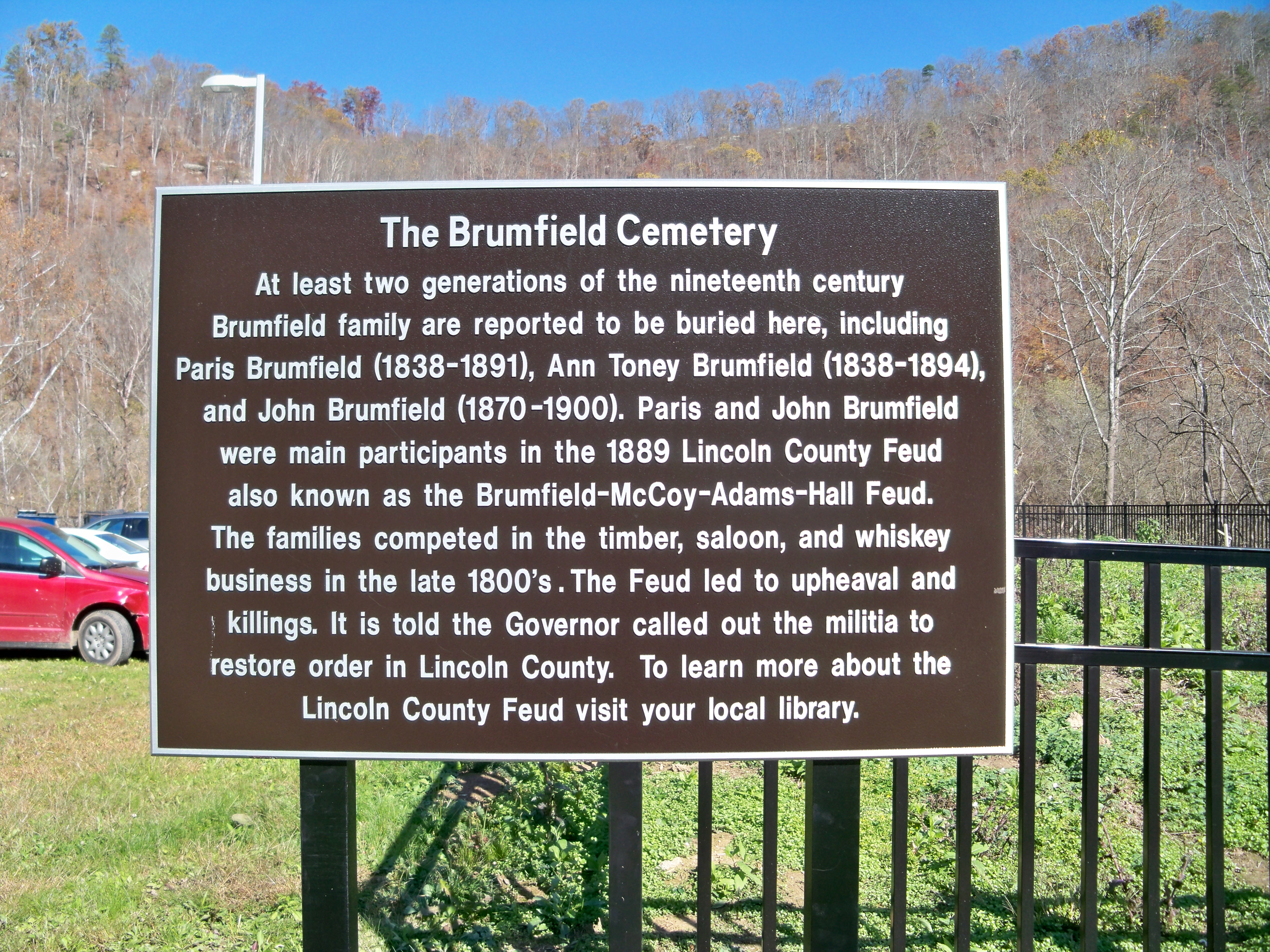
Paris Brumfield Family Cemetery

07 Tuesday Jan 2014

Posted by Brandon Ray Kirk in Cemeteries, Culture of Honor, Harts, Lincoln County Feud

≈ Leave a comment

Tags

Al Brumfield, Ann Brumfield, cemeteries, crime, feud, genealogy, history, John Brumfield, Lettie Brown, Moses Brown, Paris Brumfield, Paris Brumfield Family Cemetery, tourism, West Virginia

Harts, Lincoln County, WV, c.2012.

Harts, Lincoln County, WV, c.2012.

In Search of Ed Haley 199

18 Monday Nov 2013

Posted by Brandon Ray Kirk in Chapmanville, Civil War, Ed Haley, Green Shoal, Guyandotte River, Harts

≈ Leave a comment

Tags

Admiral S. Fry, Andrew D. Robinson, Andrew Robinson, Appalachia, Big Branch, Bill Fowler, Chapmanville, Confederate Army, Dicy Roberts, Elias Adkins, Francis Fork, G.S. Fry, general store, Green Shoal, Harts, Harts Creek, Harts Creek District, Henry H. Hardesty, Henry S. Godby, history, Hollena Brumfield, Isham Roberts, Jack Johnson, James P. Mullins, Joseph Workman, Marsh Fork, Martha Jane Brumfield, merchant, Milt Haley, Paris Brumfield, Sallie Dingess, Sand Lick Run, teacher, Thomas H. Buckley, timber, West Fork

The town of Harts — originally named Hart’s Creek — was established at the mouth of Big Harts Creek in the summer or fall of 1870 when Henry S. Godby, a peg-legged Confederate veteran from Chapmanville, petitioned the government for the creation of a post office called “Hart’s Creek.” At that time, Green Shoal was the most thriving spot in the Harts section of the Guyandotte River. A.S. Fry was its chief businessman and postmaster. Godby’s effort to establish Harts as a postal town was a short-lived venture. By 1876, Green Shoal still reigned supreme in local affairs. According to a business directory, it could boast a gristmill, free school and a Baptist and Methodist church. T.H. Buckley and G.S. Fry were physicians, while Joseph Workman was a clergyman.

Around that time, in 1876, Bill Fowler — a local general storekeeper — petitioned the government for the creation of a “Hearts Creek” post office and established his business headquarters at Harts. Fowler had migrated to the area in 1847 and married a daughter of Elias Adkins, an early settler. After a short stint as a schoolteacher in 1871, Fowler was by 1876 a general storekeeper and owner of some 30 acres of land on the Marsh Fork of West Fork. In March of 1877, he became postmaster of “Hearts Creek;” he was also a saloon keeper according to oral tradition. As his business interest generated profits (primarily in timber), he extended his land holdings. In 1878, he purchased 75 acres on the Guyan River from Abner Vance, valued at $5.00 per acre. The following year, he added a 90-acre tract to his estate on the west side of the Guyan River, valued at $3.25 per acre, which he purchased from brothers-in-law, Aaron and Enos Adkins.

Throughout the period, Fowler was unquestionably the chief businessman in Harts. Curiously, Andrew D. Robinson replaced him as postmaster of Hearts Creek in 1879. Robinson was a Union veteran and former township clerk, justice of the peace, and secretary of the district board of education. He was a brother-in-law to Ben Adams, as well as Sallie Dingess (Hollena Brumfield’s mother). In 1881, Robinson shortened the name of the Hearts Creek post office to “Hart.”

The Green Shoal area, meanwhile, fell into a state of decline as a local economic center. A.S. Fry gave up his postmaster position in 1878. He maintained his local business interests well into the next decade, then turned them over to his son George and left to pursue a hotel business in Guyandotte, a town situated at the mouth of the river in Cabell County. The Green Shoal post office was discontinued in 1879.

By 1880 — roughly the time that Milt Haley came to Harts from “over the mountain” — Harts reigned supreme as the hub of local business affairs. In that year, according to census records, the population of the Harts Creek District was 1,116. There were 1,095 white residents, fifteen blacks and six mulattos. 93-percent of locals were born in Virginia or West Virginia, while six percent were born in Kentucky. Most men worked at farming, although A.S. Fry and Paris Brumfield both had stores. In 1882-1883, Brumfield was listed in a state business directory as a distiller.

At that time, Bill Fowler was the undisputed kingpin of the local business scene. According to Hardesty’s History of Lincoln County, published around 1884, Fowler owned 200 acres of land at the mouth of Harts Creek and 254 acres on Mud River. He also owned 200 acres on Sand Lick Run, a branch of Francis Fork, based on land records at the Lincoln County Courthouse. “That situated on Hart creek produces well,” Hardesty wrote, “and has a good orchard and a part is heavily timbered with oak, poplar and pine; coal and iron ore are quite abundant.” Fowler was the father of four small children, recently born to his second wife.

There were other notable business folks in the neighborhood, namely Isham Roberts, who operated a store near Fowler on the Guyandotte River. He was the son of Dicy Roberts and the stepson of Jack Johnson, a local farmer. In the early 1880s, he married Martha Jane Brumfield, a daughter of Paris Brumfield, and opened a store on rental property at the mouth of Harts Creek. By 1884, when Hardesty wrote his history of the county, he referred to Roberts as “a prosperous young merchant in Hart Creek district, having his headquarters on Guyan river, at the mouth of Big Hart creek. His prices are the most reasonable and the business very extensive.” Roberts was the postmaster at Harts from 1883 until 1884, when Dr. T.H. Buckley replaced him.

James P. Mullins, who operated a general store building above Roberts at Big Branch, was also a budding merchant. By 1882, Mullins was the owner of a $200 storebuilding situated on a 203-acre tract of land. Over the next few years, he added another 55 acres on lower Harts Creek and 150 acres on Francis Fork (this latter tract likely acquired for timbering purposes). Hardesty referred to Mullins as being “of good business qualifications and prosperously engaged in merchandising, with business headquarters on Hart creek, one and one-half miles from its mouth.” In that year, Mullins purchased an additional 93 acres on Harts Creek. One year later, the value of his store building increased by $100, hinting at his growing prosperity.

← Older posts
Newer posts →

Feud Poll 1

If you had lived in the Harts Creek community during the 1880s, to which faction of feudists might you have given your loyalty?

Categories

  • Adkins Mill
  • African American History
  • American Revolutionary War
  • Ashland
  • Atenville
  • Banco
  • Barboursville
  • Battle of Blair Mountain
  • Beech Creek
  • Big Creek
  • Big Harts Creek
  • Big Sandy Valley
  • Big Ugly Creek
  • Boone County
  • Breeden
  • Calhoun County
  • Cemeteries
  • Chapmanville
  • Civil War
  • Clay County
  • Clothier
  • Coal
  • Cove Gap
  • Crawley Creek
  • Culture of Honor
  • Dingess
  • Dollie
  • Dunlow
  • East Lynn
  • Ed Haley
  • Eden Park
  • Enslow
  • Estep
  • Ethel
  • Ferrellsburg
  • Fourteen
  • French-Eversole Feud
  • Gilbert
  • Giles County
  • Gill
  • Green Shoal
  • Guyandotte River
  • Halcyon
  • Hamlin
  • Harts
  • Hatfield-McCoy Feud
  • Holden
  • Hungarian-American History
  • Huntington
  • Inez
  • Irish-Americans
  • Italian American History
  • Jamboree
  • Jewish History
  • John Hartford
  • Kermit
  • Kiahsville
  • Kitchen
  • Leet
  • Lincoln County Feud
  • Little Harts Creek
  • Logan
  • Man
  • Matewan
  • Meador
  • Midkiff
  • Monroe County
  • Montgomery County
  • Music
  • Native American History
  • Peach Creek
  • Pearl Adkins Diary
  • Pecks Mill
  • Peter Creek
  • Pikeville
  • Pilgrim
  • Poetry
  • Queens Ridge
  • Ranger
  • Rector
  • Roane County
  • Rowan County Feud
  • Salt Rock
  • Sand Creek
  • Shively
  • Spears
  • Sports
  • Spottswood
  • Spurlockville
  • Stiltner
  • Stone Branch
  • Tazewell County
  • Timber
  • Tom Dula
  • Toney
  • Turner-Howard Feud
  • Twelve Pole Creek
  • Uncategorized
  • Warren
  • Wayne
  • West Hamlin
  • Wewanta
  • Wharncliffe
  • Whirlwind
  • Williamson
  • Women's History
  • World War I
  • Wyoming County
  • Yantus

Feud Poll 2

Do you think Milt Haley and Green McCoy committed the ambush on Al and Hollene Brumfield in 1889?

Blogroll

  • Ancestry.com
  • Ashland (KY) Daily Independent News Article
  • Author FB page
  • Beckley (WV) Register-Herald News Article
  • Big Sandy News (KY) News Article
  • Blood in West Virginia FB
  • Blood in West Virginia order
  • Chapters TV Program
  • Facebook
  • Ghosts of Guyan
  • Herald-Dispatch News Article 1
  • Herald-Dispatch News Article 2
  • In Search of Ed Haley
  • Instagram
  • Lincoln (WV) Journal News Article
  • Lincoln (WV) Journal Thumbs Up
  • Lincoln County
  • Lincoln County Feud
  • Lincoln County Feud Lecture
  • LinkedIn
  • Logan (WV) Banner News Article
  • Lunch With Books
  • Our Overmountain Men: The Revolutionary War in Western Virginia (1775-1783)
  • Pinterest
  • Scarborough Society's Art and Lecture Series
  • Smithsonian Article
  • Spirit of Jefferson News Article
  • The Friendly Neighbor Radio Show 1
  • The Friendly Neighbor Radio Show 2
  • The Friendly Neighbor Radio Show 3
  • The Friendly Neighbor Radio Show 4
  • The New Yorker
  • The State Journal's 55 Good Things About WV
  • tumblr.
  • Twitter
  • Website
  • Weirton (WV) Daily Times Article
  • Wheeling (WV) Intelligencer News Article 1
  • Wheeling (WV) Intelligencer News Article 2
  • WOWK TV
  • Writers Can Read Open Mic Night

Feud Poll 3

Who do you think organized the ambush of Al and Hollene Brumfield in 1889?

Recent Posts

  • Logan County Jail in Logan, WV
  • Absentee Landowners of Magnolia District (1890, 1892, 1894)
  • Charles Spurlock Survey at Fourteen Mile Creek, Lincoln County, WV (1815)

Ed Haley Poll 1

What do you think caused Ed Haley to lose his sight when he was three years old?

Top Posts & Pages

  • History for Boone County, WV (1928)
  • Origin of Place Names in Logan County, WV (1937)
  • Big Harts Creek Post Offices
  • Early Coal Mines in Logan County, WV
  • Post Offices of Wayne County, WV

Copyright

© Brandon Ray Kirk and brandonraykirk.wordpress.com, 1987-2023. Unauthorized use and/or duplication of this material without express and written permission from this blog’s author and/or owner is strictly prohibited. Excerpts and links may be used, provided that full and clear credit is given to Brandon Ray Kirk and brandonraykirk.wordpress.com with appropriate and specific direction to the original content.

Archives

  • February 2025
  • January 2025
  • October 2023
  • September 2023
  • December 2022
  • November 2022
  • May 2022
  • April 2022
  • February 2022
  • November 2021
  • October 2021
  • September 2021
  • June 2021
  • May 2021
  • April 2021
  • March 2021
  • February 2021
  • January 2021
  • December 2020
  • November 2020
  • October 2020
  • July 2020
  • June 2020
  • May 2020
  • April 2020
  • March 2020
  • February 2020
  • January 2020
  • December 2019
  • November 2019
  • October 2019
  • September 2019
  • August 2019
  • July 2019
  • June 2019
  • May 2019
  • April 2019
  • March 2019
  • February 2019
  • January 2019
  • December 2018
  • November 2018
  • October 2018
  • September 2018
  • August 2018
  • July 2018
  • June 2018
  • May 2018
  • April 2018
  • March 2018
  • February 2018
  • January 2018
  • December 2017
  • November 2017
  • October 2017
  • September 2017
  • August 2017
  • July 2017
  • June 2017
  • May 2017
  • April 2017
  • March 2017
  • February 2017
  • January 2017
  • December 2016
  • November 2016
  • October 2016
  • September 2016
  • August 2016
  • July 2016
  • June 2016
  • May 2016
  • April 2016
  • March 2016
  • February 2016
  • January 2016
  • December 2015
  • November 2015
  • October 2015
  • September 2015
  • August 2015
  • July 2015
  • June 2015
  • May 2015
  • April 2015
  • March 2015
  • February 2015
  • January 2015
  • December 2014
  • October 2014
  • September 2014
  • August 2014
  • July 2014
  • June 2014
  • May 2014
  • April 2014
  • March 2014
  • February 2014
  • January 2014
  • December 2013
  • November 2013
  • October 2013
  • September 2013
  • August 2013
  • July 2013
  • June 2013
  • May 2013
  • April 2013
  • March 2013
  • February 2013
  • January 2013
  • December 2012
  • November 2012

Enter your email address to follow this blog and receive notifications of new posts by email.

Join 2,925 other subscribers

Tags

Appalachia Ashland Big Creek Big Ugly Creek Blood in West Virginia Brandon Kirk Cabell County cemeteries Chapmanville Charleston civil war coal Confederate Army crime culture Ed Haley Ella Haley Ferrellsburg feud fiddler fiddling genealogy Green McCoy Guyandotte River Harts Harts Creek Hatfield-McCoy Feud history Huntington John Hartford Kentucky Lawrence Haley life Lincoln County Lincoln County Feud Logan Logan Banner Logan County Milt Haley Mingo County music Ohio photos timbering U.S. South Virginia Wayne County West Virginia Whirlwind writing

Blogs I Follow

  • OtterTales
  • Our Appalachia: A Blog Created by Students of Brandon Kirk
  • Piedmont Trails
  • Truman Capote
  • Appalachian Diaspora

BLOOD IN WEST VIRGINIA is now available for order at Amazon!

Blog at WordPress.com.

OtterTales

Writings from my travels and experiences. High and fine literature is wine, and mine is only water; but everybody likes water. Mark Twain

Our Appalachia: A Blog Created by Students of Brandon Kirk

This site is dedicated to the collection, preservation, and promotion of history and culture in Appalachia.

Piedmont Trails

Genealogy and History in North Carolina and Beyond

Truman Capote

A site about one of the most beautiful, interesting, tallented, outrageous and colorful personalities of the 20th Century

Appalachian Diaspora

  • Subscribe Subscribed
    • Brandon Ray Kirk
    • Join 787 other subscribers
    • Already have a WordPress.com account? Log in now.
    • Brandon Ray Kirk
    • Subscribe Subscribed
    • Sign up
    • Log in
    • Report this content
    • View site in Reader
    • Manage subscriptions
    • Collapse this bar
 

Loading Comments...