
• About

Brandon Ray Kirk

~ This site is dedicated to the collection, preservation, and promotion of history and culture in my section of Appalachia.

Brandon Ray Kirk

Tag Archives: music

In Search of Ed Haley 212

19 Thursday Dec 2013

Posted by Brandon Ray Kirk in Ed Haley

≈ 3 Comments

Tags

Billy Adkins, Cliff Top, Ed Haley, John Hartford, John W Runyon, Johnny Hager, music, Pat Haley, Steve Haley, Tim Wendt, Tom Atkins, West Virginia, writing

Late in the summer of 1995, I boarded my bus and cruised along the familiar Kentucky interstate highway system toward something called the Appalachian String Band Festival at Cliff Top, West Virginia. J.P. Fraley and Wilson Douglas assured me it was of the fastest growing festivals in the region and would be a great place to learn more about Ed Haley. Along the way I picked up Brandon Kirk, who gave me the first draft of the Haley manuscript. Somewhere around Oak Hill, we eased off of the interstate onto a ridiculously curvy road and, after what seemed like hours, we arrived at Cliff Top — a Depression era CCC camp on top of a mountain filled with buses, automobiles, tents, campers, fiddlers, concessioneers, hippies, and just about anything else a person could imagine.

There were a lot of familiar faces milling about the grounds.

Brandon busily snapped pictures and kept saying things like, “So that’s Wilson Douglas?” or “Wow, that’s J.P. Fraley?” or “Virgil Alfrey? Cool.”

I wasted little time getting out my fiddle and playing with folks. There was an “Ed Haley buzz” at the camp. People were curious about my research into his life and music. Once I started playing in jam sessions, a lot of people asked if I was using an “extra-long bow.” At first, I wondered what the hell that was all about. Then, remembering how I had been busy working on Ed’s bowing style — his use of long bow and the Scotch snap (the little “stops”), I realized that I was (like Ed) creating the illusion of a longer bow. Wilson Douglas had once said that Ed’s bow was “six inches longer than any other kind of bow.” He was been sure of it. “A boy don’t miss nothing for he’s eager to learn,” he had said.

At some point Billy Adkins showed up with his teenage son Clint bringing news of new leads. He said he had found references to a “Runyon’s Branch” in old Harts deeds and had made contact with Tom Atkins, a genealogist and great-grandson to Cain Adkins who lived in Williamson. Cain, I remembered, was Green McCoy’s father-in-law. Billy left after a few hours saying that he’d see us in Harts in a couple of days.

At dinner, I met Jess Chambers, a Boone County resident and great-nephew to Ed’s friend, Johnny Hager. Jess didn’t know much about Ed but told us some interesting stories about Johnny’s background. In the late 1880s, Johnny took his mother and left the Mud River country of Boone County and headed West. Roxie Mullins had told me about that venture in 1991. “My mother, she was a Hager, and her mother went to the Western States and died there and was buried on the banks of the Wabash River,” Roxie said. “Uncle John told us — he was with her. Said she just lived there six months till she died.” Johnny returned to West Virginia around the turn of the century, Jess said, and soon persuaded Ed to travel with his music. No doubt, Johnny brought styles and tunes back with him from the West, which may have carried over to Ed. Wilson Douglas had told me Ed played a tune called “Boot Hill” that “came from out West back in the 1880s.” There was another tune in Ed’s recorded repertoire called “Poplar   Bluff”, which I recognized as the name of a Missouri town.

Later that evening, just at the start of a fiddling contest, Pat Haley showed up with her son Steve. Pat’s leg was healing up nicely. She looked much better than when I’d seen her in March, but her spirits were down. The doctors didn’t give her daughter Beverly long to live. Brandon took to Pat right away. He hung out with her for several hours until Steve drove her back to Ashland. Steve returned later that night and hung out till daylight with Brandon and my bus driver, Tim Wendt.

In Search of Ed Haley 211

14 Saturday Dec 2013

Posted by Brandon Ray Kirk in Ed Haley

≈ Leave a comment

Tags

Appalachia, Ed Haley, fiddle, fiddling, history, John Hartford, Laury Hicks, Lawrence Haley, music, Ugee Postalwait, West Virginia, writing

After pouring over all of this new information, I called Ugee Postalwait and asked if she could sing me any more of Ed’s songs. I hadn’t been thinking much about Laury Hicks lately and it seemed like a good time to just “check in” on that facet of Ed’s story. It wasn’t long until she was spinning this story that gave me insight into Ed’s ability to take a little melody and make it into a tune.

“One time when I was a little girl, somebody went up or down the road at night a singing, ‘Blue-eyed rabbit went away, the blue-eyed rabbit went to stay. Doodledy-do, doodledy do, doodledy do do doodledy do’,” Ugee said. “So I got up and that’s all I was singing all day long. Ed said, ‘What are you trying to sing?’ I said, ‘I’m a singing ‘Doodledy Doo’.’ Dad and him said, ‘Well it’s got a name. What is it?’ I said, ‘I don’t know.’ Said, ‘Where’d you hear it?’ I said, ‘I heard it in the night.’ Said, ‘Did you dream it?’ I said, ‘No, I didn’t dream it.’ They fooled around with that piece there for weeks trying to play it. When Ed Haley and Dad got done playing that, they had all kinds of runs in that there piece. One’d be a playing it and then the other’n, then they’d bring the different runs in on that song. Someone liked it real well when Ed was a playing it and wanted to know what the name of it was. He said, ‘Well, the one that give me the name of it said it was ‘Doodledy Doo’.’ Ed just laughed and would tell Aunt Rosie about him a playing that piece.”

This story was very interesting since I was starting to formulate this improvable theory that Ed first learned to play fiddle tunes by listening to his mother whistle or hum them. As a young widow who had lost her husband in tragic circumstances, she may well have been determined to pass along some of her beloved’s music to little Ed as best as she could. Of course, he may well have begun playing before Milt’s death, even “sneaking” and playing on his fiddle when his father was out working timber. (I’d had a similar experience with an old fiddle in my grandfather’s closet as a boy.)

I asked Ugee if Ed ever talked about where he learned to play and she said, “He told me about somebody leaving an old fiddle laying around when he was a boy. I don’t remember who the man was.” I told her his father had been a fiddler and asked if maybe he’d meant “my old man left an old fiddle laying around” and she said, “Some old man left an old fiddle laying around and I just wonder if it was his dad. And he picked that up and went to see-sawing on it and he said he found out he could play the fiddle. He said that was all he was good for: to play the fiddle. That’s all he studied. I asked him if he went to school to learn to play the fiddle. He said no.”

I just couldn’t shake the image of Ed playing on Milt’s fiddle. If he hadn’t fooled with it before Milt’s death, maybe he picked it up afterwards (“it was just laying around”) and learned to play with his mother’s help. I had these images of Emma whistling or singing Milt’s tunes to him and saying, “Yeah, do that.” “Don’t do that.” I got chills thinking about the way Ed may have began learning tunes and the way I used to ask Lawrence, “Did he do this?” “Did he play this?” Or the way he would say to me, “Pop didn’t do it like that.”

West Virginia Banjo Player 5

29 Friday Nov 2013

Posted by Brandon Ray Kirk in Fourteen, Music

≈ Leave a comment

Tags

Appalachia, banjo, culture, Fourteen Mile Creek, genealogy, history, Holly Sias, life, Lincoln County, music, photos, West Virginia

Holly "Hod" Sias, Lincoln County, West Virginia, 1925-1940.

Holly “Hod” Sias, Lincoln County, West Virginia, 1925-1940.

In Search of Ed Haley 204

27 Wednesday Nov 2013

Posted by Brandon Ray Kirk in Big Harts Creek, Chapmanville, Ed Haley, Harts, Music

≈ Leave a comment

Tags

Al Brumfield, Anthony Adams, Ashland, Bill's Branch, blind, Brandon Kirk, Cain Adkins, Cecil Brumfield, Chapmanville, Charley Davis, Cow Shed Inn, Crawley Creek, Dave Brumfield, Dick Thompson, Earl Brumfield, Ed Haley, Ellum's Inn, fiddler, fiddling, Fisher B. Adkins, Green McCoy, Harts Creek, Henderson Dingess, Hoover Fork, Hugh Dingess, John Brumfield, Kentucky, Lincoln County, Lincoln County Schools, Logan, Logan County, Milt Haley, music, Piney Fork, Smokehouse Fork, Trace Fork, Trace Mountain, West Fork, West Virginia, writing

A few days after visiting Earl Brumfield, Brandon dropped in on his good friends, Charley Davis and Dave Brumfield. Davis was an 88-year-old cousin to Bob and Bill Adkins. Brumfield was Davis’ son-in-law and neighbor. They lived just up Harts Creek near the high school and were familiar with Ed Haley and the story of his father, Milt. Charley said he once saw Ed in a fiddlers’ contest at the old Chapmanville High School around 1931-32. There were two other fiddlers in the contest — young men who were strangers to the area — but Ed easily won first place (a twenty-dollar gold piece). He was accompanied by his wife and a son, and there was a large crowd on hand.

Dave said Ed was mean as hell and laughed, as if it was just expected in those days. He said Ed spent most of his time drinking and playing music in all of the local dives. Sometimes, he would stop in and stay with his father, Cecil Brumfield, who lived in and later just down the road from the old Henderson Dingess place on Smoke House Fork. Dave remembered Ed playing at the Cow Shed Inn on Crawley Mountain, at Dick Thompson’s tavern on main Harts Creek and at Ellum’s Inn near Chapmanville. Supposedly, Ed wore a man out one time at a tavern on Trace Mountain.

Dave said he grew up hearing stories about Ed Haley from his mother’s people, the Adamses. Ed’s blindness was a source of fascination for locals. One time, he was sitting around with some cousins on Trace who were testing his ability to identify trees by their smell. They would put first one and then another type of limb under his nose. Dave said Ed identified oak and walnut. Then, one of his cousins stuck the hind-end of an old cat up under his nose. Ed smiled and said it was pussy willow.

Dave said he last saw Ed around 1945-46 when he came in to see his father, Cecil Brumfield. Ed had gotten drunk and broken his fiddle. Cecil loaned him his fiddle, which Ed never returned. Brumfield later learned that he had pawned it off in Logan for a few dollars to buy a train ticket to Ashland. Cecil bought his fiddle back from the shop and kept it for years.

Dave’s stories about Milt Haley were similar to what his Aunt Roxie Mullins had told me in 1991. Milt supposedly caused Ed’s blindness after getting angry and sticking him head-first into frozen water. Not long afterwards he and Green McCoy were hired by the Adamses to kill Al Brumfield over a timber dispute. After the assassination failed, the Brumfields captured Milt and Green in Kentucky. Charley said the two men were from Kentucky — “that’s why they went back there” to hide from the law after the botched ambush.

The vigilantes who captured Milt and Green planned to bring them back to Harts Creek by way of Trace Fork. But John Brumfield — Al’s brother and Dave’s grandfather — met them in the head of the branch and warned them to take another route because there was a rival mob waiting for them near the mouth of the hollow. Dave said it was later learned that Ben and Anthony Adams — two brothers who had ill feelings toward Al Brumfield — organized this mob.

The Brumfield gang, Dave and Charley agreed, quickly decided to avoid the Haley-McCoy rescue party. They crossed a mountain and came down Hoover Fork onto main Harts Creek, then went a short distance down the creek and turned up Buck Fork where they crossed the mountain to Henderson Dingess’ home on Smoke House Fork. From there, they went up Bill’s Branch, down Piney and over to Green Shoal, where Milt played “Brownlow’s Dream” — a tune Dave said (mistakenly) was the same as “Hell Up Coal Hollow”. Soon after, a mob beat Milt and Green to death and left them in the yard where chickens “picked at their brains.” After Milt and Green’s murder, Charley said locals were afraid to “give them land for their burial” because the Brumfields warned folks to leave their bodies alone.

Brandon asked about Cain Adkins, the father-in-law of Green McCoy. Charley said he had heard old-timers refer to the old “Cain Adkins place” on West Fork. In Charley’s time, it was known as the Fisher B. Adkins place. Fisher was a son-in-law to Hugh Dingess and one-time superintendent of Lincoln County Schools.

In the years following the Haley-McCoy murder, the Brumfields continued to rely on vigilante justice. Charley said they attempted to round up the Conleys after their murder of John Brumfield in 1900, but were unsuccessful.

In Search of Ed Haley 202

20 Wednesday Nov 2013

Posted by Brandon Ray Kirk in Ed Haley

≈ Leave a comment

Tags

Ashland, blind, Catlettsburg, Ed Haley, Ella Haley, fiddling, Green McCoy, history, Mona Haley, music, Pat Haley, Ralph Haley, Wicks Music Store

A few days later, Pat Haley called me from Ashland with news that Mona was visiting. This was a new development: Pat and Mona were apparently patching up some of their differences. Pat knew I would want to speak with Mona and, in spite of whatever hard feelings existed between them, she was willing to give me access to her.

When Mona took the telephone, I told her about getting the new copies of Ed’s recordings. She immediately began to talk about her father making them.

“I was only about fourteen, fifteen,” she said. “I didn’t pay much attention. My oldest brother made the records, him and his wife.”

The whole thing took place around the dining room table.

“You know, they were made on plastic,” Mona said. “And they would brush the plastic strips away as the thing would cut the records. It was kinda tedious, I do remember that.”

Mona said Ed sat about three feet across the table from the recording machine, while Ella was a little closer.

“It shows in the records, don’t it?” she said. I didn’t want to say anything but I totally agreed.

She remembered that Ed listened to each record after it was made and liked what he heard.

“He was talking mostly to my oldest brother,” she said.

I had other questions for Mona, mostly dealing with her general childhood memories. I asked, “Do you remember the house being dark when you were growing up, because obviously they didn’t have any need for light.”

“We had gas lights at home, and after that we had electric,” she said. “Not overly dark, no. We had plenty of light. Always except bedtime, and then my mother would get her big New York Point books out and read to us in the dark.”

“Could your dad see any light at all?” I asked.

“No,” Mona said. “They were both completely blind. My mother said the only thing she remembered was daylight. And I don’t know how old she was when she went blind, but it was infancy, toddler, something like that.”

Mona seemed to be in a particularly talkative mood, so I pressed her for clues about Ed’s music. I asked her how her father’s eyes appeared when he played and she said, “He looked straight out. He never slouched unless he was drinking and then he put one leg behind him and one in front of him.”

Mona said Ed was not a short bow fiddler.

“Long bow, except where it was needed. But he always played that bow to the end,” she insisted.

She didn’t remember her father “rotating” the fiddle at all, although Lawrence Haley (and others) had sure made a big deal out of it. She said Pop always rosined his bow up “real good” before playing but never had any caked on the fiddle. She thought he used Diamond steel strings, which he bought in a local music store named Wicks. He patted his foot in what I call two-four-time when fiddling but “it didn’t override the music.”

I asked Mona if Ed was a loud fiddler and she said, “Oh, yes. You know his voice was strong, too. I’ve been around places with Pop and Mom and people would hear him from far off and come to him. You know, like in the workplace. He always had a crowd around him — always. Always when he played on the street or at the court house square or when he played at the Catlettsburg Stock Market.”

I asked if she remembered Ed playing on trains and she said, “Yes, we’d get in the backseat longways the width of the train and he’d play.” People sometimes gave him money but he mainly played for himself. “Just to pass time,” Mona said.

I was very curious about Ed’s mode of travel, especially considering his blindness and the great distance of ground he covered in his lifetime. I asked Mona if her father hitchhiked a lot and she said, “I don’t think he did. I think he walked more than he hitchhiked.”

Did he sing or whistle while he walked?

“No,” she said. “My mother did that for our benefit, you know. To pacify us, I guess.”

Mona said Ed loved playing for dances because he “enjoyed hearing people dance” and preferred it to the street “a hundred percent.”

I told her that someone said Ella didn’t care a whole lot for playing on the street and she said, “I never heard Mom complain about nothing except Pop drinking.”

I wondered if Ed drank on general principles.

“Whenever he felt like it,” she said. “Whenever somebody brought him something and asked him to take a drink, he would. And there’s times he has gone out and got it, too. Aw he’d cuss real bad. He’d say, ‘god almighty goddamn,’ like he was disgusted with the whole world. We lived down on Greenup Avenue between Greenup and Front and trains went by. His bedroom was in the front, and he cussed one time. I’ll never forget it. He said, ‘Them god almighty goddamn trains just act like they put their damn whistles in the window and blow.'”

I said, “Let me ask you this. In their relationship, was your mother or your father the dominant one, would you say?”

Mona surprised me a little bit when she said, “I’d say my mother was the dominant one until Pop was drinking.”

Ella was also the disciplinarian.

“Mom, she’d pinch a piece out of you, buddy,” Mona said. “She wouldn’t make a scene in a store or anything but she’d just grab you and pinch you and say, ‘Quieten down.’ She did it to me.”

Just before I hung up with Mona, I told her some of the things I’d found out about Ed’s genealogy on my recent trip to Harts. She listened quietly, then said, “Well see, the story I got was that Green McCoy shot this lady. And that’s the story that Pop told me, that I understood. Now, it may be wrong. My memory might be wrong or maybe I didn’t want to believe it the other way.”

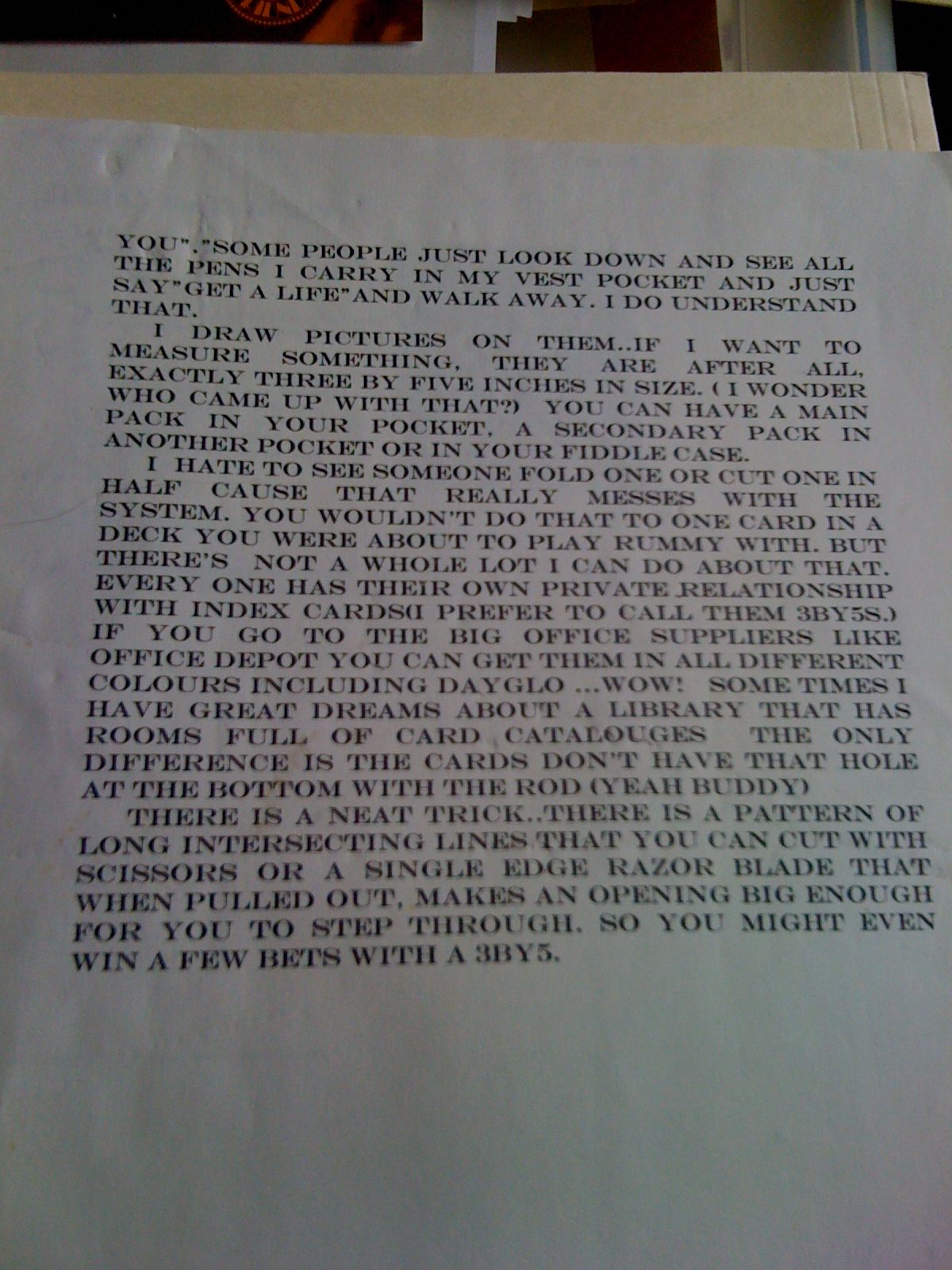
John Hartford’s Notecards

20 Wednesday Nov 2013

Posted by Brandon Ray Kirk in John Hartford

≈ Leave a comment

Tags

bluegrass, culture, John Hartford, life, music, Nashville, notecards, Tennessee, thoughts, writing

John's thoughts on notecards, page 2. Nashville, TN, c.2000.

John’s thoughts about notecards, page 2. Nashville, TN, c.2000.

In Search of Ed Haley 201

20 Wednesday Nov 2013

Posted by Brandon Ray Kirk in Ed Haley

≈ Leave a comment

Tags

Bruce Nemerov, Ed Haley, fiddling, history, John Hartford, Lee Hazen, Lynn Davis, Mark Wilson, music, Nashville, Parkersburg Landing, writing

When I got back to Nashville, I had this boxed package in the mail from Mark Wilson, the folklorist who co-produced Parkersburg Landing. Inside the box was a pile of wire recordings, looking very much like a gossamer bird’s nest, which Mark said were Lynn Davis’ recordings of Ed Haley from the forties. I had no idea why Mark had these wires, or really why he had sent them to me. Some years before, I had called him about Ed and received a cool reception, sort of like, “Why don’t you leave all of this to the real folklorists?”

I took the wire recordings to Lee Hazen, a studio engineer and friend whose life-long hobby was wire recordings, and he told me right away that they were way beyond hope. “Even if you took pieces of them and run them through and taped them and then assembled the tape?” I asked.

Nope.

He said it would require someone with enough patience to spend the rest of their life untangling them. I decided to keep them safe though and maybe someday, who knows? But wouldn’t it be awful to get them all together and discover that they were not even of Ed?

Later that spring, Bruce Nemerov notified me that he’d completed his work on Ed Haley’s recordings. I got a hold of the new copies, which included an audio log. There were several records that Bruce didn’t copy.

Ferrellsburg Musicians

19 Tuesday Nov 2013

Posted by Brandon Ray Kirk in Ferrellsburg, Music

≈ 2 Comments

Tags

culture, guitar, history, J.M. "Doc" Mullins, life, Minnis "Mink" Mullins, music, Ona "Teaberry" Mullins, Standard Mullins, Vernon Mullins, West Virginia

J.M. "Doc" Mullins and sons, Ferrellsburg, Lincoln County, WV, 1920s.

J.M. “Doc” Mullins and sons, Ferrellsburg, Lincoln County, WV, 1920s.

In Search of Ed Haley 193

06 Wednesday Nov 2013

Posted by Brandon Ray Kirk in Ed Haley

≈ Leave a comment

Tags

Angeline Lucas, Billy Adkins, Boney Lucas, Don Morris, feud, Green McCoy, Harkins Fry, history, Imogene Haley, Milt Haley, music, Paris Brumfield, Sherman McCoy, Spicie McCoy, Tucker Fry, Vinnie Workman, writing

I said, “That’s the very same story that Ed Haley’s people told. They would have just as much shame about the incident as Ed Haley’s folks. I wonder if Spicie and Emma got together and got their stories straight before they went their separate ways? I wonder if Spicie knew Emma Jean?”

Billy said, “Grandmaw I believe said them women come over that night and begged for them men — for them not to kill them. She said her mother was telling her about it. Her mother was the Fry where they lived at there. They wouldn’t listen to them. Now I don’t know if that’s true or not. That’s just what was passed down to her. Now I’ll tell you, that table had bullet holes in it.”

Oh, yeah…the table where Milt and Green ate their final meal. Brandon asked Billy who had it last and he said, “My grandmother, Vinnie Workman. I don’t know whether I can remember it or if I was just told about it.”

I told Billy that it sure would be nice to find that table, so he called up his Aunt Don Morris, who had eaten many meals on it as a child. When he got off the telephone, he confirmed, “The table they had their last meal in ended up with my Grandmother Vinnie (Thompson) Workman. And there were bullet holes in the table. Of course my aunt wasn’t there, but she said she can verify there was bullet holes in the table under the bottom of it — not on the top of it. You know, how side pieces are on a table. But when they’d be under the table as kids playing under the table, they’d see the bullet holes. She doesn’t know where the table is.”

And why did Vinnie end up with the table?

“I don’t know,” Billy said. “Uncle Tucker Fry, the one that owned the house where they was killed at, was my grandmother’s uncle. He may have just give the table to her. They was just probably getting rid of it and she took it.”

After thinking about it for a while, Billy said the table might be stored in his parents’ abandoned house next door. We walked over to the dark house and searched in vain.

Back at Billy’s, we returned to the family histories. I noticed there seemed to be a great deal of musical talent in Green and Spicie McCoy’s family. The Fry history referred to Spicie as a “well-known quartet singer” and featured a photograph of her in a quartet with her son, guitarist Sherman McCoy, and her grandsons, Charles and Raymond McCoy. Whether their talent came from Spicie or Green (or both) I didn’t know, but I took note of the fact that some of the children by Spicie’s second husband were also musical. According to Adkins, Harkins Fry of Huntington was a “song writer and publisher, and music teacher.”

My head was filled with images of Milt, Green and Spicie playing dances around Harts.

There was another surprise: according to the Adkins book, Spicie’s sister Angeline married Monteville “Mounty P.” Lucas (a brother to Mrs. George Fry) – a.k.a. “Boney Lucas.” Boney, then, was a brother-in-law to Green McCoy — making his death closely connected to the troubles of 1889. He and Angeline had several children: Eliza Lucas (1877), Julie A. Lucas (1879), Millard Fillmore Lucas (1880-1971), Blackburn Lucas (1882-1946), Ruth “Spicey Jane” Lucas (1883-1971), Taylor Lucas (1889-1966) and Wilda Lucas, born in 1891. Boney died around 1891, according to the Adkins history, when the “Brumfield brothers killed him by cutting his throat while Angeline watched.” According to Billy’s notes, Boney was “killed by Paris Brumfield while he was running from Paris.”

George W. Ferrell 2

30 Wednesday Oct 2013

Posted by Brandon Ray Kirk in Ferrellsburg

≈ Leave a comment

Tags

Arena Ferrell, Charley Brumfield, Charlie Conley, Ferrellsburg, George W. Ferrell, history, Irene Mitchell, Keenan Ferrell, Lula Fowler, music, The Lincoln County Crew, The Murder of John Brumfield, writing

Keenan S. Ferrell, the adoptive father of George W., had been born in March of 1854 to George and Nancy (Farley) Ferrell in Boone County. He appeared in the 1860 and 1870 censuses for that county in the home of his parents. On April 6, 1877, in Logan County, he married Arena Sanders, a daughter of Martin and Elizabeth (Mitchell) Sanders. Arena, or Rena as she was called, had been born in March of 1861 in Russell County, Virginia. In 1880, the Ferrells lived in the Logan District of Logan County.

In the late 1890s, Keenan and Arena Ferrell moved to the Harts area of southern Lincoln County. In 1895, Rena bought 75 acres of land at Fry, on the east side of the Guyandotte River, from Admiral S. Fry, an early landowner and postmaster at Green Shoal. The following year, she bought 70 more acres on the west side of the river from John Q. Adams. In 1897 she bought a portion of the old Elias Adkins estate, situated on the river between Harts and Green Shoal. Upon this latter piece of property she erected a store building and, in short time, the surrounding area became known as Ferrellsburg. By 1900, the Ferrells had acquired George W., whom they reportedly adopted. Census records for that year show him as an “adopted son.”

Also in the home in 1900 was Lula Vance, the seven-year-old orphaned daughter of John and Columbia (Kirk) Vance. Lula would have practically grown up in the Ferrell home at the time that George W. lived there. Strangely, she never spoke about him to her children. “I don’t remember Mommy ever mentioning anything about George Ferrell,” said daughter Irene Mitchell, of Harts, in a 2003 interview. “That’s kind of strange since Mommy would’ve been raised with him. But she never really talked much about staying with the Ferrells.”

George Ferrell spent his twenties as a bachelor working around the store and making music. He was postmaster at Green Shoal from December 22, 1902 until December 26, 1904, when the office was discontinued to Ferrellsburg. He is credited with the authorship of “The Lincoln County Crew” and “The Murder of John Brumfield,” as well as a song about someone named Harve Adkins. In composing “The Lincoln County Crew,” Ferrell borrowed heavily from “The Rowan County Crew,” assuming this latter tune — documenting events of the Martin-Tolliver Feud in Kentucky — was written first. Ferrell’s version of the song, which primarily draws on local events that happened in Harts between 1889 and 1891, is a warning for men to stop drinking or risk a young, violent death.

“The Murder of John Brumfield” details Brumfield’s murder by Charlie Conley at a Chapmanville Fourth of July celebration in 1900. There is a story that Ferrell was playing this latter song for a crowd of people near the Ferrellsburg train depot when one of Conley’s brothers passed through. According to the story, Ferrell ceased his playing and singing because he feared his tune might cause trouble. But one of the attendants, Charley Brumfield, a brother to the slain John Brumfield, told him to keep the song going — no one would bother him. As Ferrell continued his music, Conley made his way by and on across the river toward his home on the Smokehouse Fork of Big Harts Creek.

George W. Ferrell died on August 6, 1905 at the age of 30 years, reportedly of tuberculosis. His tombstone offers this Biblical quote: “In my father’s house are many mansions.” Also on the stone is the following epitaph:

His last words were Mamma come to me. God bless you. Cease your mourning. Cease to languish o’er the graves of those you love. Pain and death and night anguish, enter not the world above. Sight and peace at once deriving from the hand of God most high. In his glorious presence living, they shall never, never die.

Years later, Fred B. Lambert, noted genealogist and regional historian, published “The Lincoln County Crew” and “The Murder of John Brumfield” in his 1926 edition of The Llorrac. His private notes, now in the hands of the Special Collections Department at Marshall University’s Morrow Library, contain slightly different versions of “The Lincoln County Crew,” as well as a reference to the tune Ferrell wrote about Harve Adkins.

George W. Ferrell 1

25 Friday Oct 2013

Posted by Brandon Ray Kirk in Big Ugly Creek, Ferrellsburg, Music

≈ Leave a comment

Tags

Archibald Harrison, Arena Ferrell, Big Ugly Creek, C&O Railroad, Cleme Harrison, Daniel Fry, Don McCann, Ferrellsburg, genealogy, George W. Ferrell, Guy Harrison, Guyandotte River, Guyandotte Valley, Harold Ray Smith, Harts Creek District, history, Keenan Ferrell, Laurel Hill District, Lincoln County, Logan County, Martha E. Harrison, Martha Harrison, music, Nancy Fry, Nine Mile Creek, Phernatt's Creek, Tazewell County, Virginia, writing

Around the turn of the century, in the years just prior to the arrival of the C&O Railroad in the Guyandotte Valley, George W. Ferrell, a musician in present-day Ferrellsburg, busily wrote songs about local personalities and events. Today, Ferrell’s solitary grave is marked with an ornate tombstone that sits at the edge of what was, until recent years, a garden.

George W. Ferrell was born on October 10, 1874 to Archibald B. and Martha E. (Fry) Harrison. Archibald was the son of Guy P. and Cleme (Harmon) Harrison of Tazewell County, Virginia. Mary was the daughter of Daniel H. and Nancy P. (Bailey) Fry of Logan County. Ferrell’s birthplace is not known because, soon after his parents married in 1865, they left the area, settling at first in Kentucky and then elsewhere.

In 1878, George, then four years old, returned to Lincoln County with his parents. In 1880, his family lived near the mouth of Big Ugly Creek or at the “Bend,” just across the Guyandotte River. Shortly thereafter, they made their home at Phernatt’s Creek, further downriver in Laurel Hill District.

By 1889, Ferrell’s father — who was perhaps recently divorced from his mother — had sold all of the family property in Harts Creek District and at Phernatt’s Creek and relocated to Nine Mile Creek.

Details concerning Ferrell’s early life remain elusive. It is not known who influenced him musically or when he even started writing or playing music. There is no indication of his father or mother being musicians but his mother’s first husband, Jupiter Fry, was a well-known fiddler on Big Ugly. Some of his first songs may have been inspired by his father’s stories of the Civil War.

At some point in his young life, and for reasons unknown, Ferrell was adopted by Keenan and Arena Ferrell, a childless couple at Ferrellsburg in Lincoln County.

“I heard he was just a big old boy when the Ferrells took him in,” said Don McCann, current owner of the property surrounding Ferrell’s grave. “They didn’t have any children of their own.”

In the 1900 Lincoln County Census, Ferrell was listed as their 25-year-old adopted son. More than likely, he was assisting the Ferrells in the operation of their store and business interests.

It is easy to see how Ferrell would have become acquainted with his future foster parents.

“His father worked a lot of timber around Big Ugly or Green Shoal,” said Harold R. Smith, Lincoln County genealogist and historian. “And that would have put him in close contact with the Ferrells at Ferrellsburg.”

But why was he not living with his mother (wherever she was), who died in 1901, or his maternal grandmother, who was alive on Big Ugly? And what was his connection to the Ferrells?

In Search of Ed Haley 186

25 Friday Oct 2013

Posted by Brandon Ray Kirk in Ed Haley

≈ Leave a comment

Tags

Bill Brumfield, Branchland, Ed Haley, Ferrellsburg, fiddling, history, Isaiah Mullins, Lawrence Kirk, Lincoln County, Mildred Cook, music, Paris Brumfield, writing

That evening, Brandon and I went to see Lawrence Kirk at his nice single-story home on Fowler Branch in Ferrellsburg, West Virginia. We sat around the kitchen table where Lawrence pulled out a map of the Tug Valley and showed us the route taken by the Brumfield posse after they apprehended Milt and Green in Kentucky. We made plans to re-trace the route the next afternoon.

I said, “Of course, they had to ford back and forth at the low water mark of the river. They were on horseback weren’t they?”

“Yeah, they rode horses back through there,” Lawrence answered.

I asked, “Do you reckon they had Green and Milt on the same horse or on different horses?”

“I figure they had a horse for all of them,” he said.

Reckon they had their hands tied?

“I imagine they did.”

Brandon asked if Lawrence’s grandfather Bill Brumfield had been in the Haley-McCoy mob. He was a younger brother to Al and a teenager at the time of the killings.

“Never did know,” he said. “I doubt that he was. I believe I’d a heard something about it. See, he was pretty young at the time.”

Bob Adkins had remembered Bill as a “mean old devil,” and most people around Harts said he was the roughest of Paris Brumfield’s sons.

“The old man, as bad as he was to fool with that liquor, he tried to keep order, but he’d get drunk hisself and he’d get out of hand, see,” Lawrence said. “Well, his son — my uncle — my mother’s brother — shot him and killed him. They said they was just on a big binge there at my grandfather’s.”

At midnight, we were still huddled around Lawrence’s kitchen table talking and looking over maps when Brandon’s mother showed up wearing flannel pajamas with a letter from Mildred Cook of Branchland, Lincoln County. According to the letter, Mildred was the daughter of Isaiah Mullins and a cousin to Ed Haley.

“I remember when Mr. Haley came up Little Hart and played the fiddle for me, my two brothers, sister and My Dad,” the letter partially read. “He had a little boy with him about 8 years old. Mr. Haley came to our house 1931. I was 11 years old. He was just visiting when he come to our house. He was there approx. 2 hours. The Best I can remember Ed Haley played ‘Wildwood Flower’ and ‘Turkey in the Straw.’ He went on up little Harts Creek after he stayed and talked a while.”

In Search of Ed Haley 176

27 Friday Sep 2013

Posted by Brandon Ray Kirk in African American History, Ed Haley, Music

≈ Leave a comment

Tags

Annie Adkins, Anse Blake, Appalachia, Ben France, Bob Claypool, Bob Glenn, Burgess Stewart, Cain Adkins, Champ Adkins, Charley Robinson, Dave Glenn, Ed Haley, fiddling, Frank Jefferson, Fred B. Lambert, George Stephens, Gilbert Smith, Harkins Fry, Hezekiah Adkins, history, Isom Johnson, Jimmie Rodgers, Kish Adkins George Crockett, Leander Fry, Lish Adkins, Lucian W. Osbourne, music, Percival Drown, Spicie McCoy, Staunton Ross

In a separate interview, one Mr. Miller told Fred B. Lambert, “Leander Fry used to come down from Lincoln on timber to play the fiddle. He was a great fiddler. Jack McComas was an old fiddler, as was also his brother. Mose Thornburg said that a man who wouldn’t fight to the music made by the musicians of the musters had no fight in him. Wm. Collins was a fifer. John Reece was a tenor drummer, Clarke Thurston a base drummer. On muster days, whiskey, ginger ales, cider, &c were plentiful. Hogs were fattened on the way East. That wore the valley out. Dishes were plain. Cups instead of glass. They were cheaper. No washboards. Lye soap. Used a board to beat clothes with. Later, washboards were made of soft wood and sold for 5 cents each. Old fiddlers: George Stephens and Wiley, — Joplin, Guyandotte (?). In later days Morris Wentz and Ben France.”

Amaziah Ross told Lambert about some of the other fiddlers.

“Old Charley Robison came from Alabama. Brought ‘Birdie.’ He was a colored man and a good fiddler. Bob Glenn lived up Ohio River about Mason Co., played at Guyandotte when I was a boy. A first class fiddler. His bro. Dave Glenn also was a good one. Jimmie Rodgers lived at Guyandotte. He was a bro. to Bascom Rogers who kept saloon at Guyandotte — The Logan Saloon when I was a boy.”

Ross gave Lambert the names of many old fiddle tunes, which I of course noted being an avid fan and collector of such things:

Shelvin’ Rock                                      played by Ben France

Natchez Under the Hill

Seven Mile Winder

Money Muss

Devil’s Dream

Mississippi Sawyer

Sixteen Days in Georgia

Little Sallie Waters

Marching Through Georgia

Whitefield, Georgia

Annie Adkins — By herself a fiddler when my father was a boy.

Ocean Wave

Over the Way

Grasshopper

Cabin Creek

Fisher’s Hornpipe

Sailor’s Hornpipe

Ladies’ Hornpipe

Gerang Hornpipe

Forked Deer

Third Day of July

Butterfly

Birdie

Lop Eared Mule

Billy in the Lowground

Wild Horse

Old Bill Keenan

Round Town Girls

SourwoodMountain

Old Joe Clark

Greasy String

Cross Keys

Bet My Money on Bobtail Horse

Blue Ridge Mountain Home

Someone told Lambert about the dances held after corn-shuckings.

“After a few weeks, it was ready to shuck. It was an opportunity for young and old to gather and spend a day at work in the name of play. Of course, the women and girls prepared the noon meal and sometimes even the supper. When night came on, the labors of the day were followed by a dance, which of all pioneer amusements was king. Shooting matches with rifles, wrestling matches, foot races, fist fights between neighborhood bullies, or to settle old scores. It was not uncommon for contestants to engage in ‘gouging’, as a natural sequence of a first fight. Weapons were banned, but many a man lost an eye by having it gouged out.”

Another person said, “Dances were very common at weddings, and on many other occasions.” Some of the tunes played were:

The Devil’s Dream

Old Zip Cook

Billie in the Low Ground

Virginia Reel

“I had a Dog And His Name was Rover,

When he Had Fleas, He had ‘Em All Over”

Irish Washerwoman

Mississippi Sawyer

Myron Drumond gave these tunes to Lambert: “Sugar in the Gourd”, “Chicken Reel”, “Fisher’s Hornpipe”, “Cincinnati Hornpipe” (the latter two tunes for “Jig dancing”) and “Irish Washerwoman”.

These tunes and fiddlers came from “a Barboursville man:”

Tunes

 Turkey In the Straw

Sourwood Mountain

“Hage ’em Along.”

The Lost Indian

Pharoah’s Dream

Hell up the Coal Hollow

The Devil’s Dream

Shady Grove

Arkansas Traveler

Little Bunch o’ Blues

New River Train

I Love Some Body

Hard Up

Fiddlers

Morris Wentz

Ben France

Percival Drown

Bob Claypool—Lincoln Co.

Staunton Ross—near Salt Rock

Burgess (“Coon”) Stewart — Lincoln Co.  Buffalo Cr.  Extra Good

Frank Jefferson — Nine Mile

Anse Blake — Nine Mile

A lot of Lambert’s research, particularly in regard to old-time music trailed off around the time of the War Between the States. He only mentioned Ed Haley twice — once in relation to Milt Haley and once in a list with Ben France, Blind Lish Adkins, Hezekiah Adkins of Wayne County, “Fiddler Cain” Adkins (a son of Jake Adkins), Gilbert Smith and Isom Johnson. His last letter on fiddling was from an uninterested Lucian W. Osbourne of East Lynn, Wayne County, who wrote in March of 1951: “Complying with your request, I send the names of a few old fiddlers, as follows: Champ Adkins, Kish Adkins, Ben Frances, George Crockett. All dead. For information about others write Mrs. Spicy Fry, Stiltner, and Harkins Fry, Kenova. Here are some of the old tunes: ‘Sourwood Mountain,’ ‘The Lone Prairie,’ ‘Little Old Log Cabin in the Lane,’ ‘Nelly Gray,’ &c. I know but little about the fiddling, as I am a Sunday School man, and interested in better things. I think it is better to say after one when he is dead that he is a Christian than to say he was a fiddler or baseball fan.”

J.T. “Pomp” Wentz: Steamboat Captain of Cabell County, WV

23 Monday Sep 2013

Posted by Brandon Ray Kirk in Music

≈ Leave a comment

Tags

Appalachia, Cabell County, fiddler, fiddling, Fred B. Lambert, Guyandotte River, history, J.T. "Pomp" Wentz, music, photos, steamboats, West Virginia

Pomp Wentz

J.T. “Pomp” Wentz, riverboat captain in the Guyandotte Valley. From the Fred B. Lambert Papers, Special Collections Department, Morrow Library, Marshall University, Huntington, WV.

In Search of Ed Haley 173

21 Saturday Sep 2013

Posted by Brandon Ray Kirk in African American History, Ed Haley, Music

≈ Leave a comment

Tags

fiddling, Fred B. Lambert, George Stephens, Gus Wolcott, history, Ike Handley, Jim Peatt, Jim Wilcot, Morton Milstead, music, Percival S. Drown, Sam Peatt, slavery

“There were other fiddlers of less note than those I have named,” Percival Drown continued. “Jim Peatt was a fiddler of fair attainments only as to the number of tunes. I only remember that he played ‘Pigeon on the Gate’, ‘Indian Eat the Woodcock’ (with words), and ‘Old Dan Tucker’ with words and chorous… Ike Handley and Jim Wilcot, who lived below Guyan seven or eight miles, were of the class with Jim Peatt, as I now regard them and recall their fiddling.”

Around 1846, a “dark-skinned” fiddler named Joplin with a “French-Italian look about him” appeared briefly in Cabell County. He was “an educated fiddler and dancing master.”

“It was charming to me, at least, to listen to Joplin’s refined music and I scarcely let the opportunity pass and not hear him,” Drown wrote.

While a master of the violin in the classical sense, Joplin didn’t impress many locals.

“The average native of Cabell County at the period of which I am writing,” one citizen said, “would be far more entertained listening to George Stephen’s ‘Possum Creek’ or ‘Soap Suds over the Fence’, or ‘Peach Tree’ as he played it by ear, than Joplin’s classics rendered from book Clythe Masters.”

These fiddlers made a great impression on young Percival Drown, who took up the fiddle himself as a teenager.

“As brief as I can make it, I will give an account of my own career as a fiddler, which is of little merit, yet would appear to be in order to detail here with other reminiscent memories,” he wrote.

Early in the 40s my father said to me: “Perl would you like to learn to play the fiddle?” I was in my thirteenth year, I think. “Yes sir, I certainly would,” was about my reply — I think my exact words. He went on at some length in extolling the virtues of the violin — how a fiddler could elevate himself socially, and even become a great and popular personage. I have no idea he had ever listened to Joplin or Turner at that time, and certainly not an Ole Bull, or other high class performers. “Bonaparte’s Retreat” and “Money Musk”, also the “Irish Washerwoman,” were his special tunes to listen to. He then said: “Take this $3.00 and get Vere or Gus Wolcott (who kept the wharfboat at Logan) to send to Cincinnati and get the best instrument the $3.00 will buy, and you can begin and try and learn”. I took the money. Wolcott sent and got the instrument, and I was not long “to try and learn to play on it.” The employment of a teacher was out of the question — not to be thought of. We lived far in the back country, too far from where an instructor of the violin ever came. I could never have paid the tuition of an instructor could one have been engaged, but the husband of a negro woman and two children my father had bought at a public sale of the property of Joe Gardner, dec’d at Guyan, was a fiddler. My father hired the husband [named Sam] every winter to work on the farm. Sam became my teacher. I watched his fingers as he played “Old Grimes”, and by timing the fingers and getting the tune effectively fixed in my mind, it was not long until I could actually play “Old Grimes” myself, by which time I could also “tune up” the instrument. The worst was over.

 [I learned] by listening to Geo. Stephens, and every other fiddler that came along the road, closely watching Sam’s fingers and hearing him play every rainy day that we wouldn’t work on the farm (and every night, rain or dry). In four to six months I could play any slow tune and the “Peach Tree” for a dance. For a cotillion I could play one tune, “Rose in the Mountain”. On an occasion, I think it was near 1846, a popular blacksmith and farmer named Stonebreaker who lived out on Beech Fork wanted to give the young people a party. So, he gathered his corn crop, hauled it into the barn, and appointed a day for the husking. “Corn shucking” it was called. The day for the corn shucking was Saturday. George Stephens was sought for, but was away and could not be got in time. Walcott lived twenty miles away, and was not known much anyway. Milstead lived in Ohio, fifteen miles or more. Joplin lived in Gallipolis, thirty miles up the Ohio, too. Hence, he was not available. I had no reputation as a fiddler, and Sam could not leave home — his wife was expecting to be sick of another kid — when it seemed that no fiddler of any known qualification could be engaged. A messenger was sent for me to ascertain if I would come, the time being short. I readily assented. Nothing said about the fiddler’s fee for the service. On the day set I done up the fiddle in my overcoat, and strapping it behind my saddle, mounted “Dave” a very comely animal and away to Stonebreaker’s. Afternoon I went nine or ten miles. Made the trip in good shape, arriving as big as life, fiddle and all. The husking of the corn concluded, the next order of business was to dance. The figures chiefly danced were “Virginia Reel”, “French Four”, and “Dan Tucker”. I could only play the “Peach Tree” in fairly good shape for dancing; and the “Peach Tree” it was for all night, except for supper. We adjourned for about an hour. Then on with the dance for the balance of the night. For this service I received all that was collected, 75 cents, fifteen times five cents in 5 cent pieces… but like George Stephens I felt that I, too, was a lilter. That was my very first playing for the dance. That was fully 68 years ago.

 In 1854 I obtained another and superior instrument that, figuring some time ago how many miles I had carried that violin, it amounted to some 38,000 miles.

In Search of Ed Haley 172

20 Friday Sep 2013

Posted by Brandon Ray Kirk in Ed Haley, Music

≈ Leave a comment

Tags

Anthony Riggs, Barboursville, fiddler, fiddling, Fred B. Lambert, George Stephens, Guyandotte River, history, Morton Milstead, music, Percival S. Drown, Samp Johnson, writing

The next morning, I went to see the Lambert Collection at the Morrow Library in Huntington, West Virginia. According to information at the library, the late Fred B. Lambert (1873-1967), a schoolteacher and administrator, had spent “at least sixty years of his life collecting information about West Virginia history” into a 500-notebook collection, mostly focusing on Cabell, Lincoln, Wayne, and Logan Counties. His notes on fiddling and old-time music were incredibly detailed. In some cases, he documented the first time a tune arrived in the Guyandotte Valley. Incredibly, none of his work was published outside of The Llorrac, an old high school yearbook from the 1920s.

As I flipped through his notebooks, it was difficult to keep my focus — there were stories about murders, genealogy, and life on the river. I took great interest in the stories about early fiddlers in the Guyan Valley. It helped put Ed — at least his early years — into a sort of regional context, the culmination of years of musical evolution. Any one of the mid-nineteenth century Guyan fiddlers may have actually known Ed Haley or, more likely, his father Milt.

In the 1830s and 1840s, according to Lambert’s research, George Stephens was a dominant fiddler in the Cabell County towns situated at or near the mouth of the Guyandotte River.

“George Stephens was a fiddler of wider reputation than most of those old time artists of the ‘fiddle and the bow,'” wrote one Percival S. Drown in a 1914 letter. “In his repertoire was ‘Bonaparte’s Retreat from Moscow,’ ‘Bonaparte Crossing the Rhine,’ ‘Cold, Frosty Morning,’ ‘Puncheon Floor,’ ‘Possum Creek,’ ‘Pop Goes the Weasel,’ ‘Pretty Betty Martin,’ ‘Carry Me Back to Old Virginia,’ ‘Hail Columbia,’ and ‘Star Spangled Banner.’ He had another tune and words ‘Big John, Little John, Big John Bailey.’ The tune Stephens seemed to throw himself away most on was the ‘Peach Tree.’ The meter and time governing this tune permitted its use and adaptation for dance music, and applying a long drawn bow with correct harmony and concord of sound, he carried the listener away in dreamy thought and recollection.

“When about midnight after the day of the ‘quilting,’ ‘Corn Husking,’ and ‘Log Rolling,’ when the ‘dance was on,’ Stephens, well-liquored up on Dexter Rectified, would have his face turned over his right shoulder apparently as much asleep as awake, but never missing a note of the ‘Peach Tree’, while the dancers would be ‘hoeing down’ for dear life. All at once he would order ‘Promenade to Seats’, cease playing, adjust himself in his seat and exclaim with energy ‘if I aint a lilter damme.’ Seemingly he was suddenly inspired with an exalter opinion of his greatness as a fiddler. As much as to say at the same time ‘and don’t you forget it.’ Then he might resen his bow and break out with a few stanzas of ‘Puncheon Floor’ or a tune he called ‘Soap Suds Over the Fence,’ to be followed by a slow tune so everyone could march to the supper table in the kitchen, across the yard (It was a common thing in those dear old times, for the kitchen to be detached from the ‘big house’).”

Samp Johnson was another top local fiddler, according to Percival Drown.

“‘Samp’ Johnson was the first fiddler I heard play ‘Arkansas Traveler’. One of his favorite places to play was at McKendree’s Tavern in Barboursville [on Main Street]. His favorite for playing was during Court days, when fiddler’s drinks were full and plentiful. The sun [was] full at 2 o’clock that day. Court day. The Town was full of visitors, chiefly ‘hayseed’, most of whom were fully equipped for home when they could tear themselves away from ‘Samp’ Johnson’s music. I well remember the day. McKendree’s second story porch was crowded with the audience. Roll Bias, who was a character in his day, lived far up Guyan River. He usually had business ‘at Court’. He was prosperous, in a way. I think he paid for all the drinks flowing from the attraction furnished by Johnson’s music in the street. While endowed with good common sense he could neither write his own or any other name. Poor ‘Samp’ Johnson came to his death at the Falls of Guyan when driving logs at high tide of the river, date not far from the time (1852) of my leaving the State.”

Another great fiddler in that era was Anthony Riggs.

“Anthony Riggs’ favorite tune that I more distinctly remember than others he played was called ‘Annie Hays,'” Drown wrote. “It was that fiddler’s favorite tune and one to suit the step and time for reels, and other ‘figures’ so called. Like all fiddlers of his class, he played ‘Nachez Under the Hill’, now known as ‘Turkey in the Straw.'”

Morton Milstead of Ohio “would come over to Cabell, stay around a few days, in the early 30s, I heard it said, and played the fiddle for drinks, mostly,” Drown wrote. “Milstead was rated as a high-class musician, as I recollect the talk of him. Never heard Milstead play but once, and I well remember now after a lapse of 65 or 70 years that his performance was much below that of George Stephens, Anthony Riggs, or ‘Samp’ Johnson, from my viewpoint at least.”

In Search of Ed Haley 169

10 Tuesday Sep 2013

Posted by Brandon Ray Kirk in Ed Haley

≈ 3 Comments

Tags

Alva Greene, Brandon Kirk, Ed Haley, fiddling, Fred B. Lambert, Huntington, J P Fraley, John Hartford, Kentucky, Lawrence Kirk, music, Pat Haley, writing

Not long after talking with Patsy, while on a trip through Kentucky, I visited J.P. Fraley. I had Ed’s fiddle with me, which excited J.P. greatly. He fiddled Haley’s version of “Granny Will Your Dog Bite?” as best as he could remember it and said Ed used to sing:

Granny, will your dog bite, dog bite, dog bite?

Granny will your dog bite?  “No, child, no.”

Granny will your dog bite, dog bite, dog bite?

“Johnny cut his biter off a long time ago.”

He said Ed also used to play “Hunky Dory”.

Between tunes, J.P. talked about how Haley was the top fiddler in his section of Kentucky. “Daddy and Alva Greene and Doctor Sparks and Frank Clay, Drew Crockett — reputable fiddlers, I called them — ever chance they got, they’d go listen to Ed Haley. He was the yardstick of the fiddlers in this whole area.”

J.P. said, “I’ve kept something for years, buddy. I’ve got a fiddle bridge of Ed Haley’s. I don’t know what it’s made out of.”

Apparently, when he borrowed the Haley fiddle from the Holbrooks years ago, he had kept a little memento before returning it.

In the next couple of weeks, I finalized plans for another “Ed Haley trip.” Pat Haley said I could stay at her place in Ashland, while Lawrence Kirk said I was welcome to stay with him in West Virginia. I called Brandon Kirk, the Harts genealogist, and arranged to meet him at the Morrow Library in Huntington. There he said we would have a lot of genealogical material at our fingertips, as well as all the room we needed to sort through our books and old photographs. I was very interested in the Lambert Collection, which he said was full of local historical information.

In Search of Ed Haley 164

04 Wednesday Sep 2013

Posted by Brandon Ray Kirk in Ed Haley

≈ 1 Comment

Tags

Ashland, fiddling, genealogy, Jack Haley, John Hartford, Kentucky, Lawrence Haley, Morehead, music, Pat Haley, Patsy Haley, Ralph Haley, Scott Haley

A few days later, I was in Ashland at Pat Haley’s house, where the Haley clan had gathered in for Lawrence’s funeral. All of Lawrence’s kids were there, of course (Beverly, Steve and David), as was Clyde and Mona. I also spotted Noah, who introduced me to his son, James Edward Haley (Ed’s namesake). Pat made a point to introduce me to Patsy Haley and her son Scott, who were in from Cleveland. A little later, I played Ed’s fiddle for Lawrence’s service and it sounded so good that I seriously considered making it my main fiddle on stage. I quickly slipped into “the zone” and it was the first time I seemed to experience (as crazy as it may seem) the sensation of Ed and Lawrence both whispering in my ear, guiding me along, looking over my shoulder, and saying things like, “Easy now, don’t play so many notes.” “Yeah, try that and see if it works.” “You’re getting too far away from the melody.”

After the funeral, I returned to Pat’s and played for the family in the kitchen. I wasn’t really sure what to expect. I mean, with Lawrence gone it would have been really easy for the Haleys to say, “Thanks for showing an interest in Pop, now see ya later,” but instead they took me into their fold — with Pat leading the way.

There were a few new stories. For instance, Patsy’s son Scott Haley told me about “catching” his father Jack in private moments playing a fiddle right along with Ed’s records. I was excited to hear that and could easily imagine that Jack was the child who had inherited Ed’s talent for the fiddle. But when I asked Pat and Steve about it they gave Scott’s claim little credence. They said Jack might have tried to play with the records but he couldn’t really play anything. They fancied Scott’s memory to be a lot like the one they had of Lawrence, who occasionally strung up Ed’s fiddle (backwards because he was left-handed) and attempted to play along with the records. I never forgot the possibility, though, that Jack Haley could play the fiddle, which seemed to irritate Pat.

Before I left Ashland, Pat gave me Ed’s records. She said she wanted me to keep them because I would “know what to do with them.”

“I have a real love-hate relationship with those records,” Steve said jokingly. “When we were kids we had to tip-toe through the house to keep from scratching them.”

Pat also loaned me Ella’s postcards and explained why Lawrence hadn’t wanted me to see them on my first visit roughly four years earlier. Apparently, they alluded to the fact that Ella had conceived Ralph not by a previous marriage — but out of wedlock. Pat said Ella was boarding with a Mr. Payne and giving piano lessons to his five-year-old daughter in Farmers, Kentucky, when she became pregnant. Mr. Payne promptly returned her to her family in nearby Morehead.

In Search of Ed Haley 163

03 Tuesday Sep 2013

Posted by Brandon Ray Kirk in Ed Haley

≈ Leave a comment

Tags

Appalachia, Ashland, Cincinnati, Ed Haley, fiddle, history, John Hartford, Lawrence Haley, life, music, Nashville, Portsmouth, U.S. South

Once I returned to Nashville, I called Lawrence Haley, who was in the mood to reminisce.

“Me and Pop hitch-hiked to Cincinnati out of Portsmouth a time or two,” he said. “We took old 52. And we’d had about three rides to get there.”

I asked him if Ed took his fiddle on those trips and he said, “Yeah, if he thought he was gonna be in a little bit other than country settings, he would put it in the case. But most of the time, he’d just carry it in his hand, tucked under his arm, maybe, with the bow in his hand.”

I wondered if Ed packed any extra bags on the road and Lawrence said, “Mostly just the clothes on his back, unless he was going on an extended trip — then he’d pack him a suitcase. He’d, of course, fill it up about a third with his homemade tobacco. His own cure — apple or peach or something. He’d take him some of that with him and off he’d go.”

Lawrence Haley passed away on February 3, 1995, the 44th anniversary of his father’s death.

Rector Hicks

30 Friday Aug 2013

Posted by Brandon Ray Kirk in Calhoun County, Ed Haley, Music

≈ Leave a comment

Tags

Akron, Appalachia, Calhoun County, culture, fiddler, fiddlers, fiddling, history, Kerry Blech, life, music, Ohio, photos, Rector Hicks, U.S. South, West Virginia

James Ward Jarvis (b.1894), fiddler from Braxton County, West Virginia, 1970s

Rector Hicks, fiddler from Calhoun County, West Virginia, c.1976. Photo courtesy of Kerry Blech

← Older posts
Newer posts →

Feud Poll 1

If you had lived in the Harts Creek community during the 1880s, to which faction of feudists might you have given your loyalty?

Categories

  • Adkins Mill
  • African American History
  • American Revolutionary War
  • Ashland
  • Atenville
  • Banco
  • Barboursville
  • Battle of Blair Mountain
  • Beech Creek
  • Big Creek
  • Big Harts Creek
  • Big Sandy Valley
  • Big Ugly Creek
  • Boone County
  • Breeden
  • Calhoun County
  • Cemeteries
  • Chapmanville
  • Civil War
  • Clay County
  • Clothier
  • Coal
  • Cove Gap
  • Crawley Creek
  • Culture of Honor
  • Dingess
  • Dollie
  • Dunlow
  • East Lynn
  • Ed Haley
  • Eden Park
  • Enslow
  • Estep
  • Ethel
  • Ferrellsburg
  • Fourteen
  • French-Eversole Feud
  • Gilbert
  • Giles County
  • Gill
  • Green Shoal
  • Guyandotte River
  • Halcyon
  • Hamlin
  • Harts
  • Hatfield-McCoy Feud
  • Holden
  • Hungarian-American History
  • Huntington
  • Inez
  • Irish-Americans
  • Italian American History
  • Jamboree
  • Jewish History
  • John Hartford
  • Kermit
  • Kiahsville
  • Kitchen
  • Leet
  • Lincoln County Feud
  • Little Harts Creek
  • Logan
  • Man
  • Matewan
  • Meador
  • Midkiff
  • Monroe County
  • Montgomery County
  • Music
  • Native American History
  • Peach Creek
  • Pearl Adkins Diary
  • Pecks Mill
  • Peter Creek
  • Pikeville
  • Pilgrim
  • Poetry
  • Queens Ridge
  • Ranger
  • Rector
  • Roane County
  • Rowan County Feud
  • Salt Rock
  • Sand Creek
  • Shively
  • Spears
  • Sports
  • Spottswood
  • Spurlockville
  • Stiltner
  • Stone Branch
  • Tazewell County
  • Timber
  • Tom Dula
  • Toney
  • Turner-Howard Feud
  • Twelve Pole Creek
  • Uncategorized
  • Warren
  • Wayne
  • West Hamlin
  • Wewanta
  • Wharncliffe
  • Whirlwind
  • Williamson
  • Women's History
  • World War I
  • Wyoming County
  • Yantus

Feud Poll 2

Do you think Milt Haley and Green McCoy committed the ambush on Al and Hollene Brumfield in 1889?

Blogroll

  • Ancestry.com
  • Ashland (KY) Daily Independent News Article
  • Author FB page
  • Beckley (WV) Register-Herald News Article
  • Big Sandy News (KY) News Article
  • Blood in West Virginia FB
  • Blood in West Virginia order
  • Chapters TV Program
  • Facebook
  • Ghosts of Guyan
  • Herald-Dispatch News Article 1
  • Herald-Dispatch News Article 2
  • In Search of Ed Haley
  • Instagram
  • Lincoln (WV) Journal News Article
  • Lincoln (WV) Journal Thumbs Up
  • Lincoln County
  • Lincoln County Feud
  • Lincoln County Feud Lecture
  • LinkedIn
  • Logan (WV) Banner News Article
  • Lunch With Books
  • Our Overmountain Men: The Revolutionary War in Western Virginia (1775-1783)
  • Pinterest
  • Scarborough Society's Art and Lecture Series
  • Smithsonian Article
  • Spirit of Jefferson News Article
  • The Friendly Neighbor Radio Show 1
  • The Friendly Neighbor Radio Show 2
  • The Friendly Neighbor Radio Show 3
  • The Friendly Neighbor Radio Show 4
  • The New Yorker
  • The State Journal's 55 Good Things About WV
  • tumblr.
  • Twitter
  • Website
  • Weirton (WV) Daily Times Article
  • Wheeling (WV) Intelligencer News Article 1
  • Wheeling (WV) Intelligencer News Article 2
  • WOWK TV
  • Writers Can Read Open Mic Night

Feud Poll 3

Who do you think organized the ambush of Al and Hollene Brumfield in 1889?

Recent Posts

  • Logan County Jail in Logan, WV
  • Absentee Landowners of Magnolia District (1890, 1892, 1894)
  • Charles Spurlock Survey at Fourteen Mile Creek, Lincoln County, WV (1815)

Ed Haley Poll 1

What do you think caused Ed Haley to lose his sight when he was three years old?

Top Posts & Pages

  • Chasing John Runyon (1996)
  • 1st Annual Ed Haley Fiddle Contest
  • Stephen Hart: Origins of Harts Creek (1896/1937)
  • The McCoy Time Singers
  • Baisden Family Troubles

Copyright

© Brandon Ray Kirk and brandonraykirk.wordpress.com, 1987-2023. Unauthorized use and/or duplication of this material without express and written permission from this blog’s author and/or owner is strictly prohibited. Excerpts and links may be used, provided that full and clear credit is given to Brandon Ray Kirk and brandonraykirk.wordpress.com with appropriate and specific direction to the original content.

Archives

  • February 2025
  • January 2025
  • October 2023
  • September 2023
  • December 2022
  • November 2022
  • May 2022
  • April 2022
  • February 2022
  • November 2021
  • October 2021
  • September 2021
  • June 2021
  • May 2021
  • April 2021
  • March 2021
  • February 2021
  • January 2021
  • December 2020
  • November 2020
  • October 2020
  • July 2020
  • June 2020
  • May 2020
  • April 2020
  • March 2020
  • February 2020
  • January 2020
  • December 2019
  • November 2019
  • October 2019
  • September 2019
  • August 2019
  • July 2019
  • June 2019
  • May 2019
  • April 2019
  • March 2019
  • February 2019
  • January 2019
  • December 2018
  • November 2018
  • October 2018
  • September 2018
  • August 2018
  • July 2018
  • June 2018
  • May 2018
  • April 2018
  • March 2018
  • February 2018
  • January 2018
  • December 2017
  • November 2017
  • October 2017
  • September 2017
  • August 2017
  • July 2017
  • June 2017
  • May 2017
  • April 2017
  • March 2017
  • February 2017
  • January 2017
  • December 2016
  • November 2016
  • October 2016
  • September 2016
  • August 2016
  • July 2016
  • June 2016
  • May 2016
  • April 2016
  • March 2016
  • February 2016
  • January 2016
  • December 2015
  • November 2015
  • October 2015
  • September 2015
  • August 2015
  • July 2015
  • June 2015
  • May 2015
  • April 2015
  • March 2015
  • February 2015
  • January 2015
  • December 2014
  • October 2014
  • September 2014
  • August 2014
  • July 2014
  • June 2014
  • May 2014
  • April 2014
  • March 2014
  • February 2014
  • January 2014
  • December 2013
  • November 2013
  • October 2013
  • September 2013
  • August 2013
  • July 2013
  • June 2013
  • May 2013
  • April 2013
  • March 2013
  • February 2013
  • January 2013
  • December 2012
  • November 2012

Enter your email address to follow this blog and receive notifications of new posts by email.

Join 2,927 other subscribers

Tags

Appalachia Ashland Big Creek Big Ugly Creek Blood in West Virginia Brandon Kirk Cabell County cemeteries Chapmanville Charleston civil war coal Confederate Army crime culture Ed Haley Ella Haley Ferrellsburg feud fiddler fiddling genealogy Green McCoy Guyandotte River Harts Harts Creek Hatfield-McCoy Feud history Huntington John Hartford Kentucky Lawrence Haley life Lincoln County Lincoln County Feud Logan Logan Banner Logan County Milt Haley Mingo County music Ohio photos timbering U.S. South Virginia Wayne County West Virginia Whirlwind writing

Blogs I Follow

  • OtterTales
  • Our Appalachia: A Blog Created by Students of Brandon Kirk
  • Piedmont Trails
  • Truman Capote
  • Appalachian Diaspora

BLOOD IN WEST VIRGINIA is now available for order at Amazon!

Blog at WordPress.com.

OtterTales

Writings from my travels and experiences. High and fine literature is wine, and mine is only water; but everybody likes water. Mark Twain

Our Appalachia: A Blog Created by Students of Brandon Kirk

This site is dedicated to the collection, preservation, and promotion of history and culture in Appalachia.

Piedmont Trails

Genealogy and History in North Carolina and Beyond

Truman Capote

A site about one of the most beautiful, interesting, tallented, outrageous and colorful personalities of the 20th Century

Appalachian Diaspora

  • Subscribe Subscribed
    • Brandon Ray Kirk
    • Join 789 other subscribers
    • Already have a WordPress.com account? Log in now.
    • Brandon Ray Kirk
    • Subscribe Subscribed
    • Sign up
    • Log in
    • Report this content
    • View site in Reader
    • Manage subscriptions
    • Collapse this bar
 

Loading Comments...