Tags
Appalachia, Ben Creek, Big Sandy River, Mingo County, Norfolk and Western Railroad, photos, Tug Fork, West Virginia, Wharncliffe

The old railroad town of Wharncliffe is gone. 30 May 2020

Mouth of Ben Creek, Mingo County, WV. 30 May 2020

24 Wednesday Jun 2020
Posted in Big Sandy Valley, Wharncliffe
Tags
Appalachia, Ben Creek, Big Sandy River, Mingo County, Norfolk and Western Railroad, photos, Tug Fork, West Virginia, Wharncliffe
The old railroad town of Wharncliffe is gone. 30 May 2020
Mouth of Ben Creek, Mingo County, WV. 30 May 2020
24 Wednesday Jun 2020
Posted in Coal, Williamson
Tags
Alexander Breedlove, Appalachia, Baldwin-Felts Detective Agency, Charleston, crime, history, James Bolles, Lick Creek, Logan Banner, Matewan Massacre, Mine Wars, Mingo County, United Mine Workers of America, Welch, Williamson
The following story appeared in the Logan Banner on July 8, 1921, providing some history for events in Mingo County, WV, after the murder of Baldwin-Felts agents in Matewan and before the killing of Sid Hatfield at Welch:
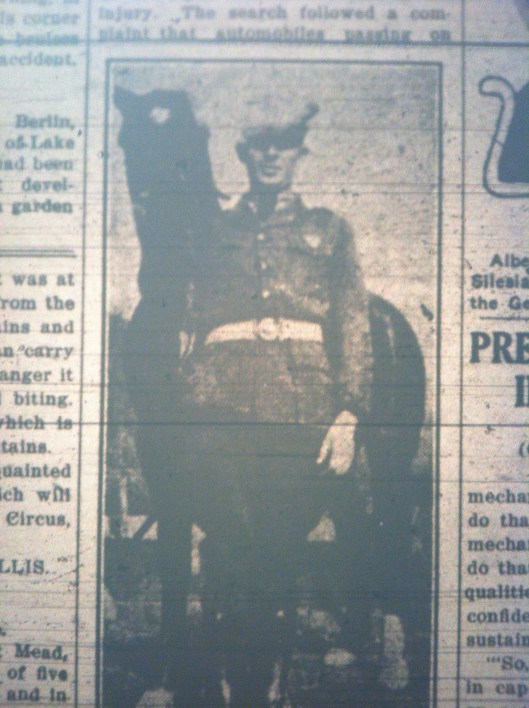
TROOPER SHOT IN MINGO FRAY
WOUNDED MAN MAY LOSE USE OF ARM AS RESULT OF THE AFFAIR
Trooper James A. Bolles, of Charleston, who was shot June 14 while engaged in searching for arms in the Lick Creek tent colony near Williamson, Mingo county, may lose the use of his right arm as a result of the injury. The search followed a complaint that automobiles passing on the public highway had been fired upon from the tent colony.
A detachment of state police, assisted by some 10 citizens who had volunteered and been sworn in as special state police, went to the camp to seize arms found there in order to prevent further shooting, the identification of any person using his rifle viciously and recklessly being impossible while many of the residents of the colony had arms.
With a party of 15 special state police, Trooper Bolles came upon a group of armed men. He ordered them to put down their weapons but was answered by a number of shots. The trooper and the citizens with him returned the fire with the result that Alexander Breedlove, on of the armed group, was killed.
Shot From Hillside
Some person hidden away on the wooded hillside opened fire and Trooper Bolles was struck in the back, the bullet breaking several bones and severing a number of nerves. Although severely wounded, the state police officer attempted to lift his rifle. He fell to the ground and was guarded by two armed civilians while others attempted vainly to locate the man who had shot him.
When first taken to hospital, Bolles’ chances of recovery appeared slight but the doctors later announced that he would get well but might lose the use of his right arm. The popularity of the injured trooper was such that many citizens of Williamson called upon him daily in the hospital.
20 Saturday Jun 2020
Posted in Big Sandy Valley, Hatfield-McCoy Feud, Music
Tags
Appalachia, banjo, Beech Creek, Early Mahon, genealogy, history, Mingo County, music, photos, Plyant Mahon, Vicie Mahon, Wall Hatfield, West Virginia

Early Mahon (1884-1969), son of Plyant and Vicie (Hatfield) Mahon. Plyant Mahon was a participant of the Hatfield-McCoy Feud. Early was the grandson of Valentine “Wall” Hatfield. The family holds the original photo.
20 Saturday Jun 2020
Tags
Appalachia, Beech Creek, Ben Creek, Big Bottom Fork, Big Creek, Big Fork, Bluff Mountain, Bone Lick Bottom, Breckenridge's Fork, Clear Fork, Coal Branch, Coal River, Cow Creek, Crawley Creek, Crooked Creek, Crooked Run, Defeats Branch, Double Camp Branch, Drew's Creek, Elkhorn Branch, Elkhorn River, Flat Top Mountain, Grapevine Creek, Green Shoal Creek, Guyandotte River, Harts Creek, history, Horsepen Creek, Huff's Creek, Indian Creek, Ingrams Branch, Island Creek, Laurel Creek, Laurel Fork, Lick Branch, Lincoln County, Little Coal River, Little Huffs Creek, Logan County, Marsh Fork, Mate Creek, Middle Fork, Mill Creek, Millers Branch, Mingo County, New River, North Fork, Peach Tree, Peter Huffs Creek, Pigeon Creek, Pine Creek, Pond Fork, Rattlesnake Branch, Rock Creek, Rock House Fork, Rum Creek, Sand Lick Fork, Shannon Branch, Skin Fork, Spruce Fork, Trace Fork, Tug Fork, Turtle Creek, Twelve Pole Creek, Virginia, West Fork, West Virginia, Wolf Pen Creek
The following list of regional place names of streams is derived from Surveyors Record Book A at the Logan County Clerk’s Office in Logan, WV. Each document generally lists three dates for the survey; I chose to identify the earliest (Treasury warrant date) and the latest date (survey completion date). The purpose of this list is to document the earliest usage and spelling of a place name in my region. Logan County was extremely large in the 1820s and has since been partitioned to create new counties, so many of these places are not located in Logan County today. This list will be updated periodically.
Beech, a branch of Tug Fork (24 May 1825, 12 October 1825, p. 64)
Ben (26 July 1826, 13 October 1826, p. 89)
Bend of Guyandotte (30 April 1823, 3 March 1831, p. 129)
Big and Clear Fork of Guyandotte River (1 October 1818, 26 June 1826, p. 79)
Big Bottom Fork of Guyandotte (12 February 1823, 25 October 1827, p. 100)
Big Creek (11 December 1817, 25 October 1824, p. 34)
Big Fork of Guyandotte River (18 July 1825, 17 February 1826, p. 73)
Big Island [Logan] (16 February 1825, 17 January 1827, p. 94)
Bluff Mountain (1 October 1818, 21 February 1825, p. 37)
Bone Lick Bottom, New River (19 January 1824, 31 July 1830, p. 123)
Breckenridge’s forks of Cole River (31 January 1825, 27 February 1827, p. 100)
Buffalo (10 February 1825, 6 February 1827, p. 99)
Coal Branch of Guyandotte River (17 December 1824, 31 March 1825, p. 42)
Cow Creek of Island Creek (13 December 1823, 11 October 1826, p. 87-88)
Crawley (10 June 1824, 8 July 1825, p. 47)
Crawleys Creek (16 February 1825, 17 January 1827, p. 95)
Crooked Creek (16 February 1825, 1 April 1825, p. 43-44)
Defeats Branch on Little Huffs Creek (7 October 1830, 27 July 1831, p. 131)
Double Camp Branch of Clear Fork (1 June 1821, 29 December 1825, p. 69)
Drew’s Creek, one of the forks of Peech Tree, a branch of Marsh Fork of Cole River (22 July 1826, 15 October 1828, p. 109)
Elk, a branch of Guyandotte (14 January 1830, 22 November 1830, p. 127)
Elk, a branch of Pigeon (16 February 1825, 18 August 1825, p. 51)
Elkhorn Branch of Tug Fork (30 April 1825, 12 November 1826, p. 93)
Elkhorn River (30 April 1825, 1 November 1825, p. 65)
Flat Top Mountain (22 November 1824, 14 February 1826, p. 72)
Gilbert (14 January 1830, 26 August 1830, p. 121)
Grapevine, a small branch called Grapevine (8 July 1825, 14 October 1825, p. 63)
Green Shoal Creek (15 March 1826, 10 October 1826, p. 86-87)
Harts Creek (17 February 1824, 10 October 1826, p. 87)
Hewetts Creek, a branch of Spruce Fork of Coal River (20 May 1813, 11 April 1825, p. 44)
Horse Creek (10 February 1825, 22 July 1826, p. 92)
Horsepen Creek, a fork of Gilbert (14 January 1830, 26 August 1830, p. 121)
Huff Creek (11 December 1822, 11 March 1825, p. 40)
Huffs Creek (18 July 1825, 14 March 1828, p. 104-105)
Indian Creek (22 July 1826, 8 February 1827, p. 99)
Ingrams Branch, New River (6 October 1829, 4 December 1829, p. 117)
Island of Guyandotte [Logan] (17 December 1824, 18 January 1827, p. 96)
Island tract [Logan] (4 May 1826, 12 May 1830, p. 120)
Jacks Branch of Clear Fork (6 January 1824, 16 December 1825, p. 66)
Laurel Fork of Guyandotte River (17 February 1824, 27 August 1830, p. 122)
Left Fork of Island Creek (4 February 1817, 28 October 1824, p. 35)
Left Hand Fork of Ben, waters of Tug Fork (13 December 1823, 11 October 1826, p. 88)
Laurel Creek and Crooked Run, New River (10 May 1825, 25 August 1825, p. 56)
Laurel Fork of Pigeon Creek (17 December 1824, 10 October 1826, p. 85)
Laurel Fork of Twelve Pole (3 November 1813, 19 March 1825, p. 40)
Lick Branch (24 May 1825, 10 October 1826, p. 85)
Little Huff’s Creek (4 May 1826, 27 May 1829, p. 116)
Loop of New River (20 February 1821, 26 February 1825, p. 90)
Main Right Hand Fork of Big Creek (24 May 1825, 8 September 1825, p. 54)
Marsh Fork of Cole River (17 February 1823, 9 March 1825, p. 39)
Marshes of Cole River (30 April 1825, 3 February 1830, p. 118)
Mate, a branch of the Tug Fork of Sandy (8 July 1825, 11 October 1825, p. 62)
Mazzel, Little Huffs Creek (12 February 1825, 18 September 1829, p. 116)
Mill Creek, a branch of Guyandotte (18 July 1825, 28 January 1831, p. 128)
Mill Creek of Island Creek (10 January 1823, 29 October 1824, p. 36)
Millers Branch of Tug Fork (4 May 1826, 16 September 1826, p. 81)
North Branch of Big Creek (18 July 1825, 7 September 1825, p. 52-53)
North Fork of Big Creek (4 April 1825, 9 September 1825, p. 54)
Old Island survey [Logan] (22 July 1826, 17 January 1827, p. 95)
Peach Tree, a small branch called the Peach Tree (24 May 1824, 7 October 1825, p. 60)
Pete Huff’s Creek (18 July 1825, 27 August 1830, p. 125)
Peter Huffs Creek (13 December 1823, 12 November 1825, p. 66)
Pigeon Creek (16 February 1825, 15 October 1825, p. 63)
Pine Creek of Island Creek (4 February 1817, 27 October 1824, p. 35)
Pond Fork of Cole River (8 March 1826, 13 November 1828, p. 112-113)
Rock Creek (22 July 1826, 11 August 1828, p. 106)
Rock House Fork of Middle Fork of Island Creek (17 February 1824, 5 October 1825, p. 59)
Rock House Fork of Pigeon (6 February 1825, 22 March 1825, p. 41)
Rum Creek (23 November 1824, 17 July 1828, p. 105)
Sand Lick Fork of Cole River (14 May 1826, 31 January 1827, p. 97)
Shannon branches, Tug Fork (6 December 1828, 2 September 1830, p. 125-126)
Skin Fork of Cole River (12 February 1825, 29 October 1828, p. 111)
Spruce Fork of Coal River (16 February 1825, 22 April 1825, p. 45)
Tonies Fork of Big Cole and Horse Creek (10 February 1825, 22 July 1826, p. 92)
Trace Fork of Big Creek (16 February 1825, 8 September 1825, p. 52)
Tug Fork of Sandy River (10 March 1825, 24 March 1825, p. 42)
Turtle Creek, a branch of Little Coal River (13 December 1824, 12 April 1825, p. 45)
West Fork of Cole River (12 February 1825, 10 November 1828, p. 111-112)
Wolf Pen Creek, branch of New River (10 May 1825, 25 August 1825, p. 56)
Wolf Pen Creek at mouth of Rattlesnake Branch (10 February 1825, 11 January 1826, p. 71)
19 Tuesday May 2020
Posted in Matewan

The menu is perfect for locals and tourists! 15 June 2018

Open! 6 July 2019
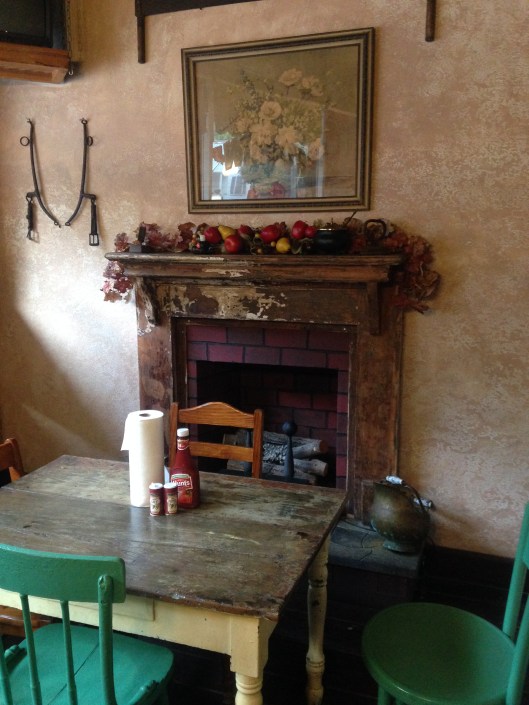
This is my preferred table. 6 July 2019
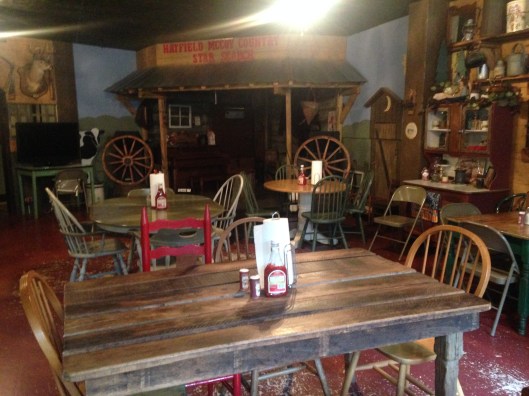
Lots of seating with great ambiance…and a performing area (“Hatfield-McCoy Star Search”) in the corner! 6 July 2019

Hatfield-McCoy-themed displays are prominent on this side of the restaurant. 6 July 2019

Hatfield-McCoy Bluegrass Festival Sign. 6 July 2019

This is my preferred meal at Wingo’s… 6 July 2019

One dessert option… 6 July 2019

My usual dessert option… 6 May 2015

Support this business and these great people! 13 September 2014
22 Sunday Mar 2020
Posted in Big Sandy Valley
Tags
Appalachia, Beech Creek, Big Sandy River, Devon, history, Kentucky, Mingo County, photos, Tug Fork, West Virginia
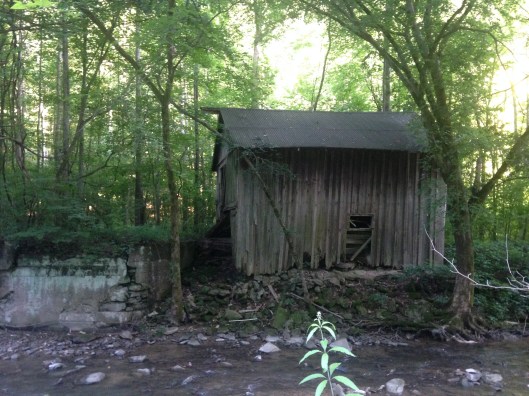
Here’s a beautiful old landmark. Devon, Mingo County, WV. 12 July 2019

This way to the Tug Fork. Devon, Mingo County, WV. 12 July 2019

Mouth of Beech Creek in Devon, Mingo County, WV. 12 July 2019

That’s Kentucky across the river! Devon, Mingo County, WV. 12 July 2019
17 Tuesday Mar 2020
Tags
Appalachia, crime, farming, genealogy, Gilbert Creek, H.E. Ellis, history, James E. McDonald, James Stimpson, Joseph Bragg, justice of the peace, Logan, Logan County, Logan County Banner, logging, M.A. Hatfield, merchant, Mingo County, timbering, West Virginia, William Johnson
From the Logan County Banner of Logan, WV, come these items about Gilbert in present-day Mingo County, WV, dated 1894:
On yesterday William Johnson lodged James Stimpson and Joseph Bragg in jail here. They were sent on for further trial by Justice M.A. Hatfield, on a charge of breaking into the store of H.E. Ellis, on Gilbert creek. The boys confessed to the offense.
Logan County Banner (Logan, WV), 24 May 1894
***
From Waco, written on July 7, 1894 from Gilbert:
EDITOR BANNER: Farmers are very busy with their crops. Corn is looking as well as could be expected. Oats in most cases are promising.
Two or three applications have been made for our school, but it is thought that Prof. James E. McDonald will teach it.
That log tide which failed to materialize makes it hard on taxpayers and merchants.
Logan County Banner (Logan, WV), 12 July 1894
04 Wednesday Mar 2020
Posted in Hatfield-McCoy Feud
Tags
Ambrose Mullins, Appalachia, feud, feuds, Hatfield-McCoy Feud, history, Levisa Hatfield, Logan County, Mingo County, moonshine, moonshining, Vicy Hatfield, West Virginia
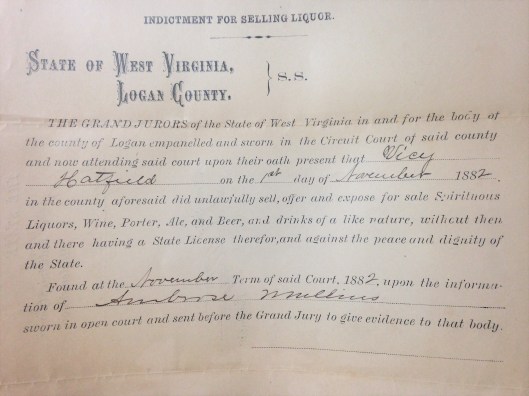
Levisa “Vicy” Hatfield indictment for selling spirituous liquors based upon information by Ambrose Mullins, Logan County, WV, 1882.
03 Tuesday Mar 2020
Posted in Coal, Williamson
Tags
Appalachia, coal, David Fowler, history, Logan Banner, Logan County, Mingo County, United Mine Workers of America, West Virginia, Williamson
From the Logan Banner of Logan, WV, comes this bit of news relating to coal miners on strike in Mingo County, dated March 31, 1922:
Mine Workers Cut Mingo Miners’ Wage
Will Reduce Strike Benefits to $3 to Men in Mingo Field, According to Letter
WANT AND FAMINE SURE TO INCREASE RAPIDLY
Fight Has Been a Losing One for Many Weeks and as Big Strike Looms Further Aid is Gone
The miners who have been fighting and striking in Mingo county for recognition of the union have just received word that their schedule of relief had been cut to $3 a week which would show that their fight has been a losing one.
This long story of suffering, want and privation in Mingo county will now be added to with additional misery, for the coming strike cannot be reckoned in days. Surely we of Logan county should be glad of the fact that our miners are working with their employers and not against them, and the first man who would suggest the Mingo conditions as better than the ones we are now enjoying should be properly dealt with by his fellow workers who are sure of year around employment at good wages to the $3 a week or less that is given to the strikers in Mingo. Surely the union officials will realize some day the suffering their greed is causing and stop this movement toward anarchy.
The following is the letter sent to miners on strike in Mingo county:
Williamson, W.Va., Mar. 20, 1922
Dear Sir and Brother:–
As you well know the drain upon the International Treasury for sometime has been very great. Notwithstanding that we have continued to supply the miners of Mingo county with a very liberal amount of relief. The amount of relief issued in the Williamson field has been greater than that in any strike in the history of the organization. The miners have been working on slack time throughout the country and on March 31, 1922, the present working agreement will expire and the miners of Mingo county will be standing side by side with the other miners of the country. The other miners of the country have given you more consideration than they have given themselves and are still willing to give further consideration through the long duration of your strike.
It will require a considerable amount of money to carry on negotiations so that it will be necessary for us to reduce the relief at this time.
I am therefore advising you that beginning with the week of March 27th, the schedule of relief will be men $3, women $1, child 50 cents a week. I am not sure that I can continue to pay even this amount if the general suspense of mining should last any length of time. However the miners of this country will do the best they can and continue to send in the liberal relief amount as long as possible.
With every good wish, I am,
Very truly yours,
DAVID FOWLER
International representative and financial agent
United Mine Workers of America
08 Saturday Feb 2020
Posted in Hatfield-McCoy Feud, Logan
Tags
Appalachia, Delorme, Democratic Party, Devil Anse Hatfield, Evaline Marie Hatfield, genealogy, Grace Ferrell, history, Huntington Business College, Island Creek, Joe D. Hatfield Jr., Joe Hatfield, Levisa Hatfield, Logan Banner, Logan County, Marshall College, Mingo County, politics, Republican Party, sheriff, Stirrat, teacher, Tennis Hatfield, Tug River, West Virginia
From the Logan Banner of Logan, WV, comes this bit of political history dated December 13, 1927:

J.D. Hatfield Announces Candidacy For Sheriff
Native Son Will Ask for Republican Nomination in May Primary–That He Would Enter Race Was Expected, and That He Possesses Unusual Political Strength Is Undisputed
Joe Hatfield will be a candidate for the Republican nomination for sheriff in the primary election May 29.
That announcement will doubtless arouse tremendous interest but will create little surprise. For many months the public has expected that at a seasonable time his hat would be quietly tossed into the ring and remain there until the voters had registered their approval or disapproval. Having determined upon a course of action, he will go straight ahead.
Born and reared in Logan county, in love with its every stream and mountain, hoping and expecting to spend the remainder of his life amid the rugged hills to which his ancestors were lured by fate a century ago, he says he has long had an ambition to serve as sheriff of the county beloved of his kith and kin.
The statement that he was born in this county calls for this qualification: Joe Davis Hatfield was born at Delorme, on Tug River, then in Logan county but now in Mingo. That was 44 years ago. Except for a period at Huntington Business College and a year (1903-4) at Marshall College, he has lived hereabouts and his life is an open book. He attended country school on Island Creek and had some experience as a relief teacher, though at no time did he ever consider that his vocation. He is a brother of Sheriff Tennis Hatfield and a son of the late Captain Anse Hatfield and Lovisa Chafin Hatfield–their fourth youngest child, Tennis being the youngest.
Joe was married in 1917 to Grace Ferrell of a Mingo county family and is the father of two children, Evaline Marie, aged eight, and Joe D., Jr., aged five.
His fraternal affiliation are limited to the Elks and the Modern Woodmen of America.
In commenting on his announcement, Mr. Hatfield said, “I’m not running for the office solely for the honor and rewards it might bring, but also because I believe I can fill it in a way that my children and friends will be proud of. I want to give the people a square deal for their sake and mine–why should a man in an important office like that want to do less? I expect to be nominated, but if not I’ll do my part for the man who beats me; and when nominated I’ll plan to wage an active and winning campaign. Besides my experience and observation have given me some ideas about what a sheriff can and should do and I’ll probably discuss these with friends and perhaps in the papers at the proper time.”
Republican Stronghold
It is not The Banner’s purpose to espouse any man’s candidacy before the primary, yet there is no hesitancy in saying here and now that Joe Hatfield will be regarded by voters of all parties as a formidable candidate for the nomination. Quiet, suave, friendly, neat and attractive in appearance, on intimate terms with hundreds and even thousands of voters in the county, the scion of a prominent pioneer family, his strength is obvious to the humblest citizens as well as those trained in politics. And while on the subject of politics, let it be recalled that Stirrat, Hatfield’s precinct, was the banner Republican precinct in the county in 1926. The Republican vote varied from 310 to 312 for the different candidates; the Democratic vote from 54 to 58. The precinct won a flag for the largest registration of Republican voters before the primary and won a silver cup for the largest Republican vote in the election, the prizes having been offered by the county committee. Incidentally, that feat was credited largely to Joe Hatfield and brought the first prophecy the writer heard that he would be the next sheriff of Logan county.
13 Friday Dec 2019
Posted in Coal, Hungarian-American History, Huntington, Inez, Logan, Music, Williamson
Tags
Appalachia, Beauty, Charleston, Cinder Bottom, coal, crime, dancing, Elizabeth Nagy, Ellis Park, Emmett Scaggs, Himlerville, history, Hungarian Benevolent Association, Hungarian Miners' Journal, Hungarian-Americans, Hungarians, Huntington, Joe Hatfield, Kentucky, Keystone, Logan, Logan Banner, Logan County, Martin County, McDowell County, Mingo County, Mud Fork, Rose Mustapha, Warfield, Welch, West Virginia, Williamson, Williamson Daily News
Between 1900 and 1920, a large number of Hungarians settled in West Virginia. Most were employed as coal miners. As of 1920, 6,260 Hungarians lived in West Virginia, primarily in Logan and McDowell counties. The Logan Banner, seated in Logan, WV, offered coverage of Hungarian news. It also commented on items published by Martin Himler in the Hungarian Miners’ Journal.
New Marathon Dance Record Is Made Here
Rose Mustapha, Pretty Hungarian Starts the Step Believed to Be the record.
At nigh noon Sunday, Rose Mustapha, a beautiful Hungarian girl, tripped the starting step in a terpsichorean debauch, that is believed to have established a record for sustained dancing in groups. Rose led a cotillion of thirty of her countrymen over a stretch of nineteen hours of continual dancing.
The dance started at twelve o’clock Sunday noon and continued without intermission till seven o’clock Monday morning. The jolly spirit of old Budapest struck color with jazz hilarity as the dancers spun in a vortez over the polished floor.
Hundreds of the dancers’ admirers rimmed the floor, hailing the participants in a half dozen different languages and dialects. Three wheezy but quite animated violins provided the music, which ran in wild Magyar strains and jazzy syncopation.
For the most part the dancers adhered to their native folk dances, but occasionally a couple would break into a fox trot, or a one step. At six o’clock Sunday evening, the dancers were given liquid nourishment as they whirled, and at midnight the same was repeated.
Most of the dancers finished strong, but several of the weaker sex had to be helped from the floor by their friends. Long distance dancing is quite common in their native land, and had the participants been in trim the task would have been comparatively easy, they say. As it was all of the men, who are miners, reported for work Monday morning and so far no ill results have been reported of the affair.
Logan (WV) Banner, 3 August 1923
***
Hungarian Dance
Several hundred persons enjoyed the dance given by the Hungarian Benevolent Association at Ellis Park skating rink last Saturday night. The program included many attractive features and novelties. Miss Elizabeth Nagy of Mud Fork was the winner of the beauty prize. She received a fine watch and $5 in gold.
Logan (WV) Banner, 29 November 1927
***
Hungarian Paper Tells of Resorts Hereabouts
Sensational Charges Prompt Williamson News to Demand Investigation and “Clean-Up”–Logan and Neighboring Cities Are Mentioned In This Alleged Expose
A Hungarian paper published at Himlerville, Ky., not far from Williamson, is running a series of sensational articles on vice conditions in Logan, Williamson, Huntington and Charleston. These articles are printed both in English and Hungarian and are attracting much attention, many copies of the paper having been sent to the cities named.
Two articles about Logan have mentioned various resorts in which it is charged that vice is rampant, that protection is obtained by bribery of officials, and that conditions are getting worse. Local officers brand these so-called disclosures as either baseless or greatly exaggerated.
In Williamson the expose has attracted much attention, particularly since the Williamson Daily News carried the following editorial, under the heading, “A Clean City.”
It’s a sad commentary on our city, county, and state police officials when the leaders of the foreign element in our midst are forced to take the lead in cleaning up moral conditions.
Through the Hungarian paper published at Himlerville, Ky., a campaign is being waged to clean up Williamson, Logan, Huntington and Charleston.
We are primarily concerned in Williamson and this paper charges that Williamson is harboring not less than eleven Hungarian brothels and some fifteen speak-easies. The editor of the paper has furnished the Williamson Daily News with the names of eight hotels and rooming houses where he says “light o’ love ladies” may be found.
It is common knowledge in Williamson that what he charges is true. Furthermore it is also common knowledge that there is hardly a hotel from the best to the worst in the city that does not harbor women of prostitution.
These women are debauching our manhood and spreading disease and there are attendant demoralizing evils which add to the indictment against them.
Not only are there Hungarian brothels in Williamson, but there are brothels that cater to every race and condition. The fact that they exist is known to practically every person in Williamson.
In this same Himlerville paper in an article published in this week’s issue it is stated that “Protection fees vary between twenty-five and seventy-five dollars weekly” suggesting a reason why no action is taken to remedy conditions.
We have had every reason to believe that Williamson was infested with brothels of every degree of degradation, but until the bold statement is made in the Hungarian paper, we had no reason to suspect that some persons were receiving protection fees.
However, such a state of things is a natural noncomitant, in view of the laws of the land. It would be very easy for city, state or county officers to take action, and if they do not the question immediately arises: Why?
It cannot be argued that it is impossible to clean up the city in this respect. We all know better. The chief of police and four good policemen, with proper backing of the mayor and the citizens of Williamson could do the job, and do it thoroughly in ten days. In doing it they could be so impressively earnest that there would be no recurrence of the evil for months to come. If instances of violations of the law of this character did occur in the future they could enforce the law with such vigor as to deter others. Williamson would soon be classed as a “clean city.”
Even the notorious “Cinder Bottom” at Keystone has been cleaned up. Welch, the county seat of McDowell county, is known far and wide as a “clean city.” Chippies and their like give it a wide berth. Why? Because the mayor and the chief of police of Welch, with a determined citizenship back of them, will not tolerate the evil. Merchants and business men of Welch generally are unreservedly in favor of an absolute ban against women of evil character being allowed to remain in hotels and rooming houses, because they know it hurts business and is a thoroughly demoralizing factor.
Primarily the question is one for the mayor and the chief of police at Williamson to handle, but there are other law enforcement agencies that could function.
For instance, the prosecuting attorney has an effective weapon at hand if he wants to use it. We refer to the state padlock law, upheld by the supreme court. With this weapon he could close every hotel and rooming house in the city that harbored women of ill fame. And there would be no question of securing sufficient evidence to act. It is ready at hand.
There is another agency, the state police. This efficient body of men could take action and bring the matter to a hand.
The state health department is aware of the fact that Williamson is one of the vilest cities in the way of brothels in the state. It has investigated conditions here and has data that could be used by officials who wanted to take action. Furthermore the state health department, on request of the city or county officials, would send investigators here to ascertain true conditions. But, if we understand the situation rightly there is no need for further investigation. The brothels are conducted more or less openly, are well advertised and unfortunately are well patronized.
There would be no lack of information to proceed upon if city, county or state officials wanted to take action. And first of all, it is up to our city officials to act.
Logan (WV) Banner, 27 January 1928
***
NOTICE TO LOGAN
With newly sharpened sticks the Hungarian Miners Journal, published at Himlerville, Ky., continues to prod into vice conditions hereabouts. Its latest issue is devoted largely to a further exposure at Williamson’s intrenched vice, but Logan has not been forgotten. In fact, in a large type box on the first page notice is given that the spotlight will be turned again soon on the garden spot. It says:
“The brother-situation of Williamson is taking up all our space and our energies for a few days.
“This does not mean that we have nothing more to say about Logan brothels.
“A score of Hungarian criminals, keepers of brothels and white-slavers are harbored in and by Logan, to the great detriment of the decent Hungarians in the Logan field.
“We demand the expulsion of these criminals and we will turn to Logan in a very short time.
“Surely the decent citizens of Logan are not going to build a roof over their town to designate THE red-light district.”
Logan (WV) Banner, 3 February 1928
***
Hungarian Paper Reverts to Logan’s Need of Reformation
Editor Fisher Takes Crack at The Banner, Sheriff Hatfield and Chief Scaggs–Long Silence Broken By Familiar, Rasping Outcry
Remember the Magyar Banyaszlap, a newspaper formerly published at Warfield, Ky., not far from Williamson, W.Va. A year or more ago it probed conditions in Logan and carried some sensational strictures about county and city officials. Finally, an officious and offensively inquisitive soul, the editor hisself, came in person and before he left was given quite a thumping by Chief of Police Scaggs.
Some time later the coal company located at Warfield and Hungarian-owned, went into the hands of a receiver and whether the Banyaszlap then suspended publication or not it ceased to come to this office. The other day a copy came. It is published in Columbus now but its editor is evidently still interested in conditions here. After scanning its eight pages, the writer of these lines found but one article printed in English. That embraced a clipping from The Banner and the Banyaszlap’s comments thereupon. The article clipped appeared to the Banner on April 9 and had to do with reports that the sheriff’s forces were determined to suppress the liquor traffic in boarding and lodging houses that cater to foreign-born miners. Most Banner readers will recall that news item and for that reason it will not be reproduced here, but what the Columbus paper says may be of some interest.
“We are glad to note the sudden interest of Sheriff Hatfield, and the rather mild interest of the Logan Banner, in the speak-easyes.
“The officers do not have to ‘trail’ these boarding houses, for we have published a list of them.
“And we have also published a long-long list of speak-easyes and brothels in Logan, W.Va., with addresses, and names, with locations and any other needed informations.
“Why not start a housecleaning right here in Logan, W.Va., and spread it then to the coal field?
“We can promise Logan and its vicinity that others than the sheriff will also be interested in these affairs.
“When the gunman (called chief of police) of Logan so heroically objected to our articles, we have promised that we will have the matter attended to in good time.
“It will happen soon.
“Perhaps hence the sudden interest in the Logan vice.”
Logan (WV) Banner, 23 April 1929
***
For more information about Hungarians in West Virginia, go here: https://www.appalachianhistory.net/2017/03/magyars-in-morgantown.html
For more information about Martin Himler, Himlerville (Beauty), and the Magyar Banyaszlap: Hungarian Miners’ Journal, go here: https://www.appalachianhistory.net/2014/11/saving-himler-house.html
31 Thursday Oct 2019
Posted in Coal, Matewan, Williamson
Tags
Appalachia, Baldwin-Felts Agency, Bluefield, Cabell Testerman, Carleton Starr, Chambers Hardware Store, chief of police, Clara Berman, coal, crime, Harry Berman, history, Matewan, mayor, Mine Wars, Mingo County, Sid Hatfield, teacher, United Mine Workers of America, Welch, West Virginia, Williamson
On December 2, 1978, Harry Berman of Williamson, Mingo County, West Virginia, recalled the Matewan Massacre of May 19, 1920:
When do you remember that the union… What do you remember about the organization of the unions?
Well, that was in Matewan. I was at the age of about thirteen years old at that time. That was about 1915, I’d say. This was concerning the miners there, about a strike. They all got together and so they went on a strike, and the company has ordered the people that went on a strike. The company has ordered them to vacate their homes.
That was the company houses?
That was the company houses. The miners at that time, they didn’t approve of it and so they began to gather around. So they got Baldwin-Felts men in there. There as about twelve of them from Bluefield, West Virginia. So they came in on that midnight train that comes through there about twelve.
The Baldwin-Felts gang was a gang that broke the unions. They traveled all over the state or throughout the coalfields breaking the unions.
Well, they were trying to break the union at that time, but these twelve men were sent in here from Bluefield and they came in on the twelve o’clock train and they went over to the hotel. They spent the night there and the next morning they got up and out and they vacated more houses for these men. This kindly upset the union men at that time. So anyway then when after all that was all done they all went back again to the hotel, and so they packed their bags. Unfortunately, what they done, they took their rifles, they took them apart, and they packed them on the inside of their bags and some of them packed them on the outside of their bags.
In other words, they were going to show that they were leaving in peace?
Yeah.
After vacating people from their company houses?
Yeah. That was about the time… Let’s see, the train comes through there, that Number 16, it comes through there about five o’clock in the evening. So they all came to the station at that time. When they all got to the station, all the union men–there must have been at least 100 of them–all gathered around them. You know, as they came to the station. Well, I was standing there in front of the door, in front of my father’s store there at that time, and watched all these people coming to the station. So, they all went the other way–that was Chambers Hardware at that time–they went toward Chambers Hardware. When they all got there, they all bunched together.
Was that the union men bunching together?
That was the union men that bunched together there around the Baldwin-Felts men, because I don’t think the Baldwin-Felts men suspected anything at all. If they did, they would have went there with their rifles, see.
In other words, you think they were surprised with an ambush?
Yeah, they were surprised. It took them by surprise.
The whole, as I understand it, the whole Baldwin gang was shot on the platform as they were getting ready to board the train?
Well, before the train came in. That was about maybe fifteen minutes before the train came in through there, see. So the mayor of the town was Testerman. He went along with them to the Baldwin-Felts men down in there and also with the union men and they all bunched around Chambers Hardware Store. Then the chief of police–he was also in the crowd, too. Just for the curiosity I went right along with them. Sid Hatfield, I knew him pretty well. So when he was standing there with Testerman, which is the mayor. Facing one another, I was standing about maybe two feet in the back of Sid Hatfield, and all at once there was a shot fired and I think he was the one who put a bullet through Testerman.
The mayor?
Yeah. The mayor. And then that was what started all this shooting. So the first thing I knew I got scared and I beat it back to the store again, see, and while I was going back to the store there was one man laying across the broadwalk. At that time there wasn’t any…
Boards for a sidewalk?
Yeah. The boards were made out of sidewalks. One was scattered there. One was laying here, one was over there. And the first thing you know, then they began to get out and try to get away from them, if they could, you know, see. But the first thing I knew, there must have been at least maybe about eight or ten of them laying around on the ground there.
Bullets went over your head. Remember the bullets that were shot over your head?
Oh, there was bullets everywhere at that time. I really do recall that. That’s a fact. Then after Sixteen came in, the union men, the conductor got off. Which he was a tough conductor, too, he was. They called him McCullock. A captain McCullock at that time. So he got off of the train and he wanted to know what it was all about. And then union men all went into the train. When all the passengers on the train came off you know, the union men went in there and they were searching the train because they figured that some of these detectives stopped Sixteen down there just on this side of the tunnel. To see if any did get on there. Because they said there was about…
In other words, they expected more of the gang to come in?
No. Some of these that did get away from the union men… They thought about two or three of them went down toward the tunnel to stop the train to get on. So that’s what they expected, you know.
The union breakers?
Yeah, the union breakers, and so when the train came in to the station they rushed into the train and they looked all through the compartments. Under the seats and everywhere and there wasn’t no union men on there.
Strike breakers?
Yeah. There wasn’t any detectives on there at all. In the meantime, I think there was about maybe one got away, from what I understand. He was hid in a coal pile. Mrs. Hoskins, a school teacher, hid him in a coal pile and she didn’t say anything about him at all. She must have felt sorry for him or something. And I think he got away. He really did… He got away, from what I understand. So that was it and so when Sixteen came in they put Testerman on the baggage car and before he got to Welch he died.
They killed him.
Yeah. Well, they killed him, naturally.
In other words, he left here alive but they killed him before he got to the hospital?
Yeah. He died in the baggage car. Testerman died in the baggage car.
But the chief of police’s family killed him because the chief of police had been shot?
No. The chief of police wasn’t shot. Let’s get it straight. The mayor is the one who got shot. The chief of police is the one who shot the mayor.
19 Thursday Sep 2019
Posted in Big Sandy Valley, Timber, Twelve Pole Creek
Tags
Appalachia, Big Sandy River, Bragg Creek, Fort Gay, history, Horse Creek, Kenova, logging, Mingo County, Naugatuck, Ohio River, pushboats, rafting, steamboats, timber, timbering, Tom Brown, Tug Fork, Twelve Pole Creek, Wayne County, West Virginia
The following interview excerpt of Tom Brown (born c.1909) was conducted at Fort Gay in Wayne County, WV, on December 15, 1979.
***
It was probably hard to get around back then, to go to church.
Well the only way you could get around through this country was up and down creeks or on horseback or wagon. And roads were in the creek most of the way. And where they cut timber and logs they had tram roads built back in the heads of the hollows and they had tracks–they built their track out of 2″ X 4″s–and they hauled these logs or ties from the mills back to the heads of the hollows back to the railroads. And they logged out of the mountains and they ran lots of rafts down Tug River. I’ve see high as four to five. They started the rafts running in the spring. They run them out of Mingo County and generally a lot of them was set out in Naugatuck.
That’s how they got them, they used rafts and boats?
Yes, they used rafts. Logs. They’d put these logs together… Sometimes a raft would be maybe 200 or 300 feet long.
200 or 300 feet long?
Almost as wide as the river. The man would stay on that and they’d pull the men to, I guess, Kenova and the Ohio River down here. And they would log them through the winter. The spring waters came and they started down the rivers with the rafts. The river banks were all cut clean.
That’s what I was going to ask you about. They had to be cut clean, didn’t they?
Yes, they was all cut clean. But the rafts… Well they ran logs down Twelve Pole Creek to… Back then people used to put their logs in the creek when it would raise and run them plumb out down Twelve Pole to Kenova. Heads of these creeks… And sometimes I can remember Bragg Creek and Horse Creek… They was a sawmill. There was locks in at Saltpeter and they pushed just like water to Bragg Creek. I’d say along 1916-1917. And almost the travel was boats. It went down on a little showboat. It used to come up an old paddle wheel boat.
That was in about 1917?
About 1917, ’18, ’19, along that.
Could you get a ride on that showboat if you wanted to?
No, they just pulled in and parked and had a show every night, like the picture show, the movie picture show had.
How long did that showboat go up and down the river? How many years did that last?
Well, I don’t know. It would just come up every once in a while maybe, and just stopped at certain places maybe. Places you know at that time… That was about as far as it could get up. And then things was brought up on pushboat. They loaded ties and stuff like that. I remember them loading them on the boat at the river at the mouth of Horse Creek. It was about as far as boats could come up the river.
10 Saturday Aug 2019
Tags
Appalachia, Bert Curry, Catlettsburg, coal, Cole and Crane Company, Delbarton, Elk Creek, Henry Ferrell, history, Holden, Island Creek, Island Creek Coal Company, Lando Mines, Lenore, logging, Louisa, Mingo County, Mud Fork, Pigeon Creek, rafting, Rock House, splash dams, timber, timbering, Trace Fork, Tug Fork, Wallace Curry, West Virginia
The following interview excerpt of Bert Curry (born c.1901) was conducted at Lenore in Mingo County, WV, on December 5, 1978.
***
How much money was around back then?
The first public works to come into the Pigeon Creek areas was when Cole and Crane come in to cut all of this virgin timber. All of Pigeon Creek. They built a splash dam at Delbarton, one on Elk Creek, and one on Rock House. They come in here in 1910 and they paid seventy-five cents a day and board for a man to work and he worked from daylight til dark and along later some of their best men, their team drivers… Team drivers had to work extra hours. They’d put them on by the month. I remember my brother-in-law got $35 a month, but he’d have to get up at 4 o’clock in the morning and then after supper he’d have to go out and clean the stable and curry his team and doctor ‘em, anything that had to be doctored and feed ‘em and bed ‘em down of the night.
Where did people get most of their income in those days?
If you had a job it was usually helping somebody cut timber. My first job was fifty cents a day carrying water for seventeen men and I was about twelve or thirteen years old.
Was that for loggers?
Well, these was loggers but my brother Wallace had a big field of corn. He had to grow corn to feed his cattle. He had six yokes of cattle and he used cattle in logging and he’d take a big flour barrel full of corn and them cattle would get around and he’d feed that corn to ‘em. They’d eat a barrel of corn each night and they’d let ‘em… Maybe a little fodder, or once in a while in bad weather they’d give ‘em a little hay. But them cattle, they worked ‘em six days a week haulin’ logs. They was trained to work and them six yokes of cattle was worth more than you could get for… You could buy a beef for $25 at that time but if you bought a good oxen that was broke you’d have to give about $50 for him.
What do you remember about the logging operations?
They was very primitive. They had nothin’ like a chain saw. They had a cross cut saw and they had axes and they had cane hooks and they had their teams of oxen and then some had teams of mules and horses. When Cole and Crane come in here they contracted all the cuttin’ of this timber. All the haulin’ it and puttin’ it into the creeks where the waters from the dams would take care of it. They had several contractors. They’d contract a whole boundary, maybe 500 or 1000 acres of timber to cut, and it was all virgin timber. It took six yoke of oxen or two to three big span of mules or horses to pull a tree. They didn’t cut it up into logs like they do now. They cut the whole tree and they didn’t take anything less than 16 inches up to the top. They’d be from 5 to 7 feet down where they cut them off and some of them would be 100 feet long and I’ve seen gorges of logs in Pigeon Creek they claimed had 5,000 trees in it. For a mile it’d be piled up bank to bank as high as they could pile. They’d work sometimes with all the teams they could get around them for three weeks a breaking one gorge. And when they got it to the Tug, they’d raft it. Sometimes they’d raft them and sometimes they would drift them down to the locks at Louisa before they’d raft them and they never went past there. They’d raft them there and then take tug boats and haul them from there to Cincinnati.
How did you raft them? I’m not familiar with that.
They had what you call chain dogs, a little chain about that long (indicates about 12 inches) with a spike on each end. They’d drive a spike in this log here and in this log (indicates two logs laying side by side) to hold it together, one at the front and one at the back, and they’d be oh maybe they’d be 50 feet wide and two or three hundred feet long, the rafts would. Maybe they’d have two or three rafts. One steamboat would be pullin’ maybe two or three rafts.
The logs wouldn’t drift apart?
They’d drive them spikes. Them spikes was about that long (indicating about six inches) and they’d drive them in there and it took a whole lot to pull ‘em out.
Did they work in the winter time, too?
Oh yes! I’ve seen fellers wade Pigeon Creek when they mush ice was a floatin’ and when they’d have to get back in the water to thaw before they could walk.
Was the creek deeper then or about like it is now?
It was more even. They had water all the time but they didn’t have as many severe floods as they have now because this was all covered with timbers, all of everything. See, this mulch in these forests held the water and let it leak out. It didn’t run off like it does now.
The water flow was more evened out this year around?
More evened out. But when they’d have a splash dam at Delbarton, one on Rockhouse up at Lando Mines and one in the head of Elk Creek, they’d time these. They’d know how long it took the water to run from Elk Creek, and they knowed how long it took the water to run from Rock House, and they knowed how long it took the water to meet. They’d try to have them all three come out at once so that they’d have a vast big sudden increase in water. You could look up the creek when they’d splash and you could see a wall floatin’ and a turnin’ in and everything.
And that was to wash the logs out?
Yes, well they washed them out to Tug River that way. That’s the way they got them out of Pigeon Creek.
Do you remember when Island Creek first came into the area?
No. Island Creek first come in about 1901. That was over there. They started when two young fellows come from New York in there looking for oil, to prospect for oil, so they could invest some money. And some old man had a mine open right where No. 1 Island Creek mine is and he was a haulin’ coal with a mule—a mule and a sled. He’d go back in there and he’d haul coal out—a big seam of coal six foot high and good and clean. So they decided that there was where they could make their money. So they got to talkin’ with these fellows and they went and got lawyers and they bought around Holden and Trace Fork and up Mud Fork and a vast area. I don’t know how much: 79,000 acres for 470,000 dollars. And fellows like Henry Ferrell, he counted timber so long. To count timber you have men a goin’ through and selecting the trees and one man a tallying. They’d make a mark on a tree when they’d count it, and the fellow with the tally sheet, he kept the numbers. He said they’d count timber a while and said then they had more money than they had brains. To spend that much money for that much land—470,000 dollars—and he said they put up a band mill and cut the timber and sold the timber and built their camps and sold enough lumber to pay for all of it. They got their coal and their land free. Just cut the timber and sold it and got their money back. People thought they were foolish for paying that kind of prices. Buying some of them farms out with all that timber for thousand dollars—that sounded like an awful lot of money. They didn’t have any money. They weren’t used to money. You worked for fifty cents a day. $1000 seemed like a whole lot.
23 Tuesday Jul 2019
Posted in Hatfield-McCoy Feud, Matewan
Tags
Albert Simpkins, Ambrose Guzlin, Anderson Ferrell School, Blackberry Creek, Bob Williams, Charles Carpenter, Coon Branch School, Delorme School, Devil Anse Hatfield, Dials Branch School, Dick Bachtel, education, Elias Hatfield, Elias Hatfield School, Ella Hatfield McCoy, feud, feuds, Hatfield School, Hatfield-McCoy Feud, Head of Blackberry School, Henry D. Hatfield, history, Homer Claude McCoy, Jackson County, Johnnie Rutherford, Kate Ray, Kentucky, Lee Rutherford, Logan County, Mate Creek, Mate Creek School, Matewan, Mike Clingenpeel, Mingo County, Mud Fork, Pharmer McCoy, Pike County, Ransom, Sam Jackson, Scott Justice, teacher, Tolbert McCoy, Tug River, Upper Mate Creek School, W.A. McCoy, West Virginia, Will Bachtel
From “The Rise of Education and the Decline of Feudal Tendencies in the Tug River Valley of West Virginia and Kentucky in Relation to the Hatfield and McCoy Feud” by Homer Claude McCoy (1950):
The following list of school houses are given to determine the location of schools at the time of the feud. Most of the information obtained in regard to the existence of schools and their teachers have been received from interviews. These people were actual students at the schools or had brothers or sisters who went to school there. This information has been verified when possible from different interviews.
Mate Creek School: Mate Creek School was located about a mile up Mate Creek from Matewan which is located at its mouth. It was a log structure and had only one room. The schoolhouse was used during the feud as a prison to retain the three McCoy boys in. David Ross was the teacher of the school during the time of the feud, 1882, just a few days after the boys were held there, and there is a possibility that there was school there before the incident and that David Ross was the teacher.
Upper Mate Creek School: It is believed that there was a school at the head of Mate Creek, but the information is not strong enough to be substantiated.
Coon Branch School: Coon Branch School was located in Kentucky across from the site of Matewan. The teacher of the Coon Branch School was Ambrose Guzlin, and was attending in 1887.
Anderson Ferrell School: This school was located on Anderson Ferrell’s farm a mile below Matewan and came into use when the Mate Creek School was closed about 1883. The teacher of this school was Johnnie Rutherford.
Hatfield School: This school was located on the farm of Elias Hatfield in a hollow behind his home. It was a log structure and came into use when the railroad made it necessary to eliminate the Anderson Ferrell School.
Delorme School: The Delorme school was located near the home of Devil Anse, it was believed, for Charles Carpenter mentioned as a schoolteacher taught in that neighborhood. It is doubtful that there was a school there, for no definite record has been found. Charles Carpenter was said to be a teacher in that locality.
The Dial’s Branch School: This school is not substantiated by any strong evidence as being in operation during the early days of the feud, but was known to exist in the latter days of the feud.
Head of Blackberry School: This was at what is known today as Ransom. This school was some distance (about 15 miles from the mouth of Blackberry). Bob Williams taught school there. Dr. H.D. Hatfield attended school at this school.
Kate Ray who was a teacher at the Elias Hatfield School in 1893, says that she went to school there and when she graduated from the fifth grade she took an examination and taught the next year. She says the examination was not hard, and all the teachers gathered at Williamson. Other teachers that taught there were Albert Simpkins, Dr. Rutherford, Lee Rutherford. Scott Justice taught school at Mud Fork. Mike Clingenpeel was another teacher at Mud Fork.
Mrs. Ray stated:
I went to my first school on Mud Fork in 1888. I was only four years old. They didn’t mind for I didn’t give them any trouble. I learned a little at that age. Lee Curry was the teacher that year. He made improvements in the log school. His first improvement was to put backs on the seats. We did not have any desks or any blackboards. Dick and Will Bachtel also taught school at Mud Fork. They came from Jackson County. They stayed at Sam Jackson’s. They paid about $8.00 a month for board. Scott Justice, now a resident of Huntington, West Virginia, taught school on Mud Fork. So did Mack Clingenpeel. Every one liked Mack. He could explain the lessons so well.
When I was in the fifth grade I went to the Hatfield School below Matewan. When I graduated, I took the teachers examination and taught the next year there at the school on Elias Hatfield’s farm about the year 1895.
Sources:
Derived from these interviews by Mr. McCoy:
Ella Hatfield McCoy interview (she “lived on Blackberry Creek during the time of the feud”) (c.1949)
W.A. McCoy interview (c.1949)
Kate Ray interview (c.1949)
17 Wednesday Jul 2019
Posted in Cemeteries, Hatfield-McCoy Feud
Tags
Appalachia, Brandon Kirk, Ellison Hatfield, Floyd Hatfield, genealogy, Hatfield Cemetery, Hatfield-McCoy Feud, history, Mate Creek, Mingo County, Newtown, Phyllis Kirk, Sarah Hatfield, West Virginia
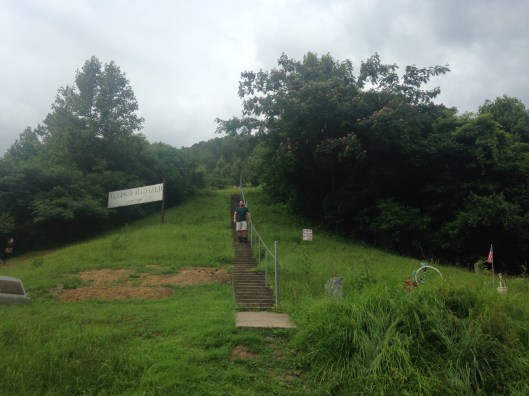
Up this way to the old Hatfield cemetery. Newtown, Mingo County, WV. Photo by Mom. 6 July 2019.

Entering the old Hatfield cemetery. It was a bit weedy! Photo by Mom. 6 July 2019.
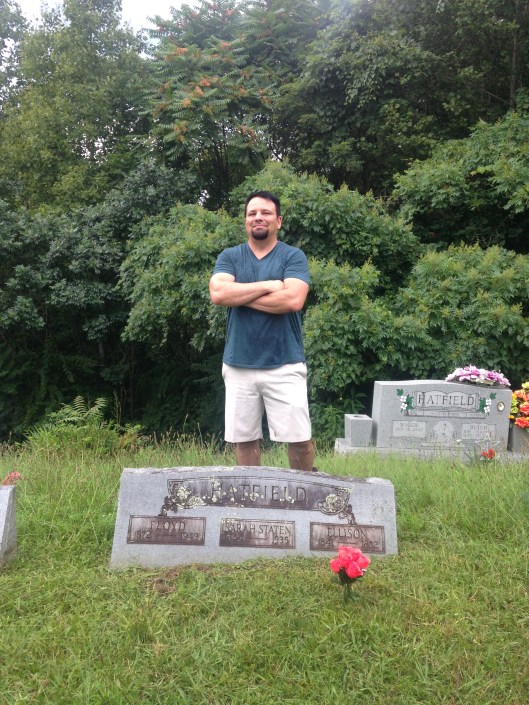
I mowed some of the graves and made sure to place flowers at the grave of Ellison Hatfield. Photo by Mom. 6 July 2019
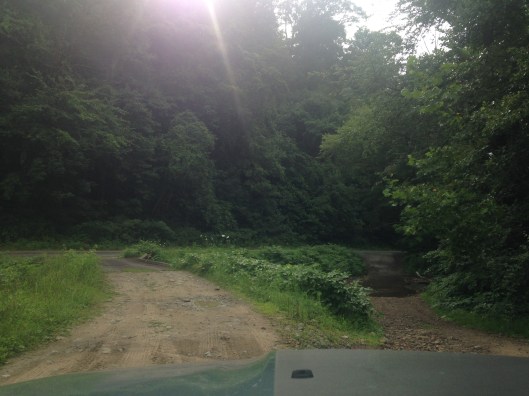
Leaving the cemetery, you can return to the paved road by going left over the bridge or right through Mate Creek. 6 July 2019
15 Monday Jul 2019
Posted in Giles County, Logan, Pecks Mill
Tags
Anna Stuart, Appalachia, Arter White, Battle of New Orleans, Ben White, Betty Radford, Charles White, Editha White, Elijah White, Frank White, Franklin, genealogy, Giles County, Henry Mitchell, Hezekiah Staton, Hiram White, history, Howard White, Indiana, Isaac White, James Buskirk, James Thompson, James White, John Chambers, John Sansom, John White, Judith White, Lark White, Logan, Logan Banner, Logan County, Lucretia Elkins, Major White, Margaret White, Mason White, Maston White, Millard White, Mingo County, Monroe County, Montgomery County, Nancy White, Ohio, Pigeon Creek, Pleasant Chafin, Reuben White, Robert Chambers, Robert Whitt, South Carolina, Susannah Elkins, Susannah Marcum, Thomas White, Viola Ellis, Virginia, Wade Hampton, Wallace White, West Virginia, Will White, William White
From the Logan Banner of Logan, WV, comes this bit of history about the White family in Logan County, West Virginia. The story is dated May 21, 1937.
White Family Among Early Settlers in Logan County
Great Grandfather of Patrolman Frank White Moved From Pecks Mill to Mingo County; His Father Had Settled on Mitchell Farm
Among the pioneer families which settled in and around Logan during the early days of its building from a settlement to a village was the family of John White.
John White came to Logan and settled on the farm later owned by Henry Mitchell with a family of grown men and one daughter. Ben and James had come to Pecks Mill early in the 19th century and built their cabins.
His daughter, Nancy, married Robert Whitt, who afterwards moved to Ohio.
His sons were John, who married Susannah Marcum of Franklin; Ben, who married Anna Stuart of Montgomery; James, who married Lucretia Elkins; and William, who married a daughter of John Sansom, another pioneer of the county.
James, tiring of this section of the country because “hunting was bad”, moved to Mingo county and bought five miles of land on Pigeon Creek for a bear gun and a bear dog.
He reared his family and among his children was John, grandfather of Frank White, city patrolman, Mrs. James Buskirk, Power Plant addition, and Lark, Will, Millard, Howard, Wallace, and Mason, all of Logan.
John was the breadwinner of his family, his father having died not long after his son reached the age of 12. John hunted and filled the soil to take care of his aging mother and several brothers and sisters.
He married Betty Radford, also of Mingo county and was the father of twelve children. They were William, who married Editha White; John, who married Susannah Elkins; Thomas, James, Reuben, Isaac, Charles, Major, Elijah, Hiram, Masten, and Judith, who married James Thompson.
Elijah was the father of the Logan citizens named above. He left Mingo county and came to Logan where he married Viola Ellis.
Thomas, James, and Reuben went to Giles county, Virginia, and Major went to Indiana.
All the others remained in Logan and reared large families.
Ben White was the father of seven children, five sons and two daughters. His sons were John, Arter, Ben, William, and James, and his daughters were Nancy, who married Pleasant Chafin, and Margaret, who married Hezekiah Staton.
James had but one child, a daughter Nancy, who married John Chambers, a son of Robert Chambers of Monroe county.
William, the youngest son, joined the regular army in 1808 and was assigned for duty in a regiment that was being raised by Col. Wade Hampton of South Carolina.
When Hampton was made Brigadier-General in 1806 and assigned to duty at New Orleans, White went with him, and when Hampton was superseded by Wilkinson, White remained with Wilkinson and then under Jackson until after the Battle of New Orleans in which battle he participated.
He returned home in 1816 and married the daughter of John Sansom.
14 Sunday Jul 2019
Posted in Hatfield-McCoy Feud, Meador
Tags
Appalachia, Brandon Kirk, cemeteries, genealogy, Hatfield-McCoy Feud, history, Meador, Meador Cemetery, Mingo County, Nancy Varney, Sarah Jane Mitchell, Tom Mitchell, West Virginia

Heading up to the cemetery. What a rush! 12 July 2019

This cemetery has several names, most commonly Meador, Varney, or Steele Cemetery. 12 July 2019
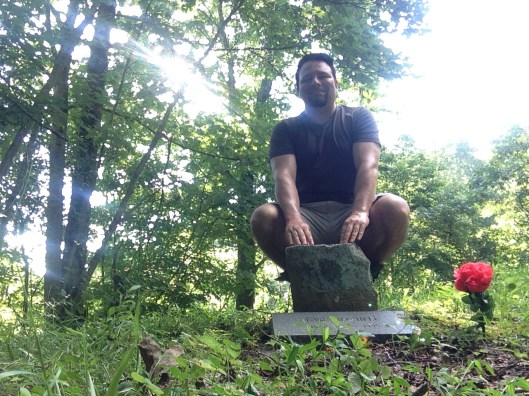
Tom Mitchell is buried to the left just as you enter the cemetery. I made sure to place flowers at his grave. 12 July 2019
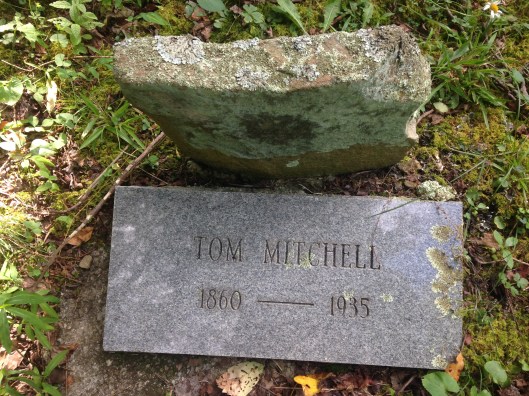
Tom Mitchell (Feb 1865-10/20/1935), son of Sarah Jane Mitchell, married Nancy Varney and fathered at least twelve children. He was a key participant in the Hatfield-McCoy Feud.
23 Sunday Jun 2019
Posted in Big Sandy Valley, Hatfield-McCoy Feud
Tags
Anderson Ferrell, Appalachia, crime, David Ross, education, Ferrell School, feud, feuds, Hatfield-McCoy Feud, history, Homer Claude McCoy, Johnnie Rutherford, Kentucky, Logan County, Mate Creek, Mate Creek School, Mingo County, Nona McCoy, Pike County, Tug Fork, West Virginia, William Anderson McCoy
From “The Rise of Education and the Decline of Feudal Tendencies in the Tug River Valley of West Virginia and Kentucky in Relation to the Hatfield and McCoy Feud” by Homer Claude McCoy (1950):
Appendix A
I attended school in the school house on Mate Creek just a few days after the McCoy boys was taken out and killed. The kettles and pans that they used to cook their grub in was still in the school house yet. This was my first school. This was about 1882. My next school was in the school house on the Anderson Ferrell farm about one mile below Mate Creek on the W.Va. side of Tug River. The teacher of Mate Creek School was David Ross and teacher for the Ferrell School was Johnie Rutheford.
William Anderson McCoy
Dec. 4, 1949
Note: Homer Claude McCoy (b. 1904) was the son of William Anderson and Nona (Jackson) McCoy. William Anderson McCoy was born in 1873 and died in 1960. To see William’s family in the 1880 Logan County, WV, Census, follow this link: https://www.familysearch.org/ark:/61903/3:1:33S7-9YB2-97NB?i=7&cc=1417683
01 Saturday Jun 2019
Posted in Cemeteries, Hatfield-McCoy Feud, Matewan
Tags
Allen Hatfield, Altina Waller, Appalachia, Beckley, Beech Creek, Brandon Kirk, Cap Hatfield, Coleman Hatfield, Delorme, Devil Anse Hatfield, Dutch Hatfield, Ellison Mounts, Ephraim Hatfield, feuds, genealogy, Hatfield Cemetery, Hatfield-McCoy Feud, Henry Hatfield, history, History Channel, Jean Hatfield, Jim Vance, Johnson Hatfield, Levisa Hatfield, Logan Banner, Logan County, Matewan, Mingo County, Nancy Vance, Otis Rice, Randolph McCoy, Red Jacket, Route 44, Sarah Ann, Stirrat, Tennis Hatfield, The Hatfield and McCoy Feud After Kevin Costner, The McCoys: Their Story, The Tale of the Devil, Thomas Dotson, tourism, Truda Williams McCoy, Valentine Wall Hatfield, West Virginia
In 2001-2002, I wrote a series of popular stories for the Logan Banner that merged aspects of well-known Hatfield-McCoy books written by Otis Rice and Altina Waller in the 1980s. I had previously enjoyed Rice’s narrative and Waller’s analysis; I did not conduct any new research. Even though I believed the definitive Hatfield-McCoy Feud book remained unwritten, my purpose in writing these stories was not a step toward writing a book; my purpose in writing these stories was to revisit the narrative with some analysis for Banner readers. My hope was that readers would see what I saw: first, fascinating history (or folk story) for its own sake; second, the power of history to create a popular type of tourism.
I was fortunate during this time to meet Jean Hatfield. Jean, born in 1936, operated a Hatfield family museum at Sarah Ann, WV. Jean was not a native of West Virginia but had lived her entire adult life locally and had personally known several of Anderson Hatfield’s children. I really appreciated her desire to promote regional history. She “got it.” She inspired me. Anytime that I drove up Route 44, I stopped to visit Jean at the museum. She was always welcoming. Knowing her reminded me that every Hatfield (and McCoy) descendant is a source of information–-and that for the most part they have yet to tell the story in their own words. Three notable exceptions include The McCoys: Their Story by Truda Williams McCoy (1976), The Tale of the Devil (2003) by Coleman Hatfield and Bob Spence, and The Hatfield and McCoy Feud After Kevin Costner: Rescuing History (2013) by Thomas Dotson.
What follows is Part 4 of my interview with Jean, which occurred on August 7, 2001:
What kind of house did Johnse have?
Probably just a frame house.
I don’t know much about what he did for a living.
I really don’t know either. There’s not that much on him. Maybe he just spent his time chasing ladies. I don’t even know what type of work he did. But he had to work. He worked for his father, for one thing. But now there’s some of his grandchildren still living. But I’m like you, he’s not as good looking as most of the other boys were. But then when you’re like eighteen years old, everybody’s good looking at eighteen.
I wonder what Devil Anse thought about people taking his photo?
There was just always somebody wanting to take his picture. Now this is by Life magazine. They done a story.
I love the one in his hat.
That’s a very rare one. And the one with the long rifle. Because most of the time in the pictures you see him with his little shotgun. But that has the long rifle. I think that’s the muzzle-loading type.
Not nearly as many photos of Randolph McCoy.
This one here, when we did the McCoy monument, they didn’t have any pictures. We had gathered up quite a few of the McCoys and we made a collage picture and that one was in it. That’s the one mostly you see of him is that one. But I have a couple here somewhere when he was younger but it’s not a very clear copy. But he looks very sad and very old and very sick in that one. But he was like thirteen years older than Grandpa, though.
Did your husband hold any grudges?
No.
Was he raised to?
Oh no. He says on the History Channel tape that he went to school with McCoys and he never did have any animosity towards any of them. In fact, our postmaster down here, she was a McCoy before she married. And she and I get along real good.
So not all of Devil Anse’s brothers were involved in the feud…
Well now, like Wall Hatfield, he wasn’t concerned in it nowhere and they took him before a jury and found him guilty of murder, which he didn’t do. And he died in the pen just not long after he got in because he just couldn’t handle penitentiary life. And he’s buried down under that highway. The highway went over the graves of the prisoners that were buried there. Isn’t that terrible? That’s what the family said. Uncle Allen Hatfield from Beech Creek was one of his children. That’s where that come from.
Where did they bury Ellison Mounts?
I think he’s buried over at Hatfield Cemetery at Matewan. That’s where Grandma and Grandpa’s mother and father is buried. Ephraim. He was buried there.
Are they marked?
Yeah. I think they have a small marker is all. Devil Anse’s father was Big Eph Hatfield and she was Nancy Vance. That’s where Uncle Jim come in at. That was her brother. So that would have been Grandpa’s uncle. He loved Grandpa so well, he would kill for him, that was all there was to it. And Grandpa didn’t have to tell him. He went out on his own and done it. I think that had a lot to do with it. In all that I read, Grandpa’s personality just didn’t seem like he was that type of a person.
Did they ever talk about him doing things like singing or whittling?
He was a joker. Like my mother-in-law said, Tennis had give her a new diamond ring. And she was out helping Grandpa milk the cow and she was showing him her pretty ring and he said, “I’d just soon have a pewter button.” He was always joking with people and things like that. Now my mother-in-law was a very scary person. And if he’d a been a mean person she wouldn’t have stayed around him. But her and Tennis lived with them until they had two children. He couldn’t have been very threatening.
Who had the home when it burned?
Tennis. He inherited it from his momma. It burned after she passed. That was on the land that he inherited. All of the children got a certain amount of land.
Did Devil Anse sell out in Mingo County?
Yeah. Cline got it. He just let him have it all and he moved over here.
Who owned the old property where the cemetery is in Mingo County?
That’s part of the other estate, I’d say, Ephraim. That would be part of his. Delorme and up in that area was where they were all at mostly. Delorme, Red Jacket. I don’t know a whole lot about Mingo County. And we lost one of our good little relatives over there: Dutch Hatfield. He used to be chief of police of Matewan and he knew everybody. And him and Henry was really close together and they passed within a year of each other. But he was pretty well up on all of the relatives and who was whose child and all of that.
Why was Cap’s family not buried with the other Hatfields?
Cap and Grandpa and the boys, seems like there was a rift there all the time. He was at Grandpa’s funeral but they hadn’t had much dealings from what I can understand. So when he died he just wanted to be buried on his own land. They started their own little cemetery down there. They may have had some people die before that and buried them there.
Where is Johnse buried?
Johnse is buried up here.
Any of his wives buried with him?
No.
That’s sad that he had so many wives and none are buried with him.
Yeah. That’s a lesson to those men. Better find one and be loyal to them.
I hope someone can figure out how to make this tourism work here.
If you happen to see them down at the Chamber of Commerce, you ask ‘em about a road up here. See if we can get it changed some way. Because if they’re going to use this for tourism they’re going to need to be able to locate it. This is 44. 18 miles from the boulevard to the top of the mountain—that’s as far as 44 goes. And they’re advertising it through the rest stop areas. And Sarah Ann’s not even on the map. Stirrat is.
They don’t have it together in the county seat either.
No. I think it’s one group pulling against another group and if they don’t get together nothing gets done.
Have you ever seen that play in Beckley?
No. I’ve had people say it’s good. I don’t like to stay overnight away from home. I’m a home body.
***
Jean died in 2011. I miss seeing her when I drive up Route 44.
Writings from my travels and experiences. High and fine literature is wine, and mine is only water; but everybody likes water. Mark Twain
This site is dedicated to the collection, preservation, and promotion of history and culture in Appalachia.
Genealogy and History in North Carolina and Beyond
A site about one of the most beautiful, interesting, tallented, outrageous and colorful personalities of the 20th Century
 Brandon Ray Kirk