• About

Brandon Ray Kirk

~ This site is dedicated to the collection, preservation, and promotion of history and culture in my section of Appalachia.

Brandon Ray Kirk

Tag Archives: Louisa

Recollections of Bert Curry about Timbering on Pigeon Creek, WV (1978)

10 Saturday Aug 2019

Posted by Brandon Ray Kirk in Coal, Holden, Timber

≈ Leave a comment

Tags

Appalachia, Bert Curry, Catlettsburg, coal, Cole and Crane Company, Delbarton, Elk Creek, Henry Ferrell, history, Holden, Island Creek, Island Creek Coal Company, Lando Mines, Lenore, logging, Louisa, Mingo County, Mud Fork, Pigeon Creek, rafting, Rock House, splash dams, timber, timbering, Trace Fork, Tug Fork, Wallace Curry, West Virginia

The following interview excerpt of Bert Curry (born c.1901) was conducted at Lenore in Mingo County, WV, on December 5, 1978.

***

How much money was around back then?

The first public works to come into the Pigeon Creek areas was when Cole and Crane come in to cut all of this virgin timber. All of Pigeon Creek. They built a splash dam at Delbarton, one on Elk Creek, and one on Rock House. They come in here in 1910 and they paid seventy-five cents a day and board for a man to work and he worked from daylight til dark and along later some of their best men, their team drivers… Team drivers had to work extra hours. They’d put them on by the month. I remember my brother-in-law got $35 a month, but he’d have to get up at 4 o’clock in the morning and then after supper he’d have to go out and clean the stable and curry his team and doctor ‘em, anything that had to be doctored and feed ‘em and bed ‘em down of the night.

Where did people get most of their income in those days?

If you had a job it was usually helping somebody cut timber. My first job was fifty cents a day carrying water for seventeen men and I was about twelve or thirteen years old.

Was that for loggers?

Well, these was loggers but my brother Wallace had a big field of corn. He had to grow corn to feed his cattle. He had six yokes of cattle and he used cattle in logging and he’d take a big flour barrel full of corn and them cattle would get around and he’d feed that corn to ‘em. They’d eat a barrel of corn each night and they’d let ‘em… Maybe a little fodder, or once in a while in bad weather they’d give ‘em a little hay. But them cattle, they worked ‘em six days a week haulin’ logs. They was trained to work and them six yokes of cattle was worth more than you could get for… You could buy a beef for $25 at that time but if you bought a good oxen that was broke you’d have to give about $50 for him.

What do you remember about the logging operations?

They was very primitive. They had nothin’ like a chain saw. They had a cross cut saw and they had axes and they had cane hooks and they had their teams of oxen and then some had teams of mules and horses. When Cole and Crane come in here they contracted all the cuttin’ of this timber. All the haulin’ it and puttin’ it into the creeks where the waters from the dams would take care of it. They had several contractors. They’d contract a whole boundary, maybe 500 or 1000 acres of timber to cut, and it was all virgin timber. It took six yoke of oxen or two to three big span of mules or horses to pull a tree. They didn’t cut it up into logs like they do now. They cut the whole tree and they didn’t take anything less than 16 inches up to the top. They’d be from 5 to 7 feet down where they cut them off and some of them would be 100 feet long and I’ve seen gorges of logs in Pigeon Creek they claimed had 5,000 trees in it. For a mile it’d be piled up bank to bank as high as they could pile. They’d work sometimes with all the teams they could get around them for three weeks a breaking one gorge. And when they got it to the Tug, they’d raft it. Sometimes they’d raft them and sometimes they would drift them down to the locks at Louisa before they’d raft them and they never went past there. They’d raft them there and then take tug boats and haul them from there to Cincinnati.

How did you raft them? I’m not familiar with that.

They had what you call chain dogs, a little chain about that long (indicates about 12 inches) with a spike on each end. They’d drive a spike in this log here and in this log (indicates two logs laying side by side) to hold it together, one at the front and one at the back, and they’d be oh maybe they’d be 50 feet wide and two or three hundred feet long, the rafts would. Maybe they’d have two or three rafts. One steamboat would be pullin’ maybe two or three rafts.

The logs wouldn’t drift apart?

They’d drive them spikes. Them spikes was about that long (indicating about six inches) and they’d drive them in there and it took a whole lot to pull ‘em out.

Did they work in the winter time, too?

Oh yes! I’ve seen fellers wade Pigeon Creek when they mush ice was a floatin’ and when they’d have to get back in the water to thaw before they could walk.

Was the creek deeper then or about like it is now?

It was more even. They had water all the time but they didn’t have as many severe floods as they have now because this was all covered with timbers, all of everything. See, this mulch in these forests held the water and let it leak out. It didn’t run off like it does now.

The water flow was more evened out this year around?

More evened out. But when they’d have a splash dam at Delbarton, one on Rockhouse up at Lando Mines and one in the head of Elk Creek, they’d time these. They’d know how long it took the water to run from Elk Creek, and they knowed how long it took the water to run from Rock House, and they knowed how long it took the water to meet. They’d try to have them all three come out at once so that they’d have a vast big sudden increase in water. You could look up the creek when they’d splash and you could see a wall floatin’ and a turnin’ in and everything.

And that was to wash the logs out?

Yes, well they washed them out to Tug River that way. That’s the way they got them out of Pigeon Creek.

Do you remember when Island Creek first came into the area?

No. Island Creek first come in about 1901. That was over there. They started when two young fellows come from New York in there looking for oil, to prospect for oil, so they could invest some money. And some old man had a mine open right where No. 1 Island Creek mine is and he was a haulin’ coal with a mule—a mule and a sled. He’d go back in there and he’d haul coal out—a big seam of coal six foot high and good and clean. So they decided that there was where they could make their money. So they got to talkin’ with these fellows and they went and got lawyers and they bought around Holden and Trace Fork and up Mud Fork and a vast area. I don’t know how much: 79,000 acres for 470,000 dollars. And fellows like Henry Ferrell, he counted timber so long. To count timber you have men a goin’ through and selecting the trees and one man a tallying. They’d make a mark on a tree when they’d count it, and the fellow with the tally sheet, he kept the numbers. He said they’d count timber a while and said then they had more money than they had brains. To spend that much money for that much land—470,000 dollars—and he said they put up a band mill and cut the timber and sold the timber and built their camps and sold enough lumber to pay for all of it. They got their coal and their land free. Just cut the timber and sold it and got their money back. People thought they were foolish for paying that kind of prices. Buying some of them farms out with all that timber for thousand dollars—that sounded like an awful lot of money. They didn’t have any money. They weren’t used to money. You worked for fifty cents a day. $1000 seemed like a whole lot.

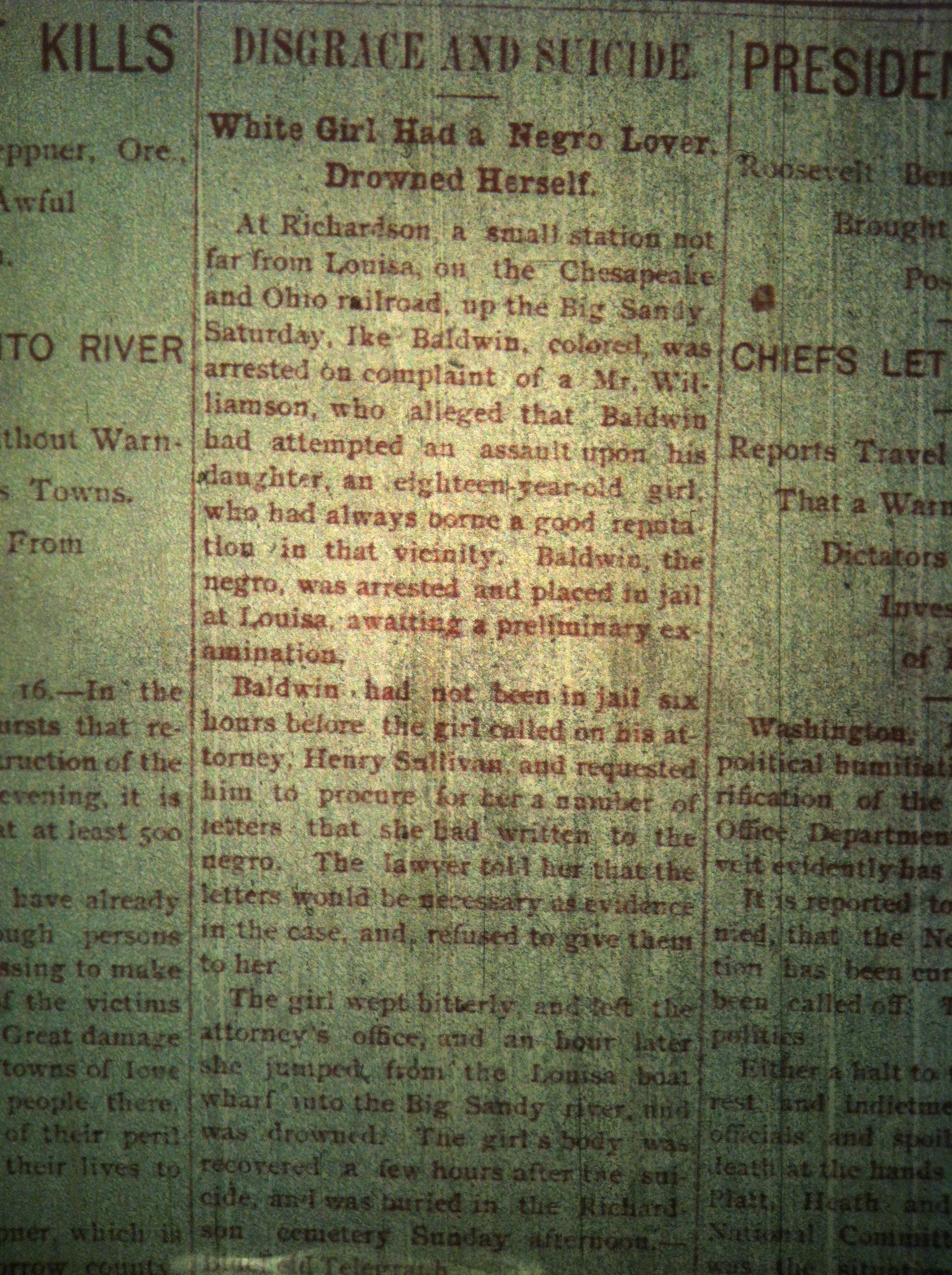
White Girl Had Negro Lover (1903)

12 Monday Jan 2015

Posted by Brandon Ray Kirk in African American History, Big Sandy Valley, Women's History

≈ Leave a comment

Tags

Appalachia, Big Sandy News, Big Sandy River, Chesapeake & Ohio Railroad, Henry Sullivan, Ike Baldwin, Kentucky, Lawrence County, Louisa, Richardson, Richardson Cemetery, U.S. South

"Disgrace and Suicide," Big Sandy News (Louisa, KY), 18 June 1903

“Disgrace and Suicide,” Big Sandy News (Louisa, KY), 18 June 1903

In Search of Ed Haley 323

19 Thursday Jun 2014

Posted by Brandon Ray Kirk in Big Harts Creek, Ed Haley, Holden

≈ Leave a comment

Tags

Albert Dingess, Alice Dingess, Birdie, blind, Brandon Kirk, Cecil Brumfield, Cripple Creek, Dorothy Brumfield, Ed Haley, fiddler, fiddling, Harts Creek, Henderson Dingess, history, Holden, Hugh Dingess Elementary School, John Brumfield Jr., John Hartford, Kentucky, Logan County, Louisa, Milt Haley, music, Smokehouse Fork, West Virginia, Wildwood Flower, writing

About a half hour later, we drove up the Smoke House Fork of Harts Creek to see Dorothy Brumfield. Dorothy lived in a white one-story home situated on a hillside overlooking the Hugh Dingess Elementary School, just down the stream from the old Henderson Dingess homeplace. Dorothy had been born in 1929 at Louisa, Kentucky, but came to Harts when she was seventeen and soon married John Brumfield, a son of Ed’s friend, Cecil. Her father was a descendant of Albert Dingess, a member of the 1889 mob.

I started the conversation by asking Dorothy about Ed. She said she never knew him personally but heard that he lost his eyesight after his father dipped him in water. She also heard that he was a great fiddler when he got “pretty high” but was mean and eager to fight if he drank too much.

Dorothy knew the story about Ed borrowing a fiddle from her father-in-law Cecil Brumfield; her husband later acquired it. “He had come through here and borrowed a fiddle off of Paw Brumfield, him and Bernie Adams, and went up yonder to Logan and pawned it,” she said. “Paw Brumfield liked to never found it.”

Dorothy said the only time she actually saw Ed was when her husband brought him home early one Sunday morning around 1949-50.

“My husband worked at Holden, and I’d heard tell of Ed Haley but I hadn’t met him,” she said. “So John stopped at the top of Trace Mountain at this place. Back then, they called them saloons. And he was supposed to been in at one o’clock in the morning. He didn’t make it. Oh, did I get mad when four o’clock come in the morning. Here he knocked on the door and I could tell someone was with him, but I couldn’t make out that it was a blind person with him. I thought it was just somebody real drunk that had passed out. He got here in the house with him and I fixed them something to eat.”

“Why didn’t I know you all was over there and got me a babysitter and caught me a ride over there and had me a time?” Dorothy said to her husband. “What would you done if I’d walked in?”

“What, mam?” Ed said.

“All them women John had over there tonight,” she said to Ed.

“Mam, he didn’t have no women,” Ed said.

“Now sir, you told me you couldn’t see,” she said. “How do you know?”

“Well, John sit beside of me,” Ed said.

A little later, Dorothy fixed Ed a bed and she went and asked her husband, “Would you tell me who in the world you’ve brought home with you again?”

John said he’d stopped in at that saloon and found Ed playing music “and a bunch of them women dancing” and he “wouldn’t leave Ed there. When they closed, he brought him here.”

“Well, then they got up the next morning and I said, ‘Now John you help him around and show him around.’ I was already mad at John for laying out. Little bit jealous, too. We hadn’t been married long.”

Dorothy said she cooked a big breakfast for everyone.

“Mam, have you got any onions?” Ed asked her at the table.

“Yes I have but why would you want an onion for breakfast?” she said.

“Don’t you know what onions are good for?” Ed said. “Many a things.”

Dorothy said Ed seemed intelligent by the morning conversation.

After breakfast, Ed went back into the front room and played the fiddle for Dorothy’s kids in front of the fireplace. She said he held his fiddle under his chin and played “Wildwood Flower” and an extremely fast version of “Cripple Creek”.

John said, “Ed, play that there ‘Birdie’ for these children.”

“Well, he stayed around and I think they drunk all the booze up,” Dorothy said. “John, he was wanting more booze, too, so he went off with Ed to Aunt Alice’s or somewhere and got some liquor and he didn’t come back till about dark. I don’t know where all he took Ed. When he come back, he kept telling me why he brought him here. He said that he didn’t want to leave him. If something happened, he wouldn’t forgive hisself. Nobody else wouldn’t take him after all the big time was over with.”

Queens Ridge 10.09.1913

07 Saturday Jun 2014

Posted by Brandon Ray Kirk in Ferrellsburg, Hamlin, Logan, Queens Ridge

≈ Leave a comment

Tags

Arnold Perry, Columbus, Dr. York, Ellen Carter, Ferrellsburg, genealogy, Hamlin, Henry F. Workman, history, Isaac Workman Jr., Ivy Bias, J.J. Maynard, James Workman, John Workman, Joseph Maynard, Kentucky, Lincoln County, Lincoln Republican, Logan, Louisa, Maynard School House, Nancy Workman, Ohio, Queens Ridge, Squire Vance, Stone Coal, West Virginia, William F. Workman, Williamson, Wilsondale

“Bull Mooser,” a local correspondent from Queens Ridge in Lincoln County, West Virginia, offered the following items, which the Lincoln Republican printed on Thursday, October 9, 1913:

John Workman, Sr., is in very poor health. Dr. York, of Louisa, Ky., is the attending physician.

Isaac Workman, Jr., is recovering from a severe illness.

Squire Vance is on a business trip to Ferrellsburg this week.

Mr. and Mrs. J.J. Maynard were visiting Arnold Perry’s Sunday.

Joseph Maynard has been quite busy making repairs on the Maynard school house.

H.F. Workman is getting in his winter’s supply of coal.

W.F. Workman is attending the Association at Stone Coal, West Virginia.

Mr. and Mrs. Charley Gray, of Columbus, Ohio, are visiting relatives and friends here.

Ivy Bias, telegraph operator at Wilsondale, W.Va., went to Williamson to a hospital to have his right leg amputated.

Mrs. Isaac Workman is paying her daughter, Mrs. Ellen Carter who resides at Rolfe, a visit.

James Workman made a business trip to Logan this week.

Joseph Maynard made a business trip to Hamlin this week.

In Search of Ed Haley 287

13 Sunday Apr 2014

Posted by Brandon Ray Kirk in Ed Haley

≈ Leave a comment

Tags

Ashland, Catlettsburg, Curly Wellman, Ed Haley, Ella Haley, fiddling, Fort Gay, Great Depression, guitar, history, Horse Branch, John Hartford, Kentucky, Keystone, life, Logan County, Louisa, Madison, Man, music, Ralph Haley, Red Jacket, Wayne, Wayne County, West Virginia, writing

In the spring of 1996, I made my way back to Ashland where I dropped in on Curly Wellman. Curly was an old guitarist in town who grew up watching Ed Haley on Horse Branch. I hadn’t visited him since a trip with Lawrence Haley some four years earlier. Unlike last time, he was quick to comment on Ed’s poverty.

“Now this story about Ed Haley, this was during the thirties — right after the Great Depression started,” Curly said. “And of course all they had coming was, I guess, just a blind pension, which wouldn’t have been much. They had to play on the corners with the tin cups. Those people, they had to struggle for life. The winter months on Ed Haley and his family were very hard. My grandfather — he came down here with money out of the big timber country up around Louisa, Ft. Gay, Wayne — and he run a little grocery store. Well, he was fortunate enough and had money enough to be able to carry these type of people through the winter months when they couldn’t make money. And as quick as spring come and they went to work every one come right in and paid him ever dime they owed. And the Haley family a lot of winters survived under his care. A lot of times, clothes we would outgrow would be taken to the Haleys because Mother thought so much of them. They had a hard struggle to raise those children but they were good people and the kids all turned out good as far as I know.”

I asked Curly to tell me about playing the guitar with Ed on Horse Branch.

“I was just a beginner and my aunt was teaching me,” he said. “The Haleys lived just across the street from us and down maybe a couple of houses. In the evenings, there was nothing else to do; no radio, no television, no nothing like that. Well, Ed would get out on the porch and Ralph and the mother and they’d start playing. I was learning to play a little bit, so I’d sit in with the guitar. I was just a very mediocre guitar player at that time. I was so rank that he’d have to tell me when he was going into a minor. I’d say, ‘I don’t know that,’ and Ralph would say, ‘Get right in there and play it anyhow.’ Them little kids would get out there and jump up and down and dance. Quick as people heard music, they’d start coming down the hollow and off’n the hillsides and gather up. They even had horse and buggies to stop and real old model cars would stop. People would open up their windows and their doors that lived up high where I was at — they’d get out on their porch till they could hear it all.”

Later, when Curly got better on the guitar, he played with Ed at the Boyd County Courthouse in Catlettsburg. Ed sat on a wooden bench with his hat turned up on the ground.

“You could throw a dime or nickel or quarter in his hat and you could tell by the way he grinned he knew the amount that went in the hat,” Curly said. “He could tell by the way it hit.”

I asked if Ed ever talked between tunes and he said, “He told little stories behind the tunes, like where it came from. He’d say, ‘Here’s an old tune I learned in Red Jacket, West Virginia,’ or, ‘Here’s an old tune I heard down in Logan County.’ And he used to talk about Madison, West Virginia, a lot. And another town I’d hear him talk about was Man, West Virginia. Keystone, it’s right in that area, too.”

In Search of Ed Haley 243

16 Sunday Feb 2014

Posted by Brandon Ray Kirk in Big Sandy Valley, Civil War, Ed Haley

≈ Leave a comment

Tags

45th Kentucky Volunteer Mounted Infantry, Albert Gallatin Jenkins, Arthur I. Boreman, Ashland, Ben Haley, Buffalo Shoals, Catlettsburg, Ceredo, Cumberland Gap, Flemingsburg, Independent Company of Scouts, James Haley, John Bowen, Kentucky, Louisa, Morgan Garrett, Mount Sterling, Prestonsburg, Saltville, Vincent A. Witcher, Virginia, Wayne County, West Virginia, William A. Haley

On June 8, 1863, Benjamin R. Haley and his son James enlisted for one year of service in the 45th Kentucky Volunteer Mounted Infantry. The 45th was organized in the summer of 1863 as a battalion (four companies) whose purpose it was the protect the Virginia front and the counties of eastern Kentucky. On October 10, the 45th was upgraded to a regiment in Ashland. At that time, Haley was made captain of Company B, while son William A. Haley was made second lieutenant.

“During the early part of 1864 the regimental headquarters were at Mt. Sterling, Ky., from which point the 45th was continually employed in constant and arduous duty, covering the entire Virginia front from Cumberland Gap to Louisa, and keeping in check, by ceaseless activity, the rebel cavalry command concentrated in and about Abingdon, Va.,” according to Union Regiments of Kentucky.

In March of ’64, the 45th moved its headquarters further north to Flemingsburg, Kentucky. Haley, perhaps wishing to remain closer to his home in Wayne County, resigned on March 17, 1864. William absented himself from command at Prestonsburg, Kentucky, on April 24, 1864 while on the march to Saltville, Virginia. James A. was mustered out on December 24, 1864 at Catlettsburg.

On April 8, 1864, John Bowen, a resident of Buffalo Shoals, wrote West Virginia governor Arthur I. Boreman to request that Ben Haley be permitted to organize a company and provide more Union protection in Wayne County.

Dear Sir I wish to inform you that Mr. Morgan Garret has declined to raise a Scouting Company for this part of our county and has gone to Kentucky. Horse Stealing is Still going on here. We need a company for this part of the county very much. They have three companeys upon Sandy and I understand they are trying to get another one. I think if their are to be another company for this county it ought to be for this part of the county. I would recommend either Benjamin Haley or William Nixson for capt. of a company and I request that one of them be commisioned to raise a company as soon as possible as we need protection badly.

Governor Boreman heeded Bowman’s request. On April 28, 1864, 46-year-old Ben Haley organized an Independent Company of Scouts for Wayne County. Some 25 men enlisted at Ceredo to serve in Captain Ben Haley’s Company for twelve months. “The members of my com were organized and Sworn in to the Servis by Abel Segar Esq the only Justice of the Peace that is in the County that will attempt to Edecute his office,” Haley wrote to the governor. On May 7, he requested 25 hats, 25 pairs of boots, 25 woolen blankets, 25 rubber blankets, 25 haversacks, 50 flannel shirts, fifty pairs of drawers and fifty pairs of stockings. He also requested 25 Colt rifles, 4000 bullet cartridges, 25 bayonet scabbards, 25 waist belts, 12 screw drivers and two ball screws, among other items. On May 10, Haley took his oath of office and then signed an oath of allegiance to the United States of America on the following day.

On June 6, Haley wrote Governor Boreman:

Sir I have the Honor of reporting the condition of my co of Independent Scouts for Wayne Co West Va. We are in Camp at present in Ceredo. The men in good condition except 3 cases of sickness disserrtions non captured two rebels prisoners one of Rebel Witcher command & the other of Jenkins turned over to the post at Catllesburg Ky please instruction what to be don with Sick also what is to be don with capturd property horses guns in consequence of the U.S. Troops being Sent to the front we are very much trobled with Strong bands of gurillas which prevents our Scouting very far in the county notwithstanding we have Scouted considerable & have lost no man I think in my next months report I shall be able to give a good account of the Service of my men as they are brace & hardy. Men all Suplied with arms in good condition.

In Search of Ed Haley 6

26 Monday Nov 2012

Posted by Brandon Ray Kirk in Ashland, Big Sandy Valley, Ed Haley, Matewan, Music, Pikeville, Williamson

≈ 1 Comment

Tags

Appalachia, Art Stamper, Arthur Smith, Ashland, Big Sandy River, Billy Lyons, Blackberry Blossom, blind, Charles Wolfe, Clark Kessinger, Clayton McMichen, Duke Williamson, Ed Haley, fiddle, fiddler, fiddlers, fiddling, Fox in the Mud, Frazier Moss, Fred Way, Ft. Gay, Grand Ole Opry, history, Huntington, Joe Williamson, John Hartford, Kentucky, Kermit, Kirk McGee, Levisa Fork, Louisa, Mark Howard, Matewan, Mississippi River, Molly O'Day, music, Nashville, Natchee the Indian, Ohio River, Old Sledge, Packet Directory, Paintsville, Parkersburg Landing, Pikeville, Prestonsburg, Red Apple Rag, River Steamboats and Steamboat Men, Robert Owens, Roy Acuff, Sam McGee, Skeets Williamson, Snake Chapman, square dances, St. Louis, Stacker Lee, Stackolee, steamboats, Tennessee Valley Boys, Tri-State Jamboree, Trouble Among the Yearlings, Tug Fork, West Virginia, Williamson, WSAZ

Back in Nashville, I was knee-deep in Haley’s music, devoting more time to it than I care to admit. I talked so much about it that my friends began to tease me. Mark Howard, who was producing my albums at the time, joked that if Ed’s recordings were of better quality, I might not like them so much. As my obsession with Haley’s music grew, so did my interest in his life. For a long time, my only source was the liner notes for Parkersburg Landing, which I had almost committed to memory. Then came Frazier Moss, a fiddling buddy in town, who presented me with a cassette tape of Snake Chapman, an old-time fiddler from the Tug Fork of the Big Sandy in eastern Kentucky. On the tape, Snake said he’d heard Haley play the “old original” version of “Blackberry Blossom” after he “came in on the boats” at Williamson, West Virginia.

The boats?

This was making for a great story. I was already enthralled by Haley’s fiddling…but to think of him riding on “the boats.” It was the marriage of my two loves. I immediately immersed myself in books like Captain Fred Way’s Packet Directory 1848-1983: Passenger Steamboats of the Mississippi River System Since the Advent of Photography in Mid-Continent America (1983) to see which boats ran in the Big Sandy Valley during Haley’s lifetime. Most of the boats were wooden-hulled, lightweight batwings – much smaller than the ones that plied the Mississippi River in my St. Louis youth – but they were exciting fixtures in the Big Sandy Valley culture.

“I have seen these boats coming down the river like they were shot out of a cannon, turning these bends, missing great limbs hanging over the stream from huge trees, and finally shooting out of the Big Sandy into the Ohio so fast that often they would be nearly a mile below the wharf boat before they could be stopped,” Captain Robert Owens wrote in Captain Mace’s River Steamboats and Steamboat Men (1944). “They carried full capacity loads of sorghum, chickens and eggs. These days were times of great prosperity around the mouth of Sandy. Today, great cities have sprung up on the Tug and Levisa forks. The railroad runs on both sides, and the great activity that these old-time steamboats caused has all disappeared.”

During the next few weeks, I scoured through my steamboat photograph collection and assembled pictures of Big Sandy boats, drunk with images of Haley riding on any one of them, maybe stopping to play at Louisa, Paintsville, Prestonsburg and Pikeville, Kentucky on the Levisa Fork or on the Tug Fork at Ft. Gay, Kermit, Williamson, and Matewan, West Virginia.

Finally, I resolved to call Snake Chapman and ask him about his memories. It was a nervous moment – for the first time, I was contacting someone with personal memories of Ed Haley. Snake, I soon discovered, was a little confused about exactly who I was and why I was so interested in Haley’s life and then, just like that, he began to offer his memories of Ed Haley.

“Yeah, he’s one of the influences that started me a fiddling back years ago,” Snake said, his memories slowly trickling out. “I used to go over to Molly O’Day’s home – her name was Laverne Williamson – and me and her and her two brothers, Skeets and Duke, used to play for square dances when we first started playing the fiddle. And Uncle Ed, he’d come up there to old man Joe Williamson’s home – that’s Molly’s dad – and he just played a lot for us and then us boys would play for him, me and Cecil would, and he’d show us a lot of things with the bow.”

Molly O’Day, I knew, was regarded by many as the most famous female vocalist in country music in the 1940s; she had retired at a young age in order to dedicate her life to the church.

“And he’s the one that told me all he could about old-time fiddling,” Snake continued. “He said, ‘Son, you’re gonna make a good fiddler, but it takes about ten years to do it.'”

I told Snake about reading in the Parkersburg Landing liner notes how Haley reportedly wished that “someone might pattern after” him after his death and he totally disagreed. He said, “I could have copied Uncle Ed – his type of playing – but I didn’t want to do it because he told me not to. He told me not to ever copy after anyone. Said, ‘Just play what you feel and when you get good, you’re as good as anybody else.’ That was his advice.”

I didn’t really know what to make of that comment. I mean, was Haley serious? Was he speaking from personal experience or was it just something he told to a beginning fiddler for encouragement?

After that, my conversation with Snake consisted of me asking questions – everything from how much Haley weighed to all the intricate details of his fiddling. I wondered, for instance, if Ed held the bow at the end or toward the middle, if he played with the fiddle under his chin, and if he ever tried to play words in his tunes. I wanted to know all of these things so that I could just inhabit them, not realizing that later on what were perceived as trivial details would often become major items of interest.

Snake answered my questions precisely: he said Haley held the bow “up a little in the middle, not plumb on the end” and usually played with the fiddle at his chest – “just down ordinarily.” He also said Haley “single-noted” most of his bow strokes, played frequently in cross-key, hated vibrato and used a lot of “sliding notes.” He seldom got out of first position, only occasionally “going down and getting some notes” that he wanted to “bring in the tune” and he definitely tried to play words in his music.

“The old fiddlers through the mountains here – and I guess it’s that way everywhere – they tried to make the fiddle say the words of the old tunes,” Snake said.

“Uncle Ed, he was a kind of a fast fiddler,” he went on. “Most old-time fiddlers are slow fiddlers, but he played snappy fiddling, kindly like I do. Ah, he could do anything with a fiddle, Uncle Ed could. He could play a tune and he could throw everything in the world in it if he wanted to or he could just play it out straight as it should be. If you could just hear him in person because those tapes didn’t do him justice. None of them didn’t. To me, he was one of the greatest old-time fiddlers of all time. He was telling me, when I was young, he said, ‘Well, I could make a fiddle tune any time I want to,’ but he said he just knowed so many tunes he didn’t care about making any more. He played a variety of tunes that a lot of people didn’t play, and a lot of people couldn’t play. He knew so many tunes he wouldn’t play one tune too long.”

I asked Snake about Haley’s repertoire and he said, “He played an old tune called ‘Old Sledge’ and it was one of his good ones. He played tunes like ‘Trouble Among the Yearlings’, but when he was gonna play it he called it ‘Fox in the Mud’. He made that up himself. One of the favorite tunes of mine he played was the old-time way of playing ‘Blackberry Blossom’ and he played it in G-minor. Ed could really play it good. They was somebody else that made the tune. Uncle Ed told me who it was – Garfield. He said he was a standing fiddling near a big blackberry patch and it was in bloom at the mouth of the hollow one time and this fella Garfield played this tune and he asked this fella Garfield what the name of the tune was. He said, ‘Well, I ain’t named it, yet,’ and he turned around and spit in that blackberry patch with a big bunch of ambeer and said, ‘We’ll just call it ‘Blackberry Blossom’.”

Snake laughed.

“Yeah, Uncle Ed, he had tales behind every one of them like that, but that’s where he said he got the name of it. He said he named it there…spitting in the blackberry blossom.”

Snake only remembered Haley singing “Stacker Lee”, a tune I’d heard him fiddle and sing simultaneously on Parkersburg Landing:

Oh Stacker Lee went to town with a .44 in his hand.

He looked around for old Billy Lyons. Gonna kill him if he can.

All about his John B. Stetson hat.

Stacker Lee entered a bar room, called up a glass of beer.

He looked around for old Billy Lyons, said, “What’re you a doin’ here?

This is Stacker Lee. That bad man Stacker Lee.”

Old Billy Lyons said, “Stacker Lee, please don’t take my life.

Got a half a dozen children and one sweet loving wife

Looking for my honey on the next train.”

“Well God bless your children. I will take care of your wife.

You’ve stole my John B. Stetson hat, and I’m gonna take your life.”

All about that broad-rimmed Stetson hat.

Old Billy Lyons said, “Mother, great God don’t weep and cry.”

Oh Billy Lyons said, “Mother, I’m bound to die.”

All about that broad-rimmed Stetson hat.

Stacker Lee’s mother said, “Son, what have you done?”

“I’ve murdered a man in the first degree and Mother I’m bound to be hung.”

All about that John B. Stetson hat.

Oh Stacker Lee said, “Jailor, jailor, I can’t sleep.

Old Billy Lyons around my bedside does creep.”

All about that John B. Stetson hat.

Stacker Lee said, “Judge, have a little pity on me.

Got one gray-haired mother dear left to weep for me.”

All about that broad-rimmed Stetson hat.

That judge said, “Old Stacker Lee, gonna have a little pity on you.”

I’m gonna give you twenty-five years in the penitentiary.”

All about that John B. Stetson hat.

It was one awful cold and rainy day

When they laid old Billy Lyons away

In Tennessee.  In Tennessee.

Snake said Haley used to play on the streets of Williamson, West Virginia where he remembered him catching money in a tin cup. In earlier years, he supposedly played on the Ohio River and Big Sandy boats and probably participated in the old fiddlers’ contests, which Snake’s father said was held on boat landings. These impromptu contests were very informal and usually audience-judged, meaning whoever got the most applause was considered the winner. Sometimes, fiddlers would just play and whoever drew the biggest crowd was considered the winner.

I asked Snake if he ever heard Ed talk about Clark Kessinger and he said, “Skeets was telling me Ed didn’t like Clark at all. He said, ‘That damned old son-of-a-gun stands around and tries to pick up everything he can pick up from you.’ And he did. Clark tried to pick up everything from Uncle Ed. He was a good fiddler, too.”

Snake said Clayton McMichen (the famous Skillet Licker) was Haley’s favorite fiddler, although he said he knew just how to beat him. This made me think of the line from Parkersburg Landing, “In regard to his own fiddling, Haley was not particularly vain, although he was aware that he could put ‘slurs and insults’ into a tune in a manner that set him apart from all other fiddlers.” (I wasn’t exactly sure he meant by slurs and insults.)

Snake could tell that I was really into Haley.

“Try to come see me and we’ll make you as welcome as we possibly can,” he said. “I tell you, my wife is poorly sick, and I have a little trouble with my heart. I’m 71. Doctors don’t want me to play over two or three hours at a time, but I always like to meet other people and play with them. I wouldn’t have no way of putting you up, but you can come any time.”

Just before hanging up, I asked Snake if he had any Haley recordings. He said Skeets Williamson had given him some tapes a few years back and “was to bring more, but he died two years ago of cancer.” Haley had a son in Ashland, Kentucky, he said, who might have more recordings. “I don’t know whether he’s got any of Uncle Ed’s stuff or not. See, most of them old tapes they made, they made them on wire recordings, and I don’t know if he’s got any more of his stuff than what I’ve got or not.”

I told Snake I would drive up and see him in the spring but ended up calling him a week later to ask him if he knew any of Ed’s early influences. He said Ed never talked about those things. “No sir, he never did tell me. He never did say. Evidently, he learned from somebody, but I never did hear him say who he learned from.” I felt pretty sure that he picked up tunes from the radio. “Ed liked to listen to the radio, preferring soap operas and mystery chillers, but also in order to hear new fiddle tunes,” the Parkersburg Landing liner notes read. “A good piece would cause him to slap his leg with excitement.” I asked Snake if he remembered Haley ever listening to fiddlers on the radio and he said, “I don’t know. He must have from the way he talked, because he didn’t like Arthur Smith and he liked Clayton McMichen.”

What about pop tunes? Did he play any of those?

“He played ragtime pretty good in some tunes,” Snake said. “Really you can listen to him play and he slides a little bit of ragtime off in his old-time fiddling – and I never did hear him play a waltz in all the time I ever heard him play. He’d play slow songs that sound old lonesome sounds.”

Snake quickly got into specifics, mentioning how Haley only carried one fiddle around with him. He said, “He could tune right quick, you know. He didn’t have tuners.  He just had the keys.”

Did fiddlers tune low back in those days?

“I’d say they did. They didn’t have any such thing as a pitch-pipe, so they had to tune just to whatever they liked to play.”

Haley was the exception.

“Well, it seemed like to me he tuned in standard pitch, I’m not sure. But from hearing his fiddling – like we hear on those tapes we play now – I believe he musta had a pitch-pipe at that time.”

I wondered if Haley spent a lot of time messing around with his fiddle, like adjusting the sound post, and Snake said, “No, I never did see him do that. He might have did it at home but when he was out playing he already had it set up the way he wanted to play.”

Surprisingly, Snake didn’t recall Haley playing for dances. “I don’t think he did because I never did know of him playing for a dance. He was mostly just for somebody to listen to, and what he did mostly was to make money for a living playing on the street corner. I seen him at a fiddling contest or two – that was back before I learned to play the fiddle. That’s when I heard him play ‘Trouble Among the Yearlings’. He won the fiddling contest.”

What about playing with other fiddlers?

“Well, around in this area here he was so much better than all the other fiddle players, they all just laid their fiddles down and let him play. The old fiddlers through here, they wasn’t what I’d call too good fiddlers. We had one or two in the Pikeville area over through there that played a pretty good fiddle. Art Stamper’s dad, he was a good old-time fiddler, and so was Kenny Baker’s dad.”

After hanging up with Snake, I gave a lot of thought to Haley reportedly not liking Arthur Smith. His dislike for Smith was documented on Parkersburg Landing, which stated plainly: “Another fiddler he didn’t care for was Arthur Smith. An Arthur Smith record would send him into an outrage, probably because of Smith’s notoriously uncertain sense of pitch. Cecil Williamson remembers being severely lectured for attempting to play like ‘that fellow Smith.'”

Haley probably first heard Smith over the radio on the Grand Ole Opry, where he debuted in December of 1927. Almost right away, he became a radio star, putting fiddlers all over the country under his spell. His popularity continued to skyrocket throughout the 1930s, during his collaboration with Sam and Kirk McGee. In the late thirties, Haley had a perfect chance to meet Smith, who traveled through southern West Virginia and eastern Kentucky with the Tennessee Valley Boys. While unlikely, Haley may have met him at fiddling contests during the Depression. “In the thirties, Haley occasionally went to fiddle contests to earn money,” according to Parkersburg Landing. At that same time, Smith was participating in well-publicized (usually staged) contests with Clark Kessinger, Clayton McMichen and Natchee the Indian. Haley, however, tended to avoid any contest featuring Natchee the Indian, who “dressed in buckskins and kept his hair very long” and was generally a “personification of modern tendencies toward show fiddling.”

In the early 1940s, Haley had a perfect opportunity to meet Smith, who appeared regularly on WSAZ’s “Tri-State Jamboree” in Huntington, West Virginia. Huntington is located several miles up the Ohio River from Ashland, Kentucky and is West Virginia’s second largest city.

In the end, Haley’s reported low opinion of Smith’s fiddling was interesting. Arthur Smith was one of the most influential fiddlers in American history. Roy Acuff regarded him as the “king of the fiddlers,” while Dr. Wolfe referred to him as the “one figure” who “looms like a giant over Southern fiddling.” Haley even had one of his tunes – “Red Apple Rag” – in his repertoire. Maybe he got a lot of requests for Smith tunes on the street and had to learn them. Who knows how many of his tunes Haley actually played, or if his motives for playing them were genuine?

Feud Poll 1

If you had lived in the Harts Creek community during the 1880s, to which faction of feudists might you have given your loyalty?

Categories

  • Adkins Mill
  • African American History
  • American Revolutionary War
  • Ashland
  • Atenville
  • Banco
  • Barboursville
  • Battle of Blair Mountain
  • Beech Creek
  • Big Creek
  • Big Harts Creek
  • Big Sandy Valley
  • Big Ugly Creek
  • Boone County
  • Breeden
  • Calhoun County
  • Cemeteries
  • Chapmanville
  • Civil War
  • Clay County
  • Clothier
  • Coal
  • Cove Gap
  • Crawley Creek
  • Culture of Honor
  • Dingess
  • Dollie
  • Dunlow
  • East Lynn
  • Ed Haley
  • Eden Park
  • Enslow
  • Estep
  • Ethel
  • Ferrellsburg
  • Fourteen
  • French-Eversole Feud
  • Gilbert
  • Giles County
  • Gill
  • Green Shoal
  • Guyandotte River
  • Halcyon
  • Hamlin
  • Harts
  • Hatfield-McCoy Feud
  • Holden
  • Hungarian-American History
  • Huntington
  • Inez
  • Irish-Americans
  • Italian American History
  • Jamboree
  • Jewish History
  • John Hartford
  • Kermit
  • Kiahsville
  • Kitchen
  • Leet
  • Lincoln County Feud
  • Little Harts Creek
  • Logan
  • Man
  • Matewan
  • Meador
  • Midkiff
  • Monroe County
  • Montgomery County
  • Music
  • Native American History
  • Peach Creek
  • Pearl Adkins Diary
  • Pecks Mill
  • Peter Creek
  • Pikeville
  • Pilgrim
  • Poetry
  • Queens Ridge
  • Ranger
  • Rector
  • Roane County
  • Rowan County Feud
  • Salt Rock
  • Sand Creek
  • Shively
  • Spears
  • Sports
  • Spottswood
  • Spurlockville
  • Stiltner
  • Stone Branch
  • Tazewell County
  • Timber
  • Tom Dula
  • Toney
  • Turner-Howard Feud
  • Twelve Pole Creek
  • Uncategorized
  • Warren
  • Wayne
  • West Hamlin
  • Wewanta
  • Wharncliffe
  • Whirlwind
  • Williamson
  • Women's History
  • World War I
  • Wyoming County
  • Yantus

Feud Poll 2

Do you think Milt Haley and Green McCoy committed the ambush on Al and Hollene Brumfield in 1889?

Blogroll

  • Ancestry.com
  • Ashland (KY) Daily Independent News Article
  • Author FB page
  • Beckley (WV) Register-Herald News Article
  • Big Sandy News (KY) News Article
  • Blood in West Virginia FB
  • Blood in West Virginia order
  • Chapters TV Program
  • Facebook
  • Ghosts of Guyan
  • Herald-Dispatch News Article 1
  • Herald-Dispatch News Article 2
  • In Search of Ed Haley
  • Instagram
  • Lincoln (WV) Journal News Article
  • Lincoln (WV) Journal Thumbs Up
  • Lincoln County
  • Lincoln County Feud
  • Lincoln County Feud Lecture
  • LinkedIn
  • Logan (WV) Banner News Article
  • Lunch With Books
  • Our Overmountain Men: The Revolutionary War in Western Virginia (1775-1783)
  • Pinterest
  • Scarborough Society's Art and Lecture Series
  • Smithsonian Article
  • Spirit of Jefferson News Article
  • The Friendly Neighbor Radio Show 1
  • The Friendly Neighbor Radio Show 2
  • The Friendly Neighbor Radio Show 3
  • The Friendly Neighbor Radio Show 4
  • The New Yorker
  • The State Journal's 55 Good Things About WV
  • tumblr.
  • Twitter
  • Website
  • Weirton (WV) Daily Times Article
  • Wheeling (WV) Intelligencer News Article 1
  • Wheeling (WV) Intelligencer News Article 2
  • WOWK TV
  • Writers Can Read Open Mic Night

Feud Poll 3

Who do you think organized the ambush of Al and Hollene Brumfield in 1889?

Recent Posts

  • Logan County Jail in Logan, WV
  • Absentee Landowners of Magnolia District (1890, 1892, 1894)
  • Charles Spurlock Survey at Fourteen Mile Creek, Lincoln County, WV (1815)

Ed Haley Poll 1

What do you think caused Ed Haley to lose his sight when he was three years old?

Top Posts & Pages

  • History for Boone County, WV (1928)
  • Origin of Place Names in Logan County, WV (1937)
  • Big Harts Creek Post Offices
  • Early Coal Mines in Logan County, WV
  • Post Offices of Wayne County, WV

Copyright

© Brandon Ray Kirk and brandonraykirk.wordpress.com, 1987-2023. Unauthorized use and/or duplication of this material without express and written permission from this blog’s author and/or owner is strictly prohibited. Excerpts and links may be used, provided that full and clear credit is given to Brandon Ray Kirk and brandonraykirk.wordpress.com with appropriate and specific direction to the original content.

Archives

  • February 2025
  • January 2025
  • October 2023
  • September 2023
  • December 2022
  • November 2022
  • May 2022
  • April 2022
  • February 2022
  • November 2021
  • October 2021
  • September 2021
  • June 2021
  • May 2021
  • April 2021
  • March 2021
  • February 2021
  • January 2021
  • December 2020
  • November 2020
  • October 2020
  • July 2020
  • June 2020
  • May 2020
  • April 2020
  • March 2020
  • February 2020
  • January 2020
  • December 2019
  • November 2019
  • October 2019
  • September 2019
  • August 2019
  • July 2019
  • June 2019
  • May 2019
  • April 2019
  • March 2019
  • February 2019
  • January 2019
  • December 2018
  • November 2018
  • October 2018
  • September 2018
  • August 2018
  • July 2018
  • June 2018
  • May 2018
  • April 2018
  • March 2018
  • February 2018
  • January 2018
  • December 2017
  • November 2017
  • October 2017
  • September 2017
  • August 2017
  • July 2017
  • June 2017
  • May 2017
  • April 2017
  • March 2017
  • February 2017
  • January 2017
  • December 2016
  • November 2016
  • October 2016
  • September 2016
  • August 2016
  • July 2016
  • June 2016
  • May 2016
  • April 2016
  • March 2016
  • February 2016
  • January 2016
  • December 2015
  • November 2015
  • October 2015
  • September 2015
  • August 2015
  • July 2015
  • June 2015
  • May 2015
  • April 2015
  • March 2015
  • February 2015
  • January 2015
  • December 2014
  • October 2014
  • September 2014
  • August 2014
  • July 2014
  • June 2014
  • May 2014
  • April 2014
  • March 2014
  • February 2014
  • January 2014
  • December 2013
  • November 2013
  • October 2013
  • September 2013
  • August 2013
  • July 2013
  • June 2013
  • May 2013
  • April 2013
  • March 2013
  • February 2013
  • January 2013
  • December 2012
  • November 2012

Enter your email address to follow this blog and receive notifications of new posts by email.

Join 2,925 other subscribers

Tags

Appalachia Ashland Big Creek Big Ugly Creek Blood in West Virginia Brandon Kirk Cabell County cemeteries Chapmanville Charleston civil war coal Confederate Army crime culture Ed Haley Ella Haley Ferrellsburg feud fiddler fiddling genealogy Green McCoy Guyandotte River Harts Harts Creek Hatfield-McCoy Feud history Huntington John Hartford Kentucky Lawrence Haley life Lincoln County Lincoln County Feud Logan Logan Banner Logan County Milt Haley Mingo County music Ohio photos timbering U.S. South Virginia Wayne County West Virginia Whirlwind writing

Blogs I Follow

  • OtterTales
  • Our Appalachia: A Blog Created by Students of Brandon Kirk
  • Piedmont Trails
  • Truman Capote
  • Appalachian Diaspora

BLOOD IN WEST VIRGINIA is now available for order at Amazon!

Blog at WordPress.com.

OtterTales

Writings from my travels and experiences. High and fine literature is wine, and mine is only water; but everybody likes water. Mark Twain

Our Appalachia: A Blog Created by Students of Brandon Kirk

This site is dedicated to the collection, preservation, and promotion of history and culture in Appalachia.

Piedmont Trails

Genealogy and History in North Carolina and Beyond

Truman Capote

A site about one of the most beautiful, interesting, tallented, outrageous and colorful personalities of the 20th Century

Appalachian Diaspora

  • Subscribe Subscribed
    • Brandon Ray Kirk
    • Join 787 other subscribers
    • Already have a WordPress.com account? Log in now.
    • Brandon Ray Kirk
    • Subscribe Subscribed
    • Sign up
    • Log in
    • Report this content
    • View site in Reader
    • Manage subscriptions
    • Collapse this bar
 

Loading Comments...