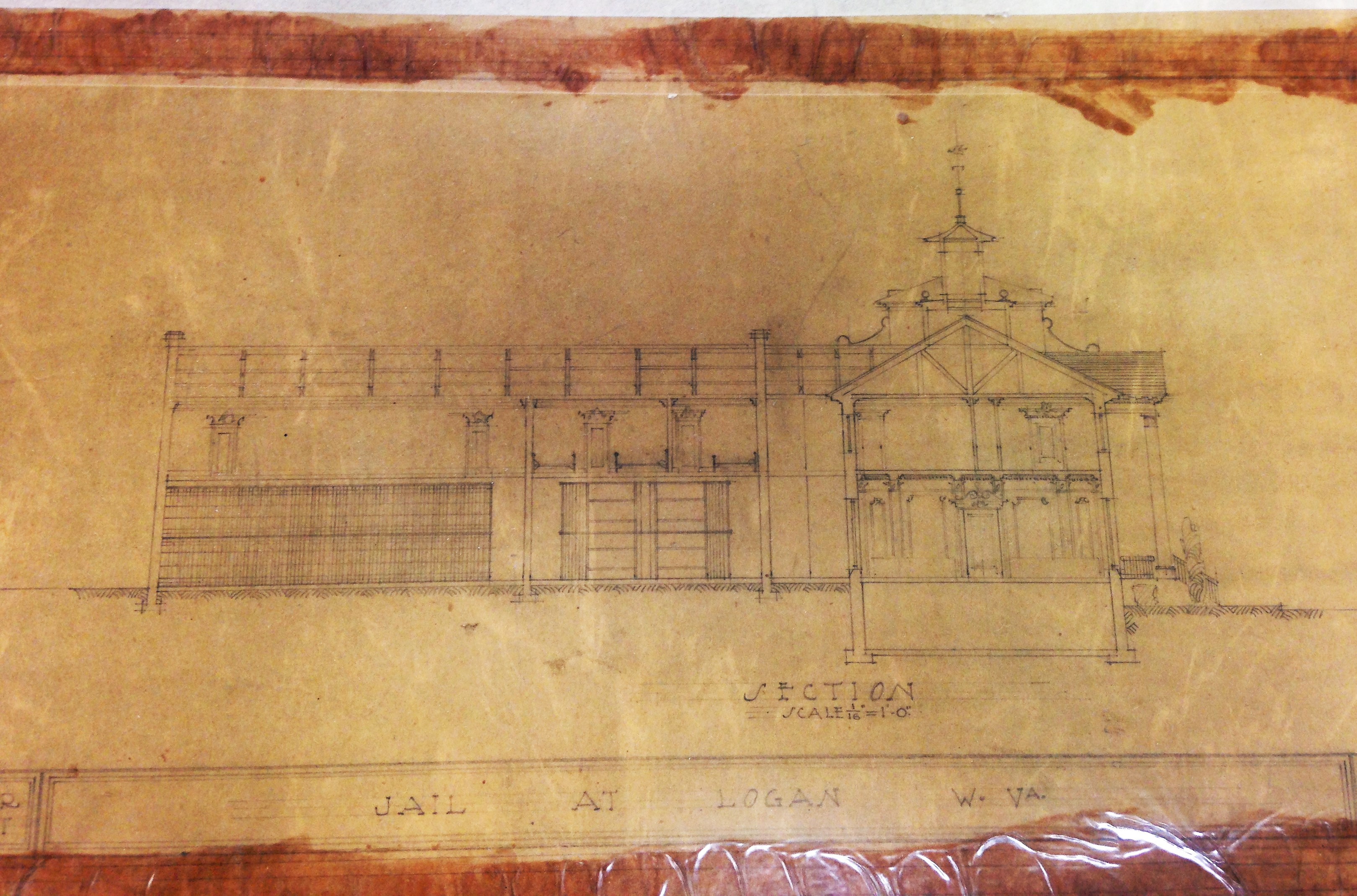
Logan County Jail in Logan, WV
19 Wednesday Feb 2025

19 Wednesday Feb 2025
12 Monday Dec 2022
Posted in Barboursville, Coal, Guyandotte River, Huntington, Logan, Peach Creek
Tags
Appalachia, Barboursville, C.A. Coulter, Chesapeake & Ohio Railroad, Chesapeake and Ohio Historical Newsletter, coal, Empty Yard, Gay Coal and Coke Company, Guyandotte River, history, Huntington, Logan, Logan County, Mount Gay, Peach Creek, railroad, Red Onion, Slabtown, West Logan, West Virginia, World War I
From the Chesapeake and Ohio Historical Newsletter (June 1974) comes this history titled “The Shops at Peach Creek” composed by C.A. Coulter. This is Part 1 of Mr. Coulter’s account.
The railroad was first built to Logan in 1904, the first train arriving on September 9 of that year. The line was started at Barboursville, West Virginia, on the main line, and ran up the Guyan River for 65 miles to Logan. By 1913, rail lines had been run to the heads of all the main branches of the Guyan River in Logan County. As soon as the rail lines reached the branches, coal mines were built, and coal immediately began to move to outside markets.
The first shop facilities were built at Slabtown, a small settlement just north of Logan. Just when the shops were built, I have no record, but it was soon after trains had begun to arrive from Huntington. A short pit track, a shed track with a shed for the freight that was handled, a wye track, and a small yard of three tracks that held about fifty cars each were constructed. This yard is still in use, and is known now as the merchandise yard. Later, another yard was built just north of this one, with about three tracks; this was used to assemble the loaded coal cars. This yard was later lengthened and more tracks were added; it is now known as the Empty Yard. A yard office building was located along the main line between the two yards.
There was also an old bunkhouse located near the pit track at Slabtown, called the “Red Onion.” I have heard my father mention this many times, as he would lay up in it when he came in from the run from Huntington. I have heard him tell of how he would have to wait until someone got out of bed so he could get in and get a few hours of rest before being called back to Huntington. This was a long, hard run with the small, hand-fired G-4s, G-6s, and G-7s that were in use at that time. The trains were much shorter than they are today. By World War I, trains were lengthened to 55 loads for a single engine and 85 loads for a doubleheader. This limit held for many years until the Mallets and Mikados arrived, then the car limit was done away with.
The first carload of coal was run out of Logan County on Thanksgiving Day, 1905. It was loaded in wagons at the Gay Coal and Coke Company mine at Mt. Gay, about one mile south of Logan, and hauled and dumped into a coal car at Logan. The old coal loading records show that for 1905 about 55 carloads of coal were mined in the county. As the years passed, coal loadings began to boom, and by 1907 15 companies were operating in the county. By 1923, 148 mines were working in the county. According to the records, this was about the peak year for the number of mines in operation.
It was not long after the first small shop facilities were built at Logan that it became evident that a much larger one had to be built. The company finally decided to build at the present site of Peach Creek. Peach Creek was an old town, having been established as a small settlement about 1806. Quite a number of houses were clustered near the mouth of the small creek that emptied into the Guyan at this point. It is said that the town got its name from a small peach orchard that stood near the mouth of the creek.
I am not sure just when construction began on the new shops. It was some little time before 1916, as the company moved the shops from Logan in 1916. The town of Peach Creek was laid out in lots and streets at about the same time, as the town of West Logan, on the west side of the Guyan River. A swinging foot bridge across the river, near the site of the present highway bridge, connected the two towns. Soon, employees of the company began to build their homes in both towns.
08 Thursday Dec 2022
Posted in Atenville, Banco, Beech Creek, Big Creek, Big Harts Creek, Big Sandy Valley, Big Ugly Creek, Boone County, Breeden, Chapmanville, Clothier, Cove Gap, Crawley Creek, Dingess, Dunlow, East Lynn, Enslow, Ferrellsburg, Fourteen, Gilbert, Gill, Green Shoal, Guyandotte River, Halcyon, Hamlin, Harts, Holden, Kermit, Kiahsville, Kitchen, Leet, Little Harts Creek, Logan, Man, Matewan, Meador, Midkiff, Pecks Mill, Peter Creek, Queens Ridge, Ranger, Rector, Sand Creek, Spurlockville, Stiltner, Stone Branch, Toney, Twelve Pole Creek, Wayne, West Hamlin, Wewanta, Wharncliffe, Whirlwind, Williamson, Wyoming County, Yantus
Tags
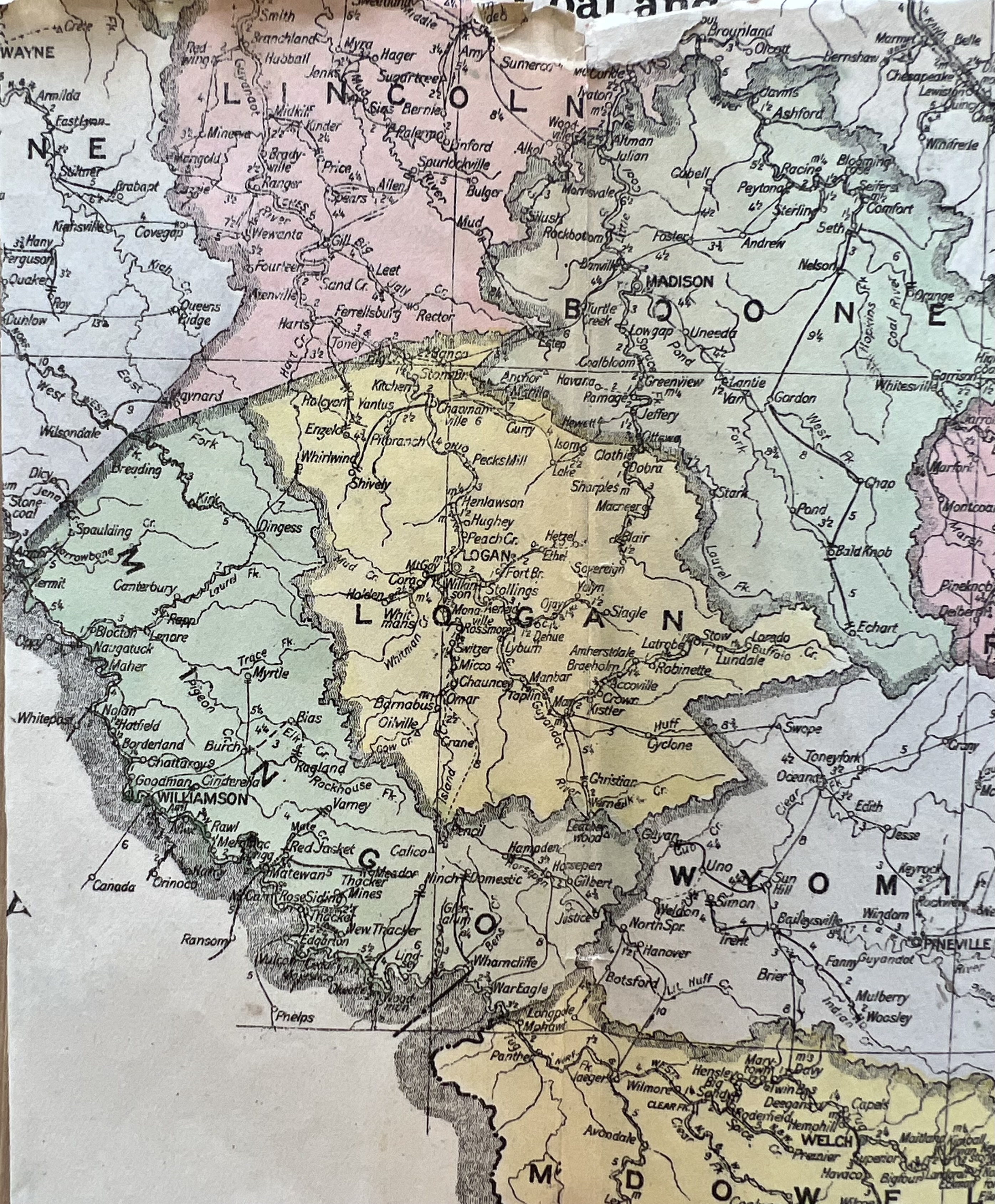
Appalachia, Big Sandy River, Boone County, Guyandotte River, Hamlin, history, Lincoln County, Logan, Logan County, Madison, map, maps, McDowell County, Mingo County, Pineville, Polk's State Gazetteer and Business Directory, Tug Fork, Twelve Pole Creek, Wayne, Wayne County, Welch, West Virginia, Williamson, Wyoming County
05 Monday Dec 2022
Posted in Big Sandy Valley, Boone County, Coal, Huntington, Logan, Native American History, Williamson
Tags
Appalachia, Aracoma, Aracoma Hotel, Boone County, Charleston, Chief Cornstalk, Chief Logan, coal, Daniel Boone, farming, history, Huntington, Kanawha County, Logan, Logan-Boone Highway, logging, Madison, Marmet, Midland Trail, mining, Tug Fork, West Virginia, West Virginia Biographical Association, Williamson
From West Virginians, published by the West Virginia Biographical Association in 1928, comes this profile of the Logan-Boone Highway in southwestern West Virginia:
Boone County, south of Kanawha, has been opened up by a hard road from Marmet, across the Kanawha from the Midland Trail. A second connection with Charleston is offered by a highway on the south side of the Kanawha. The county was named for Daniel Boone, the great hunter and Indian fighter, who lived in West Virginia many years. Madison is the county seat. Logan, county seat of Logan County, was named for Chief Logan, the speech-making Indian chief, who has been made one of the numerous story book heroes of the Indian race. Whether or not Chief Logan ever shot a deer or pitched his wig-wam in this county is much in doubt. The modern hotel at Logan, the Aracoma, further reflects the Indian influence with the name of this member of Chief Cornstalk’s family. Coal mining, lumbering and farming are the principal activities of Logan and Boone counties. Most of the road south is also hard-surfaced, and will eventually form the link between the Midland Trail to the North and the Huntington-Williamson highway along Tug River.
05 Monday Dec 2022
Tags
Alderson-Wilkinson Land Company, Appalachia, Ashburn, attorney, Big Huff Coal Company, California, Carroll County, Cincinnati, David Wilkinson, Ernest Eugene Wilkinson, First Baptist Church, genealogy, Guyan Coal Company, Guyan Valley Bank, Guyandotte Valley, history, Hollywood, John B. Wilkinson, John B. Wilkinson Jr., Knights Templar, lawyer, Logan, Logan County, Margaret Midyette, Mary Belle Straton, Mingo County, Mona Coal Company, Mona Russo, Mystic Shrine, prosecuting attorney, Robertson Consolidated Land Company, Robertson Grocery Company, San Diego, Seventh Judicial Circuit, Virginia, Wayne, West Virginia, West Virginia Biographical Association
From West Virginians, published by the West Virginia Biographical Association in 1928, comes this profile of Judge John B. Wilkinson of Logan, WV:
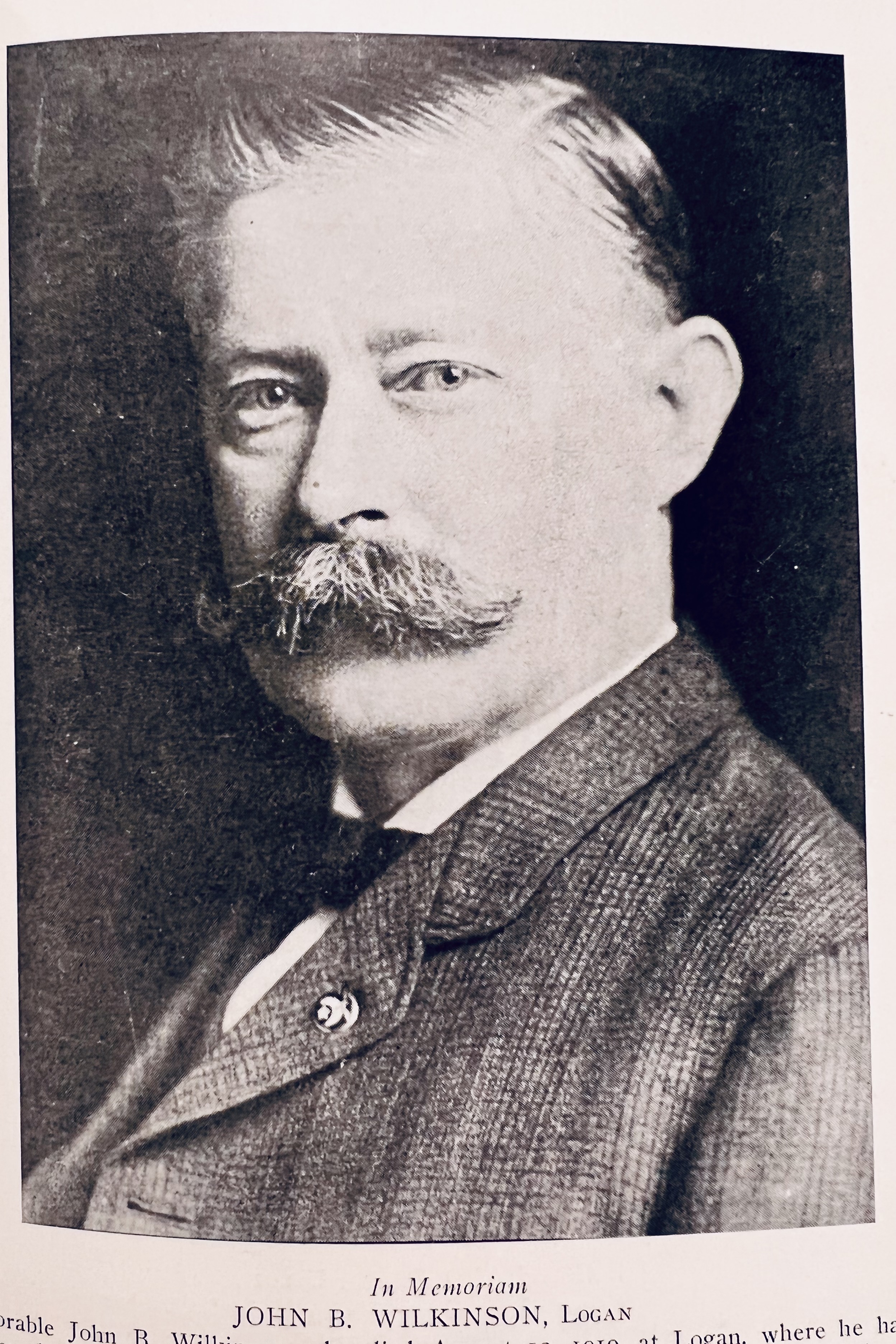
The Honorable John B. Wilkinson, who died August 12, 1919, at Logan, where he had long been a foremost citizen, held rank among the best known and most successful lawyers and jurists in West Virginia. In business likewise Judge Wilkinson enjoyed a distinguished success. One of the leaders in the early development of the coal industry in the Guyan Valley, his position at the time of his death was among the great figures in business and industry. He was treasurer of the Guyan Coal Company, the Mona Coal Company, the Robertson Consolidated Land Company and the Alderson-Wilkinson Land Company. He was president of the Big Huff Coal Company and a director of the Robertson Grocery Company. He was originally a director of the Guyan Valley Bank, but later disposed of his holdings in that institution. Throughout the state at large, however, his fame was earned chiefly by his work as a jurist. During twelve years on the bench of the Seventh Judicial Circuit, he was noted for his fairness, accuracy and knowledge of the law. The press of the whole state reported his passing at great length and with sincere regret that so valuable a personality had been lost to the community. Judge Wilkinson was born in Logan County, W.Va., February 13, 1860, the son of David Wilkinson, who had come from Carroll County, Va. He lived on a farm and attended school in that part of Logan County which afterward became Mingo County, coming to the then village of Logan Court House to attend a teachers’ institute and take an examination for a teacher’s certificate. He taught two or three local normal schools here and at Wayne. His legal career began in 1882, when he was admitted to the bar. He continued in the legal profession until his death in 1919. In 1884 he was elected prosecuting attorney of Logan County, which office he filled continuously till 1896. After an interval of four years he again assumed that office, in 1900, and served till January 1, 1905. Having been elected Judge of the Seventh Judicial Circuit, he resigned as prosecutor and took his place on the circuit bench on the first of January, 1905, and remained as judge until failing health induced him to resign twelve years later. Several times Judge Wilkinson was urged to become his party’s candidate for Governor of the State, although he preferred not to accept that honor. In the summer of 1916 he was nominated for Judge of the Supreme Court of West Virginia. After leaving the office of circuit judge, the condition of his health inclined him to give up the practice of law and close his office, but many friends had learned to depend on him for legal counsel, and at their urging he continued in active practice until his death. Judge Wilkinson was married, September 21, 1882, to Mary Belle Straton of Logan, who survives him with their four children, John B., Jr., who resides at Ashburn, Va.; Ernest Eugene, of Cincinnati; Mrs. Mona Russo, of San Diego, Calif.; and Mrs. Margaret Midyette, of Hollywood, Calif. Judge Wilkinson was for a long time a member of the First Baptist Church of Logan, and a member of its board of deacons. He was a member of the Masonic Orders—the Knights Templar and the Mystic Shrine. Hundreds of people in West Virginia and neighboring states, although not personally acquainted with Judge Wilkinson, knew of his work as a jurist and his renown as a civic leader in general, so that at the time of his death, his passing elicited the sincere feeling that the state had lost one of its best and most constructive citizens.
04 Sunday Dec 2022
Posted in Logan, Native American History, Women's History
Tags
American Primitive, Appalachia, Aracoma, Battle of Point Pleasant, Camp Charlotte, Chief Cornstalk, Chief Logan, Circleville Elm, genealogy, history, Horn Papers, James Logan, John Breckenridge, Lawnsville, Logan, Lord Dunmore, Michael Cresap, Native American History, Native Americans, surveyor, Tahgahinte, The Aracoma Story, Thomas Dunn English, Thomas Patterson, West Virginia, West Virginia Women, William Madison, William Penn, William Preston
Doris Miller (1903-1993), a longtime educator, historian, writer, and poet operating in the area of Huntington, West Virginia, composed this biography of Aracoma, a well-known Native American figure who lived in present-day Logan, West Virginia. This is Part 4 of her composition.
One other detail of the legend, not generally known but occasionally heard, is the story that Aracoma was Cornstalk’s daughter by adoption, that her mother was a sister of Cornstalk who had married Chief Logan and died soon after Aracoma’s birth. For this reason, the infant was taken into the lodge of Chief Cornstalk, where there were squaws to rear her, and this kinship by marriage and common interest in Aracoma was the secret of the alliance between the two famous Indian leaders who joined forces at the Battle of Point Pleasant in 1774. There is nothing in Aracoma’s dying words to refute this claim—she still would have considered Cornstalk her father and have been the last of his line, through a niece. But Logan’s words do carry a refutation.
At the time Logan made this speech under the Circleville Elm, and it was written down to be dispatched to Lord Dunmore at Camp Charlotte, where peace was being negotiated, he could not have said, “There runs not a drop of my blood in any living creature” if Aracoma had been his daughter.
Some historians have discounted Logan’s speech, but it is fully in keeping with the man pictured by his contemporaries in the Horn Papers and other sourcebooks of American history. Scottish Lord Dunmore must have [p. 10] accepted it as authentic, when it was brought to him wrapped in a wampum belt by a man he had sent to fetch Logan.
Logan had been friendly to white settlers of Virginia and Pennsylvania. As a boy, he lived in the home of James Logan, former secretary of William Penn, who educated the youth, a son of a friendly Indian chief. Thereafter Logan bore the name of his foster-father instead of Tahgahinte, his Indian name. Chief Logan remained friendly to the settlers until his family was treacherously murdered by white men. Later it was established that Colonel Cresap was not a party to the deed, though Logan thought so for a long time.
Colonel Madison who led the Virginians against Aracoma’s settlement, is said to have been a son-in-law of Colonel William Preston, a noted Virginia surveyor. Some of the earliest land surveys in present Logan County were recorded in names of members of the Preston, Madison and Breckenridge families, and it is quite likely others went to men who served under Madison and Breckenridge of the Battle of the Island, or members of their families. So the Legend of Aracoma came into the Guyandotte Valley in the memories of the white settlers who came first after her, and in their imaginations.
Another reason for discounting the story that Aracoma was the daughter of Logan is her name. Cornflower seems the logical name of a daughter of Cornstalk.
The residents of the Guyandotte Valley have treasured their legend and have honored the name of Aracoma in many ways. In the early 1800s, the town which grew up in the area of Aracoma’s settlement and grave was known as Lawnsville. During the 1850s, Thomas Dunn English, a physician and poet who was the first mayor of the town, insisted on changing the name to Aracoma, which it remained until its incorporation as a city in 1907. The change then may have been due to men’s custom of referring to the town as “Logan Courthouse” rather than by its true name. Since that time, the name of Aracoma has been given to a smaller community in the county.
When Logan County observed its Centennial in 1952, Thomas Patterson, the author of American Primitive and other well known plays, was commissioned to write a drama based on the legend of Princess Aracoma. The pageant was produced on successive days of the celebration and was considered one of the highlights. [p. 11]
Source: West Virginia Women, Richwood, WV: Jim Comstock (1974), p. 11.
For more about Doris Miller, go here: https://mds.marshall.edu/cgi/viewcontent.cgi?article=1284&context=sc_finding_aids
04 Sunday Dec 2022
Posted in Logan, World War I, Wyoming County
Tags
A.J.S. England, Appalachia, Arline England, Athens, attorney, attorney general, Attorney Generals Association of the United States, Barbour County, Benevolent and Protective Order of Elks, Charleston, Concord Normal College, Edward Theodore England, Francis M. England, Grand Chancellor, history, Huldah Lenburg, Huntingdon, Independent Order of Odd Fellows, Jackson County, Junior Vice Grand Chancellor, Kiwanis Club, Knights of Pythias, Logan, Logan County, Louisiana, Loyal Order of the Moose, Majorie England, Mary Elizabeth England, masons, Methodist Church, minister, Minneapolis, Minnesota, Moulton, Oceana, politics, Post Office and Postal Committee, Republican Party, senator, Shriners, Southern Normal University, State Council of Defense, Tennessee, Thea Springs, U.S. Congress, West Virginia, World War I, Wyoming County
From West Virginians, published by the West Virginia Biographical Association in 1928, comes this profile of Congressman Edward Theodore England of Logan, WV:

Edward Theodore England, congressman from the sixth district of West Virginia, made a reputation, which finally took him to Congress through his singularly able and efficient administration as attorney general of the state, 1916-1924. Mr. England was born in Jackson County, W.Va., the son of A.J.S. and Mary Elizabeth (Welch) England. His father was a native of Barbour County, W.Va., and a minister in the Methodist Church. He spent a boyhood and youth of mingled labor and effort to advance and improve himself. His education was largely derived from the opportunities he created. He attended public schools, the Concord Normal at Athens, W.Va., graduating therefrom in 1892 and was also graduated with the degrees of Bachelor of Science and Bachelor of Law from the Southern Normal University, Huntingdon, Tenn. He began the practice of law at Oceana, then the county seat of Wyoming in the spring of 1899. From there, seeking a larger field for his activities, he removed to Logan, county seat of Logan County in 1901 and from that county, his abilities as a successful lawyer gained him recognition throughout the state. He served as mayor of Logan in 1903 and again in 1908 and in 1912 was elected to the state senate. He was a leader in that body for eight years and in 1915 was elected president of the senate, an office in which he represented West Virginia and presided over the first meeting of state lieutenant governors, held at Rhea Springs, Tennessee, in 1916. In 1916, Mr. England was elected on the state Republican ticket as attorney-general and in 1920 was re-elected by an increased majority. It was during his administration, that the Virginia-West Virginia debt settlement was negotiated and finally cleared up, Mr. England handing West Virginia’s interests in the affair. He also represented the state in the cases of Ohio and Pennsylvania vs. West Virginia, involving the constitutionality of an act passed by the West Virginia legislature affecting the transportation of gas out of the state. During his term as attorney general occurred the World War and there were many matters growing out of the war period that were assigned to his office. He was a member of the State Council of Defense and as a four-minute man, his services were enlisted as a speaker in war drives and campaigns. In 1923, Mr. England was elected president of the Attorney-Generals’ Association of the United States at a meeting in Minneapolis, Minn. He was a candidate for governor of the state in 1924, being defeated by a small majority, in the primary. He is known all over West Virginia as a loyal member of the Knights of Pythias. During 1920-21 he was Grand Chancellor of the state order and was also Junior Vice Grand Chancellor in 1923. He is a thirty-second degree Mason and Shriner, and is otherwise affiliated with the Independent Order of Odd Fellows., Elks, Loyal Order of Moose, and the Kiwanis club, of Charleston. He is also a member of the Methodist church. Mr. England was elected to Congress November 2, 1926, and has looked after the interests of the state faithfully. The sixth congressional district which he represents comprises the counties of Boone, Fayette, Greenbrier, Kanawha, Pocahontas and Raleigh, and in committee appointment he holds place on the Post Office and Postal Committee, being one of a fewto be honored with appointment to a major committee during first term. He was renominated without opposition in the Republican Primary in May, 1928. Mr. England was married to Huldah L. Lenburg, of Moulton, La., December 25, 1901. They have three children, Arline, Francis M. and Majorie England.
03 Saturday Dec 2022
Tags
Appalachia, Aracoma, Blue Feather, Bluestone River, Boling Baker, Doris Miller, Guyandotte River, history, HorsepenCreek, Huntington, Jim Comstock, John Breckenridge, Little Black Bear, Logan, Logan County, Man, Montgomery County, Native American History, Native Americans, Ohio, Raindrop, Running Deer, Snow Lily, Virginia, Waulalisippi, West Virginia, West Virginia Women, William Ingles, William Madison
Doris Miller (1903-1993), a longtime educator, historian, writer, and poet operating in the area of Huntington, West Virginia, composed this biography of Aracoma, a well-known Native American figure who lived in present-day Logan, West Virginia. This is Part 3 of her composition.
Aracoma has been described as an Indian maiden of exceptional grace and beauty. Perhaps the Virginians she impressed deeply in her dying hours may have believed she had great beauty in youth. Boling Baker is said to have had a fine physique and courageous bearing, which would have given his Indian captors reason for adopting him into the tribe. He is given credit for artful courtship of his love, and it seems likely he must have been skillful to win her away from other suitors the sachem’s daughter must have had.
The long history of their wedding, an elaborate ceremony her father accompanied them to the Guyandotte to perform, is less credible, but not impossible. More stress has been given to Aracoma’s royal estate than Indian customs warranted, but the English settlers had their own traditions of royal pomp and ceremony as patterns to draw from.
The carefree life credited to the Indians in the Guyandotte valley before 1776 reflects the wishful thinking of people whose own lives were filled with toil. Certainly the Indians must have lived stremuous lives, though they may have had an interlude of unusual peace and happiness before family life was saddened by the scourge which overtook them in 1776.
According to the story-tellers, Aracoma and Boling Baker had six children. Their names were Waulalisippi, or Laughing Waters, Snow Lily, Raindrop, Running Deer, Little Black Bear and Blue Feather.
It is said that Baker became despondent and bitter after the death of his children and during the hardships undergone by the colony after disease had reduced its strength. Doubtless the ones who added this detail had seen similar results in other men’s lives. They deduce that it was his desire to recoup the fortunes of the tribe that led him to attempt a bold exploit which resulted in disaster for his settlement.
Legendary history tells us that in the spring of 1780, a stranger appeared at a white settlement on Bluestone River, a man with a woe-begone countenance who recited sorrowful accounts of hardships he had undergone as a captive among the Indians in Ohio. He stayed for several days, familiarizing himself with everything about the settlement, then departed for the east (he said) in the hope of being reunited with his aged parents. The man was Boling Baker, who merely circled back to Flat Top Mountain, where he had left a band of his braves. On a dark rainy night in April, they stole quietly into the settlement and left with every horse there without disturbing a single sleeper.
The outraged settlers realized their recent visitor must have led the raid. Without horses to follow, they could only send for help from the mounted guard at Montgomery, seat of government for Montgomery County, Virginia, in which this entire area was then located. Colonel William Ingles, sheriff of the county, dispatched Colonel Madison and a deputy sheriff, John Breckenridge, with [p. 10] the party which massacred Aracoma’s village a few days later. Her paleface husband was one of the party absent on a hunt that day.
Little is known of Boling Baker after the death of Aracoma. It is said that for many a year afterward, men could read a couplet carved on beech trees in the area: ‘Boling Baker—his hand and knife, He can’t find a horse to save his life.’ Whether the words were carved by Baker or were a gibe directed at him by another, none can say.
The story is told that years later, an aged stranger came wandering up the Guyandotte River, asking questions of those he met. After standing a long time weeping on the mountainside opposite the island where Aracoma had lived, he went on past Horsepen Creek and eventually found lodging for a night in a home near Man. That night he told briefly some of the experiences of his life, which later were recognized to match the known story of Boling Baker. Next morning he was found dead in bed.
Source: West Virginia Women, Richwood, WV: Jim Comstock (1974), p. 10-11.
For more about Doris Miller, go here: https://mds.marshall.edu/cgi/viewcontent.cgi?article=1284&context=sc_finding_aids
14 Monday Nov 2022
Tags
American Revolution, Aracoma, Battle of Point Pleasant, Boling Baker, Chief Cornstalk, Circleville, Doris Miller, Edward Braddock, Fort Randolph, French and Indian War, Horsepen Creek, Horsepen Mountain, Huntington, Jim Comstock, Logan, Matthew Arbuckle, Native American History, Native Americans, Ohio, Pickaway Plain, Point Pleasant, Revolutionary War, Shawnee, Treaty of Camp Charlotte, West Virginia, West Virginian Women
Doris Miller (1903-1993), a longtime educator, historian, writer, and poet operating in the area of Huntington, West Virginia, composed this biography of Aracoma, a well-known Native American figure who lived in present-day Logan, West Virginia. This is Part 2 of her composition.
The father whose death was mentioned by Aracoma was the noted Shawnee sachem, Cornstalk, leader at the Battle of Point Pleasant on October 10, 1774. After the treaty of Camp Charlotte was signed following that battle, Cornstalk appears to have been constant in keeping his promise to be a friend to the border Virginians. The American Revolution was then in progress, and Tory colonists strongly entrenched in Canada were using every influence they could bring to bear on the Indians to persuade them to harry western settlements of the colonies that were banded together in rebellion. In September, 1777, Cornstalk went to Fort Randolph, on the site of Point Pleasant, to warn the commander of the garrison, Colonel Arbuckle, of impending hostitlies from other Shawnees, incited by the British.
As a reward for his warning, Cornstalk was held with two companions as hostages. While Colonel Arbuckle waited for a messenger to reach the governor of Virginia and a reply to be received, two men from the fort crossed the Ohio to hunt venison and were waylaid by hostile Indians. One of the men was killed and scalped. Members of the garrison were so enraged that they killed Cornstalk and his companions in vengeance, defying officers who sought to restrain them from an act in violation of military ethics.
Aracoma’s husband was Boling (or Bowling) Baker, an English soldier who had come to America with General Braddock’s army. Though he had been called a deserter, he may have been captured by Indians lurking along the path of Braddock’s march or in the route which followed the English army’s disastrous engagement with the French and Indians on July 9, 1755.
Apparently Baker had been taken to Cornstalk’s town at Pickaway Plain, near Circleville, O., and had been made a member of the tribe. There he met the sachem’s young daughter and at some later time became her husband. Together they were leaders of the Indian settlement in present Logan County.
In addition to the town located on the island at Logan, the Indians apparently had a camping place on Horsepen Creek where the braves sometimes camped with whatever horses they might possess. The animals could be walled in here by steep mountain sides and with hickory withes wound from tree to tree. Still today Horsepen Creek and Horsepen Mountain bear the names first white settlers gave them for their connections with the earlier inhabitants.
At this time, land-hungry white settlers were pressing continually westward from eastern Virginia. it is said that scouting parties sent out after crops were gathered in the fall of 1779 found Indians encamped with a strong force on Horsepen Fork of Gilbert’s Creek and on Ben Creek and returned home to wait until after spring crops had been planted for another visit. Also, Indian depredations and the occasional massacre of a white settler’s family by stray bands of Indian hunters far from home kept the frontiersmen alert and distrustful of all Indians, however peaceful and friendly.
Tradition says that they Indians on the Guyandotte prospered until 1776, when their settlement was stricken by a great scourge. The pestilence may have been smallpox, measles, dysentery, or even some lighter disorder, for Indians have no immunity built up against diseases which beset the white men. Among the many who died were the children of Aracoma and Boling Baker.
As repeated countless times, the Aracoma legend varies in details. Some begin the story by telling of Boling Baker’s arrival as a captive in the Shawnee village. They say that Aracoma interceded with her father when the young Englishman was about to be made to run the gauntlet, just as Pocahontas protected John Smith. Though doubtless based on surmise, the story could be true, for captives who escaped from the Indian villages in Ohio told of having been forced to run the gauntlet. Some romanticists believe Baker’s love for the Indian maiden began with his gratitude that day, and that also could be true.
Source: West Virginia Women, Richwood, WV: Jim Comstock (1974), p. 7-9.
For more about Doris Miller, go here: https://mds.marshall.edu/cgi/viewcontent.cgi?article=1284&context=sc_finding_aids
11 Friday Nov 2022
Posted in Huntington, Logan, Native American History, Women's History
Tags
Aracoma, Doris Miller, Guyandotte River, Henry Clay Ragland, history, Huntington, Jim Comstock, Logan, Logan County, Logan High School, Native Americans, West Virginia, West Virginia Women, William Madison
Doris Miller (1903-1993), a longtime educator, historian, writer, and poet operating in the area of Huntington, West Virginia, composed this biography of Aracoma, a well-known Native American figure who lived in present-day Logan, West Virginia. This is Part 1 of her composition.
West Virginians can lay claim to one of America’s most romantic legends, the story of Aracoma which has grown in Logan County around the meager authentic details of an incident in the history of the region which occurred some 200 years ago.
It is a legend of romance and tragedy about an Indian Princess who lies buried in the city of Logan. The story tells of her love for a white man taken captive by her tribe, of their happy life together as leaders of a settlement of her people on the Guyandotte River until tragedy wiped out their children and many others of their tribe, and of his depredations which led to her death.
Legends are stories built by folklore on a foundation of historic fact. Folklore is history preserved by tradition by people searching for the heroic. Such is the Logan County legend, a story of a courageous woman whose death brought her to the attention of ancestors of many of the people now living in Logan County, with details added by the romantic imaginations of residents of the region who have preserved and added to the legend.
Aracoma, an Indian word said to mean “corn blossom,” was the name given Colonel (later General) William Madison by a dying Indian woman who appeared to be the leader of a settlement of Indians located on the island where Logan High School now stands. She had been mortally wounded in combat between her people and a party of 90 Virginians led by Colonel Madison, in which all of the Indians were massacred except some braves strong and fast enough to escape when they saw the tide of battle had turned against them and a party of hunters absent when the Virginians made their surprise attack.
In later accounts, Aracoma was described as a woman of dignity and courage who appeared to be about 40 years old. The Virginians had been reared in a culture that still remembered the old chivalric tradition of reverence for women. They quickly forgot their animosity in concern for this woman of noble bearing, and treated their wounded captive with compassion and respect.
Tradition says that for several hours the woman resisted every effort to get her to talk. She lay with closed eyes, stoically awaiting her fate. Then, apparently realizing her life was ebbing away and there was no hope for recapture by her people she asked for their leader.
“My name is Aracoma and I am the last of a mighty line,” she told Colonel Madison. “My father was a great chief and friend of your people. He was murdered in cold blood by your people when he had come to them as a friend to give them warning. I am the wife of a paleface who came across the great waters to make war on our people, but came to us instead and was made one of us. Many moons since, a great plague carried off my children with a great number of my people and they lie buried just above the bend of the river. Bury me with them with my face toward the setting sun that I may see my people in their march toward the happy hunting grounds. For your kindness, I warn you to make haste in returning to your homes, for my people are still powerful and will return to avenge my death.”
It was told that the battle occurred in the afternoon of a spring day in 1780 and that Aracoma died before daybreak of the following morning. After burying her in the place and manner she had requested, the Virginians soon departed to return to their homes.
This story of Aracoma’s death differed but slightly in detail as it was repeated around countless firesides for a century before the late Henry Clay Ragland wrote it into the History of Logan County. It seems to be a reasonably accurate account, authenticated by certain details of historic record.
Source: West Virginia Women, Richwood, WV: Jim Comstock (1974), p. 6-7.
For more about Doris Miller, go here: https://mds.marshall.edu/cgi/viewcontent.cgi?article=1284&context=sc_finding_aids
30 Monday May 2022
Posted in Poetry
Tags
Appalachia, Fred Durham, Logan, Logan Banner, poem, poems, poetry, poets, The Rainbow End, West Virginia, writers, writing
The following poem appeared in the Logan Banner of Logan, WV, on August 7, 1928. The author was Fred Durham, address unknown.
THE RAINBOW END
At the end of every rainbow,
So we always have been told,
If we find its termination
Sits a pot of virgin gold.
There are those who take it serious
And their entire talent bend
To a lifelong ceaseless searching
For the fleeting rainbow end.
Some are harmless near Micawbers.
Some of lawless dangerous trend.
But they all have one objective
The entrancing rainbow’s end.
Some there are who hear the story
With a tolerant knowing smile,
Knowing that these little stories
Help to make life more worthwhile.
And to them life in its fullness
Will an untold blessing lend
They seek not but find contentment
At the phantom rainbow end.
***
This poem was brought to The Banner office last week either by the author or some one else who deemed it worth publishing. The editor, though knowing little indeed of the technique of versification, thinks it meritorious in several essential respects.
01 Sunday May 2022
Posted in Logan
Tags
Aracoma Hotel, Dick Arters, E.D. Arters, E.W. Oakley, Faymont, history, Huntington, Island Creek Coal Company, Jefferson Hotel, Logan, Logan County, Mike Ghiz, Monitor Coal and Coke Corporation, Montgomery, W.L. Davis, West Virginia
From the Logan Banner comes this bit of history for the Aracoma Hotel dated March 17, 1933:
Arters Brothers Lease Aracoma Hotel Property
Starting April 1st W.L. Davis and Dick Arters, of this city, and E.D. Arters of Huntington will operate the Aracoma Hotel. They have leased the hotel from the Ghiz estate, Mike Ghiz having been manager for the past six months. Dick Arters has been Mr. Ghiz’ assistant.
The Arters brothers are hotel men known the state over. At one time they operated the Faymont in Montgomery, and E.D. Arters was manager of the old Jefferson in Logan, when Dick Arters served in the capacity of assistant manager. The Arters and Mr. Davis have hosts of friends among the traveling public, as well as locally, who will be interested in this announcement. Mr. Davis, now with the Pioneer, used to be at the Aracoma and Mr. Arters has been on the same force. At the present time E.D. Arters is with the Huntington Hotel in Huntington, where he has managed the Farr.
Mr. Davis has lived in this county since 1914. He was superintendent of the Island Creek Coal Company for ten years, and has also been superintendent of the Monitor Coal and Coke Corporation. He became interested in the hotel business several years back. Mr. Davis when interviewed today, in behalf of the new management, said they planned on renovating the Aracoma as soon as they can take charge, give their particular attention to social gatherings, for which the hotel is an ideal place, and further stated that Mrs. E.W. Oakley would remain in charge of the dining room.
21 Thursday Apr 2022
Posted in Logan
Tags
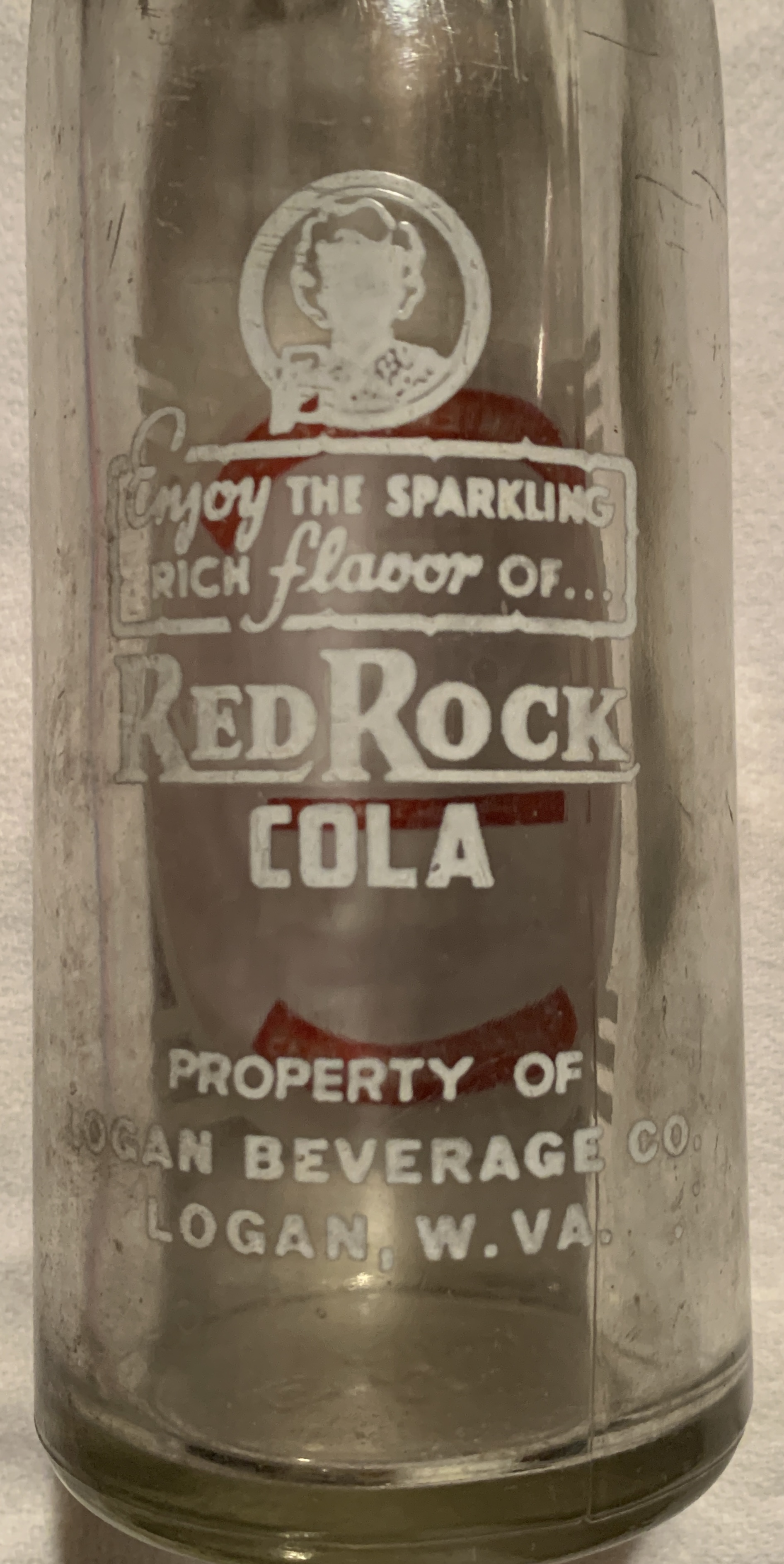
Atlanta, Babe Ruth, Georgia, ginger ale, history, Lee Hagan, Logan, Logan Beverage Company, Red Rock Cola, Red Rock Company, West Virginia

20 Wednesday Apr 2022
Posted in Logan
Tags
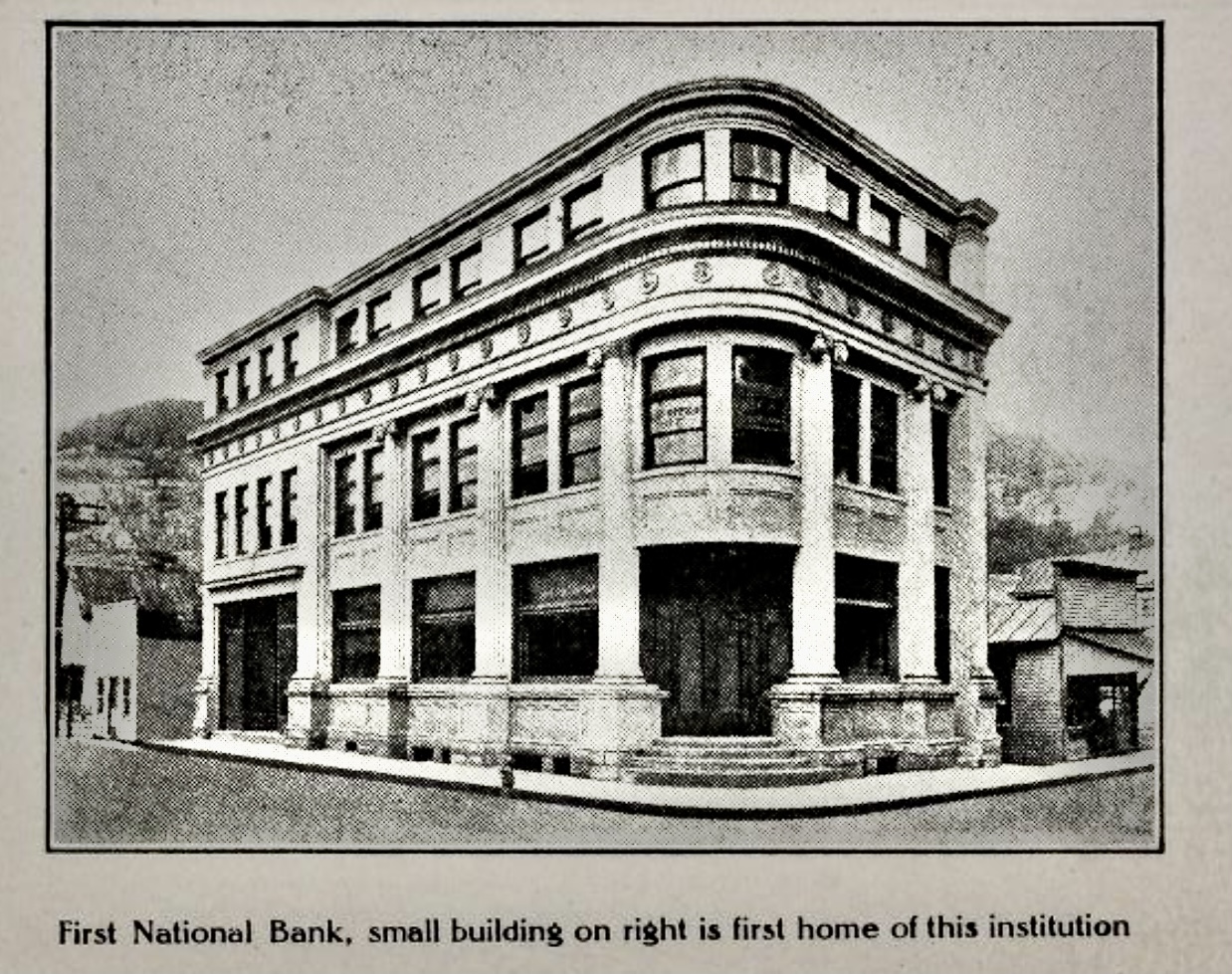
Appalachia, banks, First National Bank, George T. Swain, History of the City of Logan, Logan, West Virginia
20 Wednesday Apr 2022
Tags
37th Ohio Volunteer Infantry Regiment, Appalachia, civil war, Confederate Army, Edward Siber, history, Isaac Morgan, James R. Perry, John DeJarnett, L.D. Chambers, Logan, Logan County, Thomas Buchanan, Union Army, West Virginia
From Law Orders Book A 1873-1878 in the Logan County (West Virginia) Circuit Clerk’s office comes this entry regarding the destruction of the Logan County Courthouse in 1862:
On the 14th day of June 1878, came the following persons viz: John Dejarnett, Thomas Buchanan (except as to Investigation of the Regiment), Dr. Hinchman, who being duly sworn in open Court depose and say: That they know the fact that the Court House of Logan County West Virginia after being temporarily occupied by the 34th Ohio Regt of Federal troops commanded by Col. Seiber, was set fire to and burned up, in the month of Nov. 1862. The said Court House had not been occupied at any time by the Confederate troops, but was used alone for the administration of Justice and for the custody and preservation of the Records of the Several Courts of the said County of Logan. The building was Constructed of bricks and wood, and was a substantial, durable and convenient Exterior, and was worth at the least at the time of its destruction not less than four thousand dollars and belonged exclusively to the said County of Logan, which County has ever since been within the jurisdiction of West Virginia. The destruction of said building was a wanton and inexcusable act of the said Regt. and in no manner contributed to the prosecution of the war in behalf of the Federal Government.
At a County Court continued and held for the County of Logan State of West Virginia on the 14th day of June 1878. Present Isaac Morgan, President, and James R. Perry and L.D. Chambers, Justices, the Court with the view of obtaining Compensation for the destruction of said Court House from the Government of the United States, caused the gentlemen above named to be examined on Oath in open Court, and ordered the substance of the facts above stated by them to be spread upon the Records of this Court, and the Court further caused to be certified that the above named citizens of said County of Logan and that their Statements are entitled to full faith and credit and further that they are in no wise interested in this application except in common with other citizens of the County and Tax payers thereof.
Source: Law Orders Book A 1873-1878, p. 713-714. Note: The entry contains a few errors, such as the date of the courthouse’s destruction, the spelling of Col. Edward Siber’s name, and the correct name of the unit (37th Ohio Volunteer Infantry Regiment).
17 Thursday Feb 2022
Tags
23 Tuesday Nov 2021
Tags
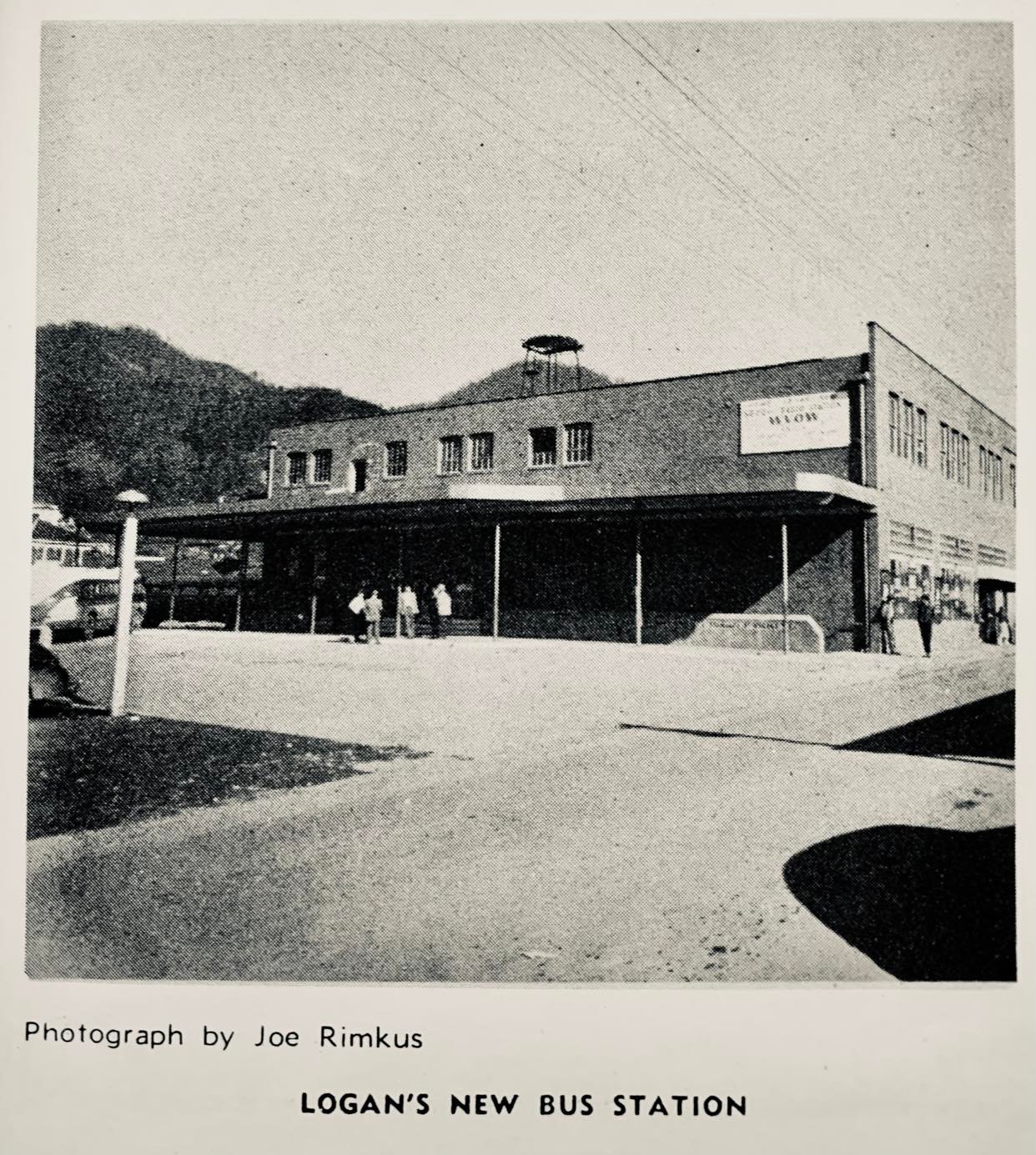
Appalachia, architecture, history, Joe Rimkus, Logan, Logan County, radio station, West Virginia, WVOW
Posted by Brandon Ray Kirk | Filed under Logan
30 Saturday Oct 2021
Posted in Logan
30 Saturday Oct 2021
Posted in Big Harts Creek, Logan, Twelve Pole Creek, Whirlwind
Tags
Bernie Adams, Big Harts Creek, Bulwark, Bulwark School, Daniel McCloud, farming, genealogy, history, Logan, Logan Banner, Logan County, Lora Martin, Lucy McCloud, singing school, Twelve Pole Creek, West Virginia, Whirlwind, Wilburn Mullins
An unnamed correspondent from Whirlwind on Big Harts Creek in Logan County, West Virginia, offered the following items, which the Logan Banner printed on May 10, 1927:
Mrs. Alla Mullins was the guest of Daniel McCloud Monday.
Daniel McCloud made a business trip to Twelve Pole Monday.
All the farmers are getting very busy in this vicinity.
Wilburn Mullins was calling on friends at Daniel McCloud’s Sunday.
Lucy McCloud visited her aunt Lora Martin Sunday.
Bernie Adams has just returned from a business trip to Logan.
Daniel McCloud is teaching a singing school at the Bulwark school house. All report a nice time.
Daily Acts: Florence and her straw hat; Lucy and her pink dress; Lenville carrying milk; Roy making whistles.
30 Saturday Oct 2021
Tags
Appalachia, Aracoma, Highland Avenue, history, Kanada Street, Lee Street, Logan, Logan County, Oak Hill Addition, Pine Street, West Virginia
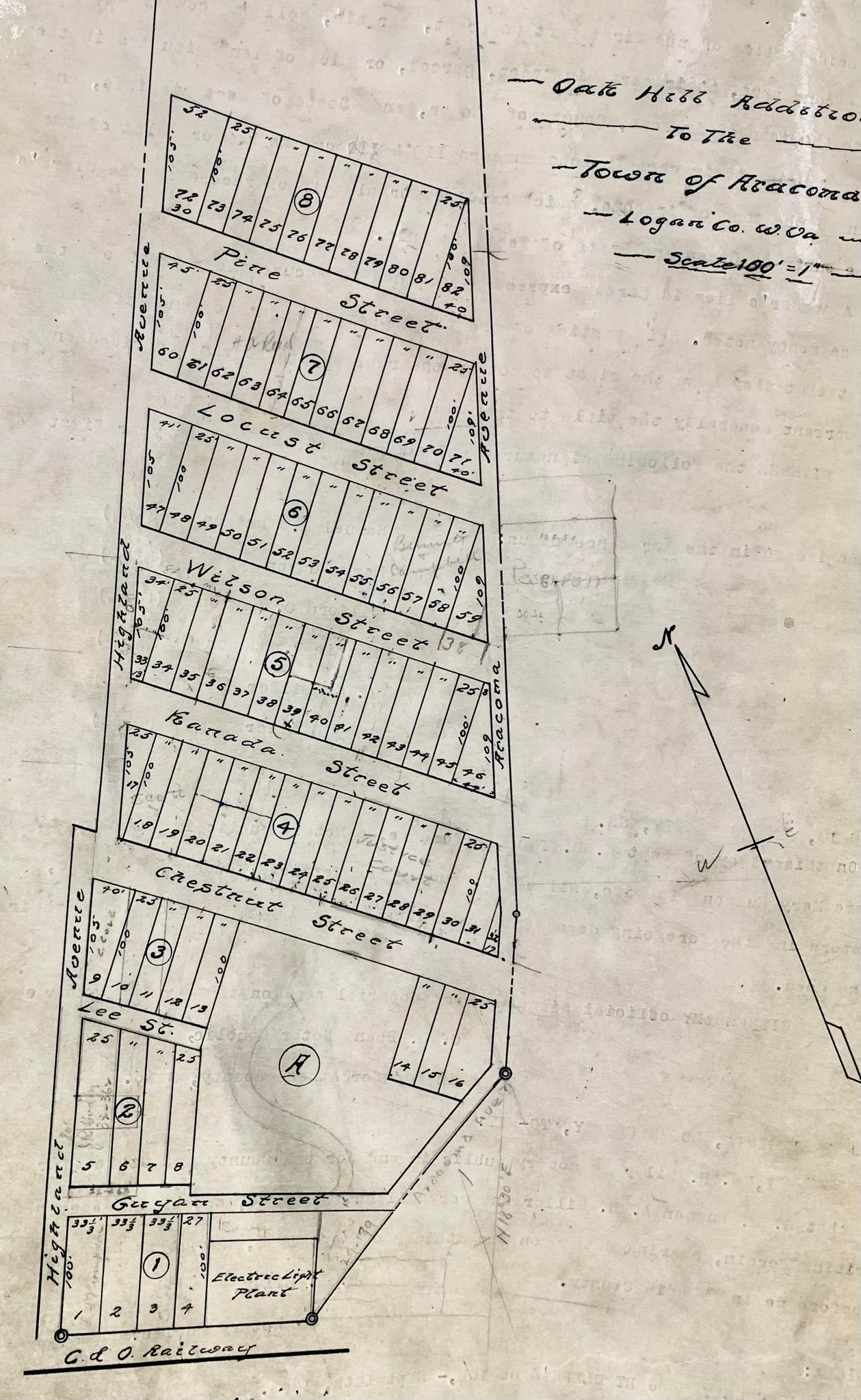
Posted by Brandon Ray Kirk | Filed under Logan
Writings from my travels and experiences. High and fine literature is wine, and mine is only water; but everybody likes water. Mark Twain
This site is dedicated to the collection, preservation, and promotion of history and culture in Appalachia.
Genealogy and History in North Carolina and Beyond
A site about one of the most beautiful, interesting, tallented, outrageous and colorful personalities of the 20th Century
 Brandon Ray Kirk