• About

Brandon Ray Kirk

~ This site is dedicated to the collection, preservation, and promotion of history and culture in my section of Appalachia.

Brandon Ray Kirk

Tag Archives: Kentucky

In Search of Ed Haley 249

24 Monday Feb 2014

Posted by Brandon Ray Kirk in Big Harts Creek, Culture of Honor, Ed Haley, Lincoln County Feud, Timber

≈ Leave a comment

Tags

Al Brumfield, Ben Adams, Billy Hall, crime, Ed Haley, Eveline Dingess, feud, Floyd Dingess, Harts Creek, Henderson Dingess, history, Hollene Brumfield, Hugh Dingess, Imogene Haley, John W Runyon, Kentucky, Kiahs Creek, Robinson Creek, West Virginia, writing

At the time of the ambush on Al and Hollena Brumfield, Henderson Dingess and his family were in no mood to see yet another one of their fold die violently. Less than a year before, on November 15, 1888, Floyd Dingess, an older son of Henderson, was murdered while working logs at the mouth of Rockhouse Fork on Harts Creek. It was a horrific deed: Floyd, whose wife was several months pregnant, was murdered by his own brother-in-law, Billy Hall. Floyd had never been popular with the Halls. He reportedly made a habit of bullying Billy. It was said that when he came home from working, his wife would clatter pots and pans in the kitchen just so her family wouldn’t hear his footsteps.

When Billy finally shot Floyd on that fateful day, some of the younger Dingess boys were fishing in the creek nearby. They raced home to tell their family what had happened, while Billy quickly returned home and received instructions to hide out in Robinson Creek, Kentucky. Meanwhile, Floyd’s pregnant wife was floated across the creek to her husband, who died in her arms. Hugh Dingess, Floyd’s brother, tracked Billy to Kiah’s Creek but lost his trail. For years, Hugh was devastated by his brother’s death. He used to get drunk and shoot the Halls’ cattle.

The Dingesses eventually learned the whereabouts of Billy Hall and prepared to fetch him by force. The Halls on Harts Creek caught wind of their plan and sent word to Billy to escape by train to Tennessee, which he did — and was never heard from again.

Surely, when Milt Haley and Green McCoy shot Hollena Brumfield less than a year later, the Dingess family was determined to execute a harsh revenge. It was, after all, the second attack on their clan in several months. We wondered then, why would Milt, Green, Runyon, and Ben Adams — knowing the fate of poor Billy Hall — want to risk their lives (and fortunes) to attack Brumfield? Surely Milt and Green — taking a cue from Billy Hall — were well aware that once they committed their heinous act, the only avenue open to them was to flee the state forever. We also wondered if Milt just abandoned Emma and Ed on Trace Fork or if there was some kind of arrangement to later meet him in Kentucky?

In Search of Ed Haley 247

22 Saturday Feb 2014

Posted by Brandon Ray Kirk in Big Sandy Valley, Ed Haley

≈ 4 Comments

Tags

Andrew Francis Messinger, Bill Duty, Blackburn Messinger, David Messinger, Fall Creek, genealogy, George T. Swain, George W. Parsley, history, James Muncy, James Parsley, John H. Messinger, Jr., Keenan Parsley, Kentucky, Lawrence County, Lincoln County, Marcum-Muncy Feud, Nellie Muncy, Nicholas Messinger, Pigeon Creek, Ryburn Parsley, Tug River, Wayne County, West Virginia, Wilson Messinger, writing

Penelope Muncy — Milt Haley’s mother — was born around 1823 to James Muncy and Mary Martha Copley. Nellie, as she was sometimes called, was probably an illegitimate child. On January 23, 1840, she married Ryburn Parsley in Lawrence County, Kentucky. In her marriage record, she gave her last name as Copley…not Muncy. According to Logan County historian George T. Swain, Nellie and her husband settled on Jenny’s Creek near the Tug Fork. They had at least four children: James Parsley (born c.1842), George W. Parsley (born c.1845), Sarah J. Parsley (born c.1848) and Martha Parsley (born c.1850). Ryburn was listed in the 1850 Logan County Census of (West) Virginia as a farmer then disappeared from local records. Swain’s history of Logan County gives a clue: “Riburn [Parsley], who married a Miss Muncey, became involved in the Muncey-Marcum feud and moved to Mississippi and became a brigadier general of the Confederate States in the Civil War.”

Strangely, Parsley left his wife and children in the Tug Valley.

In 1853, Nellie gave birth to a son named Keenan Parsley at Big Hurricane Creek near FortGay on the Big Sandy River in Wayne County. In Keenan’s birth record, no father was listed, perhaps indicating that he was an illegitimate child. Approximately three years later, Nellie gave birth to a son census records identify as Thomas P. Parsley – a.k.a. Thomas Milton Haley.

In 1860 Nellie married Wilson Messinger in Logan County. In her marriage record she gave her age as 37 years, her surname as Muncy instead of Copley or Parsley and listed her parents’ names as James and Mary Muncy. She also referred to herself, curiously enough, as a widow. At the time of the marriage, Wilson Messinger (also widowed) had five children: Mary Messinger, born about 1844; Blackburn Messinger, born about 1846; Andrew Francis Messinger, born about 1848; John H. Messinger, born about 1850; and David Messinger, born about 1855.

In the 1860 Logan County Census, Wilson and Nellie lived at the mouth of Pigeon Creek in the Tug Valley near Bill Duty. Wilson operated a mill and owned $250 worth of personal property. He had the following children in his household: two Parsley stepchildren (including Milt), five children, and a newborn son, Wilson Messinger, Jr., who was less than a year old.

By 1870, Nellie and Wilson had disappeared from West Virginia census records, possibly indicating their death or a move across the Tug into Kentucky. The family seems to have broken apart, as many of the Messinger children flocked to live near their wealthy grandfather Nicholas Messinger, a water mill operator in the Fall Creek area of Lincoln County.

Milt Haley apparently didn’t follow his stepsiblings to the GuyandotteValley. In 1870, he was still on Pigeon Creek in the home of Bill Duty, who was no apparent kin to him. Was it a coincidence that Duty had been a close neighbor to the Messingers in 1860?

In Search of Ed Haley 245

18 Tuesday Feb 2014

Posted by Brandon Ray Kirk in Big Sandy Valley, Civil War, Ed Haley

≈ Leave a comment

Tags

Andersonville Prison, Arthur I. Boreman, Ben Haley, Ben Haley Branch, Bessie Fraley, Bill Smith, Brandon Kirk, Cabell County, Cabell County Scouts, Cain Adkins, Catherine Haley, civil war, Ed Haley, history, Independent Company of Scouts, James H. Ferguson, James Haley, Jane McCoy, Kentucky, Kiahsville, Lick Creek, Lincoln County, Martha Spence, Peter McCoy, Quincy, Thomas McCoy, Wayne County, West Virginia, William A. Haley, writing

On March 20, 1865, Captain Benjamin R. Haley wrote West Virginia Governor Arthur I. Boreman about his capture the previous fall, the disbanding of his independent company of scouts and of his desire to join Captain James H. Ferguson’s Cabell County Scouts.

I have the Honor to Report the condition of my company of Ind. Scouts for Wayn County W.Va on the night of the 15th of Sept./64 we were Surrounded by 115 Rebells under command of Bill Smith in person I having only my Self and Seven of my men on duty when we were captured together with nine citizens whom I had cald in and armed to assist us in case we should be attacked we were all gobbled up with our armes and accouterments making in all Seventeen gunes with there accouterments. on my Return after Being parroled I Lernd that Senator Bowen had Recivd orders from you Excellency to take up the Remainder of the armes and accouterments and to Disband the men that was not captured. I have been bound to keep the parole they gave me for Life Sake not that I hold them a Legal Ware power yet for that and personal Safety I have kept it till now. I ernistly Desire an exchange as I wish to participate in defending my country with James H. Ferguson of Cabell County on whose List my name Shall Shortly appear.

On March 25, 44-year-old Haley enlisted in Ferguson’s Company of Cabell County Scouts at Guyandotte for one year, along with his sons William and 18-year-old James. Ben was appointed 2nd Sergeant on April 1, while William was appointed corporal. James was listed as a private in a muster roll dated May 25. The war, of course, wound down in the spring of 1865 and with it the military career of Ben Haley.

After the war, Haley settled in the headwaters of Ben Haley Branch, a tributary located at a small post office known as Kiahsville near the Wayne-Lincoln county line. In 1870, 50-year-old “Benjamin Hale” was listed with his family in the Sheridan District of newly created Lincoln County with $315 worth of real estate and $200 worth of personal property. His son William was also still in the area, having married Catherine O’Neil of Ireland in 1869. By 1880, 66-year-old Ben was back in Wayne County with 30-year-old Martha Deeryfield Spence and her children. His wife and younger children were no longer in the county.

During the 1880s, Ben Haley relocated to Quincy, Kentucky, perhaps around the time of Ed Haley’s birth in 1885. According to locals, nothing remains of his home on Ben Haley Branch except an old well. Just down the hill is Lick Creek, where Cain Adkins had been born in 1833.

In 1890, Catherine Haley was listed in the Special Union Veterans Census as a resident of the Laurel Hill District of Lincoln County. She gave John’s military information as follows: 9th West Virginia Infantry (Company G) from October 1862 until October 1864 and 1st West Virginia Infantry (Company F) from 1864 until June 1865. He suffered from consumption and was held in prison for nine months and fourteen days in Andersonville and Florence, South Carolina.

By 1900, there were no Haleys living in the Grant District of Wayne County.

Of Ben’s children, only Jane Haley currently has any descendants in the WayneCounty area. Jane married Thomas McCoy, Jr. (no relation to Green) and was the mother of Peter McCoy — the preacher who gave Milt and Green money for their escape in 1889. Peter died in 1963 but his daughter Bessie Fraley lives at the old homeplace on Route 37 near the family cemetery at the Wayne-Lincoln county line. When Brandon called her, she said her grandma Jane McCoy (Milt’s half-sister) was a “great big fat lady” who died before her birth in 1920. She had never heard of Milt Haley or even Ben Haley and had no idea that a Ben Haley Branch was only a few miles from her home.

In Search of Ed Haley

17 Monday Feb 2014

Posted by Brandon Ray Kirk in Big Sandy Valley, Ed Haley, Ferrellsburg

≈ Leave a comment

Tags

Appalachia, Brandon Kirk, feud, history, Inez, Kentucky, Lawrence Kirk, life, Martin County, photos

Lawrence Kirk, Inez, Martin County, KY, 4 March 1995.

Lawrence Kirk, Inez, Martin County, KY, 4 March 1995.

In Search of Ed Haley 244

17 Monday Feb 2014

Posted by Brandon Ray Kirk in Big Sandy Valley, Civil War, Ed Haley

≈ Leave a comment

Tags

5th West Virginia Infantry, Arthur I. Boreman, Ben Haley, Bill Smith, Camp Chase, Catlettsburg, civil war, Guyandotte, history, Independent Company of Scouts, James Buskirk, Jim Smith, Kentucky, steamboats, Stephen Strawther, Wash Watts, Wayne, Wayne County, West Virginia, William A. Haley, William T. Sherman, writing

On August 30, 1864, Captain Benjamin R. Haley wrote a letter to West Virginia Governor Arthur I. Boreman:

Sir I have the Honor of reporting to you the Success and condition of my company I have Lost no men tho there is Some ten cases of Sickness in my company owing to exposure in Scouting and Lying out in the night time we have had quiet times for the Last month untill the Last few days we now have Bill Smith and his gang in our midst which gives us much trouble and fatigue Looking out for him we also have Jim Smith the arch trator and a Small gang to Look after which is a great innoiance attended with considerable Trouble and Danger so upon the whole we have our hands full and in deed we may consider ourselves fourtunate if we are able to compete Successfully with them our armes are in good order and ammunition plenty for the ensuing month.

We have Arrested 9 Disloyal citizens which have been Sent away under Gen. Shermans order and two more who are now under trial at Catletts Burg Ky. Also one cofederate Soldier who was sent to Camp Chase whose name was Wash Wats. There has been Recently a trasaction in our county of Some importanc that a cirtain Rebel capt. James Buskerk who was experimenting with uncle Abe pills and took one too many So it worked him out of this wourld and also out of our way for ever and at the Same time there was one Stephen Strawther who took a very Heary Dose which is prooveing it is Supposed pretty fatal to him tho he may recover its affects for any thing we know yet we do hope it may have a good effect Let it work as it will it is an expressed opinion that if this Little company Should be removed the gurillas would be robbing Steam Boats between Catlettsburg & Guyandott and it is threatned Strongly as it is.

Attached to the August 30 letter was this message:

Sir wee are concious that our company is too weak to purform the Duty that is Required oweing to the increased numbers of gurilas and the Disbandment of the other three companies puting all together it becomes dangerous to Scout through the county or even to Hold a position in the County we have time and again Reported to the federal forces and with one Single exception have failed to get Help they invariably tell us to Remain with them and Keep out of Danger which you at once Se gives our County no protection at all now I have conversed with your warmest costituance and just friends and they all think it Due them and the intrust of our county that you Should give an order for more men now I can asure you the men can be recruited in a very Short time. You are aware that the term of Servis of the 5 Va Regt. is now about out and there are quite a number of them who have not nor will not reenlist also quite a number of them who Reside in wayn County and cannot Stay at home under existing circumstanses. They therefore would Readily enlist in a compey of this kind and Defend the Interest of the Loyal people of this county. There are also quite a number of citizens who would becom Souldiers in a Local Company like this be you assured we must have moor men or Suffer great Loss after Runing great Risks of our own Live we are held as usurpers of the Laws of Va and cald Borman Bogus theaves and cut throats by the Rebels and threatened with instantaneous Death when captured.

We are not at all Dismaid or intimidated at there threats not with Standing that there is plenty moor men to Help us we think it nothing more than Right they Should be permitted to do wee know they will do if armed and put at it we therefor petition you to give us the minimum number of a company Say eighty the Rank and file to be paid from the Date of there enlistment and for to be economical Say one Lieutenant.

On September 15, 1864, Haley was captured by a force under the command of Rebel Bill Smith. A few days later, on September 23, he was officially discharged from the 5th West Virginia Infantry, as was his son, William. The following day, the Wheeling Intelligencer reported on his capture:

A RAID: A few days ago the notorious rebel Bill Smith, with about sixty men, made a raid on Ceredo, situated on the Ohio river, in Wayne County in this state. They captured Capt. Ben. Hailey, and eight of his men, who belonged to the West Virginia State Guards, who were stationed at Ceredo for the protection of that point and surrounding neighborhood. They also captured all the male citizens of the place, with the exception of two old men, and robbed the Post Office of stationary and postage stamps, and other valuables, to the amount of about forty dollars, and robbed the citizens of all the horses in the neighborhood, and about seven hundred dollars. The guerillas left Ceredo with their prisoners and booty, going in the interior, in the direction of Wayne Court House, robbing the citizens of their horses and other property. The loyal citizens have been greatly annoyed for the want of necessary protection, ever since March or April last, the country being overrun by guerillas, committing depredations of the most shameful character, such as murdering citizens, robbing houses of bed clothing and their valuables, and taking money from citizens. It would be a great relief to the loyal citizens of Wayne County if the military authorities could possibly spare soldiers sufficient to protect said county from the bands of guerillas that are continually infesting the county, and driving the loyal citizens away from their homes.

In Search of Ed Haley 243

16 Sunday Feb 2014

Posted by Brandon Ray Kirk in Big Sandy Valley, Civil War, Ed Haley

≈ Leave a comment

Tags

45th Kentucky Volunteer Mounted Infantry, Albert Gallatin Jenkins, Arthur I. Boreman, Ashland, Ben Haley, Buffalo Shoals, Catlettsburg, Ceredo, Cumberland Gap, Flemingsburg, Independent Company of Scouts, James Haley, John Bowen, Kentucky, Louisa, Morgan Garrett, Mount Sterling, Prestonsburg, Saltville, Vincent A. Witcher, Virginia, Wayne County, West Virginia, William A. Haley

On June 8, 1863, Benjamin R. Haley and his son James enlisted for one year of service in the 45th Kentucky Volunteer Mounted Infantry. The 45th was organized in the summer of 1863 as a battalion (four companies) whose purpose it was the protect the Virginia front and the counties of eastern Kentucky. On October 10, the 45th was upgraded to a regiment in Ashland. At that time, Haley was made captain of Company B, while son William A. Haley was made second lieutenant.

“During the early part of 1864 the regimental headquarters were at Mt. Sterling, Ky., from which point the 45th was continually employed in constant and arduous duty, covering the entire Virginia front from Cumberland Gap to Louisa, and keeping in check, by ceaseless activity, the rebel cavalry command concentrated in and about Abingdon, Va.,” according to Union Regiments of Kentucky.

In March of ’64, the 45th moved its headquarters further north to Flemingsburg, Kentucky. Haley, perhaps wishing to remain closer to his home in Wayne County, resigned on March 17, 1864. William absented himself from command at Prestonsburg, Kentucky, on April 24, 1864 while on the march to Saltville, Virginia. James A. was mustered out on December 24, 1864 at Catlettsburg.

On April 8, 1864, John Bowen, a resident of Buffalo Shoals, wrote West Virginia governor Arthur I. Boreman to request that Ben Haley be permitted to organize a company and provide more Union protection in Wayne County.

Dear Sir I wish to inform you that Mr. Morgan Garret has declined to raise a Scouting Company for this part of our county and has gone to Kentucky. Horse Stealing is Still going on here. We need a company for this part of the county very much. They have three companeys upon Sandy and I understand they are trying to get another one. I think if their are to be another company for this county it ought to be for this part of the county. I would recommend either Benjamin Haley or William Nixson for capt. of a company and I request that one of them be commisioned to raise a company as soon as possible as we need protection badly.

Governor Boreman heeded Bowman’s request. On April 28, 1864, 46-year-old Ben Haley organized an Independent Company of Scouts for Wayne County. Some 25 men enlisted at Ceredo to serve in Captain Ben Haley’s Company for twelve months. “The members of my com were organized and Sworn in to the Servis by Abel Segar Esq the only Justice of the Peace that is in the County that will attempt to Edecute his office,” Haley wrote to the governor. On May 7, he requested 25 hats, 25 pairs of boots, 25 woolen blankets, 25 rubber blankets, 25 haversacks, 50 flannel shirts, fifty pairs of drawers and fifty pairs of stockings. He also requested 25 Colt rifles, 4000 bullet cartridges, 25 bayonet scabbards, 25 waist belts, 12 screw drivers and two ball screws, among other items. On May 10, Haley took his oath of office and then signed an oath of allegiance to the United States of America on the following day.

On June 6, Haley wrote Governor Boreman:

Sir I have the Honor of reporting the condition of my co of Independent Scouts for Wayne Co West Va. We are in Camp at present in Ceredo. The men in good condition except 3 cases of sickness disserrtions non captured two rebels prisoners one of Rebel Witcher command & the other of Jenkins turned over to the post at Catllesburg Ky please instruction what to be don with Sick also what is to be don with capturd property horses guns in consequence of the U.S. Troops being Sent to the front we are very much trobled with Strong bands of gurillas which prevents our Scouting very far in the county notwithstanding we have Scouted considerable & have lost no man I think in my next months report I shall be able to give a good account of the Service of my men as they are brace & hardy. Men all Suplied with arms in good condition.

In Search of Ed Haley 204

27 Wednesday Nov 2013

Posted by Brandon Ray Kirk in Big Harts Creek, Chapmanville, Ed Haley, Harts, Music

≈ Leave a comment

Tags

Al Brumfield, Anthony Adams, Ashland, Bill's Branch, blind, Brandon Kirk, Cain Adkins, Cecil Brumfield, Chapmanville, Charley Davis, Cow Shed Inn, Crawley Creek, Dave Brumfield, Dick Thompson, Earl Brumfield, Ed Haley, Ellum's Inn, fiddler, fiddling, Fisher B. Adkins, Green McCoy, Harts Creek, Henderson Dingess, Hoover Fork, Hugh Dingess, John Brumfield, Kentucky, Lincoln County, Lincoln County Schools, Logan, Logan County, Milt Haley, music, Piney Fork, Smokehouse Fork, Trace Fork, Trace Mountain, West Fork, West Virginia, writing

A few days after visiting Earl Brumfield, Brandon dropped in on his good friends, Charley Davis and Dave Brumfield. Davis was an 88-year-old cousin to Bob and Bill Adkins. Brumfield was Davis’ son-in-law and neighbor. They lived just up Harts Creek near the high school and were familiar with Ed Haley and the story of his father, Milt. Charley said he once saw Ed in a fiddlers’ contest at the old Chapmanville High School around 1931-32. There were two other fiddlers in the contest — young men who were strangers to the area — but Ed easily won first place (a twenty-dollar gold piece). He was accompanied by his wife and a son, and there was a large crowd on hand.

Dave said Ed was mean as hell and laughed, as if it was just expected in those days. He said Ed spent most of his time drinking and playing music in all of the local dives. Sometimes, he would stop in and stay with his father, Cecil Brumfield, who lived in and later just down the road from the old Henderson Dingess place on Smoke House Fork. Dave remembered Ed playing at the Cow Shed Inn on Crawley Mountain, at Dick Thompson’s tavern on main Harts Creek and at Ellum’s Inn near Chapmanville. Supposedly, Ed wore a man out one time at a tavern on Trace Mountain.

Dave said he grew up hearing stories about Ed Haley from his mother’s people, the Adamses. Ed’s blindness was a source of fascination for locals. One time, he was sitting around with some cousins on Trace who were testing his ability to identify trees by their smell. They would put first one and then another type of limb under his nose. Dave said Ed identified oak and walnut. Then, one of his cousins stuck the hind-end of an old cat up under his nose. Ed smiled and said it was pussy willow.

Dave said he last saw Ed around 1945-46 when he came in to see his father, Cecil Brumfield. Ed had gotten drunk and broken his fiddle. Cecil loaned him his fiddle, which Ed never returned. Brumfield later learned that he had pawned it off in Logan for a few dollars to buy a train ticket to Ashland. Cecil bought his fiddle back from the shop and kept it for years.

Dave’s stories about Milt Haley were similar to what his Aunt Roxie Mullins had told me in 1991. Milt supposedly caused Ed’s blindness after getting angry and sticking him head-first into frozen water. Not long afterwards he and Green McCoy were hired by the Adamses to kill Al Brumfield over a timber dispute. After the assassination failed, the Brumfields captured Milt and Green in Kentucky. Charley said the two men were from Kentucky — “that’s why they went back there” to hide from the law after the botched ambush.

The vigilantes who captured Milt and Green planned to bring them back to Harts Creek by way of Trace Fork. But John Brumfield — Al’s brother and Dave’s grandfather — met them in the head of the branch and warned them to take another route because there was a rival mob waiting for them near the mouth of the hollow. Dave said it was later learned that Ben and Anthony Adams — two brothers who had ill feelings toward Al Brumfield — organized this mob.

The Brumfield gang, Dave and Charley agreed, quickly decided to avoid the Haley-McCoy rescue party. They crossed a mountain and came down Hoover Fork onto main Harts Creek, then went a short distance down the creek and turned up Buck Fork where they crossed the mountain to Henderson Dingess’ home on Smoke House Fork. From there, they went up Bill’s Branch, down Piney and over to Green Shoal, where Milt played “Brownlow’s Dream” — a tune Dave said (mistakenly) was the same as “Hell Up Coal Hollow”. Soon after, a mob beat Milt and Green to death and left them in the yard where chickens “picked at their brains.” After Milt and Green’s murder, Charley said locals were afraid to “give them land for their burial” because the Brumfields warned folks to leave their bodies alone.

Brandon asked about Cain Adkins, the father-in-law of Green McCoy. Charley said he had heard old-timers refer to the old “Cain Adkins place” on West Fork. In Charley’s time, it was known as the Fisher B. Adkins place. Fisher was a son-in-law to Hugh Dingess and one-time superintendent of Lincoln County Schools.

In the years following the Haley-McCoy murder, the Brumfields continued to rely on vigilante justice. Charley said they attempted to round up the Conleys after their murder of John Brumfield in 1900, but were unsuccessful.

In Search of Ed Haley

20 Wednesday Nov 2013

Posted by Brandon Ray Kirk in Ed Haley

≈ Leave a comment

Tags

Ed Haley, Ella Haley, genealogy, history, Ironton, Kentucky, life, Mona Haley, Ohio, photos

Mona Haley Mullins-Hager, daughter of Ed Haley.

Mona Haley Mullins-Hager, daughter of Ed Haley.

U.B. Buskirk: West Virginia Timber Boss 2

30 Monday Sep 2013

Posted by Brandon Ray Kirk in Logan, Timber

≈ 1 Comment

Tags

Betty Shoals, Cincinnati, Cole and Crane Company, Dave Straton, Dr. Bedford Moss, Fred B. Lambert, genealogy, Henry Clay Ragland, Hinchman House, history, John Thomas Moore, Kentucky, Logan, Louisville, Pecks Mill, rafting, Roughs of Guyan, Standard Mercantile Store, timbering, Urias Buskirk, West Virginia, writing

The Peter Morgan affair, as well as subsequent related events, had a profound impact on young U.B. Buskirk, who would become Logan’s wealthiest citizen in future years, but he chose not to divulge any information about it to Fred B. Lambert, regional historian. Instead, he discussed another murder involving Dave Straton, the son of Maj. William Straton of Logan.

“Once in 1870 or 1871, 200 or 300 rafters came to Barboursville. All got drunk. There was no room in the hotels. There were many fights and a wild time generally. Scott Lusher and Dave Straton were fighting in the street. Then John Thomas Moore was killed by Dave Straton. John Thomas Moore owned the Burnet House, a two-story building, and kept a hotel and bar room. It was near the Flour Mill at the corner of Water Street and Main Street (exactly where the First Methodist Church now stands). He had rented the upstairs for a dance.”

After 1870, Urias and Louisa Buskirk divorced and young U.B. went to stay with Dr. Bedford Moss in Barboursville.

“My parents fell out and Dr. Moss of Barboursville wanted a boy so I went to live with him,” Buskirk said. “This was about 1874 (September). I remember Henry Poteet, the Thornburgs, Baileys. John Wigal was my teacher. I went there April 1874.”

Throughout the 1870s, then, Buskirk lived in Dr. Moss’ home and received a Cabell County education. His father spent the decade in and out of court over the Morgan murder, while his mother married twice: first to Thomas Buchanan, a Civil War veteran, in 1874 and then to Henry Clay Ragland, future editor of the Logan County Banner, in 1878.

In 1880, young U.B. Buskirk left Dr. Moss and returned to Logan County.

“I left there on July 2, 1880 and came back to Logan,” he said.

After his return to Logan, Buskirk took a teaching position at Pigeon Creek for one year, then used the money he saved to pursue a life in business. His father, a local businessman, may have encouraged this venture.

“In 1881 I was a merchant at Logan,” he said. “I worked at this for 25 years. I bought deer skins, even bear skins, ginseng, etc.”

By the early 1890s, Buskirk was Logan’s wealthiest citizen, with business interests in timber, coal, and real estate. In 1892, he opened the Standard Mercantile Store (later the Guyan Mercantile Company). He served on the town council and built a livery on Hudgins Street. In 1896, he began construction of a mansion at 404 Cole Street.

“I first engaged in timbering, pushing timber into the river, for C. Crane and Co., about 1897,” he told Lambert. “They bought only portable timber. They had three double band mills in Cincinnati. They were in business 25 or 30 years before that.”

In his interview with Lambert, Buskirk showed a real familiarity with the timber industry — particularly its rafting era — as it existed in the Guyandotte Valley in the late 1800s. He sprinkled his stories with memories of people and geography.

“Rafting was rarely done beyond the mouth of Little Huff, just up above Ep Justice’s,” he said. “Most of the Justice family came to Logan. Ben lived on Main Island Creek. He moved to Huntington and died there.”

The upper Guyan Valley was difficult to navigate on rafts because of two geographical features, namely the “Roughs” and the “Betty Shoals.”

“The ‘Roughs of Guyan’ extended 14 miles from the mouth of Gilbert Creek to the forks of the river as the junction of the Clear Fork and the Guyan,” Buskirk said. “The Betty Shoals were just below the mouth of Gilbert Creek. A preacher Fontaine drowned there. His body was recovered.”

Peck’s Mill was a familiar site to raftsmen as they plied their way downriver toward the timber market in Guyandotte and Huntington.

“Peck’s Mill was built by Mr. White in the late ’60s and sold to J.E. Peck Sr. and Ed Peck,” Buskirk said. “R.W. Peck Sr. was sheriff in 1880.”

Logan County rafstmen heading toward the Ohio River usually made it to the Harts area of southern Lincoln County on their first day of travel.

“At the end of the first day’s run, raftsmen put up at Big Ugly, seven miles below Harts Creek — on the right going down,” Buskirk said. “Rafts ran 8-9 miles per hour coming down and reached Logan in 2-3 hours.”

A little further downriver, near West Hamlin, was the “Falls of Guyan,” an actual waterfall and hindrance to river traffic.

“The Falls were dangerous but were removed, as was Dusenberry Dam,” Buskirk said. “The Jordan Sands shifted. Men sometimes had to cut through the sands here and elsewhere to get pushboats through them.”

Upon reaching the town of Guyandotte, loggers sold their rafts and took their money to local saloons and hotels.

“Mrs. Carroll at Guyandotte kept 3-4 businessmen but not raftsmen,” Buskirk said.

Unfortunately, Fred Lambert’s interview ends on that note, leaving no personal record of his later life. Actually, his interview stops at the very moment when Buskirk was at a high point in his personal, economic, and political life. This makes sense considering that Lambert was probably most interested in his genealogy and connections to the timber industry, not his biography.

As a result, we must rely on local historians to briefly conclude the man’s life story.

At the end of 1897, Buskirk completed construction of a mansion at 404 Cole Street in Logan — known in later years as the Hinchman House — then promptly went to Cincinnati and married Frances “Fantine” Humphrey.

Mr. and Mrs. Buskirk settled in their Logan mansion, where they had three children: Voorheis (Buskirk) McNab, born January 2, 1899, Dr. Joseph Randolph Buskirk, born July 30, 1900, and Dr. James Humphrey Buskirk.

On May 15, 1909, Buskirk sold his home in Logan to Ettie Robinson (the wife of former sheriff and councilman, S.B. Robinson) and moved to Cincinnati. He kept in touch with his friends in Logan and died a wealthy man on March 14, 1956 at the age of 94 in Louisville, Kentucky.

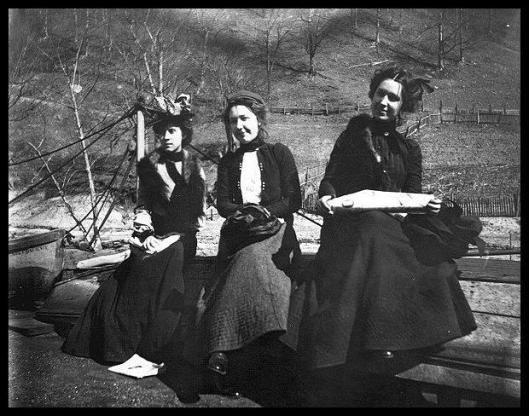
Pikeville Belles (1901)

29 Sunday Sep 2013

Posted by Brandon Ray Kirk in Big Sandy Valley, Pikeville, Women's History

≈ 1 Comment

Tags

Appalachia, Big Sandy River, culture, history, Kentucky, life, photos, Pikeville, steamboat, U.S. South

Pikeville Belles waiting on steamboat 1901

“Waiting on a boat,” Pikeville, Kentucky, 1901

In Search of Ed Haley 171

18 Wednesday Sep 2013

Posted by Brandon Ray Kirk in Ed Haley

≈ Leave a comment

Tags

Appalachia, Ashland, blind, Ed Haley, Ella Haley, genealogy, history, Kentucky, Lawrence Haley, life, Mona Haley, Pat Haley, writing

“So when Larry and I got there, my mother-in-law, she was the one opened the door. I fell in love with her right away. And I didn’t see Ed until the next day. He was in bed and he was also hard-of-hearing and he didn’t hear us come in. Mom led us inside and, of course, Jack’s wife Patsy had the house very clean.”

One of the first things they did after arriving was eat a meal.

“Mom asked Lawrence, she said, ‘’awrencey boy, are you hungry?’ He said, ‘We’re starving, Mom.’ Well, Mom called upstairs and told Pat and Jack that we was here and they came down and Mom told Patsy we were hungry and Pat said, ‘Well, we don’t have much ready to eat. Would you like sausage and eggs?’ Well, I thought that was fine. But when these little patties came up… There was an oilcloth on the table — everything was clean and nice but the silverware was in a Mason jar in the middle of the table. I was just amazed that nobody set the table like I had been used to. I’d never seen sausage fried black. After dinner, they told us they had the bedroom upstairs fixed up for us. My mother-in-law had bought a new bedspread and new doilies for the dresser and Patsy had bought a lamp and some doilies and a picture for the wall. She’d really tried to fix up the room and make it nice for us. Mom had bought a very nice wardrobe and a dresser. The bed was Mom’s. The other furniture had belonged to Patsy and Jack.”

The next morning, Pat first met Ed.

“He came into the dining room and I was in the dining room, me and Larry. Larry just said, ‘Pop, this is Patricia.’ He just, you know, said, ‘Howdy do.’ And I went up to him to shake his hand. Larry had told me that I would have to go to him. If you looked at Ed Haley, it looked as though he was looking right at you. When I got up to him, Larry put his hand on my head and told him I was as short as Mom. Larry had told me that Pop would put his hands on me and check my head and face and my arms to see what kind of woman I was. He took his fingers — that’s the way he checked your features. And he could tell how you was built. Then he patted me on the shoulder to see what sort of made woman I was. But he had the smoothest hands. They were not a bit rough. Larry took Pop’s hand and put it on my belly and said, ‘See here, Pop.'”

Pat said she met Mona later that day.

“Mona came over the next day after I got here — her and her husband and her mother-in-law and her sister-in-law. Sometime after that, Mona came over and was playing a mandolin and her and Mom was playing. Mom played me some English tunes. And I don’t know how come they played but they got Pop to play a tune or two and he wouldn’t play much because he had whittled on his fingers and made them raw. He always loved my salmon. Course he called them salmon cakes. I call them croquettes.”

In Search of Ed Haley 170

16 Monday Sep 2013

Posted by Brandon Ray Kirk in Ed Haley

≈ Leave a comment

Tags

Ashland, blind, Ed Haley, Ella Haley, Farmers, immigration, Jim Brown, John Hartford, Kentucky, Lawrence Haley, Morehead, Pat Haley, writing

Early in March 1995, I fired up the Cadillac and drove the familiar road toward Ashland, Kentucky. After several hours of travel, I entered Rowan County — the place of Ella’s birth — and took the Farmers exit off of I-64. I wanted to get a closer look at Farmers, it being a place where Ella had lived, where Ralph was supposedly conceived, and where Lawrence remembered Ed playing for a dance. At one time, Farmers was the county’s largest town with 1,000 people. At the time of my visit, it was a small settlement, easily eclipsed by nearby Morehead.

A little later, I made my way into Morehead, a small college town with a curvy downtown business district and with most of its historical buildings torn down. It was somewhat disappointing. Triplett Creek, the Trumbo section of town, was dull and uninspiring. Small modern apartments replaced Ella’s old home place. Scenes of the Martin-Tolliver feud were long gone, removed to make way for a new road. At the college library, I found some interesting local history but nothing really pertaining to Ed and Ella’s story.

That evening, I arrived at Pat Haley’s home in Ashland. Pat was really down about Lawrence’s death and the progression of her daughter’s cancer. It was sad to be there – especially in the kitchen where Lawrence and I had spent so much time hashing out Ed’s music. Pat’s grandchildren were around frequently – especially David’s three daughters – but there was a great void in the house. I imagine it was a hundred-fold for Pat.

“We met August 14th, 1948, and he came back to America on November 5th,” she said of Lawrence. “We wrote to each other and I never saw him again until he came back to England and we met on Valentine’s Day, 1949. We married ten days later. I was almost eighteen. He was 21. I was staying with my sister in Hertfordshire, which is just on the outskirts of London. Larry came back to America in May, when he got out of the service. That’s when he told his mother he was married. Although she was writing to me, she didn’t know we were married. And she told him, ‘I suppose there’s a baby on the way.’ And he told her yes.

“I left England September 28th, 1949 on a Danish ship with a Polish crew. I was seven and a half months pregnant. It was a terrible experience. I went into false labor on the way over. The doctor was Polish and I never did understand a word the man said except ‘Haley.’ Had Beverly been born on that ship she could have claimed nationality to any country because we were in international waters. I got in this country on October 6th after eight days of choppy water. Larry met me in New York. We come past Staten Island and Ellis Island. I couldn’t see Larry on the dock but bless his heart he didn’t know he had to get a docking pass. He was stuck up at the barrier and here were all these people getting off the ship. And there was Larry in civilian clothes. It was the first time I’d seen Larry in civilian clothes. And one of the immigration officers said, ‘Why, he’s just a little boy.’

“We spent ten days in New York. Part of my luggage was lost and we were having some problem with some papers Larry should have gotten done. I didn’t know his parents were blind until we were in New York. I asked Larry what his mother thought of the pictures that he had given her of him and I, and he said, ‘She hasn’t seen them.’ And I said, ‘Why not?’ and he said, ‘She can’t see them. She’s blind.’ And I said, ‘Well, what did your dad think of them?’ And he said, ‘He’s blind, too.’

“We stayed in New York till October 16th. Just before we left, we had enough to buy a Spam sandwich and two apples in the bus station. He gave me the sandwich. It took us 24 hours to get from New York to Ashland. I got deathly sick on that bus ride. It was twist and turn over those mountains. It was about midnight when we got into Ashland and we had three cents in our pocket. Jack thought we would be there in the afternoon so he and Jim Brown had gone to the bus station and looked for us. They were drinking. Well, when we didn’t show up — I think it was between six and eight o’clock — they went back to the house. The bus station was located at 13th Street between Winchester and Carter Avenue. His parents lived at 1040 Greenup Avenue. So we walked and carried our suitcases and I had high heels on. We walked about six blocks — three down and three across.”

In Search of Ed Haley 169

10 Tuesday Sep 2013

Posted by Brandon Ray Kirk in Ed Haley

≈ 3 Comments

Tags

Alva Greene, Brandon Kirk, Ed Haley, fiddling, Fred B. Lambert, Huntington, J P Fraley, John Hartford, Kentucky, Lawrence Kirk, music, Pat Haley, writing

Not long after talking with Patsy, while on a trip through Kentucky, I visited J.P. Fraley. I had Ed’s fiddle with me, which excited J.P. greatly. He fiddled Haley’s version of “Granny Will Your Dog Bite?” as best as he could remember it and said Ed used to sing:

Granny, will your dog bite, dog bite, dog bite?

Granny will your dog bite?  “No, child, no.”

Granny will your dog bite, dog bite, dog bite?

“Johnny cut his biter off a long time ago.”

He said Ed also used to play “Hunky Dory”.

Between tunes, J.P. talked about how Haley was the top fiddler in his section of Kentucky. “Daddy and Alva Greene and Doctor Sparks and Frank Clay, Drew Crockett — reputable fiddlers, I called them — ever chance they got, they’d go listen to Ed Haley. He was the yardstick of the fiddlers in this whole area.”

J.P. said, “I’ve kept something for years, buddy. I’ve got a fiddle bridge of Ed Haley’s. I don’t know what it’s made out of.”

Apparently, when he borrowed the Haley fiddle from the Holbrooks years ago, he had kept a little memento before returning it.

In the next couple of weeks, I finalized plans for another “Ed Haley trip.” Pat Haley said I could stay at her place in Ashland, while Lawrence Kirk said I was welcome to stay with him in West Virginia. I called Brandon Kirk, the Harts genealogist, and arranged to meet him at the Morrow Library in Huntington. There he said we would have a lot of genealogical material at our fingertips, as well as all the room we needed to sort through our books and old photographs. I was very interested in the Lambert Collection, which he said was full of local historical information.

In Search of Ed Haley 167

07 Saturday Sep 2013

Posted by Brandon Ray Kirk in Ed Haley

≈ Leave a comment

Tags

Allie Trumbo, Ashland, Cincinnati, Clyde Haley, Ed Haley, Ella Haley, Jack Haley, James Brown, Kentucky, Margaret Arms, Ohio, Ralph Haley, Texas Anna Trumbo

On April 10, 1916, a postcard referenced Ralph for the first time. “Florence,” of Portsmouth, wrote to Ella, who had settled at 630 Curtis Avenue in Middletown, Ohio.

“Dear Friend,” she wrote. “I got your card. Was glad to hear from you. Kiss Ralph a dozen kisses for me. Ruth gave me Ralph’s picture and is awful sweet. Tell Mrs. Trumbo I said Hello. How do you like Middletown? Let me know how you and Ralph are.”

Ella was still in Middletown in December of 1916.

By November of 1917, Ella had settled at 913 10th Street in Portsmouth, Ohio. Today, this address (just around the corner from her former Portsmouth location) is an empty lot situated in a bad section of town. Ella’s brother Luther lived nearby on Gay Street, while brother Allie was away in the Army.

“Hello Sister,” Allie wrote. “I am now on my way to the training camp. Will arrive there Some time tomorrow. It is at San Antonio Texas Camp Travis.”

On January 10, 1918, “Miss Ella Trumbo” was living in Ashland, Kentucky. She remained unmarried, based on the usage of her maiden name in the postcard.

The next postcard is dated in the early 1930s. By this time, she had married Ed Haley.

On April 17, 1934, Ralph sent Ella a postcard from Fort Knox, Kentucky. It was addressed to “Mrs. J.E. Haley” at 1030 45th Street in Ashland.

“Having a fine time, leaving for Cal. Thursday,” Ralph wrote. “Wish you could go. Tell Allie, Jane, and the children hello.”

In another card from Ralph and postmarked from Fort Knox (April 19, 1934), he wrote: “Dear Mother. Rec. your letter yesterday. Glad to hear from U. I am leaving today for San Diego Cal. down on the mexican border. Am saving stamped envelope to write to U while on the train. do not try to answer till I send address. Your affecionate Son, Ralph.”

In May of 1934, there was a card from a sister in Cincinnati, Ohio (probably Sissy), which read, “Will be at your house a Bout noon Saturday. Will stay all night at Margaret’s. we will Leve circa in the morning.”

In April 1941, Clyde sent several postcards to the family at 337 37th Street from Washington, D.C. His message for “Monnie & Lawrence Haley” was: “Hello Kids! How is school now-a-days? Fine, I hope. Wish I could see you. I’ll be seeing you. Write soon.” To Jack: “How are you? Fine, I hope. I know I am. Wish you were here. It’s a great place.” To “Mrs. J.E. Haley”: “Am getting along Fine. Hope you’re O.K. Am Sight seeing in the mountains along Skyline Drive. Your affectionate Son.”

In May, Jack received this odd note from Louisville, Kentucky: “I thought may be I would write you a few lines to let you know I got in Louisville okay. Well Jack how are you getting along. Fine I hope. Jack how is the girls out in South Ashland getting along? Well you be a good boy honey and daddy will bring you a candy sucker. Well Jack I will have to close for now. It’s getting late. Jack it is Tuesday night. I am in Bed writing this card. Love James Brown.”

Clyde sent another card home from Cincinnati, Ohio, postmarked February 16, 1943: “Dear Mom: We are all well and hope you are the same. As soon as you send me my Birth Certificate I go to work. Get it tomorrow and send it. SALARY $33.50 a week. Go down town and get it and send it soon as possible.”

There was one final card dated April of 1943 from “Pvt. Ralph A. Payne” at Camp Crowder, Missouri. The Haley family was still at 337 37th Street.

In Search of Ed Haley 166

06 Friday Sep 2013

Posted by Brandon Ray Kirk in Ed Haley

≈ Leave a comment

Tags

Allie Trumbo, Ella Haley, Florida, history, Kentucky, life, Luther Trumbo, Mont Spaulding, Morehead, Ohio, Plant City, Portsmouth, writing

Ella was in Morehead as late as June 1911, where she received a card from “C.E.G.” reading, “I am living high. I go riding every day with my friend, Mrs. Mell Washington.”

Later in the fall of 1911, Ella was once again at 115 Woodland Avenue in Lexington, Kentucky. While there, one card was sent to her reading, “Well Ella, I got your card. Was glad to hear you Was all Well. Luther is Still here. Will Stay till you come home.”

Ella was back in Morehead by July 1912, where she received a card from Mont and Jim Spaulding postmarked in Richmond, Virginia. I wondered, was this the Mont Spaulding who was blind and played the fiddle around Kermit, West Virginia? In September, Mont and Dora Spaulding wrote her from Charleston, West Virginia:  “hello Ella. Did you get the card I send you from Va?”

“M. Spaulding” wrote to her again in November (although in a totally different handwriting), this time from Norton, Virginia. “It might be possible that my Daughter and I will see you about the last of this month.” The Spauldings apparently made the trip because Dora wrote Ella early in December, again from Charleston: “certainly did enjoy my short stay in your town.”

Ella’s postcards for the first part of 1913 were primarily from her brother Luther and were postmarked from Asheville, Knoxville, and Indianapolis.

In May, some friends sent her a postcard that read: “We would like very much for you to come up Sat. night and play for us. Come to stay all night if you can. Let us know if you will come.” At that time, Ella’s address was Clearfield, Kentucky, but she was in Morehead briefly the next month.

In September, she was in Farmers, Kentucky — her location when she became pregnant with Ralph. While in Farmers, she received a card from “Sissie” postmarked in Hitchins, Kentucky, reading “I am so Lonesome.”

In May of 1914, Allie and Texana wrote her in care of C.D. Davis.

“We are keeping house here in West Morehead and want you to come up and See us at once So Bring your Harp and harp rack with you So we can have some music So let us know When you are coming and we will meet you.”

In August 1914 Allie wrote to her in care of R.A. Thomas from Loveland, Kentucky.

“Well, Ella, I am thinking about getting married Sometime. I think I will and then I change my mind.”

In the next several months, Ella moved from Farmers to 1124 Gay Street in Portsmouth, Ohio. At that location, which is now a DMV parking lot, she received frequent postcards from a mysterious “R.B.” in Plant City, Florida. Only two of the cards were postmarked. In June of 1915, R.B. wrote: “Well, the Sun is Getting hot as H. Down hear.” In August: “I am at Cincinnati to Night But Don’t know whear I will Be to morrow.”

None of the remaining cards from R.B. are postmarked, making it impossible to arrange them chronologically. Here are some of the more interesting ones:

“My Dear friend. You Do Eny Thing with The money you want to. I will Try and Send you Some more wedensday if nothing happens. Don’t forget your Florida friend.”

“This is Tuesday Eve, and no Letter yet. Don’t no what to think if you are mad Rite and tell me what you got mad about. I am going to Kentucky next week.”

“Dear friend, I am Disipointed this Evening By Not getting a Letter. Hoping you haven’t Forgotten me.”

“I will Rite you a few Lines as I promest you. I guess you wish I wood quit Riting So much. Yes, Ella I wood Bee more Then Pleased to get That Picture we was talking about. I am Sorrow you are not well. Say Ella if you can Rite to me three times a week as I am So Lonesom hear. you have no Idea what I have to put up with.”

“I am going to do the Best I can till I can get away But what Ever you Do Don’t change Bording houses. Now you may think I am crazy But I no what I am talking about. I will Rite a Point Letter the first chance I have hoping to hear from you again Soon.”

“Yes Ella I guess you are tard of hearing that word Some Day But Don’t get worried I am going to Do the Best I can.”

“I am so Proud you think of me as often as you Do for I am so Lonesom hear.”

“I think you ort to Rite oftener Then you Do. Please tell me why you Don’t. I am worrying my Life away Faster Then Eny one on Earth. So Rite and cheer me up all you can.”

“This Leaves me feeling Bad This Evening. I was Expectin a Letter But got Disipointed. I will Start you That money Saturday if Nothing happens.”

“Why Don’t you Rite oftener. this is Tuesday Evening and I haven’t had a Letter since Saturday. I guess you are about to Forget me.”

“Some one Swears Thay are going Back to Ky. and I wood Be glad to get Rid of Them So keep quite.”

“Yes, Ella I am going to come Back Soon. I want to get a way From hear By the 20th of July if I can. Ella I can’t tell you wheather or not Maudie and Vada Noes eny thing about what. Guess at the Rest.”

“Say Ella the theater is Right By the Post office hear and the Piano is Playing Silver threads among the Gold. you can guess how I feal. I get so nervous Some times I can’t hardly Liv.”

In Search of Ed Haley 165

05 Thursday Sep 2013

Posted by Brandon Ray Kirk in Ed Haley

≈ Leave a comment

Tags

Allie Trumbo, Ella Haley, genealogy, history, Kentucky, Kentucky School for the Blind, life, Lula Lee, Luther Trumbo, Morehead, S.H. Childers, U.S. South, writing

When I got back in Nashville, I arranged all of Ella’s postcards into chronological order in the hopes of discovering some new revelation. Most of the cards were dated between 1908-1918, the years immediately prior to her marriage to Ed. Individually they carried only short messages from family and friends, but together they formed an interesting story line detailing events from Ella’s “single years.”

Ella was at the Kentucky School for the Blind in Louisville throughout the first part of 1908. She returned home to Morehead during her summer break, where friends wrote her fondly from Louisville, Nashville, Richmond, and Paducah. There was one card from “Bridget” – probably the same one that Lawrence remembered his mother visiting in Mt. Healthy, Ohio.

“Suppose you think I have forgotten you but think of you every day,” the card read. “Company season has started in and we are having plenty of visitors. Wish you were one. Your cousin Lula is expecting to go West for her health. She was much grieved to hear of the death of Aunt Henrette. Answer soon with love.”

In June of 1909, Ella received a card from “Loula Lee” in Denison, Texas. This was no doubt the same Lula Lee who Lawrence Haley had remembered playing music on the streets of Ashland at the same time as his parents, likely the same person as “cousin Lula” referenced in other cards.

“Hello Ella how are you,” Loula wrote. “all wright I hope. Got out here all right and I like Very Well. It is hot as Summer out here.”

There was also a card from Nellie Motts in South Portsmouth, Ohio.

“I rec’d your card a few days ago and was very glad to hear from you. I am having a delightful vacation. How did you enjoy the Fourth?”

Then this from “Mabel” in Mississippi: “I am away down in the Sunny South. Awful warm weather. I will be glad to get back to Kentucky.”

Ella was back in Louisville that fall where her brother Allie Trumbo sent several cards to her.

“Luther is at home now,” one read. “Please write within 23 hours this time.”

Luther was Ella’s other brother and a future soldier in World War I.

“Hello Allie,” she responded. “It seems as though you keep the road hot sending cards. Now I have written within 23 hours. What more do you bid me to do? The girls are waiting on you.”

Allie wrote back: “how is everything. We had a little rain last week. Please write within 22 hrs. I just got your letter out of the office and will write to you soon.”

“Thank you for the pretty card,” someone wrote from Providence, Rhode Island. “Am glad you are having a pleasant year. Be sure and do good work.”

More from Allie: “I couldn’t make out all of your card but I enjoy it very much. I will send you some cards of our town which will show the bridge and george’s house and part of grandmaw’s.”

“how are you?” one from someone named Cora in Morehead read. “We have biscuits this morning for breakfast and I am going to have fried potatoes for dinner and when I got your card last night we had beef steak.”

“You have been sending me the ugliest cards you can find,” Allie writes. “Try and do better. The creek was Higher than it ever was before Tuesday night.”

In November 1909, there was a “Forget-Me-Not” card from S.H. Childers postmarked in Hellier, Kentucky.

“I do insist on you sending me one of those pictures,” Childers wrote. “Never mind what it looks like.”

There were more from Childers, often signed, “Your lonely friend,” with passages reading, “I am not quite well now. Haven’t don any thing for two weeks. They tell me I am love sick but I don’t think that’s it.”

Bridget sent a Christmas card, signing her last name as Welsh, while another friend, “Flossie,” wrote a few months later.

“You may think I have forgotten you but indeed I have not,” she wrote. “Hope you are having a good time playing in the snow.”

In May 1910, Allie wrote from Portsmouth, Ohio.

“I came from Ashland on this Boat. We got here all O.K. and have got a job. Go to work Tuesday. I like to stay here.”

For the next several weeks, Ella received mail at 115 Woodland Avenue in Lexington, Kentucky. By June of 1910, she was back in Morehead. A card was sent there to “Miss Bridget Welsh & Miss Ella Trumbo” from Miss Henderson in Little Rock, Arkansas.

In July, there was another card reading, “Know you and Bridget are enjoying each others company.”

Late in August 1910 there was a card from “Aunt Anna” to Ella and Bridget: “arrived here all right. Am well and having a fine time. hope you are both enjoying good health.”

On September 7, “Oma” wrote: “Received your pretty card. I guess you will sure hate to see Bridget leave.”

Later in September was a card sent “With Fond Love” and stamped with a fanciful signature from S.H. Childress at the Sunset Ranch in Rhine, Washington.

“I have at last made up my mind to vacate Ky. and have done so. Will write you all a bout my future home when I get my slate.”

It seemed clear that this “S.H. Childress” was the same “S.H. Childers” who’d written Ella the previous fall. He wrote again in December.

“I believe is your first Xmas at home and I trust it will be the happiest you have ever spent.”

In Search of Ed Haley 164

04 Wednesday Sep 2013

Posted by Brandon Ray Kirk in Ed Haley

≈ 1 Comment

Tags

Ashland, fiddling, genealogy, Jack Haley, John Hartford, Kentucky, Lawrence Haley, Morehead, music, Pat Haley, Patsy Haley, Ralph Haley, Scott Haley

A few days later, I was in Ashland at Pat Haley’s house, where the Haley clan had gathered in for Lawrence’s funeral. All of Lawrence’s kids were there, of course (Beverly, Steve and David), as was Clyde and Mona. I also spotted Noah, who introduced me to his son, James Edward Haley (Ed’s namesake). Pat made a point to introduce me to Patsy Haley and her son Scott, who were in from Cleveland. A little later, I played Ed’s fiddle for Lawrence’s service and it sounded so good that I seriously considered making it my main fiddle on stage. I quickly slipped into “the zone” and it was the first time I seemed to experience (as crazy as it may seem) the sensation of Ed and Lawrence both whispering in my ear, guiding me along, looking over my shoulder, and saying things like, “Easy now, don’t play so many notes.” “Yeah, try that and see if it works.” “You’re getting too far away from the melody.”

After the funeral, I returned to Pat’s and played for the family in the kitchen. I wasn’t really sure what to expect. I mean, with Lawrence gone it would have been really easy for the Haleys to say, “Thanks for showing an interest in Pop, now see ya later,” but instead they took me into their fold — with Pat leading the way.

There were a few new stories. For instance, Patsy’s son Scott Haley told me about “catching” his father Jack in private moments playing a fiddle right along with Ed’s records. I was excited to hear that and could easily imagine that Jack was the child who had inherited Ed’s talent for the fiddle. But when I asked Pat and Steve about it they gave Scott’s claim little credence. They said Jack might have tried to play with the records but he couldn’t really play anything. They fancied Scott’s memory to be a lot like the one they had of Lawrence, who occasionally strung up Ed’s fiddle (backwards because he was left-handed) and attempted to play along with the records. I never forgot the possibility, though, that Jack Haley could play the fiddle, which seemed to irritate Pat.

Before I left Ashland, Pat gave me Ed’s records. She said she wanted me to keep them because I would “know what to do with them.”

“I have a real love-hate relationship with those records,” Steve said jokingly. “When we were kids we had to tip-toe through the house to keep from scratching them.”

Pat also loaned me Ella’s postcards and explained why Lawrence hadn’t wanted me to see them on my first visit roughly four years earlier. Apparently, they alluded to the fact that Ella had conceived Ralph not by a previous marriage — but out of wedlock. Pat said Ella was boarding with a Mr. Payne and giving piano lessons to his five-year-old daughter in Farmers, Kentucky, when she became pregnant. Mr. Payne promptly returned her to her family in nearby Morehead.

In Search of Ed Haley 161

28 Wednesday Aug 2013

Posted by Brandon Ray Kirk in Ed Haley

≈ 2 Comments

Tags

Ashland, Calhoun County, Ed Haley, Ella Haley, history, John Hartford, Kentucky, Laury Hicks, Manuel Martin, music, Ugee Postalwait, West Virginia, writing

After hanging up with Pat, I called Ugee Postalwait — Laury Hicks’ daughter in Akron, Ohio — to tell her about getting the picture of Ed from Maxine McClain. Ugee was full of energy. Her memory was obviously working in overdrive.

“I used to know all of them,” she said of the old musicians in her part of the country. “They was all to our house. They’d come from miles around to hear Dad play, especially when Ed was in the country. Maybe they’d stay two or three days at our house. I’d get up of a morning to look see who was in the house asleep and who all I was gonna have to cook breakfast for, when I was a girl growing up. The young men would sleep in the boys’ room and they’d sleep in the floor. Then they’d sleep four crossways in the bed, too. As I get old, I get to thinking about all of them and wonder how in the world my dad ever fed them all. I been a cooking ever since I was nine years old for workhands and people like that. One morning — I never will forget I wasn’t very old, then — got up and got breakfast. We’d had cabbage the day before for supper. A big pot of cabbage. And Ed and Ella was there. I never put cabbage on the table for breakfast. Ed looked at me and he said, ‘Ugee, what did you do with that cabbage last night?’ I said, ‘It’s in there.’ ‘Well why didn’t you put it on the table for breakfast?’ I said, ‘Well who eats cabbage for breakfast?’ He said, ‘I do.’ Now I never seen anyone eat such a mess of cabbage for breakfast. Him and Ella did. Ella said, ‘Oh, we always eat the same thing we had for supper.’ I never will forget that. From that time on, whatever was left over from supper, I’d warm it up, you know, and fix it for their breakfast ’cause they would eat it. They liked cabbage or kraut.”

Ugee really laughed telling about that, then started in with another tale.

“One time they was some Baileys there and I believe they was some of them McClain boys, and I was peeling tomatoes for supper — you know, slicing them and putting them on the plate — and I had a plate on one end [of the table] and one on the other end. And Manuel Martin was there too, and Commodore Cole. And I looked in both places and them tomatoes was gone. ‘What in the world? Some of them’s come in and hid my tomatoes.’ I looked out and Ed was standing there sitting on the walk — I never will forget — a laughing, and he said, ‘Wait till she finds out.’ I said, ‘Ed did you get them tomatoes in there?’ He said, ‘We ate every one of them.’ I said, ‘If I could find the plate, I’d break it over your head.’ That Commodore Cole, he said, ‘You wouldn’t dare do that.’ Ed said, ‘Don’t dare her too much, Commodore. I know her.’ And they was a eating them tomatoes as fast as I was a peeling them. Them ornery birds, I never will forget that.”

“The last time I ever seen Ed was at his house,” Ugee said. “He looked at me and he said, ‘Ugee, can you still make a rhubarb pie?’ I said, ‘Why lord yes, I reckon I can. Why?’ He said, ‘Well, I want a rhubarb pie.’ And I made four and I never seen no such eating as he done that evening, him and Ella, on them rhubarb pies while they was hot — with milk cream over them. I can see them yet. I went down to Ashland, Kentucky. They lived on 45th Street.”

In Search of Ed Haley 159

26 Monday Aug 2013

Posted by Brandon Ray Kirk in Ed Haley

≈ Leave a comment

Tags

Appalachia, blind, Ed Haley, feud, fiddling, history, Kentucky, Lawrence Haley, Milt Haley, Mona Haley, music, U.S. South, writing

In one of those “passing the torch moments,” Lawrence reached the telephone to his sister, Mona. I told her about Milt Haley being a fiddler, and she said, “Really? Well we didn’t never know that.”

I figured that Ed had kept all of the details about Milt hidden from his kids, but Mona said, “Well, he talked about it some, because I wouldn’t know what I know about it if he hadn’t. You did find out what I told you was true, didn’t you? It wasn’t my dad’s mother that was killed, the way I heard it. It was one of the Hatfield women. Got half her face shot away and it killed her. That’s why they retaliated against Green McCoy and my grandfather. That’s only hearsay, but it had to come from Pop. I do remember him saying that.”

Pat seemed pleased that Mona was visiting Lawrence.

“He asks for her a lot,” she said.

I wanted to know more about Lawrence’s condition.

“He sits with his eyes closed and he found a pair of sunglasses that look exactly like the ones his daddy wore,” Pat said. “These are a pair that one of the kids bought. They were laying on the dining room table and he picked them up and said, ‘There’s my glasses.’ He insists on wearing them and you would think it was Ed Haley back many years ago. He talks about horse and buggies a lot. He sits with your book constantly. He does not like to look at the picture of his mother’s tombstone. What keeps you in his mind a lot, he listens to the tapes and he knows he gave you the records. Beverly was here this past weekend. He knew who she was but he was still talking in riddles. But today he’s pretty much himself. He got up and got dressed about 5:30 and he’s been roaming ever since.”

In Search of Ed Haley

23 Friday Aug 2013

Posted by Brandon Ray Kirk in Ed Haley

≈ Leave a comment

Tags

Appalachia, Ashland, genealogy, history, Kentucky, life, Mona Haley, photos

Mona Haley, 1945

Mona Haley, 1945

← Older posts
Newer posts →

Feud Poll 1

If you had lived in the Harts Creek community during the 1880s, to which faction of feudists might you have given your loyalty?

Categories

  • Adkins Mill
  • African American History
  • American Revolutionary War
  • Ashland
  • Atenville
  • Banco
  • Barboursville
  • Battle of Blair Mountain
  • Beech Creek
  • Big Creek
  • Big Harts Creek
  • Big Sandy Valley
  • Big Ugly Creek
  • Boone County
  • Breeden
  • Calhoun County
  • Cemeteries
  • Chapmanville
  • Civil War
  • Clay County
  • Clothier
  • Coal
  • Cove Gap
  • Crawley Creek
  • Culture of Honor
  • Dingess
  • Dollie
  • Dunlow
  • East Lynn
  • Ed Haley
  • Eden Park
  • Enslow
  • Estep
  • Ethel
  • Ferrellsburg
  • Fourteen
  • French-Eversole Feud
  • Gilbert
  • Giles County
  • Gill
  • Green Shoal
  • Guyandotte River
  • Halcyon
  • Hamlin
  • Harts
  • Hatfield-McCoy Feud
  • Holden
  • Hungarian-American History
  • Huntington
  • Inez
  • Irish-Americans
  • Italian American History
  • Jamboree
  • Jewish History
  • John Hartford
  • Kermit
  • Kiahsville
  • Kitchen
  • Leet
  • Lincoln County Feud
  • Little Harts Creek
  • Logan
  • Man
  • Matewan
  • Meador
  • Midkiff
  • Monroe County
  • Montgomery County
  • Music
  • Native American History
  • Peach Creek
  • Pearl Adkins Diary
  • Pecks Mill
  • Peter Creek
  • Pikeville
  • Pilgrim
  • Poetry
  • Queens Ridge
  • Ranger
  • Rector
  • Roane County
  • Rowan County Feud
  • Salt Rock
  • Sand Creek
  • Shively
  • Spears
  • Sports
  • Spottswood
  • Spurlockville
  • Stiltner
  • Stone Branch
  • Tazewell County
  • Timber
  • Tom Dula
  • Toney
  • Turner-Howard Feud
  • Twelve Pole Creek
  • Uncategorized
  • Warren
  • Wayne
  • West Hamlin
  • Wewanta
  • Wharncliffe
  • Whirlwind
  • Williamson
  • Women's History
  • World War I
  • Wyoming County
  • Yantus

Feud Poll 2

Do you think Milt Haley and Green McCoy committed the ambush on Al and Hollene Brumfield in 1889?

Blogroll

  • Ancestry.com
  • Ashland (KY) Daily Independent News Article
  • Author FB page
  • Beckley (WV) Register-Herald News Article
  • Big Sandy News (KY) News Article
  • Blood in West Virginia FB
  • Blood in West Virginia order
  • Chapters TV Program
  • Facebook
  • Ghosts of Guyan
  • Herald-Dispatch News Article 1
  • Herald-Dispatch News Article 2
  • In Search of Ed Haley
  • Instagram
  • Lincoln (WV) Journal News Article
  • Lincoln (WV) Journal Thumbs Up
  • Lincoln County
  • Lincoln County Feud
  • Lincoln County Feud Lecture
  • LinkedIn
  • Logan (WV) Banner News Article
  • Lunch With Books
  • Our Overmountain Men: The Revolutionary War in Western Virginia (1775-1783)
  • Pinterest
  • Scarborough Society's Art and Lecture Series
  • Smithsonian Article
  • Spirit of Jefferson News Article
  • The Friendly Neighbor Radio Show 1
  • The Friendly Neighbor Radio Show 2
  • The Friendly Neighbor Radio Show 3
  • The Friendly Neighbor Radio Show 4
  • The New Yorker
  • The State Journal's 55 Good Things About WV
  • tumblr.
  • Twitter
  • Website
  • Weirton (WV) Daily Times Article
  • Wheeling (WV) Intelligencer News Article 1
  • Wheeling (WV) Intelligencer News Article 2
  • WOWK TV
  • Writers Can Read Open Mic Night

Feud Poll 3

Who do you think organized the ambush of Al and Hollene Brumfield in 1889?

Recent Posts

  • Logan County Jail in Logan, WV
  • Absentee Landowners of Magnolia District (1890, 1892, 1894)
  • Charles Spurlock Survey at Fourteen Mile Creek, Lincoln County, WV (1815)

Ed Haley Poll 1

What do you think caused Ed Haley to lose his sight when he was three years old?

Top Posts & Pages

  • Halcyon 4.10.1919
  • Civil War Gold Coins Hidden Near Chapmanville, WV
  • Halcyon-Yantus 12.08.1911
  • Yantus 10.20.1911
  • Blood in West Virginia: Brumfield v. McCoy (2014)

Copyright

© Brandon Ray Kirk and brandonraykirk.wordpress.com, 1987-2023. Unauthorized use and/or duplication of this material without express and written permission from this blog’s author and/or owner is strictly prohibited. Excerpts and links may be used, provided that full and clear credit is given to Brandon Ray Kirk and brandonraykirk.wordpress.com with appropriate and specific direction to the original content.

Archives

  • February 2025
  • January 2025
  • October 2023
  • September 2023
  • December 2022
  • November 2022
  • May 2022
  • April 2022
  • February 2022
  • November 2021
  • October 2021
  • September 2021
  • June 2021
  • May 2021
  • April 2021
  • March 2021
  • February 2021
  • January 2021
  • December 2020
  • November 2020
  • October 2020
  • July 2020
  • June 2020
  • May 2020
  • April 2020
  • March 2020
  • February 2020
  • January 2020
  • December 2019
  • November 2019
  • October 2019
  • September 2019
  • August 2019
  • July 2019
  • June 2019
  • May 2019
  • April 2019
  • March 2019
  • February 2019
  • January 2019
  • December 2018
  • November 2018
  • October 2018
  • September 2018
  • August 2018
  • July 2018
  • June 2018
  • May 2018
  • April 2018
  • March 2018
  • February 2018
  • January 2018
  • December 2017
  • November 2017
  • October 2017
  • September 2017
  • August 2017
  • July 2017
  • June 2017
  • May 2017
  • April 2017
  • March 2017
  • February 2017
  • January 2017
  • December 2016
  • November 2016
  • October 2016
  • September 2016
  • August 2016
  • July 2016
  • June 2016
  • May 2016
  • April 2016
  • March 2016
  • February 2016
  • January 2016
  • December 2015
  • November 2015
  • October 2015
  • September 2015
  • August 2015
  • July 2015
  • June 2015
  • May 2015
  • April 2015
  • March 2015
  • February 2015
  • January 2015
  • December 2014
  • October 2014
  • September 2014
  • August 2014
  • July 2014
  • June 2014
  • May 2014
  • April 2014
  • March 2014
  • February 2014
  • January 2014
  • December 2013
  • November 2013
  • October 2013
  • September 2013
  • August 2013
  • July 2013
  • June 2013
  • May 2013
  • April 2013
  • March 2013
  • February 2013
  • January 2013
  • December 2012
  • November 2012

Enter your email address to follow this blog and receive notifications of new posts by email.

Join 2,927 other subscribers

Tags

Appalachia Ashland Big Creek Big Ugly Creek Blood in West Virginia Brandon Kirk Cabell County cemeteries Chapmanville Charleston civil war coal Confederate Army crime culture Ed Haley Ella Haley Ferrellsburg feud fiddler fiddling genealogy Green McCoy Guyandotte River Harts Harts Creek Hatfield-McCoy Feud history Huntington John Hartford Kentucky Lawrence Haley life Lincoln County Lincoln County Feud Logan Logan Banner Logan County Milt Haley Mingo County music Ohio photos timbering U.S. South Virginia Wayne County West Virginia Whirlwind writing

Blogs I Follow

  • OtterTales
  • Our Appalachia: A Blog Created by Students of Brandon Kirk
  • Piedmont Trails
  • Truman Capote
  • Appalachian Diaspora

BLOOD IN WEST VIRGINIA is now available for order at Amazon!

Blog at WordPress.com.

OtterTales

Writings from my travels and experiences. High and fine literature is wine, and mine is only water; but everybody likes water. Mark Twain

Our Appalachia: A Blog Created by Students of Brandon Kirk

This site is dedicated to the collection, preservation, and promotion of history and culture in Appalachia.

Piedmont Trails

Genealogy and History in North Carolina and Beyond

Truman Capote

A site about one of the most beautiful, interesting, tallented, outrageous and colorful personalities of the 20th Century

Appalachian Diaspora

  • Subscribe Subscribed
    • Brandon Ray Kirk
    • Join 789 other subscribers
    • Already have a WordPress.com account? Log in now.
    • Brandon Ray Kirk
    • Subscribe Subscribed
    • Sign up
    • Log in
    • Report this content
    • View site in Reader
    • Manage subscriptions
    • Collapse this bar
 

Loading Comments...