• About

Brandon Ray Kirk

~ This site is dedicated to the collection, preservation, and promotion of history and culture in my section of Appalachia.

Brandon Ray Kirk

Tag Archives: Fred B. Lambert

Sam Bias Recollections of Pioneer Life

18 Monday May 2020

Posted by Brandon Ray Kirk in Barboursville

≈ Leave a comment

Tags

Appalachia, Cabell County, Daniel Peyton, Dusenberry Dam, Elizabeth Rutherford, Fred B. Lambert, history, Holland's Creek, James Ford, Jenny Rutherford, Lafe Samuels, Milly Rutherford, Old Tuck, Polly Rutherford, Robert Rutherford, Roland Bias, Sam Bias, Thomas Rutherford

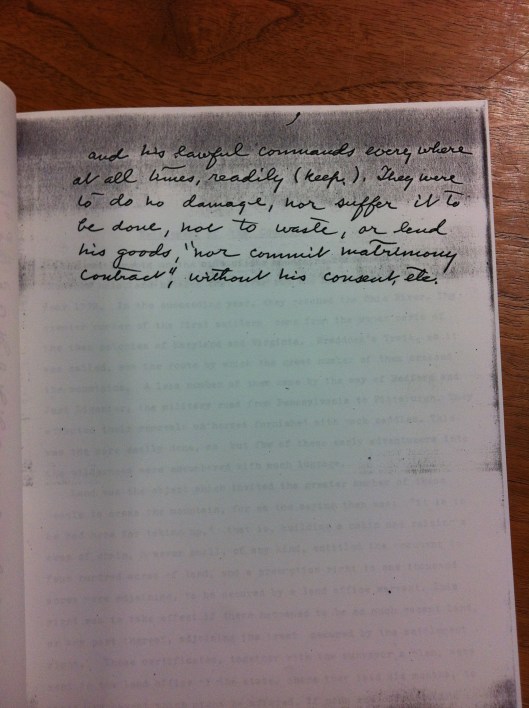
IMG_8361

Ms 76, Bx 6, Nbk 14: Fred B. Lambert Papers, Special Collections Department, Morrow Library, Marshall University, Huntington, WV. 

IMG_8362

Ms 76, Bx 6, Nbk 14: Fred B. Lambert Papers, Special Collections Department, Morrow Library, Marshall University, Huntington, WV. 

IMG_8363

Ms 76, Bx 6, Nbk 14: Fred B. Lambert Papers, Special Collections Department, Morrow Library, Marshall University, Huntington, WV. 

Guyan Valley High School Graduates (1932)

17 Tuesday Mar 2020

Posted by Brandon Ray Kirk in Ferrellsburg, Gill, Harts, Midkiff, West Hamlin

≈ 3 Comments

Tags

Appalachia, Brady, Branchland, Cecil Dean, Earl Brumfield, education, Emma Adkins, Ferrellsburg, Fred B. Lambert, Gill, Guyan Valley High School, Hallie Messinger, Harry Pinson, Harts, Hazel Adkins, history, Huntington, Juanita Cline, Lincoln County, Macil Covey, Marshall University, Midkiff, Morrow Library, Philip Adkins, Pleasant View, Reva Pierson, Roncie White, Samuel Adkins, West Virginia, Wilford Dingess

Fred B. Lambert, a prominent educator in the Guyandotte Valley, compiled this list of early Guyan Valley High School graduates. Guyan Valley High School was located in Pleasant View, Lincoln County, WV.

Picture 456A

GVHS students, 1928.

List of 1932 graduates

1. Earl Brumfield     Harts, WV

2. Samuel Adkins     Harts, WV

3. Roncie White     Gill, WV

4. Emma Adkins     Branchland, WV

5. Hazel Adkins     Branchland, WV

6. Philip Adkins     Harts, WV

7. Macil Covey     West Hamlin, WV

8. Juanita Cline     Bradyville, WV

9. Hallie Messinger     Branchland, WV

10. Reva Pierson     West Hamlin, WV

11. Wilford Dingess     Midkiff, WV

12. Harry Pinson     Midkiff, WV

13. Cecil Dean     Ferrellsburg, WV

Source: Fred B. Lambert Papers, Special Collections Department, James E. Morrow Library, Marshall University, Huntington, WV.

Stephen Hart: Origins of Harts Creek (1896/1937)

07 Thursday Feb 2019

Posted by Brandon Ray Kirk in Big Harts Creek, Boone County, Crawley Creek, Native American History, Roane County

≈ 1 Comment

Tags

Appalachia, Boone County, Crawley Creek, Dick Johnson, Elizabeth Hart, Fred B. Lambert, genealogy, Harts Creek, Henderson Dingess, Henry Clay Ragland, history, Jacob Stollings, James Hart, John Baker, Lincoln County, Little Harts Creek, Logan Banner, Logan County, Logan County Banner, Mud River, Native Americans, Roane County, Smokehouse Fork, Stephen Hart, West Virginia

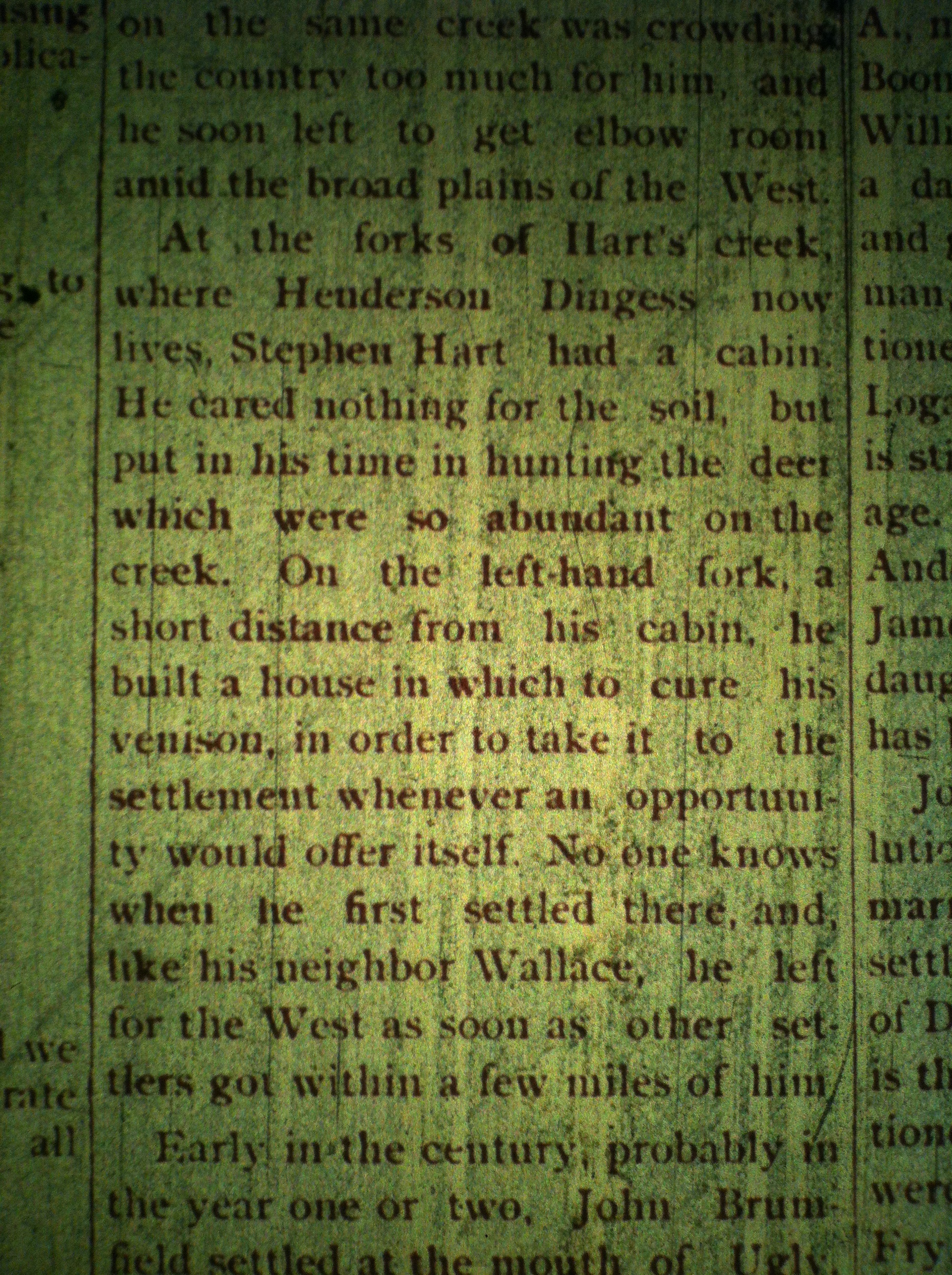
From the Logan County Banner of Logan, WV, comes this bit of history written by amateur historian Henry Clay Ragland relating to Stephen Hart and the naming of Harts Creek in Lincoln and Logan counties, West Virginia, dated 1896:

Stephen Hart Ragland LCB 04.08.1896.JPG

Logan County (WV) Banner, 8 April 1896.

***

On 13 April 1937, the Logan Banner printed another story about Hart and his relationship to Harts Creek. This latter story was generally derived from Ragland’s 1896 history.

Harts Creek Named After Stephen Hart—A Wanderer And Famous Deer Hunter

Much has been told about Harts Creek in late years, but little is known about the first settler who built his home in the long hollow and gave it a name.

Stephen Hart built a cabin on the farm which Henderson Dingess later owned at the forks of Hart’s Creek. He cared nothing for the soil, but spent his time hunting deer and curing the meat. He didn’t stay long in one place.

Near his cabin he built a house in which to store his cured venison between his infrequent trips to the settlements down the river and was altogether self-sufficient. His neighbors knew little about the man. There is no record of a family reared by him and he told neighbors little of his past history.

His was a roaming nature. He, like the Arabs, pitched his tent where the water was clearest, the game gamest, and the soil most fertile.

To commemorate his short stay at the forks of Harts, neighbors named the creek for him after he had loaded his gun, food stores and skins on a pack mule, and started west.

His few friends heard no more about him, but they remembered him as a “quiet man, a good shot, and a good neighbor.”

Just “around the bend and over the ridge,” Jacob Stollings, John Baker, and Dick Johnson brought their families and built their homes. From descendants of this family comes much of the record of Stephen Hart who gave the creek a name.

Hart’s venison was known for miles around as the tenderest, the most delicately cured meat in the Hart’s section and Stollings, Baker, and Johnson always put in a small supply of Hart’s meat for the winter, sometimes to take an unusually large supply off the hunter’s hands but most times just because they liked the venison.

John Baker married a daughter of Jacob Stollings, and Dick Johnson married a sister of Baker’s. Both men reared large families whose names are familiar in the county’s history.

But Hart left only the name of his beloved deer hunting grounds as a reminder that he had first set foot on Hart’s Creek.

MY NOTE: Of importance, much confusion remains regarding the source for the naming of Harts Creek, essentially relating to the fact that Stephen Hart was born too late to have inspired the naming of the stream. I first attempted to unravel this story when I published a profile of Stephen Hart in a Lincoln County newspaper in 1995/6. Stephen Hart, son of James and Elizabeth Hart, was born c.1810 in North Carolina; Harts Creek appears on a map printed prior to 1824 (Hart was still quite young). In the early 1900s, amateur historian Fred B. Lambert noted that Hart’s father had been killed by Native Americans at the mouth of present-day Little Harts Creek (according to a Hart descendant). Possibly it is Mr. Hart’s father who inspired the naming of the local stream. Problematic to this possibility is the fact that, based on Stephen Hart’s estimated year of birth, his father would have been killed in 1809-1811, which is about fifteen to twenty years too late for an Indian attack in the Guyandotte Valley. Stephen Hart did settle locally. He may well have squatted on Harts Creek land, as Ragland reported in 1896. Based on documentary evidence, he acquired 50 acres on Crawley Creek in 1839. He appears in the 1840 Logan County Census and the 1850 Boone County Census. By 1860, he had settled in Roane County, where he died in 1896–the same year that Ragland published his history. He also left plenty of local descendants in the Mud River section of Lincoln County. How did Ragland garble this section of his history so badly? For those who wish to avoid sorting out this confusing tale, consider this version: at least one early account states the creek was named “hart” due to the prevalence of stags in its vicinity.

Guyan Valley High School Graduates (1929-1931)

28 Saturday Jul 2018

Posted by Brandon Ray Kirk in Gill, Guyandotte River, West Hamlin

≈ Leave a comment

Tags

Alvin Franklin Watts, Appalachia, Bessie Arix, Branchland, Clyde Okra Adkins, David Keith Smith, Dennis Nathan Roy, Dorothy Beatrice Roy, Edgar Ray Midkiff, education, Ella Mae Covey, Elva Mae Adkins, Fred B. Lambert, Freda Marie McComas, Gilbert Garmon Isaac, Gill, Gilmer Odell McClellan, Glada Ellen Cyfers, Glenna Helena Midkiff, Glenna Naoma Roy, Guidna Bates, Guyan Valley High School, Guyan Valley Middle School, Helen Mary Yost, Helena Johnson, Helena Scraggs, Hilbert Harmon Isaac, history, Hubball, Huntington, Ida Lee Adkins, Irma Holton, Jennings Orlando Midkiff, Lincoln County, Mable Virginia Chapman, Marshall University, Maude Jewel Jaynes, Midkiff, Mildred Vivian Smith, Milton, Morrow Library, Olive Maude Triplett, Pleasant View, Rhoda Irene Messinger, Ruel Dial, Ruth Dewdrops Adkins, Ruth Lucas Stowers, Sarah Nelson, Sheridan, Smith, Thern Hodge, Thomas Wondel Adkins, Virginia Catherine Scites, Virginia Louise Johnson, West Hamlin, West Virginia, William Earl Bias

Fred B. Lambert, a prominent educator in the Guyandotte Valley, compiled this list of early Guyan Valley High School graduates. Guyan Valley High School was located in Pleasant View, Lincoln County, WV.

gv 1929.jpg

Guyan Valley High School, 1929. Photo credit unknown.

List of 1929 graduates

  1. Edgar Ray Midkiff     Smith, WV
  2. Jennings Orlando Midkiff     Smith, WV
  3. Gilmer Odell McClellan     Branchland, WV
  4. Olive Maude Triplett     West Hamlin, WV
  5. Dennis Nathan Roy     Hubball, WV
  6. Glenna Naoma Roy     Hubball, WV
  7. Rhoda Irene Messinger     Branchland, WV

List of 1930 graduates

  1. Clyde Okra Adkins     West Hamlin, WV
  2. Bessie Arix     Smith, WV
  3. Ruel Dial     Branchland, WV
  4. Thern Hodge     West Hamlin, WV
  5. Virginia Louese Johnson     Branchland, WV
  6. Sarah Nelson     Gill, WV
  7. Ruth Lucas Stowers     Milton, WV
  8. Elva Mae Adkins     West Hamlin, WV
  9. Dorothy Beatrice Roy     Hubball, WV
  10. David Keith Smith     West Hamlin, WV

List of 1931 graduates

  1. Ida Lee Adkins     West Hamlin, WV
  2. Ruth Dewdrops Adkins     West Hamlin, WV
  3. Thomas Wondel Adkins     Midkiff, WV
  4. Guidna Bates     Sheridan, WV
  5. William Earl Bias     West Hamlin, WV
  6. Mable Virginia Chapman     Hubball, WV
  7. Ella Mae Covey     West Hamlin, WV
  8. Glada Ellen Cyfers     Gill, WV
  9. Irma Holton      Branchland, WV
  10. Gilbert Garmon Isaac     Smith, WV
  11. Hilbert Harmon Isaac     Smith, WV
  12. Maude Jewel Jaynes     West Hamlin, WV
  13. Helena Johnson     West Hamlin, WV
  14. Freda Marie McComas     West Hamlin, WV
  15. Glenna Helena Midkiff     West Hamlin, WV
  16. Virginia Catherine Scites     Midkiff, WV
  17. Helena Scraggs     West Hamlin, WV
  18. Mildred Vivian Smith     West Hamlin, WV
  19. Alvin Franklin Watts     Branchland, WV
  20. Helen Mary Yost     West Hamlin, WV
IMG_1194.JPG

Guyan Valley Middle School, c.2017.

Source: Fred B. Lambert Papers, Special Collections Department, James E. Morrow Library, Marshall University, Huntington, WV.

Recollections of A. Peterson Christian of Simon, WV (c.1943)

28 Monday May 2018

Posted by Brandon Ray Kirk in Big Creek, Gilbert, Guyandotte River, Logan, Timber, Wyoming County

≈ Leave a comment

Tags

Appalachia, Betty Shoals, Big Branch Shoal, Big Creek, Big Cub Creek, Blackburn Mullins, Burrell Morgan, Byron Christian, Chapman Browning, Charley Toler, Copperas Fork, Ed Robertson, Eli Blankenship, Eli Morgan, Elk Creek, Ellis Toler, Epson Justice, Fred B. Lambert, Fred B. Lambert Papers, G. Pendleton Goode, genealogy, Gilbert, Guyandotte, Guyandotte River, H.C. Avis, Hickory Shute, history, Hugh Toney, Humphrey Cline, Huntington, James A. Nighbert, James Pine Christian, Jesse Belcher, John Buchanan, John Justice, justice of the peace, Lane Blankenship, Lark Justice, Leatherwood Shoal, Lewis Mitchell, Little Kanawha Lumber Company, Logan County, Logan Court House, logging, Marshall University, Mingo County, Morrow Library, Paren Christian, Peter Cline Jr., Peter Cline Sr., Peterson Christian, Pineville, pushboats, rafting, Raleigh County, Roughs of Guyan, Salt River Shute, Sanford Morgan, Simon, Spice Creek, Staffords Mill, West Virginia, White Oak Cliff, Wyatt Toler, Wyoming County

Recollections of A. Peterson Christian of Simon, WV, provided by G. Pendleton Goode of Pineville, WV, January 1, 1944:

I was born on Spice Creek, Logan Co., now Mingo County, West Va. on Oct. 12, 1857 — Now 86 years of age, Son of Rev. Byron Christian, and grandson of James Pine Christian (1800-1892), one of the justices who organized Logan County in 1824.

About 1867, people began what we called saw-logging. Dr. Warren from Big Creek brought the first six yoke ox team to our neighborhood, used them two years and then sold them to Chapman Browning who lived on Spice Creek. There sprang up among us, what we called timber merchants, among those were Paren Christian, Chapman Browning, Col. John Buchanan, H.C. Avis, Blackburn Mullins and Epson Justice and many others. Besides hauling and rafting their own timber, they would buy rafts of other parties and run them to Logan Court House and sell others to John and Lark Justice and afterwards to Ed Robertson and James Nighbert.

I entered the logging business in 1875, on a small scale. Lewis Mitchell and I bought some timber and made up a raft, and when the river reached rafting stage, Brother Mont Lewis and I started down the river with the raft which swung across the head of “Island 16,” but when the big July 12th freshet came it swept our raft away and we lost it. My next adventure in logging was in the spring of 1876, when Mont and I bought some timber in the bluff opposite the mouth of Elk Creek and with some loose logs in “Island 16,” we made up two rafts, but there was no rafting stage that summer, but when the ice went out the next winter, both rafts went with it and we lost them also.

Rafting down Guyandotte River from Reedy to Logan Court house was a great art during the 1870s and 80s. There were different opinions about the bad places along the stream. People at Logan Court house thought that the river from Spice down was real bad; but the river men around Spice did not mind running from there down, but said that up Copperas Fork, the Betty Shoals, Staffords Mill, and the White Oak Cliff was too bad for anybody to run a raft. The river men around about Gilbert said that the river from there down was a little rough but they didn’t mind it, but from Epson Justice’s up to Reedy was so rough that no person had any business trying it. But when you came up to Big Cub, Long Branch and Reedy and talked with the old pilots, such as Jesse Belcher, Lane Blankenship, Peter Cline Jr., Humphrey Cline and Peter Cline Sr. and numerous other persons such as oar carriers and seconds they would say something like this, “Well, the river for a few miles is pretty rough, especially at Wyatt Toler’s mill dam, the Fall Rock, near Charley Toler’s mill dam, the Hickory Shute, the Leatherwood Shoal, the Big Branch Shoal and the Salt River Shute, but if a man has good judgment about the drain and the water he will have but little trouble.” So you see all depends on whom you are talking to as to where the rough is on the Guyandotte River. The only way to find this out is to go through on a raft yourself.

I remember very well the thrill I got the first time I went through the “Roughs” on a raft. I got on at the mouth of Big Cub Creek; in a few minutes we were at the upper end of Leatherwood Shoal. We worked the raft to the proper position in the hole of water just above the shoal. We could look along the top of the water to the upper end of the shoal but there was such a fall there we could see the water until we dropped over the upper end of the shoal. The bow of the raft struck a wave and the water flew over our heads. I was carrying the oar and held the stern down on the raft while my second held my clothes to keep the oar from throwing me off. From there on to the lower end of the shoals (about ¼ mile) as soon as the raft would rise on one wave, it would plunge into another until we got through the shoal. From that time (1876), I followed running from Reedy to Guyandotte until about 1890.

It took 4 men to run a raft from Reedy or Cub to Spice. Then 2 men could take it from there to Logan C.H. Then we would latch two of those rafts together and 2 men would take those rafts through to Guyandotte.

In 1889, the Little Kanawha Lumber Co. came to Wyoming County and began logging on a big scale. The winter was warm and rainy. All goods and supplies were hauled from Prince Station on the C. and O. Ry. The roads through Raleigh were so muddy that a four-horse team could pull only 1000 or 1200 pounds, so in April Alec, Henry Blankenship and I made a push boat 50 feet long and 6 feet wide and 18 inches deep. We landed it at the mouth of Reedy Creek and started to Guyandotte with five men. I had about $95.00 in money, and the men from here to Elk sent money by me to buy flour. When I left Elk, I had about $260.00. Among the men that sent money by me to buy flour were Burrell Morgan, Ellis Toler, Eli Blankenship, Eli Morgan, Sanford Morgan and Chapman Browning and the only one alive now is Burrell Morgan. We reached Guyandotte the 3d day, where I bought 45 lbs of flour, 300 lbs of bacon and a lot of other things and after laying over at Capt. Toney’s for 2 days on account of high water, we arrived at the mouth of Spice Creek in 8 days from Guyandotte. I received $125 per 100 lbs. freight which gave me a nice profit for my trip. At that time and long before the people of Logan brought their goods up on push boats.”

Source: Fred B. Lambert Papers, Special Collections Department, Morrow Library, Marshall University, Huntington, WV.

Thomas Dunn English and “Ben Bolt”

15 Saturday Jul 2017

Posted by Brandon Ray Kirk in Logan

≈ Leave a comment

Tags

Appalachia, Ben Bolt, Fred B. Lambert, Huntington, Logan, Logan Banner, Logan County, Marshall University, poems, poetry, Sam Miller, Thomas Dunn English, West Virginia, writers

Thomas Dunn English 6

Fred B. Lambert Papers, Special Collections Department, James E. Morrow Library, Marshall University, Huntington, WV.

Ben Bolt LB 9.25.03 2

Logan (WV) Banner, 25 September 1903.

Ben Bolt LB 9.25.03 3

Logan (WV) Banner, 25 September 1903.

Enos Dial of Harts, WV (1926)

22 Monday May 2017

Posted by Brandon Ray Kirk in Harts

≈ Leave a comment

Tags

Appalachia, Burbus Dial, Enos Dial, Fred B. Lambert, Garnett Dial, genealogy, Harts Creek, Harts Creek District, history, Lincoln County, Logan County, Martha Dial, photos, teacher, The Llorrac, West Fork, West Virginia

Enos Dial copyright

Enos Dial (1897-1981), son of Burbus and Martha Jane (Fry) Dial, was a longtime educator in Lincoln County, WV. According to the 1926 edition of The Llorrac: “He was reared on a farm and followed farming as an occupation until he was eighteen years of age, when he began teaching. His first school was in Logan County. For the past eight years he has been teaching in Harts Creek District, five of his schools having been taught at the same place.” On 29 December 1928, Mr. Dial married Garnett Morris. Based on 1930 and 1940 census records, he and his family lived on the West Fork of Harts Creek.

Island Creek, WV (1902-1903)

06 Saturday May 2017

Posted by Brandon Ray Kirk in Holden

≈ Leave a comment

Tags

Appalachia, Fred B. Lambert, genealogy, history, Holden, Huntington, Island Creek, log cabin, Logan County, Marshall University, photos, West Virginia

Island Creek, 1902-1903, Copyright Image.jpg

Island Creek residence (present-day Holden), Logan County, WV, 1902-1903. Courtesy of Fred B. Lambert Papers, Special Collections Department, Morrow Library, Marshall University, Huntington, WV.

Dr. W.W. Baker of Hamlin, WV

29 Wednesday Mar 2017

Posted by Brandon Ray Kirk in Hamlin, Huntington

≈ 2 Comments

Tags

Appalachia, Fred B. Lambert, genealogy, Hamlin, history, Huntington, life, Lincoln County, Marshall University, McMaster's Hospital, medicine, Morrow Library, physician, W.W. Baker, West Virginia, Wheeling, William Ward Baker

Dr. W.W. Baker 5.jpg

Dr. W.W. Baker (1841-1920) of Hamlin, Lincoln County, WV. Photo copyright: Fred B. Lambert Papers, Special Collections Department, James E. Morrow Library, Marshall University, Huntington, WV. https://www.findagrave.com/cgi-bin/fg.cgi?page=gr&GRid=47399295

Dr. Baker's Foot Amputated HuA 11.19.1898

Huntington (WV) Advertiser, 19 November 1898.

Guyandot Valley Railroad (c.1900)

05 Sunday Mar 2017

Posted by Brandon Ray Kirk in Barboursville, Guyandotte River

≈ Leave a comment

Tags

Appalachia, Barboursville, C&O Railroad, Cabell County, Fred B. Lambert, Guyandot Valley Railroad, history, Huntington, Huntington Advertiser, Marshall University, Virgil Bostic, West Virginia

virgil-bostic-section-crew-copyright-1

Virgil Bostic Section Crew, GVRR. Photo from Fred B. Lambert Papers, Special Collections Department, James E. Morrow Library, Marshall University, Huntington, WV.

virgil-bostic-section-crew-copyright-3

“The railroad contractors have the pile driver at work above here [Barboursville] and are getting ready to construct the trestles along the line,” said the Huntington Advertiser on April 19, 1900.

virgil-bostic-section-crew-copyright-2

“Men are working day and night on the river above here [Barboursville] putting in coffer dams for the railroad bridge,” said the Huntington Advertiser on April 21, 1900.

virgil-bostic-section-crew-copyright-4

“Contractor Allen has put on a night force above here where the foundation for the piers for the Guyandot Valley Railway bridge are being constructed,” said the Huntington Advertiser on May 9, 1900. “One of the river abutments will be completed tomorrow.” On May 16, it added this: “Work on the trestle over the ‘Big Gut’ just above here [Barboursville] will commence this week. This is the first trestle on the line of the Guyandot Valley requires considerable timber.”

Fred B. Lambert

04 Sunday May 2014

Posted by Brandon Ray Kirk in Barboursville

≈ Leave a comment

Tags

Appalachia, Barboursville, Cabell County, Fred B. Lambert, genealogy, Guyan Valley High School, history, Lincoln County, photos, U.S. South, West Virginia, writers

Fred B. Lambert, regional historian and educator, Cabell County, WV

Fred B. Lambert, regional historian and educator, Cabell County, WV

Ben France: Confederate Soldier and Fiddler from Cabell County, WV

07 Friday Mar 2014

Posted by Brandon Ray Kirk in Civil War, Ed Haley, Music

≈ 1 Comment

Tags

Appalachia, Ben France, Cabell County, civil war, Confederate Army, fiddler, fiddling, Fred B. Lambert, genealogy, history, music, photos, West Virginia

Ben France, Cabell County, West Virginia.

Ben France, fiddler and Confederate veteran, Cabell County, West Virginia. From the Fred B. Lambert Papers at Special Collections Department, Morrow Library, Marshall University, Huntington, WV.

In Search of Ed Haley 250

25 Tuesday Feb 2014

Posted by Brandon Ray Kirk in Culture of Honor, Ed Haley, Lincoln County Feud

≈ Leave a comment

Tags

Admiral S. Fry, Anderson County, Burbus Toney, Charles Lucas, Cincinnati, civil war, Eliza Fry, Evermont Ward Fry, Franklin County, Fred B. Lambert, Garnett, genealogy, George Fry, Green Shoal, history, James L. Caldwell, Kansas, Lucinda Lucas, Ohio, Ottawa, Rhoda Fry, Will Fry, writing

A.S. Fry — the man who owned the home where Milt Haley and Green McCoy were murdered — was a former officer in the Confederate army and early businessman in Harts. According to the Fry history, “Shortly after his return home from the War, his adventurous spirit led him to Kansas and on to Texas; his family remained in Lincoln County. After his return from the West, his youngest son was born.” This son, Evermont Ward Fry, was born in 1872 and was later interviewed by Fred Lambert.

“When I was a boy, people gathered for a week’s religious meetings,” Fry told Lambert. “My father would keep from forty to fifty people. They held meetings in the summer or early fall. The people came on horseback from all directions. The preaching was at the Green Shoal School house; this was an old log building. Before it stood three or four beech trees. Preaching was under these trees. On one occasion my father’s house caught fire. He kept store and had just received an order of five or six dozen buckets. It was the nighttime, but he got out the fire buckets and the men formed a line up from the river. They put out the fire, but one end of the house was pretty badly burned.”

In subsequent years, A.S. Fry made other trips West, apparently with his son, George. George Franklin Fry was born in 1858 and was married to his first cousin, Eliza Virginia Lucas, a daughter of Charles and Lucinda (Fry) Lucas.

“Mrs. Rhoda Fry — Wear in this city and will Remain Hear for a few days,” A.S. Fry wrote to his wife from Ottawa, Franklin County, Kansas, on July 14, 1880. “Lands is from $3 to $20 dollars per acor. Thare is fine crops hear. We may By Land in this County. This is said to be the beste County in the state and thare is thousands of acors for sail heare. It is vary warm. I don’t know when I will be at home. I will wright when I will be at home and I want you and Ward to meet me at huntington. This is a nice Country. I will wright to you in 2 or 3 days what we ar a doing. We have Gist Reatch this City. The Pepel is all Kind and seemes to tak intrust in Emzy Jane. I have nothing worthey of wrighting. Give all of my frieands best Respects for me and tell BC Toney not to Rune his stones two close. So I will close by saying that we ar well. Hoping the last few Lines will find you all well. So fare well. If you Right Direct yere Letter A.S. Fry, Garnett, Anderison Co., Kansas.”

“We wrote you from Cincinnati Ohio regarding Goods,” George wrote as an attachment to the aforementioned letter. “We bough[t] a little stock — and if Will has not gone after them go at once — they are in care of J.L. Caldwell. We also sent Bills at same time. In close you will find a butiful song bough[t] on Train.”

In Search of Ed Haley 217

31 Tuesday Dec 2013

Posted by Brandon Ray Kirk in Ed Haley

≈ 2 Comments

Tags

Big Ugly Creek, Billy Adkins, Boney Lucas, Doska Adkins, Durg Fry, Ed Haley, Eunice Ferrell, Fred B. Lambert, George Fry, history, Jupiter Fry, Leander Fry, Solomon Mullins, writing

As we headed out of Big Ugly, we dropped Eunice and Doska off at their homes and said our “thank yous” and “goodbyes.” Billy suggested leaving the creek by a different route than Green Shoal, so we could see the grave of Ed’s great-great-grandfather, Money Makin’ Sol Mullins. That sounded good to me, I said. Plus, it was such a beautiful day; the extra drive with our windows down would be a nice way to take in all the fresh air and scenery.

We drove out of Big Ugly on a paved road and then over a mountain that dumped us at a gravel road on the Ellis Fork of the North Fork of Big Creek in Boone County. Sol’s grave was a few feet from the road in a weed patch. His headstone read, “SOLOMON MULLINS, FEB 23, 1782  NC – AUG 28, 1858, A GENIUS IN HIS OWN TIME.” Quite an epitaph for a counterfeiter. On the back of the headstone were the names of his sons: Peter (Ed’s ancestor) of Harts Creek, Alexander of Kentucky, Eli of Kentucky and Spencer of Harts. The footstone mentioned his military service and provided conflicting dates from what was given on his headstone: “SOLOMON MULLINS, 16 KY MILITIA, WAR OF 1812, FEB 20, 1782 – AUG 25, 1858.”

His wife’s headstone listed the names of their daughters: Matilda, Jenny, Margaret, and Dicie (Hollena Brumfield’s grandmother).

Back at Billy’s, we pulled out the Fry family history and looked up information on Lewis “Jupiter” Fry (1843-1924), the fiddler Mayme referenced as her father’s favorite.

“Known as Jupiter because he was interested in astronomy, he owned a telescope and predicted the weather to his family and associates,” the history read. “He also owned a typewriter and typed his own contracts. He never hired a lawyer when he was hauled into court, but represented himself and pleaded his own case. Once when he was involved in a feud over his land, he shot a man. The victim survived and Jupiter was not sentenced. He was a tall, thin man who was well-known for his fiery temper. Lewis owned and operated a grocery store at Gill of Lincoln County for many years. He also operated a push boat, running it from Gill to Guyandotte to buy groceries.”

Jupiter’s younger brother Anderson “Durg” Fry (1849-c.1938) was also a fiddler. He married a first cousin, Drusilla Lucas, and lived at Durg Frye Hollow on the Laurel Fork of Big Ugly. Drusilla was a sister to Boney Lucas and a first cousin to George Fry.

“Durg, of average height, was truly a mountaineer, a great hunter who practically stayed in the woods: coon hunting, trapping, hunting ginseng and catching ground hogs,” according to the Fry history. “He sold lots of animal furs, butchered cattle and hogs for others, and also made molasses. He smoked a pipe and chewed tobacco. He had a dog he called ‘Rat,’ and told others that when he died he hoped the Lord gave him back Rat and 1,000 acres for hunting ground. Durg loved to tell stories and relate stories of the past.”

Mayme Ferrell had told us nothing about Leander Fry (1856-c.1896), who seems to have been the best of the family fiddlers. The Fry history simply said that he “could play the violin well,” while the Lambert Collection had mentioned him as “a great fiddler” who “used to come down [the Guyan River to Guyandotte] from Lincoln on timber to play the fiddle.” Billy said his father used to play a tune called “The Ballad of Lee Fry”. Leander’s biography was vague: so far as we could tell, he never married nor had any children.

In Search of Ed Haley 183

16 Wednesday Oct 2013

Posted by Brandon Ray Kirk in Ed Haley, Timber

≈ Leave a comment

Tags

Appalachia, Cabell County, Doc Suiter, Dolph Spratt, fiddlers, Fred B. Lambert, Guyandotte River, history, John Thomas Moore, logging, Lucian Mitchell, Paris Brumfield, Thomas Dunn English, timbering, W.M. Carter, writing

The weather was also a problem for loggers, who often plied the river in freezing temperatures.

“I was on the water that cold Saturday, about 1900,” W.M. Carter of Ferrellsburg told Fred B. Lambert, regional historian. “People froze to death, finger and toe nails froze off, but we went on.”

Some loggers built fires on their rafts to battle the cold.

“I have had fires on a raft in winter by throwing sand between close logs,” Mitchell said.

For warmth and a little light-hearted comfort, the loggers drank whiskey along the way. A resident of the Salt Rock area told Lambert about hearing “a hundred men passing his home, one night, about 1896” who “were gloriously drunk and filled the air with such cursing and yelling as one hears not more than once in a lifetime.” Johnson’s Representative Men of Cabell County, West Virginia (1929) said “they were often so boisterous that children playing along the banks ran away in fright as they heard these raftsmen sweeping by, yelling and swearing lustily. Yet, they were only a lot of mountaineers taking their trips as high adventure.”

In addition to their whiskey, loggers also used music to alleviate the hardship of their trip. They always had one or two fiddlers with them who sometimes played on the ride downriver. Thomas Dunn English’s poem “Rafting on the Guyandot” hinted at that part of the journey with the line: “Where’s the fiddle? Boys, be gay!” The fiddles were brought out again after dark, when loggers were camped at various points on the riverbank, in the yard of inns or at houses along their route where people made a business of caring for them. Raftsmen spent their evening eating packed lunches (or fresh, home-cooked meals if they were lucky), drinking, dancing, then sleeping it all off in preparation for the next day.

I could just picture Milt Haley playing the fiddle under the stars and lifting the spirits of burly men who were gathered around their campfires.

“If no bad luck overtook them, they could make the whole journey to Guyandotte in one or two days,” according to The Llorrac.

At that location, their timber was caught in a boom, then examined by measuring crews, who paid them based on the quality and usability (per cubic foot) of each log.

“Here they were delivered to sawmills or run into the Ohio where they were gathered into ‘fleets’ containing many rafts,” Lambert wrote. “They were sold to lumber dealers in Cincinnati, Louisville, Jeffersonville, Indiana, or other cities, and floated down the river.”

Having rid themselves of their timber, the loggers found vacant hotel rooms or boarding houses in the town of Guyandotte and set about the business of “having a good time.” Locals had no choice but to surrender to them and prepare for the worst.

Ferrell’s Centennial Program put it thusly: “When the timbermen had anchored their rafts, the good people of the town anchored themselves at home.”

The whole scene was as exciting and dangerous as any thing in the Wild West. There were a lot of horrible atrocities, like when John T. Moore was burned to death after some loggers renting the upstairs of his large house caught the whole place on fire.

“I’ve seen some fancy fights in Huntington among the raftsmen,” Lucian Mitchell said. “Policemen usually didn’t interfere. Dolph Spratt of Mingo County or Paris Brumfield hit Doc Suiter. He toned down after that.”

After several days of hell-raising, loggers bought a final half-gallon of the best whiskey and made plans to return home. Most made their way back upriver on borrowed or rented horses and mules — or less dramatically by walking. (To get to Harts by foot was a six or seven day trip.)

“They often went in crowds of twenty-five to fifty,” Lambert wrote.

It was rare for them to return home sober, and when they did, it often warranted special attention by local newspapers.

“We note with satisfaction that the raftsmen all returned home safely,” one reported, “and we are pleased to say that the absence of drunkedness among them on this trip was indeed gratifying.”

In Search of Ed Haley 182

15 Tuesday Oct 2013

Posted by Brandon Ray Kirk in Ed Haley, Timber

≈ Leave a comment

Tags

Appalachia, Carol Caraco, Fred B. Lambert, history, Logan County, logging, Lucian Mitchell, Milt Haley, rafting, timbering, West Virginia, writing

Milt Haley, by all accounts, made his living as a timber man. He was probably lured “over the mountain” from the Tug River section by the timber industry that evolved in the Guyandotte Valley following the Civil War. It certainly played a role in his death. Really, for all practical purposes, logging was imbedded in the life fabric of every person living around Harts Creek in 1889…including little Ed Haley, who grew up in the era when timbering and steamboats gave way to coal and the railroad.

“Almost from the very beginning of history in this region, logs have been rafted on the Guyandotte and floated to Cincinnati and even to more distant markets,” according to Fred B. Lambert’s The Llorrac (1926). “In autumn, men with saws and axes went into the woods and cut down the trees. At first, the trees were so plentiful that they could be cut and rolled directly into the stream. In some cases, the bark was peeled from the logs and they were allowed to slide down the mountain side. But gradually the timber along the shore became scarce, and timbermen were compelled to go farther and farther into the hills or up the creeks, until now most of the virgin timber has been cut, and they are beginning on the second growth and, in some places, even on the third.”

The logging season began with the construction of logging camps “during the late winter and early spring months before the spring rains began to swell the creeks and rivers,” according to River Cities Monthly.

The men who came into these camps for work “were men in every sense of the word, and their beards of many days growth betrayed the fact that razors as well as some one to use them were quite scarce…,” Lambert wrote. They worked silently but would “yell like wild men” if something “unusual” happened. They were “master hands at swearing” and often fought amongst themselves, be it for sport or in fits of rage. Because of their wild nature, a foreman was often hired to regulate their activity. At night, they slept on bundles in crude log cabins. If the camp was large enough, a mess hall was constructed and a cook was hired to serve them bacon, beans, bread, coffee “or whatever may be brought into the camp from the surrounding country.”

According to Carol Caraco’s The Big Sandy (1979), loggers marked their timber by branding it with their initials. After branding their logs, they got them out of the hollow and to the river, usually by use of horse or oxen and cant hooks. Another often-used method involved splash dams. “When thousands of logs accumulated behind the timber and stone splash dam, a key wedge would be removed and the timber spewed forth,” Caraco wrote. As the logs made their way down the creek, many were jammed or land-locked along the bank.

At the mouth of creeks and rivers were “taker-ups” and booms. “The taker-ups were free-lance agents who caught and held unrafted logs until the owners appeared,” according to Caraco. “When their charge for this service proved excessive, the legislature standardized fees. Other times loose logs were stopped by a boom, a dam of huge poplar logs reinforced by a giant chain stretched across the stream.”

This boom concept, as well as questions about branding, were apparently at the heart of the 1889 troubles.

According to The Llorrac, “After the logs were all in the river, they were arranged into a raft and held in position by hickory pins driven through the small tiepoles. Later they were made more secure by the use of iron ‘chain dogs.’ Three men were required to build a raft; one to sight or place the logs, one to carry poles, and one to drive pins or chaindogs. They received a dollar a day each and it took about a day. The rafting was done in the fall and winter so as to be ready to go out on the first ‘log-tide’ of spring or early summer. An experienced raftsman always knew when it was safe to go. And well he did, for below him were the treacherous falls and shoals and eddies ready, without a moment’s notice, to hurl him to a terrible death. When the day came for the trip and the oarsmen decided that the river was at safe ‘log tide,’ the great ropes were loosened, the men took their places, the raft slowly moved into the current, and the wild ride was on.”

Based on Lambert’s notes, rafts moved at speeds of eight or nine miles per hour in convoys of fifty or more.

“There was an oarsmen at the bow’ and another behind, directing, with their strokes, every movement of the raft,” he wrote. “No one who has ever been near the river when rafts were passing, can fail to have heard the strange calls of the raftsmen to each other as they rounded the bends of the river or passed through dangerous chutes or rapids.”

“The man on the bow didn’t have to know much,” according to Lucian Mitchell, an old rafter who spoke with Lambert. “The man at the stern knew where to go, where the shoals were, and how to work up to the point on a hard bend and knew the Jordan sands at the mouth of Bear Creek. Sometimes a raft would cork the river by bowing and swing around in such a position as to get both ends afoul. If another raft came down it was rulable to hit this raft in the middle and cut it in two pieces.”

“This was a thrilling time,” The Llorrac claimed. “The front oar was often broken, leaving the raft unmanageable and, in the language of the raftsmen, it sometimes ‘swarped’ or turned completely around and even went to pieces. Let no one minimize the danger. If by accident, a man lost his balance and fell into the water, he was generally carried at once by the eddies to the bottom of the river; or, he drifted under the raft and was seen no more until his body was found, drifting far below, after many days or even months. In case they escaped these dangers they were still subject to sunken logs or great stones.”

Lucian Mitchell of Logan County downplayed the drowning aspect, saying, “Not many drowned. Most could swim.”

In Search of Ed Haley 181

14 Monday Oct 2013

Posted by Brandon Ray Kirk in Big Sandy Valley, Big Ugly Creek, Ed Haley

≈ Leave a comment

Tags

Appalachia, Big Ugly Creek, Bill Duty, civil war, Fred B. Lambert, genealogy, history, Jeff Duty, John Hartford, Milt Haley, Tom Ferrell, Tug River, writing

We next looked at Logan County census records, where Milt Haley appeared in 1870 as “T. Milton Haley,” aged 13, living with a Bill Duty on Rich Creek in the Tug Valley. Duty’s home in Hardee District was relatively far away from the Harts area. Ten years later, in 1880, there was no trace of Milt or Duty anywhere in West Virginia, indicating that they may have lived outside the state at that time.

Had they moved together across the Tug into Kentucky?

We got back in the Lambert Collection for help…and found a circa-1934 interview with Jeff Duty, Bill Duty’s son.

At the time of the interview, Jeff was living at Dollie, a now extinct post office on Big Ugly Creek just upriver and over Green Shoal Mountain from Harts. He didn’t mention Milt Haley but gave a great account of his family story:

Grandfathers both came from Russell County, Virginia. Grandfather Geo. Duty came to Pigeon Creek in what is now Mingo County, before the Civil War. Grandfather James Ferrell settled on Big Creek, Logan County before the Civil War. Grandmother Duty was a Jackson and Grandmother Ferrell was a Fields.

Father was born in what is now Mingo County, and volunteered in 1861 as a Confederate. My father, William Duty, was in Gettysburg and Fort Donelson battles. They fought here seven days and seven nights. He was twice wounded. Father Wm. Duty lived in Mingo until fifty-one years ago, when he moved to Big Ugly, Lincoln County [around 1883]. When we moved to Big Ugly there were only three houses from Broad Branch, which is about one-half the length of Big Ugly to the head of Big Ugly, and now there are about two hundred. Big Ugly is nineteen miles long. There were plenty of deer, wild cats, coons, &c. when my father came. Wolves were here for about fifteen years after we came. Tom Ferrell killed the last deer killed about here about forty-five years ago.

My father was a rather big farmer for this part of the country, raising 1,000 bushels of corn a year, and always raising wheat. He had the first “chaff Piler” threshing machine brought in. It took about twelve horses to pull it. When it came on the first trip, my mother had about twenty geese in the yard, and when they heard it they took to the woods and did not come back for three or four days. My father had six children: John lived on Broad Branch, Lincoln County; Jeff here at Dollie; Phidelia Vernatter-Chapman lives in Boone County; Annie Steele lives in Logan County; George lives within three miles of Hurricane, Putnam County; Martha lives in Logan; she married Queen. My father, Wm. Duty, was the man who rode a $150.00 horse to death to save Tom Ferrell, who was in jail, in Hamlin, about 1889, for killing a man named Butcher, from a mob of Butcher relatives. Tom Ferrell is my cousin.

I am sixty-seven. I have eleven children, of whom three are dead: Alva, Lula, Stonewall, Solomon, Vernonda, Thos. Jefferson, Lee, Musco, Ira, Doska, Maggie. Mrs. Duty was Betty Pauley; her people came from Virginia. “Tiger Bill” Pauley was her father.

U.B. Buskirk: West Virginia Timber Boss 2

30 Monday Sep 2013

Posted by Brandon Ray Kirk in Logan, Timber

≈ 1 Comment

Tags

Betty Shoals, Cincinnati, Cole and Crane Company, Dave Straton, Dr. Bedford Moss, Fred B. Lambert, genealogy, Henry Clay Ragland, Hinchman House, history, John Thomas Moore, Kentucky, Logan, Louisville, Pecks Mill, rafting, Roughs of Guyan, Standard Mercantile Store, timbering, Urias Buskirk, West Virginia, writing

The Peter Morgan affair, as well as subsequent related events, had a profound impact on young U.B. Buskirk, who would become Logan’s wealthiest citizen in future years, but he chose not to divulge any information about it to Fred B. Lambert, regional historian. Instead, he discussed another murder involving Dave Straton, the son of Maj. William Straton of Logan.

“Once in 1870 or 1871, 200 or 300 rafters came to Barboursville. All got drunk. There was no room in the hotels. There were many fights and a wild time generally. Scott Lusher and Dave Straton were fighting in the street. Then John Thomas Moore was killed by Dave Straton. John Thomas Moore owned the Burnet House, a two-story building, and kept a hotel and bar room. It was near the Flour Mill at the corner of Water Street and Main Street (exactly where the First Methodist Church now stands). He had rented the upstairs for a dance.”

After 1870, Urias and Louisa Buskirk divorced and young U.B. went to stay with Dr. Bedford Moss in Barboursville.

“My parents fell out and Dr. Moss of Barboursville wanted a boy so I went to live with him,” Buskirk said. “This was about 1874 (September). I remember Henry Poteet, the Thornburgs, Baileys. John Wigal was my teacher. I went there April 1874.”

Throughout the 1870s, then, Buskirk lived in Dr. Moss’ home and received a Cabell County education. His father spent the decade in and out of court over the Morgan murder, while his mother married twice: first to Thomas Buchanan, a Civil War veteran, in 1874 and then to Henry Clay Ragland, future editor of the Logan County Banner, in 1878.

In 1880, young U.B. Buskirk left Dr. Moss and returned to Logan County.

“I left there on July 2, 1880 and came back to Logan,” he said.

After his return to Logan, Buskirk took a teaching position at Pigeon Creek for one year, then used the money he saved to pursue a life in business. His father, a local businessman, may have encouraged this venture.

“In 1881 I was a merchant at Logan,” he said. “I worked at this for 25 years. I bought deer skins, even bear skins, ginseng, etc.”

By the early 1890s, Buskirk was Logan’s wealthiest citizen, with business interests in timber, coal, and real estate. In 1892, he opened the Standard Mercantile Store (later the Guyan Mercantile Company). He served on the town council and built a livery on Hudgins Street. In 1896, he began construction of a mansion at 404 Cole Street.

“I first engaged in timbering, pushing timber into the river, for C. Crane and Co., about 1897,” he told Lambert. “They bought only portable timber. They had three double band mills in Cincinnati. They were in business 25 or 30 years before that.”

In his interview with Lambert, Buskirk showed a real familiarity with the timber industry — particularly its rafting era — as it existed in the Guyandotte Valley in the late 1800s. He sprinkled his stories with memories of people and geography.

“Rafting was rarely done beyond the mouth of Little Huff, just up above Ep Justice’s,” he said. “Most of the Justice family came to Logan. Ben lived on Main Island Creek. He moved to Huntington and died there.”

The upper Guyan Valley was difficult to navigate on rafts because of two geographical features, namely the “Roughs” and the “Betty Shoals.”

“The ‘Roughs of Guyan’ extended 14 miles from the mouth of Gilbert Creek to the forks of the river as the junction of the Clear Fork and the Guyan,” Buskirk said. “The Betty Shoals were just below the mouth of Gilbert Creek. A preacher Fontaine drowned there. His body was recovered.”

Peck’s Mill was a familiar site to raftsmen as they plied their way downriver toward the timber market in Guyandotte and Huntington.

“Peck’s Mill was built by Mr. White in the late ’60s and sold to J.E. Peck Sr. and Ed Peck,” Buskirk said. “R.W. Peck Sr. was sheriff in 1880.”

Logan County rafstmen heading toward the Ohio River usually made it to the Harts area of southern Lincoln County on their first day of travel.

“At the end of the first day’s run, raftsmen put up at Big Ugly, seven miles below Harts Creek — on the right going down,” Buskirk said. “Rafts ran 8-9 miles per hour coming down and reached Logan in 2-3 hours.”

A little further downriver, near West Hamlin, was the “Falls of Guyan,” an actual waterfall and hindrance to river traffic.

“The Falls were dangerous but were removed, as was Dusenberry Dam,” Buskirk said. “The Jordan Sands shifted. Men sometimes had to cut through the sands here and elsewhere to get pushboats through them.”

Upon reaching the town of Guyandotte, loggers sold their rafts and took their money to local saloons and hotels.

“Mrs. Carroll at Guyandotte kept 3-4 businessmen but not raftsmen,” Buskirk said.

Unfortunately, Fred Lambert’s interview ends on that note, leaving no personal record of his later life. Actually, his interview stops at the very moment when Buskirk was at a high point in his personal, economic, and political life. This makes sense considering that Lambert was probably most interested in his genealogy and connections to the timber industry, not his biography.

As a result, we must rely on local historians to briefly conclude the man’s life story.

At the end of 1897, Buskirk completed construction of a mansion at 404 Cole Street in Logan — known in later years as the Hinchman House — then promptly went to Cincinnati and married Frances “Fantine” Humphrey.

Mr. and Mrs. Buskirk settled in their Logan mansion, where they had three children: Voorheis (Buskirk) McNab, born January 2, 1899, Dr. Joseph Randolph Buskirk, born July 30, 1900, and Dr. James Humphrey Buskirk.

On May 15, 1909, Buskirk sold his home in Logan to Ettie Robinson (the wife of former sheriff and councilman, S.B. Robinson) and moved to Cincinnati. He kept in touch with his friends in Logan and died a wealthy man on March 14, 1956 at the age of 94 in Louisville, Kentucky.

U.B. Buskirk: West Virginia Timber Boss 1

29 Sunday Sep 2013

Posted by Brandon Ray Kirk in Logan, Timber

≈ 8 Comments

Tags

36th Virginia Volunteer Infantry Regiment, C.R. Williams, civil war, crime, Frank Buskirk, Fred B. Lambert, genealogy, Guy Lawson, history, Holland, Logan, Logan Wildcats, Peter Morgan, Thomas Buchanan, Thomas Buskirk, Urias Buskirk, Urias Guy Buskirk, West Virginia, writing

In the early decades of the twentieth century, Fred B. Lambert, local historian and educator, interviewed Urias Beckley Buskirk, a former resident of Logan, West Virginia, who had amassed a great deal of wealth in coal and timber. Buskirk spoke primarily of his family history and the timber industry as it existed around the turn of the century.

“I was born November 22, 1862 in the City of Logan,” Buskirk began. “My father was Urias Buskirk, a Pennsylvania Dutchman of Erie Co., Pa. My grandfather was Joseph Van Buskirk who lived in Erie Co., Pa., with one or two older children. My mother was Louisa Goings, of Lawrence Co., Kentucky, a daughter of William Goings.”

In early Logan County records, Urias “Guy” Buskirk, father to U.B., was listed as a shoemaker (1856), bootmaker (1859), and merchant (1860).

“We are a family of shoemakers,” the younger Buskirk told Lambert. “My father’s grandfather and all of his boys were shoemakers, even in Holland. All had a big demand. My father did that here — probably made 10 cents an hour clear.”

Urias Buskirk married Louisa (Goings) West on October 6, 1856 in Logan County. Louisa was a daughter of Alex and Mary (Skidmore) Goings. She was first married to James West. The Buskirks had six children: James Bilton, born about 1853, Ann Brooke, born about 1857, John L., born about 1859, Urias Beckley (the subject of this sketch), George, born about 1866, and Robert W. “Bob”, born about 1869.

“I am a brother of James Bilton Buskirk, a hotel man of Logan, postmaster and storekeeper,” Buskirk told Lambert. “My sister was Ann Buskirk who married James A. Sidebottom of Boone County. One of my brothers was John Buskirk who, at the time of his death, lived at Apple Grove in Mason County but was buried at Logan.”

Buskirk gave more detailed genealogy for his younger brothers, George and Bob.

“My brother George married Mollie Henderson, a daughter of the late James R. Henderson of Montgomery Co., Va., a sheriff,” he said. “Their daughter Mattie died single while Tina married John Maynard and had two children. My brother Bob married Moldah Hamilton. They had no children. Then he married a widow with two children from Arkansas. They had one son, Robert, Jr., who was born the day after his father’s death.

In recounting events of his early life to Lambert, Buskirk could have drawn on the two sensational events of his childhood: the Civil War, which ended in 1865, and his father’s murder of Peter Morgan in 1870. More than likely, he was too young to have had any personal memories of the war, but his father, a private in Company E of the 45th Battalion Virginia Infantry, surely told him stories, as did his relatives Thomas V., a private in Company G of the 16th Virginia Cavalry, and Francis S., a private in Company D of the 36th Virginia Infantry (Logan Wildcats).

Or maybe not.

For whatever reason, Buskirk limited his childhood memories to a single but interesting line: “When I was a small boy, a bear was chased through the streets of Logan.”

In the spring of 1870, Urias Buskirk, the father of U.B. and a merchant in Logan, shot and killed Peter D. Morgan, a former Logan County constable and sergeant in the Logan Wildcats. Morgan was reportedly engaged in an affair with Buskirk’s wife and had threatened to kill him. In an 1874 trial, Buskirk pled self-defense for the murder in front of a hung jury at Wayne. A Cabell County jury finally acquitted him of the crime in 1879.

A newspaper story from the period offers some insight into the murder.

“In May, 1870, the community here was startled by the intelligence that a murder had been committed — a cold-blooded, deliberate murder,” the Democratic Banner of Guyandotte, West Virginia, reported on Thursday, August 27, 1874. “The murdered man was Peter D. Morgan; the murderer supposed to be Urias Buskirk. Buskirk had a bad reputation, and on account of his troubles had been compelled to leave; he had a pretty little wife, and Morgan had been in a liaison with her during his absence as well as after his return. Buskirk had threatened to kill Morgan, and on the evening he was killed said that he should not be surprised at any time to hear of Morgan’s brains being blow out. One night Buskirk was at Morgan’s store with a rifle, Morgan was at the counter waiting on some customers, and while standing there some one standing outside the window, with deadly aim, sent a bullet crashing through his brain. The blood gushed over the lady’s face he was waiting on and over the goods, and he fell to the floor a corpse. Buskirk, a few minutes afterward, went to a doctor who lived near and told him ‘he heard a gun go off, and should not wonder if some one was killed.’ He was arrested on suspicion, but escaped from jail and remained for two years returning in 1872. He was then re-arrested, and had a trial but the jury disagreed.”

“His counsel moved for a change of venue and his trial moved to Wayne Court-house, where it took place, after several postponements, last March, and resulted in another disagreement,” the story continued. “He is now out on bail, Morgan, who was killed left a very pretty widow, and since his death she has been living a rather fast life, having had an amour with one C.R. Williams, prosecuting attorney of the county, who was also one of the principal witnesses against Buskirk. On Tuesday morning, Guy Lawson, brother of Mrs. Morgan, met Williams and accused him of debauching his sisters; from words they rapidly came to blows; then pistols were drawn, and an indiscriminate firing begun. The friends of the parties rush in; C.R. Williams shot Lawson, and Frank Buskirk, brother of the one who is accused of murder, took up for him, and shot both of the Williamses. It was at first reported that C.R. Williams and Lawson were both killed, but that was a mistake.”

“Lawson was shot in the left breast near the heart, and is not likely to recover; C.R. Williams was shot under the left eye, the ball passing down into his mouth, knocking out several of his teeth; R.B. Williams shot in the left leg, and a man named Dingess behind the left ear, but the ball did not enter the skull,” the story concluded. “The doctors think all will recover except Lawson. In the height of the affray Thomas Buskirk appeared on the ground with his wife, and stopped the fight by jumping right in between  the combatants and swearing he would kill the next man who fired a shot. He was greatly commended for his action, as the combatants had friends who had rushed to the scene — many of them armed — and it seemed likely there would be a bloody affray. Several parties have been arrested. Most of the original combatants were under the influence of whisky. It is a mixed up affair, and we should not be surprised to hear of a renewal of the combat.”

In Search of Ed Haley 176

27 Friday Sep 2013

Posted by Brandon Ray Kirk in African American History, Ed Haley, Music

≈ Leave a comment

Tags

Annie Adkins, Anse Blake, Appalachia, Ben France, Bob Claypool, Bob Glenn, Burgess Stewart, Cain Adkins, Champ Adkins, Charley Robinson, Dave Glenn, Ed Haley, fiddling, Frank Jefferson, Fred B. Lambert, George Stephens, Gilbert Smith, Harkins Fry, Hezekiah Adkins, history, Isom Johnson, Jimmie Rodgers, Kish Adkins George Crockett, Leander Fry, Lish Adkins, Lucian W. Osbourne, music, Percival Drown, Spicie McCoy, Staunton Ross

In a separate interview, one Mr. Miller told Fred B. Lambert, “Leander Fry used to come down from Lincoln on timber to play the fiddle. He was a great fiddler. Jack McComas was an old fiddler, as was also his brother. Mose Thornburg said that a man who wouldn’t fight to the music made by the musicians of the musters had no fight in him. Wm. Collins was a fifer. John Reece was a tenor drummer, Clarke Thurston a base drummer. On muster days, whiskey, ginger ales, cider, &c were plentiful. Hogs were fattened on the way East. That wore the valley out. Dishes were plain. Cups instead of glass. They were cheaper. No washboards. Lye soap. Used a board to beat clothes with. Later, washboards were made of soft wood and sold for 5 cents each. Old fiddlers: George Stephens and Wiley, — Joplin, Guyandotte (?). In later days Morris Wentz and Ben France.”

Amaziah Ross told Lambert about some of the other fiddlers.

“Old Charley Robison came from Alabama. Brought ‘Birdie.’ He was a colored man and a good fiddler. Bob Glenn lived up Ohio River about Mason Co., played at Guyandotte when I was a boy. A first class fiddler. His bro. Dave Glenn also was a good one. Jimmie Rodgers lived at Guyandotte. He was a bro. to Bascom Rogers who kept saloon at Guyandotte — The Logan Saloon when I was a boy.”

Ross gave Lambert the names of many old fiddle tunes, which I of course noted being an avid fan and collector of such things:

Shelvin’ Rock                                      played by Ben France

Natchez Under the Hill

Seven Mile Winder

Money Muss

Devil’s Dream

Mississippi Sawyer

Sixteen Days in Georgia

Little Sallie Waters

Marching Through Georgia

Whitefield, Georgia

Annie Adkins — By herself a fiddler when my father was a boy.

Ocean Wave

Over the Way

Grasshopper

Cabin Creek

Fisher’s Hornpipe

Sailor’s Hornpipe

Ladies’ Hornpipe

Gerang Hornpipe

Forked Deer

Third Day of July

Butterfly

Birdie

Lop Eared Mule

Billy in the Lowground

Wild Horse

Old Bill Keenan

Round Town Girls

SourwoodMountain

Old Joe Clark

Greasy String

Cross Keys

Bet My Money on Bobtail Horse

Blue Ridge Mountain Home

Someone told Lambert about the dances held after corn-shuckings.

“After a few weeks, it was ready to shuck. It was an opportunity for young and old to gather and spend a day at work in the name of play. Of course, the women and girls prepared the noon meal and sometimes even the supper. When night came on, the labors of the day were followed by a dance, which of all pioneer amusements was king. Shooting matches with rifles, wrestling matches, foot races, fist fights between neighborhood bullies, or to settle old scores. It was not uncommon for contestants to engage in ‘gouging’, as a natural sequence of a first fight. Weapons were banned, but many a man lost an eye by having it gouged out.”

Another person said, “Dances were very common at weddings, and on many other occasions.” Some of the tunes played were:

The Devil’s Dream

Old Zip Cook

Billie in the Low Ground

Virginia Reel

“I had a Dog And His Name was Rover,

When he Had Fleas, He had ‘Em All Over”

Irish Washerwoman

Mississippi Sawyer

Myron Drumond gave these tunes to Lambert: “Sugar in the Gourd”, “Chicken Reel”, “Fisher’s Hornpipe”, “Cincinnati Hornpipe” (the latter two tunes for “Jig dancing”) and “Irish Washerwoman”.

These tunes and fiddlers came from “a Barboursville man:”

Tunes

 Turkey In the Straw

Sourwood Mountain

“Hage ’em Along.”

The Lost Indian

Pharoah’s Dream

Hell up the Coal Hollow

The Devil’s Dream

Shady Grove

Arkansas Traveler

Little Bunch o’ Blues

New River Train

I Love Some Body

Hard Up

Fiddlers

Morris Wentz

Ben France

Percival Drown

Bob Claypool—Lincoln Co.

Staunton Ross—near Salt Rock

Burgess (“Coon”) Stewart — Lincoln Co.  Buffalo Cr.  Extra Good

Frank Jefferson — Nine Mile

Anse Blake — Nine Mile

A lot of Lambert’s research, particularly in regard to old-time music trailed off around the time of the War Between the States. He only mentioned Ed Haley twice — once in relation to Milt Haley and once in a list with Ben France, Blind Lish Adkins, Hezekiah Adkins of Wayne County, “Fiddler Cain” Adkins (a son of Jake Adkins), Gilbert Smith and Isom Johnson. His last letter on fiddling was from an uninterested Lucian W. Osbourne of East Lynn, Wayne County, who wrote in March of 1951: “Complying with your request, I send the names of a few old fiddlers, as follows: Champ Adkins, Kish Adkins, Ben Frances, George Crockett. All dead. For information about others write Mrs. Spicy Fry, Stiltner, and Harkins Fry, Kenova. Here are some of the old tunes: ‘Sourwood Mountain,’ ‘The Lone Prairie,’ ‘Little Old Log Cabin in the Lane,’ ‘Nelly Gray,’ &c. I know but little about the fiddling, as I am a Sunday School man, and interested in better things. I think it is better to say after one when he is dead that he is a Christian than to say he was a fiddler or baseball fan.”

← Older posts

Feud Poll 1

If you had lived in the Harts Creek community during the 1880s, to which faction of feudists might you have given your loyalty?

Categories

  • Adkins Mill
  • African American History
  • American Revolutionary War
  • Ashland
  • Atenville
  • Banco
  • Barboursville
  • Battle of Blair Mountain
  • Beech Creek
  • Big Creek
  • Big Harts Creek
  • Big Sandy Valley
  • Big Ugly Creek
  • Boone County
  • Breeden
  • Calhoun County
  • Cemeteries
  • Chapmanville
  • Civil War
  • Clay County
  • Clothier
  • Coal
  • Cove Gap
  • Crawley Creek
  • Culture of Honor
  • Dingess
  • Dollie
  • Dunlow
  • East Lynn
  • Ed Haley
  • Eden Park
  • Enslow
  • Estep
  • Ethel
  • Ferrellsburg
  • Fourteen
  • French-Eversole Feud
  • Gilbert
  • Giles County
  • Gill
  • Green Shoal
  • Guyandotte River
  • Halcyon
  • Hamlin
  • Harts
  • Hatfield-McCoy Feud
  • Holden
  • Hungarian-American History
  • Huntington
  • Inez
  • Irish-Americans
  • Italian American History
  • Jamboree
  • Jewish History
  • John Hartford
  • Kermit
  • Kiahsville
  • Kitchen
  • Leet
  • Lincoln County Feud
  • Little Harts Creek
  • Logan
  • Man
  • Matewan
  • Meador
  • Midkiff
  • Monroe County
  • Montgomery County
  • Music
  • Native American History
  • Peach Creek
  • Pearl Adkins Diary
  • Pecks Mill
  • Peter Creek
  • Pikeville
  • Pilgrim
  • Poetry
  • Queens Ridge
  • Ranger
  • Rector
  • Roane County
  • Rowan County Feud
  • Salt Rock
  • Sand Creek
  • Shively
  • Spears
  • Sports
  • Spottswood
  • Spurlockville
  • Stiltner
  • Stone Branch
  • Tazewell County
  • Timber
  • Tom Dula
  • Toney
  • Turner-Howard Feud
  • Twelve Pole Creek
  • Uncategorized
  • Warren
  • Wayne
  • West Hamlin
  • Wewanta
  • Wharncliffe
  • Whirlwind
  • Williamson
  • Women's History
  • World War I
  • Wyoming County
  • Yantus

Feud Poll 2

Do you think Milt Haley and Green McCoy committed the ambush on Al and Hollene Brumfield in 1889?

Blogroll

  • Ancestry.com
  • Ashland (KY) Daily Independent News Article
  • Author FB page
  • Beckley (WV) Register-Herald News Article
  • Big Sandy News (KY) News Article
  • Blood in West Virginia FB
  • Blood in West Virginia order
  • Chapters TV Program
  • Facebook
  • Ghosts of Guyan
  • Herald-Dispatch News Article 1
  • Herald-Dispatch News Article 2
  • In Search of Ed Haley
  • Instagram
  • Lincoln (WV) Journal News Article
  • Lincoln (WV) Journal Thumbs Up
  • Lincoln County
  • Lincoln County Feud
  • Lincoln County Feud Lecture
  • LinkedIn
  • Logan (WV) Banner News Article
  • Lunch With Books
  • Our Overmountain Men: The Revolutionary War in Western Virginia (1775-1783)
  • Pinterest
  • Scarborough Society's Art and Lecture Series
  • Smithsonian Article
  • Spirit of Jefferson News Article
  • The Friendly Neighbor Radio Show 1
  • The Friendly Neighbor Radio Show 2
  • The Friendly Neighbor Radio Show 3
  • The Friendly Neighbor Radio Show 4
  • The New Yorker
  • The State Journal's 55 Good Things About WV
  • tumblr.
  • Twitter
  • Website
  • Weirton (WV) Daily Times Article
  • Wheeling (WV) Intelligencer News Article 1
  • Wheeling (WV) Intelligencer News Article 2
  • WOWK TV
  • Writers Can Read Open Mic Night

Feud Poll 3

Who do you think organized the ambush of Al and Hollene Brumfield in 1889?

Recent Posts

  • Logan County Jail in Logan, WV
  • Absentee Landowners of Magnolia District (1890, 1892, 1894)
  • Charles Spurlock Survey at Fourteen Mile Creek, Lincoln County, WV (1815)

Ed Haley Poll 1

What do you think caused Ed Haley to lose his sight when he was three years old?

Top Posts & Pages

  • U.B. Buskirk of Logan, WV (1893-1894)
  • Tice Elkins in Ferrellsburg, WV
  • Red Rock Cola in Logan, WV (1939)
  • Tom Chafin Recalls Story of Ellison Hatfield's Killing (1989)
  • John Hartford's home

Copyright

© Brandon Ray Kirk and brandonraykirk.wordpress.com, 1987-2023. Unauthorized use and/or duplication of this material without express and written permission from this blog’s author and/or owner is strictly prohibited. Excerpts and links may be used, provided that full and clear credit is given to Brandon Ray Kirk and brandonraykirk.wordpress.com with appropriate and specific direction to the original content.

Archives

  • February 2025
  • January 2025
  • October 2023
  • September 2023
  • December 2022
  • November 2022
  • May 2022
  • April 2022
  • February 2022
  • November 2021
  • October 2021
  • September 2021
  • June 2021
  • May 2021
  • April 2021
  • March 2021
  • February 2021
  • January 2021
  • December 2020
  • November 2020
  • October 2020
  • July 2020
  • June 2020
  • May 2020
  • April 2020
  • March 2020
  • February 2020
  • January 2020
  • December 2019
  • November 2019
  • October 2019
  • September 2019
  • August 2019
  • July 2019
  • June 2019
  • May 2019
  • April 2019
  • March 2019
  • February 2019
  • January 2019
  • December 2018
  • November 2018
  • October 2018
  • September 2018
  • August 2018
  • July 2018
  • June 2018
  • May 2018
  • April 2018
  • March 2018
  • February 2018
  • January 2018
  • December 2017
  • November 2017
  • October 2017
  • September 2017
  • August 2017
  • July 2017
  • June 2017
  • May 2017
  • April 2017
  • March 2017
  • February 2017
  • January 2017
  • December 2016
  • November 2016
  • October 2016
  • September 2016
  • August 2016
  • July 2016
  • June 2016
  • May 2016
  • April 2016
  • March 2016
  • February 2016
  • January 2016
  • December 2015
  • November 2015
  • October 2015
  • September 2015
  • August 2015
  • July 2015
  • June 2015
  • May 2015
  • April 2015
  • March 2015
  • February 2015
  • January 2015
  • December 2014
  • October 2014
  • September 2014
  • August 2014
  • July 2014
  • June 2014
  • May 2014
  • April 2014
  • March 2014
  • February 2014
  • January 2014
  • December 2013
  • November 2013
  • October 2013
  • September 2013
  • August 2013
  • July 2013
  • June 2013
  • May 2013
  • April 2013
  • March 2013
  • February 2013
  • January 2013
  • December 2012
  • November 2012

Enter your email address to follow this blog and receive notifications of new posts by email.

Join 2,925 other subscribers

Tags

Appalachia Ashland Big Creek Big Ugly Creek Blood in West Virginia Brandon Kirk Cabell County cemeteries Chapmanville Charleston civil war coal Confederate Army crime culture Ed Haley Ella Haley Ferrellsburg feud fiddler fiddling genealogy Green McCoy Guyandotte River Harts Harts Creek Hatfield-McCoy Feud history Huntington John Hartford Kentucky Lawrence Haley life Lincoln County Lincoln County Feud Logan Logan Banner Logan County Milt Haley Mingo County music Ohio photos timbering U.S. South Virginia Wayne County West Virginia Whirlwind writing

Blogs I Follow

  • OtterTales
  • Our Appalachia: A Blog Created by Students of Brandon Kirk
  • Piedmont Trails
  • Truman Capote
  • Appalachian Diaspora

BLOOD IN WEST VIRGINIA is now available for order at Amazon!

Blog at WordPress.com.

OtterTales

Writings from my travels and experiences. High and fine literature is wine, and mine is only water; but everybody likes water. Mark Twain

Our Appalachia: A Blog Created by Students of Brandon Kirk

This site is dedicated to the collection, preservation, and promotion of history and culture in Appalachia.

Piedmont Trails

Genealogy and History in North Carolina and Beyond

Truman Capote

A site about one of the most beautiful, interesting, tallented, outrageous and colorful personalities of the 20th Century

Appalachian Diaspora

  • Subscribe Subscribed
    • Brandon Ray Kirk
    • Join 787 other subscribers
    • Already have a WordPress.com account? Log in now.
    • Brandon Ray Kirk
    • Subscribe Subscribed
    • Sign up
    • Log in
    • Report this content
    • View site in Reader
    • Manage subscriptions
    • Collapse this bar
 

Loading Comments...