Tags
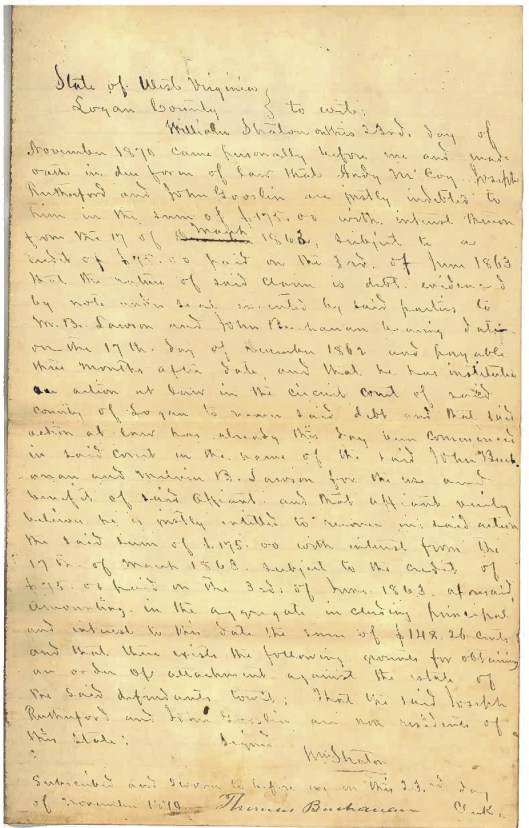
Andy McCoy, Appalachia, county clerk, crime, genealogy, history, John Buchanan, John Gooslin, Joseph Rutherford, Logan County, Melvin B. Lawson, Mingo County, West Virginia, William Straton


19 Saturday Jan 2019
Posted in Big Sandy Valley, Logan
16 Wednesday Jan 2019
Posted in Big Sandy Valley, Hatfield-McCoy Feud
Tags
Appalachia, crime, Devil Anse Hatfield, Elias Hatfield, Ellison Hatfield, Ephraim Hatfield, Evans Ferrell, G.W. Taylor, genealogy, Harrison Blair, Henry Clay Ragland, history, John Buchanan, John Chafin, Logan County, sheriff, West Virginia
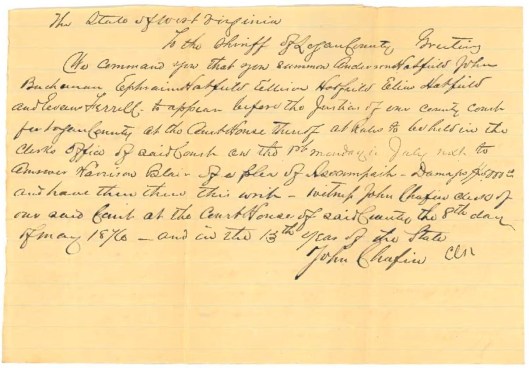
Summons for Anse Hatfield, John Buchanan, Ephraim Hatfield, Ellison Hatfield, Elias Hatfield, and Evans Ferrell, 8 May 1876.

Executed on Anse Hatfield and Evans Ferrell in Logan County on 25 June 1876 by Sheriff G.W. Taylor.
16 Wednesday Jan 2019
Posted in Big Sandy Valley, Hatfield-McCoy Feud, Pikeville
Tags
Alex Messer, Anderson Hatfield, Appalachia, Blackberry Creek, Bud McCoy, Cap Hatfield, Charley Carpenter, Chuck Murphy, constable, crime, Devil Anse Hatfield, Doc Mayhon, Elias Hatfield, Floyd Hatfield, Floyd McCoy, genealogy, Hatfield-McCoy Feud, history, Jerry Hatfield, John Hatfield, Johnson Hatfield, Kentucky, Pharmer McCoy, Pike County, Pikeville, Plyant Mayhon, Tolbert McCoy, Tug River, Valentine Wall Hatfield, West Virginia
The killing of Tolbert, Pharmer, and Bud McCoy by a Hatfield-led gang on August 8, 1882 represented one of the most sensational events of the Hatfield-McCoy Feud. What follows is Randolph McCoy’s deposition regarding the affair:
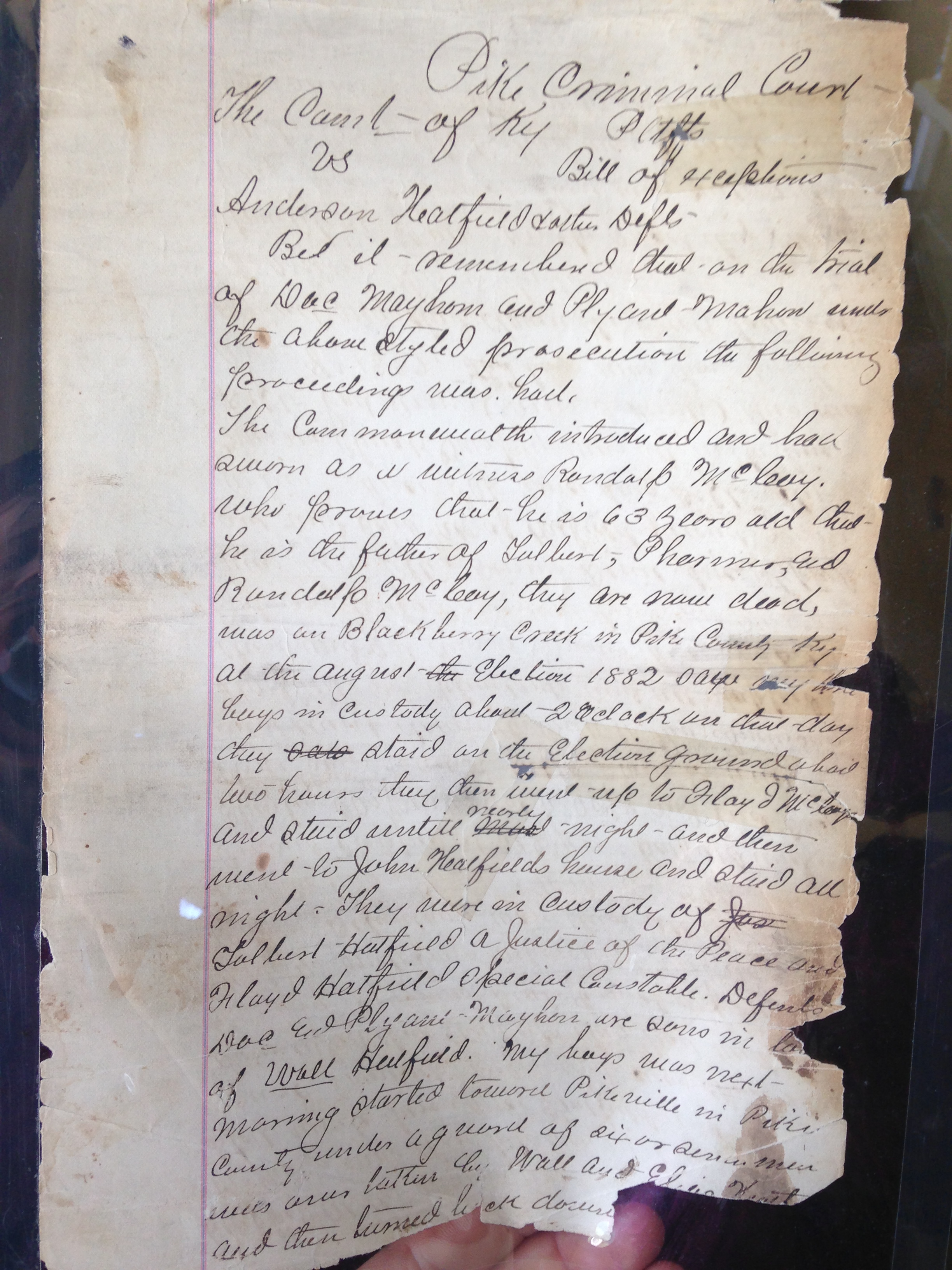
The Court of Ky
Vs.
Anderson Hatfield & other Defts.
Pltffs Bill of Exceptions
Be it remembered that on the trial of Doc Mayhorn and Plyant Mahon under the above styled prosecution the following proceedings was had.
The Commonwealth introduced and has worn as a witness Randolp McCoy, who proves that he is 63 years old that he is the father of Tolbert, Pharmer, and Randolp McCoy, they are now dead, was on Blackberry Creek in Pike County Ky at the August Election 1882 says that the boys in custody about 2 oclock on that day staid on the Election grounds about two hours they then went up to Floyd McCoys and staid until nearly night and then went to John Hatfields house and staid all night. They were in custody of Tolbert Hatfield a Justice of the Peace and Floyd Hatfield special Constable. Defents Doc and Plyant Mayhon are sons in law of Wall Hatfield. My boys was next morning started toward Pikeville in Pike County under a guard of six or seven men and was taken by Wall and Elias Hatfield and then turned back down [page torn] stopped at the mouth of Dial [page torn] his boys was then placed in a large corn sled while there. Anse Hatfield and his squad come up. Defendants was with them when they come up. they had with them country Rifle guns. Dials branch is from a ¼ to ½ miles from where Wall Hatfield came to them. Defendants were there all the time from the time they come to the corn sled. the crowd stopped at old Jerry Hatfield and Charley Carpenter got a rope and tied my three boys together. then went down the creek to Rev. Anderson Hatfields and defendants and all stopped there and got dinner. Knows Ance, Cap & Johnson Hatfield. they was there. Alex Messer was there. After Dinner Devil Ance stepped out and said “all of Hatfields frirends form a line” Ance Cap Jonce two Defts. Alex Messer Chuck Murphy was all in the line. Defts had arms (Guns I think). this was Aug 8 1882. My boys was then by this squad marched down the creek toward the river. This is the last time I ever saw them alive. I was on the road from Pikeville home they day my boys was buried. There was quite a crowd at the corn sled. There were a great many persons who were not interested several had guns. If I am not mistaken the first time I saw defendants was at the mouth of Dials branch. I may be mistaken but do not think I am. I saw no one catching horses in pasture at Rev. Anderson Hatfield’s. If I did I do not know who they were. The defts. were present when my boys were tied at Jerry Hatfield’s above Rev. Anderson Hatfield’s. When Devil Ance at the Rev. Anderson Hatfield’s called for the Hatfield friends to fall into the line the defts. went into the line and they were I think both armed with rifles and guns. The boys were then taken down the creek toward Tug river still tied together. I never saw them alive again.
16 Wednesday Jan 2019
Posted in Battle of Blair Mountain, Coal, Logan
12 Saturday Jan 2019
Posted in Big Sandy Valley, Hatfield-McCoy Feud
Tags
Anderson Blair, Appalachia, county clerk, crime, deputy sheriff, genealogy, Harrison Blair, history, John Chafin, John Dils Jr., Logan County, Marion McCoy, R.W. Peck, sheriff, West Virginia

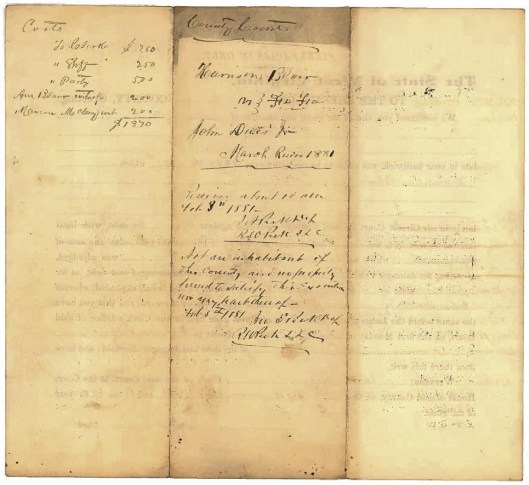
Summons for goods and chattels of John Dils, Jr., Logan County, WV.
31 Monday Dec 2018
Posted in Big Sandy Valley, Hatfield-McCoy Feud, Timber
Tags
Appalachia, crime, deputy sheriff, Devil Anse Hatfield, Ephraim Hatfield, genealogy, Hatfield-McCoy Feud, history, J.M. Jackson, James Allison, John Hatfield, Logan County, logging, Mingo County, sheriff, timber, timbering, Valentine Wall Hatfield, West Virginia
In 1871-1872, Ephraim Hatfield was accused of stealing “with force and arms” twenty saw logs valued at fifty dollars from James Allison in Logan County, WV. Most likely, the Ephraim Hatfield of this record is Ephraim “Big Eph” Hatfield (c.1811-c.1881), father to Anderson “Devil Anse” Hatfield. Other possibilities include Ephraim Hatfield (b. c.1851), son of John Hatfield, and Ephraim Hatfield (b. c.1856), son of Valentine “Wall” Hatfield.

Grand jury indictment for Ephraim Hatfield, who stood accused of stealing twenty “saw logs” from James Allison valued at fifty dollars on 10 April 1871. Logan County, WV. Page 1.
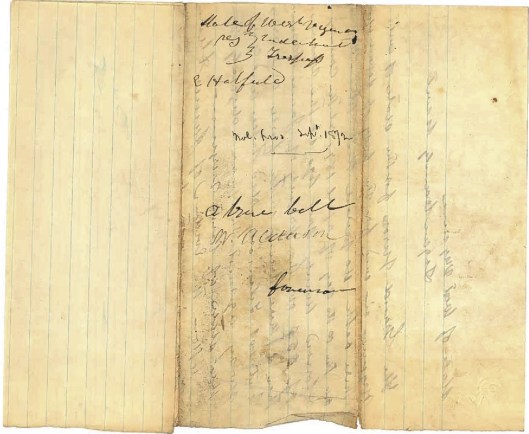
Page 1 (back). Note: This event is not related to the Hatfield-McCoy Feud.
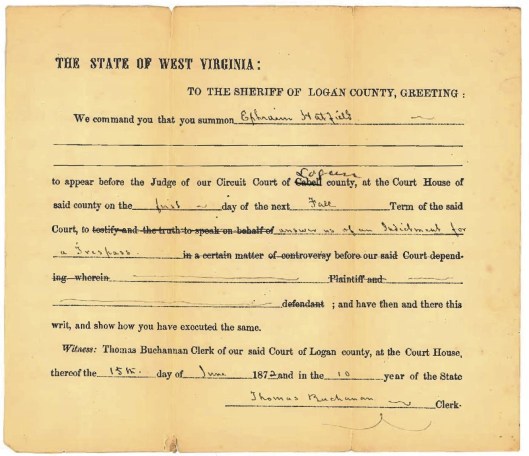
Summons for Ephraim Hatfield to appear for the Fall Term of Court 1872 in Logan County, WV. Dated June 15, 1872. Page 1
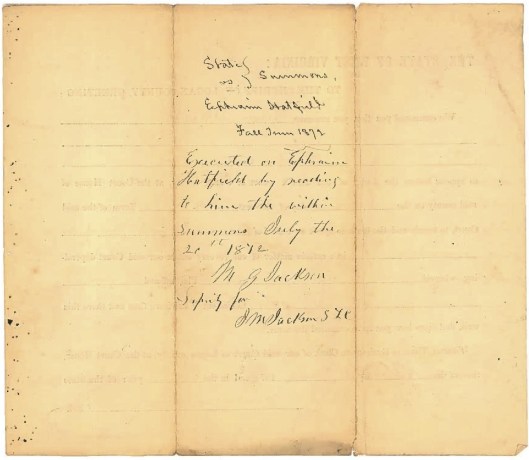
M. Jackson served summons to Ephraim Hatfield on 20 July 1872. Page 1 (back)
28 Friday Dec 2018
Tags
Appalachia, civil war, constable, crime, Eli Gore, Emmett Scaggs, Frank McKesson, genealogy, George Scaggs, Henry S. Walker, history, justice of the peace, lawyer, Logan Banner, Logan County, Man, Raleigh County, Stollings, Taplin Hollow, Virginia, West Virginia
From the Logan Banner of Logan, WV, comes this bit of history about a Civil War hanging in present-day Logan County, West Virginia.
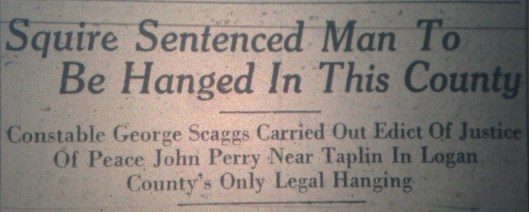
Squire Sentenced Man To Be Hanged In This County
Constable George Scaggs Carried Out Edict Of Justice Of Peace John Perry Near Taplin In Logan County’s Only Legal Hanging
Nothing but the gnarled weather beaten stump of an old locust tree remains today to mark the scene of Logan county’s only legal hanging.
The stump is standing just below the highway at the mouth of Taplin hollow and is the only landmark which calls to mind the hanging of Henry S. Walker, convicted of murder by Squire John Perry of Man in the spring of 1862 and hanged the same day by Constable George Scaggs, uncle of Emmett Scaggs, prominent lawyer, and brother-in-law of Eli Gore, old resident of Stollings.
A story is told that Henry Walker came down Taplin Hollow late one night in the closing months of the civil war on a “scouting” tour. He entered the home of Uncle Frank McKesson and for no apparent reason seized a double bitted axe and chopped to lifeless, bleeding masses the bodies of Uncle Frank and his wife and then fled to Raleigh county.
One week later Constable George Scaggs arrested the man in the county where he was hiding and brought him before Justice of the Peace John Perry.
Squire John Perry had a fine eye for justice and he was meting it out under the Virginia law which allowed a justice of the peace to pass the death sentence.
George Scaggs was delegated as executioner and Walker was put on a wagon and brought to Taplin down the river road to the spot where he committed the crime.
Old-timers say that a crowd of men, women and children laughing and passing jokes on the show they were to see followed the wagon to the scene of the proposed hanging and watched tensely as a rope was thrown over the limb of the locust tree and the noose was placed snuggly around the neck of the murderer.
He was placed on the flour barrel, a couple of feet of the slack in the rope was taken up and tied securely to the trunk of the tree, and George Scaggs, without any preliminaries, kicked the flour barrel from under the man.
The man fell to within six inches of the ground and the awed onlookers gasped as they heard an audible crack which told them the murderer’s neck had snapped. He hung quivering at the end of the rope several minutes before the peace officer cut him down and placed him in the wagon to be taken to Man for burial.
The same crowd followed the wagon back to Man, but it was a crowd of sober individuals who had seen a human life pass into oblivion. There was no joking and even the children talked in muted undertones.
Source: Logan (WV) Banner, 01 June 1937.
16 Sunday Dec 2018
Posted in Hatfield-McCoy Feud, Timber
Tags
Appalachia, county clerk, crime, deputy clerk, Devil Anse Hatfield, Farmer McCoy, genealogy, Harrison Blair, Hatfield-McCoy Feud, Hiram H. Williamson, history, Jim Vance, John Buchanan, Logan County, Mingo County, sheriff, Thomas Buchanan, timber, timbering, West Virginia, William Straton

Hiram H. Williamson and William Straton, $1800 bond, 15 September 1868.

Hiram H. Williamson and William Straton, $1800 bond, 15 September 1868.
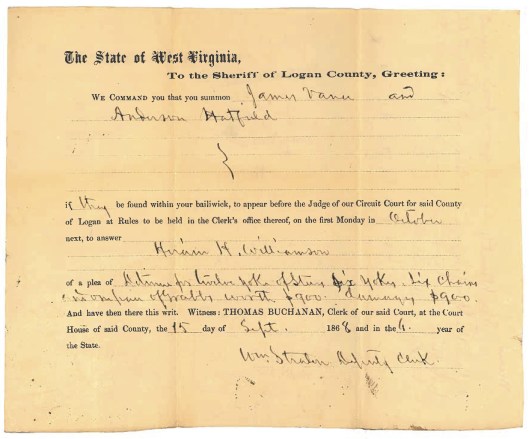
Summons for Jim Vance and Anse Hatfield, 15 September 1868.
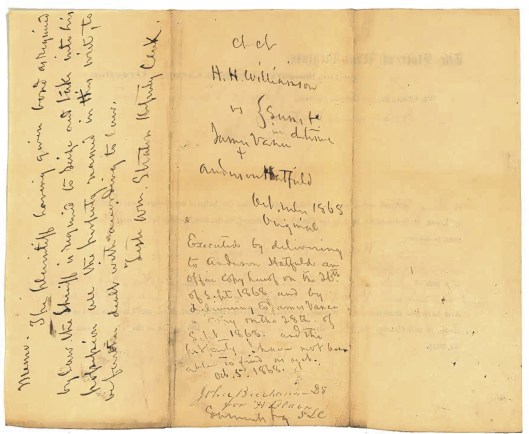
Summons for Jim Vance and Anse Hatfield, 15 September 1868.
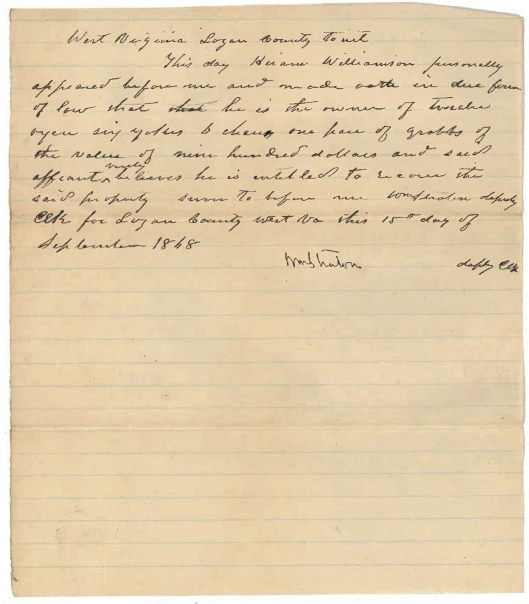
Hiram H. Williamson oath, 15 September 1868.
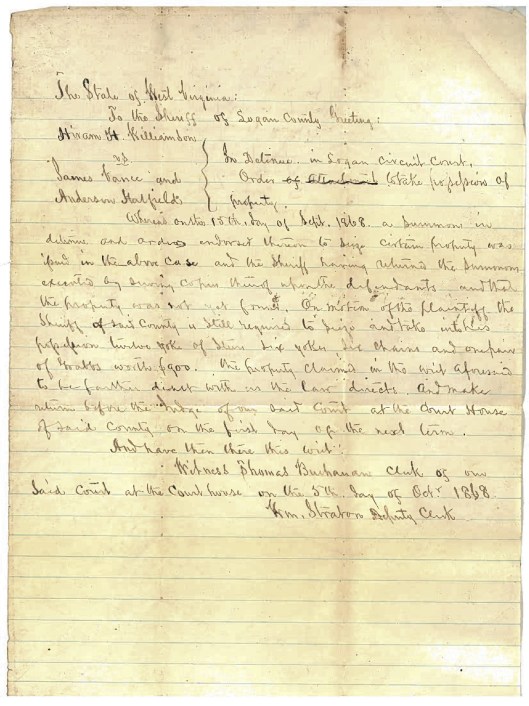
Order to seize property, 5 October 1868.
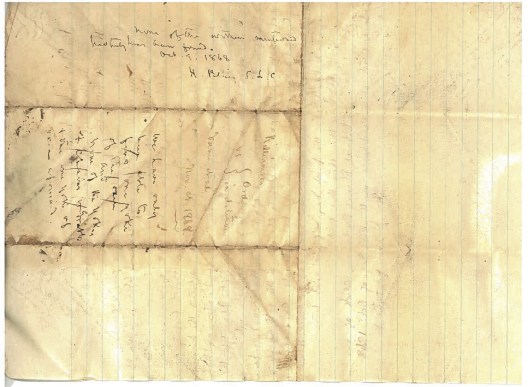
Order to seize property, 5 October 1868.

Law Order Book A, page 38, 10 November 1868, Logan County Circuit Clerk’s Office, Logan, WV. NOTE: This latter document relates to a charge against Hatfield for unlawful retailing of liquor and also against Farmer McCoy for lewdness.
30 Friday Nov 2018
Posted in Big Sandy Valley, Hatfield-McCoy Feud
Tags
Alex Messer, Anderson Ferrell, Appalachia, Blackberry Creek, Bud McCoy, Cap Hatfield, clerk, crime, Devil Anse Hatfield, Doc Mayhorn, Elias Hatfield, Elijah Mounts, Ellison Hatfield, Floyd Hatfield, G.W. Pinson, genealogy, Hatfield-McCoy Feud, history, James McCoy, Joe Davis, Joe Hatfield, Johnson Hatfield, Kentucky, Logan County, Mate Creek, Mathew Hatfield, Pharmer McCoy, Pike County, Pikeville, Plyant Mayhorn, Preacher Anse Hatfield, Tolbert McCoy, Tom Mitchell, true crime, Valentine Wall Hatfield, West Virginia
The killing of Tolbert, Pharmer, and Bud McCoy by a Hatfield-led gang on August 8, 1882 represented one of the most sensational events of the Hatfield-McCoy Feud. What follows is James McCoy’s deposition regarding the affair:
COMMONWEALTH VS DOC MAYHORN &C
Bill of Exceptions
FILED Sept. 1889
G.W. Pinson, Clk
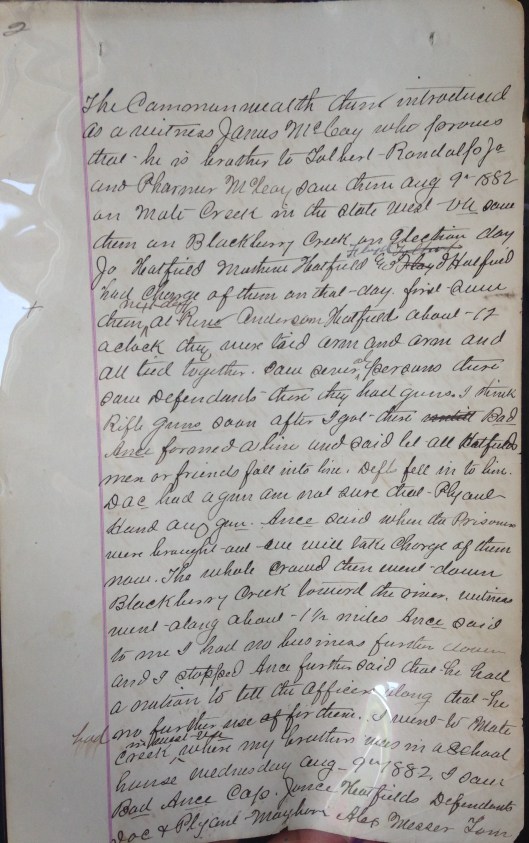
The Commonwealth then introduced as a witness James McCoy who proves that he is brother to Tolbert, Randolp (sic) Jr. and Pharmer McCoy. Saw them Aug 9, 1882 on Mate Creek in the state West Va. Saw them on Blackberry Creek on Election day. Jo Hatfield, Mathew Hatfield and Floyd Hatfield had charge off them on that day. First saw them next day at Rev. Anderson Hatfield about 12 o’clock. They were tied arm and arm and all tied together. Saw several persons there. Saw Defendants there. They had guns. I think Rifle guns. Soon after I got there Bad Ance formed a line and said let all Hatfield men or friends fall into line. Deft. fell in to line. Doc had a gun. Am not sure that Plyant Had any gun. Ance said when the Prisoners were brought out we will take charge of them now. The whole crowd then went down Blackberry Creek toward the river. Witness went along about 1 ½ miles. Ance said to me I had no business further down and I stopped. Ance further said that he had a notion to tell the officers along that he had no further use for them. I went to Mate Creek in West Va. where my brothers was in a School house Wednesday Aug 9th 1882. I saw Bad Ance, Cap, Jonce Hatfields Defendants Doc & Plyant Mayhorn, Alex Messer, Tom Mitchell and some others. Defendants had guns some times. I left there about 3 o’clock p.m. Went down to mouth Mate Creek staid a few minutes at Sam Simpkin’s. Then went to Asa McCoy’s at mouth Sulphur. I saw Wall with a papers. Do not know what it contained and heard Wall call for signers. Saw Plyant walk up to Wall but can not say whether he signed it or not. Saw Plyant with Wall & Elias Hatfield and Elijah Mounts that evening late at the mouth Mate Creek. They went up river. Saw them again just after dark pass down by the mouth of Sulphur. I was there and they had not been gone by perhaps 20 minutes when I heard a volley of guns or pistols fired on the Ky side of the river about ½ way between Mouth Sulphur and Mate Creek but on the opposite side of the river from Sulphur. My brothers was dead when I found them. Anderson Ferrell went with him to find them. Found on the Ky shore short distance from river in a sink or flat all tied together and to two Paw Paw Bushes. Tolbert had one hand over his head. Made an examination of my brothers and found Pharmer shot 16 times. Randolph with the whole top of his head shot off. Six or seven shots in Tolbert. We removed them in a sled. They were all burried (sic) in one coffin. Elias Hatfield had a gun as they passed me at the mouth of Sulphur there was one horse in the crowd was considerably excited at times. The officers had the boys in charge for murdering Ellison Hatfield. There were a great many men along who had guns that are not indicted. There was six or seven guards and some that were not guards along with my brothers. I do not know where any one objected to my brothers being brought to Pikevill or not. I can not tell all the parties who had guns. Ellison Hatfield died about 2 ½ or 3 oclock Wednesday Aug 9, 1882. The men who taken the corps of Ellison Hatfield to Elias Hatfields was a part of the men he had seen at the school house. My brothers were found dead in Pike County Ky. Wall Hatfield is the brother of Ance, Elison & Elias Hatfield, and the father in law of the defts. When I saw my brothers at Rev. Anderson Hatfield’s there was also present Ance, Cap, Johns, Wall & Elias Hatfield. Carpenter, Dan Whitt, Messer, Murphy, Mose Christian and defts. When I found my brothers dead they were tied together and to two paw paw bushes. When Wall, Elias, & deft. Plyant Mahorn found me near the mouth of Sulphur at dark they were passing from the direction of Joe Davis’ at mo. Blackberry and going in the direction of the mouth Mate. From Jo Davis’ to mouth of Sulphur is about ½ mile, and from Sulphur to mouth Mate is about ½ mile. From the point where my brothers were found dead in Pike Co Ky is _____ in WVa immediately opposite is about 125 yards. As soon as they passed me near the mouth of Sulphur I ___ my horse pulled some grass and fed him, went back and sat down on the porch, and the firing directly began. I think it was 20 minutes after they passed until the firing began. I think I heard 50 shots. After the volley ceased there was one loud shot.
***
Written in the margin: Soon after this I went down to Ferrell’s and ___ Simpkins and myself went and found my brothers.
23 Friday Nov 2018
Posted in Hatfield-McCoy Feud
Tags
Alex Hatfield, Appalachia, crime, feuds, Hatfield-McCoy Feud, history, Lafe Chafin, Logan Banner, Mingo County, New York, New York Times, prosecuting attorney, West Virginia
Perceptions of the Hatfield-McCoy Feud and of Southern Appalachia in general often differ greatly among insiders and outsiders. The following letter from Lafe Chafin of Mingo County, WV, reveals his disdain for inaccurate reporting by the New York Times about the feud and his community:
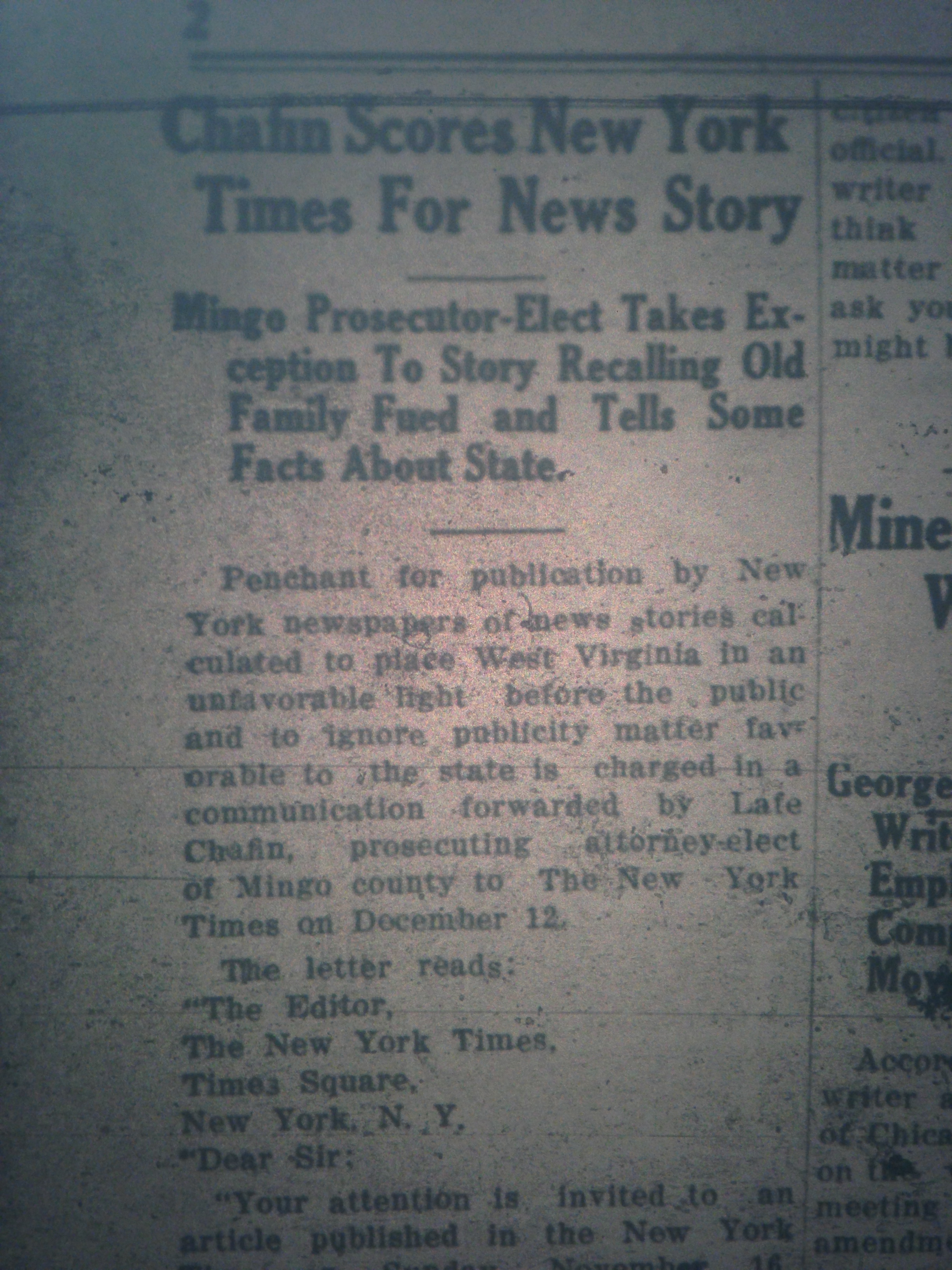
Chafin Scores New York Times For News Story
Mingo Prosecutor-Elect Takes Exception To Story Recalling Old Family Feud and Tells Some Facts About State.
Penchant for publication by New York newspapers of news stories calculated to place West Virginia in an unfavorable light before the public and to ignore publicity matter favorable to the state is charged in a communication forwarded by Lafe Chafin, prosecuting attorney-elect of Mingo county in The New York Times on December 12.
The letter reads:
The Editor
The New York Times.
Times Square
New York, N.Y.
Dear Sir:
Your attention is invited to an article published in the New York Times on Sunday, November 16, 1924, on page 20 of section 8, headlined, “One More Hatfield Bites the West Virginia Dust.” The article appears on the back page of section 8. Hence, it is apparent to the reader that you did not care to dignify it as news matter for the public but simply used as filler. No doubt you had run out of anything else to print on this page and so ran this in the thought that it would be interesting reading for those who have heard of the feud days in West Virginia. The article is unsigned. Hence, I am taking you, as editor, to task for permitting the publication of it and what I shall say will be offered in a spirit of friendly criticism and I hope you will accept it as such.
To begin with, you deliberately publish an untruth when you say, at the head of the article, that Alex Hatfield was killed and that Mingo county was humming and teaming with excitement. It is true that a man by the name of Alex Hatfield was shot about ten days prior to the recent election, but it is not true that he was killed, or even seriously wounded. He sustained a flesh wound and this is known only to a few people. Alex Hatfield is not the son of the mountaineer who started as bloody a feud as the south has ever known. In fact, he is not related in any way to the Hatfields who were involved in the so-called Hatfield-McCoy feud. The writer of the article simply seized upon the fact that a Hatfield had been shot as an excuse to rehearse his conception of the so-called Hatfield-McCoy feud, and he proceeds to write in a dime-novel fashion his notion of what happened in the fight between the Hatfields and the McCoys.
If it were not for the fact that your paper is read so universally and by people who do not know of conditions in West Virginia and Mingo county, I should not write you this letter. The so-called Hatfield-McCoy feud is dead and has been dead for twenty-five years or more. Every community, like every family, has its family skeleton, but we bury our skeletons and try to keep them buried until someone like you comes along and resurrects them.
I shall not take the time to point out all the slander and untruths included in this article, because most of it is untrue, as all who know conditions here will attest. I want particularly to call your attention to the fact that the apparent excuse for the article, if any there is, lies in the fact that a man by the name of Hatfield was shot about ten days prior to the recent election. Notwithstanding the fact that he only sustained a flesh wound, you carry a story in this article almost a month later, to-wit, November 16, 1924, that he was killed and that the county was all in excitement and that it has never forgotten the days of the so-called feud. A publication of the standing of The Times cannot afford to publish such misstatements and to libel this community in such manner.
Would it not be better to publish facts about West Virginia and about our community? In the thought that you were misinformed in this instance, I purpose giving you some facts that you can publish with safety and without fear of contradiction.
The population of West Virginia in 1920 was 1,500,000. Ninety per cent of the population is native white American. Less than four per cent is foreign born. Ninety-eight per cent of the farm population is native American stock. Less than six per cent of the population is illiterate. The per capita wealth is $1,429.64. There are twelve state educational institutions to train for leadership in the professions. There are 213 high schools, with an enrollment of 35,000. There are 1,800 high school teachers. Five thousand five hundred complete high school courses each year. There are 500,000 enrolled in the elementary schools. The per capita cost of education based on enrollment is $44.20.
This is the kind of publicity we want and we feel it is the kind that we deserve. Our natural resources are unmatched by any other state in the union. While these resources are decreasing, our human resources are increasing, in value. Like any community, we have had, and how have our problems, but we are doing our best to solve them. You are not helping us to solve them by publishing such articles as you published in our issue of November 16.
I would be glad to know that you have given some attention to this letter, and it seems to me that in justice and fairness to our county the party responsible for the article appearing in your issue of November 16, should be taken to task.
It so happens that I am the prosecuting attorney-elect of Mingo county and I resent such libel, not only as a citizen of the county, but as an official. Since I cannot prosecute the writer of the article for this libel, I think I at least ought to take this matter up with you as the editor and ask you to correct it insofar as you might be able to do so.
Yours very truly,
Lafe Chafin
Source: Logan (WV) Banner, 19 December 1924.
10 Saturday Nov 2018
Posted in Logan
Tags
Appalachia, C.L. Bradley, crime, Democratic Party, Deputy Marshal, deputy sheriff, Don Chafin, George Pack, George Thompson, history, Hugh Deskins, Ira P. Hager, Jay Elkins, Joe Hatfield, Logan County, Mine Wars, Mud Fork Precinct, Nannie Pack, Pat Adkins, Pat Murphy, Republican Party, sheriff, Tennis Hatfield, U.S. Commissioner, West Virginia
Political history for Logan County, West Virginia, during the 1920s was particularly eventful; it included the latter years of Sheriff Don Chafin’s rule, the Mine Wars (“armed march”), Republican Party ascendancy, and the rise of Republican sheriffs Tennis and Joe Hatfield. What follows are selected primary source documents relating to this period:
UNITED STATES OF AMERICA
SOUTHERN DISTRICT OF WEST VIRGINIA,
HUNTINGTON DIVISION
BEFORE THE UNDERSIGNED authority, Ira P. Hager, a United States Commissioner in and for said District, personally appeared this day, Nannie Pack, who after being by me first duly sworn, deposes and says:
That she was standing on the election ground at Mud Fork Precinct, Logan County, election day, November 4th, 1924, and saw Don Chafin, Sheriff of Logan County there. That Pat Adkins was standing on the ground, waiting to vote, and affiant saw the said Don Chafin take hold of the said Pat Adkins and shove him, saying, “Go on in,” and repeated it, “Go on in,” and shoved the said Pat Adkins toward the election room door. That he turned immediately and ran toward Hugh Deskins, Deputy Marshal, who was standing near by, and said, “What are you doing here, you cock-eyed son-of-a-bitch?” That he slapped the said Hugh Deskins, Deputy Marshal. That he then followed the said Deputy Marshal around on the ground, saying, “Have you had enough? Have you had enough?”
That they put affiant’s husband, George Pack, in jail on November 1st, 1924, and affiant went to Jay Elkins and George Thompson to ask them to go the bond of affiant’s husband. This was on Saturday, November 1st, 1924. That they declined and refused to do it, and affiant went home. That John Roberts followed affiant and said, “If you will vote our way, we will sure go this evening and get your husband out.” Then he said, “Unless you do that, we will not get him out and he will not get out.” The same day Thompson and Elkins refused to go my husband’s bond. They hunted me up while I was on the Dempsey Branch and told affiant that “if I would vote Democratic, and talk to my children and have them vote Democratic, that they would see that my husband got bond and got out.”
Nannie Pack (her mark)
Taken, subscribed and sworn to before me this the 10th day of November, A.D., 1924.
Ira P. Hager
United States Commissioner as aforesaid.
***
UNITED STATES OF AMERICA
SOUTHERN DISTRICT OF WEST VIRGINIA,
HUNTINGTON DIVISION
BEFORE THE UNDERSIGNED AUTHORITY, this day personally came, C.L. BRADLEY, who after being by me first duly sworn, says: That he was on the election grounds at the Mud Fork Precinct on election day, November 4th, 1924, and affiant saw Don Chafin, sheriff of Logan County strike Hugh Deskins, Deputy Marshal on the head or face. I saw Don follow him up after he had hit him and I heard him say, “How did you like that?” and if “he did not like it he could give him more of it, or oodles of it,” or words to that effect.
When Don Chafin was after Hugh Deskins, Pat Murphy, supposed to be a Deputy Sheriff, was acting like he was about to pull his gun from his pocket. He pulled it part way out of his pocket.
C.L. Bradley
Taken, subscribed and sworn to before me, the undersigned authority, this the 10th day of November, 1924.
Ira P. Hager
U.S. Commissioner as aforesaid
Appeared 1-13-25
28 Sunday Oct 2018
Posted in Logan
Tags
Appalachia, Cherry Tree, Cora, crime, Democratic Party, deputy sheriff, Deputy U.S. Marshal, Don Chafin, Ed Dingess, genealogy, Henry Sansom, history, Hugh Deskins, Ira P. Hager, Joe Hatfield, John Dingess, Lee Belcher, Logan, Logan County, Mine Wars, politics, Randolph Dial, Republican Party, Simp Thompson, Tennis Hatfield, Thomas Fisher, U.S. Commissioner, West Virginia
Political history for Logan County, West Virginia, during the 1920s was particularly eventful; it included the latter years of Sheriff Don Chafin’s rule, the Mine Wars (“armed march”), Republican Party ascendancy, and the rise of Republican sheriffs Tennis and Joe Hatfield. What follows are selected primary source documents relating to this period:
UNITED STATES OF AMERICA
SOUTHERN DISTRICT OF WEST VIRGINIA,
HUNTINGTON DIVISION
Before the undersigned authority, Ira P. Hager, a United States Commissioner in and for said District, Ed Dingess, who after being by me first duly sworn, says that he is thirty-seven years of age, married, resides at Cherry Tree Bottom, Logan County, and works in the ice business during the summer season.
That on November 2nd, 1924, affiant was in the Marshal’s office at Logan, when a man who lived at Cora came in and reported that Lee Belcher had ordered him to leave Cora, where he lived, on account of his having Republican literature on his car and house, stating that the said Lee Belcher, Deputy Sheriff had threatened to do him bodily injury, that affiant along with Henry Sansom was deputized by one of the Deputy Marshals to go to Cora and protect the man, he being afraid to return to his home without protection. That affiant and the said Henry Sansom were in Cora, guarding the man, and Lee Belcher came up and said, “Are you fellows here to guard these men out of here?” And I said, “Yes.” And he said, “The county ought to be filled up with good looking men like us.” And I replied “that it was pretty well full.” He then went away and did not make any trouble for us. On the night of the election I went to the Court House at Logan to ascertain the results of the election, and as I went through the corridors of the Court House I met Lee Belcher, and he said, “What was you doing in Cora, you god-damned son-of-a-bitch, that is my town.” He said, “I am running Cora,” and made at me with his pistol, and John Dingess, who used to be a deputy, pulled his pistol and said, “Give it to him, god-damned son-of-a-bitch,” and repeated it several times. John Dingess kept his pistol drawn on me while Lee Belcher beat me about the face. The scars and bruises are visible on my face where I was struck. I tried to shove off his licks, but he hit me twice, and Simp Thompson ran in and stopped him, and I presume that Thompson saved me.
I bled right much and suffered considerable pain as a result of the blows.
Ed Dingess
Taken, subscribed and sworn to before me this the 8th day of November, A.D., 1924.
Ira P. Hager
United States Commissioner as aforesaid.
***
UNITED STATES OF AMERICA
SOUTHERN DISTRICT OF WEST VIRGINIA,
HUNTINGTON DIVISION
Before the undersigned authority this day personally came Thomas Fisher, who after being by me first duly sworn, says:
That he was deputized by Hugh Deskins, at Mud Fork, on election day, after the said Hugh Deskins, Deputy U.S. Marshal, had been assaulted by Don Chafin, Sheriff of Logan County, and that the said Hugh Deskins gave affiant a pistol, and about thirty minutes after affiant was deputized, the said Don Chafin came around and arrested affiant, and took the pistol away from affiant, and turned affiant over to Deputy Sheriff Randolph Dial, who took affiant to jail, where affiant was kept until the next morning. Affiant lost his vote. Affiant asked the said Randolph Dial to let him vote, having told the said Randolph Dial that affiant had not voted, and the said Randolph Dial said, “I haven’t time to fool with you.” So affiant lost his vote.
Affiant saw Don Chafin assault Hugh Deskins, Deputy U.S. Marshal. Hugh Deskins was standing on the election ground and Don Chafin drove up in his car. Hugh was standing with his hands folded and Chafin walked up and hit him on the side of the face under the left ear. Deskins backed off, and Chafin said, “Don’t you like that? If you don’t, I will give you some more.” Chafin drove off in his car and in a little while came back and one of the Mounts boys called to Don and pointed me out and then Don arrested me. When Chafin arrested me I told him that I was deputized by a United States Deputy Marshal and he said, “That don’t go here.”
Thomas Fisher
Taken, subscribed and sworn to before me this the 8th day of November, 1924.
Ira P. Hager
U.S. Commissioner
20 Saturday Oct 2018
Posted in Big Creek, Big Harts Creek, Boone County, Civil War, Coal, Logan
Tags
Appalachia, Aracoma, Big Creek, Boone County, Brooke McNeely, Camp Chase, Chapmanville District, Charles Williams, civil war, Claude Ellis, coal, Confederate Army, crime, Dave Kinser, Democratic Party, Douglas Kinser, Elbert Kinser, Ethel, Fort Branch, French River, genealogy, ginseng, Harts Creek, Hetzel, history, J. Green McNeely, Jake Kinser, Jane Mullins, Jefferson Davis, Jim Aldridge, John Carter, John Kinser, Logan, Logan Banner, Logan County, logging, Malinda Kinser, Malinda Newman, Mary Ann Ellis, Mud Fork, Otis Kinser, rafting, Scott Ellis, Smyth County, Stonewall Jackson, timbering, tobacco, Virginia, Washington Township, West Virginia, Wythe County

Logan (WV) Banner, 20 June 1936. Note: Jacob was not born in 1850, so he does not appear with his family in the 1850 Census for Wythe County, Virginia. He was nine years old in the 1860 Census for Smyth County, Virginia.

Logan (WV) Banner, 12 November 1936. Note: Jake Kinser appears as a seventeen-year-old fellow in the 1870 Census for Boone County, West Virginia (Washington Township).

Jake Kinser and his sister Jane Mullins, Logan (WV) Banner, 7 July 1937.

Jake Kinser and his sister Jane Mullins, Logan (WV) Banner, 7 July 1937. Note: Mary Jane (Kinser) Mullins was eleven years old in the 1860 Census for Smyth County, Virginia. Mr. Kinser died in 1944; his death record can be found here: http://www.wvculture.org/vrr/va_view2.aspx?FilmNumber=571280&ImageNumber=349
20 Saturday Oct 2018
Posted in Culture of Honor, Hatfield-McCoy Feud, Matewan
Tags
Alex Messer, Anderson Ferrell, Appalachia, Asa McCoy, Blackberry Creek, Bud McCoy, Cap Hatfield, Charlie Carpenter, clerk, crime, Devil Anse Hatfield, Doc Mayhorn, Elias Hatfield, Elijah Mounts, Ellison Hatfield, feuds, Floyd Hatfield, G.W. Pinson, genealogy, Hatfield-McCoy Feud, history, Joe Hatfield, Johnson Hatfield, Kentucky, Mate Creek, Matthew Hatfield, Pharmer McCoy, Pike County, Pikeville, Plyant Mayhorn, Preacher Anse Hatfield, Sam Simpkins, Tolbert McCoy, Tom Mitchell, Valentine Wall Hatfield, West Virginia
The killing of Tolbert, Pharmer, and Bud McCoy by a Hatfield-led gang on August 8, 1882 represented one of the most sensational events of the Hatfield-McCoy Feud. What follows is Plyant Mayhorn’s deposition regarding the affair:
COMMONWEALTH VS DOC MAYHORN &C
Bill of Exceptions
FILED Sept. 1889
G.W. Pinson, Clk
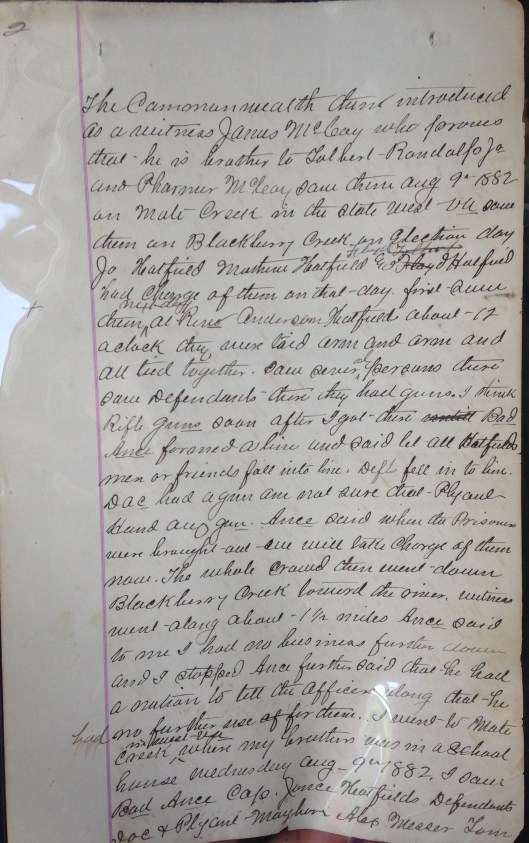
The Commonwealth then introduced as a witness James McCoy who proves that he is brother to Tolbert, Randolp (sic) Jr. and Pharmer McCoy. Saw them Aug 9, 1882 on Mate Creek in the state West Va. Saw them on Blackberry Creek on Election day. Jo Hatfield, Mathew Hatfield and Floyd Hatfield had charge off them on that day. First saw them next day at Rev. Anderson Hatfield about 12 o’clock. They were tied arm and arm and all tied together. Saw several persons there. Saw Defendants there. They had guns. I think Rifle guns. Soon after I got there Bad Ance formed a line and said let all Hatfield men or friends fall into line. Deft. fell in to line. Doc had a gun. Am not sure that Plyant had any gun. Ance said when the Prisoners were brought out we will take charge of them now. The whole crowd then went down Blackberry Creek toward the river. Witness went along about 1 ½ miles. Ance said to me I had no business further down and I stopped. Ance further said that he had a notion to tell the officers along that he had no further use for them. I went to Mate Creek in West Va. where my brothers was in a School house Wednesday Aug 9th 1882. I saw Bad Ance, Cap, Jonce Hatfields Defendants Doc & Plyant Mayhorn, Alex Messer, Tom Mitchell and some others. Defendants had guns some times. I left there about 3 o’clock p.m. Went down to mouth Mate Creek, staid a few minutes at Sam Simpkin’s. Then went to Asa McCoy’s at mouth Sulphur. I saw Wall with a papers. Do not know what it contained and heard Wall call for signers. Saw Plyant walk up to Wall but can not say whether he signed it or not. Saw Plyant with Wall & Elias Hatfield and Elijah Mounts that evening late at the mouth Mate Creek. They went up river. Saw them again just after dark pass down by the mouth of Sulphur. I was there and they had not been gone by perhaps 20 minutes when I heard a volley of guns or pistols fired on the Ky side of the river about ½ way between Mouth Sulphur and Mate Creek but on the opposite side of the river from Sulphur. My brothers was dead when I found them. Anderson Ferrell went with him to find them. Found on the Ky shore short distance from river in a sink or flat all tied together and to two Paw Paw Bushes. Tolbert had one hand over his head. Made an examination of my brothers and found Pharmer shot 16 times. Randolph with the whole top of his head shot off. Six or seven shots in Tolbert. We removed them in a sled. They were all burried in one coffin. Elias Hatfield had a gun as they passed me at the mouth of Sulphur, there was one horse in the crowd was considerably excited at times. The officers had the boys in charge for murdering Ellison Hatfield. There were a great many men along who had guns that are not indicted. There was six or seven guards and some that were not guards along with my brothers. I do not know where any one objected to my brothers being brought to Pikevill or not. I can not tell all the parties who had guns. Ellison Hatfield died about 2 ½ or 3 oclock Wednesday Aug 9, 1882. The men who taken the corps of Ellison Hatfield to Elias Hatfields was a part of the men he had seen at the school house. My brothers were found dead in Pike County Ky. Wall Hatfield is the brother of Ance, Elison & Elias Hatfield, and the father in law of the defts. When I saw my brothers at Rev. Anderson Hatfield’s there was also present Ance, Cap, Johns, Wall & Elias Hatfield. Carpenter, Dan Whitt, Messer, Murphy, Mose Christian and defts. When I found my brothers dead they were tied together and to two paw paw bushes. When Wall, Elias, & deft. Plyant Mahorn found me near the mouth of Sulphur at dark they were passing from the direction of Joe Davis’ at mo. Blackberry and going in the direction of the mouth Mate. From Jo Davis’ to mouth of Sulphur is about ½ mile, and from Sulphur to mouth Mate is about ½ mile. From the point where my brothers were found dead in Pike Co Ky is _____ in WVa immediately opposite is about 125 yards. As soon as they passed me near the mouth of Sulphur I ___ my horse pulled some grass and fed him, went back and sat down on the porch, and the firing directly began. I think it was 20 minutes after they passed until the firing began. I think I heard 50 shots. After the volley ceased there was one loud shot.
Written in the margin: Soon after this I went down to Ferrell’s and ___ Simpkins and myself went and found my brothers.
For more information about this incident, follow these links:
http://explorekyhistory.ky.gov/items/show/785?tour=55&index=3
http://wvpublic.org/post/three-mccoys-killed-hatfields-kentucky-august-8-1882#stream/0
http://hatfield-mccoytruth.com/2017/04/22/in-hatfield-country-blackberry-creek-in-the-1880s/
20 Saturday Oct 2018
Tags
Appalachia, Buck Adams, crime, Democratic Party, deputy sheriff, Don Chafin, G.F. Gore, genealogy, history, Ira P. Hager, Jack Meadows, Joe Hatfield, John Colley, John Cooley, Logan County, McConnell, Mine Wars, Orville Hall, Republican Party, sheriff, Stollings, Switzer, Tennis Hatfield, United States Commissioner, Wayne Grover, West Virginia
Political history for Logan County, West Virginia, during the 1920s was particularly eventful; it included the latter years of Sheriff Don Chafin’s rule, the Mine Wars (“armed march”), Republican Party ascendancy, and the rise of Republican sheriffs Tennis and Joe Hatfield. What follows are selected primary source documents relating to this period:
UNITED STATES OF AMERICA
SOUTHERN DISTRICT OF WEST VIRGINIA,
HUNTINGTON DIVISION
John Cooley being by the undersigned authority first duly sworn, says that on the 5th day of November, A.D., 1924, he was on his way from work, and was traveling along the county road through the Town of Switzer, in Logan County, having been a mule driver, was riding his mule. Orville Hall was with affiant. I was riding and Orville was walking. We saw a car coming, with Jack Meadows and Buck Adams, Deputy Sheriffs in the car, with some other men we did not know. When they approached us, about 300 yards away, they began firing their pistols shooting down by the side of the car into the ground. They kept shooting until they came up where we were, and shot by the side of the mule I was riding, and frightened him right much, but the mule did not throw me. They shot within about three feet of the mule. Several citizens heard the shots in Switzer, and some of them saw it.
We went before G.F. Gore to get a warrant for the men, and he ask us who did the shooting, and we told him, and he said, “They are deputies. I do not see how you can do anything with them.”
John Colley
Taken, subscribed and sworn to before me this the 8th day of November, A.D., 1924.
Ira P. Hager
United States Commissioner as aforesaid.
***
UNITED STATES OF AMERICA
SOUTHERN DISTRICT OF WEST VIRGINIA,
HUNTINGTON DIVISION
Before the undersigned authority, Ira P. Hager, a United States Commissioner in and for said District, personally appeared this day Jesse Yeager, who after being by me first duly sworn, says that he resides at Stollings (or McConnell), Logan County, in said District.
That on November 5th, 1924, being election day, affiant went to the Court House to ascertain the results of the election, and affiant was standing in the crowded room. Wayne Grover came up to affiant and said, “God dam you, you haven’t any business here. You are legging for the Republican Party.” And at the same time struck this affiant in the side of the head with some sort of weapon, which affiant believes was a black-jack. That affiant fell to the floor in a dazed condition, very much injured, and affiant’s hip was almost broken, and affiant suffered a great deal on account of the same.
There were no arrests made. He ran back into the crowd as soon as he struck me. Affiant never had any trouble or hard feelings against the said Wayne Grover, and there was no excuse or provocation for the assault, except that affiant worked for the Republican Party in the election.
Jesse Yeager
Taken, subscribed and sworn to before me this the 8th day of November, 1924.
Ira P. Hager
United States Commissioner as aforesaid.
18 Thursday Oct 2018
Posted in Logan
Tags
Appalachia, counterfeiting, crime, history, Logan County, Peter Dingess, Richmond, Richmond Enquirer, Virginia, West Virginia
From the Richmond Enquirer comes this bit of history about counterfeiters in present-day Logan County, WV:
LAWS CASE. At the late term of the Federal Court, Judge Caldwell presiding, holden at Staunton, on the 2d of this month, the trial of Peter Dinges came up on a charge of having passed counterfeit notes purporting to have been issues by the bank of the United States. Upon a full investigation, which lasted several days, the jury found the prisoner guilty of the offense, provided there was then in existence any law which punishes such an offense; upon this verdict the court gave judgment for the prisoner. There were several other indictments against this man for similar offenses, and demurers being filed to all of them, on the ground that the bank charter having expired, all further prosecution was at an end, and the court being of that opinion, the prisoner was discharged; but forthwith taken into custody by the State authorities.
We understand it to be a principle of criminal law, that when a statute creates an offense, and defines its punishment, and is limited in its duration, no conviction can lawfully be had after the expiration of the statue, unless such an event be officially provided for. No such provision is contained in the bank charter.
This man being one of the principal chiefs of counterfeiters, and venders of base money, it is to be, regretted that he was not brought to trial during the existence of the law against which he has offended. His example in the country in which he has resided must have been very pernicious. He possesses considerable property, is a colonel in the militia, and has been elected twice to the House of Delegates by the citizens of Logan county, where he resides.
Two of Dingess’ confederates, of equal consideration with himself, were arrested by the deputy marshals appointed for the purpose, but made their escape, and have left the country. Two others, having a separate establishment, were indicted, and held to bail, and shortly before court sat, left the State, their securities accompanying them. Four others have been sentenced for long periods, one to the penitentiary at Richmond, the others to the penitentiary in the District of Columbia.
These prosecutions have totally broken up the establishment for counterfeiting notes and bills on the Bank of the United States, and on the various Banks of Virginia, which had so long infested the Southwestern part of this State.
Much credit is due to the marshal of this district for the plans laid by him to detect these men, and the address with which he carried them into execution. In this matter he has been engaged for two years past and has accomplished much for the security of society.
Source: Richmond (VA) Enquirer, 7 June 1836
16 Tuesday Oct 2018
Posted in Huntington
From the Huntington Advertiser of Huntington, WV, comes this letter from “a tax payer” regarding Halloween, dated October 31, 1899:
EDITOR ADVERTISER:
The observance of the evening of October 31st, in Huntington, seems to have sadly deteriorated, or at least is very different from that in the balance of the world. The old time pleasantness and superstitions connected with “Hallow eve,” are lost sight of here, and in their stead are introduced drunkenness and vandalism. The night is made hideous. Women and children terrorized, property wantonly destroyed and life endangered. The night is looked forward to with dread. Now this is all wrong, and some vigorous measures should be taken to protect citizens and taxpayers from the outrages committed on this night in the past few years. Let the city give us the protection we are entitled to. Put on a special police force sufficiently strong for the purpose. $150 or $200 had better be thus invested than to have this much or more property maliciously destroyed and life made miserable besides. Nay, more than this may be averted. A man’s house is his castle, and if the authorities are inadequate to protect him, and he is subjected to the outrages heretofore perpetrated, he may be forced to protect himself, and some serious tragedy result, which under the circumstances the law can only justify. It is to be hoped the authorities will take action in the matter, and lawless individuals take warning in time.
A TAX PAYER.
Source: Huntington (WV) Advertiser, 31 October 1899.
24 Monday Sep 2018
Posted in Culture of Honor
Tags
Appalachia, crime, feuds, history, Huntington Advertiser, Jack Robinson, Knoxville, Robinson-Savage Feud, Tennessee, true crime, Union County, William Savage

Huntington (WV) Advertiser, 10 August 1899.
13 Thursday Sep 2018
Posted in Hatfield-McCoy Feud, Kermit
Tags
Appalachia, Brit Jones, Buchanan County, Carroll County, Catherine Wills, Catlettsburg Republican, crime, Flora Baisden, Floyd County, genealogy, Grant Bollman, Grover Waldron, Grundy, Harrison Baisden, Harrison Baisden Jr., Hatfield-McCoy Feud, Hiram Wills, history, Ira J. McGinnis, Jack Maynard, James Brewer, Jeffersonville, John Brewer, John Henry Baisden, John Lee White, John Smith Baisden, Johnson County, Kentucky, Lebanon, Lee Brewer, Lewis Dempsey, Logan County, Logan County Banner, Logan Democrat, Marrowbone Creek, Martha Baisden, Mingo County, murder, Naugatuck, Parkersburg Sentinel, Pigeon Creek, R.W. Buskirk, Reuben Baisden, Riley Brewer, Robert Irons, Robert L. Baisden, Ruby Harrison Baisden, Trace Fork, Virginia, West Virginia, William Baisden, William Bevins
Between 1883 and 1891, several members of the Baisden family suffered troubles in their section of West Virginia and Virginia. What follows are some news and other accounts of those events:
At the mouth of Pigeon creek, in Logan county, Grant Bollman and Dr. Harrison Baisden got into a difficulty over a settlement, short words brought blows, when Bollman used a knife severely if not fatally stabbing Baisden. Thereupon he drew a revolver and shot Bollman, who died the same day from the effects of the wound. There is little hopes of the recovery of Baisden.
Parkersburg (WV) Sentinel, 18 August 1883
***
Judge McGinnis has issued a vacation order to the Circuit Clerk of Wayne County admitting Dr. Baisden, charged with the murder of Yancy Bolin, in Logan County, to bail in the sum of $2,000.
Huntington (WV) Advertiser, 31 July 1886
***
According to one item printed in an old genealogy newsletter: “John Smith Baisden was born May 14, 1864. On May 29, 1885 he married Martha Jane Wills who was born in Carroll County, Virginia, on August 4, 1870, the daughter of Hiram and Catherine Massey Wills. Martha had come to Floyd County, Kentucky, in a wagon train in 1879. She was fifteen when she married John Smith Baisden. They had two children: Flora, who was born on January 8, 1888, and Ruby Harrison “Harry” Baisden [February 7, 1890]. On May 4, 1890, John Smith Baisden was shot and killed by John Brewer and John Lee White, while the family was visiting in West Virginia. He was shot in an argument over a horse. It is thought that his murder was indirectly associated with the Hatfield-McCoy Feud. The Baisdens became involved after relatives married McCoys. About the same time of his father’s death, the Hatfields kidnapped and imprisoned Ruby Harrison Baisden (then only a child) and other members of the McCoy clan, and held them in a log barn in what is now Mingo County, West Virginia. Ruby Harrison Baisden was found by a roadside where he had been left for dead. Soon after John S. Baisden’s death, Martha, against the advice of family members, returned to Kentucky by horseback, traveling at night over lonely mountain trails with her son and daughter.”
***
Last week several capias against John Henry Baisden and John Smith Baisden were placed in the hands of the Sheriff of this County. The Baisdens had established the very unenviable name of being dangerous and desperate men, and, a part of the process was placed in the hands of Wm. Bevins with instructions to go by way of Marrowbone to summon a guard who knew the haunts of the Baisdens and to locate them if he could and meet the Sheriff, who was accompanied by Jailor Buskirk, Deputy Sheriff McDonald and several guards, at the mouth of the Trace Fork of Pigeon. Mr. Bevins arrived on Marrowbone on Friday morning and learned that just before his arrival the Baisden boys had made an attack on the house of James Brewer with Winchester Rifles, and that assisted by John Lee White, he had repelled the attack, mortally wounding John Smith Baisden. On learning this Mr. Bevins at once summoned a posse consisting of John Lee White, Brit Jones, James Brewer, Riley Brewer, Lee Brewer and John Brewer and followed the Baisdens to Pigeon Creek. Locating them at Dr. Harrison Baisden’s, Bevins left all of the guard about a quarter of a mile from the house, except John Lee White, who he took with him to find the position of the Baisden boys. As soon as he came in sight of them he demanded their surrender, which they refused to do and fire was opened on them. James Baisden was killed and John Henry Baisden was badly wounded and captured. William Baisden having left the crowd made his escape and is still at large. John Henry Baisden was brought to this place and is now in jail. He was shot through both arms and in the right side, but his wounds are not dangerous. All parties regret the killing of young James Baisden, as there was nothing against him. Heretofore a man in this county had thought that to establish for himself the name of a dangerous man was all the security that he needed against the officers of the law. That is now changed and all of them will hereafter be hunted down.
Logan County (WV) Banner, 24 April 1890
***
John Smith Baisden, who was shot by James Brewer and John Lee White, on April 18th, while making an attack on Brewer’s house, died last Sunday evening.
Logan County (WV) Banner, 8 May 1890
***
On Monday morning John Henry Baisden was turned over by the authorities of West Virginia to Wm. A. Bevins upon a requisition from the Governor of Virginia. Baisden is wanted in Buchanan county, Va., for the murders of a man named Irons. Bevins, accompanied by R.W. Buskirk and Lewis Dempsey, started with Baisden to Jeffersonville, Va., where he will be confined for safe keeping until the Buchanan authorities are ready for his trial. He was not taken to Buchanan as there has been some talk of lynching him there.
Logan County (WV) Banner, 26 June 1890
***
R.W. Buskirk, Wm. Bevin and Lewis Dempsey, who took John Henry Baisden to Virginia on a charge of murder, returned on Sunday. The prisoner was first taken to Jeffersonville, then to Grundy, and finally to Lebanon as neither the Jeffersonville nor Grundy Jail were safe.
Logan County (WV) Banner, 10 July 1890
***
A Logan Man Gone Wrong.
Wm. Baisden, formerly of this county, was last week sentenced to the Virginia penitentiary from Buchanan county, for the term of 18 years, for the murder of a man named Irons, some two years ago. Outside of whisky, Baisden was regarded as a good man, and had a great many friends on the Sandy side of our county, where he was raised, and where his relatives now live.
Logan County (WV) Banner, 6 August 1890
***
Baisdens Allowed to Escape.
John Henry Baisden who killed Robert Irons in Buchanan county, Va. last fall and who afterwards figured in a terrible tragedy in Logan county, W.Va., and who was captured and taken to Virginia has been allowed to escape. After killing Irons, he fled to W.Va. to find another man living with his wife. He got a party of his relatives and went to attack the man, but was met by an officer and posse in search of him. Two desperate fights ensued between the two parties on consecutive days and Jim and John Smith Baisden were killed. John Henry was captured, after being seriously wounded, and lodged in jail. The parties who captured him in W.Va. delivered him to the authorities all right and received the Reward. He was afterwards sent to Russell county jail and being taken back to Buchanan for trial was taken from the guard by his brother. It is thought that the officers were willing that the prisoner should be rescued.
Catlettsburg (KY) Republican via the Logan County (WV) Banner, 21 August 1890
***
Murder on Sandy.
Monday afternoon Harrison Baisden, Jr., a member of the notorious gang of Baisden outlaws came down to the Mouth of Pigeon where there was a whiskey boat moored on this side of the river. He took his horse across to the Kentucky side, and then returning, he walked deliberately up to Jack Maynard, between whom and himself, it appears, there had been some bad blood, and shot him through the head, killing him instantly. The last heard from Baisden he was in Kentucky riding from about five men, who were pursuing him hotly. As the report says he was very drunk and the men were only a mile behind, the chances are that he is captured by now. It is feared that if he is caught that he will be lynched.
Logan County (WV) Banner, 3 September 1891
***
Found Dead.
A rumor has reached us that Reuben Baisden, the murderer of Jack Maynard, was found dead at the head of a lonely creek, in Johnson county, Kentucky, with fifty-three bullet wounds on his body and his dead horse lying on him. It was thought that he had been dead about three days when found. We do not credit the story.
Logan County (WV) Banner, 17 September 1891
***
Manslaughter for Dr. Baisden
In the Mingo criminal court last week, Dr. Robert L. Baisden was found guilty of voluntary manslaughter for killing Grover Waldron, at Naugatuck on April 23, of last year.
The evidence showed that young Waldron was stabbed to the heart on the above named night near the signal tower at Naugatuck. Dr. Baisden was coming down the tower steps when some person threw a beer bottle against a stone wall not far away. Young Waldron and two companions were standing near the foot of the steps.
Using an oath Dr. Baisden inquired who threw the bottle at him and there came a reply and also an oath, that it was for him and some one of the three also called out that they would send Dr. Baisden to hell “feet first” if he was not careful.
Logan (WV) Democrat, 20 April 1911
07 Friday Sep 2018
Tags
Accoville, Appalachia, Bill Mosely, Bruno, Buffalo Creek, Burl Christian, Cap Hatfield, coal, crime, Cub Creek, Democratic Party, deputy sheriff, Devil Anse Hatfield, Don Chafin, Elech Luster, Elech Steven, Elk Creek, genealogy, Harve Grimmett, Henderson Grimmett, history, influenza, Italian-Americans, Joe Browning, Joe Hatfield, justice of the peace, Logan County, Logan Lumber Company, Mallory, Mallory Coal Company, Matilda Hatfield, McKinley Grimmett, Nancy Grimmett, Phil Elkins, Sand Lick, Scott Browning, sheriff, Spice Creek, Tennis Hatfield, Thomas Hatfield, Watt Elkins, West Virginia, World War I, Wyatt Belcher, Wyoming County
McKinley Grimmett was born on November 30, 1896 to Henderson and Nancy (Hatfield) Grimmett at Sand Lick, Logan County, WV. On May 14, 1916, Mr. Grimmett married a Ms. Plymale, who soon died, in Logan County. One child named Alva died on June 21, 1919 of whooping cough, aged fourteen months. His World War I draft registration card dated September 12, 1918 identifies him as having blue eyes and light-colored hair. He was employed by Mallory Coal Company at Mallory, WV. On November 13, 1919, he married Matilda “Tilda” Hatfield, daughter of Thomas Hatfield, in Logan County. He identified himself as a farmer in both of his marriage records. During the 1920s, he served as a deputy under Sheriff Tennis Hatfield.
The following interview of Mr. Grimmett was conducted at his home on July 17, 1984. In this part of the interview, he recalls his occupations. The post-World War I flu pandemic, early Bruno residents, timbering, the Hatfields, politics, and crime are featured.
***
Do you remember the flu that came along after World War I?
Oh yeah, I’ve seen ‘em up here in my graveyard bury as high as three or four in one day. Buried a man and his wife and kid all in one day there. It was bad. I was running a drum at Mallory for the company. I went there well that morning and at 10 o’clock they hauled me back in a jo-wagon. I couldn’t walk with the flu. I was down for four days and the mine didn’t run. I got over it awful quick. The doctor come… Dr. Shrewsbury, used to be at Mallory. Next day was Saturday and Sunday and he told me to stay off for Monday. And he said he’d send after me. Come and get me, bring me back in the evening. All he wanted me to do was run the drum. Not get hot or anything. I got over mine. My sister come there to see me. She had seven kids. She come there and took it. And all her kids come to see her and they all took it. And her husband come to see about them and he took it. And her husband couldn’t talk plain. Keenan Walls was her husband. He called onions “inghams.” My mother would say, Keenan, what do you want to eat today? They fried them. She’d fry them onions. He said, I don’t know hardly unless you fry me some more inghams. Yeah, they’s about 250 graves in that graveyard of mine.
Tape stops.
There’s a lot of people up this creek. Used to be there wasn’t about six families when I was a boy growing up. Wyatt Belcher lived down below the mouth of the creek. And Burl Christian lived up here a little ways. And Watt Elkins lived over there. And my daddy lived next. And my daddy’s brother Harve Grimmett lived next. Phil Elkins lived next. Now in the head of the creek where this backland was, that was before McDonalds got a hold of it. They lived on it, built log houses and everything else. I couldn’t tell you who all… Mountses there. I made several caskets. I made my mother’s coffin. I bought my daddy a steel coffin and I had to take some straw out of it. He was a pretty good sized man like myself. They both had the flu. And she had a lot of chickens here. I lived up at the old homeplace and they lived here. She wanted to know where that straw come from. I told her the truth about it. I told her I had to take it out of Daddy’s casket. It was a little too tight on him and I wouldn’t put him away that way. And said, Kin—she called me Kin, my nickname—said, whenever I die I want you to make my casket. She’d seen me make so many, you know. She wanted me to do that. And so I made it. I went to Logan and I bought the handles. It cost me $105 dollars. Looked like silver. And I bought plush stuff and lined it and everything. And I went down here to this planing mill and I bought the first class lumber. Didn’t have a knot in it. Logan Lumber Company run it then. And I made it. Oh, I’ve made oodles of ‘em. I made the old man Joe Browning’s in Spice Creek up here one time… And he’d sawed beech lumber now for me to make that casket out of. And old man Scott Browning, I got him to help me. And I bet you he weighed about 300 pound. And that beech lumber was 22 inches wide and I still had to put a slab on each side up at his hips down about four inches wide on each side. They couldn’t get enough men around that to lift it. I don’t see how they ever got it down in the grave. I didn’t go to the grave with ‘em. I made the casket and that was all.
Would you rather work with timber or coal?
Well, it’s according to what kind you do with lumber. I believe I would rather work in the mines because I’ve always had a good job in the mines. I worked 44 years and two months around the mines and I never was laid off. Born and raised here in Logan County. Never been in jail. Never been arrested. Never been sued. I never bothered nobody’s business only my own. I’ve been honest with everybody.
Were you ever politically active?
Yeah, I was, whenever them Hatfields was in there. They’d make you, whether you wanted to or not. Tennis and Joe and all of them. You get in that bunch of Hatfields at that day and time you couldn’t get away from ‘em. They’d claim me as their cousin all the time, ‘cause I was half-Hatfield myself. I don’t reckon my mother was any relation to any of them. She didn’t know nothing about them. She was from Wyoming County up on Big Cub Creek, you know. Now she heard lots of talk about Devil Anse and Cap and all of them. She was afraid for me to be with them all the time.
Did you like politics?
Yeah, I liked it pretty good.
Did you ever run for office?
Yeah, I run for JP one time. ’52. Bill Mosely run against me. And I beat Bill over here at his office precinct but he beat me up at Buffalo. Yeah, I run for JP one time. I never did run any more.
Who has impressed you the most in politics?
I reckon Tennis has been the one. Now Joe is a man that was still kind of sulky like. He didn’t seem like that he appreciated what you’d done or something like that. Either that or he thought hisself a little bit higher than you was. Something like that. I don’t know. I couldn’t figure him out. But Cap now, he’d cuss them out and everything else.
Do you remember the ’32 election?
Oh yeah. I remember. Why, coal companies, they went in with the Democrats and they fired us off of the deputy force. The coal companies put us on as guards. And we stayed that way for about three months. And Democrats come in and they cut that law out. And we went on back to work and that didn’t change nothing. I tell you, it was a sight whenever Chafin was in there. Lord, they killed people and everything. Up Buffalo at Accoville, they was building a railroad up through there. Well, that day and time they built camps for their men to stay in and they rode horses, the bosses did, ride him right out on the job. And they’d get up in the morning, Elech Steven and Elech R. Luster was the two bosses—one was superintendent, one was boss—and they’d go around, one had a ball bat and a hole drilled through it and a strap of leather in it and it was a small ball bat now and if them colored people or hunkies and Italians wasn’t up they’d knock the window lights out and then nail the window up instead of buying them a window and putting it back in. And they killed them two, the hunkies and Italians. They come out on ‘em and shot ‘em both and killed ‘em. About eight of them. Well, they killed three of ‘em before they got out of sight, the Americans did, up Accoville Hollow there. And the rest of ‘em come through and they shot one right over the Huff Knob and he rolled plumb from the top of that ridge down just like a dog bouncin’ plumb into the river. That made four of ‘em they got. Then they got two more up here on Elk Creek. Then they got two more up at Spice. Made the eight. Well, they killed them all. And they brought them—I was up there at the store at Elk Creek whenever they brought them two Italians down there… Now, this old raw bacon. Slabs that come that wide and be that long, grease would be running out. And they would cut them off raw meat and throw it to them like throwing it to a dog and they’d eat it.
NOTE: Some names may be transcribed incorrectly.
Writings from my travels and experiences. High and fine literature is wine, and mine is only water; but everybody likes water. Mark Twain
This site is dedicated to the collection, preservation, and promotion of history and culture in Appalachia.
Genealogy and History in North Carolina and Beyond
A site about one of the most beautiful, interesting, tallented, outrageous and colorful personalities of the 20th Century


 Brandon Ray Kirk