In Search of Ed Haley 324

Tags

, , , , , , , , , , , , , , , , , , , , , , , , , , ,

Sensing that Dorothy had told all she knew about Ed and knowing that she was one-quarter Dingess, we asked her about Milt Haley.

“Some terrible things went on about Ed’s daddy,” she said. “I heard about that.”

Dorothy blamed the trouble squarely on Ben Adams. She said he was a “bully” who wanted to control all the timber on Harts Creek. He hired Milt Haley and Green McCoy to kill Al Brumfield but they accidentally shot Hollena.

“And them men that shot them went back in towards Kentucky somewhere and they put out a reward for them,” Dorothy said.

Haley and McCoy were soon caught and a Brumfield posse took possession of them.

Ben Adams organized a mob to free them at the mouth of Smoke House Fork but the Brumfields were warned by a spy and detoured up Buck Fork and over a mountain to Hugh Dingess’ house.

“The Adamses come a hair of catching them,” Dorothy said. “You can just imagine what kind of war would have been if they had a got them.”

A large number of men gathered in at Hugh’s for protection, including Albert Dingess (her great-grandfather), “Short Harve” Dingess (her great-uncle), John Brumfield, and French Bryant, among others. At some point, they took Milt outside and shot a few times to scare Green into making a confession inside Hugh’s, but Milt yelled, “Don’t tell them a damn thing. I ain’t dead yet!” McCoy yelled back, “Don’t be scared. I ain’t told nothing yet!”

Dorothy said the mob eventually took Milt and Green up Bill’s Branch and down Piney where they “knocked their heads out with axes and the chickens eat their brains.”

Just before we left Dorothy, we asked if she remembered any of Ed’s family. She said his uncle Ticky George Adams (the grandfather of her late husband) was a ginseng digger who spoke with a lisp and loved to heat hog brains. This image contrasted sharply with what others around Harts Creek had said: that he was a moonshiner who’d shoot someone “at the drop of a hat.” Violet Mullins had told us earlier how Ticky George would get “fightin’ mad” if anyone called him by his nickname. The only thing Dorothy knew about Ed’s wife was, “She went in the outside toilet and then after that some woman went in there and said they was a big blacksnake a hanging. They said she went places and played music.”
In Search of Ed Haley 323

Tags

, , , , , , , , , , , , , , , , , , , , , , , , , ,

About a half hour later, we drove up the Smoke House Fork of Harts Creek to see Dorothy Brumfield. Dorothy lived in a white one-story home situated on a hillside overlooking the Hugh Dingess Elementary School, just down the stream from the old Henderson Dingess homeplace. Dorothy had been born in 1929 at Louisa, Kentucky, but came to Harts when she was seventeen and soon married John Brumfield, a son of Ed’s friend, Cecil. Her father was a descendant of Albert Dingess, a member of the 1889 mob.

I started the conversation by asking Dorothy about Ed. She said she never knew him personally but heard that he lost his eyesight after his father dipped him in water. She also heard that he was a great fiddler when he got “pretty high” but was mean and eager to fight if he drank too much.

Dorothy knew the story about Ed borrowing a fiddle from her father-in-law Cecil Brumfield; her husband later acquired it. “He had come through here and borrowed a fiddle off of Paw Brumfield, him and Bernie Adams, and went up yonder to Logan and pawned it,” she said. “Paw Brumfield liked to never found it.”

Dorothy said the only time she actually saw Ed was when her husband brought him home early one Sunday morning around 1949-50.

“My husband worked at Holden, and I’d heard tell of Ed Haley but I hadn’t met him,” she said. “So John stopped at the top of Trace Mountain at this place. Back then, they called them saloons. And he was supposed to been in at one o’clock in the morning. He didn’t make it. Oh, did I get mad when four o’clock come in the morning. Here he knocked on the door and I could tell someone was with him, but I couldn’t make out that it was a blind person with him. I thought it was just somebody real drunk that had passed out. He got here in the house with him and I fixed them something to eat.”

“Why didn’t I know you all was over there and got me a babysitter and caught me a ride over there and had me a time?” Dorothy said to her husband. “What would you done if I’d walked in?”

“What, mam?” Ed said.

“All them women John had over there tonight,” she said to Ed.

“Mam, he didn’t have no women,” Ed said.

“Now sir, you told me you couldn’t see,” she said. “How do you know?”

“Well, John sit beside of me,” Ed said.

A little later, Dorothy fixed Ed a bed and she went and asked her husband, “Would you tell me who in the world you’ve brought home with you again?”

John said he’d stopped in at that saloon and found Ed playing music “and a bunch of them women dancing” and he “wouldn’t leave Ed there. When they closed, he brought him here.”

“Well, then they got up the next morning and I said, ‘Now John you help him around and show him around.’ I was already mad at John for laying out. Little bit jealous, too. We hadn’t been married long.”

Dorothy said she cooked a big breakfast for everyone.

“Mam, have you got any onions?” Ed asked her at the table.

“Yes I have but why would you want an onion for breakfast?” she said.

“Don’t you know what onions are good for?” Ed said. “Many a things.”

Dorothy said Ed seemed intelligent by the morning conversation.

After breakfast, Ed went back into the front room and played the fiddle for Dorothy’s kids in front of the fireplace. She said he held his fiddle under his chin and played “Wildwood Flower” and an extremely fast version of “Cripple Creek”.

John said, “Ed, play that there ‘Birdie’ for these children.”

“Well, he stayed around and I think they drunk all the booze up,” Dorothy said. “John, he was wanting more booze, too, so he went off with Ed to Aunt Alice’s or somewhere and got some liquor and he didn’t come back till about dark. I don’t know where all he took Ed. When he come back, he kept telling me why he brought him here. He said that he didn’t want to leave him. If something happened, he wouldn’t forgive hisself. Nobody else wouldn’t take him after all the big time was over with.”

In Search of Ed Haley 322

Tags

, , , , , , , , , , , , ,

After spending a few hours with Vilas, we drove a short distance up main Harts Creek to see Violet Mullins. Violet still lived in her mother Roxie’s little house. I hadn’t seen her since my first visit to Harts with Lawrence Haley in 1991; the home seemed a bit empty without Roxie. Violet began to speak in a voice hauntingly reminiscent of her mother’s.

“I knew Ed well,” she said. “He used to come stay all night at our house when he was traveling through here. I know he played all kinds of music. He’d play tunes and then sing them. He’d sing ‘The Drunkard’s Hell’ and the ‘Brownlow’s Dream’, I’ve heard him play that. They’d always be a big gang with him and I never stayed around with them where they was a playing music very much. He’d drink with them every now and then. He’d get to drinking and they’d get into a racket and have him a talking every once in a while. He never was at our house too much — just come and stay all night, him and his daughter and his son. Now, his son Jack stayed with us a long time. He come here, you see, and stayed with Uncle Peter’s fellers, and with different families around here. He stayed for a year or two.”

In Search of Ed Haley 321

Tags

, , , , , , , , , , , , , , , , , , , , , , , , , , , , , , , , , , , ,

Trying to lift our spirits, we went to see Vilas Adams, who lived on the Boardtree Branch of Trace Fork. Vilas was a great-grandson of Ben Adams and a grandson of Ticky George Adams. He was very friendly, inviting us inside his very nice home where his wife fed us a whole mess of good food, which we ate between asking questions.

I first asked him about his memories of Ed Haley, who he said frequented Ewell Mullins’ store during the late 1930s and early forties.

“Down there at old man Ewell’s store, they’d gather in there of an evening and tell tales, old man Jeff Baisden and them,” Vilas said. “My grandpaw Ant Adams and I would walk down there and then Ed would walk down there from Uncle Peter’s. It was a quarter a mile — just a little hop and a jump I call it. Ed would come in there and fiddle for them and if they wanted a certain song, they’d give him a quarter or fifty cents. That was good money I guess back then.”

Vilas’ grandfather Anthony Adams (a brother to Greasy George) always gave Ed a quarter to hear his favorite tune.

“What was Ed like?” I asked.

Vilas implied that he was withdrawn.

“Mostly he stayed with that fiddle,” he said. “He was good.”

Like most of the other older people in Harts, Vilas knew about the Haley-McCoy killings.

“My grandpaw would tell me them tales but I wouldn’t pay no attention,” he said. “He was telling about them fellers — Sol Adams — going over there and locating them and they went back and captured them. Well, his daddy Anthony tried to waylay them and take them back through here somewhere. They thought they’d come through these hills somewhere but they missed them.”

So, Sol Adams — a 20-year-old nephew to Ben Adams who was often called “Squire Sol” because of his status as an officer of the law — “went over and located Haley and McCoy” in Kentucky after the ambush. Meanwhile, his father Anthony and uncle Ben Adams, organized a gang to recapture them as the Brumfields brought them back through Harts Creek. This seemed strange: why would Sol operate against the interests of his family? And why would he have even been compelled to even become involved since he was a Logan County justice and the crime had occurred in Lincoln County?

Brandon asked Vilas if he knew who had been in the Adams gang and he said, “No, I’ve heard my grandpaw talk but I’ve forgot some of it. They was somebody from down around Hart somewhere. He said they took them over around Green Shoal or over in there somewhere and killed them. Grandpaw said they maybe hit them with axe handles.”

Vilas said his grandfather told him something horrible had happened to most of the men who murdered Haley and McCoy.

“He said just about every one of them that was in on that, something bad happened to them,” he said. “I heard one of them’s own boy killed one of them. And one of them got drowned and my grandpaw said the river wasn’t deep. Said he fell off a horse or something right at the mouth of Hart.”

Of course, Vilas was referring to Paris Brumfield, who was killed by his son Charley in 1891, and to Will Adkins, who drowned at the mouth of Harts Creek on November 23, 1889.

Brandon asked Vilas about “old Ben Adams” and he almost immediately started talking about the old timber business.

“See, that was my great-grandpaw,” he said. “They would build splash dams. They had one right out here. They had them tied some way or the other. And they built them up on Hart there, maybe up on Hoover, and they’d work all winter and put them logs in the creek. And in the spring when them floods come, it would wash all them logs down around Hart and then they’d put them together and raft them on down to Kenova. I guess that was all they had to make a living — timber and farm.”

Ben, of course, made his living in timber. He lived at the mouth of Adams Branch, a little tributary of Trace Fork presently referred to as Still Hollow.

“Over there at what we call Still Hollow, they said he had a still-house there and he had a license to make apple brandy back then,” Vilas said. “And he would go with a wagon everywhere and get apples. They was a log house over there in the mouth of that holler — just down the road here a little ways. When I was a boy the old log house was there, but it rotted down. Just one-story as far as I can remember. The old well’s there. He had some kind of an old store or saloon right there.”

Vilas speculated very little on Ben Adams’ personality, but compared him to his son, Greasy George Adams: “always a likeable fella but seemed like trouble followed him.” He heard that after Ben’s first wife died, he lived with first one woman, then the next. He eventually got into a heap of trouble by murdering a local postman, Jim Martin.

“He killed a fella right over there at the mouth of that hollow,” Vilas said. “My grandpaw said he had some sort of an old store or saloon and he was shooting out the door. Right there in the mouth of that holler. It broke him. Lawyers. Lost everything he had.”

It was rumored that Ben’s and Martin’s trouble had something to do with a woman or a right-of-way.

Adkins-McCoy family of Stiltner, WV

Tags

, , , , , , , , , , , , ,

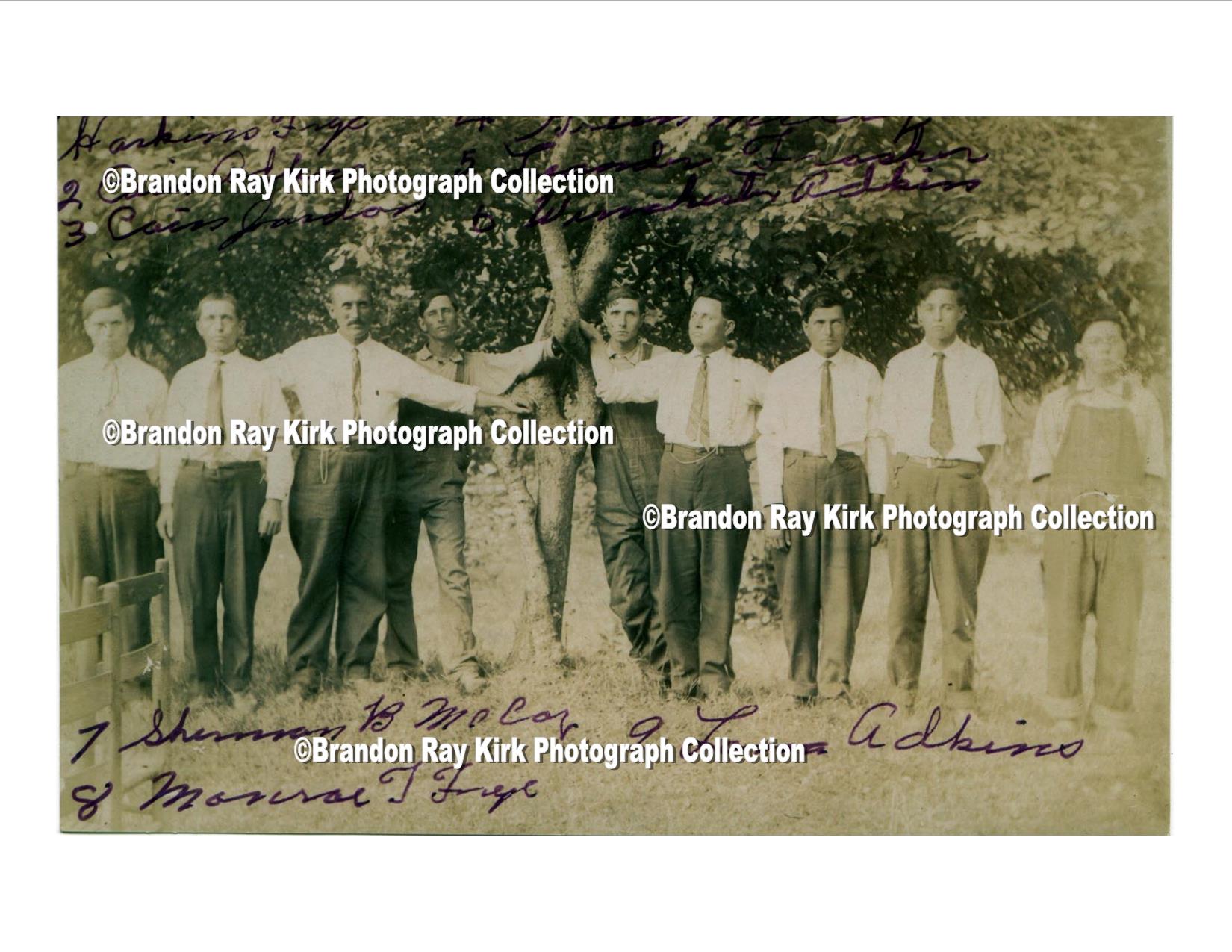
(L-R): Harkins Fry, Cain Adkins Jr., Canaan D. Jordan, Green McCoy Jr., Leander Frazier, Winchester Adkins, Sherman McCoy, Monroe Fry, and Alonzo "Lon" Adkins.

(L-R): Harkins Fry, Cain Adkins Jr., Canaan D. Jordan, Green McCoy Jr., Leander Frazier, Winchester Adkins, Sherman McCoy, Monroe Fry, and Alonzo “Lon” Adkins.

Rector Items 04.16.1914

Tags

, , , , , , , , , , , , , , , , , , , , , , , , , , , , ,

“Trix,” a local correspondent from Rector in Lincoln County, West Virginia, offered the following items, which the Lincoln Monitor printed on Thursday, April 16, 1914:

Rev. Elijah Pauley and wife attended services at Estep Sunday.

Miss Maggie Fry was shopping in Logan and Holden Saturday.

Mrs. Squire Toney spent Saturday and Sunday with her daughter, Mrs. Albert Wall.

Mrs. Emma Barker of Boone county was the guest of her father, Tell Gillenwater, Saturday and Sunday.

Frank Stone and Ed Harmon of Big Creek made a flying trip to the city Sunday.

Born: To Mr. and Mrs. Ervin Ellis, Thursday, a fine boy. Mother and child doing nicely.

Cleveland Brumfield, a well-known horse dealer, passed thru here Sunday en route to Gill.

James Ferrell, Jr. was a business visitor in town the early part of the week.

Miss Junnie Fry was a guest of her aunt, Miss Maude Toney, Sunday.

Lonnie Vannatter and Lee Toney attended the regular Saturday night meeting of the Odd Fellow fraternity at Big Creek.

In Search of Ed Haley 320

Tags

, , , , , , , , , , , , ,

In the mid-summer heat of July, I pulled into the Harts Fas Chek parking lot on my bus with the Haley-McCoy grave bearing strongly on my mind. Early the next morning, Billy, Brandon, and I drove over to Presto’s Garden and made our way up the hillside toward Milt’s grave, cringing at the destruction wrought by bulldozers. The land was scarred and brush was everywhere. There was a wide road recently forged into the side of the mountain, which seemed to be sliding gently down the hillside like thick tears or even blood from the earth’s gaping wounds. It led right up to the grave. There was a bulldozer trail leading down below the grave to a pile of scrap wood, a trail cutting beside the grave leading on up into the hollow, and the entire Low Gap side of the grave area was scraped bare. Nearby, a dozer whirred and rumbled, tossing logs in neatly stacked piles. Somehow the grave was safe from destruction, but this special place was violated after one hundred and seven years of peace and solitude.

Rector Items 03.19.1914

Tags

, , , , , , , , , , , , , , , , , , , , , , , , , , , , , , , , , , , , , , , , , , , ,

“Butterflie,” a local correspondent from Rector in Lincoln County, West Virginia, offered the following items, which the Lincoln Monitor printed on Thursday, March 19, 1914:

Rev. Willie Chapman held services at the Wilson School-house on the Broad Branch of Big Ugly, Saturday and Sunday.

Wirt Toney was at Rector Monday on business.

Tracy Baird just returned from Barboursville.

John B. Toney was a business caller at Leet Monday.

John Bell is very ill with pneumonia. Little hopes are entertained for his recovery.

Miss Rosa Ferrell visited homefolks Saturday and Sunday from Estep.

Miss Allie Gillenwater paid her uncle, Wirt Toney, a visit Saturday night and Sunday.

Miss Junie Fry and Della Ferrell were the guests of their cousin Dollie Toney Saturday and Sunday.

Mrs. John Hunter was shopping in Rector Monday.

Miss Myrtle Toney was the guest of her brother John Toney Monday.

Misses Mary, Maude and Kizzie Toney were on Left Hand Branch the past week to see the gas well.

Mrs. Albert Wall is still very ill.

Miss Dixie Toney was calling on her cousin Allie Gillenwater, Saturday evening.

Squire John Fry of Harts Ck District made a business call on Hugh Duty, Monday.

Marshall Adkins has returned home from Huntington.

Misses Mary Miller and Lula Ferrell paid their uncle, John Hager, a visit the latter part of the past week.

Misses Kate Hager of Huntington and Garnet Hager of Big Creek are visiting relatives and friends on Big Ugly.

Curtis Haven of Holden is visiting his uncle Thomas Vannatter.

Miss Maggie Fry was a visitor at her uncle Wirt Toney’s, Sunday.

In Search of Ed Haley 319

Tags

, , , , , , , , , , , , , , , , , , , , , , , , , ,

A little later, Brandon visited Lillian Ray, a seventy-something-year-old daughter of Cecil Brumfield who lived in a beautiful two-story house on the Smokehouse Fork of Harts Creek. Lilly, he discovered, had a lot of the old Dingess family photographs. To Brandon’s surprise, there were several thick-paged Victorian velvet-covered albums full of tintypes and a few boxes of sepia images on decorative cardboard squares. Only a few were labeled, but he recognized some of the faces: Al Brumfield, Henderson and Sallie Dingess, Hugh Dingess, Mrs. Charley Brumfield, Mrs. John Brumfield, and Dave Dingess. No doubt, there were pictures in the album of Ben Adams and Hollena Brumfield in their youth.

Before leaving, Brandon asked Lilly about Ed Haley. She said she remembered him coming to her father’s house when he lived in the old Henderson Dingess homeplace. He would just show up, leading himself with a cane, and stay for two or three days. Lilly hated to see him come because he was so hateful to the Brumfield children — “always running his mouth.” She described him as a “little short man” who “drank a lot” and told how he and Bernie Adams once borrowed a fiddle from her father and then pawned it off in Logan. The fiddle originally belonged to Tom Martin.

Not long after visiting Lilly, Brandon sent me a letter updating me on his research along with pictures of people we’d only imagined. As they turned up, I wondered if I were to go into a room with Al, Paris, Milt, Green, French, Cain, Runyon — without knowing who any of them were — which ones would I take to strictly on a personality basis? Which ones would I have a gut reaction to think, “Well, he’s a pretty fair good old boy,” or, “Boy, I don’t know about that feller there. Something’s just not right.” I mean, you walk in the room and, “That’s Al Brumfield?” No way. “That’s Cain Adkins?” Nope, I can’t believe that.

In Search of Ed Haley 318

Tags

, , , , , , , , , , , , , , , , , , , , , , , , , ,

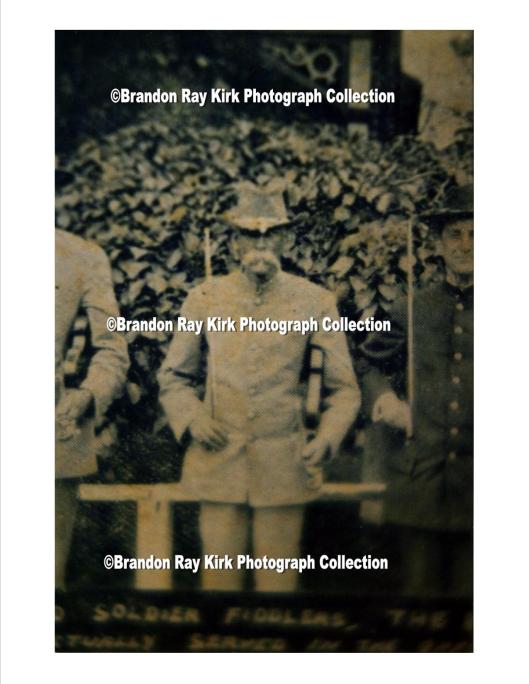
Around that same time, Brandon located a picture of Ben France in a newsletter called High Notes: Mountain Music from West Virginia (1996). France was the most famous fiddler in the Guyandotte Valley during the 1850s. He may have been acquainted with Ed’s grandfather, Ben Haley, or even influenced Milt or Ed.

“These are the ‘Old Soldier Fiddlers’ — two Union, two Confederate — who toured the country after the Civil War,” the caption read. “The second fiddler from the left is Ben France of Wayne County, a Confederate courier who was second on the scene after Stonewall Jackson was fatally wounded. France was the great-great-great-great-great-uncle of our own Bing Brothers. Thanks to Dave Bing for the use of the photograph.”

A little later, I called Dave Bing, a West Virginia fiddler pretty well known among the traditional festival circuit, to ask him about the picture.

“Uncle Ben was born in what is now Wayne County, West Virginia, in the 1840s,” he said. “He joined the Confederate Army at the age of seventeen and served as a carrier in the Shenandoah Valley campaign. He was in the area on a mission the night Stonewall Jackson was shot and was said to be the second man to come to his aid. During the Battle of Gettysburg, he was wounded and transferred to the Army of Tennessee where he served until the end of the war. Uncle Ben was known as a fine horseman.”

France became somewhat of a professional musician after the war.

“After the war, Uncle Ben and three other war veterans (all fiddlers) toured the country playing resorts and fine hotels,” Bing said. “The group was known as the ‘Blue and the Gray.’ Uncle Ben once played by invitation for John D. Rockefeller, Sr. at his hotel. He was an outstanding banjo player but was more famous for his fiddling. He was well-dressed and always had his fiddle — which he called ‘Sally.’ He never married but was the father of a daughter. He died in 1917. He was buried in Henry France Cemetery located off of Long Branch in Cabell County.”

Carter’s Company

Tags

, , , , , , , , , , , , , , , , , , , ,

OLYMPUS DIGITAL CAMERA

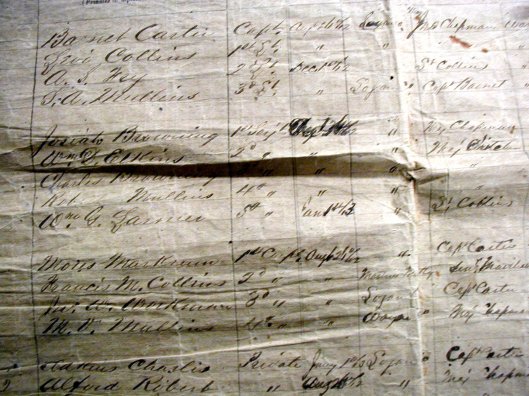
Muster Roll, Company D, 34th Battalion Virginia Cavalry (CSA)


OLYMPUS DIGITAL CAMERA

Muster Roll, Company D, 34th Battalion Virginia Cavalry (CSA)


In Search of Ed Haley 317

Tags

, , , , , , , , , , , , , , , , ,

In that same time frame, Brandon re-visited Tootsie Tomblin, a daughter of Ed Haley’s friend Dood Dalton. She presented him with a reel-to-reel recording of Dood playing the fiddle around 1971. He knew this was an amazing find, somewhat comparable to finding a recording of Laury Hicks, Ed’s fiddling friend in Calhoun County.

Tootsie warned Brandon that the recording wasn’t great because her father had been very old and somewhat crippled in his left hand.

“He was playing with three fingers on his left hand ’cause his fourth finger wouldn’t bend where he’d got it mashed in the mines,” she said.

Brandon sent me a copy of the Dalton recording and when I played it I found that Dood was just what Tootsie said — a man of advanced years whose fingers were tough, stiff and scarred from years of working in the mines — using what sounded like a bow with three hairs and no rosin and a fiddle that had been refinished with floor varnish and strung up with barbed wire and with an action so high you could probably put your shoe under the strings. Still, there he was playing “Wild Horse”, “Cacklin’ Hen”, “Calhoun County Blues”, and “Garfield’s Blackberry Blossom”…and doing it so slowly, as if he were trying to communicate to me through the years that he’d been one hell of a fiddler earlier in his life. His final number was an unaccompanied vocal rendition of an old gospel tune. I came away from the recording thinking that yes, by god, Dood Dalton had been a good fiddler in his day.

Big Ugly Items 03.19.1914

Tags

, , , , , , , , , , , , , , , , , , , , , ,

“Golden Rod,” a local correspondent from Big Ugly Creek in Lincoln County, West Virginia, offered the following items, which the Lincoln Monitor printed on Thursday, March 19, 1914:

Clinton Ferrell, Milton Ferrell, Jeff Miller, and a number of other members from this community attended the regular weekly meeting of the Red Men at Toney this week.

Keenan Toney, one of our very best farmers is kept busy these days looking after a bunch of about 130 head of fine calves.

John Bell is very ill with pneumonia. This makes the fourth attack which the young man has had of this malady.

Albert Ferrell has just returned home from Hamlin where he served on the petit jury at the recent term of circuit court.

The oil well drillers on Big Left Hand Branch have gone down about 1400 feet to date.

John Mullins has moved to the Philip Hager place at the mouth of Big Sulphur. Mr. Mullins is making the old place shine.

Milton Ferrell and boys are sowing their tobacco beds this week.