• About

Brandon Ray Kirk

~ This site is dedicated to the collection, preservation, and promotion of history and culture in my section of Appalachia.

Brandon Ray Kirk

Category Archives: Timber

Peytona Lumber Company in Omar, WV (2019)

23 Tuesday Apr 2019

Posted by Brandon Ray Kirk in Timber

≈ 6 Comments

Tags

history, Logan County, logging, Omar, Peytona Lumber Company, photos, Pine Creek, timber, timbering, West Virginia

IMG_6304

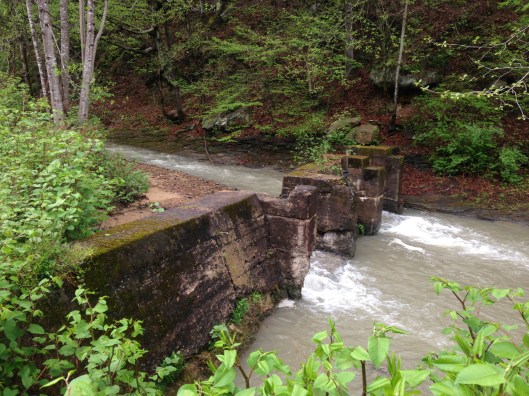
The Peytona Lumber Company established itself in 1916 at Omar, Logan County, WV. As of 1921-1922, the company boasted 150 employees. Here’s a PLC splash dam crib on Pine Creek in Omar. 19 April 2019

Georgia Perry Deed to John W. Robertson (1909)

30 Wednesday Jan 2019

Posted by Brandon Ray Kirk in Big Harts Creek, Timber

≈ Leave a comment

Tags

Appalachia, Big Branch, Charles Avis, genealogy, Georgia Perry, Harts Creek, history, John W. Robertson, Lincoln County, notary public, Sarah A. Perry, timber, timbering, W.B. Wilkinson, W.C. Holstein, West Virginia

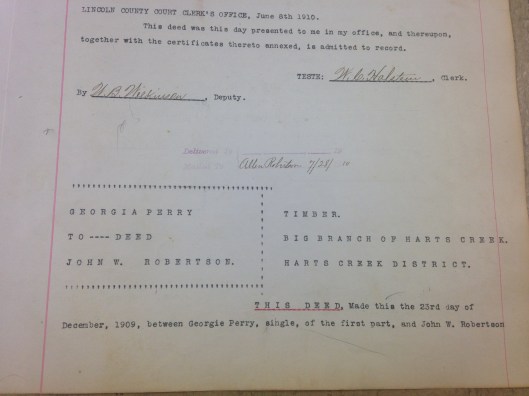
georgia perry to john robertson 1

Deed Book __, page ___, Lincoln County Clerk’s Office, Hamlin, WV.

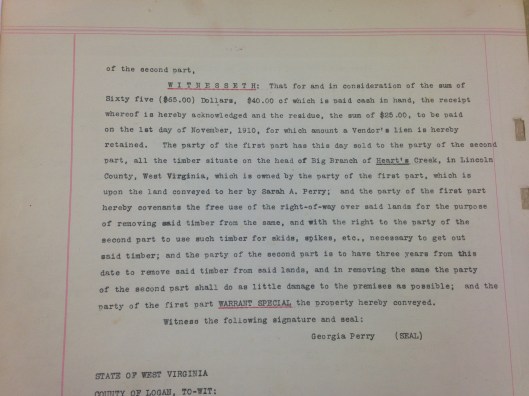
georgia perry to john robertson 2

Deed Book __, page ___, Lincoln County Clerk’s Office, Hamlin, WV.

georgia perry to john robertson 3

Deed Book __, page ___, Lincoln County Clerk’s Office, Hamlin, WV.

State v. Ephraim Hatfield (1871-1872)

31 Monday Dec 2018

Posted by Brandon Ray Kirk in Big Sandy Valley, Hatfield-McCoy Feud, Timber

≈ Leave a comment

Tags

Appalachia, crime, deputy sheriff, Devil Anse Hatfield, Ephraim Hatfield, genealogy, Hatfield-McCoy Feud, history, J.M. Jackson, James Allison, John Hatfield, Logan County, logging, Mingo County, sheriff, timber, timbering, Valentine Wall Hatfield, West Virginia

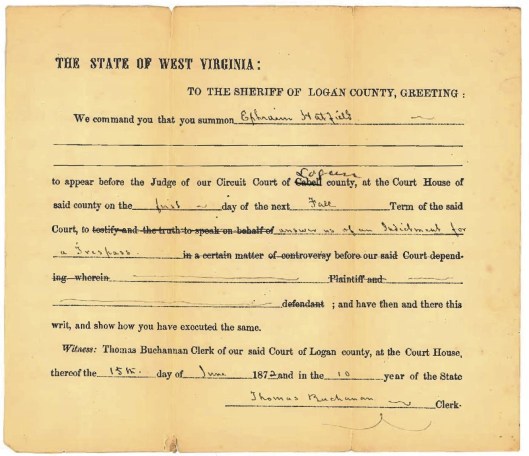
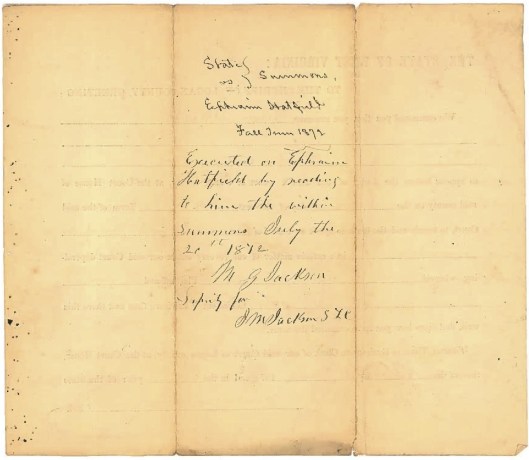
In 1871-1872, Ephraim Hatfield was accused of stealing “with force and arms” twenty saw logs valued at fifty dollars from James Allison in Logan County, WV. Most likely, the Ephraim Hatfield of this record is Ephraim “Big Eph” Hatfield (c.1811-c.1881), father to Anderson “Devil Anse” Hatfield. Other possibilities include Ephraim Hatfield (b. c.1851), son of John Hatfield, and Ephraim Hatfield (b. c.1856), son of Valentine “Wall” Hatfield.

56

Grand jury indictment for Ephraim Hatfield, who stood accused of stealing twenty “saw logs” from James Allison valued at fifty dollars on 10 April 1871. Logan County, WV. Page 1.

57

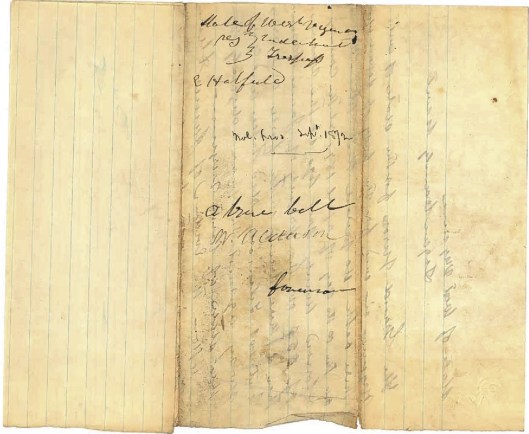
Page 1 (back). Note: This event is not related to the Hatfield-McCoy Feud.

64

Summons for Ephraim Hatfield to appear for the Fall Term of Court 1872 in Logan County, WV. Dated June 15, 1872. Page 1

65

M. Jackson served summons to Ephraim Hatfield on 20 July 1872. Page 1 (back)

Mingo Oak near Holden, Logan County, WV

18 Tuesday Dec 2018

Posted by Brandon Ray Kirk in Holden, Timber

≈ Leave a comment

Tags

Appalachia, history, Holden, Jill Baisden, Logan County, Lowe Mountain, Mingo County, Mingo Oak, photos, Rum Creek, timber, West Virginia

Big Tree at Lowe Mountain 1

This tree was an old landmark on near Holden in Logan County, WV. The owner of this photo thought this photograph was taken on Lowe Mountain in the head of Rum Creek, Logan County, WV. Photo courtesy of Jill (Mullins) Baisden.

For more information, go here: https://www.wvencyclopedia.org/articles/1833

Anse Hatfield and Jim Vance (1868)

16 Sunday Dec 2018

Posted by Brandon Ray Kirk in Hatfield-McCoy Feud, Timber

≈ Leave a comment

Tags

Appalachia, county clerk, crime, deputy clerk, Devil Anse Hatfield, Farmer McCoy, genealogy, Harrison Blair, Hatfield-McCoy Feud, Hiram H. Williamson, history, Jim Vance, John Buchanan, Logan County, Mingo County, sheriff, Thomas Buchanan, timber, timbering, West Virginia, William Straton

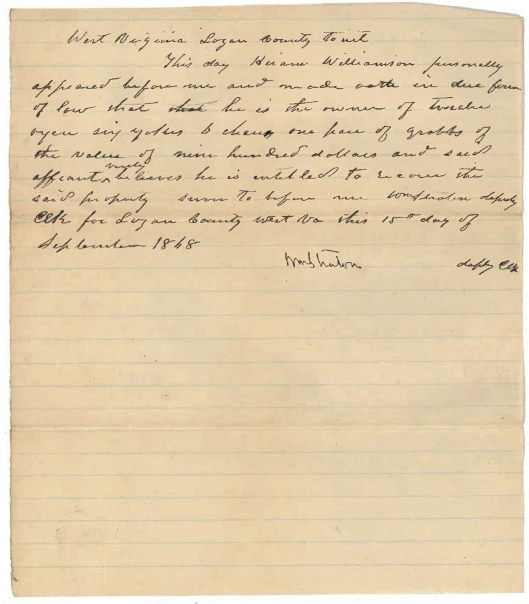
Anderson Hatfield and James Vance Document 1868 1

Hiram H. Williamson and William Straton, $1800 bond, 15 September 1868.

Anderson Hatfield and James Vance Document 1868 2

Hiram H. Williamson and William Straton, $1800 bond, 15 September 1868.

Anderson Hatfield and James Vance Document 1868 3

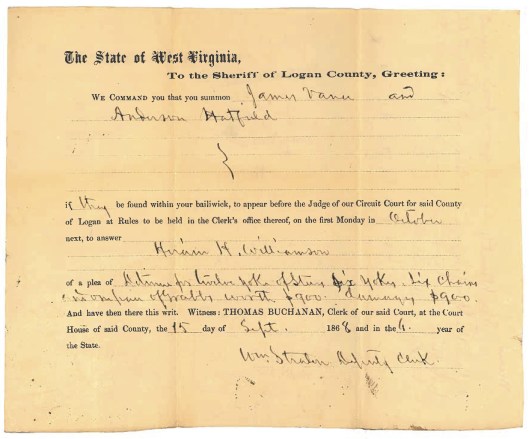
Summons for Jim Vance and Anse Hatfield, 15 September 1868.

Anderson Hatfield and James Vance Document 1868 4

Summons for Jim Vance and Anse Hatfield, 15 September 1868.

Anderson Hatfield and James Vance Document 1868 5

Hiram H. Williamson oath, 15 September 1868.

Anderson Hatfield and James Vance Document 1868 6

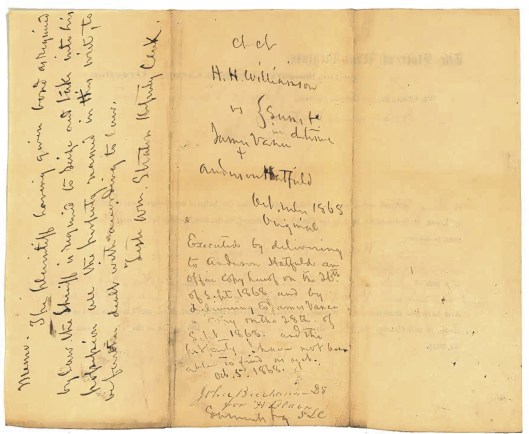
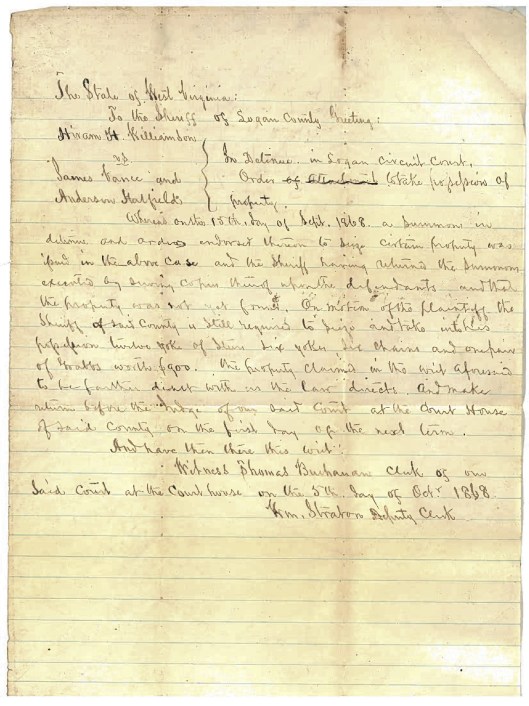
Order to seize property, 5 October 1868.

Anderson Hatfield and James Vance Document 1868 7

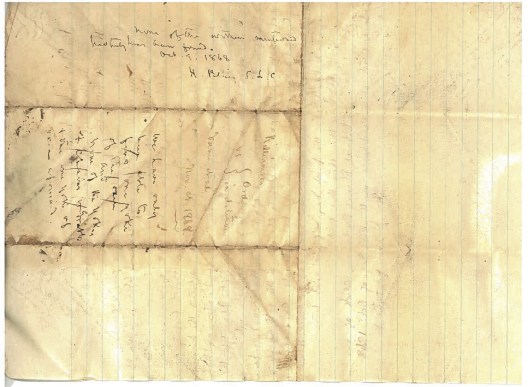
Order to seize property, 5 October 1868.

Anderson Hatfield indicted for retailing Nov 10 1868 LC LO BK A p. 38 1

Law Order Book A, page 38, 10 November 1868, Logan County Circuit Clerk’s Office, Logan, WV. NOTE: This latter document relates to a charge against Hatfield for unlawful retailing of liquor and also against Farmer McCoy for lewdness.

Joshua Butcher Deed to John G. Butcher (1854)

16 Tuesday Oct 2018

Posted by Brandon Ray Kirk in Crawley Creek, Guyandotte River, Timber

≈ Leave a comment

Tags

Appalachia, Crawley Creek, genealogy, Guyandotte River, history, John G. Butcher, John J. Besnoist, Joshua Butcher, justice of the peace, Logan County, Mill Branch, Sarah Butcher, Virginia, Wesley Stollings, West Virginia, William Smith, William Straton

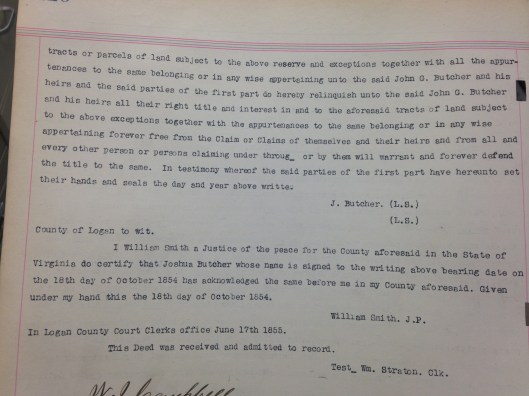
Joshua Butcher to John G. Butcher Deed 1

Deed Book C, page ___, Logan County Clerk’s Office, Logan, WV. Note: References timber.

Joshua Butcher to John G. Butcher Deed 3

Deed Book C, page ___, Logan County Clerk’s Office, Logan, WV.

Museum and Log Cabin at Breaks Interstate Park in Breaks, VA (2018)

17 Monday Sep 2018

Posted by Brandon Ray Kirk in Civil War, Hatfield-McCoy Feud, Native American History, Timber

≈ Leave a comment

Tags

Appalachia, Battle of Middle Creek, Brandon Kirk, Breaks, Breaks Canyon, Breaks Interstate Park, civil war, fossils, Hatfield-McCoy Feud, history, James A Garfield, Kentucky, Marion, moonshine, moonshining, Native American History, Native Americans, photos, Phyllis Kirk, rafting, Saltville, Union Army, Virginia

IMG_6831

Video showcasing regional history. 25 August 2018.

IMG_6816

Hammerstone and Polishing Stone. 25 August 2018.

IMG_6818

Fully Grooved Axe. 25 August 2018.

IMG_6819

Lt. James A. Garfield, Union hero at the Battle of Middle Creek, KY. 25 August 2018.

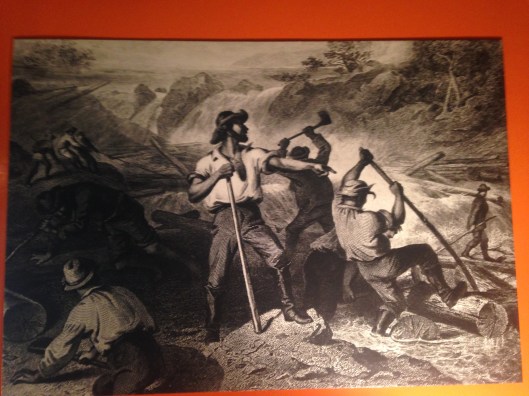
IMG_6825.JPG

Rafting through Breaks Canyon, c.1885. 25 August 2018.

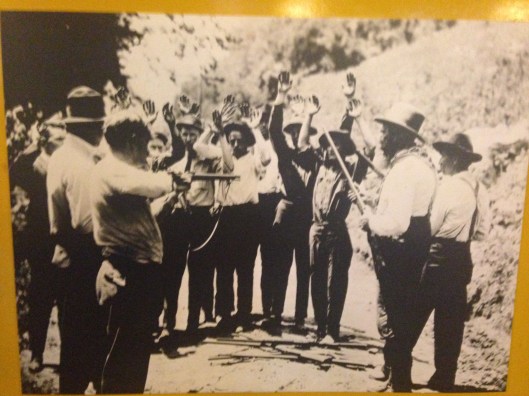
IMG_6821

This photo is labeled: “A Confrontation Between the Hatfields and the McCoys.”

IMG_6823

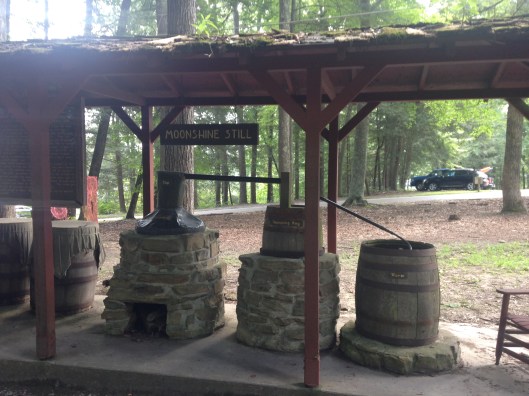
Moonshine still. 25 August 2018.

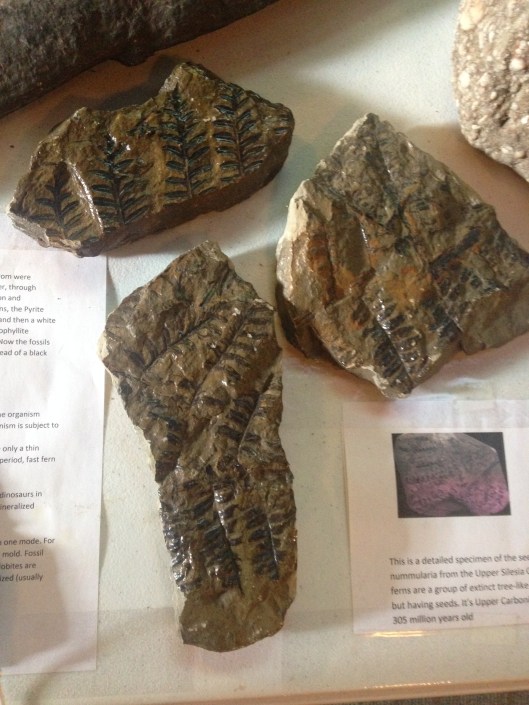
IMG_6827

Seed fern fossil, 305 million years old. 25 August 2018.

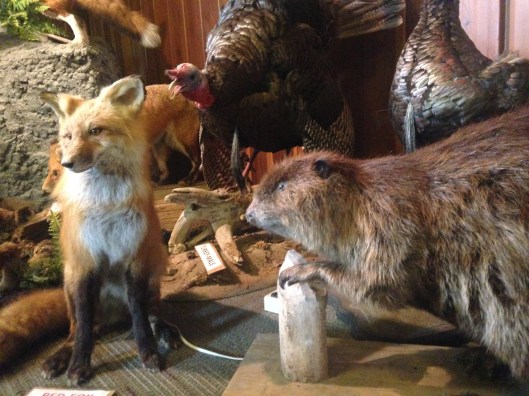
IMG_6833

Native wildlife. 25 August 2018.

IMG_6835

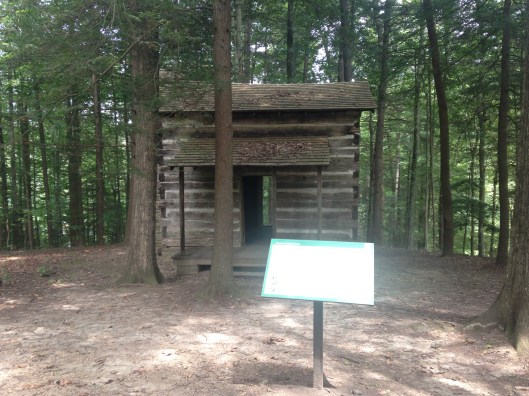
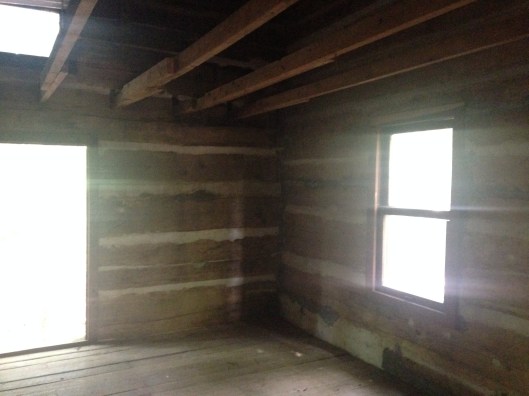
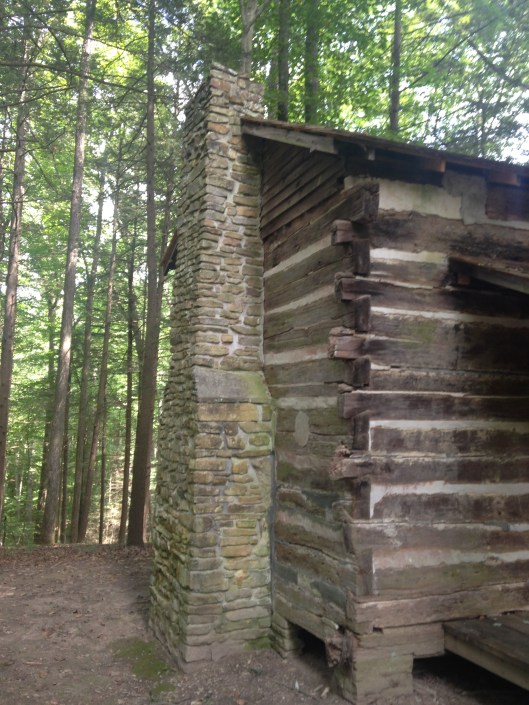
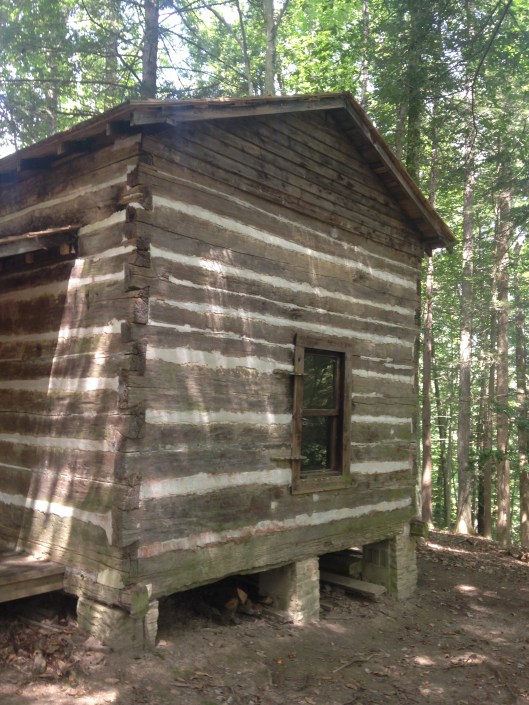
Log cabin. 25 August 2018.

IMG_6839

Log cabin. 25 August 2018.

IMG_6837

Log cabin. 25 August 2018.

IMG_6842

Log cabin. 25 August 2018.

IMG_6840

Log cabin. 25 August 2018.

IMG_6841.JPG

Mom at the cabin. 25 August 2018.

IMG_6844

Moonshine still showing cap, thumping keg, and worm. 25 August 2018.

IMG_6852

Salt kettle cast at Marion, VA, about 1860 and buried to conceal it from Union troops at Saltville, VA, in 1864. 25 August 2018.

Recollections of McKinley Grimmett of Bruno, WV 3 (1984)

06 Thursday Sep 2018

Posted by Brandon Ray Kirk in Coal, Hatfield-McCoy Feud, Logan, Timber, World War I

≈ Leave a comment

Tags

Appalachia, assessor, blacksmith, Bruno, Burl Stotts, California, Cap Hatfield, Christian, Christmas, coal, Devil Anse Hatfield, drum runner, Edith Grimmett, Elba Hatfield, Elk Creek, Ellison Toler, genealogy, Harvey Ferguson, Harvey Howes, Hatfield-McCoy Feud, Henderson Grimmett, history, Huff Creek, J.G. Hunter, Joe Hatfield, Johnny Davis, justice of the peace, Logan, Logan County, Mallory, Mallory Coal Company, Matilda Hatfield, McKinley Grimmett, mining, Nancy Grimmett, Osey Richey, politics, pushboats, rafting, Ralph Grimmett, Rum Creek, Sand Lick, sheriff, Smoke House Restaurant, Tennis Hatfield, Thomas Hatfield, timber, West Virginia, whooping cough, Willis Hatfield, World War I

McKinley Grimmett was born on November 30, 1896 to Henderson and Nancy (Hatfield) Grimmett at Sand Lick, Logan County, WV. On May 14, 1916, Mr. Grimmett married a Ms. Plymale, who soon died, in Logan County. One child named Alva died on June 21, 1919 of whooping cough, aged fourteen months. His World War I draft registration card dated September 12, 1918 identifies him as having blue eyes and light-colored hair. He was employed by Mallory Coal Company at Mallory, WV. On November 13, 1919, he married Matilda “Tilda” Hatfield, daughter of Thomas Hatfield, in Logan County. He identified himself as a farmer in both of his marriage records. During the 1920s, he served as a deputy under Sheriff Tennis Hatfield.

The following interview of Mr. Grimmett was conducted at his home on July 17, 1984. In this part of the interview, he recalls his occupations. Tennis Hatfield, Cap Hatfield, Joe Hatfield, Willis Hatfield, pushboats, Logan, World War I, coal, and blacksmithing are featured.

***

What about Tennis and Joe Hatfield?

But now they come out, they paid all their debts and everything and stuff like that. They was honest, as far as I know. I think both of ‘em went broke, they was so good to the people. They had all kinds of things… Tennis had a five thousand dollar ring and he pawned it to the First National Bank and somebody got the ring. I don’t know who did. Tennis didn’t get it back. They both lost everything they had. And not just only them. Osey Richey, he was assessor and J.G. Hunter was assessor, and they lost all they had. People just, after they got elected and everything, thought that they had to furnish ‘em whether they had it or whether they didn’t.

Tennis and Joe were too young to participate in the Hatfield-McCoy Feud.

Oh yeah. That happened before I got big enough, Cap and them. Cap was chief deputy, though, while I was on. I can remember some of it. Just hear-says. I don’t know nothing about it. Ellison Toler was related to them someway and he stayed at my daddy’s and they kept him up for killing somebody over there at Welch and they hung him there at Welch yard on a tree. I remember getting into my daddy’s papers and reading the letters after I was just learning in school about such stuff like that. And I thought that was the awfulest thing ever was, writing to him and telling about it.

What changed in the county for the Hatfields between the feud and the 1920s?

Mostly, they died out to tell you the truth. Joe and Tennis died out and nobody else had guts enough to take it, you see? Now, Willis, he was the youngest brother. Elba, now he was JP and after he got out as JP he pulled out and went to California. And Willis, he died here about a year ago up on Rum Creek. And Tennis and Joe both died. And that was all of ‘em. All of the old people. Harvey Howes married their sister, and they’re all dead.

Did you ever talk to Cap or Willis?

Oh yeah. Willis, they’d hang after me all the time. They knowed I was half-Hatfield, you know. Tennis and Joe would, too. They was awful good to me ever way. Now Cap, I never – Cap just had one word for a person. If he wanted to talk with you, he’d say, well let’s talk a while, and if he didn’t, he’d say, get the hell away from here. That was the way Cap was. Devil Anse, he used to kill a beef and roast it every Christmas, you know. I’ve went there and eat with him a lot. They tell me they wouldn’t know that place now. They’ve cleaned the graveyard up, you know. I ain’t been up there in… Be five years in January since I got down and I ain’t been away … Only one takes me anyplace is my daughter Edith and Ralph and Edith’s working all the time and Ralph’s all the time busy and Ralph takes me to the doctor every month and Edith took me to the store back and forth and Ralph took me last Saturday.

How has Downtown Logan changed since you were young?

Oh, it’s changed a big lot. Built more buildings in it and everything. Used to be you had about three or four policeman and that was it. Now I can remember back whenever they had a wooden courthouse. A boxed building. I was just a big boy then. Daddy followed rafting and pushboating. You know what pushboating is? Well, they had a big long boat. He had two. And one of ‘em was about eight feet wide and about 46 feet long. Other one was about twelve feet wide. And they had to catch water to get that big boat. And sixteen foot wide. And they’d take a pair of mules or horses, whichever they had, and they’d go to Logan and buy groceries. He had a store and he boated most of his stuff. They’d kill hogs and take chickens and catch fish and take it down to Logan and sell it and they’d bring groceries back.

And they’d make these trips how often?

He went every week. It would take two days to make it, very best. You had from daylight to dark.

Tell me more about your work history.

Well I was a blacksmith. Worked in electric force. They knew I was going to fire. Harvey Ferguson was superintendent. Johnny Davis was general manager. They knowed how old I was. They knowed I was going to retire. I left Christian over here. They shut down. Johnny Davis offered me a job and offered me a job and I wouldn’t take it. I met him right at the foot of the hill. He was a boss over some Elk Creek mine. Well, I went and worked about six months lacking two days for Burl Stotts over there in Campbell’s Creek, built a tipple he fell off of and got killed. I come back and Johnny had come in home that week and Johnny and Harvey Ferguson had been up here and they wanted me to come around there and talk with them on Saturday night. I went around there. They said Johnny said he wanted me to come back up and work for him. I said, well you won’t give me enough. He said, how much you getting? I told him. He said, well I’ll give you three dollars on the day more. I said, well I’ll do it. The rates was 24 dollars. Union then. He give me 27 dollars. I wasn’t getting 24 and going over there and paying board, you know. So I said, well I’ll go back over there and work next week and pay my board up. I wouldn’t walk right off the job from him. He was a good fellow. And he was good to me. And he liked me and everything. And he give me all he could give me. They said they appreciated that, Davis and Harvey Ferguson both. That I’d do a thing like that. So I went back and worked that week and paid my board and come back and went up there and stayed with him fourteen years and retired. In November 30, 1962.

Do you remember anything about your last day?

No, they give me a pair of gloves and Johnny told me that he was going to put a ten dollar gold piece in my envelope. And he did.

What about World War I?

Well I was called… I was drum runner. The superintendent come down in the drum house where I was at. The superintendent said I see you are called for service. I said, Yeah, two more weeks will be my last. You better get somebody in here and let me learn him while I can. He said, we were studying about that. Do you want to go? I said, no I don’t want to go but I guess I’ll have to go. Kaiser was his name. He said, We’ll see what we can do about it. I’ll let you know and I’ll keep you posted at all times. Well, that was on Monday morning, I believe it was. On Saturday evening, I had to work six days a week, Saturday evening he wanted me to come over to his office. That was around on Huff Creek, at Mallory 1. And I went over there. He said, I think I’ve got you retired. He said, We’ve got to have coal men as well as army men. Just don’t say anything about it to none of the boys. You’ll not have to go. And that was all of it. I never did have to go. But I registered five different times for the service. Last time I registered, they took everybody. They didn’t get too old—I registered them all. And the company put me in a little old room beside the store and furnished my eatings for that day paid me for my day’s work and the government never did pay me a cent for none of it. Five different times. Now at first start I had to take them, I had to keep a tally of how many registered, had to take them to Logan and send them out, call in to Washington and tell them how many I registered and everything. Now the last time, I didn’t have to do that. A man come and got ‘em the next day.

Who taught you how to blacksmith?

Oh, I taught myself. My daddy used to shoe horses and I used to help him in the shop. That’s the hardest job ever I got in, shoeing horses or mules. Dangerous job, too. I’ve had them kick me plumb over top of… At that time you had belluses you blow. They’d kick me plumb over top of them belluses. Almost kill me sometimes.

Were there any blacksmith shops around Logan when you were a boy?

Oh yeah. There was plenty of them. There in Logan there was a big one. A fellow named White was the blacksmith down there. Boy, he’d whip a mule. He kept big old hickory poles in there and a mule or horse that didn’t hold still or anything he’d throw its leg down and grab one of them poles—I’ve been in there and watched him—and he’d beat that mule… I swear, I’d be uneasy about it. Think he was going to kill it. It would just quiver like a leaf.

Where was his shop?

Right where the courthouse sits now. There was a wooden courthouse. Box building. Two-story high. And his blacksmith shop was right on down the street. I’d say it wasn’t quite down to the Smoke House. Not quite down that far. Over on the right hand side. It was a big old boxed building and a shed to it. He’d get dirty coal. He was too tight to buy the coal or something. And he’d have enough smoke go all over that town. Yeah, I remember all about that.

NOTE: Some names may be transcribed incorrectly.

Recollections of McKinley Grimmett of Bruno, WV 1 (1984)

31 Friday Aug 2018

Posted by Brandon Ray Kirk in African American History, Coal, Dingess, Guyandotte River, Holden, Logan, Man, Timber, Wyoming County

≈ 4 Comments

Tags

African-Americans, Alva Grimmett, Appalachia, Austin Grimmett, Baileysville, Big Cub Creek, Bruno, Buffalo Creek, Christian, Cole and Crane Company, Devil Anse Hatfield, Dingess, Edith Grimmett, education, Elk Creek, Ettie Grimmett, farming, genealogy, general store, Green Perry, Guyandotte River, Guyandotte Valley, Henderson Browning, Henderson Grimmett, history, Holden, Horse Pen Mountain, Johnny Grimmett, Landsville, Lilly Grimmett, Logan, Logan County, logging, Madison Creek, Mallory, Man, McGuffey Readers, McKinley Grimmett, Mingo County, Mud Fork, Nancy Grimmett, rafting, Ralph Grimmett, Rose Grimmett, Sand Lick, Sanford Grimmett, Slater Hatfield, Tennis Hatfield, Thomas Hatfield, Tilda Hatfield, timber, timbering, Travis Grimmett, Verner, Walter Buchanan, West Virginia, whooping cough, World War I, Wyatt Belcher, Wyoming County

McKinley Grimmett was born on November 30, 1896 to Henderson and Nancy (Hatfield) Grimmett at Sand Lick, Logan County, WV. On May 14, 1916, Mr. Grimmett married a Ms. Plymale, who soon died, in Logan County. One child named Alva died on June 21, 1919 of whooping cough, aged fourteen months. His World War I draft registration card dated September 12, 1918 identifies him as having blue eyes and light-colored hair. He was employed by Mallory Coal Company at Mallory, WV. On November 13, 1919, he married Matilda “Tilda” Hatfield, daughter of Thomas Hatfield, in Logan County. He identified himself as a farmer in both of his marriage records. During the 1920s, he served as a deputy under Sheriff Tennis Hatfield.

The following interview of Mr. Grimmett was conducted at his home on July 17, 1984. In this part of the interview, he recalls his family background and early occupations. Logging and rafting in the Guyandotte Valley are featured.

***

Would you mind telling me when and where you were born?

Right here. I was born about a mile up above here. I was borned in Logan County. The post office was Christian at that time. Christian, WV. It’s changed now. They throwed Christian out – it was over here at Christian – and they throwed it out and moved it over here to Bruno. Christian went… The mines stopped over there. And that’s where I was born, right here at Bruno, Logan County. Been here all my life.

What day were you born?

November 30, 1896.

Who were your parents?

Henderson Grimmett and Nancy Hatfield Grimmett.

What kind of work did they do?

They did logging work. All they had that day and time. Mule teams and ox teams.

Where did your dad do his work?

All over Logan County.

Did he have his own farm?

Oh yeah. Yeah.

How big was his farm?

It was about 287 acres.

Can you describe his house?

Well, the house was a two-story building. But he never did get… He took the fever and he never did get the upper story, all of it completed. He died at a very early age of 74. He put him up a little store. Got ahead a little bit. Had a store here. Come down and bought this place off Walter Buchanan and he deeded his five kids the homeplace up there. And then he stayed on it from ’21 to ’29. He died 19th day of January, 1929.

Who were your mother’s parents?

Oh, Lord, I can’t… Slater Hatfield was her daddy’s name. And I don’t know my grandma. My daddy, now they both was born in Wyoming County. Baileysville or somewhere in there. I think my mother was born over there in Big Cub Creek. She was a Hatfield. I don’t know where…

How many brothers and sisters do you have?

I had three brothers and three sisters. Sanford was the oldest one. Austin and Johnny. They’re all dead. I’m the only one that’s living. All my three sisters… Lilly was the oldest one, and Rose was the next one, and Ettie was the youngest. They’re all dead. All of ‘em but me.

Were you educated in Logan County schools?

Yeah, that’s all we got. Free schools. I believe we started off about three months out of the year. Right over there where that first house is sitting – a one-room school house. All of us kids.

What was the last year of school you completed?

I believe it was about 1914, I’m not right sure. ’15.

Did you use the McGuffey Readers?

That’s all we had. And the spelling books. And in the late years, why we had a U.S. history… A small one. Most of it was just about West Virginia. It wasn’t about the whole United States. And geography, we had that. Arithmetic. That was about all we had in free schools. We had to buy them all then. They weren’t furnished.

How did you meet your wife?

She was born and raised over here at Horse Pen in Mingo County. And that’s how we met. We were just neighbors.

What was her maiden name?

She was a Hatfield, too. But now they were… There’s three or four sets of them.

Was her family related to Devil Anse Hatfield?

Well, they was some… Not very close, though, I don’t think.

Which church did you belong to?

I don’t belong to any.

Did you belong to a church when you were younger?

No, never did. If I ever would have joined, I’d have stayed with it.

Do you remember the year of your marriage?

Yeah, I sure do. November 13, 1919.

How many children do you have?

Four. We have two boys and two girls. Travis Grimmett is the oldest. And Ralph, Edith, and Nancy.

What was your wedding like?

Well, we just got married and come right home. At that time, they didn’t have such things, to tell you the truth.

Who was the preacher?

Green Perry. Rev. Green Perry on Elk Creek. Rode a horse back when I went up there to get married. A pair of mules. I rode them mules.

Where did you first live after you married?

Right about a mile above here at the old homeplace.

You have lived here all of your life?

All of our life.

Was it always this populated?

No, no. Wasn’t three or four houses on this creek at that day and time. It was farm land. It’s all growed up now. All them hills was put in corn, millets, and stuff like that. If they couldn’t get a machine to it, they cut it by hand. Some of them raised oats and some of them raised millet, corn. Raised hogs and cattle and sheep and selling ‘em.

Who owned this property back then?

Burl Christian owned this here, but I don’t know… My daddy bought his… A fellow by the name of Wyatt Belcher. Wait a minute. Browning. I can’t think of his name. He lived over here on Christian and he bidded in… It sold for back taxes and he bidded in. Henderson Browning.

What kind of work did you do after you married?

Just the same thing as I worked at before I got married. I first started out – my daddy was a boss for Cole and Crane on this river. I first started out working in the log business. I worked two years at that and then I decided… Mule team – I worked about eighteen months at that. Then in 1913 the coal company started in and I went to work in carpenter work. I helped build all of these houses down here at Landville. The superintendent, we got done, they was wanting to hire men, he give me a job keeping time for a while. And he wanted me to learn to run the drum – that’s letting coal off the hill. I learned it and about the third day I was up there, a preacher was running it, and he told me they’d just opened up and they didn’t have much coal to run off the hill, he told me, that preacher, he rolled out two cards and he said if that preacher fails to go out and work on that side track today you give him one of these cards. Well, I didn’t give him a card. But he come out that evening, the boss did. And he said, did the preacher work. And I said, no he refused. He said, I’ll fix him. He fired him. And I took the job and stayed with it four years and then I got married and then I went to work over here at Christian running a drum and I stayed there 34 years.

When you worked for Cole and Crane, did either of those men ever come up here?

Oh yeah. One of them was. Cole was. I don’t think Crane was ever here. A little slim fella.

Did you get a chance to talk to them?

No, they wouldn’t talk to us working men. They’d talk to the boss. They’d go away from us and talk to theirselves. We just got a $1.10 for ten hours. Eleven cents an hour.

What kind of a person did Cole seem to be?

Well, he knowed how the men was. They’d raft timber and go down this river to Guyandotte. Had what they called locks and dams there to catch the logs. This river was full of logs. He bought timber everywhere. Plumb at the head of it.

Did you ever ride a raft?

Oh, yeah. I went with my daddy. I wasn’t grown.

Can you describe it?

Oh, they’d raft the logs, poplar. Now they didn’t raft hardwoods. They’d sink on them. Some rafts, a big one would be 160 to 200 feet long, about 24 to 26 feet wide. Oar on each end of it. If it was a big raft, they had two men up front all the time plumb in to Guyandotte. I was the second man on it when I got to go out on it. My dad had timber and he rafted it, took it there and sold it. Took what they called dog wedges and cut little basket oaks and rafted them, stringers across ‘em, you know. Lots of people get drowned, too.

Were you ever in an accident?

No, I never was in no big one. I’ve seen about six or eight drown.

Could you describe how it happened?

Oh, if he couldn’t swim, sometimes the best swimmer drowned, you know, if he got under a lot of logs or something. According to whatever happened there with him. He could get out if there wasn’t no logs on top of him no where to hold him under, you know. If logs were on top of him, he was gone. Now about the last ones I seen drowned was two colored people. They was building a railroad from Logan to Man up Buffalo Creek. So we was working on a log gorge down there at the lower end of Landville. And there was four colored men… 1921. Had a saloon up here at Verner. They wouldn’t allow one in Logan County. And they went up there on the 21st day of December to get ‘em a load of whisky. And they come back… They’d seen white people ride these logs. Some county people would get on one log and ride it plumb to Logan, as far as you wanted to go. And they thought they could ride it. And they got on. Rode ‘em off the gorge and they was running into eddy water and they would hit the back end, it would, and the other end would swarp out and they’d pull out that way. And they got on ‘em with their whisky and everything and two of ‘em got out and two of ‘em drowned.

When you rode the raft to Guyandotte, how did you get back to Logan?

Oh, we had to walk. We’d get a train up to Dingess over here. You know where that’s at? We’d ride down up to there. And then we’d have to get off and walk across the hill there and come right straight out at the mouth of Mud Fork, Holden there, and up another little drain and down Madison Creek down here. And walk… Man alive, our feet would be so sore, I’d be up for two or three weeks I couldn’t walk, my feet would be wore out so.

NOTE: Some names may be transcribed incorrectly.

Brad Toney Stationery

21 Tuesday Aug 2018

Posted by Brandon Ray Kirk in Big Creek, Timber, Toney

≈ Leave a comment

Tags

Appalachia, Big Creek, Brad Toney, genealogy, history, Lincoln County, Logan County, merchant, timber, timbering, Toney, West Virginia

B.D. Toney Stationery.JPG

Bradford D. Toney, son of Burbus C. and Sarah Kesiah (Lucas) Toney, was born in 1847. Toney, a town located in southern Lincoln County, WV, is named for him.

History of the West Virginia Penitentiary (1901), Part 1

31 Tuesday Jul 2018

Posted by Brandon Ray Kirk in African American History, Civil War, Culture of Honor, Timber

≈ Leave a comment

Tags

African-Americans, Alabama, Appalachia, Arthur I. Boreman, civil war, history, J.W. McWhorter, Moundsville, North Carolina, Ohio River, Potomac River, South Carolina, Virginia, West Virginia, West Virginia State Penitentiary

HISTORY OF THE WEST VIRGINIA PENITENTIARY.

WRITTEN BY A PRISONER.

In 1863 the state was admitted as one of the constellation of states of the union. Virginia had seceded from the union by a majority vote. The strong and indomitable minority citizens of the Old Dominion residing in the western part of it, many of whom were Scotch and Irish descendants and natives of the adjoining states, who had taken up their homes in the valleys and on the hillsides, were loyal to the Union, loved well the flag, and reverenced with an undying affection the builders of the union of states for the greater blessing of the people, and stood firm and unyielding for an indivisible united country. By their hands and brave hearts they built a state stretching from the Potomac to the Ohio river, carved out of the Old Dominion. The war-born daughter of the historical commonwealth proved, in subsequent years, to be rich in the production of materials in active demand in the marts of commerce, and she now outstrips her mother state in the race for greatness, prosperity, and happiness.

Many regions of the state are mountainous, and the principal industries are lumbering, mining, and oil production. Many of the white people are typical mountaineers and somewhat rough and uncouth in manner, while the negroes, many of them, have drifted from North and South Carolina, Alabama, and other southern states to be employed in the development of these industries.

There are very many respectable farmers, professional and business men, and cultured ladies residing in these almost inaccessible parts; but the rough element in many places predominates, and the order of the day and night is drinking and brawling, ending as a rule in desperate encounters and murder. Most of the white and black inmates of the penitentiary have been and are now composed of the lawless men from these regions, from the time it was only a stockade of ten acres in 1866, when Hon. J.W. McWhorter of the Tenth Judicial District was appointed warden by Governor Boreman. He resigned this position after viewing it. In a letter to Warden Hawk he states it was for the reason that there was not so much as a building erected for the shelter of the inmates, and he thought he could not work the convicts to advantage under the circumstances. The penitentiary has been improved from time to time to the present, by additions, until it is a massive structure of stone and iron, with a high stone surrounding wall. It has 695 inmates at the present writing.

The center, or main building, is built after the old baronial castellated style of architecture, and with its several stories height, it makes an imposing appearance. It is flanked on the north and south by the stone and strongly-barred buildings, wherein the old and first built stone cells and the modern steel ones–900 in all–are placed. Entrance is to be had into the prison proper by means of a round turning iron-barred cage in the main hallway of the central building.

Source: E.E. Byrum, Behind the Prison Bars: A Reminder of Our Duties Toward Those Who Have Been So Unfortunate as to Be Cast Into Prison (Moundsville, WV: Gospel Trumpet Publishing Co., 1901), pp. 73-75.

Nancy Hatfield v. The Little Kanawha Lumber Company (1892)

07 Saturday Jul 2018

Posted by Brandon Ray Kirk in Hatfield-McCoy Feud, Timber, Women's History

≈ Leave a comment

Tags

Appalachia, Cap Hatfield, G.W. Morgan, G.W. Taylor, genealogy, Hatfield-McCoy Feud, history, Island Creek, John A. Sheppard, justice of the peace, Little Kanawha Lumber Company, Logan County, Nancy Hatfield, P.A. Farley, Patterson Christian, splashing, timber, timbering, West Virginia

Historians have well-documented Anderson Hatfield’s timber activity. In 1892, Nancy Hatfield, wife of Cap, sued the Little Kanawha Lumber Company. Here are transcriptions of a few court documents.

DOCUMENT 1

Nancy Hatfield

vs.

The Little Kanawha Lumber Company

Civil Action

Summons issued June 29, 1892 by G.W. Morgan, a Justice of Logan County, W.Va., and returnable at the residence of Cap Hatfield on Main Island Creek in Logan District of said County on the 14th day of July 1892. Residence of Cap Hatfield June 14, 1892. Summons returned duly executed by P.A. Farley, a constable of said county. Present the plaintiff in person and by Counsel Jno. A. Sheppard. No person appearing for the defendant. G.W. Morgan the Justice issuing the summons being absent and sick and the plaintiff being ready for trial the undersigned Justice of said county having waited on hour after the time set for trial and the defendant still failing to appear. After hearing the evidence offered by the plaintiff doth find for the plaintiff and assess her damages at $50.00. Judgment is therefore rendered in favor of the plaintiff and against the defendant for the sum of $50.00 and her costs in this behalf expended.

Given under my hand this June 14, 1892.

Patterson Christian, Justice

DOCUMENT 2

The Little Kanawha Lumber Company

To Nancy Hatfield

To damage by splashing to bottom creek bank &c of land on Island Creek, $75.00

To fence gate &c splashed away & cost of replacing, $25.00

To timber out, $25.00

Total: $125.00

Cr. by cash on same, $10.00

DOCUMENT 3

APPEAL BOND

Know all men by these presents that we Little Kanawha Lumber Company and G.W. Taylor are held and firmly bound unto the state of West Virginia in the just and full sum of one hundred dollars for the true payment whereof well and truly to be made we bind ourselves heirs and personal representatives jointly severally and firmly by these presents sealed with our seals and dated this the 20th day of July 1892.

The condition of the above obligation is such that whereas on the 14th day of July 1892 a Judgment was rendered by Patterson Christian a justice of the peace against the Little Kanawha Lumber Company in favor off Nancy Hatfield in the sum of $50.00 with interest from date and cost in a cause pending before said Christian J.P. wherein said Nancy Hatfield was plaintiff and said Little Kanawha Lumber Company was defendant and said Little Kanawha Lumber Company desiring an appeal from the decision of said justice in rendering said judgment tenders this bond for that purpose. Now if the above bond Little Kanawha Lumber Company and G.W. Taylor do pay off and satisfy any judgment rendered against them by the Circuit Court of Logan County on said appeal then this obligation to be void otherwise to remain in full force and virtue.

Little Kanawha Lumber Co.

G.W. Taylor

Approved this July 20, 1892

Patterson Christian, J.P.

NOTE: This case had nothing to do with the Hatfield-McCoy Feud.

Spencer A. Mullins Deposition in Debt Case (1870)

07 Thursday Jun 2018

Posted by Brandon Ray Kirk in Guyandotte River, Harts, Lincoln County Feud, Timber

≈ Leave a comment

Tags

Appalachia, Cain Adkins, genealogy, history, Isaac Adkins Jr., Jeremiah Lambert, justice of the peace, Lincoln County, Lincoln County Feud, Logan County, rafting, Spencer A. Mullins, timber, timbering, West Virginia, William Robinson

IMG_0692

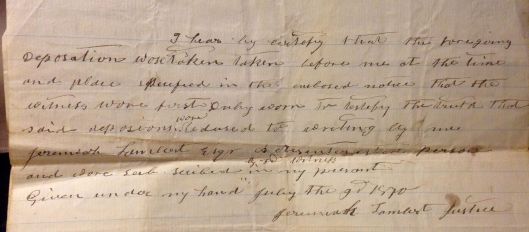
Partly to resolve the debt case, prominent resident Spencer A. Mullins provided a deposition that referenced three important residents of Harts: Isaac Adkins, Jr., William Robinson, and Canaan Adkins. Note: Canaan “Cain” Adkins was a leading figure in the Lincoln County Feud.

Question by Defendant

Was you by at settlement took place between Isaac Adkins and William Robinson?

I was with them at the mouth of harts creek on a raft of timber that the(y) had bought of Deft. which timber I suposed they had just measshered as they had they measherment of the timber presant. they thare mad(e) a settlement on the raft and they raft locked fifteen its(?) or fifteen feet of paying a note that he held on defendant, which note had been executed to Canaan Adkins and the note was not presant at the time of settlement. the plantif was to give the said note to Defendant another time as he hadent the note withe him at the time they made they settlement.

At what time did this settlement take place?

In the year sixty or sixty one.

S.A. Mullins

IMG_0693.JPG

Jeremiah Lambert, Justice of the Peace, Lincoln County, WV, July 1870. Jeremiah Lambert is my great-great-great-great-grandfather.

Melvin and Susan (Thompson) Kirk Homeplace (2018)

28 Monday May 2018

Posted by Brandon Ray Kirk in Cemeteries, Halcyon, Lincoln County Feud, Timber

≈ Leave a comment

Tags

Appalachia, Brandon Kirk, Elizabeth Kirk, Floyd Caldwell, genealogy, Halcyon, Harts Creek, history, Hog Hollow, Kentucky, Lawrence County, Lincoln County, Lincoln County Feud, Logan County, Martin County, Melvin Kirk, Melvin Kirk Family Cemetery, photos, Phyllis Kirk, Piney Fork, Thomas Kirk, West Fork, West Virginia

IMG_1107.JPG

Melvin and Susan (Thompson) Kirk Homeplace, Piney Fork of West Fork of Harts Creek, Logan County, WV. 24 May 2018. Melvin and Susan are my great-great-grandparents.

IMG_1282

Kirk Homeplace sign, Piney Fork of West Fork of Harts Creek, Logan County, WV. 24 May 2018. Melvin was born in 1862 to Thomas and Elizabeth “Betty” (Maynard) Kirk and was partly raised in Lawrence (later Martin) County, KY. To see Melvin with his father in the 1870 Lawrence County, KY, Census, follow this link: https://www.familysearch.org/ark:/61903/3:1:S3HT-D8S9-4LS?i=7&cc=1438024 

IMG_1220

Kirk Cemetery sign, Piney Fork of West Fork of Harts Creek, Logan County, WV. 24 May 2018. Melvin followed his mother to Piney before 1880. To see Melvin in the 1880 Lincoln County Census, follow this link: https://www.familysearch.org/ark:/61903/3:1:33SQ-GYB2-9WFZ?cc=1417683 

IMG_1128

Heading up to the cemetery. 24 May 2018. Melvin was a powerful left-handed timberman. In 1888, he bought a 35-acre farm from Floyd Caldwell.

IMG_1209

Kirk Cemetery Statue, Kirk Cemetery, Piney Fork of West Fork of Harts Creek, Logan County, WV. 24 May 2018. Melvin played an important role in the Lincoln County Feud. https://www.amazon.com/Blood-West-Virginia-Brumfield-McCoy/dp/1455619183 

IMG_1194

Melvin Kirk grave, Kirk Cemetery. 24 May 2018. Photo by Mom. Melvin’s property was assessed in Lincoln County until 1897, when it transferred to Logan County. To see Melvin in the 1900 Logan County Census, follow this link: https://www.familysearch.org/ark:/61903/3:1:S3HY-68V3-C77?i=31&cc=1325221 

Recollections of A. Peterson Christian of Simon, WV (c.1943)

28 Monday May 2018

Posted by Brandon Ray Kirk in Big Creek, Gilbert, Guyandotte River, Logan, Timber, Wyoming County

≈ Leave a comment

Tags

Appalachia, Betty Shoals, Big Branch Shoal, Big Creek, Big Cub Creek, Blackburn Mullins, Burrell Morgan, Byron Christian, Chapman Browning, Charley Toler, Copperas Fork, Ed Robertson, Eli Blankenship, Eli Morgan, Elk Creek, Ellis Toler, Epson Justice, Fred B. Lambert, Fred B. Lambert Papers, G. Pendleton Goode, genealogy, Gilbert, Guyandotte, Guyandotte River, H.C. Avis, Hickory Shute, history, Hugh Toney, Humphrey Cline, Huntington, James A. Nighbert, James Pine Christian, Jesse Belcher, John Buchanan, John Justice, justice of the peace, Lane Blankenship, Lark Justice, Leatherwood Shoal, Lewis Mitchell, Little Kanawha Lumber Company, Logan County, Logan Court House, logging, Marshall University, Mingo County, Morrow Library, Paren Christian, Peter Cline Jr., Peter Cline Sr., Peterson Christian, Pineville, pushboats, rafting, Raleigh County, Roughs of Guyan, Salt River Shute, Sanford Morgan, Simon, Spice Creek, Staffords Mill, West Virginia, White Oak Cliff, Wyatt Toler, Wyoming County

Recollections of A. Peterson Christian of Simon, WV, provided by G. Pendleton Goode of Pineville, WV, January 1, 1944:

I was born on Spice Creek, Logan Co., now Mingo County, West Va. on Oct. 12, 1857 — Now 86 years of age, Son of Rev. Byron Christian, and grandson of James Pine Christian (1800-1892), one of the justices who organized Logan County in 1824.

About 1867, people began what we called saw-logging. Dr. Warren from Big Creek brought the first six yoke ox team to our neighborhood, used them two years and then sold them to Chapman Browning who lived on Spice Creek. There sprang up among us, what we called timber merchants, among those were Paren Christian, Chapman Browning, Col. John Buchanan, H.C. Avis, Blackburn Mullins and Epson Justice and many others. Besides hauling and rafting their own timber, they would buy rafts of other parties and run them to Logan Court House and sell others to John and Lark Justice and afterwards to Ed Robertson and James Nighbert.

I entered the logging business in 1875, on a small scale. Lewis Mitchell and I bought some timber and made up a raft, and when the river reached rafting stage, Brother Mont Lewis and I started down the river with the raft which swung across the head of “Island 16,” but when the big July 12th freshet came it swept our raft away and we lost it. My next adventure in logging was in the spring of 1876, when Mont and I bought some timber in the bluff opposite the mouth of Elk Creek and with some loose logs in “Island 16,” we made up two rafts, but there was no rafting stage that summer, but when the ice went out the next winter, both rafts went with it and we lost them also.

Rafting down Guyandotte River from Reedy to Logan Court house was a great art during the 1870s and 80s. There were different opinions about the bad places along the stream. People at Logan Court house thought that the river from Spice down was real bad; but the river men around Spice did not mind running from there down, but said that up Copperas Fork, the Betty Shoals, Staffords Mill, and the White Oak Cliff was too bad for anybody to run a raft. The river men around about Gilbert said that the river from there down was a little rough but they didn’t mind it, but from Epson Justice’s up to Reedy was so rough that no person had any business trying it. But when you came up to Big Cub, Long Branch and Reedy and talked with the old pilots, such as Jesse Belcher, Lane Blankenship, Peter Cline Jr., Humphrey Cline and Peter Cline Sr. and numerous other persons such as oar carriers and seconds they would say something like this, “Well, the river for a few miles is pretty rough, especially at Wyatt Toler’s mill dam, the Fall Rock, near Charley Toler’s mill dam, the Hickory Shute, the Leatherwood Shoal, the Big Branch Shoal and the Salt River Shute, but if a man has good judgment about the drain and the water he will have but little trouble.” So you see all depends on whom you are talking to as to where the rough is on the Guyandotte River. The only way to find this out is to go through on a raft yourself.

I remember very well the thrill I got the first time I went through the “Roughs” on a raft. I got on at the mouth of Big Cub Creek; in a few minutes we were at the upper end of Leatherwood Shoal. We worked the raft to the proper position in the hole of water just above the shoal. We could look along the top of the water to the upper end of the shoal but there was such a fall there we could see the water until we dropped over the upper end of the shoal. The bow of the raft struck a wave and the water flew over our heads. I was carrying the oar and held the stern down on the raft while my second held my clothes to keep the oar from throwing me off. From there on to the lower end of the shoals (about ¼ mile) as soon as the raft would rise on one wave, it would plunge into another until we got through the shoal. From that time (1876), I followed running from Reedy to Guyandotte until about 1890.

It took 4 men to run a raft from Reedy or Cub to Spice. Then 2 men could take it from there to Logan C.H. Then we would latch two of those rafts together and 2 men would take those rafts through to Guyandotte.

In 1889, the Little Kanawha Lumber Co. came to Wyoming County and began logging on a big scale. The winter was warm and rainy. All goods and supplies were hauled from Prince Station on the C. and O. Ry. The roads through Raleigh were so muddy that a four-horse team could pull only 1000 or 1200 pounds, so in April Alec, Henry Blankenship and I made a push boat 50 feet long and 6 feet wide and 18 inches deep. We landed it at the mouth of Reedy Creek and started to Guyandotte with five men. I had about $95.00 in money, and the men from here to Elk sent money by me to buy flour. When I left Elk, I had about $260.00. Among the men that sent money by me to buy flour were Burrell Morgan, Ellis Toler, Eli Blankenship, Eli Morgan, Sanford Morgan and Chapman Browning and the only one alive now is Burrell Morgan. We reached Guyandotte the 3d day, where I bought 45 lbs of flour, 300 lbs of bacon and a lot of other things and after laying over at Capt. Toney’s for 2 days on account of high water, we arrived at the mouth of Spice Creek in 8 days from Guyandotte. I received $125 per 100 lbs. freight which gave me a nice profit for my trip. At that time and long before the people of Logan brought their goods up on push boats.”

Source: Fred B. Lambert Papers, Special Collections Department, Morrow Library, Marshall University, Huntington, WV.

Albert Dingess Family Cemetery (2018)

04 Friday May 2018

Posted by Brandon Ray Kirk in Cemeteries, Shively, Timber

≈ Leave a comment

Tags

Albert Dingess, Albert Dingess Family Cemetery, Appalachia, cemeteries, Charleston, genealogy, Harts Creek, history, James Bryant, Logan County, Martha Ann Dingess, Minerva Adkins, Shively, Shively Post Office, Smokehouse Fork, West Virginia, West Virginia State Archives, Works Progress Administration

IMG_9139

Albert Dingess Family Cemetery, Shively, Smokehouse Fork of Harts Creek, Logan County, WV. You can see the old Shively Post Office down past the trees and along the road. 28 April 2018.

IMG_9136

Albert Dingess Family Cemetery, Shively, Smokehouse Fork of Harts Creek, Logan County, WV. 28 April 2018.

Albert Dingess Grave 1

Albert Dingess was an important splasher and timberman on Harts Creek in Logan County, WV. His sister, Minerva (Dingess) Adkins, is my great-great-great-grandmother. 8 March 2013.

Martha Ann Bryant Dingess Grave

Martha Ann (Bryant) Dingess was Albert’s second wife. 8 March 2013.

Albert Dingess Cemetery Map

Here’s an old WPA map of the cemetery that shows graves for Albert Dingess and his father-in-law, James Bryant. Courtesy of the WV State Archives, Charleston, WV.

Banco News 10.08.1926

05 Thursday Apr 2018

Posted by Brandon Ray Kirk in Banco, Battle of Blair Mountain, Big Creek, Harts, Huntington, Logan, Timber

≈ Leave a comment

Tags

Anna Duty, Appalachia, Aracoma, Arnold Thomas, Banco, Battle of Blair Mountain, Big Creek, Ed Stone Branch, Eva Ellis, Fannie Brumfield, genealogy, Gladys Ferrell, Harts, Hassell Vance, Henlawson, history, Huntington, J.A. Stone, J.W. Thomas, L.P. Swentzel, Logan, Logan County, McClintock Field Company, Peach Creek, Robert Varney, timber, timbering, Trace Fork, West Virginia

An unknown correspondent from Banco on Big Creek in Logan County, West Virginia, offered the following items, which the Logan Banner printed on October 8, 1926:

Everyone is very busy in Banco at this writing.

Everything sure is lively around this town as there are three sawmills on the Ed Stone Branch.

L.P. Swentzel of Huntington who is working for the McClintock Field Company was calling in Banco last week.

Mr. and Mrs. J.A. Stone of Blair were calling in our town one day this week.

Wonder if Hassell Vance likes taffy? We believe he does as he has been visiting the taffy mill real often.

Miss Fannie Brumfield of Trace Fork left for her home at Harts Saturday accompanied by her grandmother.

Miss Eva Ellis of Ellis Fork was a business caller in Banco last Tuesday.

Miss Gladys Ferrell and two sisters of Henlawson are visiting relatives on Ed Stone Branch this week.

J.W. Thomas and son Arnold returned from a peddling tour at Peach Creek, Logan and Aracoma.

Wonder which H.F.L. likes best: the North Pole or the ‘ville?

Mrs. Anna Duty and small daughter returned from Logan where she has been visiting her daughter, Mrs. Robert Varney.

F.D. Stollings Coal and Timber Lands Advertisement (1913)

03 Saturday Mar 2018

Posted by Brandon Ray Kirk in Coal, Logan, Timber

≈ Leave a comment

Tags

Appalachia, coal, F.D. Stollings, genealogy, history, Logan, Logan County, Logan Democrat, timber, West Virginia

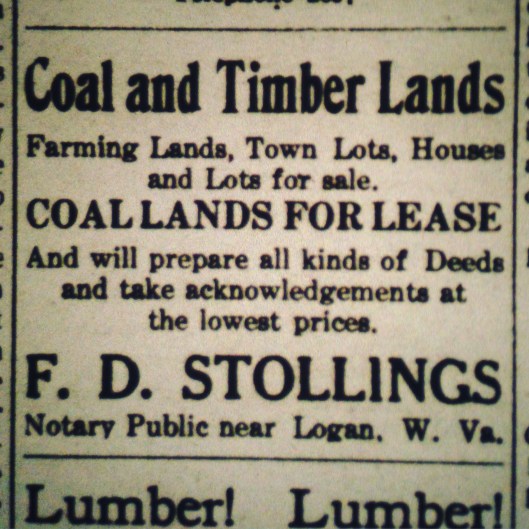
Coal and Timber Lands F.D. Stollings LD 01.02.1913 2

Logan (WV) Democrat, 2 January 1913.

Timber Companies Active in the Guyandotte Valley (1890s)

28 Wednesday Feb 2018

Posted by Brandon Ray Kirk in Guyandotte River, Timber

≈ Leave a comment

Tags

Appalachia, Burks and Prichard, C. Dingess & Company, Cole and Crane Company, Fridman Lumber Company, Guyan River Coal and Mercantile Company, Guyandotte Valley, history, Hugh Dingess & Company, Huntington Advertiser, Ironton Cross Tie Company, Little Kanawha Lumber Company, Logan County, Logan County Banner, Logan Timber Company, logging, McClintock & Son, Panther Lumber Company, Penn Lumber Company, R.H. Prichard, Ratliff and Shannon, Sliger Lumber Company, timbering, Wayne County, West Virginia, Wittenburg, Yellow Poplar Lumber Company

A partial list of timber companies active in the Guyandotte Valley of West Virginia during the 1890s, based on Logan County deeds, the Logan County Banner, and the Huntington Advertiser:

C. Crane & Company (1891, 1894, 1895, 1896, 1898, 1899, 1900)

C. Dingess & Company (1891, 1892, 1893, 1894)

Fridman Lumber Company (1899)

Guyan River Coal and Mercantile Company (1897)

Hugh Dingess & Company (1893)

Ironton Cross Tie Company (1897)

Little Kanawha Lumber Company (1891, 1892, 1893, 1895, 1898)

Logan Timber Company (1897)

McClintock & Son (1895)

Panther Lumber Company (1896)

Penn Lumber Company (1898)

R.H. Prichard or Burks and Prichard (1891)

Ratliff and Shannon of Wayne County (1890)

Sliger Lumber Company (1896)

Yellow Poplar Lumber Company (1893)

Wittenburg (1898)

Robert A. “Bob” Lewis Grave (2018)

14 Wednesday Feb 2018

Posted by Brandon Ray Kirk in Cemeteries, Timber, West Hamlin

≈ Leave a comment

Tags

Appalachia, cemeteries, genealogy, history, Lewis Family Cemetery, Lincoln County, Robert Lewis, Tyler Creek, West Hamlin, West Virginia

IMG_4841

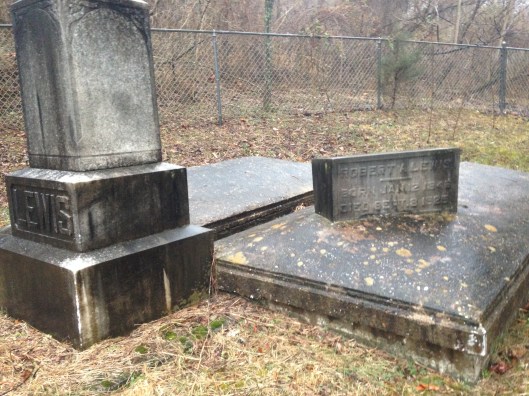
Robert “Bob” Lewis was a regional timber boss in the Guyandotte Valley. He’s buried at West Hamlin, Lincoln County, WV. 10 February 2018.

IMG_4748

Bob Lewis grave. 10 February 2018.

IMG_4735

Bob Lewis grave. 10 February 2018.

← Older posts
Newer posts →

Feud Poll 1

If you had lived in the Harts Creek community during the 1880s, to which faction of feudists might you have given your loyalty?

Categories

  • Adkins Mill
  • African American History
  • American Revolutionary War
  • Ashland
  • Atenville
  • Banco
  • Barboursville
  • Battle of Blair Mountain
  • Beech Creek
  • Big Creek
  • Big Harts Creek
  • Big Sandy Valley
  • Big Ugly Creek
  • Boone County
  • Breeden
  • Calhoun County
  • Cemeteries
  • Chapmanville
  • Civil War
  • Clay County
  • Clothier
  • Coal
  • Cove Gap
  • Crawley Creek
  • Culture of Honor
  • Dingess
  • Dollie
  • Dunlow
  • East Lynn
  • Ed Haley
  • Eden Park
  • Enslow
  • Estep
  • Ethel
  • Ferrellsburg
  • Fourteen
  • French-Eversole Feud
  • Gilbert
  • Giles County
  • Gill
  • Green Shoal
  • Guyandotte River
  • Halcyon
  • Hamlin
  • Harts
  • Hatfield-McCoy Feud
  • Holden
  • Hungarian-American History
  • Huntington
  • Inez
  • Irish-Americans
  • Italian American History
  • Jamboree
  • Jewish History
  • John Hartford
  • Kermit
  • Kiahsville
  • Kitchen
  • Leet
  • Lincoln County Feud
  • Little Harts Creek
  • Logan
  • Man
  • Matewan
  • Meador
  • Midkiff
  • Monroe County
  • Montgomery County
  • Music
  • Native American History
  • Peach Creek
  • Pearl Adkins Diary
  • Pecks Mill
  • Peter Creek
  • Pikeville
  • Pilgrim
  • Poetry
  • Queens Ridge
  • Ranger
  • Rector
  • Roane County
  • Rowan County Feud
  • Salt Rock
  • Sand Creek
  • Shively
  • Spears
  • Sports
  • Spottswood
  • Spurlockville
  • Stiltner
  • Stone Branch
  • Tazewell County
  • Timber
  • Tom Dula
  • Toney
  • Turner-Howard Feud
  • Twelve Pole Creek
  • Uncategorized
  • Warren
  • Wayne
  • West Hamlin
  • Wewanta
  • Wharncliffe
  • Whirlwind
  • Williamson
  • Women's History
  • World War I
  • Wyoming County
  • Yantus

Feud Poll 2

Do you think Milt Haley and Green McCoy committed the ambush on Al and Hollene Brumfield in 1889?

Blogroll

  • Ancestry.com
  • Ashland (KY) Daily Independent News Article
  • Author FB page
  • Beckley (WV) Register-Herald News Article
  • Big Sandy News (KY) News Article
  • Blood in West Virginia FB
  • Blood in West Virginia order
  • Chapters TV Program
  • Facebook
  • Ghosts of Guyan
  • Herald-Dispatch News Article 1
  • Herald-Dispatch News Article 2
  • In Search of Ed Haley
  • Instagram
  • Lincoln (WV) Journal News Article
  • Lincoln (WV) Journal Thumbs Up
  • Lincoln County
  • Lincoln County Feud
  • Lincoln County Feud Lecture
  • LinkedIn
  • Logan (WV) Banner News Article
  • Lunch With Books
  • Our Overmountain Men: The Revolutionary War in Western Virginia (1775-1783)
  • Pinterest
  • Scarborough Society's Art and Lecture Series
  • Smithsonian Article
  • Spirit of Jefferson News Article
  • The Friendly Neighbor Radio Show 1
  • The Friendly Neighbor Radio Show 2
  • The Friendly Neighbor Radio Show 3
  • The Friendly Neighbor Radio Show 4
  • The New Yorker
  • The State Journal's 55 Good Things About WV
  • tumblr.
  • Twitter
  • Website
  • Weirton (WV) Daily Times Article
  • Wheeling (WV) Intelligencer News Article 1
  • Wheeling (WV) Intelligencer News Article 2
  • WOWK TV
  • Writers Can Read Open Mic Night

Feud Poll 3

Who do you think organized the ambush of Al and Hollene Brumfield in 1889?

Recent Posts

  • Logan County Jail in Logan, WV
  • Absentee Landowners of Magnolia District (1890, 1892, 1894)
  • Charles Spurlock Survey at Fourteen Mile Creek, Lincoln County, WV (1815)

Ed Haley Poll 1

What do you think caused Ed Haley to lose his sight when he was three years old?

Top Posts & Pages

  • U.B. Buskirk of Logan, WV (1893-1894)
  • Vance Homeplace and Cemetery on West Fork (2017)
  • Tice Elkins in Ferrellsburg, WV
  • Alice Dingess piano
  • Civil War Gold Coins Hidden Near Chapmanville, WV

Copyright

© Brandon Ray Kirk and brandonraykirk.wordpress.com, 1987-2023. Unauthorized use and/or duplication of this material without express and written permission from this blog’s author and/or owner is strictly prohibited. Excerpts and links may be used, provided that full and clear credit is given to Brandon Ray Kirk and brandonraykirk.wordpress.com with appropriate and specific direction to the original content.

Archives

  • February 2025
  • January 2025
  • October 2023
  • September 2023
  • December 2022
  • November 2022
  • May 2022
  • April 2022
  • February 2022
  • November 2021
  • October 2021
  • September 2021
  • June 2021
  • May 2021
  • April 2021
  • March 2021
  • February 2021
  • January 2021
  • December 2020
  • November 2020
  • October 2020
  • July 2020
  • June 2020
  • May 2020
  • April 2020
  • March 2020
  • February 2020
  • January 2020
  • December 2019
  • November 2019
  • October 2019
  • September 2019
  • August 2019
  • July 2019
  • June 2019
  • May 2019
  • April 2019
  • March 2019
  • February 2019
  • January 2019
  • December 2018
  • November 2018
  • October 2018
  • September 2018
  • August 2018
  • July 2018
  • June 2018
  • May 2018
  • April 2018
  • March 2018
  • February 2018
  • January 2018
  • December 2017
  • November 2017
  • October 2017
  • September 2017
  • August 2017
  • July 2017
  • June 2017
  • May 2017
  • April 2017
  • March 2017
  • February 2017
  • January 2017
  • December 2016
  • November 2016
  • October 2016
  • September 2016
  • August 2016
  • July 2016
  • June 2016
  • May 2016
  • April 2016
  • March 2016
  • February 2016
  • January 2016
  • December 2015
  • November 2015
  • October 2015
  • September 2015
  • August 2015
  • July 2015
  • June 2015
  • May 2015
  • April 2015
  • March 2015
  • February 2015
  • January 2015
  • December 2014
  • October 2014
  • September 2014
  • August 2014
  • July 2014
  • June 2014
  • May 2014
  • April 2014
  • March 2014
  • February 2014
  • January 2014
  • December 2013
  • November 2013
  • October 2013
  • September 2013
  • August 2013
  • July 2013
  • June 2013
  • May 2013
  • April 2013
  • March 2013
  • February 2013
  • January 2013
  • December 2012
  • November 2012

Enter your email address to follow this blog and receive notifications of new posts by email.

Join 2,925 other subscribers

Tags

Appalachia Ashland Big Creek Big Ugly Creek Blood in West Virginia Brandon Kirk Cabell County cemeteries Chapmanville Charleston civil war coal Confederate Army crime culture Ed Haley Ella Haley Ferrellsburg feud fiddler fiddling genealogy Green McCoy Guyandotte River Harts Harts Creek Hatfield-McCoy Feud history Huntington John Hartford Kentucky Lawrence Haley life Lincoln County Lincoln County Feud Logan Logan Banner Logan County Milt Haley Mingo County music Ohio photos timbering U.S. South Virginia Wayne County West Virginia Whirlwind writing

Blogs I Follow

  • OtterTales
  • Our Appalachia: A Blog Created by Students of Brandon Kirk
  • Piedmont Trails
  • Truman Capote
  • Appalachian Diaspora

BLOOD IN WEST VIRGINIA is now available for order at Amazon!

Blog at WordPress.com.

OtterTales

Writings from my travels and experiences. High and fine literature is wine, and mine is only water; but everybody likes water. Mark Twain

Our Appalachia: A Blog Created by Students of Brandon Kirk

This site is dedicated to the collection, preservation, and promotion of history and culture in Appalachia.

Piedmont Trails

Genealogy and History in North Carolina and Beyond

Truman Capote

A site about one of the most beautiful, interesting, tallented, outrageous and colorful personalities of the 20th Century

Appalachian Diaspora

  • Subscribe Subscribed
    • Brandon Ray Kirk
    • Join 787 other subscribers
    • Already have a WordPress.com account? Log in now.
    • Brandon Ray Kirk
    • Subscribe Subscribed
    • Sign up
    • Log in
    • Report this content
    • View site in Reader
    • Manage subscriptions
    • Collapse this bar
 

Loading Comments...