Tags
Appalachia, baseball, history, Logan, Logan Banner, Logan County, photos, Sports, West Virginia

Logan Banner, 9 April 1926.

28 Tuesday Feb 2017
Posted in Logan
Tags
Appalachia, baseball, history, Logan, Logan Banner, Logan County, photos, Sports, West Virginia
Logan Banner, 9 April 1926.
28 Tuesday Feb 2017
Posted in Hatfield-McCoy Feud, Logan
Tags
Appalachia, Cap Hatfield, deputy sheriff, genealogy, history, Logan, Logan Banner, Logan County, Stirrat, Tennis Hatfield, West Virginia

William Anderson “Cap” Hatfield applies for a revolver license, Logan Banner, 7 May 1926.
28 Tuesday Feb 2017
Posted in Hatfield-McCoy Feud, Logan
Tags
Albert J. Kirk, Appalachia, genealogy, history, Joe Hatfield, Logan, Logan Banner, Logan County, photos, Republican Party, sheriff, Tennis Hatfield, West Virginia

Tennis Hatfield, Republican, is Sheriff of Logan County, WV. Source: Logan Banner, 20 April 1926. My Kirk family was aligned with Tennis and Joe Hatfield. Uncle Albert Kirk served as a deputy under Sheriff Joe Hatfield.
19 Thursday Jan 2017
Posted in Chapmanville, Logan
Tags
Alvis Godby, Appalachia, Chapmanville, Connie Bentley, Dan Cox, Ebb Thompson, Elva Cox, Elva Godby, Eunice Scaggs, genealogy, Hartford Mounts, Henlawson, history, J.D. Price, Jim Pauley, John Addis, Lizzie Sansom, Logan, Logan County, Nelson Bentley, Phico, R.C. Phillips, Ruth Jordan, Shirl Bias, Vanzel Bentley, Vivian Johnson, Walter McNeely, West Virginia
An unknown local correspondent from Chapmanville in Logan County, West Virginia, offered the following items, which the Logan Banner printed on March 12, 1926:
Roses on our shoulders, Slippers on our feet,
We are Phico girls, don’t you think we’re sweet?
We are having some cold weather at this writing.
Shirl Bias was calling on Miss Ruth Jordan Sunday.
Vanzel Bentley was calling on Miss Elva Cox Sunday.
Dan Cox looks very down hearted nowadays. Wonder why?
Walter McNeely of Logan was calling on Miss Connie Bentley Sunday.
M. McNeely of Henlawson was calling on Miss Elva Godby Sunday.
Nelson Bentley had quite a lot of visitors Sunday.
J.D. Price is very ill at this writing.
Ebb Thompson was calling on Miss Vivian Johnson Sunday.
Mr. Jim Pauley was calling on Miss Katie Chapman Sunday.
Wonder why Miss Elva Cox was disappointed Saturday night.
Mrs. Annie Bias was visiting Mrs. Martha Jordan Sunday.
Wonder what has become of Miss Leta Thomas? She has not been seen for some time.
A. Wright was visiting home folks Sunday.
Bobby Hale was calling on Miss Bertha Jordan Sunday.
Wonder what has become of Miss Mary Craddock? She is never seen in our town anymore.
Alvis Godby was calling on Miss Lizzie Sansons Sunday evening.
John Addis was calling on Miss Eunice Scaggs Sunday.
We were sorry to hear of R.C. Phillips losing his white mule. Cheer up, Rube. There are plenty more.
Hartford Mounts seems to enjoy wearing his hip boots.
Daily Happenings:
Ruth had her red hat. Shirl and his new shirt. Vanzel and his overcoat. Elva and her jump jacket. Dan and his new rain coat. Walter and his smiles. Connie going to Cox’s. Markyle anad his blues. Elva and her blue dress. Nelson and his new suit. J.D. and his store. Russell looking down hearted. Sallie keeping house. Wayne and his new cook. Andy and his pictures. Grace and her sweetie. Edgar and his blues. Ebb and his sweetie. Vivian and her beau. Jim and his music. Katie and her wrist watch. Elva Cocks and her curly locks. Annie and her store. Martha and her checked dress. Brook and her chickens. Leta and her hair cut. Almond and his traveling case. Bobby and his smiles. Bertha going to the office. Mary going to school. Alvis and his watch. Lizzie and her hair clasp. John Addis and his girl. Eunice and her sweetie. R.C. Phillips and his white mule.
06 Tuesday Dec 2016
Posted in Logan
Tags
Appalachia, farming, genealogy, history, Logan County, R.F. Mitchell, W.C. Browning, West Virginia
The following is the list of appraisement of the estate of W.C. Browning, deceased, as given by the appraisers, to wit:
1 Roan horse, $35.00
1 Dark bay mule, $75.00
1 Sorrel blazed face horse, $40.00
1 set blacksmith tools, $15.00
2 Bulls (twins) 3 yrs old, $30.00
3 yoke of cattle & rigging, $120.00
1 cripple steer, $10.00
2 walnut logs, $10.00
1 Set irons on horse wagon, $5.00
1 cane mill, $20.00
2 set flow gears, $5.00
1 cow & calf (calf died before day of sale), $20.00
1 cow & calf 15 yrs old, $15.00
1 load chain, $5.00
1 South bend chilled plow 2 right, $4.00
1 Hillside turner, $2.50
1 South Bend chilled broke, $1.50
1 dinner bell, $2.00
1 Pair scales (Platform), $4.00
1 Pair scales (Scoop), $1.50
2 7/11 Augers, $1.70
2 cans mixed paint, $2.50
1 can oil finish, $.50
3 12 gallons jars stoneware, $3.60
9 Bottles of Soothing Syrup, $1.75
10 ox bells, $1.50
2 thread cabinets 50, $1.00
2 molasses barrels, $.25
1 oil tank, $2.50
2 saws crosscut, $1.00
20 Bee guns, $40.00
8 head hogs large size, $32.00
13 head hogs shoats, $13.00
2 Sows & 8 pigs, $12.00
1 heifer, $12.00
1 log wagon (junk), $4.00
1 kittle 2 br., $2.00
1 Safe, $2.50
1 bed clothes and stead, $15.00
1 feather bed, $6.00
1 lounge stead & tick, $7.00
1 bed mattress & stead, $12.00
1 clock, $2.50
1 Bureau, $6.00
1 Sewing machine, $10.00
1 large trunk, $2.00
1 small trunk, $.50
1 gun rifle, $8.00
1 watch, $18.00
23 covers, quilts, Blankets, counterpanes, $23.00
2 Vol. Vir & Va, $5.00
1 Hitchcock’s Analysis of Bible, $2.50
1 Bible Scenes & Studies, $1.50
1 Sea & Land, $1.00
1 King’s Physicians, $2.00
1 Memoir Duncan, $.25
1 bed Mattress, $5.00
2 bedsteads, $3.00
2 tables, $2.00
1 cupboard, $2.50
5 dishes, $1.00
5 cups & saucers, $.20
1 Set plates, $.25
1 pitcher, $.25
glassware, $.25
1 stove & out fit, $5.00
1 Pair Saddle pockets, $4.00
11 chairs & rocker, $3.60
1 glass, $.50
1 man Saddle, $1.50
2 Shovel plows and Stalks, $1.00
5 Broad hoes, $.50
2 Matlocks, $.65
2 axes, $1.00
1 pitchfork, $.30
1 frou?, $.50
1 chisel, $.20
1 musical clock, $1.00
1 Shovel, $.15
R.F. Mitchell, administrator of W.C. Browning, deceased
Source: File No. 60, Case No. 66, Logan County Circuit Clerk’s Office, Logan, WV.
20 Sunday Nov 2016
Posted in Chapmanville, Logan
Tags
Appalachia, C.H. Gore, Elizabeth Conley, genealogy, H.H. Bryan, history, Jefferson Hale, John Fon Conley, Logan, Logan County, physician, West Virginia

Source: C.H. Gore, Sheriff v. Elizabeth Conley et al, File No. 47, Case No. 2, Logan County Circuit Clerk’s Office, Logan, WV.
17 Thursday Nov 2016
Posted in Gill, Hamlin, Harts, Huntington, Logan, Sand Creek, West Hamlin
Tags
Anna Lambert, Appalachia, Bessie Adkins, Blanch Lambert, Catherine Adkins, Charles Brumfield, Charleston, Cole Branch, Cora Adkins, Dr. Ferrell, Easter, Enos Dial, genealogy, Gill, Hamlin, Hardin Marcum, Harts, Hawkins Perry, Hendricks Brumfield, history, Jewell Brumfield, John C. McEldowney, Laura Lambert, Lincoln County, Logan, Logan Banner, Luther Dempsey, Mae Brumfield, Nora Brumfield, Sadie Powers, Sand Creek, Sylvia Cyfers, Victoria Pack, Ward Brumfield, Watson Adkins, Wesley Ferguson, West Virginia
An unknown local correspondent from Harts in Lincoln County, West Virginia, offered the following items, which the Logan Banner printed on February 26, 1926:
Several boys and girls of this place attended singing school at Coal Branch Sunday.
Dr. Ferrell and Cora Adkins were calling on friends at Sand Creek last Saturday evening.
Miss Jewell Brumfield attended Sunday school at Gill Sunday and was accompanied by Sylvia Ciphers and Hawkins Perry.
J.C. McEldowney of Charleston was calling on friends and relatives at Harts Saturday.
Chas. Brumfield was a business caller in Huntington Saturday.
Ward Brumfield was transacting business in Hamlin Saturday.
Blanch, Anna and Laura Lambert were visiting friends in Harts Wednesday.
Hardin Marcum was calling on Shirlie Adkins at West Hamlin Sunday.
Hendrix Brumfield attended singing at Coal Branch Sunday and reported there were over fifty singers present and the singing was progressing nicely.
Every body is planning to hunt Easter eggs here.
Mrs. C.C. Pack and daughter, Miss May, were visiting relatives in Logan Saturday and Sunday.
Enos Dials spent Sunday in Huntington.
Daily Happenings: Bob Hendrix meeting the train; Ward with the tax books; Watson with his pipe; Herb in the garage; Nora and Jewell teaching school; Bessie and Cora in the store; Aunt Cathrine with her hair; Sadie with her glasses on; Luther in his old rattle trap; Wesley reading the newspaper; Fred, the law maker.
13 Sunday Nov 2016
Posted in Logan
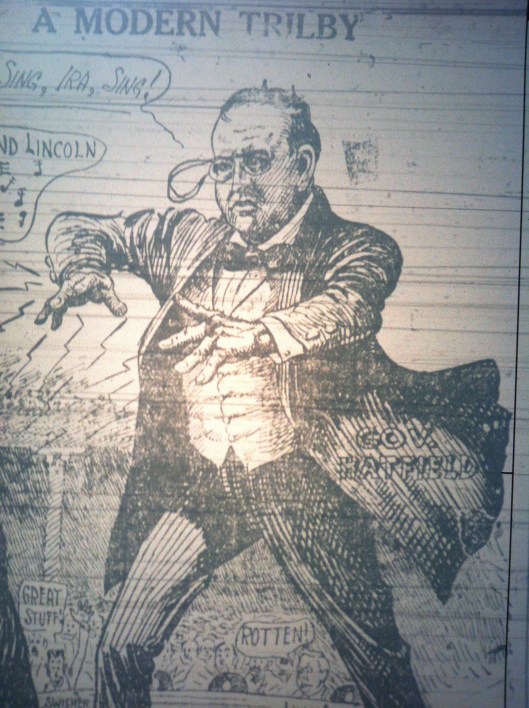
Logan (WV) Democrat, 12 October 1916.
11 Friday Nov 2016
Tags
Appalachia, coal, history, Logan, Logan Banner, UMWA, West Virginia
The following “poem” appeared in the Logan Banner of Logan, West Virginia, on March 5, 1926.
The other day
We read in the paper
That the big strike
Of union miners
Just over the hill
Had been called off
For this reason:
Funds were short
And no more aid could be given.
The men and their families
Who had weathered the storms
Of the past two years
In their tent and rags
On the small amounts
Allowed by the union.
And from time to time
They would get notice
From headquarters
That the meager amounts
Were to be cut down
Until at last the order came
That all aid would be stopped
And they could go back to work
With nothing gained
After two years of suffering.
But at the same time
We could see
A set of officers
In big fine offices
Drawing big salaries
Enjoying life in good homes
And never a time
Did we hear one say
“We will go live in the tents
And draw our rations as they do
And we will stick to the end?”
Nor did we hear them say
“We will cut our salaries
To provide more aid
For them who are out in the cold.”
But we do know this:
They draw big money
And live in the fine homes.
Their families are well fed
And they all enjoy life
And at the same time
They will tell you and me
To stick tight and rough it out
For in the end we are sure to win.
And in the end
If we win they win.
If we lose they win.
Do you see the point?
Just another reason why
We wouldn’t be a member
Of the U.M.W.A.
If we were a miner.
25 Tuesday Oct 2016
Posted in Logan
Tags
Appalachia, Brandon Kirk, Canada, Frank Desoer, history, Logan, Logan County, Montreal, politics, radio, Southern West Virginia Community and Technical College, West Virginia
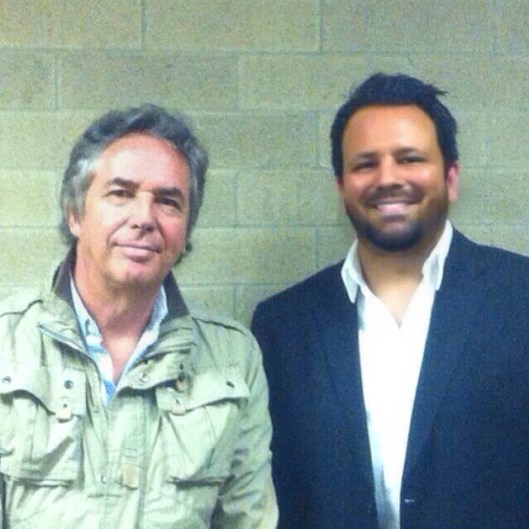
I recently met Montreal radio journalist Frank Desoer, who traveled to Logan, WV, to explore political trends in my part of Appalachia. Mr. Desoer and I enjoyed a two-hour conversation about Logan County’s political history and culture. My hope is that he found his story. 13 October 2016.
06 Thursday Oct 2016
Posted in Chapmanville, Ferrellsburg, Logan
Tags
317 Steak House, Alec Soth, Anthony Adams, Appalachia, Brandon Kirk, cemeteries, Chapmanville, culture, Ferrellsburg, Galen Fletcher, Harts Creek, history, In the Heart of Trump Country, John Hartford, Larissa MacFarquhar, Lincoln County, Logan, Logan County, politics, Squire Sol Adams, West Virginia
John Hartford introduced me to The New Yorker magazine in the mid-1990s. “I need to get you a subscription to The New Yorker,” he told me several times. John had become familiar with the magazine as a youth. His parents were regular subscribers to the magazine; they encouraged him to read it because, they said, it contained the absolute best writing available. John told this story several times and I could tell by the way he retold it that he believed it to be true. In fact, after reading multiple issues (mostly John’s issues at the house, but also complimentary issues I spotted in medical offices), I agreed that, yes, The New Yorker did in fact contain the best writing available. Once I discovered Truman Capote’s In Cold Blood, unquestionably the greatest true crime book ever written, and learned The New Yorker had frequently printed Capote’s writing, my love for the magazine became unshakable. For these reasons, and others, I am delighted to have made a small contribution to Larissa MacFarquhar’s story, “In the Heart of Trump Country,” published by The New Yorker on October 10, 2016. The opportunity to contribute to a New Yorker story, much less to appear in The New Yorker, is an honor.
You can read Larissa’s exceptionally well-composed piece by following this link:
http://www.newyorker.com/magazine/2016/10/10/in-the-heart-of-trump-country
Prior to the story, Larissa approached me (and other locals) about her desire to write a piece at least partly involving recent political developments in Logan County, West Virginia. I agreed to assist Larissa in whatever way I could for several reasons: I wanted to welcome her to my section of Appalachia, I wanted to be helpful, I wanted her story to succeed, I wanted her readers to better understand my region, I’m always anxious to discuss my region’s rich history… Larissa and I corresponded via email about general political history in Logan County, then enjoyed a memorable two-and-a-half-hour conversation at 317 Steak House in Logan. I liked her right away. I like her more after reading her story.
Larissa is an accomplished professional writer. You can read more about her impressive credentials by following these links:
http://www.newyorker.com/contributors/larissa-macfarquhar
It was likewise pleasurable to meet photographer Alec Soth and his assistant, Galen Fletcher, who visited Logan, Chapmanville, Ferrellsburg, and Harts Creek, in order to capture images pertinent to Larissa’s story. Alec took a few photos of me in Ferrellsburg, one of which ultimately appeared in the story, then spent a hot evening taking a ton of photos at one of my favorite Harts Creek cemeteries (the Anthony Adams Family Cemetery) and a nearby historic log cabin (Squire Sol Adams residence).
You can find out more about Alec by following these links:
http://alecsoth.com/photography/
https://pro.magnumphotos.com/C.aspx?VP3=CMS3&VF=MAGO31_10_VForm&ERID=24KL532_M
He even has a Wikipedia entry!
https://en.wikipedia.org/wiki/Alec_Soth
These were nice folks. If they ever visit your part of the world, welcome them.
.
28 Wednesday Sep 2016
Posted in Lincoln County Feud, Logan
Tags
Appalachia, author, Blood in West Virginia, books, Brandon Kirk, Chief Logan State Park, Goldenseal, history, Lincoln County Feud, Logan, Pelican Publishing Company, Rebellion in the Hills, West Virginia

Chief Logan State Park, Logan, WV, 24 September 2016. Photo by Mom.
28 Wednesday Sep 2016
Tags
Appalachia, C&O Railroad, Craneco, Dingess Run, George T. Swain, history, Holden, Island Creek, Logan, Logan County, Logan Democrat, Omar, West Virginia
Logan–Now and What It Will Be When Its Destiny Is Fulfilled
by G.T. Swain
Situated here among the “Hills of West Virginia” on the banks of the beautiful Guyan lies the little city of Logan–our home. Time was when a few years ago Logan was a struggling little village trying to pull herself out of the mud and how well she succeeded is left to you, gentle reader, to judge. We now have nicely paved streets, solid and substantial sidewalks, large and commodious business buildings and beautiful homes. Lots that were formerly occupied with frame buildings have been raised and have given way for substantial brick and stone buildings and more going up as fast as can be built with more to come in the future. Our people are liberal, energetic and hospitable and a glad hand and hearty welcome is extended to all newcomers, while the passing stranger is always welcome within our gates. Logan is situated in the very heart of the famous Guyan Valley coalfields and is surrounded with the natural advantages to become sometime in the near future a second Pittsburg. With branch roads leading in every direction, reaching a large number of mines from which pour forth every day an enormous of the famous “Black Diamond” which afford employment to a large army of laborers and positions for many more, with different kinds of business houses in the city requiring the services of a large number of skilled laborers we find our little city progressive in the fullest sense of the word and what Logan is at the present time will be nothing in comparison of the city in the near future. At the present time we boast of three wholesale houses, a great many department stores to supply your every want, and many handsome churches to look after your spiritual needs, a large number of efficient lawyers to look after your legal affairs, quite a few experienced physicians and surgeons to attend your physical ailments and a large, commodious high school building and a large public school building to look after the education of your children and while we admit that “all work and no play makes Jack a dull boy” we have for your amusement two elegant and comfortable moving picture theatres at which you view the best pictures obtainable while we extend you an invitation to visit our park where you will be entertained with athletic sports. We take time during the strenuous hustle and activity to eat occasionally and we invite you to patronize our large and first class hotels, restaurants and boarding houses where you will be furnished the best food the market affords. If you have any surplus change that is too heavy to carry around in your pocket we have, for your convenience, two large and perfectly safe banks who will gladly receive your deposit or extend any other accommodation consistent with good sound banking.
Take a little time and sit down and rest while we furnish you with the Daily Courier and permit you to digest the very latest news fresh over the wires of the Associated Press. In fact call on us for any favor and we will do our utmost to supply your every need and should you unfortunately get in the way of any of our numerous “jitney buses” we will tenderly convey you to our new, fine hospital, just completed at a cost of $40,000 where your injuries will be treated while you wait.
Logan–Ten Years Hence–Or A Peep Into The Future
My–but can this be Logan? We stand in the cupola of the magnificent stone Court house and gaze up Island creek and as far as the eye can see we see numerous buildings of all description and we are told that they too extend up Main Island creek. We turn and gaze up Dingess Run and we find the same, while we are informed that all the way up the Guyan the buildings are too numerous to count. We look toward Huntington and find that the town has extended down the river while all the vacant lots that formerly specked the town are all now covered with handsome and elegant homes. On every hand we find new coal operations and the hum of the machinery dulls the sound of the hustle and bustle of the street traffic below. Wires leading from the large and power electric station situated on the banks of the river cover the county like giant cobwebs, carrying to various points the giant current for lighting and operating purposes. Coal trains loaded to doubled track road of the C. & O. capacity are moving West while empty cars are coming East. Electric cars are passing and branching off up into the hollows transporting their load of passengers and freight to all the operations while those that desire are accommodated by motor vehicles over the fine macadamized roads leading in all directions but in the end pointing the way back to Logan, the hub of all this activity. We look down to where the C. & O. formerly had a coop called a station and we find a large magnificent passenger station in keeping with the balance of the town. We hear that the former little ramshackle affair called the water system has given way to the march of progress and we learn that a short distance back in the mountain Logan has an enormous storage dam from which her people are supplied with water from the pure mountain streams and the water pressure is sufficient for all purposes. We look below and we find the streets patrolled by uniform police. We see the Logan Band pass by playing a patriotic air. The “newsies” are crying aloud the latest news that has been flashed over the wires and published in an extra edition of the Daily Courier. The mail is being delivered to the doors of all citizens by uniformed carriers at the expense of Uncle Sam. Many of the large number of visitors to the city are taking the cars of the incline railway for a trip to the beautiful fraternal home that crowns the crest of the reservoir mountain, while listen–down the street at full speed comes the organized fire department in charge of the very latest fire fighting apparatus. Surely this is the “Miracle Land.”
‘Tis said that Holden and Omar are only suburbs while Craneco is clamoring for annexation.
–What? Yes–why–sure climbing to the cupola of the Court house and enjoying the balmy breeze of pure mountain air, shaded from the rays of the noon-day sun I fell asleep and being espied by the janitor who being afraid my presence would molest the workings of the town clock has climbed up here and shaking me from my pleasant day-dream has invited me to plant my cute little “tootsies” on terra firma. Some dream. Believe me.
Source: Logan (WV) Democrat, 22 June 1916.
28 Wednesday Sep 2016
Posted in Civil War, Lincoln County Feud, Logan
Tags
Appalachia, author, Blood in West Virginia, books, Brandon Kirk, Chief Logan State Park, history, Huntington, Lincoln County Feud, Logan, Ohio River Festival of Books, Pelican Publishing Company, West Virginia
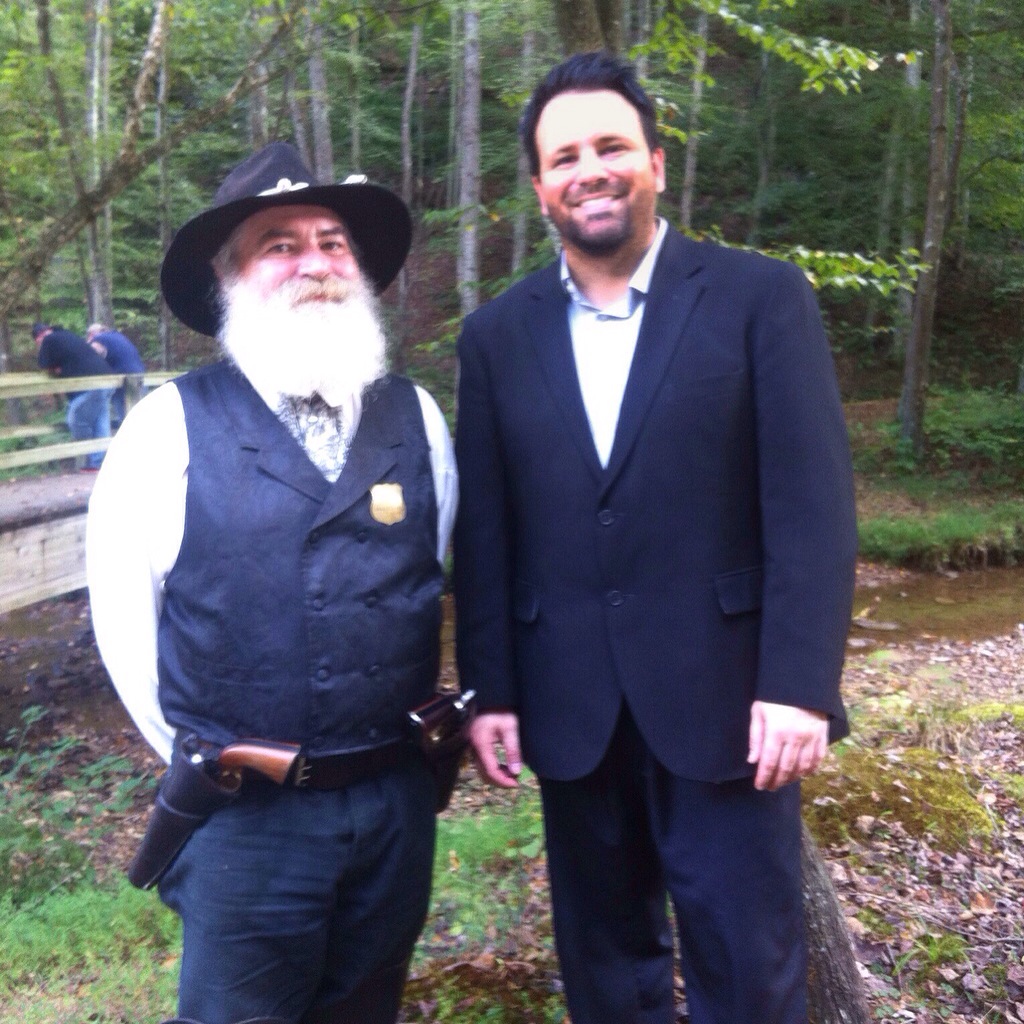
We had a great time promoting the book and meeting folks at Rebellion in the Hills in Chief Logan State Park on Saturday, September 24, 2016. Our next appearance will be this weekend at Ohio River Festival of Books in Huntington, WV.
23 Friday Sep 2016
Posted in Civil War, Lincoln County Feud, Logan
Tags
Blood in West Virginia, books, Brandon Kirk, Chief Logan State Park, civil war, feuds, history, Lincoln County Feud, Logan County, Pelican Publishing Company, West Virginia
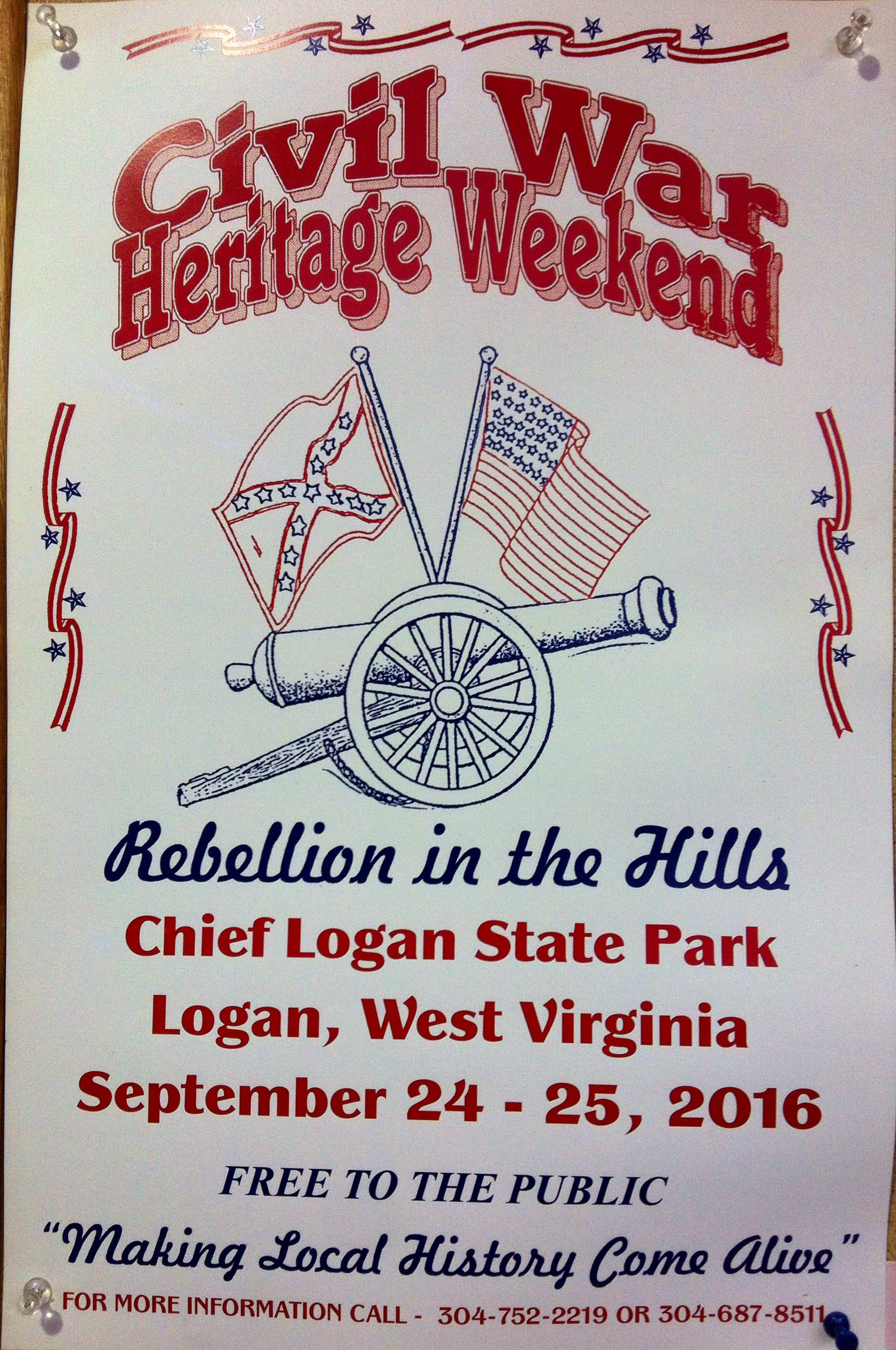
On Saturday, September 24, 2016, the book and I will appear at Rebellion in the Hills in Chief Logan State Park in Logan County, West Virginia. If you’re local, come and see us.
20 Tuesday Sep 2016
Posted in Hatfield-McCoy Feud, Logan
Tags
Devil Anse Hatfield, genealogy, Hatfield-McCoy Feud, history, Logan, Logan County Banner, Oakland House, West Virginia

Logan County Banner (Logan, WV), 13 April 1893.
17 Saturday Sep 2016
Posted in Logan
Tags
Appalachia, circus, history, Logan, Logan County, Logan Democrat, Sun Brothers, Tango Bill, West Virginia
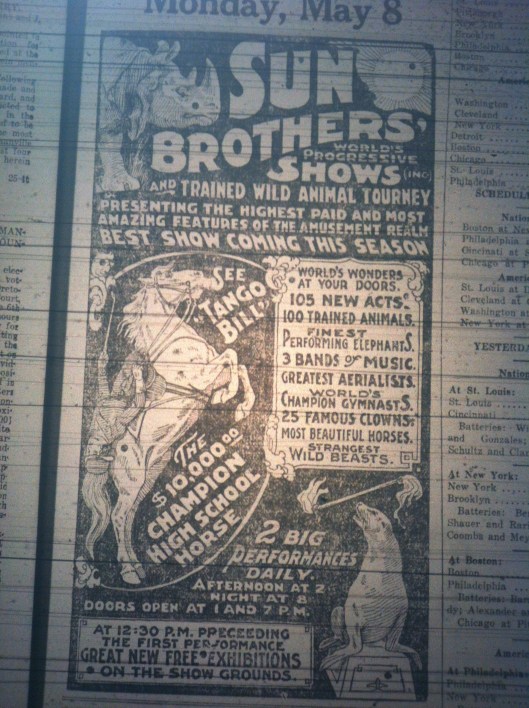
Logan (WV) Democrat, 4 May 1916.
13 Tuesday Sep 2016
Posted in Logan
Tags
advertisement, Grape Smash, history, Logan, Logan Baking & Bottling Company, Logan Democrat, pop, soda, West Virginia

Logan (WV) Democrat, 13 July 1916.
11 Sunday Sep 2016
Posted in Boone County, Logan
Tags
Arthur I. Boreman, Boone County, civil war, Confederate Army, John A. Barker, justice of the peace, Logan, Logan County, Richmond, Thomas Buchanan, Union Army, Virginia, West Virginia
The following letter from Thomas Buchanan dated July 14, 1865 at Brownstown, WV to Governor Arthur I. Boreman offers insight into immediate postwar conditions in Logan and Boone counties, WV. The letter was titled “Enclosed account for services in recruiting a Co. of Scouts for Logan & Boone Counties.”
Brownstown
July 14, 1865
His Excellency A.I. Boreman (Governor)
Sir: I Rec’d an order dated March 2nd 1865 authorizing me to organize a company of State Guards for the counties of Logan and Boone to consist of not less than 25 men. At first I thought I could recruit 25 men in a short time, but I was much deceived. Men remaining in those counties at that time had bin [sic] conscripted in to the Confederate service (or what they called State line Service under the Confederate authorities) and had bin [sic] disbanded and they seemed to have taken up the idea (or a portion of them at least) that neutral ground was saftest for them, as the country was infested with bushwhackers, and sixty or seventy miles outside of federal lines I could get no assistance from federal troops and consequently had to scout alone and sometimes [with] one man for company. Finally I succeeded in recruiting 32 or 33 men, made off my muster Roll, called my men together, the required oath was administered to them by John A. Barker, a Justice of the Peace, and his certificate with the Roll and form of oaths was directed to the adjutant Gen’l of the State and I have not heard from it since tho when Richmond fell I did not expect my men would be armed and equipped tho I shall expect to be enumerated for my services to the State for recruiting the company.
Yours respectfully,
Thomas Buchanan
P.S. My address is Logan C.H., W.Va. I did not expect an answer to my muster Roll.
Source: West Virginia Adjutant Generals’ Papers, Union Militia 1861-1865, Militia Box 12, Logan County, Folder 2. WV State Archives and History, Charleston, WV.
Note: To see Mr. Buchanan’s account, follow this link: http://www.wvculture.org/history/wvmemory/militia/logan/logan02-01.html
05 Monday Sep 2016
Posted in Chapmanville, Civil War, Logan
Tags
Abraham Lincoln, Andrew Jackson, Arthur I. Boreman, Battle of Kanawha Gap, Boone County, Boone Democrat, Chapmanville District, Charleston Daily Star, Chesapeake and Ohio Railroad Company, civil war, Confederacy, Democratic Party, First Wheeling Convention, Franklin Pierce, Grover Cleveland, Guyandotte Valley Railroad Company, Hardee District, Henry Clay Ragland, history, Horace Greeley, Horatio Seymour, Isaac E. McDonald, James A. Nighbert, James Buchanan, James K. Polk, James Lawson, John Bell, John Breckenridge, Lewis Cass, Logan Banner, Logan County, Logan County Banner, Logan District, Magnolia District, Martin Van Buren, Parkersburg Sentinel, Parkersburg State Journal, politics, Samuel J. Tilden, Second Wheeling Convention, slavery, Stephen Douglas, Triadelphia District, Virginia Ordinance of Secession, West Virginia, West Virginia Statehood Referendum, William H. Crawford, William Jennings Bryan, William Straton, Winfield Scott Hancock, Wyoming County
Democrats who lived in Logan County, West Virginia, prior to 1896 may best be thought of as Democrats of the Jeffersonian and particularly the Jacksonian variety. The earliest settlers and their immediate progeny likely carried popular political viewpoints across the mountains from Virginia. Logan County Democrats appear to have believed in states’ rights, although few residents owned slaves. The old Democrats of the Civil War generation guided Logan County’s political scene until the 1890s, when the national political climate shifted toward issues relating to gold/silver, imperialism, etc. Still, the Confederate veterans of the county continued activity until the 1910s, even raising the Confederate flag over the courthouse as late as 1911. The Logan County Banner (later the Logan Banner), a Democratic organ since its inception in 1889, remained silent about issues that divided the Democratic Party in the 1890s. Based on its editorials, the Banner—operated by men of the Civil War era—was more concerned about industrial progress, particularly the development of a railroad in the Guyandotte Valley, than the national political issues that emerged in the 1890s. Examination of the active participants in the railroad effort include both Democrats and Republicans, locals and outsiders…
Logan County was organized in 1824. Voting trends from 1824 until 1856 reveal a strong preference for Democratic candidates:
1824: William H. Crawford (Democratic-Republican)
1828: Andrew Jackson (Democrat, 90+ percent)
1832: Andrew Jackson (Democrat, 90+ percent)
1836: Martin Van Buren (Democrat)
1840: Martin Van Buren (Democrat)
1844: James K. Polk (Democrat)
1848: Lewis Cass (Democrat)
1852: Franklin Pierce (Democrat)
1856: James Buchanan (Democrat, 80-90 percent)
We know, based on the above presidential tallies, the county was heavily Democratic. Because the Democratic Party was closely linked to slavery during this era, it is useful to consider local slave statistics.
1850 Logan County Slave Census: 26 slave owners in Logan County; 84 slaves (largest slave owner had 10)
1860 Logan County Slave Census: 27 slave owners in Logan County; 80 slaves (largest slave owner had 7)
We know the county voted heavily for John Breckenridge in the 1860 presidential election. What is remarkable to modern residents is this: Logan Countians gave no votes to Abraham Lincoln (see below):
Logan County Presidential Election Results (1860):
John Breckenridge (Southern Democratic), 271
John Bell (Constitutional Union), 100
Stephen Douglas (Democratic), 6
Abraham Lincoln (Republican), 0
We know Logan County’s delegate to the Virginia Secession Convention favored secession. James Lawson, the delegate to the Secession Convention for Logan, Boone, and Wyoming counties, voted in favor of the Ordinance of Secession on 17 April 1861.
We know the county did not favor anti-secession political developments in Wheeling. Logan declined to send delegates to the First Wheeling Convention (May 13-15, 1861).
We know the voters of Logan County favored secession. Here are results for Logan County regarding the Secession Ordinance in Virginia (23 May 1861):
For: 518
Against: 63
We know Logan County did not support the political gatherings in Wheeling. Logan County sent no delegates to the Second Wheeling Convention, First Session (June 11-25, 1861). Likewise, it sent no delegates to the General Assembly of the Reorganized Government of Virginia (July 1-26, 1861) or to the Second Wheeling Convention, Second Session (August 6-21, 1861).
In the mind of local people, Logan County was invaded in 1861. On 25 September 1861, Union soldiers attacked Confederates at the Battle of Kanawha Gap (Chapmanville). The battle was a Confederate loss.
Due to the absence of its men and election irregularities, Logan County did not vote heavily on the question of “West Virginia.” This was true for many counties in western Virginia: West Virginia Statehood Referendum (24 October 1861): 34 percent turnout statewide; 18,408 for statehood and only 781 opposed! We can be sure that Logan did not favor “West Virginia.” Logan County sent no delegate to the West Virginia Constitutional Convention (26 November 1861).
Logan Countians overwhelmingly enlisted to fight for the Confederacy (60-90%). According to one estimate, Logan County contributed over 780 soldiers to the Confederacy. Contributions to the Union Army were less than 60. Based on the 1890 census, the following number of Union veterans lived in Logan County:
Chapmansville District: 7
Hardee District (later Mingo County): 16
Logan District: 13
Magnolia District (later Mingo County): 9
Triadelphia District: 11
During the war, Logan sent delegates to participate in the Confederate government in Richmond. Isaac E. McDonald represented Logan, Boone, and Wyoming counties at the Confederate General Assembly from 1861 to 1863. James A. Nighbert represented Logan, Boone, and Wyoming counties at the Confederate General Assembly from 1863 to 1865.
Because Logan was known as a Confederate stronghold and recruiting station, the town was invaded in 1862. Union troops burned the Logan Courthouse (15 January 1862).
Logan County was one of 15 counties in WV that did NOT vote in the 1864 U.S. presidential election (most were south of the Kanawha River).
After the war, Logan Countians refused to recognize West Virginia as a legitimate state and refused to pay taxes to the new state. Guerillas and gangs were active in the county. Governor Arthur I. Boreman sent troops into the county in order to collect taxes and maintain order.
Ex-Confederate disenfranchisement was common after the war. In 1868, of 888 voters in Logan County, only 125 voted for president. In 1870, 220 voted for the Democratic candidate for governor while 70 voted for the Republican (total 290). In Logan County, it was difficult to find any men who had NOT served in the Confederacy who could hold political office (or practice law, or teach).
Maj. William Straton (namesake of Stratton Street) typified Logan County political leadership during this time.
After the war, Democrats and Republicans largely chose/maintained party identification based on their views of the war. Logan had been heavily Democratic before the war; Logan was pro-Confederate during the war; Logan was strongly Democratic after the war
Logan County in Presidential Elections After the War:
1868: Horatio Seymour (Democrat)
1872: Horace Greeley (Democrat)
1876: Samuel J. Tilden (Democrat, by 90+ percent)
1880: Winfield Scott Hancock (Democrat, by 90+ percent)
1884: Grover Cleveland (Democrat, by 90+ percent)
Winfield Scott Hancock’s victory in Logan County is somewhat noteworthy considering that he was a former Union general.
On 30 October 1886, the Parkersburg Sentinel reported: “Logan county is so intensely democratic that there are thirteen democratic candidates running for the legislature and only one republican. Nevertheless one of the thirteen democrats will be elected.”
In 1888, Logan Countians voted for Grover Cleveland (Democrat).
The Logan County Banner was established on 7 March 1889 by Henry Clay Ragland (editor) and J.A. Nighbert (business manager). On 28 March 1889, it stated:
The paper will be devoted to the best interests of the people of Logan county. To the improvement of the education and morals of its people, and to the development of its great material resources. Politically, the Banner will be Democratic. Every one connected with it is a Democrat, but at the same time it will be fair to the opposition, and will heartily accord to the Republican party due credit for any good work which it may do. In addressing the questions which may arise in the Democratic party, as to its management and its leaders, the Banner will be Independent and will acknowledge no faction or factions, but will labor earnestly and zealously for the success of the party, and not for any individual.
In 1892, it reported: “Three years ago in order to furnish the people of Logan county with a home paper, we unfurled the Banner. We expected neither money nor glory, and our expectations have been fully realized.” On 3 January 1895, Ragland stated: “When I first went into the newspaper business I had no idea of continuing on for any length of time. My only desire was to see a newspaper in Logan county which would truly reflect the character of its people and be able to defend them from the many slanders which have been heaped upon them by the outside world…”
The Banner‘s reputation as a Democratic organ was well-known. In April 1889, the Parkersburg State Journal referred to it as “Democratic to the core.” On 11 July 1889, the Charleston Daily Star said: “The Logan County Banner is being made one of the best country weeklies in the State. As long as it continues as it has begun Logan may be depended upon for her customary Democratic majority.” On 13 January 1898, the Boone Democrat said of the Banner: “We cheerfully hail it, and hope that it may long continue to wave in the vanguard of Logan Democracy.”
The Banner never failed to applaud Democratic gains. On 6 November 1890, it stated: “Glorious old Chapmansville always does her fully duty. The Democratic vote increased from 205 in 1888 to 210, and the Republican vote decreased from 28 in 1888 to 14.”
This editorial, from 15 September 1892, is one example of Banner political commentary:
We have heard that there are several so-called Democrats born and reared in the mountain fastnesses of old Logan who have avowed their intention of ‘scratching’ one or another of the nominees of our party when they ides of November shall roll around, but we hope for the credit of Logan’s ‘rock-ribbed, copper-bottomed’ democracy that such reports are false. It is but natural that bitter feelings should be engendered by the clashing of the claims of rival candidates before our conventions but the conventions have done their work now, well and conscientiously, and every true Democrat in hearty and earnest response to the bugle call of freedom must face about with his brethren and forgetting all private feuds and grievances join in the charge upon our friends the enemy. That Democrat who falters in his duty in this the crisis of our party’s need betrays the trust reposed in him by the party of the people, forfeits his claim upon the confidence and good will of his compeers and deserves to be incarcerated in the bottom-most pit of damnation. You cannot afford to let a petty desire for revenge prevent you from casting a straight Democratic ticket on the 8th day of November. If you have ever harbored such a thought, exorcise the evil spirit that has taken possession of you and come back to the fold on bended knee and ask forgiveness for the wicked thoughts of your heart. The people have spoken and ‘the voice of the people is the voice of God.’ We feel sorry for that Democrat who, when the glorious news flashes over the wires next November that Cleveland, MacCorkle, Alderson and Mahood are elected can’t forget one or more of them was scratched on his ticket. Verily, like the Judas of old, he will feel like sneaking off with down cast eyes and hanging himself to the nearest tree. Logan expects every Democrat to do his whole duty during this campaign. The eyes of friend and foe alike are turned towards the mountains of old Logan whence cometh our help. Every Republican in the county is alert, active and zealous in the support of his whole ticket, and it behooves every Democrat to see to it that he does not prove a traitor in the camp of his friends. Stop a minute, friend, and think of the issues involved in the fight that is now upon us. Do you want the robber tariff barons to keep on heaping up their multiplied millions from your hard-earned dollars? Do you want your polls to be manned by Federal soldiers or maybe negroes from Virginia or North Carolina?
In 1892, Logan Countians voted for Grover Cleveland (Democrat).
During the mid-1890s, the Banner offered more brief political commentary. Here are some examples. On 21 June 1894, it stated: “The Logan Republican club was organized last Saturday night, with 20 members.” On 9 September 1896: “There is a meeting of the W.J. Bryan club at Chapmansville next Saturday evening. Everybody is invited to attend.”
Logan Countians voted for William Jennings Bryan (Democrat) in 1896 and 1900.

Logan County Banner, 10 November 1892.
Writings from my travels and experiences. High and fine literature is wine, and mine is only water; but everybody likes water. Mark Twain
This site is dedicated to the collection, preservation, and promotion of history and culture in Appalachia.
Genealogy and History in North Carolina and Beyond
A site about one of the most beautiful, interesting, tallented, outrageous and colorful personalities of the 20th Century
 Brandon Ray Kirk