• About

Brandon Ray Kirk

~ This site is dedicated to the collection, preservation, and promotion of history and culture in my section of Appalachia.

Brandon Ray Kirk

Category Archives: Logan

Big Creek News 01.27.1922

12 Wednesday Dec 2018

Posted by Brandon Ray Kirk in Big Creek, Huntington, Logan, Pikeville

≈ Leave a comment

Tags

Appalachia, barber, Big Creek, Big Creek Coal Company, Black Hawk Colliery Company, C&O Railroad, C.C. Spriegel, Cyrus Elkins, D P Crockett, genealogy, history, Huntington, J.W. Carver, jeweler, Kentucky, L.J. Manor, Logan, Logan Banner, Logan County, Millard Sanders, Peach Creek, Peter M. Toney, Pikeville, Standard V. Rousey, stenographer, W.F. Stone, W.H. McKinney, Washington D.C., West Virginia

An unknown correspondent from Big Creek in Logan County, West Virginia, offered the following items, which the Logan Banner printed on January 27, 1922:

JAN. 25–Millard Sanders has just completed a nice two story building and is going to open up a store in the store room building.

Mr. Cyrus Elkins, car repairer of the C. & O. at Big Creek, has been laid off from work for the past ten days or two weeks on the account of an abscess on his shoulder due to a bruise while repairing bad order cars, but will resume duty again next week.

Mr. P.M. Toney, of Big Creek, has been in Huntington for a few days attending to business matters and visiting his family.

Mrs. L.J. Manor, wife of the general manager of the Big Creek Coal Co. and Black Hawk Colliery co., gave a dance and farewell party last week in honor of Mr. and Mrs. C.C. Spriegel who left recently for Washington, D.C.

Mr. and Mrs. W.H. McKinney from Pikeville, Ky., are visiting friends and relatives in Big Creek.

Mr. W.F. Stone, who has been living in Big Creek and working at Peach Creek as train dispatcher, is moving to Huntington to accept another position with the C. & O. Railway Company.

Mr. S.V. Rousey, supervisor of the C. & O., has been in Big Creek several times in the last week or so on business for the company.

Mr. J.W. Carver, local barber and jeweler, of Big Creek has recently built a new barber shop and jewelry store.

Mr. D.P. Crockett, stenographer for England and Hager of Logan, was in Big Creek last Saturday.

Early Anglo Settlers of Logan, WV (1937)

10 Monday Dec 2018

Posted by Brandon Ray Kirk in Guyandotte River, Logan, Native American History, Tazewell County

≈ Leave a comment

Tags

Appalachia, Aracoma, Bluestone Valley, Boling Baker, Deskins Addition, Guyandotte River, Hatfield Island, Henry Mitchell, history, Island Creek, John Breckinridge, John Dempsey, John Dingess, Joseph Workman, Logan, Logan Banner, Logan County, Montgomery County, Nancy McNeely, Native American History, Native Americans, Nimrod Workman, Peter Dingess, Shawnee, Tazewell County, Virginia, West Virginia, William Dingess, Wythe County

From the Logan Banner of Logan, WV, comes this bit of history about Logan’s earliest Anglo settlers in a story printed April 1, 1937:

First White Settler To Make His Home In Logan Lived on Hatfield Island

The first white settler to make his home near Logan was James Workman who was with the force of men who struck the blow that broke the power of the Shawnee in the valley of the Guyandotte.

He was a member of the group of white settlers who pursued Boling Baker from a settlement in the Bluestone valley to the island that is now known as “Hatfield Island” and there burned an Indian village and mortally wounded Princess Aracoma. Boling Baker escaped.

After Workman had a glimpse of the beautiful lush valley of the Guyandotte, it took little persuasion by John Breckinridge, who had been granted much of the valley after the battle of the Islands to get Workman and his two brothers Joseph and Nimrod to make settlement there, Breckinridge was forced to settle the land by the law of 1792 in order to hold title to it.

Workman and his two brothers came to the island in 1794 and built a cabin and planted a few acres of corn. In 1795 and 1796 the brothers planted the same land and James, who was a man of family, brought his wife and children from their old home in Wythe (now Tazewell) county, Virginia, where they continued to live until about the year 1800 when they moved to a farm nearby which was later owned by Henry Mitchell.

The first recorded permanent settlement was made by William Dingess, son of Peter Dingess, a German. Dingess was the oldest in a family of eleven children.

He was born in Montgomery county in 1770 and married Nancy McNeely. He purchased a survey of 300 acres, which covers the present site of the courthouse and a portion of the land across the river which is now Deskins addition.

Dingess moved to his survey in 1799 and made his home. John Dempsey came with him and built a cabin on the island, but afterwards moved to Island Creek.

William Dingess was said to be almost a giant in strength, but so peaceable that no one could induce him to fight. He was a relentless Indian fighter in the Guyan Valley, however. A story is told that he was with a force of whites who pursued a band of Indian marauders as far as the falls of the Guyan where they killed several braves.

Dingess cut a portion of the skin from a forearm of one of the braves and tanned it using it for a razor strop until his death.

The first settler had no children by his first wife. In 1800, Peter Dingess and John Dingess joined him and built their homes in the fertile land on each side of the river near the islands. Other settlers followed in time and the little settlement grew to a thriving frontier town.

James Browning Trust Deed to James and Anthony Lawson (1850)

04 Tuesday Dec 2018

Posted by Brandon Ray Kirk in Logan

≈ Leave a comment

Tags

Anthony Lawson, Appalachia, county clerk, genealogy, history, James Browning, James Lawson, Logan County, Virginia, West Virginia, William Straton

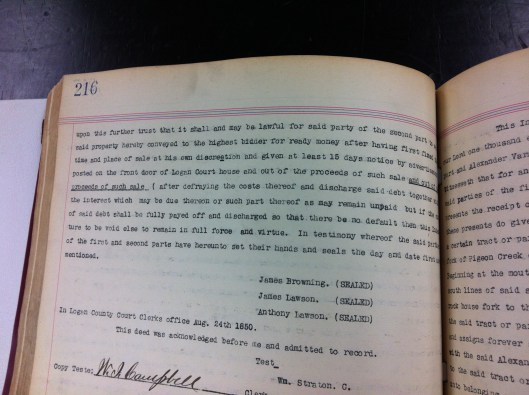
James Browning Trust Deed to Lawson 1850 1

Deed Book C, page 215, Logan County Clerk’s Office, Logan, WV.

James Browning Trust Deed to Lawson 1850 2

Deed Book C, page 216, Logan County Clerk’s Office, Logan, WV.

Levisa Hatfield (1927-1929)

03 Monday Dec 2018

Posted by Brandon Ray Kirk in Big Sandy Valley, Hatfield-McCoy Feud, Holden, Huntington, Logan, Matewan, Pikeville, Wharncliffe, Women's History

≈ 1 Comment

Tags

Abraham Lincoln, Appalachia, Barnabus, Ben Creek, Betty Caldwell, Betty Hatfield, Bob Hatfield, C.C. Lanham, Cap Hatfield, Charles Dardi, Charleston, deputy sheriff, Devil Anse Hatfield, E. Willis Wilson, Elias Hatfield, Elliott R. Hatfield, F.M. Browning, Fayette County, feud, genealogy, governor, Halsey Gibson, Hatfield-McCoy Feud, Henry D. Hatfield, Hibbard Hatfield, history, Holden, Huntington, Island Creek, J.O. Hill, Jim McCoy, Joe Hatfield, John Caldwell, John J. Jackson, Johnson Hatfield, Kentucky, L.W. Lawson, Levicy Hatfield, Logan, Logan Banner, Logan County, Lundale, Marion Browning, Mary Howes, Mate Creek, Matewan, Matilda Chafin, Mingo County, Nancy Carey, Nancy Mullins, Nathaniel Chafin, Omar, Pike County, Pikeville, Pittsburgh, pneumonia, R.A. Woodall, Randolph McCoy, Rebecca Hatfield, Rose Browning, sheriff, Tennis Hatfield, Tom Chafin, Troy Hatfield, Tug River, W.R. Eskew, West Virginia, Wharncliffe

The following news items from the Logan Banner of Logan, WV, provide some history about the final years of Levisa Hatfield, widow of Anse Hatfield:

Levisy Hatfield Dies LB 03.15.1929 1.JPG

MRS. HATFIELD BETTER

Mrs. Levicy Hatfield, widow of Ance Hatfield, continues to recuperate from a serious illness and is now able to walk about the home of her daughter, Mrs. F.M. Browning, of Holden, where she has been cared for. She is 84 years old.

Source: Logan (WV) Banner, 03 June 1927

***

Mrs. Hatfield Hurt

Mrs. Lovisa Hatfield, widow of the late “Devil Anse” Hatfield, is suffering from injuries received in a fall at her home on Island Creek Sunday. She hurt her hip and shoulder and forehead and her condition was such as to cause some concern, yet she was able to sit up yesterday. Two or three of her daughters are helping to take care of her. She is 85 years old.

Source: Logan (WV) Banner, 20 September 1927

***

DEVIL ANSE’S WIDOW, AGED 86, RECOVERS FROM PNEUMONIA

In recovering from her recent severe illness Mrs. Levisa Hatfield, widow of the late “Devil Anse,” has again demonstrated her remarkable vitality. Though in her 87th year, she is now recovering from pneumonia with which she was stricken on December 28. Monday of this week her lungs began to clear up, and her son, Sheriff Joe Hatfield, said yesterday that she seemed to be assured of recovery.

So critical was her illness for several days that half a dozen physicians were summoned to her bedside. These included Dr. H.D. Hatfield, L.W. Lawson, J.O. Hill, Brewer and Moore as well as Dr. E.R. Hatfield, of Charleston, a son of the aged patient.

Mrs. Hatfield celebrated her 86th birthday at the Hatfield homestead near the head of Island Creek on December 20.

Source: Logan (WV) Banner, 18 January 1929.

***

Devil Anse’s Widow Died Early Today

Mrs. Levisa Hatfield Succumbs Unexpectedly In 87th Year

10 Living Children

Hers Was Life of Storm And Stress for Several Decades

Funeral services for Mrs. Hatfield will be held at 2:30 Sunday at the Hatfield cemetery on Island Creek.

Mrs. Levisa Hatfield, widow of “Devil Anse” of Hatfield-McCoy feud fame, died at the family homestead up near the head of Island Creek at about 8 o’clock this morning. Though she was frail and had been in ill health all winter, the news of her passing caused much surprise and regret among relatives and friends outnumbered. Still, her condition yesterday was unsatisfactorily, indicating she had suffered a backset.

Mrs. Hatfield celebrated her 86th birthday on December 20. Eight days later she was stricken with pneumonia, and for several weeks her condition was alarming. Despite her advanced age, her indomitable grit and wiry strength and endurance triumphed, having as she did the tender, constant care of her children and other kinfolk, neighbors, and friends.

Hers was a stout heart, otherwise it could not have, withstood the storms that raged about her home and her family for many years. But long before her interesting career ended, peace and contentment had come into her life, and her declining days were brightened by the successes that had come to her children and grandchildren.

The decedent was born and reared on Mate Creek in what was then Logan county but now in Mingo. She was a daughter of Nathaniel Chafin. In her teens she was married to a neighbor youth, William Anderson Hatfield, who shortly thereafter entered the Confederate army and attained the rank of captain. That was a trying experience for a bride, but a longer and more terrifying one came in the early ‘80s when her family became involved in a now historic private war with the McCoys, a large family living on the Kentucky side of the Tug River. Even after the feud ended and a tacit agreement was carried out whereby her family moved back from the Tug and over the county divide and their foes went farther away from the Tug in the opposite direction, tragedies cast their shadows across her pathway. Chief of these was the slaying of her sons Troy and Elias by a drunken miner in Fayette county in 1911. The miner, too, was riddled with bullets after his victims had fallen mortally wounded.

Ten children survive Mrs. Hatfield and three are dead, Johnson, the oldest, having died in 1922 on Ben Creek, Mingo county. The living are: William A. (Cap), who shared with his father the leadership of their clan in the days of the feud, now a deputy sheriff and living at Stirrat; Robert L., Wharncliffe; Mrs. Nancy Mullins, living just above the Hatfield place; Dr. Elliott R., Charleston; Mrs. Mary Howes, at home; Mrs. John (Betty) Caldwell, Barnabus; Sheriff Joe D. Hatfield; Mrs. Marion (Rose) Browning, Holden; Willis, deputy sheriff at Lundale; Tennis, former sheriff.

She is survived by two sisters and a brother: Mrs. Betty Hatfield, widow of Elias Hatfield and mother of U.S. Senator H.D. Hatfield; Mrs. Rebecca Hatfield, of Logan, mother of Hibbard Hatfield, and Tom Chafin, who lives on Mate Creek.

Mrs. Hatfield and devoted to her home and family. And her home as well as herself was widely known for hospitality. There the friend or wayfarer ever found a welcome. She was a member of the Church of Christ and was baptized along with her husband by Uncle Dyke Garrett some years before her husband’s death.

No announcement was made this forenoon as to the funeral arrangements. Squire Elba Hatfield, a grandson, said he supposed the funeral would be held Sunday. Burial will be in the family cemetery.

Source: Logan (WV) Banner, 15 March 1929

***

Great Crowd At Funeral of Mrs. Hatfield

Throng Surpassed That of Any Previous Funeral In County

Pictures Are Taken

News of Death of “Devil” Anse’s Widow Travels Far and Wide

Hundreds of relatives and friends and neighbors paid their last tribute of affection to Mrs. Lovisa Hatfield Sunday afternoon. It is declared to be, by persons capable of judging, the largest funeral crowd ever assembled in the county. Perhaps the maximum attendance of the afternoon was no larger than that at the funeral of Charles Dardi last November, but on Sunday people were coming and going for an hour or more before the hour set–2:30–for the services and until the services were concluded.

Early in the afternoon a crowd began to form both at the Hatfield cemetery and the homestead. A cool, steady, stiff breeze made it uncomfortable for those who gathered at the cemetery, with the result that they did not tarry long there; and on account of weather conditions a great many did not leave their cars, which were closely parked along both sides of the highway from Sheriff Joe Hatfield’s home up to and beyond the home of the decedent.

The attendance at Sunday’s rites exceeded that of the funeral of Mrs. Hatfield’s widely known husband, “Devil Anse,” which was held on Sunday, January 9, 1921. At that time there was but a semblance of a highway up toward the head of Island Creek and most of those who attended the rites of the old feudist chieftain rode on a special train that was run that day or walked for a great distance.

At the homestead there were scripture readings, sermons, and tributes by Rev. Joe Hatfield, a nephew of the decedent, of Matewan; Rev. Halsey Gibson and Rev. C.C. Lanham, pastor of the first Methodist church of Logan. Before the cortege left the house R.A. Woodall, local photographer, took pictures of the body at rest in a beautiful metallic casket and of the grandchildren and perhaps others who were grouped on the porch.

At the grave the services were conducted by Rev. W.R. Eskew of Omar and a solo by a Mr. Woods of Huntington featured the singing. Mr. Eskew paid a tribute to the generosity and hospitality of Mrs. Hatfield, to her love of home and her devotion to her children and other loved ones.

As related in Friday’s paper, Mrs. Hatfield died at about 8 o’clock that morning, after having nearly recovered from pneumonia. Her age was 86 years, two months and 25 days. She was a daughter of Nathaniel and Matilda Varney Chafin and was born on Mate Creek, now in Mingo county. Her sisters, Mrs. Elizabeth Hatfield of Huntington , Mrs. Nancy Carey, Pittsburgh, and Mrs. Rebecca Hatfield of Logan, and her brother Tom Chafin of Mingo were at the funeral.

All over the country the news of Mrs. Hatfield’s death was flashed and it called forth much comment on the old Hatfield-McCoy feud that for a long time held the close attention evidently of millions of newspaper readers.

—

An old sketch of “Devil Anse” says he had none of the attributes of “bad men” in his character. He was always recognized as a loyal friend of the many who had some sort of claim to his friendship. Numbered among those who believed he had been right in the position he took during the feud days were the late Judge John J. Jackson, known as the “Iron Judge,” who was appointed to the federal bench by President Lincoln, and the late Governor E.W. Wilson, the former protecting Hatfield when he was called into court, and the latter refusing to honor a requisition of the Governor of Kentucky for the arrest of Devil Anse on a charge of killing some particular member of the McCoy family.

Detectives, real and alleged, had arranged for the capture of Hatfield, spurred by a reward, after they had seen to it that he was indicted on a charge of whiskey selling; in 1888, Judge Jackson, hearing of these plans, sent word to him that if he would appear in court voluntarily the court would see that he had ample protection until he returned to his home in this county.

Uncle Anse appeared and was acquitted of the charge against him. Some of the detectives pounced on him soon after he left the court room, but Judge Jackson summoned all of them before him, threatened to send them to jail, and directed special officers to see that Hatfield was permitted to reach his home. After Hatfield was well on his way, Judge Jackson told the detectives that if they wanted to get him they could proceed, just as the McCoys had been doing for a number of years. They never went.

Captain Hatfield spent the last 20 years of his life peacefully on his farm then in an isolated section of the county. Once he was prevailed upon by some enterprising amusement manager to go on the vaudeville stage but the lure of his home in the mountains soon proved stronger than the lure of the footlights.

—

In the splendid account of the death of Mrs. Anderson Hatfield, estimable woman who passed away at her home Friday, it was stated that Mrs. Hatfield was one of the last of either the Hatfield or McCoy family directly connected with the feud and that all the McCoy principals are believed to be dead. This last is in error as James McCoy, who resided in Pikeville for many years and latter came here, where he lived with his family for a number of years, and after the death of his wife only a few years ago again returned to Pikeville and is now living there. He is a highly respected and esteemed citizen and was the eldest son of the late Randall McCoy, of Pike county, and was one of the main principals of the feud.

Catlettsburg cor. in Huntington Advertiser

Source: Logan (WV) Banner, 19 March 1929.

Armistice Day (1936)

10 Saturday Nov 2018

Posted by Brandon Ray Kirk in Logan, World War I

≈ Leave a comment

Tags

Appalachia, Armistice Day, football, history, Logan Banner, Logan County, West Virginia, World War I

Armistice Day LB 11.11.1936 1

Armistice Day, Logan (WV) Banner, 11 November 1936.

Democratic Party Intimidation in Logan County, WV (1924)

10 Saturday Nov 2018

Posted by Brandon Ray Kirk in Logan

≈ Leave a comment

Tags

Appalachia, C.L. Bradley, crime, Democratic Party, Deputy Marshal, deputy sheriff, Don Chafin, George Pack, George Thompson, history, Hugh Deskins, Ira P. Hager, Jay Elkins, Joe Hatfield, Logan County, Mine Wars, Mud Fork Precinct, Nannie Pack, Pat Adkins, Pat Murphy, Republican Party, sheriff, Tennis Hatfield, U.S. Commissioner, West Virginia

Political history for Logan County, West Virginia, during the 1920s was particularly eventful; it included the latter years of Sheriff Don Chafin’s rule, the Mine Wars (“armed march”), Republican Party ascendancy, and the rise of Republican sheriffs Tennis and Joe Hatfield. What follows are selected primary source documents relating to this period:

UNITED STATES OF AMERICA

SOUTHERN DISTRICT OF WEST VIRGINIA,

HUNTINGTON DIVISION

BEFORE THE UNDERSIGNED authority, Ira P. Hager, a United States Commissioner in and for said District, personally appeared this day, Nannie Pack, who after being by me first duly sworn, deposes and says:

That she was standing on the election ground at Mud Fork Precinct, Logan County, election day, November 4th, 1924, and saw Don Chafin, Sheriff of Logan County there. That Pat Adkins was standing on the ground, waiting to vote, and affiant saw the said Don Chafin take hold of the said Pat Adkins and shove him, saying, “Go on in,” and repeated it, “Go on in,” and shoved the said Pat Adkins toward the election room door. That he turned immediately and ran toward Hugh Deskins, Deputy Marshal, who was standing near by, and said, “What are you doing here, you cock-eyed son-of-a-bitch?” That he slapped the said Hugh Deskins, Deputy Marshal. That he then followed the said Deputy Marshal around on the ground, saying, “Have you had enough? Have you had enough?”

That they put affiant’s husband, George Pack, in jail on November 1st, 1924, and affiant went to Jay Elkins and George Thompson to ask them to go the bond of affiant’s husband. This was on Saturday, November 1st, 1924. That they declined and refused to do it, and affiant went home. That John Roberts followed affiant and said, “If you will vote our way, we will sure go this evening and get your husband out.” Then he said, “Unless you do that, we will not get him out and he will not get out.” The same day Thompson and Elkins refused to go my husband’s bond. They hunted me up while I was on the Dempsey Branch and told affiant that “if I would vote Democratic, and talk to my children and have them vote Democratic, that they would see that my husband got bond and got out.”

Nannie Pack (her mark)

Taken, subscribed and sworn to before me this the 10th day of November, A.D., 1924.

Ira P. Hager

United States Commissioner as aforesaid.

***

UNITED STATES OF AMERICA

SOUTHERN DISTRICT OF WEST VIRGINIA,

HUNTINGTON DIVISION

BEFORE THE UNDERSIGNED AUTHORITY, this day personally came, C.L. BRADLEY, who after being by me first duly sworn, says: That he was on the election grounds at the Mud Fork Precinct on election day, November 4th, 1924, and affiant saw Don Chafin, sheriff of Logan County strike Hugh Deskins, Deputy Marshal on the head or face. I saw Don follow him up after he had hit him and I heard him say, “How did you like that?” and if “he did not like it he could give him more of it, or oodles of it,” or words to that effect.

When Don Chafin was after Hugh Deskins, Pat Murphy, supposed to be a Deputy Sheriff, was acting like he was about to pull his gun from his pocket. He pulled it part way out of his pocket.

C.L. Bradley

Taken, subscribed and sworn to before me, the undersigned authority, this the 10th day of November, 1924.

Ira P. Hager

U.S. Commissioner as aforesaid

Appeared 1-13-25

Samuel Zook Deed to Thomas Dunn English (1854)

06 Tuesday Nov 2018

Posted by Brandon Ray Kirk in Guyandotte River, Logan

≈ Leave a comment

Tags

Appalachia, Big Ugly Creek, genealogy, Guyandotte River, history, Lincoln County, Logan County, Mile Branch, New York, New York City, Pigeon Roost Branch, Samuel Zook, Thomas Dunn English, Virginia, West Virginia

Samuel Zook to Thomas Dunn English 1.JPG

Deed Book C, page ____, Logan County Clerk’s Office, Logan, WV. This land is located in present-day Lincoln County, WV.

Boling Baker and Princess Aracoma (1937)

06 Tuesday Nov 2018

Posted by Brandon Ray Kirk in Gilbert, Logan, Native American History, Women's History

≈ 3 Comments

Tags

Abner Vance, Appalachia, Aracoma, Ben Stewart, Ben White, Bluestone River, Boling Baker, Buffalo Creek, Charles Hull, Clear Fork, Dingess Run, Elias Harman, Flat Top Mountain, genealogy, George Berry, Gilbert Creek, Guyandotte River, Henry Clay Ragland, history, Horse Pen Mountain, Huff Creek, Island Creek, James Hensley, James Hines, James White, John Breckinridge, John Carter, John Cook, Joseph Workman, Kentucky, Logan, Logan Banner, Logan County, Logan County Banner, Mallory, Native American History, Native Americans, Oceana, Peter Huff, Rockcastle Creek, Shawnee, West Virginia, William Dingess, William S. Madison

From the Logan Banner of Logan, WV, comes this bit of history concerning Boling Baker and Princess Aracoma, dated March 23, 1937:

IMG_1668

Historical marker on Horse Pen Mountain near Gilbert, Mingo County, WV. 25 April 2015.

Dying Words of Princess Aracoma Related In Story Taken From Banner Files

Though much has been written on the history of Logan county, just as much has been forgotten about its early development.

One of the county’s first historians, Henry Clay Ragland, mayor of the city, church worker and editor of the Logan County Banner, recorded some of the high spots of the development of Logan county in a series of articles which he ran in his newspaper during 1896.

It is from this series of articles that the following story of the early settlement of Logan county is taken.

Records show that a large number of white men first set foot in what is now Logan county in the spring of 1777, when Captain Charles Hull with 20 men pursued a band of marauding Shawnees to the site where Oceana was later built. They lost the trail at Oceana and had to turn back. The Shawnees had raided a white settlement near the falls of New River one spring night and had stolen thirty head of horses. The army captain and his men set out in pursuit but the redskins had too great a start.

Huff Creek was given its name on this expedition in honor of Peter Huff who was killed in a skirmish on the banks of the stream as the men returned home. Huff was buried near the spot where he was killed, which is believed to have been near where the town of Mallory now stands.

Other men on this expedition and who returned to the valley of the Guyandotte later and built homes were John Cook, James Hines, William Dingess and James Hensley.

The first white man really to be identified with what is now Logan county was Boling Baker, a renegade white, but the old-timers would not give him credit for being a white man. They said: “He lived with the Injins and that makes him an Injin.” Baker, however dastardly he was, was indirectly responsible for the settlement of Logan county in 1780-85.

The renegade had one great weakness. A weakness that they hung men for in those days. He was a horse thief. He would take a party of Indians a hundred miles through the mountain passes of Logan county to raid a white settlement in order to steal 20 or 30 horses.

Baker had gone into the business on a large scale. At the head of Gilbert Creek, on Horse Pen Mountain, where the mountain rises abruptly with almost cliff-like sharpness, he had stripped bark from hickory trees and stretched it from tree to tree making a pen in which to keep his stolen stock.

Old settlers of the county who have had the story passed down to them from their great-grandfathers say that the pen was somewhere in the hollow below the road which leads to the fire tower on Horsepen Mountain. It was from this improvised corral of Boling Baker that the mountain was named.

But, back to how Baker was responsible for the settlement of the county.

He left his Indian camps on the Guyan river in the fall of 1780 and visited the white settlements in the Bluestone valley in the Flat Top mountain territory. There he told the settlers a story of how he had been captured by the Indians when he was a young man and had learned their ways. He said he had just escaped from the Shawnee tribe known to be hunting in the Guyandotte valley and was on his way back east to see his father and mother who lived in Boston. Shrewd chap, this Baker!

The settlers were taken in by his story and allowed him to remain with them for several weeks during which time he got the location of all the settlers barns well in mind and after a time departed “back east.”

Soon after the renegade left the Bluestone settlement the whites awoke one rainy morning late in autumn and found every barn empty. The Indians had come with the storm which lashed the valley and had gone without arousing a person. Thirty horses from the settlement went with them.

An expedition headed by Wm. S. Madison and John Breckinridge—son of the Breckinridges who settled much of Kentucky—was made up in a neighboring settlement and set out in pursuit of the thieving Shawnees.

They trailed the party over Flat Top Mountain and southwest to the headwaters of the Guyan River by way of Rockcastle creek and Clear Fork. Trail marks showed that the band had gone down the river, up Gilbert Creek to Baker’s pen and thence over the mountain.

Madison and his 75 men did not follow the Indian trail over the mountain but the redskins probably brought their herd of 50 or 75 horses down Island Creek to the Guyan.

The white expedition chose to follow the Guyan in a hope that they would find the party encamped somewhere along its banks. Scouts had reported that a large tribe of Indians used the Guyan valley as its hunting grounds.

Madison’s party followed the river down to Buffalo Creek—named because the white men found such a large number of buffalo grazing in its bottoms—crossed Rum Creek and pitched camp for a night at the mouth of Dingess Run because “Guyan” Green and John Carter, scouts sent ahead to reconnoiter, had reported finding ten Indian lodges in the canebrakes of an island formed by the joining of a large creek and the Guyan river.

The men rested on their guns for the night and the following morning divided into two parties and attacked the encampment from the front and rear.

In the furious fighting that followed, nine of the thirty Indians in the camp were killed and ten or twelve wounded. Only a few escaped the slaughter of the white men. Among those captured was an old squaw 50 or 60 years old, who by her bearing, was obviously leader of the party. She was wounded but refused to talk.

Near midnight, however, following the massacre of the camp the old squaw felt death creeping upon her and called Madison to her quarters, and told him in broken English the following:

“I am the wife of a pale face who came across the great waters to make war on my people, but came to us and became one of us. A great plague many moons ago carried off my children with a great number of my people, and they lay buried just above the bend in the river. Bury me with them with my face to the setting sun that I may see my people in their march to the happy hunting ground. For your kindness I warn you to make haste in returning to your homes, for my people are still powerful, and will return to avenge my death.”

The proud princess died before morning and the white men buried her “near the bend in the river.” The Indian captives were all killed.

Four days later the men returned to the valley of the Bluestone.

Among those who helped Wm. S. Madison rout the Shawnees and who vowed to possess the valley of the Guyandotte for themselves and their children were George Booth, George Berry, Elias Harman, Ben Stewart, Abner Vance, Joseph Workman, Ben White and James White. All these names are familiar in the county today.

After the Indians were pushed to the west, surveyors allotted the land to the first settlers who had dared, with Madison, to come into the wilderness of the Guyandotte and open it up for the white man.

Madison owned several thousand acres of land on Island Creek, Gilbert Creek and Dingess Run. Other fighters were given like parcels of land.

Source: Logan (WV) Banner, 23 March 1937

Thomas Dunn English and “Ben Bolt” (1928)

06 Tuesday Nov 2018

Posted by Brandon Ray Kirk in Guyandotte River, Huntington, Logan, Poetry

≈ Leave a comment

Tags

Appalachia, Battle of Buena Vista, Ben Bolt, Charles Porter, Charleston, Edgar Allan Poe, George P. Morris, Green Gables Inn, history, Huntington, Know Nothing Party, Logan, Logan Banner, Logan Grazier, McDowell County, N.P. Willis, Nelson F. Kneass, New York Mirror, Philadelphia, poems, poetry, Rafting on the Guyan, Roy Fuller, Staunton, Thomas Dunn English, Vicie Nighbert, Wayne County, Welch, West Virginia, West Virginia Review, Wyoming Hunter

From the Logan Banner of Logan, WV, comes this bit of history concerning Thomas Dunn English and his famous poem “Ben Bolt,” which was reportedly composed in Logan:

Poem Ben Bolt Not Written In This City

Legend Concerning Thomas Dunn English Is Refuted by Roy Fuller in Magazine Article

Another forceful kick has been directed against the legend that Thomas Dunn English wrote the poem Ben Bolt under the big elms back of the former Vicie Nighbert home, now known as the Green Gables Inn.

Though all reliable investigators agree that this famous poem was written before Dr. English settled in this community, the legend survives with a strange pertinacity.

The subject is discarded in an interesting and enlightening way in the current number of the West Virginia Review by J. Roy Fuller. He has written before in a similar vein for other publications.

Fuller, a native of Wayne county, had been connected with Charleston, Huntington, and Welch papers for several years. Recently he went to New York to take an editorial position on Picture Play. On the subject “As to Ben Bolt,” he writes as follows:

If a man writes a poem a little more sentimental than any other, and then some ten years later moves to another state, it seems that the towns and counties around his new home will, years later, recall the very spot where the poem was written. Such has been the case with Ben Bolt, by Thomas Dunn English. The people of Logan county point with pride to the very tree under which the poet scribbled Ben Bolt, and time and again articles have been written in support of the legend, and people who speak of it choose to believe nothing else. Why this should be considered in the least important is amusing. But that is not all. In McDowell county, it is said, Thomas Dunn English wrote the feverish lines while at the old county seat town, now called English. A clerk in a hotel informed this writer that he knew exactly where Ben Bolt was written and offered to show him the house somewhere just over the Virginia state line.

The rare honor of being the birthplace of Ben Bolt cannot be claimed truthfully for this section at all. It was written in Philadelphia nine years before he ever came to West Virginia. There was no romantic posing over the grave of the beloved lady in the song as it has been said in Logan county. A New York editor asked English to write something for him. He insisted, and finally English mailed the verses with instructions to burn them if not satisfactory, after combining parts of two poems into one. So any weeping we do can be for our own images, and not for sympathy with the poor poet.

English was once postmaster of Logan (1857), and also a resident doctor, politician, poet and lawyer. One time he attended a convention in Staunton where he made a speech that was influential in helping to bring about the downfall of Know-Nothingism. He wrote many local poems such as Rafting on the Guyan, Logan Grazier, and Wyoming Hunter. Before coming to the south he was well known in the east and was mentioned—unfavorably—by Edgar Allan Poe in his Literati. For calling him Thomas Dunn “Brown,” English wrote a severe criticism of Poe. Some time later Poe answered him in a Philadelphia paper, and brought suit against him. Poe was awarded $225 damages for English’s sarcastic literary thrust.

It has always been a matter of chagrin to English that his Ben Bolt was the most popular of his literary works. He himself called the song “twaddle.” But the German melody, mention of old mills, school, a loved one, friendship—these things made it take hold of the heart.

He wrote Ben Bolt in 1843 after having dabbled in his professions for several years, and quite unexpectedly found himself famous. The story of the song will show how far removed it is from the cherished pastoral story told in Logan county. The story persists, however, this being one of the cases where the “moving finger writes,” etc., and nothing more can be done about it.

N.P. Willis and George P. Morris had revived the old New York Mirror. The former asked English to write a poem for the paper and suggested a sea song. English tried to write it after renewed pressure but he reported to the editors that his muse was not working. Later he drifted into reminiscence and produced four and a half stanzas of the well known song. His muse balked again, and after some thought he added the first four lines of a sea song he had started and sent the whole with a note to Willis telling him that he would send something else when he was in a better writing mood. The poem was printed with a little puff, and was signed with the author’s initial.

Later it was suggested that the poem be set to music, but several attempts failed. English composed a melody for it, but another got the start of his. In 1846 Charles Porter, manager of the Pittsburgh theatre had Nelson F. Kneass, a fine tenor, in his company. Porter told the singer that if he could find a song suitable for his voice he would cast him in The Battle of Buena Vista. An Englishman, a sort of hanger-on named Hunt, had read Ben Bolt and could recall most of it. The gaps were patched up and to this Kneass adapted a German air and sang the piece. The drama was soon dropped but the song took the country by

Source: Logan (WV) Banner, 11 December 1928

Joe Hatfield for Sheriff! (1928)

28 Sunday Oct 2018

Posted by Brandon Ray Kirk in Hatfield-McCoy Feud, Logan

≈ Leave a comment

Tags

Appalachia, genealogy, history, Joe Hatfield, Logan Banner, Logan County, politics, Republican Party, sheriff, West Virginia

Joe Hatfield Personal Appeal LB 10.30.1928 1.JPG

Logan (WV) Banner, 30 October 1928.

Democratic Party Intimidation in Logan County, WV (1924)

28 Sunday Oct 2018

Posted by Brandon Ray Kirk in Logan

≈ Leave a comment

Tags

Appalachia, Cherry Tree, Cora, crime, Democratic Party, deputy sheriff, Deputy U.S. Marshal, Don Chafin, Ed Dingess, genealogy, Henry Sansom, history, Hugh Deskins, Ira P. Hager, Joe Hatfield, John Dingess, Lee Belcher, Logan, Logan County, Mine Wars, politics, Randolph Dial, Republican Party, Simp Thompson, Tennis Hatfield, Thomas Fisher, U.S. Commissioner, West Virginia

Political history for Logan County, West Virginia, during the 1920s was particularly eventful; it included the latter years of Sheriff Don Chafin’s rule, the Mine Wars (“armed march”), Republican Party ascendancy, and the rise of Republican sheriffs Tennis and Joe Hatfield. What follows are selected primary source documents relating to this period:

UNITED STATES OF AMERICA

SOUTHERN DISTRICT OF WEST VIRGINIA,

HUNTINGTON DIVISION

Before the undersigned authority, Ira P. Hager, a United States Commissioner in and for said District, Ed Dingess, who after being by me first duly sworn, says that he is thirty-seven years of age, married, resides at Cherry Tree Bottom, Logan County, and works in the ice business during the summer season.

That on November 2nd, 1924, affiant was in the Marshal’s office at Logan, when a man who lived at Cora came in and reported that Lee Belcher had ordered him to leave Cora, where he lived, on account of his having Republican literature on his car and house, stating that the said Lee Belcher, Deputy Sheriff had threatened to do him bodily injury, that affiant along with Henry Sansom was deputized by one of the Deputy Marshals to go to Cora and protect the man, he being afraid to return to his home without protection. That affiant and the said Henry Sansom were in Cora, guarding the man, and Lee Belcher came up and said, “Are you fellows here to guard these men out of here?” And I said, “Yes.” And he said, “The county ought to be filled up with good looking men like us.” And I replied “that it was pretty well full.” He then went away and did not make any trouble for us. On the night of the election I went to the Court House at Logan to ascertain the results of the election, and as I went through the corridors of the Court House I met Lee Belcher, and he said, “What was you doing in Cora, you god-damned son-of-a-bitch, that is my town.” He said, “I am running Cora,” and made at me with his pistol, and John Dingess, who used to be a deputy, pulled his pistol and said, “Give it to him, god-damned son-of-a-bitch,” and repeated it several times. John Dingess kept his pistol drawn on me while Lee Belcher beat me about the face. The scars and bruises are visible on my face where I was struck. I tried to shove off his licks, but he hit me twice, and Simp Thompson ran in and stopped him, and I presume that Thompson saved me.

I bled right much and suffered considerable pain as a result of the blows.

Ed Dingess

Taken, subscribed and sworn to before me this the 8th day of November, A.D., 1924.

Ira P. Hager

United States Commissioner as aforesaid.

***

UNITED STATES OF AMERICA

SOUTHERN DISTRICT OF WEST VIRGINIA,

HUNTINGTON DIVISION

Before the undersigned authority this day personally came Thomas Fisher, who after being by me first duly sworn, says:

That he was deputized by Hugh Deskins, at Mud Fork, on election day, after the said Hugh Deskins, Deputy U.S. Marshal, had been assaulted by Don Chafin, Sheriff of Logan County, and that the said Hugh Deskins gave affiant a pistol, and about thirty minutes after affiant was deputized, the said Don Chafin came around and arrested affiant, and took the pistol away from affiant, and turned affiant over to Deputy Sheriff Randolph Dial, who took affiant to jail, where affiant was kept until the next morning. Affiant lost his vote. Affiant asked the said Randolph Dial to let him vote, having told the said Randolph Dial that affiant had not voted, and the said Randolph Dial said, “I haven’t time to fool with you.” So affiant lost his vote.

Affiant saw Don Chafin assault Hugh Deskins, Deputy U.S. Marshal. Hugh Deskins was standing on the election ground and Don Chafin drove up in his car. Hugh was standing with his hands folded and Chafin walked up and hit him on the side of the face under the left ear. Deskins backed off, and Chafin said, “Don’t you like that? If you don’t, I will give you some more.” Chafin drove off in his car and in a little while came back and one of the Mounts boys called to Don and pointed me out and then Don arrested me. When Chafin arrested me I told him that I was deputized by a United States Deputy Marshal and he said, “That don’t go here.”

Thomas Fisher

Taken, subscribed and sworn to before me this the 8th day of November, 1924.

Ira P. Hager

U.S. Commissioner

Jake Kinser of Logan County, WV (1936-1937)

20 Saturday Oct 2018

Posted by Brandon Ray Kirk in Big Creek, Big Harts Creek, Boone County, Civil War, Coal, Logan

≈ Leave a comment

Tags

Appalachia, Aracoma, Big Creek, Boone County, Brooke McNeely, Camp Chase, Chapmanville District, Charles Williams, civil war, Claude Ellis, coal, Confederate Army, crime, Dave Kinser, Democratic Party, Douglas Kinser, Elbert Kinser, Ethel, Fort Branch, French River, genealogy, ginseng, Harts Creek, Hetzel, history, J. Green McNeely, Jake Kinser, Jane Mullins, Jefferson Davis, Jim Aldridge, John Carter, John Kinser, Logan, Logan Banner, Logan County, logging, Malinda Kinser, Malinda Newman, Mary Ann Ellis, Mud Fork, Otis Kinser, rafting, Scott Ellis, Smyth County, Stonewall Jackson, timbering, tobacco, Virginia, Washington Township, West Virginia, Wythe County

Jake Kinser Visits LB 06.20.1936 1

Logan (WV) Banner, 20 June 1936. Note: Jacob was not born in 1850, so he does not appear with his family in the 1850 Census for Wythe County, Virginia. He was nine years old in the 1860 Census for Smyth County, Virginia.

Jake Kinser Recollections LB 11.12.1936 2

Logan (WV) Banner, 12 November 1936. Note: Jake Kinser appears as a seventeen-year-old fellow in the 1870 Census for Boone County, West Virginia (Washington Township).

Jake Kinser and Jane Mullins LB 07.07.1937 2

Jake Kinser and his sister Jane Mullins, Logan (WV) Banner, 7 July 1937. 

Jake Kinser and Jane Mullins LB 07.07.1937 3

Jake Kinser and his sister Jane Mullins, Logan (WV) Banner, 7 July 1937. Note: Mary Jane (Kinser) Mullins was eleven years old in the 1860 Census for Smyth County, Virginia. Mr. Kinser died in 1944; his death record can be found here: http://www.wvculture.org/vrr/va_view2.aspx?FilmNumber=571280&ImageNumber=349


Democratic Party Intimidation in Logan County, WV (1924)

20 Saturday Oct 2018

Posted by Brandon Ray Kirk in Coal, Logan

≈ Leave a comment

Tags

Appalachia, Buck Adams, crime, Democratic Party, deputy sheriff, Don Chafin, G.F. Gore, genealogy, history, Ira P. Hager, Jack Meadows, Joe Hatfield, John Colley, John Cooley, Logan County, McConnell, Mine Wars, Orville Hall, Republican Party, sheriff, Stollings, Switzer, Tennis Hatfield, United States Commissioner, Wayne Grover, West Virginia

Political history for Logan County, West Virginia, during the 1920s was particularly eventful; it included the latter years of Sheriff Don Chafin’s rule, the Mine Wars (“armed march”), Republican Party ascendancy, and the rise of Republican sheriffs Tennis and Joe Hatfield. What follows are selected primary source documents relating to this period:

UNITED STATES OF AMERICA

SOUTHERN DISTRICT OF WEST VIRGINIA,

HUNTINGTON DIVISION

John Cooley being by the undersigned authority first duly sworn, says that on the 5th day of November, A.D., 1924, he was on his way from work, and was traveling along the county road through the Town of Switzer, in Logan County, having been a mule driver, was riding his mule. Orville Hall was with affiant. I was riding and Orville was walking. We saw a car coming, with Jack Meadows and Buck Adams, Deputy Sheriffs in the car, with some other men we did not know. When they approached us, about 300 yards away, they began firing their pistols shooting down by the side of the car into the ground. They kept shooting until they came up where we were, and shot by the side of the mule I was riding, and frightened him right much, but the mule did not throw me. They shot within about three feet of the mule. Several citizens heard the shots in Switzer, and some of them saw it.

We went before G.F. Gore to get a warrant for the men, and he ask us who did the shooting, and we told him, and he said, “They are deputies. I do not see how you can do anything with them.”

John Colley

Taken, subscribed and sworn to before me this the 8th day of November, A.D., 1924.

Ira P. Hager

United States Commissioner as aforesaid.

***

UNITED STATES OF AMERICA

SOUTHERN DISTRICT OF WEST VIRGINIA,

HUNTINGTON DIVISION

Before the undersigned authority, Ira P. Hager, a United States Commissioner in and for said District, personally appeared this day Jesse Yeager, who after being by me first duly sworn, says that he resides at Stollings (or McConnell), Logan County, in said District.

That on November 5th, 1924, being election day, affiant went to the Court House to ascertain the results of the election, and affiant was standing in the crowded room. Wayne Grover came up to affiant and said, “God dam you, you haven’t any business here. You are legging for the Republican Party.” And at the same time struck this affiant in the side of the head with some sort of weapon, which affiant believes was a black-jack. That affiant fell to the floor in a dazed condition, very much injured, and affiant’s hip was almost broken, and affiant suffered a great deal on account of the same.

There were no arrests made. He ran back into the crowd as soon as he struck me. Affiant never had any trouble or hard feelings against the said Wayne Grover, and there was no excuse or provocation for the assault, except that affiant worked for the Republican Party in the election.

Jesse Yeager

Taken, subscribed and sworn to before me this the 8th day of November, 1924.

Ira P. Hager

United States Commissioner as aforesaid.

Counterfeiters in Logan County, WV (1836)

18 Thursday Oct 2018

Posted by Brandon Ray Kirk in Logan

≈ Leave a comment

Tags

Appalachia, counterfeiting, crime, history, Logan County, Peter Dingess, Richmond, Richmond Enquirer, Virginia, West Virginia

From the Richmond Enquirer comes this bit of history about counterfeiters in present-day Logan County, WV:

LAWS CASE. At the late term of the Federal Court, Judge Caldwell presiding, holden at Staunton, on the 2d of this month, the trial of Peter Dinges came up on a charge of having passed counterfeit notes purporting to have been issues by the bank of the United States. Upon a full investigation, which lasted several days, the jury found the prisoner guilty of the offense, provided there was then in existence any law which punishes such an offense; upon this verdict the court gave judgment for the prisoner. There were several other indictments against this man for similar offenses, and demurers being filed to all of them, on the ground that the bank charter having expired, all further prosecution was at an end, and the court being of that opinion, the prisoner was discharged; but forthwith taken into custody by the State authorities.

We understand it to be a principle of criminal law, that when a statute creates an offense, and defines its punishment, and is limited in its duration, no conviction can lawfully be had after the expiration of the statue, unless such an event be officially provided for. No such provision is contained in the bank charter.

This man being one of the principal chiefs of counterfeiters, and venders of base money, it is to be, regretted that he was not brought to trial during the existence of the law against which he has offended. His example in the country in which he has resided must have been very pernicious. He possesses considerable property, is a colonel in the militia, and has been elected twice to the House of Delegates by the citizens of Logan county, where he resides.

Two of Dingess’ confederates, of equal consideration with himself, were arrested by the deputy marshals appointed for the purpose, but made their escape, and have left the country. Two others, having a separate establishment, were indicted, and held to bail, and shortly before court sat, left the State, their securities accompanying them. Four others have been sentenced for long periods, one to the penitentiary at Richmond, the others to the penitentiary in the District of Columbia.

These prosecutions have totally broken up the establishment for counterfeiting notes and bills on the Bank of the United States, and on the various Banks of Virginia, which had so long infested the Southwestern part of this State.

Much credit is due to the marshal of this district for the plans laid by him to detect these men, and the address with which he carried them into execution. In this matter he has been engaged for two years past and has accomplished much for the security of society.

Source: Richmond (VA) Enquirer, 7 June 1836

Old Time Band and Fiddlers Contest in Logan, WV (1937)

18 Thursday Oct 2018

Posted by Brandon Ray Kirk in Logan, Music

≈ Leave a comment

Tags

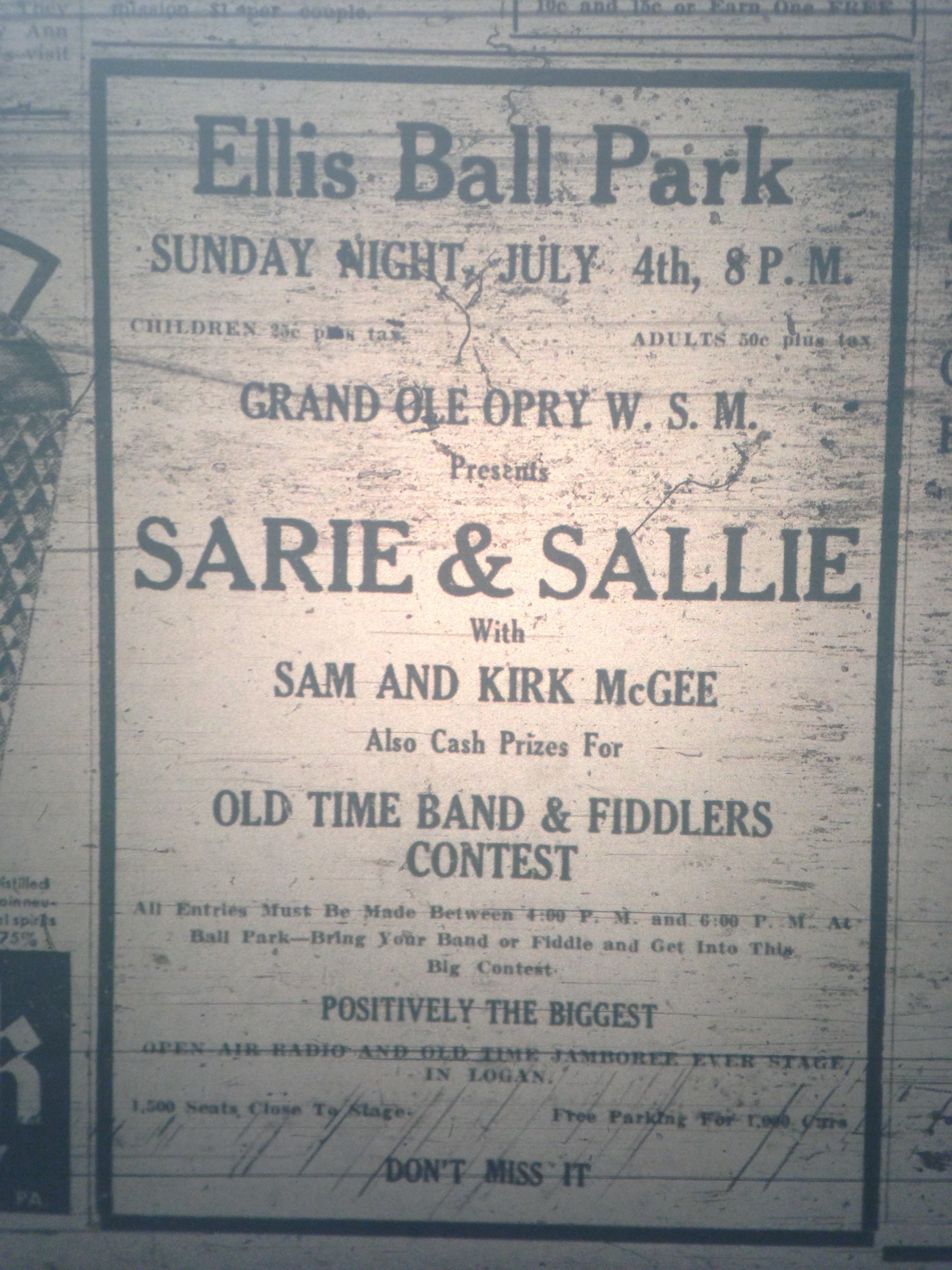
Appalachia, Ellis Ball Park, fiddlers, fiddling, Grand Ole Opry, history, Kirk McGee, Logan, Logan Banner, Logan County, music, Sam McGee, Sarie and Sallie, West Virginia

Old Time Band and Fiddlers Contest McGees LB 07.01.1937.JPG

Logan (WV) Banner, 1 July 1937. 1500 seats!

Democratic Party Intimidation in Logan County, WV (1924)

16 Tuesday Oct 2018

Posted by Brandon Ray Kirk in Coal, Logan, Man

≈ Leave a comment

Tags

Anna Meade, Appalachia, Charley Stollings, Cherry Tree, constable, Cora, Democratic Party, deputy sheriff, Don Chafin, Frank Bell, history, Ira P. Hager, jailer, Joe Hatfield, John Harris, John Parmer, John T. Gore, Lee Belcher, Logan County, Logan District, Mine Wars, politics, Republican Party, Taplin, Tennis Hatfield, Tom Chafin, United States Commissioner, W.E. White, West Virginia

Political history for Logan County, West Virginia, during the 1920s was particularly eventful; it included the latter years of Sheriff Don Chafin’s rule, the Mine Wars (“armed march”), Republican Party ascendancy, and the rise of Republican sheriffs Tennis and Joe Hatfield. What follows are selected primary source documents relating to this period:

UNITED STATES OF AMERICA

SOUTHERN DISTRICT OF WEST VIRGINIA,

HUNTINGTON DIVISION

Before the undersigned authority this day personally came FRANK BELL, who after being by me first duly sworn, deposes and says that he resides at Taplin, Logan County, in said District; that he is a contractor in the mines at Cora, Logan County. That Lee Belcher, Deputy sheriff came to affiant’s employees yesterday and told affiant’s employees that affiant was a Republican and that he “was going to get him.” That on last night they fired several shots all around affiant’s house and some shots into affiant’s house, some of them kept parading and firing pistols around the walls of the house all night, and affiant did not sleep any, but kept his clothes on all night.

That affiant looked out and saw some of the men and knew one of them to be Tom Chafin, Deputy Sheriff.

Frank Bell

Taken, subscribed and sworn to before me this the 6th day of November, 1924.

Ira P. Hager

United States Commissioner as aforesaid.

***

UNITED STATES OF AMERICA

SOUTHERN DISTRICT OF WEST VIRGINIA,

HUNTINGTON DIVISION

Before the undersigned authority, Ira P. Hager, a United States Commissioner in and for said District, personally appeared this day Annie Meade who after being by me first duly sworn, says: That on election day, November 4th, 1924, she voted a Republican Ticket at Cherry Tree Bottom, and that after affiant voted W.E. White, Jailor of Logan County, and John T. Gore, a Deputy Sheriff of Logan County, and John Harris, Constable of Logan District, and John Parmer, whose business is unknown to affiant, followed affiant down the street to the home of Charley Stollings, where affiant stopped, and they ordered affiant to get off the public highway. I was then standing in front of Charley Stollings’s house on the hard road. They then said, “If you open your mouth we will take you and put you in jail on your head.” I answered Squire White by telling him that he would not do it. Deputy John T. Gore then said, “You will see if I do not do it.” They then abused me for voting the Republican ticket.

Affiant is forty-four years of age.

Anna Meade

Taken, subscribed and sworn to before me this the 7th day of November, 1924.

Ira P. Hager

United States Commissioner as aforesaid.

Sunday School Children at the Methodist Episcopal Church South in Logan, WV (1914)

14 Sunday Oct 2018

Posted by Brandon Ray Kirk in Logan

≈ Leave a comment

Tags

Appalachia, history, Logan, Logan Banner, Logan County, Methodist Episcopal Church South, photos, United Methodist Church, West Virginia

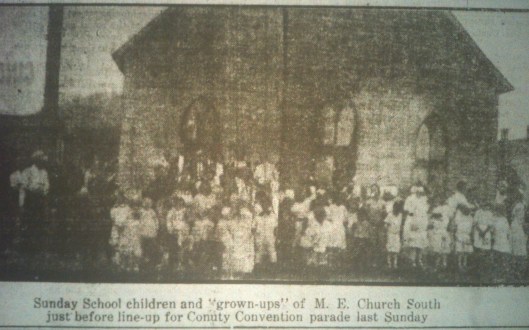
Sunday School, M.E. Church South LB 07.03.1914 1.JPG

Sunday School Children Before County Convention, Logan (WV) Banner, 3 July 1914. The Methodist Church split in 1844 primarily over the issue of slavery and reunited in 1939. In 1968, it merged with additional splinter organizations to form the United Methodist Church.

Teddy Roosevelt, Jr. Visits Logan, WV (1928)

14 Sunday Oct 2018

Posted by Brandon Ray Kirk in Huntington, Logan, Williamson, Women's History, World War I

≈ Leave a comment

Tags

A.A. Lilly, American Legion, Appalachia, Beckley, Braeholm, C.C. Lanham, Calvert Estill, Casey M. Jones, Charleston, Emmett Scaggs, First Methodist Church, G.R. Claypool, Guyandotte Valley, Harrisville, Henry D. Hatfield, Herbert Hoover, history, Hugh Ike Shott, Huntington, John M. Mitchell, John W. Davis, Kentucky, Logan, Logan Banner, Logan County, Lundale, M.Z. White, Naaman Jackson, Peach Creek, photos, Point Pleasant, politics, Princeton, Republican Party, Ripley, Teddy Roosevelt Jr., W.C. Lybarger, W.C. Price, W.G. Conley, W.J. Fields, Welch, West Virginia, Williamson, Woman's Christian Temperance Union, World War I, YMCA

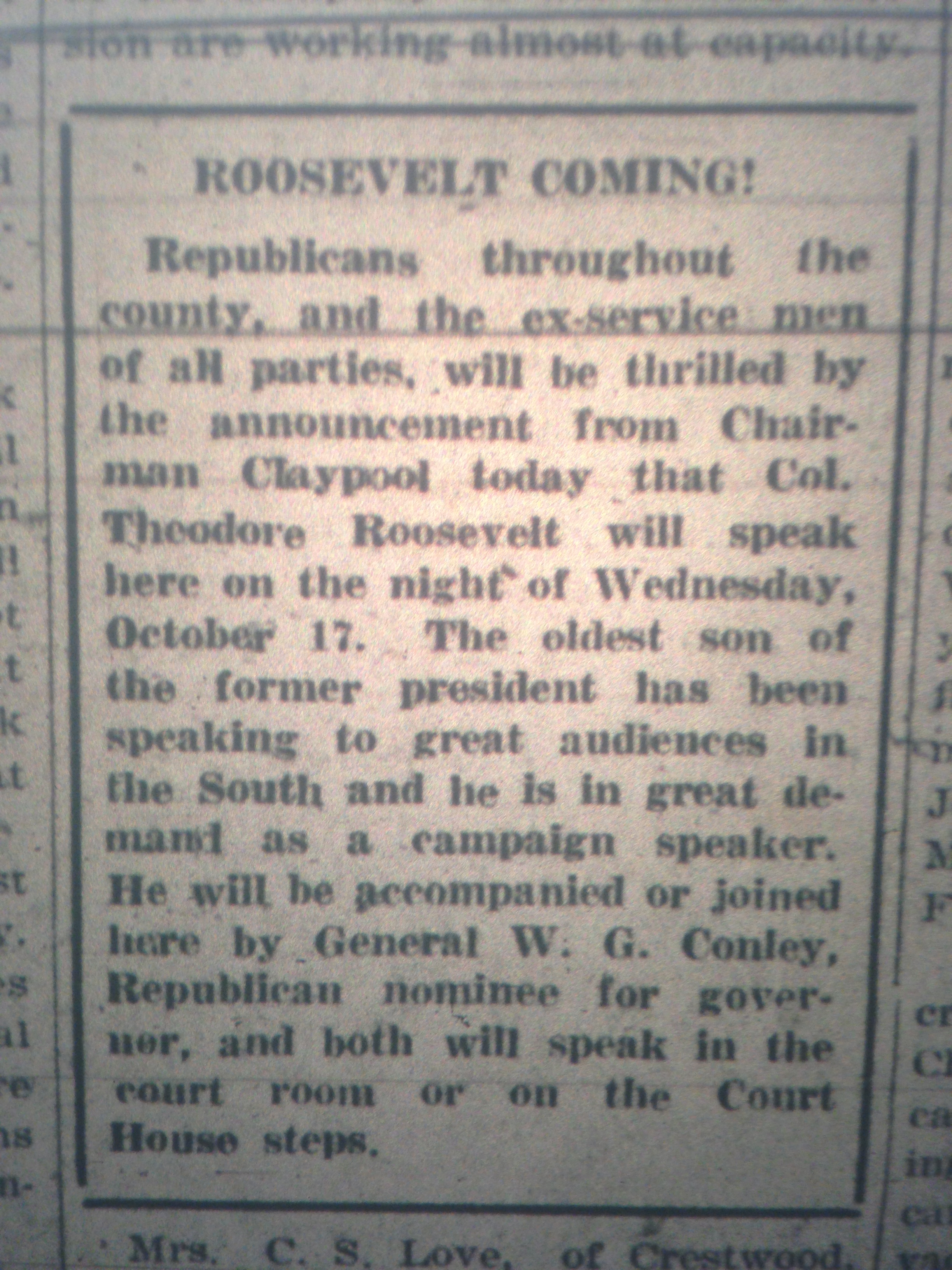
On October 17, 1928, Theodore Roosevelt, Jr. visited Logan, WV, and gave a speech to approximately 10,000 people. The Logan Banner offered plenty of coverage for the event:

Tedd Roosevelt Jr. is Coming LB 10.05.1928.JPG

Logan (WV) Banner, 5 October 1928

***

War-Time Buddies to Greet Col. Roosevelt

After His Meeting Here Wednesday Night–General Conley Will Also Speak at Open-Air Meeting That Night–Whale of Rally Assured

Every ex-service man in Logan county is urged to meet Col. Theodore Roosevelt when he comes here to deliver a campaign address in front of the Court House next Wednesday night. A reception in honor of the distinguished son of a distinguished sire will be held in Republican headquarters on the fifth floor of the White & Browning building after the political meeting is ended. There he will be greeted by his war “buddies” and every soldier, sailor and marine who served in the World War, regardless of political affiliations, is asked to be present.

Col. Roosevelt is billed three speeches on Tuesday. He is expected to speak at Welch in the afternoon and at Princeton at 5 p.m. and at Beckley that night. He is in great demand and Logan Republicans are elated over the definite promise from state headquarters that he is coming here.

General W.G. Conley, Republican nominee for Governor, will accompany or join Col. Roosevelt here and both will speak at the Wednesday night meeting. It is probable, too, that Dr. H.D. Hatfield and A.A. Lilly, former attorney general, will be here at the same time. General Lilly is billed for a speech at Braeholm on Monday night.

Logan (WV) Banner, 12 October 1928

***

Col. Roosevelt and General Conley Speak in Logan Tomorrow Night

Open-Air Rally at Court House Expected to Attract Delegations From All Sections of County–Service Men to Hold Reception for Col. Roosevelt After Speaking Is Ended

With the coming of Theodore Roosevelt and General W.C. Conley tomorrow for what is expected to be a memorable night meeting, the speaking campaign in this county may reach a climax. They will be the chief speakers at an open-air meeting in front of the Court House. It is probable that Governor Gore will come also and in that event he may serve as chairman of the meeting.

A.A. Lilly, former attorney general and Hugh Ike Shott, Republican nominee for congress, who addressed a huge gathering at Braeholm and Lundale last night, will speak at Peach Creek tonight; Senator Jackson and E.F. Scaggs also spoke at last night’s gatherings. Mr. Shott will remain in the county up to Wednesday night.

Governor W.J. Fields of Kentucky will address a Democratic meeting in the court room tonight.

Widespread interest has been aroused in the Roosevelt-Conley meeting and delegations are looked for from every section of the county. Ex-service men are to turn out in force to meet and greet the distinguished soldier-son of the beloved soldier-president of the same name. A reception to which all ex-service men are invited will be held on the fifth floor of the White & Browning building after the big meeting is concluded. Roosevelt’s war record, his activity in helping to organize the American Legion, and his fondness for those who served with him have endeared him to World War men everywhere.

A prohibition rally sponsored by the W.C.T.U. will be held at the Court House at 7:30 Friday p.m. Everyone is urged to come. The speakers for this occasion have not been announced.

Teddy Roosevelt Jr. in Logan LB 10.16.1928 2.JPG

Logan (WV) Banner, 16 October 1928.

***

Col. Roosevelt Center of Interest of Biggest Crowd Ever Seen Here

Republicans Stage Rally Eclipsing Any of the Past in Guyan Valley, With Attentive, Enthusiastic Crowd Estimated At Around 10,000 Mark

GEN. CONLEY AND OTHERS TAKE PART

Ex-Service Men Add Zest to Ovation for Gallant Soldier Son of Beloved T.R.–Rev. Mr. Lanham Is Chairman–Flowers For Teddy

Before the largest crowd ever assembled in Logan county, Col. Theodore Roosevelt, eldest son of the late president, made an eloquent and elaborate appeal in front of the Court House Wednesday night for the election of Hoover and Curtis on November 6.

His oratory, his Rooseveltian grimaces, his deep-furrowed smiles, his warm and radiant fellowship, and genuine camaraderie in meeting and greeting ex-service men, won the hearts of all. And how game he was! Exhausted by his effort to make himself heard to the far corners of the crowd confronting him and really surrounding him, following a strenuous ordeal of many days, traveling at night and speaking several times a day, he had difficulty making his way from the platform back through the crowd and into the Court House corridor. To several companions he hoarsely confided, “I’m a wreck!” Nevertheless, he tried to shake every hand and exchange a friendly greeting with those who swarmed about him. His exit was marked by a renewal of the ovation that greeted him when he, General W.G. Conley, Senator M.Z. White, County Chairman and Mrs. G.R. Claypool, Casey M. Jones, Calvert Estill and others in the party wormed their way through the crowd to the platform erected at the foot of the steps on the side of the Court House.

After the meeting the distinguished visitor was whisked to Republican headquarters where ex-service men in large numbers held a reception in his honor. Again and again he was “dee-lighted” and thrilled to find some “buddy” who had belonged to some military unit with whose history Roosevelt is familiar. Then he would cry out to his pal Casey Jones, Charleston newspaperman and bosom friend for more than a decade,” What do you know about it, Casey, here’s an old pal that served with” so-and-so company or regiment.

Not only ex-service men but more than one professional man of Logan, miners and others whispered to him, or yelled out to his wake, “We’ll be voting for you some time, Teddy!”

Hits the Line Hard

After the reception the Colonel returned to Charleston, to make ready for a busy schedule yesterday. He was billed for speeches at Harrisville, Ripley and Pt. Pleasant, and had arranged to get back to Charleston last night and to speak both at Beckley and Welch today. All day yesterday here whenever the matter of his visit was discussed in any group the prediction was advanced that he was too terribly exhausted to adhere to his schedule. And his Logan friends are sincerely concerned about him. However, he will return to New York at the end of the week.

Wednesday night’s rally will be remembered for years, say political observers, not only because of its size but also because of its direct bearing on a momentous contest for supremacy.

Most estimates of the attendance hover around the 10,000 mark. John M. Mitchell, court bailiff, who has been familiar with political activities in this county for half a century, said it exceeded twice over any crowd he had ever seen in the county. Others say the only meeting ever held here worthy of comparison was that addressed by Senator Pat Harrison in the 1924 campaign. To the writer the crowd seemed more than half as large as that which heard John W. Davis in Huntington in 1924. That crowd was estimated at 25,000, but that was an obvious exaggeration–a characteristic of the estimates of political assemblages.

The Folks Were There

Cloudy weather and a light rain that set in at the hour when the meeting was scheduled to start doubtless kept away a considerable number and caused scores to leave. On the outer edges it was impossible to hear the speakers and so there was a steady going and coming of persons wishing to see and hear. windows in about half a dozen buildings were occupied, small boys were atop the Old Stone building, and there was a good-sized crowd clustered on and about the platform, steps, windows, portico and corridors of the Court House.

Roosevelt has a good voice but it was put to a terrific test here, considering what he had undergone recently. His voice is better than his father’s was and he is more humorous, but the only striking resemblance between the two as public speakers is that grinning grimace that once seen can never be forgotten. In his speech he did not delve exhaustively into any one issue or phase of the campaign but he gave a comprehensive review of the issues and personalities that Republicans generally assume to be involved in this campaign. As for Tammany he panned it as it has never been panned before hereabouts. He recalled, too, that his grandfather had fought the greedy Tiger: “My father fought it; I am fighting it, and if it lives 20 years longer, I expect and hope my son Teddy III will be fighting it.”

Rev. Lanham Presides

It was after 8 o’clock when the speakers arrived–more than half an hour late–whereas all available seats and many vantage points had been occupied for nearly if not fully two hours. At the home of Mr. and Mrs. G.R. Claypool they had been entertained at dinner–or supper, as Teddy and most of us call it. Besides the Colonel and General Conley there were six other guests: Hugh Ike Shott, Republican nominee for representative in Congress; Senator M.Z. White, Williamson; C.M. Jones, publicity man and side for Mr. Conley; Calvert N. Estill, Charleston correspondent for the Ogden chain of newspapers, and Senator Naaman Jackson.

Rev. C.C. Lanham, pastor of the First Methodist Church, who has been a leader in the fight to avert any backward step on prohibition, was chairman of the meeting. He filled the role with tact and good judgment and introduced the various speakers in happy style.

General Conley was the first speaker, but sensing the crowd’s desire to hear the Colonel he cut short his remarks. He did not take up state or national issues but after a word of congratulation to those who had sponsored such an immense turnout he withdrew.

Flowers For Colonel

Next a pretty little surprise was sprung. Mrs. W.C. Price, of Huntington, who is taking the lead in organizing the Republican women of the county, was introduced. Turning to Col. Roosevelt, after bringing a basket full of beautiful flowers into view, she told him of the esteem in which he is held by the women and presented the flowers in behalf of the woman’s Republican Club as a token of appreciation of his services in this campaign and of his zeal in promoting the public welfare. His face wreathed in wrinkles and aglow, he replied: “I accept with thanks. And I would much rather stand high in the esteem of women than of men. They are more important. I know, for I am married.”

The chairman then introduced W.C. Lybarger, secretary of the railway Y.M.C.A. at Peach Creek, who in turn introduced Col. Roosevelt. He paid the visitor a splendid tribute for his valor on the battlefields of France, touched the high points of his political career, and said he had a leading part in organizing the American Legion.

At the outset Roosevelt sketched the character and growth of the orphaned Hoover and gave some intimate glimpses into the habits of living and of thought, of his working and his industry and resourcefulness in solving problems of public and playing, of his zeal in tackling concern. Between these two men there is a close friendship, and there was no mistaking Roosevelt’s whole-hearted admiration for the farm boy of Iowa who has risen to a position of pre-eminence in the minds and hearts of his countrymen and even of the folk of many other lands.

Logan (WV) Banner, 19 October 1928

Origin of Place Names in Logan County, WV (1937)

12 Friday Oct 2018

Posted by Brandon Ray Kirk in Chapmanville, Coal, Gilbert, Guyandotte River, Logan, Man, Native American History

≈ Leave a comment

Tags

Appalachia, Aracoma, Barnabus, Barnabus Curry, Boling Baker, Buffalo Creek, Cham, Chapmanville, Chauncey, Chauncey Browning, coal, Crystal Block, Curry, D.E. Hue, Dehue, Dingess Run, Edward O'Toole, Gilbert Creek, Guyandotte River, history, Horse Pen Mountain, Huff Creek, Island Creek, Jim Gilbert, Litz-Smith Coal Company, Logan Banner, Logan County, Main Island Creek Coal Company, Mallory, Micco, Mountain View Inn, Native American History, Native Americans, Omar, Omar Cole, Peter Huff, Rum Creek, Sarah Ann, Sarah Ann O'Toole, Stirrat, Twisted Gun Lick, West Virginia, William Dingess, William S. Madison

From the Logan Banner of Logan, WV, comes this bit of history about Logan County place names:

Naming of Logan County Towns and Creeks Related By Logan Banner Reporter

While the first white settlers who entered the county near the middle of the 18th century had to have names for the creeks and runs in order to locate their homes, the children of these first settlers had to have names for each large settlement in order to have their mail delivered to them. Both groups used interesting methods of naming the landmarks.

Early Indian fighters who had contact with Boling Baker and his horse-thieving found little trouble naming the mountain which rises behind Mountain View Inn at the head of Island Creek. Because of the renegade’s custom of using one of the steep hollows for a corral, Captain William S. Madison, an early pioneer, named the mountain Horse Pen. Likewise, Gilbert Creek was named for Jim Gilbert, an Indian scout, who was killed in an Indian skirmish on that tributary of the Guyandotte. Near the place where he was killed there is an old salt lick which is named “Twisted Gun Lick.” The story is told that Gilbert, before he died, hit his gun barrel against a tree to keep the Indians from using it on his comrades. His friends, coming to the lick several hours later, found Gilbert scalped and the twisted firearm lying nearby.

Huff Creek was similarly named for a Peter Huff, whose scouting party was ambushed by a roving band of redskins and Huff was killed in the ensuing battle. They buried Huff on the banks of the creek near the present town of Mallory.

Buffalo Creek, however, received its name in an entirely different manner. The first settlers who hunted in the valley of the Guyandotte found buffalo herds so plentiful on this creek that they called it Buffalo Creek.

Dingess Run was named for a pioneer family of Dingesses which settled in its broad bottoms. William Dingess was the patriarchal head of the family and his children named the run in memory of him.

Island Creek received its name from the Indians who were awed by the beauty of a large creek flowing into the Guyandotte with such force as to cut an entirely separate bed, thus forming an island in the middle of the river. Old timers say that in the early days of the county Island Creek entered the Guyan river at the upper limits of Aracoma. Only during flood time did the creek meet the river at its present point.

As for the towns which have sprung up in the county since coal became king, many were named for prominent people living in them at one time or another or for pioneer families who lived in the towns when the coal companies first came in.

A unique method was used, however, in naming Micco. It received its name from the first letters of the Main Island Creek Coal Co., which formerly operated the mines there.

Omar was named for Omar Cole who was closely associated with the development of the town. The Cole family held, and still holds, extensive mining leases in the vicinity of that mining town.

Sarah Ann acquired its name from the wife of Colonel Edward O’Toole, who was manager of the coal company when the town applied to the government for a post office. The town is generally known as Crystal Block.

Barnabus received its name from Barnabus Curry, a pioneer settler whose home was near the town.

Stirrat was named for Colonel Stirrat, who was manager of the Main Island Creek Coal Company at one time.

Chauncey was named for Chauncey Browning, well-known son of a pioneer family who owned much of the land near that town. For many years the town of Chauncey was not large enough to be made a post office, but after the Litz-Smith Coal Company opened its mines there the town grew to proportions large enough to warrant a post office.

Dehue was given its name in honor of D.E. Hue, the first superintendent who operated the mines there.

Cham, a small place about two and one-half miles above Dehue, got its name from a Chambers family who lived on Rum Creek.

Chapmanville was named for the Chapmans, Curry for the Curry family and Aracoma for the famous Indian princess.

Source: Logan (WV) Banner, 25 March 1937

Aracoma High School in Logan, WV (1929)

09 Tuesday Oct 2018

Posted by Brandon Ray Kirk in African American History, Logan

≈ 2 Comments

Tags

African-Americans, Appalachia, Aracoma High School, Aracoma Junior High School, board of education, Coal Branch, education, history, L.E. Farnsworth, Logan, Logan Banner, Logan County, Logan District, Republican Party, West Virginia

Aracoma High School LB 04.16.1929 1.JPG

Logan (WV) Banner, 16 April 1929.

THE COLORED ARACOMA SENIOR HIGH SCHOOL

Now In Course of Erection, is the result of the vision and enterprise of the Logan District Board of Education to meet a need in the life of the colored citizens of this district, which need has been existing for a long period of years, and has equally as long been neglected.

The moving spirit, in the board of education, toward bringing this new school to a successful issue, is Dr. L.E. Farnsworth, and it is to him in particular that the colored citizens of this district owe a lasting debt of gratitude. Early and late, at times seasonable and times unseasonable Dr. Farnsworth worked in the Aracoma colored system, and that the shame against the intelligence and liberality of the white citizens of this district might be removed by in replacing the makeshift which existed with a decent colored school building.

The contribution of the space and picture of the proposed building, shown in this progress section devoted to colored citizens, is made by the Board of Education. This is a further evidence of their generous attitude toward our people, encouraging their efforts to improve themselves and advance their welfare. Such liberality merits our thanks and unstinted praise, and it is hereby extended generously and thankfully.

Source: Logan (WV) Banner, 16 April 1929

***

New School Building

Ground was broken last week in Coal Branch for the new Aracoma Junior high school. A large force of men with scrapers, picks and shovels are busy doing the excavating work, and delegations of patriot citizens of color are visiting the scene daily and watching the rapid progress that is being made on this long needed and prayed for school building. The site is ideal, with a large play ground and when completed and furnished, it will be one of the best in the state. The new Aracoma Junior high school building is the fulfillment of some of the pledges and campaign promises made by Republican candidates and party workers, to the colored voters during the last election. The bringing into existence of this long promised school will be a lasting credit to the members of the Logan district Board of Education and should also standout as another important reason why the Negro should vote the Republican ticket.

Source: Logan (WV) Banner, 19 April 1929

← Older posts
Newer posts →

Feud Poll 1

If you had lived in the Harts Creek community during the 1880s, to which faction of feudists might you have given your loyalty?

Categories

  • Adkins Mill
  • African American History
  • American Revolutionary War
  • Ashland
  • Atenville
  • Banco
  • Barboursville
  • Battle of Blair Mountain
  • Beech Creek
  • Big Creek
  • Big Harts Creek
  • Big Sandy Valley
  • Big Ugly Creek
  • Boone County
  • Breeden
  • Calhoun County
  • Cemeteries
  • Chapmanville
  • Civil War
  • Clay County
  • Clothier
  • Coal
  • Cove Gap
  • Crawley Creek
  • Culture of Honor
  • Dingess
  • Dollie
  • Dunlow
  • East Lynn
  • Ed Haley
  • Eden Park
  • Enslow
  • Estep
  • Ethel
  • Ferrellsburg
  • Fourteen
  • French-Eversole Feud
  • Gilbert
  • Giles County
  • Gill
  • Green Shoal
  • Guyandotte River
  • Halcyon
  • Hamlin
  • Harts
  • Hatfield-McCoy Feud
  • Holden
  • Hungarian-American History
  • Huntington
  • Inez
  • Irish-Americans
  • Italian American History
  • Jamboree
  • Jewish History
  • John Hartford
  • Kermit
  • Kiahsville
  • Kitchen
  • Leet
  • Lincoln County Feud
  • Little Harts Creek
  • Logan
  • Man
  • Matewan
  • Meador
  • Midkiff
  • Monroe County
  • Montgomery County
  • Music
  • Native American History
  • Peach Creek
  • Pearl Adkins Diary
  • Pecks Mill
  • Peter Creek
  • Pikeville
  • Pilgrim
  • Poetry
  • Queens Ridge
  • Ranger
  • Rector
  • Roane County
  • Rowan County Feud
  • Salt Rock
  • Sand Creek
  • Shively
  • Spears
  • Sports
  • Spottswood
  • Spurlockville
  • Stiltner
  • Stone Branch
  • Tazewell County
  • Timber
  • Tom Dula
  • Toney
  • Turner-Howard Feud
  • Twelve Pole Creek
  • Uncategorized
  • Warren
  • Wayne
  • West Hamlin
  • Wewanta
  • Wharncliffe
  • Whirlwind
  • Williamson
  • Women's History
  • World War I
  • Wyoming County
  • Yantus

Feud Poll 2

Do you think Milt Haley and Green McCoy committed the ambush on Al and Hollene Brumfield in 1889?

Blogroll

  • Ancestry.com
  • Ashland (KY) Daily Independent News Article
  • Author FB page
  • Beckley (WV) Register-Herald News Article
  • Big Sandy News (KY) News Article
  • Blood in West Virginia FB
  • Blood in West Virginia order
  • Chapters TV Program
  • Facebook
  • Ghosts of Guyan
  • Herald-Dispatch News Article 1
  • Herald-Dispatch News Article 2
  • In Search of Ed Haley
  • Instagram
  • Lincoln (WV) Journal News Article
  • Lincoln (WV) Journal Thumbs Up
  • Lincoln County
  • Lincoln County Feud
  • Lincoln County Feud Lecture
  • LinkedIn
  • Logan (WV) Banner News Article
  • Lunch With Books
  • Our Overmountain Men: The Revolutionary War in Western Virginia (1775-1783)
  • Pinterest
  • Scarborough Society's Art and Lecture Series
  • Smithsonian Article
  • Spirit of Jefferson News Article
  • The Friendly Neighbor Radio Show 1
  • The Friendly Neighbor Radio Show 2
  • The Friendly Neighbor Radio Show 3
  • The Friendly Neighbor Radio Show 4
  • The New Yorker
  • The State Journal's 55 Good Things About WV
  • tumblr.
  • Twitter
  • Website
  • Weirton (WV) Daily Times Article
  • Wheeling (WV) Intelligencer News Article 1
  • Wheeling (WV) Intelligencer News Article 2
  • WOWK TV
  • Writers Can Read Open Mic Night

Feud Poll 3

Who do you think organized the ambush of Al and Hollene Brumfield in 1889?

Recent Posts

  • Logan County Jail in Logan, WV
  • Absentee Landowners of Magnolia District (1890, 1892, 1894)
  • Charles Spurlock Survey at Fourteen Mile Creek, Lincoln County, WV (1815)

Ed Haley Poll 1

What do you think caused Ed Haley to lose his sight when he was three years old?

Top Posts & Pages

  • Early Schools of Logan County, WV (1916)
  • Jack Dempsey’s Broadway Restaurant Location in New York City (2019)
  • Anthony Lawson founds Lawsonville
  • Blood in West Virginia: Brumfield v. McCoy (2014)
  • Blood in West Virginia

Copyright

© Brandon Ray Kirk and brandonraykirk.wordpress.com, 1987-2023. Unauthorized use and/or duplication of this material without express and written permission from this blog’s author and/or owner is strictly prohibited. Excerpts and links may be used, provided that full and clear credit is given to Brandon Ray Kirk and brandonraykirk.wordpress.com with appropriate and specific direction to the original content.

Archives

  • February 2025
  • January 2025
  • October 2023
  • September 2023
  • December 2022
  • November 2022
  • May 2022
  • April 2022
  • February 2022
  • November 2021
  • October 2021
  • September 2021
  • June 2021
  • May 2021
  • April 2021
  • March 2021
  • February 2021
  • January 2021
  • December 2020
  • November 2020
  • October 2020
  • July 2020
  • June 2020
  • May 2020
  • April 2020
  • March 2020
  • February 2020
  • January 2020
  • December 2019
  • November 2019
  • October 2019
  • September 2019
  • August 2019
  • July 2019
  • June 2019
  • May 2019
  • April 2019
  • March 2019
  • February 2019
  • January 2019
  • December 2018
  • November 2018
  • October 2018
  • September 2018
  • August 2018
  • July 2018
  • June 2018
  • May 2018
  • April 2018
  • March 2018
  • February 2018
  • January 2018
  • December 2017
  • November 2017
  • October 2017
  • September 2017
  • August 2017
  • July 2017
  • June 2017
  • May 2017
  • April 2017
  • March 2017
  • February 2017
  • January 2017
  • December 2016
  • November 2016
  • October 2016
  • September 2016
  • August 2016
  • July 2016
  • June 2016
  • May 2016
  • April 2016
  • March 2016
  • February 2016
  • January 2016
  • December 2015
  • November 2015
  • October 2015
  • September 2015
  • August 2015
  • July 2015
  • June 2015
  • May 2015
  • April 2015
  • March 2015
  • February 2015
  • January 2015
  • December 2014
  • October 2014
  • September 2014
  • August 2014
  • July 2014
  • June 2014
  • May 2014
  • April 2014
  • March 2014
  • February 2014
  • January 2014
  • December 2013
  • November 2013
  • October 2013
  • September 2013
  • August 2013
  • July 2013
  • June 2013
  • May 2013
  • April 2013
  • March 2013
  • February 2013
  • January 2013
  • December 2012
  • November 2012

Enter your email address to follow this blog and receive notifications of new posts by email.

Join 2,927 other subscribers

Tags

Appalachia Ashland Big Creek Big Ugly Creek Blood in West Virginia Brandon Kirk Cabell County cemeteries Chapmanville Charleston civil war coal Confederate Army crime culture Ed Haley Ella Haley Ferrellsburg feud fiddler fiddling genealogy Green McCoy Guyandotte River Harts Harts Creek Hatfield-McCoy Feud history Huntington John Hartford Kentucky Lawrence Haley life Lincoln County Lincoln County Feud Logan Logan Banner Logan County Milt Haley Mingo County music Ohio photos timbering U.S. South Virginia Wayne County West Virginia Whirlwind writing

Blogs I Follow

  • OtterTales
  • Our Appalachia: A Blog Created by Students of Brandon Kirk
  • Piedmont Trails
  • Truman Capote
  • Appalachian Diaspora

BLOOD IN WEST VIRGINIA is now available for order at Amazon!

Blog at WordPress.com.

OtterTales

Writings from my travels and experiences. High and fine literature is wine, and mine is only water; but everybody likes water. Mark Twain

Our Appalachia: A Blog Created by Students of Brandon Kirk

This site is dedicated to the collection, preservation, and promotion of history and culture in Appalachia.

Piedmont Trails

Genealogy and History in North Carolina and Beyond

Truman Capote

A site about one of the most beautiful, interesting, tallented, outrageous and colorful personalities of the 20th Century

Appalachian Diaspora

  • Subscribe Subscribed
    • Brandon Ray Kirk
    • Join 789 other subscribers
    • Already have a WordPress.com account? Log in now.
    • Brandon Ray Kirk
    • Subscribe Subscribed
    • Sign up
    • Log in
    • Report this content
    • View site in Reader
    • Manage subscriptions
    • Collapse this bar
 

Loading Comments...