Tags
Appalachia, Cabell County, history, Huntington, Huntington Advertiser, Marshall College, Marshall University
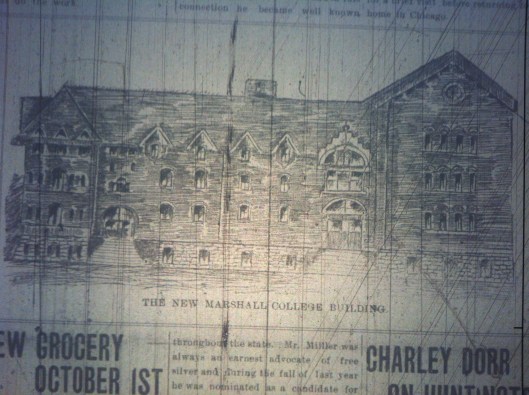
Huntington (WV) Advertiser, 16 August 1897.

Huntington (WV) Advertiser, 23 December 1897.
19 Thursday Oct 2017
Posted in Huntington
Tags
Appalachia, Cabell County, history, Huntington, Huntington Advertiser, Marshall College, Marshall University
Huntington (WV) Advertiser, 16 August 1897.
Huntington (WV) Advertiser, 23 December 1897.
19 Thursday Oct 2017
Posted in African American History, Logan
Tags
Appalachia, crime, E.T. England, Hallie Wootson, Logan, Logan Banner, Logan County, Mingo County, Monitor Junction, West Virginia
From the Logan Banner of Logan, WV, we find the following story dated October 16, 1914:
THUGS AND OUTLAWS IN FORCE
MONITOR JUNCTION, NEAR THIS PLACE IS THE SCENE OF UNLAWFUL CARNAGE
TWO COLORED MEN ARE SHOT
Last Monday Night, Oct. 12, Was a Period of Unlawful Foray in Logan County.
Unlike the posse who ran to earth in a few hours the robbers and murderers so recently killed in Mingo County, the Logan County officers have turned not one stone to apprehend what seems to be the most dastardly and cowardly criminals now loose in any county. Rumor has it that the beginning of these depredations was the day of registration before the County Court on last Monday. Upon that day there were some colored men in Logan City for the purpose of registration, more than certain people thought were best, and these latter began to lay sneaking plots to drive the colored men away. On the evening of last Monday, certain men went over the bridge at the lower end of the town to some box cars used as shanties by colored laborers. These colored men were asked by their visitors if there were any strangers in the shanties and especially any who had come to Logan to get registered. The white men received a negative reply and went on up the creek. It seems very clear that the purpose of this visit was to ascertain just where these colored men were stopping for the night, so that a night attack could be made upon them and thus run them away. About 500 yards up the creek from the shanties above mentioned there stands an old two-story framed house. In the upper story of this house lives a family by the name of Spears; in the first floor lived some colored people. About midnight two men pushed open the back door of the colored people’s abode and began shooting: one going to a bed where with a revolver he beat up a colored fellow, while his partner thug proceeded further into the house, firing his pistol at the windows and furniture. Both colored men who were lying in the bed were shot several times and are in a precarious condition. During the melee, Hallie Wootson, a colored woman staying at the house, ran between the would-be murderers and pleaded with them to cease firing till she could get her baby from the room; with an oath the thug forced her from the room, not even allowing her to properly dress herself. This woman states that there were from 15 to 20 men on guard.
Mrs. Spears, the white woman living in the upstairs of this house, states that two of the men came upstairs to her room and knocked. She told them to come in, to which they replied, “No, you don’t want to see us, go to bed, we won’t hurt you.” However a bullet was fired into the very room in which Mr. and Mrs. Spears were sleeping. From the looks of the windows and doors of this house, one hundred shots must have been fired. Mrs. Spears also states that an automobile was in the vicinity and was driven away soon after the band of men left.
About one hour after the above mentioned attack, another attack was made on Senator E.T. England’s offices. Cobble rocks were thrown through the front windows breaking them into countless pieces. Someone who knew a little more than the ordinary along certain lines was present either in person or by advice since certain well known gases were inserted under the two outside office doors. This last ruse did not avail the highwaymen of anything since their purpose was in no wise accomplished.
***
Courting Trouble.
The question that naturally comes to us is, “Why have not the officers of Logan County–and there are over 100 in number we understand–taken up the Monitor Junction matter and attempted to bring the guilty ones before the bar of justice?” Is it because some of them know more than they care to tell? We will say this, that the circumstances surrounding this trouble are, to say the least, very suspicious, as far as some of the officers of Logan County are concerned. The antagonism which the colored people of this County meet when they attempt to register for the purpose of voting is extreme and even unlawful. The Federal Constitution gives them the right to vote providing they can properly qualify themselves. Therefore we ask: How can they qualify themselves when they are not allowed the right to go before the proper tribunal which the law establishes for that purpose? There is not a single fact concerning the trouble that occurred at Monitor Junction and in the city of Logan but what points to the fact that there is an unlawful conspiracy on the part of certain persons to intimidate the colored voter, and to kill him if necessary if that is the only way to keep him from voting.
Source: Logan (WV) Banner, 16 October 1914.
19 Thursday Oct 2017
Posted in Big Harts Creek
Tags
Anthelia Elkins, Appalachia, Archibald Elkins, genealogy, Guyandotte River, Hannah Elkins, Harts Creek, history, Josephus Workman, Lincoln County, Logan County, Peter Dingess, Pigeon Roost, Rebecca Maguire, Richard Elkins, Virginia, West Virginia
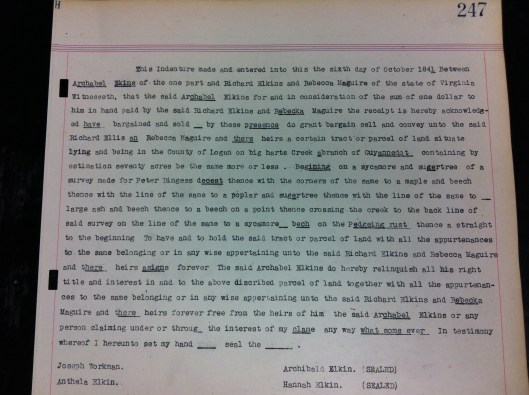
Deed Book C, page 247, Logan County Clerk’s Office, Logan, WV.
19 Thursday Oct 2017
Posted in Big Creek, Chapmanville, Ferrellsburg
Tags
A.L. Samson, America, Appalachia, Big Creek, board of education, Cap Adkins, Chapmanville, constable, county clerk, Edgwright, Ferrell Hill, Ferrellsburg, Fisher B. Adkins, genealogy, history, Jim Bryant, John Dingess, Ku Klux Klan, Lincoln County, Logan Banner, Logan County, Lumbago, O.J. Phipps, Republican Party, Route 10, The Old Rugged Cross, West Virginia
An unknown correspondent from Chapmanville in Logan County, West Virginia, offered the following items, which the Logan Banner printed on July 9, 1926:
O.J. Phipps is now on his vacation.
Cap Adkins of Kentucky has been visiting his grand children on Big Creek this week.
Grading on our new road is being finished this week.
Several of our citizens motored to Big Creek Monday evening to get their part of the hot air dispensed by John (Corn) and others.
A white-robed crowd of men of mystery assembled on the Ferrell Hill last Monday night and burned a very beautiful cross and sang “America” and “The Old Rugged Cross.”
Mrs. Jim Bryant is visiting her parents at Edgwright this week.
Fisher B. Adkins of Ferrellsburg was attending the meeting of the Board of Education here Monday. Fisher is a candidate for Clerk of the County Court of Lincoln county.
John Dingess is confined to the house with Lumbago this week.
A.L. Samson is a candidate here for constable on the Republican ticket. He says he served seven years in Lincoln county and never took any one with him to arrest a man in his life. We say hurrah for Abe.
17 Tuesday Oct 2017
Posted in Logan
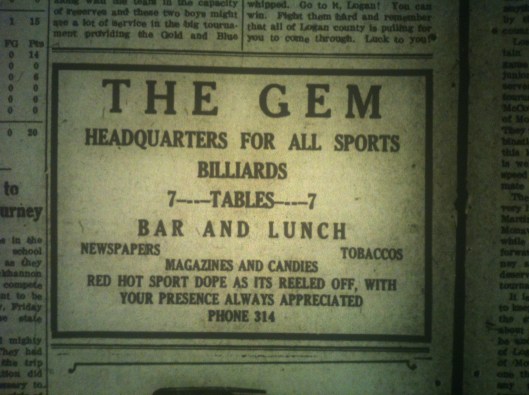
“Red Hot Sport Dope!” Logan (WV) Banner, 15 March 1927.
17 Tuesday Oct 2017
Posted in Huntington, Women's History
Tags
Appalachia, culture, England, Halloween, history, Huntington, Huntington Advertiser, Ireland, Scotland, Wales, West Virginia
From the Huntington Advertiser of Huntington, WV, we find the following story dated October 31, 1899:
Tonight is Halloween and the small boy, as well as many of the larger ones, are happy. Girls ditto.
The lads and lassies, particularly of Scotland and Ireland, and the young people of Wales and England, as well as the youth of this and other countries, have for centuries hailed the night of Halloween, the last night in October, as prophetic.
The first ceremony of Halloween among the Scotch is the pulling of a stock or plant of kale. All the company go out and with eyes closed each pulls the first plant of this kind he or she is able to lay hold of. It being big or little, straight or crooked, is prophetic of the size, shape, and other characteristic of the grand object of all the Halloween spells–the husband or wife. If any earth remains clinging to the root, that signifies fortune, and the state of the heart of the stem, as perceptible to the taste, is indicative of the natural temper and disposition of a future spouse.
Burning nuts is a famous Caledonian charm. Two hazel nuts, sacred to the witches, one bearing the name of the lad and the other the lass, are laid in the fire side by side and accordingly as they burn quietly together or start away from one another so will be the progress and issue of the courtship.
Certain forms must be observed to insure the success of a given spell and in the following one there must be no departure from the formula: A maiden should steal out, entirely alone to the kiln, and throw into the pot a ball of blue yarn, holding fast to the end. She should then begin winding the yarn until it resists, whereupon she should demand, “Who holds this yarn?” An answer will be returned from the kiln-pot, naming the Christian and surname of her future spouse.
Another test is for her to take a candle and going, alone by its light only stand before a mirror and eat an apple. Some traditions say one should comb one’s hair instead of eating the apple. The conditions of the spell being perfect, a shadowy face supposed to be that of the maiden’s future husband will be seen in the glass, as if peeping over her shoulder.
Another Scotch ceremony into which the uncanny largely enters as an element is described as follows: One or more go out, as the case may be (for this is a social spell), to a south running spring or rivulet where “three lairds’ lands meet” and dip the left shirt sleeve. Go to bed in sight of a fire and bang the wet sleeve before it to dry. Lie awake watching carefully, and about midnight an apparition having the exact figure of the grand object in question will come and turn the sleeve as if to dry the other side of it.
An interesting Halloween divination that solves matrimonial doubt and banishes uncertainty is accomplished by arranging three dishes upon the hearth. Into the first is put clean water, into second clouded or muddy water, while the third is left empty. The candidate is securely blindfolded and led to the hearth where the dishes are. The left hand is dipped and if by chance it be in the clean water the wife that is to be will come to the bar of matrimony a maid; if in the muddy water, a widow; but if in the empty dish it foretells with equal certainty no marriage at all. This ceremony is three times repeated, the arrangement of the dishes being each time changed.
Ducking for apples and the attempt to secure by means of the mouth only an apple balanced upon a stick suspended from the ceiling upon the end of which is placed a lighted candle provokes much laughter and no little spirited competition.
For a girl to know if she will marry within the year she must obtain a green pea pod in which are exactly nine peas, hang it over the door, and if the next man guest entering be a bachelor her own marriage will follow within twelve months. This spell is sometimes tried at other times than Halloween, but the conditions then are generally considered less favorable.
Three small rings should be purchased by a maiden during the period of a new moon, each at a different place. She should tie them together with her left garter and place them in her left glove with a scrap of paper cut heart-shaped on which her sweetheart’s name has been written in blue ink. The whole should be placed under her pillow when retiring Halloween and she will dream of her sweetheart if she is to marry him.
The future is sometimes prognosticate on Halloween by candle omens. If a candle burns with an azure tint it signifies the presence or near approach of a spirit or gnome. A collection of tallow rising against the candlestick is styled a winding sheet and is deemed an omen of death in the family. A spark in the candle denotes that the observer will shortly receive a letter.
Two cambric needles are named on Halloween and skillfully placed in a vessel of water. If they float, swimming side by side, the course of true love runs smooth for those they represent. If they sink both together, or if one sinks and the other floats, the persons named will not marry each other.
A printed alphabet is cut into its individual letters, which are placed in water faces downward. On the morrow the initial letters of the favored opposite will be found reversed.
Peel an apple so that the skin remains in unbroken sequence. Whirl this skin three times around the head so that when released it passes over the left shoulder and falls to the floor, assuming the initial letter of the chosen one’s name.
Many young girls fill their mouth with water on Halloween and walk or run around the block, being careful not to swallow the water or suffer it to escape from the mouth. If a girl succeeds in doing this the first man met on returning home will be her husband.
To ascertain one’s standing with a sweetheart select at random an apple and quarter it, carefully gathering the seeds from the core. According to the number found, the following formula is used: 1. I love; 2. I love; 3. I love, I say; 4. I love with all my heart; 5. I cast away; 6. He loves; 7. She loves; 8. They both love; 9. He comes; 10. He tarries; 11. He courts; 12. He marries; 13. Honor; 14. Riches.
At some of the American colleges for women it is customary to celebrate Halloween with straw rides, games, and an annual sheet and pillowcase party, where the illuminations are grotesque pumpkins containing candles, and where cakes containing mystic rings, beans, and a coin are served with the refreshments.
Source: “Hallowe’en Is Now Here,” Huntington (WV) Advertiser, 31 October 1899.
13 Friday Oct 2017
Posted in Harts

Jay Queen built this residence in Harts, Lincoln County, WV.
13 Friday Oct 2017
Posted in Huntington
Tags
Appalachia, Cabell County, crime, Halloween, history, Huntington, Huntington Advertiser, West Virginia
From the Huntington Advertiser of Huntington, WV, we find the following story dated October 31, 1899:
EDITOR ADVERTISER:
The observance of the evening of October 31st, in Huntington, seems to have sadly deteriorated, or at least is very different from that in the balance of the world. The old time pleasantness and superstitions connected with “Hallow eve,” are lost sight of here, and in their stead are introduced drunkenness and vandalism. The night is made hideous. Women and children terrorized, property wantonly destroyed and life endangered. The night is looked forward to with dread. Now this is all wrong, and some vigorous measures should be taken to protect citizens and taxpayers from the outrages committed on this night in the past few years. Let the city give us the protection we are entitled to. Put on a special police force sufficiently strong for the purpose. $150 or $200 had better be thus invested than to have this much or more property maliciously destroyed and life made miserable besides. Nay, more than this may be averted. A man’s house is his castle, and if the authorities are inadequate to protect him, and he is subjected to the outrages heretofore perpetrated, he may be forced to protect himself, and some serious tragedy result, which under the circumstances the law can only justify. It is to be hoped the authorities will take action in the matter, and lawless individuals take warning in time.
A TAX PAYER
Source: “Hallow Eve,” Huntington (WV) Advertiser, 31 October 1899.
13 Friday Oct 2017
Posted in Big Ugly Creek, Guyandotte River, Huntington, Midkiff
Tags
Appalachia, Big Ugly Creek, Burbus Clinton Spurlock, genealogy, Hamilton Fry, history, Huntington, Jefferson District, Lincoln County, merchant, Midkiff, Nancy Ann Spurlock, Nancy Fry, Nancy Spurlock, Robinson Spurlock, West Virginia
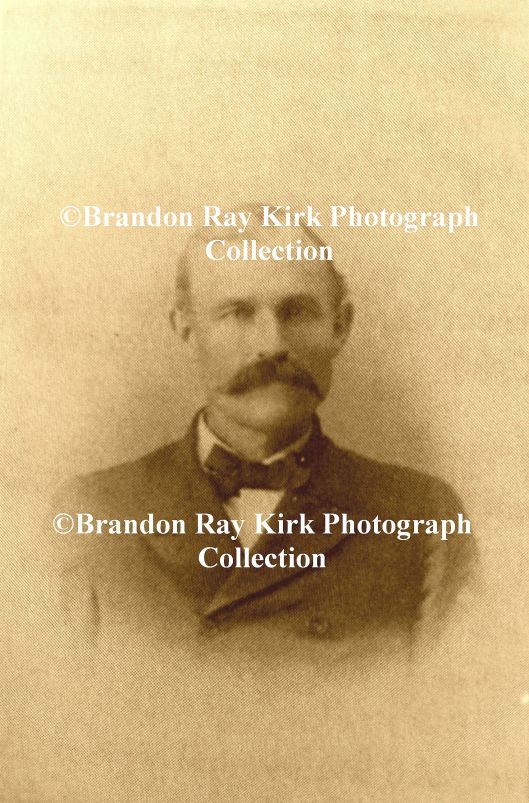
Burbus Clinton Spurlock (1851-1940), son of Robinson and Nancy (Cummings) Spurlock of Jefferson District, Lincoln County, WV. About 1876, he married Nancy Ann Fry, daughter of Hamilton and Nancy (Hunter) Fry, of Big Ugly Creek. He lived at Midkiff in Lincoln County, where he appears in 1900 and 1910 census records. He was a well-known capitalist in the Guyandotte Valley, retiring to Huntington.
13 Friday Oct 2017
Posted in Chapmanville, Huntington
Tags
Appalachia, Cam Pridemore, Chapmanville, Democratic Party, deputy sheriff, G.S. Ferrell, H.T. Butcher, history, Hubert Toney, Huntington, John Webb, Logan Banner, Logan County, Martin Johnson, moonshine, moonshining, Peach Creek, Republican Party, Route 10, Squire Barker, Sutton, W.H. Phipps, West Virginia
An unknown correspondent from Chapmanville in Logan County, West Virginia, offered the following items, which the Logan Banner printed on July 2, 1926:
The grading of our road is not quite done, but the road is open to traffic to Huntington.
W.H. Phipps of Peach Creek was here Monday and Tuesday of this week.
Cam Pridemore is the best deputy sheriff we have had for years.
Squire Barker is kept busy hiving bees these hot days.
Ask John Webb what it costs to get a taxi here.
Martin Johnson has purchased the wholesale feed store of G.S. Ferrell. We like to see new capital come to town.
Hubert Toney and wife left his morning for Sutton to visit Mrs. Toney’s parents at that place.
The Democrats can’t see how there comes to be so many Republicans here this time.
H.T. Butcher is making the bootlegger’s life a hard one these days.
03 Tuesday Oct 2017
Posted in Crawley Creek
Tags
Appalachia, Crawley Creek, Guyandotte Valley, history, Logan Banner, Logan County, moonshine, moonshining, R.L. Hill, West Virginia

Logan (WV) Banner, 11 November 1921.
03 Tuesday Oct 2017
Posted in East Lynn
Rev. Patrick Napier was a preacher in Wayne County, WV. This description of Rev. Napier appeared in the Wayne County News on February 12, 1931.
Rev. Patrick Napier was essentially a man of the hills who possessed a strong and striking personality. He was accounted one of the ablest preachers in his church as he was one of the most sincere and influential. In the associations, his opinions were given strong weight on all questions of church government and denominational doctrine. He was in all respects one of the strongest men in his community and he possessed many of the elements of leadership. Personally, he was of kindly nature, frank and openhearted and of most genial disposition. His uniformity affable manner taken in connection with his striking appearance and pleasing countenance made him a conspicuous figure in any assembly. His easy manner and gracious disposition attracted friend and stranger alike. For many years before his death he was the most potent force and influence in his association. He led his friends unconsciously and they followed his leadership because his was the stronger mind.
Source: Wayne County News (Wayne, WV), 12 February 1931.
02 Monday Oct 2017
Posted in African American History, Coal
Tags
Appalachia, Brandon Kirk, Carlisle, coal, Fayette County, Gentrytown, history, National Register of Historic Places, Oakwood, photos, Scarbro, West Virginia, Whipple, Whipple Company Store, Wingrove

Whipple Company Store, Whipple, WV. 29 July 2015.

Whipple Company Store, the “hub of the coal camp,” was built about 1900 and closed in 1957.

The Whipple Company Store is listed on the National Register of Historic Places. 29 July 2015.

Today, the Whipple Company Store is a museum. For more info, follow this link: http://www.whipplecompanystore.com/
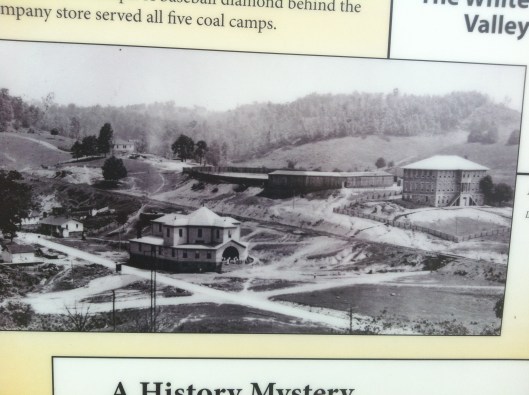
You can find more history for Whipple right here: http://www.wvexp.com/index.php/Whipple,_West_Virginia

Map of Whipple and surrounding area. 29 July 2015.

Coal brought more ethnic and cultural DIVERSITY to southern West Virginia.
02 Monday Oct 2017
Posted in African American History, Chapmanville, Logan
Tags
A.B. Eubanks, Appalachia, assessor, Chapmanville District, Charles Ritchie, Cole Hatfield, constable, county clerk, Democratic Party, E.R. Chapman, E.T. England, G.R. Claypool, history, Ira Hager, J.G. Hunter, James French Strother, Joe Buskirk, Johnny Pack, Lloyd P. Hager, Logan, Logan Banner, Logan County, Naaman Jackson, Noah Browning, politics, Republican Party, Superintendent of Schools, W.N. Bechtel, West Virginia
From the Logan Banner of Logan, WV, we find the following story dated September 10, 1926:
Groundwork for an energetic campaign was laid at a meeting of the candidates, committeemen and other party leaders and workers at a meeting held in Republican headquarters Wednesday afternoon. For more than two hours there was a frank discussion of local political conditions. Every appeal for party harmony–and these appeals came from all quarters–was greeted with applause and called forth unreserved pledges of loyalty to the whole ticket. Those present declare that so convincing was the evidence of a general determination to lay aside past differences about candidacies and party management that during the meeting and afterward predictions were advanced that the Republicans would carry the county by not less than 2,000 and more probably by 3,000. After the general meeting, local candidates and members of the committee met to formulate plans for the campaign. As a result of these meetings, it may be announced that this year the Republican campaign will be extended into every district. For the first time in the party’s history Chapmanville district is to be considered part of the battle-ground. That old Gibraltar of the Democracy is to have an opportunity at last, it is asserted, to hear both sides.
E.T. England, former attorney general and now the Republican nominee for representative in congress from the Sixth district, opened the general meeting by a fervent appeal for harmony and a whole-hearted effort in behalf of every candidate from Congressman James French Strother to Johnny Pack, candidate for constable. Notwithstanding his own candidacy, he declared that nothing interested him more in a political way than to see Logan county definitely fixed in the Republican column. “I have no personal interest at stake here,” he said, “yet if you think I’m needed at any time in the campaign let me know and I’ll come if it is possible. But you won’t need my services. All that is necessary to do is to go to the people and tell them in detail of what a Republican county court, a Republican sheriff, and a Republican assessor and magistrates have done; and then contrast that record with the record of the Democratic machine.” Until there was a political change in the administration of affairs, General England pointed out, the casual meeting of three or more Republicans on the street was considered by the authorities as an unlawful assembly. “Remind the people of the greater measure of liberty now, accorded to every man,” he advised. “Explain so all can understand that a Republican regime has lowered taxes, in spite of a reduced valuation of property for taxation purposes. It was the first time the taxpayers’ interest had been served; in fact for many years the subject of economy was never mentioned in Logan county.”
G.R. Claypool, chairman of the county committee, presided at the meeting and called on representatives of every element and of every section to discuss the party’s problems and prospects. Each speaker was able to present some new thought concerning the situation and as the meeting progressed enthusiasm waxed steadily higher. A climax was reached near the close of the session when Ira Hager, after adverting the registration figures showing a Republican margin of about 1,800, turned to General England and said: “You need not be troubled by the situation here; Logan county will give a Republican plurality of 3,000 all along the line.” Charles Ritchie, law partner of General England and a former assistant attorney general, recalled the court battle involving title to county offices in which he participated and commended Republican officials on the basis of reports he had received as to the record they are making. “No matter how earnestly you may have differed in the primary, you should abide by the expressed will of the majority,” he admonished. Senator Naaman Jackson urged the prompt discarding of minor grievances and differences tot he end that a vigorous canvass might be waged and a substantial victory won on November 2. Rev. A.B. Eubanks, introduced as one who had been made to feel the ruthless power of the Democratic machine, told of the interest of the colored voters in the impending contest.
Among others who spoke briefly were Joe Buskirk, candidate for county clerk; Noah Browning, candidate for county superintendent of schools; County Assessor J.G. Hunter; Cole Hatfield, Lloyd P. Hager, City Treasurer Nowlan, E.R. Chapman, Mr. Claypool, and W.N. Bechtel, who said he had been a member of the county committee for 30 years.
Source: “Republicans Form Plan for Spirited Campaign This Fall: Purpose to Invade Chapmanville Dist.,” Logan (WV) Banner, 10 September 1926.
Writings from my travels and experiences. High and fine literature is wine, and mine is only water; but everybody likes water. Mark Twain
This site is dedicated to the collection, preservation, and promotion of history and culture in Appalachia.
Genealogy and History in North Carolina and Beyond
A site about one of the most beautiful, interesting, tallented, outrageous and colorful personalities of the 20th Century
 Brandon Ray Kirk