• About

Brandon Ray Kirk

~ This site is dedicated to the collection, preservation, and promotion of history and culture in my section of Appalachia.

Brandon Ray Kirk

Tag Archives: writing

In Search of Ed Haley 283

07 Monday Apr 2014

Posted by Brandon Ray Kirk in Ed Haley, John Hartford, Music

≈ Leave a comment

Tags

Air Force, Ashland, Ashland High School, Beverly Haley, Biloxi, C&O Railroad, David Haley, Ed Haley, history, Kentucky, Lawrence Haley, life, Minnie Hicks, Mississippi, music, Pat Haley, Ugee Postalwait, writing

A few days after my visit with Ugee, Lawrence Haley’s daughter Beverly Williams died of cancer. Beverly had asked me to sing at her funeral, so I loaded up my bus and rode to Ashland. After the funeral, I played a bunch of Ed’s tunes in Pat’s kitchen. Once again, I could almost feel Lawrence’s presence. There was something about the location and having all the Haleys around that brought out Ed’s music in a marvelous way.

In quiet times, Pat spoke more with me about family affairs.

“Larry went to the Ashland high school until his senior year and he left when he was seventeen to join the Air Force,” she said. “He said he never ever wanted his children to ask him about the war and him not be able to say he went to fight. He got his GED when he was in Biloxi, Mississippi. He wanted his diploma from the Ashland high school but he never got it.”

After marrying, Pat said she and Lawrence settled in Ashland where he went to work for the C&O Railroad to help support the family (including his parents).

I told Pat about my recent visit to see Ugee Postalwait, who seemed to be rekindling a strong bond with the Haleys by telephone.

David, Pat’s son, remembered Ugee’s mother, Minnie Hicks.

“She called Mom and Dad and wanted them to come up and see her,” he said. “She said he didn’t think she was gonna be around much longer and wanted to see them. So Dad got off work and by the time he and Mom got ready and got up there it was two o’clock in the morning. She told them they could sleep as long as they wanted. At six o’clock in the morning, she was saying, ‘You fellas gonna sleep all day?’ She was ready to go. She was just an old farmer. Went to bed early and got up early.”

Emily Lucas Obituary

06 Sunday Apr 2014

Posted by Brandon Ray Kirk in Big Creek, Fourteen, Green Shoal, Women's History

≈ 2 Comments

Tags

Andrew Elkins, Big Creek, Catherine Fry, Emily Lucas, Fourteen Mile Creek, genealogy, Green Shoal, Grover Gartin, history, Jeff Lucas, John Fry, John Gartin, John Lucas, Lincoln County, Logan County, West Virginia, William Lucas, writing

Emily (Fry) Lucas was born on January 2, 1832 to John and Catherine (Snodgrass) Fry at the mouth of Green Shoal Creek in what is now Lincoln County, West Virginia but was then Logan County, Virginia. She married her first cousin, William R. Lucas, a son of John Lucas, who lived at nearby Big Creek. William and Emily made their home on Fourteen Mile Creek in Lincoln County. She died on June 7, 1910. I located her obituary many years ago in microfilm stored at the Hamlin-Lincoln County Public Library. Elder John Gartin penned her obituary, printed by the Lincoln Republican on June 20, 1910.

Our beloved sister, Emily Lucas, wife of W.R. Lucas, Sr., and mother of Jefferson Lucas, who is well known in this county, departed this life June 7th., at the age of almost 80 years. Mrs. Lucas united with the Church July 4th, 1883, and lived  faithfully her duty for almost 27 years. Funeral services were conducted by Eld. John Gartin, assisted by Eld. Andrew Elkins and Elder Grover Gartin. She leaves 5 children and many friends to mourn their loss and we extend our heart-felt sympathy to the bereaved ones.

Emily was my great-great-great-grandmother.

In Search of Ed Haley 282

06 Sunday Apr 2014

Posted by Brandon Ray Kirk in Ed Haley, Music

≈ Leave a comment

Tags

Ed Haley, fiddle, Harold Postalwait, history, John Hartford, Laury Hicks, music, Nashville, Ugee Postalwait, writing

A little later, just before I left, Ugee said, “John, we’re gonna give you that fiddle. That fiddle’s yours. I want to give it to you. It’s no good for it to lay around.”

Harold said, “She gave it to me and I’m gonna give it to you ’cause I don’t play it and there’s no use for it sitting in there on the shelf coming apart at the seams.”

I couldn’t believe it, but she and Harold insisted that I have the Laury Hicks fiddle. I regarded it as a real honor considering how much Ugee loved her father.

I told Harold, “I’ll treasure it as long as I live. I’ll put it right there with Ed’s fiddle and I won’t take it on the road.”

Ugee said, “Aw, play it.”

Harold’s wife said, “If you ever find out how old it is, we’d like to know.”

I said, “Well, it’s probably a German fiddle. It’s got a Stradivarius label in it.”

Ugee said, “That fiddle I know has got to be old ’cause I’m 88 years old and as fer back as I can remember Dad had that fiddle. I don’t know whether Ed Haley brought that fiddle in the country or not — you know, way back. Dad always had two or three fiddles and they’d trade around. Ed was always wanting that fiddle. Ed always did say this fiddle had a better tone than his. Every time he come home with one, why he wanted to trade with Dad to get that fiddle.”

I said, “I know why Ed wanted this fiddle — it’s a better fiddle than his. I mean, I love that one of his because it was his fiddle but this one is better.”

Harold showed me a bone tailpiece that used to be on Laury’s fiddle.

“Dad made this out of a bone,” Ugee said. “Granny had a cow by the name of ‘Old Flower’ and she died. Dad took a bone and he whittled that out of the bone from her. Granny said, ‘What are you doing Laury?’ and he said, ‘I’m trying to keep a piece of Old Flower. I got a piece of old Flower’s leg.’ Granny thought so much of that cow and she laughed. Granny said, ‘I don’t have an idea you’ll ever get it done, Laury.'”

When I got home, I went over Laury’s fiddle as closely as I had with Ed’s fiddle a few years before. I first noticed that it was worn in all of the same places as Ed’s, perhaps indicating a similar playing style. It had an incredibly deep bass tone, although it wasn’t a particularly loud instrument. Somewhere “back inside” was a little echo that wasn’t present in my other fiddles. Even though Ugee had told me to just play it, I couldn’t get past its history. It was Laury’s favorite fiddle — the one he had most of his life — the one Ed always tried to trade him out of — and one Ed surely played on.

How could I play it a lot?

I decided to put it on a shelf near Ed’s fiddle. Periodically, I refer back to it for clues.

In Search of Ed Haley 281

05 Saturday Apr 2014

Posted by Brandon Ray Kirk in Ed Haley, Music

≈ Leave a comment

Tags

Appalachia, Ashland, Calhoun County, Ed Haley, Ella Haley, fiddle, fiddlers, fiddling, Grand Ole Opry, history, John Hartford, Kentucky, Logan County, music, Nora Martin, Rosie Day, U.S. South, Ugee Postalwait, West Virginia, writing

I got my fiddle back out to play more for Ugee. When I finished “Going Across the Sea”, she said, “I’ve heard that. ‘Blackberry Wine’, that’s what he called it. They got ‘high’ on it. Dad and Ed would play it and say, ‘Boy you got a little high on that wine that time, didn’t ya?’ That meant they was getting smoother on the playing.”

I played more tunes for Ugee, who said, “You’re better on that there ‘Ed Haley playing’ than what you was the last time I heard you.”

A few tunes later, she said, “That makes me think of Dad’s fiddling.”

Harold said, “You ought to hear him play your dad’s fiddle.”

I said, “Do you want to hear me play it?”

Harold disappeared into another room and returned with Laury’s fiddle. It was in great condition. I tuned it up and played for Ugee, who just sat there quietly. I could see her emotions churning as she thought back to happy memories of her father. She was almost in tears.

“I didn’t know I’d ever hear my dad’s fiddle played again,” she said. “Last time I ever heard it played was in my dreams.”

I played Ugee a few tunes on her father’s fiddle and she said, “You like to play the fiddle. It’s hard to find good fiddlers. But since you went and loosened up on that bow down there, you’ve really got better on that. I don’t know music, but I can tell it when I hear it ’cause I was raised in a house where Dad played the fiddle, and Ed Haley.”

I played another tune for Ugee and she said, “Can you picture two fiddlers playing like that on the porch? Maybe play all day. You couldn’t play an old tune that I haven’t heard my dad and Ed Haley play ’cause they knowed them all. And it didn’t take them but a second to learn them. I’d have to learn the words to sing a song and Dad — maybe I would sing it to him about twice — and then we’d go someplace and he’d sing it. Now that’s just how quick he could catch on. Then he’d sit down and practice and smooth it out.”

Ugee told me about Laury’s final years. She said when he started feeling ill, he visited his sister Rosie Day in Ashland and his niece Nora Martin in Logan. It was his farewell tour, in a way. Ugee said he located Ed at Nora’s in what was maybe their last visit together. Once Laury made it back to Calhoun County, he slept in a chair because he was afraid he might never get up from bed. Eventually, though, he “took to his bed,” where he remained for a few years. He didn’t have a lot of company — he didn’t want Ed to see him in such poor condition. He purchased a radio and listened faithfully to the Grand Ole Opry. Every now and then, he’d get inspired to play.

“Ugee, come here,” Laury said during one of those times.

“What do you want, Dad?” Ugee answered, walking in to the room.

“Get behind me,” he said. “I’ve got to set up.”

“Okay,” she said, getting behind him.

“Now hand me the fiddle,” he said.

“I can’t and you there leaning again’ me,” she said.

“Ida, bring me my fiddle,” he told her.

Ugee said he sat there and “see-sawed and played that fiddle for me. I never got so tired in all my life. I thought I’d die.”

“Honey, I know I’m heavy on you,” he said.

“It ain’t hurting me a bit Dad,” Ugee fibbed.

When Laury was done playing, he looked up and said, “I want this fiddle give to Harold. I want Harold to have my fiddle.”

“That was the last time I seen him play the fiddle,” Ugee said. “He told me, ‘Wait till I get better and we’ll have some good music in the house.'”

In Search of Ed Haley 280

02 Wednesday Apr 2014

Posted by Brandon Ray Kirk in Ed Haley

≈ Leave a comment

Tags

blind, Calhoun County, Clay Hicks, Clyde Haley, Ed Haley, Ella Haley, history, Jack Haley, John Hartford, Laury Hicks, Lawrence Haley, Mona Haley, Noah Haley, Ralph Haley, Ugee Postalwait, West Virginia, writing

Ugee and I turned our attention back to the family photographs, where she spotted a picture of Ed’s son, Clyde. I told her about my visit with Clyde the previous year in California. She totally dismissed his story about Ed teaching him to drink, saying, “His dad never done no such stuff as that.” She paused for a second then said, “I went out and stopped Ed from whooping him one time. I think he’d stole some money or something. But he didn’t steal it. Noah did. I walked out and Ed had his belt off and I just took a hold of it. He said, ‘Who’s got a hold of me?’ He thought it was Ella. I said, ‘It’s me. You hit him another lick and the next lick’s mine. If you’re gonna whip him, whip the other’n.’ I said, ‘Noah’s the one was in your wallet.’ I seen Noah in it. I thought they’d sent him to get it. And Ed walked in and said, ‘Goddamn him, I ought to kill him.’ Then he told me, said, ‘Ugee, you ought to be careful with Clyde. He’s dangerous. He’ll sneak around and hurt ya.'”

Ugee had other run-ins with Noah, who was apparently one of Ella’s favorite children.

“Noah was picking on Lawrence and if he cried Noah’d say, ‘I never touched him.’ I said, ‘You do it again, I’ll whip you.’ Ella took Noah and went to Clay Hicks’ and stayed three days and when he come back he done just what I told him not to do. I never let on — I was a cooking. I said, ‘Noah, come here.’ I gave him three licks. I said, ‘I told you I’d whip you and I will.’ I looked at Ella and I said, ‘You needn’t take him and leave the country with him because I’ll follow wherever he’s at a whooping him.'”

This was interesting new information in the daily goings-on for Ed’s children. It was logical that since their parents were both blind they could get pretty wild. No doubt, Ed and Ella depended on family and friends to help raise the kids. Ugee, I noticed, had a close attachment to and interest in Ed’s children, almost as if they were her own family. She didn’t hesitate to tell how mean they could be.

“See, them kids had a hard time ’cause their dad and mother was blind and a lot of people didn’t want to bother with them,” she said. “People wanted the music of Ed and Ella but they didn’t want to put up with the family. That’s the truth of the matter. They was ornery. In other ways they wasn’t bad, either. You know, they was just children.”

Ugee seemed to think Mona was the meanest of the children.

“Mona was the orneriest young’n you ever seen in your life — to the core. She had to have all the attention. And she was pretty as a doll baby — curly-headed — just pretty as she could be. But my god, you couldn’t turn your back on her for a minute. If you was a baking a cake, she’d stick her hand in it. She could really get under your skin. I said, ‘Mona, you’re gonna keep on till I smack you.’ Ella said, ‘You don’t have to — I’ll give it to her.'”

Ugee lightly patted the air mimicking Ella.

“That’s the way she smacked — didn’t hurt them a bit. Mona would get up and look at her and laugh. Mona’d get out and go play a while, then she’d think of something to get into, like picking up chickens — ‘gonna weigh them’ — ringing their necks, throwing them down. ‘I’m weighing the chickens,’ she’d say. Killed about six or seven of them chickens. But that Ralph, he even shot hisself to see what it felt like. He’d do anything. You didn’t trust him out of your sight. He wouldn’t a cared to go out there and cut a cow’s throat or anything like that.”

I told Ugee what Mona had said about Ed being mean to her when she was growing up and she said, “Oh, I don’t think he was really mean to her. He’d fly up and cuss maybe. Now, the one they was really mean to was Clyde. Ella and Ed both was mean to Clyde.”

Wonder why?

“I’ve studied about that,” Ugee said. “Dad kept him all summer there at home to keep him from going to reform school. Now my dad woulda fought over him in a minute ’cause whatever he told him to do he minded him. And Mom, too. But I guess he was awful ornery when they were living in town. You know, kids a getting up to twelve, fourteen years old or something like that, there’s so much to get into. Now it would be awful to raise a family. I don’t remember Lawrence ever being like that. Jack and Lawrence was so good. Jack was a beautiful young man. Slender, dressy. He was a fine boy, but none of them came up with Lawrence far as I’m concerned. He was the best ole boy you ever seen. He would lead his mom and dad anyplace. I can see how careful he was. That little hand of his leading his mother ’round this mudhole — and his dad, too. I always called him my little boy. He was always better than the rest of them.”

Ugee said Lawrence always seemed bothered by the family troubles, even as a child.

In Search of Ed Haley 279

01 Tuesday Apr 2014

Posted by Brandon Ray Kirk in Ed Haley, Music

≈ Leave a comment

Tags

Annadeene Fraley, Beverly Haley, Calhoun County, Ed Haley, Ella Haley, fiddlers, fiddling, French Carpenter, history, John Hartford, Johnny Hager, Laury Hicks, Lawrence Haley, life, music, Pat Haley, Sol Carpenter, Ugee Postalwait, West Virginia, writing

Ugee also remembered French and Sol Carpenter coming to her father’s house. They were regarded by many as two of the best fiddlers in central West Virginia, so I had to ask, “How did your Dad and Ed regard the Carpenters?”

“There wasn’t nobody as good as Ed and Dad,” she said quickly. “They’d say, ‘Oh, you’re good,’ to the Carpenters and brag on them. Then get away from them and Ed’d say, ‘They didn’t come up with you, Laury,’ and Dad’d say, ‘They didn’t come up with you, either.'”

Ugee said a lot of fiddlers wouldn’t play in front of Ed. When they did, he would usually “listen a while, chew that tobacco and spit and wouldn’t say a thing” — then “cuss a blue streak” after they left. If the fiddler was really bad, though, or “if somebody was a playing something and they butchered it up a little bit — one of his tunes — he’d jump on his feet and stand straight up and say, ‘Goddamn! Goddamn!,'” Ugee said. “You knowed right then that there fella wasn’t playing it to suit him.” Laury would just die laughing over it and say, “Boy, he’s good ain’t he, Ed?”

I wondered if any fiddlers ever asked Ed for tips on how to play and Ugee seemed shocked. “Why, he wouldn’t a showed one how to play,” she said. “He learned music like I did — just a fooling with it.”

I asked Ugee about Johnny Hager, the banjo player she remembered coming with Ed to her father’s house when she was a small girl. I wondered if he was a good banjoist and she said, “Well, he was good for then, about like Grandpa Jones. Dad had a first cousin, Jasper McCune. Me, Dad and Jasper used to go and play music at pie suppers.” Banjos provided most of the second back then, she said. Some of the better players were Willie Smith of Ivydale and Emory Bailey of Shock. Guitars were rare.

I pulled out some of the Haley family photographs, which caused Ugee to ask about Pat Haley, who was coping with Lawrence’s death, her own poor health, and her daughter Beverly’s kidney cancer.

“Well Beverly is in a coma now,” I said. “Pat said she’ll wake up a little bit in the evening and she’ll kind of recognize them a little bit. So in other words, they’ve lost her but she’s still alive. The doctor thinks she’s got about two more weeks. Pat says, ‘We’re taking it one day at a time.’ And Annadeene Fraley, the one who introduced me to Pat, she’s got cancer.”

Ugee said she didn’t know how Pat was making it through all of the grief.

“‘Aunt Ugee,’ she calls me. She’s a fine woman. She’s a strong woman. Well, she had to be strong. She come over to this country married to Lawrence and he didn’t tell her his parents was blind until she got to New York. He said, ‘Well, I’ve got something I’ve got to tell you. My dad and mother is blind and if you want to go back I’ll pay your way back.’ She said, ‘I’ll stay.’ He went to Ed and Ella’s and Lawrence said he was starving to death for a mess of pinto beans. She said she never tasted beans. She didn’t know what they was. They cooked the beans and she tasted them and she thought they was brown mud. Said it tasted just like mud to her. Said they was just eating them beans and bragging on them and she wouldn’t touch them. They made fun of her over it.”

In Search of Ed Haley 278

31 Monday Mar 2014

Posted by Brandon Ray Kirk in African American History, Ed Haley, Music

≈ Leave a comment

Tags

Appalachia, Big Bear Fork, Black Bill, Bone Ratliff, Brown Hicks, Calhoun County, genealogy, Glenville, Harold Postalwait, Harvey Hicks, history, Jake Catlip, John Hartford, Laury Hicks, Little Bear Fork, Minnie Hicks, music, Sadie Hicks, Shock, Stumptown, Ugee Postalwait, West Virginia, writing

I asked Ugee if there were any black musicians in Calhoun County and she said she remembered some living around Big Bear Fork and Little Bear Fork.

“That’s in between Stumptown and Shock. They was two families lived out there: Jake Catlip and Bone Ratliff. They were black people. Lived out there in the country. First ones I ever seen. They called and wanted Dad to come to Bear Fork. Well, this boy had a guitar there. Maybe he was eight years old. They called him ‘Black Bill’ later. Dad said, ‘I can’t play it but I’ll show you something.’ Dad tuned it up and showed him three chords. Said, ‘Now learn that and come up and we’ll play music some day.'”

Ugee said she met Black Bill a little later.

“Well, when I was carrying Harold before Harold was born, I walked up the road and was going up to Dad’s and Mom’s and down there at what they call Hog Run there was a pile of rock there by the side the road and a paw paw tree,” she said. “And up jumped that black boy with a guitar on his back — liked to scared me to death. He said, ‘Lady, could you tell me where Dr. L.A. Hicks lives?’ I just pointed up to the house and said, ‘That house right there.’ I couldn’t speak I got scared so bad. Well, he just started out running. I was so weak I had to sit down. Got up there and here was that boy that Dad had showed how to chord. Now, you ought to heard him play. They kept him around there for a month. Well, the boys liked to hear him play the guitar. That’s where I got that ‘Down the road, down the road. Everybody going off down the road. Down the road, far as I can see. All the pretty girls look alike to me.’ Dad said to him, ‘Bill, you made a good guitar player but you can’t play with a fiddle. Now, let my daughter show you how to play the guitar with a fiddle.'”

Ugee’s meeting with Black Bill made a real impression on her.

“I’m not the type to get scared bad but that scared me: just come around a corner and there sat a black man — jump right out like that,” she said. “Now, I was only seven months along with Harold and when he was born he was so blue I thought I had ‘marked’ him with Black Bill. You know, you hear people ‘marking’ their kids? I raised up and they had him up to show me and I said, ‘Oh my god, I marked him to Black Bill.’ Mom said, ‘He’s not marked. He’s just blue.’ Me and Black Bill had many a laugh over it.”

I asked Ugee what happened to Black Bill and she said, “Brown Hicks was down sick and he went there and helped them out and everything. He stayed there one whole winter with them. Someone told me that he took up with Brown Hicks’ wife, Sadie. They lived together, I guess, over there toward Glenville and she had one kid by him. My brother Harvey seen the kid. Harvey said Sadie’s boy was ‘just a Black Bill made over.’ I don’t know what ever become of him after that. I never heard no more about him.”

In Search of Ed Haley 277

30 Sunday Mar 2014

Posted by Brandon Ray Kirk in Ed Haley, Music

≈ Leave a comment

Tags

Appalachia, Calhoun County, Cincinnati, Ed Haley, fiddlers, fiddling, Grand Ole Opry, Great Depression, Harold Postalwait, history, John Hartford, Laury Hicks, Minnie Hicks, music, Nashville, Ohio, Ugee Postalwait, West Virginia, Wilson Douglas, writing

I said, “Now when they played, would they play at the same time?”

“Oh yeah,” Ugee said. “Sometimes they played at the same time. Then one time maybe one would be a playing and the other would be a listening. Say, ‘Oh, you pulled that bow the wrong way.’ ‘Now that didn’t sound right to me. Go back over that again.’ They’d sit maybe not for ten minutes but for hours at a time when I was a growing up. Trying to out-beat the other. Which could make the best runs and which could do this. They never was mad at each other or anything like that, but they’d argue about it. ‘I know I beat you on it.’ ‘Well, you put that run in it at the wrong place.’ But Ed Haley is the only man I ever heard in my life second the fiddle. Dad’d play the fiddle and he’d second his with the fiddle. Like if you’re playing the ‘fine,’ why he might be playing the bass. That’s the prettiest stuff ever you heard. I heard Dad try to do it but Dad never got that good on it.”

I asked her if Ed ever played “Flannery’s Dream” and she said, “Oh, yeah. I’ve heard that.”

When I played “Wild Hog in the Red Brush”, she said Ed definitely played it, although she didn’t remember it having that title.

Just before I played another tune, Ugee said, “This is my birthday gift. My birthday’s the 19th. I’ll be 88 years old. Oh, I do pretty good, I reckon, for the shape I’m in. I remember pretty good but I’ve got trouble on this here voice box.”

“You remember pretty good, like your mother,” Harold said. “She was a hundred years old and she remembered when every kid was borned in that part of the country.”

Ugee said, “Mom delivered over five hundred children. She knowed every one of them and their name.”

Harold said, “And where they come from and up what hollow she had to walk and everything else. She never forgot nothing, that woman.”

Ugee said, “I don’t want to be that old. It’s all right if you can walk and get around. But if you’re down sick in the nursing home, let the good Lord take me away. I don’t wanna be there. My dad had leukemia and cancer of the stomach when he died. And it’s hard to see someone suffer like that.”

I told Ugee what Wilson Douglas had said about people gathering at her father’s home and listening to music on the porch and she said, “Sure, you ought to have seen my home. We had one porch run plumb across the front of the house. Ed and Dad just sat right along behind the railing.”

She pointed to the picture of John Hicks’ house and said, “Our house was even bigger than that. It was plank. But I remember when they all come over there and they’d gang around on that porch. Everybody. When Ed Haley was in the country, they come from miles around to our house. Word would get out that Ed was there or Ed was gonna be there a certain day.”

Inspired by Ugee’s memories, I got some paper from Harold and tried to sketch the Laury Hicks place. Ugee said things like, “It didn’t have no fireplace — we had gas then. And over on this end the steps went plumb down the hill to the road. That’s after they put the paved road down there, you see. Our house sat almost in a curve. Garage is down there at the road.”

I said, “So people gathered in front of the porch to hear all the music?” and Harold said, “They didn’t have much room. The yard only went out there maybe thirty or forty feet and then it dropped off down to the road. A pretty steep bluff — fifteen-, eighteen-, twenty-foot drop. On this side of the house was the garden spot and out the other end the yard didn’t go very far.”

Were there shade trees around the house?

“Yeah, three or four big oak trees over to one side and then we had apple trees on the other side,” Ugee said.

I asked if the crowds came at day or night or only on weekends and Ugee said, “They’d come through the day and Dad and Ed would play music all day and half the night. Weekends, why, it was always a big crowd. I’ve studied about them so much, about how good a friends Ed and Dad was. And always was that way. And they’d have the most fun together.”

Ugee said Ed never put a cup out for money.

“I never seen him put a cup out in my life. Maybe they’d be somebody to come around and put a cigar box to the side and everybody would go through and put money in it. Course when he was playing in the city — Cincinnati or some place like that — why he’d make quite a bit of money there. Whenever he played them religious songs, the hair’d stand on your neck. You’d look at two blind people sitting and singing.”

I interrupted, “Did he play Cincinnati a lot?”

Ugee said, “He played Cincinnati a lot. He went to Cincinnati to make records one time, too. That’d a been in the thirties. He fell out with them. They wanted to pick the tunes. Ain’t nobody picked tunes for Ed — Ed picked his own tunes. When he found out what they was trying to hook him on, he quit right then. Ed went down to Nashville once. I don’t know that he went to the Grand Ole Opry but he went to Nashville. When he found out what they done, he didn’t have no use for that.”

A Time to Love

30 Sunday Mar 2014

Posted by Brandon Ray Kirk in Poetry

≈ Leave a comment

Tags

Appalachia, love, poems, poetry, writing

A Time to Love

(Anniversary)

Though I did not think it possible,

I feel myself growing fond of someone.

It is a scary feeling —

One of uncertainty and curiosity.

I can feel myself ebbing toward you.

Is it time to love?

Though our eyes seldom behold each other,

Though we never have brushed lips or hands,

I can feel me loving you.

You are the girl I have dreamed of.

I have wanted you for years.

Nothing can change that.

I can not make these feelings go away.

I could conceal them longer

But I do not wish to do that.

I have wanted you for so long.

I know that it is time to love.

Do not be frightened or uncomfortable.

It is not the occasion for such negativity.

Frolic in the meadows God has created for us.

Laugh with the joy that you will finally know contentment.

I will make you happy.

I will make you love.

Have you ever truly?

O’ it is time to love.

The Spririt is everywhere around me.

It is our time to love.

Bless me with an opportunity to prove myself.

“Shew forth thy loving kindness in the morning.”

It is morning.

It’s our morning.

Let us grip hands

And love each other throughout the days.

Our sun will shine a little brighter, I think.

BRK

May 7, 1991

In Search of Ed Haley 276

29 Saturday Mar 2014

Posted by Brandon Ray Kirk in Ed Haley, Music

≈ Leave a comment

Tags

Ab Moss, Alabama, Calhoun County, Calhoun County Blues, Carey Smith, Catlettsburg, Ed Haley, Ella Haley, Euler, fiddlers, fiddling, guitar, Harold Postalwait, Hell Among the Yearlings, history, Homer Moss, John Hartford, Laury Hicks, music, Rogersville, Ugee Postalwait, West Virginia, writing

I took my fiddle out of the case and played for Ugee. A few tunes later, she said she liked my bow hold.

“Him and Dad both held the bow down there on the end,” she said. “Dad and Ed neither one never had no use for anyone that took hold of the bow way up toward the middle. They didn’t like that at all. And Ed and Dad neither one didn’t like for someone to put their fiddle down against their chest.”

Ugee paused, then said, “You’re with the fiddle like I was with the guitar after I got it. I set and fooled with it all the time — any time I had time away from dishes or anything, I’d set on the porch and play that guitar. I wanted to learn it and nobody to learn me and I learned it myself. I done the same thing with the banjo. Of course, Dad could thump the banjo some and play it a little bit. But when I got that guitar and changed over to it, then I wanted to learn that guitar.”

When I played “Yellow Barber” for Ugee she got choked up and said, “That sounds so good, John. You don’t know how good that sounds. I’ve been thinking about my dad and them all morning. I’d just have given anything if we’d had tapes of Dad.”

I told her that I’d been researching some tunes I suspected of being in Ed’s repertoire (many from the Lambert Collection) and she said, “Ed knew a lot of them. I’ve heard so many of his pieces, now I’m getting to where I’m forgetting a lot of pieces.”

When I played “Girl With the Blue Dress On”, she said, “I can’t get that one in my head. Some part of it sounds natural. Yeah, I’ve heard that song. There’s words to that: ‘She come down from Arkansas with a blue dress on. Prettiest girl I ever saw, she came down from Arkansas.’ Who was that old man that used to come and play that on the banjo? I believe it was Carey Smith from around Euler.”

I next played “Flying Cloud” for Ugee, who said, “Ed didn’t call it that. I can’t remember what he called it but he never called it ‘Flying Cloud’. Course Ed was pretty good to change names on you, too.”

I told her that Lawrence and I had always figured Ed’s “Catlettsburg” had another name, and she agreed.

“Well in fact he almost said he put the name on that piece ’cause they lived down there, you know,” Ugee said. “You see, most of them old fellas, if they’d hear a tune and they learnt to play it, then they’d change the name. Just like ‘Carroll County Blues’, we called it ‘Calhoun County’. Just whatever county you was a living in.”

I started playing “Calhoun County Blues”, fully aware that it was one of Ugee’s favorite tunes. She watched me quietly with an excited expression on her face.

“That’s my piece,” she said to Harold. “I could crack my heels to that.”

The next thing I knew, she rose out of her chair and started dancing.

I stopped and said, “Now, wait a minute. Don’t hurt yourself.”

She told me to go on, though.

“I didn’t think you could get your feet up that high,” Harold joked her.

Ugee said, “I was a dancer at one time. Never got tired.”

I continued playing the tune for a few minutes, then asked if Ed ever danced.

“I never seen Ed dance, but I’ll tell you what,” she said. “He could keep time with his feet. I can remember so well that foot coming down and then when he got older he’d pat his feet. He’d keep both of them going. He didn’t make a big noise with them or anything. Just give him a drink of whiskey or two and then he’d come down on that there fiddle and you ought to hear Ella then.”

I asked Ugee if Ed was pretty good at making up parts to tunes.

“Oh, yeah,” she said, not quite understanding my question. “He made up a lot of his tunes and then give them a name. And Dad would do the same. They was sitting around and they’d try different things. ‘Listen to this’ and ‘Put that note in there.’ I always did think they made up that ‘Hell Among the Yearlings’. Ab Moss lived down below us — very religious man — and he was there with his wife and Homer, the oldest boy, and Abner looked over to Ed and said, ‘That’s a pretty piece. What do you call that?’ and they said ‘Hell Among the Yearlings’. I always did think they made that up to aggravate him. Then they just cackled and laughed after they left. ‘Hell Among the Yearlings’, said, ‘That’s a pretty good name for it.’ I can see them yet a sitting on the porch laughing about it.”

Missing You This Day

29 Saturday Mar 2014

Posted by Brandon Ray Kirk in Poetry

≈ Leave a comment

Tags

love, poems, poetry, writing

Missing You This Day

Never have I felt so lonely,

So helpless,

As I have today.

Never have I cried for another

In frustration,

As I have today.

Never have I longed for one’s company

So desperately,

As I have today.

Today is the day

I miss you.

I am alone

And for the first time in my life,

I do not want to be.

I want my love to be here

Or I to be there.

So long as we are together.

I want to hear you laugh,

See you smile.

I want to smell your beautiful aroma

And feel your touch.

I want to love you in deed,

As well as in thought.

I want you to understand how

Lonely

I am.

Lonely, helpless, frustrated, longing.

This should convince you of my love.

See me as I weep like a child

At his dead mother’s grave.

See me as I stand alone,

Reaching for you.

Digging, clawing

In the muddy mound for what can not be had.

In this cold, desolate autumn wasteland

See me drowning in my lake of self-pity

Screaming at an unanswered echo,

Being bashed against a rocky shore,

Bleeding in the churning waters,

Mingling with its fury —

The fury of my turmoil.

Help me.

Only memories and future optimism

Keep me alive.

How I yearn for you,

Oh how I wish we could be together,

Forever,

So these separations would not be.

Oh how I want to sweep you from your

Home and run the winds

With your love, leaving rules behind.

I dream of the day we can finally be

You and I,

Until then, I will

Miss you,

As I do on this day.

 BRK

October 10, 1990

In Search of Ed Haley 275

28 Friday Mar 2014

Posted by Brandon Ray Kirk in Ed Haley, Music

≈ Leave a comment

Tags

Alabama, Arthur Smith, Calhoun County, Clayton McMichen, Douglas, Ed Haley, fiddlers, fiddling, Harold Postalwait, history, Ivydale, John Hartford, John Hicks, Johnny Hager, Josh Joplin, Laury Hicks, Lawrence Haley, Minnie Hicks, music, Rogersville, Ugee Postalwait, West Virginia, writing

Early one fall morning, I loaded up the Cadillac and drove south to the home of Harold Postalwait in Rogersville, Alabama. Harold, I knew, had a very special visitor — his mother, 88-year-old Ugee Postalwait of Akron, Ohio. Ugee remembered Ed Haley as far back as the Bull Moose era when he used to visit her father in Calhoun County, West Virginia. I hadn’t seen her since a visit to her home four years earlier and was anxious to pick her brain for new stories or tunes and show her what I had learned about Ed’s fiddling. Not long after my arrival, after we’d all said our “hellos,” Harold pulled out the picture of Laury Hicks and his family at John Hicks’ in Douglas, West Virginia.

“That’s my dad,” Ugee said, pointing to her father’s image. “I can remember when he wore the mustache.”

I wondered if the picture was taken before Ed was acquainted with Laury.

“Dad met Ed before I can remember,” Ugee said. “I don’t know whether that was before Mom and him was married. It was after Grandpap died, they said. Dad musta been about eighteen or something like that. Josh Joplin brought Ed into that country and told him they was a boy down there he wanted him to hear play the fiddle. Said, ‘He thinks he can play but he can’t play,’ and went in and had Dad to tune up his fiddle and played them two pieces. He played ‘Sally Goodin’ and I think it was the ‘Cacklin’ Hen’. Ed said, ‘Boy he’s showin’ me off.’ That was all they was to it. And that old man you know had told him a lie.”

I asked Ugee, “So Ed was coming to Ivydale before you were born?” and she said, “I have an idea he was because I wasn’t quite old enough to go to school when I first remember him. The first time I ever remember seeing him was when him and John Hager was there. I bet he wasn’t over 27 years old, when I think about it. I would say that was — I was born in 1907 — that was about 1913 or something like that. He was tall, slender. I can remember back when I was four years old real good and I remember him just as plain as if it was yesterday. We had a dirt road to the house and when he went to leave in the spring — they stayed all winter — he was walking behind John Hager and me and my brother Harvey run right to the bank and waved by at him. We’d been crying after him. I can see him walking along… But he carried that there fiddle in a flour bag. I never seen Ed with a fiddle in a case till after him and Ella was married. He always carried it in a flour poke.”

I told Ugee that I had worked a lot with Lawrence Haley in his last days trying to find out about Ed’s technique. Before I could show her what I had come up with, she started telling me what she remembered along those lines. She said Ed played with the fiddle under his chin — he hated when musicians “put the fiddle down low” — and turned it occasionally. He held the bow way out on its end, she said, and played a lot smoother than her father, a tremendous concession for a daughter to make. I asked if Ed played smoothly when she first saw him.

“Oh naturally he got better as years went by, but he was good then,” she said.

She gave me the impression that Ed’s fiddling had a lot of Irish-style “ornaments” in his early days (in the older, more European tradition), which gradually disappeared over the years — probably due to artistic peer pressure from radio fiddlers like Arthur Smith and Clayton McMichen. Smith and McMichen were extremely popular during the last few decades of Haley’s life.

Summer Blood

28 Friday Mar 2014

Posted by Brandon Ray Kirk in Poetry

≈ 2 Comments

Tags

love, poems, poetry, writing

Summer Blood

‘Twas a summer day

In the meadow

When I spied her.

She was a beauty,

A youth,

And I loved her.

She trod toward me,

And I could feel my leaves

Grow in pride.

She was to pick me

As her flower,

Her love.

As she neared me,

She smiled…

And I loved her.

She gently reached for me

And my eagerness to be hers

Grew.

As she caressed my proud stem,

She quickly pulled away

And I wept.

A drop of blood ran down my petals,

And the angel ran from the meadow.

“Take no heed to my black petals.

Only my sharp, brazen thorn.

Is it always the harmless rose

Which is chosen to adorn?”

 BRK

July 11, 1990

In Search of Ed Haley 274

27 Thursday Mar 2014

Posted by Brandon Ray Kirk in Culture of Honor, Ed Haley, Lincoln County Feud

≈ Leave a comment

Tags

Ashland, Boney Lucas, Cain Adkins, Catlettsburg, crime, Daisy Ross, Ed Haley, Eden, Fry, Goble Fry, Harts Creek, history, John Hartford, Kenova, Kentucky, Laurel Creek, Mariah Adkins, Milt Haley, murder, music, Sherman McCoy, Spicie McCoy, Wayne County, West Virginia, Winchester Adkins, writing

Excitedly, I next called Spicie McCoy’s daughter Daisy Ross who lived in Kenova, a small city near Huntington, West Virginia. Daisy’s voice was weak — she said she’d been down sick with a cold for the past week. I told her that we were trying to find out about Green McCoy’s death and she said, “My mother married Green McCoy and he was murdered. She married Goble Fry after he died. My mother was Spicie. She talked about Milt Haley. She just said they played music together, him and Green McCoy. They were good friends. I don’t know whether he was rough or not. I never heard Mom say nothing against Milt Haley.”

To our surprise, Daisy had no idea why Milt and Green were killed by the Brumfields.

“The Brumfields was rough: they had a mob,” she said. “The Brumfields first killed Grandpa’s son-in-law Boney Lucas, and when Mom married Green McCoy they said they had another’n they was gonna kill. Said they were gonna kill everything from the housecat up. They was just kindly mean people, I reckon.”

Daisy said Milt and Green tried to hide out from the Brumfields somewhere in Eden, Kentucky. She wasn’t sure where that was, but knew why they went there.

“Green McCoy had been married and had his wife and two children down there,” she said. “Yeah, Mommy didn’t know that, you see. Just before she got married, she got news that he had a wife and two children down there. He had told her that he had divorced her and Grandma said that hurt her awful bad and she couldn’t make Mommy understand it. Said Mom loved him so good she went ahead and married him anyhow.”

It didn’t take long for the Brumfields to locate Milt and Green.

“They went down and got them,” Daisy said. “The law was afraid of them, you know. They killed them there at Fry. And when the Brumfields killed them, they wasn’t satisfied with that. They took a pole-axe and beat their brains out and their brains splattered up on the door, Mom said. That hurt Mom so bad.”

I was chilled to the bone.

After Milt’s and Green’s murder, Daisy’s mother and family fled Harts Creek.

“The murder was in October and Grandpa and Uncle Winchester, his son, had to get out to Wayne County because they said they was gonna kill everything from the housecat up, the Brumfields did,” she said. “Grandma and Mom and the girls rented a boat and put all their household stuff and barrels of meat and come down on the river in January to Laurel Creek here in Wayne County. It was in January, but the peach trees was in full bloom, Mom said. Come a little warm spell and they all budded out in bloom. They didn’t have no menfolks to row the boat; the women had to do it. Mom said they was looking every minute to be drowned ’cause they was all kinds of stuff on the river. It was up from bank to bank.”

I asked Daisy if she knew Ed Haley and she said, “Yeah that’s the one played music with my brother, Sherman McCoy. My brother, he played the banjo. That was Green McCoy’s son you know and that was my half-brother. Ed Haley and Sherman McCoy — they was good friends. They got together and played music together down in Kentucky somewhere. I guess maybe in Catlettsburg or maybe in Ashland. He was Milt Haley’s son. And they said their fathers was killed together.”

In Search of Ed Haley 273

26 Wednesday Mar 2014

Posted by Brandon Ray Kirk in Culture of Honor, Ed Haley, Harts, Lincoln County Feud

≈ Leave a comment

Tags

Billy Adkins, Brandon Kirk, Cain Adkins, Cleveland, Columbus, crime, Daisy Ross, East Lynn, feud, Green McCoy, Green McCoy Jr., history, Huntington, John Hartford, Logan, Luther McCoy, Marango, McCoy Time Singers, music, Ohio, Ralph McCoy, Sherman McCoy, Spicie McCoy, Stiltner, Wayne County, West Virginia, writing

When we got back to Billy’s, we were amazed to find that he’d made contact with Green McCoy’s family. He showed us telephone numbers for two of Green’s grandsons, Ralph McCoy and Luther McCoy, as well as for Spicie McCoy’s daughter, Daisy (Fry) Ross.

I dialed up Ralph McCoy in Marango, Ohio, and explained who I was and what I was doing, then asked about Green McCoy’s murder.

“I’m 72 years old but a lot of that went on before I was born,” he said. “I’ve had two or three strokes and sometimes my memory’s gone. From the way I understood it, it was a Brumfield that killed my grandfather. There was something going on — I don’t know what the feud was about. See, I know nothing first-hand. My dad was born in 1888 and my dad was I think about two years old when his dad was murdered. My grandmother told me this part of it: that her and my dad and somebody else, I believe… My grandmother’s name was Spicie McCoy. I guess my grandfather put her on a raft or something and pushed her out in the river and told her to get out of there, to just keep on going and be quiet about it. She was pregnant for Uncle Green. Then after my grandfather got killed she married Goble Fry and then I think they came on down into Wayne County, which was around Stiltner and East Lynn and in that area.”

I asked Ralph if he knew anything about Green McCoy being a musician and he said, “Yes, very much. I’d say he was just like my dad, Sherman McCoy. He played anything that had strings on it. My dad and my grandmother, they traveled all over Wayne County playing in a quartet. They called themselves the ‘McCoy Time Singers.’ I did some traveling with them but it was just more or less in the Wayne County area. Logan city, I’ve been down that far with my dad and Grandma.”

So Green McCoy’s son Sherman was a musician, too?

“He did play with some people before he became a Christian and he played in Cleveland over the radio and stuff like that, but I wasn’t living with him then,” Ralph said. “I was living with mother. See, I was brought to Columbus, Ohio, and raised from about nine years old, so I lost track of a lot of them. But I did know he played over the radio in Cleveland and I think Huntington and several different places.”

“Have you talked with Luther McCoy?” Ralph asked.

I told him that we had tried calling Luther first but that he was in bed asleep.

“If you can talk with him, I think you’ll find out he’s probably in the same business you’re in,” Ralph said. “He plays, I think, back-up for several bands. From the way I understand it, he might be out on the West Coast.”

This was all great: our first contact with Green McCoy’s descendants.

In Search of Ed Haley 272

25 Tuesday Mar 2014

Posted by Brandon Ray Kirk in Big Harts Creek, Ed Haley, Music

≈ Leave a comment

Tags

banjo, Bernie Adams, Bernie Hager, Billy Adkins, Boone County, Brandon Kirk, Ed Haley, fiddle, fiddler, Harts Creek, history, Hubert Baisden, Ike Hager, Irene Hager, John Hartford, Johnny Hager, Low Gap, music, Robert Adams, Roy Dempsey, West Virginia, writing

The next day, I followed a tip from Billy and Brandon and made the short drive to see Irene Hager and her son Ike at Low Gap in Boone County, West Virginia. Irene was the daughter of Hubert Baisden, a close friend to Johnny Hager, and was the widow of Bernie Hager, Johnny’s nephew. Irene said Johnny used to visit her father at nearby Big Branch when she was a girl. Johnny played the fiddle and banjo and talked frequently about his travels with Ed back in the ’20s and ’30s.

“Ed Haley was an ever day word with Johnny,” Ike said.

Ike said Johnny Hager was most known as a fiddler, not a banjo-picker. He said he “cradled” the fiddle in his arms, never put it under his chin and bowed a lot of long strokes. He was primarily a claw-hammer banjoist but “did have a finger style.” Irene said his favorite song was “Joshua’s Prayer”, while Ike remembered him loving “Will There Be Any Stars in My Crown”. He also played “Rosewood Casket”, “Nelly Gray”, “Ballad of Old Number Nine”, “John Hardy”, “In the Pines”, “Cripple Creek”, “Wreck of ’97”, “Mockingbird on the Hill”, and “Little Log Cabin”.

Ike said Johnny taught his father how to play the banjo.

“He wanted a banjo player in the family to play around the houses and the homes with him,” Ike said. “My dad was musically inclined — he could chord a guitar and follow him along on the fiddle and banjo — so he talked Dad into getting a banjo. Dad traded six or seven hens and walked several mile with them hens upside down for this old banjo and Johnny taught him how to play. He picked up on playing pretty fast. I know they used to go over on Big Ugly and play in a school somewhere. Now they was some more boys that played with them. They was Wilcoxes, down on Mud River.”

That evening, I met up with Brandon at Billy Adkins’ house in Harts. Billy said a local man named Roy Dempsey told him earlier that day about having a genuine Ed Haley fiddle. I didn’t have too much time — I was leaving for Nashville later that night — but I wanted to see Roy. Brandon and I drove a little ways up Harts Creek to the Dempsey place, situated on a hill near the mouth of Big Branch. Roy showed us the fiddle, which he said Ed had given to Bernie Adams. Bernie later gave it to Roy’s father-in-law, Robert Adams. It was the first “Ed Haley fiddle” I’d seen on Harts Creek.

Dingess Family

24 Monday Mar 2014

Posted by Brandon Ray Kirk in Big Harts Creek, Ed Haley, Lincoln County Feud

≈ 3 Comments

Tags

Appalachia, genealogy, Harts Creek, Henderson Dingess, history, Hugh Dingess, Logan County, Sallie Dingess, U.S. South, West Virginia, writing

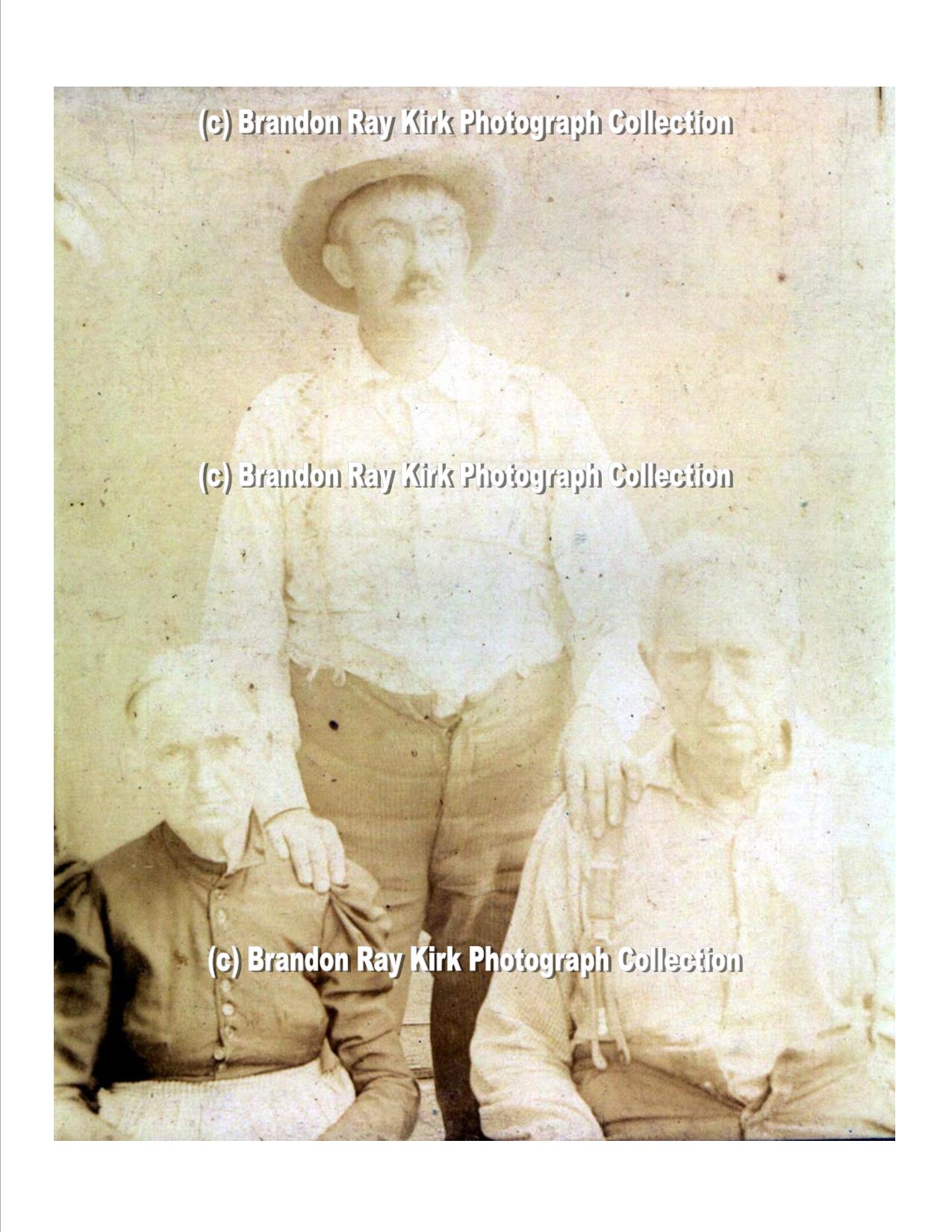
Hugh Dingess stands behind his parents, Sallie (Adams) Dingess and Henderson Dingess

Hugh Dingess stands behind his parents, Sallie (Adams) Dingess and Henderson Dingess

In Search of Ed Haley 272

24 Monday Mar 2014

Posted by Brandon Ray Kirk in Big Harts Creek, Culture of Honor, Ed Haley, Lincoln County Feud

≈ 1 Comment

Tags

Al Brumfield, Albert Dingess, Ben Adams, Brandon Kirk, Charlie Dingess, crime, Dave "Dealer Dave" Dingess, Dave Dingess, feud, fiddler, fiddling, French Bryant, Green McCoy, Harts Creek, Harve Dingess, Harvey "Long Harve" Dingess, Henderson Dingess, history, Hollene Brumfield, Hugh Dingess, Maude Dingess, Millard Dingess, Milt Haley, Thompson Branch, writing

Either way, Milt Haley and Green McCoy were paid a side of bacon and some money to eliminate Al Brumfield. Maude Dingess said Milt and Green ambushed Al and Hollena Brumfield as they rode down Harts Creek on a single horse. Hollena’s brothers, Harvey and Dave, followed behind them on separate horses.

“I guess they thought he was gonna have trouble or they wouldn’t a been doing that,” Maude said, somewhat logically.

As they made their way past Thompson Branch, Brumfield spotted two men hiding in the weeds. He ducked somehow to avoid harm, but Hollena was shot from the horse.

“Al just went on,” Maude said, while Dave and Harve “ran back up here to their mother and daddy’s house to get somebody to go down there with them.”

They later returned with a sled and hauled Hollena’s bloody body back to Smoke House.

In a short time, Milt and Green were rounded up and taken to Hugh Dingess’ home at the mouth of Bill’s Branch.

“I’d say old man Hugh got them kids and took them maybe to some of their relatives’ houses or somewhere else,” Harve Dingess said. “Maybe up to old Albert Dingess’ or somewhere like that. See, old Albert just lived on up the road a mile, mile and a half.”

Harve continued, “They said they all had a big feast there and I guess they had a lot of the corn whiskey there and all of them drinking and playing music. And they said they made the old man Haley — he was a fiddle player — they said they made him play that fiddle all night and all of them drunk a dancing. They said that they just kept telling him to keep that fiddle a going.”

I wondered where Milt got the fiddle at Hugh’s and Maude said, “They sent somebody to somebody’s house that had a fiddle I bet and brought it back. Back in them days you know a lot of households had them old instruments in them.”

I asked if Milt was considered a good fiddler and Harve said, “At that time, I think they said he was. Supposed to’ve been very good.”

Harve had never heard much talk about Green McCoy but stressed: “I know I did hear them talk about them making the old man play the fiddle all night and all of them a dancing and cooking and having a big feast there and drinking their moonshine.”

I said, “Most people that are gonna kill somebody, they don’t want to get to know them. If you have an execution, the executioner don’t want to get to know the prisoner because the more he gets to know that prisoner the harder it is for him to conduct the execution. To have two guys to play music for you before you’re fixing to kill them — that’s a good way to get to know them real quick. Boy, I don’t see how they did that.”

“I guess that’s the reason they kept old French Bryant,” Harve said. “They said he didn’t care for nothing. They said he was one of the leaders. He was a hollering, ‘Let’s go! Let’s do it!’ Pushing the thing, from what I could understand. He was a hollering, ‘Let’s kill the sons of bitches!’ That’s what I heard over the years. I even heard Millard say that one time. French was the one wanting to hang them up to the walnut tree and I think they finally decided against that.”

Brandon wondered who else was in the gang and Maude said, “Hugh and Charlie Dingess was into that. They was Grandpap’s boys — the older boys. Hugh was rough and over-bearing. Harve’s grandfather, ‘Short Harve,’ was into that. Burl Farley was into it, too.”

Maude doubted that Henderson Dingess was involved due to his advanced age (approximately 58 years), but we felt it was entirely possible since (1) men his age and older participated in the Hatfield-McCoy feud and (2) these guys had reportedly shot his daughter. Harve said he figured that his great-grandfather Albert Dingess was in on it because “he was just that kind of guy.”

“Dealer Dave” Dingess was probably involved, too, Harve said, because “them Dingesses all hung together. They was just a band of outlaws, as we would call it, that day and time.”

Harve and Maude hadn’t heard much about the story beyond that, although they knew that Milt and Green were taken away from Hugh’s when the Brumfields learned that another mob was forming to rescue them. They never confessed to committing the ambush on Al and Hollena Brumfield but everyone figured that Ben Adams was behind the trouble. As a result, Maude said the Brumfields and Dingesses were “against” Ben in following years. At one point, they tried to burn his home. Maude’s father was one of the few Dingesses who never held a grudge. He often referred to him as “poor old Uncle Ben.”

Whirlwind 1.23.1919

24 Monday Mar 2014

Posted by Brandon Ray Kirk in Big Harts Creek, Timber, Whirlwind

≈ 2 Comments

Tags

Doskie Sargent, George Hensley, Harts Creek, Harve Smith, history, Island Creek Coal Company, J.H. Workman, K.K. Thomas, Logan, Logan County, Mose Tomblin, Reece Dalton, Rhoda Jane Sargent, Rockhouse Fork, Shade Smith, Taylor Blair, timbering, West Virginia, William Tomblin, World War I, writing

“Blue Eyed Beauty,” a local correspondent at Whirlwind in Upper Hart, Logan County, West Virginia, offered the following items, which the Logan Democrat printed on Thursday, January 23, 1919:

Harve Smith and Reece Dalton were business visitors to Logan Monday.

Mrs. Rhoda Jane Sargent went to Buffalo Sunday to stay with her sister, Mrs. Doskie Sargent.

William and Mose Tomblin are cutting timber on Rockhouse for the Island Creek Coal Co.

Prof. K.K. Thomas is getting along nicely with his school on Twelvepole since his return from the army.

Shade Smith is at Logan this week serving on the petit jury.

Rev. George Hensley preached at McCloud Sunday.

Taylor Blair and family spent a few days this week with his mother.

J.H. Workman passed this way Friday, enroute to Logan.

In Search of Ed Haley 270

21 Friday Mar 2014

Posted by Brandon Ray Kirk in Big Harts Creek, Ed Haley

≈ 2 Comments

Tags

Al Brumfield, Billy Adkins, crime, French Bryant, genealogy, Harts Creek, Harve Dingess, history, Hollene Brumfield, Hugh Dingess, Logan County, Maude Dingess, Millard Dingess, Paul Dingess, West Virginia, writing

After talking with Oris, we drove back onto Smoke House Fork to locate the site of the old Hugh Dingess home. I wanted to see where Milt Haley had played his last tune. Some twenty minutes later, we parked in a driveway at Bill’s Branch and met Paul Dingess, one of Hugh’s many descendants, and a local resident. Paul gave us a walking tour of the Hugh Dingess farm, showing us what was left of the old Dingess place — a small pile of chimney stones — as well as the “hanging tree” where the mob almost hung Milt and Green. He said his grandfather Millard Dingess had inherited the property years ago. With darkness fast approaching, we thanked Paul and took off down Smoke House.

A short time later, we stopped to visit Harvey and Maude Dingess, a neat elderly couple who lived in a nice brick home just below the old Hugh Dingess homeplace. Maude, Billy said, was a niece to Hollena Brumfield and a granddaughter to Henderson Dingess. Her husband Harvey was raised on West Fork near the likes of French Bryant and others. These were incredibly close connections and I was very excited at the prospects of what they might know.

Inside, after all the proper introductions, we sat down at the kitchen table. I had Hugh Dingess’ hued log home on my mind, so I asked about it first. Harve said Hugh’s son Millard lived in it after Hugh’s death. The old-timers told all kinds of ghost stories about it.

“They said they would take pack-peddlers in there and take them upstairs and kill them and take their money and whatever they had and then take them out in the woods somewhere and just get rid of them,” he said.

I had heard similar stories about the Al Brumfield house in Harts so I had to ask if there was any truth to those kind of stories. I mean, did the Brumfields and Dingesses really murder these old pack-peddlers?

“I don’t know,” Harve said, “but it was talked. People’d swear that Hugh’s house was haunted, the upstairs part. It was pretty well dark up there. Them kids would go up there and play and they’d come running down the stairs. They’d swear it was haunted and they wouldn’t hardly go upstairs in that old house ’cause they’d told tales about it over the years, I guess. And they said Millard, back when he’d drink, he’d get down drunk and he’d swear that he could hear things up them stairs. Millard said it was all haunted up there.”

So what happened to it?

“About in the ’40s, they quit living in it for a long time,” Harve said, “and then it just kindly squashed down — the heavy snow and stuff — and it just laid there like a junk pile for a long time. They kept getting a little bit out at a time till it just got away — all but the old chimney rocks.”

← Older posts
Newer posts →

Feud Poll 1

If you had lived in the Harts Creek community during the 1880s, to which faction of feudists might you have given your loyalty?

Categories

  • Adkins Mill
  • African American History
  • American Revolutionary War
  • Ashland
  • Atenville
  • Banco
  • Barboursville
  • Battle of Blair Mountain
  • Beech Creek
  • Big Creek
  • Big Harts Creek
  • Big Sandy Valley
  • Big Ugly Creek
  • Boone County
  • Breeden
  • Calhoun County
  • Cemeteries
  • Chapmanville
  • Civil War
  • Clay County
  • Clothier
  • Coal
  • Cove Gap
  • Crawley Creek
  • Culture of Honor
  • Dingess
  • Dollie
  • Dunlow
  • East Lynn
  • Ed Haley
  • Eden Park
  • Enslow
  • Estep
  • Ethel
  • Ferrellsburg
  • Fourteen
  • French-Eversole Feud
  • Gilbert
  • Giles County
  • Gill
  • Green Shoal
  • Guyandotte River
  • Halcyon
  • Hamlin
  • Harts
  • Hatfield-McCoy Feud
  • Holden
  • Hungarian-American History
  • Huntington
  • Inez
  • Irish-Americans
  • Italian American History
  • Jamboree
  • Jewish History
  • John Hartford
  • Kermit
  • Kiahsville
  • Kitchen
  • Leet
  • Lincoln County Feud
  • Little Harts Creek
  • Logan
  • Man
  • Matewan
  • Meador
  • Midkiff
  • Monroe County
  • Montgomery County
  • Music
  • Native American History
  • Peach Creek
  • Pearl Adkins Diary
  • Pecks Mill
  • Peter Creek
  • Pikeville
  • Pilgrim
  • Poetry
  • Queens Ridge
  • Ranger
  • Rector
  • Roane County
  • Rowan County Feud
  • Salt Rock
  • Sand Creek
  • Shively
  • Spears
  • Sports
  • Spottswood
  • Spurlockville
  • Stiltner
  • Stone Branch
  • Tazewell County
  • Timber
  • Tom Dula
  • Toney
  • Turner-Howard Feud
  • Twelve Pole Creek
  • Uncategorized
  • Warren
  • Wayne
  • West Hamlin
  • Wewanta
  • Wharncliffe
  • Whirlwind
  • Williamson
  • Women's History
  • World War I
  • Wyoming County
  • Yantus

Feud Poll 2

Do you think Milt Haley and Green McCoy committed the ambush on Al and Hollene Brumfield in 1889?

Blogroll

  • Ancestry.com
  • Ashland (KY) Daily Independent News Article
  • Author FB page
  • Beckley (WV) Register-Herald News Article
  • Big Sandy News (KY) News Article
  • Blood in West Virginia FB
  • Blood in West Virginia order
  • Chapters TV Program
  • Facebook
  • Ghosts of Guyan
  • Herald-Dispatch News Article 1
  • Herald-Dispatch News Article 2
  • In Search of Ed Haley
  • Instagram
  • Lincoln (WV) Journal News Article
  • Lincoln (WV) Journal Thumbs Up
  • Lincoln County
  • Lincoln County Feud
  • Lincoln County Feud Lecture
  • LinkedIn
  • Logan (WV) Banner News Article
  • Lunch With Books
  • Our Overmountain Men: The Revolutionary War in Western Virginia (1775-1783)
  • Pinterest
  • Scarborough Society's Art and Lecture Series
  • Smithsonian Article
  • Spirit of Jefferson News Article
  • The Friendly Neighbor Radio Show 1
  • The Friendly Neighbor Radio Show 2
  • The Friendly Neighbor Radio Show 3
  • The Friendly Neighbor Radio Show 4
  • The New Yorker
  • The State Journal's 55 Good Things About WV
  • tumblr.
  • Twitter
  • Website
  • Weirton (WV) Daily Times Article
  • Wheeling (WV) Intelligencer News Article 1
  • Wheeling (WV) Intelligencer News Article 2
  • WOWK TV
  • Writers Can Read Open Mic Night

Feud Poll 3

Who do you think organized the ambush of Al and Hollene Brumfield in 1889?

Recent Posts

  • Logan County Jail in Logan, WV
  • Absentee Landowners of Magnolia District (1890, 1892, 1894)
  • Charles Spurlock Survey at Fourteen Mile Creek, Lincoln County, WV (1815)

Ed Haley Poll 1

What do you think caused Ed Haley to lose his sight when he was three years old?

Top Posts & Pages

  • Julia May Lucas, Angeline Lucas, and Eliza McComas
  • C&O Officials Visit Guyan Valley (1917)
  • William McCoy Property in Magnolia District (1878-1887)
  • In Search of Ed Haley 309
  • Civil War Gold Coins Hidden Near Chapmanville, WV

Copyright

© Brandon Ray Kirk and brandonraykirk.wordpress.com, 1987-2023. Unauthorized use and/or duplication of this material without express and written permission from this blog’s author and/or owner is strictly prohibited. Excerpts and links may be used, provided that full and clear credit is given to Brandon Ray Kirk and brandonraykirk.wordpress.com with appropriate and specific direction to the original content.

Archives

  • February 2025
  • January 2025
  • October 2023
  • September 2023
  • December 2022
  • November 2022
  • May 2022
  • April 2022
  • February 2022
  • November 2021
  • October 2021
  • September 2021
  • June 2021
  • May 2021
  • April 2021
  • March 2021
  • February 2021
  • January 2021
  • December 2020
  • November 2020
  • October 2020
  • July 2020
  • June 2020
  • May 2020
  • April 2020
  • March 2020
  • February 2020
  • January 2020
  • December 2019
  • November 2019
  • October 2019
  • September 2019
  • August 2019
  • July 2019
  • June 2019
  • May 2019
  • April 2019
  • March 2019
  • February 2019
  • January 2019
  • December 2018
  • November 2018
  • October 2018
  • September 2018
  • August 2018
  • July 2018
  • June 2018
  • May 2018
  • April 2018
  • March 2018
  • February 2018
  • January 2018
  • December 2017
  • November 2017
  • October 2017
  • September 2017
  • August 2017
  • July 2017
  • June 2017
  • May 2017
  • April 2017
  • March 2017
  • February 2017
  • January 2017
  • December 2016
  • November 2016
  • October 2016
  • September 2016
  • August 2016
  • July 2016
  • June 2016
  • May 2016
  • April 2016
  • March 2016
  • February 2016
  • January 2016
  • December 2015
  • November 2015
  • October 2015
  • September 2015
  • August 2015
  • July 2015
  • June 2015
  • May 2015
  • April 2015
  • March 2015
  • February 2015
  • January 2015
  • December 2014
  • October 2014
  • September 2014
  • August 2014
  • July 2014
  • June 2014
  • May 2014
  • April 2014
  • March 2014
  • February 2014
  • January 2014
  • December 2013
  • November 2013
  • October 2013
  • September 2013
  • August 2013
  • July 2013
  • June 2013
  • May 2013
  • April 2013
  • March 2013
  • February 2013
  • January 2013
  • December 2012
  • November 2012

Enter your email address to follow this blog and receive notifications of new posts by email.

Join 2,927 other subscribers

Tags

Appalachia Ashland Big Creek Big Ugly Creek Blood in West Virginia Brandon Kirk Cabell County cemeteries Chapmanville Charleston civil war coal Confederate Army crime culture Ed Haley Ella Haley Ferrellsburg feud fiddler fiddling genealogy Green McCoy Guyandotte River Harts Harts Creek Hatfield-McCoy Feud history Huntington John Hartford Kentucky Lawrence Haley life Lincoln County Lincoln County Feud Logan Logan Banner Logan County Milt Haley Mingo County music Ohio photos timbering U.S. South Virginia Wayne County West Virginia Whirlwind writing

Blogs I Follow

  • OtterTales
  • Our Appalachia: A Blog Created by Students of Brandon Kirk
  • Piedmont Trails
  • Truman Capote
  • Appalachian Diaspora

BLOOD IN WEST VIRGINIA is now available for order at Amazon!

Blog at WordPress.com.

OtterTales

Writings from my travels and experiences. High and fine literature is wine, and mine is only water; but everybody likes water. Mark Twain

Our Appalachia: A Blog Created by Students of Brandon Kirk

This site is dedicated to the collection, preservation, and promotion of history and culture in Appalachia.

Piedmont Trails

Genealogy and History in North Carolina and Beyond

Truman Capote

A site about one of the most beautiful, interesting, tallented, outrageous and colorful personalities of the 20th Century

Appalachian Diaspora

  • Subscribe Subscribed
    • Brandon Ray Kirk
    • Join 789 other subscribers
    • Already have a WordPress.com account? Log in now.
    • Brandon Ray Kirk
    • Subscribe Subscribed
    • Sign up
    • Log in
    • Report this content
    • View site in Reader
    • Manage subscriptions
    • Collapse this bar
 

Loading Comments...