• About

Brandon Ray Kirk

~ This site is dedicated to the collection, preservation, and promotion of history and culture in my section of Appalachia.

Brandon Ray Kirk

Tag Archives: Williamson

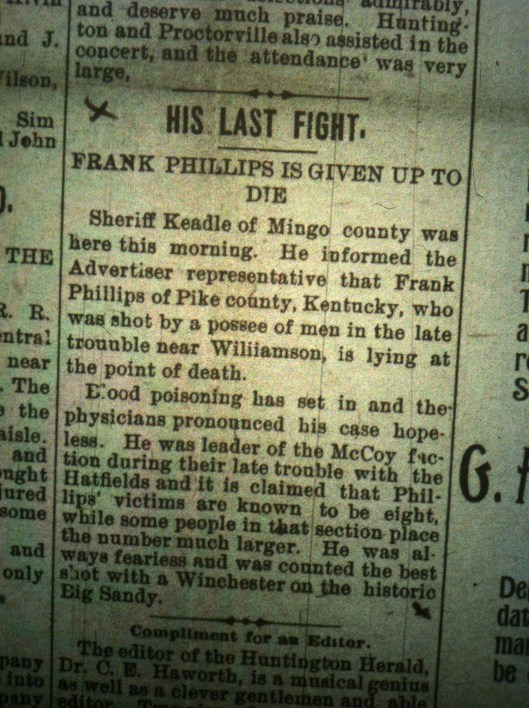
Frank Phillips is Given Up to Die (1895)

16 Wednesday Jul 2014

Posted by Brandon Ray Kirk in Big Sandy Valley, Culture of Honor, Hatfield-McCoy Feud

≈ Leave a comment

Tags

Appalachia, Big Sandy River, blood poisoning, crime, Frank Phillips, genealogy, Hatfield-McCoy Feud, history, Huntington Advertiser, Kentucky, Mingo County, Pike County, Sheriff Keadle, U.S. South, West Virginia, Williamson

Frank Phillips HA 09.28.1895

“His Last Fight: Frank Phillips is Given Up to Die,” Huntington (WV) Advertiser, 28 September 1895

Interview with John Dingess 2 (1996)

11 Friday Jul 2014

Posted by Brandon Ray Kirk in Big Harts Creek, Culture of Honor, Ed Haley, Lincoln County Feud, Warren

≈ Leave a comment

Tags

Al Brumfield, Albert Dingess, Anthony Adams, Ben Adams, Bill Brumfield, Bill's Branch, Billy Adkins, blind, Blood in West Virginia, Boardtree Bottom, Brandon Kirk, Buck Fork, Burl Farley, Carolyn Johnnie Farley, Cecil Brumfield, Charley Brumfield, Charlie Dingess, crime, Ed Haley, Fed Adkins, fiddling, French Bryant, George Fry, Green McCoy, Green Shoal, Hamlin, Harts Creek, Harve "Short Harve" Dingess, Hell Up Coal Hollow, Henderson Dingess, history, Hugh Dingess, John Brumfield, John Dingess, Kentucky, life, Lincoln County Feud, Low Gap, Milt Haley, murder, Paris Brumfield, Polly Bryant, Smokehouse Fork, Sycamore Bottom, Tom Maggard, Trace Fork, Vilas Adams, West Fork, West Virginia, Will Adkins, Williamson, writing

Al rounded up a gang of men to accompany him on his ride to fetch the prisoners in Williamson. Albert and Charlie Dingess were ringleaders of the posse, which included “Short Harve” Dingess, Hugh Dingess, John Dingess, Burl Farley, French Bryant, John Brumfield, and Charley Brumfield. Perhaps the most notorious member of the gang was French Bryant – “a bad man” who “did a lot of dirty work for the Dingesses.” On the way back from Kentucky, he tied Milt and Green by the arms and “drove them like a pair of mules on a plow line.”

“French Bryant run and drove them like a pair of horses ahead of these guys on the horses,” John said. “That’s quite a ways to let them walk. Old French, he married a Dingess. I knew old French Bryant. When he died, he was a long time dying and they said that he hollered for two or three days, ‘Get the ropes off me!’ I guess that come back to him.”

When the gang reached the headwaters of Trace Fork — what John called “Adams territory” — they sent a rider out ahead in the darkness to make sure it was safe to travel through that vicinity.

Waiting on the Brumfield posse was a mob of about 100 men hiding behind trees at Sycamore Bottom, just below the mouth of Trace Fork. This mob was led by Ben and Anthony Adams and was primarily made up of family members or people who worked timber for the Adamses, like Tom Maggard (“Ben’s right hand man”).

As the Brumfield rider approached their location, they began to click their Winchester rifles — making them “crack like firewood.” Hearing this, the rider turned back up Trace Fork, where he met the Brumfields and Dingesses at Boardtree Bottom and warned them about the danger at the mouth of Trace. They detoured safely up Buck Fork, then stopped at Hugh Dingess’ on Smokehouse where they remained for two or three days, not really sure of what to do with their prisoners. They made a “fortress” at Hugh’s by gathering about 100 men around them, fully aware that Ben Adams might make another effort to recapture Milt and Green.

While at Hugh’s, they got drunk on some of the red whiskey and apple brandy made at nearby Henderson’s. They also held a “trial” to see if Milt and Green would admit their guilt. They took one of the men outside and made him listen through the cracks between the logs of the house as his partner confessed on the inside. About then, the guy outside got loose and ran toward Bill’s Branch but was grabbed by “Short Harve” Dingess as he tried to scurry over a fence.

After this confession, the Brumfields and Dingesses considered killing Milt and Green on the spot but “got scared the Adamses was gonna take them” and headed towards Green Shoal.

John didn’t know why they chose George Fry’s home but figured Mr. Fry was a trusted acquaintance. He said they “punished” them “quite a bit there” but also got one to play a fiddle.

“These people that killed them, they made them play their last tune,” John said. “One of them would play and one guy, I think, he never would play for them.  I forgot which one, but they never could get one guy to do much. The other one’d do whatever they’d tell him to do. That’s just before they started shooting them. The tune that they played was ‘Hell Up Coal Hollow’. I don’t know what that tune is.”

After that, the mob “shot their brains out” and left them in the yard where the “chickens ate their brains.”

A neighbor took their bodies through Low Gap and buried them on West Fork.

John said there was a trial over Haley and McCoy’s murders, something we’d never heard before. Supposedly, about one hundred of the Brumfields and their friends rode horses to Hamlin and strutted into the courtroom where they sat down with guns on their laps. The judge threw the case out immediately because he knew they were fully prepared to “shoot up the place.”

This “quick trial,” of course, didn’t resolve the feud. Back on Harts Creek, Ben Adams often had to hide in the woods from the Dingesses. One time, Hugh and Charlie Dingess put kerosene-dowsed cornstalks on his porch and set them on fire, hoping to drive him out of his house where they could shoot him. When they realized he wasn’t home, they extinguished the fire because they didn’t want to harm his wife and children. Mrs. Adams didn’t live long after the feud. Ben eventually moved to Trace Fork where he lived the rest of his life. Charlie never spoke to him again.

John also said there seemed to have been a “curse” on the men who participated in the killing of Haley and McCoy. He said Albert Dingess’ “tongue dropped out,” Al Brumfield “was blind for years before he died,” and Charlie Dingess “died of lung cancer.” We had heard similar tales from Johnny Farley and Billy Adkins, who said mob members Burl Farley and Fed Adkins both had their faces eaten away by cancer. Vilas Adams told us about one of the vigilantes drowning (Will Adkins), while we also knew about the murders of Paris Brumfield, John Brumfield, Charley Brumfield, and Bill Brumfield.

Just before hanging up with John, Brandon asked if he remembered Ed Haley. John said he used to see him during his younger days on Harts Creek.

“When he was a baby, old Milt wanted to make him tough and he’d take him every morning to a cold spring and bath him,” he said. “I guess he got a cold and couldn’t open his eyes. Something grew over his eyes so Milt took a razor and cut it off. Milt said that he could take that off so he got to fooling with it with a razor and put him blind.”

John said Ed made peace with a lot of the men who’d participated in his father’s killing and was particularly good friends with Cecil Brumfield, a grandson of Paris.

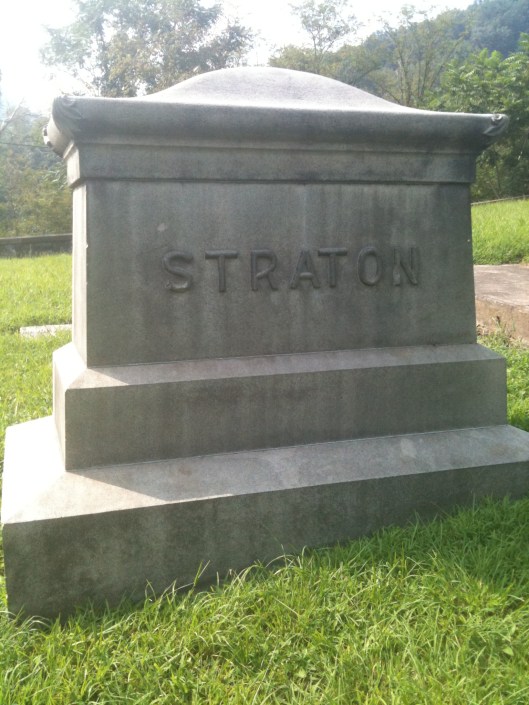
Major William Straton

28 Saturday Jun 2014

Posted by Brandon Ray Kirk in Civil War, Logan

≈ Leave a comment

Tags

Allen B. Straton, Bella Wilkinson, civil war, David Straton, genealogy, Henry Clay Ragland, history, James A. Nighbert, John B. Wilkinson, John F. Aldridge, Logan Banner, Logan County, Mary Perry, Minnie Straton, photos, U.S. South, Vicie Nighbert, West Virginia, West Virginia Legislature, William Straton, Williamson

Straton Headstone

Major William Straton headstone, Logan, WV, 2010

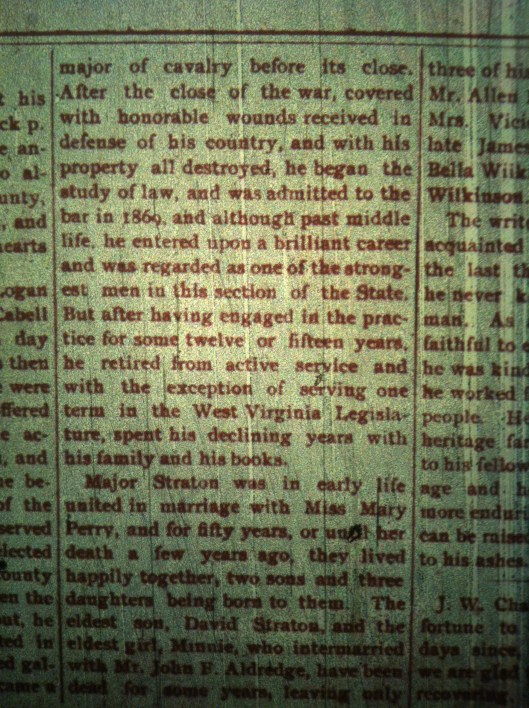
Major Straton obit LB 7.2.03 1

William Straton obituary, Logan (WV) Banner, July 2, 1903

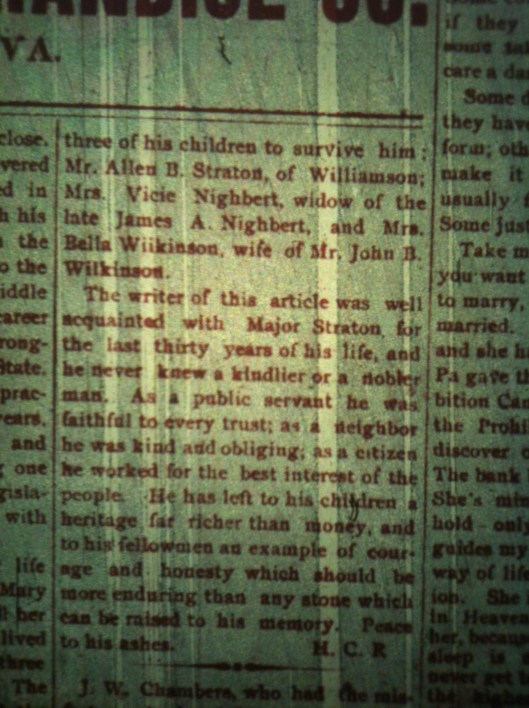
Major Straton obit LB 7.2.03 2

William Straton obituary, Logan (WV) Banner, July 2, 1903

Major Straton obit LB 7.2.03 3

William Straton obituary, Logan (WV) Banner, July 2, 1903


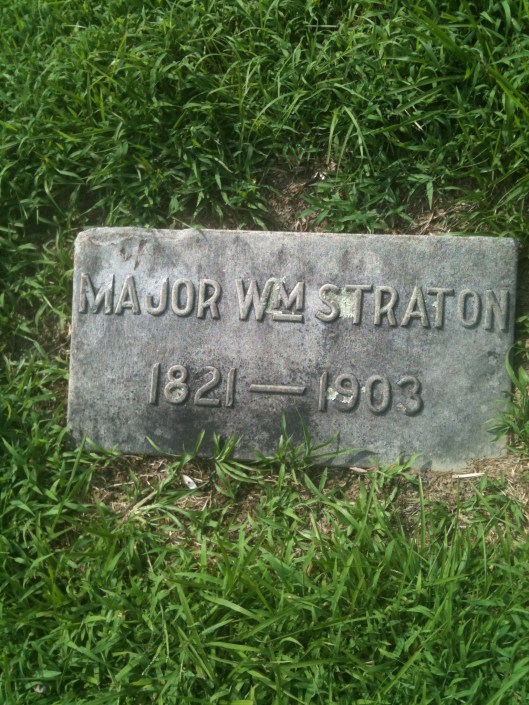
Major William Straton Grave

Major William Straton footstone, Logan, WV, 2010

In Search of Ed Haley 328

26 Thursday Jun 2014

Posted by Brandon Ray Kirk in Big Harts Creek, Ed Haley, Lincoln County Feud, Music

≈ Leave a comment

Tags

Andy Mullins, banjo, Bernie Adams, Bill Adkins, Bill Monroe, Billy Adkins, Black Sheep, blind, Bob Dingess, Brandon Kirk, Buck Fork, Claude Martin, Dingess, Dobie Mullins, Drunkard's Hell, Ed Haley, Floyd Mullins, George Baisden, George Mullins, Green McCoy, Grover Mullins, guitar, Harts Creek, history, Hollene Brumfield, John Hartford, Logan County, Maple Leaf on the Hill, measles, Michigan, Millard Thompson, Milt Haley, Mona Haley, moonshine, music, Naaman Adams, Roxie Mullins, Smokehouse Fork, Ticky George Hollow, Trace Fork, West Virginia, Williamson, Wilson Mullins, writing

From Naaman’s, we drove out of Trace and on up Harts Creek to see Andy Mullins, who Brandon had met a few months earlier at Bill Adkins’ wake. Andy had just relocated to Harts after years of living away in Michigan; he had constructed a new house in the head of Ticky George Hollow. Andy was a son to Roxie Mullins, the woman who inspired my fascination with Harts Creek. Andy, who we found sitting in his yard with his younger brother Dobie, was very friendly. He treated us as if we had known him for years.

“I was just catting when you fellas come up through there,” Andy said to us. “One of the girls lost a cat down there over the bank last night — a kitten. This morning I went down there and it was up in that rock cliff and I took its mother down there and it whooped the mother. And I took one of the kittens down there and it whooped the kitten. The old tomcat, he come down there and he whooped it. It went back up under that damn rock.”

I liked Andy right away.

We all took seats in lawn chairs in the front yard where Andy told about Ed Haley coming to see his parents every summer when he was a boy, usually with his wife. He described him as having a “big, fat belly” and weighing about 200 pounds.

“He wasn’t much taller than Dobie but he was fat,” Andy said. “I can remember his eyes more than the rest of him because his eyes was like they had a heavy puss over them or something. It was real thick-like. Not like they were clouded or anything.”

Even though Ed was blind, he could get around all over Harts Creek and even thread a needle.

Andy had heard that Milt caused Ed’s blindness.

“They said that Ed got a fever of some kind when he was a baby and Milt went out and cut a hole in the ice and stuck him under the ice in the creek to break the fever,” he said.

Andy knew very little about Milt.

“Just that Milt got killed, that was it, over shooting the old lady down at the shoal below Bob Dingess’ at the mouth of Smokehouse,” he said.

“All the old-timers that knows anything about his daddy is probably dead,” Dobie said.

Brandon said we’d heard rumors that Milt and Green were innocent of shooting Hollena Brumfield and Andy quickly answered, “That’s what my father-in-law told me.”

Changing the conversation back to Ed, Andy said, “Ed used to go up on Buck Fork to George Mullins’ to stay a lot and up to Grover Mullins’. He lived just above George’s place — the old chimney is the only thing still standing.”

He also went up in the head of Hoover to see George Baisden, a banjo-picker who’d hoboed with him in his younger days. The two of them had a lot of adventures, like the time Ed caught a train at Dingess and rode it over to Williamson to play for a dance or at a tavern. Just before they rolled into town, George pushed him off the train then jumped off himself. It made Ed so mad that George had to hide from him for the rest of the night.

I asked Andy if Ed ever told those kind of stories on himself and he said, “He told big tales, I’d call them, but I don’t remember what they were. Well, he set and talked with my grandmother and grandfather all the time he was here, and Mom. I never paid any attention to what they talked about really. I guess, man, I run these hills. I was like a goat. Hindsight is 20/20.”

Not long into our visit with Andy, he got out his guitar and showed me what he remembered about Bernie Adams’ guitar style. From there, he took off on Bill Monroe tunes, old lonesome songs, or honky-tonk music, remarking that he could only remember Ed’s tunes in “sketches.”

I asked, “Do you reckon Ed would sing anything like ‘Little Joe’?” and he said, “I don’t know. It’s awful old. I heard him sing ‘The Maple on the Hill’. He played and sang the ‘Black Sheep’.”

“He played loud, Ed did,” Dobie said.

“And sang louder,” Andy said immediately. “He’d rare back and sing, man.”

The tune he best remembered Ed singing was “The Drunkard’s Hell”.

I wanted to know the time frame of Andy’s memories.

“1944, ’45,” he said. “I was thirteen year old at that time. Now in ’46, we lived across the creek up here at Millard’s. Him and Mona Mae and Wilson — they wasn’t married at the time — went somewhere and got some homebrew and they all got pretty looped. That was up on Buck Fork some place. Ed got mad at Wilson and her about something that night and that’s the reason they didn’t play music — him and Claude Martin and Bernie Adams.”

I asked Andy about Ed’s drinking and he said, “Just whatever was there, Ed’d drink. He didn’t have to see it. He smelled it. Ed could sniff it out.”

Brandon wondered if Ed ever played at the old jockey grounds at the mouth of Buck Fork. Andy doubted it, although it sure seemed to me like the kind of place for him to go. There was moonshine everywhere and men playing maybe ten card games at once.

“They’d get drunk and run a horse right over top of you if you didn’t watch,” Andy said. “It was like a rodeo.”

The last jockey ground held at the mouth of Buck Fork was in 1948.

Queens Ridge 10.09.1913

07 Saturday Jun 2014

Posted by Brandon Ray Kirk in Ferrellsburg, Hamlin, Logan, Queens Ridge

≈ Leave a comment

Tags

Arnold Perry, Columbus, Dr. York, Ellen Carter, Ferrellsburg, genealogy, Hamlin, Henry F. Workman, history, Isaac Workman Jr., Ivy Bias, J.J. Maynard, James Workman, John Workman, Joseph Maynard, Kentucky, Lincoln County, Lincoln Republican, Logan, Louisa, Maynard School House, Nancy Workman, Ohio, Queens Ridge, Squire Vance, Stone Coal, West Virginia, William F. Workman, Williamson, Wilsondale

“Bull Mooser,” a local correspondent from Queens Ridge in Lincoln County, West Virginia, offered the following items, which the Lincoln Republican printed on Thursday, October 9, 1913:

John Workman, Sr., is in very poor health. Dr. York, of Louisa, Ky., is the attending physician.

Isaac Workman, Jr., is recovering from a severe illness.

Squire Vance is on a business trip to Ferrellsburg this week.

Mr. and Mrs. J.J. Maynard were visiting Arnold Perry’s Sunday.

Joseph Maynard has been quite busy making repairs on the Maynard school house.

H.F. Workman is getting in his winter’s supply of coal.

W.F. Workman is attending the Association at Stone Coal, West Virginia.

Mr. and Mrs. Charley Gray, of Columbus, Ohio, are visiting relatives and friends here.

Ivy Bias, telegraph operator at Wilsondale, W.Va., went to Williamson to a hospital to have his right leg amputated.

Mrs. Isaac Workman is paying her daughter, Mrs. Ellen Carter who resides at Rolfe, a visit.

James Workman made a business trip to Logan this week.

Joseph Maynard made a business trip to Hamlin this week.

Anderson “Devil Anse” Hatfield (1896)

01 Sunday Jun 2014

Posted by Brandon Ray Kirk in Culture of Honor, Hatfield-McCoy Feud

≈ Leave a comment

Tags

Appalachia, Ceredo Advance, Devil Anse Hatfield, feud, Hatfield-McCoy Feud, history, Mingo County, West Virginia, Williamson

Anderson Hatfield story CA 03.04.1896 2

Anderson “Devil Anse” Hatfield, Ceredo (WV) Advance, March 4, 1896

Spottswood Items 08.07.1903

11 Sunday May 2014

Posted by Brandon Ray Kirk in Big Harts Creek, Spottswood

≈ Leave a comment

Tags

Alice Adams, Belle Dora Adams, Bettie Workman, culture, education, genealogy, Grover Adams, history, Hoover Fork, Island Creek, Joe Crause, life, Logan Banner, Logan County, Palmer Stave Mill, Sol Riddell, Spottswood, W.J. Bachtel, West Virginia, Williamson

“Oliver Winters,” a local correspondent from Spottswood in Logan County, West Virginia, offered the following items, which the Logan Banner printed on Friday, August 7, 1903:

The graded school at this place, conducted by Mr. Riddell, opened Tuesday with a fine attendance.

Misses Alice and Belle Dora Adams and Bettie Workman, three of Spottswood’s belles, are attending Institute at Williamson this week.

Joe Crause, foreman for the Palmer stave mill, wearing his genial smile, was making it pleasant for certain young ladies of Spottswood last Sunday.

Grover Adams has moved into his new residence at the forks of Hoover.

Mr. W.J. Bachtel has gone to Island Creek to accept a position in the Company store. W.J. is a hustler and will be a good man for the place.

As I look out of my window a troop of merry school children are trudging past. Their faces are ruddy with the glow of health. Their spirits are running over with joy. Their will is truly the “wind’s will,” and their thoughts “are long, long thoughts.” I see an other procession with a poor boy in it who is a cripple for life. He catches the inspiration and tries to be merry and gay, but something in his manner and looks speaks plainer than words of his pitiable condition. We too often forget the destitute and suffering. Bless the school children, they are now happier than they will be when they grow older and wiser. I have digressed from my purpose, but I have to think. Hope this will not reach the waste basket.

In Search of Ed Haley 293

21 Monday Apr 2014

Posted by Brandon Ray Kirk in Ed Haley

≈ Leave a comment

Tags

Ashland, blind, Ed Haley, Ella Haley, history, Jack Haley, Kentucky, Lawrence Haley, life, Luther Trumbo, Mona Haley, Nellie Muncy, Noah Haley, Pat Haley, The Waltons, West Virginia, Williamson, writing

The more I played for Mona, the more Pat’s little dogs barked at me — especially when I got up and danced. Their commotion caused Mona to say, “We always had an animal. We used to have an old blue-tick hound named King and every time Pop would play the fiddle he’d howl. Uncle Luther gave him to Pop when I was a baby. I don’t know if it was as much Pop as it was Mom, but they all loved King. All of us did. He was smart. He was a good hunter. He taught all the dogs in the neighborhood to hunt. Everybody wanted to hunt with him — they come from miles around to borrow him to go hunting — and someone stole him one time and he was gone about a week and when he came back blood was running out of all four paws and he just flopped on the front porch. He had a broken-like front paw right here in the first joint. He was young then. We had him till he died. He growed old and died. I was about fourteen when he died — maybe thirteen.”

I wondered if Ed ever used a seeing eye-dog and Pat said no, although Ella did. She said the family had a pet dog named “Jaybird” when she married Lawrence.

I could tell that Mona was in the mood to talk, so I put my fiddle away and told her about our recent research on Milt Haley. When I told her that Milt appeared to have been an illegitimate son of Nellie Muncy, she immediately told me how Ed visited a family of Muncys around Williamson, West Virginia. Her memories of such trips were vague.

“I remember a place we had to go in an automobile so far and then we had to cross the river in a boat to get to where we was a going — in a rowboat — but I don’t remember where it was. It had to be in West Virginia somewhere. I remember a store building where we went and we slept upstairs over that store building. I remember Pop getting real mean and mad at Mom up there one night and I wanted to crawl under the covers and pull it on me. He was getting real nasty with her.”

I asked Mona what they were into it over and she said, “Sex, I reckon. He wanted it and she didn’t want it and he said he had to have it. That’s how nasty he was — but he didn’t say it in those nice words. My dad happened to be drinking that time, too, so it made it that much worse.”

Trying to lighten the memory, I told her that sex had been a sore spot with married couples for thousands of years.

Pat said what was remarkable about Mona’s memories was the fact that Lawrence had never said a bad word about his father.

“He never talked bad about Pop,” she said. “Of course, he was Momma’s boy.”

Mona said Ed only whipped her once.

“It was on my birthday and I was getting ready to cry and he said, ‘Four, five, six.’ That’s the only time he ever whipped me. I do remember a time that Jack and Noah got into a fight and they was young men. And Pop jumped up — he wore suspenders — and he had them down. He jumped up to part them and got a hold of each of them and his pants fell down. The fight stopped and we all started laughing.”

Pat said that happened at 1040 Greenup after she’d married into the family — “right out on the front porch.”

Mona added, “But he had long underwear on.”

That fond memory caused her to say, “You know, The Waltons remind me a lot of the way we were brought up. We had a pretty good family life. We’d tell each other good night and stuff. Lawrence and I usually slept with Mom.”

Pat said, “Scratch each other’s backs,” and Mona said, “Yeah.”

I asked if Ed came around and kissed every one goodnight at bedtime and Mona said, “No, no. Mom did. Pop didn’t. If she’d tell him to go see about one of us, why, he would.”

For entertainment, the family gathered around the radio or listened to Ed’s “wild stories.”

Whirlwind 3.13.1919

31 Monday Mar 2014

Posted by Brandon Ray Kirk in Big Harts Creek, Whirlwind

≈ 2 Comments

Tags

Alex Tomblin, Baltimore, Bill Davis, Buck Fork, Camp Lee, Crit Mullins, Dalton School, Dave Bryant, education, Eli Workman, genealogy, Harts Creek, history, Holden, Isaac Collins, James Mullins, John Dalton, Kern Carter, life, Logan County, Logan Democrat, Maryland, Mollie Conley, Moses Tomblin, Olive Stollard, Omar, Peter Dalton, Peter Hensley, Peter Tomblin, Stonewall Conley, Tom Mullins, Twelve Pole Creek, W.J. Bachtel, West Virginia, Whirlwind, Will Tomblin, Williamson

“Blue Eyed Beauty,” a local correspondent at Whirlwind in Upper Hart, Logan County, West Virginia, offered the following items, which the Logan Democrat printed on Thursday, March 13, 1919:

Peter Hensley purchased a mule of Dave Bryant this week.

Moses Tomblin has purchased the grist mill of James Mullins.

John Dalton had a house raising on Thursday.

Peter Dalton, who spent a week home on furlough from Camp Lee, returned to that place Friday.

Will Tomblin has moved from his farm on Twelvepole to Omar. His mother-in-law will occupy the farm.

Peter Tomblin has purchased the Eli Workman farm and will remove to it in the near future. We understand that Bill Davis will occupy the property vacated by Mr. Tomblin.

W.J. Bachtel began teaching the Dalton school on Monday, but was able to continue but two days on account of sickness.

Tom Mullins and brother, Crit, have moved from Twelvepole to Buckfork.

It is reported that Isaac Collins will set up in the mercantile business.

Miss Kern Carter is visiting with her brother at Williamson.

Alex Tomblin is visiting on Hart’s Creek.

We hear that Mrs. Olive Stollard, an English woman, of Baltimore, Md., who was a former resident of Holden, was at Stonewall Conley’s the first of the week for the purpose of taking Miss Mollie Conley home with her. A grandson of Mrs. Stollard’s married a sister of Miss Mollie.

In Search of Ed Haley 241

13 Thursday Feb 2014

Posted by Brandon Ray Kirk in Big Sandy Valley, Ed Haley, Music

≈ 2 Comments

Tags

Billy Adkins, Cain Adkins, fiddle, fiddler, Grand Ole Opry, Harts Creek, Lincoln County, Mingo Ramblers, Norfolk and Western, Stiltner, Tom Atkins, Wayne County, West Virginia, Williamson, Winchester Adkins, writing

A week later, I followed up on a lead from Billy Adkins and called Tom Atkins. Tom was a great-grandson of Cain Adkins and a genealogist in Williamson, West Virginia. It was a chance lead: Billy had called him to ask about Ed Haley’s genealogical connections in the Tug Valley only to discover that Tom’s grandfather was Winchester Adkins — a son to Cain.

When I called Tom, he said he knew almost nothing about Cain and only a little about his grandfather, Winchester Adkins. He said Winchester left the West Fork of Harts Creek at a young age and settled at Stiltner in Wayne County. He eventually moved to Williamson and worked as an engineer on the N&W Railroad. At that location, after a repeated “mix-up over his checks” he changed the spelling of his surname from “Adkins” to “Atkins.” He was also a well-known fiddler who tried his hand at professional music.

“I heard my mother tell someone here while back how many tunes my grandfather played,” Tom said. “It was a hundred and some. See, he just knew them by ear. And I believe that at one time he had a fiddle that was made by Cain — his father — and I don’t know who has that or whether it’s even in existence now ’cause we’ve had floods here. And I do know at one time he was a member of a group in Mingo County called the ‘Mingo Ramblers’ and they were on the Grand Ole Opry way back in the early days.”

Tom said that was all he knew because his grandfather died when he was four years old.

In Search of Ed Haley 96

27 Saturday Apr 2013

Posted by Brandon Ray Kirk in Ed Haley, John Hartford, Music

≈ Leave a comment

Tags

Appalachia, Catlettsburg, Clyde Haley, Ed Haley, Ella Haley, fiddle, fiddlers, fiddling, Harts Creek, history, Irish lilt, Kenova, Kermit, Kevin Burke, Lawrence Haley, music, Nashville, Noah Mullins, Norfolk and Western Railroad, Patsy Haley, snap bowing, West Virginia, Williamson, writing

Nestled in Nashville, I worked obsessively on Ed Haley’s music. First, I made a real effort to transcribe it note for note and break it down “under the microscope.” Initially, I had tried to play it generally the way he did while keeping its spirit — with my own twists, of course, which is nearly impossible not to do. This time, though, I wanted to study it as you might a fabulous book — break it down, look at it mechanically… I made a huge discovery regarding Ed’s bowing during that time. With Lawrence’s help via telephone conversations, I deduced that Ed used what Scotch fiddlers call “snap bowing,” which is when you separate notes by applying pressure (“little stops”) with the bow — not by changing its direction. Of course, Ed didn’t use those patterns exclusively and mixed them with more conventional strokes.

I also spent a lot of time listening to Ed’s recordings and playing my versions of his songs into a tape recorder. One of the first things I figured out was that he used what fiddler Kevin Burke calls the “Irish lilt” to give his music a “dotted note feel.” It would be like playing a tune in triplets with the middle note taken out.

I also discovered that Lawrence was right about Ed not playing so many notes; instead, he created the illusion of doing so by phrasing his tunes in a way that gave them a nice “crooked” flavor.

Throughout these discoveries, Lawrence continued his role as my brutally honest fiddle teacher. His comments were surprisingly musical for someone who kept reminding me that he didn’t even play anything. When I played “Yellow Barber” for him over the telephone, he said, “That sounded right except when you get down to that low end, you’re doing a little skipping in there and it seemed to me like Pop played that a little bit smoother. Like he had a roll to his… And I noticed you had a few jumping notes in there that really I don’t remember hearing. Maybe you can hear them. Other than that, it sounded great to me.”

Lawrence seemed pleased with my playing of Ed’s “Catlettsburg”.

“That was good, John,” he said. “That was really good.”

I told him I didn’t know how Ed was able to get up into second position on that tune with the fiddle sitting at his shoulder.

“I always thought that he kinda controlled the violin with his thumb and the meaty part of his hand between his finger and thumb,” Lawrence said. “He could relax that up and down the neck of the violin or he could tighten that and he could still have the flexibility of his fingers, plus that give him the ability to rock that violin body underneath the bow, too.”

I was trying that and eventually got to where I could will my fingers into third position still holding the fiddle at my shoulder, which if you have to play for a long time is sure easier on the neck of the player.

I told Lawrence about talking with Clyde, especially about his memories of Ed mistreating him as a child.

“I don’t know, maybe my dad was mean to him when he was a young’n,” Lawrence said. “But I can’t remember my dad ever laying a hand on me to hurt me. I musta been a rowdy little kid ’cause it seemed like whenever Pop’d pick me up he’d call me ‘muddy duck’ because I was always dirty, I reckon, whenever he’d get a hold of me. He’d just rub my head or something like that and call me his ‘muddy duck.’ I don’t know where Clyde got his story from.”

Lawrence agreed that his dad sometimes abused his mother, although he placed a lot of blame for their marital problems on her.

“Well, he could be temperamental with my mother at times, but I think she was temperamental, too. I think my mother’s people had higher tempers than Dad’s people did. They seemed to be kinda quiet people. Noah Mullins was supposed to killed a revenuer up there at Harts. They waylaid a revenuer and they laid it on Noah, but Noah Mullins always seemed to me like just as quiet and as calm a fella as could be. But I had some of my uncles on my mother’s side, they were a little bit of a temperamental type of people. So I’d put some of the blame on my mother for her treatment of my dad. You know, a woman can upset a man and whip him quicker with words than he can whip her with his fists.”

I totally agreed, then asked Lawrence if he knew anything about the Muncys from Patsy’s genealogy.

“We’d ride the Norfork and Western train up from Kenova and stop at Kermit and stay there with Muncy people,” he said. “They lived in an apartment up over their store and filling station-type thing and they had one of them small monkeys. I went up there one day and got right at the top of the steps and was playing with that monkey and I musta made it mad and it made a rush at me and I musta jumped back and I went to the bottom of them steps. That made me remember it more than anything else. I can’t even remember that Pop played music while he was there for them. They mighta just talked. We used to stop there maybe and stay all night and Pop and Mom and me would go on to Williamson and they’d play at courthouse days or something there. Pop musta had people up in there, but he never said anything to me about it.”

In Search of Ed Haley 64

12 Tuesday Feb 2013

Posted by Brandon Ray Kirk in Ashland, Big Sandy Valley, Ed Haley, Music

≈ 1 Comment

Tags

Ashland, Big Sandy River, Blackberry Blossom, Blaze Starr, Bluegrass Meadows, Boyd County, Clark Kessinger, Dave Peyton, Delbarton, Duke Williamson, Ed Haley, fiddle, fiddler, fiddlers, fiddling, Georgia Slim Rutland, Grand Ole Opry, Hank Williams, Herald-Dispatch, history, Huntington, Jennies Creek, John Fleming, John Hartford, Kentucky, Lawrence Haley, Lynn Davis, McVeigh, Mingo County, Minnie Pearl, Molly O Day, Molly O'Day, music, Parkersburg Landing, Pike County, Pond Creek, Short Tail Fork, Shove That Hog's Foot, Skeets Williamson, Snake Chapman, Texas, West Virginia, Williamson

Early that summer, I was back at Lawrence Haley’s in Ashland with plans to visit Lynn Davis in Huntington, West Virginia. Lynn had been mentioned in the Parkersburg Landing liner notes as a source for Haley’s biographical sketch and was the widower of Molly O’Day, the famous country singer. Snake Chapman had told me that Molly and her family were close friends to Haley, who visited their home regularly in Pike County, Kentucky. I was sure Lynn would have a lot of great stories to tell about Ed. At our arrival, he was incredibly friendly — almost overwhelming us with the “welcome mat.” All we had to do was mention Ed’s name and he started telling us how he and Molly used to pick him up in Ashland and drive him up the Big Sandy Valley to see Molly’s father in southeastern Kentucky.

“That was back in the early forties,” he said. “We’d come to Ashland and get him at his home up on Winchester about 37th Street. They was a market there or something you turned up by and we’d go there and pick him up and take him up to Molly’s dad and mother up in Pond Creek, Kentucky — above Williamson. There’s an old log house up there — it’s been boarded up and sort of a thing built around it so people couldn’t get in and tear it up or something — but it’s falling down. He’d stay up there with Molly’s dad and mother for several days. They’d take him to Delbarton, a coal town over there from Williamson, and they’d just drive him around, buddy. Now Molly’s brother, he really loved Ed’s fiddling.”

Lynn was referencing Skeets Williamson, Molly’s older brother and a good fiddler by all accounts. Lynn showed me an album titled Fiddlin’ Skeets Williamson (c.1977), which referenced him as “one of country music’s more skilled fiddlers during the 1940’s — one of the best in his day.”

Skeets was born in 1920 at McVeigh, Kentucky, meaning he was approximately 35 years younger than Haley. As a child, he played music with Molly and his older brother Duke Williamson, as well as Snake Chapman. “During these years, the famous fiddler of Eastern Kentucky, Blind Ed Haley, became a tremendous influence on him,” the album liner notes proclaimed. “Skeets (along with Clark Kessinger) still contend that Haley was the greatest fiddler who ever played.” During a brief stint on Texas radio, Skeets met Georgia Slim Rutland, the famous radio fiddler who spent a year listening to Haley in Ashland.

I asked Lynn more about his trips to Haley’s home on 37th Street.

“We used to go down to his house and Molly’d say, ‘Uncle Ed, I’d just love to hear you play me a tune.’ Well he’d be sitting on the couch and he’d just reach over behind the couch — that’s where he kept his fiddle. He always had it in hand reach. So he would get it out of there, man, and fiddle.”

Sometimes Lynn and Molly would join in, but they mostly just sat back in awe.

“You’ve seen people get under the anointing of the Holy Ghost, John,” Lynn said. “Well now, that’s the way he played. I mean, I’ve seen him be playing a tune and man just shake, you know. It was hitting him. I mean, it was vibrating right in his very spirit. Molly always said, ‘I believe that fiddlers get anointed to the fiddle just like a preacher gets anointed to preach.’ They feel it. Man, he’d rock that fiddle. He’d get with rocking it what a lot of people get with bowing. It was something else. But he got into it man. He moved all over.”

Lynn said Ed was a “great artist” but had no specific memories of his technique. He didn’t comment on Ed’s bowing, fingering or even his fiddle positioning but did say that he mostly played in standard tuning. Only occasionally did Ed “play some weird stuff” in other tunings.

Lynn’s memories of Haley’s tunes seemed limited.

“Well, he played one called ‘Bluegrass Meadows’,” he said. “He had some great names for them. Of course one of his specials was ‘Blackberry Blossoms’. He liked that real good, and he’d tell real stories. He would be a sawing his fiddle a little while he was telling the story, and everybody naturally was just quiet as a mouse. You know, they didn’t want to miss nothing.”

What kind of stories?

“Well, I know about the hog’s foot thing. He said they went someplace to play and they didn’t have anything to eat and those boys went out and stole a hog and said they brought it in and butchered it and heard somebody coming. It was the law. They run in and put that hog in the bed and covered it up like it was somebody sleeping. And Ed was sitting there fiddling and somebody whispered to him, said, ‘Ed, that hog’s foot’s stickin’ out from under the cover there.’ So he started fiddling and singing, ‘Shove that hog’s foot further under the cover…’ He made it up as he went.”

The next thing I knew, Lynn was telling me about his musical career. He’d been acquainted with everybody from country great Hank Williams to Opry star Minnie Pearl. We knew a lot of the same people — a source of “bonding” — and it wasn’t long until he started handing me tapes and records of Molly O’Day and Georgia Slim Rutland. He said he had a wire recording of Ed and Ella somewhere, but couldn’t find it. He promised me though, “When I find this wire — and I will find it — it’s yours.”

Sometime later, he called Dave Peyton, a reporter-friend from the Huntington Herald-Dispatch, to come over for an interview. With Peyton’s arrival, Lynn (ever the showman) spun some big tales.

“Now, Molly’s grandfather on her mother’s side was the king of the moonshiners in West Virginia and he was known as ‘Twelve-Toed John Fleming’,” Lynn said. “He had six toes on each foot. Man, he was a rounder. Little short fella, little handlebar mustache — barefooted. He was from the Short Tail Fork of Jenny’s Creek. And the reason they called it that, those boys didn’t have any britches and they wore those big long night shirts till they was twelve or fourteen years old.”

Lynn was on a roll.

“I preached Molly’s uncle’s funeral. Her uncle is the father of Blaze Starr — the stripper. That’s Molly’s first cousin. In her book, she said she would walk seven miles through the woods to somebody that had a radio so she could hear her pretty cousin Molly sing. She was here in town about three or four months ago. We had breakfast a couple times together. She’s not stripping anymore. She makes jewelry and sells it. She’s about 60 right now.”

In Search of Ed Haley 60

30 Wednesday Jan 2013

Posted by Brandon Ray Kirk in Big Sandy Valley, Ed Haley, Huntington, Music, Pikeville, Williamson

≈ 2 Comments

Tags

Appalachia, Beaver Creek, Big Sandy River, Bill Necessary, Carter Caves State Park, Curly Wellman, Ed Haley, Ella Haley, fiddler, fiddling, Floyd County, Fraley Family Festival, Grayson, history, Huntington, J P Fraley, John Hartford, Kentucky, Lawrence Haley, Levisa Fork, Lynn Davis, Mingo County, Molly O Day, Molly O'Day, Mona Hager, music, Nashville, Paintsville, Prestonsburg, Snake Chapman, Tug Fork, U.S. South, Ugee Postalwait, West Virginia, Williamson, writers, writing

A few months later, I met Lawrence Haley at the Fraley Family Festival at Carter Caves State Park near Grayson, Kentucky. Lawrence and I spoke with Bill Necessary, a musician who saw Ed and Ella all over the Big Sandy Valley when he was about twenty years old. He said they rode a train up Levisa Fork to Paintsville, the seat of government for Johnson County, where they spent the day playing music at the courthouse. From there, they continued by train to Prestonsburg, county seat of Floyd County. At times, they went into the nearby coal camps of Beaver Creek and played at theatres. From Prestonsburg, they took the train to Pikeville, the county seat of Pike County, and then continued over to the Tug River around Williamson, county seat of Mingo County, West Virginia.

“Aw, they took in the whole dern country up through there,” Bill said. “By the time they made that circuit, why it’d be time for them to come again. I guess they’d tour a couple of weeks. By God, I just followed them around, son.”

Lawrence didn’t remember going to all of those places with Ed but did remember staying with Molly O’Day’s family around Williamson. Bill said Molly’s widow Lynn Davis was still living around Huntington, West Virginia.

Bill said Ed always wore a long overcoat — “rain or shine” — and even played in it. He never sang or entered contests.

“He was pretty up to date on music at that time,” Bill said. “His notes were real clear, boy.”

Back in Nashville, I worked really hard trying to figure out Ed’s bowing. There was a lot of contradictory information to consider. Snake Chapman said he bowed short strokes, indicating a lot of sawstrokes and pronounced note separation. J.P. Fraley, Slim Clere, Lawrence and Mona said that he favored the long bow approach and only used short strokes when necessary, like for hoedowns. Preacher Gore, Ugee Postalwait and Curly Wellman spoke about how smooth his fiddling was, which kind of hinted at him being a long bow fiddler. All were probably accurate in some respect. It seemed plain to me that one reason why there were so many contrasting and sometimes completely opposite accounts of how or even what Ed played was that everyone I’d talked to witnessed him playing at different times and places during his musical evolution. All along the way, he was experimenting, looking for that “right combination” or playing the style needed to create the sounds popular in a certain area. Even what I could actually hear on his home recordings was really just a glimpse into the world of his fiddling as it existed at that moment toward the end of his lifetime.

In Search of Ed Haley 20

07 Friday Dec 2012

Posted by Brandon Ray Kirk in Ed Haley

≈ Leave a comment

Tags

Appalachia, Arkansas Traveler, Ashland, Blackberry Blossom, blind, Chillson Leach, Ella Haley, fiddler, fiddlers, fiddling, Fisher's Hornpipe, J P Fraley, John Hartford, Kentucky, Lawrence Haley, Mt. Sterling, music, Ralph Haley, Turkey in the Straw, U.S. South, Virgil Alfrey, West Virginia, Williamson

Later that evening, Lawrence and I went to see J.P. Fraley. On the way, he told me more about his father’s recordings.

“Well, he depended on my brother Ralph to tap him on the shoulder when he wanted him to start, and when he was getting near the end of the disc he’d tap him again, see? And Pop, sometimes he’d stop right then, cut it off real short, and then sometimes he’d go to the end of that run and hit that shave and a haircut at the end of it. Sometimes it sounded like he was gonna quit, see? Ralph hadn’t give him the signal that they was close to the end of the recording, so you can hear a little bit of hesitation at times. I thought Mom was getting ready to stop, too.”

Lawrence figured the records were made in the daytime but wasn’t sure of the time of year. “I guess the good part of maybe one spring or something because I was in the service and I wasn’t home.”

At the time of the recordings, Ed was no longer playing professionally. “He’d go out, like I say, a few times. Somebody’d come and get him, take him somewhere. He thought, ‘Well, if they’re gonna have a good time, I’ll go up and play for them and have a good time with them.’ As time went on, the older he got, the harder it was to get him to go. I guess he was having more trouble with his circulatory system.”

At J.P.’s, we met Virgil Alfrey and Chillson Leach, two old-time fiddlers from around Ashland. Virgil began playing the fiddle as a boy of twelve in the early thirties, around the time he used to see Ed in Williamson, West Virginia. The last time he saw him there he reached Ed a dollar and requested “Fisher’s Hornpipe”. Haley recognized his voice, played the tune then tried to give his dollar back because he liked him.

Chillson Leach, an 83-year-old retired rigger from Mt. Sterling, Kentucky, had been playing the fiddle since he was nine years old.

“Uncle Ed was one of the best fiddlers in this country,” he said. “He would get an audience in front of him and he kinda knowed that they was a lot of people by the sound of the money they throwed in his cup. And he’d say, ‘People, they’s a mental strain and a physical strain on playing the violin.’ Now that’s what he would tell them. He wanted them to know that he was earning his money when he was a playing that violin. And lord, when he would pull that bow across that fiddle he’d get some of the prettiest notes that ever you heard in your life. His fingers was long and slim and as nimble right up I reckon till he died.”

Lawrence, who was taking all of this in, said, “Pretty close. He slowed down the last five or six years.”

Chillson said, “Yeah but when I knowed him, my goodness, he’d get way down on that neck. Any position you wanted him to play. He was wonderful. It’s a shame that a person has to die. I’d give him a quarter and I’d say, ‘Play that ‘Blackberry Blossom’ and he played that for me and man he could just make your hair stand on your head. And then he played a lot of reels, you know. He could play anything you’d ask him: ‘Turkey in the Straw’, ‘Arkansas Traveler’.”

Chillson was obviously a fan.

“I just thought the world of him because he entertained everybody in Ashland,” he said. “He had a blind fellow that played the guitar with him and this blind fellow would sit there and man they’d make some pretty music.”

On the way home, Lawrence told me that his father hated to play “Turkey in the Straw”.

In Search of Ed Haley 6

26 Monday Nov 2012

Posted by Brandon Ray Kirk in Ashland, Big Sandy Valley, Ed Haley, Matewan, Music, Pikeville, Williamson

≈ 1 Comment

Tags

Appalachia, Art Stamper, Arthur Smith, Ashland, Big Sandy River, Billy Lyons, Blackberry Blossom, blind, Charles Wolfe, Clark Kessinger, Clayton McMichen, Duke Williamson, Ed Haley, fiddle, fiddler, fiddlers, fiddling, Fox in the Mud, Frazier Moss, Fred Way, Ft. Gay, Grand Ole Opry, history, Huntington, Joe Williamson, John Hartford, Kentucky, Kermit, Kirk McGee, Levisa Fork, Louisa, Mark Howard, Matewan, Mississippi River, Molly O'Day, music, Nashville, Natchee the Indian, Ohio River, Old Sledge, Packet Directory, Paintsville, Parkersburg Landing, Pikeville, Prestonsburg, Red Apple Rag, River Steamboats and Steamboat Men, Robert Owens, Roy Acuff, Sam McGee, Skeets Williamson, Snake Chapman, square dances, St. Louis, Stacker Lee, Stackolee, steamboats, Tennessee Valley Boys, Tri-State Jamboree, Trouble Among the Yearlings, Tug Fork, West Virginia, Williamson, WSAZ

Back in Nashville, I was knee-deep in Haley’s music, devoting more time to it than I care to admit. I talked so much about it that my friends began to tease me. Mark Howard, who was producing my albums at the time, joked that if Ed’s recordings were of better quality, I might not like them so much. As my obsession with Haley’s music grew, so did my interest in his life. For a long time, my only source was the liner notes for Parkersburg Landing, which I had almost committed to memory. Then came Frazier Moss, a fiddling buddy in town, who presented me with a cassette tape of Snake Chapman, an old-time fiddler from the Tug Fork of the Big Sandy in eastern Kentucky. On the tape, Snake said he’d heard Haley play the “old original” version of “Blackberry Blossom” after he “came in on the boats” at Williamson, West Virginia.

The boats?

This was making for a great story. I was already enthralled by Haley’s fiddling…but to think of him riding on “the boats.” It was the marriage of my two loves. I immediately immersed myself in books like Captain Fred Way’s Packet Directory 1848-1983: Passenger Steamboats of the Mississippi River System Since the Advent of Photography in Mid-Continent America (1983) to see which boats ran in the Big Sandy Valley during Haley’s lifetime. Most of the boats were wooden-hulled, lightweight batwings – much smaller than the ones that plied the Mississippi River in my St. Louis youth – but they were exciting fixtures in the Big Sandy Valley culture.

“I have seen these boats coming down the river like they were shot out of a cannon, turning these bends, missing great limbs hanging over the stream from huge trees, and finally shooting out of the Big Sandy into the Ohio so fast that often they would be nearly a mile below the wharf boat before they could be stopped,” Captain Robert Owens wrote in Captain Mace’s River Steamboats and Steamboat Men (1944). “They carried full capacity loads of sorghum, chickens and eggs. These days were times of great prosperity around the mouth of Sandy. Today, great cities have sprung up on the Tug and Levisa forks. The railroad runs on both sides, and the great activity that these old-time steamboats caused has all disappeared.”

During the next few weeks, I scoured through my steamboat photograph collection and assembled pictures of Big Sandy boats, drunk with images of Haley riding on any one of them, maybe stopping to play at Louisa, Paintsville, Prestonsburg and Pikeville, Kentucky on the Levisa Fork or on the Tug Fork at Ft. Gay, Kermit, Williamson, and Matewan, West Virginia.

Finally, I resolved to call Snake Chapman and ask him about his memories. It was a nervous moment – for the first time, I was contacting someone with personal memories of Ed Haley. Snake, I soon discovered, was a little confused about exactly who I was and why I was so interested in Haley’s life and then, just like that, he began to offer his memories of Ed Haley.

“Yeah, he’s one of the influences that started me a fiddling back years ago,” Snake said, his memories slowly trickling out. “I used to go over to Molly O’Day’s home – her name was Laverne Williamson – and me and her and her two brothers, Skeets and Duke, used to play for square dances when we first started playing the fiddle. And Uncle Ed, he’d come up there to old man Joe Williamson’s home – that’s Molly’s dad – and he just played a lot for us and then us boys would play for him, me and Cecil would, and he’d show us a lot of things with the bow.”

Molly O’Day, I knew, was regarded by many as the most famous female vocalist in country music in the 1940s; she had retired at a young age in order to dedicate her life to the church.

“And he’s the one that told me all he could about old-time fiddling,” Snake continued. “He said, ‘Son, you’re gonna make a good fiddler, but it takes about ten years to do it.'”

I told Snake about reading in the Parkersburg Landing liner notes how Haley reportedly wished that “someone might pattern after” him after his death and he totally disagreed. He said, “I could have copied Uncle Ed – his type of playing – but I didn’t want to do it because he told me not to. He told me not to ever copy after anyone. Said, ‘Just play what you feel and when you get good, you’re as good as anybody else.’ That was his advice.”

I didn’t really know what to make of that comment. I mean, was Haley serious? Was he speaking from personal experience or was it just something he told to a beginning fiddler for encouragement?

After that, my conversation with Snake consisted of me asking questions – everything from how much Haley weighed to all the intricate details of his fiddling. I wondered, for instance, if Ed held the bow at the end or toward the middle, if he played with the fiddle under his chin, and if he ever tried to play words in his tunes. I wanted to know all of these things so that I could just inhabit them, not realizing that later on what were perceived as trivial details would often become major items of interest.

Snake answered my questions precisely: he said Haley held the bow “up a little in the middle, not plumb on the end” and usually played with the fiddle at his chest – “just down ordinarily.” He also said Haley “single-noted” most of his bow strokes, played frequently in cross-key, hated vibrato and used a lot of “sliding notes.” He seldom got out of first position, only occasionally “going down and getting some notes” that he wanted to “bring in the tune” and he definitely tried to play words in his music.

“The old fiddlers through the mountains here – and I guess it’s that way everywhere – they tried to make the fiddle say the words of the old tunes,” Snake said.

“Uncle Ed, he was a kind of a fast fiddler,” he went on. “Most old-time fiddlers are slow fiddlers, but he played snappy fiddling, kindly like I do. Ah, he could do anything with a fiddle, Uncle Ed could. He could play a tune and he could throw everything in the world in it if he wanted to or he could just play it out straight as it should be. If you could just hear him in person because those tapes didn’t do him justice. None of them didn’t. To me, he was one of the greatest old-time fiddlers of all time. He was telling me, when I was young, he said, ‘Well, I could make a fiddle tune any time I want to,’ but he said he just knowed so many tunes he didn’t care about making any more. He played a variety of tunes that a lot of people didn’t play, and a lot of people couldn’t play. He knew so many tunes he wouldn’t play one tune too long.”

I asked Snake about Haley’s repertoire and he said, “He played an old tune called ‘Old Sledge’ and it was one of his good ones. He played tunes like ‘Trouble Among the Yearlings’, but when he was gonna play it he called it ‘Fox in the Mud’. He made that up himself. One of the favorite tunes of mine he played was the old-time way of playing ‘Blackberry Blossom’ and he played it in G-minor. Ed could really play it good. They was somebody else that made the tune. Uncle Ed told me who it was – Garfield. He said he was a standing fiddling near a big blackberry patch and it was in bloom at the mouth of the hollow one time and this fella Garfield played this tune and he asked this fella Garfield what the name of the tune was. He said, ‘Well, I ain’t named it, yet,’ and he turned around and spit in that blackberry patch with a big bunch of ambeer and said, ‘We’ll just call it ‘Blackberry Blossom’.”

Snake laughed.

“Yeah, Uncle Ed, he had tales behind every one of them like that, but that’s where he said he got the name of it. He said he named it there…spitting in the blackberry blossom.”

Snake only remembered Haley singing “Stacker Lee”, a tune I’d heard him fiddle and sing simultaneously on Parkersburg Landing:

Oh Stacker Lee went to town with a .44 in his hand.

He looked around for old Billy Lyons. Gonna kill him if he can.

All about his John B. Stetson hat.

Stacker Lee entered a bar room, called up a glass of beer.

He looked around for old Billy Lyons, said, “What’re you a doin’ here?

This is Stacker Lee. That bad man Stacker Lee.”

Old Billy Lyons said, “Stacker Lee, please don’t take my life.

Got a half a dozen children and one sweet loving wife

Looking for my honey on the next train.”

“Well God bless your children. I will take care of your wife.

You’ve stole my John B. Stetson hat, and I’m gonna take your life.”

All about that broad-rimmed Stetson hat.

Old Billy Lyons said, “Mother, great God don’t weep and cry.”

Oh Billy Lyons said, “Mother, I’m bound to die.”

All about that broad-rimmed Stetson hat.

Stacker Lee’s mother said, “Son, what have you done?”

“I’ve murdered a man in the first degree and Mother I’m bound to be hung.”

All about that John B. Stetson hat.

Oh Stacker Lee said, “Jailor, jailor, I can’t sleep.

Old Billy Lyons around my bedside does creep.”

All about that John B. Stetson hat.

Stacker Lee said, “Judge, have a little pity on me.

Got one gray-haired mother dear left to weep for me.”

All about that broad-rimmed Stetson hat.

That judge said, “Old Stacker Lee, gonna have a little pity on you.”

I’m gonna give you twenty-five years in the penitentiary.”

All about that John B. Stetson hat.

It was one awful cold and rainy day

When they laid old Billy Lyons away

In Tennessee.  In Tennessee.

Snake said Haley used to play on the streets of Williamson, West Virginia where he remembered him catching money in a tin cup. In earlier years, he supposedly played on the Ohio River and Big Sandy boats and probably participated in the old fiddlers’ contests, which Snake’s father said was held on boat landings. These impromptu contests were very informal and usually audience-judged, meaning whoever got the most applause was considered the winner. Sometimes, fiddlers would just play and whoever drew the biggest crowd was considered the winner.

I asked Snake if he ever heard Ed talk about Clark Kessinger and he said, “Skeets was telling me Ed didn’t like Clark at all. He said, ‘That damned old son-of-a-gun stands around and tries to pick up everything he can pick up from you.’ And he did. Clark tried to pick up everything from Uncle Ed. He was a good fiddler, too.”

Snake said Clayton McMichen (the famous Skillet Licker) was Haley’s favorite fiddler, although he said he knew just how to beat him. This made me think of the line from Parkersburg Landing, “In regard to his own fiddling, Haley was not particularly vain, although he was aware that he could put ‘slurs and insults’ into a tune in a manner that set him apart from all other fiddlers.” (I wasn’t exactly sure he meant by slurs and insults.)

Snake could tell that I was really into Haley.

“Try to come see me and we’ll make you as welcome as we possibly can,” he said. “I tell you, my wife is poorly sick, and I have a little trouble with my heart. I’m 71. Doctors don’t want me to play over two or three hours at a time, but I always like to meet other people and play with them. I wouldn’t have no way of putting you up, but you can come any time.”

Just before hanging up, I asked Snake if he had any Haley recordings. He said Skeets Williamson had given him some tapes a few years back and “was to bring more, but he died two years ago of cancer.” Haley had a son in Ashland, Kentucky, he said, who might have more recordings. “I don’t know whether he’s got any of Uncle Ed’s stuff or not. See, most of them old tapes they made, they made them on wire recordings, and I don’t know if he’s got any more of his stuff than what I’ve got or not.”

I told Snake I would drive up and see him in the spring but ended up calling him a week later to ask him if he knew any of Ed’s early influences. He said Ed never talked about those things. “No sir, he never did tell me. He never did say. Evidently, he learned from somebody, but I never did hear him say who he learned from.” I felt pretty sure that he picked up tunes from the radio. “Ed liked to listen to the radio, preferring soap operas and mystery chillers, but also in order to hear new fiddle tunes,” the Parkersburg Landing liner notes read. “A good piece would cause him to slap his leg with excitement.” I asked Snake if he remembered Haley ever listening to fiddlers on the radio and he said, “I don’t know. He must have from the way he talked, because he didn’t like Arthur Smith and he liked Clayton McMichen.”

What about pop tunes? Did he play any of those?

“He played ragtime pretty good in some tunes,” Snake said. “Really you can listen to him play and he slides a little bit of ragtime off in his old-time fiddling – and I never did hear him play a waltz in all the time I ever heard him play. He’d play slow songs that sound old lonesome sounds.”

Snake quickly got into specifics, mentioning how Haley only carried one fiddle around with him. He said, “He could tune right quick, you know. He didn’t have tuners.  He just had the keys.”

Did fiddlers tune low back in those days?

“I’d say they did. They didn’t have any such thing as a pitch-pipe, so they had to tune just to whatever they liked to play.”

Haley was the exception.

“Well, it seemed like to me he tuned in standard pitch, I’m not sure. But from hearing his fiddling – like we hear on those tapes we play now – I believe he musta had a pitch-pipe at that time.”

I wondered if Haley spent a lot of time messing around with his fiddle, like adjusting the sound post, and Snake said, “No, I never did see him do that. He might have did it at home but when he was out playing he already had it set up the way he wanted to play.”

Surprisingly, Snake didn’t recall Haley playing for dances. “I don’t think he did because I never did know of him playing for a dance. He was mostly just for somebody to listen to, and what he did mostly was to make money for a living playing on the street corner. I seen him at a fiddling contest or two – that was back before I learned to play the fiddle. That’s when I heard him play ‘Trouble Among the Yearlings’. He won the fiddling contest.”

What about playing with other fiddlers?

“Well, around in this area here he was so much better than all the other fiddle players, they all just laid their fiddles down and let him play. The old fiddlers through here, they wasn’t what I’d call too good fiddlers. We had one or two in the Pikeville area over through there that played a pretty good fiddle. Art Stamper’s dad, he was a good old-time fiddler, and so was Kenny Baker’s dad.”

After hanging up with Snake, I gave a lot of thought to Haley reportedly not liking Arthur Smith. His dislike for Smith was documented on Parkersburg Landing, which stated plainly: “Another fiddler he didn’t care for was Arthur Smith. An Arthur Smith record would send him into an outrage, probably because of Smith’s notoriously uncertain sense of pitch. Cecil Williamson remembers being severely lectured for attempting to play like ‘that fellow Smith.'”

Haley probably first heard Smith over the radio on the Grand Ole Opry, where he debuted in December of 1927. Almost right away, he became a radio star, putting fiddlers all over the country under his spell. His popularity continued to skyrocket throughout the 1930s, during his collaboration with Sam and Kirk McGee. In the late thirties, Haley had a perfect chance to meet Smith, who traveled through southern West Virginia and eastern Kentucky with the Tennessee Valley Boys. While unlikely, Haley may have met him at fiddling contests during the Depression. “In the thirties, Haley occasionally went to fiddle contests to earn money,” according to Parkersburg Landing. At that same time, Smith was participating in well-publicized (usually staged) contests with Clark Kessinger, Clayton McMichen and Natchee the Indian. Haley, however, tended to avoid any contest featuring Natchee the Indian, who “dressed in buckskins and kept his hair very long” and was generally a “personification of modern tendencies toward show fiddling.”

In the early 1940s, Haley had a perfect opportunity to meet Smith, who appeared regularly on WSAZ’s “Tri-State Jamboree” in Huntington, West Virginia. Huntington is located several miles up the Ohio River from Ashland, Kentucky and is West Virginia’s second largest city.

In the end, Haley’s reported low opinion of Smith’s fiddling was interesting. Arthur Smith was one of the most influential fiddlers in American history. Roy Acuff regarded him as the “king of the fiddlers,” while Dr. Wolfe referred to him as the “one figure” who “looms like a giant over Southern fiddling.” Haley even had one of his tunes – “Red Apple Rag” – in his repertoire. Maybe he got a lot of requests for Smith tunes on the street and had to learn them. Who knows how many of his tunes Haley actually played, or if his motives for playing them were genuine?

Newer posts →

Feud Poll 1

If you had lived in the Harts Creek community during the 1880s, to which faction of feudists might you have given your loyalty?

Categories

  • Adkins Mill
  • African American History
  • American Revolutionary War
  • Ashland
  • Atenville
  • Banco
  • Barboursville
  • Battle of Blair Mountain
  • Beech Creek
  • Big Creek
  • Big Harts Creek
  • Big Sandy Valley
  • Big Ugly Creek
  • Boone County
  • Breeden
  • Calhoun County
  • Cemeteries
  • Chapmanville
  • Civil War
  • Clay County
  • Clothier
  • Coal
  • Cove Gap
  • Crawley Creek
  • Culture of Honor
  • Dingess
  • Dollie
  • Dunlow
  • East Lynn
  • Ed Haley
  • Eden Park
  • Enslow
  • Estep
  • Ethel
  • Ferrellsburg
  • Fourteen
  • French-Eversole Feud
  • Gilbert
  • Giles County
  • Gill
  • Green Shoal
  • Guyandotte River
  • Halcyon
  • Hamlin
  • Harts
  • Hatfield-McCoy Feud
  • Holden
  • Hungarian-American History
  • Huntington
  • Inez
  • Irish-Americans
  • Italian American History
  • Jamboree
  • Jewish History
  • John Hartford
  • Kermit
  • Kiahsville
  • Kitchen
  • Leet
  • Lincoln County Feud
  • Little Harts Creek
  • Logan
  • Man
  • Matewan
  • Meador
  • Midkiff
  • Monroe County
  • Montgomery County
  • Music
  • Native American History
  • Peach Creek
  • Pearl Adkins Diary
  • Pecks Mill
  • Peter Creek
  • Pikeville
  • Pilgrim
  • Poetry
  • Queens Ridge
  • Ranger
  • Rector
  • Roane County
  • Rowan County Feud
  • Salt Rock
  • Sand Creek
  • Shively
  • Spears
  • Sports
  • Spottswood
  • Spurlockville
  • Stiltner
  • Stone Branch
  • Tazewell County
  • Timber
  • Tom Dula
  • Toney
  • Turner-Howard Feud
  • Twelve Pole Creek
  • Uncategorized
  • Warren
  • Wayne
  • West Hamlin
  • Wewanta
  • Wharncliffe
  • Whirlwind
  • Williamson
  • Women's History
  • World War I
  • Wyoming County
  • Yantus

Feud Poll 2

Do you think Milt Haley and Green McCoy committed the ambush on Al and Hollene Brumfield in 1889?

Blogroll

  • Ancestry.com
  • Ashland (KY) Daily Independent News Article
  • Author FB page
  • Beckley (WV) Register-Herald News Article
  • Big Sandy News (KY) News Article
  • Blood in West Virginia FB
  • Blood in West Virginia order
  • Chapters TV Program
  • Facebook
  • Ghosts of Guyan
  • Herald-Dispatch News Article 1
  • Herald-Dispatch News Article 2
  • In Search of Ed Haley
  • Instagram
  • Lincoln (WV) Journal News Article
  • Lincoln (WV) Journal Thumbs Up
  • Lincoln County
  • Lincoln County Feud
  • Lincoln County Feud Lecture
  • LinkedIn
  • Logan (WV) Banner News Article
  • Lunch With Books
  • Our Overmountain Men: The Revolutionary War in Western Virginia (1775-1783)
  • Pinterest
  • Scarborough Society's Art and Lecture Series
  • Smithsonian Article
  • Spirit of Jefferson News Article
  • The Friendly Neighbor Radio Show 1
  • The Friendly Neighbor Radio Show 2
  • The Friendly Neighbor Radio Show 3
  • The Friendly Neighbor Radio Show 4
  • The New Yorker
  • The State Journal's 55 Good Things About WV
  • tumblr.
  • Twitter
  • Website
  • Weirton (WV) Daily Times Article
  • Wheeling (WV) Intelligencer News Article 1
  • Wheeling (WV) Intelligencer News Article 2
  • WOWK TV
  • Writers Can Read Open Mic Night

Feud Poll 3

Who do you think organized the ambush of Al and Hollene Brumfield in 1889?

Recent Posts

  • Logan County Jail in Logan, WV
  • Absentee Landowners of Magnolia District (1890, 1892, 1894)
  • Charles Spurlock Survey at Fourteen Mile Creek, Lincoln County, WV (1815)

Ed Haley Poll 1

What do you think caused Ed Haley to lose his sight when he was three years old?

Top Posts & Pages

  • New Year's Raid (1888): Randolph McCoy's Testimony
  • Civil War Gold Coins Hidden Near Chapmanville, WV
  • Feudist Jim McCoy (1929)
  • Paw Paw Incident: Dan Whitt Deposition (1889)
  • Paw Paw Incident: Ellison Mounts Deposition (1889)

Copyright

© Brandon Ray Kirk and brandonraykirk.wordpress.com, 1987-2023. Unauthorized use and/or duplication of this material without express and written permission from this blog’s author and/or owner is strictly prohibited. Excerpts and links may be used, provided that full and clear credit is given to Brandon Ray Kirk and brandonraykirk.wordpress.com with appropriate and specific direction to the original content.

Archives

  • February 2025
  • January 2025
  • October 2023
  • September 2023
  • December 2022
  • November 2022
  • May 2022
  • April 2022
  • February 2022
  • November 2021
  • October 2021
  • September 2021
  • June 2021
  • May 2021
  • April 2021
  • March 2021
  • February 2021
  • January 2021
  • December 2020
  • November 2020
  • October 2020
  • July 2020
  • June 2020
  • May 2020
  • April 2020
  • March 2020
  • February 2020
  • January 2020
  • December 2019
  • November 2019
  • October 2019
  • September 2019
  • August 2019
  • July 2019
  • June 2019
  • May 2019
  • April 2019
  • March 2019
  • February 2019
  • January 2019
  • December 2018
  • November 2018
  • October 2018
  • September 2018
  • August 2018
  • July 2018
  • June 2018
  • May 2018
  • April 2018
  • March 2018
  • February 2018
  • January 2018
  • December 2017
  • November 2017
  • October 2017
  • September 2017
  • August 2017
  • July 2017
  • June 2017
  • May 2017
  • April 2017
  • March 2017
  • February 2017
  • January 2017
  • December 2016
  • November 2016
  • October 2016
  • September 2016
  • August 2016
  • July 2016
  • June 2016
  • May 2016
  • April 2016
  • March 2016
  • February 2016
  • January 2016
  • December 2015
  • November 2015
  • October 2015
  • September 2015
  • August 2015
  • July 2015
  • June 2015
  • May 2015
  • April 2015
  • March 2015
  • February 2015
  • January 2015
  • December 2014
  • October 2014
  • September 2014
  • August 2014
  • July 2014
  • June 2014
  • May 2014
  • April 2014
  • March 2014
  • February 2014
  • January 2014
  • December 2013
  • November 2013
  • October 2013
  • September 2013
  • August 2013
  • July 2013
  • June 2013
  • May 2013
  • April 2013
  • March 2013
  • February 2013
  • January 2013
  • December 2012
  • November 2012

Enter your email address to follow this blog and receive notifications of new posts by email.

Join 2,925 other subscribers

Tags

Appalachia Ashland Big Creek Big Ugly Creek Blood in West Virginia Brandon Kirk Cabell County cemeteries Chapmanville Charleston civil war coal Confederate Army crime culture Ed Haley Ella Haley Ferrellsburg feud fiddler fiddling genealogy Green McCoy Guyandotte River Harts Harts Creek Hatfield-McCoy Feud history Huntington John Hartford Kentucky Lawrence Haley life Lincoln County Lincoln County Feud Logan Logan Banner Logan County Milt Haley Mingo County music Ohio photos timbering U.S. South Virginia Wayne County West Virginia Whirlwind writing

Blogs I Follow

  • OtterTales
  • Our Appalachia: A Blog Created by Students of Brandon Kirk
  • Piedmont Trails
  • Truman Capote
  • Appalachian Diaspora

BLOOD IN WEST VIRGINIA is now available for order at Amazon!

Blog at WordPress.com.

OtterTales

Writings from my travels and experiences. High and fine literature is wine, and mine is only water; but everybody likes water. Mark Twain

Our Appalachia: A Blog Created by Students of Brandon Kirk

This site is dedicated to the collection, preservation, and promotion of history and culture in Appalachia.

Piedmont Trails

Genealogy and History in North Carolina and Beyond

Truman Capote

A site about one of the most beautiful, interesting, tallented, outrageous and colorful personalities of the 20th Century

Appalachian Diaspora

  • Subscribe Subscribed
    • Brandon Ray Kirk
    • Join 787 other subscribers
    • Already have a WordPress.com account? Log in now.
    • Brandon Ray Kirk
    • Subscribe Subscribed
    • Sign up
    • Log in
    • Report this content
    • View site in Reader
    • Manage subscriptions
    • Collapse this bar
 

Loading Comments...