• About

Brandon Ray Kirk

~ This site is dedicated to the collection, preservation, and promotion of history and culture in my section of Appalachia.

Brandon Ray Kirk

Tag Archives: Wayne County

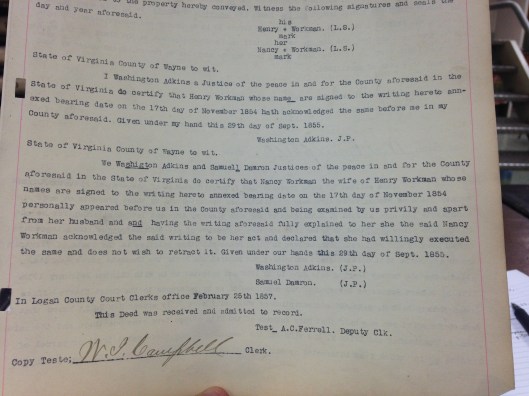
Henry Workman Deed to James Browning (1854)

14 Sunday Apr 2019

Posted by Brandon Ray Kirk in Twelve Pole Creek

≈ Leave a comment

Tags

A.C. Ferrell, Appalachia, county clerk, genealogy, Henry Workman, history, James Browning, justice of the peace, Laurel Branch, Nancy Workman, Samuel Damron, Twelve Pole Creek, Virginia, W.I. Campbell, Washington Adkins, Wayne County, West Virginia, Wiley Branch, Witchers Branch

Henry Workman to James Browning Deed 1

Deed Book C, page __, Logan County Clerk’s Office, Logan, WV.

Henry Workman to James Browning Deed 2

Deed Book C, page ___, Logan County Clerk’s Office, Logan, WV.

Thomas Dunn English and “Ben Bolt” (1928)

06 Tuesday Nov 2018

Posted by Brandon Ray Kirk in Guyandotte River, Huntington, Logan, Poetry

≈ Leave a comment

Tags

Appalachia, Battle of Buena Vista, Ben Bolt, Charles Porter, Charleston, Edgar Allan Poe, George P. Morris, Green Gables Inn, history, Huntington, Know Nothing Party, Logan, Logan Banner, Logan Grazier, McDowell County, N.P. Willis, Nelson F. Kneass, New York Mirror, Philadelphia, poems, poetry, Rafting on the Guyan, Roy Fuller, Staunton, Thomas Dunn English, Vicie Nighbert, Wayne County, Welch, West Virginia, West Virginia Review, Wyoming Hunter

From the Logan Banner of Logan, WV, comes this bit of history concerning Thomas Dunn English and his famous poem “Ben Bolt,” which was reportedly composed in Logan:

Poem Ben Bolt Not Written In This City

Legend Concerning Thomas Dunn English Is Refuted by Roy Fuller in Magazine Article

Another forceful kick has been directed against the legend that Thomas Dunn English wrote the poem Ben Bolt under the big elms back of the former Vicie Nighbert home, now known as the Green Gables Inn.

Though all reliable investigators agree that this famous poem was written before Dr. English settled in this community, the legend survives with a strange pertinacity.

The subject is discarded in an interesting and enlightening way in the current number of the West Virginia Review by J. Roy Fuller. He has written before in a similar vein for other publications.

Fuller, a native of Wayne county, had been connected with Charleston, Huntington, and Welch papers for several years. Recently he went to New York to take an editorial position on Picture Play. On the subject “As to Ben Bolt,” he writes as follows:

If a man writes a poem a little more sentimental than any other, and then some ten years later moves to another state, it seems that the towns and counties around his new home will, years later, recall the very spot where the poem was written. Such has been the case with Ben Bolt, by Thomas Dunn English. The people of Logan county point with pride to the very tree under which the poet scribbled Ben Bolt, and time and again articles have been written in support of the legend, and people who speak of it choose to believe nothing else. Why this should be considered in the least important is amusing. But that is not all. In McDowell county, it is said, Thomas Dunn English wrote the feverish lines while at the old county seat town, now called English. A clerk in a hotel informed this writer that he knew exactly where Ben Bolt was written and offered to show him the house somewhere just over the Virginia state line.

The rare honor of being the birthplace of Ben Bolt cannot be claimed truthfully for this section at all. It was written in Philadelphia nine years before he ever came to West Virginia. There was no romantic posing over the grave of the beloved lady in the song as it has been said in Logan county. A New York editor asked English to write something for him. He insisted, and finally English mailed the verses with instructions to burn them if not satisfactory, after combining parts of two poems into one. So any weeping we do can be for our own images, and not for sympathy with the poor poet.

English was once postmaster of Logan (1857), and also a resident doctor, politician, poet and lawyer. One time he attended a convention in Staunton where he made a speech that was influential in helping to bring about the downfall of Know-Nothingism. He wrote many local poems such as Rafting on the Guyan, Logan Grazier, and Wyoming Hunter. Before coming to the south he was well known in the east and was mentioned—unfavorably—by Edgar Allan Poe in his Literati. For calling him Thomas Dunn “Brown,” English wrote a severe criticism of Poe. Some time later Poe answered him in a Philadelphia paper, and brought suit against him. Poe was awarded $225 damages for English’s sarcastic literary thrust.

It has always been a matter of chagrin to English that his Ben Bolt was the most popular of his literary works. He himself called the song “twaddle.” But the German melody, mention of old mills, school, a loved one, friendship—these things made it take hold of the heart.

He wrote Ben Bolt in 1843 after having dabbled in his professions for several years, and quite unexpectedly found himself famous. The story of the song will show how far removed it is from the cherished pastoral story told in Logan county. The story persists, however, this being one of the cases where the “moving finger writes,” etc., and nothing more can be done about it.

N.P. Willis and George P. Morris had revived the old New York Mirror. The former asked English to write a poem for the paper and suggested a sea song. English tried to write it after renewed pressure but he reported to the editors that his muse was not working. Later he drifted into reminiscence and produced four and a half stanzas of the well known song. His muse balked again, and after some thought he added the first four lines of a sea song he had started and sent the whole with a note to Willis telling him that he would send something else when he was in a better writing mood. The poem was printed with a little puff, and was signed with the author’s initial.

Later it was suggested that the poem be set to music, but several attempts failed. English composed a melody for it, but another got the start of his. In 1846 Charles Porter, manager of the Pittsburgh theatre had Nelson F. Kneass, a fine tenor, in his company. Porter told the singer that if he could find a song suitable for his voice he would cast him in The Battle of Buena Vista. An Englishman, a sort of hanger-on named Hunt, had read Ben Bolt and could recall most of it. The gaps were patched up and to this Kneass adapted a German air and sang the piece. The drama was soon dropped but the song took the country by

Source: Logan (WV) Banner, 11 December 1928

Confederate Pensions in West Virginia (1929)

24 Monday Sep 2018

Posted by Brandon Ray Kirk in African American History, Big Creek, Big Harts Creek, Boone County, Civil War, Crawley Creek, Holden, Logan, Man, Pecks Mill, Whirlwind

≈ Leave a comment

Tags

A.B. White, A.L. Browning, A.V. Pauley, African-Americans, Andrew Jackson, Appalachia, Band Mill Hollow, Big Creek, Boone County, C.H. Gilkinson, civil war, Confederacy, Confederate Army, Crawley Creek, Curry, Dave Bryant, Dyke Bryant, Dyke Garrett, Ethel, genealogy, Gettysburg, Green Thompson, Harrison White, Harts Creek, Harvey Chafin, Henlawson, Henry Mitchell, history, Holden, House of Delegates, Hugh Avis, J. Matt Pauley, Jackson McCloud, James Zirkles, John Bryant, John Neece, Joseph Lowe, Judy Bryant, Kistler, Leslie Mangus, Logan, Logan Banner, Logan County, Lucinda Spry, M.T. Miller, Madison, Man, Martha Jane Smith, Melvin Plumley, Mingo County, Monaville, Mt. Gay, Pecks Mill, preacher, Shegon, Slagle, slavery, Steve Markham, Stollings, Union Army, W.C. Turley, Wade Bryant, Wayne County, West Virginia, Whirlwind, William C. Lucas, William Chafin, William Workman, Zan Bryant

In 1929, the State of West Virginia nearly opted to allocate a monthly pension to its Confederate veterans, as well as blacks who had served the Confederate Army in service roles. In covering the story, the Logan Banner of Logan, WV, compiled a list of its remaining Confederate veterans.

HOW MANY VETERANS?

A pension of $20 a month is provided for Confederate veterans of the state by a bill passed by the Senate last week and sent in the House for concurrence. Senator M.T. Miller, of Boone county, who said he could not vote to pension men who had carried arms against their government, cast the only vote against the proposal.

A Charleston paper says there are only about 60 Confederate veterans living. This paper cannot believe that, although it has no information on the subject. How many are there in Logan county? Does anyone know? Has anyone an approximately correct list? If so, will he or she make the fact known? Uncle Dyke Garrett probably knows most of them.

The Banner would like to obtain a list of both Confederate and Union veterans still living in the county, together with their post office address.

Source: Logan Banner, 26 February 1929.

***

AS TO OLD SOLDIERS

The Banner’s request for information about old soldiers living in Logan county has not been in vain, nor has the response been satisfactory. The names of four confederate veterans have been turned in, as follows:

Rev. Dyke Garrett, Curry, beloved and venerable minister; William Workman, Shegon, who fought at Gettysburg and is now 88; Steve Markham, Holden No. 20, who has been blind for 20 years; and William Chafin, who lives with his son Harvey, at Holden 5 and 6.

Who are the others? Send in their names and addresses and any information you deem of interest concerning their careers as soldiers and citizens. The same information about Union soldiers, residents of the county, is likewise desired.

Logan Banner, 5 March 1929.

***

PREPARING THE ROLL

Another name has been added to the list of old soldiers that The Banner has undertaken to compile. Reference is to J. Matt Pauley, residing in Band Mill Hollow, post office Stollings. He was in the Confederate army, fought throughout the war and was wounded, writes Mrs. A.V. Pauley of Ethel. He is of the same age as Uncle Dyke Garrett.

The names of four survivors of the War Between the States, all living in Logan county, were published in Tuesday’s paper. There must be others. Who are they?

Today, W.C. Turley brought in a list of eight Confederate veterans, including the following new names: Wm. C. Lucas, Big Creek; Henry Mitchell, Henlawson; Hugh Avis, Green Thompson and John Neece, Logan; Harrison White, Pecks Mill.

Logan Banner, 8 March 1929.

***

On Confederate Roll

Two more names have been added to the roll of Confederate veterans that The Banner is preparing. These are James Zirkles of Man, whose name was sent in by Leslie Mangus, of Kistler, and Zan Bryant of Whirlwind, whose name was recalled by County Clerk McNeely. Are there not others besides nine or ten previously published?

Logan Banner, 12 March 1929.

***

Confederate Veterans Living Here Number at Least 17

There Are Probably  Others–Will You Help to Enroll Them–All Merit the Tender Interest of Younger Folk

Seventeen names of Confederate soldiers, residents of the county, have been collected by The Banner. Wonder if any have been overlooked, or if the appended list is in error in including any Union veterans? If any reader knows of a Confederate soldier not listed here, please send in the name and address AT ONCE. There will be no further request or reminder.

This paper undertook to make up a list of these old soldiers for two reasons. Chief of these was a desire to prevent any of them being overlooked in case a bill to pension them was passed by the legislature–but the writer does not know yet whether or not that bill was enacted into law. Another reason for assuming the task was to test in a limited way a statement in a Charleston paper that there were only 60 Confederate veterans left in the state. That statement was doubted, and with good reason judging from the number polled in this county. Anyhow, the ranks have become terribly thinned. Every few days we all read of taps being sounded for another one here and there.

Middle-aged men and young folk should esteem it a privilege to do something to brighten the lives of these old soldiers. As the years roll by our pride will increase as we recall our acquaintance with and our kindness toward the “boys of ’61 and ’65.”

Here is the list. Look it over, and if there is a name that should be added or a name that should be stricken out, or any error or omission that should be corrected or supplied, speak up:

James Zirkles, Man; Zan Bryant, Whirlwind; J. Matt Pauley, Ft. Branch; Uncle Dyke Garrett, Curry; William C. Lucas, Big Creek; Henry Mitchell, Henlawson; Hugh Avis, Green Thompson and John Neece, all of Logan; Harrison White, Pecks Mill; Melvin Plumley, Crawleys Creek (post office not known); William Workman, Shegon; Steve Markham, Holden No. 20; William Chafin, No. 5 and 6.

Logan Banner, 15 March 1929.

***

Two Names Added Confederate Roll

Bill to Pension Them is Defeated By Parliamentary Tactics in House

Names of two more Confederate soldiers living in the county have been sent to The Banner. They are: C.H. Gilkinson, minister, resident of Holden, who was born and reared in Wayne county, and is the father of Dr. L.W. Gilkinson. Jackson McCloud, a resident of Whirlwind on Harts Creek. His name was supplied by A.L. Browning of Monaville, who says he feels sure that Mr. McCloud was in the Confederate service and fought at Gettysburg.

Assuming both names should be added to the roll, it means that there are at least 19 Confederate veterans still living in Logan county, seventeen names having been listed and published a week ago.

For many of them there will be disappointment in the information that the bill to pension them did not pass. Sponsored in the Senate by ex-governor A.B. White, the son of a Union soldier, the bill passed, that body, Senator M.T. Miller of Madison casting the only vote against it. In the House of Delegates it was amended, by a majority of one, to include Negroes, whether slave or free, who had served in the Confederate army of cooks, personal servants, or otherwise, and later tabled.

Source: Logan Banner, 22 March 1929.

***

Slagle Man 17th in Confederate List

Zan Bryant Probably Oldest Veteran In County–Born in Jackson’s Time

Joseph Lowe of Slagle is the latest name to be added to the list of Confederate veterans that has been compiled by The Banner. However, that leaves the count at 17, as the name of Melvin Plumley of Crawleys Creek was erroneously included in the published list. He was a Union soldier, it seems.

Of all those listed Zan Bryant of Whirlwind must be the oldest. He is said to be 98 years old and his wife, Judie Hensley Bryant, 91. They have been married for 75 years and have a son, Dave Bryant, who is 73. There are five other children, Dave, John, Wade and Dyke all live on Harts Creek, most of them near their parents; Mrs. Martha Jane Smith at Gay, and Mrs. Lucinda Spry of Mingo county.

This venerable couple have spent all their years in the isolated Harts country, their home being on White Oak fork, and can be reached only by a long horseback ride.

When Zan was born Andrew Jackson was president and Logan county as a political subdivision was but five years old. He was 23 years old when married and 30 when the War Between the States began.

Logan Banner, 26 March 1929.


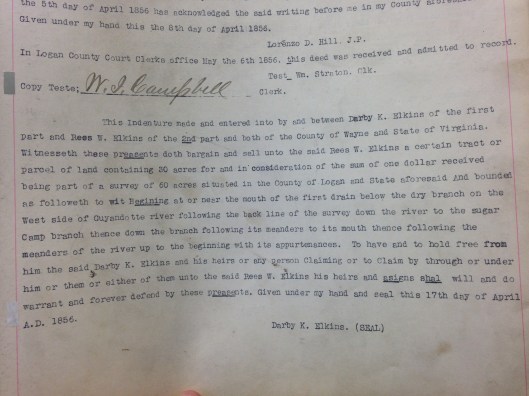
Darby K. Elkins Deed to Reese W. Elkins (1856)

12 Wednesday Sep 2018

Posted by Brandon Ray Kirk in Atenville, Guyandotte River

≈ Leave a comment

Tags

Appalachia, county clerk, Darby K. Elkins, Dry Branch, genealogy, Guyandotte River, Hezekiah Adkins, history, justice of the peace, Logan County, Reese W. Elkins, Sugar Camp Branch, Virginia, W.I. Campbell, Wayne County, West Virginia, William Straton

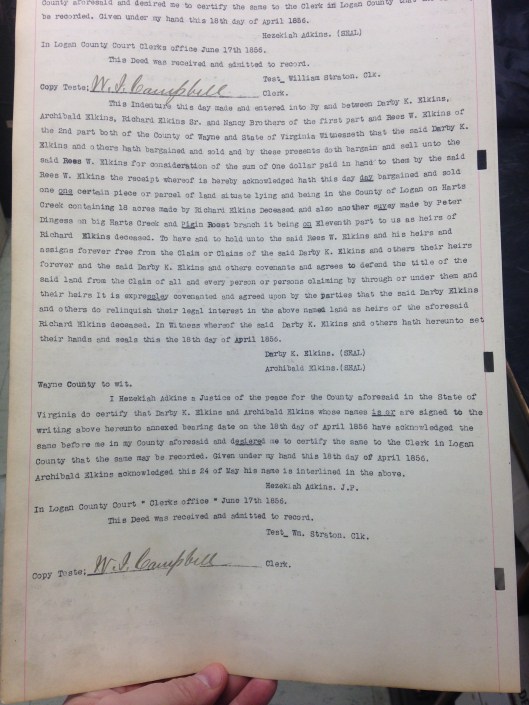
Darby K. Elkins to Reece W. Elkins Deed 1

Deed Book C, page 461, Logan County Circuit Clerk’s Office, Logan, WV. Note: This property is located near present-day Atenville, Lincoln County, WV.

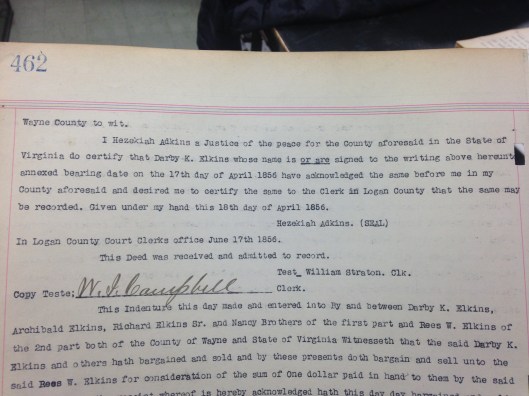
Darby K. Elkins to Reece W. Elkins Deed 2

Deed Book C, page 462, Logan County Circuit Clerk’s Office, Logan, WV

Mariah (Vance) Adkins Obituary (1931)

06 Thursday Sep 2018

Posted by Brandon Ray Kirk in Big Harts Creek, Cemeteries, Lincoln County Feud, Stiltner, Women's History

≈ 1 Comment

Tags

Abner Vance, Angeline Adams, Appalachia, Blood in West Virginia, Cain Adkins, Cain Adkins Jr., cemeteries, Community Memorial Gardens, Eliza Kelly, genealogy, Harts Creek, history, Jesse Nelson, Kenova, Lena Napier, Lick Creek, Lincoln County, Lincoln County Feud, Mariah Adkins, Mary Jane Jordan, Mittie Adkins, photos, Spicie Fry, Stiltner, Tams, Thomas Vaughan, Walton, Wayne, Wayne County, Wayne County News, West Fork, West Virginia, Williamson, Winchester Adkins

Mariah Adkins Obituary WCN 07.02.1931 1.JPG

Wayne County (WV) News, 2 July 1931. Mariah (Vance) Adkins was born on the West Fork of Harts Creek in present-day Lincoln County, WV. She married Canaan “Cain” Adkins, a preacher, teacher, doctor, and justice of the peace.

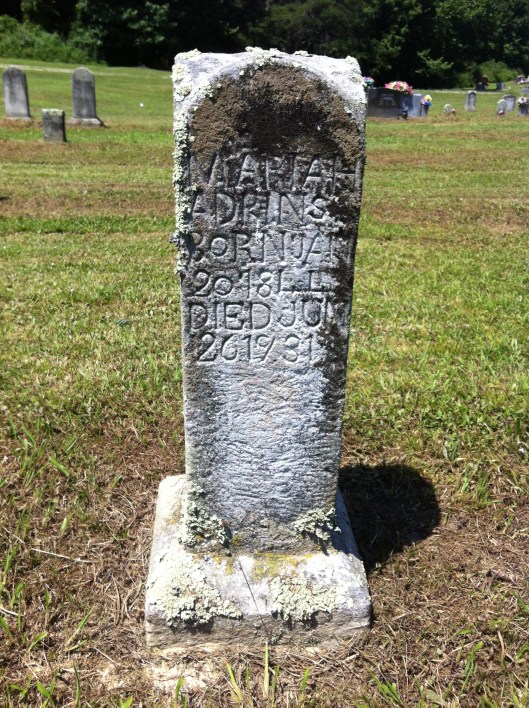
IMG_6738

Mariah Adkins grave at Community Memorial Gardens near Wayne, Wayne County, WV. 23 July 2016.

Civil War in the Guyandotte and Big Sandy Valleys (1862)

03 Monday Sep 2018

Posted by Brandon Ray Kirk in Big Sandy Valley, Chapmanville, Civil War, Guyandotte River, Pikeville, Tazewell County

≈ Leave a comment

Tags

Abington Virginian, Appalachia, Big Sandy River, Cabell County, Chapmanville, civil war, Confederate Army, genealogy, Guyandotte River, history, John B. Floyd, John Clarkson, John Dils, John Letcher, Kanawha River, Kentucky, Levisa Fork, Lincoln County, Logan County, Ohio River, Pigeon Creek, Pike County, Pikeville, Prestonsburg, Smyth County, Tazewell County, Union Army, Virginia, Virginia State Line, Washington County, Wayne County, West Virginia

Confederate General John B. Floyd composed this letter detailing military activity in the Guyandotte and Big Sandy valleys in late 1862, which was published by the Abington Virginian on January 2, 1863.

***

OFFICIAL REPORT OF GEN. FLOYD

Headquarters Virginia State Line,

Camp Clarkson, Tazewell Co.,

December 17, 1862

His Excellencey, John Letcher,

Governor of Virginia—

SIR: After my last communication to you I prepared an expedition consisting of a strong force of Cavalry under Colonel John Clarkson, to operate against the enemy in the counties of Wayne, Cabell, &c. He set out from Chapmansville on the 14th November, in the direction of Cabell down the Guyandotte river, over a rough and difficult road. The following day he fell in with a detachment of the enemy which he quickly routed and dispersed. He continued the march until a few miles of the Ohio river, breaking up the “Home Guard” organization of the enemy, which are very numerous in all that country, and taking prisoners every day.

A strong guard of Yankee troops, acting as a guard for the Pierpont Assessor for the county of Wayne, was attacked and dispersed after a short skirmish, in which was killed and wounded some of the enemy and took a few prisoners. Col. Clarkson proceeded then, according to the previous directions given him, to the Sandy river, to attack a large and formidable organization of the enemy composed mainly of the native population, and very strong posted amidst the cliffs and forests upon the precipitous banks of that river. He succeeded in taking them by surprise completely, and after killing and wounding a number of them, took a large number of prisoners, and surprised entirely the rest of the force. This force and organization were formidable and extremely dangerous to the peace and quiet of all the country round about for many miles, the loyal people were nearly all driven from their country and all were robbed. After that, Col. Clarkson, according to previous understanding, made a junction with me at the mouth of Pigeon Creek, in Logan county, on the Kentucky border, whither I had gone with the infantry and a section of the mounted howitzer battery.

I learned from Col. Clarkson that the enemy had started a number of boats with valuable supplies, from the mouth of Sandy to a post recently established at Pikeville, a point at the head of navigation on the Louisa Fork of Sandy. These boats were in charge of a strong guard, and were intended to furnish a complete outfit for a force deemed sufficient for them, by their commander, to march upon and destroy the salt works in Smyth and Washington counties.

I determined at once to attack this train, and from its distance, being more than forty miles off, it became necessary to send mounted men. Besides this reason, I found it inconvenient to move the infantry in that direction, on account of the number of prisoners with which we were encumbered. The cavalry and mounted men were put in motion within an hour and proceeded upon the march, which was uninterrupted, day or night, until the enemy were overtaken, attacked and routed.

Our people captured ten of the enemy’s transport boats, laden with valuable supplies. A great deal of these supplies was distributed amongst the men, and much of them was brought off; but a very large amount of most valuable supplies was necessarily destroyed for want of transportation to bring them away. A train of one hundred pack mules would have brought away a very large amount of extremely valuable stores, which were committed to the fire and the river.

The night following the capture of these boats (indeed, just twelve hours after the attack upon the boats,) our forces engaged that of Col. Dils, posted in an extremely strong position on the summit of a mountain on the road leading from Prestonsburg to Pikeville. This position was taken and held without any knowledge on our part, and as the attack was made after the night, and entirely unexpected, we were taken at a great disadvantage. But our men behaved with great steadiness and resolution, received the attack and charged the enemy, driving him from his position, and dispersing them entirely. The rout was complete, and the post at Pikeville, consisting of a thousand men, was entirely broken up. The prisoners and the Union people in that neighborhood reported Colonel Dils as killed in the fight that night.

For more detailed statements of this expedition I refer you to the report of Col. Clarkson. In our operation through the country, we made a number of recruits in the counties of Cabell, Wayne, Logan, &c.

My object in this campaign was, as far as possible, to prevent the occupation by the Yankee forces, of the country between the Kanawha Valley and Kentucky border, as well as to destroy the military organization of the country under the traitor government in Wheeling. Both objects were fully attained, as long as I was able to remain in the country. The military organizations, very numerous and well appointed in every particular, were almost entirely destroyed, and the attempts to set up the spurious government were entirely failed.

I was compelled to leave the country, held by me for more than three months alone, for the want of Quartermaster’s supplies. We were without tents, or clothing, or cooking utensils, or axes; and after the inclement weather of winter set in, we could no longer remain in the field. With these stores supplied, I would have remained in that country throughout the winter months. We were able to procure food (meat and bread) in the country, nearly all of it taken from the enemy.

The campaign, from first to last, was one of hardship and privations; but they were borne without complaint by the men, who are unsurpassed in hardship, activity and capability to endure privations. They deserve great praise for their constancy and general good conduct.

The officers generally deserve commendation, but to Col. Clarkson too much credit cannot be given for his energy, activity and courage. The obstacle she encountered, of every sort, throughout these expeditions, were of the most formidable character, but they were also most gallantly surmounted.

I have the honor to be, very respectfully,

Your obedient servant,

JOHN B. FLOYD,

Maj. Gen. Commanding Va. State Line

NOTE: I bolded Gen. Floyd’s description of activity in the Guyandotte Valley that occurred between Chapmanville and the lower section of the river near present-day Huntington.

Elizabeth Adkins Deed to Jacob K. Adkins (1901)

23 Monday Jul 2018

Posted by Brandon Ray Kirk in Guyandotte River, Little Harts Creek

≈ Leave a comment

Tags

Appalachia, Elizabeth Adkins, Eveline Adkins, genealogy, George W. Adkins, Guyandotte River, Harts Creek District, Henry Adkins, Henry H. Adkins, history, Jacob K. Adkins, John C. Ferguson, John Sartin, L.C. Queen, Lincoln County, Little Harts Creek, Mary Adkins, Mary Louisa Tomblin, notary public, Ohio, Spencer Adkins, Wayne County, West Virginia

Elizabeth Adkins to Jacob K. Adkins 1

Deed Book 59, page 272, Lincoln County Clerk’s Office, Hamlin, WV. This deed involves the heirs of Henry and Mary “Polly” (Dalton) Adkins, Sr.

Elizabeth Adkins to Jacob K. Adkins 2

Deed Book 59, page 273, Lincoln County Clerk’s Office, Hamlin, WV.

Timber Companies Active in the Guyandotte Valley (1890s)

28 Wednesday Feb 2018

Posted by Brandon Ray Kirk in Guyandotte River, Timber

≈ Leave a comment

Tags

Appalachia, Burks and Prichard, C. Dingess & Company, Cole and Crane Company, Fridman Lumber Company, Guyan River Coal and Mercantile Company, Guyandotte Valley, history, Hugh Dingess & Company, Huntington Advertiser, Ironton Cross Tie Company, Little Kanawha Lumber Company, Logan County, Logan County Banner, Logan Timber Company, logging, McClintock & Son, Panther Lumber Company, Penn Lumber Company, R.H. Prichard, Ratliff and Shannon, Sliger Lumber Company, timbering, Wayne County, West Virginia, Wittenburg, Yellow Poplar Lumber Company

A partial list of timber companies active in the Guyandotte Valley of West Virginia during the 1890s, based on Logan County deeds, the Logan County Banner, and the Huntington Advertiser:

C. Crane & Company (1891, 1894, 1895, 1896, 1898, 1899, 1900)

C. Dingess & Company (1891, 1892, 1893, 1894)

Fridman Lumber Company (1899)

Guyan River Coal and Mercantile Company (1897)

Hugh Dingess & Company (1893)

Ironton Cross Tie Company (1897)

Little Kanawha Lumber Company (1891, 1892, 1893, 1895, 1898)

Logan Timber Company (1897)

McClintock & Son (1895)

Panther Lumber Company (1896)

Penn Lumber Company (1898)

R.H. Prichard or Burks and Prichard (1891)

Ratliff and Shannon of Wayne County (1890)

Sliger Lumber Company (1896)

Yellow Poplar Lumber Company (1893)

Wittenburg (1898)

Elkins Men Deed to Reese W. Elkins (1856)

25 Sunday Feb 2018

Posted by Brandon Ray Kirk in Big Harts Creek

≈ Leave a comment

Tags

Appalachia, Archibald Elkins, Darby K. Elkins, genealogy, Harts Creek, Hezekiah Adkins, history, justice of the peace, Logan County, Nancy Brothers, Peter Dingess, Pigeon Roost Branch, Reese W. Elkins, Richard Elkins, Virginia, W.I. Campbell, Wayne County, West Virginia, William Straton

Elkins Men to Reece W. Elkins Deed 1

Deed Book C, page _____, Logan County Clerk’s Office, Logan, WV. This property is located in present-day West Virginia.

Republicans in Logan County, WV

03 Friday Nov 2017

Posted by Brandon Ray Kirk in Chapmanville, Logan

≈ Leave a comment

Tags

A.A. Lilly, A.D. Cook, A.J. Fowler, A.L. Sansom, Amherstdale, Appalachia, assessor, B.A. Browning, B.L. Holland, Bernadine B. Ridenour, board of education, Bruce White, C.V. White, Chapmanville, Charleston, Christian, circuit clerk, county clerk, county commissioner, Curry, Edward Cooper, Edward S. Doolittle, Evart Campbell, Fayette County, Ferrell-Cook Republican Club, G.R. Claypool, George Godby, H.C. Burgess, Henry D. Hatfield, Henry Godby Jr., history, House of Delegates, Hugh Ike Shott, Huntington, Huntington Advertiser, I.M. Conley, Ira P. Hager, J.C. Elkins, J.D. Copley, J.M. Mitchell Jr., J.W. Hinchman, James Jeffrey, John M. Perry, John Perry, justice of the peace, lawyer, Logan, Logan Banner, Logan County, Logan County Banner, Logan District, Lon Walls, Mike F. Matheny, Naaman Jackson, O.J. Deegan, Pat Riffe, prosecuting attorney, R.F. Mitchell, Republican Party, Richard Kirk, S.A. Ferrell, sheriff, T.C. Whited, Thomas B. Hensley, Thomas Wilson, Triadelphia District, Union Army, W.A. Brazie, W.C. Lawrence, W.P. Neekamp, Wayne County, West Virginia

From various regional newspapers come these stories about the Republican Party in Logan County, West Virginia:

***

Republicans of Logan

Endorses the Candidacy of Judge Doolittle for Supreme Judge

The Logan county republican convention was held last week. Instructions were given for Gaines for Congress, and the candidacy of Judge Doolittle, of this city was endorsed for Supreme court judge.

Source: Huntington (WV) Advertiser, 30 April 1900.

***

The Republican Ticket

The Republicans, at their convention on Saturday, nominated a full county ticket.

The nominee for House of Delegates, Pat Riffe, is a native of the county and an old Union soldier.

W.A. Brazie, the nominee for County Clerk, is a native of Fayette and came here about twelve years ago, and worked in this office about ten years. He is well known in the county, and is well fitted for the position for which he is named.

J.D. Copley, the nominee for Circuit Clerk, is a native of Wayne, …

Source: Logan County Banner (Logan, WV), 2 October 1902.

***

Logan Republican Municipal Ticket LD 03.30.1911 1.JPG

Logan (WV) Democrat, 30 March 1911.

***

Republican Convention in Logan LB 07.10.1914 1.JPG

Logan (WV) Banner, 10 July 1914.

Republican Convention in Logan LB 07.10.1914 2.JPG

Logan (WV) Banner, 10 July 1914.

***

Republican County Ticket.

Member of the Legislature–Naaman Jackson, of Logan.

County Clerk–John Perry, of Logan.

Circuit Clerk–J.M. Mitchell, Jr., of Curry.

County Superintendent of Schools–R.F. Mitchell, of Christian.

Member of the County Court–A.D. Cook, of Triadelphia District.

W.C. Lawrence, for the Committee on Nominations, reported the following selection for members of the County Central Committee of the Republican Committee of Logan County.

For Logan District, Bruce White, I.M. Conley, James Jeffrey, T.C. Whited and W.C. Lawrence.

For Triadelphia District, H.C. Burgess and Lon Walls.

For Chapmanville District, A.J. Fowler and T.B. Hensley.

Hon. O.J. Deegan was selected County Chairman and Hon. Ira P. Hager as County Secretary and Treasurer, both promising young attorneys of Logan.

Source: Logan (WV) Banner, 17 July 1914.

***

Primary Results LD 06.29.1916 3.JPG

Logan (WV) Democrat, 29 June 1916.


Republican Campaign Opening Ad LB 10.05.1926.JPG

Logan (WV) Banner, 5 October 1926.

***

Republicans Organize Club At Chapmanville

Republicans met at Chapmanville Friday night and organized a campaign club and named it the Ferrell-Cook Republican club. Praise was sounded for local and national Republican administrations for the tax reductions that have been made. The following officers were elected: S.A. Ferrell, chairman; Evart Campbell, secretary; A.L. Sansom, treasurer. Another meeting of the club was called for 7 o’clock tonight.

Source: Logan (WV) Banner, 19 October 1926.

Mollie Drake: “The Florence Nightingale of Blair Mountain” (1921)

20 Friday Oct 2017

Posted by Brandon Ray Kirk in Battle of Blair Mountain, Coal, Huntington, Logan, Women's History

≈ Leave a comment

Tags

Allen B. Dingess, Alleyne Dye, Appalachia, Ashland, Battle of Blair Mountain, Cabell County, Caroline Dingess, Cattaraugus County, Ceredo, coal, Democratic Party, genealogy, Hannah Mitchell, Henry Street Settlement, history, Huntington, Illinois, Kentucky, Leo Frank Drake, Logan, Logan Banner, Logan County, Mollie Drake, New York, Republican Party, Springfield, Wayne County, West Virginia

Mollie (Dingess) Drake, daughter of Allen B. Dingess and Caroline (Jackson) Dingess, was born on June 30, 1881 in Logan County, WV. She was the wife of Leo Frank Drake, a salesman. She appears in the 1910 Wayne County Census (Ceredo District). Hannah Mitchell profiled her life in the Logan Banner of Logan, WV, on December 30, 1921. Her husband died in 1925. In 1930, Mollie lived at Springfield, IL. In 1940, she made her home in Cattaraugus County, NY. Mrs. Drake died on July 7, 1958 at a nursing home in Huntington, WV.

Mollie Dingess Drake Photo.jpg

It would be easy enough to make a melodramatic start and give her some such extravagant title as “The Angel of the Hills” or “The Mother of the Mines” or “The Florence Nightingale of Blair Mountain.” But if you did and Molly Dingess Drake found it out she might laugh and she might make some sharp remark, but most certainly she would not be pleased.

How she escaped the “war correspondents” who were rushed to the front to cover West Virginia’s recent mine war is more than I can say, for the story is still told of how Molly, like “Sheridan twenty miles away,” when the armed miners were marching on Logan, made all haste not toward safety, as she might very wisely have done, but back to where the bullets were flying.

Her narrowest escape from the feature pages of newspapers was several years ago–two, in fact–when, a woman of some two score years, she was graduated from high school with her sixteen-year-old daughter. That graduation and the attendant high school diploma were in no sense honorary affairs given out of respect for Molly Dingess Drake. They had been earned by this very determined, ambitious woman of the hills after four years of high school work, in which she had enrolled along with her daughter and for which she had attended classes faithfully and with classmates half her age.

On pay day Mrs. Drake is a welfare worker for one of the coal companies operating in the Logan field. Having finished her high school course, she did not go on to college with her daughter. And, as she puts it, one of the coal producers “knew she wouldn’t sit at home and knit and crochet.” So he offered her the job of visiting nurses among the employees of his company. In this job Mollie mothers a large family. It is composed of men and women much older than she and of the children of these older children. True to the mother-type anywhere, she makes their individual troubles, their health, their happiness, a very personal matter.

There was the young Spaniard who lay in the hospital after a severe accident. No friends or relatives rallied to his bedside, and the doctors and nurses could not understand him when he moaned out a word or two in his native tongue. Mollie Drake scoured the hills for an interpreter and found one. She also dug up a cousin of the unfortunate boy. Moreover she made the lives of nurses and doctors miserable until the lad was out of danger, sometimes calling at the hospital late at night to see how the boy was getting on. Was not this foreign born lad one of her children?

It was not the Mollie Dingess Drake, ready to face danger along with other brave women of Logan county when armed miners were marching upon their homes, that interested me most, as you may have guessed already. The World War is too recent proof that American women are not afraid to risk their lives for a cause. It is Mollie Drake and the work of her hands when peace broods over her native hills that make her a woman among women.

Mrs. Drake is a mountain woman herself. She knows the desires, the needs and the hopes of the women and children who live in her hills; in a double sense she is working among her own people.

No serious-minded killjoy is Mrs. Drake, but a large motherly woman with a great capacity for fun and for seeing the human side of things.

It is a common statement among traveling salesmen that they live in a Pullman; Mollie Drake might say she lives in a day coach. Her headquarters are in Logan, and much of her time is spent in riding to and from the little mining towns along the branch lines out of Logan.

Her trips are taken to visit the homes of miners, and no place is too remote for her to visit. Her energy in tramping about and the speed with which she walks over the hills is enough to make a younger woman gasp for breath and all but beg for quarter. That from one who knows.

We started out of Logan one morning on the 10 o’clock train.

Before the train started we were part of the social gathering which greets the all-too-few passenger trains that come into Logan. Mollie Dingess knew everybody.

Arrived at the mining center, our first visit was to the schoolhouse, a substantial two-story building, in front of which were all the latest playground devices for amusing the modern child. The teachers were young and efficient in their schoolroom manners. In Logan county the schools have the advantage of extra good teachers because after the school board has voted what it can afford for salaries the coal companies make up the deficit needed to attract the best.

It was then I learned of Mrs. Drake’s unusual high school career.

“You know I have a high school education,” she remarked as we left the school and strode (at least Mrs. Drake strode) along the dirt road.

“As a girl I went to school till I was thirteen. In the teens I took up nursing and later was married. But I always wanted more education. Sometimes it is the persons who are denied education appreciate it most. Well, when my daughter was ready for high school I decided that I would get my high school education too–not by following her studies at home (I knew that wouldn’t do), but by enrolling in high school with her.

“Some of my friends thought it was an absurd idea. They said I could enroll in college for special courses or take correspondence courses. But the idea of my going to school right along with my daughter and the other young people seemed queer to them. I suppose it was unusual. But what I wanted was a regular education. So I enrolled and went through the four years of high school and was graduated in the same class with my daughter.”

“And how did your daughter feel about it?”

“Oh, she had her young friends and took part in school activities just the same.” Again the twinkle behind the glasses. “It may be that she studied harder than she would have.” I had no doubt of that.

“She is in college now,” continued Mrs. Drake. “When her grades aren’t has high as I think they ought to be she sends them to her father, but a man can’t keep such things secret, and I always find out. She knows I haven’t much patience with students who don’t keep up their grades.

“My daughter is going to be a physician. She didn’t make up her mind until after she entered college. I was rather anxious to know what she would choose. After she started studying biology she was so interested that she decided to go on and study medicine.”

It occurred to me that Mollie Drake was a feminist. I wondered if she had ever been a suffrage worker.

“No,” she answered. “I’ve always been a Democrat, though. My husband says I am what is called ‘a mean Democrat.'”

She paused and then laughed. “I made one rule when I was married. You see, Mr. Drake is a Republican. Well, I told him that if I married him he must keep just one rule. I knew our marriage would be a success if he did. And of course I promised to keep it too. The rule was that we should never talk politics. We never have and we’ve been very happy.

“Of course I voted at the last election, and much good it did so far as the Presidency was concerned. But someway I didn’t care so much for the voting. I’m old-fashioned in many ways. I was brought up in a strict way and I don’t like to hear about folks playing cards on Sunday. I suppose it isn’t wicked, but I can’t get over my bringing-up. And I never take a needle in my hand on a Sunday, only when I just have to mend something, that I don’t feel kind of guilty.”

Our conversation had been interspersed with visits to various miners’ homes, mostly where there were babies. Mrs. Drake’s philosophy had been punctuated by advice on babies and friendly comment upon the little interests of the women we visited. If we weren’t inspecting a baby we were talking with some elderly woman over a fence about her latest “misery.”

As we climbed the trails I was tired, but Mrs. Drake seemed as energetic as when the day began.

“I like the work,” she said, “but I want to study more. Last summer I took a course in New York, and I’d like to go back there for a second at the Henry Street Settlement. I want to study languages, too. There are so many things I want to do.”

Some day I have not a doubt she will do these things she wants to do. In the meantime I think of her in connection with the verse: “Whatsoever thy hand findeth to do.”

Source: “The Florence Nightingale of Blair Mountain,” Logan (WV) Banner, 30 December 1921.

Notes:

To see Mrs. Drake’s photo and entry at Find-A-Grave, follow this link: https://www.findagrave.com/cgi-bin/fg.cgi?page=gr&GRid=20145994

Mrs. Drake’s daughter, Alleyne Howell Dye, died of suicide in Ashland, KY, in 1944. For her death record, follow this link: https://www.familysearch.org/ark:/61903/3:1:3Q9M-C9YV-H7M5-H

To see Mrs. Dye’s photo and entry at Find-A-Grave, follow this link: https://www.findagrave.com/cgi-bin/fg.cgi?page=gr&GRid=20146072


Rev. Patrick Napier of Wayne County, WV

03 Tuesday Oct 2017

Posted by Brandon Ray Kirk in East Lynn

≈ Leave a comment

Tags

Appalachia, genealogy, history, Patrick Napier, Wayne County, Wayne County News, West Virginia

Rev. Patrick Napier was a preacher in Wayne County, WV.  This description of Rev. Napier appeared in the Wayne County News on February 12, 1931.

Rev. Patrick Napier was essentially a man of the hills who possessed a strong and striking personality. He was accounted one of the ablest preachers in his church as he was one of the most sincere and influential. In the associations, his opinions were given strong weight on all questions of church government and denominational doctrine. He was in all respects one of the strongest men in his community and he possessed many of the elements of leadership. Personally, he was of kindly nature, frank and openhearted and of most genial disposition. His uniformity affable manner taken in connection with his striking appearance and pleasing countenance made him a conspicuous figure in any assembly. His easy manner and gracious disposition attracted friend and stranger alike. For many years before his death he was the most potent force and influence in his association. He led his friends unconsciously and they followed his leadership because his was the stronger mind.

Source: Wayne County News (Wayne, WV), 12 February 1931.

Civil War Dispatches From Wayne County, WV (1865-1866)

07 Thursday Sep 2017

Posted by Brandon Ray Kirk in Big Sandy Valley, Civil War, Timber

≈ Leave a comment

Tags

Abel Segur, Abraham Lincoln, Appalachia, Arthur I. Boreman, Bill Smith, Burlington, Cabell County, Cassville, Catlettsburg, Ceredo, Charleston, civil war, Confederate Army, crime, David Bartram, David Frasher, Department of West Virginia, deputy sheriff, G.W. Brown, Gallipolis, Gallipolis Journal, George Crook, Greenbrier County, Guyandotte, history, Ironton Register, Isaac Bloss, J.W. Merricks, Jack Meadows, Jefferson Davis, Jim Turner, John B. Bowen, John W. Holt, Kentucky, Logan County, Monroe County, Ohio, Ohio River, Pete Jeffers, Pike County, Pocahontas County, Point Pleasant, Raleigh County, sheriff, The Weekly Register, Tug Fork, Union Army, Wayne County, Webster County, West Virginia, Wheeling Intelligencer, William Wirt Brumfield

Below are several dispatches relating to the Civil War and immediate post-war era in Wayne County, West Virginia. These dispatches appeared in pro-Union newspapers.

Wheeling Intelligencer, 21 January 1865

WEST VIRGINIA AS A PLACE TO LIVE. I could not conscientiously recommend any one to come here now to live, although investment in farms will surely be profitable. The trouble now, chiefly, is that the guerrillas have broken up their organization, if they ever had any, and scattered into small squads to rob and steal. A schoolmistress, passing along a lonely road not far from Ceredo, was robbed of all her money, the amount she had just received for three months’ teaching, by three ruffians. A few nights ago men went to the house of a quiet farmer, one mile from Ceredo, and robbed him of a few dollars, all he had, and boots and some clothing. Some of the citizens keep arms in their houses, and intend to use them if visited in that way. One of these shot one of a gang of six one night not long ago, but became frightened himself, and ran off, giving the robbers a chance to take their wounded companion away. He has not been troubled since. Geo. Crook, commanding the Department of West Virginia, has issued a circular notifying the people that they must organize for their own protection, and recommends them to hunt the bushwhackers and kill them. Governor Boreman offers to furnish arms and ammunition. It will be done, and the guerrillas will decrease every week, I hope.

The Weekly Register (Point Pleasant, WV), 26 January 1865

GIVING THEMSELVES UP. — We learn that Lieut. Samuels, brother of Judge Samuels, formerly Adjutant General of this State, recently came into Wayne county, accompanied by a dozen or fifteen other rebel soldiers, all of whom took the amnesty oath. They say they are tired of fighting for nothing and freezing to death.

Wheeling Intelligencer, 21 February 1865

A GUERRILLA MURDER. We learn from citizens of Wayne county, who arrived yesterday, that a few days ago a guerrilla murder was committed at Ceredo, on the Ohio river in that county. It appears that a gang of men, under command of the notorious Bill Smith, came down to Ceredo and entered the house of Jack Meadows, a citizen, shot him through the heart, drove his wife and children out of doors, and set fire to the premises. Mrs. Meadows who fortunately armed with a revolver, shot one of the guerrillas dead and seriously wounded another, but not until one of her legs had been broken by a blow with a gun in the hands of one of the rebels. The rebels having completely destroyed the house of Mr. Meadows, and with all its contents, fled to their hiding places, leaving their dead companion unburied. Mrs. Meadows and her children were taken to Catlettsburg, Ky., where she still remains.

Wheeling Intelligencer, 23 February 1865

GUERRILLAS. — During the debate yesterday in the House of Delegates, upon the bill to provide for the better organization of the State Guards, some horrible pictures were presented of the condition of the loyal people of the border counties. Mr. Ferguson said that every part of the county of Wayne on the Ohio river, was held by guerrillas. In the county of Cabell only one two, Guyandotte, was held by the Federal troops. The rebels have their headquarters up in Logan county, and they make forays down toward the Ohio river, stealing, murdering and devastating the country. They enter the houses of loyal people and steal household furniture and bed clothing, and frequently strip women and children of wearing apparel and leave them in an actual state of nudity. Mr. Wells, of Raleigh, and Mr. Gregory, who represents Webster and Pocahontas, gave similar accounts of the condition of things in their respective localities.

Gallipolis Journal, 2 March 1865

CEREDO, WEST VIRGINIA. — Since the breaking out of the rebellion, “I give bread” town has been subjected to many vicissitudes. Its prospects when projected, in 1854, and later, was that of a great manufacturing city. Early in 1862, many of the Yankee citizens anticipated the coming storm, and either disposed of their property or left it to the despoiler. At one time it had a regiment quartered in its midst, but of late no troops have been nearer than Guyandotte. Disloyalty has cropped out under drunkenness and personal hate, until one’s life is endangered at any moment. Guerrillas and rebel sympathizers occupy the principal houses vacated by the owners. Not a public building stands untouched. The window and door frames, flooring and every sleeper of the hotel have been torn out and burned up. The dismantling of the steam saw mill and Glass Factory have long since been accomplished. Night is made hideous by the continued debaucheries of certain desperate characters, such as Jack Meddows and Pete Jeffers. There is not a loyal family left in Ceredo.

The Weekly Register (Point Pleasant, WV), 9 March 1865

A correspondent of the Ironton Register, writing from Burlington, O., says: The murder of Jack Middaughs, at Ceredo, on the 13th inst., was attended with some circumstances that deserve mention. The guerrillas surrounded his house before he knew of their presence. Then with a single revolver he drove them a little, wounding two of them. His wife then seized the revolver and threatened them, while Jack made his motions for escape. It was then that the rebs pressed forward to get up the stairs, Mrs. Middaugh standing at the head. Jim Turner was in advance, and finding Mrs. Middaugh in his way, swung his gun and with a blow smashed her foot. She then shot him through the breast, and he fell. At this moment Jack sprang down the stairs knocking down all in his path. He got out and nearly reached the woods, when he was met by three or four mounted men, who surrounded and killed him. — There were thirty-five men in the gang, with Smith, and it would be safe to say that twenty of them were at the house. Through this crowd Jack heroically fought his way and would have escaped but for the guards near the woods. The treatment of Mrs. Middaugh was barbarous in the extreme. It has been equaled only by the cruelties practiced by the Indians in the early times in this country. After she was disabled they took her and her children out, and made her lie down upon the ground, half dressed, refusing to permit her to get a single article from the house, while they were setting fire to it. On that bitter cold night of the 13th of February, in her condition, she was compelled to remain until the savages left. The conduct of this heroic woman is duly appreciated by the citizens of Catlettsburg and they have generously provided for her and her little ones.

Wheeling Register, 6 June 1865

The following resolutions were passed at a meeting of the citizens of Wayne county, West Virginia, held at the Court House on the 18th ult.:

WHEREAS, Our country is just emerging from civil war, which has laid waste our fields and drenched the land in fraternal blood; and

WHEREAS, It is to the interest of all to restore permanent peace and harmonize the elements necessary to a well regulated society; therefore, we, the people of Wayne county, in Mass Meeting assembled, do Resolve:

1st. That in the preservation and perpetuity of the principles set forth in the Constitution and Government of our fathers, we most sincerely and devoutly acknowledge an all wise Providence, who is the Giver of every good and perfect gift, and the common Father of us all; and we will, in time to come, rely implicitly upon Him for His protection and guidance.

2d. That it is the duty of every individual to lend his active aid and energy to the establishment of civil law, both State and National, and to its enforcement for the protection of life, liberty and property.

3d. That we justify and approve the Amnesty of President Lincoln. Its results have been beneficial, and the croakers and fault finders of the policy are morally arrayed against the Government and its best interest, and are not found among those who have fought its battles and borne it through the ordeal of war with success.

4th. That we concur in the convention called by the citizens of Greenbrier and Monroe, to meet at Charleston on the third day of June next, for the purpose of suppressing the lawless persons, and the restoration of order throughout the State, and do appoint and constitute Messrs. Abel Segur, John B. Bowen, R. Banton, and Isaac Bloss as delegates to represent Wayne county in said convention.

W.W. Brumfield, President

J.W. Merricks, Secretary

Wheeling Intelligencer, 25 April 1866

AFFAIRS IN WAYNE COUNTY. Cassville, Wayne Co., W.Va., March 23d, 1866. To the Governor of the State of West Virginia: Dear Sir: — After respects, I wish to call your immediate attention to some facts, as follows: Sometime last Spring you commissioned me as a notary public, and I was sworn and gave bond as the law directs. I am also assessor of the 2d district of Wayne county. I live and keep my office in Cassville; and it is with extreme difficulty and under great danger and hard threats that I am getting along. My entire neighborhood is rebel with the exception of old Squire Bartram and his boys, one of whom is our high Sheriff and another Capt. David Bartram our deputy Sheriff. I have forborne for a long time calling for men and arms, thinking the rebels would quiet down; but sir, we cannot execute the civil law unless something is done. We have been beaten by mobs and shot at on the streets and dared to help ourselves. They say they can’t have power, and we shan’t have it. Now, Governor, I suggest and absolutely insist that a company of one hundred volunteer militia be raised for our protection. The rebels say if you call out the militia, they will be in the majority but we do not want more than one hundred men. Our county is mostly quiet except around Cassville. A commander and company is not necessary for the enforcement of civil law in the lower end of the county. If in your judgment you see fit to commission and arm men, I would suggest that William Shannon be commissioned Captain. He is an honorable and upright man and knows something of both civil and military matters. Further, that David Frasher be commissioned as Lieutenant, to be stationed at Cassville. We must have from 25 to 50 men here in Cassville, or else we must get out of here. This is the landing place for all lumber that comes down Tug river. Those big buck rebels come down in time of high water sometimes by dozens from Logan county and from Pike county, Ky., with their navies [revolvers] buckled around them, hurrahing “for Jeff Davis,” cursing the Government, cursing Union men, and then we have to get out. Sir, I frequently see men come in here who are indicted for murder in Kentucky, defying everybody. Not more than eight miles from here, as some of the Home Guards were on their way home from being paid off a company of rebels fell on them and beat and abused them severely, calling the party “damned abolitionists,” and swore they would not submit to our laws. A few days ago they gathered in here and raised a riot with our Sheriff, and fell on him with clubs and weights and tried to kill him and his brother. His brother ran into my house for protection. They stoned my window out, knocked two panels out of my door and nearly killed my little child. If you see fit to protect us send the commissions immediately. The men can be raised in a few days. Send full instructions and special orders. You may send arms if you think proper, for there will be no doubt about recruiting the men immediately. We have plenty of guns here which belong to the State that can be gathered up. This company should be armed with revolvers instead of guns. I refer you to Major Brown [Col. G.W. Brown, Q.M. General], the man who came here and paid the home guards. He formed some acquaintance with me when he was here, also with Shannon and Lieut. Frasher. Yours, with respect, John W. Holt.

 

Hezekiah Adkins (1759-1842)

04 Tuesday Jul 2017

Posted by Brandon Ray Kirk in Cemeteries, Giles County, Harts, Native American History

≈ 8 Comments

Tags

American Revolution, Appalachia, Beech Fork, Beech Fork State Park, Billy Adkins, Brandon Kirk, cemeteries, Continental Line, genealogy, Giles County, Harts, Hezekiah Adkins, Hezekiah Adkins Cemetery, history, Isaac Adkins, John Lucas, Lincoln County, Missionary Baptist, Molly Adkins, Montgomery County, Native Americans, New River, photos, preacher, Revolutionary War, Ronnie Adkins, tourism, Virginia, Wayne County, West Virginia, Winslow

IMG_6407

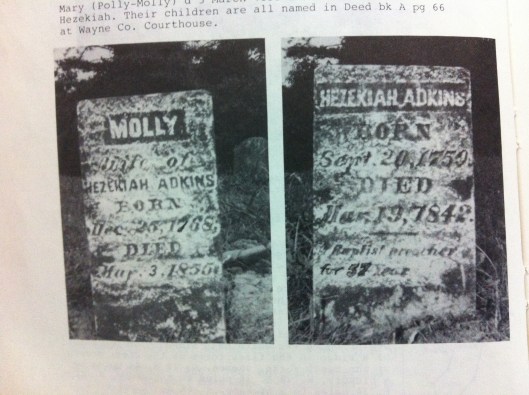
In 1990, Ronnie Adkins published THE definitive Adkins genealogy book. A great many researchers appreciated his work on Hezekiah Adkins’ line of the family. Hezekiah Adkins was born in 1759 in Virginia, served in the American Revolutionary War, moved from Giles County, Virginia, to present-day Wayne County, West Virginia, about 1810, and died in 1842. His grave markers are yet visible at Winslow on Beech Fork in Wayne County, WV. If you visit the grave site, you will find Hezekiah Adkins buried on the left and his wife Mary “Molly” buried on the right (unlike in this photo). Any Adkins researcher owes a great debt to Ronnie Adkins and his book. THANK YOU, RONNIE.

IMG_2228

Here is a photo of my good friend and mentor Billy Adkins visiting the grave site in 1991. Years ago, Billy assisted Ronnie in gathering information about members of the Adkins family who settled in the Harts area of Lincoln County, WV.

IMG_6301

Here is Hezekiah’s grave as it appears today (left). His wife Molly is buried to the right.

IMG_6299

Hezekiah Adkins is my paternal great-great-great-great-great-great-grandfather through his son, Isaac Adkins (1790-1854).

IMG_6300

Here is Molly Adkins’ grave as it appears today. She is my great-great-great-great-great-great-grandmother.

IMG_6303

Hezekiah Adkins has a nice military marker positioned at his feet.

IMG_6338

I recently visited Hezekiah Adkins’ grave. 30 June 2017.

IMG_6336

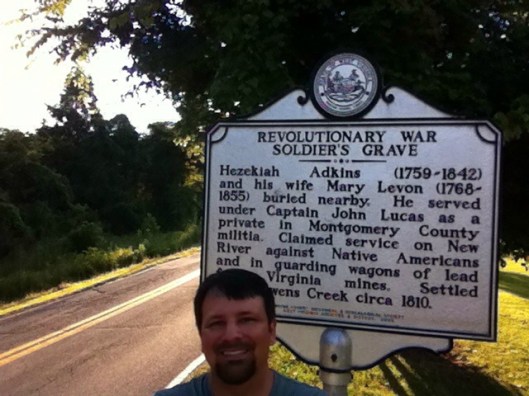
A short distance from the cemetery, beside of the highway, is this great historical marker commemorating Hezekiah Adkins’ service in the Revolutionary War. Beech Fork State Park is less than five minutes away. 30 June 2017.

Early Newspapers of Lincoln County, WV

03 Wednesday May 2017

Posted by Brandon Ray Kirk in Hamlin, Huntington

≈ Leave a comment

Tags

Appalachia, B.H. Oxley, C.M. Hall, C.W. Campbell, Cairo, Charleston, Cincinnati, Clipper Publishing Company, David Laird, Dunlow, E.S. Zeveley, Edward I. Holt, Elbert R. Hoffman, Greensboro Beacon, Hamlin, Henry Clay Ragland, Henry H. Hardesty, history, History of Logan County, History of Ritchie County, Hu Maxwell, Huntington, Huntington Advertiser, J. Jerome Haddox, Jamestown, John H. Sanborn, Joseph E. Chilton, Lincoln Citizen, Lincoln Clipper, Lincoln County, Lincoln Guidon, Lincoln News, Linnie Haddox, Logan County Banner, Minnie Kendall Lowther, newspapers, North Carolina, Parkersburg Sentinel, Pennsboro, Populist Party, R.E. Hardwicke, Republican Party, Ritchie Democrat and Beacon Light, Spencer, T.C. Miller, T.T. McDougal, The Institute Daily Lincoln News, Van Zeveley, Virgil H. Mahone, W.M. Workman, Wayne County, West Virginia, West Virginia and Its People

The following newspapers have existed in Lincoln County, WV:

Lincoln Clipper (1881-

“The publication of the Lincoln Clipper, a five column folio newspaper, was begun at Hamlin on the 15th day of September, 1881, by Messrs. C.M. Hall and T.T. McDougal, editors and proprietors. They continued it for several months, when Hall sold his interest to McDougal, by whom it was published until January, 1882, at which time he sold a half interest to Messrs. Joseph E. Chilton, C.W. Campbell and B.H. Oxley, and under the name of the Clipper Publishing Company they issued it until August, 1882, when Edward I. Holt purchased the press and office material, and by him it has been published since. Under his management it has constantly improved and enlarged. On the 18th day of October, 1883, it was made a five column quarto.” Source: Hardesty’s History of Lincoln County, WV (c.1884), p. 97.

“The Lincoln Clipper has again changed hands and is now published by the Lincoln Clipper Publishing Company. The capital stock is not given, but it is something less than $1,000,000.” Parkersburg Sentinel, 4 February 1882


Lincoln Citizen (1886-

“Mr. W.M. Workman will begin the publication of a newspaper called the Lincoln Citizen at Hamlin, Lincoln County, about the 20th inst. We presume the object of its publication is to fill the usual long-felt want, and incidentally to reap the golden reward of West Virginia journalism. We hope Mr. Workman may be successful in his enterprise.” Huntington Advertiser, 10 April 1886

“J. Jerome Haddox is again editor of the Lincoln Citizen. It is needless to say the Citizen is turned up to bold and brilliant things.” Logan County Banner, 18 September 1895

“The History of Logan County, by Hon. Henry Clay Ragland, has begun in The Logan Banner. He starts off like a true historian, and with a master pen blends romance and history together. He begins with the brave little Jamestown colony in 1607, and with a skillful pen and accurate knowledge of the footprints of colonial characteristics is bringing his readers gradually down to the settlements and formation of Logan.” Logan County Banner, 15 January 1896 (via Lincoln Citizen)

“Mr. J. Jerome Haddox, editor of the Lincoln Citizen, was married Sunday afternoon to Miss Linnie Mahone, the daughter of Mr. and Mrs. Virgil H. Mahone, prominent and well-to-do people of that county. The Banner extends congratulations.” Logan County Banner, 19 February 1896

“The Lincoln Citizen is the only exchange that comes to our tables that has the gall to try to keep alive that defunct Populist party. From the look of its dress it may be surmised that the Citizen will soon sink into its predestined grave to sleep until the vision so graphically pictured by Mr. Bellamy arrives which will perhaps be realized about the year 4000 A.D. One by one the ‘pop’ organs have dropped from the ranks until now to see one is a curiosity The Citizen may aptly be styled the last rose of summer in the West Virginia Populist garden.” Huntington Advertiser, 9 May 1896 (via Southern West Virginian)

“The populist convention of Lincoln county instructed their delegates to the State district convention to vote for Jerome J. Haddox, editor of the Lincoln Citizen, for delegate to the National populist Convention at St. Louis. Mr. Haddox was here today and thinks his chances are favorable. He is accompanied by his estimable wife and they will probably remain here for several days.” Huntington Advertiser, 8 June 1896

“The Lincoln Citizen, edited by the only Jerome Haddox, came in on time last evening and was as bright and newsy as ever. Mr. Haddox’s paper always contains some rich, rare, and racy effusions which will bring smiles to the countenance of the most disconsolate.” Huntington Advertiser, 29 January 1897

“Jerome Haddox, the populist editor, of Lincoln county, who has many friends in this city, is the happy father of a nine and one-half pound boy. It was born last Wednesday and Jerome says: ‘He is a middle of the road populist possessing oratorical abilities.'” Huntington Advertiser, 16 March 1897

“Editor Jerome J. Haddox of the Lincoln Citizen has sold out his plant and good will to Elbert R. Hoffman of the Lincoln Guidon but the paper will be known in the future as the Lincoln Citizen and will be republican in politics. Mr. Haddox is one among the most interesting writers in the state and the press generally will be sorry to lose him from the profession. Mr. Hoffman was formerly a well known Charleston newspaper man and will evidently make a success in his new field.” Huntington Advertiser, 26 July 1898.

Lincoln News (1894-

“We notice in the Lincoln News that John H. Sanborn and David Laird, of Dunlow, were in Hamlin a few days ago and subscribed for the Lincoln News. Frank says the sign was the special attraction.” Logan County Banner (Logan, WV), 21 June 1894

“Editor Van Zeveley of Hamlin, is here for a day or two after looking after the interests of his paper, The Lincoln News.” Huntington Advertiser, 10 March 1898

“The Lincoln News comes out this week in new dress and greatly enlarged. We are glad to chronicle the success of Mr. Van Zeveley its editor and owner. The News is doing good for the democracy in Lincoln.” Huntington Advertiser, 15 April 1898

“Editor Van Zeveley of the Lincoln News is in the city and is accompanied by Mrs. Zeveley. They will remain in Huntington over Sunday.” Huntington Advertiser, 13 May 1898

“Van Zeveley of Lincoln who has been in the city for a few days received a telegram yesterday afternoon that his wife who had been visiting out in the interior of the state was very ill and had been taken to the hospital at Wheeling for treatment. Mr. Zeveley left this morning for her bedside. It is hoped that he will find her much improved.” Huntington Advertiser, 6 July 1898

“Van H. Zeveley, the editor of the Lincoln news, is spending a few days here in company with his wife. Van was one of the secretaries of the Spencer convention, and a good one he was too.” Huntington Advertiser, 3 September 1898

“Van Zeveley, the well known editor of the Lincoln News, came in last night from Charleston where he has been spending a few days looking after some business matters. Mr. Zeveley will return home tomorrow morning.” Huntington Advertiser, 14 March 1899

“Editor Van Zeveley of the Lincoln News arrived in the city at noon today from Hamlin, accompanied by his wife. They will remain here until tomorrow morning, when they will leave over the Ohio railroad for Ritchie county, where they will spend a few weeks. Mrs. Zeveley has been in ill health for almost a year past, but is now much improved.” Huntington Advertiser, 20 July 1899.

“Editor Van Zeveley of the Lincoln News arrived here this morning and left this afternoon on the White Collar line steamer for Cincinnati.” Huntington Advertiser, 9 August 1899

“Van Zeveley, Editor of the Lincoln News, one of the leading democratic weeklies in the state, is in the city today looking after some business matters. The many friends of Mr. Zeveley will be sorry to learn that his health has been failing for a few months past. Mr. Zeveley will remain here until the middle of the week.” Huntington Advertiser, 18 September 1899

“Editor R.E. Hardwicke of the Lincoln News and several other prominent citizens of Lincoln are here today and will remain until tomorrow, when they go to Charleston to attend the Western Davis meeting.” Huntington Advertiser, 15 August 1900

“Editor R.E. Hardwicke of the Lincoln News came in from Charleston this morning and will spend a day or so here before returning to his home at Hamlin.” Huntington Advertiser, 21 September 1900

Van Zeveley was the son of E.S. Zeveley. The elder Mr. Zeveley was born in North Carolina in 1818 and began a newspaper called the Greensboro Beacon in 1836. In 1877, he founded the Ritchie Democrat and Beacon Light at Cairo, WV. His son, Van, began a newspaper called The Walking Beam in Volcano, WV. Following the elder Zeveley’s death in 1884, the Democrat passed to his son, Van. Van operated the Beacon Light (renamed and relocated to Pennsboro) until 1893, when he moved to Lincoln County. He edited the Lincoln News for six years until his poor health forced him to retire from the newspaper business. Sources: History of Ritchie County by Minnie Kendall Lowther (1911), p. 454-455; West Virginia and Its People by T.C. Miller and Hu Maxwell (1913), p. 304.

The Institute Daily Lincoln News (1895-

“We are in receipt of several numbers of The Institute Daily Lincoln News. This is the first daily ever published in Lincoln county, and it is bright and newsy and reflects much credit upon the management of the News.” Logan County Banner, 17 July 1895

Lincoln Guidon (1895-

Note: This is a “working” entry and will be updated periodically.


Manns Knob Fire Tower and Residence (2017)

14 Friday Apr 2017

Posted by Brandon Ray Kirk in Fourteen, Little Harts Creek, Queens Ridge

≈ 1 Comment

Tags

Appalachia, Brandon Kirk, fire towers, Gartin Knob, history, Lincoln County, Little Harts Creek, Lloyd Frye, Manns Knob, photos, Phyllis Kirk, U.S. Coast and Geodetic Survey Reference Mark, Wayne County, West Virginia

IMG_0805.JPG

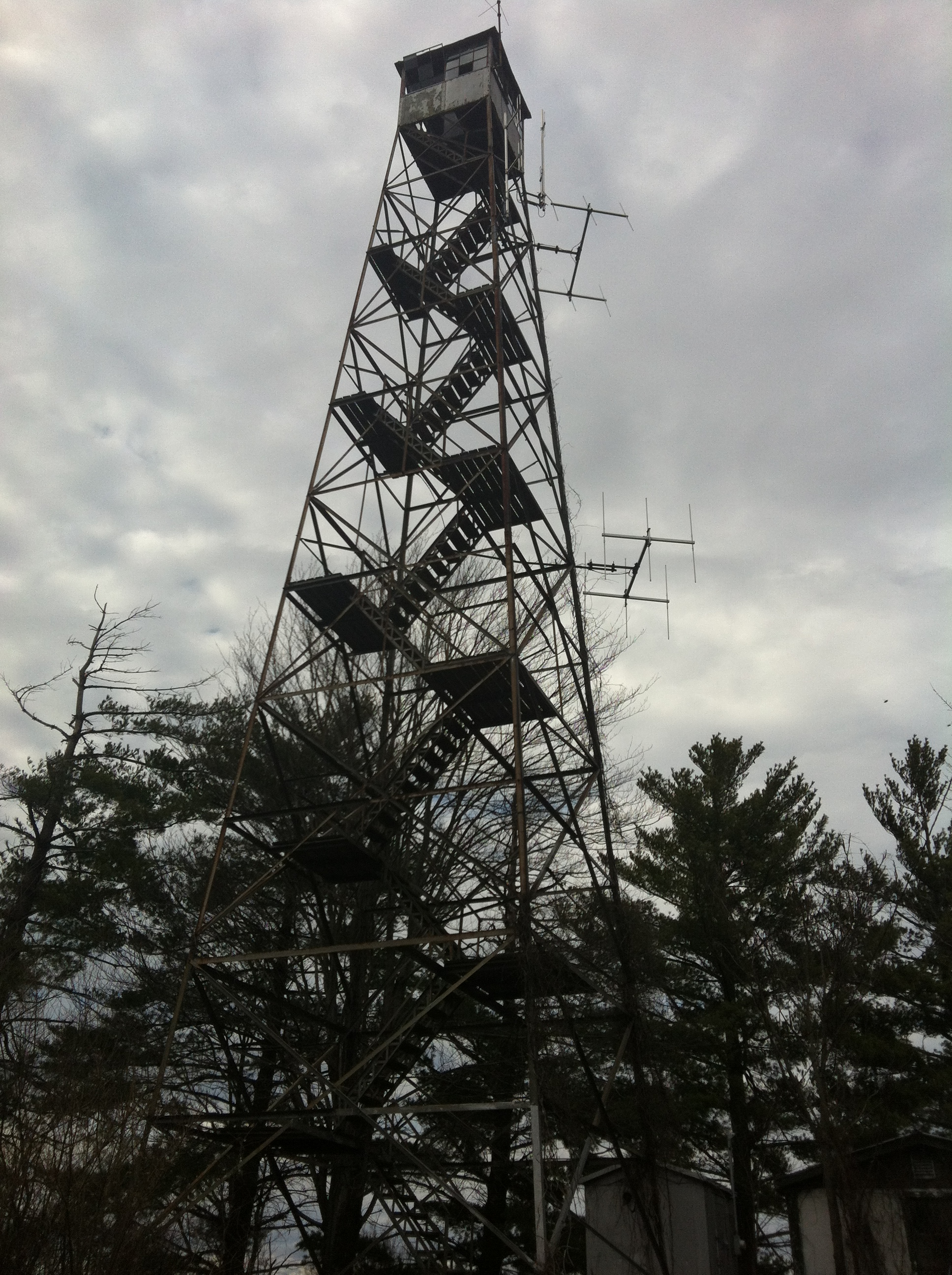
West Virginia once hosted more than 70 fire towers. Today, the number is just over a dozen. For more on West Virginia fire towers, follow this link: http://www.firehouse.com/news/10508169/west-virginia-fire-towers-make-unique-tourist-attractions

IMG_0811

The Manns Knob Fire Tower, built during the 1930s, sits at an elevation of 1439 feet. I love the little house that is located beside of the tower. My great-uncle Lloyd Frye once lived here. 12 February 2017.

IMG_0817

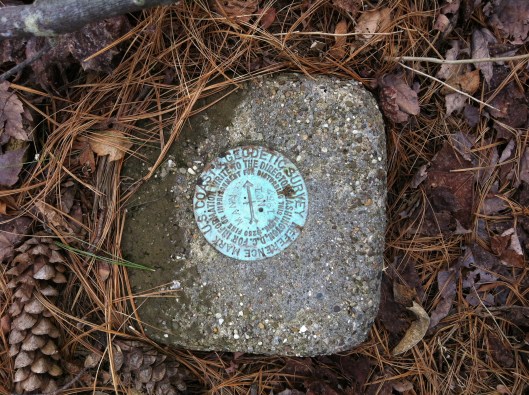
U.S. Coast & Geodetic Survey (USC&GS) Reference Mark. For more on these, follow this link: https://en.wikipedia.org/wiki/U.S._National_Geodetic_Survey

IMG_0803

One view from the tower. 12 February 2017.

IMG_0831

Photo by Mom. 12 February 2017.

Harry Edward Mullins (c.1991)

11 Tuesday Apr 2017

Posted by Brandon Ray Kirk in Cemeteries, Harts

≈ Leave a comment

Tags

Appalachia, Billy Adkins, cemeteries, Elizabeth Adkins, genealogy, Harry Edward Mullins, history, Isaac Adkins, photos, Wayne County, West Virginia

IMG_2196

Harry Edward Mullins, a genealogist, appears here visiting Adkins-Fry graves in Wayne County, WV. Harry was dedicated: he purchased modern headstones for several noteworthy Harts area residents, including Isaac and Elizabeth Adkins. Photo courtesy of Billy Adkins.

Harts Creek District (c.1883)

08 Saturday Apr 2017

Posted by Brandon Ray Kirk in Big Harts Creek, Big Ugly Creek, Fourteen, Green Shoal, Guyandotte River, Harts, Leet, Little Harts Creek, Timber, Warren, Wewanta

≈ 3 Comments

Tags

Adam Lambert, Andrew D. Robinson, Appalachia, B.C. Curry, Big Ugly Creek, Boone County, Burbus Toney, Charles Spurlock, constable, Edley Elkins, education, Fourteen Mile Creek, genealogy, Guyandotte River, Harts Creek, Harts Creek District, Henry H. Hardesty, Hezekiah Adkins, history, Isaac Elkins, James White, Jefferson District, Jeremiah Lambert, Jesse Gartin, John Fry, John H. Brumfield, John Lucas, justice of the peace, Kiahs Creek, Laurel Hill District, Lewis Queen, Lincoln County, Little Harts Creek, Little Ugly Creek, Logan County, Methodist, miller, Rhoda Elkins, Richard Adkins, Richard Elkins, Sarah Elkins, Squire Toney, timber, timbering, Wayne County, West Virginia, William Lucas, William West

From “Hardesty’s History of Lincoln County, West Virginia,” published by H.H. Hardesty, we find this entry for Harts Creek District in Lincoln County, West Virginia:

This is the most southern subdivision of the county. It derives its name from Harts creek, a tributary of the Guyandotte river. On the north is Laurel Hill district, on the northeast is Jefferson, east Boone county, on the south Logan, and on the west Wayne. Guyandotte river flows northwest and divides the district into two nearly equal parts. There are several small streams, among which are Little and Big Harts creeks, Little and Big Ugly creeks, Kiahs creek, and Fourteen Mile creek.

The first settler was Richard Elkins, who reared his cabin in the month of September, 1807. Here he removed his family, and here Charles Spurlock became his first neighbor. Other early settlers were: Esquire Toney, John Lucas, Edley Elkins, John Fry, Hezekiah Adkins, John Brumfield, and Richard Adkins. Rhoda, a daughter of Edley and Sarah Elkins, was the first white child born in the district. The first grist mill was built  by James White about the year 1821. It was a small tub-wheel mill, water being the propelling power. Isaac Elkins built the first saw mill in 1847 or 1848. It was constructed on the old sash-saw plan, and had a capacity for cutting from 800 to 1,000 feet per day.

The first school was taught in a log cabin one mile above the mouth of Big Harts creek about the year 1832, but who the teacher was cannot now be ascertained. The date, however, is remembered by an old resident, because it was the year in which he first visited this section. The first house for educational purposes was built near the mouth of Big Harts creek in 1834. It was a five-cornered building, one side being occupied by the ever-present huge fire place. There are now ten public school houses in the district, “some of which,” says an informant, “are in bad condition, but will soon be replaced by frames;” 334 boys and girls attend school in this district.

The first sermon was preached here in the year 1823 by a Methodist minister named William West, and here the same year he gathered a little church, one of the first ever formed in the valley of the Guyandotte river; but of its history or who composed its membership, nothing is known. When the writer asked of an old settler the question: “Who were the first members?” his reply was: “The register is gone, and no one living can tell.” When asked who organized the first Sabbath school, he replied: “There never was one in the district.”

The first township officers were as follows: Supervisor, Burbus Toney; justice of the peace, Jeremiah Lambert; constable, Jesse Gartin; clerk, Andrew Robinson; treasurer, B.C. Curry; school commissioners, Adam Lambert, William Lucas, and Lewis Queen. According to the census of 1880, the population was 1,116.

Source: The West Virginia Encyclopedia, Vol. 7 (Richwood, WV: Jim Comstock, 1974), p. 106-107.

NOTE: I descend from Richard Elkins, John Fry, John H. Brumfield, and Jeremiah Lambert.

Evermont Adkins

28 Tuesday Mar 2017

Posted by Brandon Ray Kirk in Civil War, Fourteen, Ranger

≈ 3 Comments

Tags

2nd Virginia Regiment, Appalachia, Catherine Drake, civil war, Confederate Army, Elizabeth Hester Adkins, Emma J. Adkins, farming, Fourteen, Fourteen Mile Creek, genealogy, Guyandotte River, Henderson Drake, Henry H. Hardesty, history, Laurel Hill District, Lewis Adkins, Lincoln County, Mary E. Adkins, Melcina Adkins, Paulina F. Adkins, school trustee, Wayne County, West Virginia, William H. Adkins

From “Hardesty’s History of Lincoln County, West Virginia,” published by H.H. Hardesty, we find this entry for Evermont Adkins, who resided at Fourteen in Lincoln County, West Virginia:

Is a son of Lewis and Melcina (Hunter) Adkins, whose personal history follows this. He is a native of Wayne county, West Virginia, born February 1, 1839, and he came to Lincoln county in 1844. Evermont Adkins was united in wedlock in Lincoln county, in 1865, with Elizabeth Hester Drake, and to them four children have been born, namely: Mary E., October 21, 1866; Paulina F., February 24, 1869; William H., April 10, 1871; Emma J., June 29, 1882. Mrs. Adkins was born in Lincoln county January 2, 1848, and her parents, Henderson and Catherine (Lucas) Drake, are both deceased. Mr. Adkins enlisted in the War Between the States in 1862, serving two years in the 2nd Virginia Regiment, Confederate army. He is, at present, a prosperous farmer in Laurel Hill district, owning 767 acres of farming land, a part of which is situated on Fourteen Mile creek, and a part on Guyan river. The land is well timbered, and has upon it a young apple and peach orchard. Evermont Adkins is school trustee in Laurel Hill district, and receives his mail at Fourteen, Lincoln county, West Virginia.

Source: The West Virginia Encyclopedia, Vol. 7 (Richwood, WV: Jim Comstock, 1974), p. 138.

Lewis Adkins

27 Monday Mar 2017

Posted by Brandon Ray Kirk in Fourteen, Ranger

≈ Leave a comment

Tags

Albert M. Adkins, Anderville Adkins, Appalachia, Cabell County, Emily Adkins, Emmazetta Adkins, Evermont Adkins, Fourteen, genealogy, Hansford Adkins, Henry H. Hardesty, history, Hugh C. Adkins, Jacob Adkins, John H. Brumfield, Laurel Hill District, Lewis Adkins, Lincoln County, Melcina Adkins, Paris Brumfield, Pheobe Adkins, Rachel Brumfield, Ranger, Richard Adkins, Sampson Adkins, Spencer Adkins, Wayne County, West Virginia

From “Hardesty’s History of Lincoln County, West Virginia,” published by H.H. Hardesty, we find this entry for Lewis Adkins, who resided at Fourteen in Lincoln County, West Virginia:

Was born in Wayne county, (then) Virginia, in 1814, and in 1841 came to what is now Lincoln county. Jacob and Pheobe (Bradshaw) Adkins were his parents, both now deceased. Lewis Adkins has been twice married; his first wife, Melcina Hunter, died, leaving eight children, born as follows: Evermont, February 1, 1839; Anderville, February 28, 1842; Albert M., August 27, 1844; Hansford, October 27, 1847; Emily, August 1850, died in 1866; Hugh C., April 17, 1853; Spencer, May 17, 1856; Richard, May 26, 1861. In Cabell county, in 1866, Mr. Adkins was again united in wedlock, with Emma Brumfield, and to them one child was born: Sampson, December 27, 1866. Mrs. Adkins was born in this county, in 1824, the year in which her parents, John and Rachel (Haskins) Brumfield, settled here. Mr. Adkins is one of the farming population of Laurel Hill district, and any mail for him may be addressed to Fourteen, Lincoln county, West Virginia.

Source: The West Virginia Encyclopedia, Vol. 7 (Richwood, WV: Jim Comstock, 1974), p. 139.

NOTE: Emmazetta (Brumfield) Adkins was a sister to my ancestor, Paris Brumfield.

← Older posts
Newer posts →

Feud Poll 1

If you had lived in the Harts Creek community during the 1880s, to which faction of feudists might you have given your loyalty?

Categories

  • Adkins Mill
  • African American History
  • American Revolutionary War
  • Ashland
  • Atenville
  • Banco
  • Barboursville
  • Battle of Blair Mountain
  • Beech Creek
  • Big Creek
  • Big Harts Creek
  • Big Sandy Valley
  • Big Ugly Creek
  • Boone County
  • Breeden
  • Calhoun County
  • Cemeteries
  • Chapmanville
  • Civil War
  • Clay County
  • Clothier
  • Coal
  • Cove Gap
  • Crawley Creek
  • Culture of Honor
  • Dingess
  • Dollie
  • Dunlow
  • East Lynn
  • Ed Haley
  • Eden Park
  • Enslow
  • Estep
  • Ethel
  • Ferrellsburg
  • Fourteen
  • French-Eversole Feud
  • Gilbert
  • Giles County
  • Gill
  • Green Shoal
  • Guyandotte River
  • Halcyon
  • Hamlin
  • Harts
  • Hatfield-McCoy Feud
  • Holden
  • Hungarian-American History
  • Huntington
  • Inez
  • Irish-Americans
  • Italian American History
  • Jamboree
  • Jewish History
  • John Hartford
  • Kermit
  • Kiahsville
  • Kitchen
  • Leet
  • Lincoln County Feud
  • Little Harts Creek
  • Logan
  • Man
  • Matewan
  • Meador
  • Midkiff
  • Monroe County
  • Montgomery County
  • Music
  • Native American History
  • Peach Creek
  • Pearl Adkins Diary
  • Pecks Mill
  • Peter Creek
  • Pikeville
  • Pilgrim
  • Poetry
  • Queens Ridge
  • Ranger
  • Rector
  • Roane County
  • Rowan County Feud
  • Salt Rock
  • Sand Creek
  • Shively
  • Spears
  • Sports
  • Spottswood
  • Spurlockville
  • Stiltner
  • Stone Branch
  • Tazewell County
  • Timber
  • Tom Dula
  • Toney
  • Turner-Howard Feud
  • Twelve Pole Creek
  • Uncategorized
  • Warren
  • Wayne
  • West Hamlin
  • Wewanta
  • Wharncliffe
  • Whirlwind
  • Williamson
  • Women's History
  • World War I
  • Wyoming County
  • Yantus

Feud Poll 2

Do you think Milt Haley and Green McCoy committed the ambush on Al and Hollene Brumfield in 1889?

Blogroll

  • Ancestry.com
  • Ashland (KY) Daily Independent News Article
  • Author FB page
  • Beckley (WV) Register-Herald News Article
  • Big Sandy News (KY) News Article
  • Blood in West Virginia FB
  • Blood in West Virginia order
  • Chapters TV Program
  • Facebook
  • Ghosts of Guyan
  • Herald-Dispatch News Article 1
  • Herald-Dispatch News Article 2
  • In Search of Ed Haley
  • Instagram
  • Lincoln (WV) Journal News Article
  • Lincoln (WV) Journal Thumbs Up
  • Lincoln County
  • Lincoln County Feud
  • Lincoln County Feud Lecture
  • LinkedIn
  • Logan (WV) Banner News Article
  • Lunch With Books
  • Our Overmountain Men: The Revolutionary War in Western Virginia (1775-1783)
  • Pinterest
  • Scarborough Society's Art and Lecture Series
  • Smithsonian Article
  • Spirit of Jefferson News Article
  • The Friendly Neighbor Radio Show 1
  • The Friendly Neighbor Radio Show 2
  • The Friendly Neighbor Radio Show 3
  • The Friendly Neighbor Radio Show 4
  • The New Yorker
  • The State Journal's 55 Good Things About WV
  • tumblr.
  • Twitter
  • Website
  • Weirton (WV) Daily Times Article
  • Wheeling (WV) Intelligencer News Article 1
  • Wheeling (WV) Intelligencer News Article 2
  • WOWK TV
  • Writers Can Read Open Mic Night

Feud Poll 3

Who do you think organized the ambush of Al and Hollene Brumfield in 1889?

Recent Posts

  • Logan County Jail in Logan, WV
  • Absentee Landowners of Magnolia District (1890, 1892, 1894)
  • Charles Spurlock Survey at Fourteen Mile Creek, Lincoln County, WV (1815)

Ed Haley Poll 1

What do you think caused Ed Haley to lose his sight when he was three years old?

Top Posts & Pages

  • About
  • Perry A. Cline Deed to Anderson Hatfield (1877)
  • Hugh Dingess Family Cemetery (2014)
  • Anderson Blair Account with William A. Dempsey (1854-1855)
  • Peterstown, WV (2016)

Copyright

© Brandon Ray Kirk and brandonraykirk.wordpress.com, 1987-2023. Unauthorized use and/or duplication of this material without express and written permission from this blog’s author and/or owner is strictly prohibited. Excerpts and links may be used, provided that full and clear credit is given to Brandon Ray Kirk and brandonraykirk.wordpress.com with appropriate and specific direction to the original content.

Archives

  • February 2025
  • January 2025
  • October 2023
  • September 2023
  • December 2022
  • November 2022
  • May 2022
  • April 2022
  • February 2022
  • November 2021
  • October 2021
  • September 2021
  • June 2021
  • May 2021
  • April 2021
  • March 2021
  • February 2021
  • January 2021
  • December 2020
  • November 2020
  • October 2020
  • July 2020
  • June 2020
  • May 2020
  • April 2020
  • March 2020
  • February 2020
  • January 2020
  • December 2019
  • November 2019
  • October 2019
  • September 2019
  • August 2019
  • July 2019
  • June 2019
  • May 2019
  • April 2019
  • March 2019
  • February 2019
  • January 2019
  • December 2018
  • November 2018
  • October 2018
  • September 2018
  • August 2018
  • July 2018
  • June 2018
  • May 2018
  • April 2018
  • March 2018
  • February 2018
  • January 2018
  • December 2017
  • November 2017
  • October 2017
  • September 2017
  • August 2017
  • July 2017
  • June 2017
  • May 2017
  • April 2017
  • March 2017
  • February 2017
  • January 2017
  • December 2016
  • November 2016
  • October 2016
  • September 2016
  • August 2016
  • July 2016
  • June 2016
  • May 2016
  • April 2016
  • March 2016
  • February 2016
  • January 2016
  • December 2015
  • November 2015
  • October 2015
  • September 2015
  • August 2015
  • July 2015
  • June 2015
  • May 2015
  • April 2015
  • March 2015
  • February 2015
  • January 2015
  • December 2014
  • October 2014
  • September 2014
  • August 2014
  • July 2014
  • June 2014
  • May 2014
  • April 2014
  • March 2014
  • February 2014
  • January 2014
  • December 2013
  • November 2013
  • October 2013
  • September 2013
  • August 2013
  • July 2013
  • June 2013
  • May 2013
  • April 2013
  • March 2013
  • February 2013
  • January 2013
  • December 2012
  • November 2012

Enter your email address to follow this blog and receive notifications of new posts by email.

Join 2,925 other subscribers

Tags

Appalachia Ashland Big Creek Big Ugly Creek Blood in West Virginia Brandon Kirk Cabell County cemeteries Chapmanville Charleston civil war coal Confederate Army crime culture Ed Haley Ella Haley Ferrellsburg feud fiddler fiddling genealogy Green McCoy Guyandotte River Harts Harts Creek Hatfield-McCoy Feud history Huntington John Hartford Kentucky Lawrence Haley life Lincoln County Lincoln County Feud Logan Logan Banner Logan County Milt Haley Mingo County music Ohio photos timbering U.S. South Virginia Wayne County West Virginia Whirlwind writing

Blogs I Follow

  • OtterTales
  • Our Appalachia: A Blog Created by Students of Brandon Kirk
  • Piedmont Trails
  • Truman Capote
  • Appalachian Diaspora

BLOOD IN WEST VIRGINIA is now available for order at Amazon!

Blog at WordPress.com.

OtterTales

Writings from my travels and experiences. High and fine literature is wine, and mine is only water; but everybody likes water. Mark Twain

Our Appalachia: A Blog Created by Students of Brandon Kirk

This site is dedicated to the collection, preservation, and promotion of history and culture in Appalachia.

Piedmont Trails

Genealogy and History in North Carolina and Beyond

Truman Capote

A site about one of the most beautiful, interesting, tallented, outrageous and colorful personalities of the 20th Century

Appalachian Diaspora

  • Subscribe Subscribed
    • Brandon Ray Kirk
    • Join 787 other subscribers
    • Already have a WordPress.com account? Log in now.
    • Brandon Ray Kirk
    • Subscribe Subscribed
    • Sign up
    • Log in
    • Report this content
    • View site in Reader
    • Manage subscriptions
    • Collapse this bar
 

Loading Comments...