• About

Brandon Ray Kirk

~ This site is dedicated to the collection, preservation, and promotion of history and culture in my section of Appalachia.

Brandon Ray Kirk

Tag Archives: Union Army

Narrows, VA (2017)

25 Monday Sep 2017

Posted by Brandon Ray Kirk in Civil War, Giles County, Native American History

≈ Leave a comment

Tags

Abraham Wood, Appalachia, Blacksburg, Brandon Kirk, Confederate Army, George Crook, Giles County, history, John McCausland, MacArthur Inn, Monroe County, Montgomery County, Mountain Lake, Narrows, Native Americans, New River, Norfolk and Western Railroad, North Carolina, Phyllis Kirk, Stonewall Jackson, Tazewell County, The Crooked Road, Thomas Batts, Union Army, Virginia, West Virginia, William B. Giles, Wood's River

IMG_7883

Plenty of my ancestors once lived in Giles County, VA. 10 August 2017.

IMG_7887

Here we are near Narrows, VA. 10 August 2017. Photo by Mom.

IMG_7890

Entering Narrows, VA. 10 August 2017. The New River is visible on the right.

IMG_7891

I enjoyed this little section of old buildings in Narrows, VA. 10 August 2017.

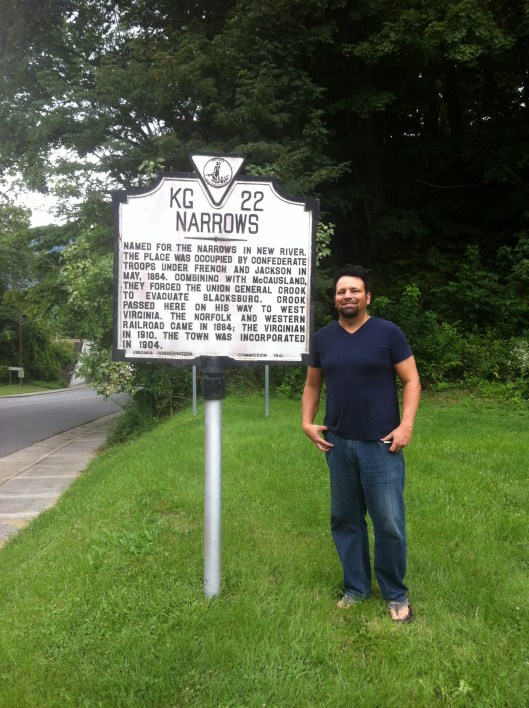
IMG_7893

Narrows, VA. 10 August 2017. For more info, follow this link: http://townofnarrows.org/history/

IMG_7894

Confederate victory here in Narrows, VA. 10 August 2017. Photo by Mom.

IMG_7934

The MacArthur Inn in Narrows, VA. 10 August 2017. For more info, follow this link: http://www.macarthur-inn.com/

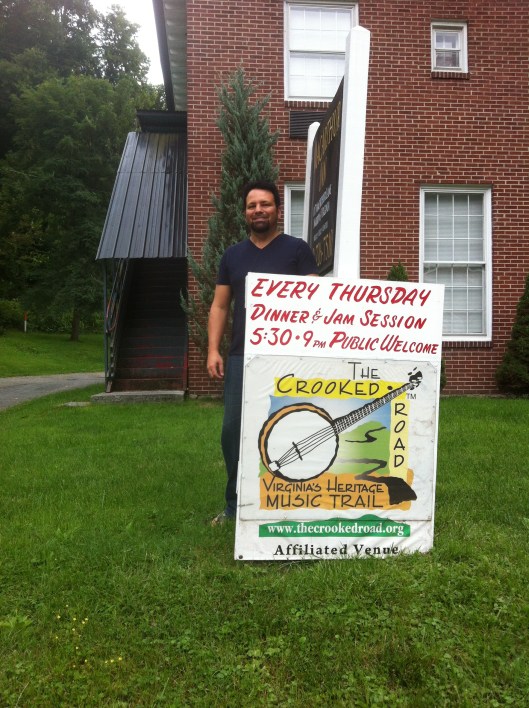
IMG_7897

Bluegrass music every Thursday at MacArthur Inn in Narrows, VA. 10 August 2017. Photo by Mom. For more info, follow this link: https://www.myswva.org/tcr

Giles County Courthouse in Pearisburg, VA (2017)

09 Saturday Sep 2017

Posted by Brandon Ray Kirk in American Revolutionary War, Civil War, Giles County

≈ Leave a comment

Tags

Action at Giles Court House, Appalachia, Brandon Kirk, Confederate Army, George Pearis, Giles County, Giles County Courthouse, Henry Heth, history, Kathryn Delaney, Pearisburg, photos, Rutherford B. Hayes, Union Army, Virginia

IMG_7935

Giles County Courthouse. August 2017.

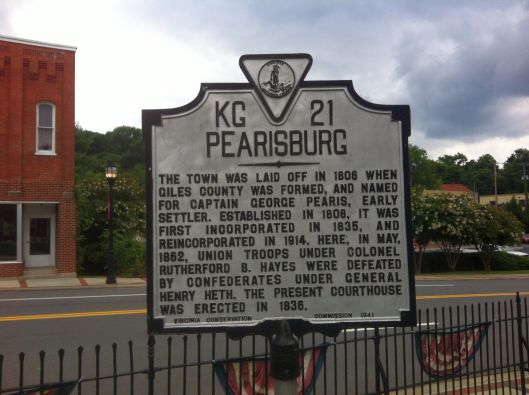
IMG_7945

Pearisburg Historical Marker. August 2017.

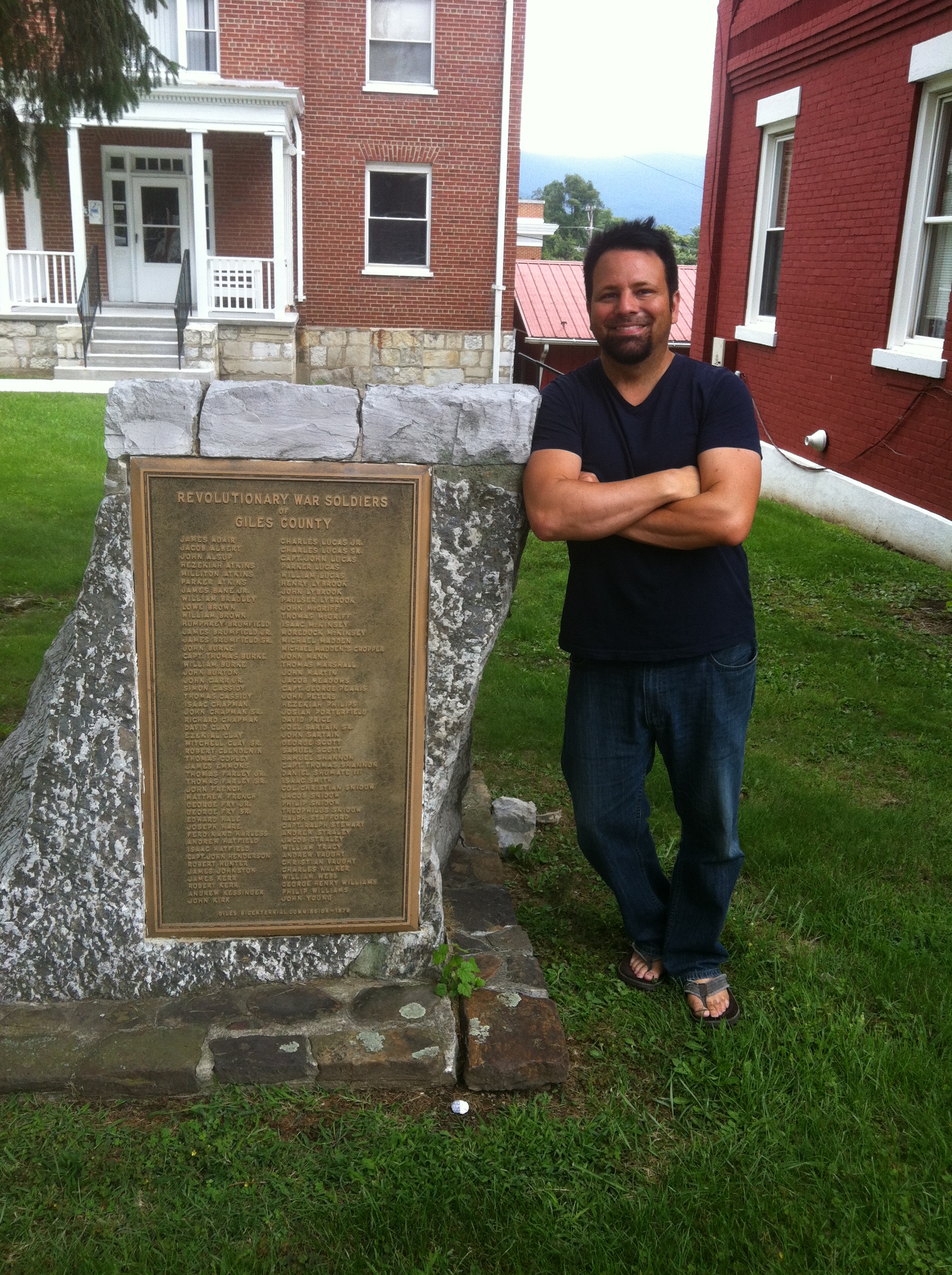
IMG_7938.JPG

Revolutionary War Memorial at Giles County Courthouse. August 2017. Several of my ancestors are listed on this memorial. Photo by Mom.

IMG_7942

Pearisburg, VA. August 2017.

IMG_7953

Pearisburg, VA. August 2017.

IMG_7956

Capt. George Pearis. August 2017.

IMG_7958

“Action at Giles Court House,” by Kathryn Delaney (2006). August 2017.

Civil War Dispatches From Wayne County, WV (1865-1866)

07 Thursday Sep 2017

Posted by Brandon Ray Kirk in Big Sandy Valley, Civil War, Timber

≈ Leave a comment

Tags

Abel Segur, Abraham Lincoln, Appalachia, Arthur I. Boreman, Bill Smith, Burlington, Cabell County, Cassville, Catlettsburg, Ceredo, Charleston, civil war, Confederate Army, crime, David Bartram, David Frasher, Department of West Virginia, deputy sheriff, G.W. Brown, Gallipolis, Gallipolis Journal, George Crook, Greenbrier County, Guyandotte, history, Ironton Register, Isaac Bloss, J.W. Merricks, Jack Meadows, Jefferson Davis, Jim Turner, John B. Bowen, John W. Holt, Kentucky, Logan County, Monroe County, Ohio, Ohio River, Pete Jeffers, Pike County, Pocahontas County, Point Pleasant, Raleigh County, sheriff, The Weekly Register, Tug Fork, Union Army, Wayne County, Webster County, West Virginia, Wheeling Intelligencer, William Wirt Brumfield

Below are several dispatches relating to the Civil War and immediate post-war era in Wayne County, West Virginia. These dispatches appeared in pro-Union newspapers.

Wheeling Intelligencer, 21 January 1865

WEST VIRGINIA AS A PLACE TO LIVE. I could not conscientiously recommend any one to come here now to live, although investment in farms will surely be profitable. The trouble now, chiefly, is that the guerrillas have broken up their organization, if they ever had any, and scattered into small squads to rob and steal. A schoolmistress, passing along a lonely road not far from Ceredo, was robbed of all her money, the amount she had just received for three months’ teaching, by three ruffians. A few nights ago men went to the house of a quiet farmer, one mile from Ceredo, and robbed him of a few dollars, all he had, and boots and some clothing. Some of the citizens keep arms in their houses, and intend to use them if visited in that way. One of these shot one of a gang of six one night not long ago, but became frightened himself, and ran off, giving the robbers a chance to take their wounded companion away. He has not been troubled since. Geo. Crook, commanding the Department of West Virginia, has issued a circular notifying the people that they must organize for their own protection, and recommends them to hunt the bushwhackers and kill them. Governor Boreman offers to furnish arms and ammunition. It will be done, and the guerrillas will decrease every week, I hope.

The Weekly Register (Point Pleasant, WV), 26 January 1865

GIVING THEMSELVES UP. — We learn that Lieut. Samuels, brother of Judge Samuels, formerly Adjutant General of this State, recently came into Wayne county, accompanied by a dozen or fifteen other rebel soldiers, all of whom took the amnesty oath. They say they are tired of fighting for nothing and freezing to death.

Wheeling Intelligencer, 21 February 1865

A GUERRILLA MURDER. We learn from citizens of Wayne county, who arrived yesterday, that a few days ago a guerrilla murder was committed at Ceredo, on the Ohio river in that county. It appears that a gang of men, under command of the notorious Bill Smith, came down to Ceredo and entered the house of Jack Meadows, a citizen, shot him through the heart, drove his wife and children out of doors, and set fire to the premises. Mrs. Meadows who fortunately armed with a revolver, shot one of the guerrillas dead and seriously wounded another, but not until one of her legs had been broken by a blow with a gun in the hands of one of the rebels. The rebels having completely destroyed the house of Mr. Meadows, and with all its contents, fled to their hiding places, leaving their dead companion unburied. Mrs. Meadows and her children were taken to Catlettsburg, Ky., where she still remains.

Wheeling Intelligencer, 23 February 1865

GUERRILLAS. — During the debate yesterday in the House of Delegates, upon the bill to provide for the better organization of the State Guards, some horrible pictures were presented of the condition of the loyal people of the border counties. Mr. Ferguson said that every part of the county of Wayne on the Ohio river, was held by guerrillas. In the county of Cabell only one two, Guyandotte, was held by the Federal troops. The rebels have their headquarters up in Logan county, and they make forays down toward the Ohio river, stealing, murdering and devastating the country. They enter the houses of loyal people and steal household furniture and bed clothing, and frequently strip women and children of wearing apparel and leave them in an actual state of nudity. Mr. Wells, of Raleigh, and Mr. Gregory, who represents Webster and Pocahontas, gave similar accounts of the condition of things in their respective localities.

Gallipolis Journal, 2 March 1865

CEREDO, WEST VIRGINIA. — Since the breaking out of the rebellion, “I give bread” town has been subjected to many vicissitudes. Its prospects when projected, in 1854, and later, was that of a great manufacturing city. Early in 1862, many of the Yankee citizens anticipated the coming storm, and either disposed of their property or left it to the despoiler. At one time it had a regiment quartered in its midst, but of late no troops have been nearer than Guyandotte. Disloyalty has cropped out under drunkenness and personal hate, until one’s life is endangered at any moment. Guerrillas and rebel sympathizers occupy the principal houses vacated by the owners. Not a public building stands untouched. The window and door frames, flooring and every sleeper of the hotel have been torn out and burned up. The dismantling of the steam saw mill and Glass Factory have long since been accomplished. Night is made hideous by the continued debaucheries of certain desperate characters, such as Jack Meddows and Pete Jeffers. There is not a loyal family left in Ceredo.

The Weekly Register (Point Pleasant, WV), 9 March 1865

A correspondent of the Ironton Register, writing from Burlington, O., says: The murder of Jack Middaughs, at Ceredo, on the 13th inst., was attended with some circumstances that deserve mention. The guerrillas surrounded his house before he knew of their presence. Then with a single revolver he drove them a little, wounding two of them. His wife then seized the revolver and threatened them, while Jack made his motions for escape. It was then that the rebs pressed forward to get up the stairs, Mrs. Middaugh standing at the head. Jim Turner was in advance, and finding Mrs. Middaugh in his way, swung his gun and with a blow smashed her foot. She then shot him through the breast, and he fell. At this moment Jack sprang down the stairs knocking down all in his path. He got out and nearly reached the woods, when he was met by three or four mounted men, who surrounded and killed him. — There were thirty-five men in the gang, with Smith, and it would be safe to say that twenty of them were at the house. Through this crowd Jack heroically fought his way and would have escaped but for the guards near the woods. The treatment of Mrs. Middaugh was barbarous in the extreme. It has been equaled only by the cruelties practiced by the Indians in the early times in this country. After she was disabled they took her and her children out, and made her lie down upon the ground, half dressed, refusing to permit her to get a single article from the house, while they were setting fire to it. On that bitter cold night of the 13th of February, in her condition, she was compelled to remain until the savages left. The conduct of this heroic woman is duly appreciated by the citizens of Catlettsburg and they have generously provided for her and her little ones.

Wheeling Register, 6 June 1865

The following resolutions were passed at a meeting of the citizens of Wayne county, West Virginia, held at the Court House on the 18th ult.:

WHEREAS, Our country is just emerging from civil war, which has laid waste our fields and drenched the land in fraternal blood; and

WHEREAS, It is to the interest of all to restore permanent peace and harmonize the elements necessary to a well regulated society; therefore, we, the people of Wayne county, in Mass Meeting assembled, do Resolve:

1st. That in the preservation and perpetuity of the principles set forth in the Constitution and Government of our fathers, we most sincerely and devoutly acknowledge an all wise Providence, who is the Giver of every good and perfect gift, and the common Father of us all; and we will, in time to come, rely implicitly upon Him for His protection and guidance.

2d. That it is the duty of every individual to lend his active aid and energy to the establishment of civil law, both State and National, and to its enforcement for the protection of life, liberty and property.

3d. That we justify and approve the Amnesty of President Lincoln. Its results have been beneficial, and the croakers and fault finders of the policy are morally arrayed against the Government and its best interest, and are not found among those who have fought its battles and borne it through the ordeal of war with success.

4th. That we concur in the convention called by the citizens of Greenbrier and Monroe, to meet at Charleston on the third day of June next, for the purpose of suppressing the lawless persons, and the restoration of order throughout the State, and do appoint and constitute Messrs. Abel Segur, John B. Bowen, R. Banton, and Isaac Bloss as delegates to represent Wayne county in said convention.

W.W. Brumfield, President

J.W. Merricks, Secretary

Wheeling Intelligencer, 25 April 1866

AFFAIRS IN WAYNE COUNTY. Cassville, Wayne Co., W.Va., March 23d, 1866. To the Governor of the State of West Virginia: Dear Sir: — After respects, I wish to call your immediate attention to some facts, as follows: Sometime last Spring you commissioned me as a notary public, and I was sworn and gave bond as the law directs. I am also assessor of the 2d district of Wayne county. I live and keep my office in Cassville; and it is with extreme difficulty and under great danger and hard threats that I am getting along. My entire neighborhood is rebel with the exception of old Squire Bartram and his boys, one of whom is our high Sheriff and another Capt. David Bartram our deputy Sheriff. I have forborne for a long time calling for men and arms, thinking the rebels would quiet down; but sir, we cannot execute the civil law unless something is done. We have been beaten by mobs and shot at on the streets and dared to help ourselves. They say they can’t have power, and we shan’t have it. Now, Governor, I suggest and absolutely insist that a company of one hundred volunteer militia be raised for our protection. The rebels say if you call out the militia, they will be in the majority but we do not want more than one hundred men. Our county is mostly quiet except around Cassville. A commander and company is not necessary for the enforcement of civil law in the lower end of the county. If in your judgment you see fit to commission and arm men, I would suggest that William Shannon be commissioned Captain. He is an honorable and upright man and knows something of both civil and military matters. Further, that David Frasher be commissioned as Lieutenant, to be stationed at Cassville. We must have from 25 to 50 men here in Cassville, or else we must get out of here. This is the landing place for all lumber that comes down Tug river. Those big buck rebels come down in time of high water sometimes by dozens from Logan county and from Pike county, Ky., with their navies [revolvers] buckled around them, hurrahing “for Jeff Davis,” cursing the Government, cursing Union men, and then we have to get out. Sir, I frequently see men come in here who are indicted for murder in Kentucky, defying everybody. Not more than eight miles from here, as some of the Home Guards were on their way home from being paid off a company of rebels fell on them and beat and abused them severely, calling the party “damned abolitionists,” and swore they would not submit to our laws. A few days ago they gathered in here and raised a riot with our Sheriff, and fell on him with clubs and weights and tried to kill him and his brother. His brother ran into my house for protection. They stoned my window out, knocked two panels out of my door and nearly killed my little child. If you see fit to protect us send the commissions immediately. The men can be raised in a few days. Send full instructions and special orders. You may send arms if you think proper, for there will be no doubt about recruiting the men immediately. We have plenty of guns here which belong to the State that can be gathered up. This company should be armed with revolvers instead of guns. I refer you to Major Brown [Col. G.W. Brown, Q.M. General], the man who came here and paid the home guards. He formed some acquaintance with me when he was here, also with Shannon and Lieut. Frasher. Yours, with respect, John W. Holt.

 

Battle of Curry Farm (1864)

19 Wednesday Jul 2017

Posted by Brandon Ray Kirk in Civil War, Hamlin

≈ 1 Comment

Tags

34th Battalion Virginia Cavalry, 3rd West Virginia Cavalry, Battle of Curry Farm, Benjamin F. Curry, Big Buffalo Creek, Blountsville, Brandon Kirk, Brandy Station, Cabell County, Carroll District, civil war, Confederate Army, Curry Chapel, Curry Chapel Cemetery, Curry Farm, Duval District, George A. Holton, Granville Curry, Hamlin, Hamlin Chapel, Henry H. Hardesty, history, Hurricane Bridge, Isaac Jackson, James A. Holly, Jeremiah Witcher, John L. Chapman, John S. Witcher, John Scites, John W. Harshbarger, Lincoln County, Logan County, Mathias Kayler, Milton, photos, Phyllis Kirk, Pound Gap, Raleigh County, Russell County, Sheridan, Straight Fork, Tennessee, Union Army, Virginia, West Virginia, West Virginia Division of Culture and History, White Hall, William A. Holstein, William C. Mahone, Winchester

This entry compiles information relating to the Battle or Skirmish at Curry Farm, which occurred as part of the War Between the States in May of 1864 at Hamlin in present-day Lincoln County, WV. It is a working entry and will be updated based on the discovery of new information.

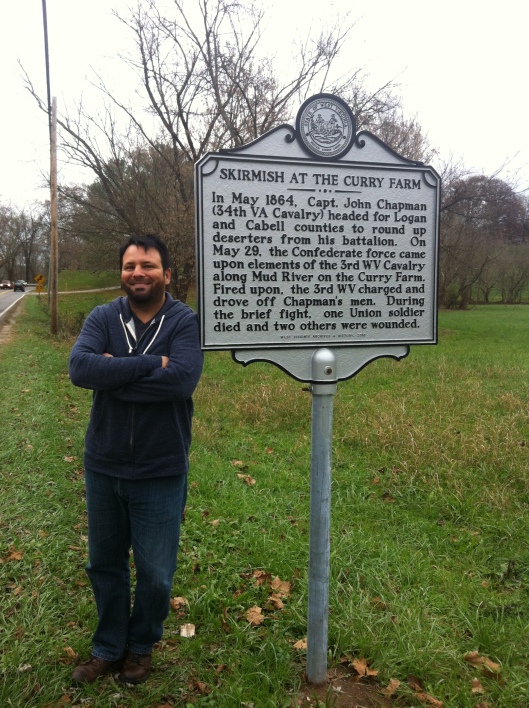
On May 29, 1864, Confederates commanded by Captain John L. Chapman of Company B, 34th Battalion Virginia Cavalry, attacked a detachment of the 3rd West Virginia Cavalry, Company G, commanded by 1st Lt. John W. Harshbarger at Curry Farm near Hamlin in present-day Lincoln County. H.H. Hardesty’s History of Lincoln County, West Virginia, compiled in c.1883, provides the only known account of the battle: “The Federals had marched from Hurricane Bridge and were proceeding up Mud river when they were fired upon by the Confederates, who were concealed on the opposite side of the river. The Federal commander at once ordered a charge and the Confederates retreated without loss. The Federals had one killed, a man named Mathias Kayler from Raleigh county, and two wounded — one being Isaac Jackson, who was shot through the left arm; and another, a member of Company K” (98-99).

Prior to the battle, on May 10, 1864, Capt. John Chapman had been sent with a detachment of dismounted men from the area of Russell County, Virginia, into Cabell and Logan counties “to gather up absentees and deserters from the 34th Battalion” (Cole, 80). Capt. Chapman had been wounded in action at Brandy Station, Virginia, on August 14, 1863 and at Blountsville, Tennessee, on March 10, 1864 (Cole, 147).

Isaac Jackson, one of the two Union soldiers wounded at Curry Farm, was a private in Company G, 3rd WV Cavalry, formerly commanded by Captain John S. Witcher (who had been promoted to major in April 1864). Hardesty cites Mr. Jackson as “wounded in action at Currys Farm, May 29, 1864” (98). Following the battle, on July 6, 1864, 1st Lt. Harshbarger was promoted to captain of Company G. On December 7, 1864, an Adjutant General’s Report shows Company G, 3rd WV Cavalry, stationed near Winchester, VA. The muster roll shows 108 names, citing Private Isaac Jackson as “Wounded in skirmish, May 5, 1864. In hospital since this date.” (Note how this record provides a different date of his wounding from the date provided by Hardesty, who compiled his history about 1881.) http://www.rootsweb.ancestry.com/~wvwayne/roster3G.htm

Curry Farm, according to Hardesty, was located 1/4 mile above Hamlin (Hardesty, 90, 98).

IMG_9626

The West Virginia Division of Culture and History has recently erected this historical marker on Curry Farm. 12 November 2017. Photo by Mom.

Capt. John Chapman left Cabell and Logan counties and rejoined the 34th Battalion Virginia Cavalry in the vicinity of Pound Gap, Virginia, by the end of June 1864 (Cole, 82).

Capt. John W. Harshbarger (1836-1909) is buried here: https://www.findagrave.com/cgi-bin/fg.cgi?page=gr&GRid=35761174

Selected Sources:

Scott C. Cole, 34th Battalion Virginia Cavalry (Lynchburg, VA: H.E. Howard, Inc., 1993) 80, 82, 121, 147.

Michael Graham, The Coal River Valley in the Civil War (Charleston, SC: The History Press, 2014) 150-151.

Some modern writers have misunderstood the Battle of Curry Farm as occurring at the Curry farm located four miles north of Hamlin on Big Buffalo Creek, near Hamlin Chapel (later Curry Chapel). Hamlin Chapel is important for the role it played in the creation of Lincoln County in 1867. “The first meeting of the Board of Supervisors was held on the 11th day of March, 1867, in what was known as Hamlin chapel, an old church which stood on the Curry farm, about one-fourth of a mile above the present county seat. There were present: William C. Mahone, of Carroll District; John Scites, of Sheridan, and William A. Holstein, of Duval. W. C. Mahone was made president, and Benjamin F. Curry, clerk, the latter giving bond in the penalty of $2000, with James A. Holly and Jeremiah Witcher as his securities. It was then ordered that the Board of Supervisors have the White Hall,  a Southern Methodist church one-fourth of a mile below where the county seat now stands arranged for holding the courts until the proper buildings could be erected, George A. Holton and a majority of the trustees consenting thereto” (Hardesty, 90-91). Curry Chapel no longer stands but its former location can be found near the intersection of Route 1 and Route 3/11 above the mouth of Straight Fork of Big Buffalo Creek.

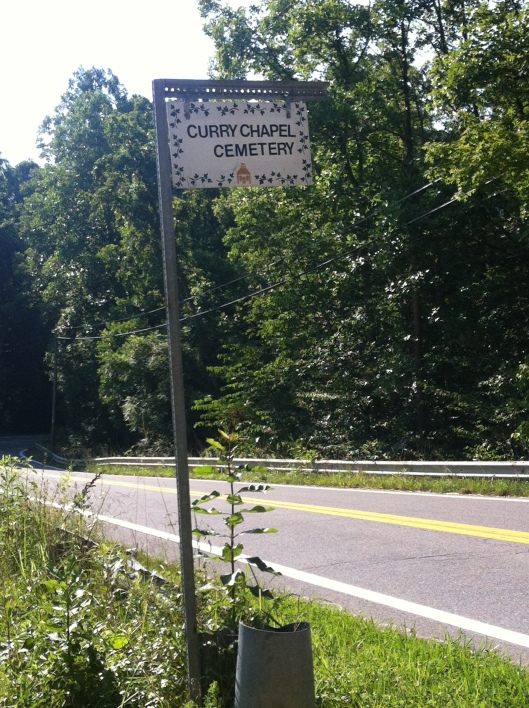
IMG_7068

Curry Chapel Cemetery, 18 July 2017. The battle did not occur here.

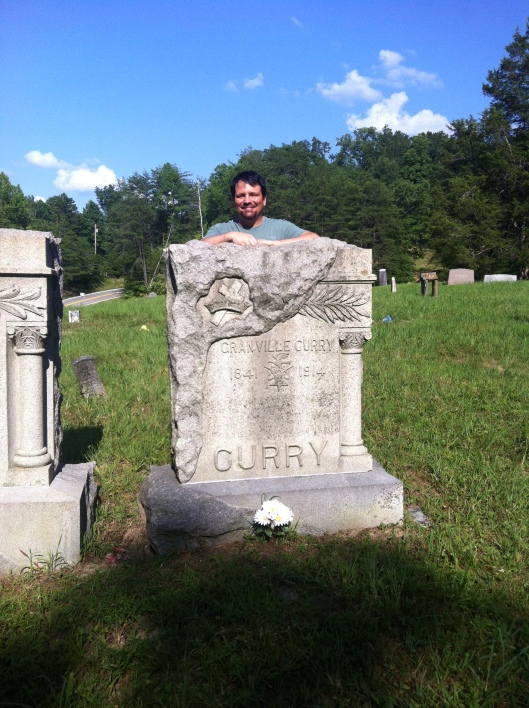
IMG_7062

Granville Curry grave, 18 July 2017. Photo by Mom. The battle did not occur here.

IMG_7076[1]

Curry Chapel Cemetery, north of Hamlin. The battle did not occur here. Instead, it occurred just to the left of the [3] in the above map.

Chapmanville District Schools (1927) 2

15 Thursday Jun 2017

Posted by Brandon Ray Kirk in Big Harts Creek, Civil War, Halcyon, Native American History, Queens Ridge, Shively, Spottswood, Stone Branch, Warren, Whirlwind, Yantus

≈ Leave a comment

Tags

Albert Thornton, Alice Dingess, Alonzo, Anna Adams, Appalachia, Battle of Cloyd's Mountain, Beatrice Adams, Ben Adams, Bob Dingess, Brown's Run, Browns Run School, Buck Fork, Buck Fork School, Bud Dingess School, Bulwark School, Chapmanville District, civil war, Cole Adams, Confederate Army, Conley School, Crawley Creek, Daisy Dingess, Dalton School, Dave Dingess School, Dixie Mullins, E. Burton, East Fork, Ed Dalton, education, Edward Chapman, F.M. McKay, Fisher B. Adkins, Fisher Thompson, genealogy, George Doss, George Mullins School, Harts Creek, history, Hoover School, Howard Adams, Hugh Dingess School, Ina Dingess, Ivy Branch School, J.A. Vickers, J.L. Thomas, John Conley, John Dingess, L.D. Stollings, Lee Dingess School, Limestone Creek, Local History and Topography of Logan County, Logan County, Lower Trace School, Manor School, Marsh Fork, Melvin Plumley, Middle Fork, Native Americans, Pigeon Roost, Piney School, Reuben Conley, Road Fork, Rocky School, Sallie Dingess, Smokehouse Fork, Stephen Hart, Striker School, T. Doss, Thelma Dingess, Three Fork School, Tim's Fork, Timothy Dwight, Twelve Pole Creek, Ula Adams, Union Army, West Fork, West Virginia, White Oak School, Workman School, World War I

Teachers identified the following schools in Chapmanville District of Logan County, WV, and offered a bit of local history in 1927:

Dave Dingess School, est. 1814

Ula Adams, teacher

One room frame school

“Harts Creek derived its name from Steven Harts, said to have been killed by Indians on the creek.”

Striker School, est. about 1874

Edward Chapman, teacher

One room frame building

Three Fork School, est. 1878

One room frame building, originally a log house

Nine Confederate veterans live here: George Doss, T. Doss, L.D. Stollings, Ed Dalton, Ruben Conley, John Conley, Ben Adams, E. Burton, Melvin Plumley. A Union veteran lives here; he originated elsewhere. Three branches of Crawley Creek are Road Fork, Middle Fork, and Pigeon Roost. Alonzo is the local post office.

Bulwark School, est. 1880

Robert Dingess, teacher

One room frame building

“All fought on the Confederate side” during the Civil War. One man gained great merit from our district as a marksman with the American marines during World War I.

Lee Dingess School, est. 1891

Cole Adams, teacher

One room frame

Five local men served in the Confederate Army.

Browns Run School, est. 1892

Ina Dingess, teacher

One room frame building

“Sent several soldiers to help the South.” The fork is named for a Brown who lived at its mouth.

Buck Fork School, est. 1894

No teacher given

One room frame building

A Church of Christ exists nearby. Three local men served in the Confederate Army. One local soldier lost both hands in World War I.

Ivy Branch School, est. 1895

Anna Adams, teacher

Albert Thornton was the first teacher here. “Trace Fork received its name from the original road leading to Twelve Pole Creek.”

Hugh Dingess School, est. 1897

Sallie Dingess, teacher

One room frame building

Conley School, est. 1897

J.L. Thomas, teacher

One room frame building

The first house built on Smoke House Fork at its mouth had no chimney for quite a while and smoked badly.

Dalton School, est. 1897

Thelma Dingess, teacher

One room frame building

“This district furnished a lot of Civil War veterans and played her part.”

Bud Dingess School, est. 1904

Beatrice Adams, teacher

One room frame building

“East Fork named on account of its being the most Eastern fork of Harts Creek.” One local soldier served in the Confederate Army.

Hoover School, est. 1910

Howard Adams, teacher

One room frame building

A Christian Church exists in the vicinity. Four local men served in the Confederate ARmy. “Harts Creek named from Steven Harts murdered by Indians.” Three boys went from here and one was wounded at the battle of Argonne.

George Mullins School, est. 1910

Dixie Mullins, teacher

One room frame building

“Buck Fork named from large number of male deer on creek.”

Rocky School (no date)

Daisy Given Dingess, teacher

References an Indian mound on Pigeon Roost where tomahawks, arrowheads, etc. can be found. Indian burial ground.

Under the Tim’s Fork entry, it says that John Dingess was killed in battle at Cloyd’s farm. Tim’s Fork is named for Timothy Dwight, who lived there.

Lower Trace School, est. 1919

Alice Dingess, teacher

Two room frame building

“Sent several soldiers to help the South.” Also, “Harts Creek named from Steven Harts.”

Piney School, est. 1921

F.M. McKay, teacher

One room building

No permanent churches exist locally; people meet occasionally in one of the school houses. Four local men served in the Confederate Army. “Piney was named because of so much pine growing there.”

White Oak School, est. 1922

Fisher Thompson, teacher

One room rented frame building

Manor School, est. 1923

Located at Limestone

Workman School, est. 1924

Fisher B. Adkins, teacher

One room frame building

Marsh Fork derived its name from the marshy land near its mouth.

Source: Local History and Topography of Logan County by J.A. Vickers (Charleston, WV: George M. Ford, State Superintendent, 1927).

Chapmanville District Schools (1927) 1

14 Wednesday Jun 2017

Posted by Brandon Ray Kirk in African American History, Banco, Big Creek, Big Harts Creek, Chapmanville, Civil War, Guyandotte River, Holden, Native American History, Stone Branch, Timber

≈ Leave a comment

Tags

36th Virginia Volunteer Infantry Regiment, African-Americans, Appalachia, Battle of Kanawha Gap, Big Creek, Big Creek School, Burley Stollings, Buzzard Hill, Chapmanville District, Chapmanville School, Charles I. Stone, civil war, Confederate Army, Crispin Stone, Daisy Pettit, Daisy School, Dare Devils, Ed Stone School, Edith Richardson, education, Fort Sumter, French Dingess, Garrett Fork, genealogy, George Hill, Godby Branch, Guyandotte River, history, Holden, Hugh Thompson School, Hugh Toney, J.A. Vickers, J.G. Beymer, John Conley, John Garrett, John Godby, John stone, Kitchen School, Lane School, Local History and Topography of Logan County, Logan County, Lot W. Adams, Mabel Lowe, Native American History, Native Americans, Pigeon Mountain, Poplar Camp Creek, Prudential Coal Mine, Rosa Barker, Sid Ferrell, Simon Girty, Spanish-American War, Stone Branch, Stone Branch School, Thomas Huff, Thomas School, Union Army, Vette, Violet H. Agee, West Virginia, World War I

Teachers identified the following schools in Chapmanville District of Logan County, WV, and offered a bit of local history in 1927:

Big Creek School, est. 1852

Edith Richardson, teacher

Big Creek School was built of logs in 1870. Crispin S. Stone taught the first free school in his kitchen in 1870. A log building was erected the next year by the people. A Baptist Church exists here as of 1906. Many soldiers of the Civil War served from here. Two are still living. George Hill of Holden served in the Spanish-American War. Sid Ferrell of Big Creek was wounded in World War I when he left the trenches ahead of his command. The first merchant started here in 1904. Prudential was the first coal mine, just below here, in 1905. The first gas well was drilled here in 1909. Big Creek was formerly named “vette.” On the left of Big Creek (stream) looking downstream is Buzzard Hill and on the right is Pigeon Mountain. Pigeon Hill was named due to the great number of pigeons resting there. Big Creek was formerly called Poplar Camp Creek from a surveyor’s camp made of logs. The town was pretty well built up since 1902.

Lane School, est. 1887

Mable Lowe, teacher

Two room frame building

Four Confederate soldiers and one Union soldier lived here during the war. Garrett Fork was named for John Garrett, an old soldier.

Under the entry for Godby Branch: Godby Branch was named for John Godby. Old settlers claim that Simon Girty who married an Indian squaw lived on Godby Branch for several years. He cut his name on a large beech tree that fell in 1890. John Godby told the story.

Chapmanville School, est. 1892

Lot W. Adams, teacher

Four rooms and two outside rooms

There is a large Indian mound in Chapmanville. French Dingess reportedly fired the first gun at Fort Sumter. The Guyandotte River was reportedly named from the Indian word meaning “narrow bottoms.” Company D, 36th Virginia Infantry, known as the Dare Devils, organized here in May 1861 with Charles I. Stone as captain. Later it combined with Co. C, 36th Virginia Volunteer Infantry and was known as the Logan Wildcats with Hugh Toney as captain. The Battle of Chapmanville Mountain was fought in the fall of 1861 here. Major Davis was wounded and captured and his original is still kept by his relatives. He charged fifty cents a month per pupil and the textbooks were free. A large beech and a large white oak plainly marked a corner trees on the Thomas Huff 850-acre survey made on June 3, 1784.

Stone Branch School (colored), est. 1902

Violet H. Agee, teacher

Kitchen School, est. 1905

Uses three one-room buildings

John Stone said there were a few straggling bands of Indians here when he came to Stone Branch in 1807 but committed no depredations after he settled. John Stone taught the first school in this district and maybe in the county at Stone Branch in 1812. The textbooks were made by him with goose quill pens.

Hugh Thompson School, est. 1916

J.G. Beymer, teacher

One room frame building

A school house erected in 1916 was blown down in a heavy storm, killing John Conley, an old citizen who had taken shelter under the floor. The house was not used for school this year but was rebuilt the following year.

Ed Stone School, est. 1919

Rosa Barker, teacher

One room frame building

One Confederate soldier lived here during the war.

Thomas School, est. 1919

Burley Stollings, teacher

One room frame building

Two Confederate soldiers lived here during the war.

Daisy School, est. 1920

Daisy Pettit, teacher

One room frame house

Source: Local History and Topography of Logan County by J.A. Vickers (Charleston, WV: George M. Ford, State Superintendent, 1927).

Rev. Eliphus Spurlock

05 Friday May 2017

Posted by Brandon Ray Kirk in Hamlin

≈ Leave a comment

Tags

8th West Virginia Infantry, Appalachia, Battle of Boone, Battle of Rocky Gap, Boone County, Cabell County, Charles Spurlock, civil war, Dicie Spurlock, Elijah Elkins, Eliphus Spurlock, farming, genealogy, Hamlin, Henry H. Hardesty, history, Laurel Hill District, Lena Spurlock, Lincoln County, Logan County, Martha Elkins, Martha Spurlock, Methodist, overseer of the poor, Pattison Spurlock, preacher, road surveyor, Selpha Spurlock, Stephen Spurlock, Union Army, West Virginia

From “Hardesty’s History of Lincoln County, West Virginia,” published by H.H. Hardesty, we find this entry for Rev. Eliphus Spurlock, who resided in Laurel Hill District in Lincoln County, West Virginia:

Is a son of Charles and Lena (Hager) Spurlock, who came to Lincoln county in 1798. He was born in Cabell county, May 11, 1824, and in Boone county, (now) West Virginia, in 1853, he was joined in marriage with Selpha, daughter of Elijah and Martha (Elkins) Elkins, residents of Boone county. She was born in Logan county, (now) West Virginia, in 1834, and is the mother of three children living in Lincoln county, and one dead: Martha, born February 14, 1857; Dicie, September 17, 1859; Stephen, April 30, 1862; Pattison, May 8, 1864, died November 29, 1866. Mr. Spurlock enlisted in the war between the States in September, 1861, serving in the Federal army, in the 8th West Virginia Infantry, and was in the battles at Boone, Scary, Maryland and Rocky Gap. Eliphus Spurlock came to Lincoln county in 1851, and in 1868 he was overseer of the poor in this county, as well as road surveyor. He is an ordained Methodist minister, and was on the Hamlin circuit one year, in 1866, as a supply, but has since been a local Preacher. Beside ministering the gospel, Mr. Spurlock is engaged in farming in Laurel Hill district, owning 60 acres of land, upon which there is a good orchard of apple, peach, and pear trees, and a part of the land is timbered with oak and chestnut. He may be addressed at Hamlin, Lincoln county, West Virginia.

Source: The West Virginia Encyclopedia, Vol. 7 (Richwood, WV: Jim Comstock, 1974), p. 141-142.

Evermont Ward Brumfield

09 Sunday Apr 2017

Posted by Brandon Ray Kirk in Civil War, Hamlin

≈ Leave a comment

Tags

3rd West Virginia Volunteer Cavalry, Appalachia, Bear Creek, Bunker Hill, Carroll District, civil war, deputy sheriff, Evermont Ward Brumfield, genealogy, Hamlin, Henry H. Hardesty, history, Irena Johnson, jailer, John H. Brumfield, Junea Lilly Brumfield, Laury Brumfield, Lincoln County, Maud Eske Brumfield, Methodist Episcopal Church, Mount Crawford, Paris Brumfield, Perry Johnson, Piedmont, Rachel Brumfield, Rudes Hill, Sheridan District, Spicy Brumfield, Union Army, Virginia, West Virginia, William Randolph Brumfield, Winchester

From “Hardesty’s History of Lincoln County, West Virginia,” published by H.H. Hardesty, we find this entry for Evermont Ward Brumfield, who resided at Hamlin in Lincoln County, West Virginia:

Is a native of Lincoln county, born July 15, 1841, and he is a son of John H. and Rachel (Haskins) Brumfield. In Lincoln county, February 14, 1867, E.W. Brumfield was joined in marriage with Laury Johnson, born in Lincoln county, October 22, 1843, and is a daughter of Perry and Irena (Gilkinson) Johnson. The children born to Mr. and Mrs. Brumfield are: Junea Lilly, May 14, 1868; Spicy, October 1, 1871; Maud Eske, April 24, 1881; all at home. Mr. Brumfield served in the Federal army during the Civil War, in Company G, 3rd West Virginia Volunteer Cavalry. He enlisted November 15, 1863, and served until the close of the war, and was a participant in the following battles: Winchester, Piedmont, Mount Crawford, Rudes Hill, and Bunker Hill. One brother of E.W. Brumfield, William Randolph, was killed in the late war. Mr. and Mrs. Brumfield joined the Methodist Episcopal Church July 16, 1869, in which Mr. Brumfield has been class leader. His grandfathers were among the earliest settlers of Lincoln county. E.W. Brumfield owns about 105 acres of fine farming land in Sheridan district, on Bear creek, four miles northwest of Hamlin; the land is well cultivated, and has upon it a large orchard of apple, peach, plum and cherry trees. Beside tilling the soil, in Carroll district, the subject of this sketch is jailer and deputy sheriff of Lincoln county, which office he has held two years. Direct mail to Hamlin, Lincoln county, West Virginia.

Source: The West Virginia Encyclopedia, Vol. 7 (Richwood, WV: Jim Comstock, 1974), p. 108-109.

NOTE: Paris Brumfield, brother to E.W. Brumfield, is my great-great-great-grandfather.

Evi Sias

05 Wednesday Apr 2017

Posted by Brandon Ray Kirk in Boone County, Civil War

≈ Leave a comment

Tags

Andrew Lewis Sias, Appalachia, Boone County, Bradford Hill, commissioner of reassessments, Confederate Army, Evi Sias, Fayette County, genealogy, Gettysburg, Henry C. Sias, Henry H. Hardesty, history, Ira Sias, Isaac Sias, James B. Sias, James Sias, James Wilson Sias, Jefferson District, justice of the peace, Left Hand Fork, Lelia Sias, Lincoln County, Missionary Baptist Church, Mud River, Noah Sias, Olivia F. Sias, Rebecca A. Sias, Rebecca Sias, Sallie R. Sias, Sarah B. Hill, Sarah B. Sias, Spurlockville, Union Army, Union District, Washington District, West Virginia

From “Hardesty’s History of Lincoln County, West Virginia,” published by H.H. Hardesty, we find this entry for Evi Sias, who resided at Spurlocksville in Lincoln County, West Virginia:

One of the farming population of Jefferson district, Lincoln county, was born in Fayette county, (then) Virginia, in 1835, and he is a son of James and Rebecca (Adkins) Sias, who came to Lincoln county in 1857. Sallie R., daughter of Bradford and Sarah B. (Thomas) Hill, was born in Boone county, (now) West Virginia, in 1852. Her parents settled in Lincoln county in 1852, and in this county, in 1871, she became the wife of Evi Sias, and six children are the result of their union: Sarah B., born July 8, 1872; Rebecca A., November 28, 1873; Olivia F., September 4, 1875, died in August, 1877; James B., October 22, 1877; Ira, September 28, 1879; Lelia, January 14, 1882. Five brothers of Evi Sias served in the late war: Isaac, James W., Noah, and Henry C. were in the Federal service, and Andrew L., joined the Confederate ranks, and was wounded at the battle of Gettysburg. Evi Sias was elected justice of the peace, and in 1880 was re-elected; he is commissioner of reassessments of land and secretary of the board of education in Jefferson district. Mr. Sias has been a strong advocate of free schools, and taught the first free school in Washington district, Boone county, and the first in Union district, Lincoln county. He has a farm of 100 acres on the Left Hand fork of Mud river; a part is heavily timbered, contains mineral, coal and iron ore, and the remainder in cultivation, with a large orchard. Evi Sias is a member of the Missionary Baptist Church, and a man respected by all. Address, Spurlocksville, Lincoln county, West Virginia.

Source: The West Virginia Encyclopedia, Vol. 7 (Richwood, WV: Jim Comstock, 1974), p. 148.

NOTE: I descend from Evi’s brothers, James Wilson Sias and Andrew Lewis Sias.

Andrew D. Robinson

14 Tuesday Mar 2017

Posted by Brandon Ray Kirk in Big Harts Creek, Civil War, Harts, Warren

≈ Leave a comment

Tags

Andrew D. Robinson, Appalachia, Benjamin F. Robinson, board of education, civil war, coal, David A. Robinson, David Robinson, Dicy Adams, Emmeline V. Robinson, farming, genealogy, Harts, Harts Creek, Harts Creek District, Henry H. Hardesty, history, Jesse Robinson, John R. Robinson, Joseph Adams, Joseph Robinson, justice of the peace, Libby Prison, Lincoln County, Logan County, Margaret Browning, Margaret Robinson, Polly A. Robinson, Rhoda J. Robinson, timber, Union Army, West Virginia

From “Hardesty’s History of Lincoln County, West Virginia,” published by H.H. Hardesty, we find this entry for Andrew D. Robinson, who resided at Harts Creek in Lincoln County, West Virginia:

Son of David and Margaret (Browning) Robinson, residents of Logan county, West Virginia, was born in that county, April 13, 1837, and came to what is now Lincoln county in 1851. He chose for a life companion Rhoda J., daughter of Joseph and Dicy (Mullins) Adams, who was born in Logan county, October 7, 1844, and in this county, in 1859 their marriage was consummated. To them nine children have been given, born as follows: David A., November 21, 1860; Emmeline V., July 5, 1863; Benjamin F., January 26, 1866; John R., September 1, 1868; Joseph, February 20, 1870; Polly A., August 7, 1873; Dicy, June 13, 1876; Margaret, June 22, 1879; Jesse, September 10, 1882. Andrew D. Robinson was elected justice of the peace in Hart Creek district in 1876, and held the office four years. He has been the secretary of the  board of education, and is now postmaster. Mr. Robinson enlisted in the war between the States, in 1863, serving in the Federal army; he was captured, taken to Libby prison and there held for two months. He was deprived of the advantages of the free school, but through his energy and perseverance gained a good practical education. Mr. Robinson is tilling the soil in Hart Creek district, owning 110 acres of land on Hart creek. The timber on the land is oak, poplar, walnut, and ash; the orchard, apple, cherry, and pear; mineral, coal and iron ore, found in abundance. Andrew D. Robinson’s post office address is Hart, Lincoln county, West Virginia.

Source: The West Virginia Encyclopedia, Vol. 7 (Richwood, WV: Jim Comstock, 1974), p. 137.

Caleb Headley

28 Tuesday Feb 2017

Posted by Brandon Ray Kirk in Civil War, Fourteen, Wewanta

≈ Leave a comment

Tags

Anthony Headley, Appalachia, Ballard Headley, Benjamin F. Headley, Caleb D. Headley, Caleb Headley, Caleb S. Headley, Catlettsburg, Christian Church, civil war, commissioner of revenue, Elisha Headley, Elizabeth J. Headley, Elizabeth Jane Farley, Fourteen, Fourteen Mile Creek, genealogy, George W. Headley, Guyandotte River, Henry H. Hardesty, history, Ida Cosby Fry, Johnny Headley, justice of the peace, Kentucky, Lincoln County, Logan County, Margaret Headley, Methodist Church, Nancy Headley, Pennsylvania, physician, Sarah A. Headley, Sarah Headley, Sulphur Spring Fork, Thomas Headley, Thomas J. Headley, Union Army, Virginia, West Virginia, Wetzel County, Will Headley, William Farley

From “Hardesty’s History of Lincoln County, West Virginia,” published by H.H. Hardesty, we find this entry for Caleb Headley, who resided at Fourteen in Lincoln County, West Virginia:

Has for nearly fifty years been a practicing physician. He was born in Pennsylvania in 1808, and his parents Thomas and Sarah (Asher) Headley, are both deceased. Caleb Headley has been twice married, his first wife, Nancy Wright, a Pennsylvanian, left him eight children: Elizabeth J., born June 2, 1829; Thomas J., November 23, 18931; Sarah A., December 8, 1833; Caleb S., March 30, 1838; George W., May 21, 1839; Benjamin F., May 31, 1841; Anthony, June 3, 1844; Elisha, born August 1, 1850. Mr. Headley was again married in Catlettsburg, Kentucky, to Sarah A. Farley, and the children of this union number six, born as follows: John T., April 20, 1867; Ida C., March 23, 1869; Caleb D., February 22, 1872; William F., August 25, 1875; Margaret, March 28, 1878; Ballard C., April 14, 1880. Mrs. Headley was born in Logan county, (now) West Virginia, May 26, 1849, and her parents, William and Elizabeth Jane (Clark) Farley, settled in Lincoln county in 1844. Caleb Headley came to Lincoln county in 1866, and is now a prosperous farmer, owning 600 acres of good land on Fourteen-mile creek, a portion of which is heavily timbered with oak, poplar and pine; coal and iron ore in abundance. There is a fine sulphur spring upon the land, on the creek three miles from Guyan river, which has been visited by people from many parts of the United States, and it is pronounced of excellent medicinal quality by all. Dr. Headley was commissioner of revenue one term, and was justice of the peace sixteen years in Wetzel county, West Virginia. He was in the late war, and ranked as captain of a company. Dr. Headley was a member of the Methodist Church for forty years, but on coming to Lincoln county, there was no church of that denomination, and he united with the Christian Church. His father was also a physician for many years. Direct mail to Fourteen, Lincoln county, West Virginia.

Source: The West Virginia Encyclopedia, Vol. 7 (Richwood, WV: Jim Comstock, 1974), p. 135.

Note: Caleb Headley is my great-great-great-grandfather through his daughter, Ida Cosby (Headley) Fry.

Overton Elkins

18 Wednesday Jan 2017

Posted by Brandon Ray Kirk in Civil War, Fourteen

≈ Leave a comment

Tags

25th Virginia Regiment, Appalachia, Bethany C. Elkins, civil war, Clarinda Elkins, Confederate Army, Corbin Estep, Darby Kelly Elkins, David J. Estep, Elizabeth D. Elkins, Elizabeth Estep, Emily Elkins, Erlery C. Elkins, Fourteen Mile Creek, genealogy, Guyandotte River, Harts Creek, Harts Creek District, Harvey Elkins, history, Jim Comstock, Lincoln County, Logan County, Luanna Elkins, Mary Jane Elkins, Miles Elkins, Nancy E. Elkins, Nancy Elkins, Overton Elkins, Pheobe Elkins, Richard Elkins, Shadrack Estep, Susan R. Elkins, The West Virginia Encyclopedia, Union Army, Wayne County, West Virginia, William F. Elkins, William O. Estep

From “Hardesty’s History of Lincoln County, West Virginia,” published by H.H. Hardesty, we find this entry for Overton Elkins, who resided at Fourteen Mile Creek in Lincoln County, West Virginia:

Is a son of Harvey and Elizabeth D. (May) Elkins, who were living here before the organization of Lincoln county. Overton Elkins was born in what was then Logan county, Virginia, December 20, 1831, and in Wayne county, March 31, 1853, by the Rev. D.K. Elkins, he was joined in marriage with Nancy Estep. She was born in Wayne county, December 25, 1838, and her parents were Corbin and Elizabeth (Davis) Estep. To Mr. and Mrs. Elkins ten children have been given: William F., born May 2, 1856; Pheribe E., May 1, 1858; Clarinda, March 18, 1860; Mary Jane, June 29, 1862; Luanna, May 30, 1864; Nancy E., March 18, 1866; Bethany C., March 9, 1868, died February 26, 1879; Emily, September 23, 1870; Erlery C., June 25, 1872; Susan R., August 10, 1877. Miles Elkins, brother of Overton, was in the late war, and served from the commencement until the close, and came home without a scar. Shadrack Estep, brother of Mrs. Elkins, served in the Confederate ranks in the war of 1861, and David J. and William O., also her brothers, were in the Federal army, 25th Virginia Regiment. William O. died soon after the close of the war from illness brought on during the service. Richard Elkins, grandfather of Overton, built the first cabin in Hart Creek district, (now) Lincoln county, about the year 1816, when Harvey, Overton’s father, was but fifteen years of age. Darby H., brother of Harvey, at the age of nine years killed a panther with a pocket knife and the assistance of his dogs. The animal measured nearly nine feet from the nose to the tip of the tail. Mr. Elkins’ mother was born January 10, 1800, and at the date of this writing (July 25, 1883) she can walk twenty miles a day. Overton Elkins is a farmer in Hart Creek district, owning 100 acres of land on Fourteen-mile creek of Guyandotte river, 30 acres under cultivation. His farm is rich and very productive, contains coal, some lead and fine building stone.

Source: The West Virginia Encyclopedia, Vol. 7 (Richwood, WV: Jim Comstock, 1974), p. 133.

James “Tar Keg” Maynard Grave (2016)

01 Tuesday Nov 2016

Posted by Brandon Ray Kirk in Cemeteries, Civil War, Kiahsville, Queens Ridge

≈ 2 Comments

Tags

Appalachia, Brandon Kirk, cemeteries, civil war, history, James Maynard, Jones Chapel Cemetery, photos, Twelve Pole Creek, Union Army, Wayne County, West Virginia

img_2634

I recently visited the grave of my great-great-great-uncle, James “Tar Keg” Maynard, a Union soldier killed during the Civil War. He is buried at the Jones Chapel Cemetery on Twelve Pole Creek in Wayne County, WV. 29 October 2016. Photo by Mom.

Jones Chapel Cemetery (2016)

29 Saturday Oct 2016

Posted by Brandon Ray Kirk in African American History, Cemeteries, Civil War, Kiahsville, Queens Ridge

≈ Leave a comment

Tags

Alberta Jones, Anna Mae Slade, Annie Slade, Appalachia, Betty E. Ramey Jones, Brack Jones, Calista Jones, cemeteries, civil war, Cubie Jones, Cubie Workman, Dova Manns, Eddie Jones, Elizabeth Maynard, Ellen A. Jones, Eugene Manns, Fanny Rigsby, Flora Etta Slade, genealogy, Geraldine Curry, Golden Jones, history, Howard Queen, Isaac Slade, J.B. Rigsby, James Maynard, Jenny Slade, Jesse F. Jones, Jesse Jones, John Jones, Johnny Slade, Jones Chapel Cemetery, Joseph Slade, Josephine Slade, Kiahs Creek, Leonard Manns, Lila Jones, Major Curry, Margaret Jones, Maxine Queen, Nelven Queen, Noah Queen, Noah Slade, Normal Queen, Ora T. Curry, Ossie Rigsby, Polly Slade, Ray Manns, Robert H. Hughes, Rufus Slade, Sallie Jones, slavery, Tennessee Queen, Twelve Pole Creek, Union Army, Virgie Jones, Virginia Ramey, Wayne County, West Virginia, Willie Jones, Yorkie Rigsby

The Jones Chapel Cemetery, which I visited on 29 October 2016, is located at Kiahs Branch of Twelve Pole Creek in Wayne County, West Virginia.

Level 1

Row 1

Little Brack Jones (17 May 1912-6 May 1925)

Eddie Jones (28 April 1868-17 March 1937)

Sallie Jones (19 October 1881-28 January 1957)

Robert H. Hughes (30 May 1910-29 May 1965)

Level 2

Row 1

L. Leonard Manns (13 February 1925-7 October 1994)

Ray Manns (16 March 1931-25 May 1949)

Dova Manns (8 July 1904-10 February 1933)

Eugene Manns (28 December 1932-28 December 1932)

Row 2

Cubie Jones (1890-1954); m. Willie Jones

Willie Jones (1884-1973); s/o Robert L. and Elizabeth Jones

Fanny Rigsby (1865-1955)

J.B. Rigsby (1857-1925)

Ossie Rigsby (12 June 1887-13 February 1919)

Yorkie Rigsby (1 December 1916-10 April 1919)

Geraldine Curry (9 May 1934-19 May 1935)

Major Curry (1882-1955)

Ora T. Curry (1896-1974); m. Major Curry

Level 3

Row 1

John Jones (17 February 1817-15 August 1903)

Margaret Jones (19 September 1839-1920); d/o ___ Helms; m. John Jones

Row 2

Alberta Jones (1905-1936); mother to Quentin Ferrell

Jesse F. Jones (1883-1911); s/o John and Margaret Elizabeth (Helms) Jones

Ellen A. Jones (1886-1909); d/o Sanders and Mary Elizabeth (Maynard) Adkins; m. Jesse F. Jones

Virgie Jones (1905-1908)

Level 4

Row 1

Golden Jones (19 May 1919-17 October 1981)

Jesse Jones (12 July 1904-25 December 1971)

Lila Jones (1877-1965); d/o ___ Maynard; m. John B. Jones

John Jonnie Jones (1873-18 March 1955); s/o John and Margaret Elizabeth (Helms) Jones

little square headstone

rock headstone and footstone

rock headstone and footstone

Row 2

Cubie Workman (12 August 1945-16 September 1945)

(little gap between graves)

Betty E. Ramey Jones (1 November 1861-14 February 1906); m. Robert L. Jones

(little gap between graves)

square headstone and round footstone

rock headstone and footstone

(little gap between graves)

rock headstone and footstone

rock headstone and footstone

Row 3

Maxine Queen (23? April 1933-18? June 1933)

Queen (baby)

Tomblin (baby)

Tennessee Queen (1894-1934); d/o Robert L. and Elizabeth Jones; m. Noah Queen

Noah Queen (1883-1968)

Howard Queen (27? December 1929-February 1936)

Nelven Queen (29 January 1919-24? July 1935)

Chlista Jones (8 June 1888-10 June 1905); d/o Robert L. and Elizabeth Jones

Virginia Jones Ramey (26 April 1881-13 December 1902); d/o Robert L. and Elizabeth Jones; m. Kelly Ramey

Row 4

Normal Queen (9 January 1914-12 October 1964)

Nelven Queen (9 November 1935-24 February 1968)

Slade Section

Row 1

rock headstone and footstone

rock headstone and footstone

Row 2

Jenny Slade

Joseph Slade

rock headstone and footstone

rock headstone and footstone

Row 3

Noah Slade

Polly Slade (12 December 1917-15 March 1920); d/o Joseph and Anna (Park) Slade

Josephene Slade (3 July 1902-27 June 1926); d/o Joseph and Anna (Park) Slade

Annie Slade (20 September 1881-6 July 1921); m. Joseph Slade

Joseph Slade (2 August 1877-15 July 1944)

Row 4

Anna Mae Slade (2 February 1931, only date)

Rufus Slade (12 November 1925-2 October 1926)

Isaac Slade (13 February 1904-1931); s/o Joseph and Anna (Park) Slade

Row 5

Floraetta Slade (6 May 1940-20 January 1941)

Johnny Slade (26 February 1934-24 July 1934)

***

John: Freed Slave of John Jones (c.1850-c.1875)

Level 5

Row 1

James Maynard (November 1814-August 1862); born 19 November 1813; s/o Jesse and Sarah (Welch) Maynard; Union soldier killed during Civil War on 9 August 1862; Damron’s Co., Independent WV INF

Elizabeth Maynard (1817-Unknown); born 13 June 1814; d/o James and Sarah (Ratliff) Maynard; m. James “Tar Keg” Maynard

John Doe, Negro Soldier, Died August 1862

Infant Maynard (death date unknown)

Recollections of the Civil War at Big Ugly and Six Mile Creeks in WV and Prestonsburg, KY (1862)

18 Sunday Sep 2016

Posted by Brandon Ray Kirk in Civil War

≈ Leave a comment

Tags

Appalachia, Battle of Big Ugly Creek, Big Ugly Creek, Cabell County, Chapmanville, civil war, Confederate Army, From Youth to Old Age, Guyandotte River, Hamilton Fry, history, Kentucky, Lincoln County, Logan County, Mason County, Prestonsburg, Six Mile Creek, T.E. Ball, Thomas H. Perry, Union Army, Virginia, Wayne County, West Virginia, William Jefferson

About 1910, Rev. Thomas H. Perry reflected on his long life, most of which was spent in the vicinity of Tylers Creek in Cabell County, West Virginia. In this excerpt from his autobiography, Mr. Perry recalled his participation in Civil War skirmishes at the Forks of Ugly and Six Mile Creek in present-day Lincoln County, WV, and military activity around Prestonsburg, Kentucky:

In 1862 my company was ordered to move from Chapmansville down the Guyan river. About three o’clock that day we ran into a company of Federal soldiers at the forks of Big Ugly creek, and as neither company was expecting trouble at this time, we were not ready for the fight, but our captain ordered his men in line, and we marched around the hillside, fronting the creek, and the Federals formed a line up the creek, fronting us. Here we tried our bravery for a few minutes, but as we had the advantage of some timber, the Federals broke ranks and went into the woods, except ten or twelve that lay flat upon the ground, and we captured them, and all the rations the company had, such as coffee and sugar, which was a treat for us in that country. About this time another company came up and followed the Federals into the woods. I never knew what became of them until after the war. Mr. T.E. Ball, of Mason county, told me after the war that he was a member of that company of Federals, and he was in the fight at the forks of Big Ugly, and that he was in the closest place that day of any time during the war. he said he was certain there were more than fifty shots fired at him as he ran through the field, and of the eighty-four men in his company, there was not a man that returned with his gun, and but few that had hats or shoes, for they were scattered in the woods and every man looked out for himself. The next day, we had six men in the advance guard. I was one of them, and as we turned the point at the mouth of Six Mile creek, six miles above the falls of Guyan river, we ran into a squad of seven Federal soldiers, who fired into us and killed William Jefferson, one of our bravest soldiers.

The next day we crossed the river at the falls of the Guyan and went through Wayne county into Kentucky. Here we were fired into every day and night for about three weeks. It was December and we had some very cold weather. Several times I have seen men and horses lying on the side of the road frozen so stiff they could not travel.

We had about fifteen hundred men with us at that time. We had several hundred prisoners and a great deal of army supplies that we had captured, and the cold weather and the Federals and so many bushwhackers to contend with, that we had no rest day or night. Just below Prestonsburg we captured seven flat boats that were loaded with army supplies, such as clothing and food, and many of us needed both, but we paid dearly for them, for many of our men on both sides lost their lives in this fight. For two hours and thirty minutes they poured the hot lead into each other as fast as they could. The battle lines of both armies extended from the river to the top of the mountain. I was on top of the mountain when the Federals broke rank. Our major ordered his men to go down both battle lines and gather up the dead and wounded and take them to the foot of the mountain.

I went down the Federal battle line in front of our men, and when I saw the dead and wounded and the guns and blood and clothing that was scattered from the top to the bottom of that mountain, I was perfectly disgusted with war. About half way down this line we found their major; he was shot through the heart. He was a nice looking gentleman; he had a long black beard. Our men seemed to have great respect for his body, because he was an officer, and gave special directions for his burial. Some of the prisoners cried aloud like children, while others cursed and said they were see every rebel in hell before he would cry. Just how many men we had killed and wounded in this fight I never knew. Some of our wounded we took with us, and some was so badly wounded we left them in private homes. From this places we turned to the south for winter quarters. My company was the rear guard that night. We thought the rear guard would suffer more than any other part of the army, but to our surprise after we had gone a few miles above Prestonsburg we heard considerable shooting and disturbance in our front about two miles from us. It was a very dark night, and when my company came up to about where we thought the shooting was, we heard horses and men groaning. After we had gone about two miles farther, we went into camp until morning. That morning one man told me one of our men that was killed last night lived in Parkersburg. The great question with us at this time was, can we ever get back to Dixie with our cattle, goods and prisoners? The Federals were above us and below us.

Source: From Youth to Old Age by T.H. Perry, Chapter 7, p. 18-20.

Note: As of 1862, Lincoln County did not exist and the surrounding area remained a part of Virginia. Big Ugly Creek was then located in Logan County and Six Mile Creek was located in Cabell County.

Note: The “forks of Ugly” references the mouth of Laurel Fork, at or near the old Hamilton Fry homeplace.

Jacob D. Cox Letter (1861)

18 Sunday Sep 2016

Posted by Brandon Ray Kirk in Chapmanville, Civil War

≈ Leave a comment

Tags

Appalachia, Chapmanville, Charleston, civil war, George W. Workman, H.J. Samuels, history, Jacob D. Cox, Union Army, Virginia, West Virginia, Wheeling

The following letter from Jacob D. Cox dated December 11, 1861 at Charleston, Virginia, to Adjutant General H.J. Samuels in Wheeling, Virginia, offers insight into war conditions in Chapmanville, Logan County.

Charleston, Va. 11 Dec 1861

Sir:

Geo. W. Workman, residing at Chapmansville, Logan Co. is represented to me by reliable parties as a reliable loyal man, & I have confidence in the representation. He desires authority to raise a company of home guards to protect that vicinity when marauding bands are doing mischief from time to time. Will you please give such authority as may be needed to enable him to organize a company & get it armed etc.

Very truly,

Your obedient servant,

J.D. Cox

Source: Adjutant Generals’ Papers, Union Militia 1861-1865, Ar 373, Letters, Logan County. West Virginia State Archives, The Culture Center, Charleston, WV.

John Adams Letter (1863)

17 Saturday Sep 2016

Posted by Brandon Ray Kirk in Civil War

≈ 1 Comment

Tags

Appalachia, Bill Smith, Ceredo, Confederate Army, history, John Adams, Ohio River, Union Army, Wayne County, West Virginia, West Virginia Adjutant Generals Papers

The following letter from John Adams dated October 5, 1863 at Ceredo, WV to Governor Arthur I. Boreman offers insight into war conditions in Wayne County, WV.

Ceredo, W.Va.

Oct. 5, 1863

Rebel Capt. Bill Smith with about 175 men made a raid into Wayne Co. this last summer with the avowed purpose of pressing horses. He passed thro our Co. one way & returned another, coming entirely to the Ohio River. He took all the horses he could from the Union men, even those that were very old & poor. But at the premises of Secessionists, he posted guards. The facts now are the Secessionists ride about the county on their good horses & the Union people walk! They deride our new State & Government, never vote, but secretly assist all rebel raids. They can stay & live at home securely while our Union people hide about where they can. As the case is now in our Co. the Secessionists are secure on their farms, secure their crops, ride good horses, make money & in fact appear to be Lords of this Country. How long do you think the Union men here will endure this state of affairs? They are beginning to think that the Rebels ought to have different rights to what they now enjoy in the Co. We want all Rebels & their assistants hung or Sent out of our Co. never to return. Please write to us. I remain yours.

Source: West Virginia Adjutant Generals’ Papers, Union Militia 1861-1865, Ar 373, Box 28, Wayne County, Folder 2. Located at WV State Archives, The Culture Center, Charleston, WV.

Thomas Buchanan Letter (1865)

11 Sunday Sep 2016

Posted by Brandon Ray Kirk in Boone County, Logan

≈ Leave a comment

Tags

Arthur I. Boreman, Boone County, civil war, Confederate Army, John A. Barker, justice of the peace, Logan, Logan County, Richmond, Thomas Buchanan, Union Army, Virginia, West Virginia

The following letter from Thomas Buchanan dated July 14, 1865 at Brownstown, WV to Governor Arthur I. Boreman offers insight into immediate postwar conditions in Logan and Boone counties, WV. The letter was titled “Enclosed account for services in recruiting a Co. of Scouts for Logan & Boone Counties.”

Brownstown

July 14, 1865

His Excellency A.I. Boreman (Governor)

Sir: I Rec’d an order dated March 2nd 1865 authorizing me to organize a company of State Guards for the counties of Logan and Boone to consist of not less than 25 men. At first I thought I could recruit 25 men in a short time, but I was much deceived. Men remaining in those counties at that time had bin [sic] conscripted in to the Confederate service (or what they called State line Service under the Confederate authorities) and had bin [sic] disbanded and they seemed to have taken up the idea (or a portion of them at least) that neutral ground was saftest for them, as the country was infested with bushwhackers, and sixty or seventy miles outside of federal lines I could get no assistance from federal troops and consequently had to scout alone and sometimes [with] one man for company. Finally I succeeded in recruiting 32 or 33 men, made off my muster Roll, called my men together, the required oath was administered to them by John A. Barker, a Justice of the Peace, and his certificate with the Roll and form of oaths was directed to the adjutant Gen’l of the State and I have not heard from it since tho when Richmond fell I did not expect my men would be armed and equipped tho I shall expect to be enumerated for my services to the State for recruiting the company.

Yours respectfully,

Thomas Buchanan

P.S. My address is Logan C.H., W.Va. I did not expect an answer to my muster Roll.

Source: West Virginia Adjutant Generals’ Papers, Union Militia 1861-1865, Militia Box 12, Logan County, Folder 2. WV State Archives and History, Charleston, WV.

Note: To see Mr. Buchanan’s account, follow this link: http://www.wvculture.org/history/wvmemory/militia/logan/logan02-01.html

Recollections of the Civil War in Cabell and Lincoln Counties, WV

10 Saturday Sep 2016

Posted by Brandon Ray Kirk in Barboursville, Civil War, Salt Rock, West Hamlin

≈ Leave a comment

Tags

Appalachia, Barboursville, Bear Creek, Cabell County, civil war, Confederate Army, Enon Church, Falls of Guyan, genealogy, George Rogers, Guyandotte River, history, Lincoln County, Mud River, Salt Rock, South Carolina, Thomas H. Perry, Tylers Creek, Union Army, Virginia, West Virginia, William R. Brumfield

About 1910, Rev. Thomas H. Perry reflected on his long life, most of which was spent in the vicinity of Tylers Creek in Cabell County, West Virginia. In this excerpt from his autobiography, Mr. Perry recalled the early years of the Civil War in his locale:

In November, 1860, South Carolina seceded from the Union. That was more than a sign of war; it was a declaration of war. Soon afterwards six other southern states seceded, and a little later three other states followed suit, and last of all, in May, 1861, Virginia seceded.

My father said he had worked, prayed, voted for the Union, but he thought he owed his allegiance first to the state and then to the general government. However, he advised us boys to stay at home, as there are many things involved in this war and its hard to say what the outcome will be. One Sunday, in 1861, many of our young people were at Enon church, and at that time the union army was at Barboursville, ten miles away. While we were at church a man came on horseback in great speed with his hat off, and when he got to the church he cried out: “Get to the mountains; the Federals are on their way to Tyler’s creek, and are destroying everything before them.”

We all ran to the woods in great haste, and remained there until the next day, except the women and the children, who returned home that evening; the old men advised the women and children to stay at home, as they did not believe the soldiers would do them any harm. But several young men from this first scare, joined the Confederate army, but I stayed at home and dodged the soldiers until the spring of 1862. During this time I thought of going north and going to school, and then I would think if I went north they would force me to join the army and I would have to fight my own people, and I could not do that. I thought if I was in the south I could not go to school; they would force me in the army and I knew I could not stay at home. So I decided as there was no neutral ground for me I would go to Dixie. At this time the Federals were scouting the country in every direction which made it difficult to go, but we set a time to meet in a low gap east of Joseph Johnson’s, a half-way place between Guyan and Mud rivers. That night we filled that gap more than full of men and horses. It was a dark night and we never knew how many men we had present, but think there were two or three hundred. We were suspicious of traitors among us that night. We did our work quickly, appointed a captain and mapped out our way for that night’s march. The way was down Tyler’s creek to the Salt Rock and then up the Guyan river. About midnight our captain said: “Gentlemen, follow me,” and as we slowly moved out of that gap it was whispered, “we do not know whose hands we are in , as there are so many more here tonight than we expected, and so many strangers.”

When we came to where my father lived on Tyler’s creek, I asked George Rogers, a man of our company to wait with me until I could go to the barn and get my horse, for I had left my horse in the barn until we were ready to march. This delayed me about twenty minutes. Mr. Rogers and I thought we would soon overtake our men, but when we came to a bridle path that led to the mouth of Bear Creek, much nearer than by way of Salt Rock, it was so dark we could not see the track of a horse, and as we did not know which way our men had gone we were much perplexed and lost some time at this point, but decided to go the nearer way, and when we came within one mile and a-half of the falls of Guyan, we heard considerable shooting in our direction, and as our men were twenty-five or thirty minutes in the advance of us, the shooting must have been at our men, and as our men were not armed the shooting was all from one side and it may be that half of our men are killed. we stopped and decided that we would wait for daylight. We hitched our horses about fifty yards from the road and lay down under a beech tree that stood about twenty-five yards from the road, and we went into a doze. Suddenly, in front of us, there was a moving army and we could not tell whether they were going up or down the road until the rear guard passed, and then we knew they were going down the road. While they were passing, I said: “George, these are our  men.” George said: “Be still, say nothing.”

When morning came, Mr. Lucas, a man living in that neighborhood, said to us: “The men that have just passed down the road killed Mr. Brumfield and had fired into a body of unarmed men at the falls just before day, this morning.” We understood the rest and at noon that day we were back again at my father’s house.

Source: From Youth to Old Age by T.H. Perry, Chapter 5, p. 14-16. Note: As of 1862, Cabell County remained a part of Virginia and Lincoln County did not exist.

Van B. Prince (1886)

15 Friday Jul 2016

Posted by Brandon Ray Kirk in Big Harts Creek, Lincoln County Feud, Warren

≈ Leave a comment

Tags

Charleston, genealogy, Harts Creek, history, Hoover Fork, Huntington, Huntington Advertiser, Lincoln County Feud, Logan, Pat Napier, Union Army, Van B. Prince, West Virginia

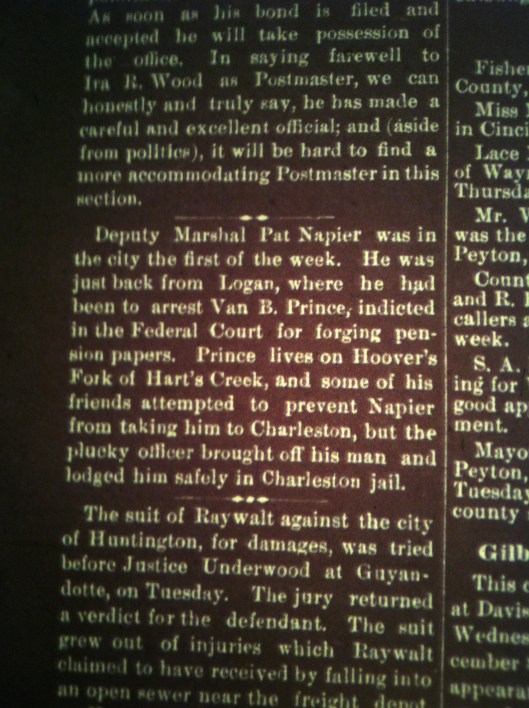
Van Prince Arrested HuA 12.04.1886 1

Van B. Prince Arrested, Huntington (WV) Advertiser, 04 December 1886. Mr. Prince was the primary preacher of Upper Hart during the Lincoln County Feud.

← Older posts
Newer posts →

Feud Poll 1

If you had lived in the Harts Creek community during the 1880s, to which faction of feudists might you have given your loyalty?

Categories

  • Adkins Mill
  • African American History
  • American Revolutionary War
  • Ashland
  • Atenville
  • Banco
  • Barboursville
  • Battle of Blair Mountain
  • Beech Creek
  • Big Creek
  • Big Harts Creek
  • Big Sandy Valley
  • Big Ugly Creek
  • Boone County
  • Breeden
  • Calhoun County
  • Cemeteries
  • Chapmanville
  • Civil War
  • Clay County
  • Clothier
  • Coal
  • Cove Gap
  • Crawley Creek
  • Culture of Honor
  • Dingess
  • Dollie
  • Dunlow
  • East Lynn
  • Ed Haley
  • Eden Park
  • Enslow
  • Estep
  • Ethel
  • Ferrellsburg
  • Fourteen
  • French-Eversole Feud
  • Gilbert
  • Giles County
  • Gill
  • Green Shoal
  • Guyandotte River
  • Halcyon
  • Hamlin
  • Harts
  • Hatfield-McCoy Feud
  • Holden
  • Hungarian-American History
  • Huntington
  • Inez
  • Irish-Americans
  • Italian American History
  • Jamboree
  • Jewish History
  • John Hartford
  • Kermit
  • Kiahsville
  • Kitchen
  • Leet
  • Lincoln County Feud
  • Little Harts Creek
  • Logan
  • Man
  • Matewan
  • Meador
  • Midkiff
  • Monroe County
  • Montgomery County
  • Music
  • Native American History
  • Peach Creek
  • Pearl Adkins Diary
  • Pecks Mill
  • Peter Creek
  • Pikeville
  • Pilgrim
  • Poetry
  • Queens Ridge
  • Ranger
  • Rector
  • Roane County
  • Rowan County Feud
  • Salt Rock
  • Sand Creek
  • Shively
  • Spears
  • Sports
  • Spottswood
  • Spurlockville
  • Stiltner
  • Stone Branch
  • Tazewell County
  • Timber
  • Tom Dula
  • Toney
  • Turner-Howard Feud
  • Twelve Pole Creek
  • Uncategorized
  • Warren
  • Wayne
  • West Hamlin
  • Wewanta
  • Wharncliffe
  • Whirlwind
  • Williamson
  • Women's History
  • World War I
  • Wyoming County
  • Yantus

Feud Poll 2

Do you think Milt Haley and Green McCoy committed the ambush on Al and Hollene Brumfield in 1889?

Blogroll

  • Ancestry.com
  • Ashland (KY) Daily Independent News Article
  • Author FB page
  • Beckley (WV) Register-Herald News Article
  • Big Sandy News (KY) News Article
  • Blood in West Virginia FB
  • Blood in West Virginia order
  • Chapters TV Program
  • Facebook
  • Ghosts of Guyan
  • Herald-Dispatch News Article 1
  • Herald-Dispatch News Article 2
  • In Search of Ed Haley
  • Instagram
  • Lincoln (WV) Journal News Article
  • Lincoln (WV) Journal Thumbs Up
  • Lincoln County
  • Lincoln County Feud
  • Lincoln County Feud Lecture
  • LinkedIn
  • Logan (WV) Banner News Article
  • Lunch With Books
  • Our Overmountain Men: The Revolutionary War in Western Virginia (1775-1783)
  • Pinterest
  • Scarborough Society's Art and Lecture Series
  • Smithsonian Article
  • Spirit of Jefferson News Article
  • The Friendly Neighbor Radio Show 1
  • The Friendly Neighbor Radio Show 2
  • The Friendly Neighbor Radio Show 3
  • The Friendly Neighbor Radio Show 4
  • The New Yorker
  • The State Journal's 55 Good Things About WV
  • tumblr.
  • Twitter
  • Website
  • Weirton (WV) Daily Times Article
  • Wheeling (WV) Intelligencer News Article 1
  • Wheeling (WV) Intelligencer News Article 2
  • WOWK TV
  • Writers Can Read Open Mic Night

Feud Poll 3

Who do you think organized the ambush of Al and Hollene Brumfield in 1889?

Recent Posts

  • Logan County Jail in Logan, WV
  • Absentee Landowners of Magnolia District (1890, 1892, 1894)
  • Charles Spurlock Survey at Fourteen Mile Creek, Lincoln County, WV (1815)

Ed Haley Poll 1

What do you think caused Ed Haley to lose his sight when he was three years old?

Top Posts & Pages

  • Big Harts Creek Post Offices
  • History for Boone County, WV (1928)
  • Origin of Place Names in Logan County, WV (1937)
  • Early Coal Mines in Logan County, WV
  • Post Offices of Wayne County, WV

Copyright

© Brandon Ray Kirk and brandonraykirk.wordpress.com, 1987-2023. Unauthorized use and/or duplication of this material without express and written permission from this blog’s author and/or owner is strictly prohibited. Excerpts and links may be used, provided that full and clear credit is given to Brandon Ray Kirk and brandonraykirk.wordpress.com with appropriate and specific direction to the original content.

Archives

  • February 2025
  • January 2025
  • October 2023
  • September 2023
  • December 2022
  • November 2022
  • May 2022
  • April 2022
  • February 2022
  • November 2021
  • October 2021
  • September 2021
  • June 2021
  • May 2021
  • April 2021
  • March 2021
  • February 2021
  • January 2021
  • December 2020
  • November 2020
  • October 2020
  • July 2020
  • June 2020
  • May 2020
  • April 2020
  • March 2020
  • February 2020
  • January 2020
  • December 2019
  • November 2019
  • October 2019
  • September 2019
  • August 2019
  • July 2019
  • June 2019
  • May 2019
  • April 2019
  • March 2019
  • February 2019
  • January 2019
  • December 2018
  • November 2018
  • October 2018
  • September 2018
  • August 2018
  • July 2018
  • June 2018
  • May 2018
  • April 2018
  • March 2018
  • February 2018
  • January 2018
  • December 2017
  • November 2017
  • October 2017
  • September 2017
  • August 2017
  • July 2017
  • June 2017
  • May 2017
  • April 2017
  • March 2017
  • February 2017
  • January 2017
  • December 2016
  • November 2016
  • October 2016
  • September 2016
  • August 2016
  • July 2016
  • June 2016
  • May 2016
  • April 2016
  • March 2016
  • February 2016
  • January 2016
  • December 2015
  • November 2015
  • October 2015
  • September 2015
  • August 2015
  • July 2015
  • June 2015
  • May 2015
  • April 2015
  • March 2015
  • February 2015
  • January 2015
  • December 2014
  • October 2014
  • September 2014
  • August 2014
  • July 2014
  • June 2014
  • May 2014
  • April 2014
  • March 2014
  • February 2014
  • January 2014
  • December 2013
  • November 2013
  • October 2013
  • September 2013
  • August 2013
  • July 2013
  • June 2013
  • May 2013
  • April 2013
  • March 2013
  • February 2013
  • January 2013
  • December 2012
  • November 2012

Enter your email address to follow this blog and receive notifications of new posts by email.

Join 2,925 other subscribers

Tags

Appalachia Ashland Big Creek Big Ugly Creek Blood in West Virginia Brandon Kirk Cabell County cemeteries Chapmanville Charleston civil war coal Confederate Army crime culture Ed Haley Ella Haley Ferrellsburg feud fiddler fiddling genealogy Green McCoy Guyandotte River Harts Harts Creek Hatfield-McCoy Feud history Huntington John Hartford Kentucky Lawrence Haley life Lincoln County Lincoln County Feud Logan Logan Banner Logan County Milt Haley Mingo County music Ohio photos timbering U.S. South Virginia Wayne County West Virginia Whirlwind writing

Blogs I Follow

  • OtterTales
  • Our Appalachia: A Blog Created by Students of Brandon Kirk
  • Piedmont Trails
  • Truman Capote
  • Appalachian Diaspora

BLOOD IN WEST VIRGINIA is now available for order at Amazon!

Blog at WordPress.com.

OtterTales

Writings from my travels and experiences. High and fine literature is wine, and mine is only water; but everybody likes water. Mark Twain

Our Appalachia: A Blog Created by Students of Brandon Kirk

This site is dedicated to the collection, preservation, and promotion of history and culture in Appalachia.

Piedmont Trails

Genealogy and History in North Carolina and Beyond

Truman Capote

A site about one of the most beautiful, interesting, tallented, outrageous and colorful personalities of the 20th Century

Appalachian Diaspora

  • Subscribe Subscribed
    • Brandon Ray Kirk
    • Join 787 other subscribers
    • Already have a WordPress.com account? Log in now.
    • Brandon Ray Kirk
    • Subscribe Subscribed
    • Sign up
    • Log in
    • Report this content
    • View site in Reader
    • Manage subscriptions
    • Collapse this bar
 

Loading Comments...