• About

Brandon Ray Kirk

~ This site is dedicated to the collection, preservation, and promotion of history and culture in my section of Appalachia.

Brandon Ray Kirk

Tag Archives: timbering

Anse Hatfield and Jim Vance (1868)

16 Sunday Dec 2018

Posted by Brandon Ray Kirk in Hatfield-McCoy Feud, Timber

≈ Leave a comment

Tags

Appalachia, county clerk, crime, deputy clerk, Devil Anse Hatfield, Farmer McCoy, genealogy, Harrison Blair, Hatfield-McCoy Feud, Hiram H. Williamson, history, Jim Vance, John Buchanan, Logan County, Mingo County, sheriff, Thomas Buchanan, timber, timbering, West Virginia, William Straton

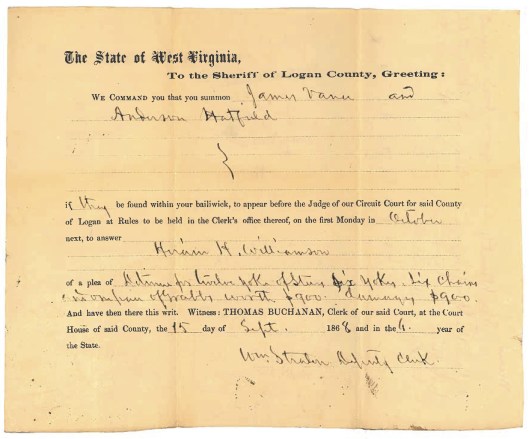
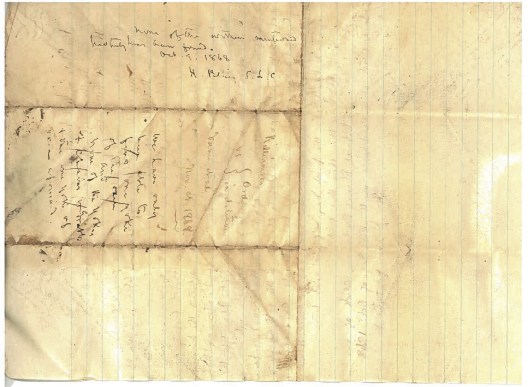
Anderson Hatfield and James Vance Document 1868 1

Hiram H. Williamson and William Straton, $1800 bond, 15 September 1868.

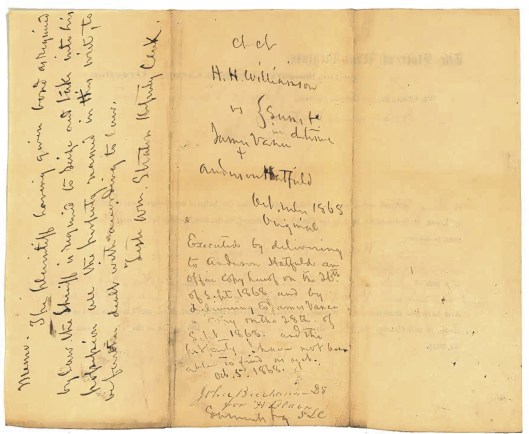
Anderson Hatfield and James Vance Document 1868 2

Hiram H. Williamson and William Straton, $1800 bond, 15 September 1868.

Anderson Hatfield and James Vance Document 1868 3

Summons for Jim Vance and Anse Hatfield, 15 September 1868.

Anderson Hatfield and James Vance Document 1868 4

Summons for Jim Vance and Anse Hatfield, 15 September 1868.

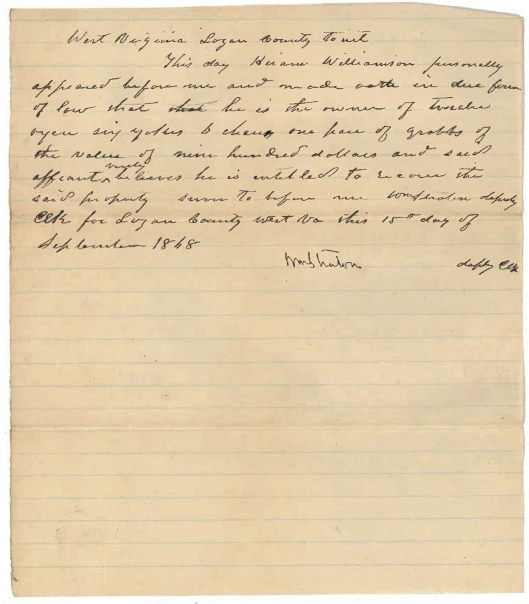
Anderson Hatfield and James Vance Document 1868 5

Hiram H. Williamson oath, 15 September 1868.

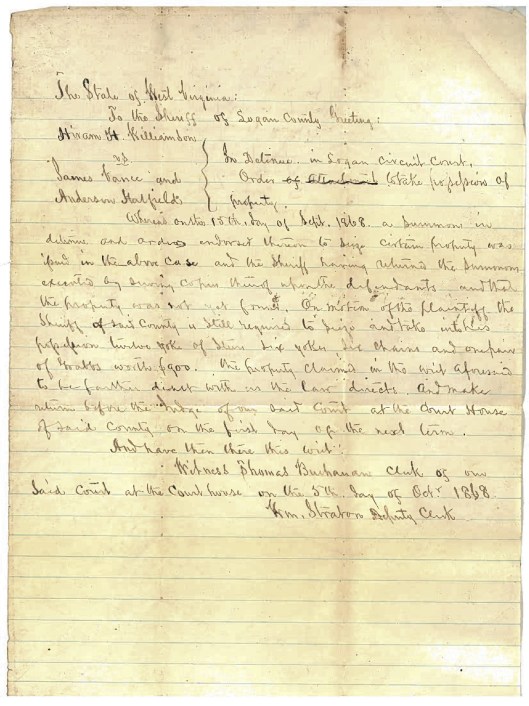
Anderson Hatfield and James Vance Document 1868 6

Order to seize property, 5 October 1868.

Anderson Hatfield and James Vance Document 1868 7

Order to seize property, 5 October 1868.

Anderson Hatfield indicted for retailing Nov 10 1868 LC LO BK A p. 38 1

Law Order Book A, page 38, 10 November 1868, Logan County Circuit Clerk’s Office, Logan, WV. NOTE: This latter document relates to a charge against Hatfield for unlawful retailing of liquor and also against Farmer McCoy for lewdness.

Jake Kinser of Logan County, WV (1936-1937)

20 Saturday Oct 2018

Posted by Brandon Ray Kirk in Big Creek, Big Harts Creek, Boone County, Civil War, Coal, Logan

≈ Leave a comment

Tags

Appalachia, Aracoma, Big Creek, Boone County, Brooke McNeely, Camp Chase, Chapmanville District, Charles Williams, civil war, Claude Ellis, coal, Confederate Army, crime, Dave Kinser, Democratic Party, Douglas Kinser, Elbert Kinser, Ethel, Fort Branch, French River, genealogy, ginseng, Harts Creek, Hetzel, history, J. Green McNeely, Jake Kinser, Jane Mullins, Jefferson Davis, Jim Aldridge, John Carter, John Kinser, Logan, Logan Banner, Logan County, logging, Malinda Kinser, Malinda Newman, Mary Ann Ellis, Mud Fork, Otis Kinser, rafting, Scott Ellis, Smyth County, Stonewall Jackson, timbering, tobacco, Virginia, Washington Township, West Virginia, Wythe County

Jake Kinser Visits LB 06.20.1936 1

Logan (WV) Banner, 20 June 1936. Note: Jacob was not born in 1850, so he does not appear with his family in the 1850 Census for Wythe County, Virginia. He was nine years old in the 1860 Census for Smyth County, Virginia.

Jake Kinser Recollections LB 11.12.1936 2

Logan (WV) Banner, 12 November 1936. Note: Jake Kinser appears as a seventeen-year-old fellow in the 1870 Census for Boone County, West Virginia (Washington Township).

Jake Kinser and Jane Mullins LB 07.07.1937 2

Jake Kinser and his sister Jane Mullins, Logan (WV) Banner, 7 July 1937. 

Jake Kinser and Jane Mullins LB 07.07.1937 3

Jake Kinser and his sister Jane Mullins, Logan (WV) Banner, 7 July 1937. Note: Mary Jane (Kinser) Mullins was eleven years old in the 1860 Census for Smyth County, Virginia. Mr. Kinser died in 1944; his death record can be found here: http://www.wvculture.org/vrr/va_view2.aspx?FilmNumber=571280&ImageNumber=349


Recollections of McKinley Grimmett of Bruno, WV 1 (1984)

31 Friday Aug 2018

Posted by Brandon Ray Kirk in African American History, Coal, Dingess, Guyandotte River, Holden, Logan, Man, Timber, Wyoming County

≈ 4 Comments

Tags

African-Americans, Alva Grimmett, Appalachia, Austin Grimmett, Baileysville, Big Cub Creek, Bruno, Buffalo Creek, Christian, Cole and Crane Company, Devil Anse Hatfield, Dingess, Edith Grimmett, education, Elk Creek, Ettie Grimmett, farming, genealogy, general store, Green Perry, Guyandotte River, Guyandotte Valley, Henderson Browning, Henderson Grimmett, history, Holden, Horse Pen Mountain, Johnny Grimmett, Landsville, Lilly Grimmett, Logan, Logan County, logging, Madison Creek, Mallory, Man, McGuffey Readers, McKinley Grimmett, Mingo County, Mud Fork, Nancy Grimmett, rafting, Ralph Grimmett, Rose Grimmett, Sand Lick, Sanford Grimmett, Slater Hatfield, Tennis Hatfield, Thomas Hatfield, Tilda Hatfield, timber, timbering, Travis Grimmett, Verner, Walter Buchanan, West Virginia, whooping cough, World War I, Wyatt Belcher, Wyoming County

McKinley Grimmett was born on November 30, 1896 to Henderson and Nancy (Hatfield) Grimmett at Sand Lick, Logan County, WV. On May 14, 1916, Mr. Grimmett married a Ms. Plymale, who soon died, in Logan County. One child named Alva died on June 21, 1919 of whooping cough, aged fourteen months. His World War I draft registration card dated September 12, 1918 identifies him as having blue eyes and light-colored hair. He was employed by Mallory Coal Company at Mallory, WV. On November 13, 1919, he married Matilda “Tilda” Hatfield, daughter of Thomas Hatfield, in Logan County. He identified himself as a farmer in both of his marriage records. During the 1920s, he served as a deputy under Sheriff Tennis Hatfield.

The following interview of Mr. Grimmett was conducted at his home on July 17, 1984. In this part of the interview, he recalls his family background and early occupations. Logging and rafting in the Guyandotte Valley are featured.

***

Would you mind telling me when and where you were born?

Right here. I was born about a mile up above here. I was borned in Logan County. The post office was Christian at that time. Christian, WV. It’s changed now. They throwed Christian out – it was over here at Christian – and they throwed it out and moved it over here to Bruno. Christian went… The mines stopped over there. And that’s where I was born, right here at Bruno, Logan County. Been here all my life.

What day were you born?

November 30, 1896.

Who were your parents?

Henderson Grimmett and Nancy Hatfield Grimmett.

What kind of work did they do?

They did logging work. All they had that day and time. Mule teams and ox teams.

Where did your dad do his work?

All over Logan County.

Did he have his own farm?

Oh yeah. Yeah.

How big was his farm?

It was about 287 acres.

Can you describe his house?

Well, the house was a two-story building. But he never did get… He took the fever and he never did get the upper story, all of it completed. He died at a very early age of 74. He put him up a little store. Got ahead a little bit. Had a store here. Come down and bought this place off Walter Buchanan and he deeded his five kids the homeplace up there. And then he stayed on it from ’21 to ’29. He died 19th day of January, 1929.

Who were your mother’s parents?

Oh, Lord, I can’t… Slater Hatfield was her daddy’s name. And I don’t know my grandma. My daddy, now they both was born in Wyoming County. Baileysville or somewhere in there. I think my mother was born over there in Big Cub Creek. She was a Hatfield. I don’t know where…

How many brothers and sisters do you have?

I had three brothers and three sisters. Sanford was the oldest one. Austin and Johnny. They’re all dead. I’m the only one that’s living. All my three sisters… Lilly was the oldest one, and Rose was the next one, and Ettie was the youngest. They’re all dead. All of ‘em but me.

Were you educated in Logan County schools?

Yeah, that’s all we got. Free schools. I believe we started off about three months out of the year. Right over there where that first house is sitting – a one-room school house. All of us kids.

What was the last year of school you completed?

I believe it was about 1914, I’m not right sure. ’15.

Did you use the McGuffey Readers?

That’s all we had. And the spelling books. And in the late years, why we had a U.S. history… A small one. Most of it was just about West Virginia. It wasn’t about the whole United States. And geography, we had that. Arithmetic. That was about all we had in free schools. We had to buy them all then. They weren’t furnished.

How did you meet your wife?

She was born and raised over here at Horse Pen in Mingo County. And that’s how we met. We were just neighbors.

What was her maiden name?

She was a Hatfield, too. But now they were… There’s three or four sets of them.

Was her family related to Devil Anse Hatfield?

Well, they was some… Not very close, though, I don’t think.

Which church did you belong to?

I don’t belong to any.

Did you belong to a church when you were younger?

No, never did. If I ever would have joined, I’d have stayed with it.

Do you remember the year of your marriage?

Yeah, I sure do. November 13, 1919.

How many children do you have?

Four. We have two boys and two girls. Travis Grimmett is the oldest. And Ralph, Edith, and Nancy.

What was your wedding like?

Well, we just got married and come right home. At that time, they didn’t have such things, to tell you the truth.

Who was the preacher?

Green Perry. Rev. Green Perry on Elk Creek. Rode a horse back when I went up there to get married. A pair of mules. I rode them mules.

Where did you first live after you married?

Right about a mile above here at the old homeplace.

You have lived here all of your life?

All of our life.

Was it always this populated?

No, no. Wasn’t three or four houses on this creek at that day and time. It was farm land. It’s all growed up now. All them hills was put in corn, millets, and stuff like that. If they couldn’t get a machine to it, they cut it by hand. Some of them raised oats and some of them raised millet, corn. Raised hogs and cattle and sheep and selling ‘em.

Who owned this property back then?

Burl Christian owned this here, but I don’t know… My daddy bought his… A fellow by the name of Wyatt Belcher. Wait a minute. Browning. I can’t think of his name. He lived over here on Christian and he bidded in… It sold for back taxes and he bidded in. Henderson Browning.

What kind of work did you do after you married?

Just the same thing as I worked at before I got married. I first started out – my daddy was a boss for Cole and Crane on this river. I first started out working in the log business. I worked two years at that and then I decided… Mule team – I worked about eighteen months at that. Then in 1913 the coal company started in and I went to work in carpenter work. I helped build all of these houses down here at Landville. The superintendent, we got done, they was wanting to hire men, he give me a job keeping time for a while. And he wanted me to learn to run the drum – that’s letting coal off the hill. I learned it and about the third day I was up there, a preacher was running it, and he told me they’d just opened up and they didn’t have much coal to run off the hill, he told me, that preacher, he rolled out two cards and he said if that preacher fails to go out and work on that side track today you give him one of these cards. Well, I didn’t give him a card. But he come out that evening, the boss did. And he said, did the preacher work. And I said, no he refused. He said, I’ll fix him. He fired him. And I took the job and stayed with it four years and then I got married and then I went to work over here at Christian running a drum and I stayed there 34 years.

When you worked for Cole and Crane, did either of those men ever come up here?

Oh yeah. One of them was. Cole was. I don’t think Crane was ever here. A little slim fella.

Did you get a chance to talk to them?

No, they wouldn’t talk to us working men. They’d talk to the boss. They’d go away from us and talk to theirselves. We just got a $1.10 for ten hours. Eleven cents an hour.

What kind of a person did Cole seem to be?

Well, he knowed how the men was. They’d raft timber and go down this river to Guyandotte. Had what they called locks and dams there to catch the logs. This river was full of logs. He bought timber everywhere. Plumb at the head of it.

Did you ever ride a raft?

Oh, yeah. I went with my daddy. I wasn’t grown.

Can you describe it?

Oh, they’d raft the logs, poplar. Now they didn’t raft hardwoods. They’d sink on them. Some rafts, a big one would be 160 to 200 feet long, about 24 to 26 feet wide. Oar on each end of it. If it was a big raft, they had two men up front all the time plumb in to Guyandotte. I was the second man on it when I got to go out on it. My dad had timber and he rafted it, took it there and sold it. Took what they called dog wedges and cut little basket oaks and rafted them, stringers across ‘em, you know. Lots of people get drowned, too.

Were you ever in an accident?

No, I never was in no big one. I’ve seen about six or eight drown.

Could you describe how it happened?

Oh, if he couldn’t swim, sometimes the best swimmer drowned, you know, if he got under a lot of logs or something. According to whatever happened there with him. He could get out if there wasn’t no logs on top of him no where to hold him under, you know. If logs were on top of him, he was gone. Now about the last ones I seen drowned was two colored people. They was building a railroad from Logan to Man up Buffalo Creek. So we was working on a log gorge down there at the lower end of Landville. And there was four colored men… 1921. Had a saloon up here at Verner. They wouldn’t allow one in Logan County. And they went up there on the 21st day of December to get ‘em a load of whisky. And they come back… They’d seen white people ride these logs. Some county people would get on one log and ride it plumb to Logan, as far as you wanted to go. And they thought they could ride it. And they got on. Rode ‘em off the gorge and they was running into eddy water and they would hit the back end, it would, and the other end would swarp out and they’d pull out that way. And they got on ‘em with their whisky and everything and two of ‘em got out and two of ‘em drowned.

When you rode the raft to Guyandotte, how did you get back to Logan?

Oh, we had to walk. We’d get a train up to Dingess over here. You know where that’s at? We’d ride down up to there. And then we’d have to get off and walk across the hill there and come right straight out at the mouth of Mud Fork, Holden there, and up another little drain and down Madison Creek down here. And walk… Man alive, our feet would be so sore, I’d be up for two or three weeks I couldn’t walk, my feet would be wore out so.

NOTE: Some names may be transcribed incorrectly.

Brad Toney Stationery

21 Tuesday Aug 2018

Posted by Brandon Ray Kirk in Big Creek, Timber, Toney

≈ Leave a comment

Tags

Appalachia, Big Creek, Brad Toney, genealogy, history, Lincoln County, Logan County, merchant, timber, timbering, Toney, West Virginia

B.D. Toney Stationery.JPG

Bradford D. Toney, son of Burbus C. and Sarah Kesiah (Lucas) Toney, was born in 1847. Toney, a town located in southern Lincoln County, WV, is named for him.

Nancy Hatfield v. The Little Kanawha Lumber Company (1892)

07 Saturday Jul 2018

Posted by Brandon Ray Kirk in Hatfield-McCoy Feud, Timber, Women's History

≈ Leave a comment

Tags

Appalachia, Cap Hatfield, G.W. Morgan, G.W. Taylor, genealogy, Hatfield-McCoy Feud, history, Island Creek, John A. Sheppard, justice of the peace, Little Kanawha Lumber Company, Logan County, Nancy Hatfield, P.A. Farley, Patterson Christian, splashing, timber, timbering, West Virginia

Historians have well-documented Anderson Hatfield’s timber activity. In 1892, Nancy Hatfield, wife of Cap, sued the Little Kanawha Lumber Company. Here are transcriptions of a few court documents.

DOCUMENT 1

Nancy Hatfield

vs.

The Little Kanawha Lumber Company

Civil Action

Summons issued June 29, 1892 by G.W. Morgan, a Justice of Logan County, W.Va., and returnable at the residence of Cap Hatfield on Main Island Creek in Logan District of said County on the 14th day of July 1892. Residence of Cap Hatfield June 14, 1892. Summons returned duly executed by P.A. Farley, a constable of said county. Present the plaintiff in person and by Counsel Jno. A. Sheppard. No person appearing for the defendant. G.W. Morgan the Justice issuing the summons being absent and sick and the plaintiff being ready for trial the undersigned Justice of said county having waited on hour after the time set for trial and the defendant still failing to appear. After hearing the evidence offered by the plaintiff doth find for the plaintiff and assess her damages at $50.00. Judgment is therefore rendered in favor of the plaintiff and against the defendant for the sum of $50.00 and her costs in this behalf expended.

Given under my hand this June 14, 1892.

Patterson Christian, Justice

DOCUMENT 2

The Little Kanawha Lumber Company

To Nancy Hatfield

To damage by splashing to bottom creek bank &c of land on Island Creek, $75.00

To fence gate &c splashed away & cost of replacing, $25.00

To timber out, $25.00

Total: $125.00

Cr. by cash on same, $10.00

DOCUMENT 3

APPEAL BOND

Know all men by these presents that we Little Kanawha Lumber Company and G.W. Taylor are held and firmly bound unto the state of West Virginia in the just and full sum of one hundred dollars for the true payment whereof well and truly to be made we bind ourselves heirs and personal representatives jointly severally and firmly by these presents sealed with our seals and dated this the 20th day of July 1892.

The condition of the above obligation is such that whereas on the 14th day of July 1892 a Judgment was rendered by Patterson Christian a justice of the peace against the Little Kanawha Lumber Company in favor off Nancy Hatfield in the sum of $50.00 with interest from date and cost in a cause pending before said Christian J.P. wherein said Nancy Hatfield was plaintiff and said Little Kanawha Lumber Company was defendant and said Little Kanawha Lumber Company desiring an appeal from the decision of said justice in rendering said judgment tenders this bond for that purpose. Now if the above bond Little Kanawha Lumber Company and G.W. Taylor do pay off and satisfy any judgment rendered against them by the Circuit Court of Logan County on said appeal then this obligation to be void otherwise to remain in full force and virtue.

Little Kanawha Lumber Co.

G.W. Taylor

Approved this July 20, 1892

Patterson Christian, J.P.

NOTE: This case had nothing to do with the Hatfield-McCoy Feud.

Spencer A. Mullins Deposition in Debt Case (1870)

07 Thursday Jun 2018

Posted by Brandon Ray Kirk in Guyandotte River, Harts, Lincoln County Feud, Timber

≈ Leave a comment

Tags

Appalachia, Cain Adkins, genealogy, history, Isaac Adkins Jr., Jeremiah Lambert, justice of the peace, Lincoln County, Lincoln County Feud, Logan County, rafting, Spencer A. Mullins, timber, timbering, West Virginia, William Robinson

IMG_0692

Partly to resolve the debt case, prominent resident Spencer A. Mullins provided a deposition that referenced three important residents of Harts: Isaac Adkins, Jr., William Robinson, and Canaan Adkins. Note: Canaan “Cain” Adkins was a leading figure in the Lincoln County Feud.

Question by Defendant

Was you by at settlement took place between Isaac Adkins and William Robinson?

I was with them at the mouth of harts creek on a raft of timber that the(y) had bought of Deft. which timber I suposed they had just measshered as they had they measherment of the timber presant. they thare mad(e) a settlement on the raft and they raft locked fifteen its(?) or fifteen feet of paying a note that he held on defendant, which note had been executed to Canaan Adkins and the note was not presant at the time of settlement. the plantif was to give the said note to Defendant another time as he hadent the note withe him at the time they made they settlement.

At what time did this settlement take place?

In the year sixty or sixty one.

S.A. Mullins

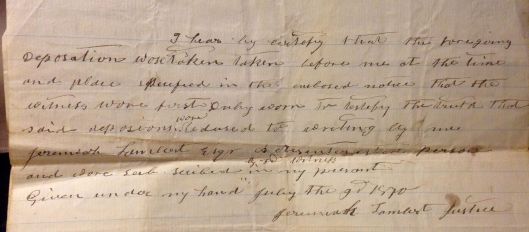
IMG_0693.JPG

Jeremiah Lambert, Justice of the Peace, Lincoln County, WV, July 1870. Jeremiah Lambert is my great-great-great-great-grandfather.

Banco News 10.08.1926

05 Thursday Apr 2018

Posted by Brandon Ray Kirk in Banco, Battle of Blair Mountain, Big Creek, Harts, Huntington, Logan, Timber

≈ Leave a comment

Tags

Anna Duty, Appalachia, Aracoma, Arnold Thomas, Banco, Battle of Blair Mountain, Big Creek, Ed Stone Branch, Eva Ellis, Fannie Brumfield, genealogy, Gladys Ferrell, Harts, Hassell Vance, Henlawson, history, Huntington, J.A. Stone, J.W. Thomas, L.P. Swentzel, Logan, Logan County, McClintock Field Company, Peach Creek, Robert Varney, timber, timbering, Trace Fork, West Virginia

An unknown correspondent from Banco on Big Creek in Logan County, West Virginia, offered the following items, which the Logan Banner printed on October 8, 1926:

Everyone is very busy in Banco at this writing.

Everything sure is lively around this town as there are three sawmills on the Ed Stone Branch.

L.P. Swentzel of Huntington who is working for the McClintock Field Company was calling in Banco last week.

Mr. and Mrs. J.A. Stone of Blair were calling in our town one day this week.

Wonder if Hassell Vance likes taffy? We believe he does as he has been visiting the taffy mill real often.

Miss Fannie Brumfield of Trace Fork left for her home at Harts Saturday accompanied by her grandmother.

Miss Eva Ellis of Ellis Fork was a business caller in Banco last Tuesday.

Miss Gladys Ferrell and two sisters of Henlawson are visiting relatives on Ed Stone Branch this week.

J.W. Thomas and son Arnold returned from a peddling tour at Peach Creek, Logan and Aracoma.

Wonder which H.F.L. likes best: the North Pole or the ‘ville?

Mrs. Anna Duty and small daughter returned from Logan where she has been visiting her daughter, Mrs. Robert Varney.

Timber Companies Active in the Guyandotte Valley (1890s)

28 Wednesday Feb 2018

Posted by Brandon Ray Kirk in Guyandotte River, Timber

≈ Leave a comment

Tags

Appalachia, Burks and Prichard, C. Dingess & Company, Cole and Crane Company, Fridman Lumber Company, Guyan River Coal and Mercantile Company, Guyandotte Valley, history, Hugh Dingess & Company, Huntington Advertiser, Ironton Cross Tie Company, Little Kanawha Lumber Company, Logan County, Logan County Banner, Logan Timber Company, logging, McClintock & Son, Panther Lumber Company, Penn Lumber Company, R.H. Prichard, Ratliff and Shannon, Sliger Lumber Company, timbering, Wayne County, West Virginia, Wittenburg, Yellow Poplar Lumber Company

A partial list of timber companies active in the Guyandotte Valley of West Virginia during the 1890s, based on Logan County deeds, the Logan County Banner, and the Huntington Advertiser:

C. Crane & Company (1891, 1894, 1895, 1896, 1898, 1899, 1900)

C. Dingess & Company (1891, 1892, 1893, 1894)

Fridman Lumber Company (1899)

Guyan River Coal and Mercantile Company (1897)

Hugh Dingess & Company (1893)

Ironton Cross Tie Company (1897)

Little Kanawha Lumber Company (1891, 1892, 1893, 1895, 1898)

Logan Timber Company (1897)

McClintock & Son (1895)

Panther Lumber Company (1896)

Penn Lumber Company (1898)

R.H. Prichard or Burks and Prichard (1891)

Ratliff and Shannon of Wayne County (1890)

Sliger Lumber Company (1896)

Yellow Poplar Lumber Company (1893)

Wittenburg (1898)

Clinton Crane (1917)

14 Wednesday Feb 2018

Posted by Brandon Ray Kirk in Logan, Timber

≈ Leave a comment

Tags

Appalachia, Christmas, Cincinnati, Clinton Crane, Cole and Crane Company, Fred Cole, genealogy, Guyandotte River, Guyandotte Valley, Henry D. Hatfield, Highland Avenue, history, Logan, Logan County, Logan Democrat, logging, Ohio, optometry, photos, timber, timbering, W.H. Cole, West Virginia

The following news items relating to Clinton Crane (1844-1917) and Cole & Crane Co. were printed in the Logan Democrat of Logan, WV, in 1917:

Clinton Crane 1

HONOR FOR LOGAN CITIZEN

C. Cole Appointed Member of State Board in Optometry

C. Cole of this city has been appointed by Governor Hatfield a member of the State Board of Examiners in Optometry, and the senate has confirmed the appointment.

It will be Mr. Cole’s duty to meet at the state capital with the other members of the board at regular intervals to prepare examinations and to examine applications who wish to practice optometry in this state, and to issue certificates to those who pass a satisfactory examination.

Mr. Cole has been practicing optometry for about sixteen years, and when the law requiring a certificate came into effect, he would have been exempt from taking the examination on account of his long practice, but preferred to take it.

In 1912 he passed a satisfactory examination and secured a life certificate, and since that time has been practicing in this profession and has taken an active part in the state optical work.

He has supervised the training and study of his two sons, W.H. and Fred Cole, who also hold certificates.

Source: Logan (WV) Democrat, 1 March 1917.

***

CAPT. CRANE IS BETTER

Veteran Timberman and Lumber Manufacturer Will Get Out Again

Capt. Clinton Crane of Cincinnati, millionaire timber and lumber dealer and manufacturer, who has been very ill for several weeks at his home in the Ohio metropolis, and whose life was for a time despaired of, is now improving, according to advices received by friends and business acquaintances here.

The messages state that Capt. Crane will be able to get out again as soon as the weather improves.

Source: Logan (WV) Democrat, 8 March 1917.

***

Work on remodeling the Cole residence on Highland avenue, which was damaged by fire before Christmas, is progressing rapidly. W.H. Cole, son of C. Cole, expects to build a house for himself later on the lot above his father’s.

Source: Logan (WV) Democrat, 27 April 1917.

***

CLINTON CRANE DEAD

Well Known Lumber Magnate Passes Away At His Home In Cincinnati

The death of Clinton Crane, a well known lumber man, at his home in Cincinnati, last Friday, came as a shock to a number of people in Logan county who were well acquainted with him.

Mr. Crane had extensive holdings in West Virginia, being junior partner in the firm of Cole & Crane. He was 77 years old. He entered the West Virginia timber market about 1880, and came to own thousands of acres in the Guyandotte valley. His firm had booms at the mouth of the Guyandotte river and drifted millions of logs from the upper waters, rafting them to the booms and then towing them to Cincinnati. Lately, they have used trains mostly for this work.

Mr. Crane kept in close touch with his vast business interests. He also had large coal interests in the Guyan valley. He leaves a widow and two daughters. He was buried last Monday. His interests in Logan county were put in the hands of trustees before his death, so his passing will have no effect on the companies in which he held interest here.

Source: Logan (WV) Democrat, 10 May 1917.

***

The late Clinton Crane, who died recently in Cincinnati, was among the first to recognize the vast resources of this part of West Virginia. He accumulated over a million dollars as a result. The same opportunities that were open to him are still open to others. The coal development of Logan county will produce many more millionaires within the lifetime of the present generation.

Source: Logan (WV) Democrat, 17 May 1917.

Banco News 07.13.1926

08 Thursday Feb 2018

Posted by Brandon Ray Kirk in Banco, Battle of Blair Mountain, Big Creek, Boone County, Chapmanville, Hamlin, Huntington, Logan, Timber

≈ Leave a comment

Tags

Albert Estep, Appalachia, Banco, Battle of Blair Mountain, Big Creek, C.A. Justice, Chapmanville, Charleston, Charlie Stone, Cornell Chapman, Dr. J.T. Ferrell, Estep, Fourth of July, genealogy, H.F. Lucas, Hamlin, Hazel Saunders, history, Huntington, J.A. Pardue, J.A. Stone, J.B. Lucas, Jeanne Eleanor Lucas, John Vance, Joseph Varney, Limestone, Logan, Logan County, Luther Bias, Minta Jeffrey, Nellis, Polly Ellis, Ruby Saunders, Samuel Pardue, Sarah Ferrell, singing schools, Spring Dale, Sylvia Hinds, T.D. Butcher, Ted Hager, Thomas' Circle, timbering, W.M. Gullett, West Virginia, Wilkinson

An unknown correspondent from Banco on Big Creek in Logan County, West Virginia, offered the following items, which the Logan Banner printed on July 13, 1926:

Mr. and Mrs. Joseph Varney and children of Thomas Circle attended the singing school at Banco last Sunday conducted by Prof. Albert Estep of Limestone.

Mr. and Mrs. T.D. Butcher and children of Wilkinson motored through Banco Monday.

Mr. and Mrs. Ted Hager of Banco left for their home in Big Creek Monday.

Charlie Stone of Blair was the all-night guest of his parents Mr. and Mrs. J.A. Stone at this place last Wednesday.

Mr. and Mrs. John Vance and children motored to Hamlin in their new Ford last Tuesday.

J.A. Pardue and sister-in-law, Miss Sylvia Hinds, of Huntington motored to Banco last Sunday were the all-day guest of Mr. Pardue’s parents, Mr. and Mrs. Samuel Pardue.

Rev. Jeffrey of Chapmanville was visiting his mother, Mrs. Minta Jeffrey, near Banco last week.

Spring Dale is getting livelier every day. W.M. Gullett has purchased a new truck to haul lumber.

Misses Hazel and Ruby Saunders spent the Fourth in Logan.

Miss Ollie and Mattie Varney and Irene Lunsford were calling in our town one evening last week.

H.F. Lucas, mother, and little sister Jeanne Eleanor returned from Nellis, W.Va., Monday. Mrs. Lucas reports her brother, C.A. Justice, who recently removed from Charleston hospital where he was operated on for appendicitis, is getting along nicely.

Mrs. Polly Ellis of Big Creek and Miss Cornell Chapman of Estep and Dr. Ferrell of Chapmanville were out motoring last Wednesday.

Luther Bias of Chapmanville sure does think a lot of the girls as he had three in his little Ford last Monday evening. Be careful, Bias. Don’t get too many. Someone might get jealous.

Mr. and Mrs. J.B. Lucas spent the Fourth of July with Mr. Lucas’ aunt, Mrs. Sarah Ferrell at Chapmanville.

Timber in Wyoming County, WV (1887)

15 Monday Jan 2018

Posted by Brandon Ray Kirk in Timber, Wyoming County

≈ Leave a comment

Tags

Appalachia, Catlettsburg, Charles Cook, Guyandotte Herald, H.H. Cook, history, Kentucky, logging, New York, timber, timbering, West Virginia, Wyoming County

Wyoming County Timber HuA 05.21.1887.JPG

Huntington (WV) Advertiser, 21 May 1887.

Republicans Driven from Logan County by Gunmen (1914)

01 Friday Dec 2017

Posted by Brandon Ray Kirk in African American History, Logan

≈ Leave a comment

Tags

African-Americans, Appalachia, coal, Con Chafin, crime, Democratic Party, deputy sheriff, Don Chafin, E.T. England, guitar, Guyandotte River, Herald-Dispatch, history, Huntington, Ira P. Hager, John B. Wilkinson, Ku Klux Klan, lawyers, Logan, Logan Banner, Logan County, mine guards, O.J. Deegan, politics, prosecuting attorney, Republican Party, sheriff, timbering, W.C. Lawrence Jr., West Virginia

From the Herald-Dispatch of Huntington, WV, comes this story printed by the Logan Banner of Logan, WV, dated October 30, 1914:

Republican Voters Driven from Co. by Gunmen

Deputy Sheriffs, Acting as Mine Guards, Are the Law and Enforcement Thereof.

Many Believe Martial Law Will be Sequel to Rule of Thugs.

Democratic schemes for the intimidation of Republican voters, for the prevention of a Republican victory in the state next Tuesday, whether by fair means or foul, have reached their climax in Logan county. If there is a place in West Virginia where lawlessness has succeeded law and order, where the persons chosen to enforce the law have initiated a system of rule by force and intimidation, a rule by force of clubs and pistols, a rule by thugs and gunmen, that place is Logan county.

A thorough investigation of conditions in Logan county today proves that the Ku Klux Klan in the south were mere pikers. There are men in Logan county who could beat them blindfolded.

The man, woman or child who would enjoy life–aye, who are willing to accept life or pass through Logan county, must be careful not to cross the paths of Sheriff Don Chafin and his force of about two hundred armed deputies.

And it can be truthfully said that the paths of these men extend to every nook and corner of the county. And several newly-made graves along the banks of the Guyandotte river and its tributaries shows who is the law and the enforcement thereof.

Several men have been shot, two negroes fatally, others have been clubbed and driven out of the county, women and children have been forced to flee clad only in their night-clothes, upon order of the Chafin deputies.

And all this because some Republicans desired to be registered in order that they might cast their votes for the Republican candidates next Tuesday.

Logan county is about to throw off the yoke of Democracy. The coal and lumber industries are rapidly being developed, and, as is always the case in progressive communities, the Republicans are making large gains.

If the voters of Logan county are allowed to cast their ballots as they desire, and those ballots are counted as cast, the Republican candidates will be elected.

If the conspiracy which has been formed by and in the interest of the Democrats is allowed to be carried out, the Democrats will continue in control of the county, the enforcement of law will be a mere joke and there will be probably a score added to the newly made graves along Old Guyan after next Tuesday.

Opinions vary as to what the outcome will be. Some believe that only martial law will prove a solution. Others are of the opinion that conditions will grow gradually worse and that the enforcement of law and order in Logan county will be a subject for investigation by the next legislature which convenes in January. Most certainly, if the threats of the Democrats are carried out, the Republicans are driven from the polls next Tuesday, the legislature will be asked to make a sweeping investigation and their findings will reveal conditions incredible in a civilized state.

Don Chafin is high sheriff of Logan county. His cousin, Con Chafin is prosecuting attorney. All the county officials are Democrats. Circuit Judge Wilkinson is a Democrat, though a man who wants the law enforced.

Sheriff Chafin, it is estimated, has about two hundred deputies. When he was elected, a part of his platform was that he would drive out the Baldwin mine guards from Logan county. No Baldwin men are known to be in this county now but these deputy sheriffs are known as mine guards. All of them are supposed to be armed with pistols, black-jacks and the usual weapons of gunmen. But few of them are licensed to carry such weapons and there is no trouble to find evidence that they have these weapons in violation of the law. Some of them are known to be ex-convicts and as such would not be licensed to carry revolvers, etc.

They shoot, club, slug and thug at will. But they are not arrested and imprisoned. For they are the law and the enforcement thereof.

Events of the past few weeks show the effectiveness of this organization of deputies and the way in which they operate. When the registrars were on their rounds registering the voters some of the deputies were on hand and even the Democratic registrars were afraid not to obey their orders. To go back further, they were on hand at the Democratic primaries and the Democratic nominees were the men of their choice and of that of their chief.

The Democratic registrars refused to register many Republicans, especially among the colored voters. When the county commissioners met to canvass the registration, four Republican lawyers State Senator E.T. England, Ira P. Hager, W.C. Lawrence, Jr., and O.J. Deegan, the latter being Republican county chairman, took the lead to see that Republicans entitled to vote were registered. One hundred colored voters were brought into Logan for examination and registration.

Threats have been made by deputies against the journeying of negroes to the court house, there to demand their rights, and the republican leaders realized there was danger.

The work before the county court was slow, as the democratic leaders challenged every step of the republicans. But eleven men were passed upon the first day, five of whom were registered, six turned down. That night the apparent cause for delay came. A colored family lived at Monitor, a mile from the court house. It was supposed that some of the negroes awaiting registration were there. This gave the conspirators a chance and the gunmen got busy.

Soon after dark a band of armed men raided the house, shot out the windows, fired bullets into bodies of two colored men, beat up others and drove a woman and child into the hills without giving them time to dress. The raiders said they were looking for “strange niggers.” As the result of that raid one colored man lies in an unmarked grave on the hillside and another is likely to join him soon. No “strange niggers” were in that house.

A colored man owned a cleaning and pressing establishment within a couple of squares of the court house. His windows were demolished and his place of business next morning looked as though a German siege gun had been turned on it.

A score of colored men awaiting registration were quartered for the night in the office of Senator England, and adjoining offices. About 11:30 o’clock at night some of the negroes were awakened by noises in the hallways and a sensation of not being able to breathe. They rushed to the windows and threw them open, but met with a shower of stones from the outside.

Piled on Senator England’s desk can be seen the stones hurled with force as is shown by the scars on the walls. Some of the stones were thrown from the court house steps.

No arrests were made. A grand jury was in session and Judge Wilkinson instructed the jurors to ferret out the dastardly assault and bring the miscreants to justice. But not an indictment resulted. It is no mystery in Logan as to who committed the deed. Any citizen not afraid to talk, and they are few, will name half a dozen deputy sheriffs as being in the party.

A telephone exchange girl next door to where some of the negroes were attacked made an outcry and was told that she would not be hurt if she kept still. She knows who told her to keep quiet, but would hardly give his name, probably not if she faced a jail sentence for contempt of court. It is not safe to talk in Logan county. “Don’t mention my name,” is what they all say when discussing the outrages.

A short distance from Logan is a construction camp. A large crowd of deputies raided the camp. One negro was playing the guitar and singing. No “strange niggers” were found there, but the one negro sang his last song. He, too, lies in an unmarked grave along the banks of Old Guyan. “Resisting arrest” was the excuse given.

Such depredations naturally drove many colored voters away and they will not vote.

Though threats have been made against the life of Senator England and his followers, they are putting up a game fight. By agreement the county court was to hold a night session to get through with the registration. England was later notified that nothing further would be done that night but the work would be taken up the next day he was amazed to find the court was no longer sitting. He went before Judge Wilkinson, mandamused the county court to sit again, and got ninety-eight colored voters registered.

The democrats were beaten in that game. “What’s the difference,” said a deputy when the court reconvened. “We will get them election day.” It has been openly boasted by the democrats that in many precincts the republicans, especially the colored voters, will not be allowed at the polls next Tuesday.

The sheriff and his deputies form an organization with unlimited power. Every little town or village, every public works, has the deputies. By intimidation and force in most instances and by favors in others, these deputies can run things to suit themselves. Infractions of the law by supporters of the organization can easily be overlooked, while on the other hand, the slightest technical violation can be punished to the full extent of the law.

The high-handed way in which the Democratic county organization is running things has caused a ruction in the Democratic ranks and many of them will quietly vote the Republican ticket. Many members of the old-time militant Democracy, some of them ex-Confederate soldiers, have assured the Republican leaders that they can no longer approve the Democratic methods employed in Logan County and will record their votes against it.

Big Sandy River Log Raft

04 Monday Sep 2017

Posted by Brandon Ray Kirk in Big Sandy Valley, Timber

≈ Leave a comment

Tags

Appalachia, Big Sandy River, history, Kentucky, logging, photos, timber, timbering, West Virginia

Big Sandy Log Raft

Big Sandy River log raft. Source of photograph to be determined.

Shay Locomotive in Boone County, WV (1890)

17 Thursday Aug 2017

Posted by Brandon Ray Kirk in Boone County, Timber

≈ Leave a comment

Tags

Appalachia, Boone County, history, logging, photos, timber, timbering, West Virginia

Shay Engine Boone County 1890 2

Shay locomotive in Boone County, WV. Photo credit undetermined.             https://www.youtube.com/watch?v=TbsbcZKCWDY


“Ben Bolt” Not Written in Logan (1926)

15 Saturday Jul 2017

Posted by Brandon Ray Kirk in Logan

≈ Leave a comment

Tags

Alice Lawson, Aracoma, assistant postmaster, Ben Bolt, Charleston Gazette, Edgar Allan Poe, George T. Swain, George Washington, Guyandotte River, history, Karl Myers, Logan, Logan Banner, Logan County, logging, mayor, New York Mirror, Pennsylvania, poems, poetry, postmaster, rafting, Rafting on the Guyandotte, Savage Grant, St. Albans, Thomas Dunn English, timbering, Vicie Nighbert, Walt Whitman, West Virginia, writers

Thomas Dunn English (1819-1902) was a Pennsylvania-born writer who lived briefly in present-day Logan, WV, before the Civil War. At one time, many Loganites believed he wrote his famous work titled “Ben Bolt” while a resident of Logan, then called Aracoma. For more information about his biography, follow this link: https://www.wvencyclopedia.org/articles/2205

The following story appeared in the Logan Banner on November 23, 1926:

“Logan gains quite a bit of notoriety from the fact that the song ‘Ben Bolt’ was written here,” said G.T. Swain in his short history of Logan county, published in 1916. Dr. English wrote “Ben Bolt” for the New York Mirror about 10 years before he ever came to Logan. So here explodeth another nice literary myth–if a myth concerning “Ben Bolt” may be called a literary one. They even tell how Dr. English laid aside his law and medicine practice, his novel writing, and his duties as assistant postmaster and politician and dreamily to go to the shades of certain elm trees overlooking the Guyandotte and there wrote the poem to a sweetheart of other days. The truth is that English wrote the poem while in the east at the request of “The Mirror” and while trying to compose a sea song he suddenly hit upon the sentimental mood and dashed it off, tacking the first four lines of the sea song-in-the-making onto the one in question. He sent it to the editor and told him the story and remarked that if it was not worth using to burn it. It was always a matter of chagrin to Dr. English that it was the best received piece he ever wrote and his prestige in congress was largely due to his fame from the song.

“For information relating to Dr. English we are indebted to Mrs. Vicie Nighbert, who gave us the information as told to her by her mother, and to Mr. Bryan [who] was personally acquainted [with English, now in his] 80th year and living at present in Straton street,” said Mr. Swain. “Mr. Bryan was personally acquainted with Dr. English, having at one time been postmaster of the town and employed Dr. English as assistant postmaster.”

English was mayor of Logan, according to Swain, in 1852. Mr. Swain said that Dr. English suddenly disappeared while living in Logan and showed up again with a woman and two children. Dr. English announced at the time that he had married a widow but rumors around the Logan chimney corners had it that the versatile gentleman had added that of wife stealing to his accomplishments. He did not permit the woman to visit or receive but a few friends “and she always carried a look of apprehension.” It is known that English, by act of the general assembly, had the names of the children changed to his own.

Although the whole thing is not worth refuting or proving, English did not write his “Ben Bolt” as told in Logan county. Mrs. Nighbert told the author of this historical sketch that “Dr. English used to often visit the large elm trees that stood by the bank of the Guyandotte near the woman’s residence. It was beneath the shade of the elm that stands today by the railroad bridge that he composed the song ‘Ben Bolt.'” Dr. English was a frequent visitor to the home of the Lawson’s, but the story to the effect that this song was dedicated to Alice Lawson is only imaginary for there was at that time none of the Lawson children bearing the name of Alice, nor were any of the girls at that time large enough to attract the attention of Dr. English.

The “Ben Bolt” myth is comparable to the story around Charleston that Poe wrote some of his works at St. Albans. Poe was never at St. Albans. It is like that pet tradition of the Huntington D.A.R. that George Washington surveyed lands in the Savage grant, the first grants involving the present site of Huntington.

Dr. English wrote a thousand rimes and jingles and couplets but no poems. “Ben Bolt” is a spurt of sentimentality of which the author was ashamed. Its popularity began when the German air was adapted to it, and has lived only on the strength of the music which is a sort the folk will not forget.

BEN BOLT

Don’t you remember sweet Alice, Ben Bolt…

Sweet Alice whose hair was so brown.

Who wept with delight when you gave her a smile.

And trembled with fear at your frown?

In the old churchyard in the valley, Ben Bolt.

In a corner obscure and alone,

They have fitted a slab of the granite so grey,

And Alice lies under the stone.

And so forth. English was at a loss how to open the verses when he hit upon the idea of tacking the first four lines of a sea song he was trying to compose for Willis, editor of “The Mirror,” and his last lines reflect the influence of the idea:

Your presence a blessing, your friendship a truth.

Ben Bolt, of the salt sea gale.

English wrote “Rafting on the Guyandotte” and two other “poems” while waiting on the return of a friend he was visiting, taking about an hour to [write] the poem. The opening to his poem is:

Who at danger never laughed,

Let him ride upon a raft

Down Guyan, when from the drains

Pours the flood from many rains,

And a stream no plummet gauges

In a furious freshet rages

With a strange and rapturous fear

Rushing water he will hear;

Woods and cliffsides darting by,

These shall terribly glad his eye.

He shall find his life blood leaping

Feel his brain with frenzy swell;

Faster with the current’s sweeping;

Hear his voice in sudden yell…

And so on for a 100 lines or more he describes the thrills of rafting. It would be interesting to have the collectors of West Virginia verse to rise up [illegible] now and tell exactly their reaction to this “beautiful verse” and why they like it, or why they attach importance to the scribbling pastimes of Dr. English, politician, physician, and lawyer.

Although he went to congress on “Ben Bolt,” there is no legitimate claims to list him as a West Virginia poet. Karl Myers writes much better verse than English ever achieved. A sixth grade pupil of native brightness a notch or two above his classmates can write pages of rhymes as good as the rafting poem. It is the sort of rhyme that is easier to do than not to do, once you establish the swing of it. Youngsters have been known to turn in history examination papers done in rhyme as good as this. But West Virginia is so anxious to claim some poets. Why this should worry the state is a mystery, for European critics say that the whole of America has produced but a poet and a half… Edgar Allan Poe the poet and Walt Whitman the half poet. So why should we feel sensitive about it?

Source: Charleston Gazette via the Logan Banner, 23 November 1926.

Whirlwind News 11.26.1926

15 Saturday Jul 2017

Posted by Brandon Ray Kirk in Big Harts Creek, Dingess, Queens Ridge, Whirlwind

≈ Leave a comment

Tags

Alice McCloud, Appalachia, Carl Adams, Charley Mullins, Dingess, Florence Adams, genealogy, George McCloud Jr., Gillis Adams, history, Hoover Fork, Howard Adams, Ireland Mullins, Logan Banner, Logan County, Lucy McCloud, Mason Adams, May Robinson, Mollie Robinson, Queens Ridge, timber, timbering, West Virginia, Whirlwind

An unknown correspondent from Whirlwind in Logan County, West Virginia, offered the following items, which the Logan Banner printed on November 26, 1926:

All the boys and girls of Hoover attended the spelling match at the Hoover school Friday and all reported a nice time.

Ireland Mullins was calling on friends at Mollie Robinson’s Saturday evening.

Mason Adams was the guest of Florence Adams Saturday.

Lucy McCloud was visiting her grandmother at Queen’s Ridge Wednesday.

Alice McCloud was looking sad Friday. Cheer up, Alice. I hope Si won’t forsake you.

Wonder who the three good-looking boys were leaving the left fork of Hoover late Sunday evening.

Look out, boys. Gillis Adams is coming back to Hoover Saturday.

Charley Mullins and George McCloud, Jr. were hauling lumber from Dingess Saturday. Boys, are you going again next Saturday?

May Robinson looked so sad Sunday. Cheer up, May. Winter sure is here.

Howard Adams is looking lonely since his girl went to Twelve Pole to spend a few weeks.

Carl Adams is right on his job this week. Stay right with it, Carl. Sunday comes but once a week.

Daily happenings: Carl and his chewing gum; Burl and his tie; Howard and his shoes; Hays and his milk; Burnett and his ring.

Interview with Frank Hill of Big Creek, WV (2004) 1

19 Friday May 2017

Posted by Brandon Ray Kirk in Banco, Big Creek, Big Ugly Creek, Estep, Ferrellsburg, Timber

≈ Leave a comment

Tags

Annie Elizabeth Hill, Annie Elizabeth Stollings, Appalachia, Big Creek, Big Ugly Creek, Billy Adkins, Boone County, Brandon Kirk, Charles Stollings, Edward Hill, Ellis Fork, Estep Branch, Ferrellsburg, Fork Creek, Frank Hill, genealogy, history, John Patrick Fowler, Jones Fowler, Lincoln County, Madison, Margery Ann Fowler, North Fork, timber, timbering, West Virginia, Willie Stollings

On June 2, 2004, Billy Adkins and I visited Frank Hill. Mr. Hill, a retired farmer, bus driver, and store keeper, made his home on Ellis Fork of North Fork of Big Creek in Boone County, West Virginia. Born in 1923, he was the son of Edward W. and Annie Elizabeth (Stollings) Hill. Billy and I were interested in hearing about Mr. Hill’s Fowler ancestry and anything he wanted to share about his own life. We greatly enjoyed our visit. What follows is a partial transcript of our interview:

JOHN PATRICK FOWLER (1827-1911)

Grandpap [John P.] Fowler lived at Ferrellsburg at one time. He was a timber specialist, I’d call him, because he always run a timber job and hired lots of men. He’d cut out all of the timber on a farm and then buy another one and cut it. They didn’t make much back then but they could get a little money together.

My grandmaw [Margery Ann Fowler] was born, I’d say, down there at Ferrellsburg. My mother lived there at Ferrellsburg when she was a teenage girl and she told me she’d plowed corn right there in Ferrellsburg Bottom before the highway or the railroad either one came up through there.

Grandpap bought a tract of timber on Big Ugly and he moved to where it was at. That was virgin timber up there. Hadn’t been cut for years. He just followed the work. He went through Big Ugly and over to Fork Creek. He sold out over there to a coal company and they just paid him so much a month. Then later he got over here on North Fork. He lived in a two-room log house just above our place.

Grandpap Fowler was well-liked. He was a pretty good sized man. My mother thought the world of him because he raised my mother. She lost her daddy [Charles Stollings] when she was ten. Her mother died of what they’d call cancer today. My mother had two sisters and a brother younger than her. The baby one was just two years old and that was Willie Stollings. Grandpap Fowler took in all four children.

My mother, she had a third grade education. She could sign her name. She met my dad when he come in that area saw-logging. His name was Edward Hill and he was a timberman. Cut timber all over this country. They’d have contests. They’d drive a stake out there and cut this tree and bet who could drive that stake on down with that tree when it falls. And he won a many a time. He was accurate. He could chop right-handed or he could chop left-handed. Anyway, there’s a record of their marriage in the courthouse down here at Madison. Preacher Ball married them, I believe.

Grandpap [John P. Fowler] had a boy named Jones that lived over on Big Ugly and he was digging coal with a pick, just enough to do tonight and tomorrow, and a rock fell in on him and killed him. And Grandpap had loaned him his pistol ‘cause him and this Johnson wasn’t getting along good. They was neighbors over there. But that was the first man got there to help get this rock off of him. But Grandpap Fowler sent my mother as soon as they buried him over there to get that pistol. She went right up here and crossed the hill and come down Estep Branch and told his wife that Grandpap had sent after that pistol. She give it to her and on her way back when she come off’n the hill here she knew that Grandpap and old man Dan Harmon wasn’t very good friends. And just for meanness, she shot five or six times and that fellow took her for a warrant. And Grandpap had to go over there to Madison Court House and pay a fine to get her out of it. She was nervy, I’ll tell you that.

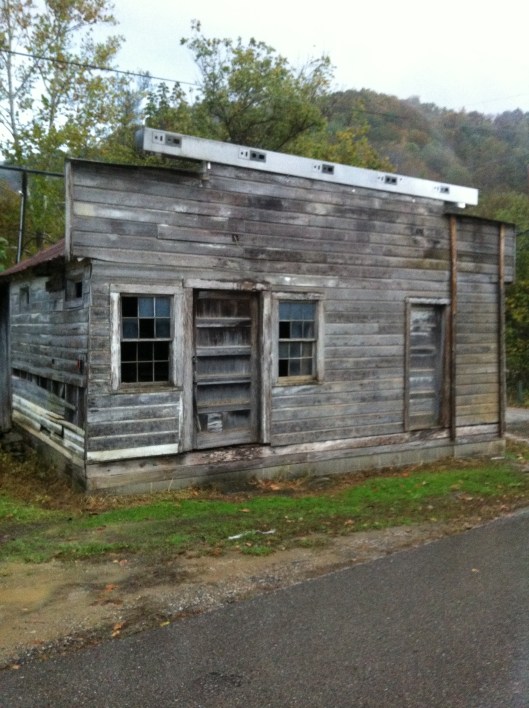
Frank Hill Store

Hill Store at the mouth of Ellis Fork of North Fork of Big Creek near the Boone-Logan county line. 19 October 2013.

Hugh C. Adkins

30 Sunday Apr 2017

Posted by Brandon Ray Kirk in Fourteen, Ranger

≈ Leave a comment

Tags

Albert W. Adkins, Appalachia, Ballard Smith, farming, Fourteen, Fourteen Mile Creek, genealogy, George T. Adkins, Guyandotte River, Henry H. Hardesty, history, Hugh C. Adkins, Laurel Hill District, Lewis B. Adkins, Lincoln County, Riland Adkins, Sarah M. Adkins, Sina Smith, timbering, West Virginia

From “Hardesty’s History of Lincoln County, West Virginia,” published by H.H. Hardesty, we find this entry for Hugh C. Adkins, who resided at Fourteen in Lincoln County, West Virginia:

Is one of the farming population in Laurel Hill district, Lincoln county, owning 50 acres of good land on Guyan river, at the mouth of Fourteen. The land has good improvements and a part of it timbered with poplar, pine, and oak. Mr. Adkins was born in Lincoln county, April 17, 1853, and his parents’ history follows this. Sarah M., daughter of Ballard and Sina (Myers) Smith, was born in Lincoln county, January 20, 1852, and in this same county, in 1873, she became the wife of H.C. Adkins. The children of the union are: Riland, born November 24, 1873; Albert W., January 25, 1878; George T., October 3, 1880; Lewis B., August 11, 1883. Mr. Adkins is a very industrious man, and is prospering in his farming. He may be addressed at Fourteen, Lincoln county, West Virginia.

Source: The West Virginia Encyclopedia, Vol. 7 (Richwood, WV: Jim Comstock, 1974), p. 138-139.

Albert M. Adkins

27 Thursday Apr 2017

Posted by Brandon Ray Kirk in Civil War, Fourteen, Ranger

≈ Leave a comment

Tags

Albert M. Adkins, Appalachia, civil war, coal, Confederate Army, Cosby J. Adkins, Fourteen, Fourteen Mile Creek, genealogy, Henry H. Hardesty, history, Jeremiah Lambert, Laurel Hill District, Lewis Adkins, Lincoln County, Melcina Adkins, Sarah Lambert, Tazewell County, timbering, Virginia, West Virginia

From “Hardesty’s History of Lincoln County, West Virginia,” published by H.H. Hardesty, we find this entry for Albert M. Adkins, who resided at Fourteen in Lincoln County, West Virginia:

At the age of eighteen, enlisted in the late war, in 1862, and bravely did he fight for Virginia and her rights. He served in the Confederate army, was taken prisoner and held ten months. Mr. Adkins was born in what is now Lincoln county, West Virginia, August 27, 1844. His parents are Lewis and Melcina (Hunter) Adkins. In Lincoln county in 1868, Albert M. Adkins wedded Cosby J. Lambert, who was born in Tazewell county, Virginia, in 1843, and whose parents, Jeremiah and Sarah (Hedrick) Lambert, settled in Lincoln county in 1856. A.M. Adkins is one of the farming population in Laurel Hill district, dealing to some extent in lumber, and is the possessor of 400 acres of land, situated on Fourteen-mile creek. A portion of the land is cultivated, and the rest is heavily timbered with oak, poplar, pine, and walnut, and coal and iron ore are found in abundance. Any mail for Albert M. Adkins may be addressed to Fourteen, Lincoln county, West Virginia.

Source: The West Virginia Encyclopedia, Vol. 7 (Richwood, WV: Jim Comstock, 1974), p. 138.

Harts Creek District (c.1883)

08 Saturday Apr 2017

Posted by Brandon Ray Kirk in Big Harts Creek, Big Ugly Creek, Fourteen, Green Shoal, Guyandotte River, Harts, Leet, Little Harts Creek, Timber, Warren, Wewanta

≈ 3 Comments

Tags

Adam Lambert, Andrew D. Robinson, Appalachia, B.C. Curry, Big Ugly Creek, Boone County, Burbus Toney, Charles Spurlock, constable, Edley Elkins, education, Fourteen Mile Creek, genealogy, Guyandotte River, Harts Creek, Harts Creek District, Henry H. Hardesty, Hezekiah Adkins, history, Isaac Elkins, James White, Jefferson District, Jeremiah Lambert, Jesse Gartin, John Fry, John H. Brumfield, John Lucas, justice of the peace, Kiahs Creek, Laurel Hill District, Lewis Queen, Lincoln County, Little Harts Creek, Little Ugly Creek, Logan County, Methodist, miller, Rhoda Elkins, Richard Adkins, Richard Elkins, Sarah Elkins, Squire Toney, timber, timbering, Wayne County, West Virginia, William Lucas, William West

From “Hardesty’s History of Lincoln County, West Virginia,” published by H.H. Hardesty, we find this entry for Harts Creek District in Lincoln County, West Virginia:

This is the most southern subdivision of the county. It derives its name from Harts creek, a tributary of the Guyandotte river. On the north is Laurel Hill district, on the northeast is Jefferson, east Boone county, on the south Logan, and on the west Wayne. Guyandotte river flows northwest and divides the district into two nearly equal parts. There are several small streams, among which are Little and Big Harts creeks, Little and Big Ugly creeks, Kiahs creek, and Fourteen Mile creek.

The first settler was Richard Elkins, who reared his cabin in the month of September, 1807. Here he removed his family, and here Charles Spurlock became his first neighbor. Other early settlers were: Esquire Toney, John Lucas, Edley Elkins, John Fry, Hezekiah Adkins, John Brumfield, and Richard Adkins. Rhoda, a daughter of Edley and Sarah Elkins, was the first white child born in the district. The first grist mill was built  by James White about the year 1821. It was a small tub-wheel mill, water being the propelling power. Isaac Elkins built the first saw mill in 1847 or 1848. It was constructed on the old sash-saw plan, and had a capacity for cutting from 800 to 1,000 feet per day.

The first school was taught in a log cabin one mile above the mouth of Big Harts creek about the year 1832, but who the teacher was cannot now be ascertained. The date, however, is remembered by an old resident, because it was the year in which he first visited this section. The first house for educational purposes was built near the mouth of Big Harts creek in 1834. It was a five-cornered building, one side being occupied by the ever-present huge fire place. There are now ten public school houses in the district, “some of which,” says an informant, “are in bad condition, but will soon be replaced by frames;” 334 boys and girls attend school in this district.

The first sermon was preached here in the year 1823 by a Methodist minister named William West, and here the same year he gathered a little church, one of the first ever formed in the valley of the Guyandotte river; but of its history or who composed its membership, nothing is known. When the writer asked of an old settler the question: “Who were the first members?” his reply was: “The register is gone, and no one living can tell.” When asked who organized the first Sabbath school, he replied: “There never was one in the district.”

The first township officers were as follows: Supervisor, Burbus Toney; justice of the peace, Jeremiah Lambert; constable, Jesse Gartin; clerk, Andrew Robinson; treasurer, B.C. Curry; school commissioners, Adam Lambert, William Lucas, and Lewis Queen. According to the census of 1880, the population was 1,116.

Source: The West Virginia Encyclopedia, Vol. 7 (Richwood, WV: Jim Comstock, 1974), p. 106-107.

NOTE: I descend from Richard Elkins, John Fry, John H. Brumfield, and Jeremiah Lambert.

← Older posts
Newer posts →

Feud Poll 1

If you had lived in the Harts Creek community during the 1880s, to which faction of feudists might you have given your loyalty?

Categories

  • Adkins Mill
  • African American History
  • American Revolutionary War
  • Ashland
  • Atenville
  • Banco
  • Barboursville
  • Battle of Blair Mountain
  • Beech Creek
  • Big Creek
  • Big Harts Creek
  • Big Sandy Valley
  • Big Ugly Creek
  • Boone County
  • Breeden
  • Calhoun County
  • Cemeteries
  • Chapmanville
  • Civil War
  • Clay County
  • Clothier
  • Coal
  • Cove Gap
  • Crawley Creek
  • Culture of Honor
  • Dingess
  • Dollie
  • Dunlow
  • East Lynn
  • Ed Haley
  • Eden Park
  • Enslow
  • Estep
  • Ethel
  • Ferrellsburg
  • Fourteen
  • French-Eversole Feud
  • Gilbert
  • Giles County
  • Gill
  • Green Shoal
  • Guyandotte River
  • Halcyon
  • Hamlin
  • Harts
  • Hatfield-McCoy Feud
  • Holden
  • Hungarian-American History
  • Huntington
  • Inez
  • Irish-Americans
  • Italian American History
  • Jamboree
  • Jewish History
  • John Hartford
  • Kermit
  • Kiahsville
  • Kitchen
  • Leet
  • Lincoln County Feud
  • Little Harts Creek
  • Logan
  • Man
  • Matewan
  • Meador
  • Midkiff
  • Monroe County
  • Montgomery County
  • Music
  • Native American History
  • Peach Creek
  • Pearl Adkins Diary
  • Pecks Mill
  • Peter Creek
  • Pikeville
  • Pilgrim
  • Poetry
  • Queens Ridge
  • Ranger
  • Rector
  • Roane County
  • Rowan County Feud
  • Salt Rock
  • Sand Creek
  • Shively
  • Spears
  • Sports
  • Spottswood
  • Spurlockville
  • Stiltner
  • Stone Branch
  • Tazewell County
  • Timber
  • Tom Dula
  • Toney
  • Turner-Howard Feud
  • Twelve Pole Creek
  • Uncategorized
  • Warren
  • Wayne
  • West Hamlin
  • Wewanta
  • Wharncliffe
  • Whirlwind
  • Williamson
  • Women's History
  • World War I
  • Wyoming County
  • Yantus

Feud Poll 2

Do you think Milt Haley and Green McCoy committed the ambush on Al and Hollene Brumfield in 1889?

Blogroll

  • Ancestry.com
  • Ashland (KY) Daily Independent News Article
  • Author FB page
  • Beckley (WV) Register-Herald News Article
  • Big Sandy News (KY) News Article
  • Blood in West Virginia FB
  • Blood in West Virginia order
  • Chapters TV Program
  • Facebook
  • Ghosts of Guyan
  • Herald-Dispatch News Article 1
  • Herald-Dispatch News Article 2
  • In Search of Ed Haley
  • Instagram
  • Lincoln (WV) Journal News Article
  • Lincoln (WV) Journal Thumbs Up
  • Lincoln County
  • Lincoln County Feud
  • Lincoln County Feud Lecture
  • LinkedIn
  • Logan (WV) Banner News Article
  • Lunch With Books
  • Our Overmountain Men: The Revolutionary War in Western Virginia (1775-1783)
  • Pinterest
  • Scarborough Society's Art and Lecture Series
  • Smithsonian Article
  • Spirit of Jefferson News Article
  • The Friendly Neighbor Radio Show 1
  • The Friendly Neighbor Radio Show 2
  • The Friendly Neighbor Radio Show 3
  • The Friendly Neighbor Radio Show 4
  • The New Yorker
  • The State Journal's 55 Good Things About WV
  • tumblr.
  • Twitter
  • Website
  • Weirton (WV) Daily Times Article
  • Wheeling (WV) Intelligencer News Article 1
  • Wheeling (WV) Intelligencer News Article 2
  • WOWK TV
  • Writers Can Read Open Mic Night

Feud Poll 3

Who do you think organized the ambush of Al and Hollene Brumfield in 1889?

Recent Posts

  • Logan County Jail in Logan, WV
  • Absentee Landowners of Magnolia District (1890, 1892, 1894)
  • Charles Spurlock Survey at Fourteen Mile Creek, Lincoln County, WV (1815)

Ed Haley Poll 1

What do you think caused Ed Haley to lose his sight when he was three years old?

Top Posts & Pages

  • History for Boone County, WV (1928)
  • Origin of Place Names in Logan County, WV (1937)
  • Big Harts Creek Post Offices
  • Early Coal Mines in Logan County, WV
  • Post Offices of Wayne County, WV

Copyright

© Brandon Ray Kirk and brandonraykirk.wordpress.com, 1987-2023. Unauthorized use and/or duplication of this material without express and written permission from this blog’s author and/or owner is strictly prohibited. Excerpts and links may be used, provided that full and clear credit is given to Brandon Ray Kirk and brandonraykirk.wordpress.com with appropriate and specific direction to the original content.

Archives

  • February 2025
  • January 2025
  • October 2023
  • September 2023
  • December 2022
  • November 2022
  • May 2022
  • April 2022
  • February 2022
  • November 2021
  • October 2021
  • September 2021
  • June 2021
  • May 2021
  • April 2021
  • March 2021
  • February 2021
  • January 2021
  • December 2020
  • November 2020
  • October 2020
  • July 2020
  • June 2020
  • May 2020
  • April 2020
  • March 2020
  • February 2020
  • January 2020
  • December 2019
  • November 2019
  • October 2019
  • September 2019
  • August 2019
  • July 2019
  • June 2019
  • May 2019
  • April 2019
  • March 2019
  • February 2019
  • January 2019
  • December 2018
  • November 2018
  • October 2018
  • September 2018
  • August 2018
  • July 2018
  • June 2018
  • May 2018
  • April 2018
  • March 2018
  • February 2018
  • January 2018
  • December 2017
  • November 2017
  • October 2017
  • September 2017
  • August 2017
  • July 2017
  • June 2017
  • May 2017
  • April 2017
  • March 2017
  • February 2017
  • January 2017
  • December 2016
  • November 2016
  • October 2016
  • September 2016
  • August 2016
  • July 2016
  • June 2016
  • May 2016
  • April 2016
  • March 2016
  • February 2016
  • January 2016
  • December 2015
  • November 2015
  • October 2015
  • September 2015
  • August 2015
  • July 2015
  • June 2015
  • May 2015
  • April 2015
  • March 2015
  • February 2015
  • January 2015
  • December 2014
  • October 2014
  • September 2014
  • August 2014
  • July 2014
  • June 2014
  • May 2014
  • April 2014
  • March 2014
  • February 2014
  • January 2014
  • December 2013
  • November 2013
  • October 2013
  • September 2013
  • August 2013
  • July 2013
  • June 2013
  • May 2013
  • April 2013
  • March 2013
  • February 2013
  • January 2013
  • December 2012
  • November 2012

Enter your email address to follow this blog and receive notifications of new posts by email.

Join 2,925 other subscribers

Tags

Appalachia Ashland Big Creek Big Ugly Creek Blood in West Virginia Brandon Kirk Cabell County cemeteries Chapmanville Charleston civil war coal Confederate Army crime culture Ed Haley Ella Haley Ferrellsburg feud fiddler fiddling genealogy Green McCoy Guyandotte River Harts Harts Creek Hatfield-McCoy Feud history Huntington John Hartford Kentucky Lawrence Haley life Lincoln County Lincoln County Feud Logan Logan Banner Logan County Milt Haley Mingo County music Ohio photos timbering U.S. South Virginia Wayne County West Virginia Whirlwind writing

Blogs I Follow

  • OtterTales
  • Our Appalachia: A Blog Created by Students of Brandon Kirk
  • Piedmont Trails
  • Truman Capote
  • Appalachian Diaspora

BLOOD IN WEST VIRGINIA is now available for order at Amazon!

Blog at WordPress.com.

OtterTales

Writings from my travels and experiences. High and fine literature is wine, and mine is only water; but everybody likes water. Mark Twain

Our Appalachia: A Blog Created by Students of Brandon Kirk

This site is dedicated to the collection, preservation, and promotion of history and culture in Appalachia.

Piedmont Trails

Genealogy and History in North Carolina and Beyond

Truman Capote

A site about one of the most beautiful, interesting, tallented, outrageous and colorful personalities of the 20th Century

Appalachian Diaspora

  • Subscribe Subscribed
    • Brandon Ray Kirk
    • Join 787 other subscribers
    • Already have a WordPress.com account? Log in now.
    • Brandon Ray Kirk
    • Subscribe Subscribed
    • Sign up
    • Log in
    • Report this content
    • View site in Reader
    • Manage subscriptions
    • Collapse this bar
 

Loading Comments...