Tags
Appalachia, Dick Elkins Branch, genealogy, Harts Creek, history, James Lawson, Jefferson Thompson, John Gore, Lincoln County, Patton Thompson, surveyor, Thompson Branch, West Virginia, Zachariah Tomblin

10 Wednesday Mar 2021
Posted in Big Harts Creek
Tags
Appalachia, Dick Elkins Branch, genealogy, Harts Creek, history, James Lawson, Jefferson Thompson, John Gore, Lincoln County, Patton Thompson, surveyor, Thompson Branch, West Virginia, Zachariah Tomblin
06 Tuesday Mar 2018
Posted in Big Harts Creek
Tags
Appalachia, Big Branch, county clerk, genealogy, Guy Conley, Harts Creek, Henry Conley, history, Lincoln County, Logan County, Patton Thompson, Richard Elkins Branch, Thompson Branch, Virginia, W.I. Campbell, West Virginia, William Straton
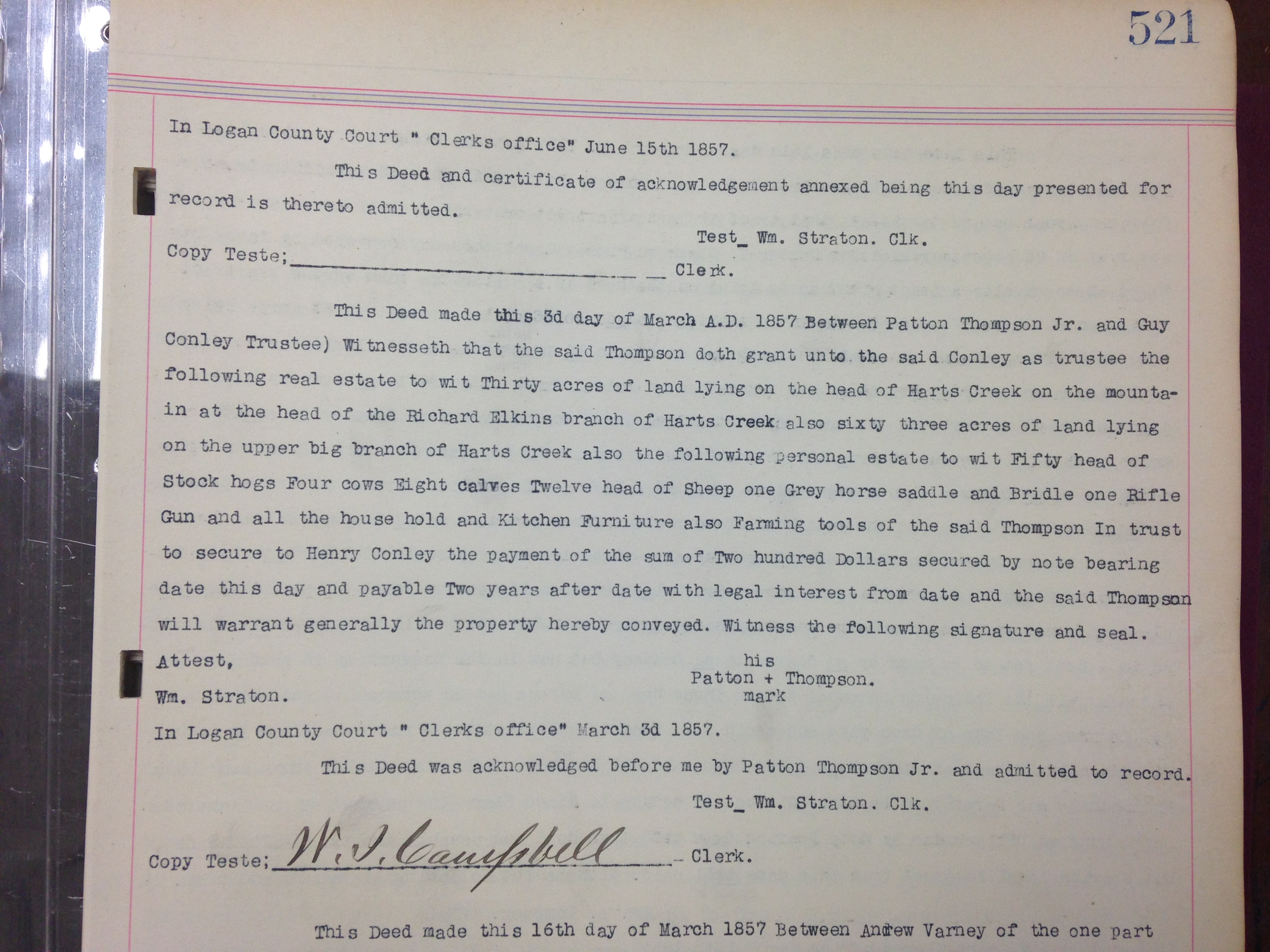
Deed Book C, page ____, Logan County Clerk’s Office, Logan, WV. Local historian Billy Adkins believes that Richard Elkins Branch is now called Thompson Branch. This property is located in present-day Lincoln County, WV.
09 Sunday Apr 2017
Posted in Big Harts Creek, Warren
Tags
Appalachia, Camel Rocks, Hall Point, Harts Creek, Indian Rocks, Lincoln County, Myrtle Kirk, nature, photos, Raven Rocks, rocks, Thompson Branch, West Virginia
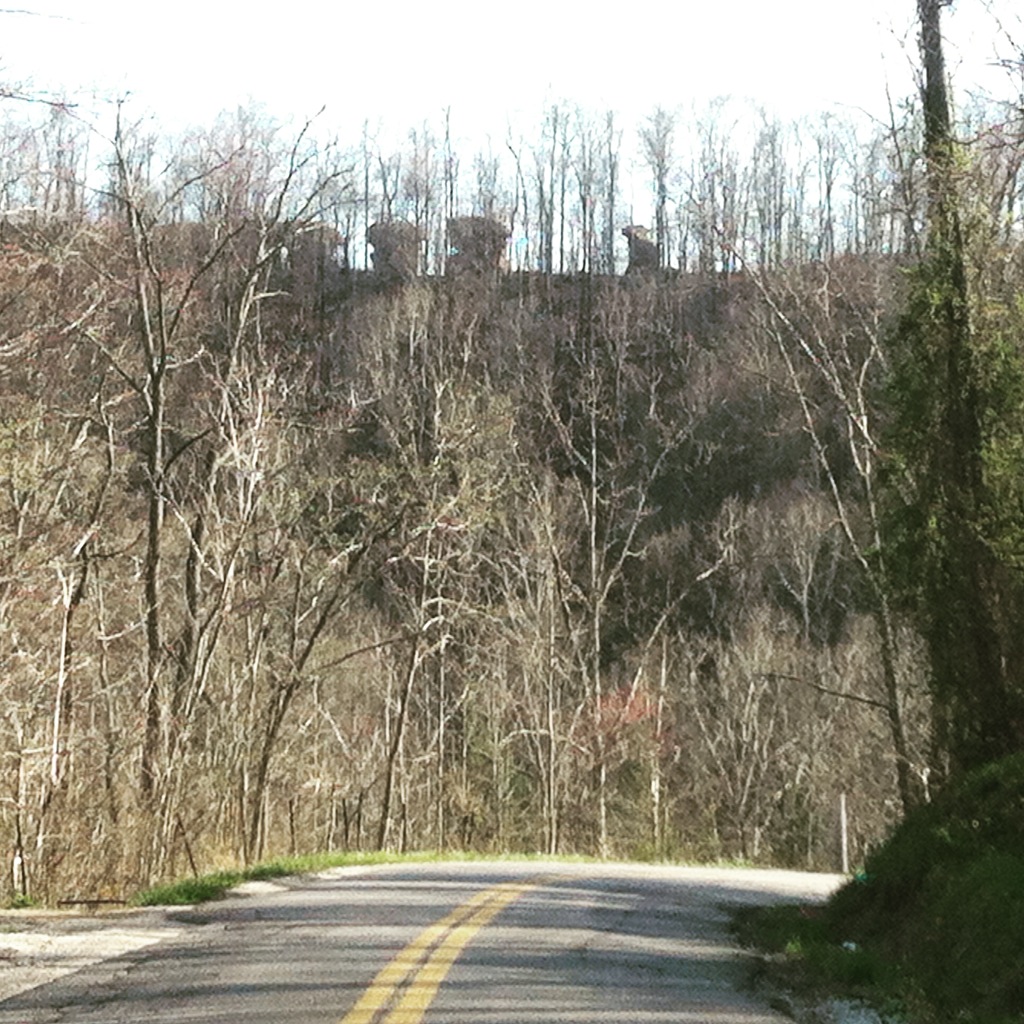
These rocks are visible from Thompson Branch and Hall Point on Harts Creek, Lincoln County, WV. Most locals today know them as the Raven Rocks. Myrtle (Farley) Kirk, born in 1909, remembered them as the Camel Rocks; she played on them as a young girl. Yet another possible name is “Indian Rocks.” 2 April 2017.
08 Saturday Apr 2017
Posted in Big Harts Creek
Tags
Appalachia, Billy Adkins, Bob Leete, Cat Eye Dave Knob, Curry Branch, Dave Thompson, genealogy, Harts Creek, history, Jenks Knob, Jenks Thompson, Lincoln County, photos, Thompson Branch, West Virginia
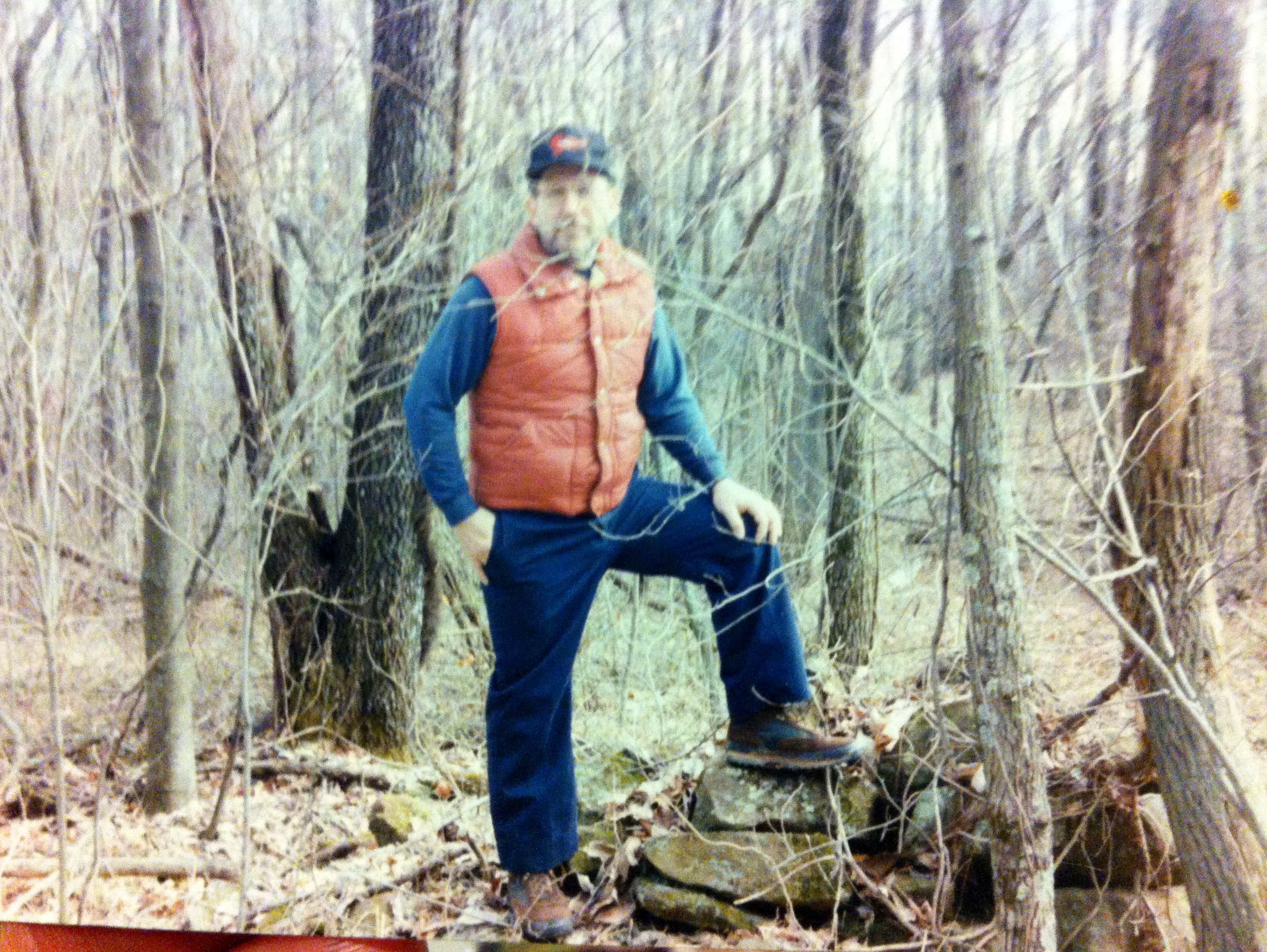
Here’s a photo of Billy Adkins, my genealogy mentor, at the old Jenks Thompson/Dave Thompson homestead. Jenks, great-grandfather to Billy, once lived at this site; later, Dave (son of Jenks, nicknamed “Cat Eye Dave”) lived here. Jenks Knob/Cat Eye Dave Knob is located between Thompson Branch and Curry Branch of Harts Creek in Lincoln County, WV. Photo by Bob Leete. Spring 1994.
06 Monday Mar 2017
Posted in Big Harts Creek, Holden, Queens Ridge
Tags
Annie Dingess, Appalachia, Bob Dingess, Cecil Brumfield, Charley Brumfield, Charley Evans, Dixie Adams, farming, genealogy, Gillis Adams, Harts Creek, history, Holden, Hoover Fork, Howard Adams, Inez Dingess, Isom Glover, Jake Workman, Logan Banner, Lucy Dingess, Mag Brumfield, Monaville, Mud Fork, Queens Ridge, Roxie Workman, Thompson Branch, Ula Adams, Wayne County, West Virginia
An unknown local correspondent from Harts Creek in Logan County, West Virginia, offered the following items, which the Logan Banner printed on May 21, 1926:
How do you do, old Banner? Glad to see you again.
We are having some rainy weather at this writing.
Jake Workman, of Holden, is visiting his parents of this place this week.
Mr. and Mrs. Isom Glover of Mud Fork were visiting homefolks Sunday of Thompson Branch.
Gillis Adams of Monaville spent the weekend with homefolks of Hoover.
Charley Evans of Mud Fork attended church here Sunday.
Chas. Brumfield passed through our vicinity last week attending business affairs.
Robert Dingess made a flying trip… [cropped]
[cropped]… ill for the past week or so but is able to be out again.
Born to Mr. and Mrs. Cecil Brumfield, a baby girl.
Mrs. Roxie Workman of Holden has returned home from a visit with her parents of Queen’s Ridge.
Misses Inez and Lucy Dingess were… [cropped]
[cropped]…downhearted Sunday? Cheer up, Freda, maybe it’s not so.
Mr. and Mrs. Robert Dingess was out car riding Sunday.
Jake Workman was calling on Miss Ula Adams Sunday.
Mr. and Mrs. Howard Adams are very busy farming this year.
Note: Queens Ridge P.O., located in Wayne County, served Harts Creek in Lincoln and Logan counties. The above news is for Harts Creek area, not Wayne County.
10 Thursday Jul 2014
Posted in Big Harts Creek, Culture of Honor, Lincoln County Feud, Warren
Tags
Al Brumfield, Ben Adams, Blood in West Virginia, Brandon Kirk, Chapman Dingess, Charlie Dingess, Cole Branch, Connecticut, crime, feud, Green McCoy, Harts Creek, Harvey "Long Harve" Dingess, Henderson Dingess, history, John Dingess, John Frock Adams, Joseph Adams, Kentucky, Lincoln County War, Milt Haley, Sallie Dingess, Smokehouse Fork, Thompson Branch, Tug River, Victoria Adams, West Virginia, World War II
That winter, Brandon made contact by telephone with John Dingess, a Connecticut resident who proved to be one of our best sources on the 1889 feud. John was born on the Smokehouse Fork of Harts Creek in 1918. A grandson to Henderson Dingess, he moved away from West Virginia after serving his country in World War II.
John said Henderson Dingess met his wife Sallie while boarding with her father Joseph Adams on Harts Creek. Henderson didn’t care much for his in-laws (he said they were “hoggish”), particularly his brother-in-law Ben Adams. Ben lived over the mountain from Henderson on main Harts Creek where he operated a small store. He and Henderson feuded “for years.” At some point, Henderson’s oldest son Charlie Dingess got into a racket with Ben over a yoke of cattle and “almost killed him in a fight” at Cole Branch.
The feud between Henderson’s family and Ben Adams reached a new level of tension when Ben refused to pay the sixteen-cents-per-log fee required by Al Brumfield to pass logs through his boom at the mouth of Harts Creek. Brumfield “was more of a businessman” than a feudist but “got into it” with Adams at his saloon near the boom. In the scrape, Ben pulled out his pistol and shot Al, who was spared from harm only because of a button on his clothes. Al subsequently fetched a gun and chased Ben up the creek — a very humiliating thing as there was probably a whole gang of people to witness his flight.
Ben soon gathered up a party of men with plans to force his timber out of Harts Creek under the cover of darkness. Before he could put his plan into action, though, the Dingesses caught wind of it and warned the Brumfields who promptly armed themselves with .38 Winchesters and .44 Winchesters and gathered in ambush on the hill at Panther Branch near the mouth of Harts.
Ben, anticipating trouble, put his wife, the former Victoria Dingess, at the front of his gang in the hopes that it might discourage her cousins from shooting at him as they came down the creek. It was a bad idea: the Brumfields and Dingesses shot “her dress full of holes.”
This was particularly horrible since she was probably pregnant at the time.
The next day, she came to her uncle Henderson’s to show him what his boys had done to her dress but he never punished them.
At that point, Ben was probably hell-bent on revenge and arranged for Milt Haley and Green McCoy, who John called two “professional gunmen,” to “bump Al off.”
John was sure of Ben’s role in the events of 1889.
“Ben Adams, my father’s uncle, he gave them a .38 Winchester apiece and a side of bacon to kill Al Brumfield,” he said.
Milt and Green caught Al one Sunday as he made his way back down Harts Creek after visiting with Henderson Dingess. He rode alone, while Hollena rode with her younger brother, Dave Dingess. As they neared Thompson Branch, Milt and Green fired down the hill at them from their position at the “Hot Rock.” Al was shot in the elbow, which knocked him from his horse and broke his arm, while Hollena was shot in the face. Al somehow managed to make it over a mountain back to Henderson Dingess’, while Hollena was left to crawl half a mile down to Chapman Dingess’ at Thompson Branch for help.
Upon learning of the ambush, Harvey Dingess (John’s father) hitched up a sled to one of his father’s yokes of cattle and fetched Hollena, who remained at Henderson’s until she recovered.
Immediately after the shootings, there was a lot of gossip about who’d been behind the whole affair. John said there was some talk that Long John Adams had been involved “but the Dingess and Brumfield people never believed it.” Everyone seemed to focus in on Milt and Green, who’d recently disappeared into Kentucky (where McCoy was from).
“They used to, if you committed a crime in West Virginia, would run away to Kentucky,” John said. “In the hill part of Kentucky there on the Tug River.”
Brumfield put up a $500 reward and it wasn’t long until a man rode up to Henderson Dingess’ claiming to have caught Milt and Green in Kentucky. He was sent to Brumfield’s home near the mouth of Harts where he found Al out back shoeing an ox steed. They talked for a while, then Brumfield told him, “You put them across the Tug River and when I identify them you’ll get your money.”
24 Monday Mar 2014
Posted in Big Harts Creek, Culture of Honor, Ed Haley, Lincoln County Feud
Tags
Al Brumfield, Albert Dingess, Ben Adams, Brandon Kirk, Charlie Dingess, crime, Dave "Dealer Dave" Dingess, Dave Dingess, feud, fiddler, fiddling, French Bryant, Green McCoy, Harts Creek, Harve Dingess, Harvey "Long Harve" Dingess, Henderson Dingess, history, Hollene Brumfield, Hugh Dingess, Maude Dingess, Millard Dingess, Milt Haley, Thompson Branch, writing
Either way, Milt Haley and Green McCoy were paid a side of bacon and some money to eliminate Al Brumfield. Maude Dingess said Milt and Green ambushed Al and Hollena Brumfield as they rode down Harts Creek on a single horse. Hollena’s brothers, Harvey and Dave, followed behind them on separate horses.
“I guess they thought he was gonna have trouble or they wouldn’t a been doing that,” Maude said, somewhat logically.
As they made their way past Thompson Branch, Brumfield spotted two men hiding in the weeds. He ducked somehow to avoid harm, but Hollena was shot from the horse.
“Al just went on,” Maude said, while Dave and Harve “ran back up here to their mother and daddy’s house to get somebody to go down there with them.”
They later returned with a sled and hauled Hollena’s bloody body back to Smoke House.
In a short time, Milt and Green were rounded up and taken to Hugh Dingess’ home at the mouth of Bill’s Branch.
“I’d say old man Hugh got them kids and took them maybe to some of their relatives’ houses or somewhere else,” Harve Dingess said. “Maybe up to old Albert Dingess’ or somewhere like that. See, old Albert just lived on up the road a mile, mile and a half.”
Harve continued, “They said they all had a big feast there and I guess they had a lot of the corn whiskey there and all of them drinking and playing music. And they said they made the old man Haley — he was a fiddle player — they said they made him play that fiddle all night and all of them drunk a dancing. They said that they just kept telling him to keep that fiddle a going.”
I wondered where Milt got the fiddle at Hugh’s and Maude said, “They sent somebody to somebody’s house that had a fiddle I bet and brought it back. Back in them days you know a lot of households had them old instruments in them.”
I asked if Milt was considered a good fiddler and Harve said, “At that time, I think they said he was. Supposed to’ve been very good.”
Harve had never heard much talk about Green McCoy but stressed: “I know I did hear them talk about them making the old man play the fiddle all night and all of them a dancing and cooking and having a big feast there and drinking their moonshine.”
I said, “Most people that are gonna kill somebody, they don’t want to get to know them. If you have an execution, the executioner don’t want to get to know the prisoner because the more he gets to know that prisoner the harder it is for him to conduct the execution. To have two guys to play music for you before you’re fixing to kill them — that’s a good way to get to know them real quick. Boy, I don’t see how they did that.”
“I guess that’s the reason they kept old French Bryant,” Harve said. “They said he didn’t care for nothing. They said he was one of the leaders. He was a hollering, ‘Let’s go! Let’s do it!’ Pushing the thing, from what I could understand. He was a hollering, ‘Let’s kill the sons of bitches!’ That’s what I heard over the years. I even heard Millard say that one time. French was the one wanting to hang them up to the walnut tree and I think they finally decided against that.”
Brandon wondered who else was in the gang and Maude said, “Hugh and Charlie Dingess was into that. They was Grandpap’s boys — the older boys. Hugh was rough and over-bearing. Harve’s grandfather, ‘Short Harve,’ was into that. Burl Farley was into it, too.”
Maude doubted that Henderson Dingess was involved due to his advanced age (approximately 58 years), but we felt it was entirely possible since (1) men his age and older participated in the Hatfield-McCoy feud and (2) these guys had reportedly shot his daughter. Harve said he figured that his great-grandfather Albert Dingess was in on it because “he was just that kind of guy.”
“Dealer Dave” Dingess was probably involved, too, Harve said, because “them Dingesses all hung together. They was just a band of outlaws, as we would call it, that day and time.”
Harve and Maude hadn’t heard much about the story beyond that, although they knew that Milt and Green were taken away from Hugh’s when the Brumfields learned that another mob was forming to rescue them. They never confessed to committing the ambush on Al and Hollena Brumfield but everyone figured that Ben Adams was behind the trouble. As a result, Maude said the Brumfields and Dingesses were “against” Ben in following years. At one point, they tried to burn his home. Maude’s father was one of the few Dingesses who never held a grudge. He often referred to him as “poor old Uncle Ben.”
18 Monday Feb 2013
Posted in Breeden, Ed Haley, Guyandotte River, Hamlin, Harts, John Hartford, Lincoln County Feud
Tags
Al Brumfield, Appalachia, Bob Adkins, Breeden, Cincinnati, crime, feud, feuds, Green McCoy, Guyandotte River, Harts Creek, Henderson Dingess, history, Hollene Brumfield, John Dingess, John Hartford, John W Runyon, Kentucky, Lincoln County Feud, Milt Haley, Norfolk and Western Railroad, Thompson Branch, Tug River, Twelve Pole Creek, West Virginia
Wow. So what about Al Brumfield, the guy who got into the feud with Milt?
“Well, he was a little more tamer fellow than old Paris but he was kind of a rough character — mean as a snake,” Bob said. “All those Brumfields were, you know. They was a tough outfit, all of them was.”
Al and his wife Hollena lived in a large white house at the mouth of Harts Creek, which Bob said had recently burned. They had a store and log boom nearby and kept a boat tied up at the riverbank for easy access across the Guyandotte. Things were going great for them until John Runyon (who Bob called “the root of all evil”) moved in from Kentucky.
“That fellow Runyon, he had a saloon and a store right across the creek there at the mouth of Harts, you know — a shebang,” Bob said. “And Aunt Hollene and Al Brumfield, they had a big store over there on the other side of the creek, over on the lower side of the creek. They was competitors in a way, you know. This fellow Runyon hired these two thugs to kill them, so as to get rid of their competition. And he hired Milt Haley and Green McCoy to kill them. They got a side of bacon and a can of lard and five dollars to do that…each. And these fellows, Milt Haley and Green McCoy, were two characters. I don’t know why they ever took a chance on that. Them boys got into that before they knew what they was into. Them Brumfields was mean as the devil up there.”
Bob spun out the details of Milt and Green’s ambush of Al Brumfield.
“Every Sunday, Al and Hollene would get on their horse and they’d ride up to the Forks of Big Hart about ten miles to visit her father. He was old Henderson Dingess, my great-grandfather. Al had a fine riding horse and he’d get on the horse and she’d ride behind him, see? And they’d been up there on a pretty summer day, and they’d done had dinner with her father.”
Haley and McCoy, meanwhile, laid in wait for them in a sinkhole at Thompson Branch with a .30/.30 Winchester.
“And Al and Hollene came along about three or four o’clock in the evening and those thugs laywaid them on the side of the hill up there as they came back down Harts Creek. They shot at Al’s head. That horse jumped and that bullet missed his head and hit Hollene right in the face right there and the bullet knocked her teeth out and came out this side here. It knocked her off of the horse.”
Al was carried on down the creek by his horse, which “sprang and run” so Milt and Green came off the hill toward his wife.
“They aimed to shoot Aunt Hollene again — and she a laying there in the road, her eyes full of blood. She couldn’t see hardly who it was. But she begged them not to shoot her anymore, because she figured they’d already killed her. She told them she was dying and begged them out of it.”
At that point, Al came back up along the creek bed shooting toward them “and they got scared and they run.”
Bob said, “Well, the Brumfields didn’t know who it was so they watched all around to see who it was. They watched Runyon like a hawk but he changed his name and walked right off. He left his store, his saloon and his family and went back to Kentucky. They hunted for years for him but they never did find him. He never poked his head around there anymore, not even to contact his family.”
Milt and Green also disappeared from the neighborhood — which caused locals to assume that they were guilty of some role in the trouble.
“And these two guys just left their family and went into Kentucky and just deserted their families,” Bob said. “Then they knew who it was. And they started looking for them.”
Al Brumfield put out a $3,000 reward for their capture. Detectives were told to search in river towns, as both men had run rafts out of the Guyan River.
A detective caught Green McCoy first in a Cincinnati restaurant. He identified him by noticing a nick in one of his ears. Just before apprehending him, the detective walked up and said, “I think you’re the man I’m looking for.” Once caught, Green gave the whereabouts of Milt, who was found working a butter churn on a steamboat at the river. Both men were jailed. Al Brumfield was informed of their capture by letter.
Brumfield organized two of his brothers-in-law and perhaps one of his brothers into a posse and rode to the rendezvous point (presumably in the vicinity of Cincinnati). He posed as a sheriff, paid the reward, took possession of the two men, then headed across eastern Kentucky and up the Tug River to Williamson. He and his gang rode a train on the N&W across Twelve Pole to Breeden, where they crossed the mountain and spent a night at the home of John Dingess, Hollena’s brother. Dingess ran a large country store and saloon, Bob said, but “nothing exciting happened around there.”
Writings from my travels and experiences. High and fine literature is wine, and mine is only water; but everybody likes water. Mark Twain
This site is dedicated to the collection, preservation, and promotion of history and culture in Appalachia.
Genealogy and History in North Carolina and Beyond
A site about one of the most beautiful, interesting, tallented, outrageous and colorful personalities of the 20th Century
 Brandon Ray Kirk