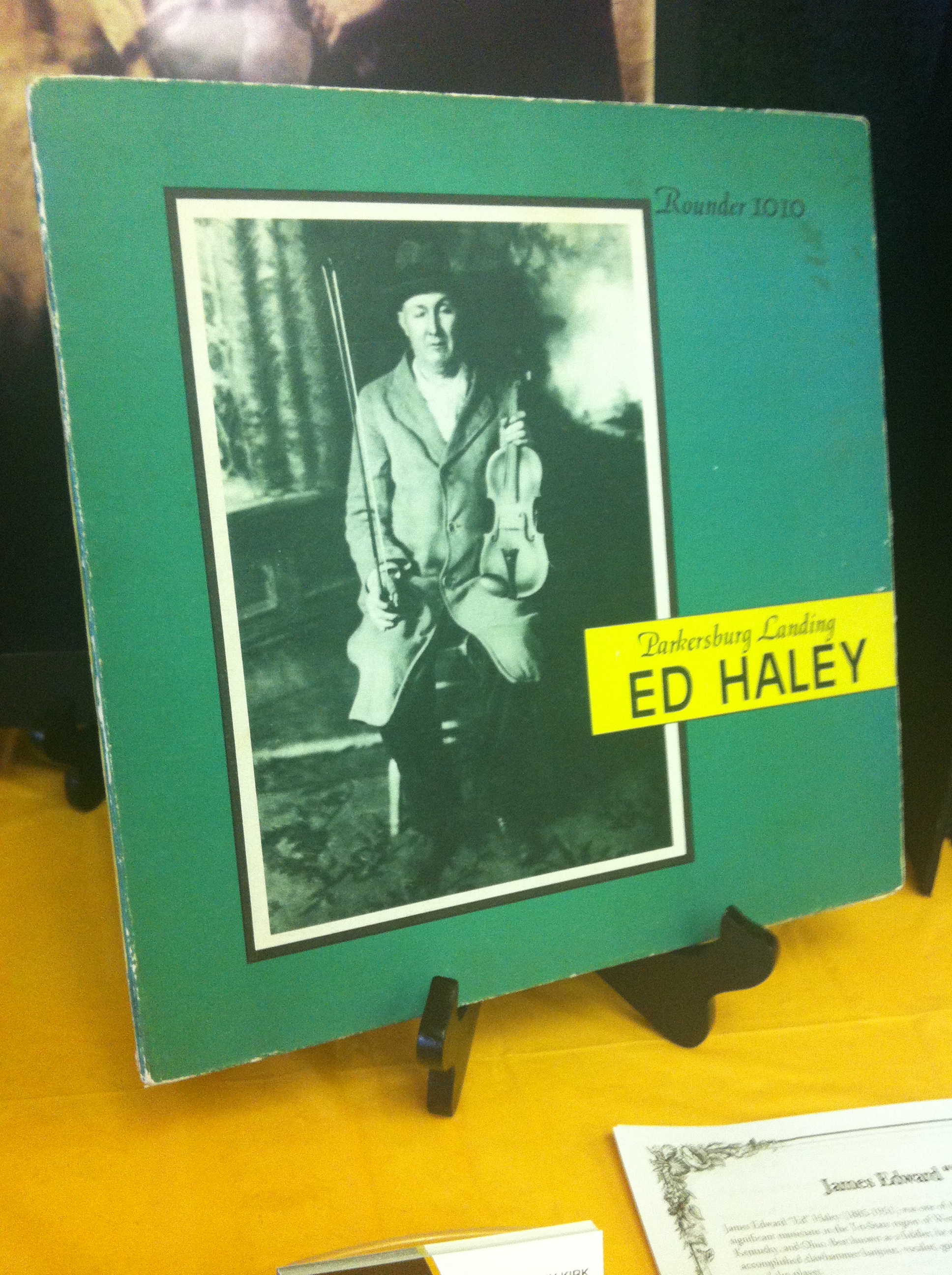
Parkersburg Landing Album (2015)
04 Sunday Oct 2015
04 Sunday Oct 2015
26 Saturday Jul 2014
Posted in Ed Haley, John Hartford, Lincoln County Feud, Music
Tags
Ashland, banjo, Bobby Taylor, Brandon Kirk, Charleston, Clyde Haley, Cultural Center, Deborah Basham, Ed Haley, Ella Haley, Forked Deer, Green McCoy, Grey Eagle, history, Jack Haley, John Hartford, Kentucky, Lawrence Haley, life, mandolin, Michigan, Milt Haley, Mona Haley, music, Pat Haley, Patsy Haley, Ralph Haley, Ralph Mullins, Rounder Records, San Quentin, Scott Haley, Smithsonian Institution, Steve Haley, West Virginia, writing
Around that time, Brandon and I received confirmation from Doug Owsley at the Smithsonian that he was interested in exhuming the Haley-McCoy grave. Doug gave us instructions on what we needed to do before his office could actually become involved — most importantly, to get permission from the state authorities, as well as from Milt’s and Green’s descendants. We felt pretty good about our chances of getting support from the family but weren’t sure what to expect from “officials.” For some guidance in that department, we called Bobby Taylor and Deborah Basham at the Cultural Center in Charleston, who told us all about exhumation law and codes in West Virginia. They felt, considering the interest of the Smithsonian, that we would have no trouble on the bureaucratic end of things.
Meanwhile, Rounder Records was in the final stages of releasing a two-CD set of Ed’s recordings called Forked Deer. The sound quality was incredible on the re-masters although to the uninitiated ear some of the music still sounded like it was coming from behind a waterfall in a cellophane factory. In addition to Forked Deer, Rounder was slated to release two more CDs of Ed’s music under the title of Grey Eagle in the near future.
I was very excited about all of these tunes getting out because I had fantasies of some “young Turk” fiddler getting a hold of them and really doing some damage.
In July, I called Pat Haley to tell her about the CDs, but we ended up talking more about her memories of Ed.
“I know when we lived in 1040 Greenup — when I first came over here — Pop would play very little. Only if he was drinking and maybe Mona would get him to play. I never knew of Pop ever playing sober. I didn’t hear Pop play too much but then his drinking days were just about over. But Mom would play. They had a mandolin and might have been a banjo and Mom would play a little bit. I didn’t know their brother, Ralph. He passed away, I believe, in ’46 or ’47 and I didn’t come into the family until ’48 — when I met Larry — but we married in ’49.”
Pat and I talked more about Ed’s 1951 death.
“Larry and I lived with Mom and Pop on 2144 Greenup Avenue and little Ralph lived with us,” she said. “Clyde had just come home from San Quentin, and a couple of months before Pop died Patsy was due to have Scott and so she moved into the house with us. Her and Jack had the front living room as their bedroom so that Patsy could be close to the hospital. Scott was born January 4th. My Stephen was born January 27th. We were all in the same house when Pop died. But about three days before Pop died, Clyde decided to rob his mother and came in in the middle of the night and stole her sweeper and radio while we were sleeping and he was picked up by the police and he was in jail when his daddy died. He didn’t get to come to his daddy’s funeral. His mother’s either, actually. He was in a Michigan prison when his momma died.”
25 Friday Jul 2014
Posted in Calhoun County, Ed Haley, John Hartford, Music
Tags
Akron, Banjo Tramp, Black Sheep, Calhoun County, Canton, Chloe, Ed Haley, fiddle, fiddlers, fiddling, Gus Meade, harp, Jo LaRose, John Hartford, Kerry Blech, Laury Hicks, Lawrence Haley, music, Ohio, Parkersburg Landing, Ragpicker Bill, Rector Hicks, Rounder Records, Stackolee, Sugar in the Morning, Tommy Jarrell, Traditional Music and Dance in Northeast Ohio, West Virginia
Not long after visiting Ugee, I received some great information in the mail regarding Rector Hicks, a fiddler and nephew to Ed’s friend Laury Hicks. Rector grew up watching his uncle Laury play the fiddle.
“Rector was born out in the country around Chloe, Calhoun County, West Virginia, in 1914,” Joe LaRose wrote in Traditional Music and Dance in Northeast Ohio (March 1985). “His father was a good mouth harp player, but no one else in his family played music. Rector learned from fiddlers who lived in his area, beginning to play the instrument when he was around ten years old. Rector learned a lot from time spent with a distant cousin, Laury Hicks, a generation older than Rector and one of the foremost fiddlers in the area. ‘I don’t know of a fiddle player, really, that played like him. Ed Haley said Laury was the best fiddler he ever heard on the old time tunes, you know, and old fast ones. Hisself, he said that. And I always thought he was.'”
While at Laury’s, Rector Hicks also had the opportunity to see Ed.
“He was hard to figure out,” Rector told LaRose. “When I was around him most I didn’t know too much about fiddling, and a lot of that stuff I could pick up now if I was around him. How he got all that in there with his bow like he did you’d never believe it. He just set there this way (passes the length of the bow back and forth across the strings) but everything seemed like it just come in there. If you’d hear him play… Now that record, that’s not Ed Haley. That’s him, but that’s no good. You don’t get a lot of what he puts in. But he puts every note in that thing. His left hand, his fingers just flew. But his right hand… He just set there and his fiddle laid on his arm, set there and rocked. That’s the way he played. All them fastest tunes he played, didn’t seem like he put any of the bow in hardly. But it was all in there.”
Rector seemed to idolize Haley, at least according to Kerry Blech, a fiddling buff and friend of mine.
“Rector, when he was a teenager, had saved up some money and got him a pretty good fiddle and when Ed would come and stay at Laury’s house Rector would always come over,” Kerry wrote. “For a couple of years, Ed would tease him and say, ‘Well, I really like that fiddle you got, Rector. We should swap.’ And once he did and went off and played in some other town, then came back through about a week later and got his fiddle back. Rector said he was just really thrilled to’ve had Ed’s fiddle for even a week.”
As Rector got older and learned more about the fiddle, he really patterned after Haley’s style.
“Rector’s approach to playing has much in common with Haley’s,” LaRose wrote of Hicks. “Like Haley, Rector holds his fiddle against his upper arm and chest and supports it with his wrist (he does not rock the fiddle under the bow, though, like Haley did.) Rector uses a variety of bow strokes. Like Haley, he uses the length of the bow, sometimes playing a passage of several notes with one long stroke, deftly rocking the bow as he plays. He will accent the melody at chosen times with short, quick strokes. Rather than overlay the melody with a patterned or constant bow rhythm as some dance-oriented fiddlers do, Rector adapts his bowing to the melody of the particular tune he’s playing. Much of the lilt and movement of his tunes is built into the sequence of notes played with his left hand.”
Rector apparently kept in touch with Ed’s family, who he sometimes visited long after Haley’s death, and was very disappointed with the quality of fiddling on the Parkersburg Landing album.
“When I met Rector in the mid-70s, the Haley LP had just come out and Rector called me up to tell me it was awful,” Kerry wrote. “He said it was not representative of the man’s genius. He told me that he knew the man, and although many years had passed, the Haley genius was still in his mind’s eye. He also said that there were many other home recordings beyond what Gus Meade had copied. He said that Haley’s children had split up the recordings, that Lawrence had a number of them, and that a daughter, who lived in the Akron-Canton area, had over a hundred of them, and that Rector occasionally went over there and listened. He said that the family was irritated by how the Rounder record came to be and did not want to be involved with any of us city folk any more, afraid that someone would exploit their father’s music.”
At that time in his life, Rector mostly played Tommy Jarrell tunes but also several Ed Haley tunes, like “Birdie”, “Sugar in the Morning” (“Banjo Tramp”), “Ragpicker Bill”, “Black Sheep”, and “Staggerlee”.
26 Monday Nov 2012
Posted in Ed Haley
Tags
Appalachia, Ashland, Billy in the Lowground, Birdie, Blackberry Blossom, blind, books, Catlettsburg, Charleston, Clovis Hurt, Columbus, Doc Holbrook, Ed Haley, fiddle, fiddler, Flannery's Dream, Forked Deer, Grayson, Greenup, history, J P Fraley, James A Garfield, John Hartford, Kentucky, Lawrence Haley, logging, Morehead, music, Ohio, Old Sledge, Parkersburg Landing, Portsmouth, Ralph Haley, Rounder Records, Route 60, Snake Chapman, Soldiers Joy, Tennessee Wagner, The Wild Rose of the Mountain, West Virginia, Wild Wagner, writing
A few days later, while re-reading the liner notes for Parkersburg Landing, I focused in on the name of J.P. Fraley as one of the informants for Ed’s biographical information. Encouraged by my success in contacting Snake, I got J.P.’s telephone number from a mutual friend and just called him up. He lived near Grayson, Kentucky, a small town southwest of Ashland and roughly mid-way between Ashland and Morehead on Route 60. I could tell right away that Ed Haley was one of his favorite subjects.
As soon as I mentioned Haley’s album, J.P. just took off. “You know, he never did make a commercial record. Those little old things, they had a cardboard center. They was home recordings. At the time, Rounder was a making the record that I did, The Wild Rose of the Mountain, and I told them about Ed Haley. And we was lucky with Lawrence, one of his boys…”
J.P. stopped.
“John, I’ll tell you quickly the story of it. Lawrence was really proud of his daddy, but people around Ashland would say, ‘Aw, he was just a bum.’ Well, he wasn’t a bum. Anyway, I got a hold of Lawrence and he was dubious about even letting us make an album of the records. He was pretty well put out because his daddy never did get recognition, but I told him Rounder was legitimate. He said, ‘I’ll go with you and take them records.’ He insisted on it. He was on the verge of being a retired postman. So he went to the Smithsonian and finally come out with the album. It tickled me to death that they did it.”
J.P. paused and then said, “Well, so much for that. I’m on your nickel,” – as if what he’d just told me was something I didn’t really care to hear.
I asked him to tell me more, specifically about his memories of seeing Haley on the street. He said, “You know, he fascinated me. When I was just a kid learning to fiddle, my daddy was a merchant. He’d take me into Ashland and stand me on the street just to listen to this blind fiddler and his boy play. I was about twelve or fourteen. Well, even earlier than that I was listening to him on the street – watching him – and I swear to god, his fingers, when he played the fiddle just looked like they was dancing. It was out of this world. Now, I don’t know which world’s fair it was, but they picked him up – I think it was Mr. Holbrook, the doctor – and took him to the world’s fair and the critics in New York – might have been ’35 or somewhere in there – wrote about him. Said he was a ‘fiddling genius.’ Just what I already knew, and I was just a kid.”
In the 1940s, one of J.P.’s friends, Clovis Hurt, had a run-in with Haley at Murphy’s Ten Cent Store in Ashland. “Clovis Hurt played fiddle in a band. He discovered Ed playing on the street and it just had him washed away. So Clovis told Ed that he was a fiddler. Ed said, ‘Have you got a fiddle?’ He said, ‘Yeah.’ Ed said, ‘Where’s it at?’ He said, ‘It’s in the car.’ Ed said, ‘Get it and play me a tune.'” J.P. chuckled. “Now, this happened. They was several of us around there when this took place. Clovis never did like Ed after what happened. He got his fiddle out and he played a tune called ‘Grandmaw’s Chickens’. It sounded like a whole flock of them – scared chickens. Ed said, ‘Listen, I wanna tell you something. Don’t you play the fiddle in public anymore. You’re just a learning it a little bit.’ Clovis hated him. Well, I mean he didn’t hate him, but he said he didn’t like him. Said he didn’t have any personality. I said, ‘Well, Clovis, he didn’t have to have. He made it with the fiddle.’ But he was nice enough.”
So Ed wasn’t afraid to speak his mind, even though he was blind?
“Oh, no,” J.P. said. “I’ve heard him get loud. He would actually try to fight if somebody bothered him. He’d tell them, ‘Come around here.'”
Haley apparently had a cranky side: according to Parkersburg Landing, he “was known for his irascible moods and anyone who did not properly appreciate music was liable to his scorn.
I asked J.P. about Haley’s fiddle and he said, “Well, Ed wouldn’t fool with a cheap instrument. Over the years, he had several fiddles. This doctor I told you about – Doc Holbrook – he had one of Ed’s fiddles and I got to keep it for two or three years.”
As for Haley’s technique, J.P. said he “leaned” the fiddle against his chest when playing and held the bow at its end. I wondered if he played long or short bow strokes. “He done it both. I know when he played for his own benefit he used more bow. But he played a lot for dances and as they used to say they had to play ‘quick and devilish.'”
Did he play in cross-key?
“Oh Lord, yeah.”
What about bluegrass music? Did he like it?
“I honestly don’t think Ed woulda fooled with it. He didn’t do a whole lot of double-stopping or too many minors and stuff.”
Being an avid collector of fiddle tunes, I was very curious about Haley’s repertoire. J.P. said, “Oh, Lord. I play some of his tunes: ‘Birdie’ and ‘Billy in the Lowground’. And he played tunes like ‘Old Sledge’. He played all the standards like ‘Soldiers Joy’ and ‘Forked Deer’ and all of that. ‘Wagner’. He didn’t call it ‘Tennessee Wagner’, but he called it ‘Wild Wagner’. He played a tune that I woulda loved to learned – one called ‘Flannery’s Dream’. He was limited but now he would play hymns, too – especially on the street, on account of this is the whole Bible Belt. He played some waltzes. They were crudely pretty. I don’t remember him a singing at all, but now I have heard his wife sing and him backing her on the fiddle.”
I asked J.P. if he remembered Haley playing the eastern Kentucky version of “Blackberry Blossom” and he said yes – that he played it, too. He knew a little bit about the tune’s history: “Well, General Garfield was a fiddler. A lot of people didn’t know it. I guess it had to be in the Civil War. The ‘Blackberry Blossom’ – the old one – was General Garfield’s favorite tune. Ed – I never will forget it – he told me that that was General Garfield’s ‘Blackberry Blossom’.” This “Garfield’s Blackberry Blossom”, J.P. said, was a different tune entirely than the one made famous by Arthur Smith. J.P. said local fiddler Asa Neal also played the tune. “He was from around the Portsmouth area. He’s dead, and he was quite a fiddler. Now, he knew Ed. Fact of the matter, he learned a lot from Ed, but he was about Ed’s age.”
J.P. said Haley never talked about where he learned to play. “I have an idea that it was probably a lot like I learned. See Catlettsburg was a jumping off place, I call it, for loggers and coal miners and rousters and so forth, and they was always some musicians in them. And Ed had this ability – he couldn’t read – but he had an ear like nobody’s business. If he heard a tune and liked it, he’d play it and he’d just figure out his own way to do it.”
J.P. was on a roll: “See, Ed has become more or less of a legend now…and rightfully so. His range was from, say, Portsmouth, Ohio to Ashland, Catlettsburg, and up to Charleston, West Virginia. I think he was at Columbus, Ohio, and then he went to the world’s fair. He played consistently up and down the river. He made good money on the boats.”
I asked J.P. how Haley got around to all of those places and he said, “What he would do, especially when that boy was living… He drank all the time and it was easy for him with his cronies. Somebody would move him here or yonder in a car. But now, like if he was a going to Portsmouth or someplace, usually Mr. Holbrook – he lived down at Greenup – he’d take him anywhere he wanted him to. And doctored him. I mean, if he got sick or anything, he took care of him.”
Doc Holbrook “was a pretty famous doctor in the area. He was known pretty well for a pneumonia doctor, which was hard to find then.”
J.P. kept mentioning “that boy” – meaning one of Haley’s sons – so I asked him about Haley’s family, particularly Lawrence. He said, “Fact of the matter, I didn’t know Lawrence at all. I had done something. I don’t know what it was. I think I’d played at the Smithsonian and had given Ed credit for some of the tunes and Lawrence read about it. And he called me and he almost cried thanking me for recognizing his daddy for what he could do. You see, when it comes to his daddy, he’s got up like a shield. He’ll say, ‘You can come this far, but you ain’t gonna go no farther.’ But once you know him, well, he became a good friend of mine. Now Annadeene, my wife, she worked with his wife a little while at a sewing factory and she broke a lot of ice, too. They’re on good terms with us.”
I told J.P. how much I’d like to meet Lawrence and his family sometime and he said, “Well, I’ll tell you, John. You’re welcome to yell at us anytime you want to and we’ll get you in contact with them.”

25 Sunday Nov 2012
Tags
accordion, Alan Jabbour, American Folklife Center, Appalachia, Ashland, Blackberry Blossom, blind, books, Charles Wolfe, Charleston, Clark Kessinger, Dick Burnett, Ed Haley, Ella Haley, fiddler, Fire on the Mountain, Forks of Sandy, Great Depression, guitar, Gus Meade, history, John Hartford, Kentucky, Ladies on the Steamboat, Lawrence Haley, Leonard Rutherford, Library of Congress, Logan, Man of Constant Sorrow, mandolin, Mark Wilson, Money Musk, Monticello, Murfreesboro, music, Nashville, National Fiddlers Association, Ohio, Parkersburg Landing, Ralph Haley, Rounder Records, Salt River, Tennessee, Tommy Magness, Washington DC, West Virginia, writers, writing
In the early days of my interest in Ed Haley, I did locate one enthusiast of his music. Dr. Charles Wolfe, a foremost country music historian at Murfreesboro, Tennessee regarded Haley as “a misty legend – perhaps the most influential of all the early eastern Kentucky traditional fiddlers…whose contributions [to country music has] been little known or appreciated.” Of the Haley recordings he had written: “The quality of the fiddling comes through even on these scratchy home recordings, and makes us wonder what this man might have sounded like in his twenties or thirties.”
Dr. Wolfe said Clark Kessinger, the famous fiddler from Charleston, West Virginia was a huge fan of Haley’s music. “Ed Haley, an old blind fellow, he was from over around Logan, close to the Kentucky-West Virginia line,” Kessinger said in an interview several years before his 1975 death. “Yeah, he was a great fiddler…he was a smooth fiddler. Oh, that Haley I thought was the best. Him and Tommy Magness used to play around Nashville, Grand Ole Opry.” There was a reference on Parkersburg Landing to Haley liking Kessinger’s fiddling, although he “once complained that Kessinger always shied away from playing in front of him.”
Clark Kessinger, born in 1896, was only slightly younger than Haley. He took up the fiddle at the age of five and was playing for dances when he was ten. By the twenties, he was a local radio star and recording artist. His career fizzled during the Great Depression, although the National Fiddlers Association declared him as the “fiddling champion of the East” in 1936. All of these accolades were in sharp contrast to Haley, who refused to make a commercial record for fear of having his music “stolen” and who sometimes shied away from contests because they were often rigged.
“Ed was always afraid the companies would take advantage of a blind man,” Parkersburg Landing claimed. “This suspicion also kept him from the folklorists recording in Ashland.”
In time, Kessinger was rediscovered. During the folk music revival of the sixties and seventies, he made appearances on the Today show, at the White House and even at the Grand Ole Opry.
Dr. Wolfe also mentioned Dick Burnett, the blind minstrel of Monticello, Kentucky. Burnett traveled extensively through the South with Leonard Rutherford during the early decades of the twentieth century. Haley played Burnett’s “Man of Constant Sorrow”, while Burnett credited him as his source for “Ladies on the Steamboat” and “Blackberry Blossom”.
“Ed Haley was the first man to play that in the State of Kentucky that I know of,” Burnett said, referencing the latter tune. “He was a blind fiddler in Ashland, Kentucky. I played in Ashland different times. He’d go down every day to meet the crowds comin’ in at the river. He was a good fiddler. He played that, and Bob Johnson of Paintsville, Kentucky, he learned it. I never heard any words to it. It’s just an old time hillbilly piece.”
Dr. Wolfe told me about Mark Wilson and Gus Meade, the two scholars who had produced Parkersburg Landing in the mid-seventies. He said they first heard about Haley from older fiddlers in the Tri-State region of West Virginia, Kentucky and Ohio. Inspired by stories of his greatness, they located Haley’s son Lawrence in Ashland, Kentucky. Lawrence Haley had most of his father’s home recordings and he agreed to allow the Library of Congress to copy them. This led to the release of Parkersburg Landing in 1976 by Rounder Records. Since then, Lawrence had made it clear that he wanted to keep his father’s records only in the family. Dr. Wolfe suggested I contact him for more information on Haley’s life and music.
The next time I was in Washington, DC, I visited Gus Meade at his home near Alexandria, Virginia. Gus had spent years of his spare time at the Library of Congress making lists of fiddle tunes, fiddlers, and old-time recordings, scanning newspapers, documenting fiddlers’ contests, studying the evolution of tunes, and going on expeditions with fiddle-buffs John Harrod and Mark Wilson. I spent much of my visit looking through various manifestations of his research, most of which was congested in the basement of his home. He had more copies of Haley’s recordings than what was used on Parkersburg Landing, which he agreed to share with me so long as I didn’t tell anyone about it.
I next went to the Library of Congress to access its complete archive of Haley’s home recordings. I initially spoke with Alan Jabbour, head of the American Folklife Center. Alan had supervised the original copying of the records with Lawrence Haley. Within a few minutes, I was given a mimeographed list of Haley’s recordings, which included the following introductory notes:
Three 10″ reels of tape double-track at 7.5 ips. Copy of 54 original discs of Ed Haley, fiddle and vocal, Mrs. Haley, mandolin, accordion, and vocal, and their son Ralph Haley, guitar. Recorded April and September 1946 and (probably) other occasions by Ralph Haley. Lent for duplication by Lawrence Haley (son of Mr. and Mrs. Ed Haley), May 23-25, 1973. An interview of Lawrence Haley by Alan Jabbour (May 25, 1973) concludes the B-side of tape 3. The interview concentrates on the musical life of his parents, who were traveling professional musicians throughout eastern Kentucky and southern and central West Virginia during the first half of the 20th century. They were both blind and relied upon music for their livelihood.
Just before giving me access to the recordings, Alan warned me of their poor sound quality. He said the Library had secured the best copies possible by playing them on a special turntable with weighted tone arms and hi-tech filters and equalization but had been unable to overcome their general overuse and fragility.
A few minutes later, I was lightly searched – no recording equipment was allowed – and placed in a booth with a volume knob, where I communicated with an engineer on the other side of a wall by use of a talkback switch. Referencing the mimeographed list, I called out the names of Ed’s tunes one by one: “Forks of Sandy”, “Money Musk”, “Salt River”, “Fire on the Mountain”… As they played back to me, it seemed like they were coming through the radio on a distant station during a rainstorm.
Writings from my travels and experiences. High and fine literature is wine, and mine is only water; but everybody likes water. Mark Twain
This site is dedicated to the collection, preservation, and promotion of history and culture in Appalachia.
Genealogy and History in North Carolina and Beyond
A site about one of the most beautiful, interesting, tallented, outrageous and colorful personalities of the 20th Century