
• About

Brandon Ray Kirk

~ This site is dedicated to the collection, preservation, and promotion of history and culture in my section of Appalachia.

Brandon Ray Kirk

Tag Archives: Milt Haley

In Search of Ed Haley 204

27 Wednesday Nov 2013

Posted by Brandon Ray Kirk in Big Harts Creek, Chapmanville, Ed Haley, Harts, Music

≈ Leave a comment

Tags

Al Brumfield, Anthony Adams, Ashland, Bill's Branch, blind, Brandon Kirk, Cain Adkins, Cecil Brumfield, Chapmanville, Charley Davis, Cow Shed Inn, Crawley Creek, Dave Brumfield, Dick Thompson, Earl Brumfield, Ed Haley, Ellum's Inn, fiddler, fiddling, Fisher B. Adkins, Green McCoy, Harts Creek, Henderson Dingess, Hoover Fork, Hugh Dingess, John Brumfield, Kentucky, Lincoln County, Lincoln County Schools, Logan, Logan County, Milt Haley, music, Piney Fork, Smokehouse Fork, Trace Fork, Trace Mountain, West Fork, West Virginia, writing

A few days after visiting Earl Brumfield, Brandon dropped in on his good friends, Charley Davis and Dave Brumfield. Davis was an 88-year-old cousin to Bob and Bill Adkins. Brumfield was Davis’ son-in-law and neighbor. They lived just up Harts Creek near the high school and were familiar with Ed Haley and the story of his father, Milt. Charley said he once saw Ed in a fiddlers’ contest at the old Chapmanville High School around 1931-32. There were two other fiddlers in the contest — young men who were strangers to the area — but Ed easily won first place (a twenty-dollar gold piece). He was accompanied by his wife and a son, and there was a large crowd on hand.

Dave said Ed was mean as hell and laughed, as if it was just expected in those days. He said Ed spent most of his time drinking and playing music in all of the local dives. Sometimes, he would stop in and stay with his father, Cecil Brumfield, who lived in and later just down the road from the old Henderson Dingess place on Smoke House Fork. Dave remembered Ed playing at the Cow Shed Inn on Crawley Mountain, at Dick Thompson’s tavern on main Harts Creek and at Ellum’s Inn near Chapmanville. Supposedly, Ed wore a man out one time at a tavern on Trace Mountain.

Dave said he grew up hearing stories about Ed Haley from his mother’s people, the Adamses. Ed’s blindness was a source of fascination for locals. One time, he was sitting around with some cousins on Trace who were testing his ability to identify trees by their smell. They would put first one and then another type of limb under his nose. Dave said Ed identified oak and walnut. Then, one of his cousins stuck the hind-end of an old cat up under his nose. Ed smiled and said it was pussy willow.

Dave said he last saw Ed around 1945-46 when he came in to see his father, Cecil Brumfield. Ed had gotten drunk and broken his fiddle. Cecil loaned him his fiddle, which Ed never returned. Brumfield later learned that he had pawned it off in Logan for a few dollars to buy a train ticket to Ashland. Cecil bought his fiddle back from the shop and kept it for years.

Dave’s stories about Milt Haley were similar to what his Aunt Roxie Mullins had told me in 1991. Milt supposedly caused Ed’s blindness after getting angry and sticking him head-first into frozen water. Not long afterwards he and Green McCoy were hired by the Adamses to kill Al Brumfield over a timber dispute. After the assassination failed, the Brumfields captured Milt and Green in Kentucky. Charley said the two men were from Kentucky — “that’s why they went back there” to hide from the law after the botched ambush.

The vigilantes who captured Milt and Green planned to bring them back to Harts Creek by way of Trace Fork. But John Brumfield — Al’s brother and Dave’s grandfather — met them in the head of the branch and warned them to take another route because there was a rival mob waiting for them near the mouth of the hollow. Dave said it was later learned that Ben and Anthony Adams — two brothers who had ill feelings toward Al Brumfield — organized this mob.

The Brumfield gang, Dave and Charley agreed, quickly decided to avoid the Haley-McCoy rescue party. They crossed a mountain and came down Hoover Fork onto main Harts Creek, then went a short distance down the creek and turned up Buck Fork where they crossed the mountain to Henderson Dingess’ home on Smoke House Fork. From there, they went up Bill’s Branch, down Piney and over to Green Shoal, where Milt played “Brownlow’s Dream” — a tune Dave said (mistakenly) was the same as “Hell Up Coal Hollow”. Soon after, a mob beat Milt and Green to death and left them in the yard where chickens “picked at their brains.” After Milt and Green’s murder, Charley said locals were afraid to “give them land for their burial” because the Brumfields warned folks to leave their bodies alone.

Brandon asked about Cain Adkins, the father-in-law of Green McCoy. Charley said he had heard old-timers refer to the old “Cain Adkins place” on West Fork. In Charley’s time, it was known as the Fisher B. Adkins place. Fisher was a son-in-law to Hugh Dingess and one-time superintendent of Lincoln County Schools.

In the years following the Haley-McCoy murder, the Brumfields continued to rely on vigilante justice. Charley said they attempted to round up the Conleys after their murder of John Brumfield in 1900, but were unsuccessful.
In Search of Ed Haley 200

19 Tuesday Nov 2013

Posted by Brandon Ray Kirk in Ed Haley, Harts

≈ Leave a comment

Tags

Abner Vance, Andrew D. Robinson, Anthony Adams, Burl Farley, Cain Adkins, Caleb Headley, Elisha Vance, Enoch Baker, Evermont Ward Brumfield, George T. Holton, Henry H. Hardesty, Imogene Haley, Jeremiah Lambert, John H. Napier, Milt Haley, Patton Thompson, Robert Mullins, writing

Cain Adkins arrived on the West Fork of Harts Creek around 1870. During the decade, he purchased a 40-acre farm from his father-in-law, Abner Vance, situated on West Fork and valued at $2.00 (and then $4.00) per acre. In 1880, according to census records, Adkins was a farmer and neighbor to Boney Lucas (his son-in-law), Elisha Vance (his brother-in-law), Abner Vance, Overton McCloud (his brother-in-law) and Marvel Vance (his brother-in-law). In 1881, Abner Vance deed him a 25-acre tract. In that same year, he was listed in land records as owning a $50 building on the 40-acre tract. The next year, the value of his 25-acre tract increased from $1.50 per acre to $2.00 per acre. In 1884, he bought 140 more acres from A.A. Low, attorney, and E. and O. Estep. One part of this, a 40-acre tract, contained a building valued at $100. It was situated between his 25-acre tract and a 185-acre 1852 grant and an 860-acre 1856 grant to Isaiah Adkins. The other 100-acre tract of land was part of the 247-acre 1856 grant to Vance.

According to the Adkins family history, Cain was a United Baptist preacher, farmer, teacher, and justice of the peace. He taught school throughout the 1870s, according to educational records. But he was best known as a preacher; his name appears frequently in county marriage books. In 1877, he married Burl Farley (a member of the future 1889 mob) and Mary Ann Dingess, sister to Hollena Brumfield. In 1884, he married Milt Haley and Emma Mullins: “Thomas M. Hauley, age 25, born Cabell County, son of B.H. Hauley and N. Muncy, married Imogene Mullins, age 15, born Logan County, daughter of J. Mullins and C. Gore, on the 22nd day of March 1884 by Canaane Adkins, Minister, at Logan, WV.”

Cain’s various occupations would have made him a real renaissance man in the community. First of all, as a country doctor, he would have been in contact with most local families. As a teacher, he would have taught many of the local children at his school. In those days, church congregations usually met in schoolhouses — as there were no church buildings — so Cain would have preached to many members of the community at his school. Again, this occupation would put him in close touch with many locals — preaching funerals, marrying people, and so forth. As a law officer, he would have had to deal with local criminal activity — which (in addition to his preaching) may have put him in direct conflict with Paris Brumfield.

In addition to Adkins, Roberts, Mullins and Fowler, John H. Napier, a 41-year-old physician, was a prominent resident at the mouth of Harts Creek. John had settled in Harts in 1879 with his young wife (a niece to Cain Adkins), five children and a nephew. He quickly took up business, although he never bought property. “Mr. Napier is a prosperous merchant in Hart Creek district, with business headquarters at the mouth of the creek,” Hardesty wrote.

By the mid-1880s, the local economy was humming along, spurred by the timber industry. In 1884, the same year that Milt Haley and Emma Haley were married, a new post office called Warren was established five miles up Harts Creek on the bank of its south side below the mouth of Smokehouse Fork. In that vicinity, which encompassed Milt Haley’s section of the community, Andrew D. Robinson was postmaster, Van B. Prince (a former schoolteacher) was a physician, Benjamin Adams was a general store operator and Joseph Williamson was a mason. Henderson Dingess (father to Hollena Brumfield) and Benjamin Hager were distillers, and Anthony Adams and Robert Mullins were blacksmiths. McCloud & Company was the major general store in the vicinity. The post office serviced three to five hundred people semi-weekly.

At that time, according to Hardesty, Jeremiah Lambert of the Bend of the River was a justice of the peace and Aaron Adkins of Little Harts Creek was a constable. Evermont W. Brumfield — a brother to Paris Brumfield — was the county jailer. Patton Thompson was a constable and a deputy-sheriff. Caleb Headley — a brother-in-law to Burl Farley — was a physician on Fourteen Mile Creek. There were ten public school buildings in the district with a student population of 334. George Thomas Holton of Fourteen was a local schoolteacher. Enoch Baker, a Nova Scotian, was busy in timber with a “lower dam” on Brown’s Run of Smokehouse Fork according to 1883 deed records.

In Search of Ed Haley 199

18 Monday Nov 2013

Posted by Brandon Ray Kirk in Chapmanville, Civil War, Ed Haley, Green Shoal, Guyandotte River, Harts

≈ Leave a comment

Tags

Admiral S. Fry, Andrew D. Robinson, Andrew Robinson, Appalachia, Big Branch, Bill Fowler, Chapmanville, Confederate Army, Dicy Roberts, Elias Adkins, Francis Fork, G.S. Fry, general store, Green Shoal, Harts, Harts Creek, Harts Creek District, Henry H. Hardesty, Henry S. Godby, history, Hollena Brumfield, Isham Roberts, Jack Johnson, James P. Mullins, Joseph Workman, Marsh Fork, Martha Jane Brumfield, merchant, Milt Haley, Paris Brumfield, Sallie Dingess, Sand Lick Run, teacher, Thomas H. Buckley, timber, West Fork

The town of Harts — originally named Hart’s Creek — was established at the mouth of Big Harts Creek in the summer or fall of 1870 when Henry S. Godby, a peg-legged Confederate veteran from Chapmanville, petitioned the government for the creation of a post office called “Hart’s Creek.” At that time, Green Shoal was the most thriving spot in the Harts section of the Guyandotte River. A.S. Fry was its chief businessman and postmaster. Godby’s effort to establish Harts as a postal town was a short-lived venture. By 1876, Green Shoal still reigned supreme in local affairs. According to a business directory, it could boast a gristmill, free school and a Baptist and Methodist church. T.H. Buckley and G.S. Fry were physicians, while Joseph Workman was a clergyman.

Around that time, in 1876, Bill Fowler — a local general storekeeper — petitioned the government for the creation of a “Hearts Creek” post office and established his business headquarters at Harts. Fowler had migrated to the area in 1847 and married a daughter of Elias Adkins, an early settler. After a short stint as a schoolteacher in 1871, Fowler was by 1876 a general storekeeper and owner of some 30 acres of land on the Marsh Fork of West Fork. In March of 1877, he became postmaster of “Hearts Creek;” he was also a saloon keeper according to oral tradition. As his business interest generated profits (primarily in timber), he extended his land holdings. In 1878, he purchased 75 acres on the Guyan River from Abner Vance, valued at $5.00 per acre. The following year, he added a 90-acre tract to his estate on the west side of the Guyan River, valued at $3.25 per acre, which he purchased from brothers-in-law, Aaron and Enos Adkins.

Throughout the period, Fowler was unquestionably the chief businessman in Harts. Curiously, Andrew D. Robinson replaced him as postmaster of Hearts Creek in 1879. Robinson was a Union veteran and former township clerk, justice of the peace, and secretary of the district board of education. He was a brother-in-law to Ben Adams, as well as Sallie Dingess (Hollena Brumfield’s mother). In 1881, Robinson shortened the name of the Hearts Creek post office to “Hart.”

The Green Shoal area, meanwhile, fell into a state of decline as a local economic center. A.S. Fry gave up his postmaster position in 1878. He maintained his local business interests well into the next decade, then turned them over to his son George and left to pursue a hotel business in Guyandotte, a town situated at the mouth of the river in Cabell County. The Green Shoal post office was discontinued in 1879.

By 1880 — roughly the time that Milt Haley came to Harts from “over the mountain” — Harts reigned supreme as the hub of local business affairs. In that year, according to census records, the population of the Harts Creek District was 1,116. There were 1,095 white residents, fifteen blacks and six mulattos. 93-percent of locals were born in Virginia or West Virginia, while six percent were born in Kentucky. Most men worked at farming, although A.S. Fry and Paris Brumfield both had stores. In 1882-1883, Brumfield was listed in a state business directory as a distiller.

At that time, Bill Fowler was the undisputed kingpin of the local business scene. According to Hardesty’s History of Lincoln County, published around 1884, Fowler owned 200 acres of land at the mouth of Harts Creek and 254 acres on Mud River. He also owned 200 acres on Sand Lick Run, a branch of Francis Fork, based on land records at the Lincoln County Courthouse. “That situated on Hart creek produces well,” Hardesty wrote, “and has a good orchard and a part is heavily timbered with oak, poplar and pine; coal and iron ore are quite abundant.” Fowler was the father of four small children, recently born to his second wife.

There were other notable business folks in the neighborhood, namely Isham Roberts, who operated a store near Fowler on the Guyandotte River. He was the son of Dicy Roberts and the stepson of Jack Johnson, a local farmer. In the early 1880s, he married Martha Jane Brumfield, a daughter of Paris Brumfield, and opened a store on rental property at the mouth of Harts Creek. By 1884, when Hardesty wrote his history of the county, he referred to Roberts as “a prosperous young merchant in Hart Creek district, having his headquarters on Guyan river, at the mouth of Big Hart creek. His prices are the most reasonable and the business very extensive.” Roberts was the postmaster at Harts from 1883 until 1884, when Dr. T.H. Buckley replaced him.

James P. Mullins, who operated a general store building above Roberts at Big Branch, was also a budding merchant. By 1882, Mullins was the owner of a $200 storebuilding situated on a 203-acre tract of land. Over the next few years, he added another 55 acres on lower Harts Creek and 150 acres on Francis Fork (this latter tract likely acquired for timbering purposes). Hardesty referred to Mullins as being “of good business qualifications and prosperously engaged in merchandising, with business headquarters on Hart creek, one and one-half miles from its mouth.” In that year, Mullins purchased an additional 93 acres on Harts Creek. One year later, the value of his store building increased by $100, hinting at his growing prosperity.

In Search of Ed Haley 198

16 Saturday Nov 2013

Posted by Brandon Ray Kirk in Ed Haley

≈ Leave a comment

Tags

Big Ugly Creek, Bill Duty, Billy Adkins, Ed Haley, Green McCoy, history, John E. Fry, Maude Duty, Milt Haley, Tucker Fry, writing

After visiting with Ida, Billy directed us to Maude Duty, who lived on Big Ugly Creek. Born in 1905, Maude was a daughter of John E. Fry, a longtime justice-of-the-peace in the district, and a niece to Tucker Fry, one-time occupant of the “murder house.” At the time of our visit, Maude was bed-fast, physically feeble, and near death. She hadn’t seen Billy for a few years but soon remembered him and began to whisper answers to his questions concerning the murder house and her husband’s family, the Dutys. She agreed with Billy that the murder of Milt and Green had taken place at her Uncle Tucker’s house at the mouth of Green Shoal. She didn’t know anything about Milt living with Bill Duty but remembered that Ed Haley visited him fairly often on Broad Branch. She said she used to dance to his fiddling when he came to her father’s home.

It was a small but crucial bit of information indicating a strong connection between Ed, Milt, and the Duty family that went beyond the 1870 census.

In Search of Ed Haley 197

13 Wednesday Nov 2013

Posted by Brandon Ray Kirk in Ed Haley

≈ Leave a comment

Tags

Al Brumfield, Bill Brumfield, Cat Fry, Charley Brumfield, Green McCoy, Hollena Brumfield, Ida Taylor, Jim Brumfield, John Fry, Letilla Dial, Milt Haley, writing

At that point, Ida gave us her account of the Haley-McCoy murders.

“Some man that lived down there at Hart had a business and Al Brumfield had a business,” she said. “Al Brumfield, he wanted to get rid of him so he would get all the trade and so he was supposed to paid them so much to kill him. And they hid as they come out of Harts Creek, they said, one Sunday afternoon, I believe. They were hired to shoot and kill Al, but they hit the woman. She was riding on behind him on a horse. I can remember seeing her. She married again after that — a Ferguson. She wasn’t a very large woman. She died with a big hole in her cheek there where they shot her. They said they went into Kentucky and got them and they was supposed to delivered them back to the law over at Hamlin, our county seat. And they stopped down there to stay overnight. That was supposed to been the house of John Fry across the track there, I was told. That was a stop-off place. Do you know where Lonnie lives now? Well now, there’s where the log house stood.”

Ida stopped, thinking, then said, “I used to hear Dad and them talk about it. He said where their horses were tied in those fences… You know how they used to build the old log rail fences? He said they tore that place apart that night, those horses and all the shooting and everything going on. And said when they were eating supper that night — Green McCoy and Milt Haley — said one looked over to the other’n and told him, said, ‘You better eat all you want because this will be our last meal.’ Sure enough it was. Started shooting them in the bed and they was handcuffed together. I don’t know what hour it was but it was some time in the nighttime, you know, after they’d gone to bed. Now Grandma Cat was at that house that night when those men were killed. And they said when that was going on she hid up a chimney — big open fireplace. She hid up in there. It was kindly a rough time, they said.”

I asked Ida if she ever heard anyone mention the names of the vigilantes.

“Who was in the pack?” she said, laughing. “People just surmised it, I guess. I wasn’t told but my daddy, he always thought Uncle Charley — that was one of his brothers — was in on it. He was a huge man, Uncle Charley was. As well as I remember, he was real fair-complected. He finally got killed afterwards. Uncle Charley, I went to his funeral. He was a big, fat round-faced fellow and he had bullet wounds in his cheeks. Back then, the undertakers, you know, they didn’t have all that stuff to work with then.”

Brandon asked Ida if Bill Brumfield was in the gang and she said, “Uncle Bill? Now, I never did hear his name mentioned. He was accused of murdering, you know, but not them.”

Billy said, “They was about 20 or 30 of them. Wild times.”

I asked Ida if she ever saw the “murder house” and she said, “No, but my mother told me about it. At that time, she was going to school around at what they call the Toney Addition. And she said when they went out of Green Shoal that morning to school, you know, Milt and Green was laying out in the yard still handcuffed together. Mother thought they was colored people. They were beat up, I guess, and shot, you know, and blood all together — that’s the reason she thought they looked like colored people. That’s what she said. Now, she seen them. And I remember tales they’d left a little stream of blood run down through the yard. There was blood all over. I remember that very clearly, her telling us that.”

Ida said the old Fry home at the mouth of Green Shoal was torn down years ago, probably when the site was “built up” by the railroad around 1904.

Lincoln County Feud

12 Tuesday Nov 2013

Posted by Brandon Ray Kirk in Lincoln County Feud

≈ Leave a comment

Tags

Appalachia, crime, feud, George Fry, Green McCoy, Green Shoal, history, Milt Haley, photos, West Virginia

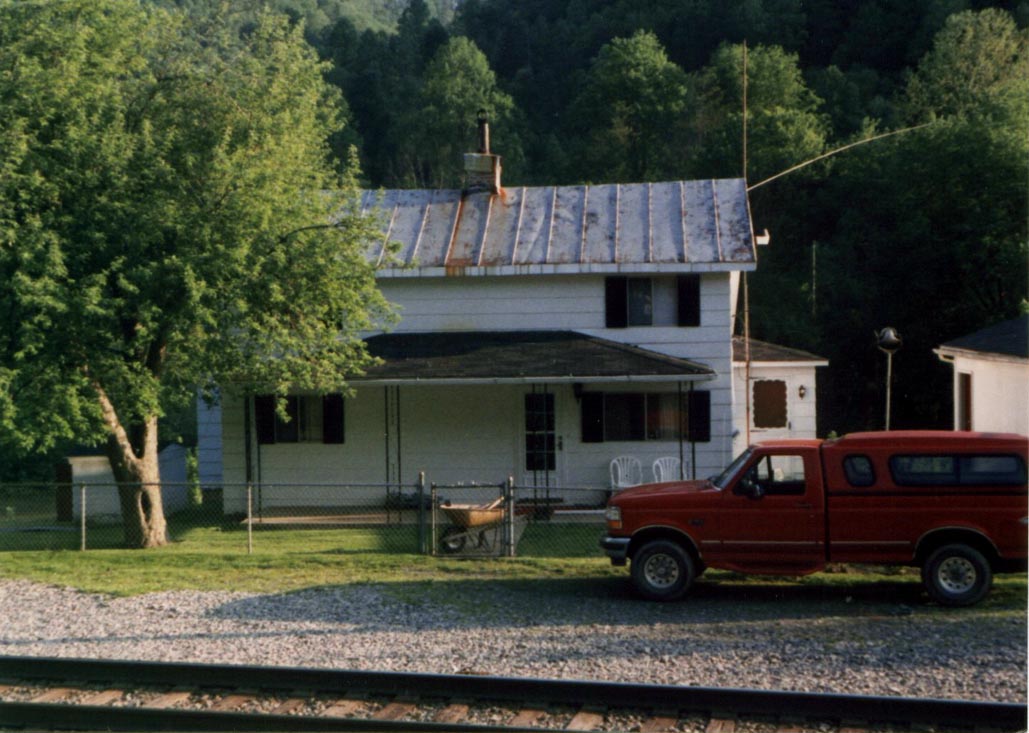
The Murder House? #Appalachia #feud #history

The Murder House? Green Shoal, Lincoln County, WV, 1995

Mouth of Green Shoal Creek

11 Monday Nov 2013

Posted by Brandon Ray Kirk in Green Shoal, Lincoln County Feud

≈ Leave a comment

Tags

Appalachia, crime, feud, George Fry, Green McCoy, Green Shoal, history, Lincoln County, Lincoln County Feud, Milt Haley, murder, photos, West Virginia

Site of the Haley-McCoy murders, Green Shoal, Lincoln County, WV.

Site of the Haley-McCoy murders, Green Shoal, Lincoln County, WV.

In Search of Ed Haley 194

11 Monday Nov 2013

Posted by Brandon Ray Kirk in Ed Haley

≈ Leave a comment

Tags

Big Ugly Creek, Bill Duty, Billy Adkins, Brandon Kirk, genealogy, Harts, history, Imogene Haley, John Hartford, Maude Duty, Milt Haley, Solomon Mullins, writing

I asked Billy about Bill Duty. We had found Milt living with Duty’s family in an 1870 Logan County census and knew from reading an interview with his son in the Lambert Collection that his family settled on Big Ugly Creek in the early 1880s. Billy turned us loose with his Duty notebook, where we soon located his notes on the family of “William Marshall Duty” (1838-c.1910). He said the family originally came to the area looking for work in timber. In 1900 and 1910, Bill Duty lived on the Broad Branch of Big Ugly Creek. We could find no apparent “blood connection” between him and Milt Haley but his wife Emma Ferrell was a great-granddaughter of Money Makin’ Sol Mullins (Ed’s great-great-grandfather). It was a seemingly distant family connection that might have played a part in Milt’s choice of Emma Mullins for a wife. Billy said we should talk with Maude Duty, a widow of one of Bill Duty’s grandsons, for more information along those lines.

That night, after hours of watching Billy and Brandon shuffle through genealogy books, census records and notebooks filled with handwriting, I realized just how difficult it would be to familiarize myself with all the characters and family relationships in the story of Milt Haley’s death. While I had little chance to memorize them, I made the effort to at least document them because they seemed to help explain a lot about Milt’s story. There were other things, of course, to mix into the blend, such as grudges, hatreds, and dislikes.

There was another important reason for documenting the genealogy: knowing how people were connected to each other helped me to objectively weigh in any slant in their stories (whether intentional or not). For instance, if I were talking to a nephew of “Uncle Al Brumfield,” I would probably get a somewhat complimentary account of his character; but if I were talking to someone whose family had feuded with him, comments might be less than flattering. It seemed obvious, then, that who I talked to, their genealogical connection to who they spoke of, where I talked to them, in whose company I talked to them, and what exactly they said (or didn’t say) were all important to note.

In Search of Ed Haley 193

06 Wednesday Nov 2013

Posted by Brandon Ray Kirk in Ed Haley

≈ Leave a comment

Tags

Angeline Lucas, Billy Adkins, Boney Lucas, Don Morris, feud, Green McCoy, Harkins Fry, history, Imogene Haley, Milt Haley, music, Paris Brumfield, Sherman McCoy, Spicie McCoy, Tucker Fry, Vinnie Workman, writing

I said, “That’s the very same story that Ed Haley’s people told. They would have just as much shame about the incident as Ed Haley’s folks. I wonder if Spicie and Emma got together and got their stories straight before they went their separate ways? I wonder if Spicie knew Emma Jean?”

Billy said, “Grandmaw I believe said them women come over that night and begged for them men — for them not to kill them. She said her mother was telling her about it. Her mother was the Fry where they lived at there. They wouldn’t listen to them. Now I don’t know if that’s true or not. That’s just what was passed down to her. Now I’ll tell you, that table had bullet holes in it.”

Oh, yeah…the table where Milt and Green ate their final meal. Brandon asked Billy who had it last and he said, “My grandmother, Vinnie Workman. I don’t know whether I can remember it or if I was just told about it.”

I told Billy that it sure would be nice to find that table, so he called up his Aunt Don Morris, who had eaten many meals on it as a child. When he got off the telephone, he confirmed, “The table they had their last meal in ended up with my Grandmother Vinnie (Thompson) Workman. And there were bullet holes in the table. Of course my aunt wasn’t there, but she said she can verify there was bullet holes in the table under the bottom of it — not on the top of it. You know, how side pieces are on a table. But when they’d be under the table as kids playing under the table, they’d see the bullet holes. She doesn’t know where the table is.”

And why did Vinnie end up with the table?

“I don’t know,” Billy said. “Uncle Tucker Fry, the one that owned the house where they was killed at, was my grandmother’s uncle. He may have just give the table to her. They was just probably getting rid of it and she took it.”

After thinking about it for a while, Billy said the table might be stored in his parents’ abandoned house next door. We walked over to the dark house and searched in vain.

Back at Billy’s, we returned to the family histories. I noticed there seemed to be a great deal of musical talent in Green and Spicie McCoy’s family. The Fry history referred to Spicie as a “well-known quartet singer” and featured a photograph of her in a quartet with her son, guitarist Sherman McCoy, and her grandsons, Charles and Raymond McCoy. Whether their talent came from Spicie or Green (or both) I didn’t know, but I took note of the fact that some of the children by Spicie’s second husband were also musical. According to Adkins, Harkins Fry of Huntington was a “song writer and publisher, and music teacher.”

My head was filled with images of Milt, Green and Spicie playing dances around Harts.

There was another surprise: according to the Adkins book, Spicie’s sister Angeline married Monteville “Mounty P.” Lucas (a brother to Mrs. George Fry) – a.k.a. “Boney Lucas.” Boney, then, was a brother-in-law to Green McCoy — making his death closely connected to the troubles of 1889. He and Angeline had several children: Eliza Lucas (1877), Julie A. Lucas (1879), Millard Fillmore Lucas (1880-1971), Blackburn Lucas (1882-1946), Ruth “Spicey Jane” Lucas (1883-1971), Taylor Lucas (1889-1966) and Wilda Lucas, born in 1891. Boney died around 1891, according to the Adkins history, when the “Brumfield brothers killed him by cutting his throat while Angeline watched.” According to Billy’s notes, Boney was “killed by Paris Brumfield while he was running from Paris.”

In Search of Ed Haley 192

03 Sunday Nov 2013

Posted by Brandon Ray Kirk in Ed Haley

≈ 1 Comment

Tags

Al Brumfield, Black John Adkins, Cain Adkins, Cat Fry, Fed Adkins, feud, Green McCoy, history, John W Runyon, Milt Haley, Paris Brumfield, Will Adkins, writing

Brandon asked Billy what he knew about the old vigilantes around Harts Creek, and he said his grandfather Fed Adkins had been affiliated with the Brumfields and their gang. (We use the word “affiliated” lightly since Fed and Hollena Brumfield supposedly had a long-term affair that produced an illegitimate daughter in 1892.) They were a rough bunch, Billy said, but usually had good intentions.

“These guys’d set big poles — big switches — on the porches of whoever they wanted to try and correct in some way,” he said. “When you got up that morning and saw switches sitting on your front porch — big long poles I’m talking about, what we’d call saplings — you knew to straighten up. And if what they didn’t do wasn’t corrected, they’d hold them and whip them with those big long switches. And if that didn’t work, they’d burn their house down.”

I had to interrupt Billy by asking, “Would you know what it was you was doing wrong?”

“Yeah, oh yeah,” he said. “You was either interfering with some of their business practices or courting the wrong woman.”

Billy said the Haley-McCoy trouble started when John Runyon moved to Harts and put in a store and saloon across the creek from Al Brumfield. There was intense competition between him and Brumfield. At some point, Runyon went to Washington, DC, and tried to have the government declare Harts Creek as a navigable stream — and thus force Brumfield to dismantle his log boom. Billy heard that Al was in the process of arranging Runyon’s death when Milt and Green ambushed him. They fled to the Mingo County area after accidentally shooting Al’s wife, Hollena.

Billy said his great-uncle Will Adkins was in the mob that executed Milt and Green. Several other participants were recorded in his notebooks: “Paris Brumfield, Al Brumfield, Charley Brumfield, Bill Brumfield, Albert Dingess and other Dingesses, Will Adkins, Black John Adkins (held the horses), French Bryant.” Billy figured his grandfather Fed Adkins was also in the gang, because he hung pretty close to his brother Will and cousin “Black John” Adkins, a mulatto.

Brandon wondered why the Adkinses sided with the Brumfields in the feud since many of the old stories pitted them as enemies.

“Dad and them was real close with the Brumfields,” Billy said. “They fought amongst each other but they still was together when they needed to be.”

Billy’s notebooks finished the story.

“The mob from Harts went to get them with extradition papers. Old Cane Adkins and John Runyon had another mob at Big Branch (another story goes at the mouth of Smokehouse) to ambush and recapture and free Haley and McCoy. But a spy tipped the Harts boys off and they went up Smokehouse, Bill’s Branch, down Piney, up Frank and Catherine Fleming’s hollow, down Abbott’s Branch and killed them at the George Fry house where Gov. Sperry’s house is now.”

Billy corrected the Gov. Sperry part of his notation, saying, “That’s written back 25 years ago, this is, so it wouldn’t be there. I’d be where Doran Lambert owns now. There’s a nun lives there.”

I told Billy, “Now, there’s a story that they came in and told everybody to clear out and there was a little girl in the house and she hid in the fireplace and she saw the whole thing happen.”

“Is that supposed to be Aunt Cat?” he asked. “Yeah, I’ve heard that but I don’t know whether that’s true or not.”

I continued, “And then Roxie Mullins said that after it happened the girl ran out of the house and jumped over the bodies and ran out into the woods.”

Billy said, “Would she have been old enough to done that?”

I said, “I guess, she was the one that told Bob Adkins the story.”

Okay, so how old was she? Based on Billy’s notes, she was born in 1862, making her 27 years old in 1889…a far cry from the “child witness” portrayed in stories. Her reasons for being present at George Fry’s at the time of the murders probably had something to do with the fact that George had married her aunt (and his first cousin).

So who was the “child witness” to Milt and Green’s murder? Maybe it was Cat’s seven-year-old daughter Letilla, who Brandon said later married one of Paris Brumfield’s sons. Or was it George Fry’s six-year-old daughter, Bertha?

And what were the chances that Cat had just made up her version of the story?

“Cat Fry and all of them, they’d tell you anything in the world,” Billy said. “I’m not saying it weren’t true, but just ’cause they told you that don’t mean it was true.”

Billy said Cain Adkins and his family were the ones who fetched Milt and Green’s bodies from Green Shoal for burial. Brandon figured the burial party probably crossed the Guyandotte using the old Ferrellsburg ferryboat.

A Harts mob eventually found John Runyon in Kentucky.

“John Runyon, he went to Kentucky, the way I heard it, and a group from here went to find him,” Billy said. “My grandfather and my uncle was supposed to have been in the bunch and some of the Brumfield boys. They was a big posse of them and they found the creek that John Runyon lived on and they said they had come to get him. He walked out and met them and he said, ‘Boys, you sure you want to take me?’ And they said, ‘Yeah, we come to getcha.’ He said, ‘Boys, I don’t wanna see anybody get hurt but you better look around you.’ And they started looking and they’s probably 150 or 200 rifles up on both hillsides pointed right down at them in the creek. They’s riding up the creek there. They wasn’t any road. And he said, ‘Now, the best thing you can do is turn around and go right back to Harts Creek.’ And they did. They didn’t look back.” Billy laughed, “He said, ‘Now don’t look back.'”

In Search of Ed Haley 190

01 Friday Nov 2013

Posted by Brandon Ray Kirk in Ed Haley

≈ Leave a comment

Tags

Appalachia, Billy Adkins, Cain Adkins, Cat Fry, crime, feud, George Fry, Green McCoy, history, Lola McCann, Milt Haley, Vinnie Workman, writing

Before heading to Billy’s, we became knee-deep in conversation about Milt Haley’s death. Billy told us about the Brumfields retrieving Milt and Green in Kentucky.

“Now, I don’t know where they come from over there,” he said. “I know they had a bogus warrant, the people that went to get them. They made up a fake warrant and got them. Then when they started back down through here, they was a big bunch of people was waiting to attack them. That was Cain Adkins and them and his family. They was fields full of them up on Big Branch. And somebody tipped them off, and so they went up what’s called Bill’s Branch. And so they took up Bill’s Branch and down Piney and then over to Frank Fleming holler.”

From Frank Fleming hollow, the Brumfield gang went over a mountain and crossed the river to a Fry house near the mouth of Green Shoal. At some point, according to Lola, a group of men came in and shot out the lights. Cat Fry crawled under a bed while either Milt or Green shouted to the other, “Stand up and die like a man!” Lola heard that one of the men “died a praying and the other died a cussing.”

I asked Billy if he’d heard how Milt and Green were killed.

“I’ve heard so many stories, I don’t know,” he said. “I just heard they was shot. I heard they was tied up to a tree. Tied to a chair back to back in the kitchen.”

Lola said she heard that Milt and Green were shot and hung.

“The table Milt and Green had their last meal on ended up with my grandmother, Vinnie Thompson Workman,” Billy said. “And there was bullet holes in the table.”

I asked Billy if he had any pictures of the “murder house” and he said, “No, I don’t know of anybody would. It’s where Doran’s house is. It was over there against the hill — an old log house. Of course, the railroad and stuff wasn’t there, you see. That was the old John and Catherine Fry house to start with. And then John’s son Baptist, he lived there next. That was my grandmaw’s grandpaw. And after he died, I guess this George Fry lived there. Charley Fry and George Fry both lived there and I don’t remember which one lived there when they killed them there.”

At that point, Lola completely changed the direction of the conversation when she said, “Billy, Cain Adkins was kin to us.” She’d never met Cain and had no clue what happened to him but knew that he once owned most of the lower end of West Fork at one time. All the old-timers referred to him as “Uncle Cain” because he’d been a well-respected person in the community.

Lola said George Thomas (one of Ed’s cousins, we later learned) owned the Cain Adkins farm in the years prior to her birth. Her father bought the place from him around 1905. At that time, the only remnant of Cain’s life there was his apple orchard by the creek. The Haley-McCoy grave was on the family lands.

“You go up almost to the top where it gets real flat,” Lola said. “They’s a path used to be up there. It’s up pretty much on the hill. It ain’t way up there, I’d say the first flat.”

Brandon asked her, “Now, did you tell me that some old woman used to come up there and decorate that grave?”

“They always came as long as they lived, I guess, and decorated the grave,” Lola said. “That was their wives. I was only four or five years old, but I can remember seeing them. One of them was tall and slim. But they stopped at our house every time they come.”

In Search of Ed Haley 189

31 Thursday Oct 2013

Posted by Brandon Ray Kirk in Ed Haley

≈ Leave a comment

Tags

Al Brumfield, Bill Adkins, Billy Adkins, Cain Adkins, fiddle, Green McCoy, Harts, history, Hollene Brumfield, Jackson Mullins, Lola McCann, Milt Haley, writing

That night, Brandon suggested visiting Lola McCann, a local widow of advanced age. Lola, born on the West Fork of Harts Creek in 1909, lived in Harts proper, just back of an old hardware store, a video store, and the post office. She spent a lot of time with her daughter Cheryl Bryant, who lived across the street with her family. We found Lola at her daughter’s home almost buried in the cushions of a plush couch. As everyone made introductions, I headed over and sat down beside of her.

When Brandon asked Lola about the old Al Brumfield house, she said it was haunted, that Hollena Brumfield had kept the clothes of deceased relatives in an upstairs closet (top-story front downriver side). She never would spend the night there. She said the staircase was stained with blood and five or six bodies lay down in the old well. This all sounded like folk tales, the type of stories to tell in an old cabin around the fireplace…but who knows?

As things kinda moved along with Lola, Brandon mentioned that we should be sure and visit Billy Adkins, a neighbor and expert on local history and genealogy. Lola’s daughter immediately called him and invited him over. The next thing I knew a little stocky guy with a shaggy beard arrived at the door. It was Billy, of course, holding a fiddle, which he said belonged to his father Bill Sr., an old fiddler in Harts.

I told Billy that his father just had to know Ed Haley but he said, “I asked him and his mind’s gone. He can’t remember. He’s got Alzheimer’s. His mind just comes and goes.”

Bill, Sr. had given up the fiddle in recent years, but Lola’s daughter had a short home video of him playing “Bully of the Town”, “Way Out Yonder”, and “Sally Goodin” in 1985. Bill’s style was completely different from what I pictured as Ed’s — he held the bow toward the middle and played roughly with a lot of double-stops — but I was still anxious to talk to him. Billy said we could see him the following day as he was already in bed asleep.

When we mentioned our interest in the 1889 troubles, Billy said, “Green McCoy married Cain Adkins’ daughter. Cain and Mariah. Mariah was a Vance, I think. And they lived where Irv Workman’s house is now.”

Brandon asked, “Which is near where they’re buried, right?” and Billy said, “Yeah, right across the road from it. And Milt Haley married Jackson Mullins’ daughter. Jackson and Chloe Mullins, from up on Trace. She married again.”

What? Ed’s mother remarried after Milt’s murder?

“I believe it was another Mullins,” Billy said, “but I’d have to look it up. Milt’s name was Thomas, you see.”

It was all in his notebooks at home, he said, although he warned us: “See, I didn’t document any of this stuff. I didn’t put my sources down and when I’d run across it I’d just write it down. Now, I don’t know how I found it out.”

In Search of Ed Haley 187

28 Monday Oct 2013

Posted by Brandon Ray Kirk in Ed Haley

≈ Leave a comment

Tags

Al Brumfield, Ben Adams, Charley Brumfield, feud, Green McCoy, Harts, Hollene Brumfield, Jane Thompson, John W Runyon, Mae Brumfield, Milt Haley, timbering, writing

After a brief rest at Mr. Kirk’s, Brandon and I drove to see Mae Brumfield at her little yellow house just up the creek from the bridge at Harts. Mae was one of Brandon’s special friends, a woman of advanced years and closely connected to the Brumfield family. As a girl, she was a close friend to Charley Brumfield’s daughters. Later, she married Tom Brumfield, one of Al’s grandsons, and settled near his widow — “Granny Hollene” — at the mouth of Harts Creek. Just back of her house was the former site of the old Brumfield log boom, as well as the spot where Paris Brumfield killed Boney Lucas.

Mae welcomed us inside as soon as she saw Brandon. She was very thin and frail — a wisp of a woman — but she seemed to be very independent and self-sufficient. Her house was tidy and there were several crafty-type dolls in sight as evidence of her fondness for crocheting and knitting. Almost right away, Brandon asked her about Hollena Brumfield — the woman supposedly shot by Milt Haley.

“Granny Hollene?” Mae said. “Why, I’ve combed that old gray head many a time. I loved her better than anything. She wasn’t afraid of nothing. She’d cuss you all to pieces if you done something to her but she was a good person. Everybody was welcome at her table. She didn’t turn nobody away. You know that hole was in her face where those men shot her. It never was worked on. They didn’t have plastic surgery like they do now. And after all that, a sawmill blew up and broke her leg. That was why she was crippled. And she still run everything on.”

Mae told us what she knew about Al Brumfield.

“I’ve heard Grandpa talk about him. Grandpa liked him. Al Brumfield, my grandpa said, was an awful smart man. He told me he was a good-looking man. He was sort of blonde-headed and had blue eyes. People said he could take a dollar and turn it into a hundred in no time. Al Brumfield today woulda been a millionaire. He owned up to Margaret Adkins’ farm where the Ramseys used to live around there. Back this way, he owned all that property over in yonder where the Chapmans lived. He owned up this creek to Big Branch, all back this way, all them bottoms up through yonder and where I live and clear on down to Ike Fry Branch — maybe to Atenville. He had sold that to Charley, I think, his brother.”

We asked about Al’s trouble with Milt Haley and Green McCoy.

“People timbered then for a living, you know,” she said. “Well, Al put that dam in across the creek here or on down there somewhere — a boom. These people drifted their timber down here when they come a raise to they could get it out. Al went to the government and got a charter to put this dam in and caught the timber. He’d catch the logs and charge people so much for catching their timber. I don’t know whether it was ten cents or a quarter. It wasn’t very much. They’d come down here then and raft them and then run them on down to Huntington and sell them. That’s what the startation was, I think, of this killing. A lot of these men up the creek, you know, they was like today. They was prejudice in families and jealousy and he was building up good, you know. Had plenty. And they didn’t want to pay that toll. And they didn’t like him. They was the ones that hired this Haley and Green McCoy.”

Brandon asked Mae who specifically hired Milt and Green and she said, “I think it was Adamses. Now I won’t tell you for sure. Old Ben Adams was one. They didn’t like him. They called him ‘Old Ben Adams.’ He lived way up this creek somewhere. Them Adamses shot at Al’s gang up here somewhere back in the beginning about this timber. I think they tried to kill him out then. That’s why they wanted rid of him was on account of him catching timber and they was enemies. But Adams wouldn’t do it hisself — he hired these two men — and that’s what caused it, so I understood.”

So John Runyon wasn’t the one who hired them?

“No, I believe he owned the mouth of this creek, didn’t he, and Al bought it from him? He’s the man that owned the store… I don’t know how much of this land he owned — just the mouth of this creek, I’ve heard them say. I guess Al bought all this other property.”

At the ambush, Hollena hollered for Al to run because she knew he was the target of the men shooting at them. Al retreated for a short time before coming back up the creek firing a pistol toward his would-be assassins, but was unable to hit them due to heavy growth on the trees. Milt and Green fled into the woods, at which time “old Jane Thompson” came to Hollena and “got her up.”

In Search of Ed Haley 184

19 Saturday Oct 2013

Posted by Brandon Ray Kirk in Ed Haley

≈ Leave a comment

Tags

Al Brumfield, Bob Adkins, Charlie Conley, crime, Green McCoy, Henderson Dingess, history, Hollene Brumfield, Hugh Dingess, John Brumfield, Lincoln County, Milt Haley, writing

A few days later, I picked Brandon up at his apartment in Huntington and we drove to see Bob Adkins in Hamlin. We parked on the street in front of Bob’s house (just past the red light) and walked up onto the front porch where his wife, Rena, a very friendly and cordial lady, met us at the door. She welcomed us inside to the living room. We listened to Bob speak of Milt Haley’s death. It was clear that his memory had faded somewhat since my last trip to see him in 1993.

“Well, what the trouble was there, that fella Runyon, he had a saloon and a little old grab-a-nickel store right across the creek there at the mouth of Harts,” Bob said. “And Aunt Hollene and Al Brumfield, they had a big store over there on the lower side of the creek. They was competitors in a way, you know. And that fella Runyon, he wanted to get rid of them, see. He hired these two thugs to kill them. These fellas Milt Haley and Green McCoy were two characters. And a fella by the name of Runyon gave them a side of bacon and a can of lard to kill them…each.”

Bob laughed, fully aware of how it would all turn out and seemingly amused.

“They got in a big sinkhole up above the road with a high-powered gun — a .30.30 Winchester.”

According to Bob, Haley and McCoy waited in that sinkhole for Al and Hollena Brumfield to pass by.

“Ever Sunday, Aunt Hollene — she was my mother’s aunt — she’d go up to the forks of Big Hart about ten miles up there to visit her father, old Henderson Dingess. Al had a fine riding horse and he’d get on the horse and she’d ride behind him. They’d go up there on a Sunday and have dinner with her father. And they’d been up there — it was a pretty summer day — and they came along about three or four o’clock in the evening. They shot at Al’s head and that high-spirited horse jumped and that bullet missed his head and hit Hollene in the side of the jaw — knocked her teeth out. That knocked her off’n the horse. Of course, that horse sprang and run. But they had come down off’n the hill and they aimed to shoot Aunt Hollene again. And she a laying there in the road — her eyes full of blood. She couldn’t see hardly who it was. She begged them not to shoot her anymore — she told them she was dying anyway.”

So where was Al Brumfield at that time?

“Al got offa the horse down below there and come back under the creek bank and got to shooting at them see and they took off,” Bob said. “Hollene got over that. She was my mother’s aunt. I was around her home a lot. She lived in that big white house in Hart. Burned down now.”

How did they figure out who ambushed the Brumfields?

“Well, they didn’t know who it was,” Bob said. “But they noticed they weren’t around home, the Brumfields and Dingesses did. They was watching all around to see who it was. And these two guys just left their families and went into Kentucky. Just deserted their families. Then they knew who it was. After they got a hold of them, the Dingesses and the Brumfields, they told them the whole story. That was at my grandfather’s home. They took one guy out there in the yard and gagged him so he couldn’t make a noise and stuck a gun in his back and told him if he made any noise they’d shoot him. So he listened to that other fella inside the house. That other fella broke down and cried and he told them the truth about it. And they killed both of them over at Green Shoal. Took them out in the yard and shot them all to pieces. Walked off and left them. I was born and raised about three quarters of a mile below there.”

I asked Bob why the Brumfields did not avenge John Brumfield’s murder with the same ferocity. John, I knew from Brandon, was killed by Charlie Conley at a Chapmanville Fourth of July celebration in 1900.

“I don’t know,” he said. “But I’ll tell you, John Brumfield, he was mean as a snake anyway. He treated them fellers pretty rough. And they killed him up there in the head of Hart in an association ground. They just walked up to him in that association ground — a whole bunch of people there — and shot his brains out.”

An association ground?

“They had them once a year near an old schoolhouse,” Bob said. “People’d all gather in and they had a place where they traded horses. Half a mile away, an old country preacher would preach to them. It was kind of a rough place up in there at that time.”

In Search of Ed Haley 182

15 Tuesday Oct 2013

Posted by Brandon Ray Kirk in Ed Haley, Timber

≈ Leave a comment

Tags

Appalachia, Carol Caraco, Fred B. Lambert, history, Logan County, logging, Lucian Mitchell, Milt Haley, rafting, timbering, West Virginia, writing

Milt Haley, by all accounts, made his living as a timber man. He was probably lured “over the mountain” from the Tug River section by the timber industry that evolved in the Guyandotte Valley following the Civil War. It certainly played a role in his death. Really, for all practical purposes, logging was imbedded in the life fabric of every person living around Harts Creek in 1889…including little Ed Haley, who grew up in the era when timbering and steamboats gave way to coal and the railroad.

“Almost from the very beginning of history in this region, logs have been rafted on the Guyandotte and floated to Cincinnati and even to more distant markets,” according to Fred B. Lambert’s The Llorrac (1926). “In autumn, men with saws and axes went into the woods and cut down the trees. At first, the trees were so plentiful that they could be cut and rolled directly into the stream. In some cases, the bark was peeled from the logs and they were allowed to slide down the mountain side. But gradually the timber along the shore became scarce, and timbermen were compelled to go farther and farther into the hills or up the creeks, until now most of the virgin timber has been cut, and they are beginning on the second growth and, in some places, even on the third.”

The logging season began with the construction of logging camps “during the late winter and early spring months before the spring rains began to swell the creeks and rivers,” according to River Cities Monthly.

The men who came into these camps for work “were men in every sense of the word, and their beards of many days growth betrayed the fact that razors as well as some one to use them were quite scarce…,” Lambert wrote. They worked silently but would “yell like wild men” if something “unusual” happened. They were “master hands at swearing” and often fought amongst themselves, be it for sport or in fits of rage. Because of their wild nature, a foreman was often hired to regulate their activity. At night, they slept on bundles in crude log cabins. If the camp was large enough, a mess hall was constructed and a cook was hired to serve them bacon, beans, bread, coffee “or whatever may be brought into the camp from the surrounding country.”

According to Carol Caraco’s The Big Sandy (1979), loggers marked their timber by branding it with their initials. After branding their logs, they got them out of the hollow and to the river, usually by use of horse or oxen and cant hooks. Another often-used method involved splash dams. “When thousands of logs accumulated behind the timber and stone splash dam, a key wedge would be removed and the timber spewed forth,” Caraco wrote. As the logs made their way down the creek, many were jammed or land-locked along the bank.

At the mouth of creeks and rivers were “taker-ups” and booms. “The taker-ups were free-lance agents who caught and held unrafted logs until the owners appeared,” according to Caraco. “When their charge for this service proved excessive, the legislature standardized fees. Other times loose logs were stopped by a boom, a dam of huge poplar logs reinforced by a giant chain stretched across the stream.”

This boom concept, as well as questions about branding, were apparently at the heart of the 1889 troubles.

According to The Llorrac, “After the logs were all in the river, they were arranged into a raft and held in position by hickory pins driven through the small tiepoles. Later they were made more secure by the use of iron ‘chain dogs.’ Three men were required to build a raft; one to sight or place the logs, one to carry poles, and one to drive pins or chaindogs. They received a dollar a day each and it took about a day. The rafting was done in the fall and winter so as to be ready to go out on the first ‘log-tide’ of spring or early summer. An experienced raftsman always knew when it was safe to go. And well he did, for below him were the treacherous falls and shoals and eddies ready, without a moment’s notice, to hurl him to a terrible death. When the day came for the trip and the oarsmen decided that the river was at safe ‘log tide,’ the great ropes were loosened, the men took their places, the raft slowly moved into the current, and the wild ride was on.”

Based on Lambert’s notes, rafts moved at speeds of eight or nine miles per hour in convoys of fifty or more.

“There was an oarsmen at the bow’ and another behind, directing, with their strokes, every movement of the raft,” he wrote. “No one who has ever been near the river when rafts were passing, can fail to have heard the strange calls of the raftsmen to each other as they rounded the bends of the river or passed through dangerous chutes or rapids.”

“The man on the bow didn’t have to know much,” according to Lucian Mitchell, an old rafter who spoke with Lambert. “The man at the stern knew where to go, where the shoals were, and how to work up to the point on a hard bend and knew the Jordan sands at the mouth of Bear Creek. Sometimes a raft would cork the river by bowing and swing around in such a position as to get both ends afoul. If another raft came down it was rulable to hit this raft in the middle and cut it in two pieces.”

“This was a thrilling time,” The Llorrac claimed. “The front oar was often broken, leaving the raft unmanageable and, in the language of the raftsmen, it sometimes ‘swarped’ or turned completely around and even went to pieces. Let no one minimize the danger. If by accident, a man lost his balance and fell into the water, he was generally carried at once by the eddies to the bottom of the river; or, he drifted under the raft and was seen no more until his body was found, drifting far below, after many days or even months. In case they escaped these dangers they were still subject to sunken logs or great stones.”

Lucian Mitchell of Logan County downplayed the drowning aspect, saying, “Not many drowned. Most could swim.”

In Search of Ed Haley 181

14 Monday Oct 2013

Posted by Brandon Ray Kirk in Big Sandy Valley, Big Ugly Creek, Ed Haley

≈ Leave a comment

Tags

Appalachia, Big Ugly Creek, Bill Duty, civil war, Fred B. Lambert, genealogy, history, Jeff Duty, John Hartford, Milt Haley, Tom Ferrell, Tug River, writing

We next looked at Logan County census records, where Milt Haley appeared in 1870 as “T. Milton Haley,” aged 13, living with a Bill Duty on Rich Creek in the Tug Valley. Duty’s home in Hardee District was relatively far away from the Harts area. Ten years later, in 1880, there was no trace of Milt or Duty anywhere in West Virginia, indicating that they may have lived outside the state at that time.

Had they moved together across the Tug into Kentucky?

We got back in the Lambert Collection for help…and found a circa-1934 interview with Jeff Duty, Bill Duty’s son.

At the time of the interview, Jeff was living at Dollie, a now extinct post office on Big Ugly Creek just upriver and over Green Shoal Mountain from Harts. He didn’t mention Milt Haley but gave a great account of his family story:

Grandfathers both came from Russell County, Virginia. Grandfather Geo. Duty came to Pigeon Creek in what is now Mingo County, before the Civil War. Grandfather James Ferrell settled on Big Creek, Logan County before the Civil War. Grandmother Duty was a Jackson and Grandmother Ferrell was a Fields.

Father was born in what is now Mingo County, and volunteered in 1861 as a Confederate. My father, William Duty, was in Gettysburg and Fort Donelson battles. They fought here seven days and seven nights. He was twice wounded. Father Wm. Duty lived in Mingo until fifty-one years ago, when he moved to Big Ugly, Lincoln County [around 1883]. When we moved to Big Ugly there were only three houses from Broad Branch, which is about one-half the length of Big Ugly to the head of Big Ugly, and now there are about two hundred. Big Ugly is nineteen miles long. There were plenty of deer, wild cats, coons, &c. when my father came. Wolves were here for about fifteen years after we came. Tom Ferrell killed the last deer killed about here about forty-five years ago.

My father was a rather big farmer for this part of the country, raising 1,000 bushels of corn a year, and always raising wheat. He had the first “chaff Piler” threshing machine brought in. It took about twelve horses to pull it. When it came on the first trip, my mother had about twenty geese in the yard, and when they heard it they took to the woods and did not come back for three or four days. My father had six children: John lived on Broad Branch, Lincoln County; Jeff here at Dollie; Phidelia Vernatter-Chapman lives in Boone County; Annie Steele lives in Logan County; George lives within three miles of Hurricane, Putnam County; Martha lives in Logan; she married Queen. My father, Wm. Duty, was the man who rode a $150.00 horse to death to save Tom Ferrell, who was in jail, in Hamlin, about 1889, for killing a man named Butcher, from a mob of Butcher relatives. Tom Ferrell is my cousin.

I am sixty-seven. I have eleven children, of whom three are dead: Alva, Lula, Stonewall, Solomon, Vernonda, Thos. Jefferson, Lee, Musco, Ira, Doska, Maggie. Mrs. Duty was Betty Pauley; her people came from Virginia. “Tiger Bill” Pauley was her father.

In Search of Ed Haley 180

09 Wednesday Oct 2013

Posted by Brandon Ray Kirk in Ed Haley

≈ 2 Comments

Tags

Al Brumfield, Appalachia, Brandon Kirk, feud, Green McCoy, Harts, Harts Creek, Henderson Dingess, Hollene Brumfield, James V. Henderson, John W Runyon, Milt Haley, Wild Bill, writing

Having satisfied my thirst for Brumfield family history, Brandon pulled out some great newspaper articles pertaining to the 1889 troubles. He began with one from the Ceredo Advance dated Wednesday, October 2, 1889, and titled “Disappointed Love Leads to a Desperate Double Crime in Lincoln County:”

HUNTINGTON, W.Va.  September 27 – Word has just reached here of a sensational crime on Big Hart’s creek, in Lincoln county, 90 miles up the Guyandotte River. Al Brumfield, a newly married man, and his bride had spent the day with his wife’s parents some distance up the creek. Just at dusk, on their return, and when near their home, they were fired upon by a man who sprang from the bushes by the road-side. Mrs. Brumfield was shot in the head and fell to the ground unconscious. Her husband was shot in the right lung but managed to crawl to a neighbor’s for assistance.

The nearest physician, twenty-five miles distant, was summoned, but arrived too late to render the woman any assistance and she died in a few hours. The latest information is that Brumfield is also dying. He claims he recognized the assassin, but refuses to say who it was. It is the belief of the neighborhood that a suitor of Mrs. Brumfield, who failed to win her, is the assassin.

The article was full of errors but its implication of a single “assassin” with a personal attachment to Hollena Brumfield was interesting.

On Wednesday, October 9, 1889, Ceredo Advance ran a letter from “WILD BILL,” written on September 27. Wild Bill gave his address as Warren, West Virginia — a now extinct post office on Harts Creek below the mouth of Smoke House Fork.

ED. ADVANCE: — As you have had no communication from this place for some time I will give you a few items. There have been several cases of flux in this vicinity and two or three deaths. Farmers are busy saving fodder and cutting up corn. Our neighborhood was thrown into a state of confusion last Sunday evening about 3 o’clock. One mile from this place some low down villain attempted to assassinate Mr. Brumfield and wife. They had been on a visit to Mrs. Brumfield’s father, Mr. Henderson Dingess, and as they returned home they were shot from the brush, one ball striking Mrs. Brumfield just in front of the right ear and ranging around the cheek bone and striking her nose producing a serious but not fatal wound, and one ball striking Mr. Brumfield in the right arm below the elbow producing only a flesh wound. They were cared for and dressed by Drs. Moss, of Cabell county, and Hudgins, of Logan county. They will recover. Mr. Brumfield is a prominent merchant living at Hart, W.Va., and is a good citizen, highly esteemed by his neighbors. His wife is a noble and kind-hearted lady and beloved by all her acquaintances. They have a large train of friends who sympathize with them in their distress. The object of the attempted murder is believed to be robbery. The good and law-abiding citizens should unite and rid the earth of such miserable miscreants.

Based on this September 27 letter, written a week after the ambush at Thompson Branch, there were two theories regarding the motive for the crime: one, it was done by a jealous suitor; two, it was an attempted robbery.  In either case, this second article again referred to the attacker in the singular sense…sort of.

By October 24, locals had deduced Haley and McCoy’s guilt, captured them in Kentucky and murdered them at Green Shoal. WILD BILL was apparently unaware about this latter act because on October 25 he again sent a letter to the Ceredo Advance (printed on November 6).

ED. ADVANCE – Mr. Allen Brumfield, who was shot in the arm near this place about a month ago, has got about well. His wife, who was shot at the same time, is improving very slowly, but she will get well. The perpetrators of the awful crime — Milton Haley and Green McCoy — have been arrested. Haley did the shooting and McCoy is accused of being an accomplice, but the latter will be released by turning state’s evidence against Haley. The law should be enforced against such persons to the utmost extent. Our neighborhood is in a state of intense excitement and may terminate in a deadly feud between two parties…

[Since the above was written a mob took Haley and McCoy from the officers and killed them. — ED]

God only knows what our country will come to, as the deadly Winchester is fast becoming the ruling factor in our land.

Well just who was this WILD BILL? He seems to have access to a lot of information regarding the growing feud on Harts Creek. Maybe it was “Detective Wild Bill,” who history records as a participant in the Hatfield-McCoy Feud in the nearby Tug Valley.

A story featured in the Ceredo Advance titled “A Visit to the Lincoln County Battle Field” and dated Wednesday, November 13, 1889, was most interesting:

Mr. J.V. Henderson, editor of the Charleston Nonpareil, was in this city today [Nov. 7], having just returned from the scene of the recent trouble in Lincoln county. He went to get a full description of the places and the causes which led to the trouble for the metropolitan dailies. Mr. Henderson went into the house where Green McCoy and Milton Haley were murdered, and made a map of the house and its surroundings. He also made a map of the Hart’s Creek country, giving the location of each faction — the Brumfields and the Runyons. While going up Hart’s Creek he was met by two men acting as pickets, armed with Winchester rifles, who asked him where he was going and what was his business. Mr. Henderson told them that he was a newspaper man and wanted to get information regarding the trouble in that vicinity. They told him that they would give him one hour to get off the creek and leave the country.

Mr. Henderson took the hint and left at once. He says he learns that both factions are heavily armed and are expecting an attack at any time. Each side has pickets out ready to give the alarm in the event of hostile movements by the other side. The road up Hart’s Creek is blockaded, and travelers through that region avoid the place.

Unfortunately, few issues of the aforementioned Charleston Nonpareil survive in libraries today. Brandon later located copies of the Nonpareil for February and May of 1889 and February and June of 1890 — the times just prior to and just after the trouble — but none for the fall of 1889, which would have maybe mapped the murder site and the location of the feudists’ homes. There was one interesting development: according to The Cabell County Record, Mr. J.V. Henderson, “one of the best known figures in West Virginia newspaper work,” died at the Spencer insane asylum in 1898 at the ripe age of 43.

In Search of Ed Haley 178

29 Sunday Sep 2013

Posted by Brandon Ray Kirk in Ed Haley

≈ Leave a comment

Tags

Al Brumfield, Boney Lucas, Brandon Kirk, George Fry, George W. Ferrell, Green McCoy, Henderson Dingess, history, Hollene Brumfield, John Hartford, John W Runyon, Milt Haley, Paris Brumfield, The Lincoln County Crew, writing

After a few hours of digesting this material, I met Brandon Kirk in the hall near the copier. Brandon, a neatly groomed young man wearing a tie, was freighted down with satchels. We introduced ourselves and were soon in the study room where Brandon started fishing through his bags and pulling out letters, notebooks, folders and photo albums. Within a few minutes, the table was covered. It was as if someone had walked up with a giant garbage bag full of papers and dumped it all out in front of me.

One of the first things Brandon showed me was a small account of Milt Haley’s murder titled “The Brumfield-McCoy Feud”, which was originally published in a 1926 edition of Lambert’s Llorrac.

The Brumfield-McCoy Feud took place in the month of September, about 1888, some three miles up Hart’s Creek. Hollena Brumfield and her husband, Allen Brumfield, had been visiting Henderson Dingess, father of Mrs. Brumfield, one Sunday and were about two miles below Mr. Dingess’ on their way home. Green McCoy and Milt Haley laid in wait for them. Mr. and Mrs. Brumfield were riding down the creek, Mrs. Brumfield being on the same horse behind her husband. McCoy and Haley began shooting at them, one bullet striking Mr. Brumfield in the arm, and the other tearing away a portion of Mrs. Brumfield’s face, disfiguring her for life. Mr. Brumfield jumped from his horse and ran, and in that way escaped further injury. McCoy afterwards told that they were bribed by John Runyons with a barrel of flour and a side of bacon to McCoy, and twenty-five dollars in money to [Haley]. The murderers escaped into Kentucky but were captured a little later and brought back. Allen Brumfield supplemented the reward offered by the state with one of his own.

It seems the cause of the trouble was bad feeling between John Runyons and Al Brumfield. Runyons had a store and saloon at the mouth of Hart’s Creek. Brumfield had a store on Guyan River about a fourth of a mile below Hart, on the south side of the Guyan and sold whiskey on a houseboat. John Dingess [Mrs. Brumfield’s brother] was a bartender.

McCoy and Haley were brought back and kept over night at the house of George Fry. The next morning a number of men, presumably Brumfield’s friends came in, and the two prisoners were shot and killed.

Along with the above article was another version of “The Lincoln County Crew”, which gave George (and not Tom) Ferrell as the author.

Come all young men and ladies, come fathers, mothers, too;

I’ll relate to you the history of the Lincoln County crew.

Concerning bloody rows, and many a thieving deed,

Dear friend, pray lend attention to these few lines I say.

It was in the month of August all on a very fine day;

Allen Brumfield he got wounded they say by Milt Haley.

But Brumfield couldn’t believe it, nor hardly thought it so;

He said it was McCoy who shot that fatal blow.

They shot and killed Boney Lucas, a sober and innocent man,

And left his wife and children, to do the best they can.

They wounded Rufus Stowers, although his life was saved;

And he seemed to shun the grog shop, since he stood so near his grave.

Allen Brumfield he recovered, some weeks and months had past;

It was at the house of George Fry, these men they met at last.

Green McCoy and Milt Haley, about the yard did walk;

They seemed to be uneasy and no one wished to talk.

And then they went into the house, and sat down by the fire,

And little did they think, dear friends, they had met their final hour.

The sting of death was near them, _________________________

A few words passed between them concerning a row before.

The people some got frightened, began to rush out of the room;

When a ball from some one’s pistol laid the prisoners in the tomb.

Their friends then gathered ’round them, their wives to weep and wail;

Tom Ferrell was arrested, and soon confined to jail.

The butchers talked of lynching him, but that was all the fear;

And when the day of trial came, Tom Ferrell he came clear.

And then poor Paris Brumfield, relation to the rest,

He got three balls shot through him, they went straight through his breast.

The death of these few men have caused great trouble in our land;

Men to leave their wives and children to do the best they can.

Lincoln County’s still at war, they never, never cease;

Oh, could I only, only see my land once more in peace.

I composed this as a warning, a warning to all men;

Your pistols will cause trouble, on that you may depend.

In the bottom of the whiskey glass, the lurking devil dwells;

It burns the hearts of those who drink, and sends their soul to hell.

In Search of Ed Haley 160

27 Tuesday Aug 2013

Posted by Brandon Ray Kirk in Ed Haley

≈ Leave a comment

Tags

Clyde Haley, family, feud, history, John Hartford, Lawrence Haley, Lawrence Kirk, life, Milt Haley, Mona Haley, Pat Haley, Tug River, writing

A few weeks later, I called Lawrence Kirk, whose ancestors had played various roles in the story of Milt Haley’s death. I hadn’t spoken with him for several months. We talked more about Milt Haley’s murder.

“Back in the old days, these people’d get into trouble here and they’d run backwards and forwards across that Tug River,” he said. “That was the state line and the law didn’t bother them. If you crossed the state line, you was safe. But they got the papers out and went over there and got Haley and McCoy. Inez is where they went to and got them. Yes, sir. They either came up Jenny’s Creek or Marrowbone Creek. See, they had horse trails all through these woods back in them days. They come right across Twelve Pole and down Henderson up there in the head of main Hart. Come right down and up what they call the Bill Branch — some people calls it the Hugh Dingess Branch — right down Piney Fork. It’s a straight shoot through there. I’ll tell you what. Come up sometime when you’ve got a day or two and we can drive right through there.”

Boy, that sure sounded good to me.

In the meantime, Pat kept me up on everything. She said Mona was helping her look after Lawrence and had even spent the night. Clyde had come in for Christmas.

“They had a red hat on him and a great big sign across the front which said ‘Clyde.’ They had a pair of pants that was rolled over about three times tops, the shoes was way too big, and, I mean, it was sad. The hat was red, his sweater was blue, and his shoes was white. Mona said they got half-way home from Cincinnati, and he was just talking away, you know, about things that had happened in their past, and then he began looking out the window and all of a sudden he turned around and he said, ‘Who in the hell are you?’ And she thought, ‘Uh, oh, it’s gonna be good.’ Larry was very happy to see him.”

In Search of Ed Haley 159

26 Monday Aug 2013

Posted by Brandon Ray Kirk in Ed Haley

≈ Leave a comment

Tags

Appalachia, blind, Ed Haley, feud, fiddling, history, Kentucky, Lawrence Haley, Milt Haley, Mona Haley, music, U.S. South, writing

In one of those “passing the torch moments,” Lawrence reached the telephone to his sister, Mona. I told her about Milt Haley being a fiddler, and she said, “Really? Well we didn’t never know that.”

I figured that Ed had kept all of the details about Milt hidden from his kids, but Mona said, “Well, he talked about it some, because I wouldn’t know what I know about it if he hadn’t. You did find out what I told you was true, didn’t you? It wasn’t my dad’s mother that was killed, the way I heard it. It was one of the Hatfield women. Got half her face shot away and it killed her. That’s why they retaliated against Green McCoy and my grandfather. That’s only hearsay, but it had to come from Pop. I do remember him saying that.”

Pat seemed pleased that Mona was visiting Lawrence.

“He asks for her a lot,” she said.

I wanted to know more about Lawrence’s condition.

“He sits with his eyes closed and he found a pair of sunglasses that look exactly like the ones his daddy wore,” Pat said. “These are a pair that one of the kids bought. They were laying on the dining room table and he picked them up and said, ‘There’s my glasses.’ He insists on wearing them and you would think it was Ed Haley back many years ago. He talks about horse and buggies a lot. He sits with your book constantly. He does not like to look at the picture of his mother’s tombstone. What keeps you in his mind a lot, he listens to the tapes and he knows he gave you the records. Beverly was here this past weekend. He knew who she was but he was still talking in riddles. But today he’s pretty much himself. He got up and got dressed about 5:30 and he’s been roaming ever since.”

← Older posts
Newer posts →

Feud Poll 1

If you had lived in the Harts Creek community during the 1880s, to which faction of feudists might you have given your loyalty?

Categories

  • Adkins Mill
  • African American History
  • American Revolutionary War
  • Ashland
  • Atenville
  • Banco
  • Barboursville
  • Battle of Blair Mountain
  • Beech Creek
  • Big Creek
  • Big Harts Creek
  • Big Sandy Valley
  • Big Ugly Creek
  • Boone County
  • Breeden
  • Calhoun County
  • Cemeteries
  • Chapmanville
  • Civil War
  • Clay County
  • Clothier
  • Coal
  • Cove Gap
  • Crawley Creek
  • Culture of Honor
  • Dingess
  • Dollie
  • Dunlow
  • East Lynn
  • Ed Haley
  • Eden Park
  • Enslow
  • Estep
  • Ethel
  • Ferrellsburg
  • Fourteen
  • French-Eversole Feud
  • Gilbert
  • Giles County
  • Gill
  • Green Shoal
  • Guyandotte River
  • Halcyon
  • Hamlin
  • Harts
  • Hatfield-McCoy Feud
  • Holden
  • Hungarian-American History
  • Huntington
  • Inez
  • Irish-Americans
  • Italian American History
  • Jamboree
  • Jewish History
  • John Hartford
  • Kermit
  • Kiahsville
  • Kitchen
  • Leet
  • Lincoln County Feud
  • Little Harts Creek
  • Logan
  • Man
  • Matewan
  • Meador
  • Midkiff
  • Monroe County
  • Montgomery County
  • Music
  • Native American History
  • Peach Creek
  • Pearl Adkins Diary
  • Pecks Mill
  • Peter Creek
  • Pikeville
  • Pilgrim
  • Poetry
  • Queens Ridge
  • Ranger
  • Rector
  • Roane County
  • Rowan County Feud
  • Salt Rock
  • Sand Creek
  • Shively
  • Spears
  • Sports
  • Spottswood
  • Spurlockville
  • Stiltner
  • Stone Branch
  • Tazewell County
  • Timber
  • Tom Dula
  • Toney
  • Turner-Howard Feud
  • Twelve Pole Creek
  • Uncategorized
  • Warren
  • Wayne
  • West Hamlin
  • Wewanta
  • Wharncliffe
  • Whirlwind
  • Williamson
  • Women's History
  • World War I
  • Wyoming County
  • Yantus

Feud Poll 2

Do you think Milt Haley and Green McCoy committed the ambush on Al and Hollene Brumfield in 1889?

Blogroll

  • Ancestry.com
  • Ashland (KY) Daily Independent News Article
  • Author FB page
  • Beckley (WV) Register-Herald News Article
  • Big Sandy News (KY) News Article
  • Blood in West Virginia FB
  • Blood in West Virginia order
  • Chapters TV Program
  • Facebook
  • Ghosts of Guyan
  • Herald-Dispatch News Article 1
  • Herald-Dispatch News Article 2
  • In Search of Ed Haley
  • Instagram
  • Lincoln (WV) Journal News Article
  • Lincoln (WV) Journal Thumbs Up
  • Lincoln County
  • Lincoln County Feud
  • Lincoln County Feud Lecture
  • LinkedIn
  • Logan (WV) Banner News Article
  • Lunch With Books
  • Our Overmountain Men: The Revolutionary War in Western Virginia (1775-1783)
  • Pinterest
  • Scarborough Society's Art and Lecture Series
  • Smithsonian Article
  • Spirit of Jefferson News Article
  • The Friendly Neighbor Radio Show 1
  • The Friendly Neighbor Radio Show 2
  • The Friendly Neighbor Radio Show 3
  • The Friendly Neighbor Radio Show 4
  • The New Yorker
  • The State Journal's 55 Good Things About WV
  • tumblr.
  • Twitter
  • Website
  • Weirton (WV) Daily Times Article
  • Wheeling (WV) Intelligencer News Article 1
  • Wheeling (WV) Intelligencer News Article 2
  • WOWK TV
  • Writers Can Read Open Mic Night

Feud Poll 3

Who do you think organized the ambush of Al and Hollene Brumfield in 1889?

Recent Posts

  • Logan County Jail in Logan, WV
  • Absentee Landowners of Magnolia District (1890, 1892, 1894)
  • Charles Spurlock Survey at Fourteen Mile Creek, Lincoln County, WV (1815)

Ed Haley Poll 1

What do you think caused Ed Haley to lose his sight when he was three years old?

Top Posts & Pages

  • Halcyon 4.10.1919
  • Halcyon-Yantus 12.08.1911
  • Civil War Gold Coins Hidden Near Chapmanville, WV
  • Ran'l McCoy's Final Months (1914)
  • Halcyon 3.27.1919

Copyright

© Brandon Ray Kirk and brandonraykirk.wordpress.com, 1987-2023. Unauthorized use and/or duplication of this material without express and written permission from this blog’s author and/or owner is strictly prohibited. Excerpts and links may be used, provided that full and clear credit is given to Brandon Ray Kirk and brandonraykirk.wordpress.com with appropriate and specific direction to the original content.

Archives

  • February 2025
  • January 2025
  • October 2023
  • September 2023
  • December 2022
  • November 2022
  • May 2022
  • April 2022
  • February 2022
  • November 2021
  • October 2021
  • September 2021
  • June 2021
  • May 2021
  • April 2021
  • March 2021
  • February 2021
  • January 2021
  • December 2020
  • November 2020
  • October 2020
  • July 2020
  • June 2020
  • May 2020
  • April 2020
  • March 2020
  • February 2020
  • January 2020
  • December 2019
  • November 2019
  • October 2019
  • September 2019
  • August 2019
  • July 2019
  • June 2019
  • May 2019
  • April 2019
  • March 2019
  • February 2019
  • January 2019
  • December 2018
  • November 2018
  • October 2018
  • September 2018
  • August 2018
  • July 2018
  • June 2018
  • May 2018
  • April 2018
  • March 2018
  • February 2018
  • January 2018
  • December 2017
  • November 2017
  • October 2017
  • September 2017
  • August 2017
  • July 2017
  • June 2017
  • May 2017
  • April 2017
  • March 2017
  • February 2017
  • January 2017
  • December 2016
  • November 2016
  • October 2016
  • September 2016
  • August 2016
  • July 2016
  • June 2016
  • May 2016
  • April 2016
  • March 2016
  • February 2016
  • January 2016
  • December 2015
  • November 2015
  • October 2015
  • September 2015
  • August 2015
  • July 2015
  • June 2015
  • May 2015
  • April 2015
  • March 2015
  • February 2015
  • January 2015
  • December 2014
  • October 2014
  • September 2014
  • August 2014
  • July 2014
  • June 2014
  • May 2014
  • April 2014
  • March 2014
  • February 2014
  • January 2014
  • December 2013
  • November 2013
  • October 2013
  • September 2013
  • August 2013
  • July 2013
  • June 2013
  • May 2013
  • April 2013
  • March 2013
  • February 2013
  • January 2013
  • December 2012
  • November 2012

Enter your email address to follow this blog and receive notifications of new posts by email.

Join 2,927 other subscribers

Tags

Appalachia Ashland Big Creek Big Ugly Creek Blood in West Virginia Brandon Kirk Cabell County cemeteries Chapmanville Charleston civil war coal Confederate Army crime culture Ed Haley Ella Haley Ferrellsburg feud fiddler fiddling genealogy Green McCoy Guyandotte River Harts Harts Creek Hatfield-McCoy Feud history Huntington John Hartford Kentucky Lawrence Haley life Lincoln County Lincoln County Feud Logan Logan Banner Logan County Milt Haley Mingo County music Ohio photos timbering U.S. South Virginia Wayne County West Virginia Whirlwind writing

Blogs I Follow

  • OtterTales
  • Our Appalachia: A Blog Created by Students of Brandon Kirk
  • Piedmont Trails
  • Truman Capote
  • Appalachian Diaspora

BLOOD IN WEST VIRGINIA is now available for order at Amazon!

Blog at WordPress.com.

OtterTales

Writings from my travels and experiences. High and fine literature is wine, and mine is only water; but everybody likes water. Mark Twain

Our Appalachia: A Blog Created by Students of Brandon Kirk

This site is dedicated to the collection, preservation, and promotion of history and culture in Appalachia.

Piedmont Trails

Genealogy and History in North Carolina and Beyond

Truman Capote

A site about one of the most beautiful, interesting, tallented, outrageous and colorful personalities of the 20th Century

Appalachian Diaspora

  • Subscribe Subscribed
    • Brandon Ray Kirk
    • Join 789 other subscribers
    • Already have a WordPress.com account? Log in now.
    • Brandon Ray Kirk
    • Subscribe Subscribed
    • Sign up
    • Log in
    • Report this content
    • View site in Reader
    • Manage subscriptions
    • Collapse this bar
 

Loading Comments...