• About

Brandon Ray Kirk

~ This site is dedicated to the collection, preservation, and promotion of history and culture in my section of Appalachia.

Brandon Ray Kirk

Tag Archives: Logan Banner

Nancy Hatfield, Widow of Cap, Identifies the Cause of the Hatfield-McCoy Feud (1937)

31 Friday Aug 2018

Posted by Brandon Ray Kirk in Hatfield-McCoy Feud

≈ 2 Comments

Tags

Appalachia, Bill Staten, Bob Hatfield, Cap Hatfield, crime, Devil Anse Hatfield, Ellison Hatfield, feuds, genealogy, Hatfield-McCoy Feud, history, Howard Alley, Island Creek, Kentucky, Logan, Logan Banner, Logan County, Mingo County, Nancy Hatfield, Paris McCoy, Pike County, Randolph McCoy, Sam McCoy, Tolbert McCoy, true crime, West Virginia

From the Logan Banner of Logan, WV, comes this story by Howard Alley titled “The Hatfield-McCoy Feud” and dated May 10, 1937:

The Hatfield-McCoy Feud…

“Aunt Nancy” Hatfield, Widow of “Cap” Hatfield, Relates That Historic Feud Actually Started Over An Election Argument When “Uncle” Ellison Was Killed Following Argument With a McCoy

Much has been said and many volumes have been written about the historic Hatfield-McCoy feud which took place in Logan and Mingo counties in the latter part of the last century. Lecturers have said the feud started over a razor-backed hog, and novelists have written that it began when a McCoy married a Hatfield lass and deserted her after he learned that she was to bear him a child. Both theories have their foundation in tradition, but neither Hatfield nor McCoy close to the feud has been quoted as saying either was right. Yesterday the mystery was cleared up. Because it seemed so utterly preposterous that two solid, level-headed mountain families with the solidity of the English for a background could wage a ten-year killing spree over a razor-backed sow when the woods were full of the animals, and because it was equally as improbable that the feud started over unhappy marital relationships when it is an established fact that mountaineers let their offspring take care of their own home life, we decided yesterday afternoon to find out what event was the spark which actually set off the powder magazine of mountain passion which rocked the hills of this section for nearly a decade.

And in the warm sunshine of a late spring Sunday afternoon we sat on the porch of the late William A. (Cap) Hatfield’s rambling frame home on the upper stretches of Main Island Creek and talked to “Cap’s” wife, the last survivor of those who were closest to the Hatfield clan in the feud.

“Aunt Nancy”, who has survived seventy winters and admits that she is “young and has the ‘hang’ of it,” but “don’t think I can do it again”, gazed reminiscently out over the newly-turned acres of her husband’s creek bottom estate, and her eyes grew misty as she told us of the closing years of the last century when Hatfield and McCoy alike expected death at every bend of the creek.

“That feud didn’t start over no ‘hog lawsuit’ and it didn’t start over a Hatfield-McCoy marriage,” Mrs. Hatfield said in a tone that showed plainly her disgust for those writers who had written of the feud and by twisting the facts had capitalized on it. “I’ve got a red-backed book two inches thick here that one of my sons brought to me and said: “Read this, Ma, and you’ll find out why we fought the McCoys.’ I read it–two pages of it–and it’s layin’ in there now with dust on its backs. Not a word o’ truth in it.”

She grew repentant.

“But they have to make their livin’, I guess. You want to know how it started? I’ll tell you. The Hatfields was always a political family, and it was their politics which got ’em into this fight. If they hadn’t gone to that election in Pike county in August of 1882, ‘Uncle’ Ellison would never have been killed and Ellison’s brother, ‘Devil’ Anse would never have been drawn into it. But I’m gettin’ ahead of my story. The way it was, ‘Uncle’ Ellison Hatfield was an officer in Logan county in 1882 and was sent out to arrest Sam and Paris McCoy who was supposed to have killed Bill Staten, ‘Uncle’ Ellison’s brother-in-law. These boys warn’t sons of Randall McCoy, ringleader of the McCoys. They were just cousins. He got the two boys and brought them to Logan county jail in Logan and afterwards testified agin’ them in a trial. The McCoys were ‘sent up’ for the killin’. Then in August ‘Uncle’ Ellison went to Pike county to ‘work’ at the polls, and it was so ordered that he was working for a man that the McCoys were agin’. Well, the only thing that could happen did happen. One of Randall McCoy’s sons, just a little twenty-one-year-old shaver, started a argument with ‘Uncle’ Ellison, and Ellison, who was always too high tempered for his own good, slapped him down. The little feller bounced up, and Ellison slapped him down agin’. But this time he jumped on top of him, and ’bout the time he drawed back his fist, aimin’ to end the fight, a shot rung out and ‘Uncle’ Ellison toppled over. He weren’t dead though. He told his friends to call ‘Devil’ Anse, who come a runnin’, and the McCoys ‘cleared out.’ ‘Devil’ Anse took his brother home and he lived from that Saturday until the next Wednesday. Just before he died, he said to Anse: ‘Anse, I want you to give the McCoys the ‘law’.’ And that’s what ‘Devil’ Anse did. He gave ’em the ‘law’ as he knowed it–and that was just about the only law in them days–and lived to see the justice handed out. And, well, you know as much about what happened after ‘Uncle’ Ellison died as I do. I don’t want to add any more tales to the list.”

We took the hint, and willingly began to talk about the celebration of “Aunt Nancy’s” birthday last September when she fell off her back porch and was told by one of her sons that “she shouldn’t have been trying to turn handsprings at her age.”

“I wasn’t hurt bad enough to keep me from cuttin’ my birthday cake. And I gave Bob the smallest piece because he was so smart about me fallin’.”
Logan, WV: Coal Street, Not Cole Street (1928)

27 Monday Aug 2018

Posted by Brandon Ray Kirk in Huntington, Logan

≈ Leave a comment

Tags

Appalachia, coal, Coal River, Coal Street, Cole Street, Collis P. Huntington, general, George Rogers Clark Floyd, governor, history, Huntington, James Buchanan, John B. Floyd, John Floyd, Logan, Logan Banner, Logan County, Logan Junior High School, Nighbert Memorial Church, T.C. Whited, Virginia, West Virginia

From the Logan Banner of Logan, WV, comes this bit of history about Coal Street dated September 7, 1928:

C-O-A-L IS CORRECT

Acknowledging that it has long been in error, The Banner announces on good authority that the name of the street running from the Wilkinson property up past Nighbert Memorial church and Junior High school is Coal street, not Cole. In some way it was impressed on the mind of the writer soon after he came to Logan that the proper spelling was C-o-l-e. That impression seems to have been widespread and fixed. Wherefore, when street signs were recently placed at the intersections preparatory to the establishment of mail delivery service and the name of “Coal” was made conspicuous at strategic points on “Cole” street, this writer and others were peeved about it. We thought it would cause endless confusion and perpetuate an inexcusable error.

In a desire to dispose of the matter with some finality we asked T.C. Whited about the spelling of the street’s name, the origin of the name, when, why and by whom was it selected. He replied that the street was named Coal by Col. George Rogers Clark Floyd, one of the most brilliant and beloved men that ever came into these mountains. Col. Floyd, a brother of John B. Floyd, who sat in Buchanan’s cabinet and later won renown as a general and who also, like his father, John Floyd, was a governor of Virginia, owned 700 acres of land in this immediate vicinity. It included what is now the west or main business section of the city. That was long before the railroad was built but Col. Floyd envisioned the industrial development that has come. In fact, he believed it would come long before it did, and his miscalculation led him eventually into financial difficulties. When he bore about the same relation to Logan village that Collis P. Huntington bore to the village of Huntington, the residents of this hamlet obtained coal for their own use from a mine opened up near the site of Mrs. Perry’s boarding house at the head of what is now Coal street. So, he gave it that name, says Mr. Whited, and having done so, there is no reason why it should not be preserved and why all confusion about it should not cease.

At that time Coal was perhaps the most logical and appropriate name, whereas under present conditions that name might be as appropriate for one street as another in any town in Logan county.

Once there was the same confusion about the name Coal River, some historians contending the name intended was Cole, in honor of a noted pioneer surveyor of that name. But that question was long ____ geographers and of those who dwelt on the banks of that noble stream.

NOTE: Today the street sign reads COLE STREET.

West Virginia Once Part of Iroquois Domain (1927)

21 Tuesday Aug 2018

Posted by Brandon Ray Kirk in American Revolutionary War, Native American History

≈ Leave a comment

Tags

Andrew P. Price, Appalachia, Canada, Cayuga, Chillicothe, Cumberland River, Dekanawida, Five Nations, Great Lakes, Greenbrier Valley, Hiawatha, history, Iroquois, Jackson River, James Fenimore Cooper, Kanawha River, Lancaster, Logan Banner, London, Marlinton, Mingo Flats, Mohawk, New York, Ohio, Oneida, Onondago, Ototarha, Pennsylvania, Revolutionary War, Rio Grande River, Seneca, Seneca Trail, Shawnee, St. Lawrence River, Tennessee, Tuscarora, Virginia, Warrior's Road, West Virginia, Winchester

From the Logan Banner of Logan, WV, comes this bit of history about the Iroqouis and West Virginia dated October 7, 1927:

West Virginia Part of Iroquois Domain

Confederation of Five Nations, Pledged to Peace, Endured For Two Centuries — Hiawatha One of Founders — Vast Indian Drama Told By Andrew P. Price, “Sage of Marlinton.”

You keep hearing of the Shawnees who overran this country prior to the Revolutionary War, and you keep hearing of them to the east and then to the west. You know that when 72 men went from this (Greenbrier) valley to fight them at the mouth of Kanawha, that they were living in Chillicothe.

The mystery of the Shawnee being to the east and then to the west is explained as follows:

When the whites first began to record history the Shawnees were far to the south and were split into two tribes. One lived on the Atlantic seaboard, around Savannah, and the other west of the mountains in the Tennessee country. They were forced north by their enemies and they were sometime after that found with towns at Winchester, in the valley of Virginia, and Lancaster, Pennsylvania, and in other places in Pennsylvania, while those from the Cumberland basin in Tennessee came north into Ohio. The eastern tribe moved first and no doubt the communicating road between the settlements at Winchester and eastern Pennsylvania traversed West Virginia. They would have to cross Seneca Trail, or Warrior’s Road, and the military town of Mingo Flats lay in their line of travel and that is the occasion of the corrupting of that place and making the garrison traitor to the Five Nations.

The whole of the Appalachia Range of mountains was owned, policed and controlled by the Iroquois or Five Nations. This was the highest type of Indian north of the Rio Grande. For centuries they held a commanding position, their country extending from the mouth of the St. Lawrence river, west on both sides to the Great Lakes and turning there took all the mountain country as far south as Georgia, and they had at least 50 towns along the way from north to south. History deals more with the Mohawks around New York, but the westernmost part in which we live was occupied and kept by the Senecas. The list of the Iroquois or Five Nations: Mohawk, Oneida, Onondago, Cayuga and Seneca. When the Tuscaroras came in in 1726 they were called the Six Nations.

Government Older Than Ours

This conference lasted for more than two centuries and was perhaps the most notable government ever set up by savages. They are the Indians that James Fennimore Cooper wrote about and they are entitled to every bit of praise that he gives them. They had a council that was noted for its dignity, faith, and ability. The kinds of Europe sent ambassadors to that council for many generations which made treaties, and it was well known in the London of that day as the American Congress is now. The Nations early agreed with the whites to allow the Europeans to settle and thrive on the Atlantic seaboard and they, the Five Nations, kept the mountains and western part of their countries.

Probably the first fraud practiced on the Five Nations was the Greenbrier Colony grant of 100,000 acres on waters that flowed into the Ohio, and this was held up for more than 30 years and only matured after the colonies had gained their independence. It is evident that it was first granted on the mistake of fact, that is, that the Greenbrier, like the Jackson River, flowed into the Atlantic.

Hiawatha an Organizer

The formation of the Five Nations was accomplished about the history the year 1750 and was the work of two Indians of great fame, Dekanawida and Hiawatha. The name of Hiawatha is famous by reason of Longfellow’s poem, but it does not contain a single fact of the history of Hiawatha. The two Indians posed as medicine men and magicians and spent their lives to bring about the league to promote peace and to end war. At the time they commenced their work, war was the religion of the tribes. Hiawatha was a Mohawk, and at times the Mohawks were cannibals. The two Indians traveled from council to council, proposing the scheme of the league to promote peace, and it was debated on the council fires, and it encountered the most bitter opposition. The name of the tyrant Ototarha comes down in history as the most formidable opponent to the peace makers.

The first success they had was to make it unlawful to prosecute family feuds and murders generally. For every murder the killer was required to pay the family of the dead man ten strings of wampum, as the value of a human life. Later the law was amended to require the payment of an additional ten strings of wampum, on the construction that the first payment was compensatory, and the second string to take the place of the life of the murderer which was forfeited under the old law to the blood kin of the slain man.

In time the confederation was formed. First by the Mohawk, Cayuga and Oneida. Then the Onondaga came in and last, the Senecas came in with reservations, and plenty of them. The Senecas refused to disband their armies and were thereupon made the police force of the Iroquois nations, and kept to themselves the department of war and foreign affairs. They gave up murder and cannibalism but clung to their military life.

The league got along pretty well until the introduction of fire-water and gunpowder. After that it was hard to keep the peace. The end of the league of the Iroquois came when they joined the British to fight the colonists. They came out of the Revolutionary War, doomed, and most of the survivors moved into Canada, though some are still to be found on the reservations in the State of New York.

Don Chafin Returns to Logan, WV (1926)

14 Tuesday Aug 2018

Posted by Brandon Ray Kirk in Coal, Huntington, Logan

≈ Leave a comment

Tags

Appalachia, Atlanta, Barnabus, Blue Goose Saloon, Democratic Party, Don Chafin, genealogy, history, Huntington, Logan, Logan Banner, Logan County, Mine Wars, Mingo Republican, sheriff, Tennis Hatfield, Wallace Chafin, West Virginia, Williamson

From the Logan Banner of Logan, WV, come these small items relating to former Logan County Sheriff Don Chafin, a prominent figure in the Mine Wars:

Chafin’s Petition For Parole Now In Hands of Sargeant

Attorney General Sergeant has placed the application for parole of former sheriff Don Chafin “on file,” indicating that it has been shelved temporarily according to reports received here.

It is understood, however, that the federal pardon board, sitting at Atlanta prison has recommended Chafin for parole.

Source: Logan (WV) Banner, 11 June 1926.

***

Don Chafin Freed From Prison Is Due Here on Wednesday

Don Chafin, former Logan county sheriff, received his parole from the federal penitentiary at Atlanta this morning at 10 o’clock, according to word received here at noon by Wallace Chafin.

The last obstacle for his parole was removed several days ago when an indictment against him in the federal court at Huntington was nollied.

Chafin left Atlanta immediately upon his release and is expected to arrive in Logan Wednesday night.

Source: Logan (WV) Banner, 24 August 1926.

***

Ex-Sheriff Chafin Returns to Logan Friday From Prison

“Don” Greeted At Station By Many Friends As He Comes Back on Federal Parole.

Don Chafin, former sheriff of Logan county, returned Friday to Logan from the federal penitentiary at Atlanta, after serving eight months of a two-year sentence imposed by Judge McClintic in federal court for violation of the prohibition act.

The former sheriff was paroled after months of strenuous work in his behalf by relatives and friends who contended his conviction was largely political.

A large number of friends met Chafin at the station in Logan on his arrival. At his request there was no demonstration here to greet him. Plans to meet him with a brass band, which had been widely broadcast, were abandoned at his request.

The former sheriff gained weight during his absence and arrived here looking well and hearty. He has consistently refused to make any statement to the press since his release at Atlanta. His only public statement in Logan for the newspaper was as follows:

“I have nothing to say for publication. All I ask is to let and be let alone.”

Source: Logan (WV) Banner, 31 August 1926.

***

Don Chafin Visits Williamson Friends In Trip On Tuesday

Don Chafin, ex-sheriff of Logan county, motored to Williamson last Tuesday morning and spent the greater part of the day here visiting friends. His visit was entirely social, says the Mingo Republican.

He stated that he was in the best of health and was glad to get back with his family and friends.

On the eve of the general election held in 1924, Chafin was indicted and tried in the Federal court at Huntington upon a conspiracy to violate the prohibition law. He had been a dominant figure in Democratic politics for many years, having held respectively the offices of assessor, county clerk and sheriff, to which latter office he was elected twice. He was sheriff of the county during the time of the armed march and gained national prominence because of his stand for law and order. He was a delegate to the Democratic National Convention held in New York City in July 1924.

It was alleged at the trial that the presiding judge was prejudiced against Chafin and several affidavits were filed to prove this. However, the judge did not permit the affidavits to be filed and the case proceeded to trial resulting in the conviction of Chafin. The principal witness against him was Tennis Hatfield, the present sheriff of Logan county, who gained the office by virtue of a decision of the Supreme Court.

The most damaging evidence introduced against Chafin was an alleged receipt which Hatfield testified Chafin had given him showing the payment of a certain sum of money which was supposed to represent the proceeds derived from operation of the once famous Blue Goose Saloon at Barnabus. Chafin alleged this paper to be a forgery and applied for a pardon on this ground.

Pending the application for pardon the Parole Board recommended Chafin’s parole and while Judge McClintic strenuously opposed it the pardon was approved by the Attorney General on Tuesday August 24, and Chafin arrived in Logan on Friday, Sept. 3. He was greeted at Huntington by several hundred of his friends and when he arrived in Logan an enthusiastic reception by friends in his home county.

It was first planned to stage a monstrous celebration but after Chafin learned of this he requested that this not be done and said that he wanted his home-coming to be of a quiet nature and to be received informally by his friends.

Throughout all of his trouble his friends proved their loyalty to him and steadfastly maintained his innocence. Many of those who met him here Tuesday have known him since boyhood.

He expressed to his friends here the intention of devoting his time to his private business. He has many large and various interests which will require constant attention and most of his time. He returned to Logan Tuesday afternoon.

Source: Logan (WV) Banner, 10 September 1926.

Big Creek News 04.09.1926

08 Wednesday Aug 2018

Posted by Brandon Ray Kirk in Big Creek, Cemeteries, Chapmanville

≈ Leave a comment

Tags

Appalachia, Banco, Big Creek, Big Creek School, Chapman Cemetery, Chapmanville, Easter, education, F.W. Saltsman, genealogy, Henlawson, history, Logan Banner, Logan County, Luther Wheeler, Manila, P.D. Bradbury, W.G. Lucas, West Virginia

An unknown correspondent from Big Creek in Logan County, West Virginia, offered the following items, which the Logan Banner printed on April 9, 1926:

Here we come with a bit of Big Creek news.

We sure did have a nice Easter. Plenty of eggs and a good time.

The teachers and pupils of this school were seen on the hill hunting eggs Friday afternoon. I bet they were all boiled hard eggs, don’t you, Nannie?

We are sorry to chronicle the death of Mrs. P.D. Bradbury of this place, who died at her home Saturday about 1:30 a.m. and was buried in the Chapman cemetery Sunday afternoon. She was a good Christian woman and will be missed by the children of God as well as other friends.

We are having nice weather at this writing and hope it will continue.

F.W. Saltsman seems rather downhearted. Cheer up, Saltsman. Winter is over.

We would be very glad if some one would come to Big Creek and preach some for us.

Mr. Chafin of Chapmanville has been doing some classified work at the Big Creek school.

We wish the school much success with their cooking.

Miss Harmon has a girl that suits her at last.

Wonder where Archie goes every Sunday when he is up? He always has to run to keep the train from leaving him. Ask Princess where he was.

Miss Thomas, what have you done with Mr. Adams?

What has become of the cook? We guess A.C. has taken his place.

Come on Banco, Manila, Chapmanville and Henlawson. Come on with more news.

Luther Wheeler demonstrated spring Monday by taking a joy ride on his bicycle.

W.G. Lucas, who has been sick for quite a while, is much better.

Marie, where is your Kennedy?

Combinations: Ikey and her sweetie; Miss Richardson going to school; Princess and her books; Martha going to Lincoln; Marie looking for Kennedy; Saltsman and his new cap; Nannie and Dell going to the show; Mr. Kennard spitting his tobacco juice; Archie going to Millard’s.

Good night, old Banner. Hope to meet you in dreamland.

If this is published, will call again.

Ranger News 01.13.1928

06 Monday Aug 2018

Posted by Brandon Ray Kirk in Hamlin, Ranger

≈ Leave a comment

Tags

Appalachia, B.E. Smith, Barney Saunders, Cecil Estep, Cecil Kidwell, Christmas, Dova Adkins, Freeda Adkins, genealogy, Golden Saunders, Hamlin, history, Hubball, John Estep, L.C. Hatfield, Lincoln County, Logan Banner, Mary Estep, Olive Adkins, Opal Adkins, Peach Creek, Ranger, Rufus Hatfield, Stollings, West Virginia

An unknown correspondent from Ranger in Lincoln County, West Virginia, offered the following items, which the Logan Banner printed on January 13, 1928:

We have been neglectful in our writing, but our town is still on the map and our memory still lingers on the dear old Banner.

We are glad to say the cold spell has passed and the weather is more agreeable.

Cecil Estep of Peach Creek met with an accident Saturday morning, losing two fingers.

B.E. Smith of Peach Creek was calling on Miss Mary Estep Sunday.

Barney Saunders of Hubball was seen in our town Monday.

Golden Saunders was the pleasant guest of Miss Opal Adkins Wednesday evening.

John Estep was visiting his sister of Peach Creek this week.

L.C. Hatfield was a business visitor in Hamlin Monday.

Misses Freeda and Olive Adkins were seen in our town Saturday.

M. Frazier who visited homefolks at Stollings last weekend, returned to his work Monday.

Cecil Kidwell was seen in our little town Monday. Dorothy was smiling out loud.

Irma was looking for Paul Saturday evening. Irma, Golden hasn’t purchased his 1928 license is why he didn’t come.

Rufus Hatfield was calling on Miss Dova Adkins Sunday.

News is scarce this week but look out for Ranger next week.

Wedding bells were not heard this Christmas, but listen for them next Christmas. This is leap year, boys.

Best wishes to The Banner and its many readers.


Queens Ridge News 09.03.1926

31 Tuesday Jul 2018

Posted by Brandon Ray Kirk in Big Harts Creek, Chapmanville, Harts, Logan, Queens Ridge

≈ Leave a comment

Tags

Annie Dingess, Appalachia, Ashland, Bob Dingess, Bulwark School, Bunt Dingess, Burl Farley, Carey Dingess, Chapmanville, Charlie Harris, Cole Adams, David Dingess, deputy sheriff, Ed Brumfield, Enos Dial, Ewell Mullins, genealogy, Harts, Harts Creek, history, Howard Adams, Inez Barker, Inez Dingess, Isaac Marion Nelson, J.W. Renfroe, Jeff Baisden, Jonas Branch, Kate Baisden, Kentucky, Lewis Farley, Lincoln County, Liza Mullins, Logan, Logan Banner, Logan County, Lucy Dingess, Mary Ann Farley, Maudie Adams, Mud Fork, Queens Ridge, Rachel Keyser, Roach, Rosa Workman, Sally Dingess, Sidney Mullins, Smokehouse Fork, Sol Adams, Trace Fork, Ula Adams, Ward Brumfield, West Virginia

An unknown correspondent from Queens Ridge (Harts Creek) in Logan County, West Virginia, offered the following items, which the Logan Banner printed on September 3, 1926:

We are having much rainy weather at this writing.

David Dingess made a business trip to Chapmanville Monday.

Miss Inez Barker of Chapmanville has been visiting Miss Ula Adams of Queen’s Ridge for the past week.

Sidney Mullins made a flying trip to Logan last week.

Edward Brumfield and Enos Dials of Harts were the guests of Misses Inez and Lucy Dingess Saturday and Sunday.

The people of this place enjoyed a fine meeting Saturday and Sunday when fine sermons were delivered by Rev. I.M. Nelson and Revs. J.W. Renfroe and Short from Ashland, Ky. There were a number of conversions.

Ward Brumfield, deputy sheriff of Lincoln county, attended church here Sunday.

Mrs. Rosa Workman of Mud Fork was the guest of her mother, Mrs. Sol Adams last week.

Mr. and Mrs. Charlie Harris of Mud Fork were visiting relatives of Smoke House Fork, Sunday.

Miss Maudie Adams and Rachel Keyser were seen out walking Sunday.

R.L. Dingess is teaching school at Bulwark this year. We wish him much success.

Mr. and Mrs. Howard Adams are raising water melons this year.

Times are very lively on Trace now since Mr. Dials made a visit up the left fork.

Born to Mr. and Mrs. Robert Dingess, a fine son, named J. Cary Dingess.

Mr. and Mrs. Lewis Farley made a trip to Roach last week, visiting the former’s parents.

Wonder why so many boys visit Mr. Baisden’s now?

Cole Adams looks lonely these days. Cheer up, Cole. Bessie has come back again.

Wonder who the barber is on Jonas Branch nowadays?

Some combinations: Howard and his wash bowl and pitcher; Liza and her flowered dress; Ewell going to Harts; Maudie and her powder puff; Kate and her bobbed hair; Sally and Bunt packing beans.

Old Time Fiddlers’ Contests at the Logan Courthouse in Logan, WV (1927)

28 Saturday Jul 2018

Posted by Brandon Ray Kirk in Logan, Music

≈ Leave a comment

Tags

Appalachia, Baumgardner's String Band, Belford Harvey, blind, David Miller, fiddle contest, fiddlers, fiddling, Grimes Music Shop, Guyandotte Mockingbirds, Hell Back of Maysville, history, Logan, Logan Banner, Logan County, music, Ohio, Paddy's on the Short Rows, Sourwood Mountain, West Virginia

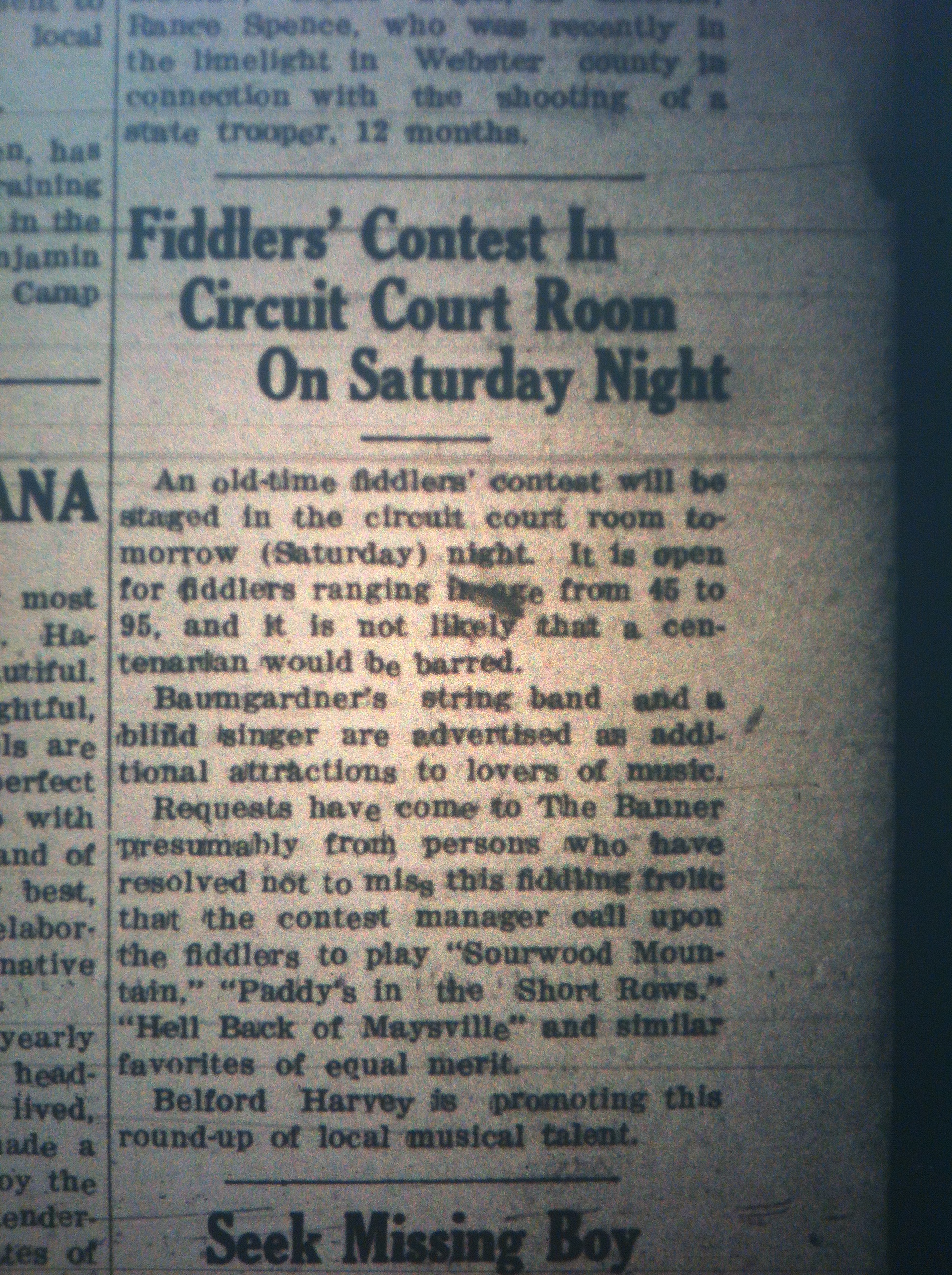
Fiddlers' Contest at Logan Circuit Court Room LB 04.29.1927.JPG

Logan (WV) Banner, 29 April 1927. Belford Harvey was a multi-instrumentalist associated with David Miller and the Guyandotte Mockingbirds.

Old-Time Fiddlers' Contest at Logan Courthouse LB 09.16.1927 1

Logan (WV) Banner, 16 September 1927.

History for Boone County, WV (1927)

28 Saturday Jul 2018

Posted by Brandon Ray Kirk in Boone County, Civil War, Native American History

≈ Leave a comment

Tags

Albert Allen, Appalachia, Ballardsville Methodist Church, Boone County, Cabell County, Charleston, civil war, Coal River, crime, Crook District, Daniel Boone, Danville, Edgar Mitchell, Frankfort, French and Indian War, genealogy, history, Jack Dotson, Johnson Copley, Kanawha County, Kanawha River, Kanawha Valley, Kentucky, Lee Sowards, Lewisburg, Logan Banner, Logan County, Madison, Missouri, Nathan Boone, North Carolina, Pennsylvania, Peytona District, Point Pleasant, Pond Fork, Ruckers Branch, Scott District, Sherman District, Spruce Fork, St. Albans, Virginia Assembly, Washington District, West Virginia, West Virginia Synodical School, Yadkin Valley

From the Logan Banner of Logan, WV, comes this bit of history about Boone County in a story dated December 9, 1927:

BOONE COUNTY

Boone county was created in 1847 of parts of Kanawha, Cabell and Logan counties. Its area is 06 miles, 65 miles larger than Logan, and in 1920 its population was 18,145. It is divided into five magisterial districts, as follows: Crook, Peytona, Scott, Sherman and Washington.

Boone county commemorates in West Virginia the name of Daniel Boone, the pathfinder to the west. It is an honor worthily bestowed, for who has not heard of Daniel Boone and the story of his efforts as an explorer, hunter, land-pilot and surveyor. His was a romantic life, picturesque and even pathetic. For more than a century he has he has been held as the ideal of the frontiersman, perhaps for the reason that his course in life was not marked by selfishness and self-seeking. He fought with the Indians, but was not tainted with the blood-lust that so often marred the border warrior and made him even more savage than the red man whom he sought to expel; he built and passed on to newer fields, leaving to others the fruits of his industry and his suffering. As a man needing plenty of “elbow room,” his places of residence mark the border between civilization and savagery for a period of fifty years. And there was a time, a period of nearly ten years, when his cabin home was on the banks of the Kanawha, a short distance above the present City of Charleston.

Daniel Boone was born in the Schulykill Valley, Pennsylvania, on November 2, 1734, but in 1750 removed with his parents to the Yadkin Valley, in North Carolina. Here he grew to manhood, married and reared a family, but was active as an Indian trader, frontiersman and defender of the feeble settlement. He was with Braddock’s army at its defeat on the Monongahela in 1755, and a few years later became the founder and defender of Kentucky. He strove with the red man with force and stratagem, and many are the fire-side tales recounted and retold in West Virginia homes of his prowess with the rifle; his ready plans and nimble wit that helped him out of situations that seemed almost impossible. Many, perhaps, are without foundation of fact; others contain enough of truth to leaven the story. Of his service to the western settlers, records preserved in the archives of state and nation show that he was indefatigable. At the Indian uprising in 1774, Boone was sent out to warn the settlers and surveyors, ranging from the settlement on the Holston river throughout all of what is now southern West Virginia to Lewisburg. In 1788, after he had lost his property in Kentucky through defective titles and failure to properly enter land grants, Boone and his family removed to Point Pleasant, at the mouth of the Great Kanawha, where they remained about one year. Contrary to his habit, his next move was toward the east to a site near the City of Charleston. When Kanawha county was formed in 1789 Boone was a resident and was named the first Lieutenant Colonel of the militia, and the following year, 1790, was elected a member of the lower house of the Virginia assembly. Colonel Boone left the Kanawha valley in 1799, removing to Missouri where he had been granted a thousand arpents of land by the Spanish government and had been appointed a Syndic for the Femme-Osage district–a local office combining the duties of sheriff, jury and military commandant. Colonel Boone died at the home of his youngest son, Colonel Nathan Boone, on the Femme Osage river, Missouri, September 26, 1820. His remains, with those of his wife, were some years later taken to Frankfort, Kentucky, and re-interred with pomp and ceremony. A monument erected by the state marks his last resting place.

Madison, the present county seat, is located at the junction of Pond Fork and Spruce Fork, which form Coal River, is 603 feet above sea level and in 1920 had a population of 604. It was incorporated as a town by the circuit court of that county in 1906. At the organization of the county in 1847, the seat of justice was located on the lands of Albert Allen, at the mouth of Spruce Fork, opposite the present town of Madison. The original court house was burned by Federal troops during the Civil War, and for a time thereafter the seat of justice was located at the Ballardsville Methodist Church. In 1866 the court house was re-located on the lands of Johnson Copley, opposite the old site, and the public buildings erected, which were used until 1921 when the present fine court house was erected.

The West Virginia Synodical School maintained and operated by the Presbyterian church, occupies the site of the original court house, opposite the present county seat.

Danville, another incorporated town in that county, had a population of 327 in 1920.

Source: Logan (WV) Banner, 9 December 1927.

Old Trees at Boone Courthouse, Hangings LB 03.22.1927.JPG

Logan (WV) Banner, 22 March 1927.

Dempsey-Sharkey Fight (1927)

24 Tuesday Jul 2018

Posted by Brandon Ray Kirk in Logan, Sports

≈ Leave a comment

Tags

Appalachia, boxing, genealogy, history, Jack Dempsey, Jack Sharkey, Logan, Logan Banner, Logan County, Smoke House Restaurant, West Virginia

Dempsey-Sharkey Fight at the Smoke House Ad LB 07.19.1927

Logan (WV) Banner, 19 July 1927.

Here’s video footage of the fight: https://www.youtube.com/watch?v=Btvw6GM33II

Hugh Toney Letter to Edward Chapman (1861)

24 Tuesday Jul 2018

Posted by Brandon Ray Kirk in Chapmanville, Civil War, Giles County

≈ Leave a comment

Tags

11th Virginia Cavalry, Appalachia, Camp Narrows, Chapmanville, civil war, Confederate Army, Edward Chapman, Giles County, history, Hugh Toney, J. Green McNeely, Logan Banner, Logan Country Club, Logan County, North Carolina, Virginia, West Virginia

Rev. J. Green McNeely (1871-1943) located the following letter written by Hugh Toney to Edward Chapman when he razed a log cabin situated on the property that later became the Logan Country Club, near Chapmanville.

Camp Narrows, Va.

March 26, 1861

Dear Friend:

I saw the officers of the 11th Virginia Cavalry about your horses. Col. French and Maj. Smith both say that your horse shall be give up if the horse can be found.

I have not been able to find out anything about who got your horse yet. The horses were sent off to North Carolina. If I have any chance to get your horse, I will attend to the matter for you. If you know the man’s names or any of the men’s names that was present when your horse was taken, write to me their names.

I have made careful inquiries about Ira Woodram’s horse. I have not been able to find out anything about his horse, also John’s. I can’t bear that horses were taken.

I can’t find out who took them, it being uncertain about getting your horse or pay for him the way matters stand at this time.

Your friend,

Hugh Toney

Source: Logan (WV) Banner, 25 June 1941.

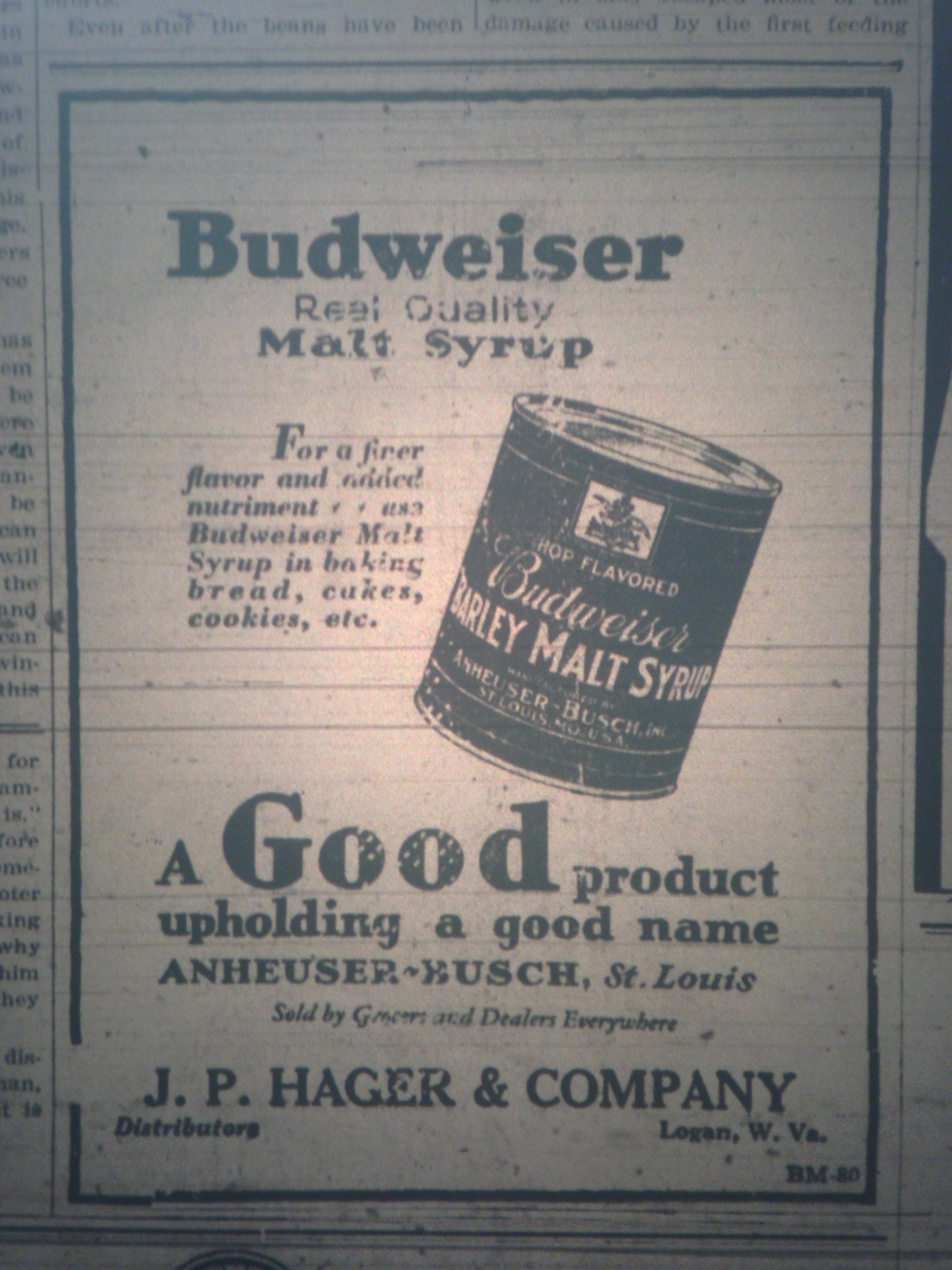
Budweiser Advertisement (1928)

23 Monday Jul 2018

Posted by Brandon Ray Kirk in Logan

≈ Leave a comment

Tags

Anheuser-Busch, Appalachia, Budweiser, history, J.P. Hager & Company, Logan, Logan Banner, Logan County, St. Louis, West Virginia

Budweiser Ad LB 06.08.1928.JPG

Logan (WV) Banner, 8 June 1928.

History for Wyoming County, WV (1927-1928)

23 Monday Jul 2018

Posted by Brandon Ray Kirk in Coal, Native American History, Wyoming County

≈ Leave a comment

Tags

A.F. Wysong, Appalachia, architecture, Baileysville District, Barkers Ridge District, Center District, Charleston, Clear Fork District, coal, crime, Early Brothers, Gertrude of Wyoming, Guyan Heating and Plumbing Company, history, Huff's Creek District, Logan, Logan Banner, Logan County, Maughwaiwama, Mingo County, Mullens, Native American History, Native Americans, Oceana, Oceana District, Pineville, Princeton, Slab Fork District, Thomas Campbell, West Virginia, Wyoming County, Wysong & Bengston

From the Logan Banner of Logan, WV, comes this bit of history about Wyoming County, dated 1927 and 1928:

Wyoming County In the Public Eye

Now that three railroads are contesting for the authority to build a branch line across Wyoming county, increased interest is shown in the probable early development in that bailiwick.

Wyoming has coal resources equal to those of any other county in the state, it is said, and it has wide valleys of fine farming land, and an unusually picturesque mountain country. Like Mingo, it was carved out of Logan territory, its formation having been authorized by an act of the general assembly passed January 26, 1850. With an area of 507.30 square miles it is more than 50 miles larger than this county, yet its population in 1920 was only 15,180.

That county’s valuation for taxation purposes exceeded $28,000,000 last year.

Wyoming county is divided into seven magisterial districts, as follows: Baileysville, Barkers Ridge, Center, Clear Fork, Huff’s Creek, Oceana and Slab Fork districts.

Wyoming county was stricken off from the older county of Logan, which took its name from a celebrated Indian chief. Another county was formed from Logan, many years later, and to this was given the name of Mingo, the tribe to which Logan belonged. Logan, Mingo and Wyoming are the three counties in West Virginia whose names are derived from the original settlers.

Wyoming county bears the name of an Indian tribe, and this tribe was later honored by having its name adopted by one of our great western States. While the derivation of the name, in its application to the county, seems to be clear, the origin of the name itself is veiled in obscurity. By some authorities it is said to be a corruption of the Indian Maughwaiwama, signifying a plain, or open space. Others assert that it is a creation of Thomas Campbell, the poet, and author, of “Gertrude of Wyoming.”

Pineville, the present county seat, is located near the center of the county. It has an elevation of 1,323 feet above the level of the sea and had a population of 304 in 1920. Later estimates do not greatly increase this figure. Pineville became the county seat years ago, having secured the removal of the seat of justice from the older town of Oceana.

Mullens, a prosperous town and center of the coal industry, had a population of 1,425 in 1920.

Oceana, long the county seat before its removal to Pineville, had at the last census a population of 90.

Source: Logan (WV) Banner, 25 November 1927.

***

WYOMING COUNTY HAS NEW JAIL–NATIVE STONE USED–COST $150,000

Wyoming county’s new jail at Pineville has been accepted by the architects and will be formally turned over within the next few days.

Erected at a cost of approximately $150,000, the new bastille is perhaps one of the finest buildings of its kind in the southern part of the state. It is built of native stone throughout, and is a most imposing and beautiful building and one of which the county may well pride itself, says the Mullins Advocate.

It is three full stories high above the basements, heated by vapor, containing room for 70 prisoners with comfort, and can accommodate twice that number, if necessary. The cells and jail construction is of tool proof steel, equipped with the latest locking devices. A prisoner when confined in a cell, must go through three sets of tool proof steel bars to make an escape.

The building contains a large and comfortable residence for the jailer, including a large, well furnished and equipped kitchen, is supplied with hot and cold water throughout, including shower baths on the inside corridors of the jail, padded cells for the insane, hospitals for the sick and detention rooms for juveniles of both sexes.

In the basement there is an incinerator, together with a laundry and large supply rooms.

The building was formally approved on January 9th by A.F. Wysong of the firm of Wysong & Bengston architects, of Charleston, who had the construction of this building in charge. Early Brothers, of Mullens, contractors, constructed the building, while the heating system was installed by the Guyan Heating and Plumbing company, of Mullens. The plumbing was done by Wickline of Princeton. Mr. Wysong, after going over the jail carefully, approved the construction and recommended payment of the balance due on the several contracts.

Source: Logan (WV) Banner, 17 January 1928.

Wife of Logan Banner Editor George A. Dean Disappears (1912-1913)

20 Friday Jul 2018

Posted by Brandon Ray Kirk in Huntington, Logan, Matewan, Tazewell County

≈ Leave a comment

Tags

Albermarle, Appalachia, Bluefield, Buchanan, Collier's Weekly, Dry Fork, genealogy, George A. Dean, Henry Clay Ragland, Herald-Dispatch, history, Huntington, Iaeger, Imperial Order of Redmen, J.B. ellison, Jefferson Hotel, Kentucky, Keyes Sisters, LaRoy Stock Company, Lena Boyd Nelson, Lena Gross, Logan, Logan Banner, Logan County, Logan Democrat, Logan Nest 1442, Matewan, Modern Maccabees, Norfolk and Western Railroad, North Carolina, Order of Owls, Sayersville, Silver Cloud Tribe 138, Tazewell County, Virginia, W.L. Richardson, West Virginia, Williamson

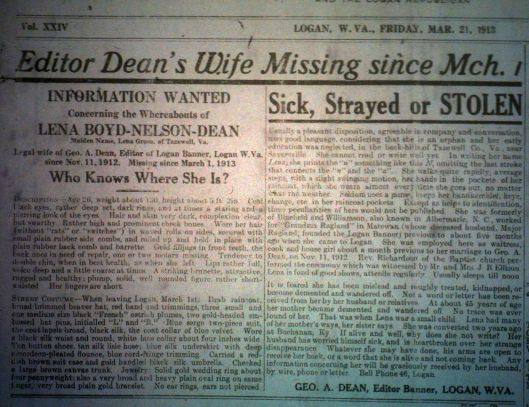
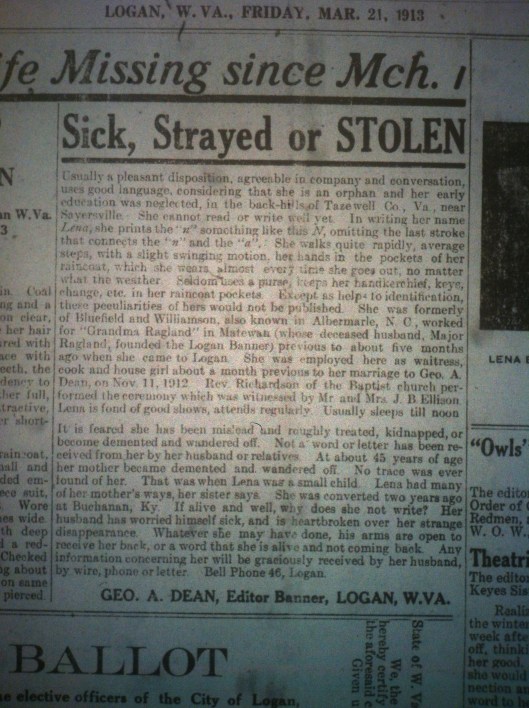
In 1912, Logan Banner editor George A. Dean married the former Lena Gross, who soon thereafter disappeared. Here are a few stories about the event:

Editor Dean Married

On Monday, Nov. 11 in the minister’s study, Geo. A. Dean and Miss Lena Gross of Virginia, were united in marriage by Rev. W.L. Richardson.

Mr. Dean is the hustling editor of the Logan Banner and is well-known in this city and surrounding country as a man of push and energy, while the bride was one of the charming dining room girls at the Hotel Jefferson.

Mr. and Mrs. Dean will be at home to their friends after Nov. 18.

Source: Logan (WV) Democrat, 14 November 1912.

***

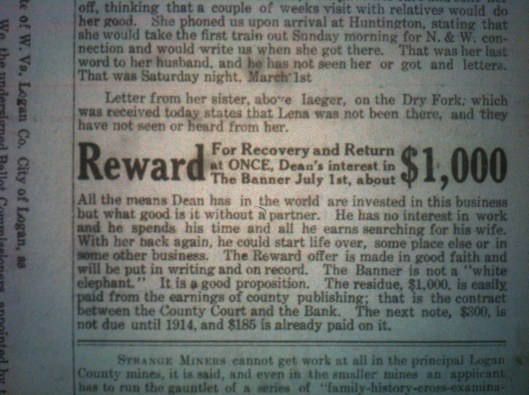
George A. Dean Logan Banner LB 01.24.1913.JPG

Logan (WV) Banner, 24 January 1913.

***

Editor of “Most Fearless Weekly” on the Trail

West Virginia editors who have failed to receive the Logan Banner on their exchange tables during the past three weeks, no doubt, marveled at its absence. But there is a reason–a tragic, gnawing reason which has caused the editor, Geo. A. Dean to suspend temporarily editorial duties and to embark upon a quest which means more to him than journalistic honors or the mere touch of hollow gold.

Readers of the Banner will remember that there appeared graven upon its front page four months ago Mr. Dean’s and his wife’s own announcement of their marriage. The paragraph attracted more than usual attention, partly because of its unique construction and partly because of the unusual manner of its presentation, but more than all because Mr. Dean was very prominently in the editorial limelight because of recent rather prominent mention in Collier’s Weekly. But that is history, and in mere prelude to the situation which now confronts him: to-wit: that of a married man, wifeless, disconsolate, yearning for the things that were.

Mr. Dean, who has been in Huntington and vicinity for two days seeking a trace of his evanished spouse, speaks frankly of his bereavement, and is importunate that the home-loving public shall, if possible, assist him in finding and restoring his lost treasure. In brief, Lena Boyd Nelson Dean has gone away and, some fear, forever departed. She went without the tender formality of a farewell husband’s kiss. She went away surreptitiously, mysteriously. She went, and Mr. Dean, who has sounded the very depths of heaven and earth, is no whit the wiser whither. Descriptive circulars, telling her height, weight, complexion, color of eyes and hair, manner of dress, and all that pertains to accurate and dependable description have been scattered broadcast all over the territory in which it might be surmised that she would be obscuring herself from the eyes of love and yearning. Mr. Dean stated last night, in conversation with the Herald-Dispatch, that he had absolutely no heart for business, that he had known no rest, no surcease from the terrible heart-longing that had seized upon him and held with tenacious grip from the morning of his wife’s departure. He has searched high and low. He has communicated with every known relative of his wife, without being able to get even the shadow of a clue tending to lead to the discovery of her whereabouts. He gives the following verbal photograph, which is almost as good as the ordinary studio product, and much better than a tintype:

Lena Boyd Nelson Dean, formerly of Williamson and Matewan and Bluefield. Four months ago she served as waitress, cook, and house girl at Logan, W.Va. Last seen at Kenova on Sunday morning, March 2. Physical description: Age 26. Height 5 ft. 2. Coal-black eyes given to starry twinkle. Raven black hair. Rather full lips. Gold filling in front teeth. Deep, well modulated musical voice, with a tendency to coarseness in time of cold. Can not read or write much as her early education was neglected. Her costume is described as being strict in the style of today. Raincoat, drab-colored; blue-serge, two piece coat suit. Beaver hat, embellished with four black ostrich plumes. Leather suitcase, canvass trunk and gold-headed umbrella.

Mr. Dean feels that his wife may have returned to one of the three occupations ascribed to her in the opening paragraphs.

He has important mail for her, both registered and ordinary, and is awaiting anxiously any news of her, and his arms are open to her return. The Logan editor’s plight is positively pitiful. He has grown emaciated, hollow-eyed, faded, wan. The tireless vigil, the ceaseless search, the anxious waiting hours, have all played their part in preying upon his splendid vitality. He is discouraged but not defeated, and will continue the search as long as human endurance will permit, or else sooner find the partner of his joys and immediate cause of his great and overpowering grief. His plight has elicited much sympathy. For what is life without a partner?

Source: Huntington (WV) Herald-Dispatch via Logan (WV) Democrat, 13 March 1913.

***

George A. Dean's Wife Missing LB 03.21.1913 1

Logan (WV) Banner, 21 March 1913.

George A. Dean's Wife Missing LB 03.21.1913 2

Logan (WV) Banner, 21 March 1913.

George A. Dean's Wife Missing LB 03.21.1913 3

Logan (WV) Banner, 21 March 1913.

George A. Dean's Wife Missing LB 03.21.1913 4

Logan (WV) Banner, 21 March 1913.

George A. Dean's Wife Missing LB 03.21.1913 5

Logan (WV) Banner, 21 March 1913.

George A. Dean's Wife Missing LB 03.21.1913 6

Logan (WV) Banner, 21 March 1913.

Jack Dempsey and Bill “Bear Cat” Clemons (1926)

19 Thursday Jul 2018

Posted by Brandon Ray Kirk in Logan, Sports

≈ Leave a comment

Tags

Appalachia, Bear Cat Clemons, Gene Tunney, genealogy, Guyandotte Valley, history, Jack Dempsey, Logan Banner, Logan County, New York, West Virginia

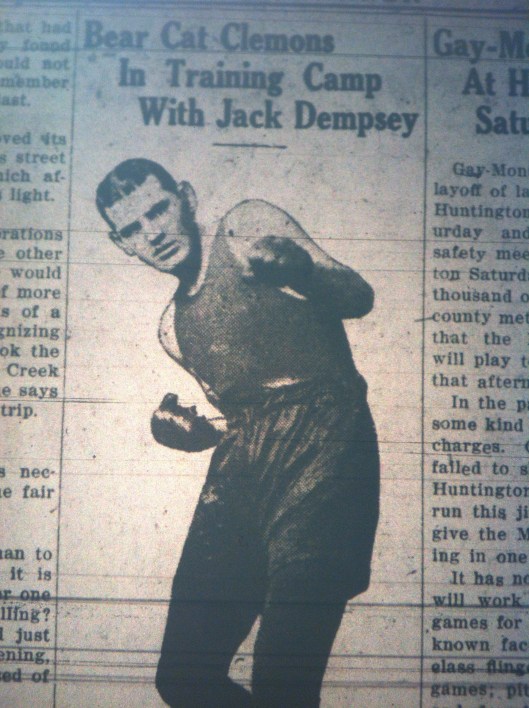
From the August 20, 1926 issue of the Logan Banner of Logan, WV, comes this bit of history about heavyweight champion boxer Jack Dempsey:

Bear Cat Clemons Training with Jack Dempsey LB 08.20.1926 3

Bear Cat Clemons, once upon a time the idol of the fistic fans of the Guyan Valley, is now in Jack Dempsey’s training camp at Sarasota Lake, New York, where Dempsey is training for his fight with Gene Tunney in New York, September 16.

Clemons goes two rounds with Dempsey every day. The champion lambasts him furiously and messes up his features, but he always is back the next day for more. When Dempsey and Clemons face each other in the squared circle, it is Logan county versus Logan county.

Source: Logan (WV) Banner, 20 August 1926.

Chapmanville News 04.06.1928

17 Tuesday Jul 2018

Posted by Brandon Ray Kirk in Chapmanville, Huntington

≈ Leave a comment

Tags

A. Lunsford, A.F. Carper, Appalachia, Chapmanville, Chapmanville School, Charleston, Demosthenian Literary Society, genealogy, Glenna Beckett, Henlawson, history, Huntington, Inez Barker Grace, Logan Banner, Logan County, Platonian Literary Society, Sid Ferrell, W.D. Nunley, West Virginia

An unknown correspondent from Chapmanville in Logan County, West Virginia, offered the following items, which the Logan Banner printed on April 6, 1928:

The Platonian Literary Society of the Chapmanville school entertained the Demosthenian Literary Society Friday evening, with a party at the school building. Every student present reported a very enjoyable time.

We are sorry to report the death of Mr. and Mrs. A. Lunsford’s baby, which occurred Saturday, March 31.

Mrs. Renner spent the week end in Huntington with homefolks.

Mrs. Inez Barker Grace spent the week end in Huntington with Mr. and Mrs. W.D. Nunley.

Mrs. A.F. Carper who has been very sick is able to be out again.

Miss Glenna Beckett of Charleston is visiting homefolks here at the present time.

Sid Ferrell of Henlawson spent Sunday in Chapmanville.

Street Fight in Chapmanville, WV (1927)

15 Sunday Jul 2018

Posted by Brandon Ray Kirk in Chapmanville

≈ Leave a comment

Tags

Appalachia, Chapmanville, genealogy, Guy Dingess, history, Hobart Ramey, J.A. White, Logan Banner, Stack Whitman, West Virginia

Chapmanville Street Fight LB 12.13.1927.JPG

Logan (WV) Banner, 13 December 1927.

History for Boone County, WV (1928)

15 Sunday Jul 2018

Posted by Brandon Ray Kirk in Boone County, Huntington, Logan

≈ 2 Comments

Tags

Appalachia, Boone County, Camp Creek, Charles L. Estep, civil war, Coal River, Coal Valley News, Cumberland Gap, Danville, education, Hadalton, history, Huntington, Isaac Barker, Jackie Dolin, John E. Kenna, John Halstead, John Morris, Kanawha River, Kentucky, Kinder Hill, Little Coal River, Logan, Logan Banner, Madison, Marshall A. Estep, Maysville, Mud River, North Carolina, Ohio River, Olive Branch Baptist Church, Spruce Fork, Spruce Ridge, Texas, Thomas Price, Turtle Creek, W.H. Turley, W.W. Hall, West Virginia, White Oak Creek, Wilderness Road

A story titled “Old Times in Boone County Told About By Historian” and printed in the Logan Banner in Logan, WV, on April 20, 1928 provides some history for Boone County:

Old-timers and students of local history should be interested in the following excerpt from the history of Boone county by Prof. W.W. Hall. The family names mentioned are familiar ones.

What is here reproduced was taken from the Coal Valley News:

About the year of 1798 Isaac Barker reared a pole cabin on the brow of the hill on the lower side of White Oak Creek, near old lock seven. This was the first white man’s home established in Boone county. The second settler in the county was Johnson Kinder, a brother-in-law of Barker. He settled on Kinder Hill a few months after Barker came. The first settler on Little Coal River was John Halstead, who settled at the mouth of Camp creek about 1800. A few months later Jackie Dolin was married to Isaac Barker’s daughter and led his blushing bride, attired in her homespun, through the trackless forest up Brush creek and over the hill to a scantily furnished home on Camp creek. Not long after this Thomas Price, a daring hunter from North Carolina, wandered over the Wilderness Road through Cumberland Gap to Maysville, Kentucky, where he embarked in a canoe, ascended the Ohio, the Kanawha, the Coal and the Little Coal rivers to the present site of the town of Danville, and became the first settler there.

For some years after the coming of the white men there were no churches, but when an Old Baptist or Methodist preacher would arrive in the settlement, word was passed around to the neighbors and that night earnest prayers, exhortations and hallelujahs would ascend from those rude homes. The first church erected in the county was the Olive Branch Baptist church at the mouth of Turtle creek. The first term of the circuit court held in the county after its organization in 1847 was held in this church. The grand jury made its investigations while seated on the framing in Ballard’s old water mill near by, and the petit jury retired to the paw paw bushes below to consider their verdicts.

The daring hunters, adventurous pioneers and brave soldiers who came from the best families in the east to establish home in the wilderness, were not contented to let their children grow up without the rudiments of an education, so they established Old Field schools in the slave cabins, tanneries, country churches and abandoned dwellings, when an itinerant teacher who could read, write and cipher a little came along. The first free school in the county was taught by John Morris, just after the Civil War, in an old house abandoned by Dr. Church. The old house stood across the hollow from W.H. Turley’s present residence in Madison. Within the next year or two a log school house was erected near the upper end of Danville and another on the point across the river from Hadalton. The children of Madison had to go to Danville or Hadalton to school until 1885, when the people of Madison, by mandamus, compelled the board of education to give them a school. The first school house erected in Madison is now used by Dr. Smoot for a barn. While the course of study in these early schools was meager and the work crude, yet they did succeed in inspiring a few boys to strive for higher education. Former United States Senator John E. Kenna was born in Boone county and attended his first schools in a log house on Big Coal river. Dr. Marshall A. Estep, an eminent physician of Texas, and his brother, Judge Charles L. Estep, of Huntington and Logan, were reared in the “Promised Land,” the name of their father’s mountain home on the summit of Spruce Ridge, and attended their first schools in a log house on the Spruce Fork. One of these early log school houses still stands on the head of Mud river, remote from the highways frequented by trade and travelers. Two of the most recent prosecuting attorneys of the county, two clerks of the circuit court, two of the clerks of the county court, four county superintendents of schools, chief U.S. Marshal for the southern district of West Virginia, and two prosperous dental surgeons attended school when boys in that little log school house on the head of Mud. The attendance in it was never large.

Ku Klux Klan in Logan, WV (1927-1928)

06 Friday Jul 2018

Posted by Brandon Ray Kirk in Logan

≈ Leave a comment

Tags

Appalachia, First Methodist Church, history, Ku Klux Klan, Logan, Logan Banner, Logan County, Old Glory Club, Stratton Street, West Virginia

KKK Buys Lot in Logan LB 12.23.1927

Logan (WV) Banner, 23 December 1927.

KKK Headquarters in Logan LB 01.17.1928

Logan (WV) Banner, 17 January 1928.

Chapmanville News 12.09.1927

06 Friday Jul 2018

Posted by Brandon Ray Kirk in Chapmanville, Huntington, Logan

≈ Leave a comment

Tags

Appalachia, Bernie Young, Chapmanville, genealogy, history, Huntington, Kentucky, Lizzie Crislip, Logan, Logan Banner, Logan County, Maude Fillinger, West Virginia, Willa Lowe

An unknown correspondent from Chapmanville in Logan County, West Virginia, offered the following items, which the Logan Banner printed on December 9, 1927:

Rev. Sreves’ wife is improving very slowly.

Miss Willa Lowe and Miss Maude Fillinger are spending a few days in Logan.

Mrs. Lizzie Chrislip and friends made a trip to Huntington Sunday.

Bernie Young was calling on friends here Sunday.

We were very glad to welcome the Cox family back again after they spent a few years in Kentucky.

← Older posts
Newer posts →

Feud Poll 1

If you had lived in the Harts Creek community during the 1880s, to which faction of feudists might you have given your loyalty?

Categories

  • Adkins Mill
  • African American History
  • American Revolutionary War
  • Ashland
  • Atenville
  • Banco
  • Barboursville
  • Battle of Blair Mountain
  • Beech Creek
  • Big Creek
  • Big Harts Creek
  • Big Sandy Valley
  • Big Ugly Creek
  • Boone County
  • Breeden
  • Calhoun County
  • Cemeteries
  • Chapmanville
  • Civil War
  • Clay County
  • Clothier
  • Coal
  • Cove Gap
  • Crawley Creek
  • Culture of Honor
  • Dingess
  • Dollie
  • Dunlow
  • East Lynn
  • Ed Haley
  • Eden Park
  • Enslow
  • Estep
  • Ethel
  • Ferrellsburg
  • Fourteen
  • French-Eversole Feud
  • Gilbert
  • Giles County
  • Gill
  • Green Shoal
  • Guyandotte River
  • Halcyon
  • Hamlin
  • Harts
  • Hatfield-McCoy Feud
  • Holden
  • Hungarian-American History
  • Huntington
  • Inez
  • Irish-Americans
  • Italian American History
  • Jamboree
  • Jewish History
  • John Hartford
  • Kermit
  • Kiahsville
  • Kitchen
  • Leet
  • Lincoln County Feud
  • Little Harts Creek
  • Logan
  • Man
  • Matewan
  • Meador
  • Midkiff
  • Monroe County
  • Montgomery County
  • Music
  • Native American History
  • Peach Creek
  • Pearl Adkins Diary
  • Pecks Mill
  • Peter Creek
  • Pikeville
  • Pilgrim
  • Poetry
  • Queens Ridge
  • Ranger
  • Rector
  • Roane County
  • Rowan County Feud
  • Salt Rock
  • Sand Creek
  • Shively
  • Spears
  • Sports
  • Spottswood
  • Spurlockville
  • Stiltner
  • Stone Branch
  • Tazewell County
  • Timber
  • Tom Dula
  • Toney
  • Turner-Howard Feud
  • Twelve Pole Creek
  • Uncategorized
  • Warren
  • Wayne
  • West Hamlin
  • Wewanta
  • Wharncliffe
  • Whirlwind
  • Williamson
  • Women's History
  • World War I
  • Wyoming County
  • Yantus

Feud Poll 2

Do you think Milt Haley and Green McCoy committed the ambush on Al and Hollene Brumfield in 1889?

Blogroll

  • Ancestry.com
  • Ashland (KY) Daily Independent News Article
  • Author FB page
  • Beckley (WV) Register-Herald News Article
  • Big Sandy News (KY) News Article
  • Blood in West Virginia FB
  • Blood in West Virginia order
  • Chapters TV Program
  • Facebook
  • Ghosts of Guyan
  • Herald-Dispatch News Article 1
  • Herald-Dispatch News Article 2
  • In Search of Ed Haley
  • Instagram
  • Lincoln (WV) Journal News Article
  • Lincoln (WV) Journal Thumbs Up
  • Lincoln County
  • Lincoln County Feud
  • Lincoln County Feud Lecture
  • LinkedIn
  • Logan (WV) Banner News Article
  • Lunch With Books
  • Our Overmountain Men: The Revolutionary War in Western Virginia (1775-1783)
  • Pinterest
  • Scarborough Society's Art and Lecture Series
  • Smithsonian Article
  • Spirit of Jefferson News Article
  • The Friendly Neighbor Radio Show 1
  • The Friendly Neighbor Radio Show 2
  • The Friendly Neighbor Radio Show 3
  • The Friendly Neighbor Radio Show 4
  • The New Yorker
  • The State Journal's 55 Good Things About WV
  • tumblr.
  • Twitter
  • Website
  • Weirton (WV) Daily Times Article
  • Wheeling (WV) Intelligencer News Article 1
  • Wheeling (WV) Intelligencer News Article 2
  • WOWK TV
  • Writers Can Read Open Mic Night

Feud Poll 3

Who do you think organized the ambush of Al and Hollene Brumfield in 1889?

Recent Posts

  • Logan County Jail in Logan, WV
  • Absentee Landowners of Magnolia District (1890, 1892, 1894)
  • Charles Spurlock Survey at Fourteen Mile Creek, Lincoln County, WV (1815)

Ed Haley Poll 1

What do you think caused Ed Haley to lose his sight when he was three years old?

Top Posts & Pages

  • Civil War Gold Coins Hidden Near Chapmanville, WV
  • West Virginia Banjo Player 5
  • Chapmanville News 06.29.1926
  • "Holly Creek" John Mullins Grave in Clintwood, VA (2018)
  • Baisden Family Troubles

Copyright

© Brandon Ray Kirk and brandonraykirk.wordpress.com, 1987-2023. Unauthorized use and/or duplication of this material without express and written permission from this blog’s author and/or owner is strictly prohibited. Excerpts and links may be used, provided that full and clear credit is given to Brandon Ray Kirk and brandonraykirk.wordpress.com with appropriate and specific direction to the original content.

Archives

  • February 2025
  • January 2025
  • October 2023
  • September 2023
  • December 2022
  • November 2022
  • May 2022
  • April 2022
  • February 2022
  • November 2021
  • October 2021
  • September 2021
  • June 2021
  • May 2021
  • April 2021
  • March 2021
  • February 2021
  • January 2021
  • December 2020
  • November 2020
  • October 2020
  • July 2020
  • June 2020
  • May 2020
  • April 2020
  • March 2020
  • February 2020
  • January 2020
  • December 2019
  • November 2019
  • October 2019
  • September 2019
  • August 2019
  • July 2019
  • June 2019
  • May 2019
  • April 2019
  • March 2019
  • February 2019
  • January 2019
  • December 2018
  • November 2018
  • October 2018
  • September 2018
  • August 2018
  • July 2018
  • June 2018
  • May 2018
  • April 2018
  • March 2018
  • February 2018
  • January 2018
  • December 2017
  • November 2017
  • October 2017
  • September 2017
  • August 2017
  • July 2017
  • June 2017
  • May 2017
  • April 2017
  • March 2017
  • February 2017
  • January 2017
  • December 2016
  • November 2016
  • October 2016
  • September 2016
  • August 2016
  • July 2016
  • June 2016
  • May 2016
  • April 2016
  • March 2016
  • February 2016
  • January 2016
  • December 2015
  • November 2015
  • October 2015
  • September 2015
  • August 2015
  • July 2015
  • June 2015
  • May 2015
  • April 2015
  • March 2015
  • February 2015
  • January 2015
  • December 2014
  • October 2014
  • September 2014
  • August 2014
  • July 2014
  • June 2014
  • May 2014
  • April 2014
  • March 2014
  • February 2014
  • January 2014
  • December 2013
  • November 2013
  • October 2013
  • September 2013
  • August 2013
  • July 2013
  • June 2013
  • May 2013
  • April 2013
  • March 2013
  • February 2013
  • January 2013
  • December 2012
  • November 2012

Enter your email address to follow this blog and receive notifications of new posts by email.

Join 2,927 other subscribers

Tags

Appalachia Ashland Big Creek Big Ugly Creek Blood in West Virginia Brandon Kirk Cabell County cemeteries Chapmanville Charleston civil war coal Confederate Army crime culture Ed Haley Ella Haley Ferrellsburg feud fiddler fiddling genealogy Green McCoy Guyandotte River Harts Harts Creek Hatfield-McCoy Feud history Huntington John Hartford Kentucky Lawrence Haley life Lincoln County Lincoln County Feud Logan Logan Banner Logan County Milt Haley Mingo County music Ohio photos timbering U.S. South Virginia Wayne County West Virginia Whirlwind writing

Blogs I Follow

  • OtterTales
  • Our Appalachia: A Blog Created by Students of Brandon Kirk
  • Piedmont Trails
  • Truman Capote
  • Appalachian Diaspora

BLOOD IN WEST VIRGINIA is now available for order at Amazon!

Blog at WordPress.com.

OtterTales

Writings from my travels and experiences. High and fine literature is wine, and mine is only water; but everybody likes water. Mark Twain

Our Appalachia: A Blog Created by Students of Brandon Kirk

This site is dedicated to the collection, preservation, and promotion of history and culture in Appalachia.

Piedmont Trails

Genealogy and History in North Carolina and Beyond

Truman Capote

A site about one of the most beautiful, interesting, tallented, outrageous and colorful personalities of the 20th Century

Appalachian Diaspora

  • Subscribe Subscribed
    • Brandon Ray Kirk
    • Join 789 other subscribers
    • Already have a WordPress.com account? Log in now.
    • Brandon Ray Kirk
    • Subscribe Subscribed
    • Sign up
    • Log in
    • Report this content
    • View site in Reader
    • Manage subscriptions
    • Collapse this bar
 

Loading Comments...