Tags
Appalachia, Cecil Lambert, genealogy, Green Shoal, Guyandotte River, history, Lincoln County, Lincoln County Feud, photos, U.S. South, West Virginia

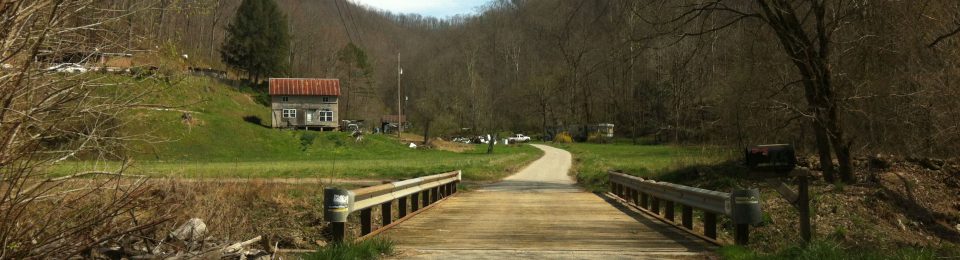
Cecil Lambert standing on the “green shoals” of Guyandotte River, Lincoln County, WV, 1996
22 Sunday Jun 2014
Posted in Green Shoal, Lincoln County Feud
Tags
Appalachia, Cecil Lambert, genealogy, Green Shoal, Guyandotte River, history, Lincoln County, Lincoln County Feud, photos, U.S. South, West Virginia
Cecil Lambert standing on the “green shoals” of Guyandotte River, Lincoln County, WV, 1996
22 Sunday Jun 2014
Posted in Green Shoal, Lincoln County Feud
Tags
Admiral S. Fry, Billy Adkins, Brandon Kirk, Cecil Lambert, crime, George Fry, Green McCoy, Green Shoal, history, John Hartford, Lincoln County Feud, Lon Lambert, Milt Haley, Virgie Rooney, Watson Lucas, writing
The next day, Brandon, Billy, and I went to investigate the Watson Lucas-Lon Lambert home at the mouth of Green Shoal. For a long time, we had suspected it of being the actual “murder house,” the place where Haley and McCoy had been brutally murdered in 1889. Cecil Lambert, the current owner and occupant of the dwelling, told us, however, upon our arrival that it was not the same house. He said his father, Lon, had told him prior to his death that the old Fry log house was long torn down. The Fry home, he said, had been located just a few feet downriver from the current home, generally at the present-day location of a garage. Cecil had done some recent remodeling and was pretty sure that his father was correct: he hadn’t found a single log anywhere behind the walls.
Cecil walked us over to a nearby embankment and showed us what he figured to be the last remaining vestige of the Fry house: some old foundation stones strewn down into a ditch. He then took us through the house, which (unfortunately for our imaginations) really didn’t have a nineteenth century look to it.
There was one thing on the second floor that excited us: easily visible through a large hole in the wall (courtesy of Cecil’s remodeling) were some old dried beans lying on the rafter “floor.” It made us think of what Vergia Rooney had said about people using the top story of the old Fry house for drying peaches and apples. Of course, the beans we could see were not George Fry’s…but finding them like we did sure struck us as a coincidence.
Back outside, Brandon walked around the house searching for anything that might connect it with the events of 1889. He made a significant find on the upriver side, which Vergia remembered as being part of the original house. Clearly visible in a corner was an old foundation stone just like the ones at the ditch. We did not notice any more old stones under the house that day, but Cecil later found many more after further remodeling. On the upriver (or “original”) side of the house, foundation stones were intact (at least partially) while on the downriver (or “newer”) side, foundation stones had been tossed in the ditch. There was also a “hidden” door on the downriver side of the house (where Vergia had remembered one swinging open in the old days).
Back at Billy’s, Brandon got out the Fry history book and located a picture of A.S. Fry’s home at Green Shoal, presumably taken around the time of the murders. We compared it mentally with what we remembered about the present home at Green Shoal and noted a few similarities but nothing really conclusive. Then we noticed in the photograph that the Fry dwelling had an extension of rough lumber off to one side that resembled the current Lambert house. It wasn’t clear whether the log portion was on the upriver or downriver side but if it was on the downriver side (the end Vergia said was torn away) it would explain why some of the old foundation stones were lying about in that direction. In such a scenario, both Vergia and Lambert would be correct in their account of what happened to the Fry house. In other words, there was a real chance that the building was at least partly intact — although radically remodeled.
21 Saturday Jun 2014
Posted in Lincoln County Feud
Tags
Blood in West Virginia, Brandon Kirk, feud, Harts, Harts Creek, history, Lincoln County, Lincoln County Feud, Logan County, West Virginia, writers, writing
If you enjoy reading Appalachian history, please consider purchasing my book, Blood in West Virginia.
http://www.pelicanpub.com/proddetail.php?prod=9781455619184#.U7Dwm08U9dg
20 Friday Jun 2014
Posted in Big Harts Creek, Culture of Honor, Ed Haley, Lincoln County Feud
Tags
Al Brumfield, Albert Dingess, Ben Adams, Bill's Branch, blind, Buck Fork, Dorothy Brumfield, Ed Haley, Ella Haley, feud, French Bryant, Green McCoy, Harts Creek, Harve "Short Harve" Dingess, history, Hollene Brumfield, Hugh Dingess, John Brumfield, Lincoln County Feud, Logan County, Milt Haley, Piney, Smokehouse Fork, Ticky George Adams, timbering, Violet Mullins, West Virginia, writing
Sensing that Dorothy had told all she knew about Ed and knowing that she was one-quarter Dingess, we asked her about Milt Haley.
“Some terrible things went on about Ed’s daddy,” she said. “I heard about that.”
Dorothy blamed the trouble squarely on Ben Adams. She said he was a “bully” who wanted to control all the timber on Harts Creek. He hired Milt Haley and Green McCoy to kill Al Brumfield but they accidentally shot Hollena.
“And them men that shot them went back in towards Kentucky somewhere and they put out a reward for them,” Dorothy said.
Haley and McCoy were soon caught and a Brumfield posse took possession of them.
Ben Adams organized a mob to free them at the mouth of Smoke House Fork but the Brumfields were warned by a spy and detoured up Buck Fork and over a mountain to Hugh Dingess’ house.
“The Adamses come a hair of catching them,” Dorothy said. “You can just imagine what kind of war would have been if they had a got them.”
A large number of men gathered in at Hugh’s for protection, including Albert Dingess (her great-grandfather), “Short Harve” Dingess (her great-uncle), John Brumfield, and French Bryant, among others. At some point, they took Milt outside and shot a few times to scare Green into making a confession inside Hugh’s, but Milt yelled, “Don’t tell them a damn thing. I ain’t dead yet!” McCoy yelled back, “Don’t be scared. I ain’t told nothing yet!”
Dorothy said the mob eventually took Milt and Green up Bill’s Branch and down Piney where they “knocked their heads out with axes and the chickens eat their brains.”
Just before we left Dorothy, we asked if she remembered any of Ed’s family. She said his uncle Ticky George Adams (the grandfather of her late husband) was a ginseng digger who spoke with a lisp and loved to heat hog brains. This image contrasted sharply with what others around Harts Creek had said: that he was a moonshiner who’d shoot someone “at the drop of a hat.” Violet Mullins had told us earlier how Ticky George would get “fightin’ mad” if anyone called him by his nickname. The only thing Dorothy knew about Ed’s wife was, “She went in the outside toilet and then after that some woman went in there and said they was a big blacksnake a hanging. They said she went places and played music.”
17 Tuesday Jun 2014
Posted in Big Harts Creek, Cemeteries, Culture of Honor, Lincoln County Feud, Spottswood, Timber
Tags
Ben Adams, Ben Adams Cemetery, genealogy, Harts Creek, history, Lincoln County Feud, Logan County, Trace Fork, Victoria Adams, West Virginia

Ben Adams grave, Trace Fork of Big Harts Creek, Logan County, WV, 27 March 2011
17 Tuesday Jun 2014
Posted in Big Harts Creek, Culture of Honor, Ed Haley, Lincoln County Feud, Timber
Tags
Allen Martin, Anthony Adams, Ben Adams, Boardtree Branch, Brandon Kirk, Charley Brumfield, crime, Ed Haley, Ewell Mullins, fiddling, Greasy George Adams, Green McCoy, Green Shoal, Harts, Harts Creek, history, Jeff Baisden, John Hartford, Jr., Kentucky, Lincoln County Feud, Logan County, Milt Haley, moonshining, murder, music, Paris Brumfield, Peter Mullins, Sol Adams, Still Hollow, Ticky George Adams, timbering, Trace Fork, Vilas Adams, West Virginia, Will Adkins, writing
Trying to lift our spirits, we went to see Vilas Adams, who lived on the Boardtree Branch of Trace Fork. Vilas was a great-grandson of Ben Adams and a grandson of Ticky George Adams. He was very friendly, inviting us inside his very nice home where his wife fed us a whole mess of good food, which we ate between asking questions.
I first asked him about his memories of Ed Haley, who he said frequented Ewell Mullins’ store during the late 1930s and early forties.
“Down there at old man Ewell’s store, they’d gather in there of an evening and tell tales, old man Jeff Baisden and them,” Vilas said. “My grandpaw Ant Adams and I would walk down there and then Ed would walk down there from Uncle Peter’s. It was a quarter a mile — just a little hop and a jump I call it. Ed would come in there and fiddle for them and if they wanted a certain song, they’d give him a quarter or fifty cents. That was good money I guess back then.”
Vilas’ grandfather Anthony Adams (a brother to Greasy George) always gave Ed a quarter to hear his favorite tune.
“What was Ed like?” I asked.
Vilas implied that he was withdrawn.
“Mostly he stayed with that fiddle,” he said. “He was good.”
Like most of the other older people in Harts, Vilas knew about the Haley-McCoy killings.
“My grandpaw would tell me them tales but I wouldn’t pay no attention,” he said. “He was telling about them fellers — Sol Adams — going over there and locating them and they went back and captured them. Well, his daddy Anthony tried to waylay them and take them back through here somewhere. They thought they’d come through these hills somewhere but they missed them.”
So, Sol Adams — a 20-year-old nephew to Ben Adams who was often called “Squire Sol” because of his status as an officer of the law — “went over and located Haley and McCoy” in Kentucky after the ambush. Meanwhile, his father Anthony and uncle Ben Adams, organized a gang to recapture them as the Brumfields brought them back through Harts Creek. This seemed strange: why would Sol operate against the interests of his family? And why would he have even been compelled to even become involved since he was a Logan County justice and the crime had occurred in Lincoln County?
Brandon asked Vilas if he knew who had been in the Adams gang and he said, “No, I’ve heard my grandpaw talk but I’ve forgot some of it. They was somebody from down around Hart somewhere. He said they took them over around Green Shoal or over in there somewhere and killed them. Grandpaw said they maybe hit them with axe handles.”
Vilas said his grandfather told him something horrible had happened to most of the men who murdered Haley and McCoy.
“He said just about every one of them that was in on that, something bad happened to them,” he said. “I heard one of them’s own boy killed one of them. And one of them got drowned and my grandpaw said the river wasn’t deep. Said he fell off a horse or something right at the mouth of Hart.”
Of course, Vilas was referring to Paris Brumfield, who was killed by his son Charley in 1891, and to Will Adkins, who drowned at the mouth of Harts Creek on November 23, 1889.
Brandon asked Vilas about “old Ben Adams” and he almost immediately started talking about the old timber business.
“See, that was my great-grandpaw,” he said. “They would build splash dams. They had one right out here. They had them tied some way or the other. And they built them up on Hart there, maybe up on Hoover, and they’d work all winter and put them logs in the creek. And in the spring when them floods come, it would wash all them logs down around Hart and then they’d put them together and raft them on down to Kenova. I guess that was all they had to make a living — timber and farm.”
Ben, of course, made his living in timber. He lived at the mouth of Adams Branch, a little tributary of Trace Fork presently referred to as Still Hollow.
“Over there at what we call Still Hollow, they said he had a still-house there and he had a license to make apple brandy back then,” Vilas said. “And he would go with a wagon everywhere and get apples. They was a log house over there in the mouth of that holler — just down the road here a little ways. When I was a boy the old log house was there, but it rotted down. Just one-story as far as I can remember. The old well’s there. He had some kind of an old store or saloon right there.”
Vilas speculated very little on Ben Adams’ personality, but compared him to his son, Greasy George Adams: “always a likeable fella but seemed like trouble followed him.” He heard that after Ben’s first wife died, he lived with first one woman, then the next. He eventually got into a heap of trouble by murdering a local postman, Jim Martin.
“He killed a fella right over there at the mouth of that hollow,” Vilas said. “My grandpaw said he had some sort of an old store or saloon and he was shooting out the door. Right there in the mouth of that holler. It broke him. Lawyers. Lost everything he had.”
It was rumored that Ben’s and Martin’s trouble had something to do with a woman or a right-of-way.
09 Monday Jun 2014
Posted in Culture of Honor, Harts, Lincoln County Feud
Tags
Al Brumfield, Bill Brumfield, Bill Fowler, Billy Adkins, Black John Adkins, Brandon Kirk, crime, Fed Adkins, feud, Green McCoy, Harts, Harts Creek, Harvey "Long Harve" Dingess, history, Hollena "Tiny" Brumfield, Hollene Brumfield, John W Runyon, Lincoln County Feud, logging, Milt Haley, Paris Brumfield, Pat Adkins, writing
Later in the summer, Brandon visited his friend Pat Adkins, who lived in a little trailer just back of where the old Al Brumfield home once sat at the mouth of Harts Creek. Pat was raised in the magnificent Brumfield house and was its owner at the time of its burning. He was a first cousin to Billy Adkins.
Pat first spoke about Al and Hollena Brumfield, who he said charged people a ten-cents-per-log tax at their boom. The tax was a constant source of friction in the community. Even Al’s in-laws weren’t fond of the fee…and apparently weren’t spared from it, either.
“One time, Harvey Dingess had a big huge amount of logs out there and he said he wasn’t gonna pay no ten cents a log tax,” Pat said. “Harvey was Hollene’s brother. They all liked to drink so he come in there being jovial and friendly and brought Al and Hollene in a big special-made malt whiskey. They got a big drunken party going and finally around twelve o’clock they all got so drunk they went to bed. Harve had his men stationed over there on that hillside and when he waved a light from that porch upstairs them men come down there and cut that splash and let his logs through. The Brumfields got up the next morning — all their hangovers — and went out and looked and that splash had been cut and all of his logs had been run through and Harve was gone. He was on his way to Huntington to sell them.”
Brandon asked Pat if the log boom was the root of the 1889 troubles.
“Bill Brumfield’s wife, Aunt Tiny, told me about the famous posse ride to lynch Milt Haley and Green McCoy,” Pat said, cutting to the chase. “Runyon had a store up on Hart and that was among Hollene’s relatives up in there and she had the big timber operations down here — the splash dam, you know — and had a saloon. Runyon had a legal still where people brought their apples in and stuff to make brandy. Somebody else run one of them too up there — a Dingess. They was into it over the business. Runyon thought that if he could kill them, he could take control of the mouth of Hart. When Hollene came into business that was what she done. She killed out her enemy, or never killed him — burned him out. That was Bill Fowler. Bill Fowler was a businessman and he come into possession of the mouth of the creek. He had him a big saloon out there and she burned him out and burned his saloon and then she took it over. So, I guess Runyon got the same idea: ‘You took it. Now I’m going to get it from you.’ So he hired these guys to kill them and if he’d a killed them they’d a been out of the way and that woulda pretty well cinched him for it. He had plenty of money and he’d a rolled in here and coulda bought it. He’d been the top man then.”
According to Pat, locals quickly determined that Haley and McCoy were involved in the ambush of Al and Hollena Brumfield and formed a mob to capture them.
“They formed about sixty men,” he said. “I know Black John Adkins was in it. John was there a holding the horses. He wasn’t taking no part in it — just going along to show he was in support. I think everybody in the country around in this area and all of Hollena’s relatives were in it. Runyon, he left the country when he realized that they might be coming after him because they suspected him as hiring them.”
Pat said Mrs. Brumfield believed that her husband Bill was too young to have participated in the killings but would have “been in on it if he’d a been old enough.” Pat didn’t think his Grandpa Fed Adkins was in the mob either, but then said, “He might have been — probably was. You know, the killing took place there, I think, about where Lon Lambert’s house is, down under that riverbank. Black John said when Paris came out from under that bank he was just as bloody as he could be where he had stabbed on them men. Said, Paris Brumfield was bloody as a hog. Said, he just took a knife and cut them to pieces and I think they gave Paris the honor of killing them because it was a vengeance killing. They dared anybody to ever touch their bodies. I think they laid about nine days and got to smelling so bad they finally give them permission to bury them.”
In Pat’s view, those who participated in the killing of Milt and Green were not typically violent men. Haley’s and McCoy’s apparent guilt in ambushing Al Brumfield provided a justification for their bloody murders in the eyes of locals and ensured that the “peace-keeping” reputations of the vigilantes would endure as stories about the feud were handed down to later generations. For instance, despite the dangerous reputation of Paris Brumfield, Pat said, “Other than the killing of Haley and McCoy, he was really not a mean person. That was understandable that he helped kill Haley and McCoy if somebody was trying to kill your son. I never heard that he was a mean person. I don’t think he deliberately went around plotting up mean things to do. And I don’t think he was a cruel person.”
Just before Brandon left Pat, he asked him about growing up in Al Brumfield’s house. Pat said when he was young he often hid behind some large framed Brumfield family photographs stacked in an upstairs room. There was one in particular that he remembered: a picture of Al Brumfield — worn and blind, sitting in a chair on a porch.
07 Saturday Jun 2014
Posted in Culture of Honor, Ed Haley, Green Shoal, Lincoln County Feud
Tags
Admiral S. Fry, George Fry, Green Shoal, history, life, Lincoln County, Lincoln County Feud, photos, West Virginia

George Fry home, Green Shoal, Lincoln County, WV
07 Saturday Jun 2014
Tags
Addison Vance, Admiral S. Fry, Basil Frye, Big Creek, Billy Adkins, Brandon Kirk, Burbus Dial, Cain Adkins, Chapmanville, crime, Essie McCann, Ferrellsburg, feud, Fry, George Fry, Green McCoy, Green Shoal, Harts Creek, history, John Hartford, Lincoln County Feud, Martha Dial, Milt Haley, West Fork, writing
I told Brandon that I would be coming to Harts at the end of July. In the meantime, he contacted Basil Frye, a grandson to George Fry. Basil, a resident of North Carolina, was old enough to know about the Haley-McCoy killings (he was born in 1925) but admittedly knew very little. He had heard through the family that his grandfather George agreed to let three “guards” stay overnight at his house with two prisoners (Milt and Green). That night, a mob of drunken vigilantes arrived with guns and demanded possession of the prisoners. The three guards allowed the gang to take Milt and Green outside where they were tied to a bush and eventually shot several times. The next morning, after daylight, the Frys and guards went outside and found the dead bodies.
Brandon asked Basil about the location of the old A.S. Fry-George Fry family home. He said he wasn’t sure of its location but always figured it to have been a short distance up Green Shoal, not at its mouth. He based that on the fact that his father, a son of George Fry, had been born in that vicinity in 1888 (a year before the killing). Billy Adkins had always heard that the old Fry home was up in that area, too, which caused a little doubt on our assuredness that the Milt and Green murders had taken place in the Lambert home at the mouth of Green Shoal. Brandon became even more confused when he went back to the Fry history and read how A.S. Fry (father of George) had two homes in the area: “a log cabin at Fry” (a.k.a. the mouth of Green Shoal) and “a stately house near Harts Creek, across the river from the log house.”
A little later, Brandon visited Essie McCann, an elderly neighbor in Ferrellsburg. Essie had been born on West Fork in 1910. She said her mother Martha Dial almost bumped into the 1889 mob as she rode toward her home on Big Creek with her husband. Upon hearing a troop of horses approaching their direction from Chapmanville, she and Mr. Dial knew it was the mob that had been recently sent out to capture Milt and Green. They hid in a patch of weeds near the riverbank and watched the mob ride by doubled up on horses. Essie said her mother recognized Addison Vance (a brother-in-law to Cain Adkins) riding in the group. Afterwards, Haley and McCoy were held in a house at Green Shoal where a group of men came and shot out the lights before killing them.
06 Friday Jun 2014
Posted in Big Harts Creek, Lincoln County Feud, Timber
Tags
Appalachia, crime, feud, Green McCoy, Haley-McCoy grave, Harts Creek, history, Lincoln County, Lincoln County Feud, logging, Milt Haley, timbering, U.S. South, West Fork, West Virginia

Haley-McCoy grave, West Fork of Harts Creek, Lincoln County, WV,
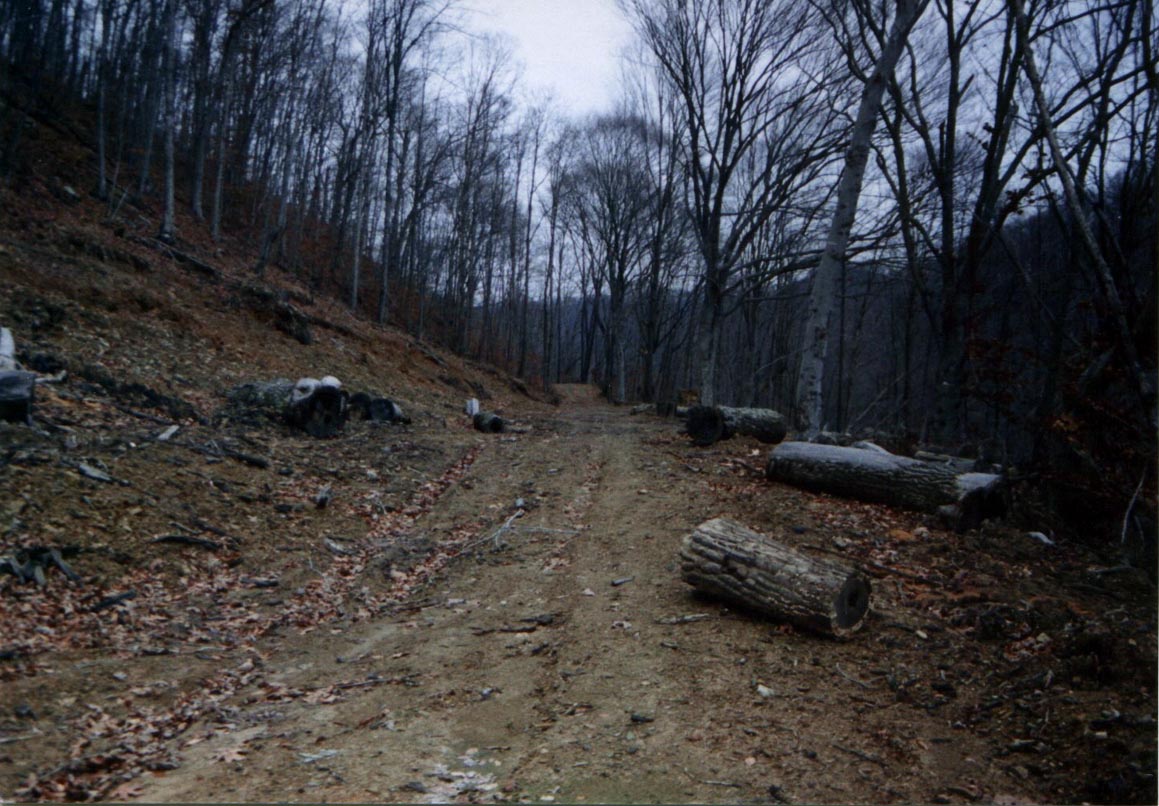
Logging job that nearly destroyed the Haley-McCoy grave
06 Friday Jun 2014
Posted in Big Harts Creek, Culture of Honor, Ed Haley, Lincoln County Feud
Tags
Billy Adkins, Brandon Kirk, Doug Owsley, feud, Green McCoy, John Hartford, Lincoln County, Lincoln County Feud, Milt Haley, Smithsonian, timbering, West Fork, West Virginia, writing
On July 4th, Brandon and Billy learned that a timber crew had been working at the Haley-McCoy grave for several days. Horrified, they raced to the site and found the ground ripped up, trees felled, and huge machinery roaring and chewing all over the mountainside. The Haley-McCoy grave was lost amidst toppled trees and fresh timber roads. Workers said the grave was okay, although property owners had not told them it was there.
When Brandon called me with this news, I told him there might be a positive outcome to the whole mess. Maybe we could now approach some people about exhuming the grave. He was all for it now.
“You know, we could try Doug Owsley at the Smithsonian,” I said. “He could tell us all kinds of things about them just by looking at their bones.”
Brandon had more of a “rescue mentality.”
“I hate to mess with their bodies,” he said. “I mean, they were real people. There’s something historical about them being there. I hate to spoil that.”
He agreed to an exhumation, though, so long as it had the support of Milt and Green’s family and so long as they would be re-buried at the site with a historical marker placed nearby to note the significance of the site and add protection from future bulldozers.
We talked more over the next few days — particularly about getting Doug Owsley, the expert forensic scientist, to conduct such a dig.
The next thing I knew, I was on the telephone with Owsley explaining my interest in Milt’s and Green’s grave. He was enthusiastic about the project but wanted more information, so Brandon gathered up some of our research and fired it off to him.
29 Friday Nov 2013
Posted in Big Harts Creek, Ed Haley, Lincoln County Feud, Timber
Tags
Al Brumfield, Allen Martin, Andrew D. Robinson, Andrew Robinson, Anthony Adams, Appalachia, Ben Adams, Ben Robinson, Boardtree Branch, Chloe Gore, Chloe Mullins, crime, David Robinson, Dicy Adams, Elizabeth Abbott, genealogy, general store, Greasy George Adams, Green McCoy, Harts Creek, Harvey Adams, Henderson Dingess, history, Hollena Brumfield, Hugh Dingess, Jackson Mullins, John Frock Adams, John M. Adams, John Robinson, Joseph Adams, Joseph Robinson, Lincoln County Feud, Logan County, Logan County Banner, Lucinda Brumfield, May Adams, Meekin Branch, Milt Haley, Peter Carter, Rhoda Robinson, Sallie Dingess, Solomon Adams, Spicie McCoy, Susan Abbott, Ticky George Adams, timber, Trace Fork, Victoria Dingess, Viola Dingess, West Virginia, Wilson Abbott
Ben Adams — the man who supposedly hired Milt Haley and Green McCoy to assassinate Al Brumfield — was born in 1855 to Joseph and Dicy (Mullins) Adams on Big Harts Creek in Logan County, (West) Virginia. His older sister Sarah married Henderson Dingess and was the mother of Hollena Brumfield, Hugh Dingess and several others. He was a first cousin to Jackson Mullins, Milt Haley’s father-in-law, and a brother-in-law to Chloe Mullins, Milt’s mother-in-law, by her first marriage to John Adams.
In 1870, 17-year-old Ben lived at home with his mother, where he worked as a farmer. He was illiterate, according to census records. His neighbors were Andrew Robinson and Henderson Dingess, both of whom had married his sisters (Rhoda J. and Sally). In the next year, according to tradition, he fathered an illegitimate child, William Adams, who was born to Lucinda Brumfield (niece of Paris).
In 1873, Ben married Victoria Dingess. Victoria was born in 1856 and was a first cousin to Hollena Brumfield and Hugh Dingess. The marriage made for an interesting genealogical connection: Ben was already Hugh’s uncle; now he was also his brother-in-law, as Hugh was married to Victoria’s sister, Viola (his first cousin). Ben’s daughter Sally, who was named after Hollena’s mother, later married a cousin of Spicie McCoy, Green’s wife. For all practical purposes then, Ben Adams was genealogically connected to all sides of the feud — making it a true intra-family feud from his perspective.
For the first decade or so of his marriage, Ben lived with his mother on family property, although he did acquire land and open a general store business. In 1880, he was listed in the Lincoln County Census with his mother Dicy, aged 63, and family. He was 26 years old, Victory was 23, Sally was six, son Charlie was four, daughter Patsy A. was two, and son Anthony was a few months old. George Greaar, age 20, was a boarder. In 1881, he purchased 25 acres on the Meekin Branch of Trace Fork. Three years later, he was listed in a business directory as the proprietor of a general store. At that same time, his brother-in-law and neighbor Henderson Dingess was a distiller.
Later in the decade, Ben fathered three more children: George “Greasy” (1885), Harvey (1886), and May (1889). In 1889, the time of Milt Haley’s ambush of Al Brumfield, Adams owned 260 acres on the Boardtree Branch of Trace Fork valued at $1.00 per acre in Logan County.
Anthony Adams — Ben’s brother and ally in the 1889 troubles — was a prominent timberman on Harts Creek. Anthony had been born in 1849 and was the husband of Pricie Alifair Chapman, Burl Farley’s half-sister. In 1884, Adams was listed in a business directory as a blacksmith. In 1889, he owned two 50-acre tracts of land, one valued at $3.50 per acre with a $30 building on it, the other valued at $2.00 per acre. By that time, he had three sons of fighting age who may have participated in the feud: Solomon Adams (born 1869), Horatio “Rush” Adams (born 1871), and Wayne Adams (born 1874), as well as a son-in-law, Harrrison Blair (born c.1867).
A quick examination of the Adams genealogy gives a clue as to Ben’s other 1889 allies. First there was brother “Bad John” Adams. Adams was deceased at the time of the Haley-McCoy incident, but he had been married to Chloe Gore — mother of Emma Jean (Mullins) Haley. He had three sons of fighting age in 1889: Joseph Adams (born 1859), John Frock Adams (born 1861), and Ticky George Adams (born 1865)…as well as son-in-law Sampson Thomas.
Rhoda J. Robinson was a sister to the three Adams brothers. She had several children who may have allied with Ben: David Robinson (born 1860), Ben Robinson (born 1866), John R. Robinson (born 1868), and Joseph Robinson (born 1870). There was also brother Solomon Adams, who may have offered his loyalty to Ben, along with sons John M. Adams (born 1869) and Benjamin Adams (born 1867), and sons-in-law David Robinson and Peter Carter (c.1873).
As for Ben himself, he stayed busy with timber after the feud. According to an 1896 article from the Logan County Banner: “Benj. Adams, of Hart, is hauling some fine poplar from trace fork.” In 1901, he married Venila Susan Abbott, a daughter of Wilson and Elizabeth (Workman) Abbott, and had at least eight more children (born between 1901 and 1921). Not long after his remarriage, he was accused of murdering a local postman named Jim Allen Martin — and nearly went bankrupt paying for his legal defense. He died in 1910 and was buried on the hill near the mouth of Trace Fork.
11 Monday Nov 2013
Posted in Green Shoal, Lincoln County Feud
Tags
Appalachia, crime, feud, George Fry, Green McCoy, Green Shoal, history, Lincoln County, Lincoln County Feud, Milt Haley, murder, photos, West Virginia

Site of the Haley-McCoy murders, Green Shoal, Lincoln County, WV.
28 Thursday Mar 2013
Posted in Big Harts Creek, Ed Haley, Green Shoal, Lincoln County Feud, Spottswood
Tags
Alice Baisden, Appalachia, blind, Cas Baisden, Clifton Mullins, Clyde Haley, Dicy Baisden, Ed Haley, Ella Haley, Green Shoal, Harts Creek, Hazard, history, Imogene Haley, John Hartford, John Henry, Kentucky, Lawrence Haley, Lincoln County Feud, Liza McKenzie, Liza Mullins, Loretta Mullins, Mag Farley, Milt Haley, Perry County, Peter Mullins, Sol Bumgarner, Trace Fork, West Virginia
We found Bum on our way up the hollow and went to sit on his porch with his aunt, Liza McKenzie, two of his sisters, Alice and Dicy — and of course Shermie. As soon as Liza figured out who we were she looked at Lawrence and said he was just a small boy the last time she’d seen him.
“Yeah, I guess around 1940 or ’41 was the last time I come to this area,” Lawrence said.
Liza said, “Well, I lived in Kentucky about sixty years. Perry County, up in Hazard.”
I said to her, “Is that where Milt Haley was from?” and she said, “I don’t know but now Ed Haley was borned and raised right around here. When he was a boy, he got up on top of that house down there where Aunt Mag used to live — in that old two-story house — and rolled off in a box. Mother said, ‘Lord, Ed, are you hurt?’ He said, ‘No, God no. It’s give me eyesight.’ He said he jarred his eyesight back.”
I liked Liza right away.
I asked her if she had any pictures and she said, “Loretta’s mother had all the pictures of Ed Haley I ever did know. They used to have a picture down there at Loretta’s of Ed’s mother. She was a pretty woman.”
She looked at Clifton and said, “Clif, I believe your mother had a picture of Ed Haley that was made down there at the old home where he was born and raised. Down there where Aunt Mag used to live. I know they had them.”
Clifton remembered it.
“Yeah, they was sitting out in the yard,” he said. “They was together. She was in the chair and he was standing. He didn’t have no pants on.”
Clifton said, “Yeah, you’re right. They was a picture down there. But I looked; they was so many pictures in that box.”
Box of pictures? I thought.
Before I could ask about them, Clifton said, “There’s one down there faded out. It’s in a big frame. I got it in another building.”
He told me, “I can show them to ya.”
About that time, Cas Baisden came up to the porch. Bum said he was Liza’s 83-year-old twin brother. I asked Cas if he remembered Ed and he said, “I knowed him, yeah. He was raised up here. Old man Peter lived down at the mouth of the holler and his boy lived up the road here and old man Ed’d go up there and he’d come down that road a running and jumping just like he could see and cut the awfulest shine that ever was.”
Lawrence joked, “That’s probably how Clyde got to be the way he was.”
Cas said, “Yeah, I guess Clyde took after him. Clyde went out here and got down in a well once and they had the awfulest time that ever was getting him out. Way back in top of a mountain.”
I asked Cas about the first time he ever saw Ed and he said, “It’s been many a year ago. He stayed down here, him and his wife and them. They’d play music and drink and fight and scratch with one another and them boys was so mean… He’d get so drunk he couldn’t walk.”
Bum knew that Ed was real “easy to get mad about music,” but said he could get him to play nearly anything he wanted because Ed liked him. He’d ask Ed to play something like “John Henry” and he’d say, “Are you sure that’s what you want me to play? You know, I was just thinking about playing that.” If Ed didn’t like someone Bum said he’d “goof around” and not play for them.
Things kinda tapered off after that. Nobody knew anything about Ed having any brothers. Cas had heard about Ed’s father, who he thought was named Green.
“You know, he got killed when I was a little fella, I guess,” Cas said. “His name was Green. They took him over yonder on Green Shoal, they said, and killed him. Walked him down here and up Smoke House and over and down Piney and across the river.”
I asked if Lawrence looked like Ed and Liza said, “Yes, he does. Ed was a bigger man than he is. Ed was a big man.”
But Lawrence looks like Ed in the face?
“Yeah, he looks like him all over.”
Cas said, “Ed was a taller man. I guess he takes after his mother. She’s a little short woman.”
Lawrence agreed: “Yeah, she was about five feet tall — not much bigger than Aunt Liza.”
18 Monday Feb 2013
Posted in Breeden, Ed Haley, Guyandotte River, Hamlin, Harts, John Hartford, Lincoln County Feud
Tags
Al Brumfield, Appalachia, Bob Adkins, Breeden, Cincinnati, crime, feud, feuds, Green McCoy, Guyandotte River, Harts Creek, Henderson Dingess, history, Hollene Brumfield, John Dingess, John Hartford, John W Runyon, Kentucky, Lincoln County Feud, Milt Haley, Norfolk and Western Railroad, Thompson Branch, Tug River, Twelve Pole Creek, West Virginia
Wow. So what about Al Brumfield, the guy who got into the feud with Milt?
“Well, he was a little more tamer fellow than old Paris but he was kind of a rough character — mean as a snake,” Bob said. “All those Brumfields were, you know. They was a tough outfit, all of them was.”
Al and his wife Hollena lived in a large white house at the mouth of Harts Creek, which Bob said had recently burned. They had a store and log boom nearby and kept a boat tied up at the riverbank for easy access across the Guyandotte. Things were going great for them until John Runyon (who Bob called “the root of all evil”) moved in from Kentucky.
“That fellow Runyon, he had a saloon and a store right across the creek there at the mouth of Harts, you know — a shebang,” Bob said. “And Aunt Hollene and Al Brumfield, they had a big store over there on the other side of the creek, over on the lower side of the creek. They was competitors in a way, you know. This fellow Runyon hired these two thugs to kill them, so as to get rid of their competition. And he hired Milt Haley and Green McCoy to kill them. They got a side of bacon and a can of lard and five dollars to do that…each. And these fellows, Milt Haley and Green McCoy, were two characters. I don’t know why they ever took a chance on that. Them boys got into that before they knew what they was into. Them Brumfields was mean as the devil up there.”
Bob spun out the details of Milt and Green’s ambush of Al Brumfield.
“Every Sunday, Al and Hollene would get on their horse and they’d ride up to the Forks of Big Hart about ten miles to visit her father. He was old Henderson Dingess, my great-grandfather. Al had a fine riding horse and he’d get on the horse and she’d ride behind him, see? And they’d been up there on a pretty summer day, and they’d done had dinner with her father.”
Haley and McCoy, meanwhile, laid in wait for them in a sinkhole at Thompson Branch with a .30/.30 Winchester.
“And Al and Hollene came along about three or four o’clock in the evening and those thugs laywaid them on the side of the hill up there as they came back down Harts Creek. They shot at Al’s head. That horse jumped and that bullet missed his head and hit Hollene right in the face right there and the bullet knocked her teeth out and came out this side here. It knocked her off of the horse.”
Al was carried on down the creek by his horse, which “sprang and run” so Milt and Green came off the hill toward his wife.
“They aimed to shoot Aunt Hollene again — and she a laying there in the road, her eyes full of blood. She couldn’t see hardly who it was. But she begged them not to shoot her anymore, because she figured they’d already killed her. She told them she was dying and begged them out of it.”
At that point, Al came back up along the creek bed shooting toward them “and they got scared and they run.”
Bob said, “Well, the Brumfields didn’t know who it was so they watched all around to see who it was. They watched Runyon like a hawk but he changed his name and walked right off. He left his store, his saloon and his family and went back to Kentucky. They hunted for years for him but they never did find him. He never poked his head around there anymore, not even to contact his family.”
Milt and Green also disappeared from the neighborhood — which caused locals to assume that they were guilty of some role in the trouble.
“And these two guys just left their family and went into Kentucky and just deserted their families,” Bob said. “Then they knew who it was. And they started looking for them.”
Al Brumfield put out a $3,000 reward for their capture. Detectives were told to search in river towns, as both men had run rafts out of the Guyan River.
A detective caught Green McCoy first in a Cincinnati restaurant. He identified him by noticing a nick in one of his ears. Just before apprehending him, the detective walked up and said, “I think you’re the man I’m looking for.” Once caught, Green gave the whereabouts of Milt, who was found working a butter churn on a steamboat at the river. Both men were jailed. Al Brumfield was informed of their capture by letter.
Brumfield organized two of his brothers-in-law and perhaps one of his brothers into a posse and rode to the rendezvous point (presumably in the vicinity of Cincinnati). He posed as a sheriff, paid the reward, took possession of the two men, then headed across eastern Kentucky and up the Tug River to Williamson. He and his gang rode a train on the N&W across Twelve Pole to Breeden, where they crossed the mountain and spent a night at the home of John Dingess, Hollena’s brother. Dingess ran a large country store and saloon, Bob said, but “nothing exciting happened around there.”
15 Friday Feb 2013
Posted in Big Harts Creek, Ed Haley, Hamlin, Harts, Huntington, Lincoln County Feud
Tags
Al Brumfield, Appalachia, Bob Adkins, Charleston, Charley Brumfield, crime, Emma Jane Hager, genealogy, Goldenseal, Griffithsville, Hamlin, Harts, Harts Creek, history, Hollena Brumfield, Huntington, Imogene Haley, John Hartford, Lawrence Haley, Lincoln County, Lincoln County Feud, Milt Haley, Paris Brumfield, Philip Hager, West Hamlin, West Virginia
The next day, Lawrence and I decided to go see 89-year-old Bob Adkins in Hamlin, West Virginia. In a recent Goldenseal article, Bob had given his biography, including his family’s connection to the story of Milt’s murder. Since reading his narrative, I’d been anxious to ask him about Milt, as well as to confirm or disprove my suspicion that his father’s first wife Emma Jane Hager was the same person as Ed’s mother.
To get to Bob’s house, we took Route 10 out of Huntington to Lincoln County. We turned off onto Route 3 just inside the county line at West Hamlin, then drove on for about ten minutes, crossed a hill and cruised into Hamlin — Lincoln County’s seat of government. Bob Adkins’ nice two-story house sat just past a block of small struggling businesses and through the only red light in town. We found Bob out back relaxing on a patio near a flower garden in full bloom.
After all the introductions, I mentioned my theory about Ed’s mother, which Bob shot out of the water right away. He was positive that Emma Jane Hager was not the same person as Emma Haley.
“No, Emma Jane Hager was old man Philip Hager’s daughter,” Bob said. “Dad got her from Griffithsville, 10 miles toward Charleston. Dad come down there and stole her.”
Bob knew all about Milt’s death but stressed that what he knew about it was hear-say, that he didn’t want to get sued and that we couldn’t take his word as gospel because there was “so dern many of ’em a shootin’ and a bangin’ around amongst each other” in Harts that he sometimes got his stories confused. Maybe Bob did have a foggy memory, as he claimed, but I found him to be a walking — or rather, sitting — encyclopedia of Harts Creek murders.
“I was born and raised up there until I was nineteen years old, but I was never afraid,” Bob said. “I walked all hours of the night and everything and do as I please, but I always tended to my business, you know. Kin to most of them. I never bothered nobody. Nobody never bothered me, but that doesn’t say they wouldn’t shoot you. Well, all you had to do was tend to your own business.”
Bob eased into the story of Milt’s death by giving Lawrence and I some background on the Brumfields. He knew a lot about them because Hollena Brumfield, the woman Milt supposedly shot, was his mother’s aunt and “about half way raised her.” She was a Dingess prior to marrying Al Brumfield.
“Now those Dingesses up there, I never knew of them to bother anybody much,” Bob said of his kinfolk. “Some of the older ones shot and banged around a little bit. But look out for them Brumfields. They was into it all the time. If they couldn’t get anybody else to shoot, they’d shoot theirselves — their own people.”
Al Brumfield’s father Paris was the most notorious of the old Brumfields.
“Well, one thing, he killed an old pack peddler up there at Hart, took his stuff and threw him in the river,” Bob said of the Brumfield patriarch. “And he killed another man, too. I forget the other fellow’s name. Son, he was a mean old man, I’ll tell you that. Why, he’d kill anybody. He lived about three quarters of a mile from the mouth of the creek down the river there in at the end of a bottom, see?”
Bob kind of chuckled.
“Yeah, killed that old pack peddler,” he said. “That’s what they said he did. I don’t know. He was a mean old devil. And boy, he’d killed two men.”
I wanted to know more about the Brumfields since they seemed to have been so wrapped up in the story of Milt Haley.
“What happened to Paris Brumfield?” I found myself asking.
“I tell you, old Paris, he got what was coming to him,” Bob said. “He was as mean as a snake and he would beat up on his wife every time he got drunk. And Paris’ wife got loose from him and she came down to her son Charley’s for protection. Charley was a grown man and was married and had a family and he lived down the road a quarter of a mile. Charley told her to come on in the house and there’d be nobody to bother her there and he told her to stay back in the room and he would take care of it. Old Paris, he was drunk and he didn’t get exactly where she was and he finally figured out where she was and old Paris come down there to get his wife. When he come down, Charley, his son, was setting on the porch with a Winchester across his lap. A Winchester is a high-powered gun, you know? And that day and time, they had steps that came up on this side of the fence and a platform at the top of the fence and you walked across the platform and down the steps again. That kept the gates shut so that the cattle and stuff couldn’t come into the yard. Well, he got up on that fence and Charley was setting on the porch with that Winchester. He said, ‘Now, Paw don’t you step across that fence. If you step across that fence, I’m going to kill you.’ And Paris quarreled and he fussed and he cussed and he carried on. That was his wife and if he wanted to whip her, he could whip her. He could do as he pleased. He was going to take his wife home. Charley said, ‘Now, Paw. You have beat up on my mother your last time. You’re not going to bother Mother anymore. If you cross that step, I am going to kill you.’ And he kept that up for a good little while there. ‘Ah, you wouldn’t shoot your own father.’ Drunk, you know? And Charley said, ‘You step your foot over that fence, I will.’ Paris was a little shaky of it even if he was drunk. Well, after a while he said, ‘I am coming to get her,’ and when he stepped over that fence, old Charley shot him dead as a doornail.”
You mean he killed his own father?
“His own father,” Bob said. “He killed him. That got rid of that old rascal. And that ended that story. They never did even get indicted for that or nothing. Everybody kept their mouth shut and nobody didn’t blame Charley for it because old Paris had beat up on his mother, you know? Everyone was glad to get rid of him.”
Writings from my travels and experiences. High and fine literature is wine, and mine is only water; but everybody likes water. Mark Twain
This site is dedicated to the collection, preservation, and promotion of history and culture in Appalachia.
Genealogy and History in North Carolina and Beyond
A site about one of the most beautiful, interesting, tallented, outrageous and colorful personalities of the 20th Century
 Brandon Ray Kirk