• About

Brandon Ray Kirk

~ This site is dedicated to the collection, preservation, and promotion of history and culture in my section of Appalachia.

Brandon Ray Kirk

Tag Archives: John W Runyon

Harts Creek Area Deed Index (1884-1910)

25 Tuesday Oct 2016

Posted by Brandon Ray Kirk in Big Harts Creek, Big Ugly Creek, Ferrellsburg, Fourteen, Green Shoal, Guyandotte River, Hamlin, Little Harts Creek, Ranger, Sand Creek, Timber

≈ Leave a comment

Tags

A.B. Harrison, A.B. Staley, A.C. Barrett, A.E. Wagner, A.F. Morris, A.P. Sanders, Aaron Adkins, Al Brumfield, Alex Hollandsworth, Allen Adkins Branch, Ben Walker, Big Branch, Big Ugly Creek, Blackburn Lucas, Brad Toney, Burbus C. Toney, C.E. Burns, Cain Adkins, Cain Lucas, Charley Lucas, David Farley, David Workman, E.E. Adkins, East Fork, Elias Vance, Elizabeth Duty, Emma Duty, Floyd Fry, Floyd Rakes, Francis Fork, genealogy, Georgia E. Staley, Green Shoal Branch, Guyandotte River, Hamlin, history, J.H. Fry, J.H. McComas, J.M. Brammer, J.P. Douglas, J.W. Johnson, Jake Adkins, James A. Holley, James L. Chafin, James P. Ferrell, Jeff Duty, Jefferson Lucas, John D. Shelton, John Dingess, John F. Duty, John P. Lucas, John W Runyon, Laurel Fork, Lee Fry, Lewis Nelson, Lincoln County, Little Harts Creek, Lorenzo D. Hill, Lottie Lucas, Louary Brumfield, Louis R. Sweetland, Louisa Lucas, Mack H. Adkins, Maggie Farley, Malinda Nelson, Martha Jane Lucas, Marvel Elkins, Mary Alice Manns, Mile Branch, Morgan Phipps, Moses Lucas, Nancy A. Holley, Nancy Jane Adkins, Nancy Webb, Nettie Ferrell, Peter M. Toney, Philip Hager, Rufus Pack, Samuel B. Price, Sand Creek, Sarah Adkins, Sarah Headley, Smith Ferrell, Spencer Adkins, Sulphur Spring Fork, timber, W.C. Mullen, Wesley Nelson, West Fork, West Virginia, William A. Sias, William Manns, William R. Duty

The following deed index is based on Deed Book 52 at the Lincoln County Clerk’s Office in Hamlin, WV, and relates to residents of the Harts Creek community. Most notations reflect Harts Creek citizens engaged in local land transactions; some reflect Harts Creek citizens engaged in land transactions outside of the community. These notes are meant to serve as a reference to Deed Book 52. Researchers who desire the most accurate version of this material are urged to consult the actual record book.

Aaron and Nancy Jane Adkins to B.W. Walker     100 acres on Allen Adkins Branch of Guyandotte River     12 June 1885     Cain Adkins, JP     p. 58-59 [NOTE: References logs, Mack H. Adkins]

Aaron Adkins, Jr. to B.W. Walker     Ridge Between East Fork and Guyandotte River (Upper 1/3 of 200 acre survey)     12 October 1889     Elias Vance, JP     p. 60 [references Samuel B. Price timber]

E.E. Adkins to Allen Brumfield, Jr.     185 5/8 acres     17 August 1897     p. 411-412

Enos Adkins et ux to Allen Brumfield, Jr.     2 Tracts     22 August 1895     p. 424-425

Enos Adkins et ux to Allen Brumfield     28 December 1894     Elias Vance, JP     p. 413-414

Isaac Adkins et al to Allen Brumfield, Jr.     22 June 1892     p. 420-421

Sarah Adkins to B.W. Walker     100 acres Allen Adkins Branch     14 August 1889     p. 61-62

Spencer Adkins to John P. Lucas     221 1/2 acres Guyandotte River (Laurel Hill District)     14 March 1896     p. 273-274

Spencer Adkins et ux to Martha Jane Lucas     63 5/8 acres     Big Branch (Laurel Hill District)     29 January 1908     p. 275-276

J.M. Brammer et ux to David Farley     44 1/2 acres     Laurel Fork of Little Harts Creek     11 April 1910     A.E. Wagner, JP     p. 300-301

Allen Brumfield to Hollena Brumfield     25 January 1904     p. 428-429

Allen Brumfield to Hollena Brumfield     70 acres     9 July 1904     p. 430-431

Louary Brumfield et al to A.C. Barrett et ux     Lot No. 6 Hamlin     23 July 1903     p. 308-310

C.E. Burns to Nancy Webb     52 1/2 acres Frances Creek     10 August 1908     p. 10

James L. Chafin to L.C. Browning et ux     Big Branch     19 January 1903     p. 314-315

John Conley et ux to Rosa N. Vannatter     66 acres Big Ugly Creek     19 October 1908     p. 117-118

B.C. Dial to Brad Toney     100 acres on East Side of Guyandotte River     23 October 1891     J.R. Wilson, NP     p. 241-242

John Dingess to Hollena Brumfield     7 August 1891     p. 418-419

J.P. Douglas, trustee, to Hollena Ferguson     p. 426-428

J.P. Douglas, trustee, to John D. Shelton     10 acres Sand Creek, Big Branch     6 June 1908     p. 38-39

Leo F. Drake et al to Lewis Thompson     100 acres Harts Creek     30 March 1905     p. 264-265

John F. Duty to Jefferson Duty     12 1/2 acres     28 July 1898     p. 114-115

William R. Duty to Emma Duty     80 acres     4 December 1897     p. 115-116

William R. Duty to Jefferson Duty     50 acres     4 December 1897     p. 113-114

Marvel Elkins to William A. Sias     100 acres Sulpher Spring Fork of Fourteen Mile Creek     7 February 1888     p. 27-28

Maggie Farley to Louis R. Sweetland     1/4 acre and 1 Lot Hamlin     15 August 1907     p. 365-367

Jonah Ferguson to Dollie Ferrell     30 acres Big Ugly     19 October 1907     P.M. Toney, NP     p. 289-290

James P. Ferrell to Bradford Toney     7 June 1887     Philip Hager, NP     p. 240-241

Smith and Nettie Ferrell to Elizabeth Duty     16 acres     21 November 1899     p. 116-117

Floyd Fry et ux to Bradford Toney     150 acre interest just above mouth of Green Shoal     28 June 1898     J.H. McComas, NP     p. 243 [references B.C. Toney farm]

A.B. Harrison and J.H. Fry to A.B. Staley     86 acres Fourteen Mile Creek (Laurel Hill District)     8 April 1892     p. 81

Sarah Headley to E.C. Lucas et ux     one acre Fourteen Mile Creek (Laurel Hill District)     2 March 1907     p. 313-314

L.D. Hill to Moses Lucas     100 acres Mile Branch     24 April 1903     p. 316-317

Alex Hollandsworth et ux to Lee Fry     House and Lot, Hamlin     26 March 1908     p. 367-368

James A. Holley et ux to Allen Brumfield, Jr.     Guyandotte River     6 June 1898     p. 415-418

Nancy A. Holley et ux to Maggie Farley     1/4 acre Hamlin     7 June 1907     p. 364-365

J.W. Johnson to Spencer Adkins and John P. Lucas     right of way     11 July 1908     p. 277-278

B.B. Lucas to Lottie Lucas     75 acres     Green Shoal branch     11 December 1906     M.C. Farley, NP     p. 220-221

Charley and Louisa Lucas et vir to Morgan Phipps     7 acres Laurel Fork (Jefferson District)     13 September 1910     p. 371

John P. Lucas to A.B. Staley     65 acres West Side Guyandotte River     26 December 1899     Jefferson Lucas, JP     p. 82-83

John P. Lucas to A.B. Staley     46 acres Fourteen Mile Creek (Laurel Hill District)     12 March 1907     Jefferson Lucas, JP     p. 78-79

William Mans to Mary Alice Mans et al     quit claim     12 May 1905     p. 11-12

A.F. Morris, special commissioner, to B.B. Lucas     75 acres on Green Shoal     7 December 1906     p. 218-219

W.C. Mullen et ux to A.P. Sanders     278 acres Lick Branch     17 October 1907     p. 369-370

Lewis and Malinda Nelson to A.E. Wagner     15 acres on West Side of Guyan River     4 December 1906     D.F. Smith, JP

Wesley Nelson to A.E. Wagner     23 acres     21 March 1906     p. 57-58

Floyd Rakes to Georgie E. Staley     50 acres on Fourteen Mile Creek (Laurel Hill District)      28 July 1892     p. 79-80

John W. Runyans to Canaan Adkins     66 2/3 acres (interest in 200 acres) West Fork and Guyandotte River     6 February 1889     p. 248

F.D. Stallings et ux to Abijah Workman     100 acre interest on Francis Creek     15 March 1899     p.7-8

Russell S. Stollings et ux to William D. Farley     35 acres Little Harts Creek and Francis Fork of Twelve Pole     24 March 1900     Isaac Fry, JP     p. 298-299

Ralph and Anna Steel to William R. Duty     73 3/4 acres     14 August 1903     p. 112-113

B.C. Toney to Bradford Toney     20 acres and 80 acres Big Ugly     20 February 1884     -. 239-240

Moses B. Toney et al to Allen Brumfield     10 June 1892     p. 422-423

Wirt Toney et al to Bradford Toney     140 acres Guyandotte River     1 April 1887     p. 244-245

O.J. Wilkinson, Commissioner of School Lands, to J.H. Meek, trustee     25 acres Ranger School     West Side Guyandotte River     20 December 1909     p. 207

F.B. Wilson to John D. Shelton     105 acres Sand Creek     Jerry Lambert, NP     1 October 1908     p. 36-37

J.R. Wilson to J.A. Holley     Timber on Bobbies Branch     15 November 1899     p. 155

Abijah Workman to Nancy Workman     30 acres Francis Creek     17 January 1900     Rufus Pack, NP     p. 9

David Workman to Brad Toney     140 acres     20 October 1891     p. 237-238

NOTE: I copied all of these deeds.

John W. Runyon Deed to Canaan Adkins (1888)

22 Sunday May 2016

Posted by Brandon Ray Kirk in Harts, Lincoln County Feud

≈ Leave a comment

Tags

Allen Adkins, Appalachia, Cain Adkins, Elias Adkins, Guyandotte River, Harts, history, James Toney, John H. Adkins, John W Runyon, Lincoln County, Lincoln County Feud, Salena Vance, West Virginia

John W. Runyon to Canaan Adkins DB52 1888 6.JPG

John W. Runyon deed to Canaan Adkins, 06 February 1888, Lincoln County Clerk’s Office, Hamlin, WV, Deed Book 52, page 248. Assigned to John H. Adkins on 12 May 1890. Assigned to Salena Vance on 15 March 1894.

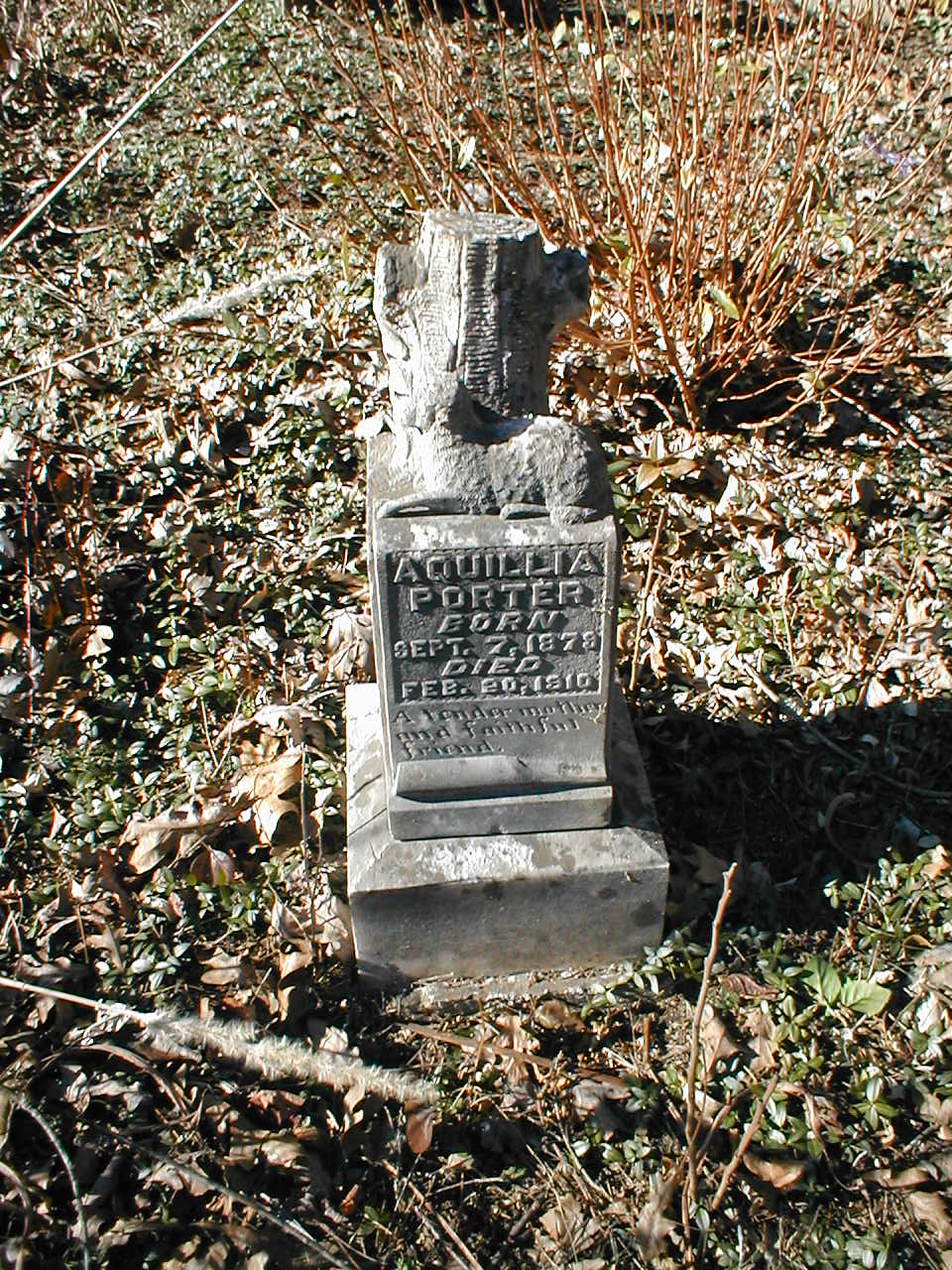
Aquillia Runyon Porter grave (2001)

07 Saturday Nov 2015

Posted by Brandon Ray Kirk in Inez, Lincoln County Feud

≈ Leave a comment

Tags

Aquillia Porter, genealogy, history, John W Runyon, Kentucky, Martin County, Mary M. Runyon, Milo, Samuel W. Porter, Stidham, Williamson Family Cemetery

Acquillia Runyon Porter grave at the Williamson Cemetery, Milo, Martin County, KY.

Aquillia Runyon Porter grave at the Williamson Family Cemetery in Milo, Martin County, KY. Aquillia, wife of Samuel W. Porter, was the daughter of John W. and Mary M. (Williamson) Runyon.

Aquillia Porter Runyon grave 2

Aquillia Runyon Porter grave at the Williamson Cemetery in Milo, Martin County, KY. Aquillia, wife of Samuel W. Porter, was the daughter of John W. and Mary M. (Williamson) Runyon.

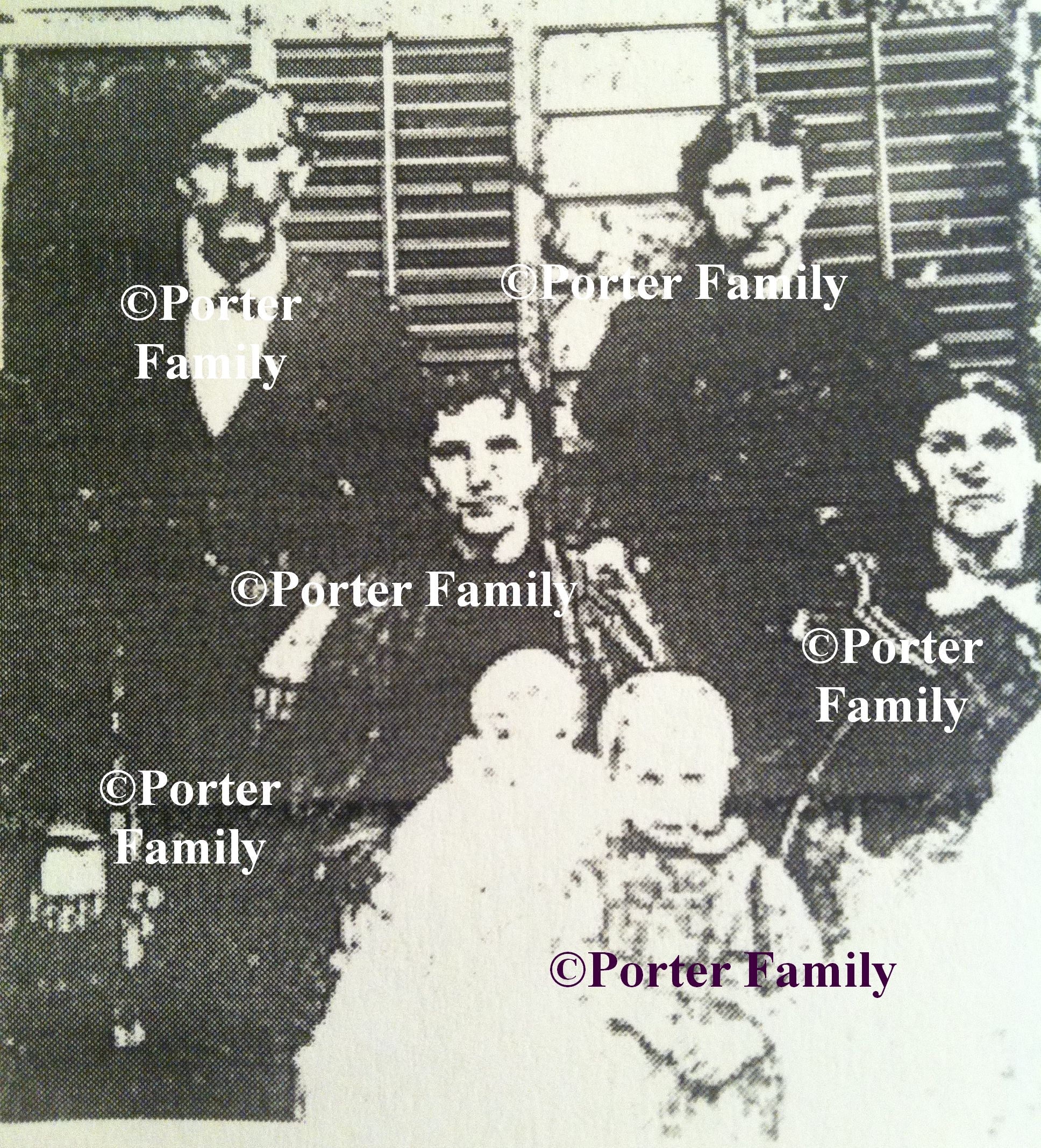
John W. Runyon family (1900)

10 Sunday May 2015

Posted by Brandon Ray Kirk in Inez, Lincoln County Feud

≈ Leave a comment

Tags

Aquillia Porter, Blood in West Virginia, genealogy, Hart, history, John W Runyon, Kentucky, Lincoln County, Lincoln County Feud, Martin County, Mary M. Runyon, photos, Stidham, Wealthy Hinkle, West Virginia

John W. Runyon family, c.1900. Mr. Runyon, shown at back left, was a storekeeper and timberboss in Hart during the late 1880s. His wife, the former Mary M. Williamson, is shown at back right. Their daughters are also shown (l-r): Aquillia and Wealthy.

John W. Runyon family, c.1900. Mr. Runyon, shown at back left, was a storekeeper and timberboss in Hart during the late 1880s. His wife, the former Mary M. Williamson, is shown at back right. Their daughters are also shown (l-r): Aquillia and Wealthy.

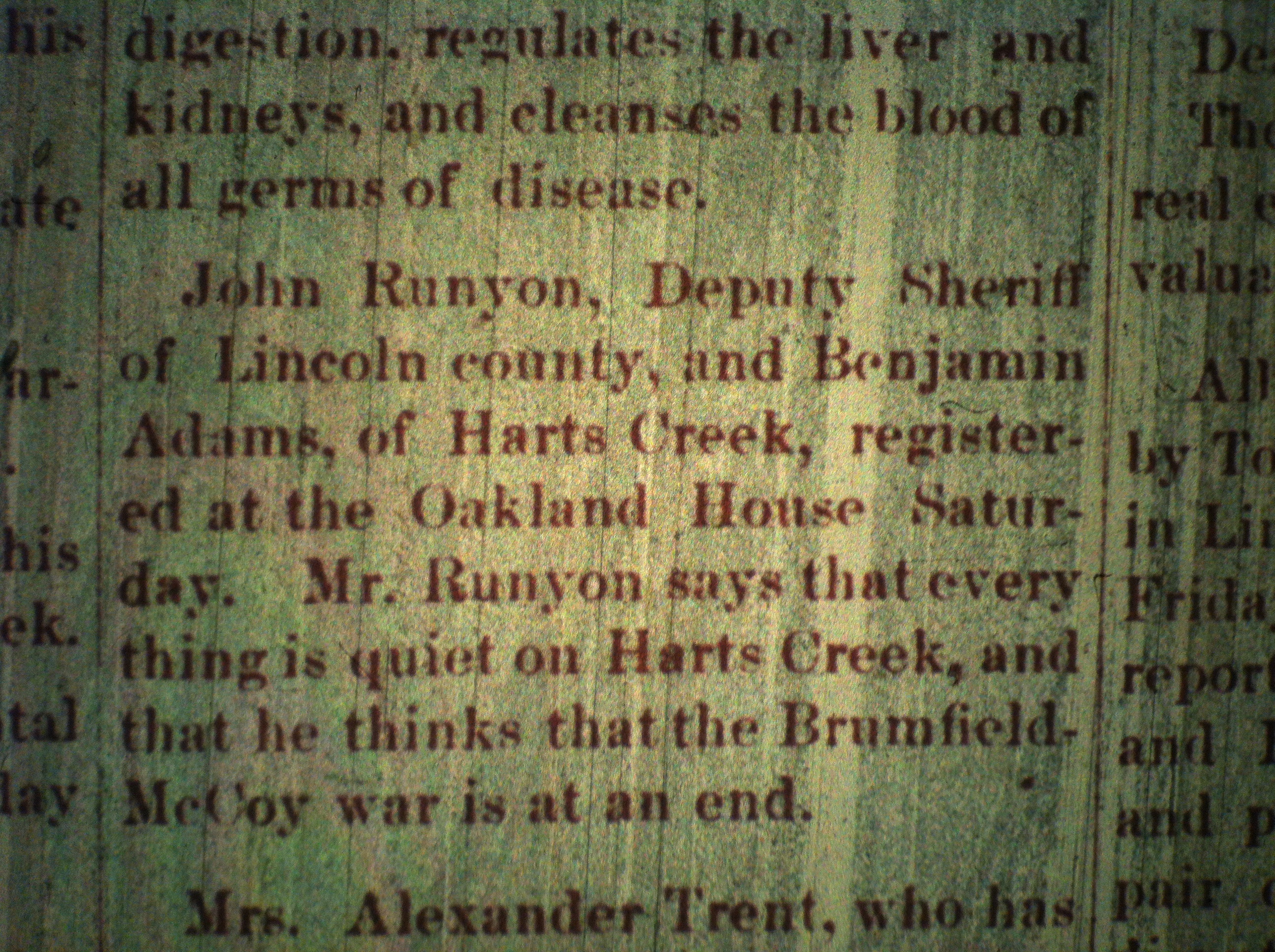
John W. Runyon and Ben Adams (1890)

15 Sunday Mar 2015

Posted by Brandon Ray Kirk in Big Harts Creek, Lincoln County Feud, Logan

≈ Leave a comment

Tags

Appalachia, Ben Adams, Blood in West Virginia, books, Brumfield-McCoy war, genealogy, Harts Creek, history, John W Runyon, Lincoln County, Lincoln County Feud, Logan, Logan County Banner, U.S. South, West Virginia

John Runyon and Ben Adams LCB 01.09.1890 2

W. Aaron Adkins

19 Thursday Feb 2015

Posted by Brandon Ray Kirk in Harts, Lincoln County Feud

≈ 1 Comment

Tags

Aaron Adkins, Appalachia, Blood in West Virginia, Burl Adkins, genealogy, Harts, history, John W Runyon, Lincoln County, Lincoln County Feud, Melissa Adkins, photos, West Virginia

W. Aaron Adkins, son of Burrell and Melissa (Adkins) Adkins. During the feud, Aaron was a neighbor to John W. Runyon.

W. Aaron Adkins, son of Burl and Melissa (Adkins) Adkins, of Harts, WV. During the feud, Aaron was a neighbor to John W. Runyon.

John W. Runyon and family

23 Saturday Aug 2014

Posted by Brandon Ray Kirk in Big Sandy Valley, Harts, Inez, Lincoln County Feud, Timber

≈ Leave a comment

Tags

Aquillia Porter, Aubrey Lee Porter, Blood in West Virginia, genealogy, Hattie Hinkle, history, John W Runyon, John W. Porter, Lincoln County Feud, Mary Runyon, photos, Wealthy Hinkle

John W. Runyon (left) and wife, Mary (right), with daughters, c.1901

John W. Runyon (left) and wife, Mary (right), with daughters and grandchildren, c.1901

Interview with James Davis of Harts, WV (1997)

17 Sunday Aug 2014

Posted by Brandon Ray Kirk in Big Harts Creek, Culture of Honor, Harts, Lincoln County Feud

≈ Leave a comment

Tags

Ben Adams, Ben Walker, Bill Fowler, Billy Adkins, Brandon Kirk, Cat Fry, Chapmanville High School, Charley Davis, Ed Haley, French Bryant, Fry, Green McCoy, Harts Creek, Henderson Dingess, history, Iris Williams, James Davis, John Brumfield, John Hartford, John W Runyon, Kentucky, Lincoln County, miller, Milt Haley, Spring Branch, West Fork, West Virginia, writing

That evening, Brandon and I met up with Billy Adkins and went to see James Davis on West Fork. James lived on Spring Branch of West Fork, a little hollow just across the creek from Iris Williams. A few years back, his older brother Charlie had told Brandon about seeing Ed win a twenty dollar gold piece in a contest at the old Chapmanville High School.

We found the eighty-something-year-old James laying on the couch with a little fuzzy dog crawling all over him like a monkey. He said he didn’t remember Ed, so I mentioned how he was Milt Haley’s son, which got an immediate reaction. He had heard the story of Milt’s death from Cat Fry, although he didn’t immediately offer up any details. Actually, James was hesitant to talk about the 1889 murders — almost as if the participants were still around and living next door. His answers to our questions were very evasive.

We learned from James that it was Bill Fowler (not John Runyon or Ben Adams) who hired Milt and Green to ambush Al. It was all over competition between businesses. Fowler was a saloon operator and a gristmill operator, while Brumfield ran a log boom.

“They was all there making money,” he said. “You know how that stirs up trouble. Some a making a little more money than others. They was bucking one another, like money men does.”

Milt and Green ambushed Al and Hollena one Sunday as they rode down the creek on a single horse after a visit with Henderson Dingess. In the attack, Mr. Brumfield was shot through the arm, while his wife was shot in the face. Milt and Green were soon captured in Kentucky by the Adkinses and Brumfields, who held them them at Fry. Neither man would admit to anything so John Brumfield shot one of them in the head. He reputedly put his toe at the hole and said, “I put a bullet right there.”

Brumfield was himself shot in the head a few years later.

French Bryant, “who was pretty hard to handle,” was also involved in the killings.

Afterwards, people were afraid to touch Milt’s and Green’s bodies until Ben Walker allowed them to be buried on his property. The whole event “shook people up pretty bad.” Fowler sold out at the mouth of Harts and moved away.

Chasing John Runyon (1996)

07 Monday Jul 2014

Posted by Brandon Ray Kirk in Cemeteries, Ed Haley, Inez, Lincoln County Feud

≈ Leave a comment

Tags

Appalachia, Aquillia Porter, Bill Duty, Bill Fields, Billy Adkins, Brandon Kirk, cemetery, Ed Haley, genealogy, Graveyard Point, Hinkle Valley Road, history, Inez, James A Garfield, Jim Webb, Joe Fannin, John W Runyon, Kentucky, Lawrence County, Leonard Porter, Martin County, Mary Runyon, Mary Runyon Fields, Mary United Baptist Church, Milo, Nat's Creek, Peach Orchard, Route 1884, Route 40, Samuel W. Porter, Stidham, Tomahawk, U.S. South, Walt Mollett, Wealthy Fry, Webb Music Store, writing

A month or so after “striking out” on the Ed Haley house, Brandon and Billy drove to Inez, Kentucky, and searched for more information about John Runyon. Venturing north of the county seat, they met Leonard Porter, who lived in a little settlement called Tomahawk. Porter remembered Mrs. Runyon staying with Mary Fields in a small house at the mouth of nearby Hall Branch and said she was likely buried in the Fields family cemetery on a point at nearby Hall Branch Road. Billy and Brandon headed up there, where they found the grave of Bill Fields (1882-1948) and Mary Fields (1888-1985), but none of John Runyon’s family. Just down the hill from the cemetery (presently a trailer court) was the old homestead of Mr. and Mrs. Fields. At one time, they later discovered, the Fieldses ran a store beside of their home. Across the road was the location of the former Mary United Baptist Church — named for Mary Runyon or Mary Fields – now converted into a house. As they stood on the hill, Billy reminded Brandon that Bill Duty’s mother-in-law was a Fields prior to her marriage.

They next tried to find the location of John Runyon’s homeplace. According to the Williamson family history, Runyon lived at the “old Stidham post office,” which they figured was located on Rockhouse Fork. Unfortunately, they found no sign of “Stidham” up the many branches of Rockhouse. There were no mailboxes labeled “RUNYON” or any signs to help them along. Many of the names of local hollows had changed since the time of the old deeds.

Feeling a little desperate, they pulled into a driveway with a mailbox labeled “HINKLE” and spoke with a very nice middle-aged man who told them the exact location of the old Stidham Post Office — actually, all three of them. The first location ran by Joe Fannin was situated at the mouth of Spence Branch near Milo. Around 1935, the office was relocated to a site on what is now called Hinkle Valley Road, just across the creek from a sign reading “Left Fork.” The final Stidham Post Office was in what is today James Webb’s Music Store. Upon viewing the sites, Billy deduced that the old Runyon homeplace had been near the second post office.

While in that vicinity, they talked with an elderly man named Walt Mollett who confirmed that John Runyon had been a local resident. He said Runyon was probably buried down the road in a cemetery on Graveyard Point at Stidham, basically the junction of Route 1884 and Route 40.

A few minutes later they were at the cemetery, parking beside the road in a treacherous curve and tromping through a forest of damp growth. At the center of the cemetery was a single, ancient pine tree. Near the pine, Brandon spotted the grave of Runyon’s daughter, Wealthy Fry. Just below her was Aquillia Porter. And below her was a grave with a new tombstone written as “Mary M. Runyons” and dated “January 28, 1861-January 29, 1958.” Beside of Wealthy Fry’s final resting place was an older stone originally created for “Mary Runyon” dated “January 28, 1861-January 29, 1956.” There were plenty of Williamsons in the cemetery — all relation to Mrs. Runyon — including Sam Porter’s second wife — but absolutely no sign of John Runyon’s grave.

Jim Webb, a gentle middle-aged musician and proprietor of Webb’s Music Store, told Brandon and Billy that someone had wrecked in the cemetery a few years earlier and destroyed many of the tombstones. Equally tragic, the wrecker that removed the vehicle from the cemetery had caused more damage to the stones. The community had organized a fund to restore the graves, Webb said, but it was little consolation. Brandon theorized that John was buried beside of Wealthy — that someone had used Mary’s old tombstone to “sort of” mark the spot. He didn’t rule out, though, that Runyon had been buried with his parents on nearby Nat’s Creek in Lawrence County. (The Graveyard Point cemetery was more oriented toward his wife’s family, the Williamsons.) A quick drive to Nat’s Creek, including a tour of the “town” of Peach Orchard (a virtually abandoned coal town once prominent in business affairs and the site of a General Garfield Civil War story), failed to produce any signs of a Runyon cemetery, although it did offer some of the most serene, peaceful, spooky and haunting countryside found in the locale.

Brandon felt a real frustration in not being able to positively find Runyon’s grave and thus achieve some sense of closure on that facet of the story. It was as if he and Billy, whose ancestors had supposedly spent years looking for Runyon, had also been evaded by ole John — even in his death.

John W. Runyon 3

02 Wednesday Jul 2014

Posted by Brandon Ray Kirk in Big Sandy Valley, Inez, Lincoln County Feud, Timber, Wyoming County

≈ 2 Comments

Tags

Adam Runyon, Analena Porter, Aquillia Runyon, Asa Williamson, Aubrey Lee Porter, Bill Fields, Bill Porter, Brandon Kirk, Buchanan County, Buskirk and Wittenberg, Clarence Hinkle, Etta M. Porter, Ferrellsburg, genealogy, Graveyard Point, Guiniford Apney, Hatti Hinkle Apney, history, Inez, Jean Ramey, John Porter Jr., John W Runyon, John W. Porter, Kentucky, Martin County, Mary Runyon Fields, Mary Williamson, Maude Williamson, Merrill Porter, Norfolk, Point Pleasant, Rockcastle Creek, Russell Goble, Samuel W. Porter, Stafford Fork Precinct, Stidham, Virgil Ramey, Virginia, Virginia Lee Porter, Wealthy Runyon, West Virginia, writing, Wyoming County

The John W. Runyon family seems to have headed further south to try their luck elsewhere. In February 1902, Mary Runyon, her recently remarried daughter, Wealthy (Runyon) Hinkle-Fry, and her former son-in-law Clarence Hinkle were listed in Martin County deed records as residents of Buchanan County, Virginia.

John Runyon, meanwhile, soon gave up on his case in Wyoming County. A court entry dated April 2, 1902 and titled “John W. Runyon vs. Buskirk and Wittenberg” mentions how he “failed to give bond for costs as required in an order entered at a former term of the Court.” The Court ruled that “the defendants recover of the plaintiff their costs in their behalf expended in their defense herein including an attorneys fee of $10.00.” Included in this record was a list of thirty-four “Petit Jurors” who were, for some reason, to be paid “out of the County Treasury to wit” for their services in this case, some of them serving as many as nine days and being paid as much as eighteen dollars. It wasn’t clear why jurors served up to nine days, as records indicate that the court dismissed Runyon’s case before it went to trial.

After a short stay in Virginia, the Runyon family returned to Martin County and settled near the old Stidham Post Office on Rockcastle Creek, several miles north of the countyseat of Inez. On June 25, 1903, Wealthy Fry died at the age of 22 years old. Aquillia Porter died on February 20, 1910. A few months later (April 20) her husband remarried to Maude Williamson. Both of the Runyon girls were buried in the Williamson family cemetery at Stidham. Runyon’s legal problems, meanwhile, continued in Martin County as late as the 1910s.

On the bright side, John and Mary Runyon Fork purchased many acres of land around Rockhouse between 1893-1917 and sold at least 1,001 acres in that same vicinity between 1904-1932. Most of it went to their family: Sam Porter got 100 acres in 1910, 50 acres in 1917 and 35 acres in 1925. Various members of the Williamson family also bought tracts from John and Mary Runyon.

In 1920, John W. Runyon was listed in the Martin County Census as a resident of the Stafford Fork Precinct. He was a 65-year-old general laborer. His wife Mary was 55 years old. Asa G. Williamson, age 52, brother-in-law, was also in the household. Next door was the family of grandson John W. Porter, a 23-year-old farmer, with wife Etta M. (age 23). There were two children listed: Analena, age three; and Virginia Lee, age one. Aubrey Lee Porter, 22-year-old brother to John, who was also present in the home and employed as a coal miner.

John Runyon died on January 12, 1925 in Martin County. His widow spent her final years under the care of his niece, Mary (Runyon) Fields, who had been listed with the family in the 1900 Wyoming County Census. Mary was a daughter of John’s twin brother. She married Bill Fields and participated in much of the “family business” (marriage records, land transactions). Mary Runyon was still alive in 1952, when the Runyon genealogy book was assembled and was a source on the Adam Runyon family line.

Back in Ferrellsburg, Brandon called Bill Porter, an 80-year-old man in the Inez-area who was distantly connected to John Runyon’s family. He hadn’t known Runyon personally but said, “He was a well-thought of person. He followed the timber business. Everywhere he went he had bad luck. He was pretty bad to crook people.”

Mr. Porter said the Runyon place sat just above the old Stidham Post Office at Graveyard Point and told all about the Runyon descendants. He said Aubrey Porter married a Williams and raised a family of three children (including one son named Jimmy) in Columbus, Ohio. John W. Porter had two children — Merrill and John, Jr — and lived in Norfolk, Virginia. Hattie (Hinkle) Apney had two daughters: one named Guiniford, who married Russell Goble (an active member of the Inez School Board for years), and Jean, who married Virgil Ramey. Mr. Porter thought Hattie divorced her husband and moved to Point Pleasant, West Virginia, where she died.

John W. Runyon 2

01 Tuesday Jul 2014

Posted by Brandon Ray Kirk in Lincoln County Feud, Timber, Wyoming County

≈ Leave a comment

Tags

A.R. Wittenberg, Anderson Beverly, Baileysville, Buskirk and Wittenberg, Clarence Hinkle, Cole and Crane Company, crime, Dr. C.W. Hall, Dr. S.A. Daniel, E.M. Seuter, genealogy, history, I.E. Christian, James Bertrand Runyon, James Ramey, John W Runyon, Kentucky, logging, Mary Runyon, Porter and Runyon, Reference Book of Wyoming County History, Samuel W. Porter, timbering, Vorheis, West Virginia, writing, Wyoming County, Wyoming Tribune

In that same time frame, John W. Runyon moved his family to Baileysville in Wyoming County, West Virginia, where he opened a business under the name of “Porter and Runyon.” He began to buy various items by credit at a store owned by Buskirk and Wittenberg, a partnership of contractors operating under the powerful Cole and Crane Company.

According to Bowman’s Reference Book of Wyoming County History (1965): “C. Crane and Co., by its contractors, Buskirk and Wittenburg, began a new era of removing timber by water. The company began building dams as soon as possible after taking over the contract.”

Buskirk and Wittenburg were often permitted to construct “roads for their convenience” and to destroy bridges for the purpose of splashing so long as they had them rebuilt. They built the only splash dam ever constructed on the Guyan River around 1903.

“The company maintained well stocked commissaries and logging camps to take care of their men,” according to the Wyoming County history. The main camp in their operation “had a commissary, blacksmith shop, business office, and post office named Vorheis, in honor of Buskirk’s daughter who had married a man named Vorheis. There were camps at Baileysville… Camps and stores were relocated from time to time as needed.” Their stores “carried a large and varied stock, including up-to-date clothing.”

Runyon’s bill at Buskirk’s and Wittenberg’s store began on May 22, 1899, when he bought a nine-dollar suit, and extended until July 17, 1900, when the store debt totaled $6,495.78. According to the bill, Runyon primarily purchased ordinary store items: bacon, beans, fruits, vegetables, coffees, tobacco, herbs, spices, silverware, kitchen utensils, nails, soap, shoes, hats, gloves, watches, candy, and various types of clothing. He also had bought a plethora of luxury items: a case of oysters, Cuban Gentlemen Cigars, several boxes of chewing gum, a box of roasted peanuts, dolls, musical instruments (including a violin), picture frames, guns, locks, turpentine, Castor Oil, clocks, fire crackers, and fishing gear.

Beginning on September 28, 1899, Runyon and Porter paid periodically on the bill (although Porter’s name was seldom mentioned specifically) and Runyon personally contributed $280.00 in January of 1900. The business folded around September 13, 1900, when Runyon made his last payment to Wittenberg and reduced his bill to $640.15.

Meanwhile, the census enumerator registered Runyon as follows: “John W. Ru[n]yon, logger, rents home, born Feb 1856 in KY, age 44, married 20 years, both parents born KY; Mary M. Ru[n]yon, born January 1861 in KY, age 39, married 20 years, mother of 1 child which is living, parents born in KY; Mary M. Ru[n]yon, born March 1889 in KY, age 11, niece, both parents born in KY.” John’s son-in-law Clarence Hinkle was listed two households away as a logger. Sam Porter was not listed in the census — perhaps well aware of the impending debt owed to Buskirk and Wittenberg. Little Mary Runyon was a daughter of John’s twin brother.

There were other legal troubles. In June of 1901, Drs. S.A. Daniel and C.W. Hall sued Runyon for a $50 debt (with interest). Apparently the doctors had rendered services to a James Ramey with the understanding that Runyon would pay his bill. When the trial took place on June 15, Runyon failed to show up. The court waited for an hour, then heard the plaintiff’s case and ruled against him. Curiously enough, Runyon appealed the decision on June 24, with funds for his appeal bond ($120) coming from the very doctors who originally sued him. In September a summons was delivered to an Anderson Beverly to appear as Runyon’s witness. On April 2, 1902 his appeal came before the court and the doctors didn’t appear even “though thrice solemnly called.” As a result, the judge ruled in Runyon’s favor and stated that he was to be paid “$5.00 for their false clamor herein” and that he “recover of the plaintiffs his costs in this behalf expended including an attorneys fee of $5.00 allowed by statute.”

By that time, Runyon was in a more serious lawsuit with Buskirk and Wittenberg over his store debt. In early July of 1901, Wittenberg sued Runyon and Porter, stating that he had not received a payment from them since September of the previous year. Wittenberg’s contacts with area politicians and influential residents had obvious legal implications. Runyon and Porter were issued a summons to appear in court on the first Monday in August to answer “A.R. Wittenberg of a plea of Trespass on the case in assumpsit damages $6,500.00.” Wittenberg’s use of the figure $6,500 referred to the original debt of $6,495.78, although records show the amount actually owed was $640.15. On the outside of this summons the following was written in poor handwriting, probably by a deputy-sheriff: “Serve[d] on the within name John W. Runyon by delivering to him an office copy of the within summon[s] in person on July 12, 1901.” A summons couldn’t be served to S.W. Porter who was “not found within my bailiwick this July 13, 1901.”

Porter was apparently not a resident of West Virginia (probably Kentucky). An affidavit of Non-Residence was filed on his behalf on August 5, 1901.

“This day I.E. Christian Personally appeared before me E.M. Seuter a Notary Public within and for said Wyoming County, West Virginia and upon oath says that S.W. Porter one of the defendants in the above styled action is a Nonresident of the State of West Virginia,” it read.

Because Wyoming County law couldn’t find him to serve a summons, an Order of Publication was issued on the first Monday in August 1901.

“At Rules held in the Clerk’s Office of the Circuit Court of Wyoming County on the first Monday in August 1901 A.R. Wittenberg vs. John W. Runyon and S.W. Porter partners trading and doing business under the firm name and style of Porter and Runyon,” it read. “The object of the above suit is to obtain a Judgment in favor of the plaintiff against the defendants for the sum of $640.15 and it appearing from an affidavit made and filed with the papers of this cause that S.W. Porter defendant in the above signed cause is a non resident of the State of West Virginia, and on motion of the plaintiff it is ordered that said defendant S.W. Porter do appear at Rules to be held in the clerk’s office of the circuit court of Wyoming County within one month after the first publication of this order and do what is necessary to protect his interest in this suit.”

Wittenberg spent five dollars and fifty cents paying for this publication, which was featured in the Wyoming Tribune from August 9th until August 30th.

It did little good. Porter was basically untouchable by Wyoming County authorities barring extradition papers.

Information at the Wyoming County Courthouse indicated that he never showed up to answer for his part in the failed business and, in so doing, crippled Runyon’s case against Wittenberg.

There is little information available on the actual trial, although records show the judge ruled against Runyon for $614.50 on September 30, 1901. Totaled near this figure was a compilation of the plaintiff’s costs ($32.81), which indicated that he was expected to pay that fee as well. Presumably, all of this debt fell on Runyon since his partner had left the state. He decided to appeal the case but as a non-property owner in Wyoming County, the owner of a failed business, and with no local contacts loyal enough to assist him, he was unable to put forth enough money to post the necessary bond. Wittenberg, meanwhile, prepared his case and hired lawyers.

John W. Runyon 1

30 Monday Jun 2014

Posted by Brandon Ray Kirk in Big Harts Creek, Big Sandy Valley, Harts, Inez, Timber, Wyoming County

≈ Leave a comment

Tags

Adam Runyon, Adam Runyon Sr., Alden Williamson Genealogy, Aquillia Runyon, Aubrey Lee Porter, Billy Adkins, Bob Spence, Brandon Kirk, Charleston, civil war, Clarence Hinkle, Crawley Creek, Cultural Center, Ellender Williamson, Enoch Baker, Garrett and Runyon, genealogy, Harts, Hattie Hinkle, Henderson Dingess, history, Inez, Izella Porter, James Bertrand Runyon, James Muncy, John W Runyon, John W. Porter, Kentucky, Land of the Guyandot, Lawrence County, Logan County, Logan County Banner, logging, Martin County, Mary Runyon, Milt Haley, Moses Parsley, Nat's Creek, Nellie Muncy, Nova Scotia, Peach Orchard, Pigeon Creek, Pike County, Pineville, Rockcastle Creek, Runyon Genealogy, Samuel W. Porter, Stephen Williamson, timbering, Wayne, Wayne County, Wealthy Runyon, West Virginia, Wolf Creek, writing, Wyoming County

In the late summer of 1996, Brandon and Billy turned their genealogical sights on John W. Runyon, that elusive character in the 1889 story who seemed to have stirred up a lot of trouble and then escaped unharmed into Kentucky. They arranged a biographical outline after locating two family history books titled Runyon Genealogy (1955) and Alden Williamson Genealogy (1962). Then, they chased down leads at the Cultural Center in Charleston, West Virginia; the Wyoming County Courthouse at Pineville, West Virginia; the Wayne County Courthouse in Wayne, West Virginia; the Martin County Courthouse at Inez, Kentucky; and at various small public libraries in eastern Kentucky. Runyon had left quite a trail.

John W. Runyon was born in February of 1856 to Adam and Wealthy (Muncy) Runyon, Jr. in Pike County, Kentucky. He was a twin to James Bertrand Runyon and the ninth child in his family. His mother was a daughter of James Muncy — making her a sister to Nellie Muncy and an aunt to Milt Haley. In other words, John Runyon and Milt Haley were first cousins.

According to Runyon Genealogy (1955), Adam and Wealthy Runyon left Pike County around 1858 and settled on the Emily Fork of Wolf Creek in present-day Martin County. In 1860, they sold out to, of all people, Milt Haley’s older half-brother, Moses Parsley, and moved to Pigeon Creek in Logan County. John’s grandfather, Adam Runyon, Sr., had first settled on Pigeon Creek around 1811. The family was primarily pro-Union during the Civil War.

At a young age, Runyon showed promise as a timber baron.

“The first lumber industry in Logan County of any importance was started on Crawley Creek by Garrett and Runyon during the year 1876,” Bob Spence wrote in Land of the Guyandot (1978). “Garrett and Runyon deserve credit for their efforts in opening the lumber business in Logan County. They were the first to hire labor in this field. It might be of interest to note here that they originally brought trained men from Catlettsburg… In a few years, Garrett and Runyon left Logan [County], and soon Enoch Baker from Nova Scotia came to Crawley Creek to take their place.”

John may have put his timber interests on hold due to new developments within his family. According to Runyon Genealogy, his mother died around 1878 and was buried at Peach Orchard on Nat’s Creek in Lawrence County, Kentucky. His father, meanwhile, went to live with a son in Minnesota. In that same time frame, on Christmas Day, 1878, Runyon married Mary M. Williamson, daughter of Stephen and Ellender (Blevins) Williamson, in Martin County, Kentucky. He and Mary were the parents of two children: Aquillia Runyon, born 1879; and Wealthy Runyon, born 1881. John settled on or near Nat’s Creek, where his father eventually returned to live with him and was later buried at his death around 1895.

During the late 1880s, of course, Runyon moved to Harts where he surely made the acquaintance of Enoch Baker, the timber baron from Nova Scotia. An 1883 deed for Henderson Dingess referenced “Baker’s lower dam,” while Baker was mentioned in the local newspaper in 1889. “Enoch Baker, who has been at work in the County Clerk’s office and post office for several weeks, is now on Hart’s creek,”  the Logan County Banner reported on September 12. Baker was still there in December, perhaps headquartered at a deluxe logging camp throughout the fall of 1889.

After the tragic events of ’89, Runyon made his way to Wayne County where he and his wife “Mary M. Runyons” were referenced in an 1892 deed. Wayne County, of course, was a border county between Lincoln County and the Tug Fork where Cain Adkins and others made their home. He was apparently trying to re-establish himself in Martin County, where his wife bought out three heirs to her late father’s farm on the Rockhouse Fork of Rockcastle Creek between 1892-1895.

In the late 1890s, John’s two daughters found husbands and began their families. On January 3, 1896, Wealthy Runyon married Clarence Hinkle at “John Runyonses” house in Martin County. She had one child named Hattie, born in 1899 in West Virginia. On March 29, 1896, Aquillia Runyon married Samuel W. Porter at Mary Runyon’s house in Martin County. They had three children: John W. Porter, born in 1897 in West Virginia; Aubrey Lee Porter, born in 1899 in Kentucky; and Izella Porter, who died young.

In Search of Ed Haley 319

12 Thursday Jun 2014

Posted by Brandon Ray Kirk in Big Harts Creek, Ed Haley, Harts, Lincoln County Feud

≈ 2 Comments

Tags

Al Brumfield, Ben Adams, Bernie Adams, Brandon Kirk, Cain Adkins, Caroline Brumfield, Cecil Brumfield, Dave Dingess, Ed Haley, fiddle, French Bryant, Harriet Brumfield, Harts Creek, Henderson Dingess, history, Hollene Brumfield, Hugh Dingess, John Hartford, John W Runyon, Lillian Ray, Logan, Milt Haley, Paris Brumfield, Sallie Dingess, Smokehouse Fork, Tom Martin, writing

A little later, Brandon visited Lillian Ray, a seventy-something-year-old daughter of Cecil Brumfield who lived in a beautiful two-story house on the Smokehouse Fork of Harts Creek. Lilly, he discovered, had a lot of the old Dingess family photographs. To Brandon’s surprise, there were several thick-paged Victorian velvet-covered albums full of tintypes and a few boxes of sepia images on decorative cardboard squares. Only a few were labeled, but he recognized some of the faces: Al Brumfield, Henderson and Sallie Dingess, Hugh Dingess, Mrs. Charley Brumfield, Mrs. John Brumfield, and Dave Dingess. No doubt, there were pictures in the album of Ben Adams and Hollena Brumfield in their youth.

Before leaving, Brandon asked Lilly about Ed Haley. She said she remembered him coming to her father’s house when he lived in the old Henderson Dingess homeplace. He would just show up, leading himself with a cane, and stay for two or three days. Lilly hated to see him come because he was so hateful to the Brumfield children — “always running his mouth.” She described him as a “little short man” who “drank a lot” and told how he and Bernie Adams once borrowed a fiddle from her father and then pawned it off in Logan. The fiddle originally belonged to Tom Martin.

Not long after visiting Lilly, Brandon sent me a letter updating me on his research along with pictures of people we’d only imagined. As they turned up, I wondered if I were to go into a room with Al, Paris, Milt, Green, French, Cain, Runyon — without knowing who any of them were — which ones would I take to strictly on a personality basis? Which ones would I have a gut reaction to think, “Well, he’s a pretty fair good old boy,” or, “Boy, I don’t know about that feller there. Something’s just not right.” I mean, you walk in the room and, “That’s Al Brumfield?” No way. “That’s Cain Adkins?” Nope, I can’t believe that.

Pat Adkins interview in Harts, WV

09 Monday Jun 2014

Posted by Brandon Ray Kirk in Culture of Honor, Harts, Lincoln County Feud

≈ Leave a comment

Tags

Al Brumfield, Bill Brumfield, Bill Fowler, Billy Adkins, Black John Adkins, Brandon Kirk, crime, Fed Adkins, feud, Green McCoy, Harts, Harts Creek, Harvey "Long Harve" Dingess, history, Hollena "Tiny" Brumfield, Hollene Brumfield, John W Runyon, Lincoln County Feud, logging, Milt Haley, Paris Brumfield, Pat Adkins, writing

Later in the summer, Brandon visited his friend Pat Adkins, who lived in a little trailer just back of where the old Al Brumfield home once sat at the mouth of Harts Creek. Pat was raised in the magnificent Brumfield house and was its owner at the time of its burning. He was a first cousin to Billy Adkins.

Pat first spoke about Al and Hollena Brumfield, who he said charged people a ten-cents-per-log tax at their boom. The tax was a constant source of friction in the community. Even Al’s in-laws weren’t fond of the fee…and apparently weren’t spared from it, either.

“One time, Harvey Dingess had a big huge amount of logs out there and he said he wasn’t gonna pay no ten cents a log tax,” Pat said. “Harvey was Hollene’s brother. They all liked to drink so he come in there being jovial and friendly and brought Al and Hollene in a big special-made malt whiskey. They got a big drunken party going and finally around twelve o’clock they all got so drunk they went to bed. Harve had his men stationed over there on that hillside and when he waved a light from that porch upstairs them men come down there and cut that splash and let his logs through. The Brumfields got up the next morning — all their hangovers — and went out and looked and that splash had been cut and all of his logs had been run through and Harve was gone. He was on his way to Huntington to sell them.”

Brandon asked Pat if the log boom was the root of the 1889 troubles.

“Bill Brumfield’s wife, Aunt Tiny, told me about the famous posse ride to lynch Milt Haley and Green McCoy,” Pat said, cutting to the chase. “Runyon had a store up on Hart and that was among Hollene’s relatives up in there and she had the big timber operations down here — the splash dam, you know — and had a saloon. Runyon had a legal still where people brought their apples in and stuff to make brandy. Somebody else run one of them too up there — a Dingess. They was into it over the business. Runyon thought that if he could kill them, he could take control of the mouth of Hart. When Hollene came into business that was what she done. She killed out her enemy, or never killed him — burned him out. That was Bill Fowler. Bill Fowler was a businessman and he come into possession of the mouth of the creek. He had him a big saloon out there and she burned him out and burned his saloon and then she took it over. So, I guess Runyon got the same idea: ‘You took it. Now I’m going to get it from you.’ So he hired these guys to kill them and if he’d a killed them they’d a been out of the way and that woulda pretty well cinched him for it. He had plenty of money and he’d a rolled in here and coulda bought it. He’d been the top man then.”

According to Pat, locals quickly determined that Haley and McCoy were involved in the ambush of Al and Hollena Brumfield and formed a mob to capture them.

“They formed about sixty men,” he said. “I know Black John Adkins was in it. John was there a holding the horses. He wasn’t taking no part in it — just going along to show he was in support. I think everybody in the country around in this area and all of Hollena’s relatives were in it. Runyon, he left the country when he realized that they might be coming after him because they suspected him as hiring them.”

Pat said Mrs. Brumfield believed that her husband Bill was too young to have participated in the killings but would have “been in on it if he’d a been old enough.” Pat didn’t think his Grandpa Fed Adkins was in the mob either, but then said, “He might have been — probably was. You know, the killing took place there, I think, about where Lon Lambert’s house is, down under that riverbank. Black John said when Paris came out from under that bank he was just as bloody as he could be where he had stabbed on them men. Said, Paris Brumfield was bloody as a hog. Said, he just took a knife and cut them to pieces and I think they gave Paris the honor of killing them because it was a vengeance killing. They dared anybody to ever touch their bodies. I think they laid about nine days and got to smelling so bad they finally give them permission to bury them.”

In Pat’s view, those who participated in the killing of Milt and Green were not typically violent men. Haley’s and McCoy’s apparent guilt in ambushing Al Brumfield provided a justification for their bloody murders in the eyes of locals and ensured that the “peace-keeping” reputations of the vigilantes would endure as stories about the feud were handed down to later generations. For instance, despite the dangerous reputation of Paris Brumfield, Pat said, “Other than the killing of Haley and McCoy, he was really not a mean person. That was understandable that he helped kill Haley and McCoy if somebody was trying to kill your son. I never heard that he was a mean person. I don’t think he deliberately went around plotting up mean things to do. And I don’t think he was a cruel person.”

Just before Brandon left Pat, he asked him about growing up in Al Brumfield’s house. Pat said when he was young he often hid behind some large framed Brumfield family photographs stacked in an upstairs room. There was one in particular that he remembered: a picture of Al Brumfield — worn and blind, sitting in a chair on a porch.

In Search of Ed Haley 311

28 Wednesday May 2014

Posted by Brandon Ray Kirk in Ed Haley, Harts, Lincoln County Feud

≈ 1 Comment

Tags

Al Brumfield, Ann Brumfield, Appalachia, Ben Adams, Bob Adkins, Brandon Kirk, Burl Adams, Cain Adkins, crime, Daisy Ross, Ed Haley, Green McCoy, Guyandotte River, Harts, Harts Creek, Henderson Dingess, history, Howard Dalton, Imogene Haley, Joe Adams, John Frock Adams, John Hartford, John W Runyon, Lawrence Haley, Lawrence Kirk, Lincoln County, Logan County, Major Adkins, Milt Haley, Paris Brumfield, Peter McCoy, Sallie Dingess, Trace Fork, West Virginia, writing

Two months later, Brandon was still digging, but in a different way. He was knee-deep in land records at the Lincoln and Logan County court houses. He was curious — based on the economic aspect of the 1889 feud — to know about property ownership for feudists, particularly those with land around the mouth of Harts Creek.

He started with the Brumfields.

In 1889, Paris Brumfield owned 771 acres of land worth $1020, while his wife owned 367 acres worth $483. Al Brumfield had 295 acres (195 acres on Brown’s Branch and 100 acres on the Guyan River) worth $642. By combining Al’s totals to that of his parents, the Brumfields owned a total of 1433 acres of land worth $2143. A little further up Harts Creek, Henderson and Sarah Dingess owned 546 acres (five tracts) worth $1234.50 with a building valued at 100 dollars.

How did these totals compare to the land holdings of their enemies?

Well, Cain Adkins owned 205 acres worth $420 (with no buildings listed for 1889), while John Runyon owned 100 acres worth $187.50. Ben Adams owned at least 340 acres in Lincoln and Logan Counties (2 tracts) worth $380. By combining Ben’s property with that of Adkins and Runyon they owned 645 acres worth $987.50 — not even half of the Brumfield family holdings.

Based on these records, we realized that it might have been the financial superiority of the Brumfields and Dingesses which caused Adams, Runyon, and/or Adkins to act out against them (through Milt and Green).

But there was also a reason for the Brumfields to feel a little threatened themselves: John Runyon, whose 100 acres of property was situated geographically closest to them near the mouth of Harts Creek, had accumulated his estate in only three years of residence in Harts. His first tract, totaling 75 acres, was worth $1.50 and was deeded by A.S. “Major” Adkins in 1887. The other tract, totaling 25 acres and worth three dollars per acre, was deeded in 1888. Neither tract contained a building, according to land records.

Al’s 100 acres near the mouth of Harts Creek, in contrast, reflected eight years of effort.

Brumfield was likely concerned that Runyon had acquired so much land at the mouth of Harts in such a short time, especially since it was property that he wanted for himself.

It was immediately clear in looking at the feud in mild economic terms that Milt Haley and Green McCoy were pawns in a larger game between local elites. While Paris Brumfield, Al Brumfield, Cain Adkins, John Runyon, and Ben Adams were leading citizens, property owners and businessmen, Milt and Green were timber laborers and musicians who owned no property whatsoever. Based on what we’d heard from Daisy Ross, it was easy to see why Green might have took a shot at Paris, but why did he attack Al? And what was Milt’s motivation for even getting involved in the whole mess? Was he pulled into the fray because of his friendship to Green, as Daisy Ross had said? Or did he have connections to Ben Adams (a possible economic dependence on the timber-boss, his residence nearby Adams on Trace, or the fact his wife was related to Ben)?

And what did either man hope to gain from the assassination of Al Brumfield? I mean, that’s a hell of a lot to risk for a side of bacon and a few dollars. I had this nagging suspicion that they were maybe innocent of the crime, but Brandon was pretty well convinced of their guilt (as had been Lawrence Haley). He did, however, leave an opening by pointing out how Bob Adkins, Howard Dalton, Joe Adams and Lawrence Kirk had all heard that they were innocent. Bob and Joe had actually mentioned other suspects: Burl Adams, a nephew to Ben Adams, and John “Frock” Adams, a half-brother to Ed’s mother (who later shot his wife’s head off with a shotgun in his front yard). There was also the testimony of Preacher McCoy, who said Milt and Green were “as innocent as Jesus Christ on the cross.”

In Search of Ed Haley 271

23 Sunday Mar 2014

Posted by Brandon Ray Kirk in Big Harts Creek, Culture of Honor, Ed Haley, Lincoln County Feud, Timber

≈ Leave a comment

Tags

Al Brumfield, Albert Dingess, Ben Adams, Billy Hall, Brandon Kirk, Burl Farley, Charlie Dingess, crime, Dave Dingess, feud, Floyd Dingess, Harts Creek, Harve Dingess, Harvey "Long Harve" Dingess, Henderson Dingess, Hollene Brumfield, Hugh Dingess, John W Runyon, Logan County, Maude Dingess, Milt Haley, Rockhouse Fork, Sallie Dingess, timbering, West Virginia

Brandon asked Maude Dingess about her grandparents, Henderson and Sallie (Adams) Dingess. Maude said Grandpap Henderson was “kindly the leader of his family” but he had a real time keeping his older sons — Charlie, Floyd, and Hugh — in line. They ran around a lot with their uncle Ben Adams, who was Sallie Dingess’ youngest brother. Uncle Ben Adams was pretty tight with the Dingesses in the early years (he named his first three children after them) but was reportedly a bad influence on the Dingess boys. At some point, Maude said, her uncles “turned their meanness on him.”

One time, after Charlie Dingess whipped Ben in a fight, Ben came to complain to Sallie. Henderson saw him coming and told her, “Go out there and tell him to go home. We don’t want no trouble with them.” Sallie went outside and said to her brother, “Now Ben. You just go right back home. Don’t you get off here. There’s no use to quarrel at Charlie and Floyd ’cause you’ve made them what they are. You taught it to them.”

In subsequent years, Henderson tried to “distance” himself from Ben. He often made snide comments, like telling his son Dave that he was “all Adams” when he wouldn’t work.

“If I knew where the Adams vein was in your body, I’d drive a knife in it and let it run out,” Henderson would say.

Brandon asked Maude if her uncle Floyd Dingess was killed over timber in 1888.

“Floyd was tough,” she said. “Floyd was killed there at the mouth of Rock House. He had some logs there and that was his brother-in-law he was into it with, Bill Hall. They just got to quarreling over the logs, I guess. Floyd was bent down to drive the dregs in the logs and Bill Hall run up behind him and knocked him in the head with a pole axe.”

“I’ve heard Maude’s father talk about it,” Harve said. “He said when they’d be a floating the logs out of here — you know, huge water — Floyd Dingess would run them logs like a gray squirrel.”

Maude said, “He was a small man. Dad said Floyd was much of a man to be a little fella like that. He said he saw him do things a big man couldn’t do.”

As soon as we asked about Milt Haley’s death, Harve said, “It was all over timber. The Adamses around in the other creek yonder, they was all wanting to make a dollar out of timber, no doubt. Ben Adams and them had their own dam built somewhere up main Hart — splash dam. Well now, up in this fork, old Albert Dingess had a big one up there. Burl Farley had one too on up above it. They kept a huge dam there and when they’d get ready to float their logs, everybody would turn their dams out at once and let them go. When they would knock them there dams off and everybody had their timber ready to float out of here the timber would get mixed a going down. Naturally, it would. When they’d get down there at Hart — the Brumfields had the boom in there that caught the timber and hold it out of the river and then they’d make up their rafts there — and they’d have to pick through that and sort their timber out. They had their brands on it, but they’d slip and change their brands. Maude’s father, I heard him talk that they’d get down there and they’d get in the awfulest arguments ever was over whose logs were whose and whose belonged to what. I guess they had a time with it.”

In addition to all the hard feelings over people stealing logs, there was a lot of animosity toward Al Brumfield — even among his in-laws — because of the toll he charged at his boom.

“They was having to pay a toll down there at Hollene’s and they didn’t want to pay any toll,” Maude said. “And that’s what Al’s wife was shot over.”

“The Mullinses put this old guy [Milt Haley] up to doing the dirty work, I think,” Harve said. “Now, I ain’t sure on that. I’ve heard that talked a little bit.”

Brandon told Harve and Maude how Ben Adams was supposedly the one who hired Milt and Green to kill Al Brumfield and Maude confirmed, “He did. I thought it was Ben ’cause, you know, they talked that here.”

“That’s what the word was,” Harve said. “The Adamses and Mullinses around there. See, the Adamses and Mullinses was always locked in through marriage. They said that old Ben was the head of it. I just heard Maude’s brothers talking, you know, that he was a pretty ruthless man.”

Maude said, “He was awful hidden in his ways but Dad always bragged on him. Ben was his uncle.”

Brandon said, “People that live in Harts, down at the mouth of the creek, they’ve all been told that John Runyon hired those two men. People up here on the creek have always been told it was Ben Adams. What it looks like is that they both were in on it.”

Harve said, “It’s possible that they were in cahoots because now… Seems to me like, something I did hear… Somebody talked that in the past — might have been Maude’s father — that there was another person or some other people — which could have been the very people you’re talking about — tried to horn in on the Brumfields there at the mouth of the creek at one time and they had some problems with it. Like they tried to put a boom in of their own and squeeze old Hollene out.”

“I think Ben did that,” Maude said.

“Well, Ben could have been in on it with this other guy like he’s talking about,” Harve said.

Blood in West Virginia

11 Tuesday Mar 2014

Posted by Brandon Ray Kirk in Big Harts Creek, Big Sandy Valley, Civil War, Culture of Honor, Harts, Lincoln County Feud, Music, Timber

≈ 2 Comments

Tags

Al Brumfield, Appalachia, Blood in West Virginia, Brandon Kirk, Cain Adkins, feud, Green McCoy, Henderson Dingess, history, John W Runyon, Lincoln County, Paris Brumfield, West Virginia, writers, writing

You may pre-order my book at Pelican Publishing Company: http://www.pelicanpub.com/index.php

You may pre-order my book directly at Pelican Publishing Company’s website or at the website of any major bookseller. http://www.pelicanpub.com/index.php

In Search of Ed Haley 249

24 Monday Feb 2014

Posted by Brandon Ray Kirk in Big Harts Creek, Culture of Honor, Ed Haley, Lincoln County Feud, Timber

≈ Leave a comment

Tags

Al Brumfield, Ben Adams, Billy Hall, crime, Ed Haley, Eveline Dingess, feud, Floyd Dingess, Harts Creek, Henderson Dingess, history, Hollene Brumfield, Hugh Dingess, Imogene Haley, John W Runyon, Kentucky, Kiahs Creek, Robinson Creek, West Virginia, writing

At the time of the ambush on Al and Hollena Brumfield, Henderson Dingess and his family were in no mood to see yet another one of their fold die violently. Less than a year before, on November 15, 1888, Floyd Dingess, an older son of Henderson, was murdered while working logs at the mouth of Rockhouse Fork on Harts Creek. It was a horrific deed: Floyd, whose wife was several months pregnant, was murdered by his own brother-in-law, Billy Hall. Floyd had never been popular with the Halls. He reportedly made a habit of bullying Billy. It was said that when he came home from working, his wife would clatter pots and pans in the kitchen just so her family wouldn’t hear his footsteps.

When Billy finally shot Floyd on that fateful day, some of the younger Dingess boys were fishing in the creek nearby. They raced home to tell their family what had happened, while Billy quickly returned home and received instructions to hide out in Robinson Creek, Kentucky. Meanwhile, Floyd’s pregnant wife was floated across the creek to her husband, who died in her arms. Hugh Dingess, Floyd’s brother, tracked Billy to Kiah’s Creek but lost his trail. For years, Hugh was devastated by his brother’s death. He used to get drunk and shoot the Halls’ cattle.

The Dingesses eventually learned the whereabouts of Billy Hall and prepared to fetch him by force. The Halls on Harts Creek caught wind of their plan and sent word to Billy to escape by train to Tennessee, which he did — and was never heard from again.

Surely, when Milt Haley and Green McCoy shot Hollena Brumfield less than a year later, the Dingess family was determined to execute a harsh revenge. It was, after all, the second attack on their clan in several months. We wondered then, why would Milt, Green, Runyon, and Ben Adams — knowing the fate of poor Billy Hall — want to risk their lives (and fortunes) to attack Brumfield? Surely Milt and Green — taking a cue from Billy Hall — were well aware that once they committed their heinous act, the only avenue open to them was to flee the state forever. We also wondered if Milt just abandoned Emma and Ed on Trace Fork or if there was some kind of arrangement to later meet him in Kentucky?

In Search of Ed Haley 236

08 Saturday Feb 2014

Posted by Brandon Ray Kirk in Ed Haley, Harts, Timber

≈ Leave a comment

Tags

Al Brumfield, Andrew Elkins, Bill Fowler, Cabell Record, Harts, history, Isaac Adkins, John Dingess, John W Runyon, timbering, Warren, writing

By that time, according to land records, Al Brumfield was the chief businessman in Harts. In 1890, he bought 150 acres of property, including a 100-acre tract from John W. Runyon valued at 188 dollars. (For some reason, deed records imply that Hollena bought it from John Dingess and not Runyon for $525 on August 7, 1891.) The following year, he bought 272 acres on Frances Creek, probably for timbering, and improved the value of a building on his land to 200 dollars (likely a home, store or sawmill). In 1892, his recently widowed mother deeded him 100 acres on Guyan River. That same year, he bought 50 acres on Fourteen Mile Creek (presumably for timbering) and improved the value of his building to 500 dollars. In June, he acquired the old 330-acre Toney farm at the mouth of Harts Creek. He bought out all of the heirs (including his mother), then paid Bill Fowler and Isaac Adkins $1550. Thereafter, he spent three years building that beautiful white home I saw on my first trip to Harts with Lawrence Haley in 1991.

By the early 1890s, the local timber industry was in full swing. “Considerable poplar timber has been cut out of Lincoln county for the last twenty years, and all the walnut that ever was, but there still remain magnificent tracts of tens of thousands of acres of timber which have never been touched by the woodman’s axe,” according to The Mountain State: A Description of the Natural Resources of West Virginia (1893). “Fully one-half the county is yet covered with magnificent oak forests, and the greater portion of this with poplar also. There is also much ash, beech, some chestnut, a little pine, and some other timber, all of which may be easily gotten to market by means of the Guyandotte. Little timber has ever been sawed at home, it being cheaper to float the logs out and saw them closer to market. Even staves are taken out in this way, not being sawed or split till they have reached a railroad point. The northern portion of the county has been cleared and settled to a greater extent than the southern [Harts], where the greater part of the timber that is still standing is to be found.”

Cashing in on the timber boom was Al Brumfield. In the mid-1890s, however, Brumfield and his capitalistic ventures suffered a minor setback: at that time, the traditional post offices were discontinued and relocated in the backcountry away from the Guyandotte River. (Harts was discontinued in 1891 and Warren in 1894.) For a brief time, Harts residents were left with a Fourteen address, named after nearby Fourteen Mile Creek. Andrew Elkins, an old Confederate veteran, served as postmaster there from 1880 until 1898. But there was hope for Brumfield and Harts: there was talk of a railroad coming to the Guyandotte Valley, scheduled to pass smack dab through town, connecting Logan County with Cabell County towns near the Ohio River.

By 1899, Brumfield owned nine tracts of land totaling 714.5 acres worth $2,774. On his property were three buildings valued at $150, $150 and $750 — all of these figures not including the money he was making from his log boom, store, saloon, ferry, gristmill, and orchard. The next year, in 1900, he re-established the Harts Post Office and, within a few years, the local economy shifted back to the banks of the Guyan. It was a prosperous time: timber was in its hey-day and the railroad was on its way. “Allen, son of the late Paris Brumfield, who has a big lot of property at and near the mouth of Hart’s creek, says times have been good,” according to The Cabell Record of July 26, 1900. “He has a pretty home and one of the finest store-houses along the river.” Later in October, The Record reported: “Times were never in better shape along the river. Timbermen are active and saw mills are busy. The farmers are doing well, and the new railroad is giving employment to many.”

In Search of Ed Haley 235

07 Friday Feb 2014

Posted by Brandon Ray Kirk in Ed Haley, Harts, Lincoln County Feud

≈ Leave a comment

Tags

Addison Vance, Al Brumfield, Benjamin Fowler, Bill Fowler, Cain Adkins, Charley Brumfield, Ed Haley, Effie Fowler, Emzy Petrie, Ferrellsburg, genealogy, George H. Thomas, George Washington Fowler, Harts Creek, Henry H. Hardesty, history, Isham Roberts, James P. Mullins, John H. Adkins, John H. Napier, John W Runyon, Milt Haley, Salena Vance, writing

The Lincoln County Courthouse — which holds deed records, vital statistics, and criminal records for the Harts Creek District — burned on November 19, 1909, taking with it whatever records might have existed pertaining to the 1889 feud. Thanks to a now-forgotten arsonist reportedly hired by a gas company to eliminate locals’ claims to mineral rights, we can locate little information in the courthouse on Milt Haley’s death or Brumfield family antics. However, somehow, we do have access to Lincoln County land records since 1867 and they reveal quite a bit about the happenings at the mouth of Harts Creek in the late 1880s. (The Logan County Courthouse, which holds similar records on Ed Haley and his family, has fared little better: it was burned by Yankee soldiers during the Civil War.)

Al Brumfield, according to Brandon’s research, first settled with his wife in a small, boxed house on property owned by his mother and located just below the mouth of Harts Creek at the Shoals along the Guyandotte River. In 1888, some seven years after his marriage, he secured his first piece of property on Brown’s Branch, courtesy of his mother. More importantly, according to land records (in one of those moments where written records confuse the story by totally conflicting with oral tradition), he did not own any property at the mouth of Harts Creek at the time of the Haley-McCoy trouble. Al apparently bought land there from Bill Fowler immediately after the Haley-McCoy trouble. The earliest documented account of him owning the log boom was an 1895 deed, which partially read, “…about three hundred yards above the mouth of said creek where the log boom is now tied.”

One thing for certain: Brumfield wasted little time in eliminating his business competitors at the mouth of Harts Creek immediately following the Haley-McCoy murders. In 1889, he had four primary rivals: (1) Bill Fowler; (2) John Runyon; (3) Isham Roberts and, to a lesser extent, (4) James P. Mullins. Fowler was his cousin, Runyon was no relation, and Roberts was his brother-in-law. Mullins was located more than a mile up Harts Creek at Big Branch and operated a business that was likely past its prime.

In 1890, Brumfield acquired two tracts of land (a 95-acre tract worth 113 dollars and a 25-acre tract worth 75 dollars) from Runyon. We don’t know what price was paid for this land (thanks to the courthouse fire) but considering the circumstances it may have helped save Runyon’s life in the wake of his possible role in the Haley-McCoy fiasco. In that same year, a stubborn Bill Fowler sold two valuable lots on the west side of Guyan River totaling 165 acres to Isaac Adkins, not Al Brumfield. Fowler was apparently resisting the urge to sell out to his ambitious younger cousin who had reportedly burned his business. One tract was 75 acres and worth six dollars per acre, while the other was 90 acres and worth four dollars per acre. The property was worth 810 dollars. Meanwhile, in 1891, Brumfield’s brother-in-law, Isham Roberts, who was referenced in a circa 1884 history as a “prosperous young merchant” at the mouth of Harts Creek, sold out and moved upriver near Fowler Branch (present-day Ferrellsburg).

Not only did Fowler, Runyon and Roberts sell out — they moved away completely. Fowler took his wife and four children (Bettie, age 15, Effie, age 14, Benjamin Franklin, age 12, and George Washington, age 10) and moved to Central City in Huntington. In May of 1892, his wife bought Lot 6 Block 88 in Central City from Susan Porter and her husband. On October 19, she deeded it to Louis H. Taliaferro, who deeded it back to William Fowler, who deeded it back to Taliaferro, who deeded it back to Mrs. Fowler. The Fowlers were in Central City in 1900. According to family tradition, Roberts moved to Oklahoma because of his wife’s disapproval of the violent deeds committed by her family. Several years later, she sold her interest in her father’s estate to Charley Brumfield — the man who had murdered her father in 1891.

Aside from businessmen, the 1889 troubles drove away other important citizens from Harts. First was Cain Adkins, a doctor, lawman, preacher and schoolteacher. In 1891, Cain Adkins sold 40 acres to John H. Adkins, who thereafter claimed the remainder of the farm. Two years later, in 1893, John and his wife Sallie deeded “the Canaan Adkins Farm” (205 acres) to Salena Vance for $607.50. In 1895, Vance and others sold the farm to J.A. Chambers, who in turn deeded it to Louis R. Sweetland in 1897. Thereafter, Salena Vance acquired the property again (jointly with her children, John and Nettie Toney) and sold it to George H. Thomas and E.O. Petrie in 1913. Later that year, Petrie sold his half-interest to Thomas. In 1914, the property contained a 300-dollar building.

In addition to Preacher Cain, John H. Napier, a doctor and in-law to Adkins, seems to have fled the community around 1890. According to Hardesty’s History of Lincoln County, West Virginia (c.1884), Napier settled near the mouth of Harts Creek in 1879. His wife, Julia Ann Ross, was a niece to Cain Adkins. Her older sister married Cain Adkins’ brother-in-law, Addison Vance, of Piney. John was listed in the 1880 census as a thirty-seven-year-old physician with a wife (age 30) and five children, as well as a nephew. He did not own property locally, although his occupation as a doctor and businessman might have made him particularly threatening to an ambitious person like Al Brumfield. “Mr. Napier is a prosperous merchant in Hart Creek district, with business headquarters at the mouth of the creek,” Hardesty wrote.

← Older posts

Feud Poll 1

If you had lived in the Harts Creek community during the 1880s, to which faction of feudists might you have given your loyalty?

Categories

  • Adkins Mill
  • African American History
  • American Revolutionary War
  • Ashland
  • Atenville
  • Banco
  • Barboursville
  • Battle of Blair Mountain
  • Beech Creek
  • Big Creek
  • Big Harts Creek
  • Big Sandy Valley
  • Big Ugly Creek
  • Boone County
  • Breeden
  • Calhoun County
  • Cemeteries
  • Chapmanville
  • Civil War
  • Clay County
  • Clothier
  • Coal
  • Cove Gap
  • Crawley Creek
  • Culture of Honor
  • Dingess
  • Dollie
  • Dunlow
  • East Lynn
  • Ed Haley
  • Eden Park
  • Enslow
  • Estep
  • Ethel
  • Ferrellsburg
  • Fourteen
  • French-Eversole Feud
  • Gilbert
  • Giles County
  • Gill
  • Green Shoal
  • Guyandotte River
  • Halcyon
  • Hamlin
  • Harts
  • Hatfield-McCoy Feud
  • Holden
  • Hungarian-American History
  • Huntington
  • Inez
  • Irish-Americans
  • Italian American History
  • Jamboree
  • Jewish History
  • John Hartford
  • Kermit
  • Kiahsville
  • Kitchen
  • Leet
  • Lincoln County Feud
  • Little Harts Creek
  • Logan
  • Man
  • Matewan
  • Meador
  • Midkiff
  • Monroe County
  • Montgomery County
  • Music
  • Native American History
  • Peach Creek
  • Pearl Adkins Diary
  • Pecks Mill
  • Peter Creek
  • Pikeville
  • Pilgrim
  • Poetry
  • Queens Ridge
  • Ranger
  • Rector
  • Roane County
  • Rowan County Feud
  • Salt Rock
  • Sand Creek
  • Shively
  • Spears
  • Sports
  • Spottswood
  • Spurlockville
  • Stiltner
  • Stone Branch
  • Tazewell County
  • Timber
  • Tom Dula
  • Toney
  • Turner-Howard Feud
  • Twelve Pole Creek
  • Uncategorized
  • Warren
  • Wayne
  • West Hamlin
  • Wewanta
  • Wharncliffe
  • Whirlwind
  • Williamson
  • Women's History
  • World War I
  • Wyoming County
  • Yantus

Feud Poll 2

Do you think Milt Haley and Green McCoy committed the ambush on Al and Hollene Brumfield in 1889?

Blogroll

  • Ancestry.com
  • Ashland (KY) Daily Independent News Article
  • Author FB page
  • Beckley (WV) Register-Herald News Article
  • Big Sandy News (KY) News Article
  • Blood in West Virginia FB
  • Blood in West Virginia order
  • Chapters TV Program
  • Facebook
  • Ghosts of Guyan
  • Herald-Dispatch News Article 1
  • Herald-Dispatch News Article 2
  • In Search of Ed Haley
  • Instagram
  • Lincoln (WV) Journal News Article
  • Lincoln (WV) Journal Thumbs Up
  • Lincoln County
  • Lincoln County Feud
  • Lincoln County Feud Lecture
  • LinkedIn
  • Logan (WV) Banner News Article
  • Lunch With Books
  • Our Overmountain Men: The Revolutionary War in Western Virginia (1775-1783)
  • Pinterest
  • Scarborough Society's Art and Lecture Series
  • Smithsonian Article
  • Spirit of Jefferson News Article
  • The Friendly Neighbor Radio Show 1
  • The Friendly Neighbor Radio Show 2
  • The Friendly Neighbor Radio Show 3
  • The Friendly Neighbor Radio Show 4
  • The New Yorker
  • The State Journal's 55 Good Things About WV
  • tumblr.
  • Twitter
  • Website
  • Weirton (WV) Daily Times Article
  • Wheeling (WV) Intelligencer News Article 1
  • Wheeling (WV) Intelligencer News Article 2
  • WOWK TV
  • Writers Can Read Open Mic Night

Feud Poll 3

Who do you think organized the ambush of Al and Hollene Brumfield in 1889?

Recent Posts

  • Logan County Jail in Logan, WV
  • Absentee Landowners of Magnolia District (1890, 1892, 1894)
  • Charles Spurlock Survey at Fourteen Mile Creek, Lincoln County, WV (1815)

Ed Haley Poll 1

What do you think caused Ed Haley to lose his sight when he was three years old?

Top Posts & Pages

  • U.B. Buskirk of Logan, WV (1893-1894)
  • Vance Homeplace and Cemetery on West Fork (2017)
  • Early Anglo Settlers of Logan, WV (1937)
  • Alice Dingess piano
  • Tice Elkins in Ferrellsburg, WV

Copyright

© Brandon Ray Kirk and brandonraykirk.wordpress.com, 1987-2023. Unauthorized use and/or duplication of this material without express and written permission from this blog’s author and/or owner is strictly prohibited. Excerpts and links may be used, provided that full and clear credit is given to Brandon Ray Kirk and brandonraykirk.wordpress.com with appropriate and specific direction to the original content.

Archives

  • February 2025
  • January 2025
  • October 2023
  • September 2023
  • December 2022
  • November 2022
  • May 2022
  • April 2022
  • February 2022
  • November 2021
  • October 2021
  • September 2021
  • June 2021
  • May 2021
  • April 2021
  • March 2021
  • February 2021
  • January 2021
  • December 2020
  • November 2020
  • October 2020
  • July 2020
  • June 2020
  • May 2020
  • April 2020
  • March 2020
  • February 2020
  • January 2020
  • December 2019
  • November 2019
  • October 2019
  • September 2019
  • August 2019
  • July 2019
  • June 2019
  • May 2019
  • April 2019
  • March 2019
  • February 2019
  • January 2019
  • December 2018
  • November 2018
  • October 2018
  • September 2018
  • August 2018
  • July 2018
  • June 2018
  • May 2018
  • April 2018
  • March 2018
  • February 2018
  • January 2018
  • December 2017
  • November 2017
  • October 2017
  • September 2017
  • August 2017
  • July 2017
  • June 2017
  • May 2017
  • April 2017
  • March 2017
  • February 2017
  • January 2017
  • December 2016
  • November 2016
  • October 2016
  • September 2016
  • August 2016
  • July 2016
  • June 2016
  • May 2016
  • April 2016
  • March 2016
  • February 2016
  • January 2016
  • December 2015
  • November 2015
  • October 2015
  • September 2015
  • August 2015
  • July 2015
  • June 2015
  • May 2015
  • April 2015
  • March 2015
  • February 2015
  • January 2015
  • December 2014
  • October 2014
  • September 2014
  • August 2014
  • July 2014
  • June 2014
  • May 2014
  • April 2014
  • March 2014
  • February 2014
  • January 2014
  • December 2013
  • November 2013
  • October 2013
  • September 2013
  • August 2013
  • July 2013
  • June 2013
  • May 2013
  • April 2013
  • March 2013
  • February 2013
  • January 2013
  • December 2012
  • November 2012

Enter your email address to follow this blog and receive notifications of new posts by email.

Join 2,925 other subscribers

Tags

Appalachia Ashland Big Creek Big Ugly Creek Blood in West Virginia Brandon Kirk Cabell County cemeteries Chapmanville Charleston civil war coal Confederate Army crime culture Ed Haley Ella Haley Ferrellsburg feud fiddler fiddling genealogy Green McCoy Guyandotte River Harts Harts Creek Hatfield-McCoy Feud history Huntington John Hartford Kentucky Lawrence Haley life Lincoln County Lincoln County Feud Logan Logan Banner Logan County Milt Haley Mingo County music Ohio photos timbering U.S. South Virginia Wayne County West Virginia Whirlwind writing

Blogs I Follow

  • OtterTales
  • Our Appalachia: A Blog Created by Students of Brandon Kirk
  • Piedmont Trails
  • Truman Capote
  • Appalachian Diaspora

BLOOD IN WEST VIRGINIA is now available for order at Amazon!

Blog at WordPress.com.

OtterTales

Writings from my travels and experiences. High and fine literature is wine, and mine is only water; but everybody likes water. Mark Twain

Our Appalachia: A Blog Created by Students of Brandon Kirk

This site is dedicated to the collection, preservation, and promotion of history and culture in Appalachia.

Piedmont Trails

Genealogy and History in North Carolina and Beyond

Truman Capote

A site about one of the most beautiful, interesting, tallented, outrageous and colorful personalities of the 20th Century

Appalachian Diaspora

  • Subscribe Subscribed
    • Brandon Ray Kirk
    • Join 787 other subscribers
    • Already have a WordPress.com account? Log in now.
    • Brandon Ray Kirk
    • Subscribe Subscribed
    • Sign up
    • Log in
    • Report this content
    • View site in Reader
    • Manage subscriptions
    • Collapse this bar
 

Loading Comments...